
A complete issue · 36 pages · 1926
Life — February 18, 1926
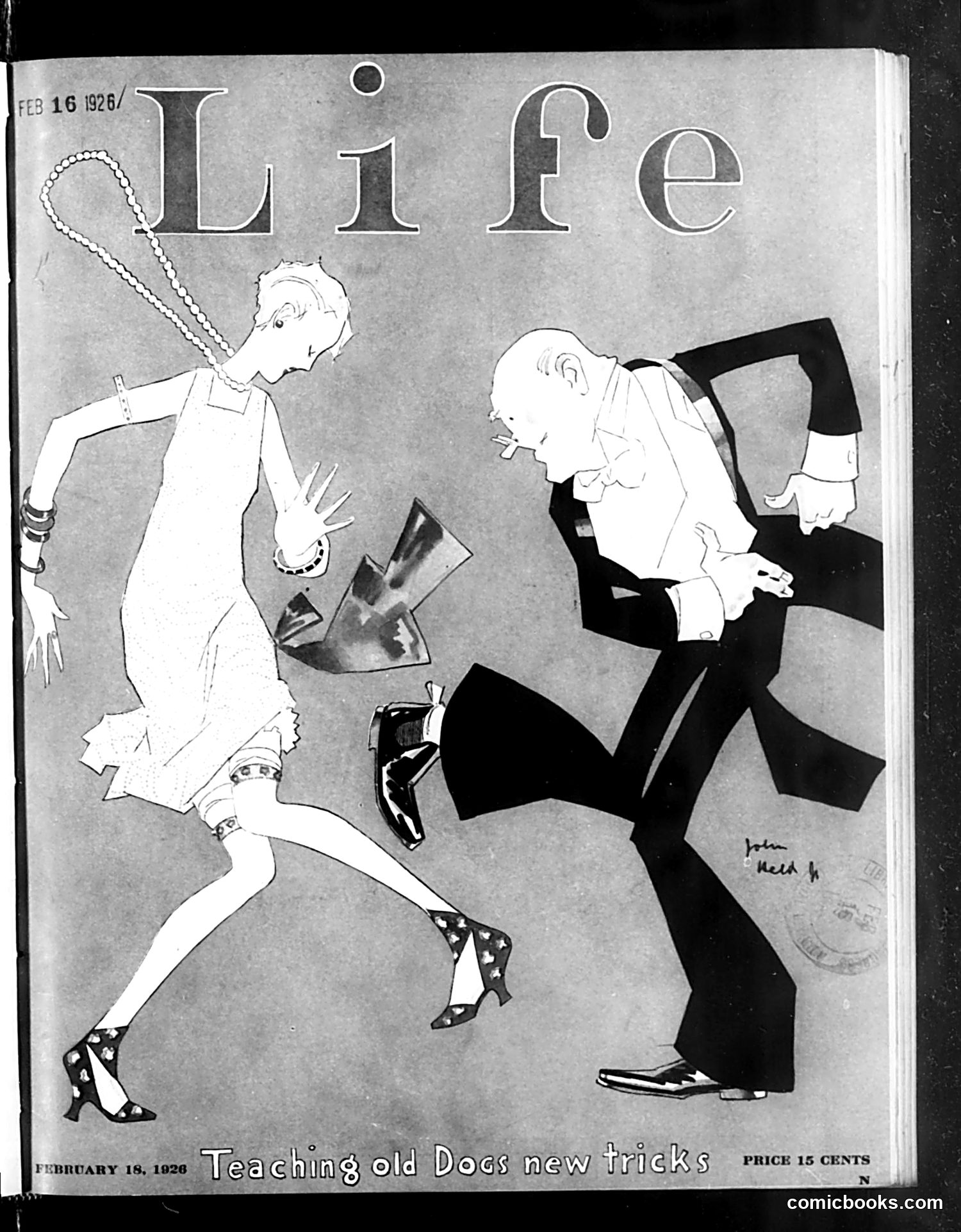
**"Teaching old Dogs new tricks"** This satirical cover depicts a playful domestic scene: a woman in a flapper-style dress (representing modern 1920s youth culture) is leading an older man in formal attire on a leash like a dog. The subtitle "Teaching old Dogs new tricks" is a visual pun on the idiom. The satire likely comments on the generational clash of the Jazz Age—the "old guard" (represented by the formally-dressed man) being dragged into modern social customs by the younger generation. The woman's fashionable bobbed hair, short dress, and confident posture embody the "flapper" movement, symbolizing how youth culture was reshaping American society to the dismay of conservative elders.
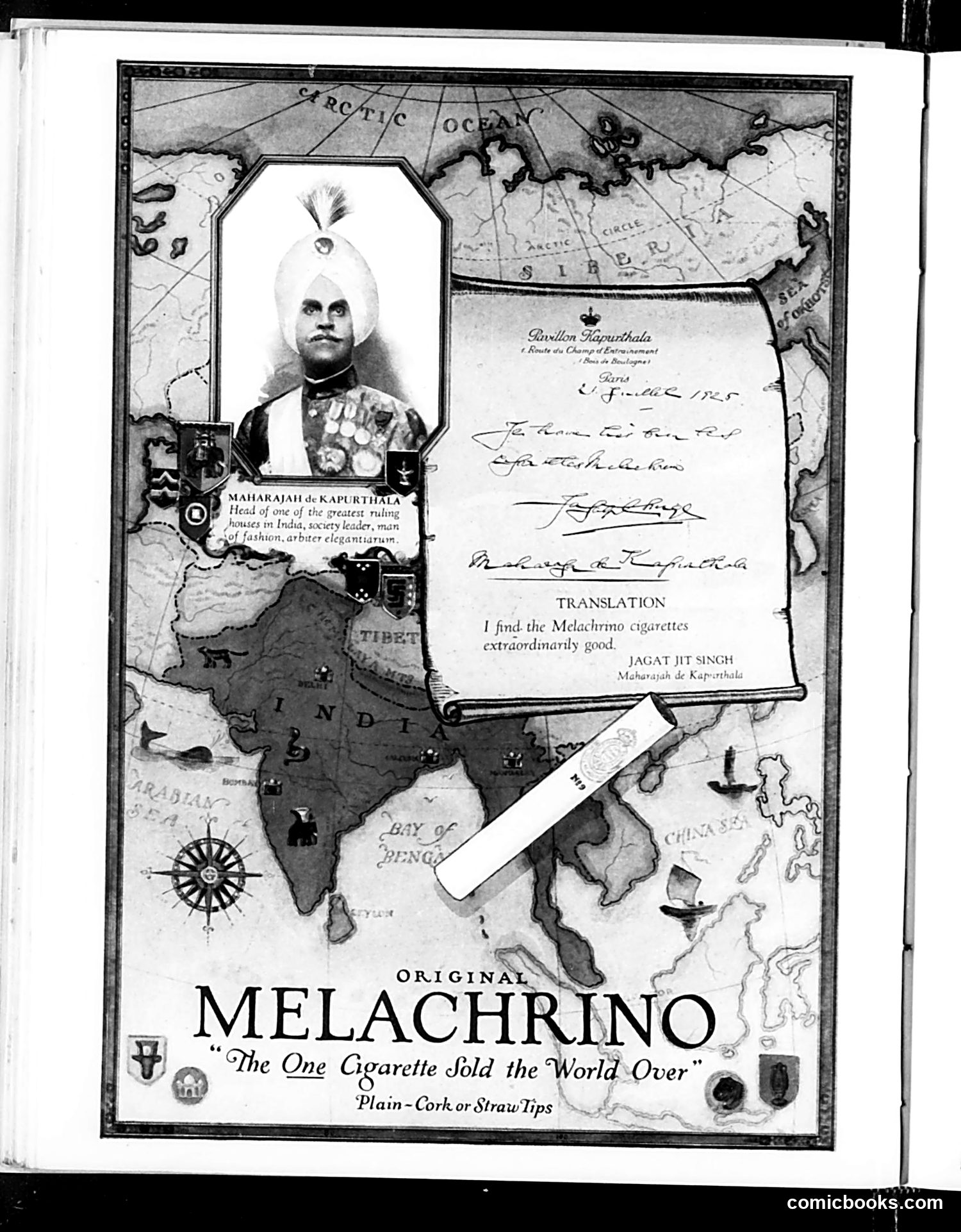
This is primarily a **cigarette advertisement** for Melachrino brand, not political satire. The page features a portrait of **Maharajah of Kapurthala**, identified as "Head of one of the greatest ruling houses in India, society leader, man of fashion, arbiter elegantium." A testimonial (in French, with English translation) attributes the quote "I find the Melachrino cigarettes extraordinarily good" to Jagat Jit Singh, the Maharajah. The advertisement uses the Maharajah's prestigious social status and refined taste to market cigarettes as a luxury product. The map of India in the background reinforces the exotic, aristocratic appeal. This reflects early 20th-century advertising strategies that leveraged celebrity endorsements and associations with wealth and sophistication to sell consumer goods.
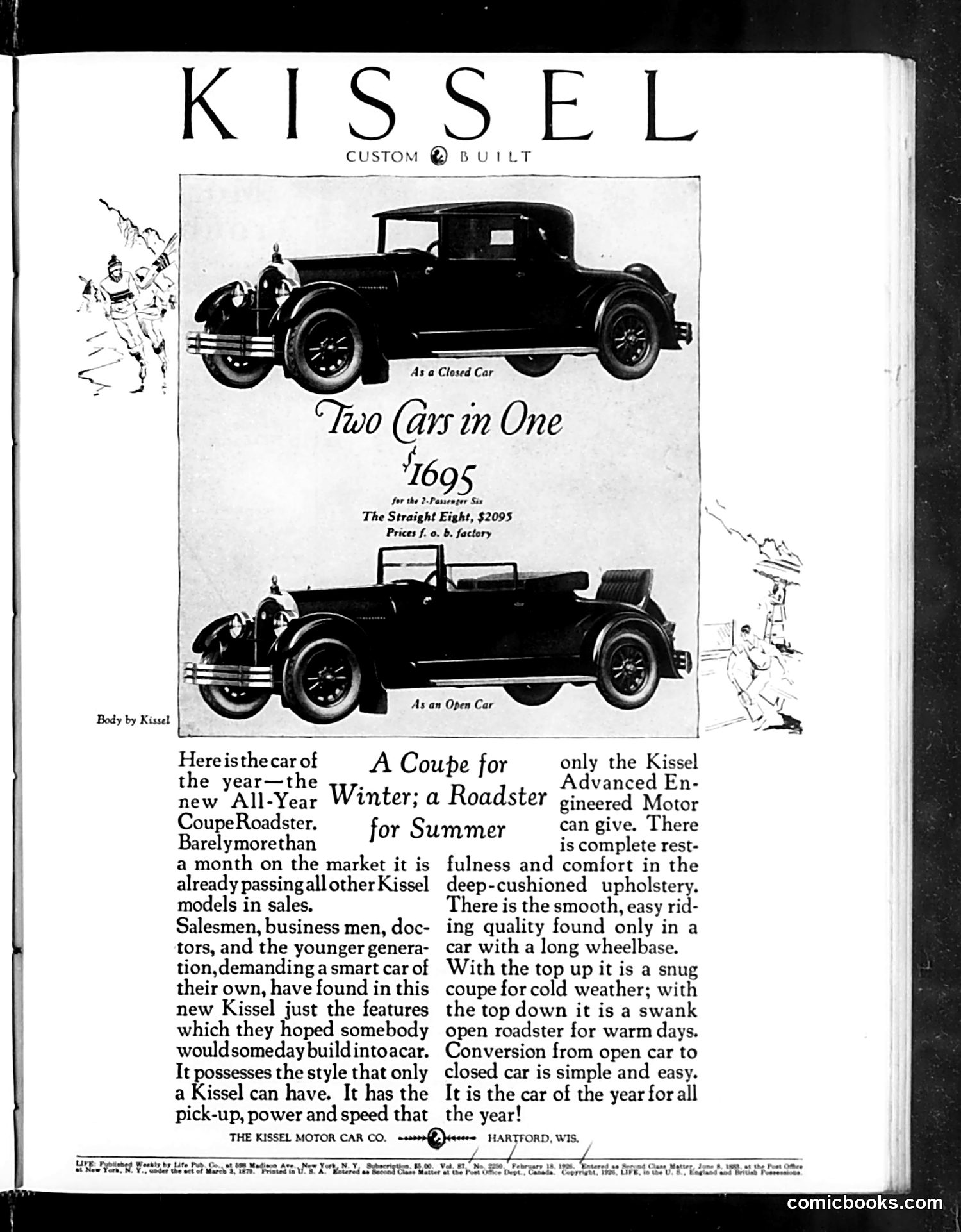
This page is **primarily an advertisement**, not satire or political commentary. It promotes the Kissel automobile, specifically their "Two Cars in One" model (priced at $1,695 for the closed coupe version, $2,095 for "The Straight Eight"). The small illustrated figures flanking the vehicle images appear to be generic decorative elements common in 1920s advertising—they don't represent specific political figures or satirize identifiable people. The advertisement's actual "hook" is practical rather than comedic: the car converts between a closed coupe for winter and an open roadster for summer. The copy emphasizes comfort, ease of conversion, and versatility—standard automotive marketing appeals of the era. This is a straightforward product advertisement, not satirical content.
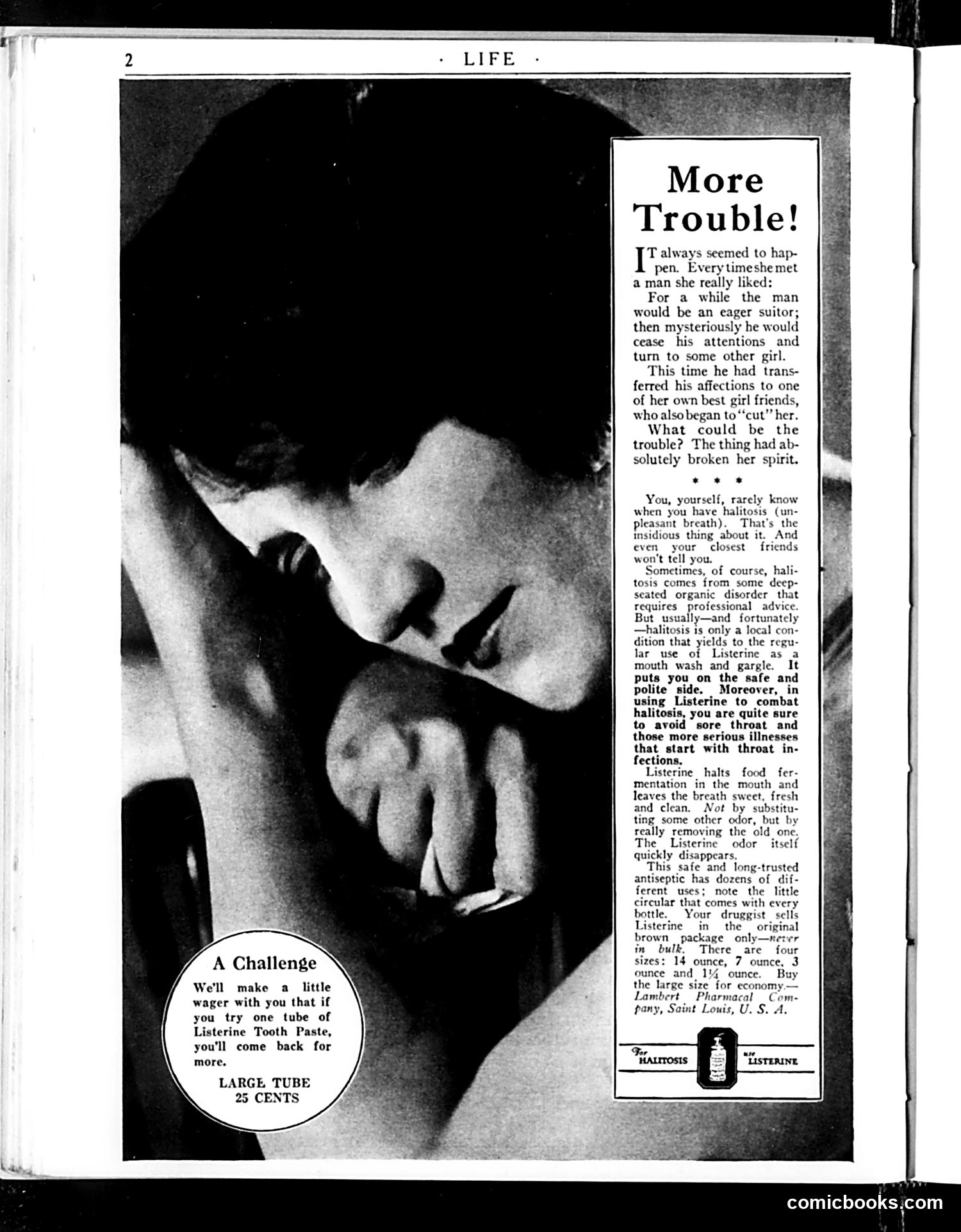
This page is primarily **advertising, not satire or editorial content**. The large photograph shows a woman's distressed face, accompanying a story titled "More Trouble!" about romantic disappointment—a man transferring his attentions to her friend, which "utterly broken her spirit." The ad below uses this emotional context to sell **Listerine Tooth Paste and mouthwash**, suggesting that halitosis (bad breath) might be the hidden reason for the woman's romantic troubles. The accompanying circular "challenge" offers a large tube for 25 cents, gambling that users will become repeat customers. This is typical early-20th-century advertising: exploiting social anxieties (especially women's romantic insecurities) to market personal hygiene products. The connection between bad breath and failed relationships is entirely manufactured marketing psychology.
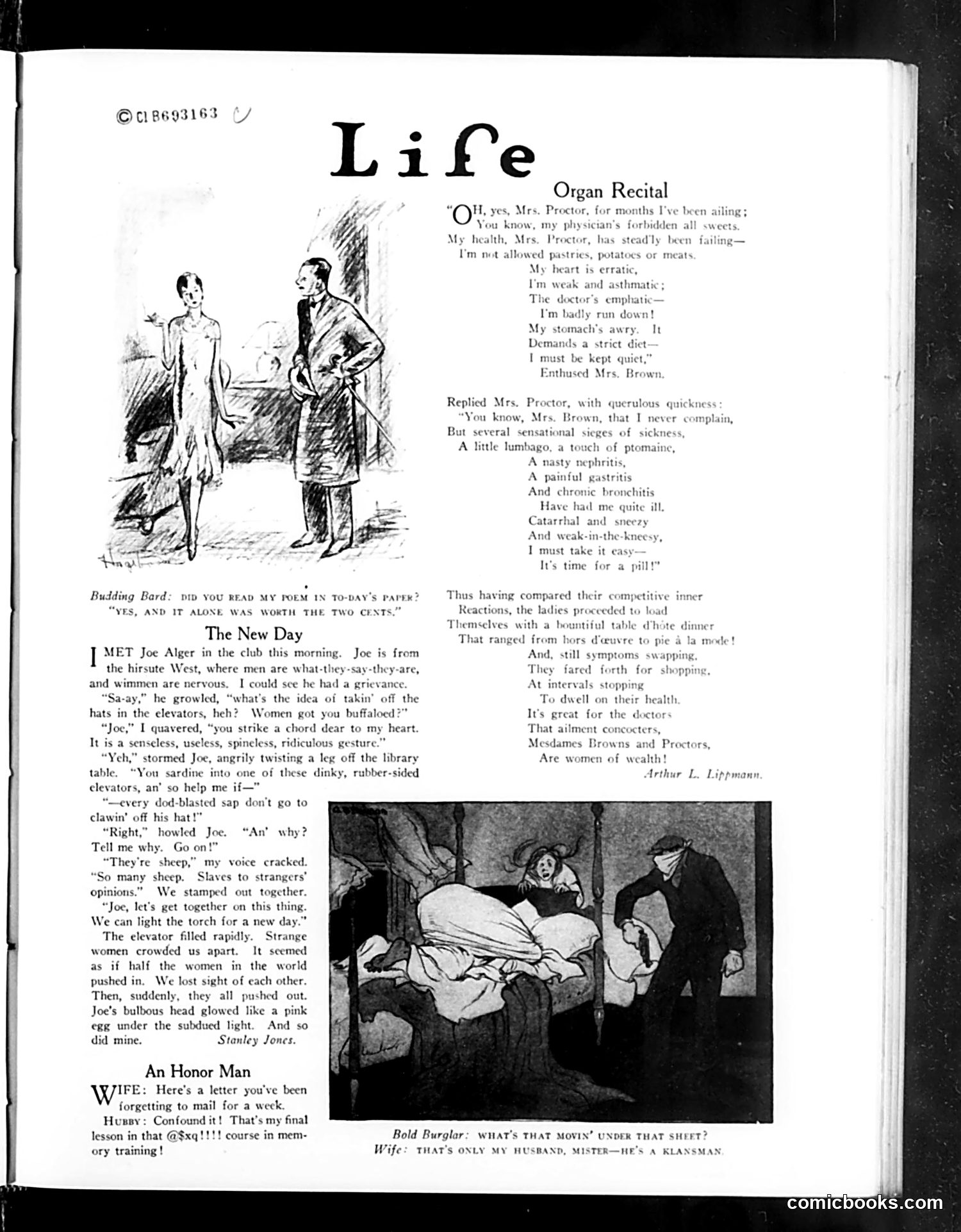
This page contains three separate pieces of social satire typical of early 20th-century Life magazine: 1. **"Life - Organ Recital"**: A poem mocking wealthy women (Mrs. Proctor and Mrs. Brown) who constantly complain about minor ailments—digestive issues, fatigue, various medical complaints—while discussing their privileged lifestyle. The satire targets hypochondria among the leisure class. 2. **"The New Day"**: A story by Stanley Jones about Joe Alger, depicting labor/working-class agitation. Joe uses elevator metaphors to discuss social consciousness and collective action ("light the torch for a new day"), suggesting early 20th-century labor organizing sentiment. 3. **"An Honor Man"**: A brief domestic humor piece about a husband's "final lesson in memory training"—forgetting to mail his wife's letter. All reflect Life's satirical focus on class dynamics and social behavior.
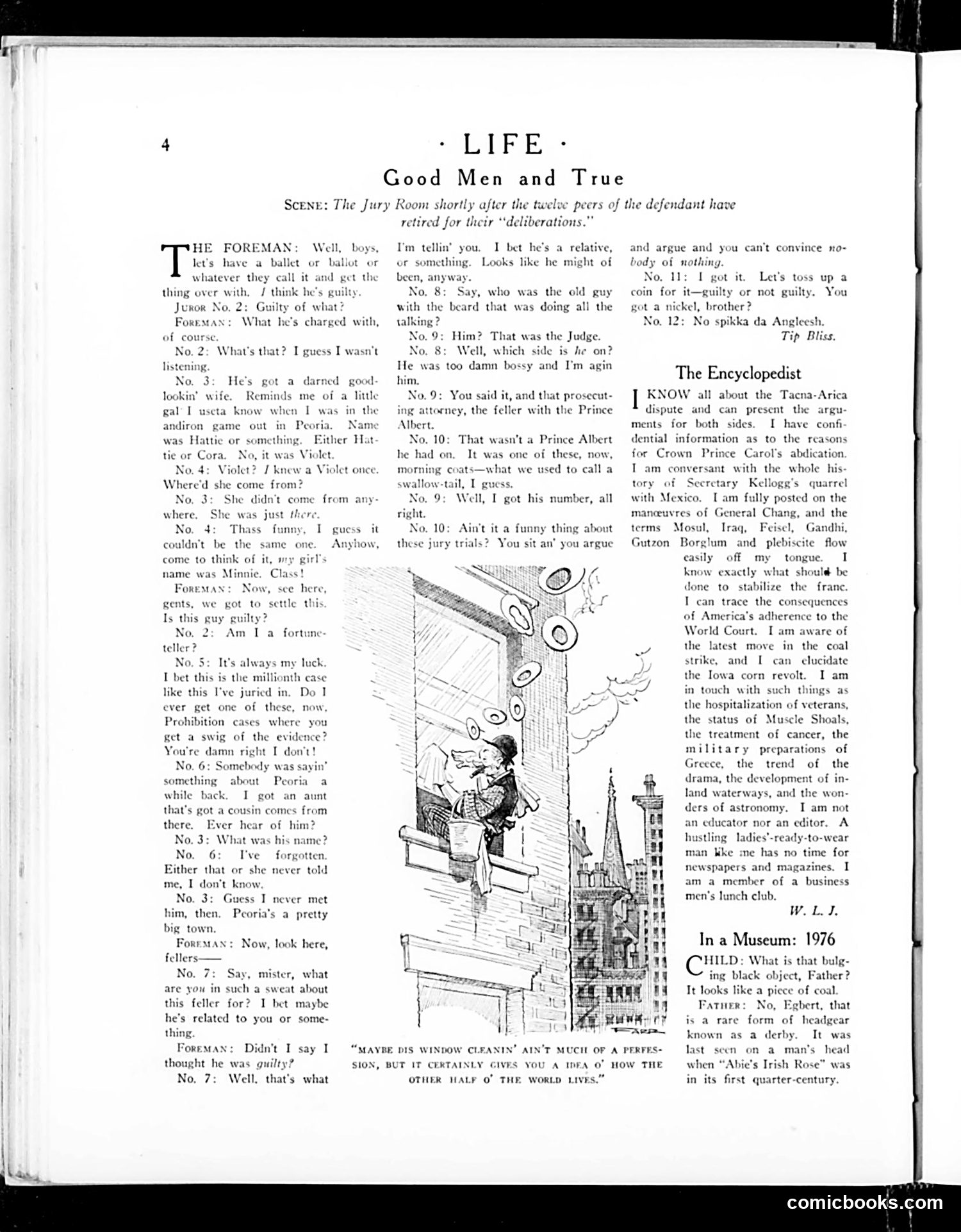
This page contains a comedic jury-room scene titled "Good Men and True," depicting twelve jurors deliberating after a defendant's acquittal. The humor derives from jurors discussing why they voted "not guilty"—each offers absurd, contradictory, or irrelevant reasons (a relative who "might of been" involved, a wife who reminds them of someone, a fortune-teller's prediction, etc.) rather than actual evidence. The accompanying illustration shows a juror peering out a window at a cityscape, with the caption suggesting his distraction: "Maybe his window cleanin' ain't much of a profession, but it certainly gives you a idea of how the other half o' the world lives." The satire mocks jury incompetence and the arbitrary nature of legal verdicts, suggesting jurors' decisions reflect personal bias and distraction rather than rational judgment.
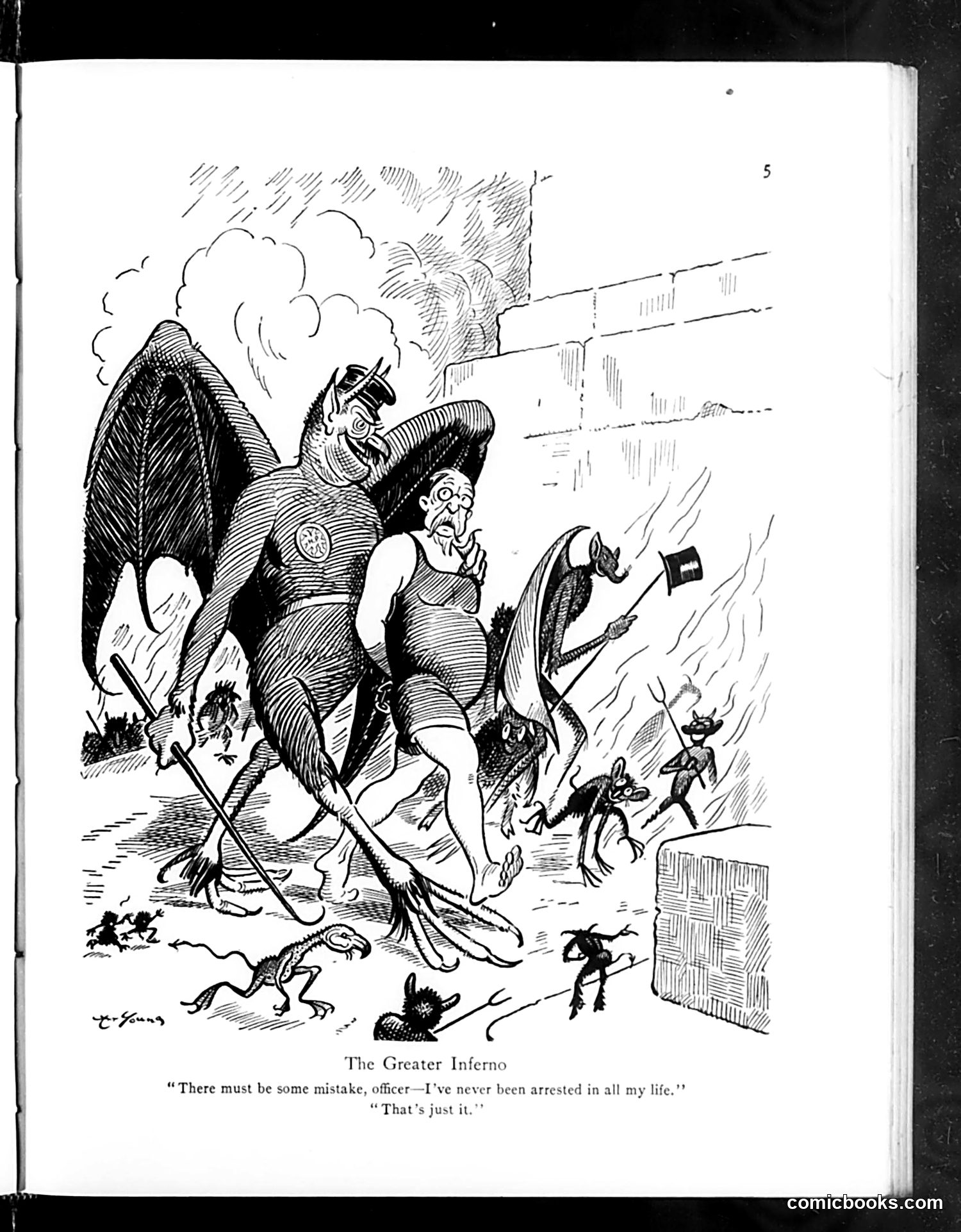
This political cartoon depicts demonic or infernal figures escorting smaller human characters into what appears to be Hell or damnation. The title references Dante's *Inferno*, using it as metaphor for a terrible fate. The caption presents a dialogue: an officer arrests someone who claims, "I've never been arrested in all my life," to which the response is "That's just it"—suggesting the arrested person's lack of criminal record makes this arrest particularly unjust or ironic. The cartoon likely satirizes wrongful arrest or miscarriage of justice, with the infernal imagery suggesting that even an innocent person can be dragged into Hell by corrupt authorities. The specific historical context remains unclear without additional publication information.
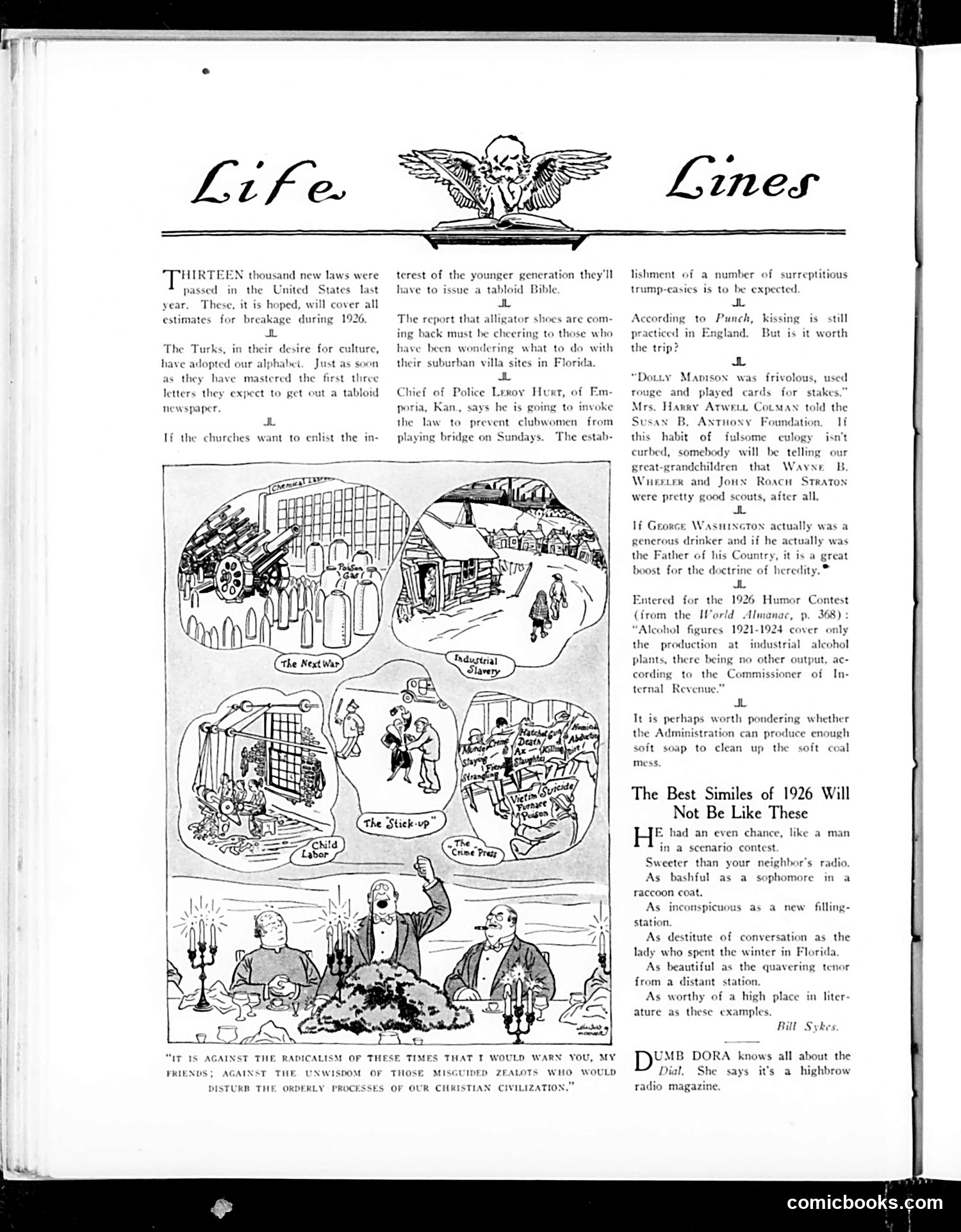
This page from *Life* magazine contains social satire about 1920s American culture. The upper cartoon sequence depicts industrial and domestic labor scenarios labeled "The First War," "Industrial Slavery," "The Stick-up," "Child Labor," and "The Cracker Trust"—satirizing workplace exploitation and economic inequality during the era. The lower cartoon shows three men in formal dress around a campfire, with a caption criticizing "the radicalism of these times" and warning against those who would "disturb the orderly progress of our Christian civilization." This appears to mock conservative fears of social change and radicalism. The text pieces discuss 1926 laws, alligator shoes, and includes a section titled "The Best Similes of 1926 Will Not Be Like These" offering humorous comparisons. Overall, the page satirizes both labor conditions and conservative anxieties about modernity.
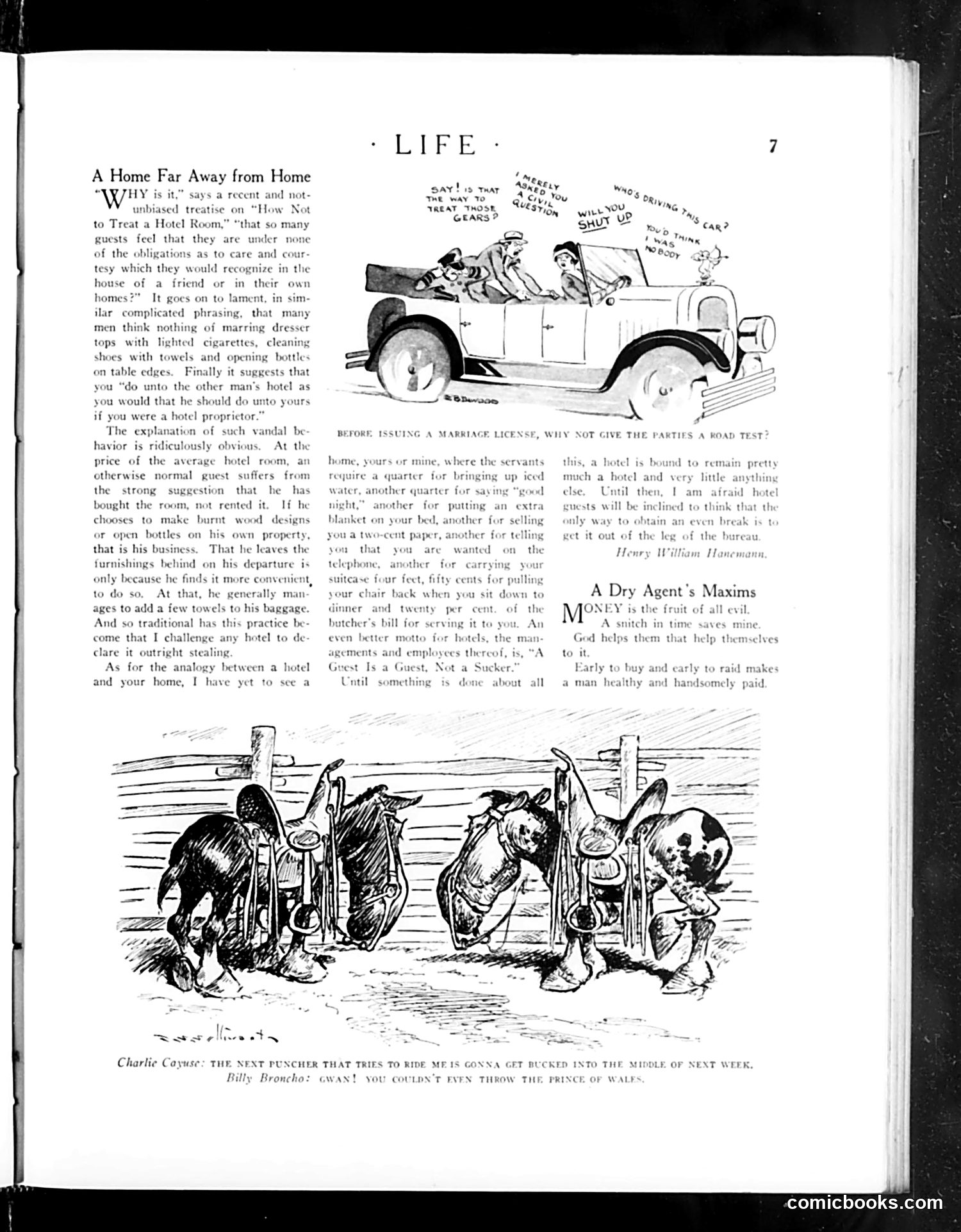
**Top Cartoon**: Depicts reckless automobile passengers throwing items and causing chaos while driving. The caption asks why hotels shouldn't give drivers a "road test" before issuing marriage licenses—a satirical suggestion that bad driving behavior correlates with poor character unsuitable for marriage. This reflects early 20th-century anxieties about automobiles as symbols of recklessness and moral decay. **Bottom Cartoon**: Shows horses tied to a hitching post, with a caption crediting "Charlie Coyote" and "Billy Broncho," likely anthropomorphized characters. The joke appears to reference riding/bucking behavior, though the exact reference is unclear without additional context about these recurring characters in Life magazine.
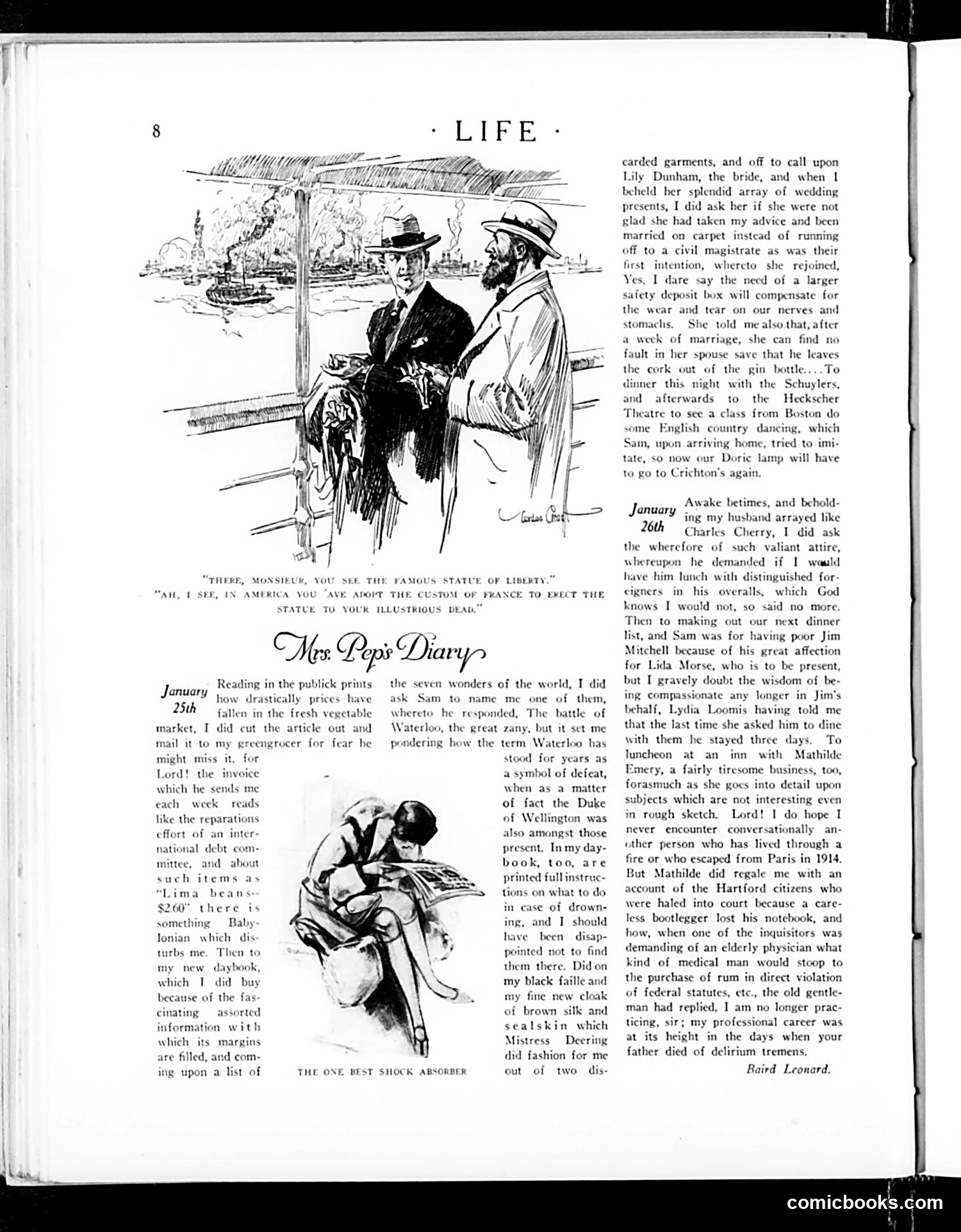
This page contains two distinct sections: an editorial cartoon and a diary entry ("Mrs. Pop's Diary"). **The Cartoon** depicts two men at what appears to be a harbor or waterfront. The caption reads: "There, Monsieur, you see the famous statue of liberty... Ah, I see, in America you have about the custom of France to erect the statue to your illustrious dead." The joke satirizes American attitudes toward French monuments and customs. A Frenchman apparently mistakes the Statue of Liberty for a memorial to the dead, rather than understanding it as a symbol of freedom. This mocks both French perspectives and American self-regard regarding the statue's significance. **Mrs. Pop's Diary** is a gossip column reporting on society weddings, theater visits, and social observations—typical society-page content of the era.
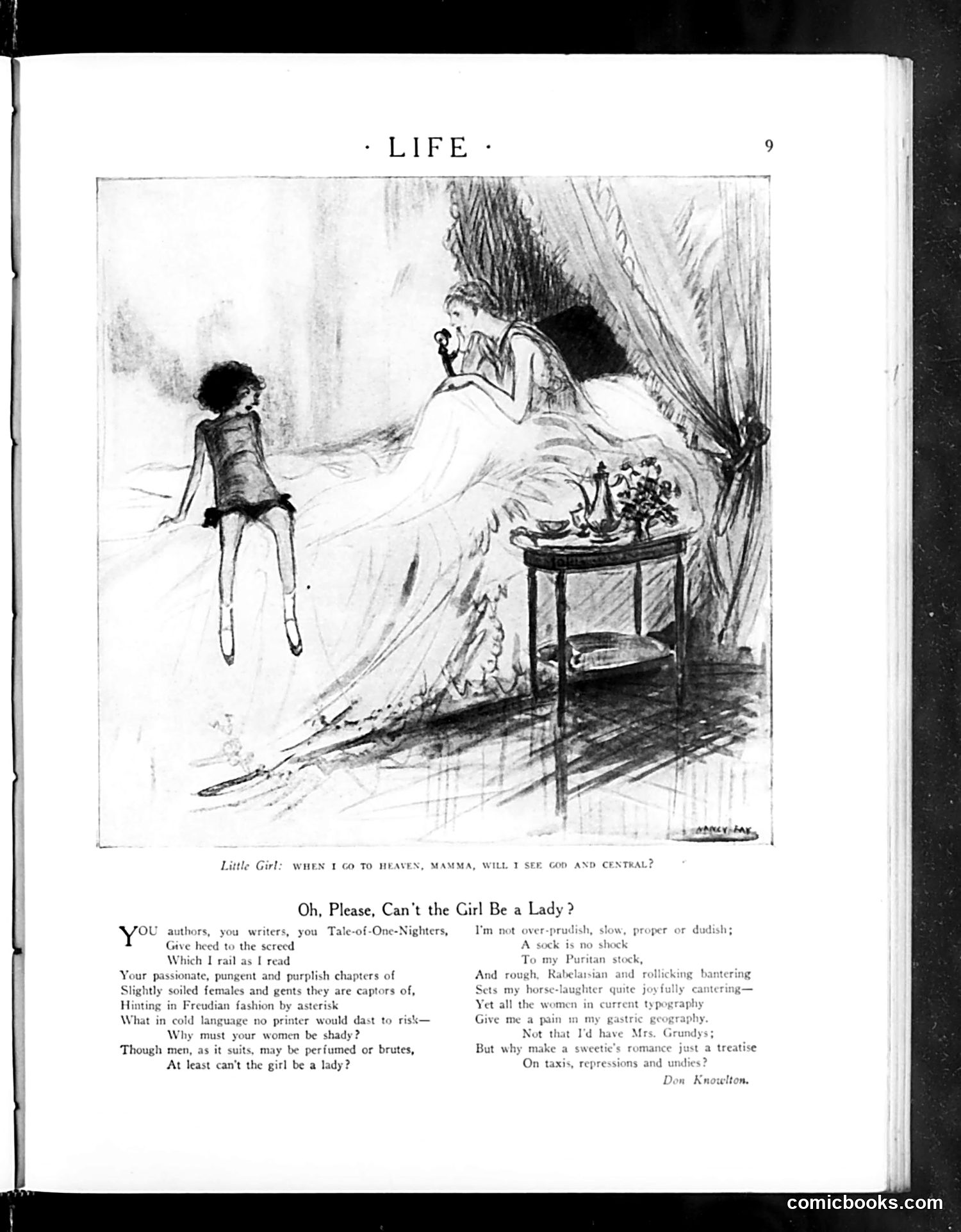
This satirical poem by Don Knowlton critiques literary conventions of the era regarding female characters. The accompanying sketch shows a young girl confronting a fashionably dressed woman in what appears to be a bedroom scene. Knowlton argues that authors habitually portray women as either "shady" or brutish extremes, lacking nuance. He pleads for female characters with dignity—"proper" behavior—rather than caricatures. The poem's refrain challenges writers to depict women as ladies deserving of respect. The satire targets how contemporary literature reduced women to stereotypes: either morally compromised or crude. Knowlton advocates for more complex, respectable female representation in fiction, reflecting emerging debates about women's dignity and more sophisticated characterization in early-20th-century writing.
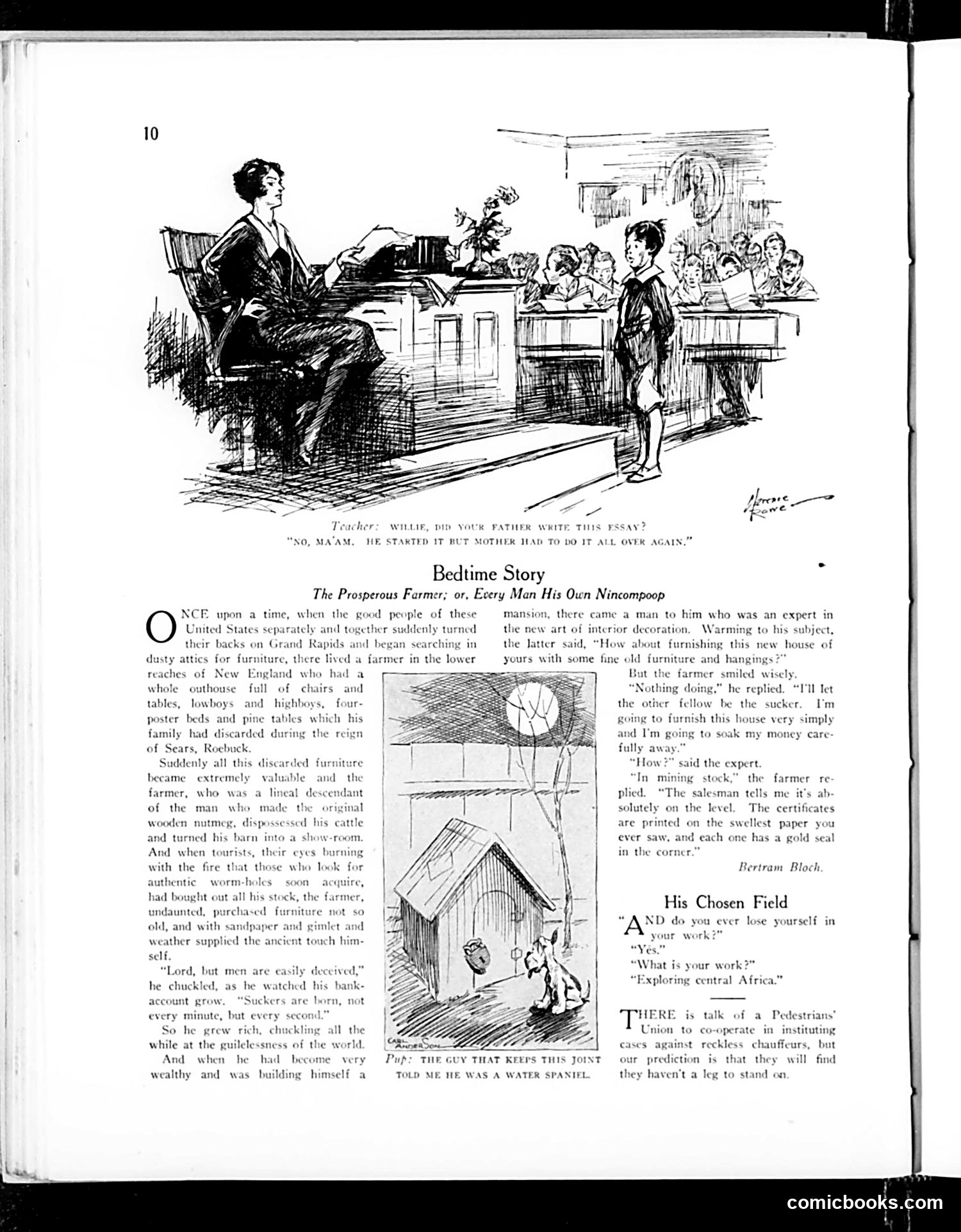
**Top Cartoon:** A classroom scene where a teacher questions a student ("Willie") about an essay. The boy admits his father started it but "mother had to do it all over again." This satirizes parents doing children's homework—a domestic comedy about parental over-involvement in education. **"Bedtime Story" Section:** A longer satirical tale about a farmer who became wealthy by furnishing his house with mismatched, discarded furniture from Grand Rapids, then selling it as "authentic" antiques. The joke mocks both consumer gullibility regarding "genuine" period furniture and the deceptive sales practices of the era. **"His Chosen Field":** A brief humorous exchange about someone's career in "exploring central Africa," likely poking fun at romantic notions of African exploration popular in early 20th-century America.
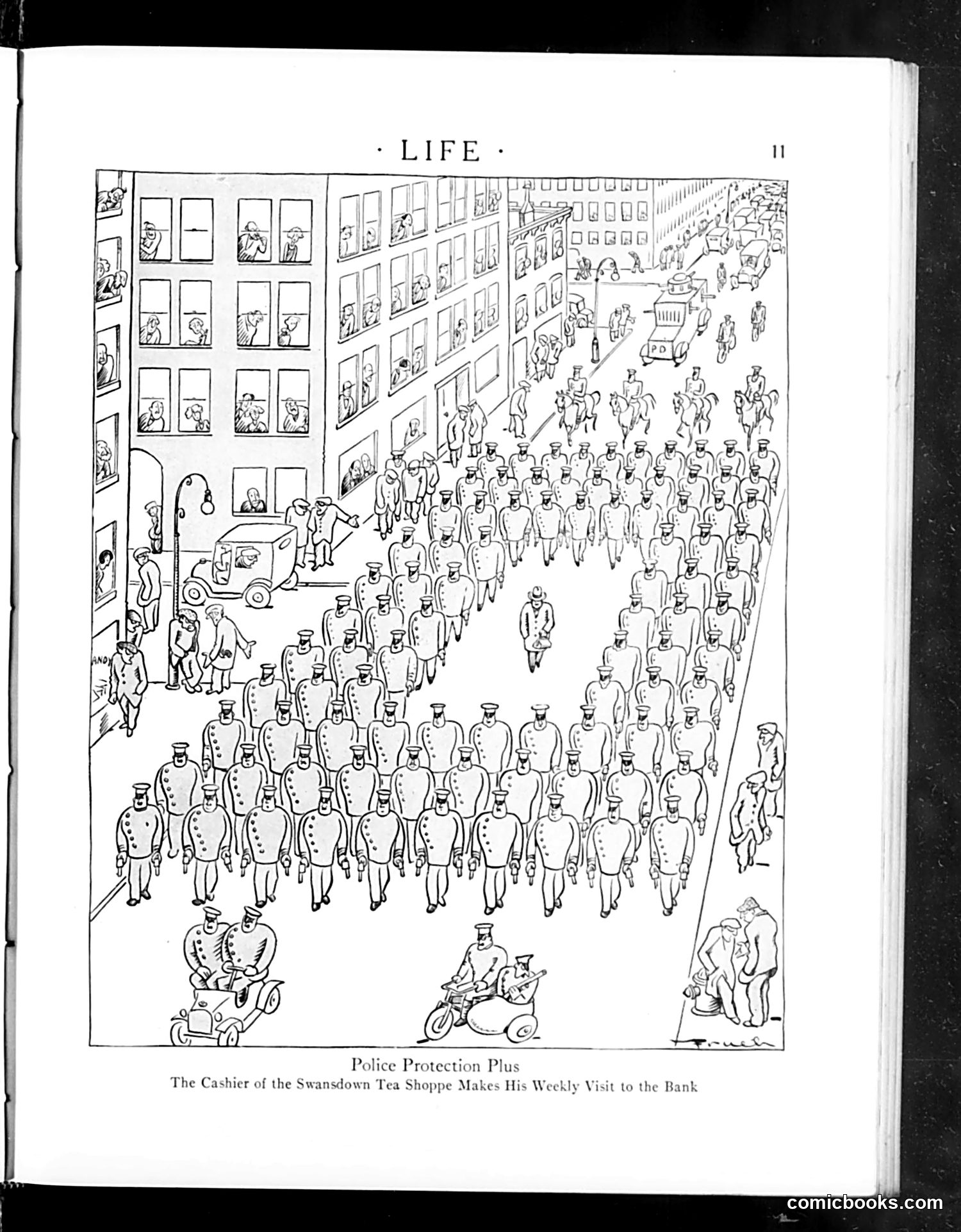
This cartoon satirizes excessive police protection for wealthy individuals. The title indicates "The Cashier of the Swansdown Tea Shoppe Makes His Weekly Visit to the Bank." The image shows a single well-dressed figure (the tea shop cashier) walking through a city street accompanied by an enormous contingent of uniformed police officers—dozens filling the entire street in formation. The satire targets the absurdity of disproportionate security: a minor business employee receives police protection befitting a head of state or major dignitary. This likely critiques either actual corruption (police protecting specific individuals inappropriately) or class privilege—suggesting the wealthy receive excessive public resources while ordinary citizens do not. The "Plus" in the title emphasizes that this protection exceeds any reasonable necessity.
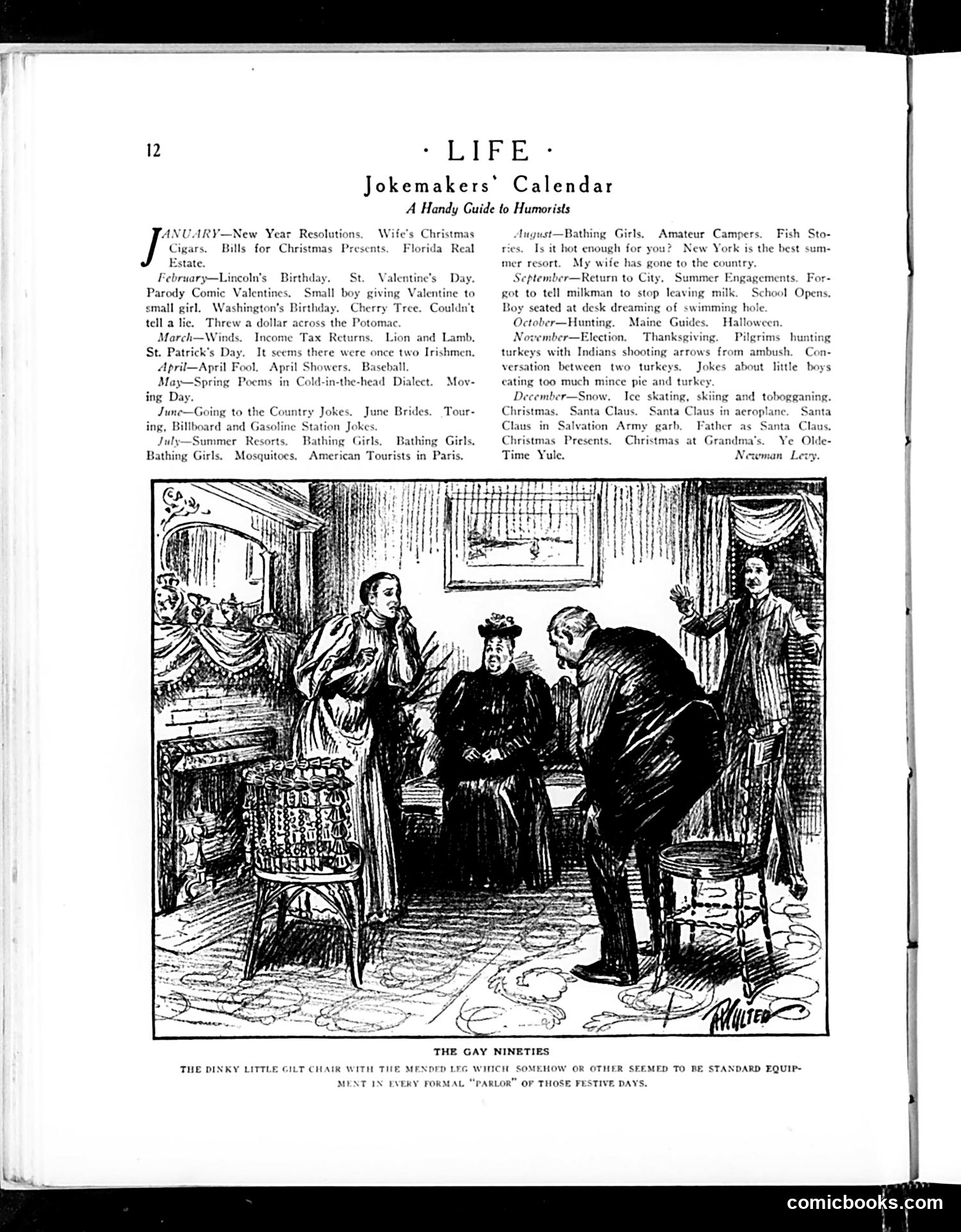
This cartoon illustrates a Victorian-era parlor scene titled "THE GAY NINETIES," depicting well-dressed figures in a formal interior with a fireplace. The caption references "THE RISKY LITTLE GILT CHAIR WITH THE MENDED LEG WHICH SOMEHOW OR OTHER SEEMED TO BE STANDARD EQUIPMENT IN EVERY FORMAL 'PARLOR' OF THOSE FESTIVE DAYS." The humor appears satirical: despite the upper-class setting and refined clothing, the joke centers on a broken, repaired chair—suggesting a gap between Victorian pretension and modest reality. This mocks the 1890s' reputation for propriety while hinting at economic constraints or decay beneath fashionable appearances. The "risky" chair implies physical peril, possibly with risqué implications typical of Life magazine's humor.
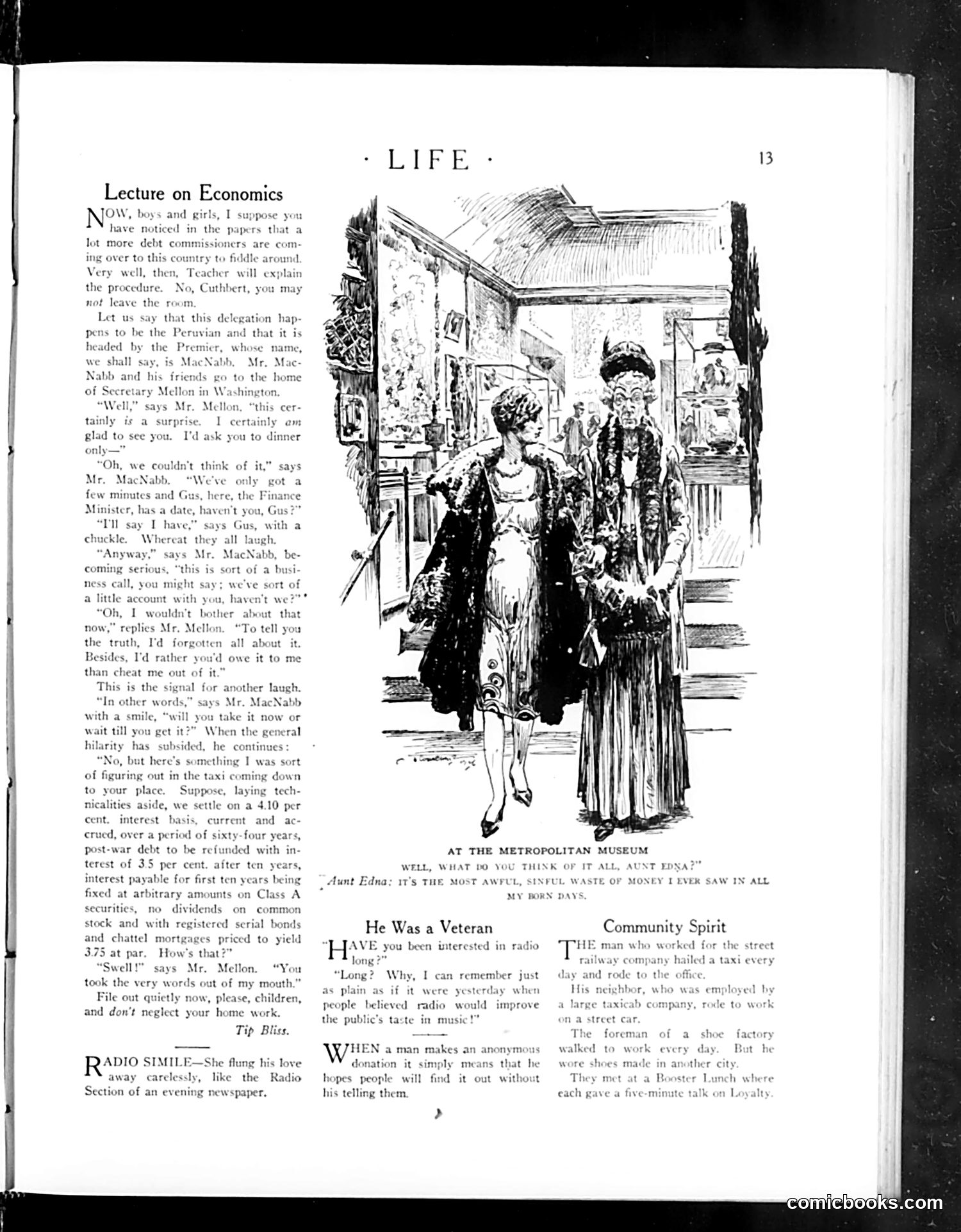
This page satirizes post-World War I economic policy through a dialogue between politicians discussing debt repayment. The cartoon shows figures at the Metropolitan Museum, with the caption "Well, what do you think of it all, Aunt Edna? It's the most awful, sinful waste of money I ever saw in all my born days." The humor juxtaposes complaints about wasteful government spending (likely federal debt obligations) against cultural spending. The "Lecture on Economics" section features Mr. MacNabb and others debating whether to settle post-war debt on a 4.10 percent interest basis over sixty years—reflecting genuine 1920s fiscal debates about managing war debt repayment. The page criticizes political hypocrisy: politicians denouncing waste while discussing complex financial instruments ordinary citizens couldn't understand.
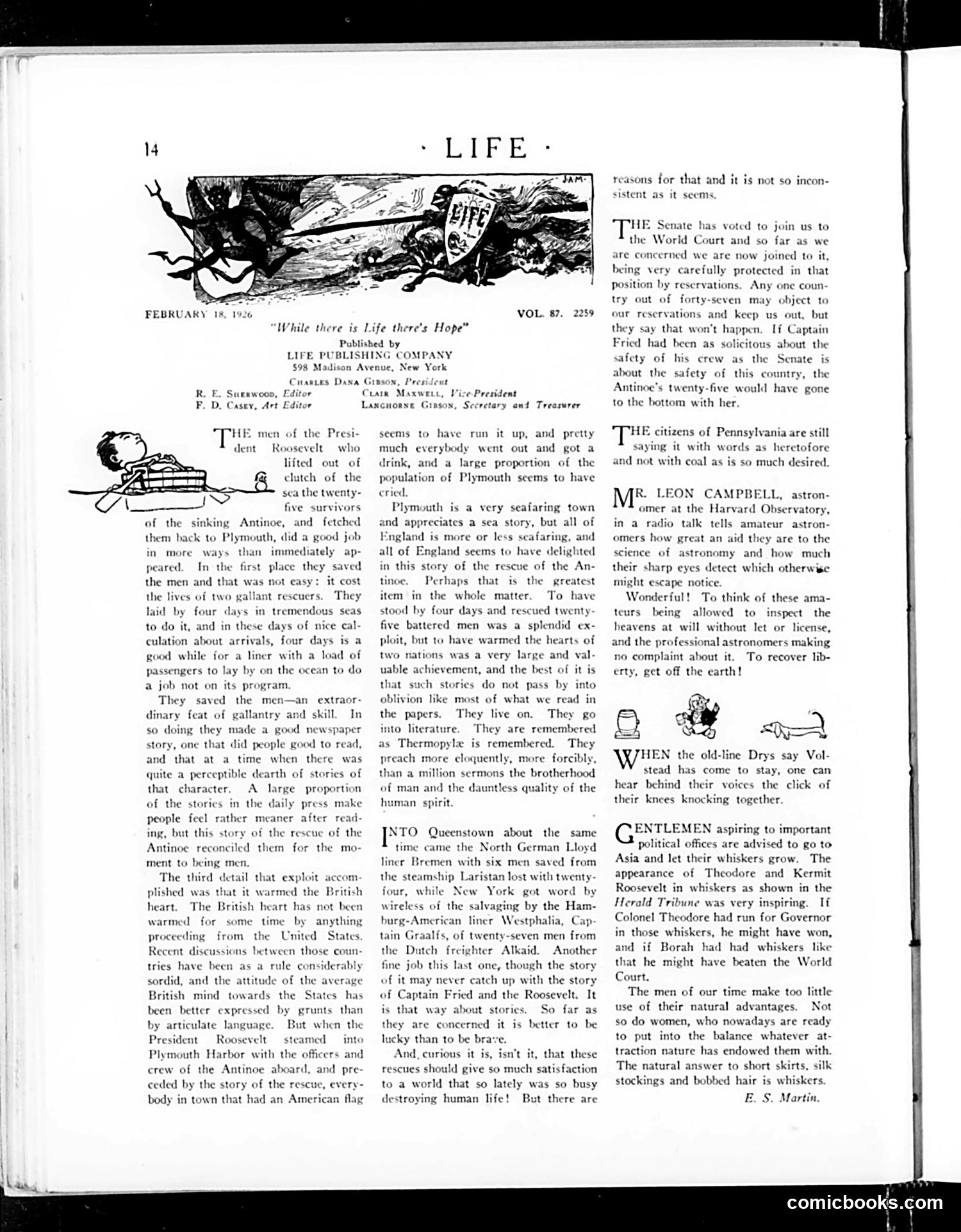
The cartoon at top depicts a skeletal Death figure labeled "LIFE" alongside the caption "While there is Life there's Hope." This is a visual pun playing on the magazine's title—using Death as ironic commentary on current events. The page's editorial content discusses the recent rescue of the *Antinoe* ship and survivors, praising this humanitarian achievement. The text contrasts this with cynicism about human nature, noting that such rescue stories—unlike typical newspaper fare—demonstrate noble human spirit worth remembering. The bottom section critiques politicians, particularly regarding Theodore Roosevelt's whiskers as a campaign asset, satirizing how candidates rely on superficial appearance rather than substantive qualification for office. The overall tone mixes admiration for genuine heroism with skepticism toward political vanity.
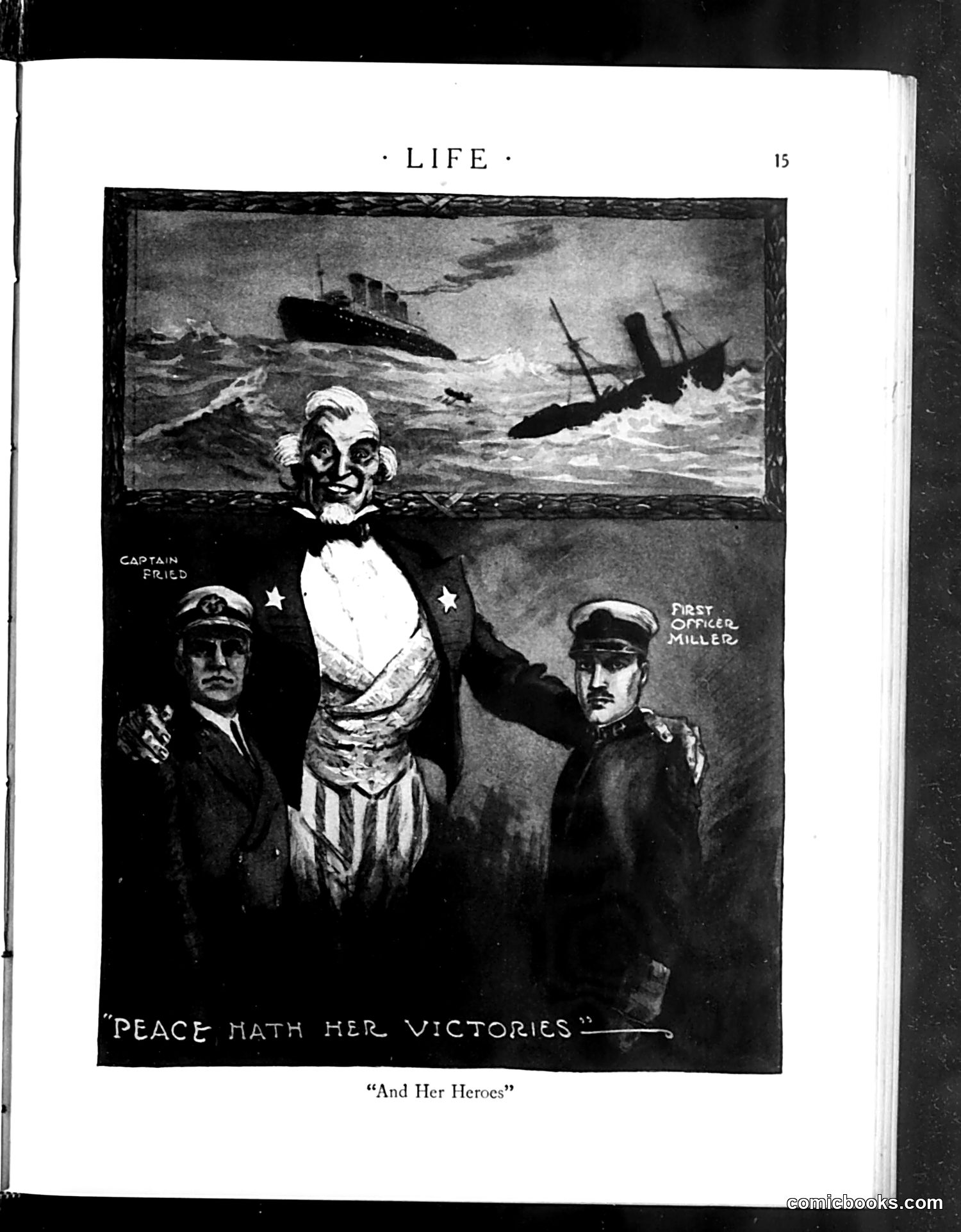
This is a World War I-era satirical illustration titled "And Her Heroes." The image depicts three military figures—labeled Captain Fried (left), an unnamed woman in center wearing a long dress with stars, and First Officer Miller (right)—standing before a backdrop of naval warfare with sinking ships. The caption reads "Peace Hath Her Victories," referencing military triumph. The central female figure appears to represent either "Peace" personified or possibly Germany (often depicted as female in propaganda). The satire seems to mock either German military leadership or to celebrate Allied naval victories over German forces, presenting the three figures as responsible for wartime outcomes. The drowning ships in the background underscore the destructive human cost of naval warfare.
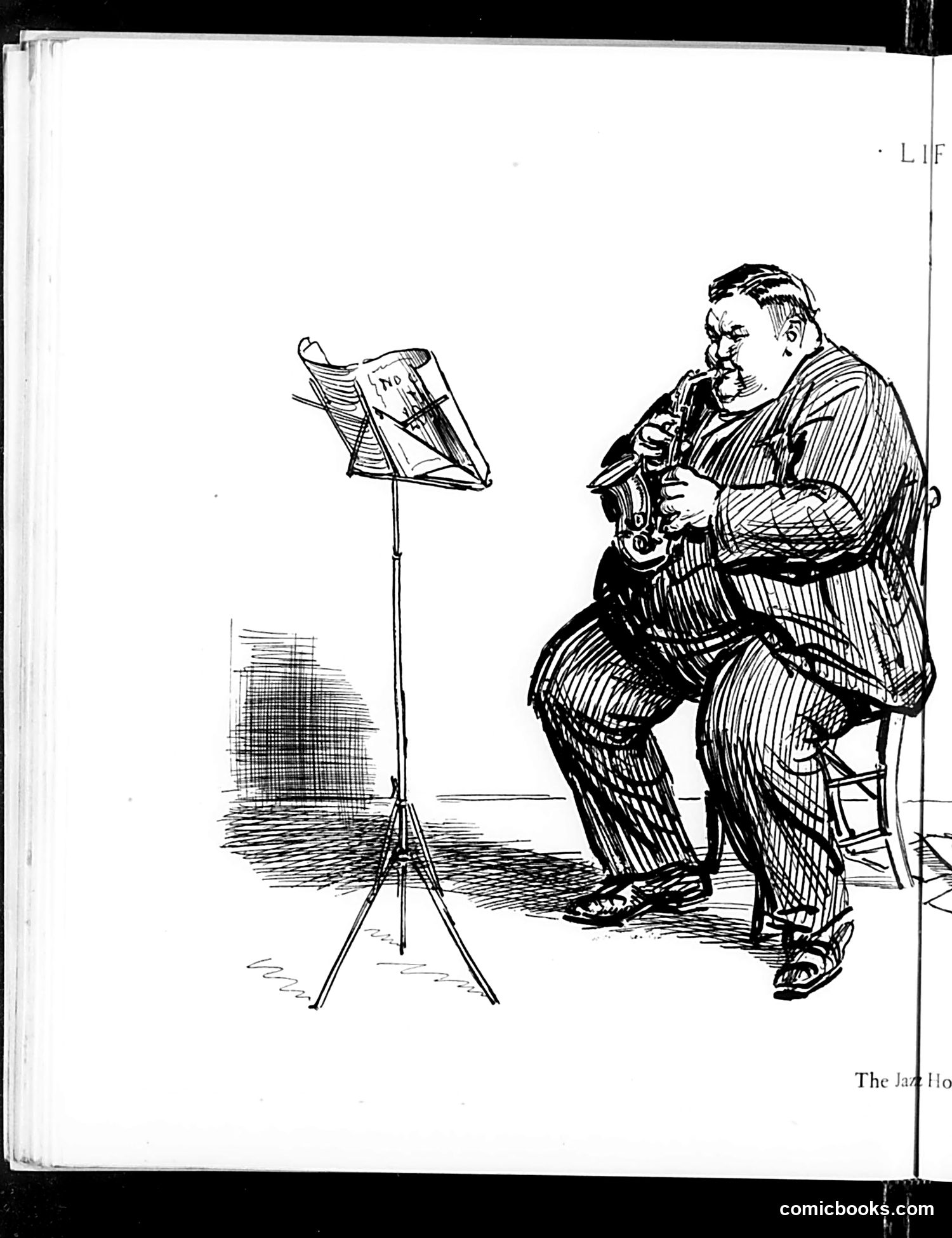
This appears to be a satirical cartoon from *Life* magazine showing a portly man in a striped suit playing a saxophone while reading sheet music on a stand. The caption reads "The Jazz Ho[t]" (likely "The Jazz Hot"). The satire targets early 20th-century jazz culture and amateur musicians. The man's exaggerated physical appearance—heavyset, earnest expression—suggests he's a wealthy or middle-class amateur attempting to play jazz, a genre then associated with African American culture and lower-class entertainment. The joke likely mocks how affluent people were adopting jazz as fashionable while lacking genuine musical skill or cultural understanding. His reliance on sheet music emphasizes his incompetence—authentic jazz musicians improvised rather than read notation. This reflects period tension between "highbrow" society adopting trendy "lowbrow" art forms superficially.
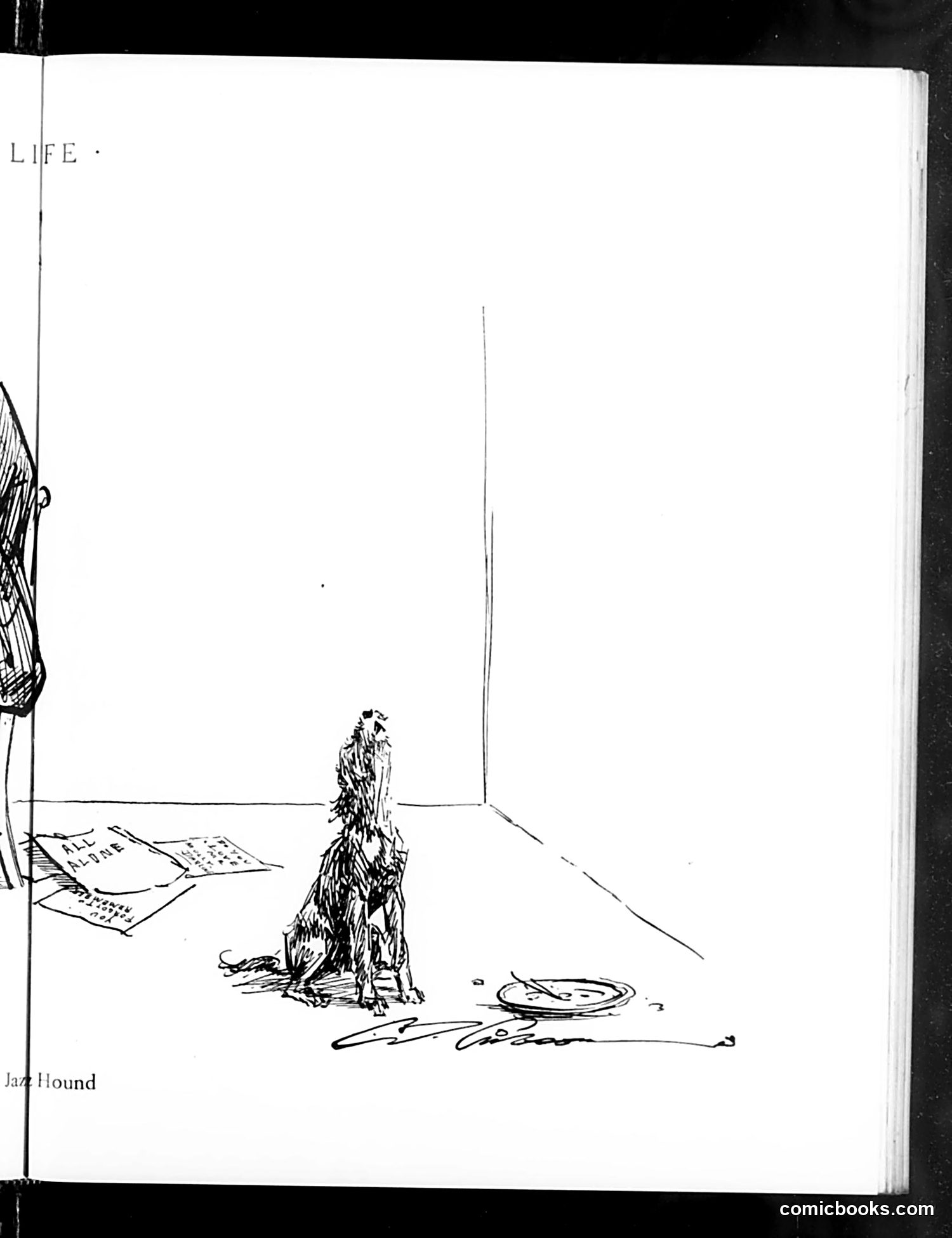
This page from *Life* magazine features a single ink illustration titled "Jam Hound" (visible at bottom left). The drawing shows a scraggly dog sitting in what appears to be a sparse, empty room with minimal furnishings and scattered papers on the floor. There's a simple plate or dish nearby. The dog's disheveled appearance and the barren surroundings suggest poverty or deprivation. The cartoon likely satirizes economic hardship, possibly referencing Depression-era conditions when *Life* was active. The title "Jam Hound" appears to play on the phrase "jam" (difficult circumstances) combined with the dog's hungry or desperate state. The scattered papers may reference failed financial documents or unpaid bills, reinforcing themes of economic struggle.
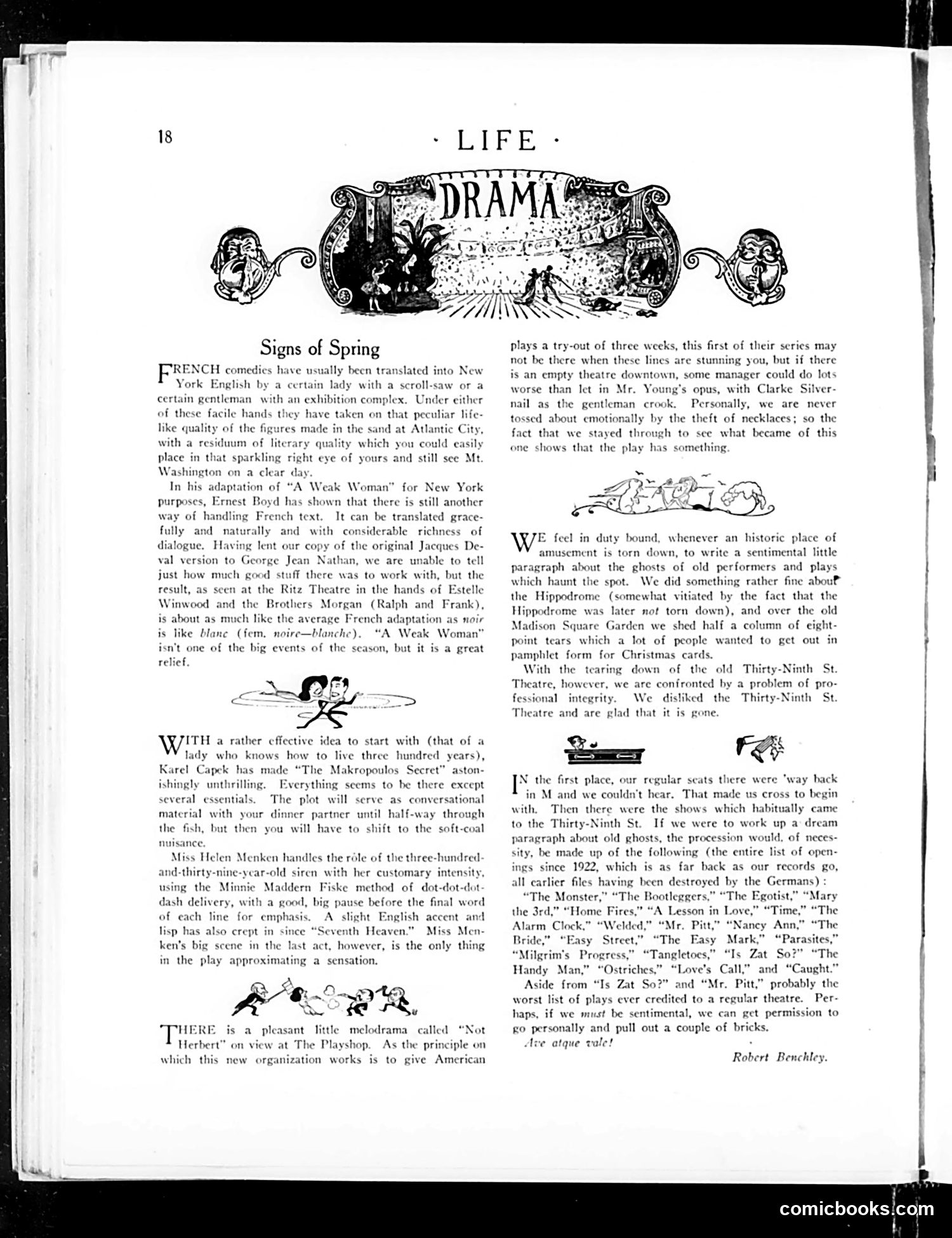
This page reviews three theatrical productions opening in New York, written in the sardonic style typical of Life magazine's drama criticism. **"A Weak Woman"** at the Ritz Theatre—a French comedy adapted by Ernest Boyd—receives backhanded praise. The critic acknowledges Boyd's skillful translation but finds the production, featuring actresses Estelle Winwood and the Morgan brothers, disappointingly flat compared to the original French wit. **"The Makropulos Secret"** by Karel Čapek features Helen Menken as a 339-year-old woman. The critic mocks both the play's thin plot and Menken's affected acting style—her overwrought delivery with strategic pauses and affected English accent. **"Not Herbert"** at The Playshop is praised as entertainingly competent melodrama, though the critic admits emotional indifference to its plot about stolen necklaces. The piece concludes with sentimental nostalgia for the recently demolished Thirty-Ninth Street Theatre, while wryly noting the critic's conflicted duty to memorialize defunct venues—a gentle satire on theatrical sentimentality.
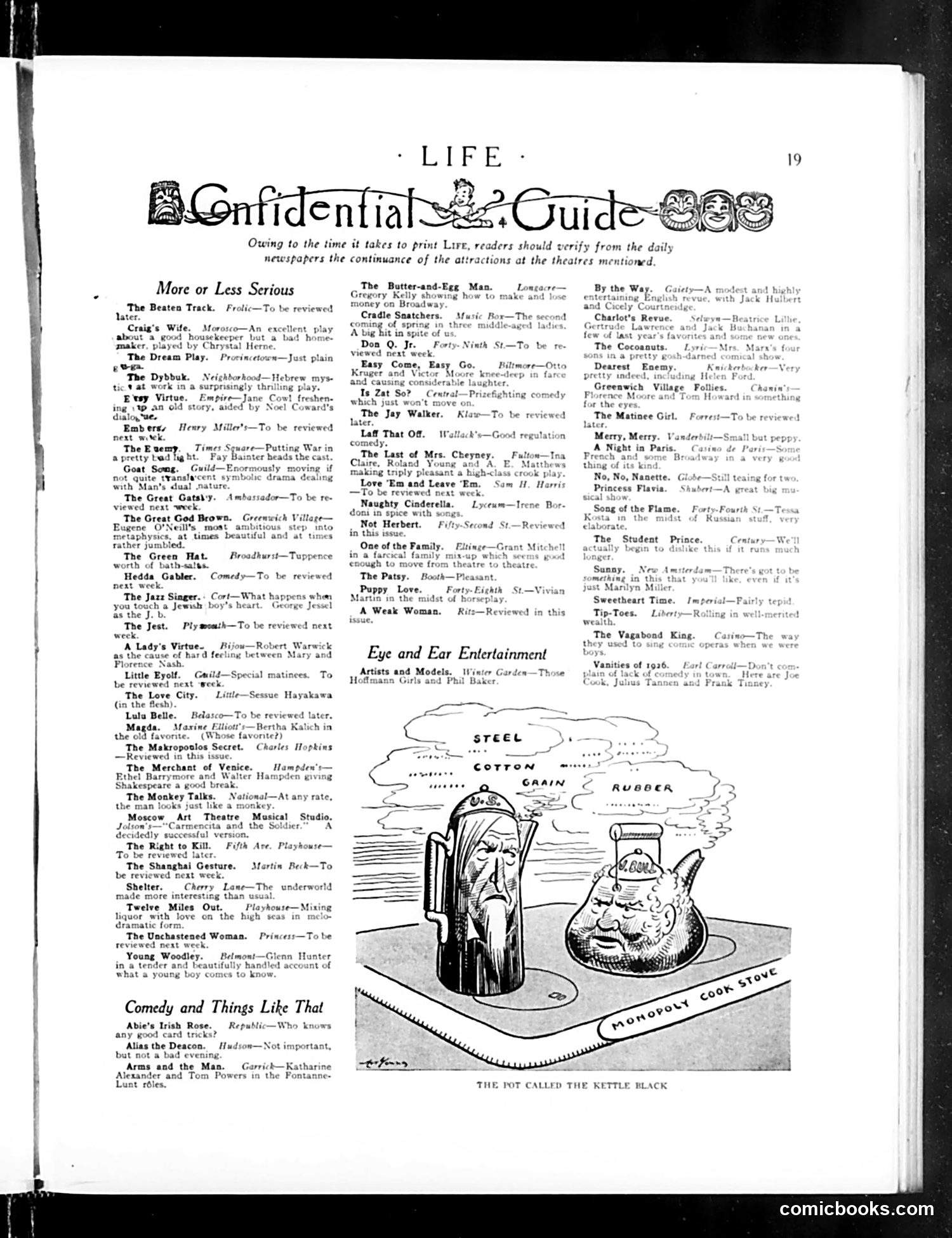
This page is a **theater guide and entertainment column** from Life magazine, not primarily a political cartoon page. The main content lists Broadway shows with brief reviews categorized as "More or Less Serious," "Comedy and Things Like That," and "Eye and Ear Entertainment." The **single cartoon** at bottom—titled "The Pot Called the Kettle Black"—depicts two anthropomorphized kitchen items (a tall pot and a round teapot) on a monopoly cook stove, surrounded by labels for industrial materials: "Steel," "Cotton," "Grain," and "Rubber." The satire appears to address **monopoly capitalism or industrial consolidation** circa the 1920s. The "pot calling the kettle black" idiom suggests mutual hypocrisy or ironic criticism. The figures likely represent competing industrial monopolies or trusts accusing each other of unfair practices while both profit from the same raw materials, making their mutual accusations equally absurd. The humor lies in showing their interdependence despite apparent opposition.
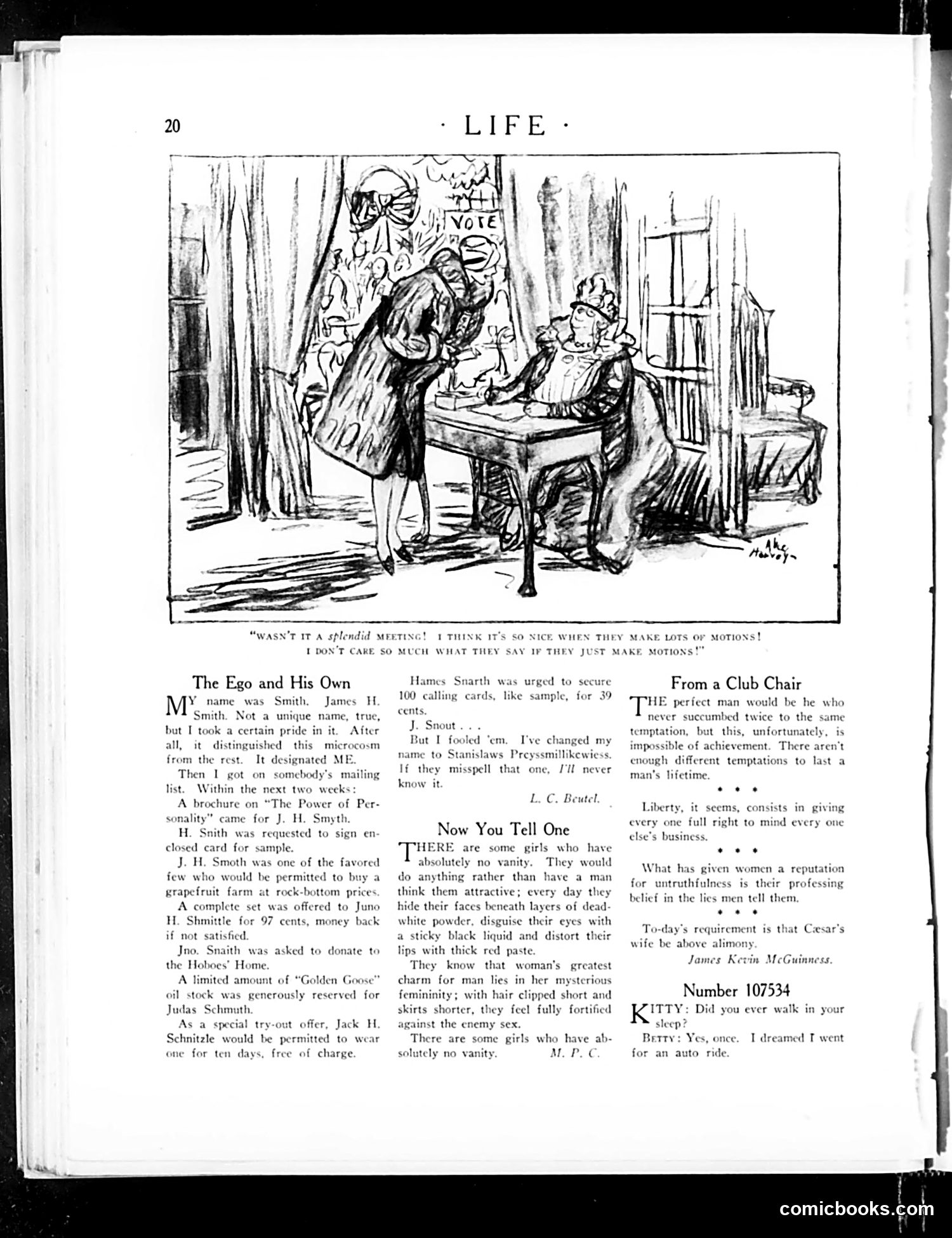
This page from *Life* magazine contains satirical commentary on early 20th-century American social absurdities. **The Main Cartoon** depicts a woman at what appears to be a club or organization meeting, remarking that she enjoys meetings where participants "make lots of motions" regardless of what's actually said. The satire targets the performative nature of civic organizations and women's clubs—the implication being that participants value the *appearance* of activity and productivity over substantive discussion or results. **"The Ego and His Own"** mocks how mass marketing and mailing lists homogenize individuality. A man named Smith takes pride in his distinctive name, only to receive mail addressed to him under countless misspellings (Smyth, Snith, Shmittle, etc.), each variant treated as a separate person for solicitations and donations. The satire critiques how impersonal commercial systems strip away individual identity. **"Now You Tell One"** and other brief pieces satirize vanity, hypocrisy about femininity, and relationships—typical *Life* magazine fare lampooning social pretense and human nature.
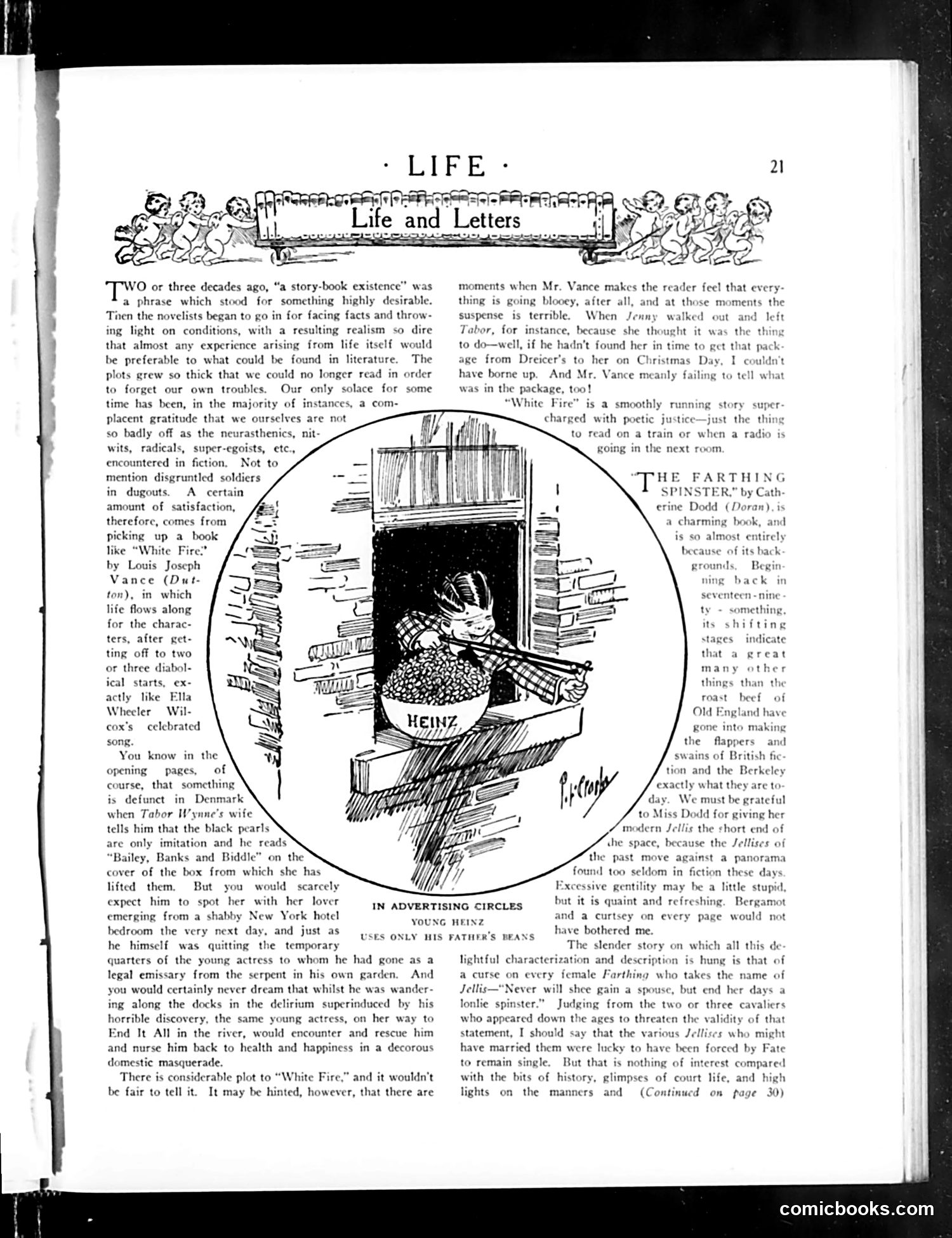
This page reviews two novels in Life's "Life and Letters" section. The main content discusses Louis Joseph Vance's "White Fire," praised as escapist entertainment—a deliberately plotty, emotionally satisfying story offering relief from the grim literary realism that had dominated recent fiction. The circular illustration shows a young man (Heinz) in an advertising plug for "Young Heinz Uses Only His Father's Beans"—a commercial advertisement cleverly embedded in the editorial content. The page also previews Catherine Dodd's "The Farthing Spinster," a British novel featuring a family curse preventing women named Jellis from marrying. The reviewer appreciates its gentle, old-fashioned charm as relief from modernist heaviness. The overall message: after years of depressing, issue-heavy novels about soldiers, neurotics, and social problems, readers craved simple, well-plotted entertainment and nostalgic stories.
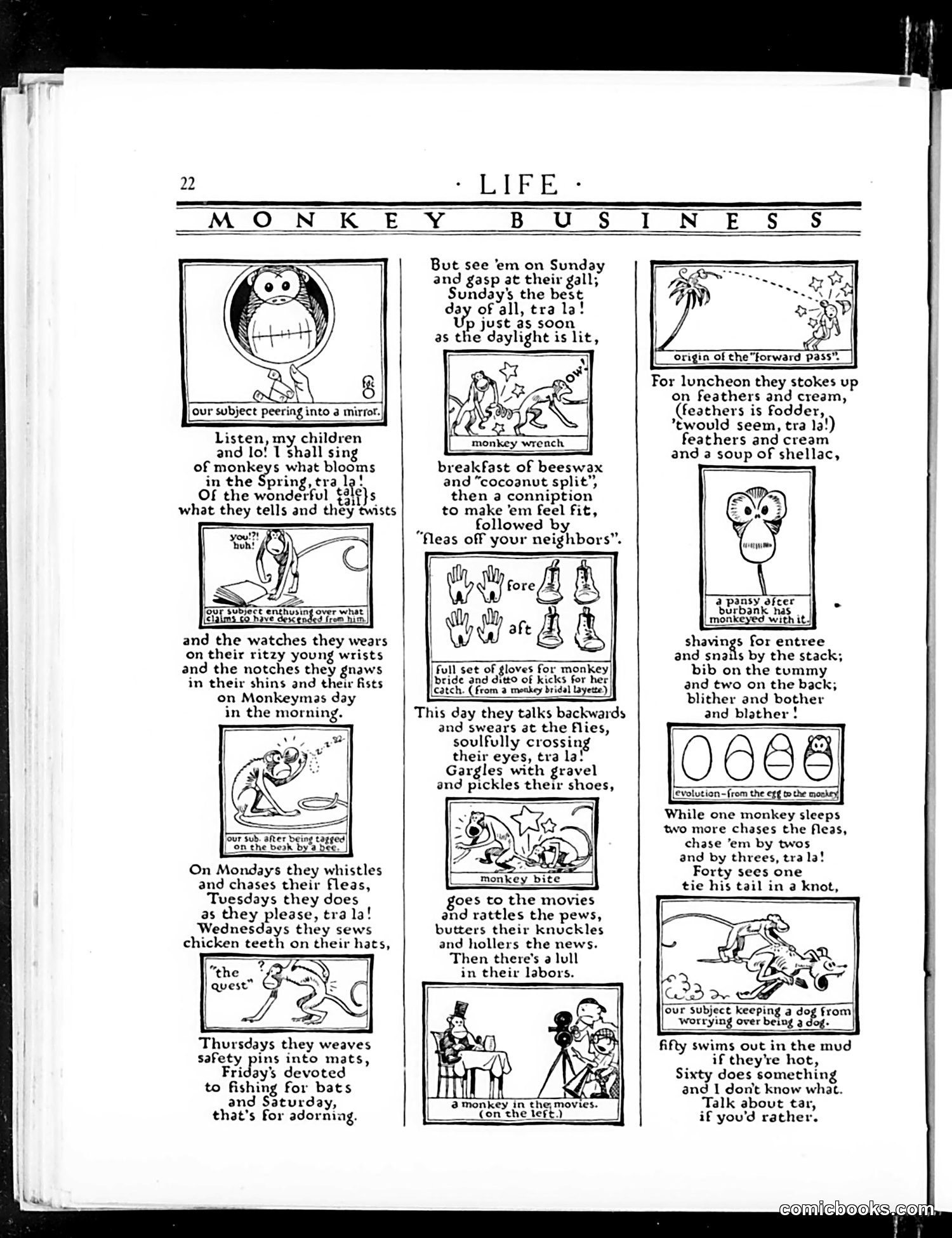
This humorous piece parodies whimsical, nonsensical poetry (in the style of Edward Lear or similar Victorian absurdist verse). The unnamed author catalogs the ridiculous daily activities of monkeys—whistling and chasing fleas on Mondays, sewing chicken teeth onto hats on Wednesdays, gargling gravel, pickled shoes, and attending movies. The satire works on multiple levels: it mocks the pretentious style of earnest nature poetry and children's instructional verse popular in the era, while the monkeys' increasingly illogical behaviors suggest commentary on human absurdity itself. The illustrations show monkeys engaged in these silly activities. The joke is partly *that* there is no coherent point—the humor lies in the accumulation of ridiculous, impossible actions presented with mock-serious poetic earnestness. It's essentially nonsense-satire, poking fun at both animal-behavior literature and Victorian literary conventions through deliberate incoherence.
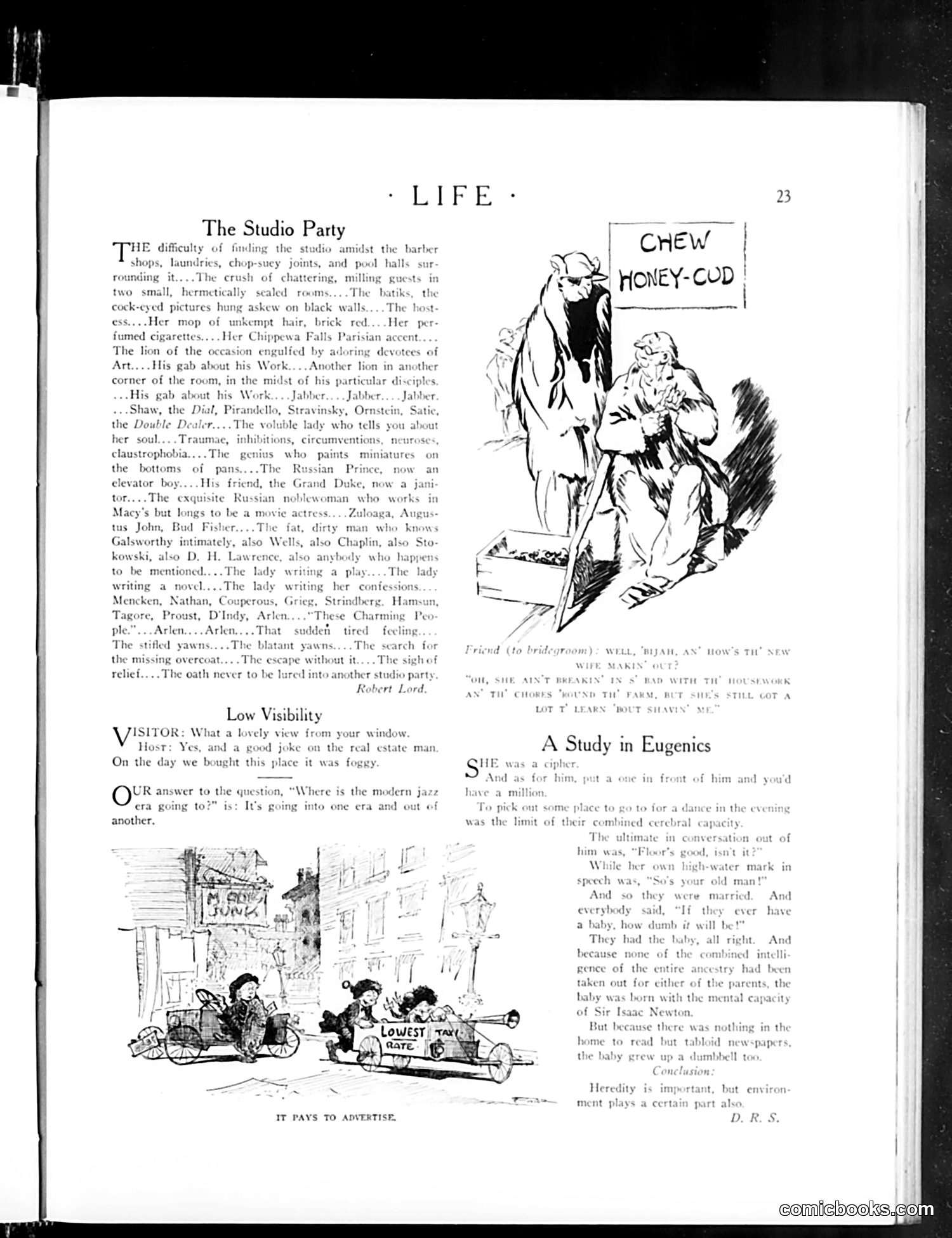
**The Studio Party** satirizes pretentious bohemian gatherings of the 1920s. The text mocks the affectations and tedious conversation of artistic circles—endless self-important talk about "Work," name-dropping of famous figures (Shaw, Stravinsky, Chaplin), and pseudo-intellectual discussion. The satire targets the studied eccentricity and posturing: the hostess with her "brick red" hair and "Parisian accent," the endless "jabber" about art and literature, the exhausting social rituals of people trying desperately to seem important. **Low Visibility** uses a conversational format to joke about real estate marketing—when they bought the house it was foggy, so they couldn't see the view. The companion illustration shows children in a soapbox-car labeled "Honest Jake's," illustrating how deceptive advertising works. **A Study in Eugenics** presents social commentary on heredity and intelligence, discussing a couple whose intellectual disparity raises concerns about their offspring's capacity—reflecting early 20th-century eugenic anxieties (now recognized as pseudoscientific racism). All three pieces exemplify Life's satirical approach to modern urban society.
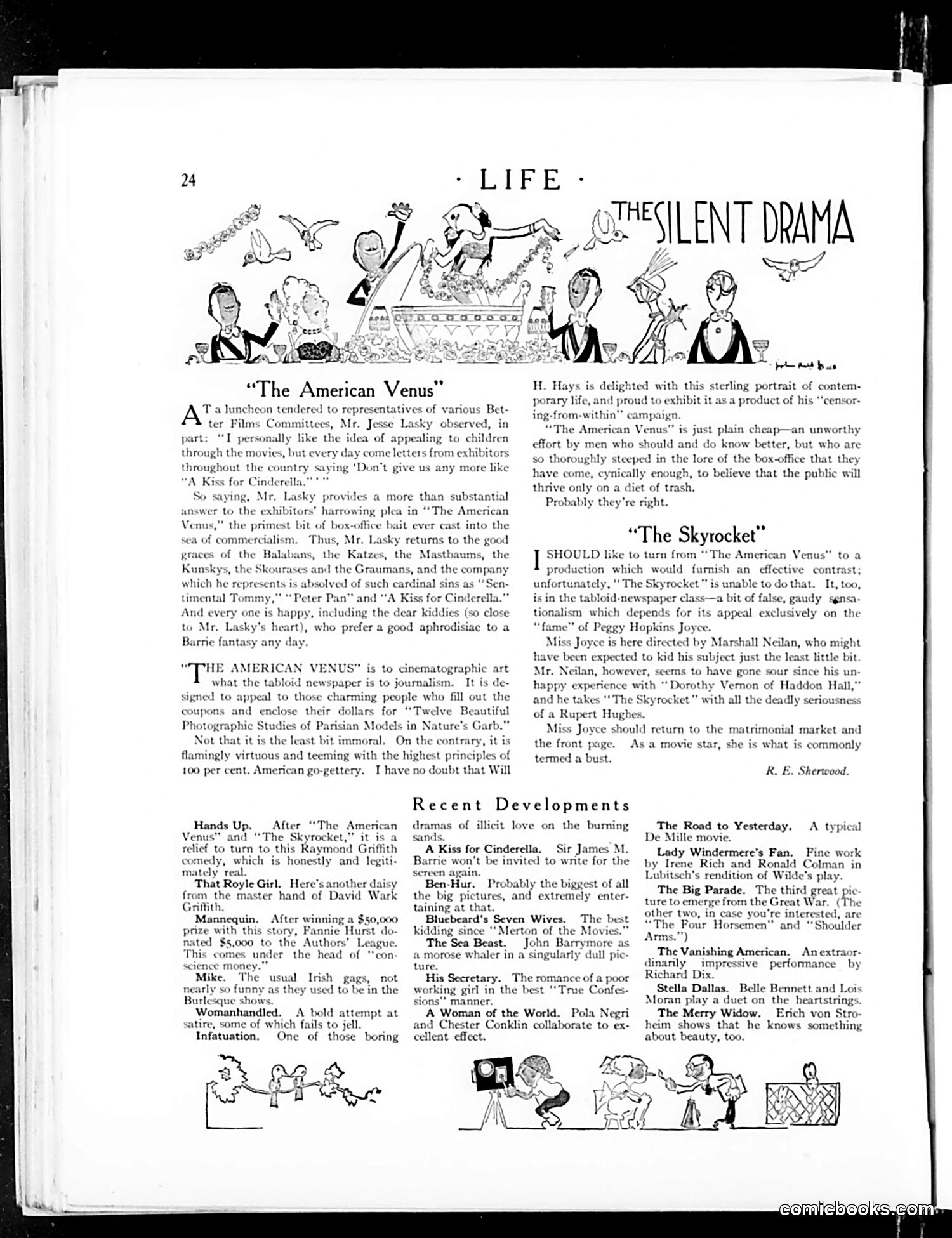
This page reviews contemporary silent films while satirizing both the movie industry and audience tastes. The main target is *"The American Venus,"* a film producer Jesse Lasky created to appeal to exhibitors' demands for commercially successful content—specifically, titillating "photographic studies of Parisian models." The critic argues the film represents degraded cinema: it's "just plain cheap" and cynically designed to exploit public appetite for trash, not artistic merit. The comparison is stark—*"The American Venus"* is to film what tabloid newspapers are to journalism: sensationalist and unprincipled. *"The Skyrocket,"* featuring actress Peggy Hopkins Joyce, receives similar criticism for relying on gaudy sensationalism rather than artistic direction. By contrast, Raymond Griffith's *"Hands Up"* is praised as "honestly and legitimately real." The satire reflects 1920s anxieties about mass culture, commercialism, and whether movies should educate or merely titillate. The critic despairs that filmmakers and audiences alike prioritize "box-office bait" over artistic integrity.
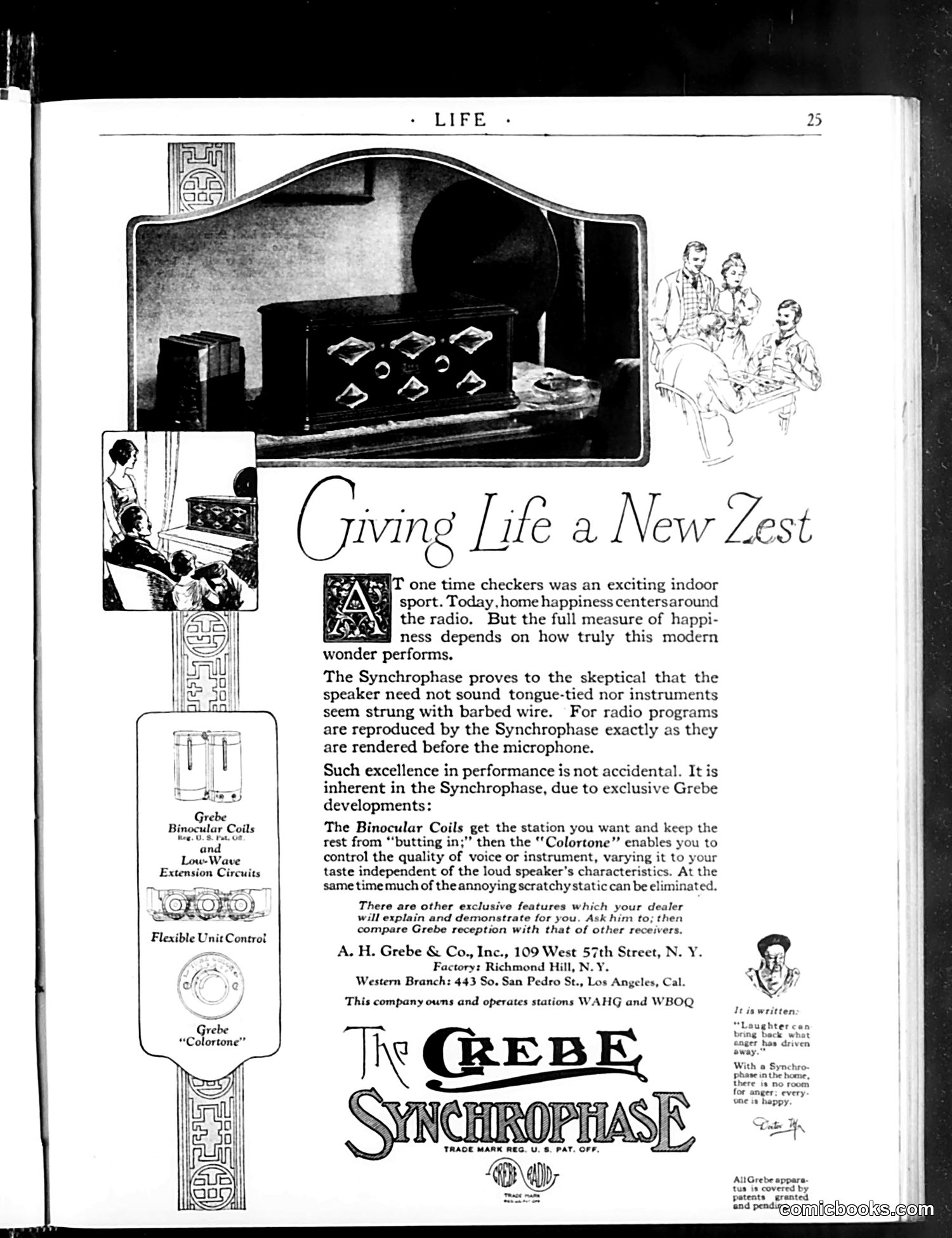
This is primarily a **radio equipment advertisement**, not political satire. It's a 1920s-era ad for the Grebe Synchrophase radio receiver. The page reflects the era's excitement about radio as a transformative home technology. The headline "Giving Life a New Zest" and accompanying illustrations show families gathered around radios, positioning the device as central to modern domestic happiness. The text emphasizes technical superiority—the Synchrophase's "Binocular Coils" and "Colortone" features supposedly deliver clearer reception and better sound quality than competitors. This was a genuine selling point when radio reception was often poor. The decorative border elements and formal typography are typical of 1920s advertising design. The small illustration showing laughter ("Laughter can never find a place when anger has driven it away") uses sentimentality to market the product. The ad mentions the company owns radio stations WAHG and WBOQ, indicating vertical integration in early broadcasting. This is straightforward period advertising rather than social commentary or satire.
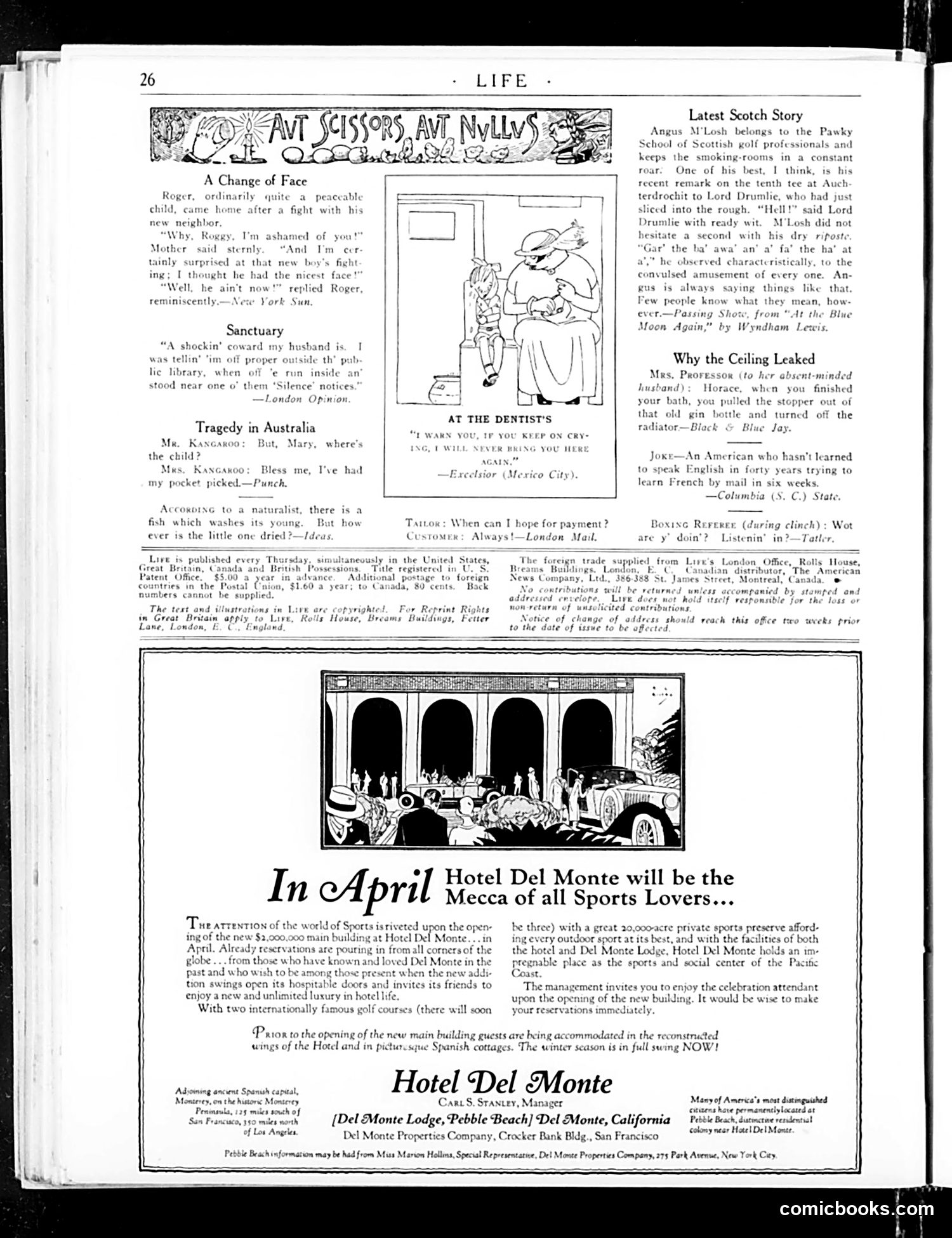
This page combines humor columns with advertising. The main content consists of brief satirical anecdotes typical of *Life* magazine's format: **"A Change of Face"**: A child comes home from a fight; his mother scolds him, but he replies the other boy "ain't" pretty anymore—dark humor about childhood violence. **"Sanctuary"** and **"Tragedy in Australia"**: Brief jokes about cowardice and parental negligence, respectively. **"Why the Ceiling Leaked"**: A wife scolds her absent-minded husband for leaving the bathtub stopper in while the radiator ran—domestic comedy. Other short jokes target French language learning, boxing etiquette, and payment delays—typical *Life* fodder mocking modern life's absurdities and social pretension. The page's dominant feature is a large **Hotel Del Monte advertisement** promoting the California resort as ideal for sports enthusiasts, featuring private golf courses and amenities. The ad claims the hotel will be "the Mecca of all Sports Lovers" when it opens in April. Overall, this reflects 1920s-30s American humor: domestic mishaps, class-conscious observations, and consumer leisure culture.
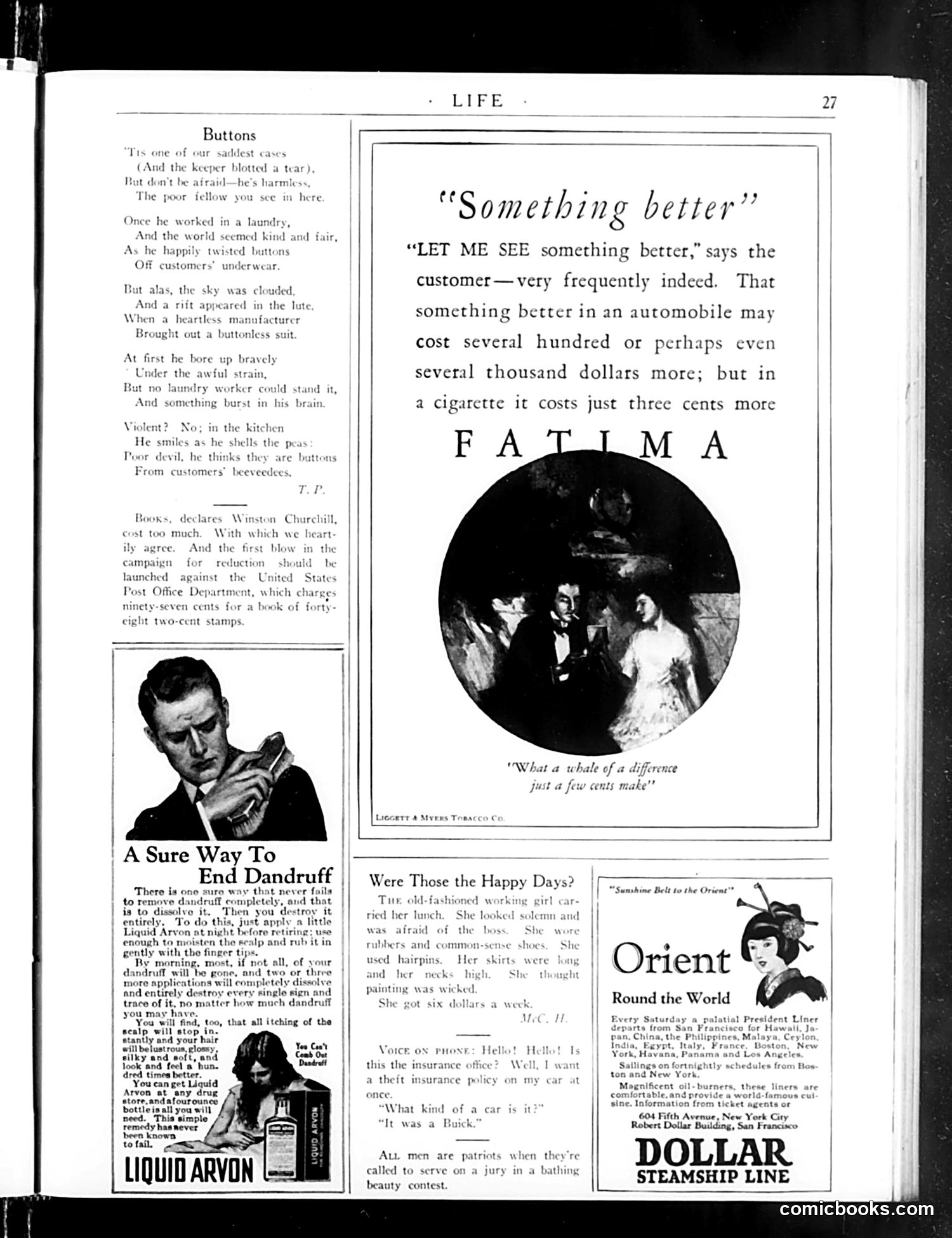
This page contains **advertisements and light satirical pieces** rather than political cartoons proper. The main content includes: **"Something Better" (Fatima cigarettes ad)**: A couple debates upgrades—automobiles might cost hundreds more for improvement, but cigarettes cost only three cents extra. The satire mocks consumerism and the minor cost differences that seem to justify luxury purchases. **"Buttons" poem**: A sympathetic piece about a laundry worker whose job involves replacing buttons on underwear. The satire is gentle, depicting a hardworking man driven to despair by the monotony and indignity of his labor. **"A Sure Way to End Dandruff"**: Advertisement for Liquid Arvon hair treatment. **"Were Those the Happy Days?"**: Brief anecdote contrasting old-fashioned working girls (long skirts, pins in hair, six dollars weekly) with modern times—implied nostalgia or criticism of changing social standards. **"Orient Round the World"** and **"Dollar Steamship Line"**: Travel advertisements. The page is primarily **commercial content with mild social commentary** rather than sharp political satire.
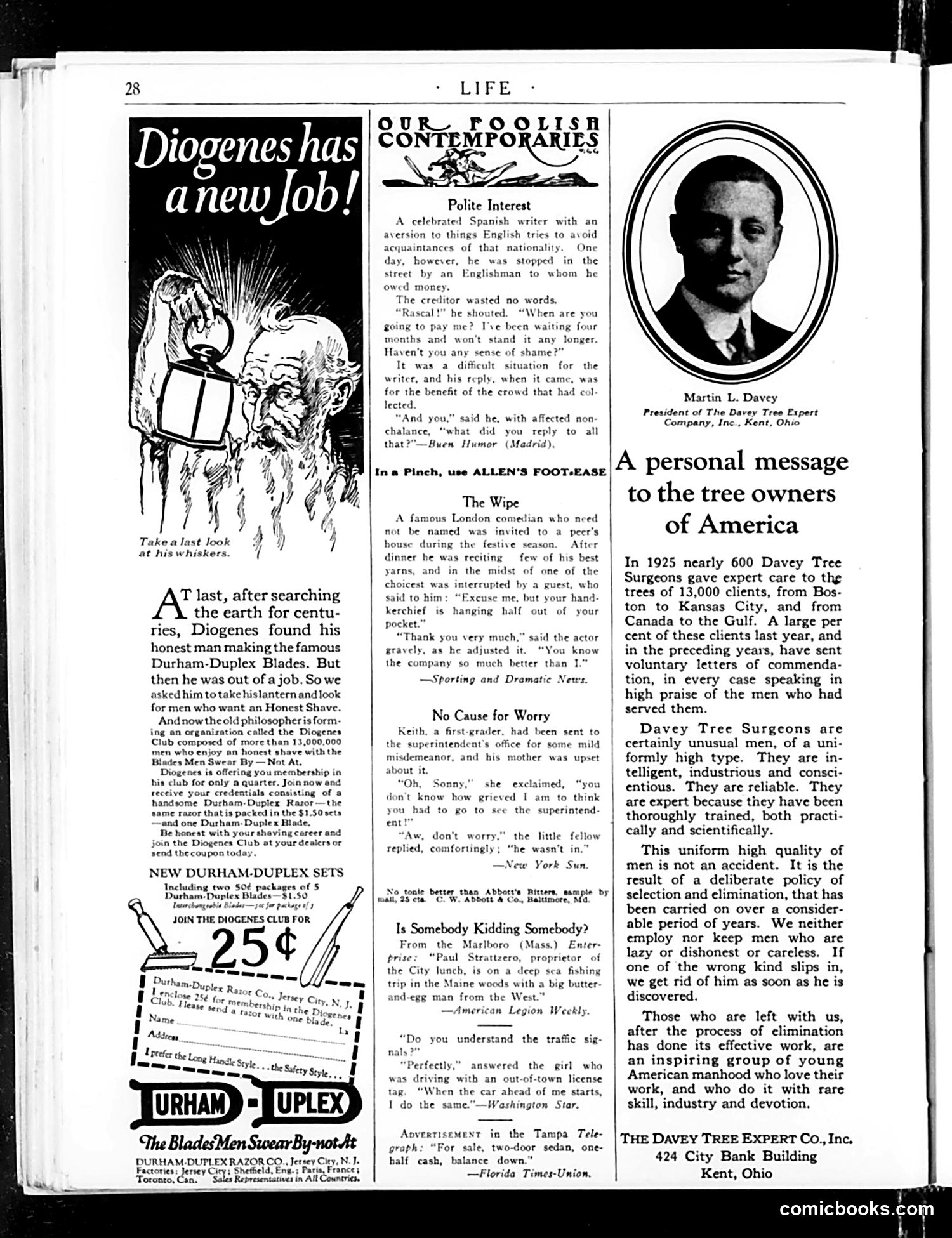
This page combines humor and advertising. The main cartoon features **Diogenes**, the ancient Greek philosopher famous for searching with a lantern for an honest man. The satire plays on his legend: after finally finding an honest man at Durham-Duplex razor blade company, he's now unemployed. So Life humorously recruits him to form a "Diogenes Club" promoting honest shaving—a tongue-in-cheek advertisement suggesting the razors appeal to morally upright men. The page also contains several brief comic anecdotes under "Our Foolish Contemporaries," including jokes about a debt-dodging Spanish writer and a London comedian's interrupted story—typical Light satirical fare mocking human foibles. The bottom half features a earnest advertisement from Martin L. Davey of the Davey Tree Expert Company, touting the reliability and quality of his tree surgeons. This contrasts sharply with the humorous satire above, representing the magazine's mixed editorial-advertising format typical of 1920s publications.
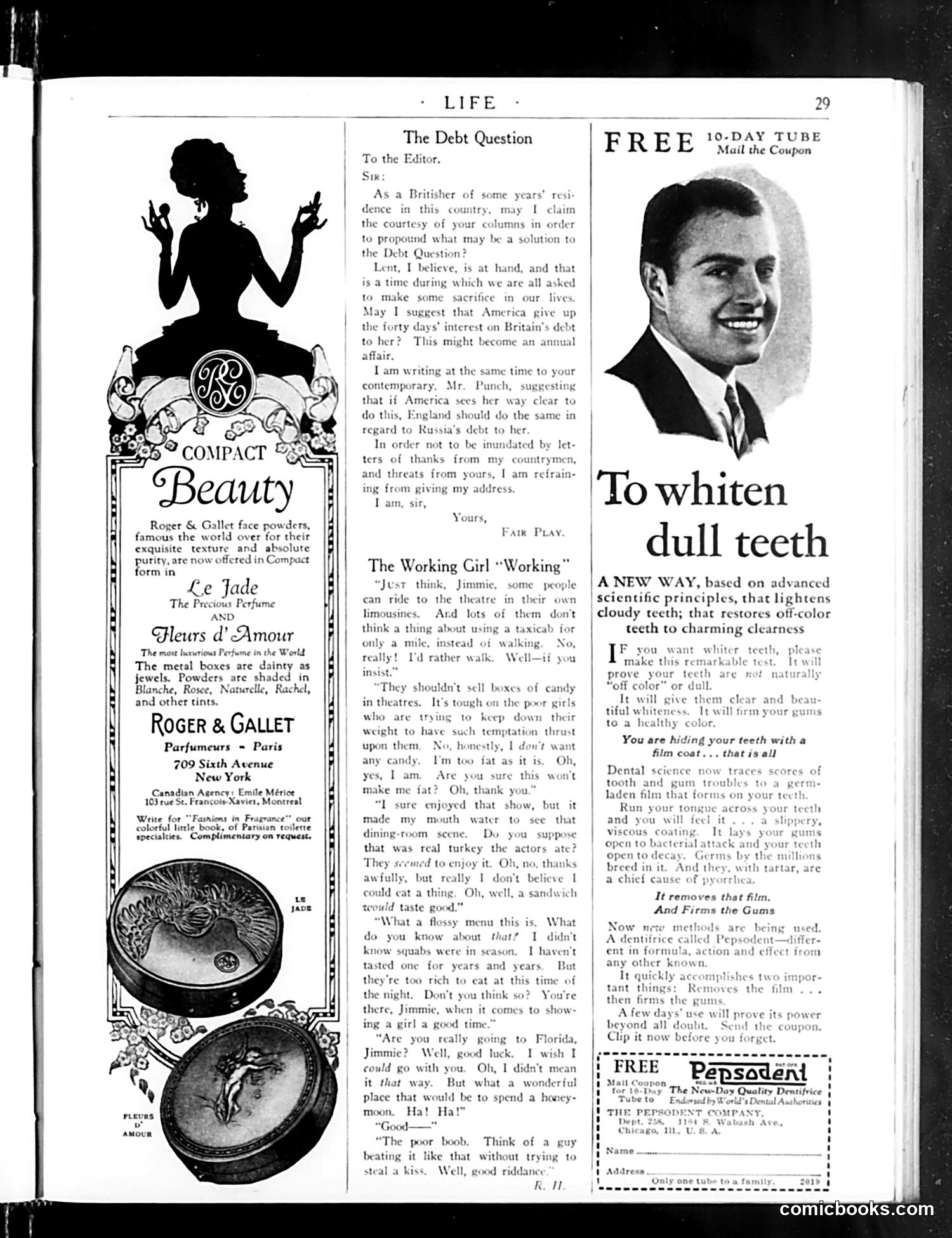
This page combines **advertisements with satirical social commentary** typical of Life magazine's format. The left side features a **Roger & Gallet cosmetics ad** with decorative Art Deco styling—standard luxury product marketing of the era. The central column contains two satirical pieces: 1. **"The Debt Question"** — A letter mocking post-WWI international debt negotiations. The writer, signing as "Fair Play," sarcastically proposes that America forgive Britain's war debt during Lent as a "sacrifice," suggesting Britain should reciprocally forgive Russia's debt. This references real 1920s-30s tensions over Allied war debts following World War I, with the satire highlighting the hypocrisy of nations claiming financial hardship while maintaining imperial pretenses. 2. **"The Working Girl"** — A dialogue satirizing young women office workers who affect sophistication (mentioning limousines, theaters, fancy foods) while actually struggling financially and walking to work. The satire exposes the gap between aspirational class-climbing and economic reality during the Jazz Age. The right side advertises **Pepsodent toothpaste** — a period product claiming scientific teeth-whitening capabilities.
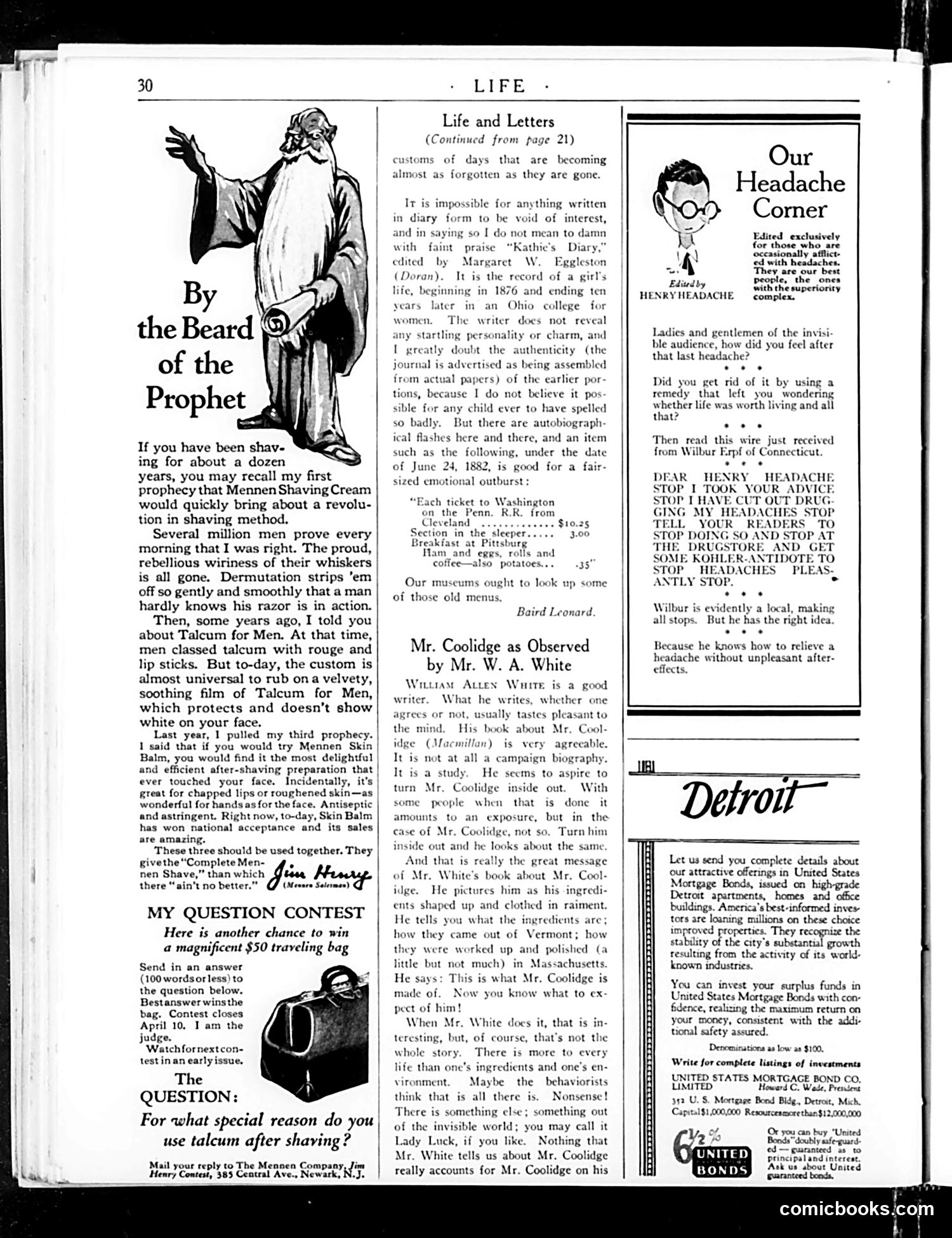
This page contains primarily **advertising and book reviews**, not political satire. The large left illustration advertising Mennen shaving products depicts a bearded prophet figure as a humorous "spokesperson" claiming credit for revolutionizing men's grooming. The satire is gentle product marketing—the "prophet" boasts about past predictions that Mennen products would transform shaving customs, positioning the company as visionary. The book reviews discuss "Kathie's Diary" (1876-1886, an Ohio college girl's journal) and W.A. White's biography of **President Calvin Coolidge**. White's study apparently seeks to understand Coolidge's character by examining his origins and influences rather than offering campaign promotion. The right column features "Our Headache Corner," a reader advice section where "Wilbur Erpf" suggests remedies for headaches. Overall, this is a typical Life magazine page mixing consumer ads with literary commentary—not political cartooning or satire about current events.
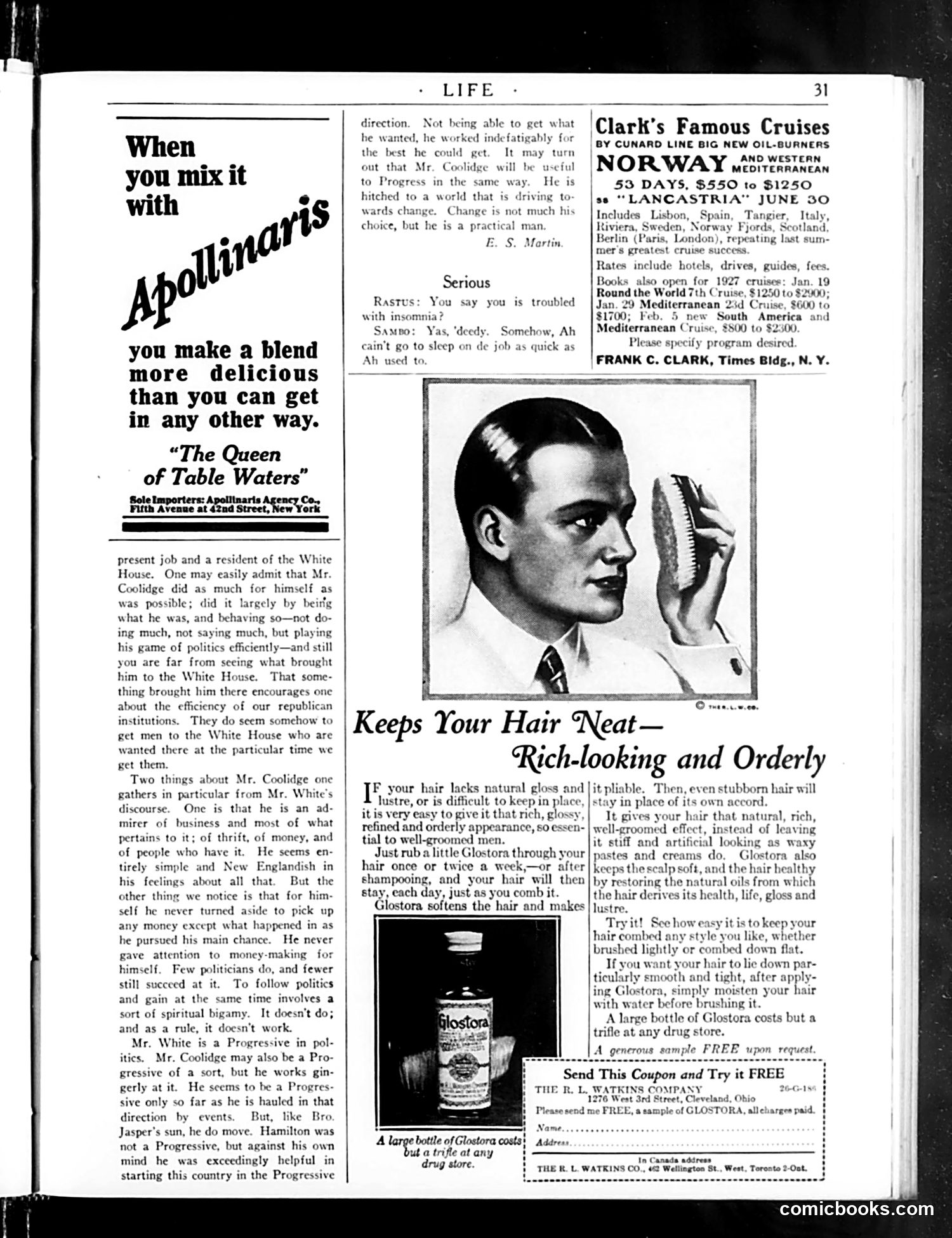
This page contains **primarily advertisements** (cruises, hair product Glostora, Apollinaris water) rather than political cartoons. The significant editorial content is a **brief dialogue labeled "Serious"** featuring "Rastus" and "Sambo"—racial caricature names typical of 1920s-era racist humor. The exchange mocks Black workers' supposed laziness, with one character claiming he cannot fall asleep quickly on the job "as quick as Ah used to." The page's only substantial political commentary is a **text piece about Calvin Coolidge**, discussing his path to the White House. The author (E.S. Martin) suggests Coolidge succeeded through practical efficiency and political competence rather than ambition, and notes approvingly that republican institutions somehow produce capable leaders. The racial stereotype dialogue reflects the casual racism endemic to 1920s American media, even in ostensibly sophisticated publications. The Coolidge commentary represents mainstream contemporary political assessment of the 30th president.
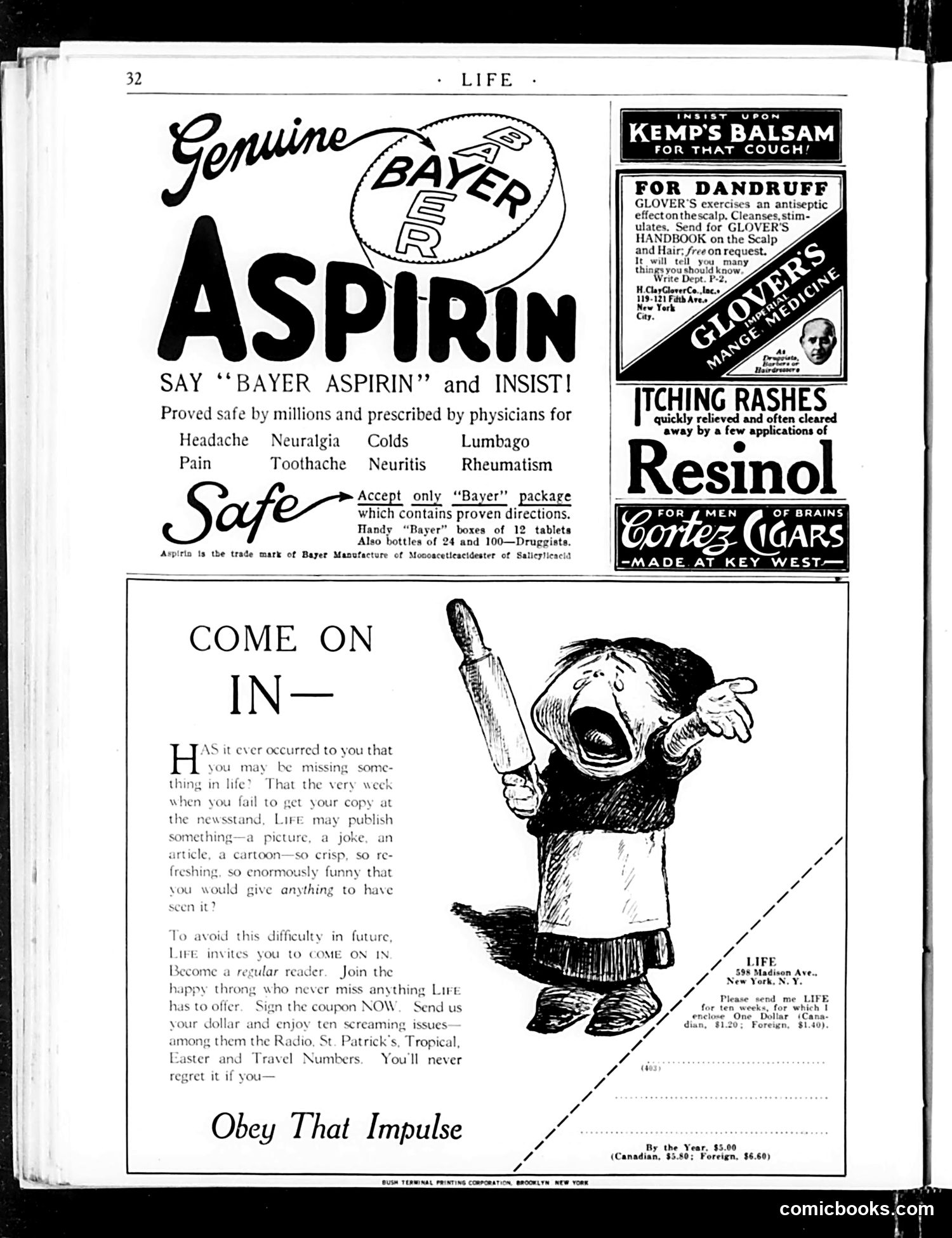
This page is primarily **advertising content** from an early 20th-century American magazine. The dominant advertisement promotes **Bayer Aspirin**, emphasizing brand loyalty ("Say 'Bayer Aspirin' and INSIST!") and listing common ailments it treats—a pitch typical of the era before FDA regulations restricted medical claims. The secondary content is a **subscription drive** for *Life* magazine itself, featuring a cartoon of an eager character wielding a rolling pin or club, with text urging readers to become regular subscribers ("Come On In—Obey That Impulse"). The pitch suggests readers miss hilarious content when they skip issues. The right sidebar contains **smaller product ads** for various patent medicines and remedies (Kemp's Balsam, Glover's dandruff treatment, Resinol for rashes, Cortez cigars)—typical of magazines from this period, when such advertisements dominated publications. The overall page reflects early 1900s consumer culture and magazine economics dependent on pharmaceutical advertising.
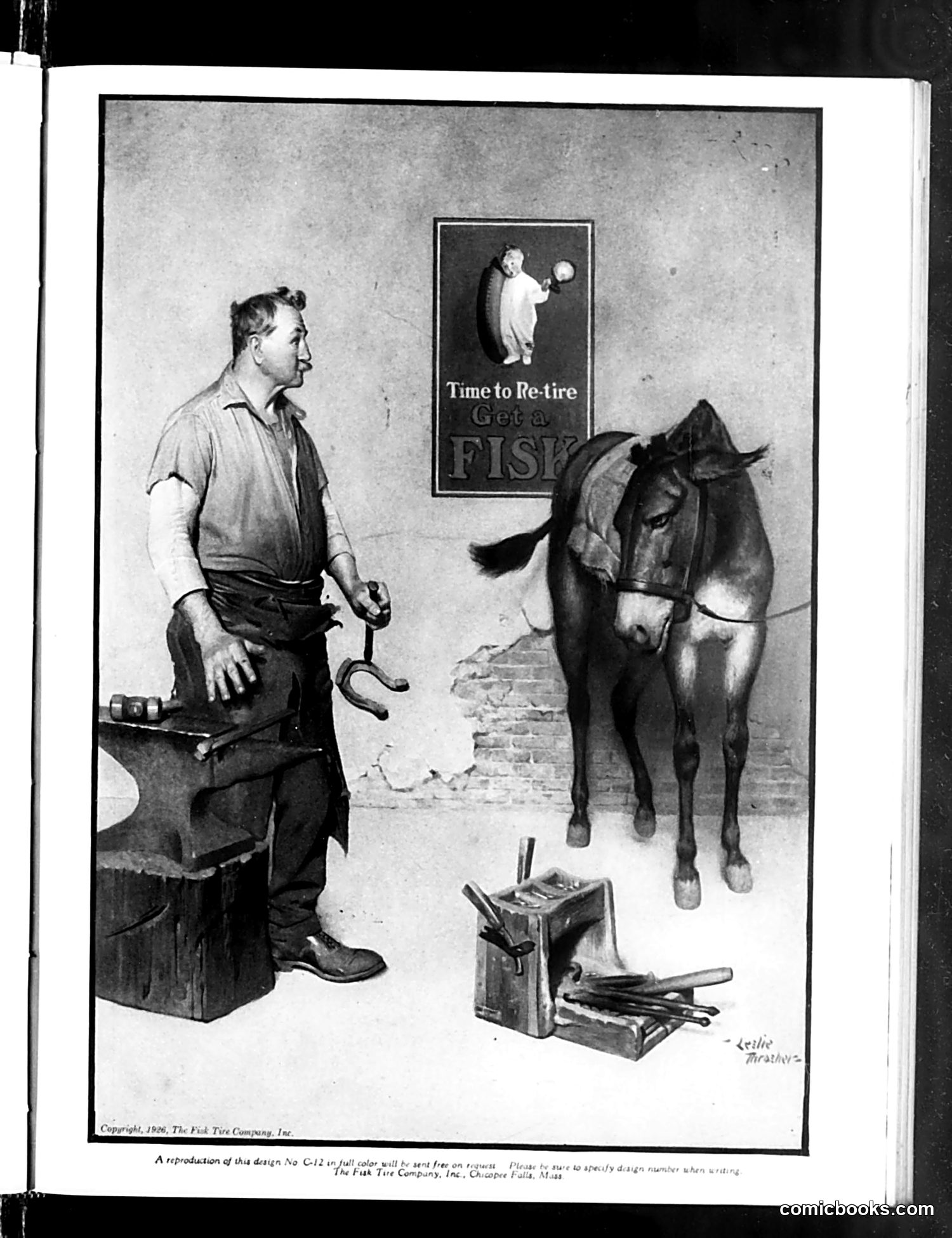
This is a **Fisk Tire Company advertisement** disguised as humor. The cartoon shows a blacksmith at his forge, holding a horseshoe, facing a saddled horse. A poster behind them reads "Time to Re-tire / Get a FISH [sic]." The joke is a visual pun: the blacksmith is doing his traditional job of shoeing horses with iron horseshoes (re-tiring them), while the advertisement suggests switching to Fisk automobile tires instead. It's promoting motorized vehicles over horse-drawn transport—a topical message for the early 20th century when cars were still relatively new. The humor relies on the double meaning of "re-tire" (replacing horseshoes vs. replacing tires) and gently mocks the obsolescence of traditional blacksmith work in an automotive age.
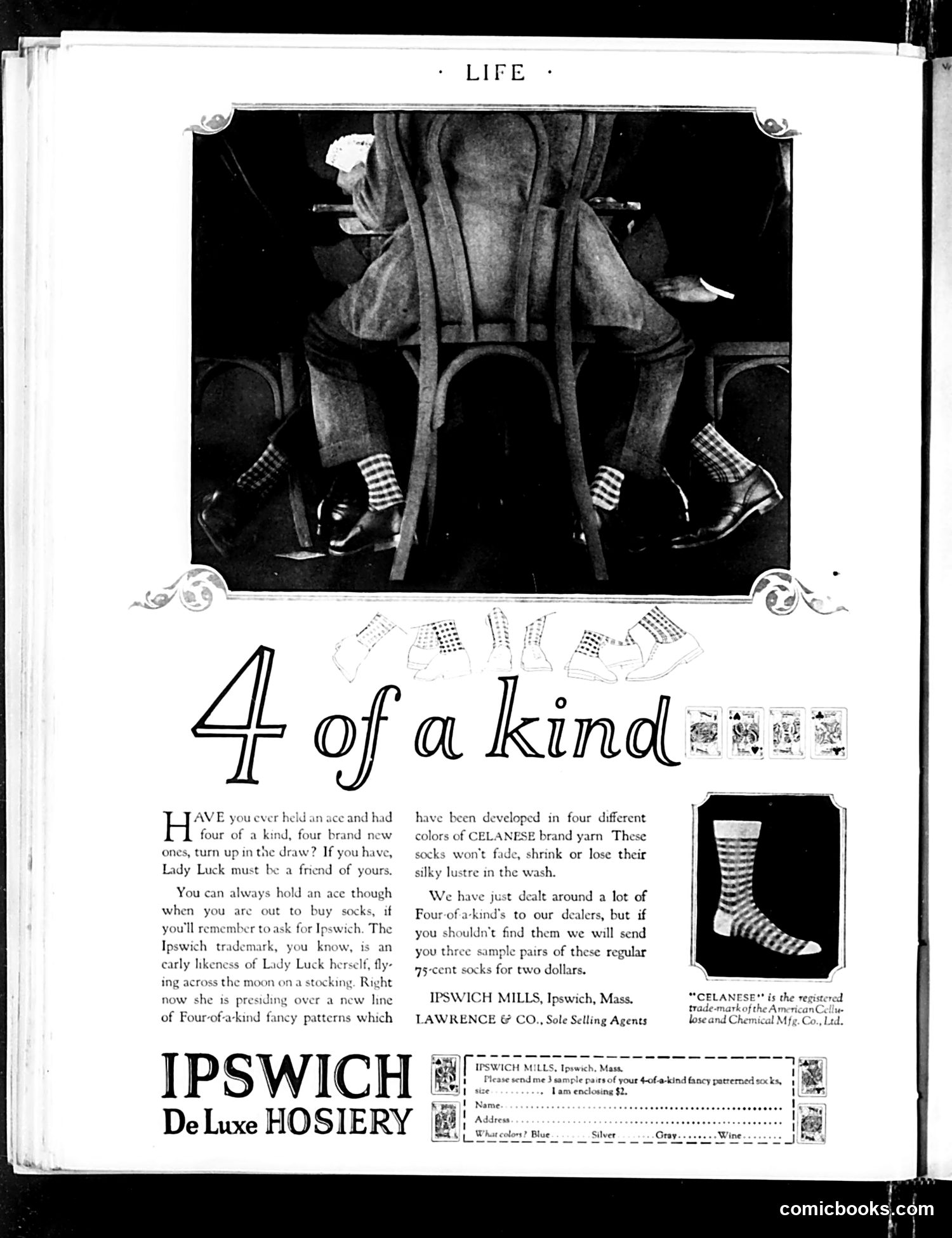
This is primarily a **vintage sock advertisement**, not political satire. The page promotes Ipswich De Luxe Hosiery, using a gambling metaphor as its central conceit. The "4 of a kind" reference plays on poker terminology—the ad compares finding quality socks to drawing lucky cards. The photograph shows a child's legs dangling, displaying checkered socks in various patterns. The accompanying text claims these new socks come in four colors and won't fade or shrink. The trademark features "Lady Luck" flying across the moon on a stocking—a whimsical mascot meant to invoke good fortune. The ad includes a mail-in coupon offering sample pairs for two dollars. This reflects early 20th-century advertising practice: using playful language and luck-based humor to sell everyday goods, particularly hosiery (a significant commodity before modern synthetic fabrics). There is no political commentary or social satire present—it's straightforward commercial promotion with period charm.