
Life, 1926-02-18 · page 26 of 36
Life — February 18, 1926 — page 26: what you’re looking at
What you’re looking at
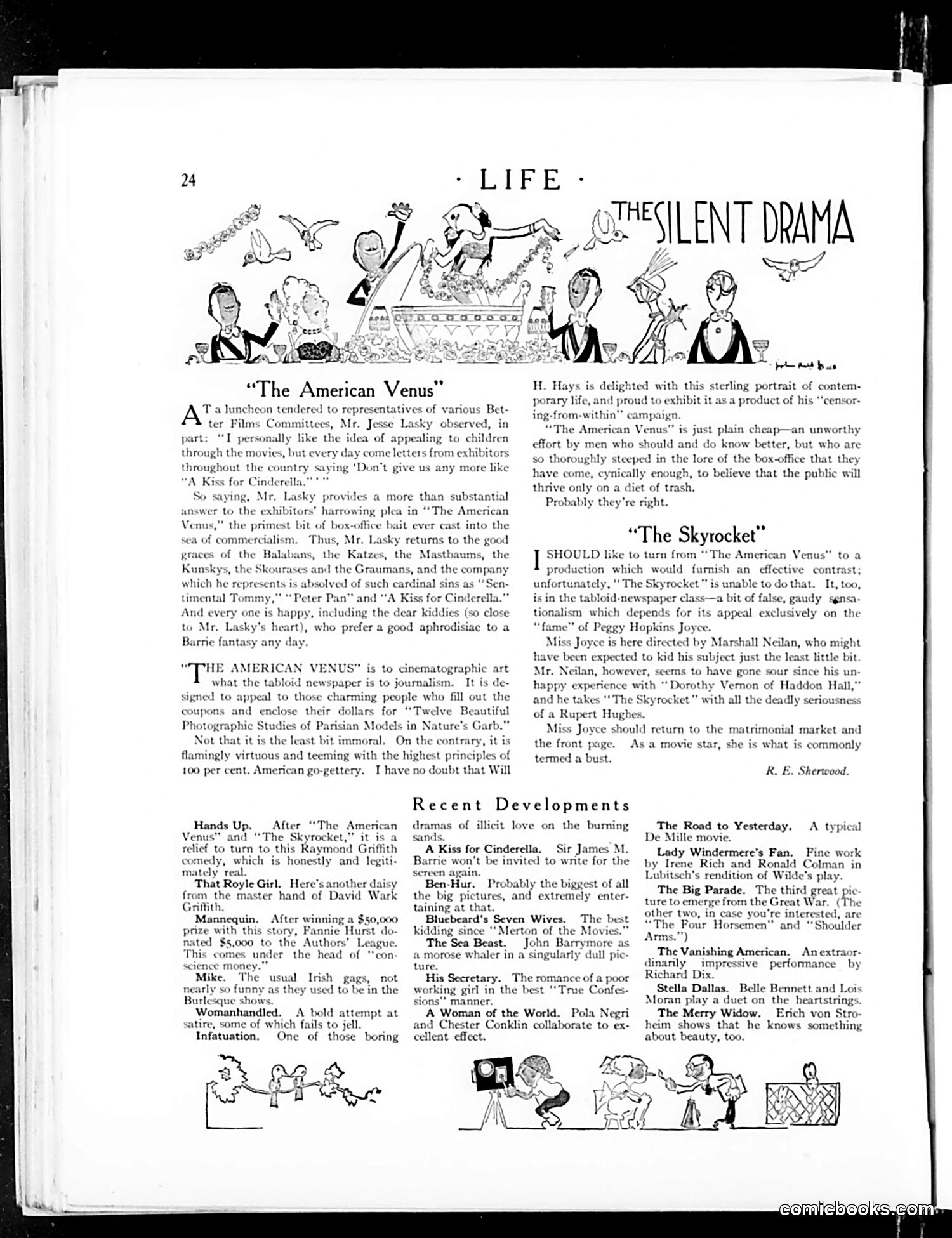
This page reviews contemporary silent films while satirizing both the movie industry and audience tastes. The main target is *"The American Venus,"* a film producer Jesse Lasky created to appeal to exhibitors' demands for commercially successful content—specifically, titillating "photographic studies of Parisian models." The critic argues the film represents degraded cinema: it's "just plain cheap" and cynically designed to exploit public appetite for trash, not artistic merit. The comparison is stark—*"The American Venus"* is to film what tabloid newspapers are to journalism: sensationalist and unprincipled. *"The Skyrocket,"* featuring actress Peggy Hopkins Joyce, receives similar criticism for relying on gaudy sensationalism rather than artistic direction. By contrast, Raymond Griffith's *"Hands Up"* is praised as "honestly and legitimately real." The satire reflects 1920s anxieties about mass culture, commercialism, and whether movies should educate or merely titillate. The critic despairs that filmmakers and audiences alike prioritize "box-office bait" over artistic integrity.
📄 Transcribed text from this page (OCR, searchable)
Machine-transcribed from the original scan — historical spelling and the odd misread are preserved.
; fd “The American Venus T a luncheon tendered to representatives of variou: Mr. Jesse Lask “T personally like the idea of appeali ter Films Committees, part through ther y throughout the country saying ‘L “A Kiss for Cinderell: So sayir ovies, but eve f } provides answer to the exhibitors’ harrowing plea in Venu sea of commercialism graces of the Balabans, the Kunskys, th 1 which he represents is absolved of such cardinal sins as ‘A Kiss for Cinderella including the dear kiddies (so close who prefer a good aphrodisiac to a timental “Peter Pan” and And every one is happy, to Mr. Lasky’s heart), Barrie fantasy any mmy, HE AMERICAN VENUS" is to cinematograg art aper is to journalism. signed to appeal to those charming people who fill out the ar “Twelve Photographic Studies of Parisian Models in Nature’s Garb.” On the cot ing with the highest princi; T have no doubt that Will what the tabloid newsp coupons and enclose their dollars for t that it is the least bit immoral flamingly virtuow: id te 100 per cent. American go-gettery. Hands Up. — After “The American Venus" and “The Skyrocket,” it is a relief to turn to this Raymond Griffith comedy, which is honestly and legiti- mately real. That Royle Girl. Here's another daisy from the master hand of David Wark Griffith, Mannequin. After winning a prize with this story, Fannie Hu nated $5,000 to the Authors’ 1 This comes under the head ¢ science mone Mike. The usual Irish nearly so funny as they used to be in the Burlesque shows. Womanhandled. A bold attempt at satire, some of which fails to jell. Infatuation. One of those boring come le n't give us any more like a more than subst 1 Pre = SLENT DRAMA Bet> ing-from-within” “The Ameri effort t to children ers from exhibitors thrive on! “The American * the primest bit of box-office bait ever cast into the Thus, Mr. Lasky returns to the good Katzes, the ‘ases and the Graumans, Mastbaums, the d the company production wh unfortunatel tionalism wh “fame” H. Hays is delighted with and proud The Skyrocket” isin the tabloid-newspaper cla ich depends for os pete Rath be sterling portrait of contem- to exhibit it as a product of his “‘censor- campaign. an Venus” is just plain cheap—an unworthy y men who should and do know better, but who are so thoroughly steeped in the lore of the box-office that have come, cynically enough, to believe that the public will diet of trash, ey're right. “The Skyrocket” SHOULD like to turn from “* The American Venus” furnish an effective contrast; is unable to do that. It, too, —a bit of false, gaudy sgnsa- s appeal exclusively on the toa would of Peggy Hopkins Joyce. Miss Joyce is here directed by Marshall N n, who might have been expected to kid his subject just the least little bit Mr. is de- he takes ** of a Rupe: Miss Joyce st the fro: termed a bust. Beautiful Recent Developments dramas of illicit love on the buming sands, A Kiss for Cinderella. Sir James Barrie won't be invited to write for th ably the biggest o the big pictures, and extremely ente taining at that. Bluebeard's Seven Wives. The best kidding since “Merton of the Movies. The Sea Beast. John Barrymore a a morose whaler in a singularly’ dull pic- ture. His Secretary. The romance of a poor working girl in the best ‘True Confes- sions” manner. A Woman of the World. Pola Negri and Chester Conklin collaborate to ex- cellent effect. cilan, however, seems to h happy experience with gone sour since his un- ‘Dorothy Vernon of Haddon Hall,” * with all the deadly seriousness uld return to the matrimonial market and is what is commonly R. E. Sherwood. The Road to Yesterday. De Mille movie. Lady dermere’s Fan. Fine work by Irene Ri d Ronald Colma Lubitsch’s rendition of Wilde’s play. The Big Parade. The third g ture to emerge from the Great V other two, in case you're interested, 4 “The Four Horsemen” and ‘Shoulder Ams.") The Vanishing American, dinarily _ impressive Richard Dix. Stella Dallas. Belle Bennett and Lois Moran play a duet on the heartstrinj The Merry Widow. Erich von Stro- heim shows that he knows something about beauty, too. A typical An extra performance