
Life, 1926-02-18 · page 20 of 36
Life — February 18, 1926 — page 20: what you’re looking at
What you’re looking at
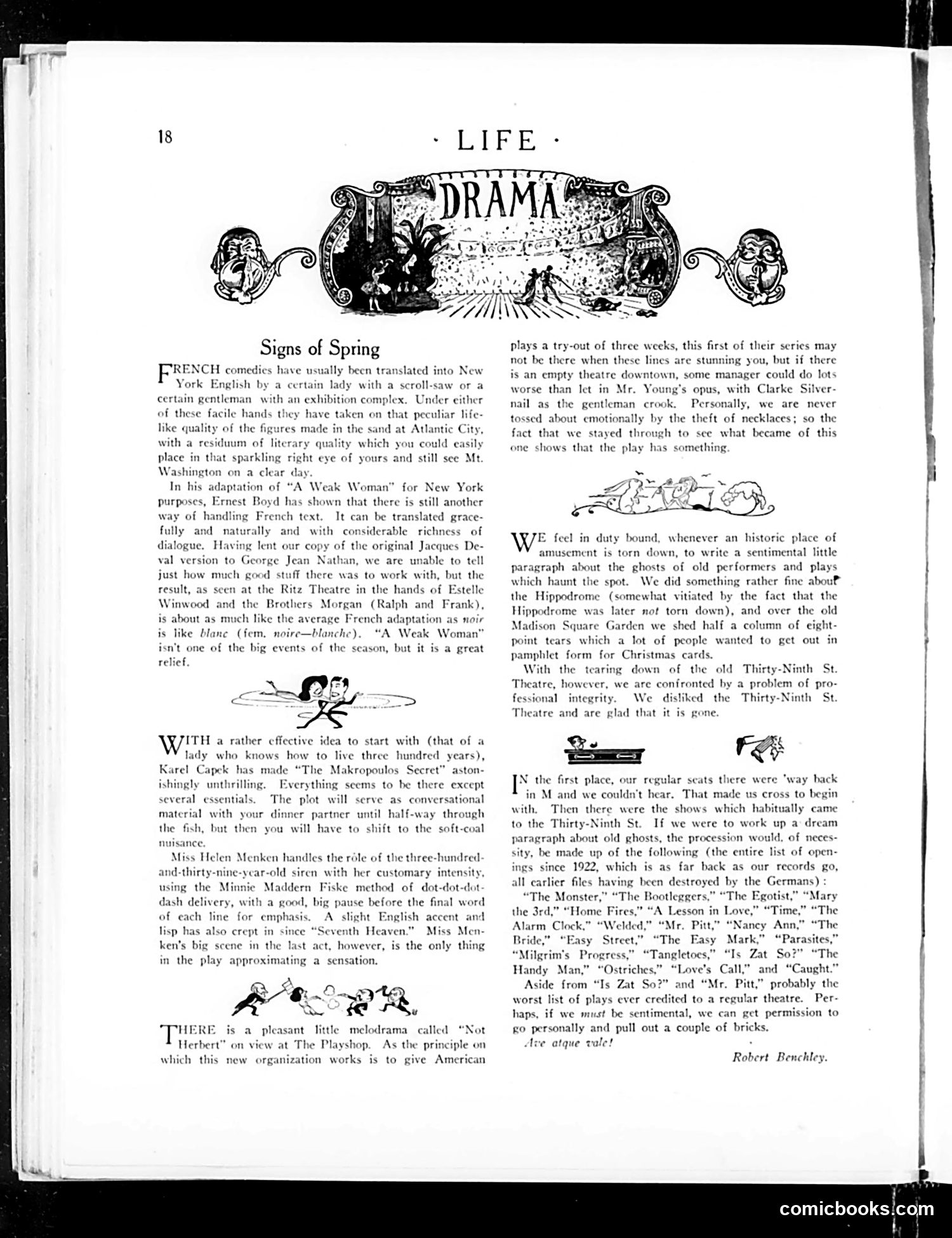
This page reviews three theatrical productions opening in New York, written in the sardonic style typical of Life magazine's drama criticism. **"A Weak Woman"** at the Ritz Theatre—a French comedy adapted by Ernest Boyd—receives backhanded praise. The critic acknowledges Boyd's skillful translation but finds the production, featuring actresses Estelle Winwood and the Morgan brothers, disappointingly flat compared to the original French wit. **"The Makropulos Secret"** by Karel Čapek features Helen Menken as a 339-year-old woman. The critic mocks both the play's thin plot and Menken's affected acting style—her overwrought delivery with strategic pauses and affected English accent. **"Not Herbert"** at The Playshop is praised as entertainingly competent melodrama, though the critic admits emotional indifference to its plot about stolen necklaces. The piece concludes with sentimental nostalgia for the recently demolished Thirty-Ninth Street Theatre, while wryly noting the critic's conflicted duty to memorialize defunct venues—a gentle satire on theatrical sentimentality.
📄 Transcribed text from this page (OCR, searchable)
Machine-transcribed from the original scan — historical spelling and the odd misread are preserved.
Signs of Spring dies have usually been translated into New h by a certain lady with a scroll-saw or a with an exhibition complex. Under either of these facile hands they have taken on ¢ like quality of the figures made in the s FRENCH com York Eng c ain gentlem: at peculiar life- at Atlantic City, h you could easily with a residuum of literar in that sparkling rig! ington on a clear day In his adaptation of “A Weak Woman” for New York purposes, Ernest Boyd has shown that there is still another way of handlin *rench text. It can be translated grace- fully 1 natu’ and with considerable richness of dialogue. Having our copy of the original Jacques De- athan, we are unable to tell just how much good stuff there was to work with, but the result, as seen at the Ritz Theatre in the hands of Winwood and the Brothers Morgan (Ralph and. Frz is about as much like the average French adaptation as noir is like blane (fem. noire—blanche) Woman” isn't one of the big events of the scason, but it is a great relief eye of yours and still see Mt val version to George Jean N ITH a rather effective idea to start with (that of a ady who knows how to live three hundred years), ‘arel Capek has made “The Makre ish woulos Secret” aston- ly unthrilling. Everything seems to be there except several essentials. The plot will serve as conversational material with your dinner partner until half-way. throu the fish, but then you will have to shift to the soft-coa nuisance. Miss Helen Menken handles th and-thirty-nine-year-old siren w ‘Sle of the three-hundred h her customary intensity, using the Minnie Maddern Fiske method of dot-dot-dot good, big pause before the final word of each line for emphasis. A slight English accent and ith Heaven.” Miss Men- ast act, however, is the only thing dash delivery, with “Seve lisp has also crept in sin ken’s big scene in the in the play approximating a. sensation. Qe 7 HERE is a pleasant little melodrama calle Herbert” on view at he Playshop. As the principle which this new organization works is to give American plays a try-out of three weeks, this first of their series may not be there when these lines are stunning you, but if there is an empty theatre downtown, some manager could do lots worse than let in Mr. Young's opus, with Clarke § nail as the gentleman crook. Personally, we are never tossed about emotionally by the theft of necklaces; so the fact that we stayed through to see what became of this ¢ shows that the play has something Iver- = feel in duty bor nd, whenever an historic place of amusement is torn down, to write a sentimental little paragraph about the ghosts of old performers and plays which haunt the spot. We did something rather ¢ abou? the Hippodrome (somewhat vitiated by the fact that the Hippodrome was later ft torn down), and over the old a column of eight- point tears which a lot of people wanted to get out in pamphlet form for Christmas cards. With the tearing down of the old Thirty-Ninth St Theatre, however, we are confronted by a problem of pro- al integrity We disliked the Thirty-Ninth St heatre lad that it is gone. Madison Square Garden we shed h fessior and are g£ eer) FY N the first place, in M and we could with, to the Thirty-Ninth St. If we were to work up a dream paragraph about old ghosts, the procession would, of neces- sity, be made up of the following (the entire list of open- gs since 1922, which is as far back as our records go, all earlier files having been destroyed by the Germans) : “The Monster,” “The Bootleg "The Egotist, the 3rd,” “Home Fires, ove,” “Tim “Welded,” Ann, lasy .” “Parasites, “Milgrim’s Pro; “Tangletocs,” “Is Zat So?” “The Handy Man,” “Ostriches,” *s Call,” and “Caught.” Aside from “Is Zat So?” and “Mr. Pitt,” probably the worst list of plays ever credited to a regular theatre. Per- haps, if we must be sentimental, we can get permission to go personally and pull out a couple of bricks. regular seats there were ‘way hack t hear. That made us cross to begin n there were the shows which habitually ca me Ave atque vale! . Robert Benchley. | comicbooksicom