
Life, 1926-02-18 · page 8 of 36
Life — February 18, 1926 — page 8: what you’re looking at
What you’re looking at
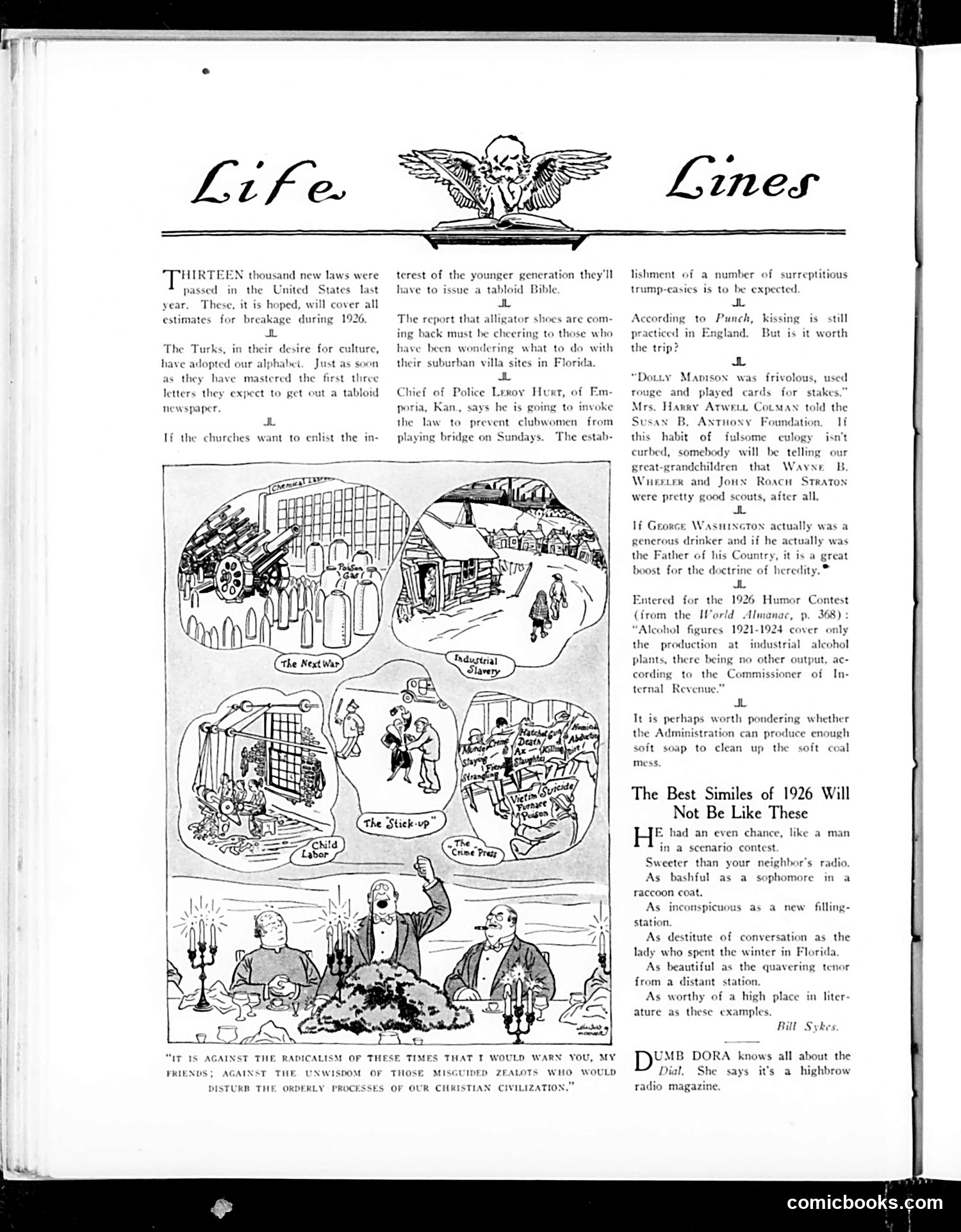
This page from *Life* magazine contains social satire about 1920s American culture. The upper cartoon sequence depicts industrial and domestic labor scenarios labeled "The First War," "Industrial Slavery," "The Stick-up," "Child Labor," and "The Cracker Trust"—satirizing workplace exploitation and economic inequality during the era. The lower cartoon shows three men in formal dress around a campfire, with a caption criticizing "the radicalism of these times" and warning against those who would "disturb the orderly progress of our Christian civilization." This appears to mock conservative fears of social change and radicalism. The text pieces discuss 1926 laws, alligator shoes, and includes a section titled "The Best Similes of 1926 Will Not Be Like These" offering humorous comparisons. Overall, the page satirizes both labor conditions and conservative anxieties about modernity.
📄 Transcribed text from this page (OCR, searchable)
Machine-transcribed from the original scan — historical spelling and the odd misread are preserved.
rf HIRTEEN thousand new laws were passed in the United States last year. These, it is hoped, will cover all for breakage during 1926. aL The Turks, in their desire for culture, estimate: have adopted our alphabet. Just as soon as they have mastered the first three letters they expect to get out a tabloid newspaper. a If the churches want to enlist the in- terest of the younger generation they'll have to issue a tabloid Bible JL The report that alliga ing back must be cheering to those who shoes are com- have been wondering what to do with their suburban villa sites in la. LL Chief of Police Leroy Hurt, of Em- ‘oke nt clubwomen from poria, Kan, says he is going to the law to preve playing bridge on Sundays. The estab- lishment of a number of surreptitious trump-easies is to be expected JL cording to Punch, k practiced in England. B the trip? ng is still is it worth L “Dotty Maptson was frivolou s, used rouge and played cards for stakes.” Mrs. Harry Atwett Cotman told the Susan B. Axtuoxy Foundation. If this habit of fulsome culogy isn't curbed, somebody will be telling our great-grandchildren that Wayse B. Wuerter and Joux Roacn Strato were pretty good scouts, after all. SL If Grorce Wasnincton actually was a generous drinker and if he actually the Father of his Countr boost for the doctrine of heredity.” = Entered for the 1926 Humor Contest (irom the World Almanac, p. 368): “Alcohol figures 1921-1924 cover only the production at industrial alec it isa plants, there being no other output, ac- cording to the Commissioner of In- ternal Revenue.” JL It is perhaps worth pondering whether the Administration can prod: soft s ¢ enough ap to clean up the soft coal mess. The Best Similes of 1926 Will Not Be Like These E had an even chance, like a man in a scenario contest Sweeter than your neighbor's radio. As bashful as a sophomore in a raccoon coat. As inconspicuous as a new filling- station. As destitute of conversation as the lady who spent the winter in Florida, As beautiful as the quavering tenor from a distant station. As worthy of a high place in liter- ature as these examples. Bill Sykes UMB DORA knows all about the She says it's a highbrow radio magazine. “IT IS AGAINST THE RADICALISM OP THESE TIMES THAT T WOULD WARN YOU, MY FRIENDS; AGAINST THE UNWISDOM OF THOSE MISGUIDED ZEALOTS WHO WOULD L DISTURB THE ORDERLY PROCESSES OF OUR CHRISTIAN CIVILIZATION.” e comicbooks.