
Life, 1926-02-18 · page 16 of 36
Life — February 18, 1926 — page 16: what you’re looking at
What you’re looking at
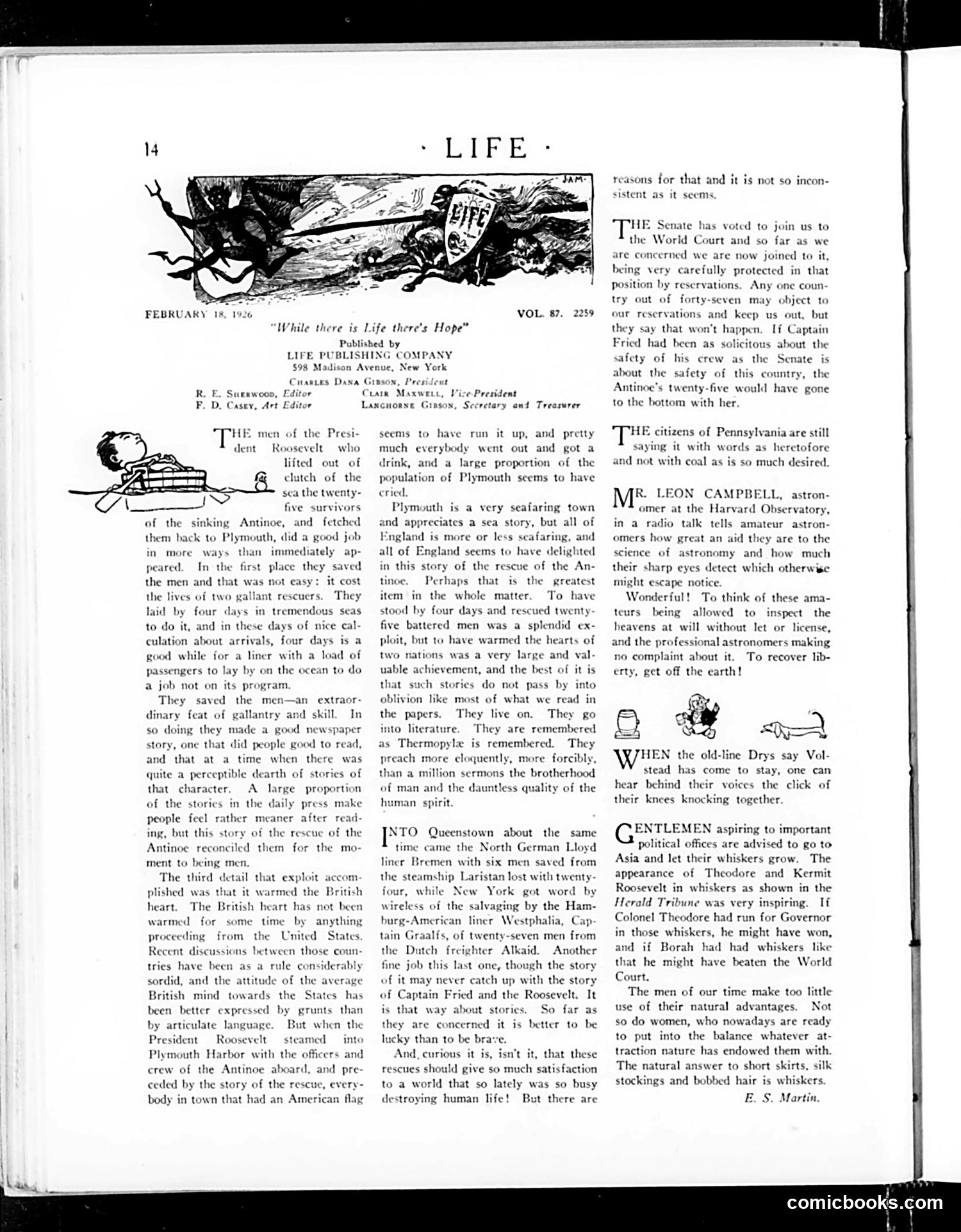
The cartoon at top depicts a skeletal Death figure labeled "LIFE" alongside the caption "While there is Life there's Hope." This is a visual pun playing on the magazine's title—using Death as ironic commentary on current events. The page's editorial content discusses the recent rescue of the *Antinoe* ship and survivors, praising this humanitarian achievement. The text contrasts this with cynicism about human nature, noting that such rescue stories—unlike typical newspaper fare—demonstrate noble human spirit worth remembering. The bottom section critiques politicians, particularly regarding Theodore Roosevelt's whiskers as a campaign asset, satirizing how candidates rely on superficial appearance rather than substantive qualification for office. The overall tone mixes admiration for genuine heroism with skepticism toward political vanity.
📄 Transcribed text from this page (OCR, searchable)
Machine-transcribed from the original scan — historical spelling and the odd misread are preserved.
ew iS “While there is Publi LIFE PUBLIS! VOL. 87. 2289 Life there’s Hope” ished by HING COMPANY $98 Madison Avenue, New York Cuarues Dana R. E. Surawoon, Editor F. D, Casey, Art Editor HE men of the Presi- who lifted out of clutch of the sea the twenty- five survivors fetched Roosevelt of the them back to Plymouth, did a good job in more sinking Antinoe, and ways than immediately ap- peared. In the the men and th the lives of tw rst place they saved t was not easy: it cost gal They four days in tremendous s nt rescuers, laid by to do it, and in these days of nice cal- cul good while for a liner with a load of tion about arrivals, four days is a passengers to lay by on the ocean to do a job not on its program. They saved the men— dinary feat of gallantry and skill. In so doing they made a good newspaper story, one that did people good to read, that at a time there was quite a perceptible dearth of stories of that character. A large proportion of the stories in the daily press make people feel rather meaner after read- ing, but this story of the rescue of the for the mo- in extraor- when Antinoe reconciled them ment to being men. The third detail that exploit accom plished was that it warmed the British heart. The British heart has warmed for Deen time by from the United some anything States, Recent discussions between those coun- proceeding tries have been as a rule con derably sordid, and the attitude of the average British been better expressed by grunts than But when the steamed — into Plymouth Harbor with the o! crew of the Antinoe aboard, mind towards the States has by articulate language. President Roosevelt ers and nd pre ceded by the story of the rescue, every- body in town that had an American flag Giasox, President Crate Maxwett, Vice-President Lancnoaxe Gisson, Secretary and Treasurer seems to have run it up, and pretty much everybody went out and got a drink, and a large proportion of the population of Plymouth seems to have cried. Plymouth is a very seafaring town and appreciates a sea story, but all of England is more or less seafaring, and all of England seems to have delighted in this story of the rescue of the An- tinoe. Perhaps that is the greatest item in the whole matter. To have stood by four days and rescued twenty- battered men was a splendid ex- ploit, but to have warmed the hearts of two nations was a very large and val- uable achievement, and the best of it is that such stories do not pass by into oblivion like most of what we read in the papers. They live on, into literature. as Thermo; They go They are remembered They forcibly, than a million sermons the brotherhood of man and the dauntless quality of the human spirit le is remembered. ch more eloquently, me the same th German Lloyd h six men saved from the steamship Laristan lost with twen four, while New York got word by wireless of the salvaging by the Ham- burg-American liner Westphalia, Cap tain Graalfs, of twenty-seven men from the Dutch freighter Alkaid. Another fine job this last one, though the story of it may never catch up with the story of Captain Fried and the Roosevelt. It is that way about s o far as they are concerned it is better to be lucky than to be brave. And, curious it is, is rescues should giv IX TO Queenstown about time came the Ne liner Bremen w ories t it, that these 0 much satisfaction to a world that so lately was so busy destroying human life! But there are reasons for that and it is not so incon- sistent as it seems. HE Senate the World Court and so far as we are concerned we are now joined to it, being very carefully protected in that position reservations. Any one coun- try out of forty-seven may object to tions and keep us out, but say that won't happen. If Captain Fried had been as solicitous about the safety of his crew as the Senate is about the safety of this country, th Antinoe’s twenty- as voted to join us to our resery they ve would have gone to the bottom with her. 'HE citizens of Pennsylvania are still saying it with words as heretofore and not with coal as is so much de: M® LEON CAMPBELL, astron- omer at the Harvard Observatory, in a radio talk tells amateur astron- omers how great an aid science of red. 'y are to the and how much their sharp eyes detect which otherwise might escape notice. Wonderful! teurs astronomy To think of these ama- allowed to inspect the heavens at will without let or license, and the professional astronomers making no complaint about it. To recover lib- erty, get off the earth! being HEN the old-line Drys say Vol- stead has come to stay, one can hear behind their voices the click of their knees knocking together. G TLEMEN aspiring to important political offices are advised to go to Asia and let their whiskers grow. The appearance of Theodore and Kermit Roosevelt in whiskers as shown in the Herald Tribune was very inspiring. If Colonel Theodore had run for Governor in those whiskers, he might have won, nd if Borah had had whiskers like that he might have beaten the World Court. The men of our time make too little use of their natural advantages. Not so do women, who nowadays are ready to put into the balance whatever at- traction nature has endowed them with. The natural answer to short skirts, silk stockings and bobbed hair is whiskers. E. S. Martin. comicbooks.com