
Life, 1926-02-18 · page 23 of 36
Life — February 18, 1926 — page 23: what you’re looking at
What you’re looking at
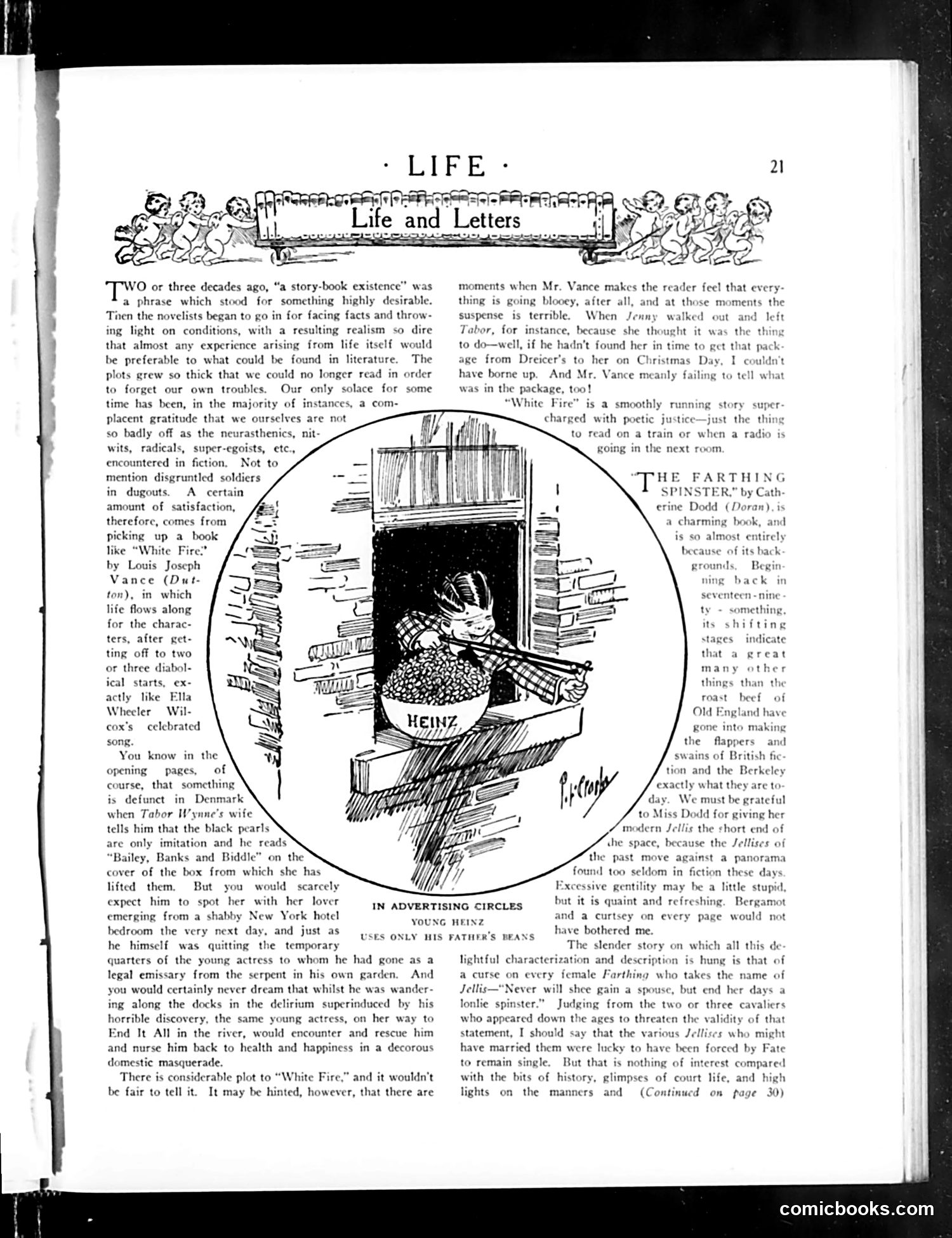
This page reviews two novels in Life's "Life and Letters" section. The main content discusses Louis Joseph Vance's "White Fire," praised as escapist entertainment—a deliberately plotty, emotionally satisfying story offering relief from the grim literary realism that had dominated recent fiction. The circular illustration shows a young man (Heinz) in an advertising plug for "Young Heinz Uses Only His Father's Beans"—a commercial advertisement cleverly embedded in the editorial content. The page also previews Catherine Dodd's "The Farthing Spinster," a British novel featuring a family curse preventing women named Jellis from marrying. The reviewer appreciates its gentle, old-fashioned charm as relief from modernist heaviness. The overall message: after years of depressing, issue-heavy novels about soldiers, neurotics, and social problems, readers craved simple, well-plotted entertainment and nostalgic stories.
📄 Transcribed text from this page (OCR, searchable)
Machine-transcribed from the original scan — historical spelling and the odd misread are preserved.
Tvo or three decades ago, “a story-book existence” was a phrase which stood for something highly desirable. Tien the novelists began to go in for facing facts and throw- ing light on conditions, with a resulting realism so dire that almost any experience arising from life itself would be preferable to what could be found in literature. The plots grew so thick that we could no longer read in order to forget our own troubles. Our only solace for time has been, in the majority of instances, a com- placent gratitude that we ourselves are not so badly off as the neurasthenics, nit- wits, radicals, super-egoists, etc., encountered in fiction. mention disgruntled soldiers in dugouts. A certain amount of satisfaction, therefore, comes from picking up a book like “White Fire.” by Louis Joseph Vance (Dut- ton), in which life flows along for the charac- ters, after get- ting off to two or three diabol- ical starts, ex- actly like Ella Wheeler Wil- cox's celebrated You know in the opening pages, of course, that something is defunct in Denma: when Tabor Wynne’s wife tells him that the black pearls are only imitation and he reads “Bailey, Banks and Biddle” on the cover of the box from which she has lifted them. But you would scarcely expect him to spot her with her lover emerging from a shabby New York hotel bedroom the very next day, and just as he himself was quitting the temporary quarters of the young actress to whom he had gone as a legal emissary from the serpent in his own garden. And you would certainly never dream that whilst he was wander- ing along the docks in the delirium superinduced by his horrible discovery, the same young actress, on her way to End It All in the river, would encounter and rescue him and nurse him back to health and happiness in a decorous domestic masquerade. There is considerable plot to “White Fire,” and it wouldn't be fair to tell it. It may be hinted, however, that there are IN ADVERTISING CIRCLES YOUNG HEINZ USES ONLY HIS FATHER'S BEAD moments when Mr. Vance makes the reader feel that every thing is going blooey, after all, and at those moments t When Jenny walked out and Tabor, for instance, because she thought it was the thing suspense is terrible. to do—well, if he hadn't found her in time to get that pack age from Dreicer’s to her on Christmas Day, I have borne up. And Mr. Vance was in the package, too! “White Fire” is a smoot i ry su charged with poetic ju eanly failing to tel tice—just the thi to read on a train or when a radio is going in the next room. HE FARTHI SPINSTER,” by Cat ine Dodd (Doran). is a charming boc sevente ty - something its shifting stages indicate that a great other things than the many roast beef of Old England have gone into making the flappers and swains of British fic tion and the Berkeley exactly what they are to. day. We must be grateful Liss Dodd for giving modern Jellis the short end of che space, because the Jellises of the past move ai too seldom in fi inst a panorama n these days Excessive gentility may be a little stupi but it is quaint and refreshing. Bergamot da curtsey on every page would not ve bothered me. e slender story on which all this de n and description is hung is that of a curse on every female Farthing who takes the name of Jellis—"Never will shee gain a spouse, but end her days a lonlie spinster.” Judging from the two or three cavaliers who appeared down the ages to threaten the validity of that statement, I should say that the various Jellises who might have married them were lucky to have been forced by Fate to remain single. But that is nothing of interest compared with the bits of history, glimpses of court life, and high lights on the manners and (Continued on page 30) comicbooks.com