
A complete issue · 40 pages · 1926
Life — February 11, 1926
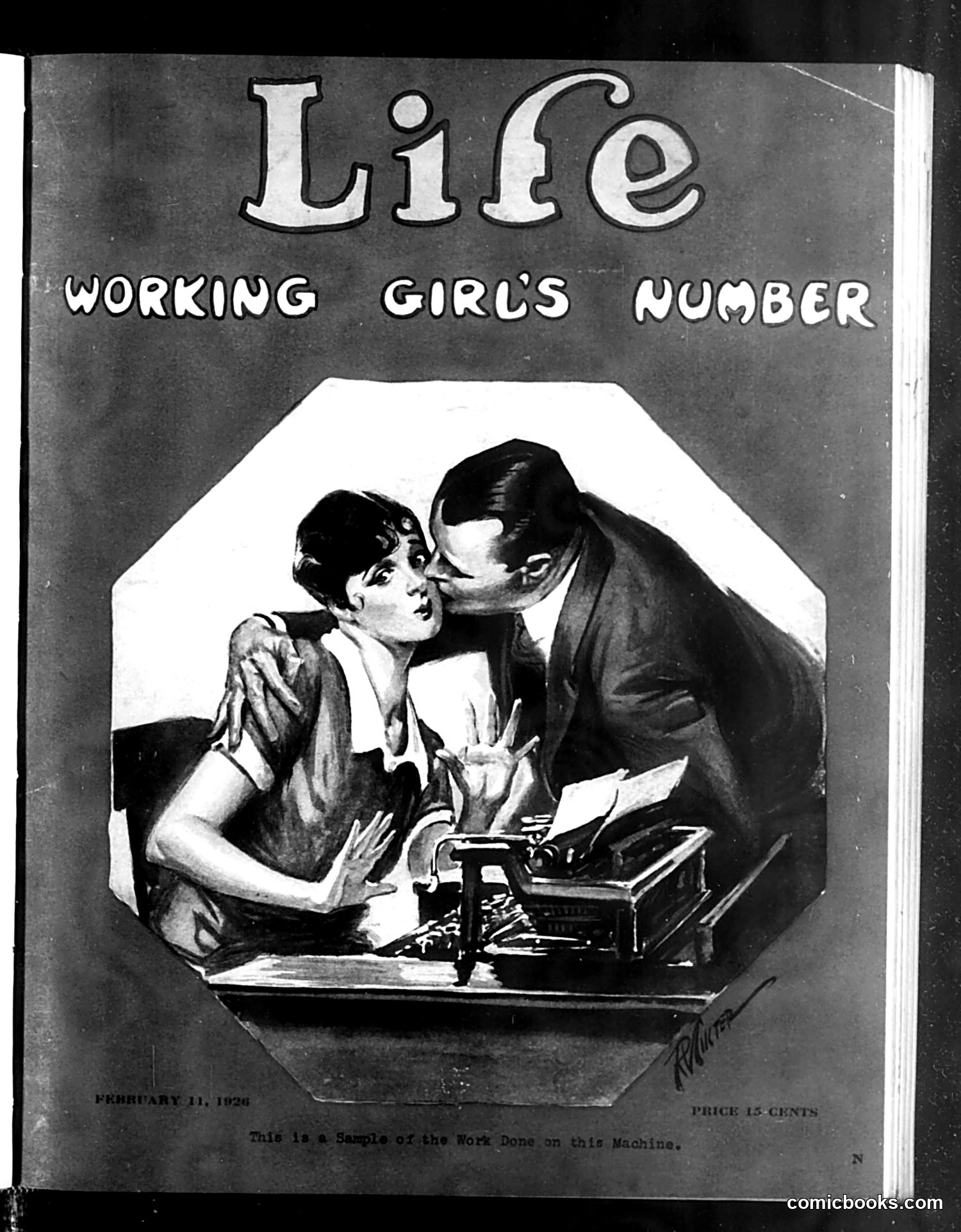
This is a February 11, 1926 cover of *Life* magazine priced at 15 cents. The title "Working Girl's Number" and the illustration depict a romantic office scenario: a man in a suit leans in to kiss a woman seated at a typewriter. The satire targets workplace dynamics of the 1920s. The caption notes "This is a Sample of the Work Done on this Machine"—a double entendre suggesting the "work" being performed isn't typing. The joke satirizes both the distraction of office romance and perhaps the stereotype that working women (a relatively new phenomenon post-WWI) were primarily objects of male attention rather than serious professionals. The illustration mocks the romantic idealization of workplace relationships while commenting on women's precarious professional status.
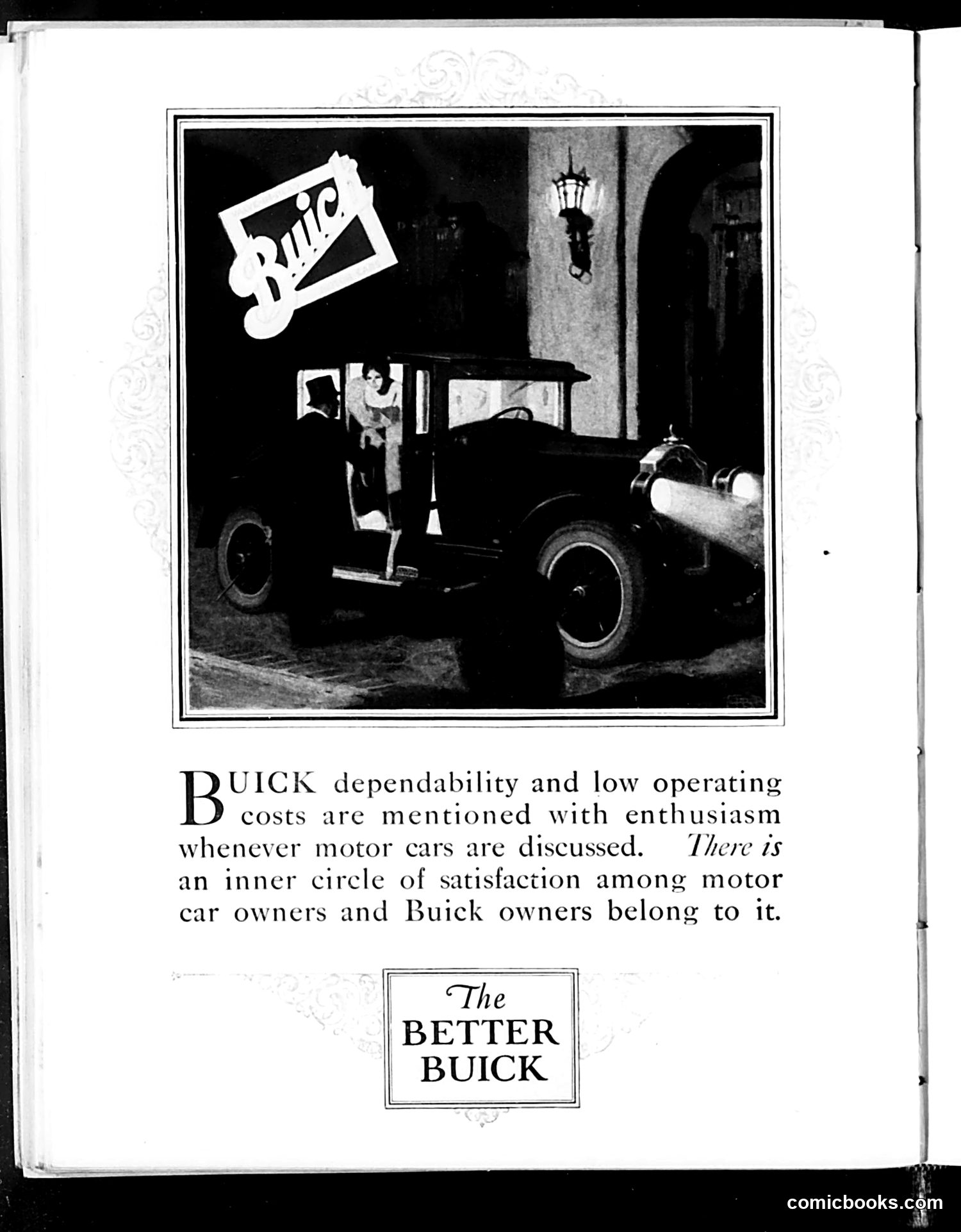
This is a **Buick automobile advertisement**, not political satire or a cartoon. The page displays a black-and-white photograph of an early 1920s Buick truck parked at night outside a building, with the distinctive Buick logo prominently featured above. The accompanying text emphasizes Buick's reputation for "dependability and low operating costs," claiming that Buick owners form an exclusive circle of satisfied customers. The tagline "The Better Buick" reinforces the brand's quality positioning. This is straightforward **product advertising** from the early automotive era, designed to build brand prestige by appealing to consumer satisfaction and practical benefits rather than satirizing anything. It represents typical commercial messaging of the period.
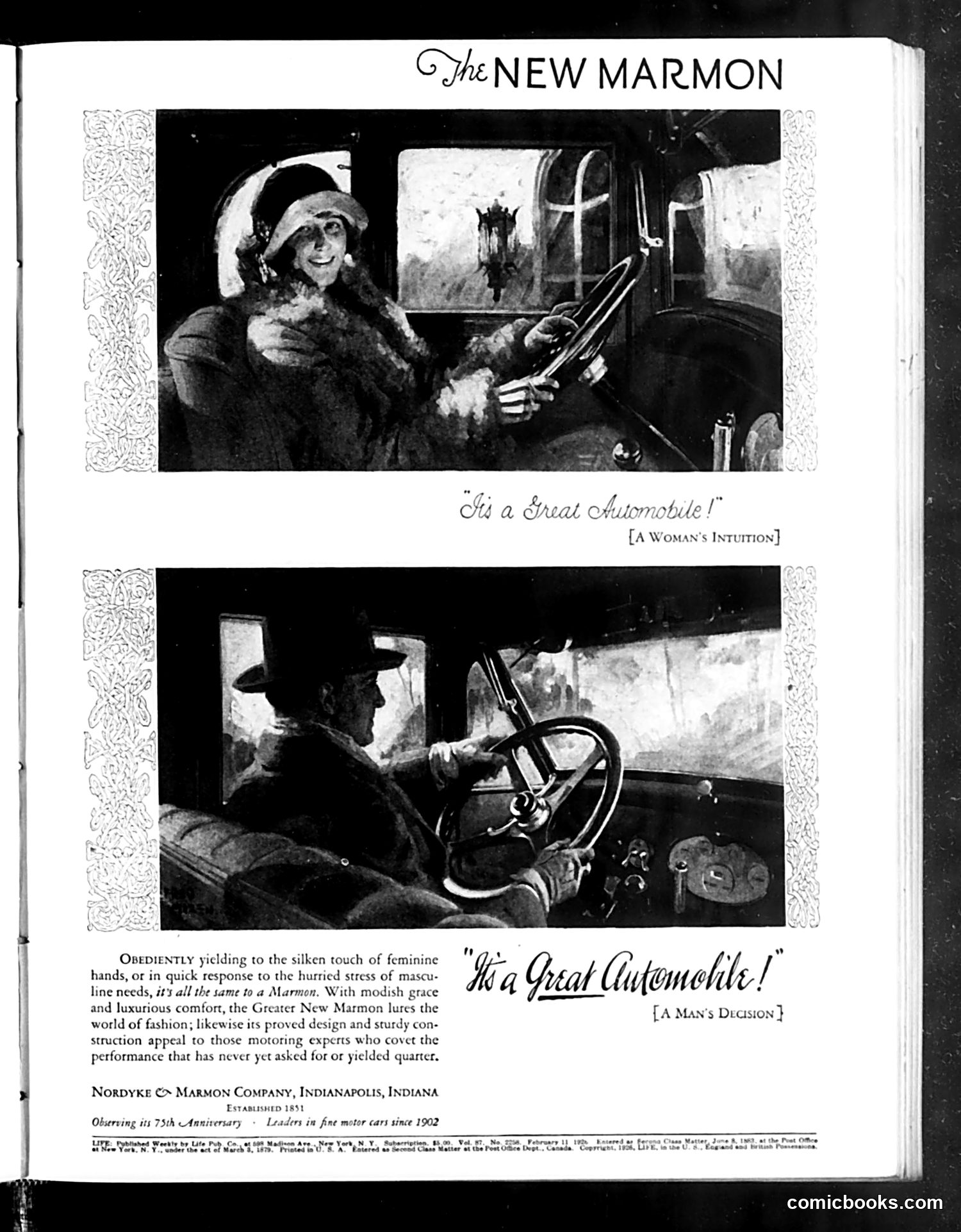
This page is primarily **advertising, not satire**. It's a Marmon automobile advertisement from the Nordyke & Marmon Company (Indianapolis, Indiana), established 1851. The ad uses a gendered marketing approach common in early 20th-century advertising. The top image, captioned "It's a Great Automobile!" [A Woman's Intuition], shows a woman driving with confidence and pleasure. The bottom image, captioned the same phrase but subtitled "[A Man's Decision]," shows a man at the wheel. The copy emphasizes the car's appeal to both genders—it combines "silken touch of feminine hands" with "sturdy construction" for "motoring experts." The advertisement suggests the Marmon satisfies both women's desire for comfort and men's demands for performance, positioning it as universally desirable across gender lines.
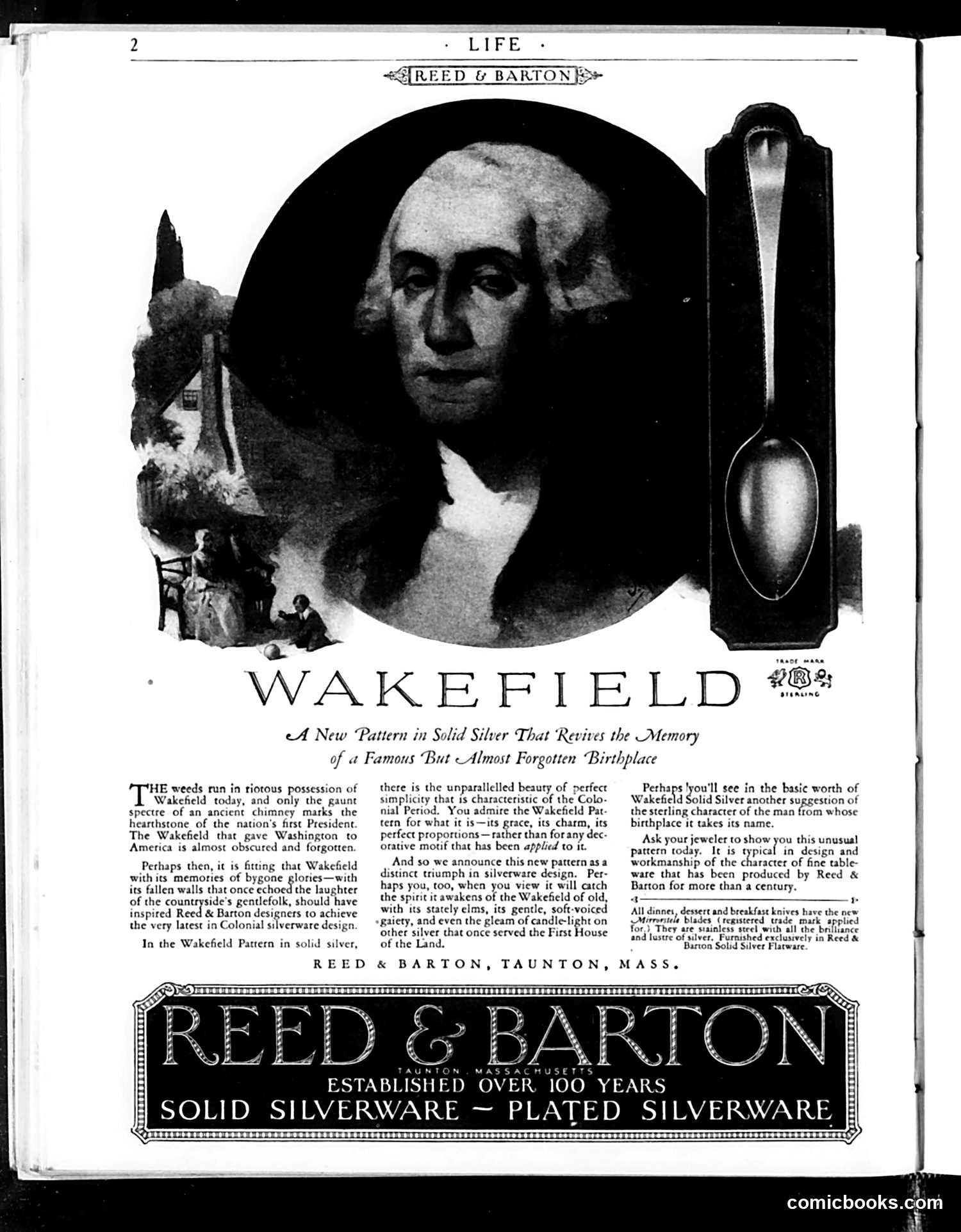
This is primarily a **silver tableware advertisement** for Reed & Barton, a Massachusetts silverware manufacturer established over 100 years prior to this publication. The ad promotes their "Wakefield" pattern in solid silver, using patriotic imagery centered on a portrait (appearing to be a historical American figure, likely colonial-era based on the styling). The left side shows a small colonial scene, while the right displays the actual silverware pattern. The text frames the product as reviving "the memory of a famous but almost forgotten birthplace"—connecting the tableware to American heritage and colonial history. This is **not political satire** but rather **commercial marketing** that leverages nostalgia and patriotic sentiment to sell luxury goods to affluent consumers, a common advertising strategy of the early 20th century.
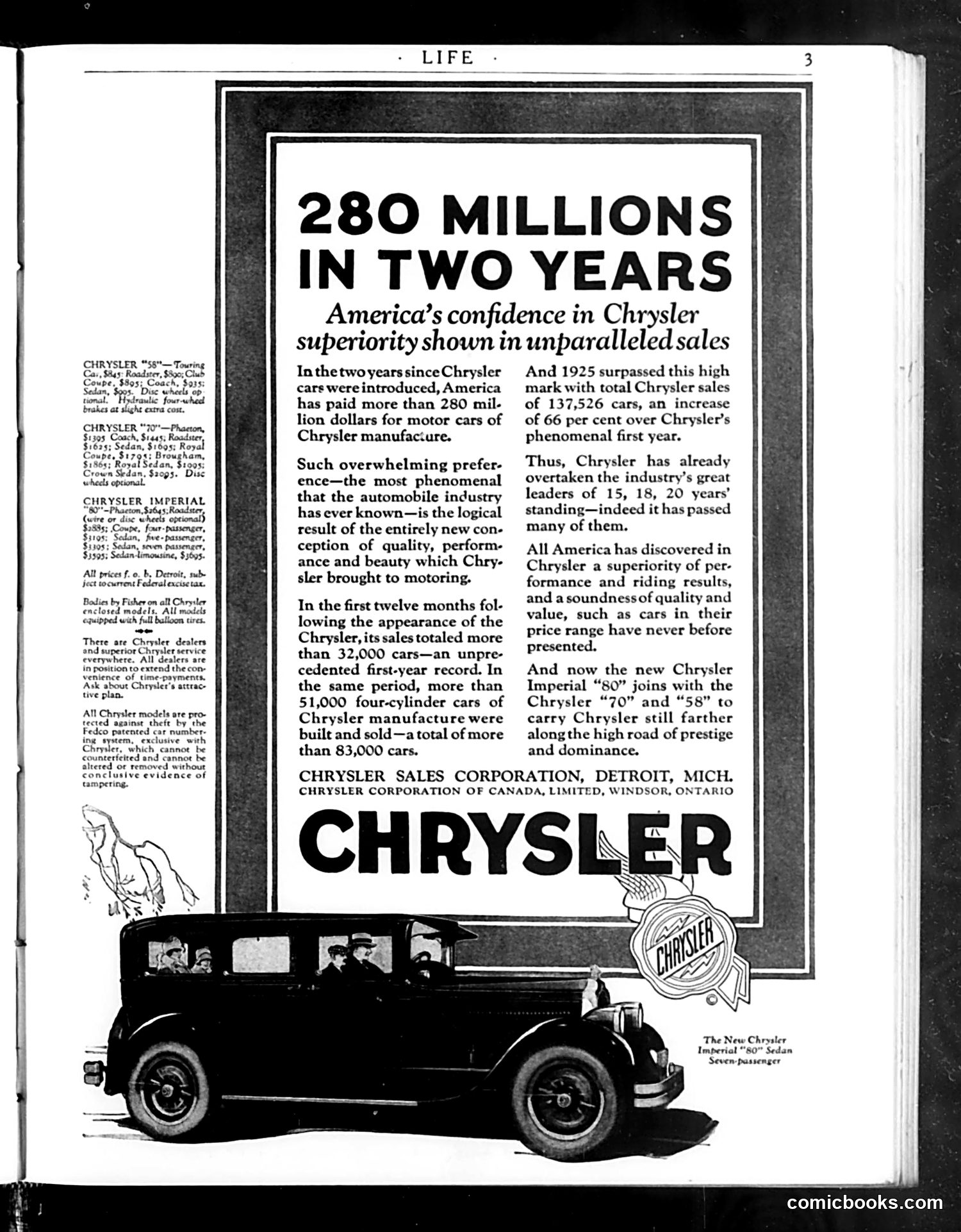
This page is primarily a **Chrysler automobile advertisement**, not satire or political commentary. The headline "280 Millions in Two Years" claims that Americans have purchased $280 million worth of Chrysler vehicles since the company's introduction, demonstrating "America's confidence in Chrysler superiority." The ad emphasizes Chrysler's rapid market dominance, noting their 1925 sales exceeded established competitors like Ford and General Motors. It boasts of quality, performance, and value in their price range. The only illustration is a photograph of a Chrysler Imperial "80" sedan at page bottom. There is no cartoon, caricature, or satirical commentary visible. This is straightforward corporate advertising from Life magazine's commercial pages, circa mid-1920s.
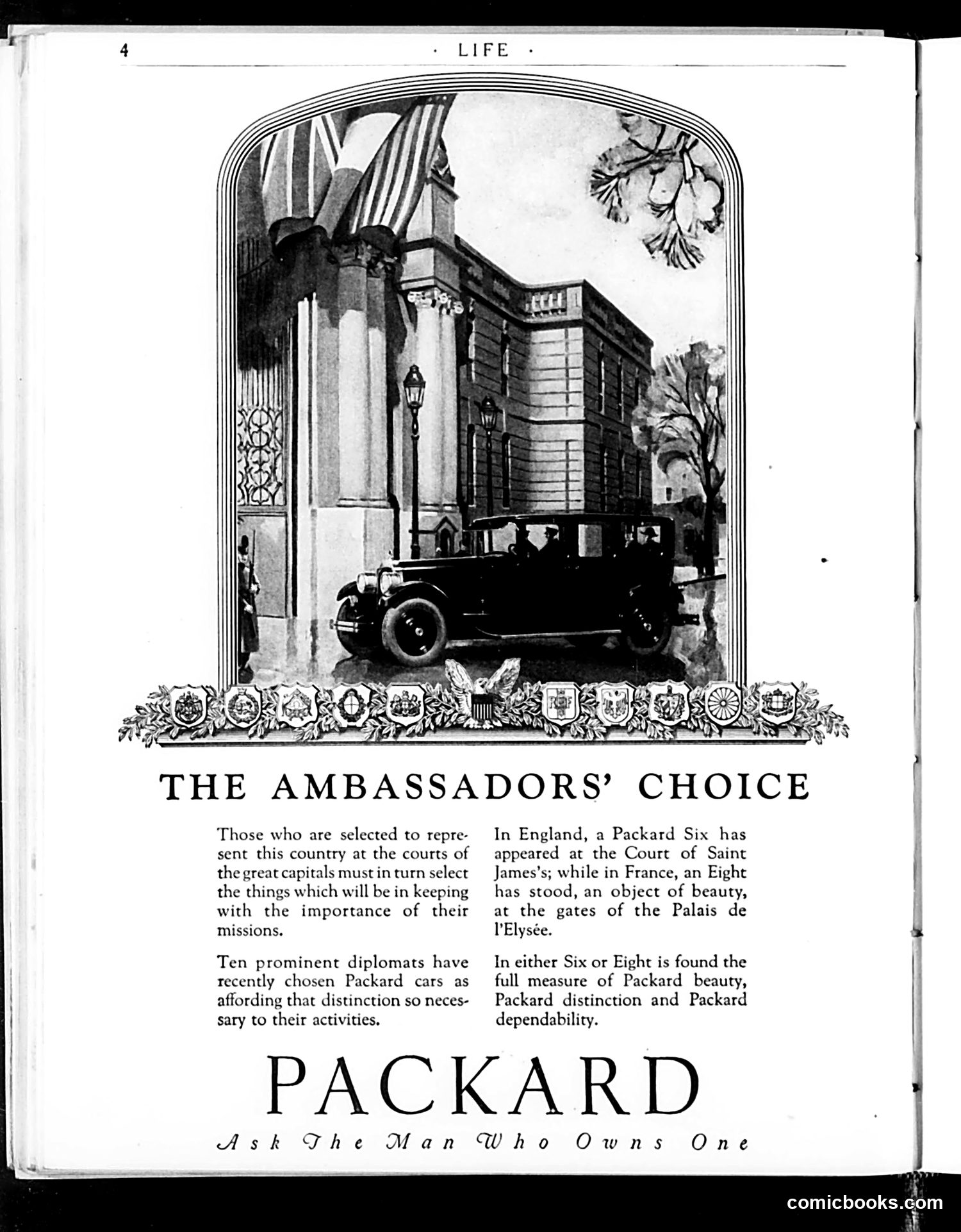
This is primarily a **Packard automobile advertisement**, not political satire. The page uses diplomatic prestige to market luxury cars. The ad's central conceit: prominent diplomats representing the U.S. at foreign courts have chosen Packard vehicles, suggesting that ambassadors—people whose mission requires maintaining national dignity—would select Packards as "keeping with the importance of their missions." Specific references include Packard Six automobiles appearing at the Court of Saint James's (Britain) and Packard Eight at the Palais de l'Élysée (France's presidential palace). The illustration shows an elegant sedan outside a grand governmental building. The tagline "Ask The Man Who Owns One" was Packard's famous slogan. This leverages diplomatic authority to imply the brand embodies "beauty, distinction and dependability."
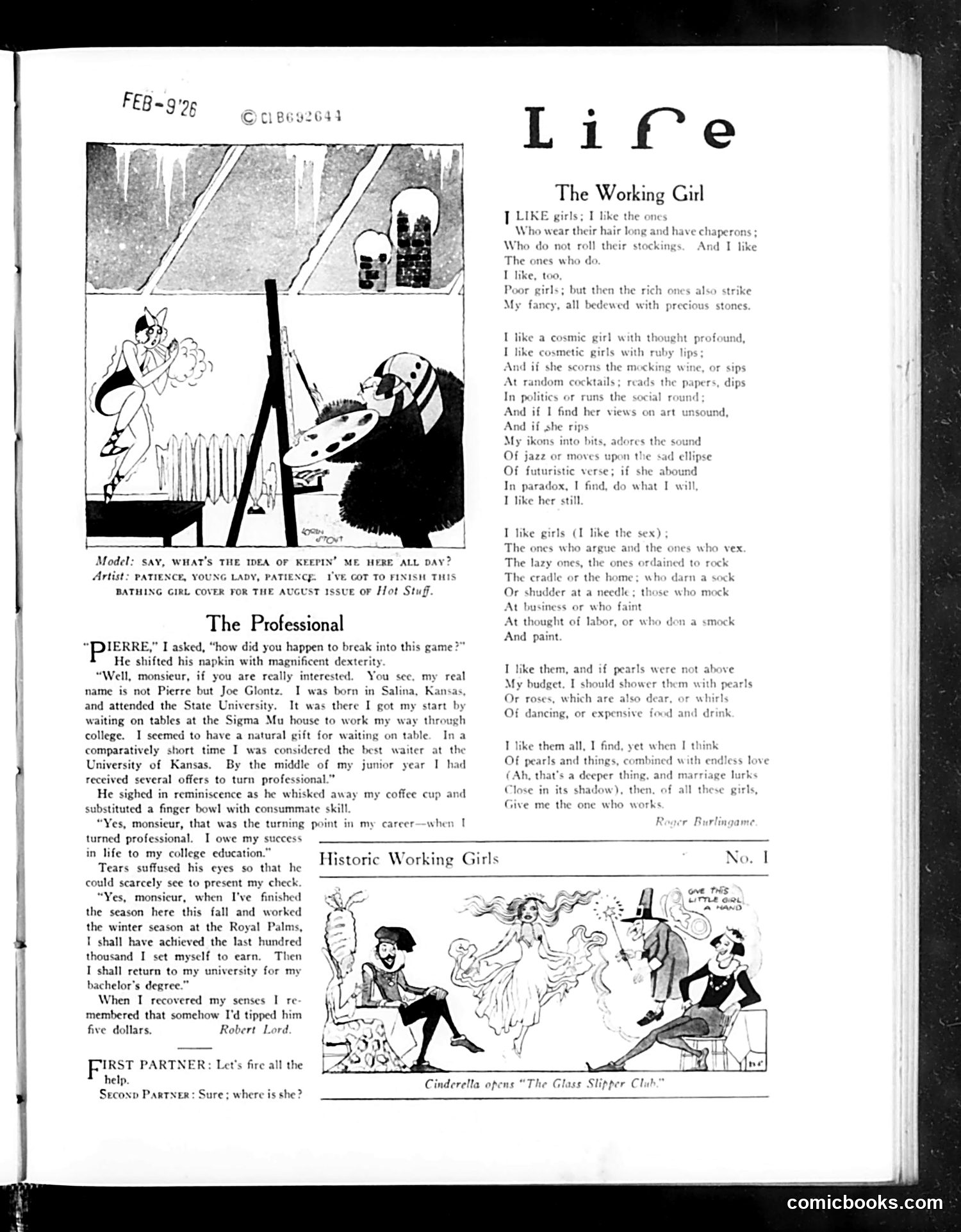
This page celebrates working women through poetry and humor. The top cartoon shows an artist painting a bathing-girl cover while a model poses—satirizing the objectification of women in commercial art while simultaneously participating in it. "The Professional" narrative mocks a waiter named Pierre who affects French sophistication to impress customers, despite being from Kansas. The satire targets class pretension and the performative nature of service work. The poem "The Working Girl" by Roger Burlingame praises independent women—those with jobs, education, and modern attitudes (wearing long hair, rejecting stockings). It celebrates their intellectual engagement and financial independence while gently mocking the wealthy women they contrast against. The final cartoon references Cinderella, suggesting working girls might achieve upward mobility through hard work.
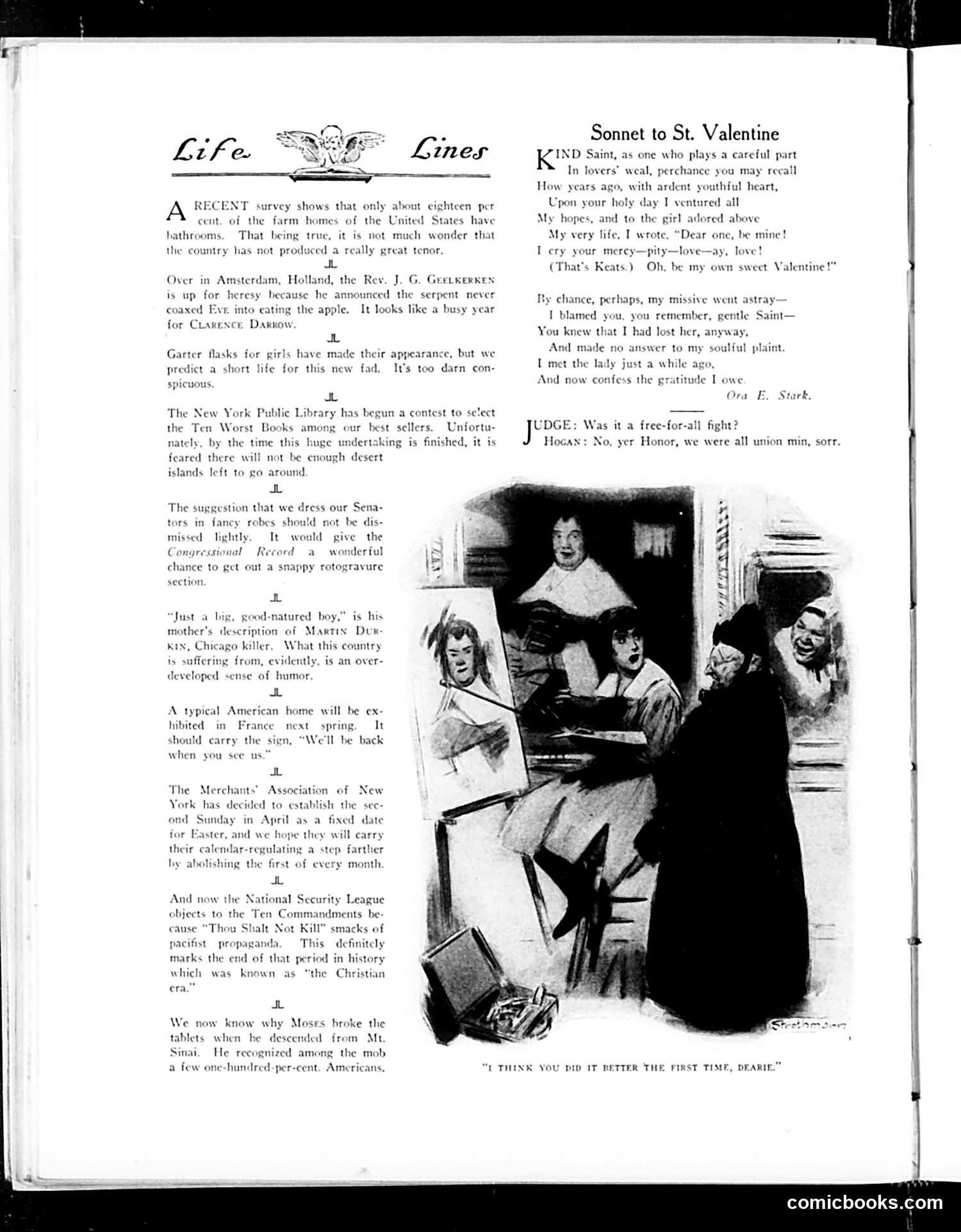
This page combines satirical commentary with a poem and illustration. The left column critiques American culture—including the lack of bathrooms in farm homes, a serpent-into-apple transformation in Amsterdam, and the National Security League's objection to "Thou Shalt Not Kill" as "pacifist propaganda." The illustration and caption "I think you did it better the first time, dearie" depicts what appears to be a domestic scene with a woman showing or discussing something (possibly a photograph or artwork) to others. The joke seems to mock either repetition, amateur attempts at something, or possibly infidelity—suggesting someone has done "it" before "better." Without clearer context on the specific publication date and figures shown, the precise target of satire remains unclear, though the tone is cynical toward American social hypocrisy.
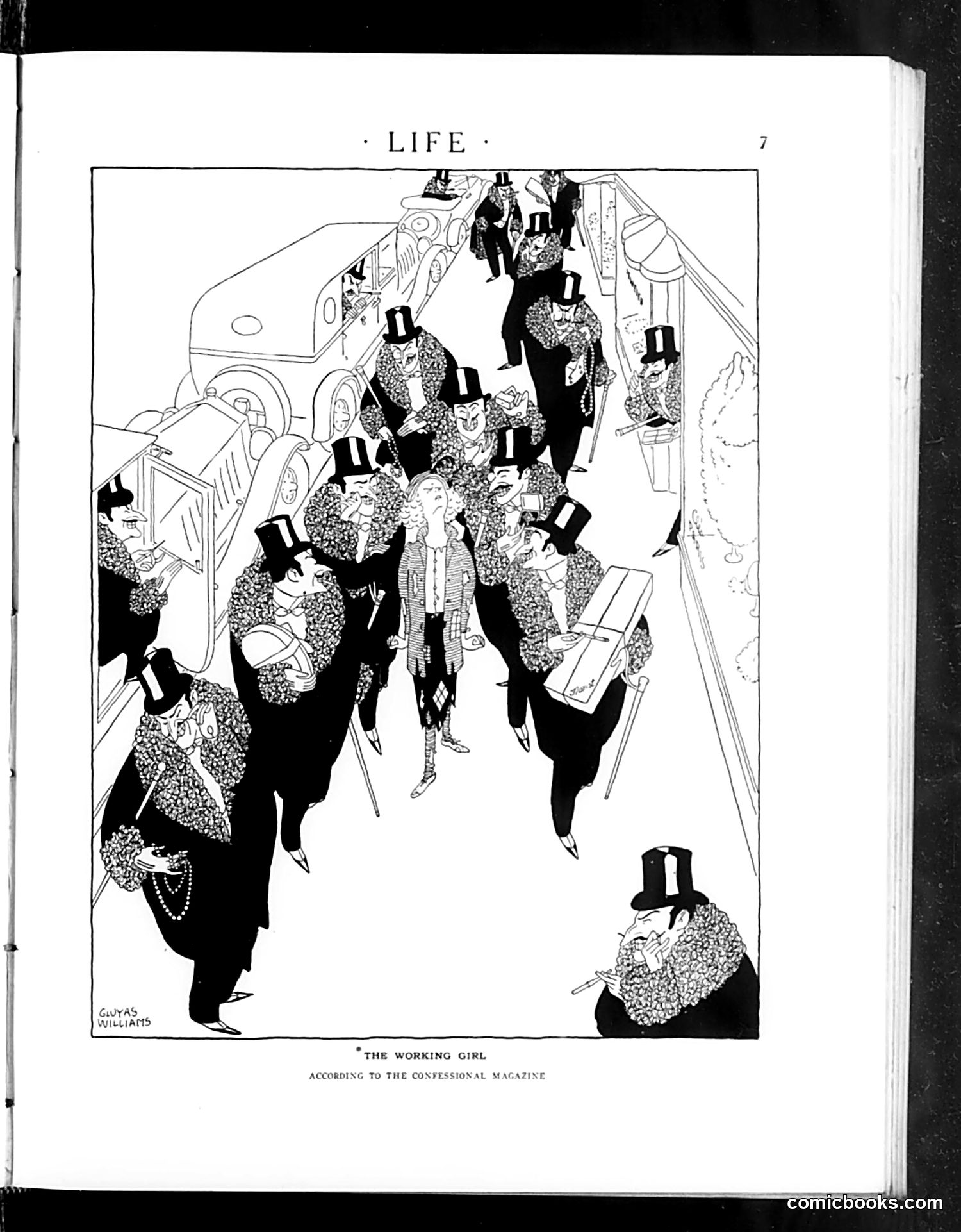
This satirical cartoon by Guyás Williattds critiques how Congress portrayed working women. The image shows a crowded street scene with women wearing identical patterned coats and top hats—formal, masculine attire incongruous with the era's gender norms. The satire appears to mock Congressional perception of working women as either overly fashionable, masculine, or stereotypically uniform rather than individuals. The packed composition and repeated identical figures suggest Congress viewed working women as a homogeneous problem or curiosity rather than understanding their actual diversity and economic necessity. The caption's reference to "Congressional Magazine" indicates this critiques how lawmakers publicly discussed or misrepresented working women during this period, likely early-to-mid 20th century when female labor force participation was controversial.
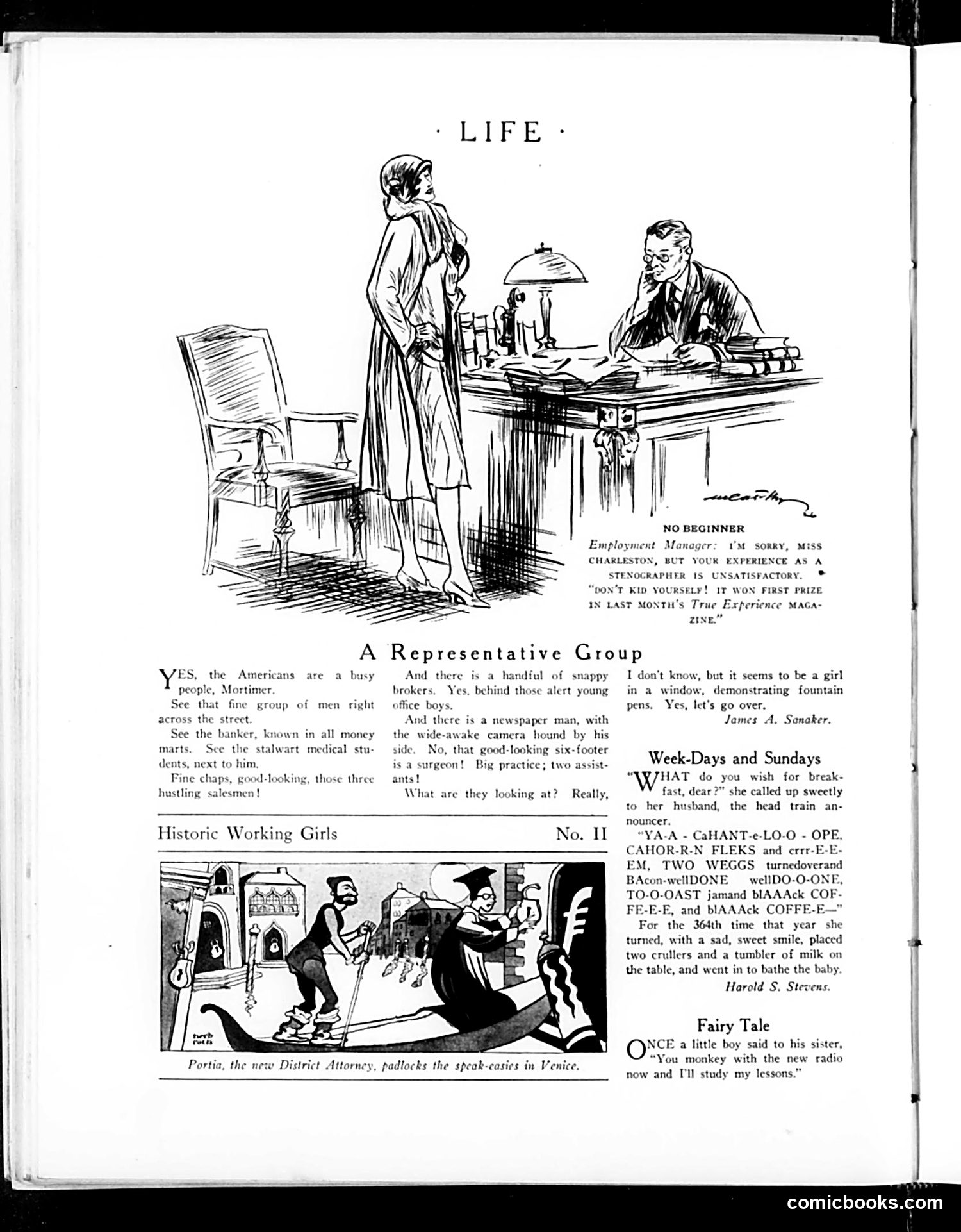
This page satirizes early 20th-century American workplace dynamics. The main cartoon "A Representative Group" depicts a woman visiting an employment office, where a manager rejects her stenography credentials—dismissing her experience as "unsatisfactory" despite winning a magazine prize. The humor targets hiring discrimination: the text notes she's competing against "alert young office boys" and references "a newspaper man" and "a surgeon," suggesting qualified women faced systematic rejection regardless of qualifications. The "Historic Working Girls" section uses historical comparison (Portia, a legal figure from Shakespeare) to mock women's limited professional advancement—the caption about "paddocks the spear-carrier in Venice" appears to mock trivial female roles. The page overall critiques gender-based employment barriers and the casual dismissal of women's professional credentials in this era.
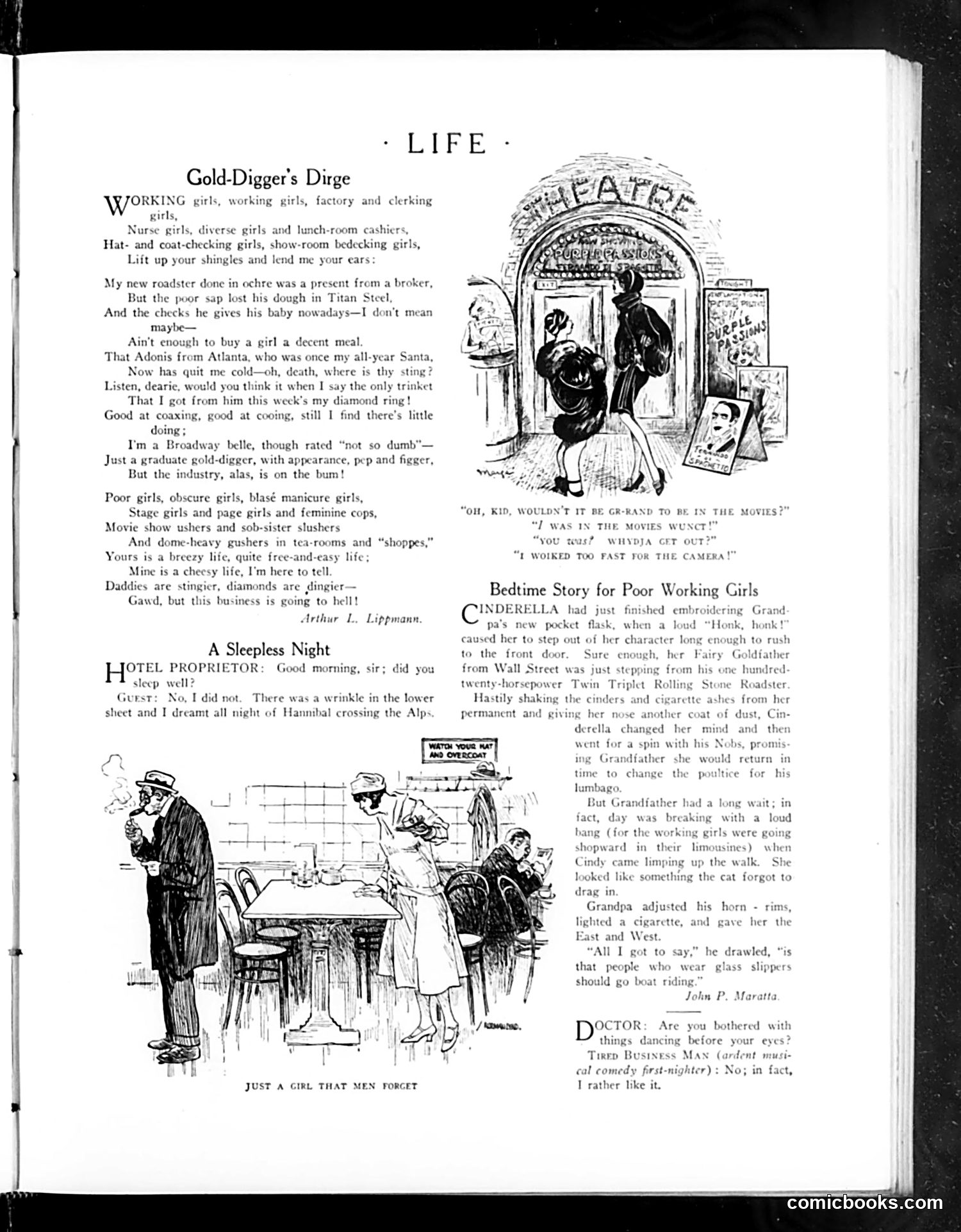
This page contains three satirical pieces about working-class women's lives circa early 20th century. **"Gold-Digger's Dirge"** (poem by Arthur L. Lippmann): Mocks young working women—factory workers, nurses, shop girls—who pursue material security through relationships with wealthier men. The satire criticizes their aspirations for "decent meals" and engagement rings, portraying them as mercenary while acknowledging their economic desperation. **"A Sleepless Night"** (cartoon): Shows a hotel proprietor and guest in conversation, illustrating a humorous domestic scenario. **"Bedtime Story for Poor Working Girls"** (story by John P. Maratta): A Cinderella-style tale about a working girl meeting a wealthy "Fairy Godfather" from Wall Street, satirizing working-class women's fantasies of marrying up and escaping poverty through romantic rescue rather than economic advancement. The overall theme critiques both working women's economic vulnerability and society's dismissal of their legitimate material needs.
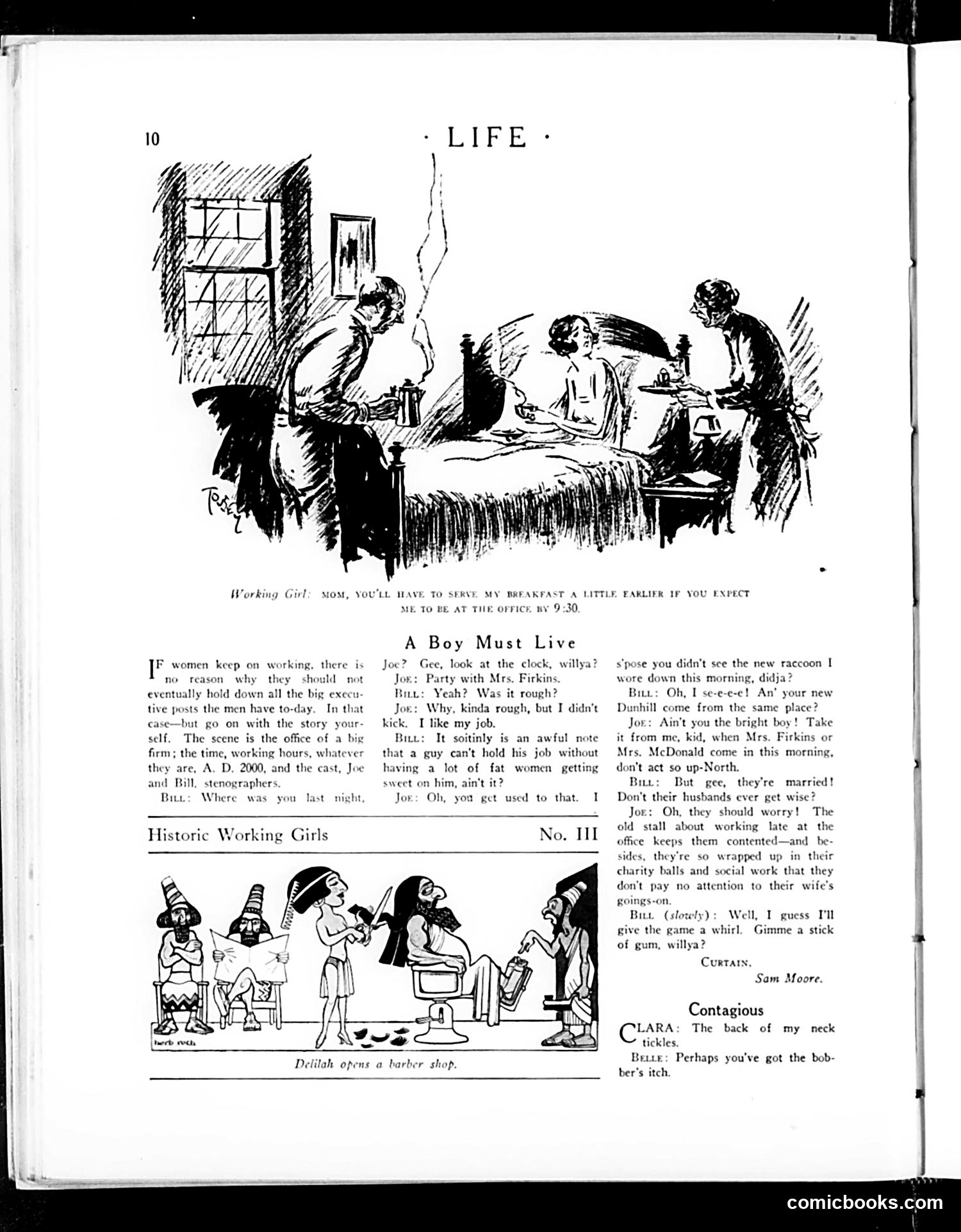
This page presents three satirical pieces about women's work during wartime: 1. **Top cartoon**: A working girl tells her mother she must serve breakfast earlier if the mother expects her at the office by 9:30—satirizing the double burden women faced balancing household duties with employment. 2. **"A Boy Must Live"** dialogue: Two men (Joe and Bill) discuss Joe's wife working while he parties with Mrs. Firkins. Bill criticizes Joe for letting his wife work while he socializes, suggesting married men should support their wives. The satire targets men avoiding responsibility. 3. **"Historic Working Girls"**: A humorous illustration shows ancient female occupations (Egyptian dancers, etc.), implying women have always worked—contextualizing current female employment as historically normal, not novel. The page satirizes gender dynamics and workplace expectations during what appears to be a wartime period requiring female labor.
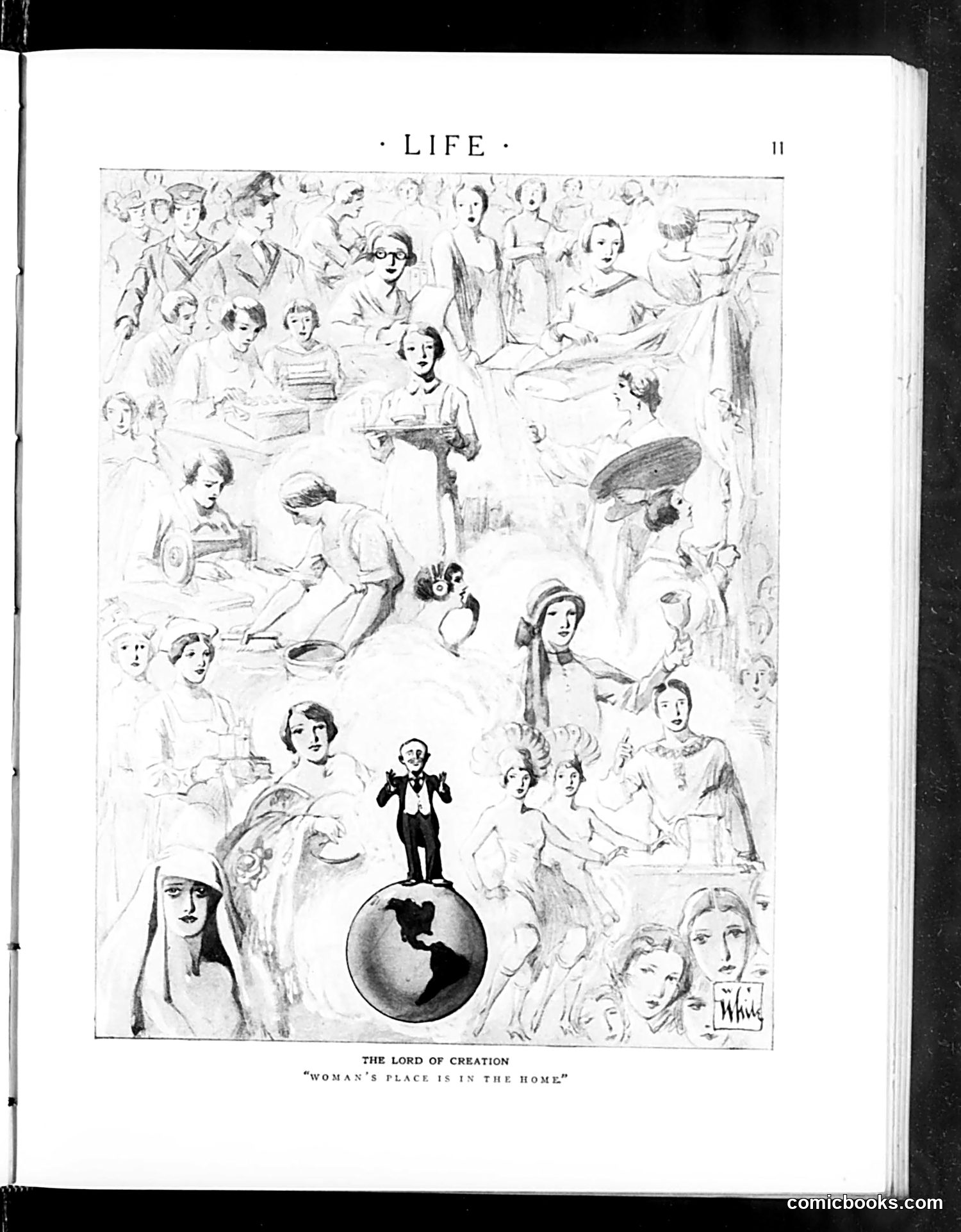
This is a satirical cartoon titled "The Lord of Creation" with the subtitle "Woman's Place Is in the Home." The image shows a small man in formal dress standing atop a globe, surrounded by numerous women engaged in various domestic and productive activities—cooking, cleaning, childcare, needlework, and other household tasks. The satire is ironic: despite the title claiming man as "lord of creation," the composition visually emphasizes women's centrality and labor. Women dominate the composition numerically and spatially, while the man occupies a tiny, precarious perch above them. The cartoon critiques the contradiction between ideology (male dominance) and reality (women's essential work sustaining society). This reflects early 20th-century feminist commentary on women's invisible yet indispensable domestic contributions.
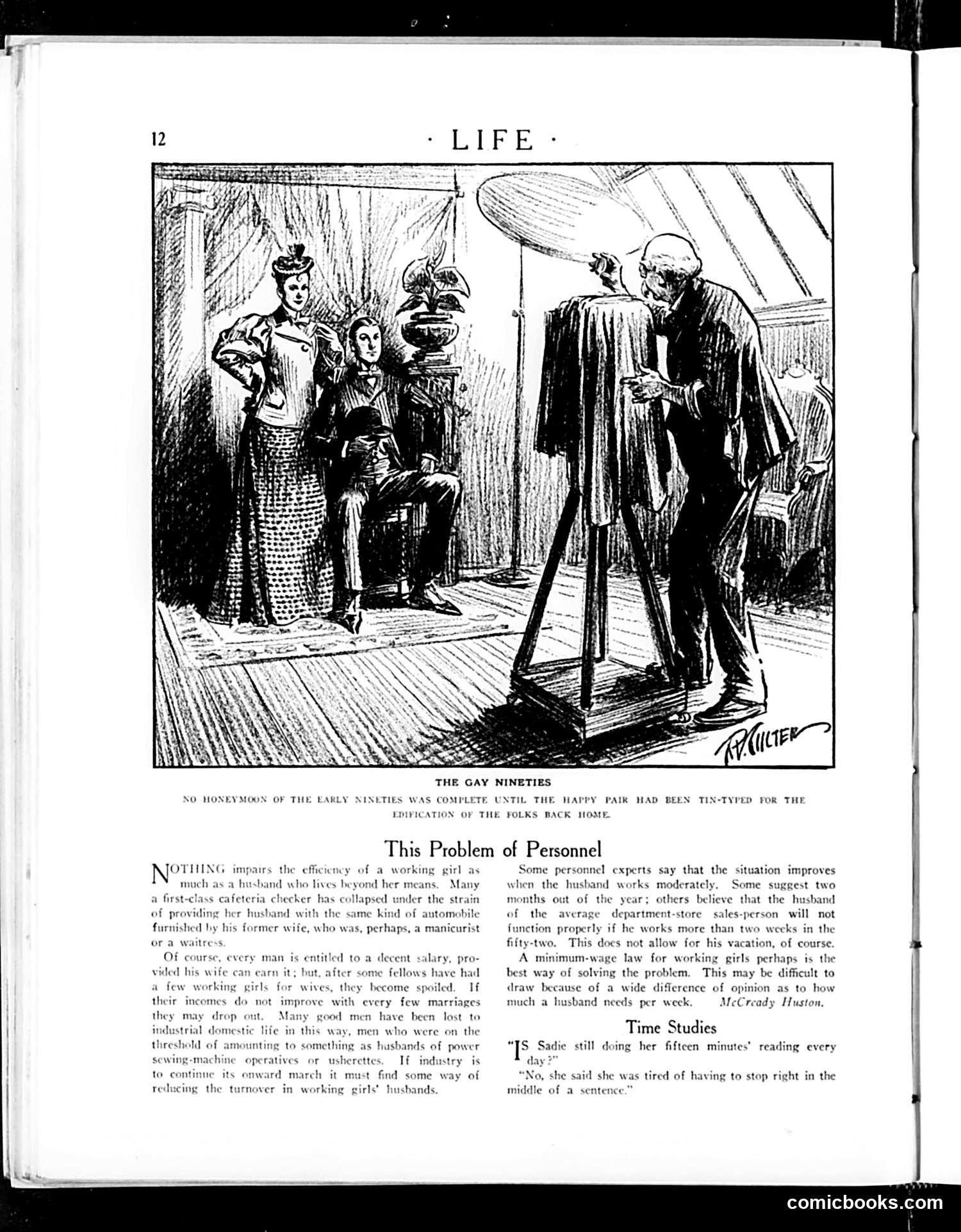
The top illustration satirizes early 1890s honeymoon photography. A photographer with a large camera captures a couple posing stiffly indoors while their relatives observe—mocking the era's formal, staged portrait conventions and the tedious process of tin-typing photographs for "folks back home." Below, the article "This Problem of Personnel" addresses a serious workplace issue: working girls (female factory/office workers) quitting jobs after marriage. The text notes that husbands often discourage their wives from working, causing industrial turnover. It debates whether husbands should work year-round or just part-time to allow wives to maintain employment. The accompanying "Time Studies" section briefly mentions a woman named Sadie resisting constant interruptions during reading time—illustrating domestic tensions over women's autonomy.
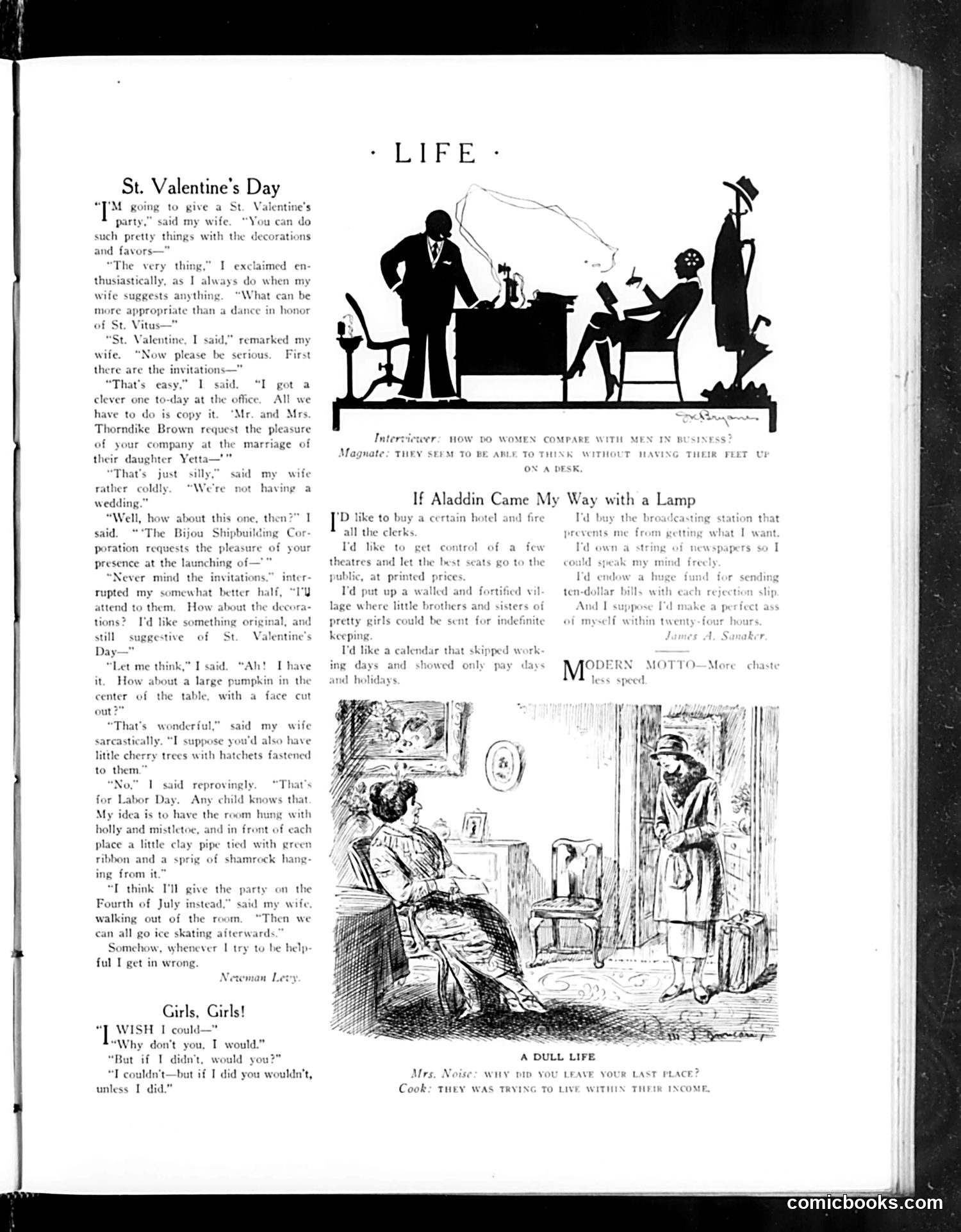
This page contains humorous domestic fiction and cartoon commentary on early 20th-century social life. The top illustration satirizes gender dynamics in business, showing a woman interviewing male employees at a desk—reversing typical workplace hierarchies. The caption jokes that women "seem to be able to think without having their feet up on a desk." The text sections include domestic comedy: a husband and wife debating Valentine's Day party ideas (she suggests elaborate decorations; he counters with absurdist proposals like "a large pumpkin in the center"). The lower sketch titled "A Dull Life" depicts a working-class domestic scene where a cook explains to Mrs. Noise why servants "were trying to live within their income"—satirizing the economic constraints on household staff. Overall, the page offers gentle satire of gender roles, marriage dynamics, and class relationships in the era.
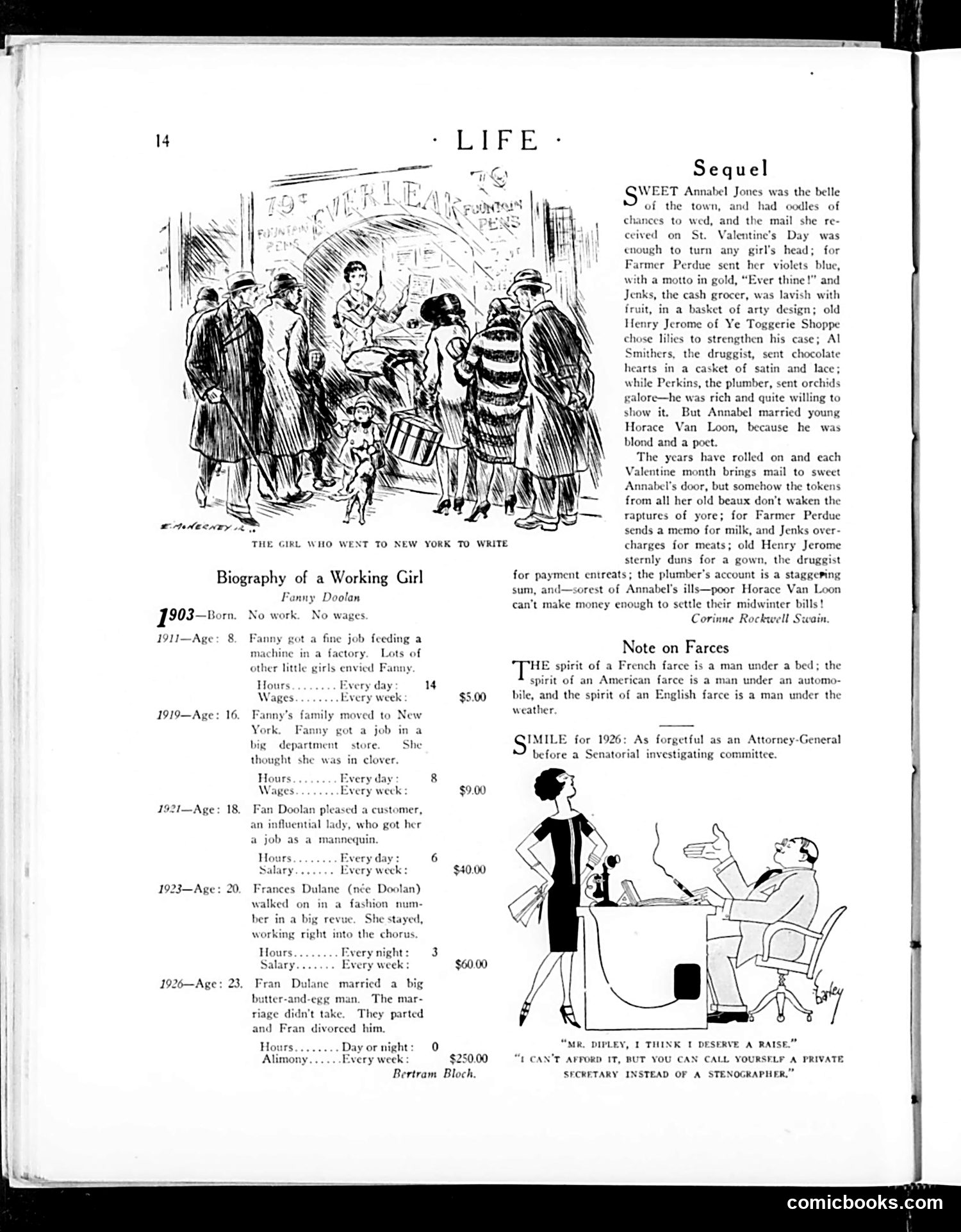
This page satirizes the economic struggles and exploitation of young working-class women in early 20th-century America. It traces "Fanny Doolan" from 1903 (age 8, unpaid factory work) through 1926 (age 23, married and divorced), documenting her declining wages and worsening conditions despite gaining experience. The progression shows how industrialization trapped women in low-paying jobs with minimal advancement. The accompanying cartoon mocks gender discrimination in office workplaces, depicting a female employee requesting a raise while her male boss dismisses her as merely a "stenographer" rather than deserving of secretarial status—reflecting period attitudes about women's professional worth and the deliberate semantic downgrading of women's labor to justify lower pay.
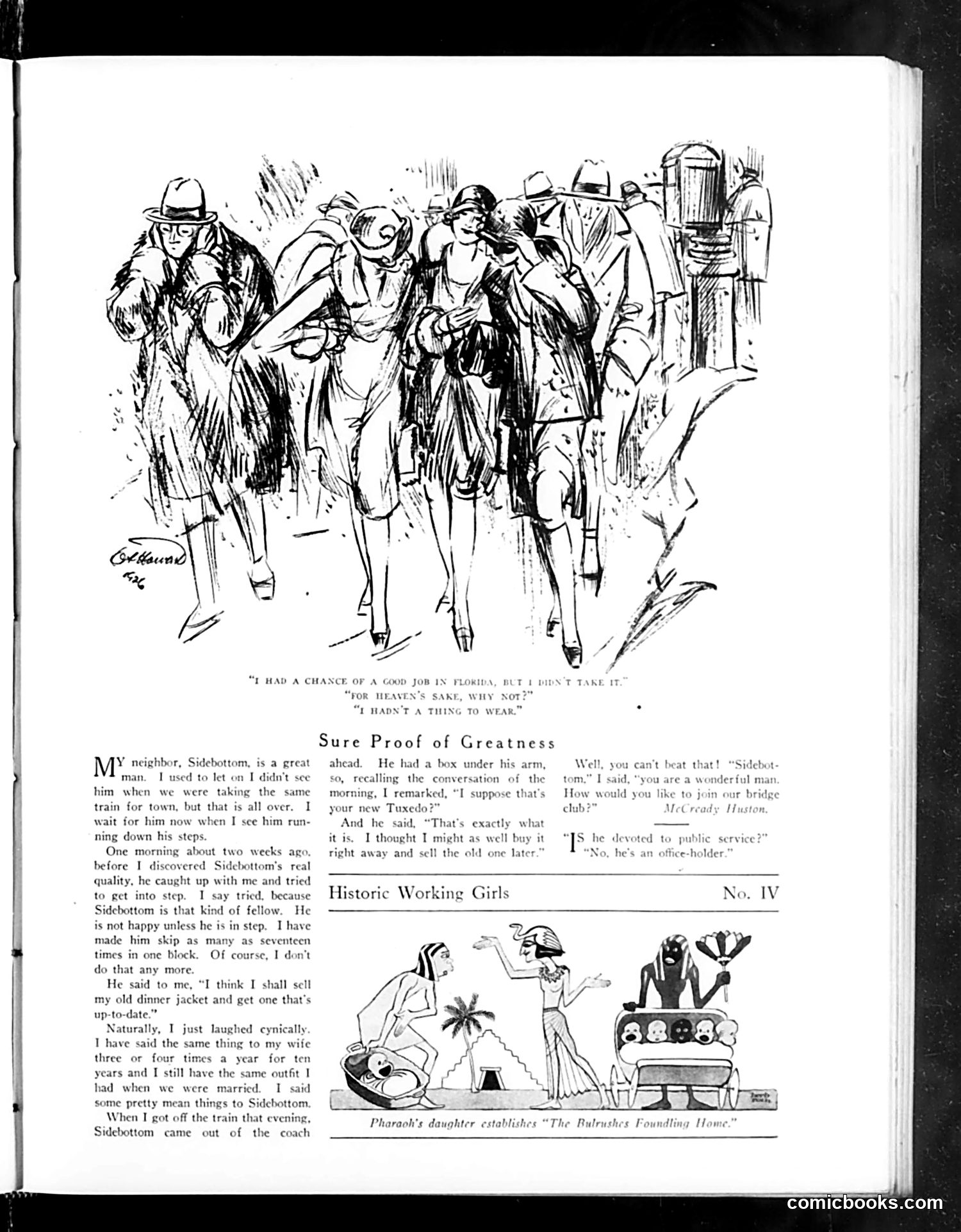
**Top Illustration & Story ("Sure Proof of Greatness"):** A sketch shows fashionably dressed women walking down a street. The accompanying text describes a neighbor named Sidebottom who is "great" because he repeatedly wears the same outfit without concern for appearing outdated. The narrator ironically praises this as evidence of Sidebottom's confidence and superiority—the joke being that most people obsess over constantly updating their wardrobes to appear fashionable. **Bottom Section ("Historic Working Girls, No. IV"):** Three cartoon panels humorously depict ancient female figures in historical roles: one operating Egyptian foundry work, another as a Pharaoh's daughter establishing a "Balustrida Founding Home," and a third in administrative position. This appears to satirize the contemporary women's employment movement by retroactively inserting women into historically male-dominated professions.
This page contains editorial commentary rather than a traditional political cartoon. The main illustration shows a **porcupine**, symbolizing defensiveness or difficulty. The text discusses **Colonel House**, a prominent Wilson-era political figure, and debates surrounding his memoir publication. The piece defends House against criticism, noting supporters like Dr. Houston backed him "as a man" despite disagreements. The commentary then shifts to **Cardinal Mercier**, praising his character and suggesting he'd make an excellent saint—a humorous, reverent compliment about his virtue and fearlessness. Finally, it addresses **William Allen White of Kansas** and agricultural/economic issues, mentioning farmers' struggles and speculation about the next presidential election and Democratic Party leadership. The page is primarily political commentary rather than visual satire.
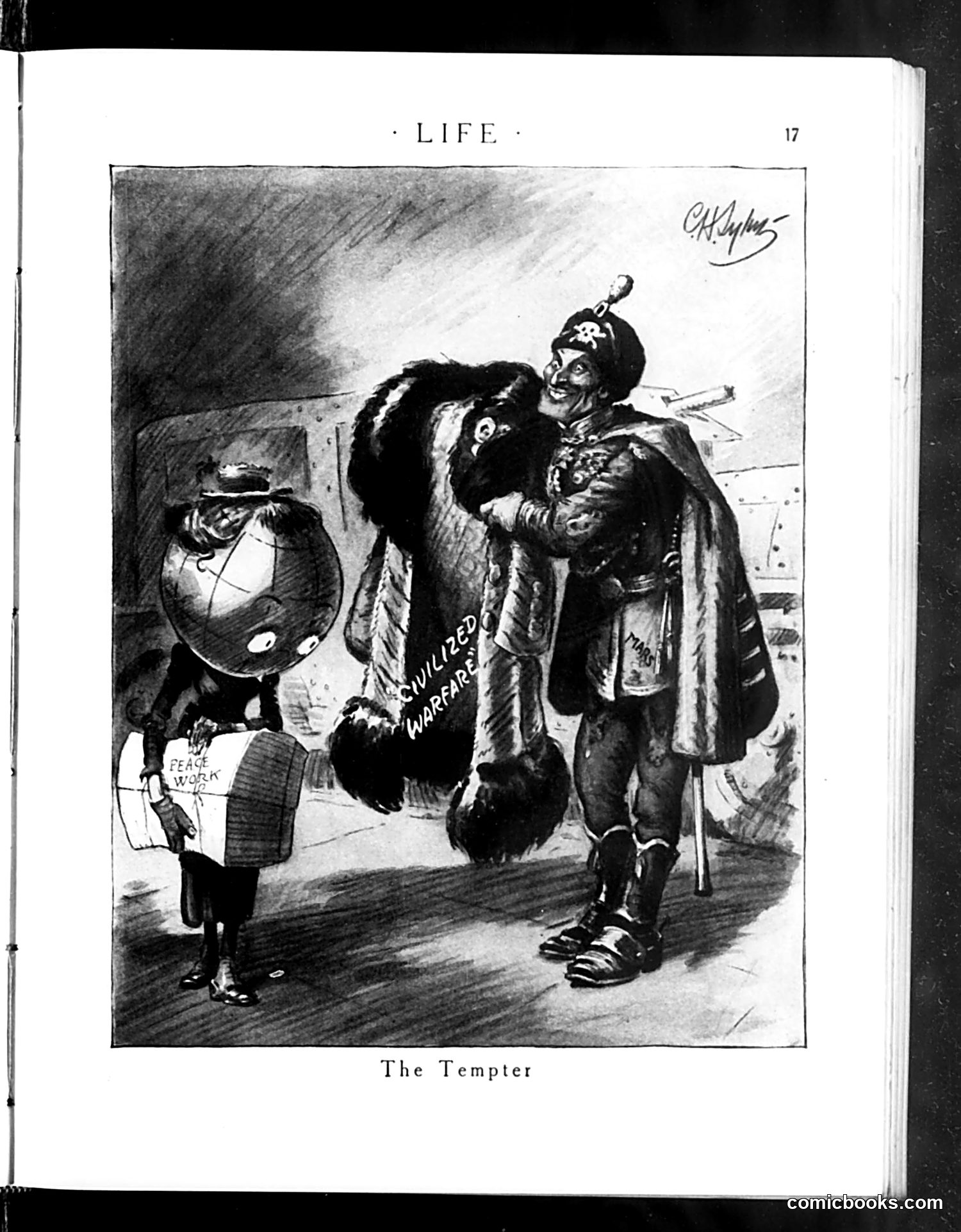
This political cartoon depicts a military figure in ornate uniform and decorative headgear offering what appears to be wartime spoils or temptations to a small figure labeled "PEACE WORKER." The military figure holds what's labeled "WORSHIPPED" (likely referring to war materials or conquest), while the peace advocate resists. The satire critiques militarism's seductive appeal during wartime, portraying military glory and conquest as dangerous temptations that threaten peace efforts. The cartoon suggests that even those committed to peace may be tempted by the promises or rewards of military power and warfare. The specific historical context remains unclear without dating information, though the style suggests early-to-mid 20th century, possibly WWI or WWII era.
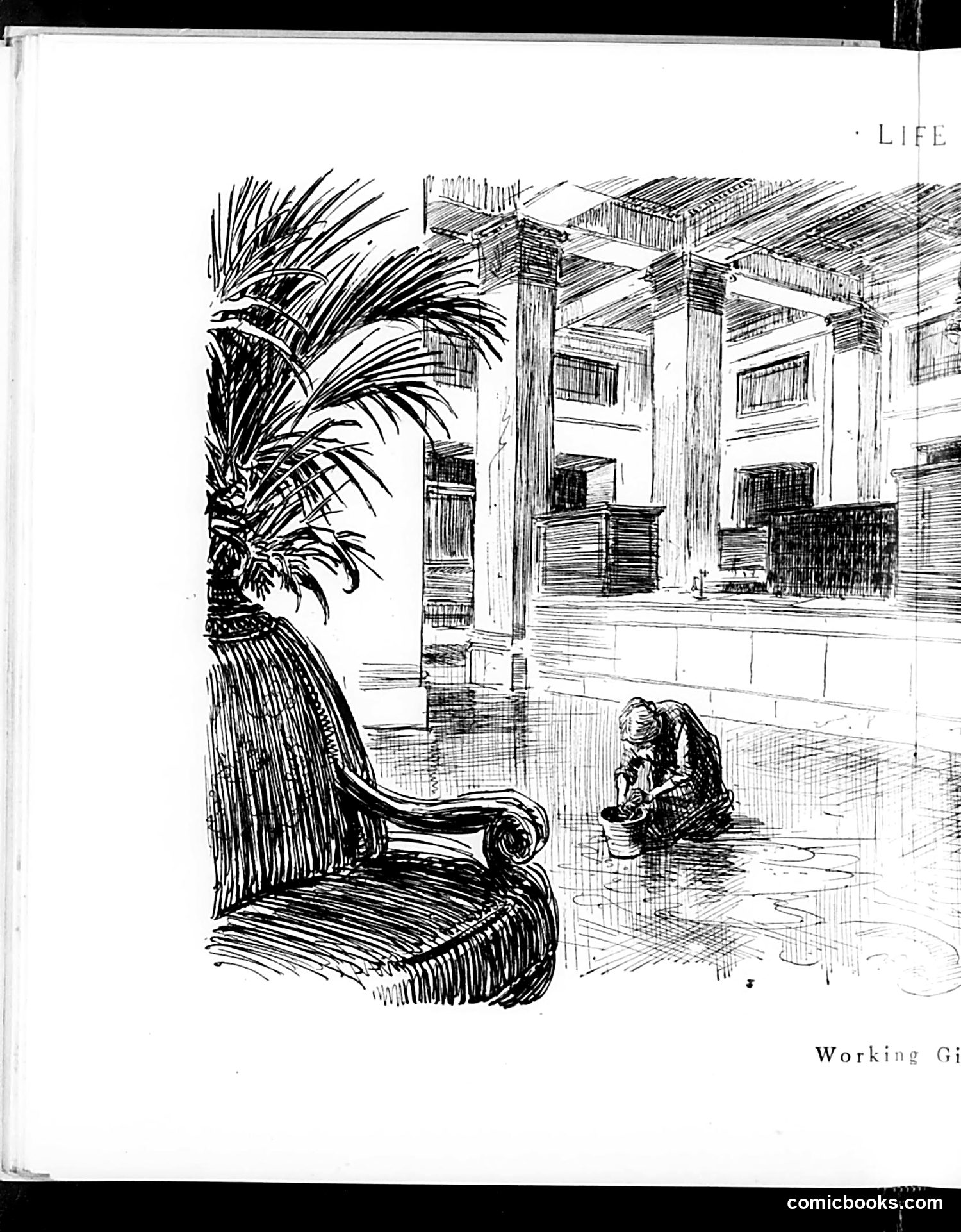
This page appears to be from *Life* magazine and shows an ink sketch illustration titled "Working Gi[rl]" (text cut off). The drawing depicts an elegant interior space with classical columns and a potted palm plant in the foreground, with a solitary figure seated or crouching on the polished floor in the background. The illustration likely satirizes the experience of working women in early-to-mid 20th century America—possibly commenting on the isolation, tedium, or social displacement of female office workers in grand, impersonal corporate or institutional settings. The contrast between the ornate architectural grandeur and the small, solitary human figure suggests commentary on alienation or the marginalizing experience of women in professional spaces. The exact satirical point remains unclear without additional context or complete text.
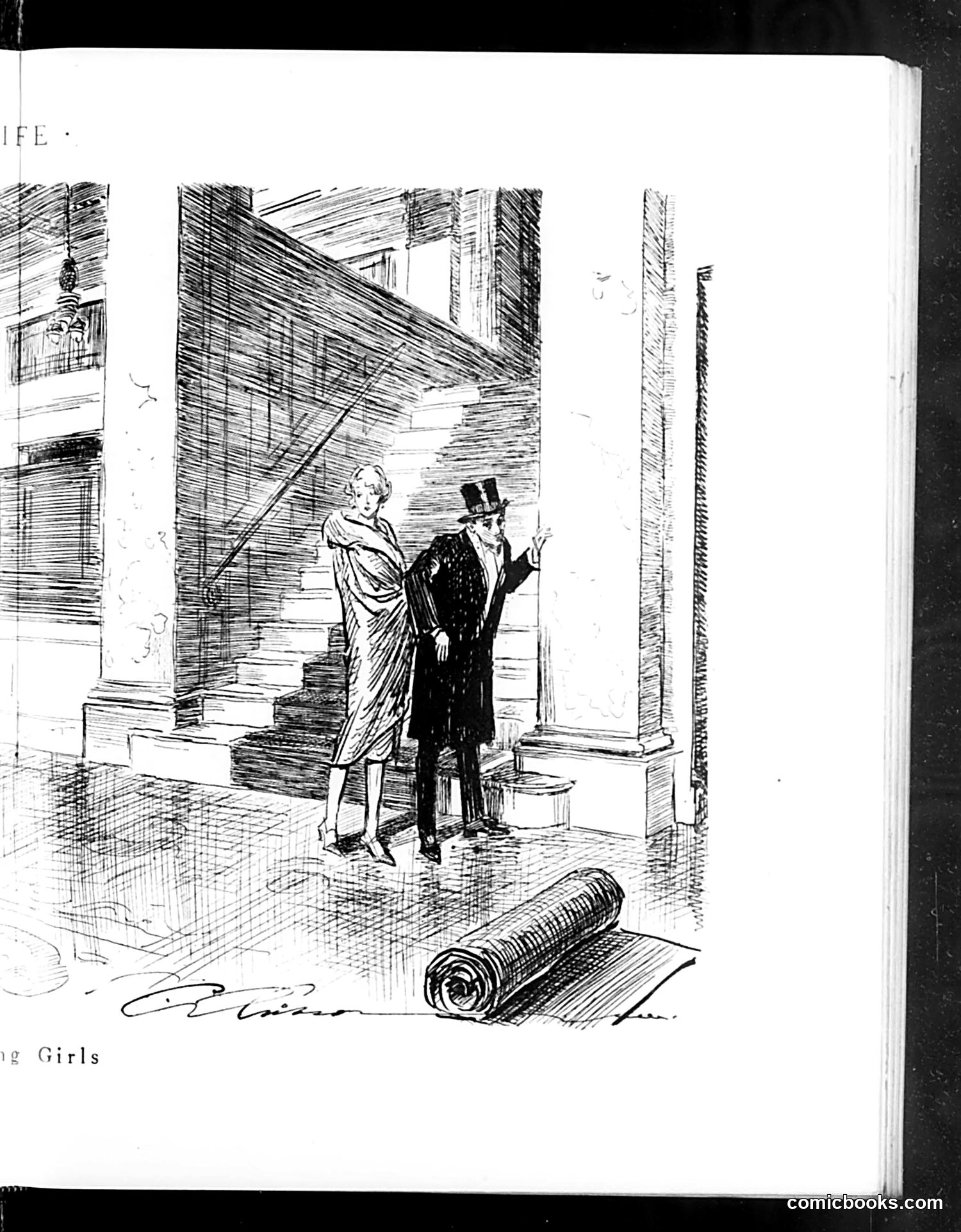
This appears to be an illustration from *Life* magazine showing two figures in an urban architectural setting. A man in a top hat and formal coat gestures expressively toward a woman in a draped garment. In the foreground, a rolled carpet or similar item lies on the floor. The caption reads "Girls," suggesting this is satirical commentary on courtship or romantic interaction, likely from the early 20th century based on the clothing and art style. Without additional context or visible text explaining the specific joke, the exact satirical point remains unclear. The composition—the man's animated gesture, the woman's stance, and the prominent rolled object—suggests social commentary about male-female dynamics or perhaps a scenario involving deception or seduction, but the precise reference or punchline cannot be determined from the image alone.
This page reviews three experimental plays by Strindberg and Eugene O'Neill, criticizing their use of avant-garde theatrical techniques. The writer dismisses Strindberg's "The Dream Play" as incomprehensible symbolism—noting a theatergoer's honest admission: "I thought I had read this play, but I find that I haven't." O'Neill's "The Great God Brown" is criticized for overusing masks to show character changes, which the reviewer argues fails to create theatrical illusion and merely makes actors look like "children at Halloween." The specific complaint about actor William Harrigan juggling multiple masks (as both Billy Brown and Dion Anthony) highlights the absurdity: the technique supposedly meant to advance drama actually obscures rather than clarifies character. The satire targets modernist theater's pretentious symbolism and technical gimmickry—suggesting that experimental playwrights sacrifice comprehensibility and genuine human emotion for intellectual obscurity.
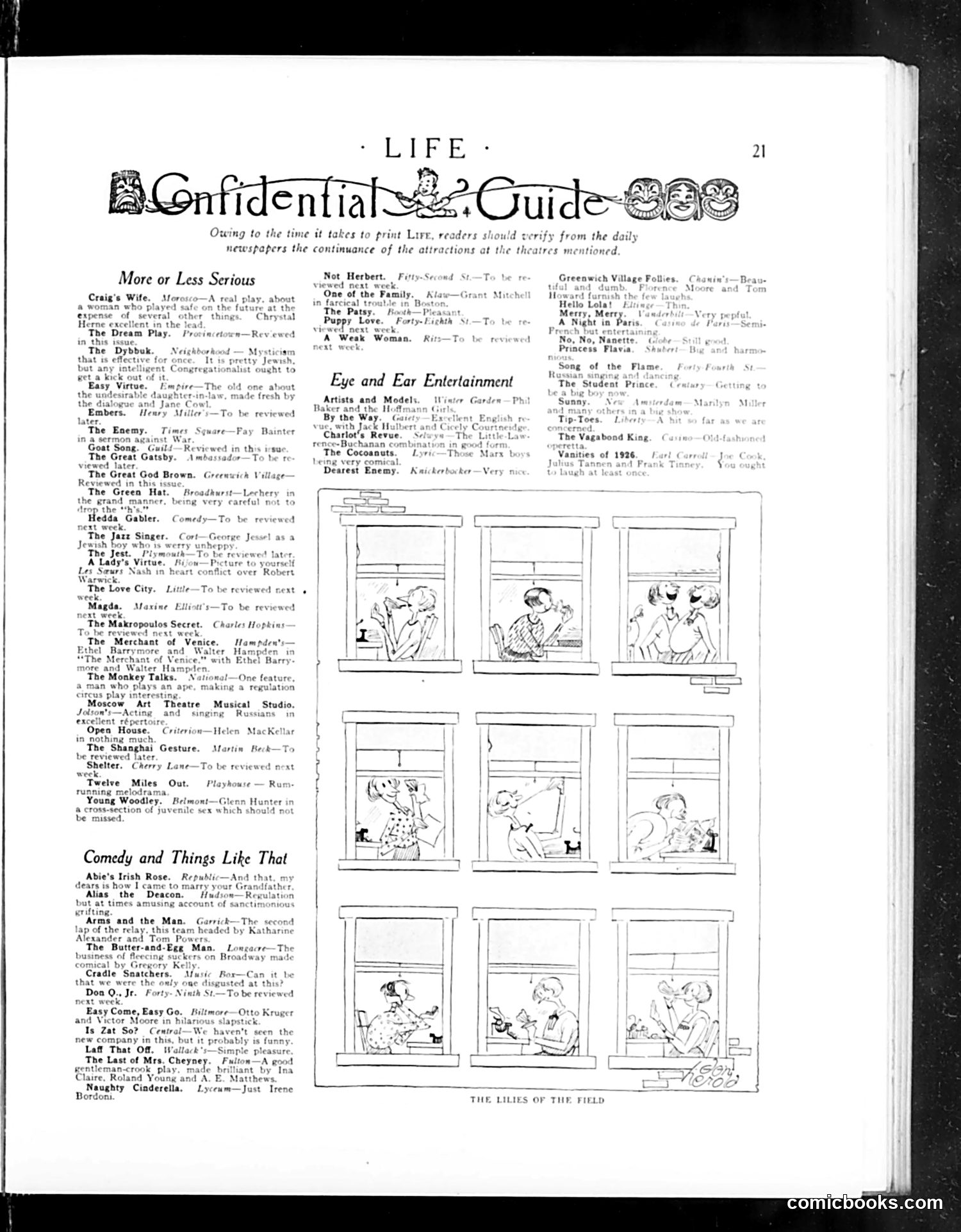
This page is a **Life magazine theater guide** from the 1920s listing current Broadway shows, with a nine-panel comic strip titled "The Lilies of the Field" at the bottom. The strip appears to be a **domestic humor comic** depicting everyday domestic scenes—likely showing a husband and wife in various household situations. The panels show figures in what seems to be apartments or homes, with the small cartoon style typical of 1920s comics. Without clear visual detail of specific characters or plot progression, the strip's humor likely derives from **marital or romantic misunderstandings**—common themes in 1920s comics. The title "The Lilies of the Field" suggests ironic contrast between the idealized, carefree image of lilies and the mundane realities of domestic life being satirized. The page itself is primarily a **theater listings reference**, with the comic strip serving as supplementary entertainment content typical of Life's mixed editorial format.
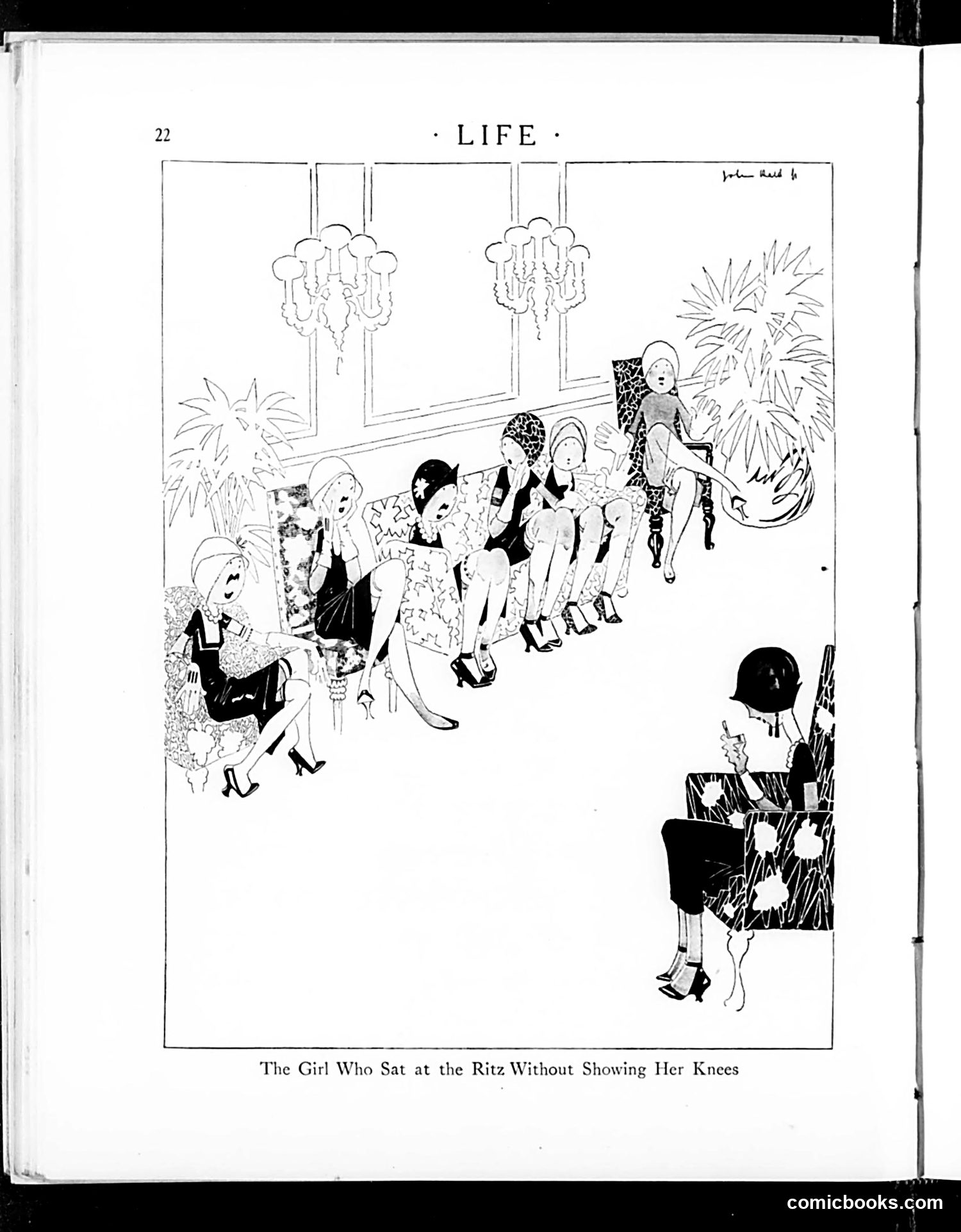
This is a satirical cartoon about 1920s social etiquette and fashion. The caption "The Girl Who Sat at the Ritz Without Showing Her Knees" mocks a woman who maintains exaggerated propriety in public. The scene shows the Ritz Hotel (a luxurious, fashionable venue) where a group of women in 1920s attire are socializing. One woman sits alone on the right, visibly self-conscious about leg exposure—a major concern during the era when hemlines were controversially rising. The satire targets the tension between the era's modernizing fashion standards (shorter skirts) and old-fashioned modesty concerns. By depicting her extreme vigilance about knee-concealment while surrounded by casually dressed socialites, the cartoon ridicules outdated prudishness as absurdly out of step with contemporary women's styles and social norms.
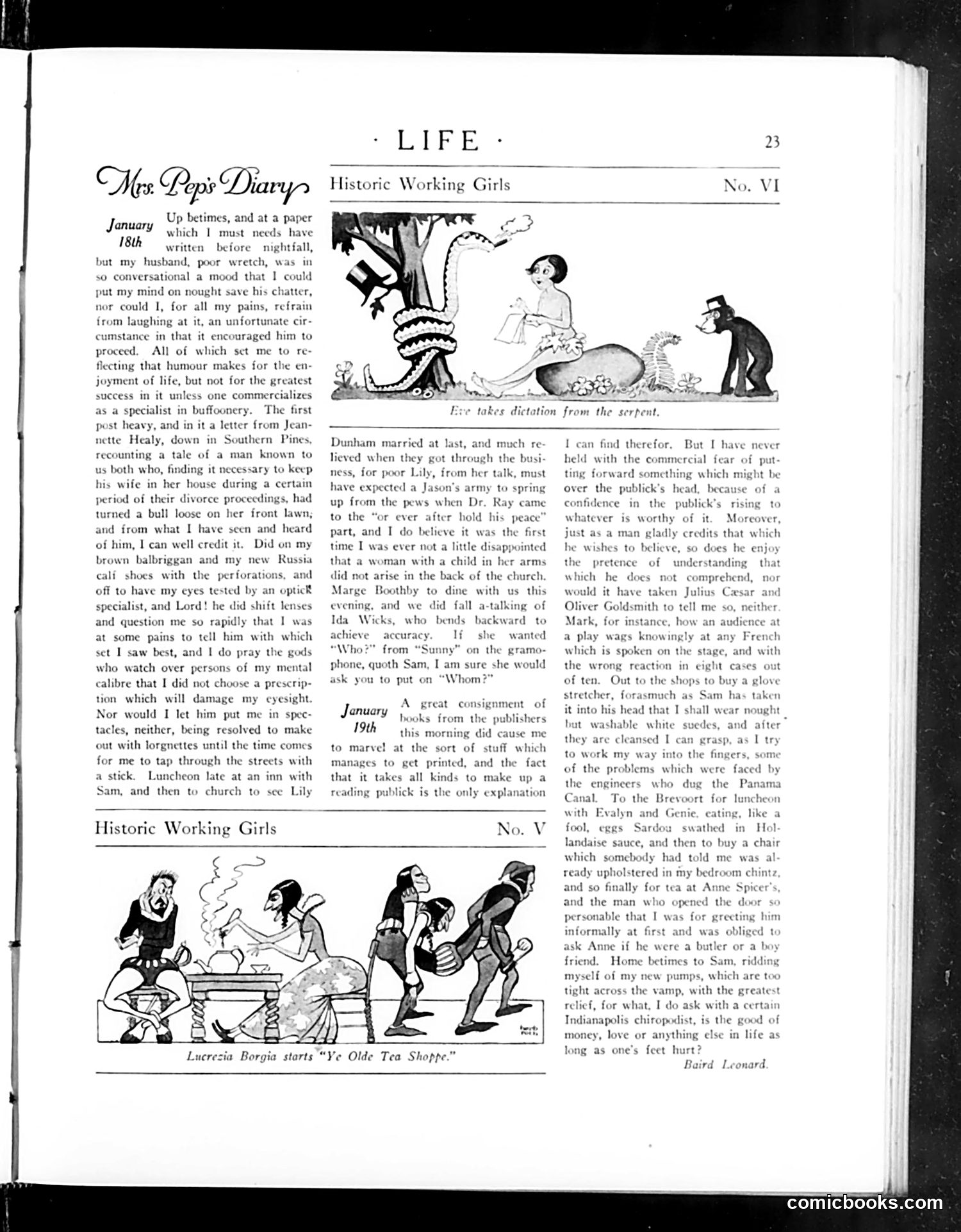
This page presents two satirical features mocking early 20th-century gender roles and women's labor. **"Mrs. Pep's Diary"** (top) parodies society women's self-absorbed diaries, presenting a wealthy woman's trivial concerns—eye exams, new shoes, dining out—in mock-serious language. The satire targets affluent women's disconnection from meaningful life. **"Historic Working Girls"** (two cartoon panels below) depicts women in actual labor: the top cartoon shows a woman being ordered about by a serpent (likely representing male authority or capitalism), while the bottom shows "Lucrezia Borgia" running "Ye Olde Tea Shoppe"—a joke equating women's historical infamy with contemporary service work. These cartoons mock both the romanticization of "historic" women and the economic reality that forces modern women into low-wage service jobs, contrasting sharply with the diary's wealthy protagonist. The juxtaposition critiques class divisions among women circa World War I.
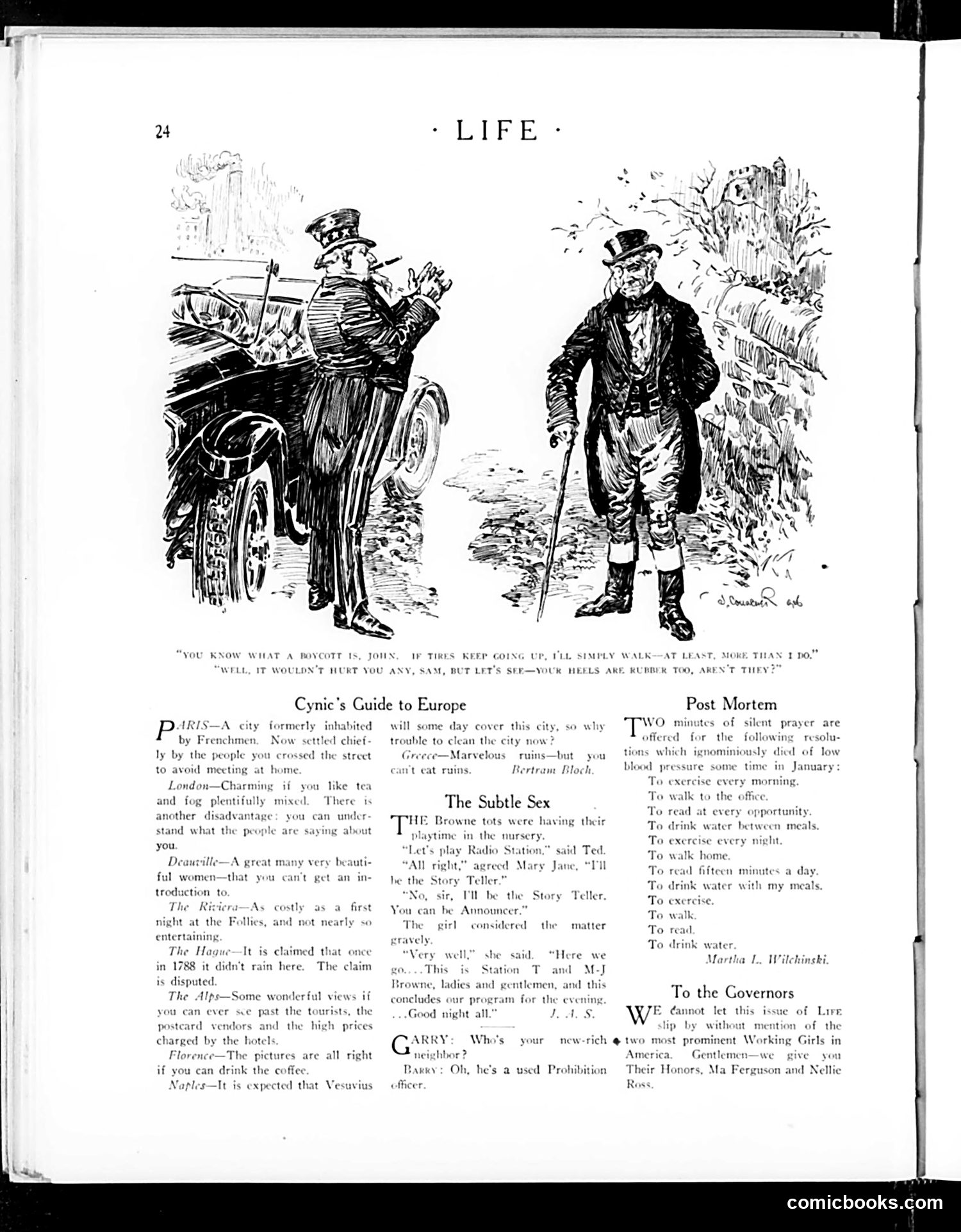
This page contains three distinct satirical pieces: **Top Cartoon:** A man in a car argues with a pedestrian about a tire boycott, suggesting he'll "simply walk" instead. The joke satirizes the contradictory logic of boycotts—the man's rubber heels are also made of rubber, so his protest is hypocritical. **"Cynic's Guide to Europe":** A humorous travel guide mocking European cities. It presents cynical, deflating observations: Paris is dirty, London's tea is mediocre, Greek ruins are inedible, the Riviera is expensive, Naples is awaiting volcanic burial. The satire targets tourists' romanticized expectations versus disappointing reality. **"The Subtle Sex" and Other Brief Items:** Short comedic anecdotes about domestic life, including children playing "Radio Station" and a dialogue about a "used Prohibition officer" (likely referencing the recent end of Prohibition, circa 1933). **"Post Mortem" and "To the Governors":** Humorous resolutions and a tribute to American working women. The page exemplifies Life's sophisticated, urbane satire aimed at educated readers skeptical of both European tourism and contemporary American pretension.
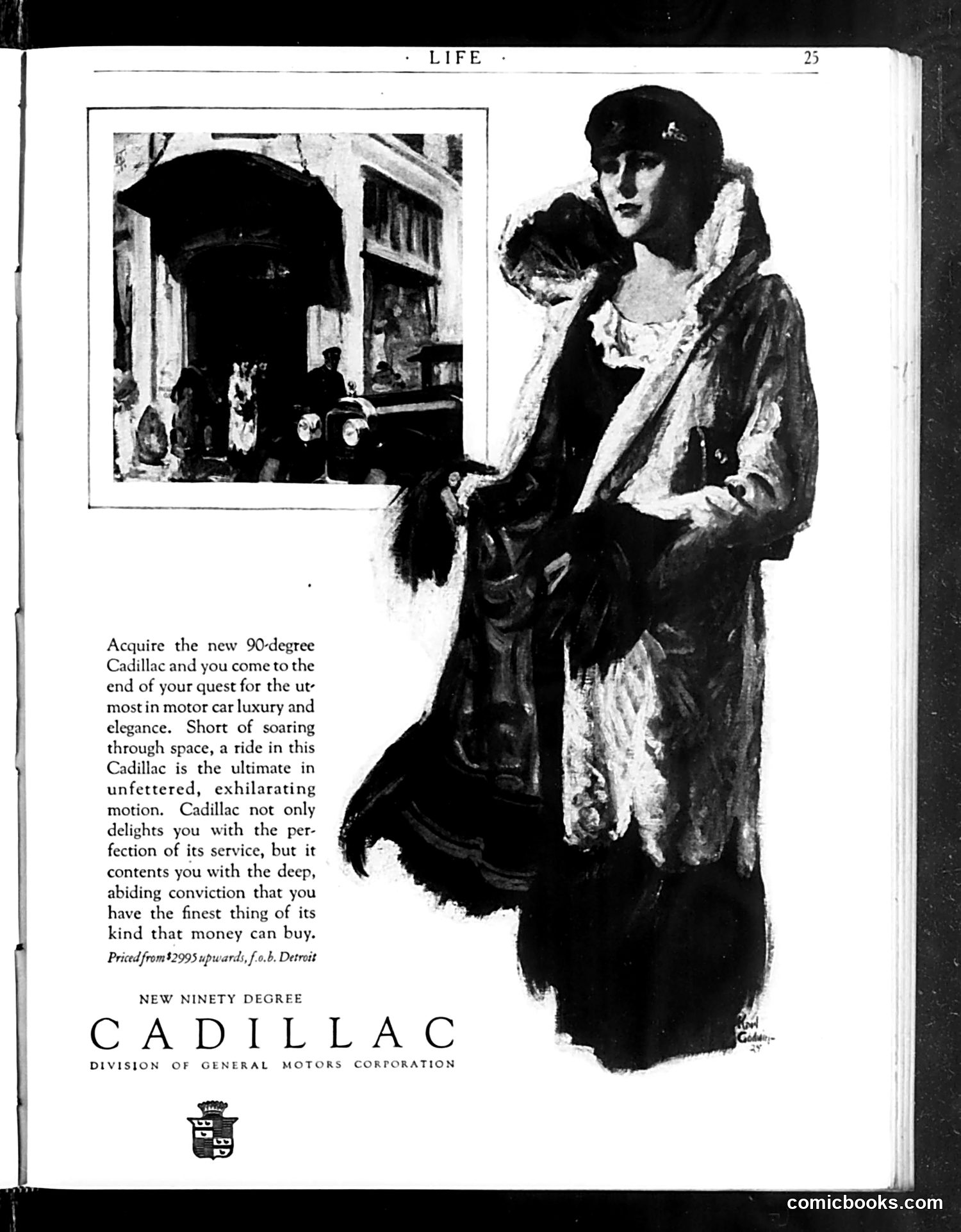
This is a **Cadillac automobile advertisement**, not political satire. The page shows a stylized illustration of an elegantly dressed woman in fur and a cloche hat, holding a small dog—imagery associated with 1920s luxury and sophistication. The advertisement emphasizes Cadillac's status as the pinnacle of automotive luxury, claiming it represents "the finest thing of its kind that money can buy." The "90-degree" reference likely refers to the engine configuration. The $2,995 starting price (from Detroit) positions it as an aspirational luxury good for wealthy consumers. The small inset photograph (upper left) appears to show the actual vehicle, though details are unclear in this reproduction. This reflects the jazz-age marketing strategy of associating automobiles with wealth, elegance, and modern sophistication—targeting affluent, style-conscious buyers.
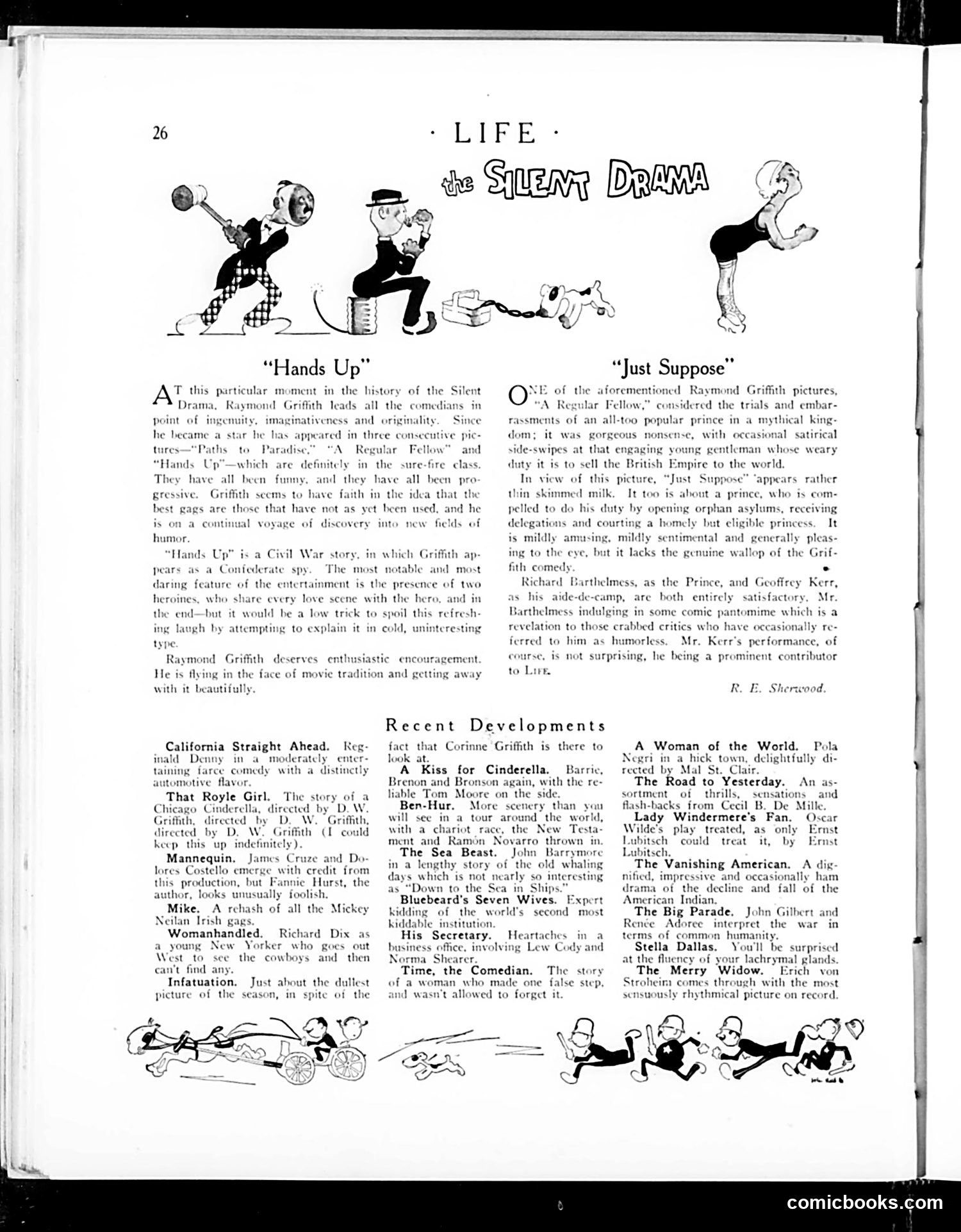
This page reviews silent films starring Raymond Griffith and contemporaries. The cartoons at top illustrate plot points: "Hands Up" shows Griffith as a Confederate spy in a Civil War story; "Just Suppose" depicts a prince fulfilling royal duties (opening orphan asylums, courting an eligible princess). The text praises Griffith's originality and comedic inventiveness, noting he's appeared in three consecutive successful films. The reviewer appreciates the film's satirical "side-swipes" at British imperial duty, though finds "Just Suppose" somewhat thin dramatically. The "Recent Developments" section lists other current releases: "Ben-Hur" (noted for scenery), "Bluebeard's Seven Wives," "The Sea Beast" with John Barrymore, and films by directors like D.W. Griffith and Cecil B. DeMille—major figures of 1920s cinema. The page reflects the era's thriving silent film industry and critical engagement with emerging movie stars and directors.

This is **not a cartoon or satire**—it's a straightforward automobile advertisement from Life magazine, circa 1925. The ad celebrates Dodge Brothers' record-breaking sales (250,000+ cars) and announces a $10 million factory expansion that will nearly double 1925 output. The key selling point is that increased production enables dramatically lower prices ($895 F.O.B. Detroit) while maintaining quality improvements: new colors, smoother engines, stylish body lines, and all-steel construction. The rhetoric reflects 1920s economic optimism—mass production drives down costs, benefiting consumers. This represents the industrial logic of the era: manufacturing scale as progress. **For modern readers:** The price ($895 in 1925, roughly $15,000 today) and the manufacturing-as-virtue messaging are period-specific. The ad assumes readers value efficiency and industrial capacity as inherent goods, without the environmental or labor critiques that would later emerge.
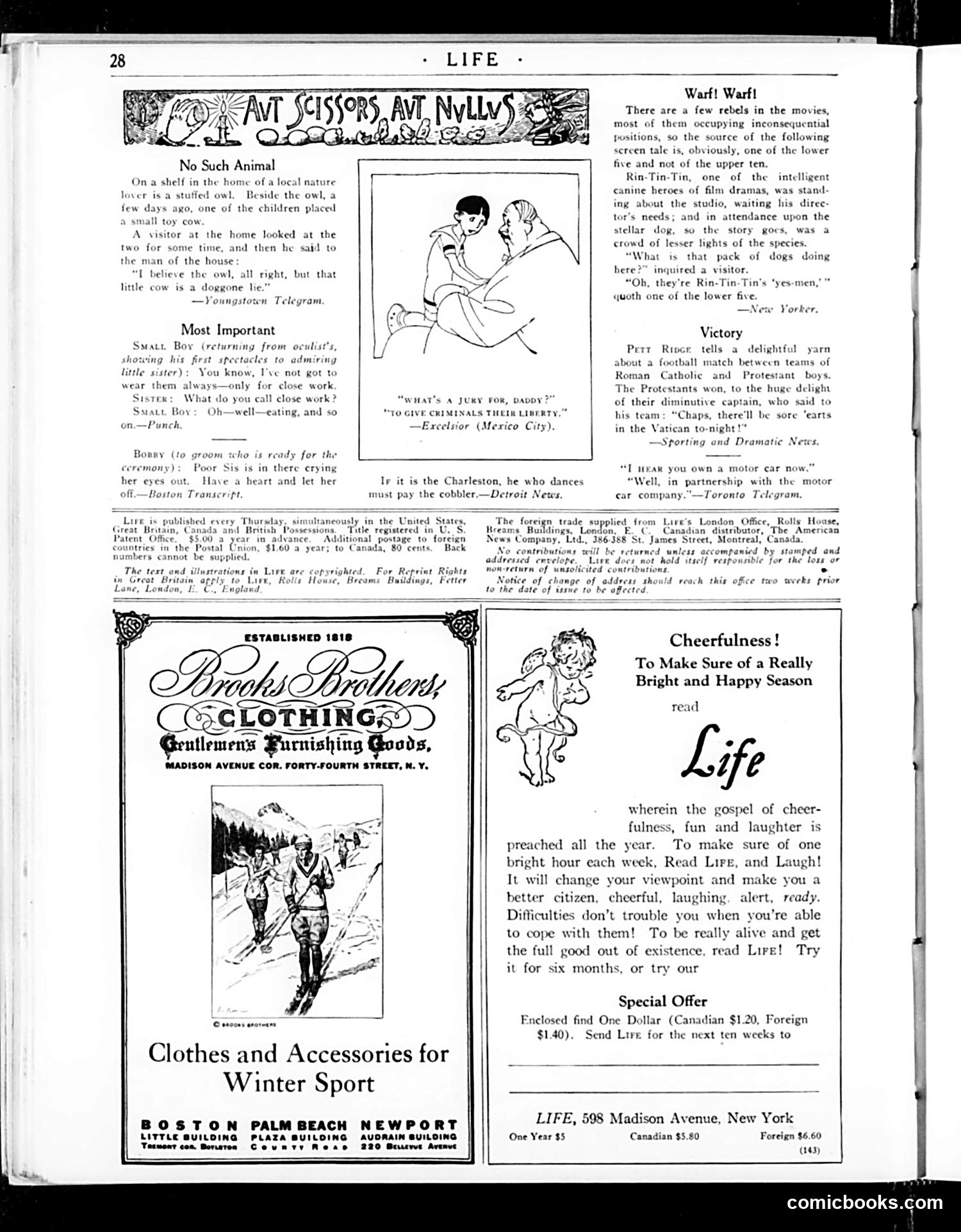
This page from *Life* magazine (a satirical publication) contains several brief humorous anecdotes and jokes typical of early 20th-century American humor: **"No Such Animal"**: A joke about a visitor questioning the logic of a child's toy collection—an owl and cow together—with the punchline suggesting the cow is "a doggone lie." **"Most Important"**: A father-son exchange where the boy misunderstands "close work" (eyeglasses prescription) as something crude, leading to a bathroom humor joke. **"Warf! Warf!"**: An anecdote about film studio workers, where lower-ranking staff attending to the famous dog actor Rin-Tin-Tin are sarcastically called his "yes-men"—poking fun at Hollywood hierarchy. **"Victory"**: A joke about Protestant and Catholic schoolboys playing football, with the Protestant captain's boastful comment about causing distress "in the Vatican." The page also includes a Brooks Brothers clothing advertisement and a *Life* magazine subscription pitch emphasizing cheerfulness and laughter. The humor reflects period attitudes toward religion, class distinctions, and Hollywood culture.
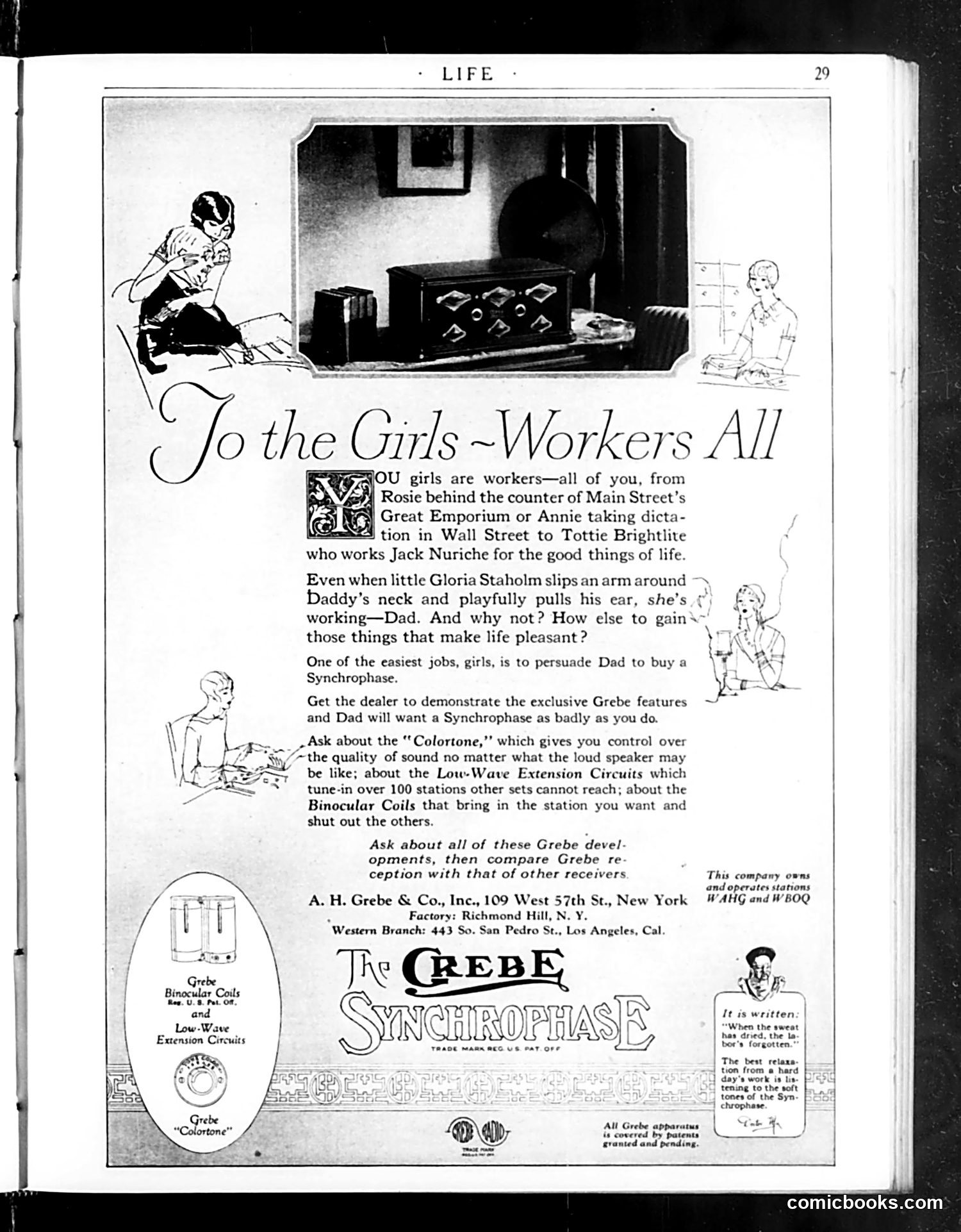
This is primarily a **radio advertisement** for Grebe Synchrophase receivers, not political satire. The "cartoon" elements are illustrative sketches accompanying the ad copy. The text employs **early 1920s gender stereotyping** to pitch radios to women: it claims all women are "workers"—from shopgirls to wives manipulating their fathers for spending money. The examples (Rosie, Annie, Tottie Brightlite, Gloria Staholm) appear to be generic feminine types rather than specific caricatures or public figures. The satirical *angle* (if any) is subtle: the ad cynically redefines women's domestic labor and manipulation as "work," then suggests the easiest female "job" is persuading fathers/husbands to buy expensive Grebe radios. This reflects period attitudes treating women's consumer influence as their primary economic role. The technical claims about superior reception (Colortone, Low-Wave circuits, Binocular Coils) are standard radio-era marketing language.
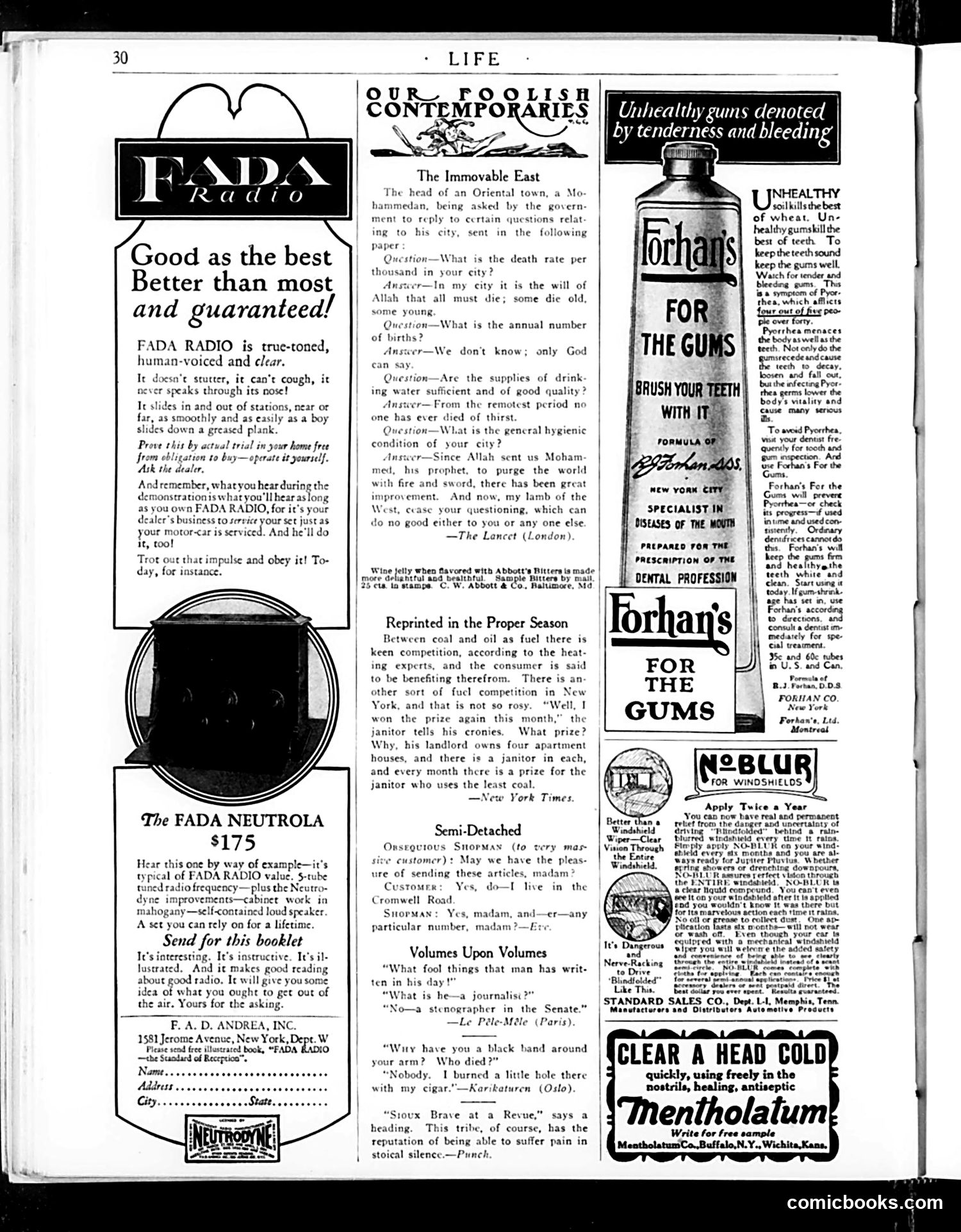
This page is primarily **advertising and humor content** rather than political satire. The main elements are: **FADA Radio Advertisement** (left): A straightforward product pitch emphasizing the radio's clear reception and reliability—"true-toned, human-voiced and clear." The language reflects 1920s-era sales rhetoric about new consumer technology. **"The Immovable East"** (center): A satirical piece mocking bureaucratic inefficiency. An Oriental town official dismisses government health inquiries with fatalistic religious answers ("it is the will of Allah"), refusing to provide practical statistics. This reflects Western stereotypes about Eastern "backwardness" versus modern scientific administration—a common trope of the era. **"Semi-Detached" and other brief jokes** (right): Humorous anecdotes from international publications, mostly wordplay and observational humor about everyday life. **Forhan's Toothpaste and other ads** (right side): Period patent medicine and consumer product advertisements with health claims. The page reflects 1920s-30s advertising culture mixed with light humor—no significant political cartooning or commentary.

This page contains two political cartoons from *Life* magazine. The top cartoon shows a figure in formal dress being struck or knocked backward by what appears to be an "Obey Tract Impulse" — suggesting someone compelled to obey an impulse. The bottom cartoon depicts a man in formal attire and top hat in a standing pose. The OCR text is largely illegible due to image quality, making precise identification difficult. However, the visual style and presentation suggest these are satirical commentaries on political or social figures of the era. Without clearer text or caption identification, I cannot confidently identify the specific figures or political references intended. The cartoons appear to critique some form of political behavior or social impulse, but specific context remains unclear from this reproduction.
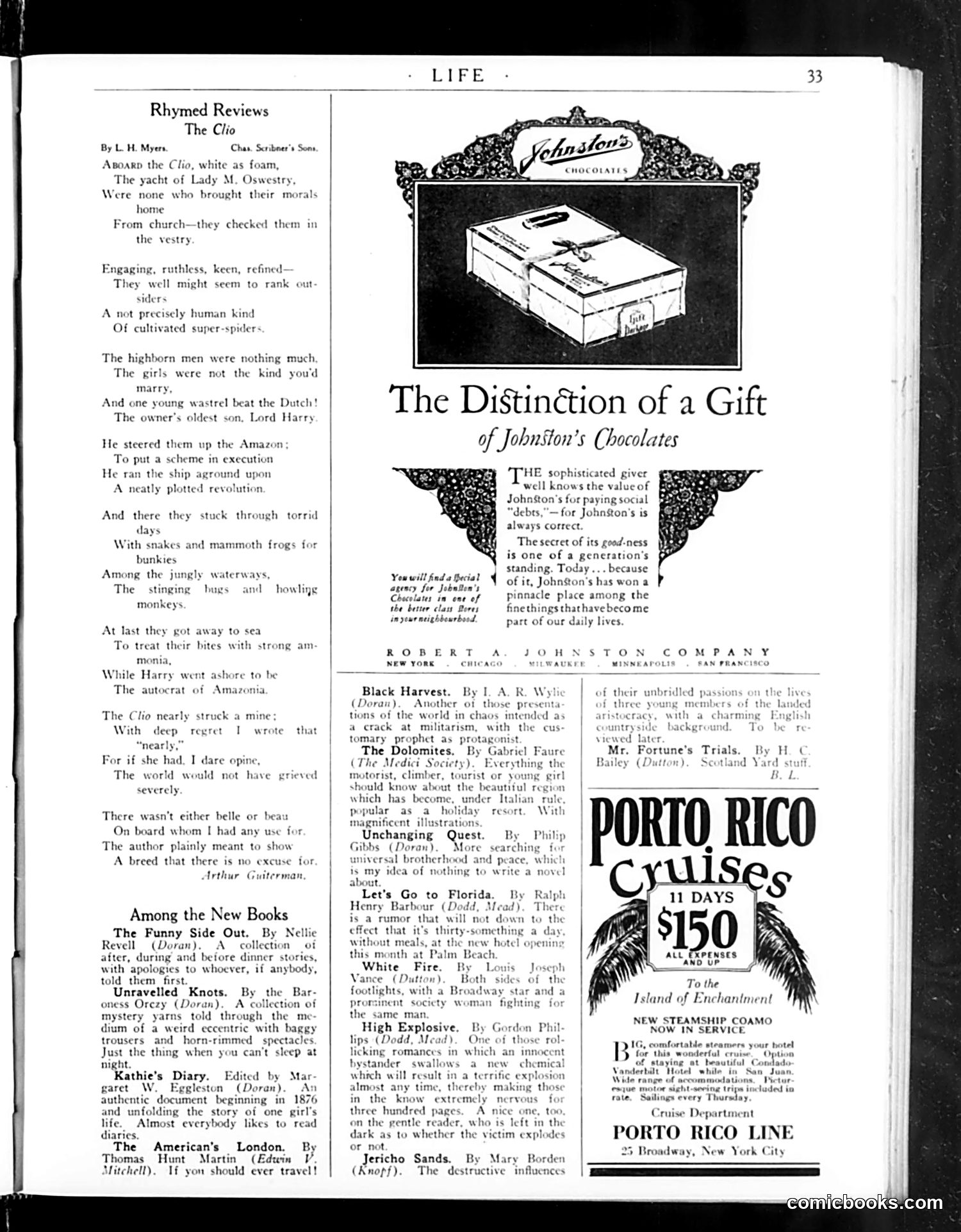
This page is primarily **advertising and book reviews**, not political satire. The main content consists of: 1. **"Rhymed Reviews: The Clio"** — A satirical poem by Arthur Guiterman reviewing L.H. Myers's novel about a yacht expedition. The verse mocks the passengers as "cultivated super-spiders" and "a breed that there is no excuse for" — upper-class English snobs who embark on an ill-fated Amazon journey. The satire targets aristocratic pretension and incompetence. 2. **Book reviews** of contemporary fiction (The Funny Side Out, Unravelled Knots, etc.) — straightforward literary notices. 3. **Large advertisements** for Johnston's Chocolates and Porto Rico Line cruises — commercial content filling roughly half the page. The Clio review is the only satirical element; it's directed at social class stereotypes rather than political figures or events. For modern readers, it reflects early 20th-century American skepticism toward the British upper class.
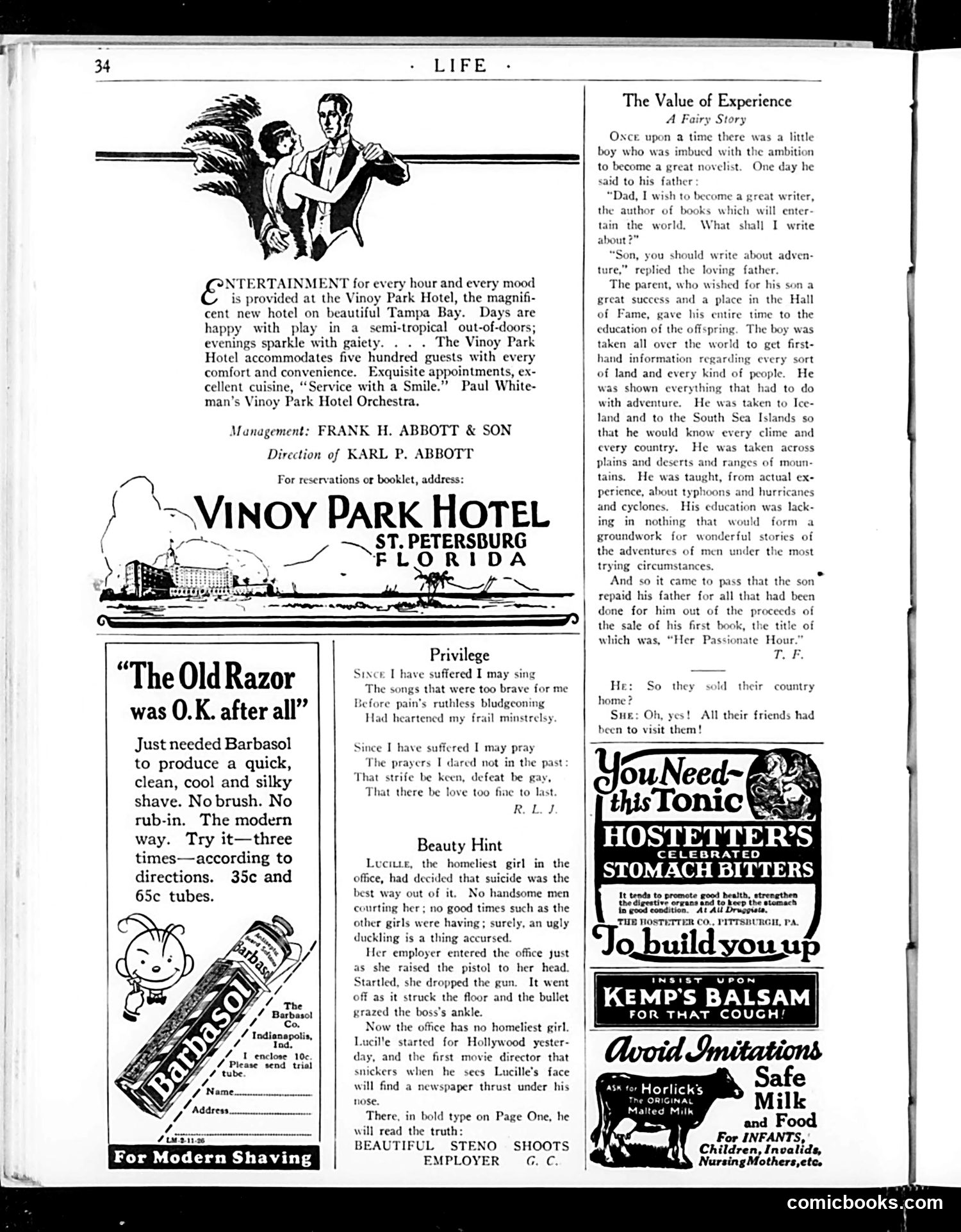
This page is primarily **advertising and light entertainment content** rather than political satire. The main elements include: **"The Value of Experience"** - A sentimental fairy tale about a boy aspiring to be a novelist. His father takes him traveling worldwide to gather material for adventure stories. The moral: the boy repays his father's investment by selling his first book, "Her Passionate Hour." This reflects early 20th-century genteel values about education and filial gratitude. **"Beauty Hint"** - A darkly humorous anecdote about an "ugly duckling" office girl who attempts suicide but accidentally shoots her boss instead. She then becomes beautiful enough for Hollywood—satirizing the magazine's own superficiality about female appearance. **Surrounding Advertisements** include Barbasol shaving cream, Hostetter's Stomach Bitters, Kemp's Balsam cough remedy, and Horlick's Malted Milk—typical period patent medicines and toiletries. The page reflects 1920s consumer culture and conventional morality rather than political commentary.
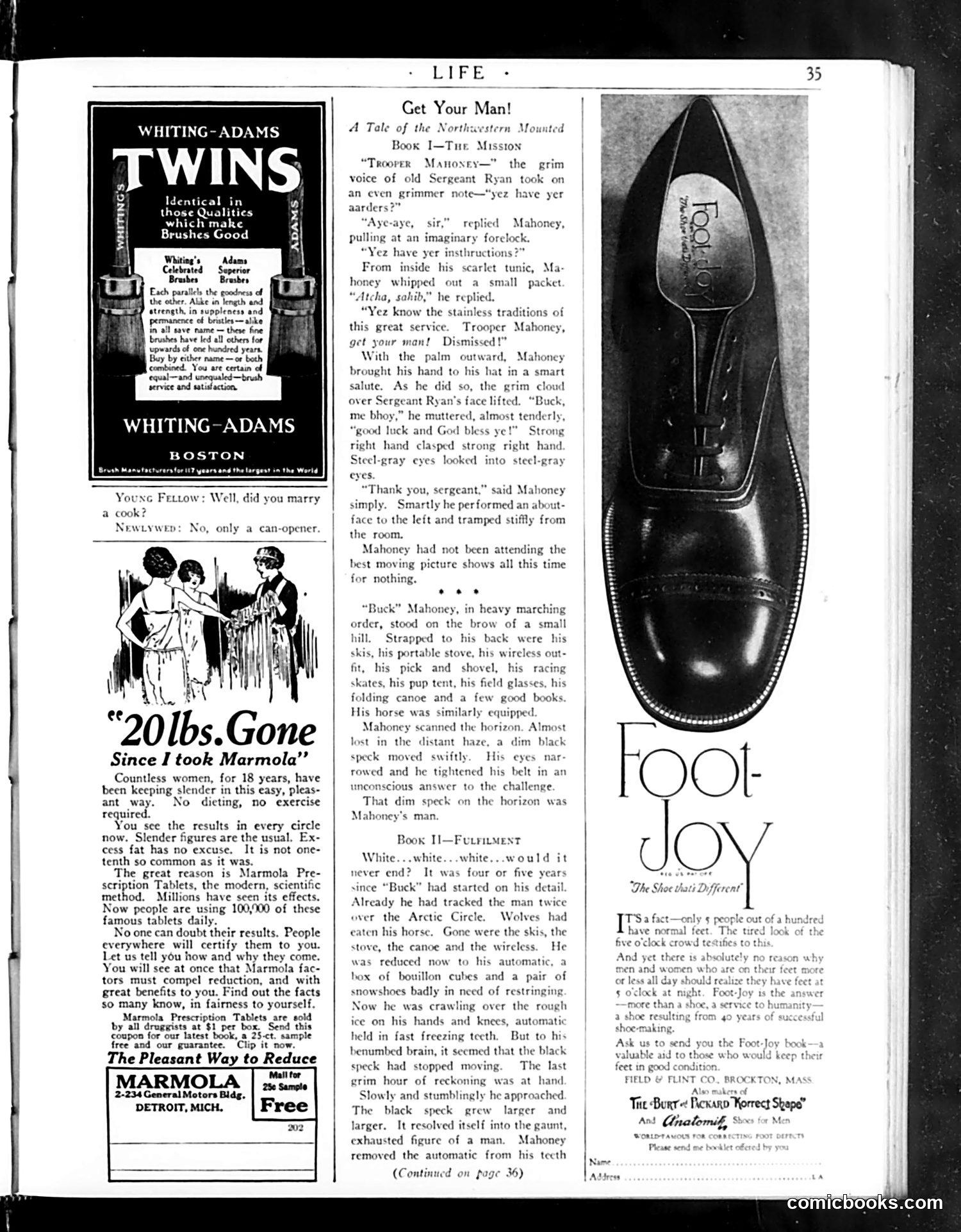
This page mixes **advertising with serialized fiction**. The main content is "Get Your Man!," a melodramatic story of Canadian Northwest Mounted Police pursuing a criminal across the Arctic. Trooper Mahoney receives orders to capture a fugitive and is shown departing on an expedition with full wilderness gear. The satirical element is subtle: the earnest, overwrought adventure narrative—complete with stock phrases ("steel-gray eyes," "grim cloud," noble hand-clasps)—parodies pulp fiction conventions. The narrator notes that Mahoney learned nothing from "the best moving picture shows," mocking how audiences absorbed dramatic clichés from cinema. The advertisements (Whiting-Adams brushes, Marmola diet tablets) are period-typical. The "20 lbs. Gone" ad exemplifies 1920s weight-loss marketing, promoting pharmaceutical diet aids as effortless solutions for women seeking slenderness—a social anxiety this magazine commercialized. The page overall satirizes popular entertainment and consumer culture aimed at middle-class readers.
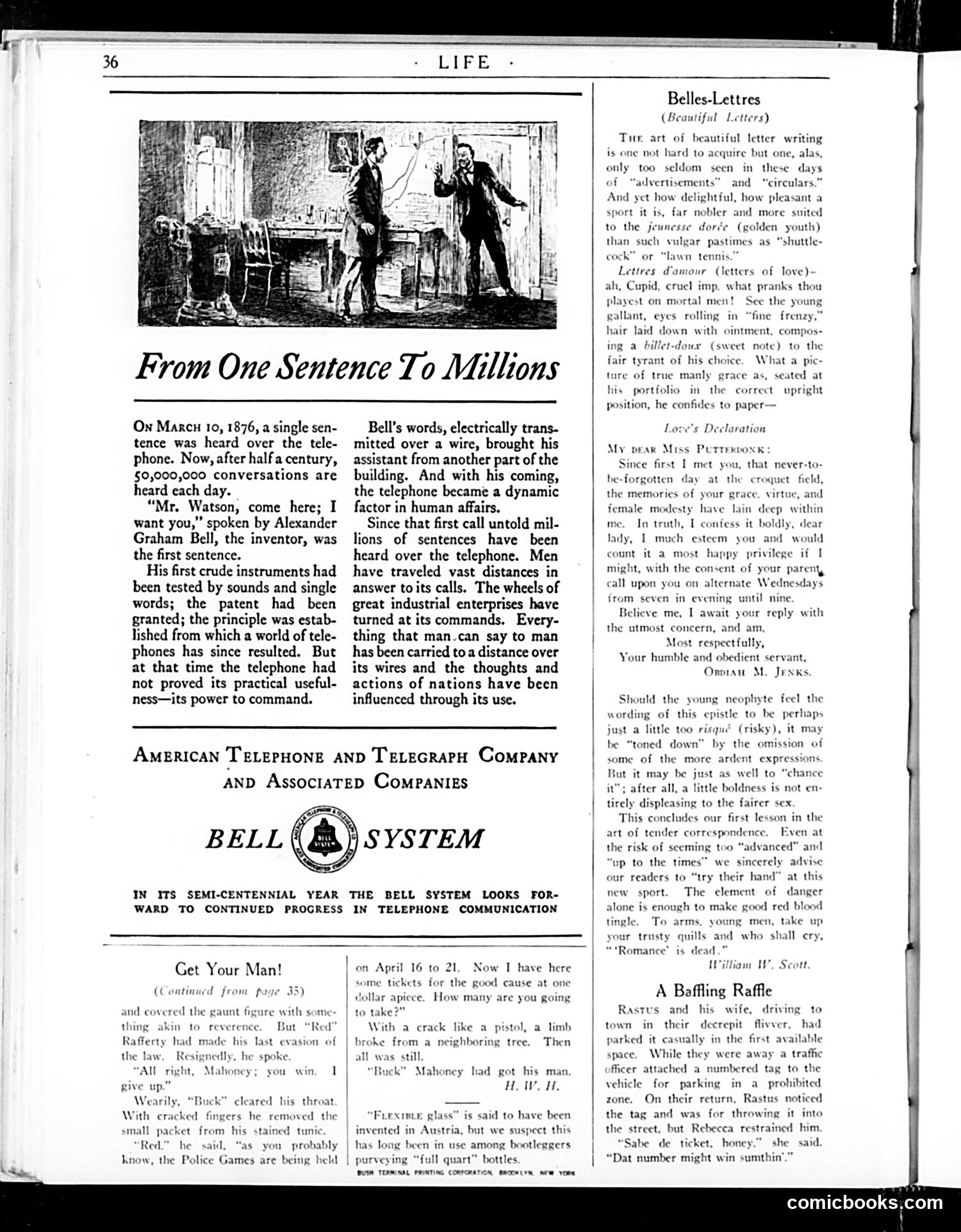
This page combines **advertising and satirical fiction**. The top section is a Bell Telephone Company advertisement celebrating the telephone's 50th anniversary, highlighting Alexander Graham Bell's first transmitted words (March 10, 1876) and promoting the technology's transformative impact on business and communication. Below is a serialized crime-fiction story titled "Get Your Man!" about a police officer named Mahoney pursuing someone called "Red"—apparently a bootlegger, as referenced by the "flexible glass" joke about bottles used by illegal alcohol dealers (this is Prohibition-era satire, circa 1920s). The right column features "Belles-Lettres," a humorous advice section mocking overly formal Victorian love letters. It presents an exaggerated example from "Orphan M. Jenks" using absurdly stiff, euphemistic language typical of period courtship writing—the satire being how bloodless and timid such "proper" correspondence was compared to actual human passion. The page essentially juxtaposes technological progress (the telephone) with static social conventions and criminal activity.
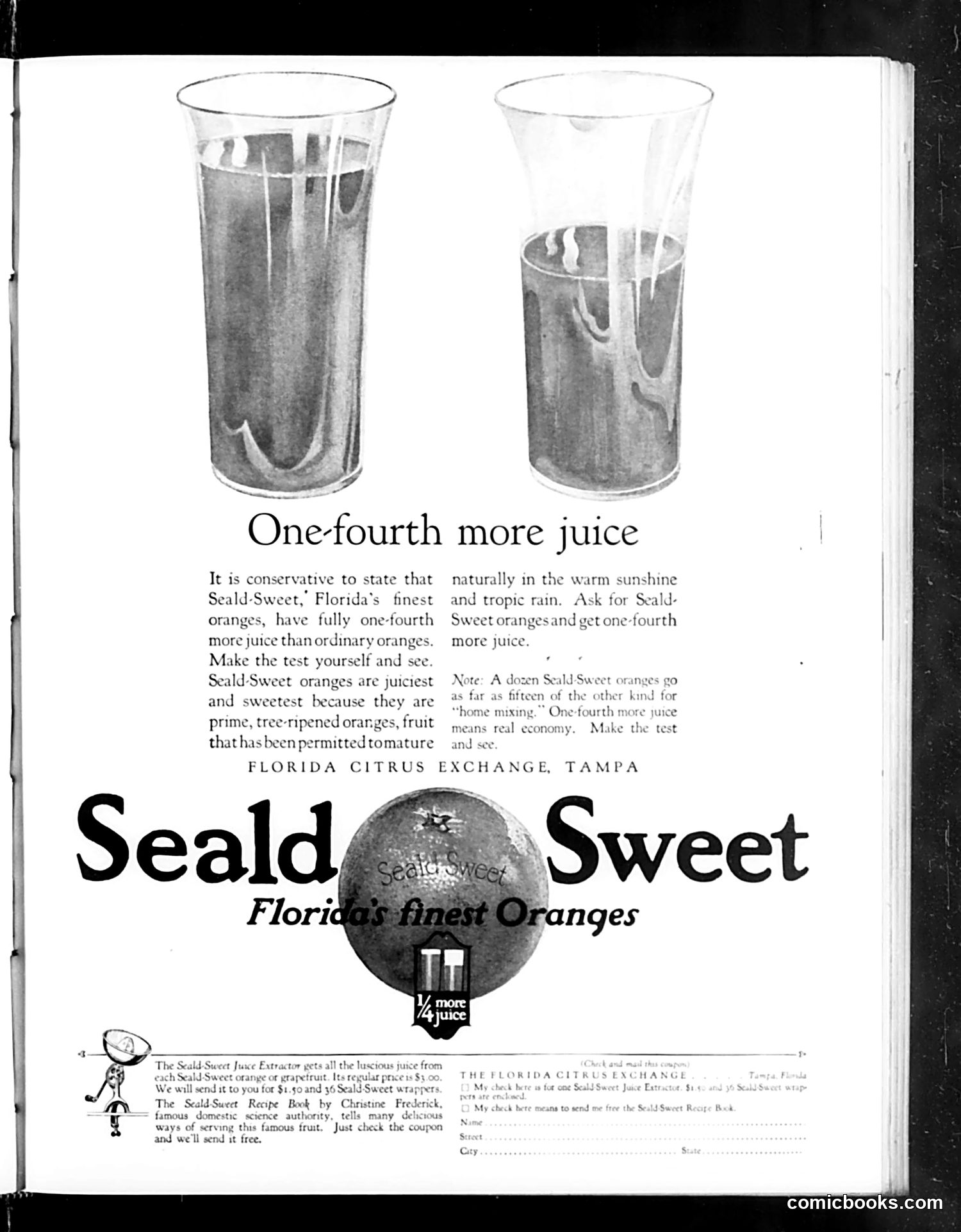
This is **not a cartoon or satire**—it's a straightforward commercial advertisement for Seald-Sweet oranges from the Florida Citrus Exchange in Tampa. The ad compares two glasses of juice side-by-side to visually demonstrate the product's key claim: Seald-Sweet oranges yield "one-fourth more juice" than ordinary oranges. The left glass appears fuller, illustrating this advantage. The copy emphasizes that these are prime, tree-ripened Florida oranges that are naturally juicier and sweeter. The ad encourages consumers to "make the test yourself and see," appealing to verification through personal experience—a common advertising strategy of the era. A coupon at bottom offers a free recipe book to interested readers, typical of vintage direct-response advertising techniques.
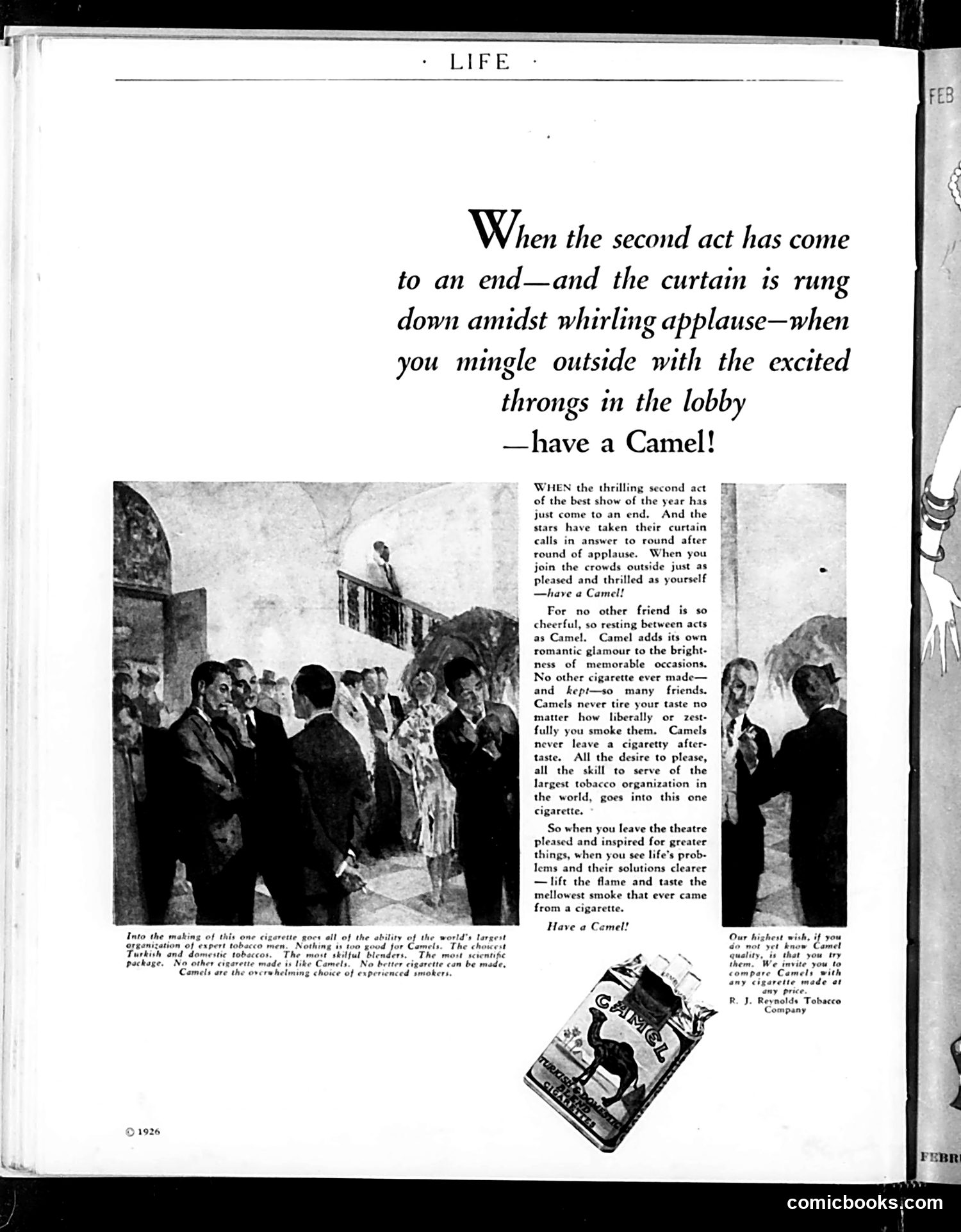
This is a full-page cigarette advertisement, not a political cartoon. It depicts a theater lobby scene where well-dressed patrons mingle after the second act of a Broadway show. The ad associates Camel cigarettes with sophisticated entertainment and upper-class leisure. The pitch: smoking a Camel between acts enhances the theater experience and social pleasure. The copywriting employs lifestyle marketing—linking the product to glamorous occasions and refined moments. Notable claims include that Camels "never tire your taste" and don't leave an aftertaste, positioning them as superior to competitors. The ad emphasizes the R.J. Reynolds Tobacco Company's scale and resources. This represents 1926 advertising before cigarette health warnings existed. The image and text work together to glamorize smoking as a marker of sophistication and worldliness for the magazine's affluent readership.