
Life, 1926-02-11 · page 28 of 40
Life — February 11, 1926 — page 28: what you’re looking at
What you’re looking at
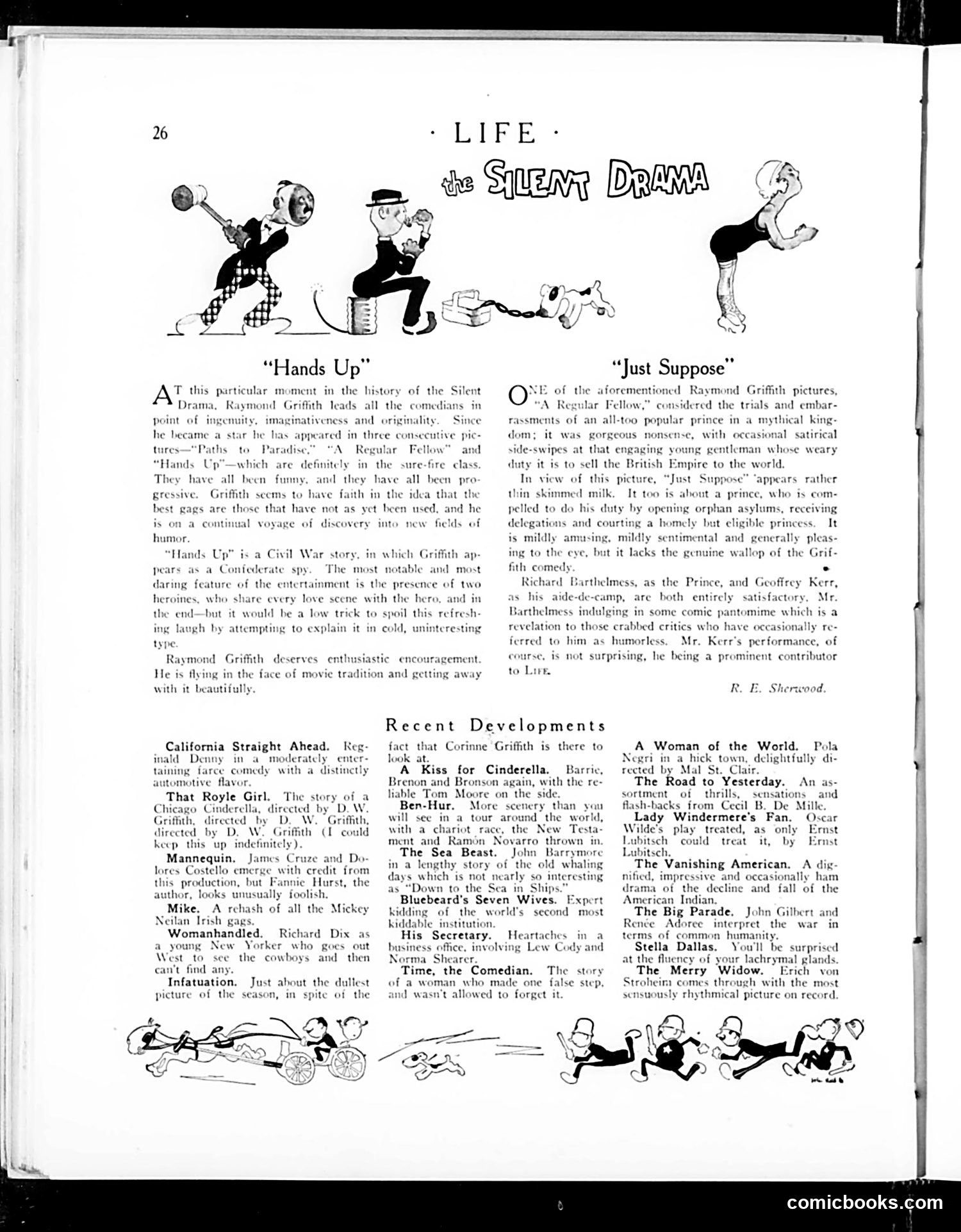
This page reviews silent films starring Raymond Griffith and contemporaries. The cartoons at top illustrate plot points: "Hands Up" shows Griffith as a Confederate spy in a Civil War story; "Just Suppose" depicts a prince fulfilling royal duties (opening orphan asylums, courting an eligible princess). The text praises Griffith's originality and comedic inventiveness, noting he's appeared in three consecutive successful films. The reviewer appreciates the film's satirical "side-swipes" at British imperial duty, though finds "Just Suppose" somewhat thin dramatically. The "Recent Developments" section lists other current releases: "Ben-Hur" (noted for scenery), "Bluebeard's Seven Wives," "The Sea Beast" with John Barrymore, and films by directors like D.W. Griffith and Cecil B. DeMille—major figures of 1920s cinema. The page reflects the era's thriving silent film industry and critical engagement with emerging movie stars and directors.
📄 Transcribed text from this page (OCR, searchable)
Machine-transcribed from the original scan — historical spelling and the odd misread are preserved.
“Hands Up” AT this particular moment in the history of the Silent all the ativeness and orig Drama, Raymond Griffith leads point of ingenuity, im: he became a star he has appeared in three consec dom; it was gorgeous nonsense, with occasional satirical tures—"Paths to Paradise,” “A Regular Felk side-swipes at that en young gentleman whose weary “Hands Up"—which are definitely in. the duty it is to sell the British Empire to the world They have all been funny, and they have all been pro In view of this picture, “Just Sup appears rather gressive. Griffith seems to have faith in the idea that t thin skimmed milk, It too is about a prince, who is com- best gags are those ve not as yet been used, and he pelled to do his duty by opening orphan asylums, receiving is on a continual v of discovery into new fields of delegations and courting a homely but eligible princess, It humor. “Hands Ur a Civil War story, in which Gri pears as a Confederate spy. The most notable and most fith comedy laring feature of the entertainment is the presence of two Richard Barthelmess, heroines, who share every love scene with the hero, and in as his aide-de-camp, are the end—but it would be a low trick to spoil this refresh- I h by attempting to explain it i type Raymond Griffith He is flying in th with it beautif California Straight Ahead. Keg- Id Denny in a moderately en ing farce comedy with a distinctly uutomotive flavor That Royle Girl. The story of a Chicago Cinderella, directed by D.W Griffith, directed by D. W. Griffith, directed by D, W. Griffith (1 could keep this up indefinitely). Mannequin, James ¢ ¢ and Do lores Costello emerge with credit from this production, but Fannie Hurst, the author, looks unusually foolish. Mike, A rehash of all the Neilan Irish gags. Womanhandled. Richard Dix as a young New Yorker who gocs out West to see the cowboys and then can't find any. Infatuation. picture of the sea Mickey Just about the dultest of the cold, uninterest enthusiastic ition and getting away NE of tl OM Tes comedians in is mildly ar ferred to h course, is to Lire encouragement Recent fact that Corinne look at. A Kiss for Cinderella. Barrie, Brenon and Bronson again, with the re- liable Tom Moore on the side. Developments Griffith is there to Ben-Hur. More scenery than will see ound the we with a ch. . the New Testa ment and ovarro thrown in. The Sea Beast. John Barrymore in a lengthy story of the old whaling days which is not nearly so interesting as “Down to the Sca in Ships.” Bluebeard’s Seven Wives. Ex kidding of the world's second most kiddable institution. His Secretary. business office, involv Norma Shearer. Time, the Comedian. The story of a woman who made one false step, and wasn't allowed to forget it. Heartaches in a Lew Cody and aforemer ar Fellow,” ex rassments of an all-too popular prince in at 1sing, mildly sentimental and generally pleas- ap- ing to the eye, but it lacks the ger sarthelmess indulging in some comic pantomime which is a revelation to those crabbed critics who have occ n as humorless. surprising, he being a pr ust Suppose” aymond Griffith pictures, ered the trials and embar- thical king- wallop of the Grif- . the Prince, and Geoffrey Kerr, both entirely sfactory, Mr Mr. Kerr's performance, of tinent contributor R A Woman of the World. la Ne in a hick town, delightfully di- rected by Mal St. Clair. The Road to Yesterday. An as- sortment of thrills, sensations and flash-backs from Cecil B. De Mille. Lady Windermere’s Fan. O. Wilde's play treated, as only Lubitsch could treat it, by Lubitsch. The Vanishing American. nified, impressive and nally drama of the decline and fall of the American Indian. The Big Parade. John Gilbert and Renée Adoree interpret. the war. in terms of common humanity. Stella Dallas. You'll be sur, at the fluency of your lachrymal g Merry Widow. | Erich von n with the most 1 picture on record. comicbooks.com