
Life, 1926-02-11 · page 38 of 40
Life — February 11, 1926 — page 38: what you’re looking at
What you’re looking at
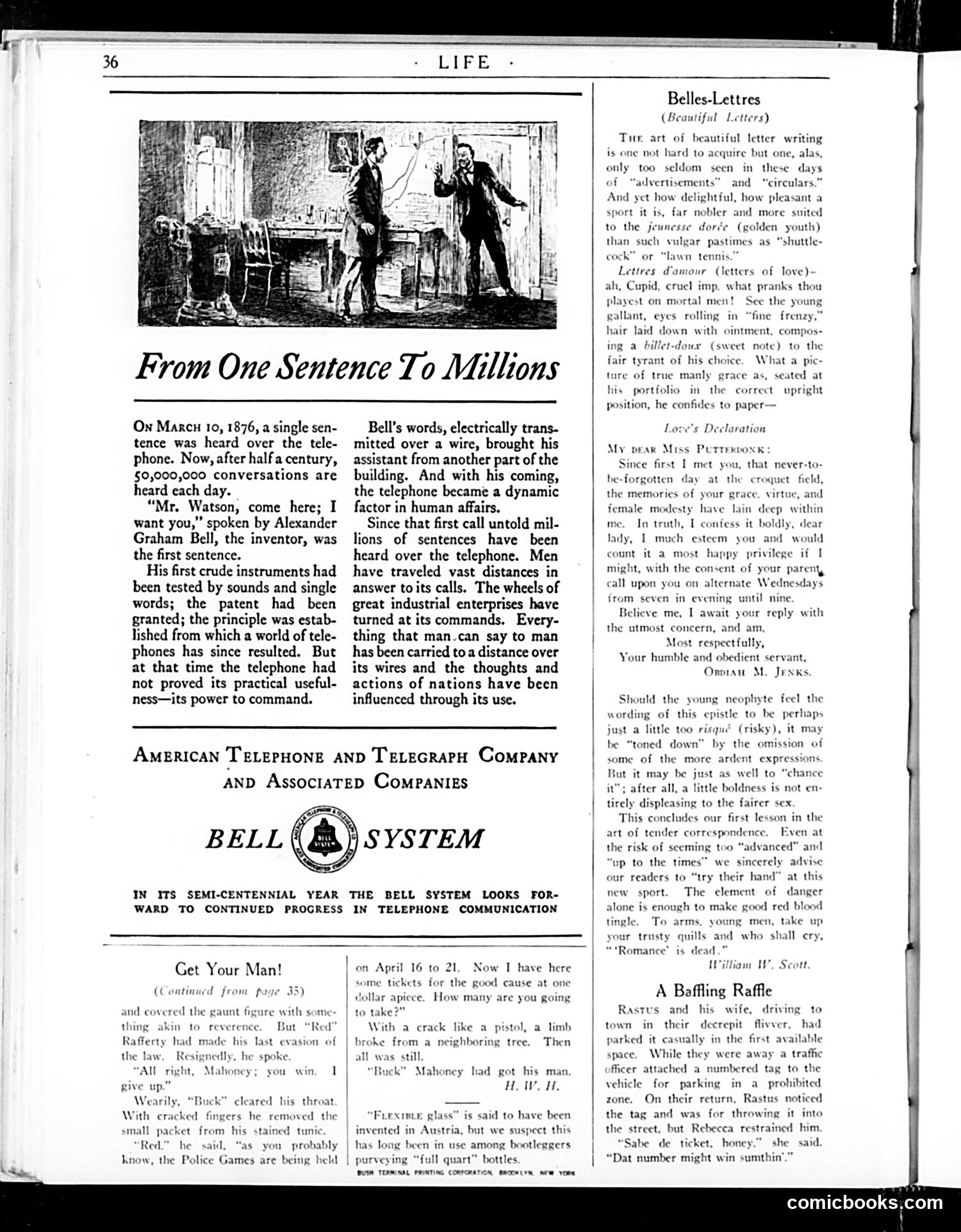
This page combines **advertising and satirical fiction**. The top section is a Bell Telephone Company advertisement celebrating the telephone's 50th anniversary, highlighting Alexander Graham Bell's first transmitted words (March 10, 1876) and promoting the technology's transformative impact on business and communication. Below is a serialized crime-fiction story titled "Get Your Man!" about a police officer named Mahoney pursuing someone called "Red"—apparently a bootlegger, as referenced by the "flexible glass" joke about bottles used by illegal alcohol dealers (this is Prohibition-era satire, circa 1920s). The right column features "Belles-Lettres," a humorous advice section mocking overly formal Victorian love letters. It presents an exaggerated example from "Orphan M. Jenks" using absurdly stiff, euphemistic language typical of period courtship writing—the satire being how bloodless and timid such "proper" correspondence was compared to actual human passion. The page essentially juxtaposes technological progress (the telephone) with static social conventions and criminal activity.
📄 Transcribed text from this page (OCR, searchable)
Machine-transcribed from the original scan — historical spelling and the odd misread are preserved.
From One Sentence To Millions On Marcu 10, 1876, a single sen- tence was heard over the tele- phone. Now, after halfa century, $0,000,000 conversations are heard each day. “Mr. Watson, come here; I want you,” spoken by Alexander Graham Bell, the inventor, was the first sentence. His first crude instruments had been tested by sounds and single words; the patent had been granted; the principle was estab- lished from which a world of tele- phones has since resulted. But at that time the telephone had not proved its practical useful- ness—its power to command. Bell’s words, electrically trans- mitted over a wire, brought his assistant from another part of the building. And with his coming, the telephone became a dynamic factor in human affairs. Since that first call untold mil- lions of sentences have been heard over the telephone. Men have traveled vast distances in answer to its calls. The wheels of great industrial enterprises have turned at its commands. Every- thing that man_can say to man has been carried toa distance over its wires and the thoughts and actions of nations have been influenced through its use. AMERICAN TELEPHONE AND TELEGRAPH CoMPANY AND AssocIATED ComPANIES Pm BELL Sez . } SYSTEM IN ITS SEMI-CENTENNIAL YEAR THE BELL SYSTEM LOOKS FOR- WARD TO CONTINUED PROGRESS IN TELEPHONE COMMUNICATION Get Your Man! and covered the gaunt figure with some- thing akin to reverence. But “Red” Raff the law. Resignedly, he spoke. All right, Mahoney; you win. I give up.” Wearily, * ty had made his last evasion of k" cleared his throat With cracked fingers he removed the small packet from his stained tunic “Red.” he sai s you probably know, the Police Games are being held on April 16 to 21. Now T have here some tickets for the good cause at one dollar to take With a crack like a p broke from a neighboring tree. Then all was still “I ce. How many are you going a limb Mahoney had got his man HOW. i, Fiextate glass” is said to have been invented in Austria, but we suspect this been in use among bootleggers purveying “full quart” bottles. USM TERMINAL PRINTING CORPORATION BRCOFLYN MW Yoms has Belles-Lettres (Beautiful Letters) Tue art of beautiful letter writing is one not hard to acquire but one, alas, too seldom seen in these days of “advertisements” and “circulars.” And yet how delightful, how pleasant a sport it is, far nobler and more stiited to the jeunesse dorée (golden youth) » such vulgar pastimes as “shuttle- or “lawn tenn Lettres d'amour (letters of love) ah, Cupid, cruel imp. what pranks thou playest on mortal men! See the young gallant, eyes rolling in “fine frenzy,” hair laid down with ointment, compos- ing a billet-douxr (sweet note) to the fair tyrant of his choice. What a pic- of true manly gr: ture € as, seated at his portfolio in the correct upright position, he confides to paper— Love's Declaration My pear Miss Puttekponk : Since first I met you, that never-to- field, nd he-forgotten day at the c the memories of me. In truth, I confess it boldly, dear lady, I much esteem you and would count it a most happy privilege if I might, with the consent of your parent, call upon you on alternate Wednesdays from seven in evening until nine. Believe me, I await your reply with the utmost concern, and am. Most respectfully, Your humble and obedient servant, Orptan M. Jenks. Should the young neophyte feel the wording of this epistle to be perhaps just a little too risqué (risky), it may be “toned down” by the omission of some of the more ardent expressions But it may be just as well to “chance it”; after all, a little boldness is not en- tirely displeasing to the fairer sex This concludes our first lesson in the en at art of tender correspondence. FE: “advanced” and the risk of sceming too “up to the times” we sincerely advise our readers to “try their hand” at this new sport. The element of danger alone is enough to make good red b To arms, young men, take rr trusty quills and who shall ery, mance’ is dead.” William W. Scott. A Baffling Raffle Rastus and his wife, dri town in their decrepit flivver, had to parked it casually in the first available space. While they were away a traffic officer attached a numbered tag to the vehicle for parking in a_ prohibited zone. On their return, Rastus noticed the tag and was for throwing it into the street, but Rebecca restrained him. Sabe de ticket, honey.” she said. “Dat number might win sumthin’.” comicbooks;com