
A complete issue · 40 pages · 1926
Life — February 4, 1926
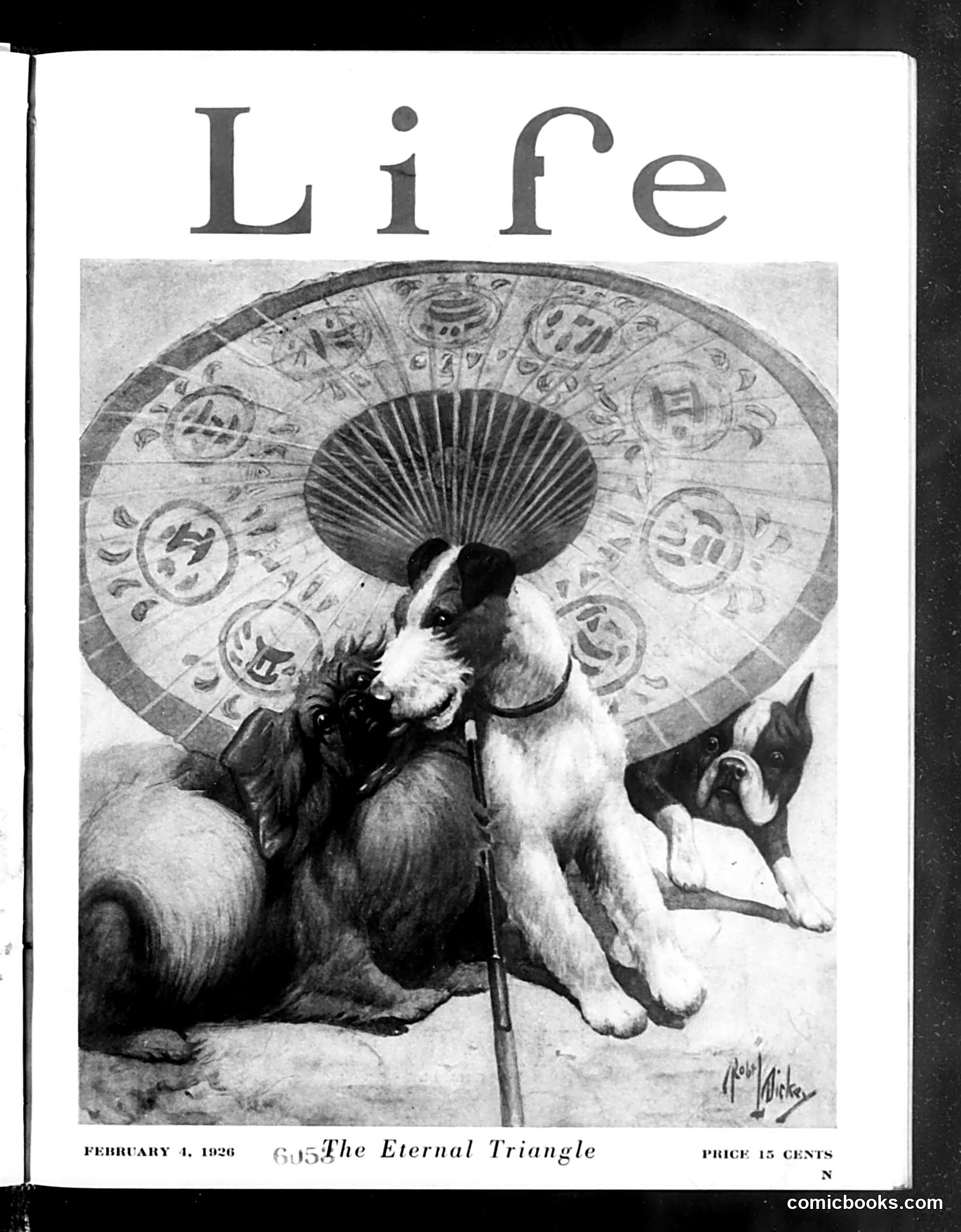
This *Life* cover features dogs arranged behind a large fan-like structure decorated with zodiac symbols and mystical imagery. The title "Life" and subtitle "The Eternal Triangle" suggest the cover satirizes fortune-telling and astrology—popular fads in the 1920s. The dogs appear to represent human characters in a romantic "eternal triangle" (a love affair involving three people). By depicting them as fortune-teller subjects with zodiac backdrop, the cartoonist mocks both the absurdity of astrology and the melodramatic romantic entanglements that fascinated 1920s popular culture. The anthropomorphized dogs and mystical props create humorous commentary on how people blamed fate or stars for romantic complications, rather than personal responsibility. This reflects 1920s skepticism toward spiritualism while poking fun at romantic scandals of the era.
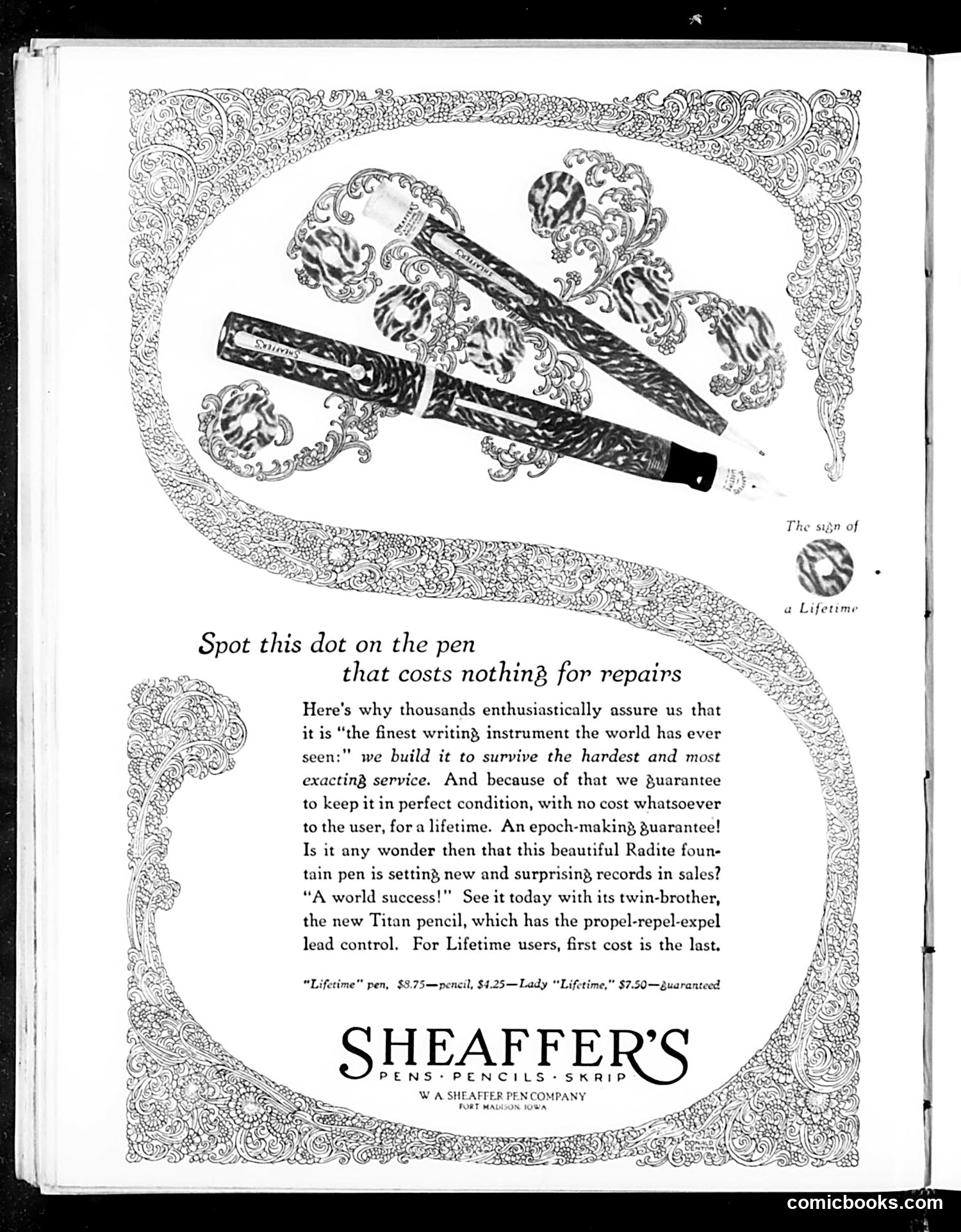
This is primarily a **Sheaffer pen advertisement**, not political satire. The page shows ornate decorative borders and displays two Sheaffer fountain pens with detailed ornamental handles alongside a pencil ("Titan"). The marketing message promises that Sheaffer's "Radite fountain pen" is built to survive "the hardest and most exacting service" with a lifetime guarantee requiring "no cost whatsoever to the user." The headline "Spot this dot on the pen that costs nothing for repairs" draws attention to a quality mark. The ad emphasizes this as "epoch-making" and notes strong sales ("world success"), positioning the pen as superior to competitors. It mentions a companion product: the "Titan pencil" with "propel-repel-expel lead control." This reflects early-20th-century advertising's emphasis on durability and lifetime warranties as selling points.

This is a straightforward advertisement, not satire. It promotes the Hupmobile Six automobile with the headline "Only two months old—7500 cars delivered and four buyers waiting for every car we can build." The ad emphasizes extraordinary consumer demand: for every vehicle manufactured, four people are reportedly waiting to purchase one. This suggests the Hupmobile Six was a popular, desirable car in the early automotive era when vehicle production was limited and demand exceeded supply. The image shows a five-passenger touring car with four doors, presented as a practical family vehicle. The ad's boast about overwhelming demand was a common sales strategy to create urgency and convey the product's popularity and quality to potential buyers.
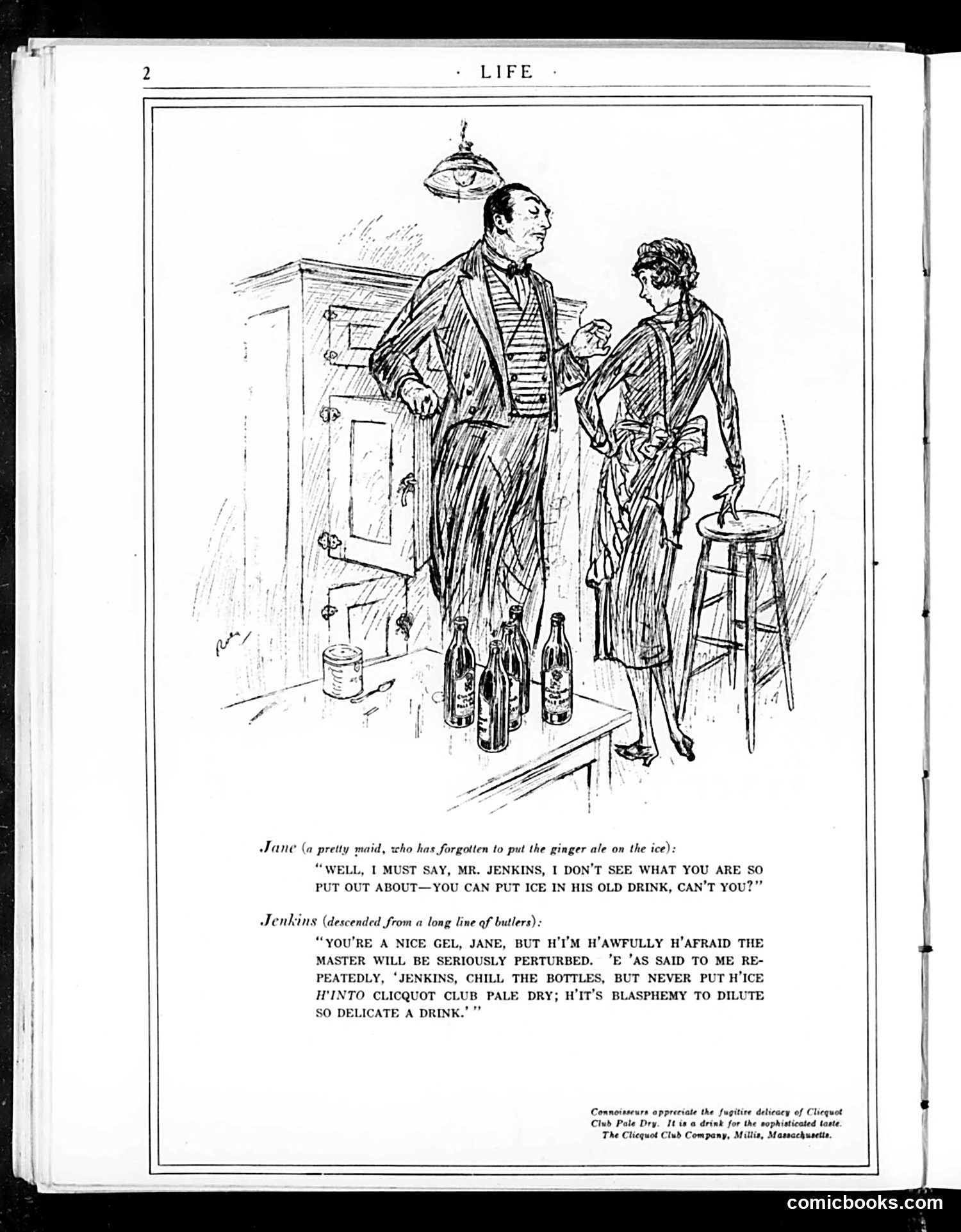
This is a humorous domestic scene satirizing Victorian-era class consciousness and servant management. Jane, a maid, has committed a social transgression by putting ice directly into expensive Clicquot Club Pale Dry ginger ale—diluting this "delicate" beverage. Jenkins, the butler (identified as "descended from a long line of butlers"), responds with mock horror, citing his employer's strict orders never to ice this particular drink. The joke targets two things: the pretentiousness of servants who adopt their masters' snobbish attitudes about luxury goods, and the absurd rules governing proper beverage service among the upper classes. The advertisement at bottom promotes Clicquot Club Pale Dry as a sophisticated drink for "the refined taste," making the satire explicit—mocking both servant hierarchy and consumer vanity.
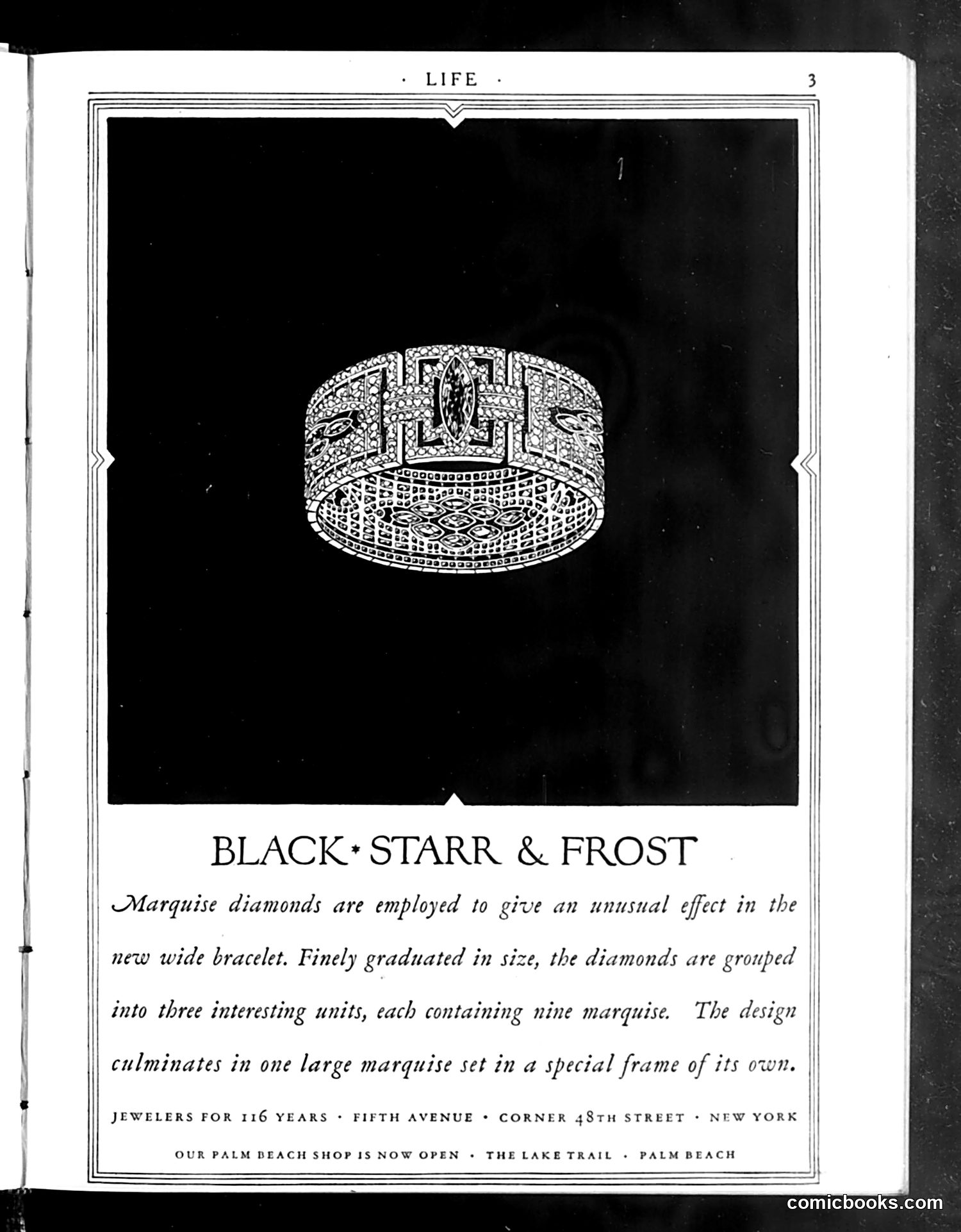
This is not a cartoon or satirical content—it's a **jewelry advertisement** for Black, Starr & Frost, a high-end jeweler. The page displays a wide diamond bracelet featuring marquise-cut diamonds arranged in three decorative units, culminating in a larger central marquise diamond. The ad copy emphasizes the bracelet's distinctive design and craftsmanship, highlighting the careful graduation and grouping of stones. The company identifies itself as "jewelers for 116 years" with locations on Fifth Avenue at 48th Street in New York and Palm Beach. There is no political or social satire present—this is straightforward luxury goods advertising from *Life* magazine's commercial pages.
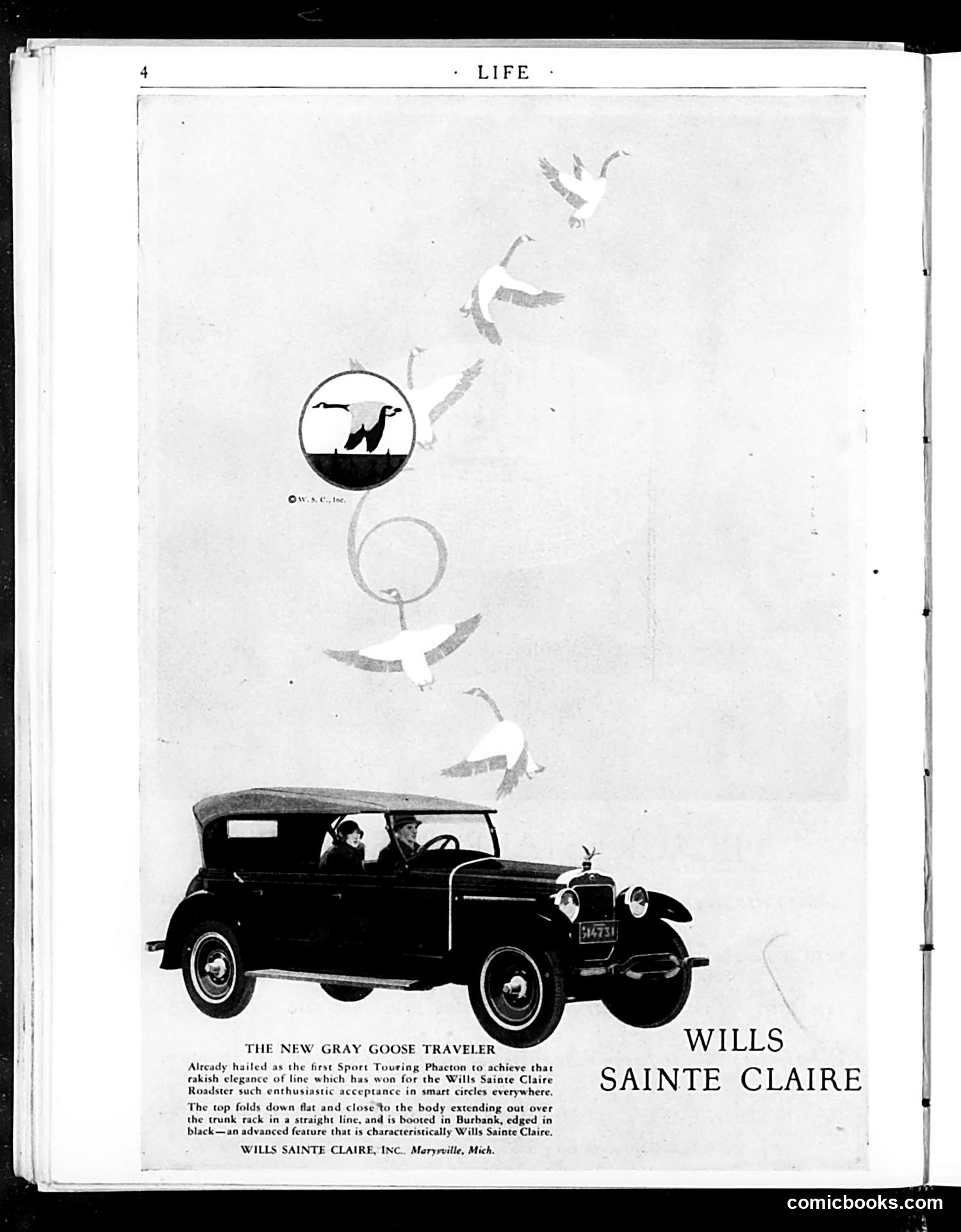
This page is primarily **advertising, not satire or political commentary**. It features a Wills Sainte Claire automobile advertisement from the 1920s era. The ad depicts "The New Gray Goose Traveler" - a sport touring car with passengers. The stylized goose logo and artistic imagery above the vehicle represent the car's branding. The text describes the vehicle as the "first Sport Touring Phaeton" with features like a trunk extending over the rear axle. The only potentially satirical element is the *goose mascot itself* - using bird imagery for an automobile brand was a marketing device meant to suggest speed and grace. However, this is straightforward advertising messaging rather than political or social satire. The manufacturer, Wills Sainte Claire, Inc., was based in Marysville, Michigan. This represents standard 1920s automotive marketing in an American magazine.
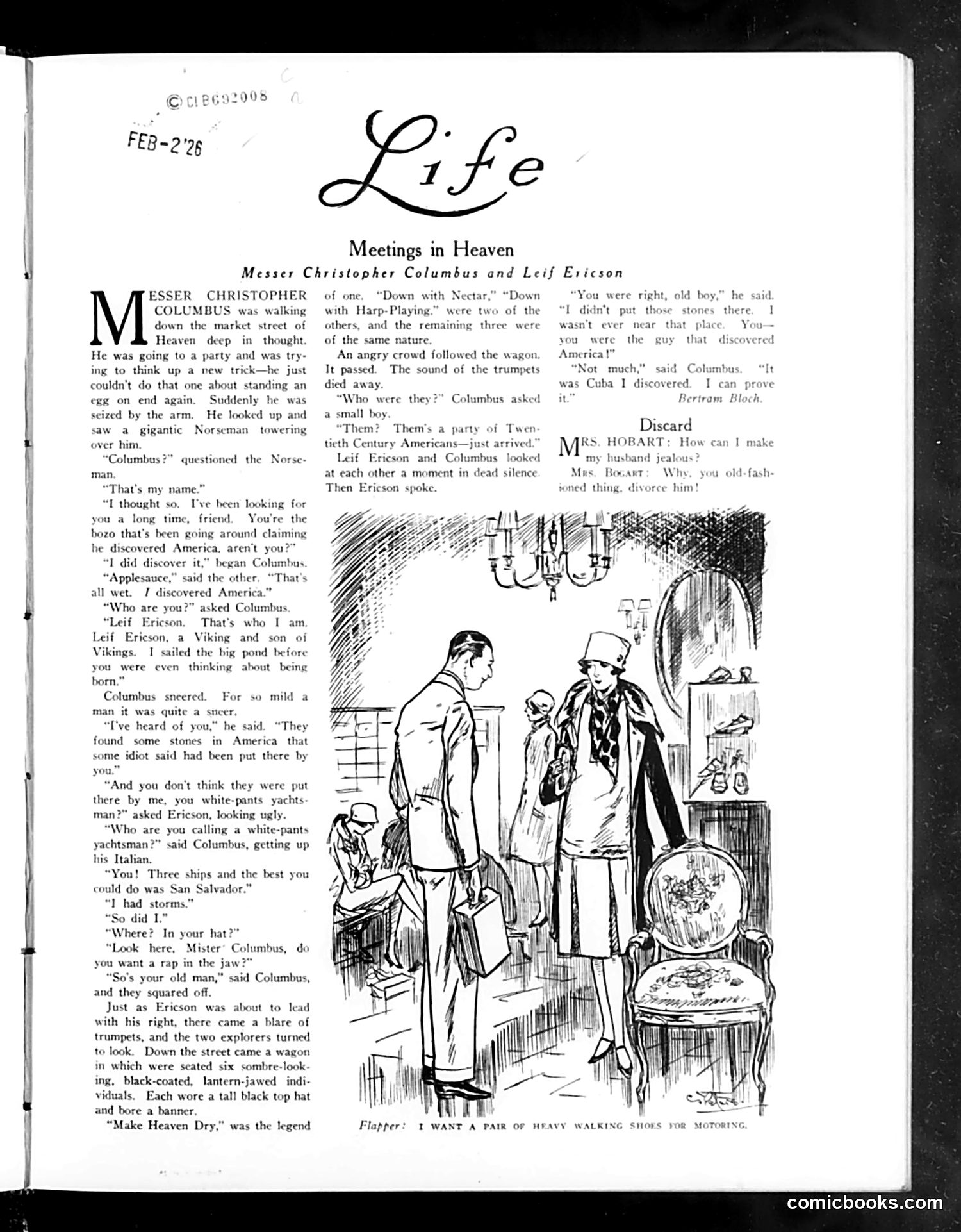
This page contains a satirical story titled "Meetings in Heaven: Messer Christopher Columbus and Leif Ericson." The narrative presents a humorous encounter between the two historical explorers in the afterlife, with Columbus claiming credit for discovering America while Ericson—a Viking—points out he arrived first, centuries earlier. The accompanying illustration depicts the two men meeting in what appears to be a heavenly setting. The satire mocks Columbus's celebrated status as America's discoverer despite Ericson's earlier Norse arrival, a historical fact that challenges the conventional narrative taught in American schools. This appears designed to humorously expose the selective nature of historical credit and national mythology around discovery and exploration.
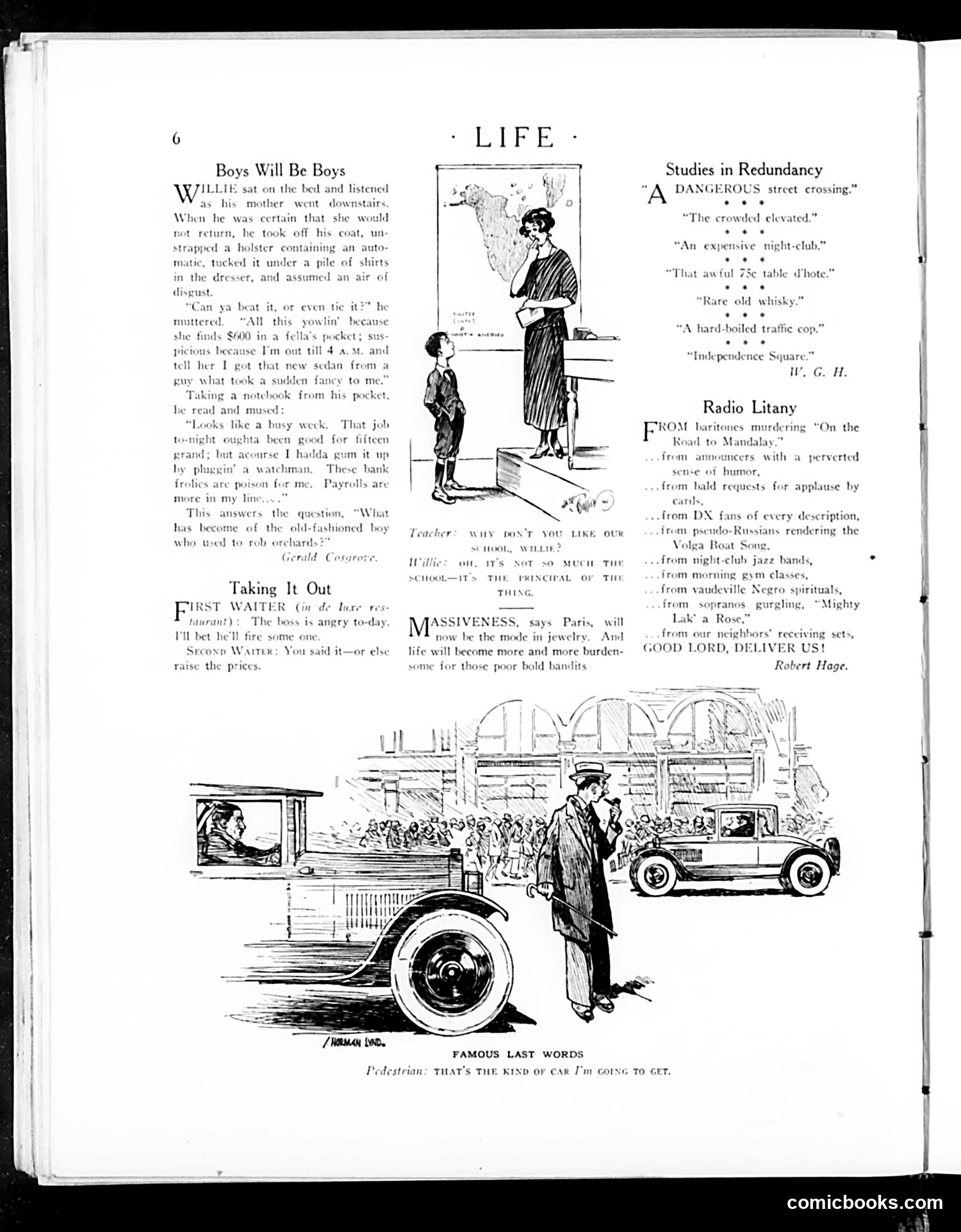
This page contains three distinct pieces of satirical humor: 1. **"Boys Will Be Boys"**: A comic strip showing a boy who steals his mother's coat to appear grown-up and "pull a sudoku fancy to me" (likely slang for impressing someone). The joke satirizes juvenile deception and vanity. 2. **"Taking It Out"**: A brief dialogue between a waiter and a second waiter discussing an angry boss who wants to raise prices—classic workplace humor about passing down frustrations through hierarchies. 3. **"Famous Last Words"**: A cartoon of a pedestrian about to be hit by a car, saying he wants "that kind of car." The satire mocks automobile enthusiasm even in the face of death, reflecting period anxiety about reckless driving. The page satirizes American social behaviors: childhood dishonesty, workplace dynamics, and dangerous car culture.
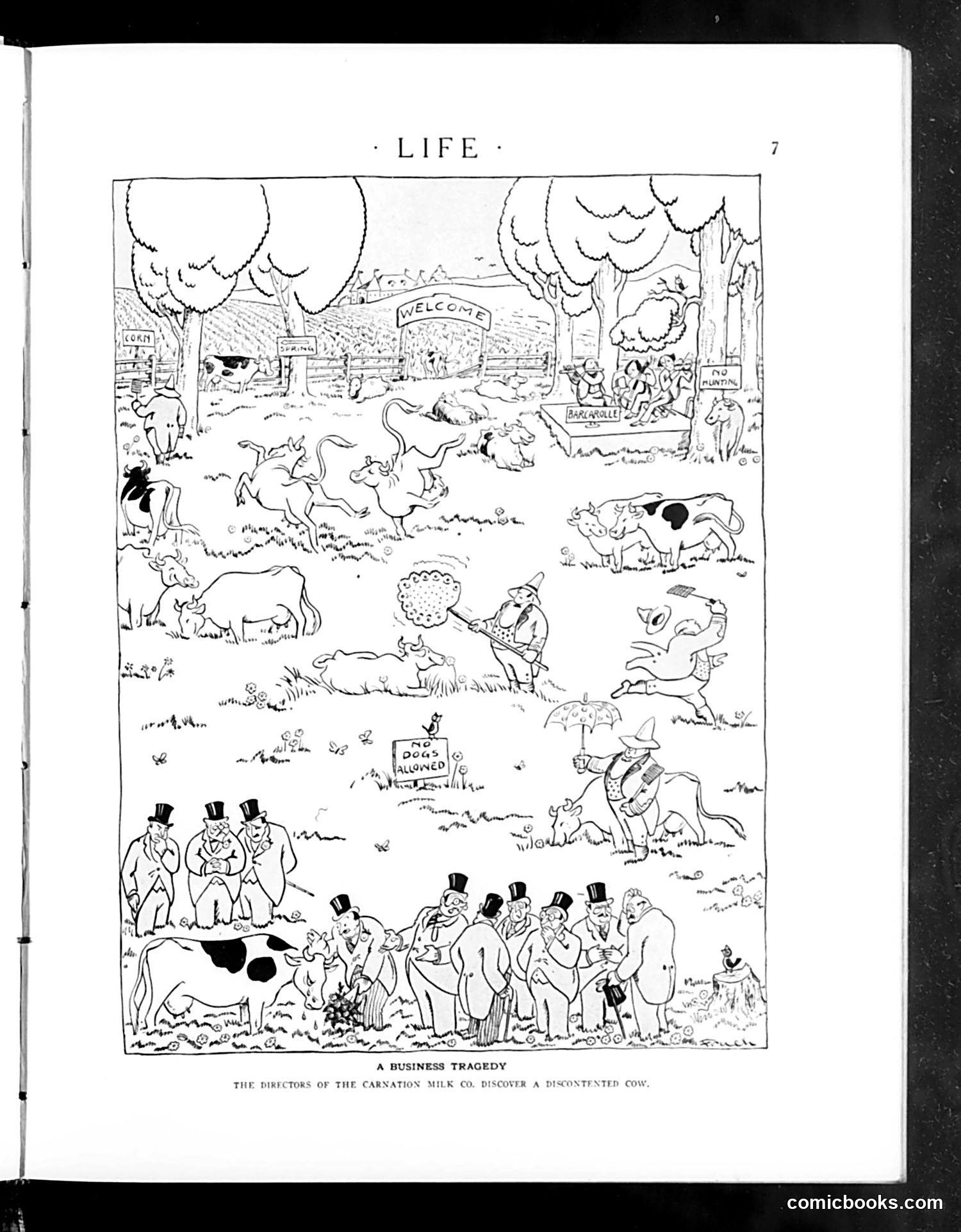
This single-panel cartoon satirizes business incompetence through absurdist humor. The caption reads: "The Directors of the Carnation Milk Co. Discover a Discontented Cow." The joke centers on the irony that a milk company's executives—dressed formally in top hats—discover a cow that is visibly unhappy or "discontented." The cartoon depicts numerous well-dressed businessmen gathered around the troubled animal in a pastoral setting, suggesting their disconnection from practical agricultural realities. The satire mocks corporate management for being out of touch with fundamental business operations. A "discontented cow" would logically be a serious problem for a dairy company, yet the executives' formal, bureaucratic response appears comically ineffectual. The cartoon reflects early 20th-century American skepticism toward corporate management and business culture.
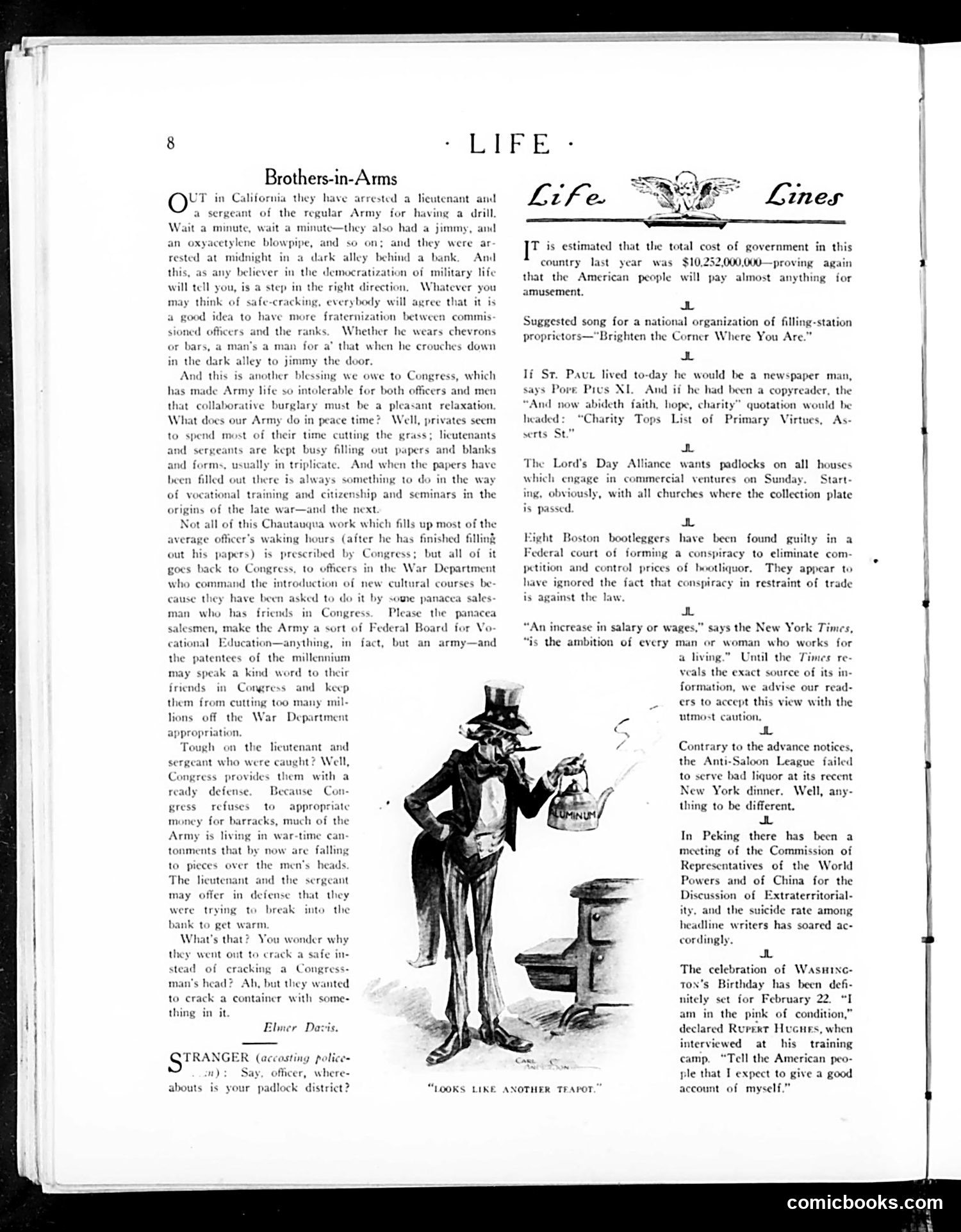
This political cartoon depicts Uncle Sam examining what appears to be a teapot or container, with the caption suggesting it resembles "another teapot." This is a reference to the **Teapot Dome Scandal** (1921-1923), a major corruption case where Secretary of Interior Albert Fall secretly leased federal oil reserves to private companies in exchange for bribes. The cartoon satirizes the scandal by suggesting the discovery of yet another corrupt scheme—implying governmental corruption was so rampant that suspicious "teapots" (scandals) kept appearing. The Uncle Sam figure represents the American public or government attempting to identify and manage these revelations of malfeasance among political leaders.
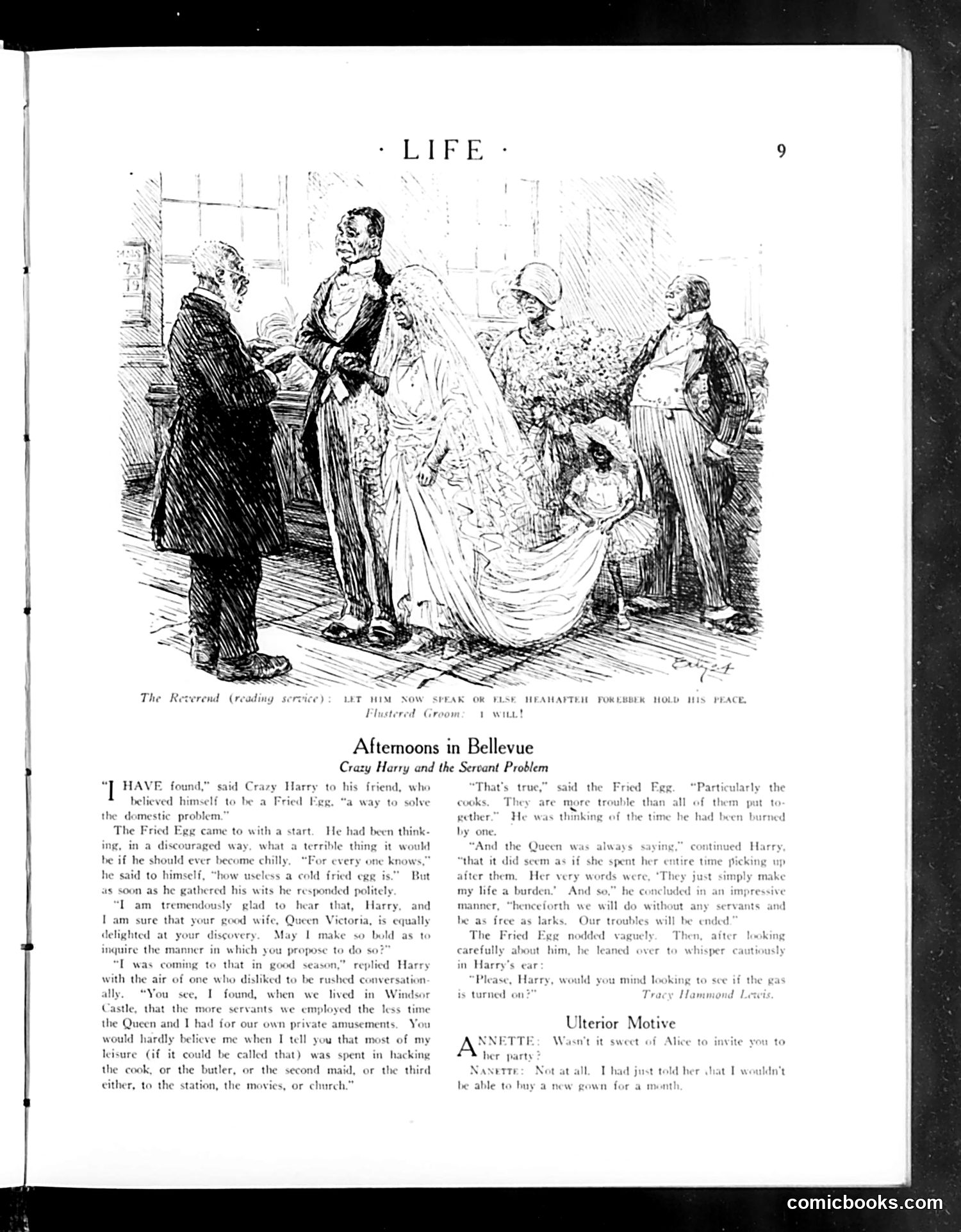
This page contains two separate satirical pieces rather than a single cartoon. **Top illustration**: Shows a wedding scene with a clergyman addressing the groom. The caption references "The Reverend (reading service): LET HIM NOW SPEAK OR ELSE HEREAFTER FOREVER HOLD HIS PEACE." This is visual satire on the traditional marriage vow's "speak now or forever hold your peace" clause—the joke appears to be about the groom's anxious expression, suggesting last-minute doubts about marriage. **Text sections**: The page features two humor pieces: "Afternoons in Bellevue" (about a character named "Crazy Harry" discussing servant problems with a friend called "the Fried Egg"), and "Ulterior Motive" (a brief dialogue between Annette and Nanette about party invitations and financial constraints). These represent typical early-20th-century Life magazine domestic humor—satirizing middle-class social anxieties around servants, marriage, and social obligations.
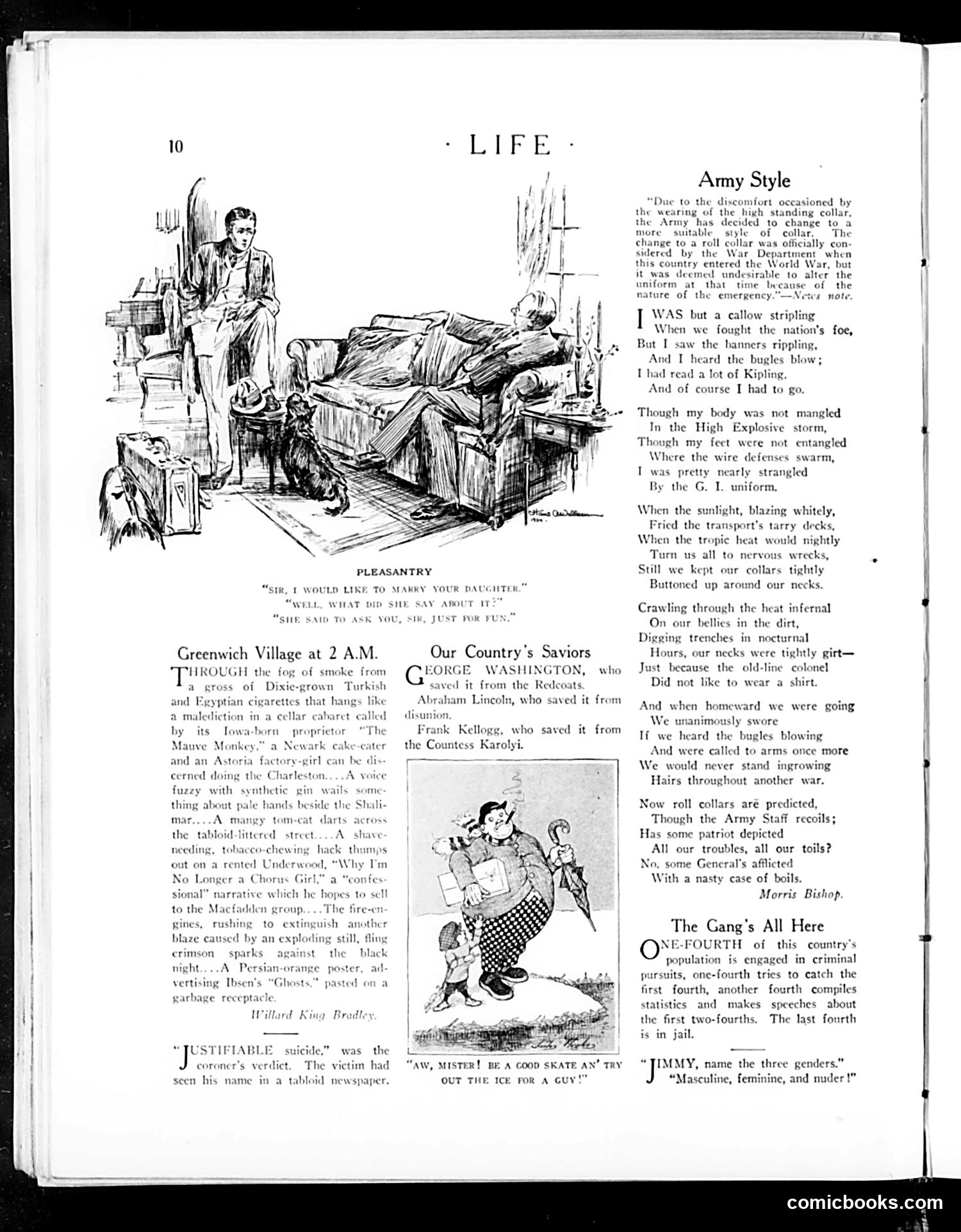
This page contains several WWI-era satirical pieces. The main cartoon "Pleasantry" depicts a domestic scene where a man in military uniform lies in bed while another soldier stands nearby—the caption suggests an awkward marriage proposal joke. The "Army Style" poem critiques the high collar uniform requirement imposed during WWI, mocking how soldiers were forced to wear uncomfortable, restrictive collars despite wartime hardships. The verse sarcastically notes that even in brutal conditions—heat, explosions, trench warfare—regulations demanded the collar remain fastened. Other brief pieces include "Greenwich Village at 2 A.M." (social commentary on bohemian life) and "Our Country's Saviors" (listing famous historical figures). The page reflects Life's characteristic blend of gentle domestic humor with pointed critiques of military regulations and wartime absurdities.
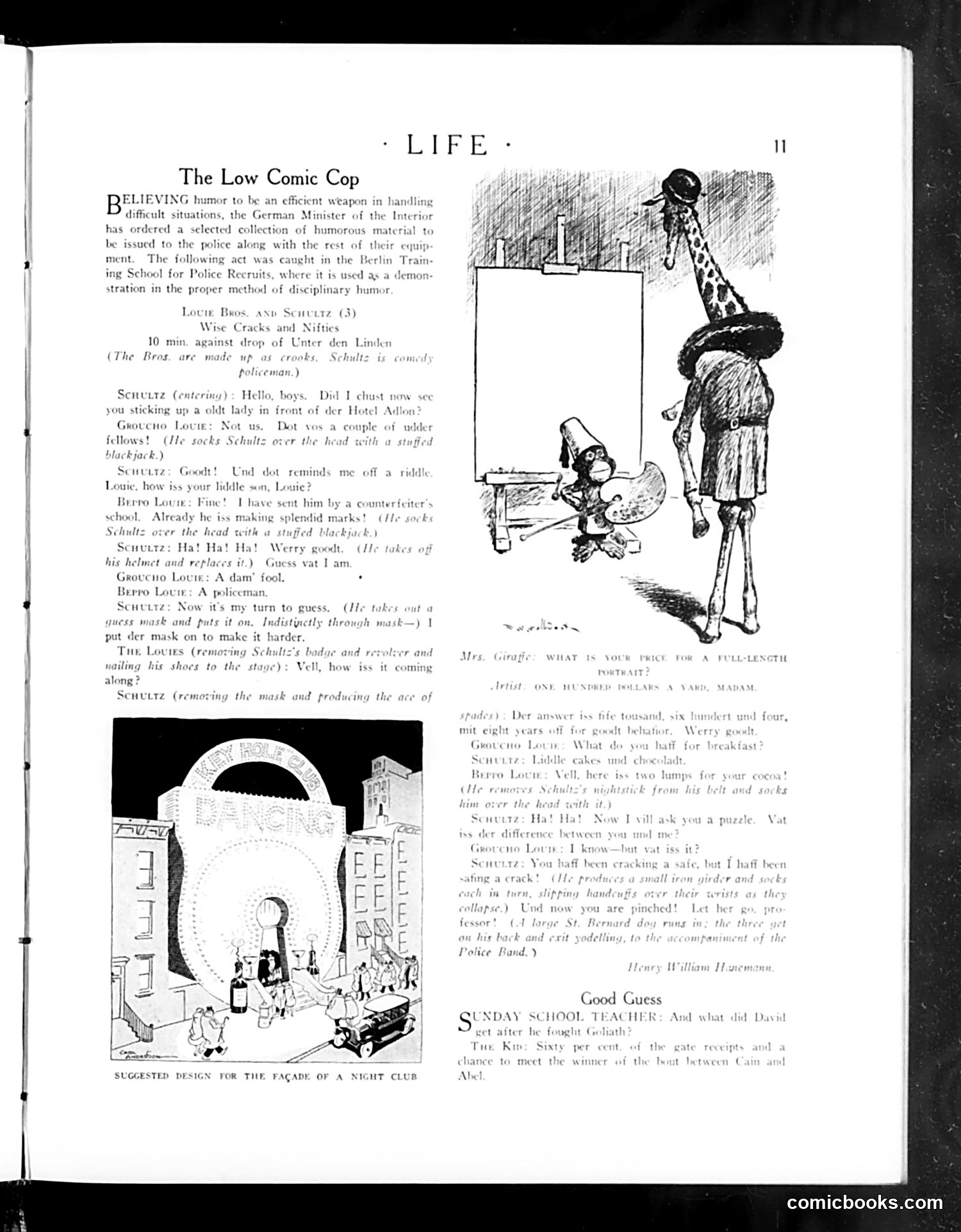
This page presents two humorous sketches supposedly from Berlin's Police Training School, demonstrating "disciplinary humor" as a management tool. **"Wise Cracks and Nifties"** (top): A comedic dialogue between police officers Schultz and the Louie brothers, using wordplay and riddles to train officers in quick thinking and wit. **"Suggested Design for the Façade of a Night Club"** (bottom): A satirical architectural drawing depicting an enormous padlock as a nightclub entrance—likely mocking Prohibition-era speakeasy culture and the absurdity of attempting to control illegal alcohol sales through comical means. The overall piece satirizes German police methods and, implicitly, American Prohibition enforcement as ineffectual and somewhat ridiculous, using humor to expose the futility of these regulatory approaches.
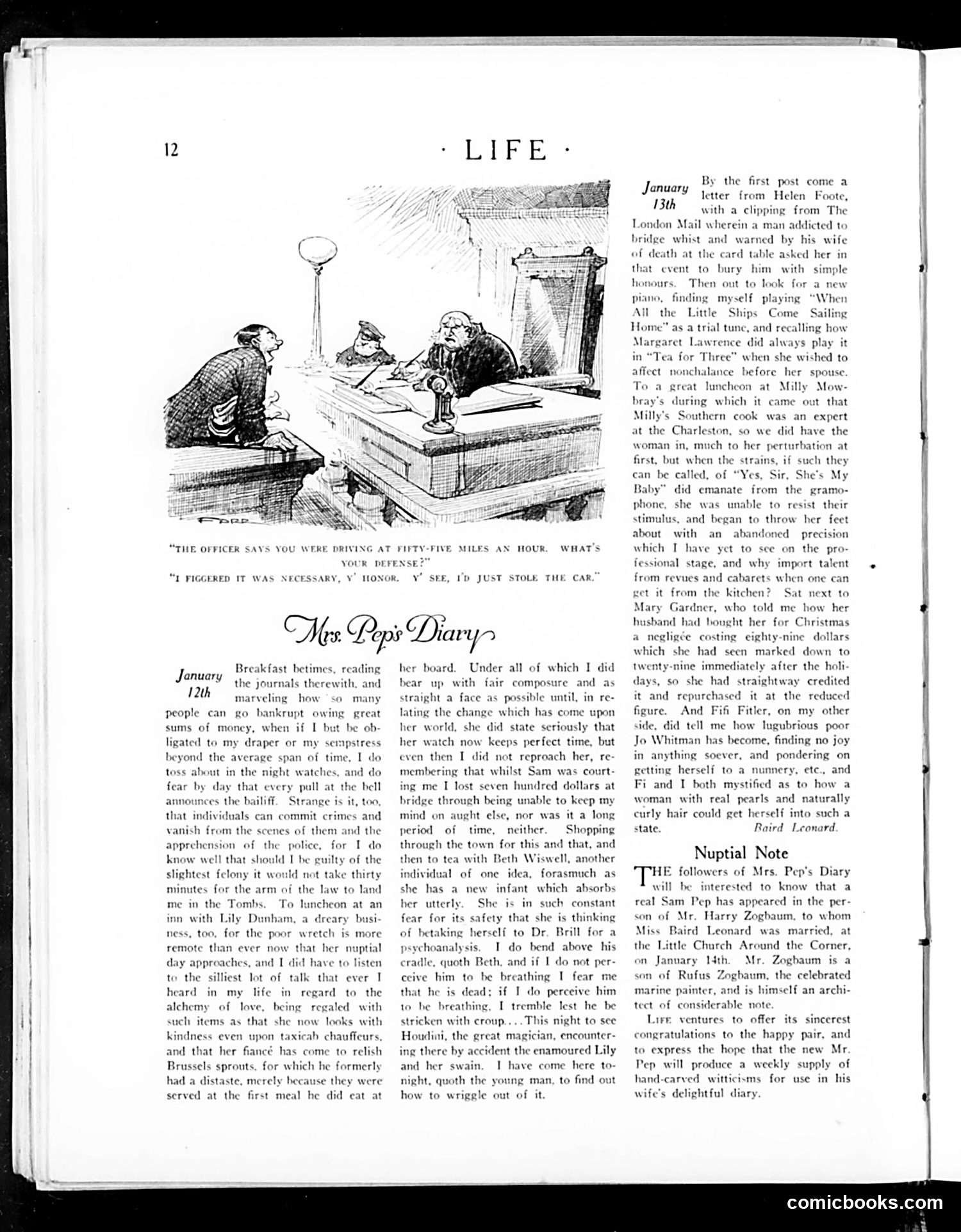
The cartoon depicts three men at what appears to be a legal or official proceeding. One man sits elevated (suggesting authority—possibly a judge or magistrate), while another stands accused. The caption reads: "THE OFFICER SAYS YOU WERE DRIVING AT FIFTY-FIVE MILES AN HOUR. WHAT'S YOUR DEFENSE?" to which the accused replies: "I FIGURED IT WAS NECESSARY, Y' HONOR. Y' SEE, I'D JUST STOLE THE CAR." **The Satire:** This is a joke about absurd legal logic. The defendant admits to car theft but justifies speeding as "necessary"—treating the lesser crime seriously while casually confessing to a major felony. The humor lies in the illogical priorities and the defendant's casual criminality. This reflects early 20th-century attitudes toward crime and the humor found in criminals' twisted reasoning.
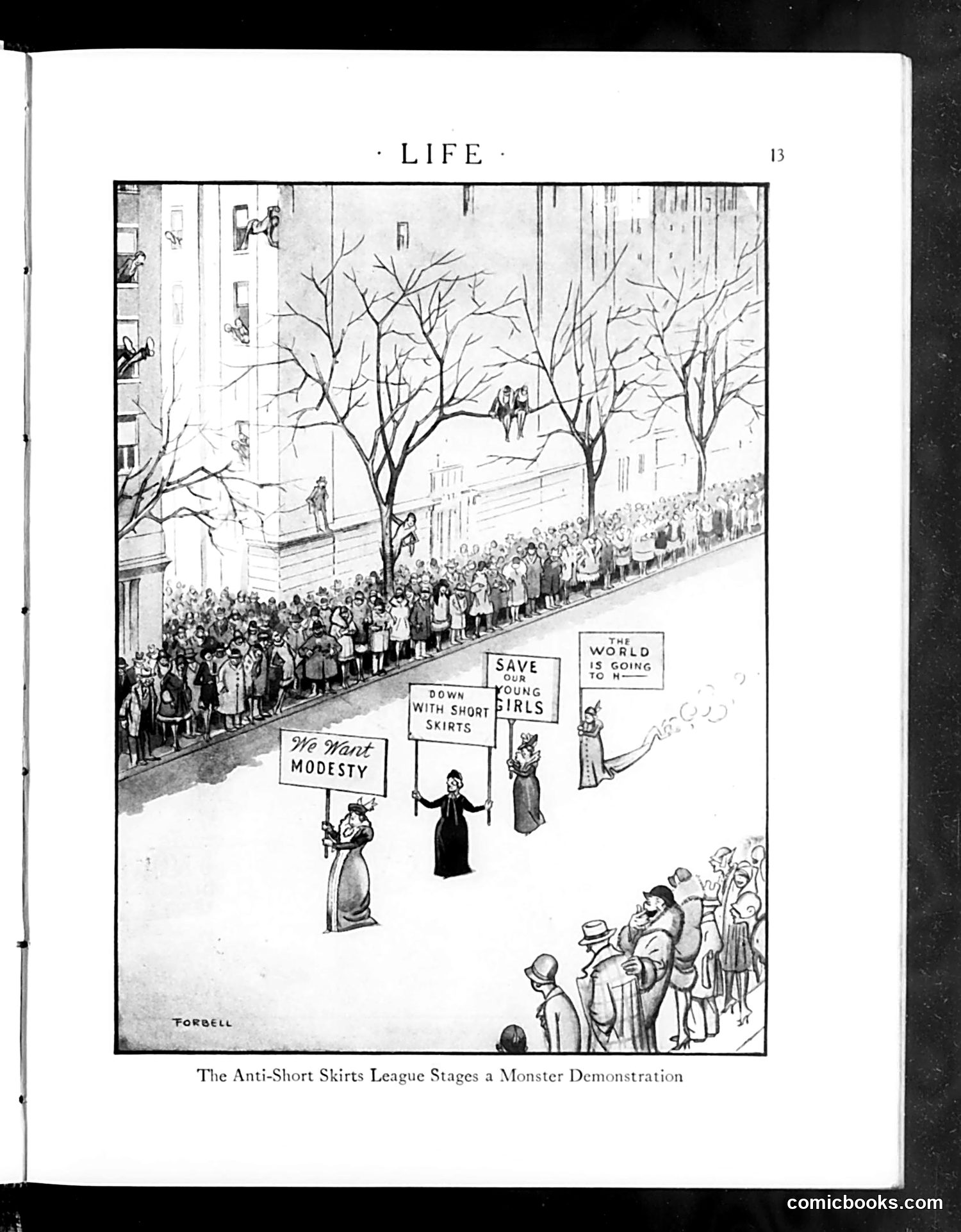
This satirical cartoon from *Life* magazine mocks the "Anti-Short Skirts League," a real conservative organization that opposed women wearing shorter hemlines—a fashion trend that emerged in the 1920s. The cartoon depicts a large, orderly protest in an urban street, with protesters holding signs reading "We Want Modesty," "Down With Short Skirts," "Save Our Young Girls," and "The World Is Going to H—." The demonstration is presented as absurdly serious and massive, satirizing the perceived overreaction to this fashion change. The cartoon's humor lies in portraying the anti-short skirts movement as histrionic moral panic over what was ultimately a minor clothing adjustment—a common *Life* magazine approach to mocking conservative social attitudes and generational conflict.
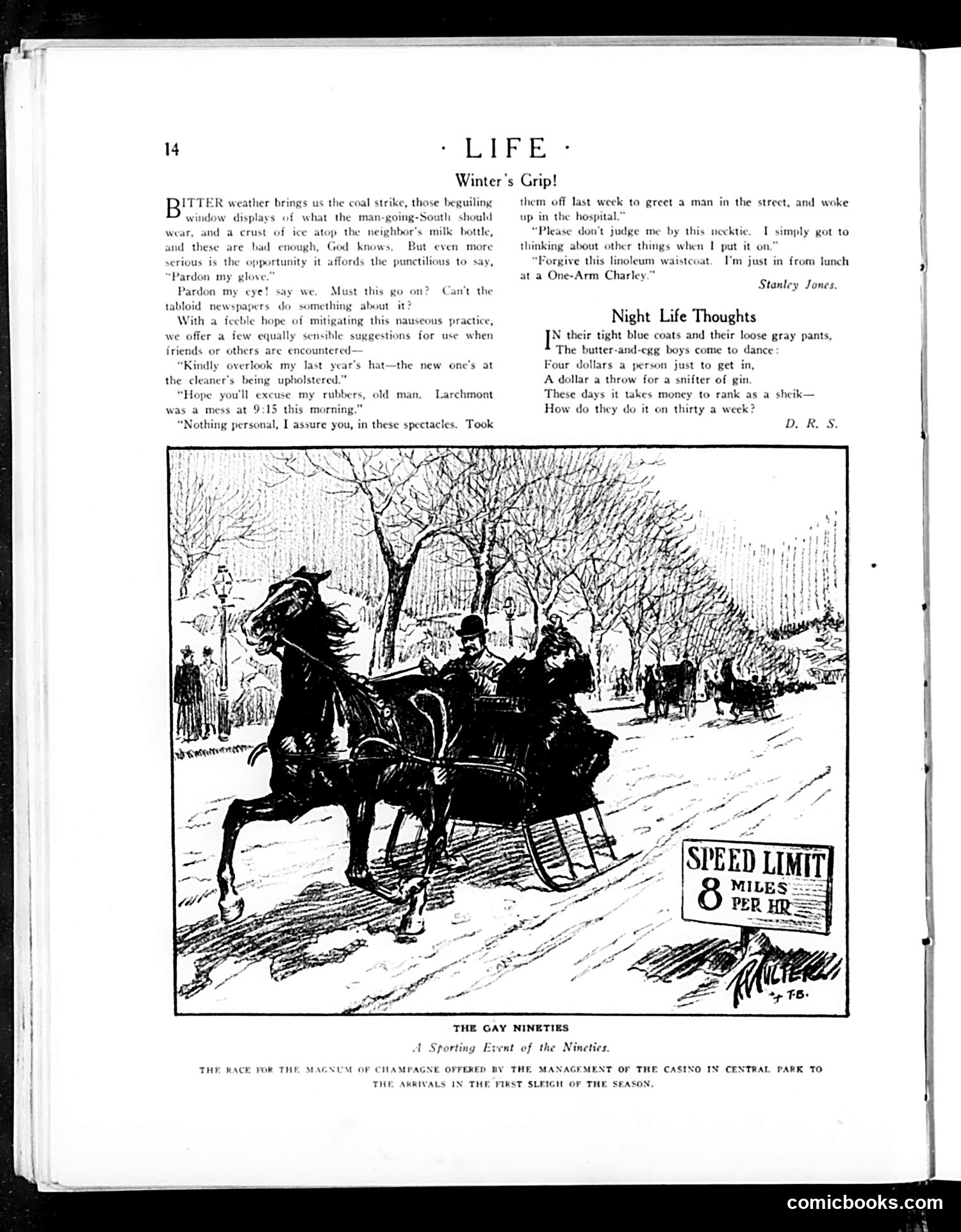
This page contains winter-themed humor and social commentary. The main cartoon, "The Gay Nineties," depicts a horse-drawn sleigh racing at "8 Miles Per Hour" speed limit—a joke about the 1890s being an era of leisurely, slow travel before automobiles. The prose section "Winter's Grip" mocks the impracticalities of cold weather: icy milk bottles, coat damage, and other minor hardships that give pontificators opportunity to complain. One anecdote mentions "Larchemont" and rubbers (galoshes), suggesting upper-class urban inconveniences. "Night Life Thoughts" satirizes nightclub economics—charging four dollars admission plus a dollar for check service—making a working-class critique of how venues exploit patrons with hidden costs. The overall tone is gentle social satire targeting urban winter inconveniences and commercialism.
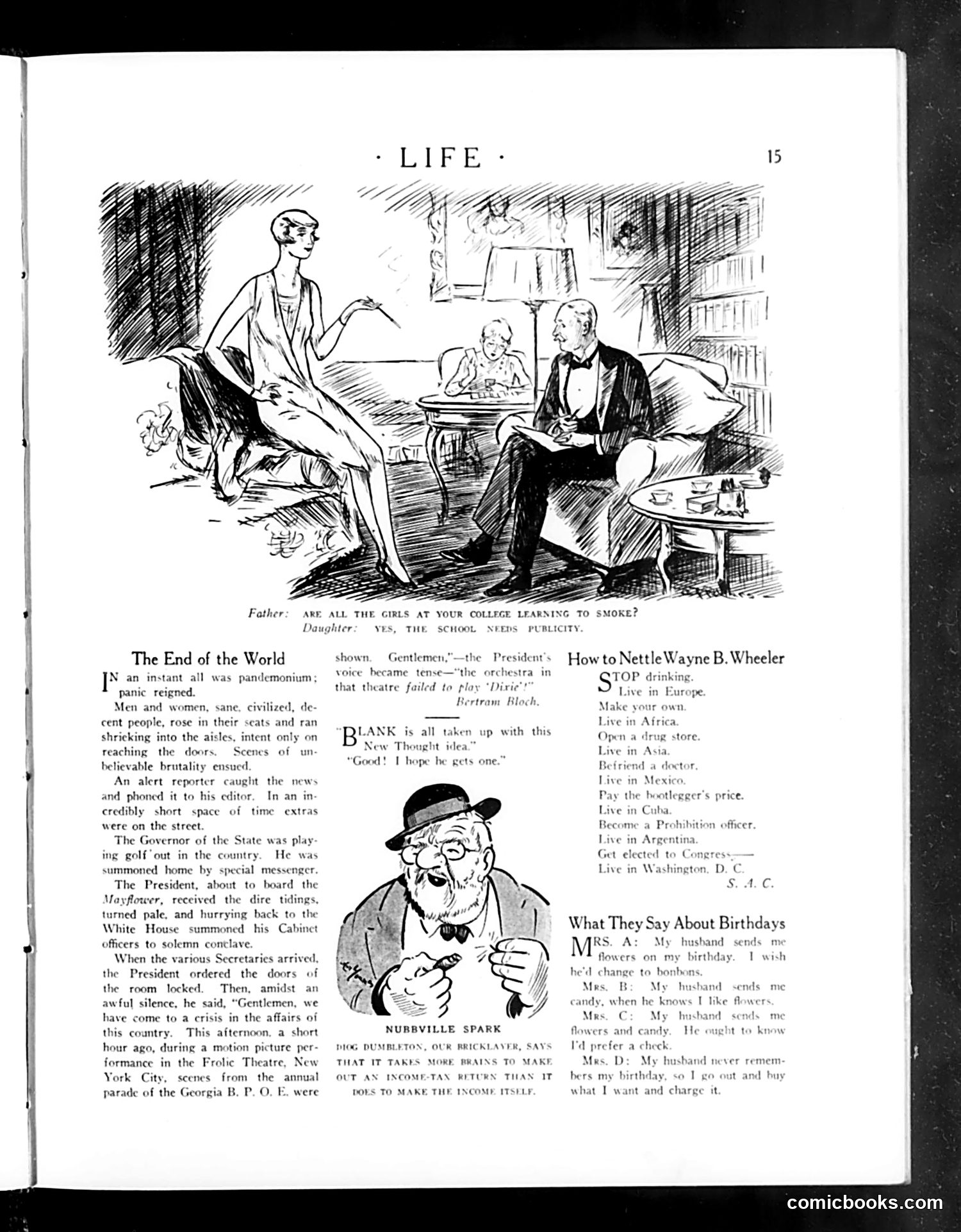
The main cartoon depicts a domestic scene where a father asks his daughter if girls at her college are learning to smoke. She replies "Yes, the school needs publicity." This satirizes: 1. **Women's smoking** — a scandalous new social behavior in the Jazz Age, considered improper for "respectable" women 2. **College reputation-seeking** — suggesting institutions would tolerate or even encourage such behavior for attention 3. **Generational conflict** — the father's shock at modern youth culture Below is a caricature labeled "Nubbyville Spark," appearing to mock small-town politics or a local figure (unclear which specific person). The right column contains humorous advice pieces about avoiding Wayne B. Wheeler (likely the prohibition activist) and observations about birthday gift-giving customs. The satire targets early-20th-century anxieties about women's liberation and changing social mores.
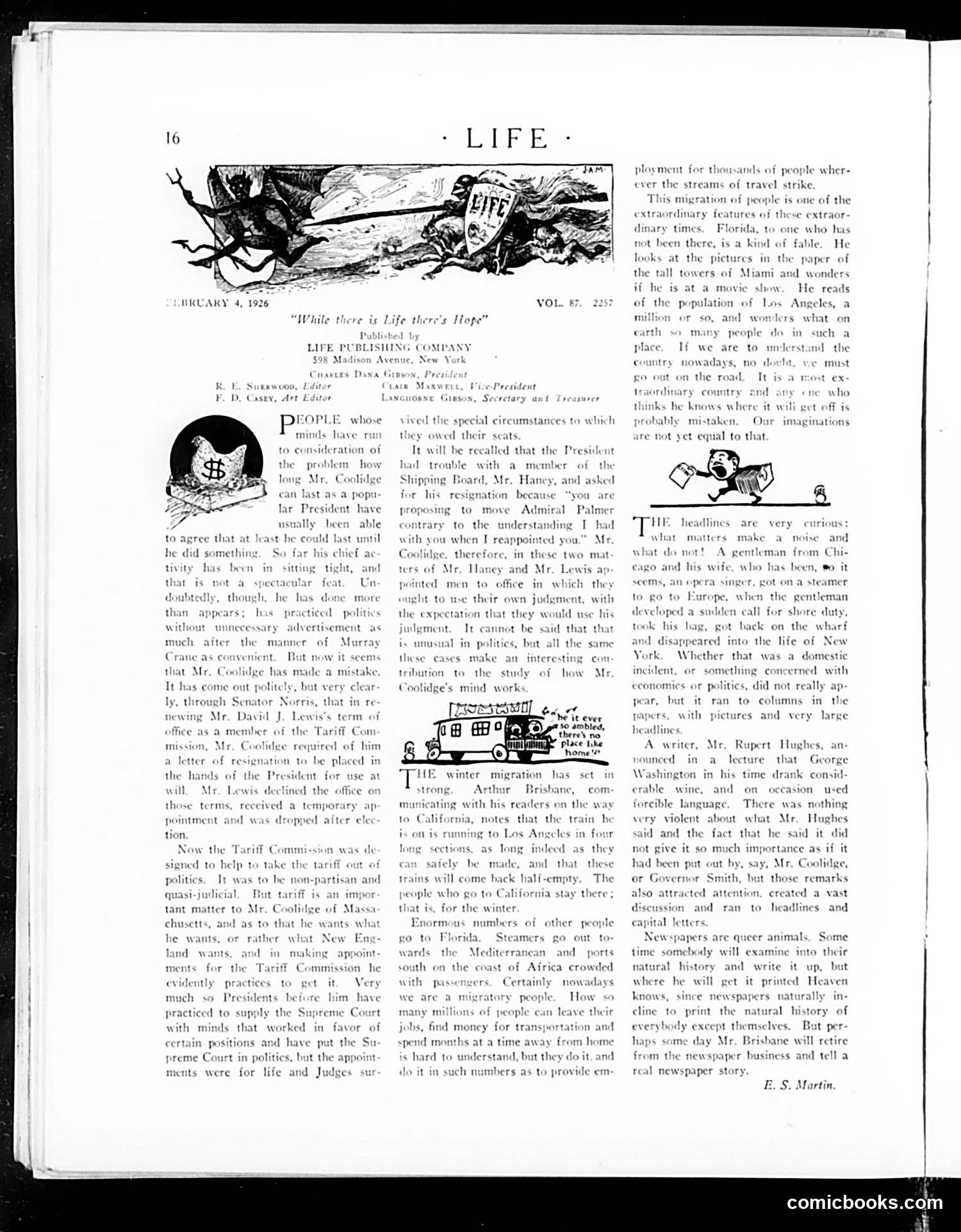
The page contains an editorial essay titled "While there is Life there's Hope" (February 4, 1926), discussing President Coolidge's handling of a Shipping Board controversy. The cartoon at the top depicts "LIFE" as a figure being knocked down or struck, suggesting the magazine's satirical commentary on current events. The text references Coolidge's management of appointments and resignations, mentioning figures like Admiral Palmer and members of the Shipping Board. The editorial criticizes how Coolidge navigated political pressures, arguing he should use better judgment in appointments. The overall tone suggests satirizing Coolidge's passive or questionable political decision-making during the 1920s. The accompanying illustrations (train, house) appear to reference migration patterns and domestic policy discussions mentioned in the text.
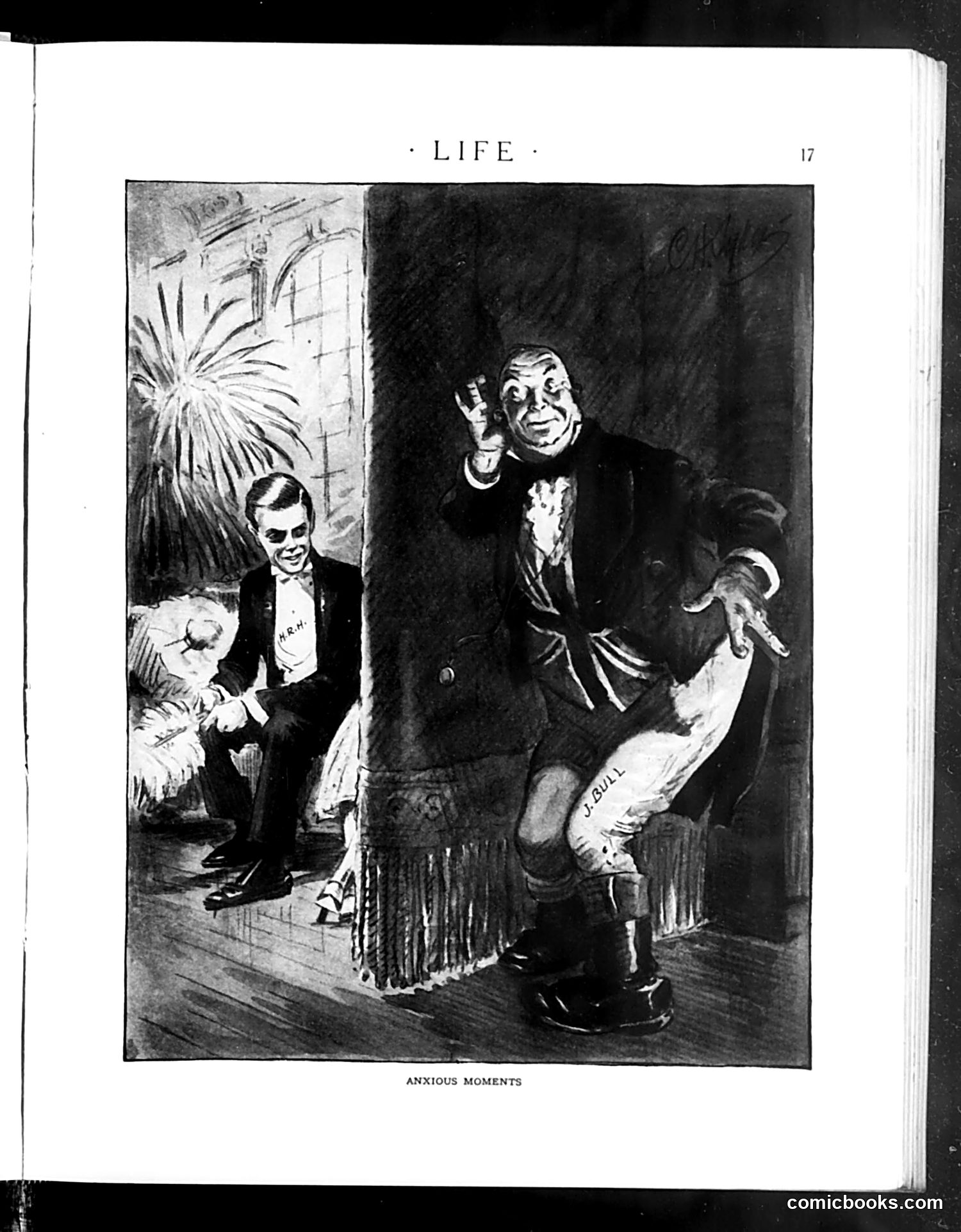
This cartoon depicts a social anxiety scenario common to early 20th-century satirical humor. A well-dressed man in formal attire (tuxedo) stands in a doorway appearing distressed or startled, gesturing dramatically. To his left, a younger man in similar formal dress observes from what appears to be a parlor with a potted plant visible. The caption "Anxious Moments" suggests the humor derives from an awkward social situation—likely a romantic or courtship scenario given the formal dress and interior setting. The exaggerated facial expression and theatrical gesture of the central figure convey embarrassment or discomfort, typical of Life magazine's gentle mockery of polite society's social conventions. Without additional context, the specific situation remains unclear, but it appears to satirize the nervousness accompanying formal social interactions.
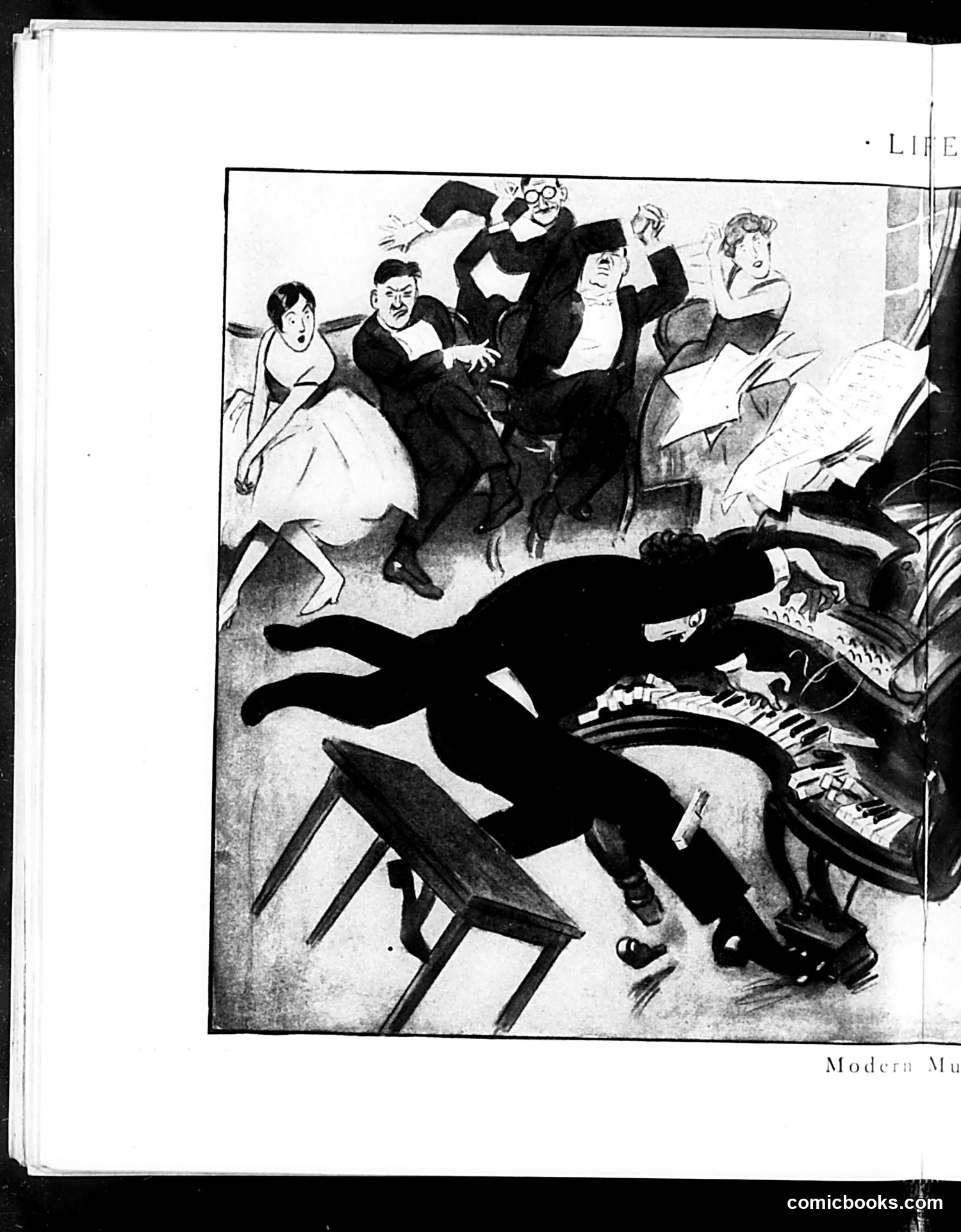
This satirical cartoon depicts a chaotic piano lesson scene. A silhouetted figure (likely a piano student or performer) is dramatically sprawled across a chair at a piano keyboard, appearing to have collapsed or fainted. Meanwhile, five well-dressed people behind (presumably family members or observers) react with shock and distress, throwing their hands up in alarm. The satire appears to target "modern music" (as suggested by the partial text "Modern Mu" at bottom), likely mocking either: atonal/discordant contemporary compositions, dramatic artistic pretension, or the emotional extremes of avant-garde musical performance. The contrast between the performer's theatrical collapse and the observers' horror suggests the cartoon ridicules either incompetent musicianship or excessively dramatic artistic affectation of the period.
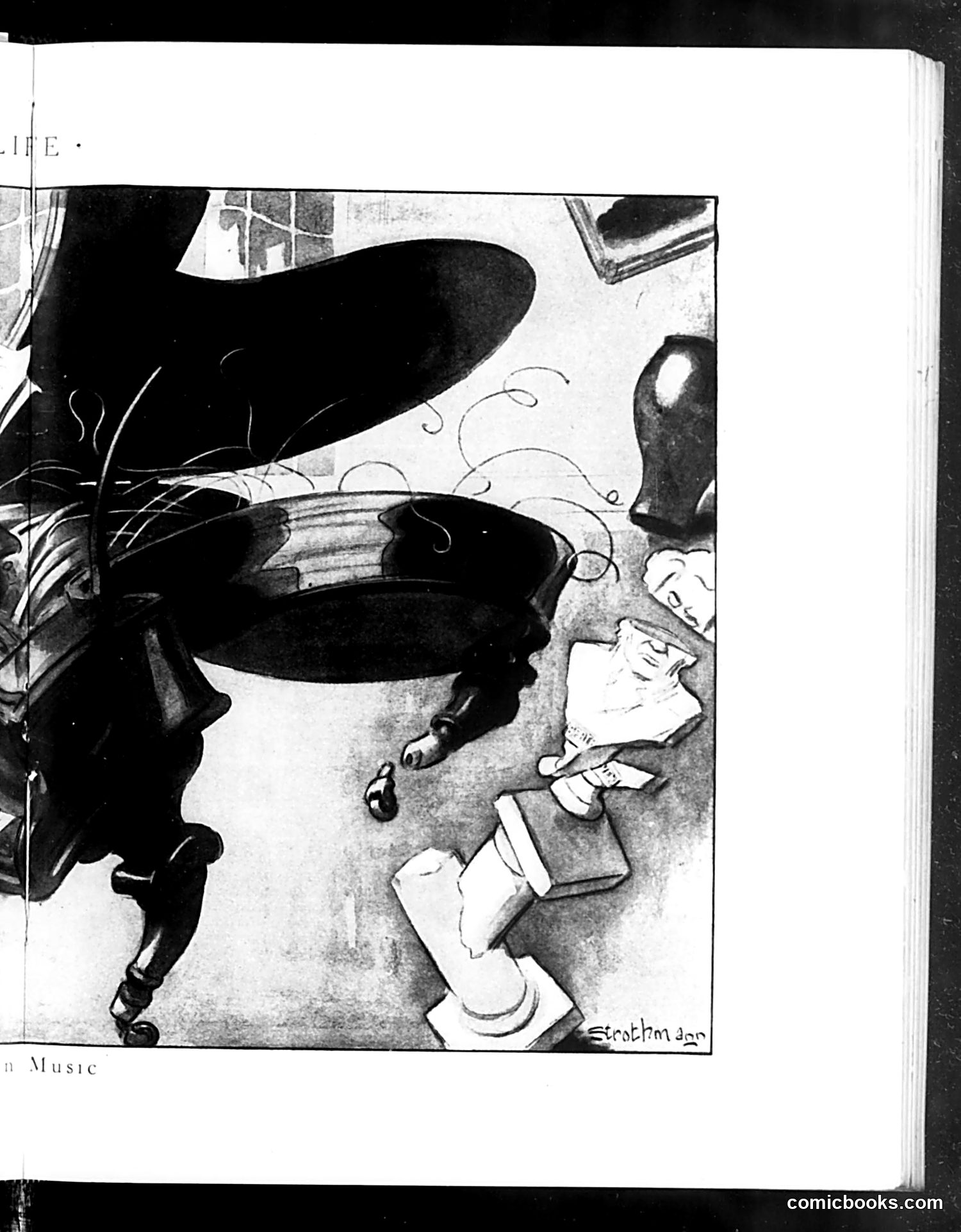
This page from *Life* magazine shows a cartoon labeled "Music" featuring a large black silhouette of what appears to be a conductor or musician with an exaggerated profile, looming over a smaller caricatured figure on the right who appears distressed or overwhelmed. The smaller figure holds papers, possibly sheet music or documents. The satire likely critiques the dominance of a particular musical figure or conductor—though the specific identity is unclear from visual context alone. The composition suggests commentary on power imbalance in the music world, with an authoritarian figure literally overshadowing a smaller, subordinate person. The style and composition are consistent with early-to-mid 20th century American satirical illustration. Without additional context or caption text, the precise target remains uncertain.
This is a theater review column covering Broadway shows. The author discusses several productions: **"A Night in Paris"** — a revue at the Casino de Paris featuring French performers (Yvonne George, Leo Bill) and the Hoffmann Girls. The piece satirizes its forced "Frenchness," noting that despite efforts by performer Sophie Tucker and energetic stage manager Jack Osterman, it succeeds more through American hustle than authentic Gallic charm. Jack Pearl's futile attempt to speak German is highlighted as comic relief. **"Song of the Flame"** — criticized for wasting comedian Hugh Cameron's talents on a show that's merely a vehicle for Russian dancing. **"No, No, Nanette"** — the reviewer admits initial snobbish dismissal of this long-running show, but found it genuinely funny upon finally attending. Charles Winninger and Wellington Cross's comedic timing is praised. The column concludes with observations about how popular songs lose their appeal when heard in theatrical orchestral arrangements rather than the simplified versions that spread through public whistling.
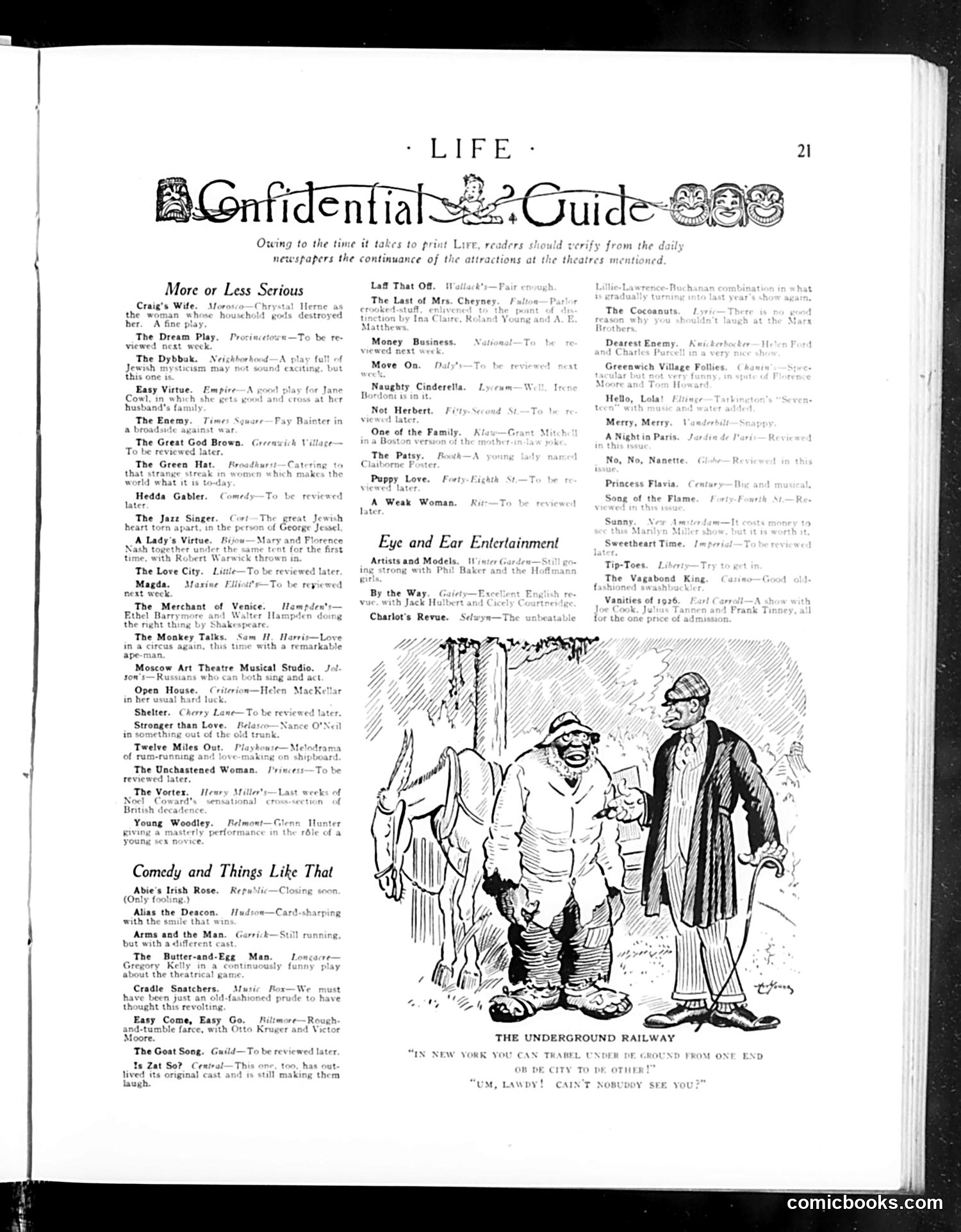
The cartoon depicts a scene on the New York City subway (the "Underground Railway"). Two working-class men—one appears to be a laborer or vagrant in worn clothes, the other in a coat and cap—interact underground. The caption reads: "In New York you can travel under ground from one end of city to the other!" with the response "Um, Landy! Can't nobody see you?" **The Satire:** This is a joke about the NYC subway system itself and class/racial dynamics. The humor plays on the double meaning of "underground"—both the literal subway and the slang term for hidden or secret activities. The punchline suggests that in the subway, one can disappear from view, or that poor/working people are literally "underground" and invisible to respectable society. It's satirizing either the novelty of the subway system or the social invisibility of the urban poor. The specific context of who these figures represent remains unclear from the image alone.
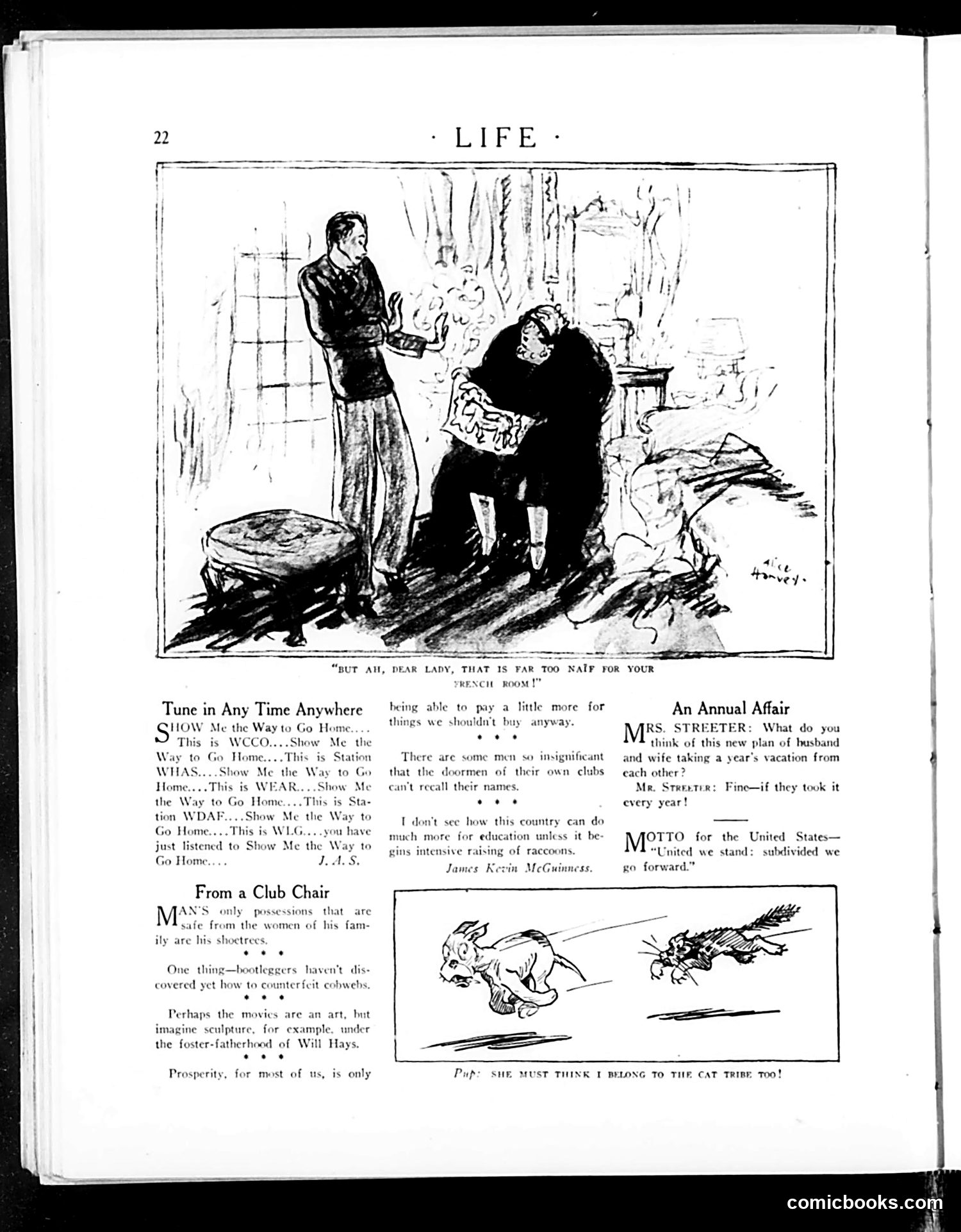
This page contains several satirical humor pieces reflecting 1920s American concerns: **Top cartoon**: A man presents his wife with expensive jewelry while their home is shabby and neglected—satirizing materialism and misplaced priorities during the prosperity era. **"Tune in Any Time Anywhere"**: Mocks the repetitive nature of early radio programming, where the same song ("Show Me the Way to Go Home") plays constantly across different stations. This reflects early radio's limited content and the public's frustration with it. **"From a Club Chair"**: Brief witty observations, including jabs at Prohibition (bootleggers), Will Hays' film censorship standards, consumer excess ("buy things we shouldn't"), and social insignificance. **Bottom cartoon**: A dog chasing a cat, with the punchline about belonging to the "cat tribe"—a simple visual joke about family loyalty or misidentification. The page captures 1920s satirical humor targeting radio monotony, consumer culture, censorship, and Prohibition-era concerns.
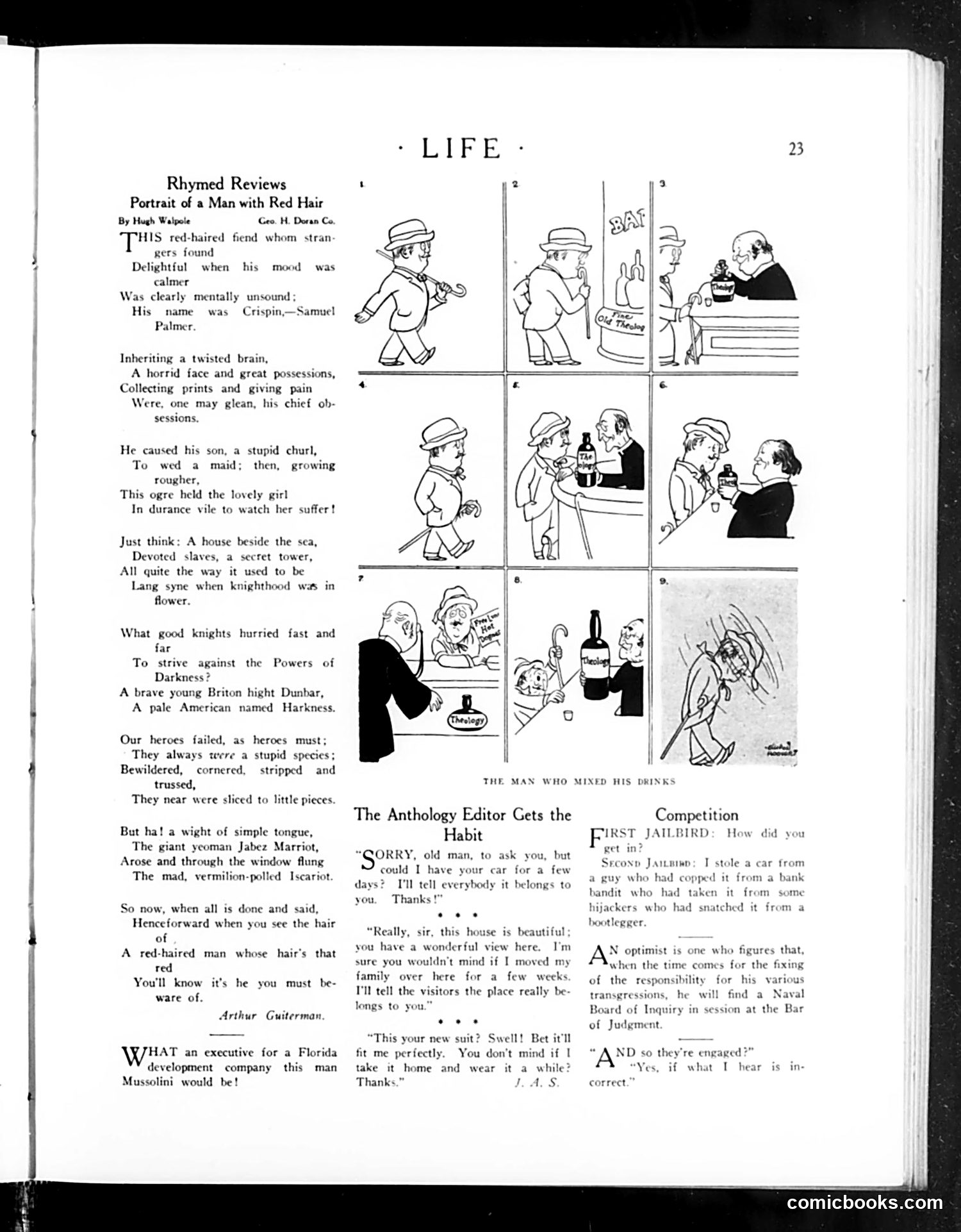
This page contains three separate satirical pieces typical of 1920s American humor: **"Portrait of a Man with Red Hair"** is a book review by Arthur Guiterman mocking a novel about a villainous red-haired man named Crispin Palmer—described as mentally unstable, cruel, and a collector. The poem jokes that readers should beware of any red-haired man matching this description. A final quip compares the character to Mussolini, suggesting contemporary anxiety about fascism. **"The Man Who Mixed His Drinks"** is a cartoon series (panels 1-9) showing a man progressively borrowing items—a car, a house, a suit—while insisting he'll tell people they belong to the owner. The humor satirizes shameless social parasites and their transparent lies. **"Competition" and "The Anthology Editor Gets the Habit"** are brief joke pieces about theft and engagement, likely referencing contemporary social behavior among literary circles. The overall theme reflects 1920s urban sophistication humor—mocking pretension, dishonesty, and moral flexibility among educated classes.
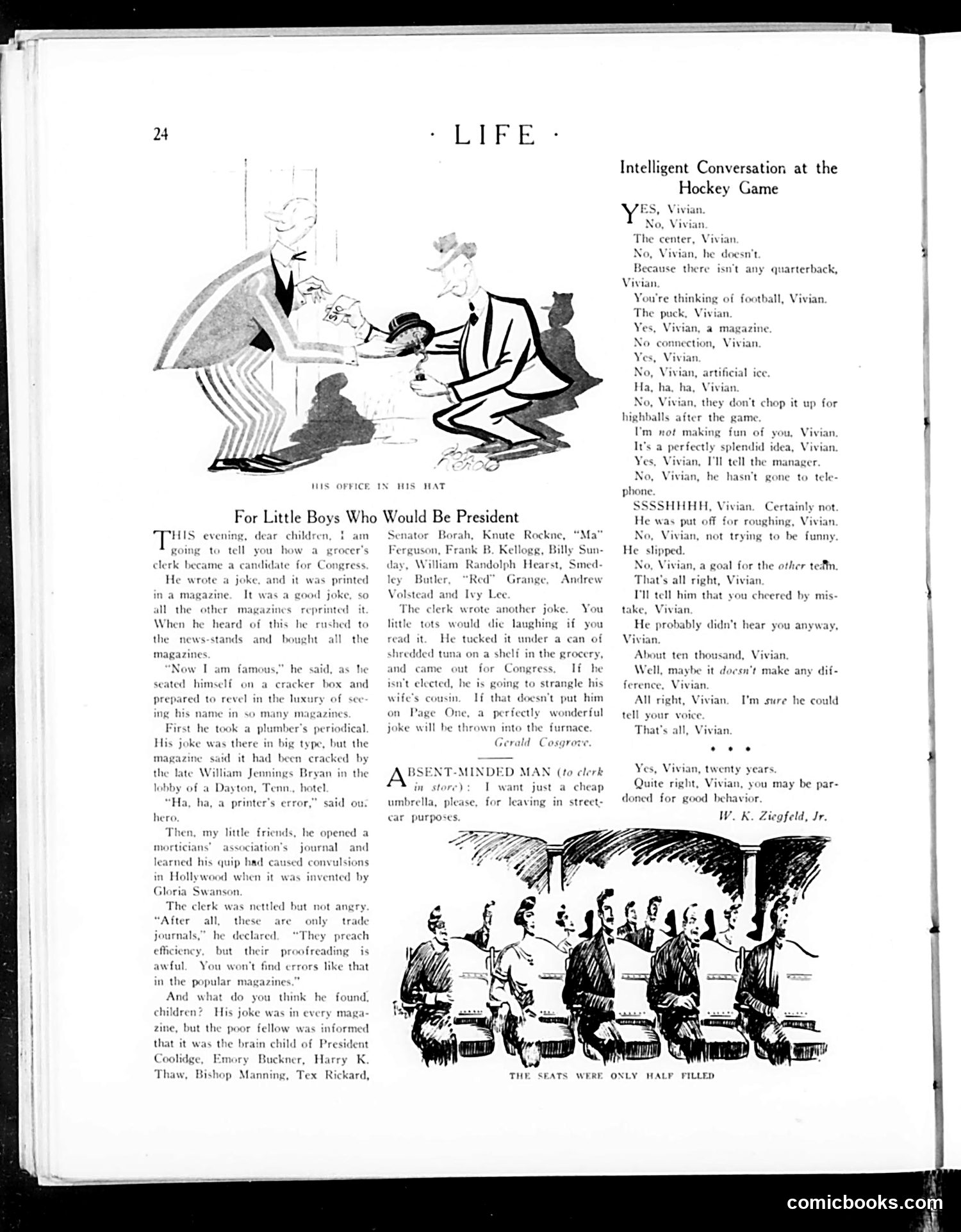
**Top Cartoon: "For Little Boys Who Would Be President"** This satirizes how minor public figures become political candidates through manufactured fame. A clerk writes a joke that gets published in magazines, gaining attention from major newspapers. Misattributing the joke to President Coolidge and other celebrities (Senator Borah, Billy Sunday, William Randolph Hearst, Red Grange, etc.—all real public figures of the era), he leverages this false prestige to announce a Congressional candidacy. The joke: mediocrity and self-promotion, not merit, can launch political careers. The satire mocks both the ease of becoming a candidate and the gullibility of the press. **Bottom Cartoon: "Intelligent Conversation at the Hockey Game"** A humorous dialogue between two spectators named Vivian reveals their complete ignorance about hockey—confusing the puck with a magazine, discussing artificial ice as if novel, misidentifying plays. The title's irony is the point: their conversation demonstrates profound stupidity masquerading as engagement with the sport. Both pieces critique American society: political ambition without substance, and public engagement without understanding.
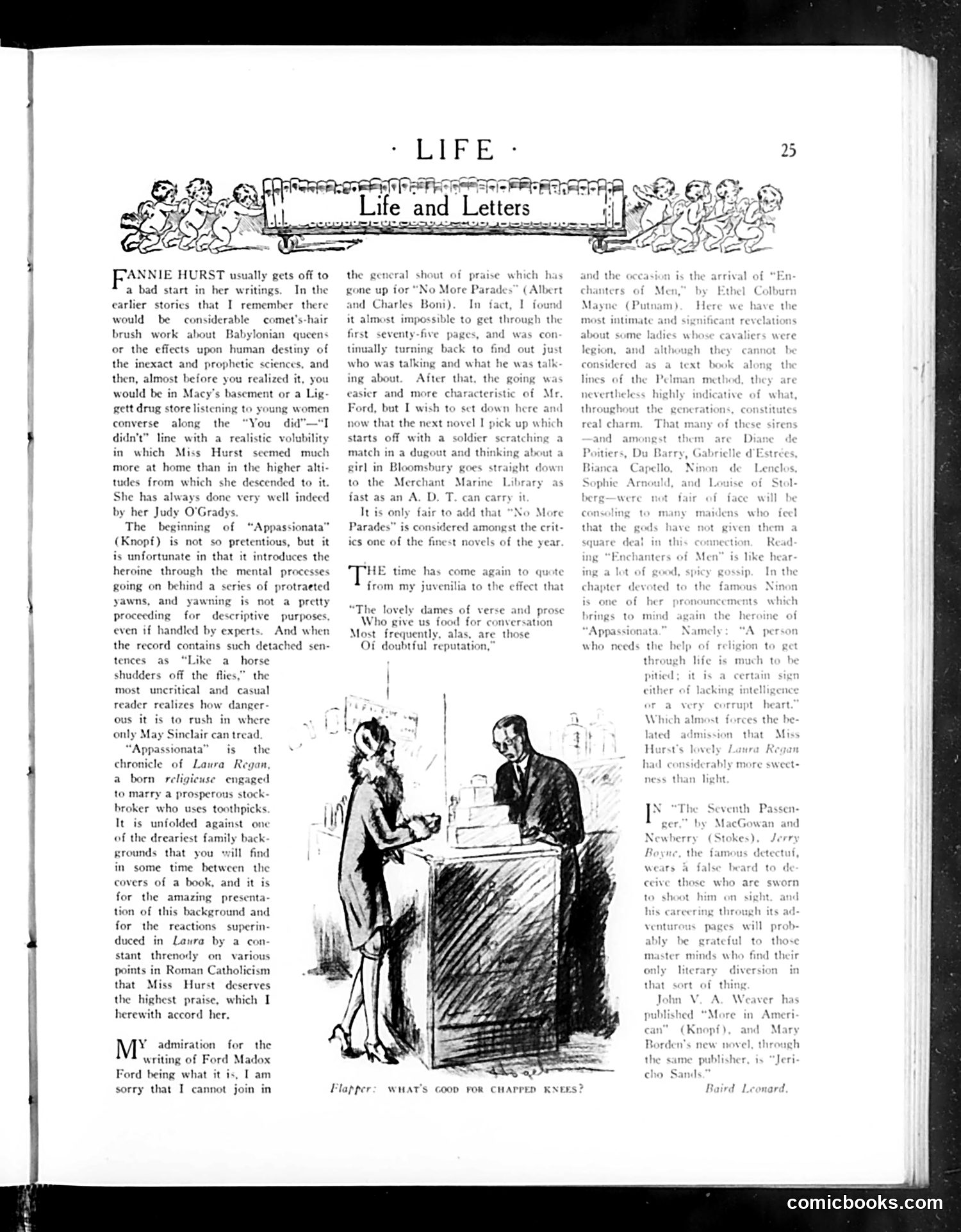
This is a **book review column** titled "Life and Letters," not a political cartoon. The page reviews new novels by author Fannie Hurst and others. The **illustration** (captioned "What's good for chapped knees?") appears to be a humorous sketch of a young woman (a "flapper," the fashionable youth of the 1920s) visiting a male doctor or pharmacist about a minor ailment—likely satirizing the era's obsession with beauty treatments and self-care products. The **text** critiques Hurst's writing style, noting her tendency toward melodrama and overly complex narratives. The reviewer praises her novel *Appassionata* for its portrayal of family dysfunction and Catholic identity, while criticizing other authors like Ford Madox Ford for confusing openings. The tone is literary criticism with gentle mockery of both authors and contemporary reading preferences.
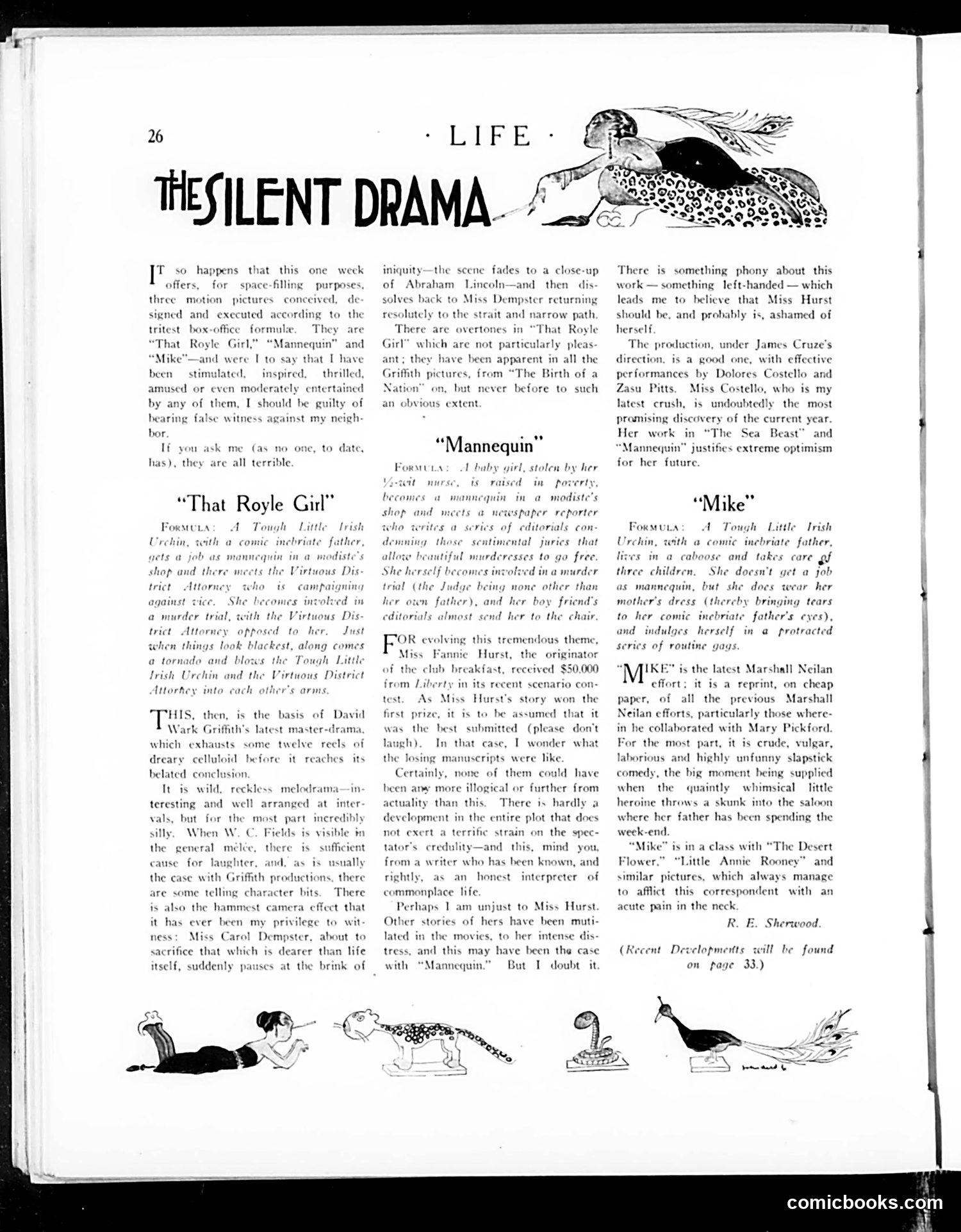
This page contains three separate film reviews from Life magazine's "Silent Drama" column, critiquing recent motion pictures. **"That Royle Girl"** - A D.W. Griffith melodrama the critic dismisses as formulaic and tedious, despite featuring the actress Carol Dempster. The plot involves an Irish urchin and a murder trial centered on Abraham Lincoln. **"Mannequin"** - Based on a story by Fannie Hurst that won a Liberty magazine contest and $50,000, this film follows a baby girl stolen and raised in poverty who becomes involved in a murder trial. The critic finds it illogical and questions why such a poorly-constructed story won the contest. **"Mike"** - A Marshall Neilan film about a tough Irish orphan raising three children in a caboose. The reviewer criticizes it as a cheap recycling of Neilan's previous work, particularly films made with Mary Pickford. Overall, the critic expresses skepticism about all three productions' artistic merit and originality.
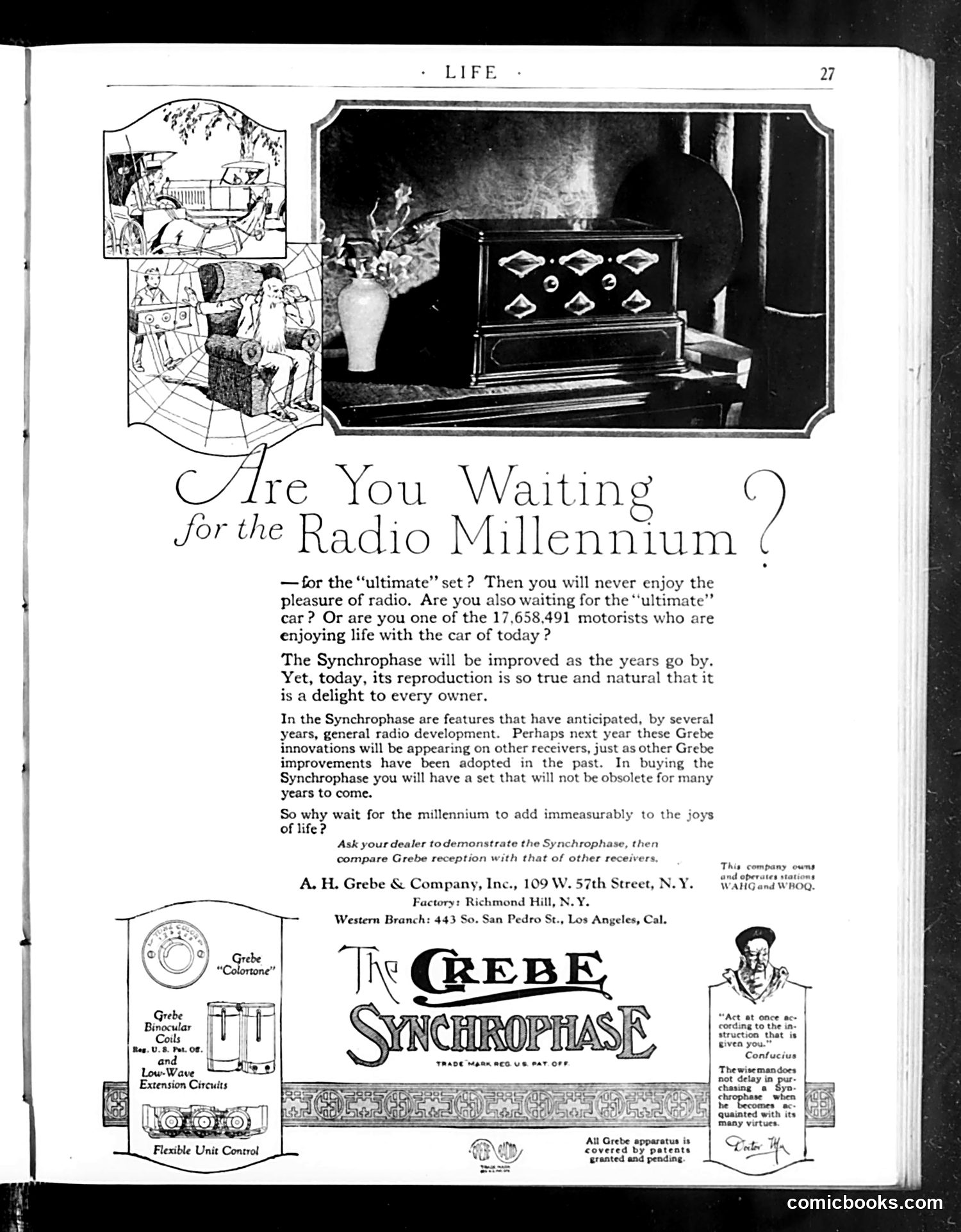
This is primarily a **product advertisement**, not political satire. The page promotes the Grebe Synchrophase radio receiver from A.H. Grebe & Company. The ad employs a rhetorical strategy common to 1920s marketing: it argues against waiting for a "perfect" future product. The opening cartoon panels (left) humorously depict people postponing life's pleasures while waiting for an "ultimate" radio set—analogous to the 17.6 million motorists already enjoying cars "of today" rather than waiting for the perfect automobile. The satire targets consumer perfectionism and delay, not politics. The ad's point: the Synchrophase is already excellent, incorporating anticipated innovations, and won't become obsolete soon—so buy now rather than wait indefinitely for improvements. The Confucius quote reinforces urgency: act immediately. This reflects 1920s consumer capitalism's pitch to middle-class buyers seeking both prestige technology and practical value.
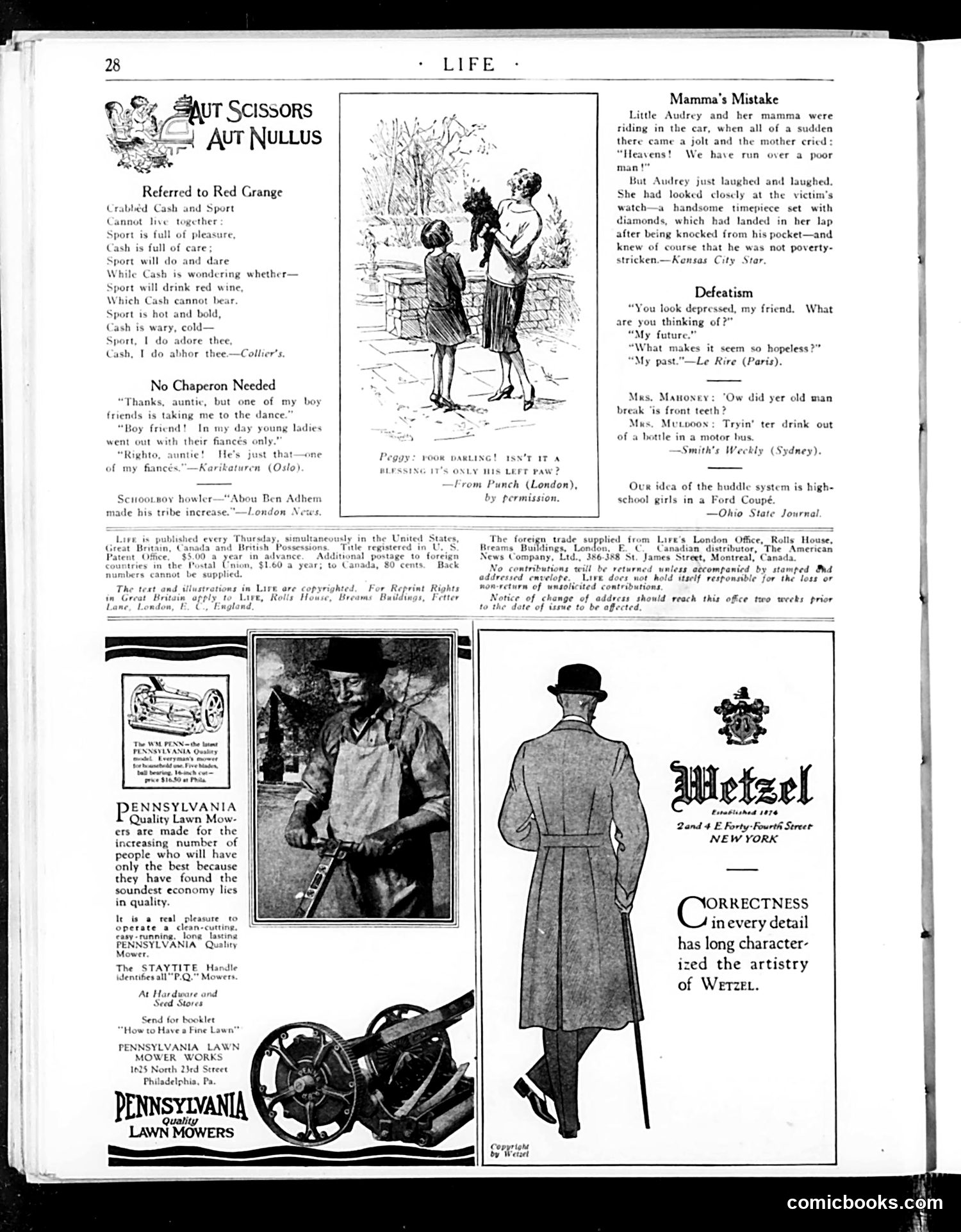
This page from *Life* magazine contains several short humorous pieces typical of early 20th-century satirical publications: **"Referred to Red Grange"** is a poem contrasting Sport (pleasurable, bold, indulgent) with Cash (cautious, wary). Red Grange was a famous 1920s football player, suggesting the piece comments on the tension between athletic pursuits and financial responsibility. **"No Chaperon Needed"** jokes about changing social mores: a young woman casually mentions having multiple "fiancés," shocking her traditional aunt who expected strict courtship rules. The humor lies in the generational gap about dating norms. **"Mamma's Mistake"** presents dark humor: a child laughs after her mother hits someone, not from cruelty but because she noticed the victim's expensive diamond watch—implying he's wealthy enough to survive without sympathy. **"Defeatism"** is a brief philosophical joke about pessimism: someone's bleak future stems from regrets about the past. The page also contains period advertisements for Pennsylvania lawn mowers and Wetzel clothing, typical of magazine placement.
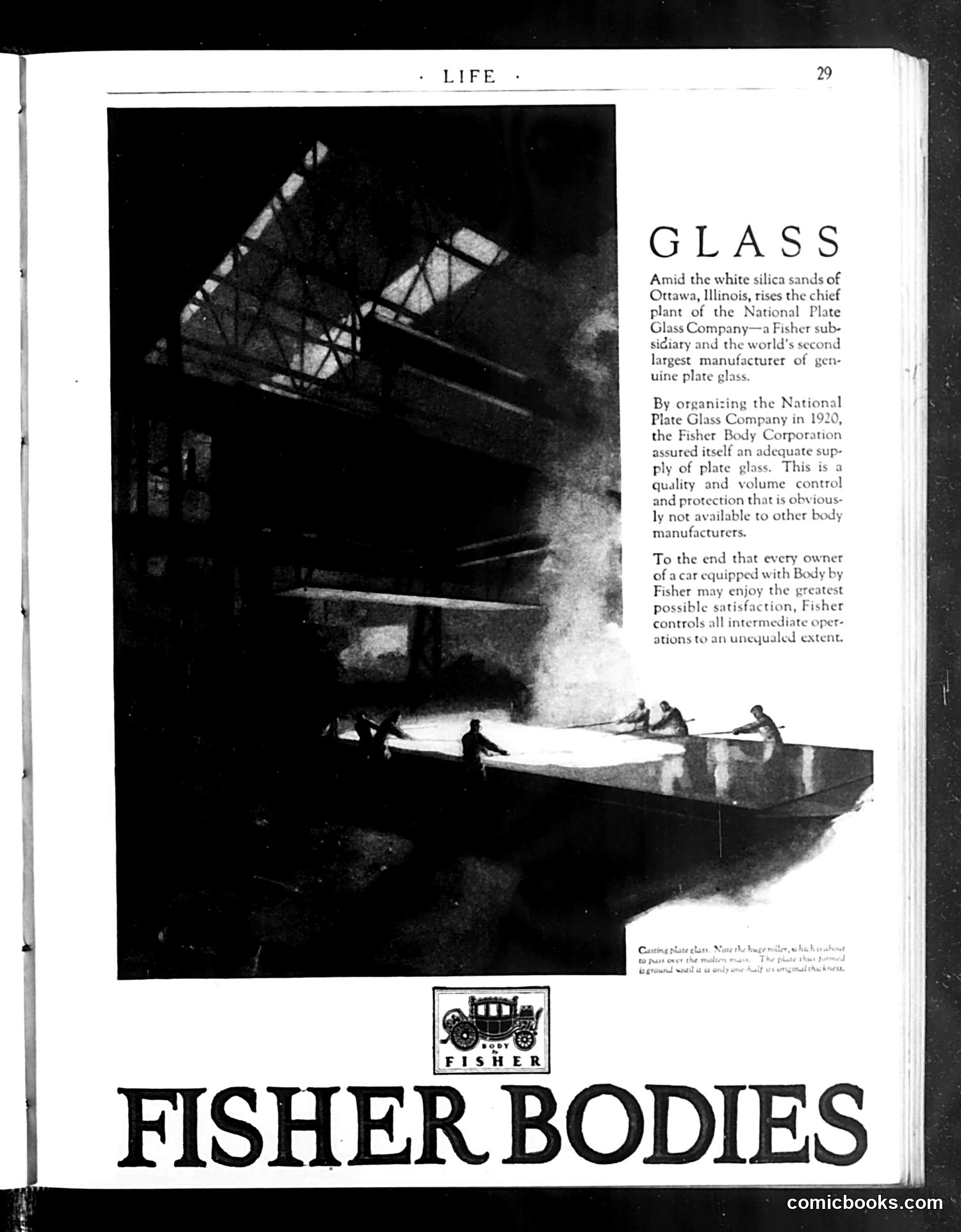
This is **not a cartoon or satire**—it's a **corporate advertisement** for Fisher Bodies, placed in *Life* magazine. The page promotes Fisher Body Corporation's vertical integration: by establishing the National Plate Glass Company in 1920 (a subsidiary), Fisher secured reliable glass supply for automobile bodies. The dramatic industrial photograph shows workers manufacturing large plate glass sheets. The advertising argument emphasizes quality control and exclusivity—Fisher Bodies can guarantee customer satisfaction because they control production "to an unequaled extent," including intermediate operations like glass manufacturing that competitors cannot. The Fisher body logo (showing an ornate car) appears at bottom. This represents early-twentieth-century corporate self-promotion in a leisure magazine, targeting affluent car owners.
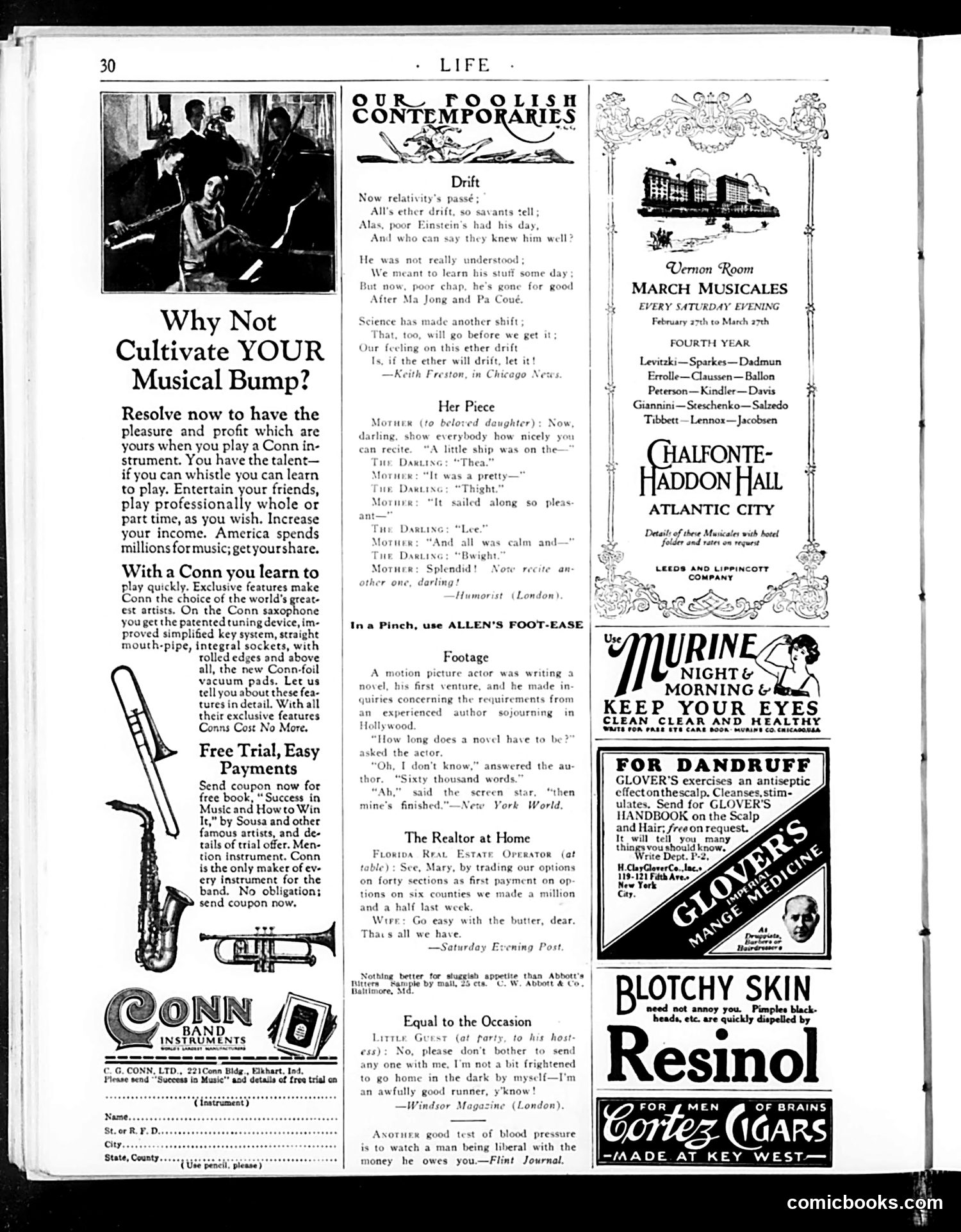
This page from *Life* magazine (a satirical publication) contains primarily **advertisements and brief humorous columns** rather than political cartoons. The main satirical content includes: **"Drift"** — A poem mocking the rapid obsolescence of scientific theories. It references Einstein's relativity theory as yesterday's news, jokingly suggesting the public never understood it anyway. The humor lies in science constantly being superseded, making serious intellectual engagement feel futile. **"Her Piece"** — A domestic humor sketch where a mother coaches her young daughter in reciting poetry, but the child keeps interrupting with corrections, suggesting children's literalism undercuts parental authority. **"The Realtor at Home"** — Satirizes real estate speculation and financial excess, depicting a realtor bragging about making "a million and a half" through option trading while simultaneously penny-pinching about butter at dinner. The remainder consists of period advertisements (musical instruments, hair products, cigars) typical of 1920s *Life* magazine's commercial content. The page reflects Jazz Age-era humor and consumer culture rather than explicit political commentary.
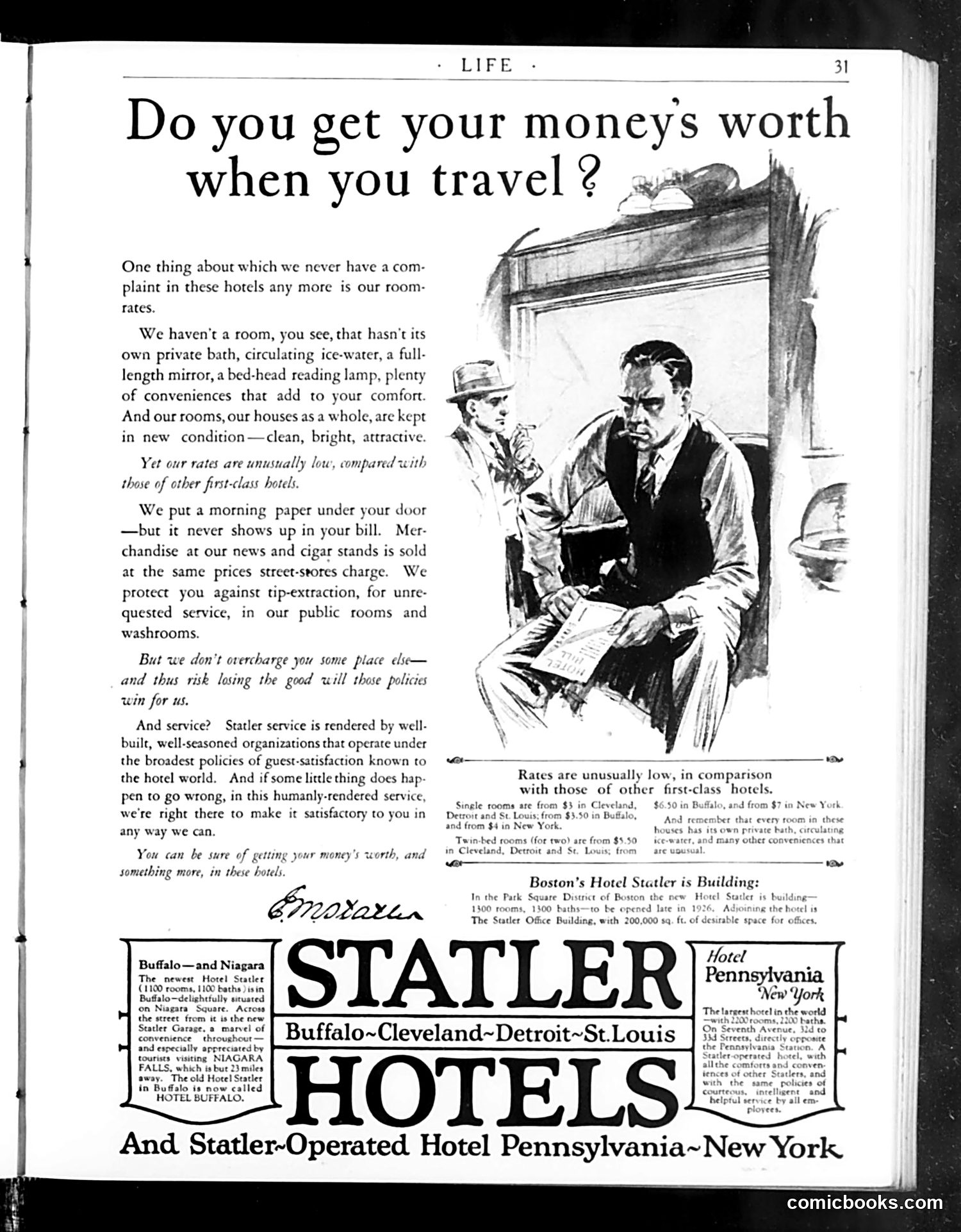
This page is primarily **advertising** for the Statler Hotels chain, disguised as editorial content. The small illustration shows two men—likely a bellhop and a guest—examining a hotel bill, which sets up the advertorial's premise: "Do you get your money's worth when you travel?" The text is a sales pitch claiming Statler Hotels offer exceptional value: reasonable rates, modern amenities (private baths, ice water, reading lamps), complimentary services (morning papers, fairly-priced merchandise), and no hidden charges or aggressive tipping culture. The phrase "tip-extraction" suggests contemporary frustration with bellhops pressuring guests for gratuities. The cartoon itself isn't satirical—it's simply illustrative. Rather, the entire page satirizes hotel industry practices by positioning Statler as the honest alternative to competitors who "overcharge you some place else." It's 1920s consumer-protection marketing wrapped in Life magazine's editorial format, exploiting readers' existing skepticism about travel expenses and hospitality-industry nickel-and-diming.
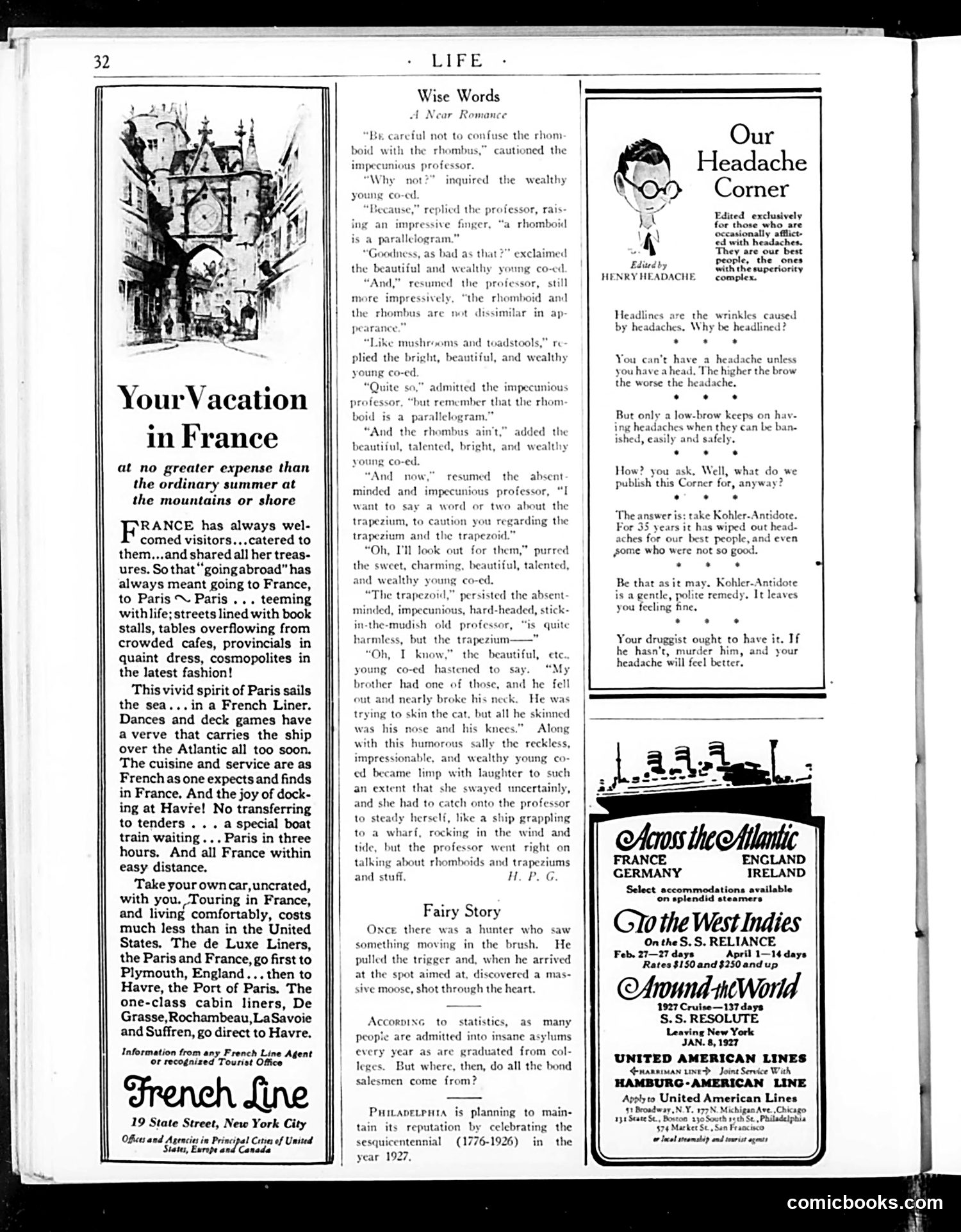
This page contains primarily **advertisements and light humor columns**, not political satire. The main content includes: 1. **"Your Vacation in France"** — A French Line steamship advertisement promoting affordable transatlantic travel to Paris, emphasizing leisure activities and affordable touring. 2. **"Wise Words: A New Romance"** — A comedic dialogue between a professor and a wealthy young co-ed about geometric shapes (rhomboids, trapezoids). The humor relies on the co-ed's flirtation and feigned confusion, with her brother's mishap providing the punchline—he broke his neck attempting gymnastics, showing the disconnect between the co-ed's charming naïveté and real-world consequences. 3. **"Fairy Story"** — A dark joke: a hunter shoots a moose and finds it dead, then the text absurdly questions where "bond salesmen" come from, implying they're as unlikely to exist as ethical hunters. 4. **"Our Headache Corner"** — A medical advice column header (text cut off). The page reflects 1920s consumer culture and period-appropriate humor targeting educated, middle-class readers.
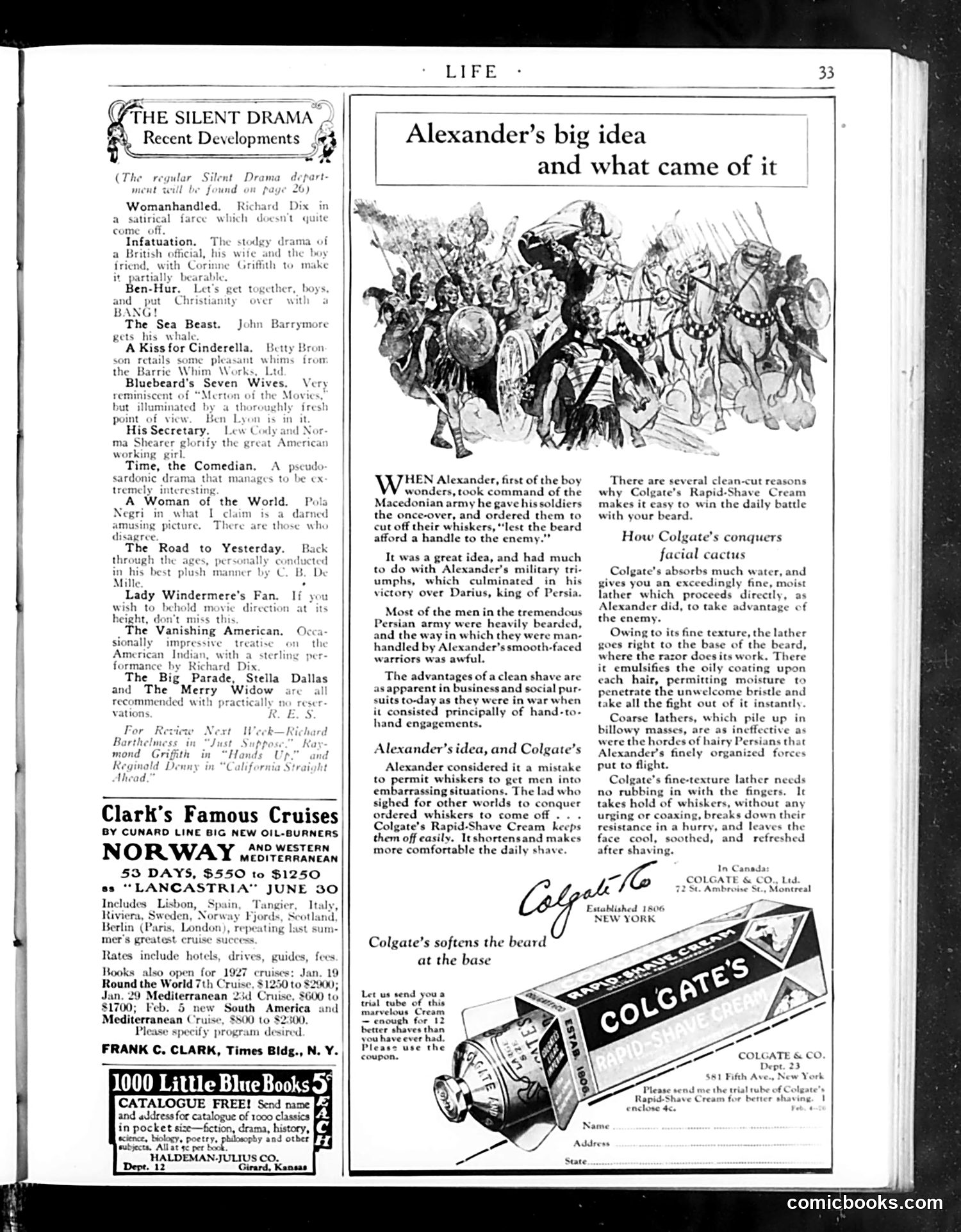
This page contains a Colgate shaving cream advertisement disguised as historical commentary. The "cartoon" compares Alexander the Great's military strategy—ordering his soldiers to shave their beards so enemies couldn't grab them in hand-to-hand combat—to modern business and social competition. The advertisement uses this historical anecdote to market Colgate's Rapid-Shave Cream to 1920s businessmen. The parallel suggests that just as clean-shaven soldiers defeated the "hairy Persians," modern men gain competitive advantage through grooming. The illustration depicts Alexander's army in battle, emphasizing the practical superiority of the beardless warriors. This is early 20th-century advertising that conflates military victory with consumer product success, appealing to masculine competition and professional advancement through personal hygiene—a common marketing strategy of the era.
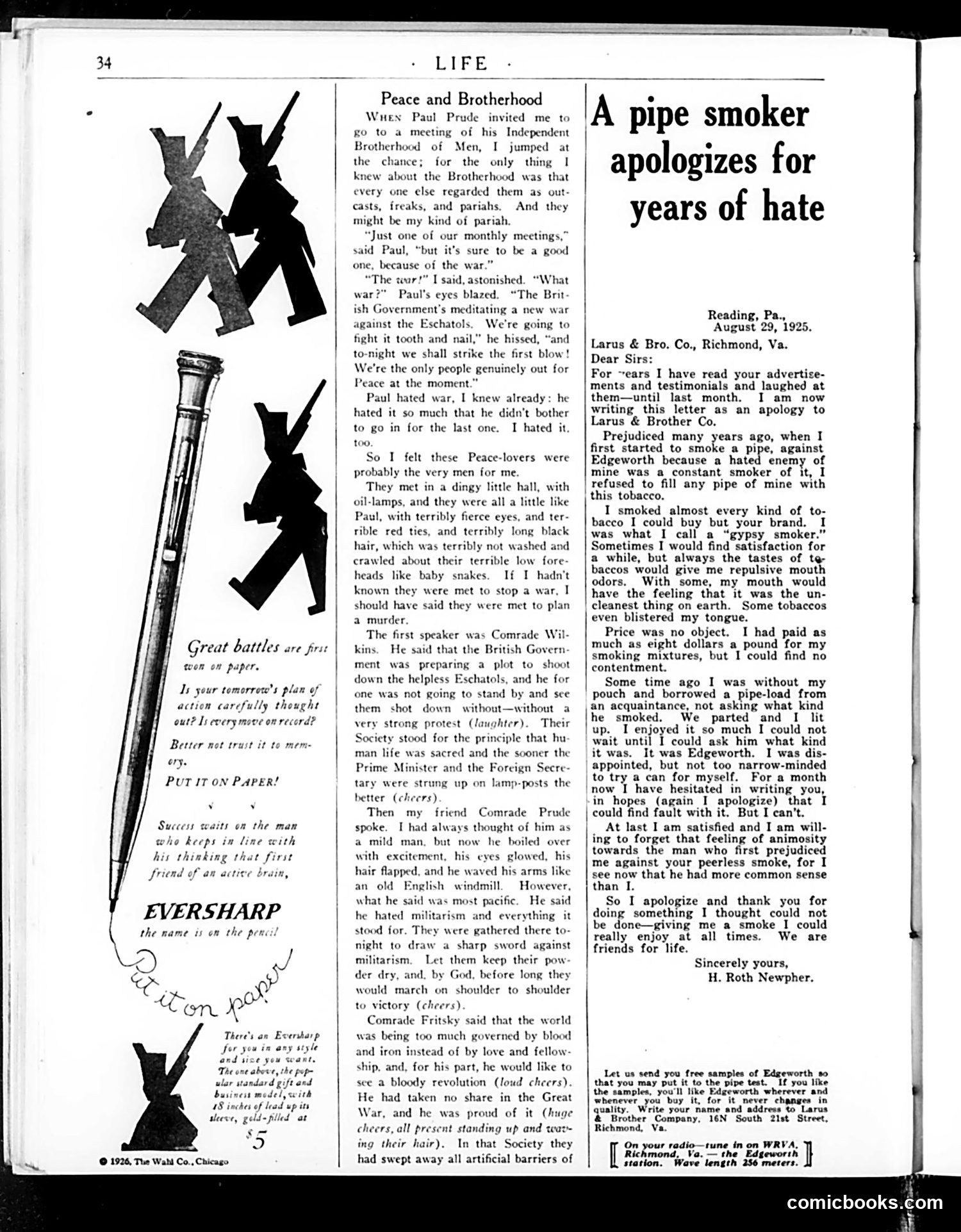
The page contains two satirical pieces: **Left side ("Peace and Brotherhood"):** A short story mocking pacifist organizations. The narrator attends a meeting of Paul Prude's "Independent Brotherhood of Men," expecting mild peace advocates. Instead, he finds passionate radicals—described with caricatured features (wild hair, fierce eyes, red ties)—who denounce war while using violent rhetoric. They speak of "drawing sharp swords against militarism" and want revolution, creating ironic contradiction between their pacifist claims and aggressive language. The satire targets self-righteous peace movements as hypocritical and performative. **Right side:** A consumer testimonial—an advertisement for Larus & Brother tobacco. A pipe smoker admits he prejudicially avoided their Edgeworth brand for years because a hated enemy smoked it, but now apologizes and endorses the product. The page juxtaposes political satire with commercial messaging, typical of *Life* magazine's format mixing editorial content with paid advertising.
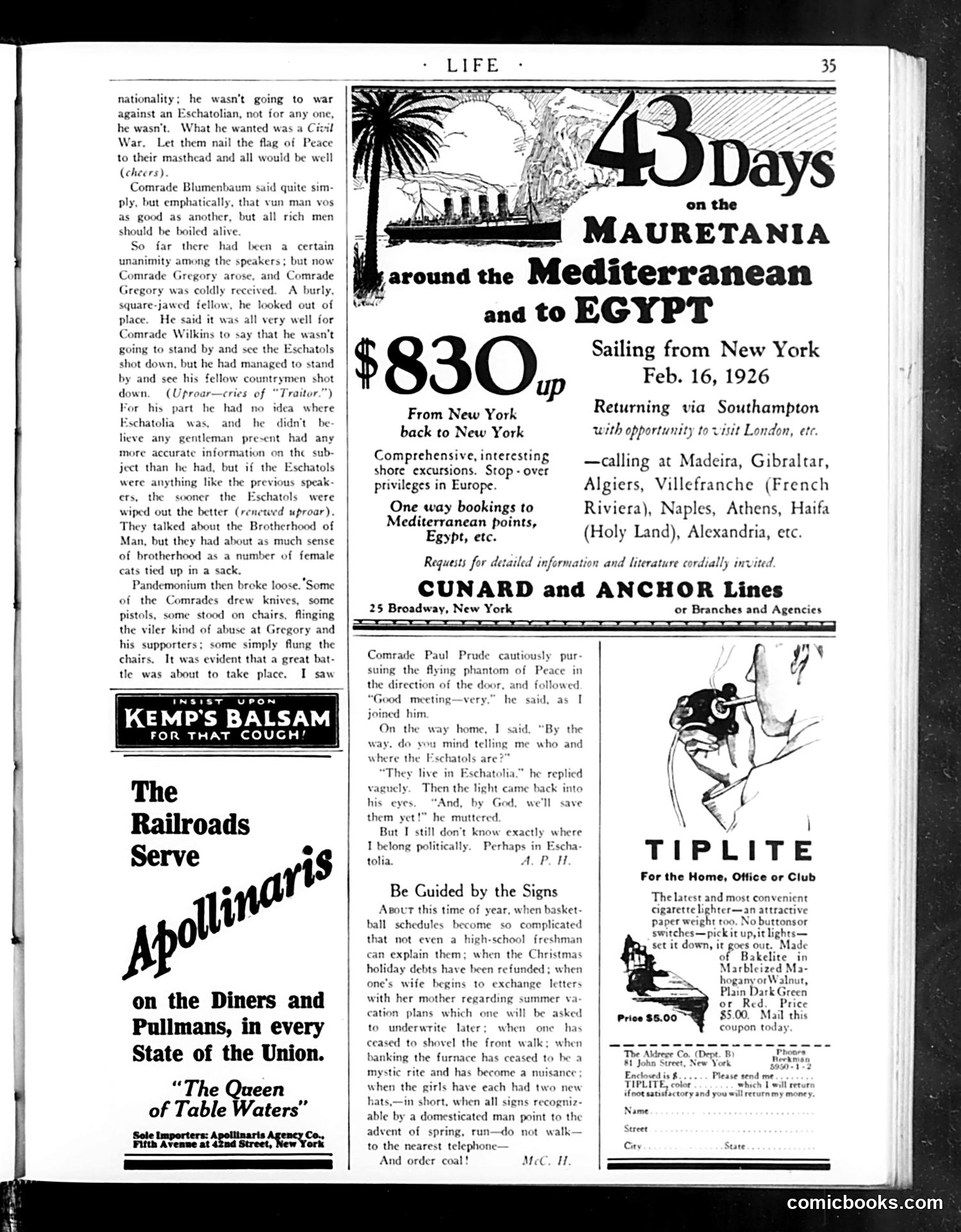
This page contains a political satire about Communist infighting. The main text describes a meeting of Comrades debating whether to support war against a fictional nation called "Eschatolia." The satire mocks Communist rhetoric and internal discord—speakers advocate contradictory positions (pacifism vs. practical violence), use exaggerated accents ("vun man vos"), and resort to literal knife-and-chair fighting over ideological disputes. The joke targets the absurdity and hypocrisy of Communist ideology: revolutionaries preach "Brotherhood of Man" while behaving like "female cats tied up in a sack," and the narrator remains uncertain what the Eschatols even represent—suggesting Communist rhetoric is fundamentally incoherent. This reflects 1920s American anti-Communist sentiment, portraying Communists as violent, irrational, and foreign (suggested by mock-Eastern European accents). The page is otherwise filled with cruise ship and consumer product advertisements.
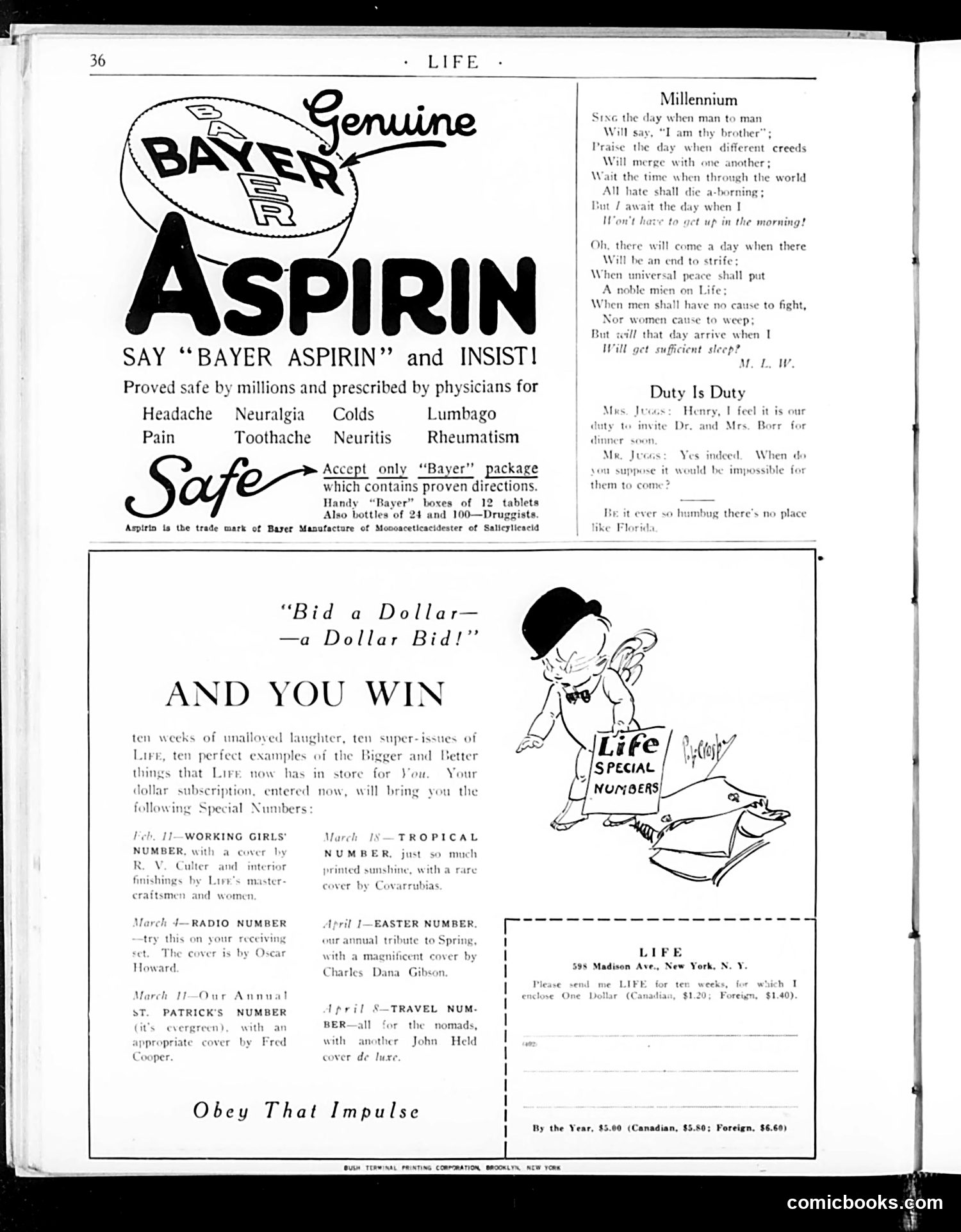
This page mixes advertising with satirical content typical of Life magazine's format. **Main Advertisement:** A Bayer Aspirin ad emphasizes brand loyalty ("Say 'BAYER ASPIRIN' and INSIST!"), promising safety and medical endorsement—reflecting early 20th-century pharmaceutical marketing before strict FDA regulations. **Poem "Millennium":** A sarcastic commentary on idealistic visions of future peace. While imagining a world without strife, the speaker's real concern is mundane: "I won't have to get up in the morning!" This satirizes how grand philosophical hopes often mask petty personal desires. **"Duty Is Duty":** A brief comic dialogue about inviting guests to dinner, suggesting social obligation conflicts with practicality (Florida's lack of appeal as a destination). **Subscription Offer:** Life promotes special themed issues (Working Girls, Radio, Easter, St. Patrick's, Travel numbers) with notable cover artists, encouraging dollar subscriptions for ten weeks of "unalloyed laughter." The page reflects Life's blend of consumer culture, gentle social satire, and lighthearted entertainment.
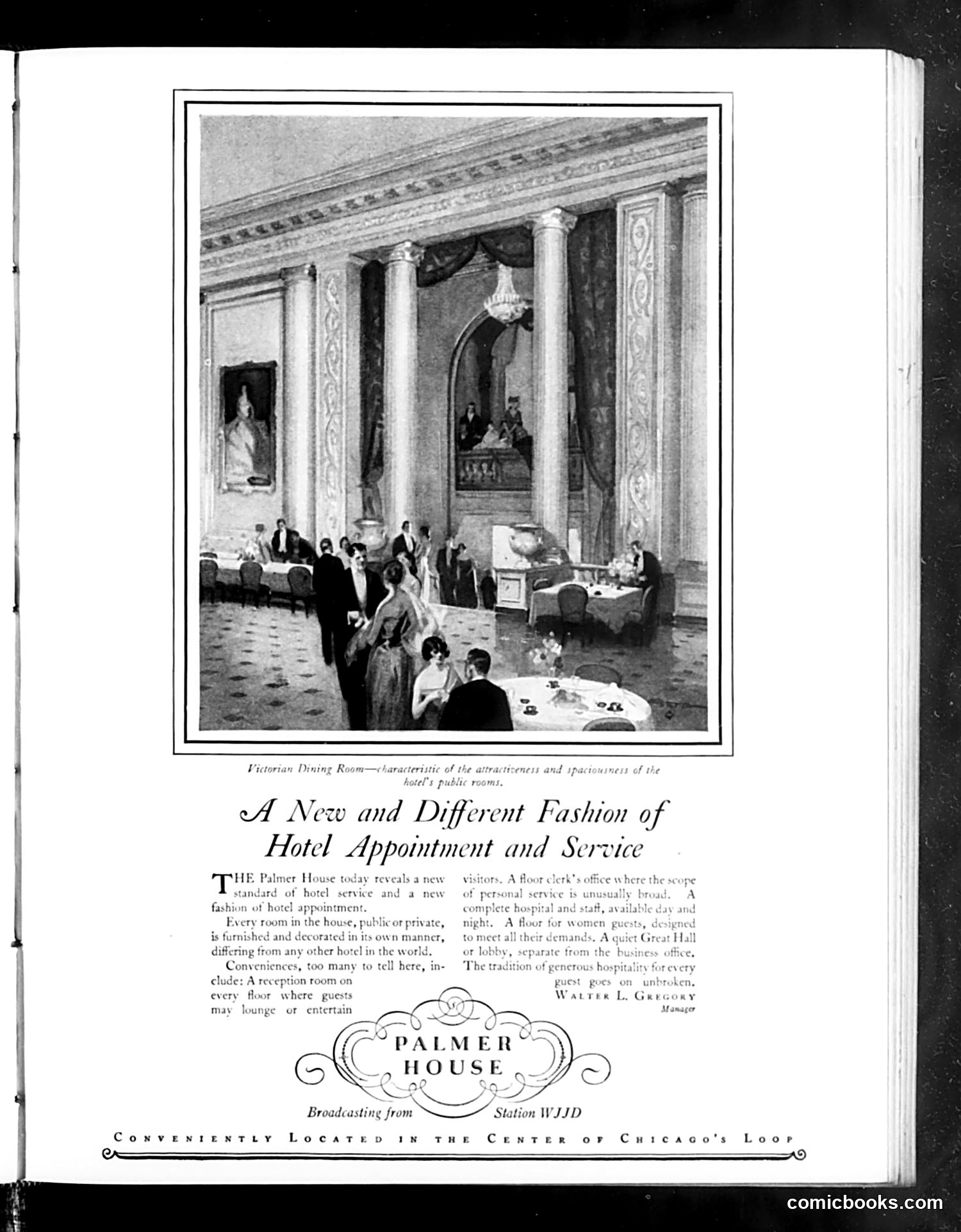
This is **not a cartoon or satire**, but rather a **hotel advertisement** for the Palmer House in Chicago's Loop district. The page promotes the Palmer House's "new and different fashion of hotel appointment and service." The photograph shows an elegant Victorian dining room with tall columns, ornate decoration, and well-dressed guests, illustrating the hotel's claim to sophistication and spaciousness. The text emphasizes luxury amenities: private reception rooms on every floor, a floor clerk's office providing broad personal service, a women's guest floor, and a separate Great Hall lobby. Manager Walter L. Gregory endorses the hotel's tradition of "generous hospitality." The bottom notes the hotel broadcasts from radio station WJJD—a modern touch for the era, suggesting cutting-edge amenities. This is straightforward promotional material highlighting the hotel's upscale positioning during what appears to be the early-to-mid twentieth century.
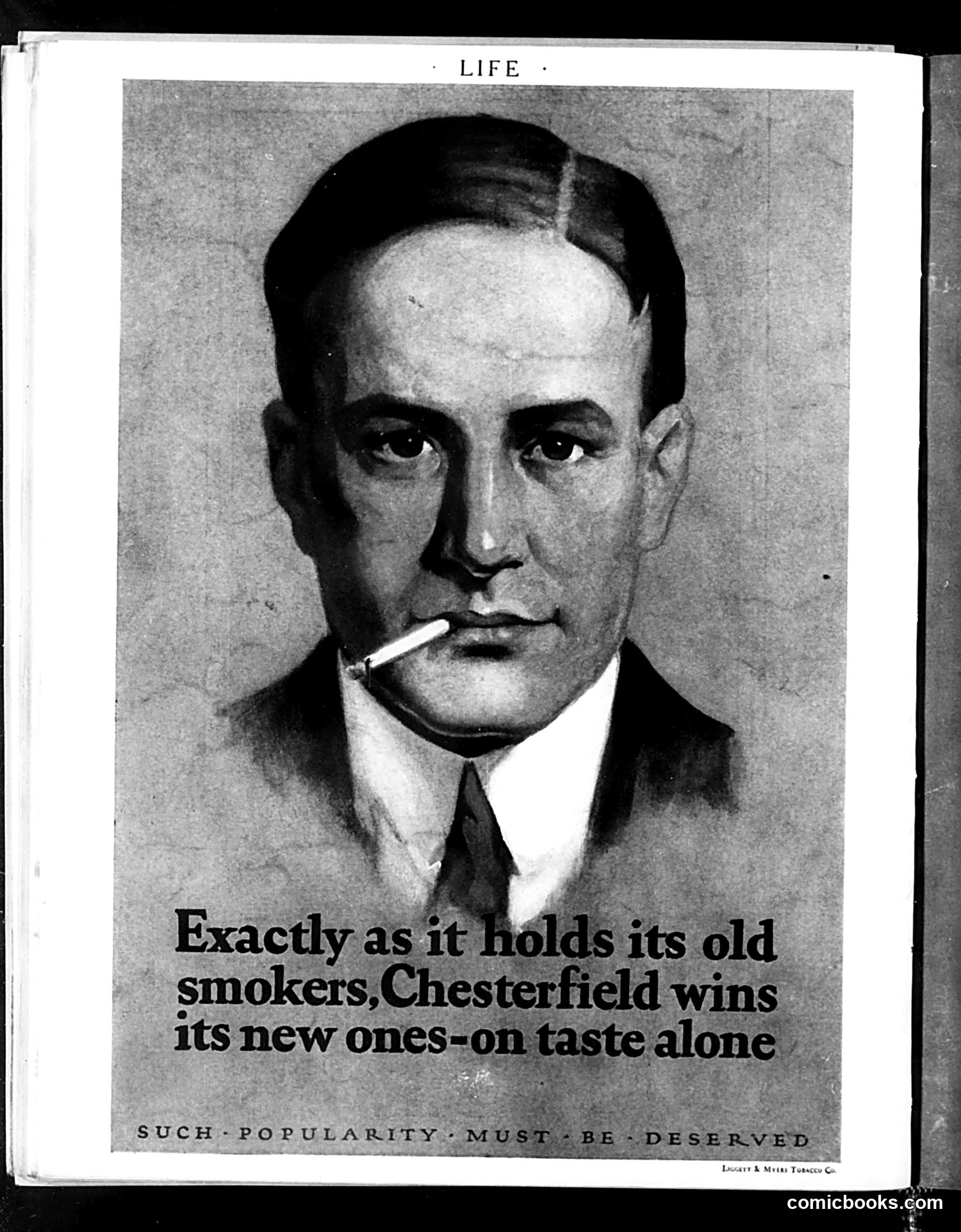
This is a **cigarette advertisement** for Chesterfield cigarettes, not a political cartoon or satire. The page features a black-and-white portrait photograph of a man smoking a cigarette, with the advertising copy: "Exactly as it holds its old smokers, Chesterfield wins its new ones—on taste alone." The tagline at the bottom reads "SUCH·POPULARITY·MUST·BE·DESERVED." The ad uses a respectable-looking male figure as an endorsement, relying on the appeal of sophistication and loyalty to market the product. This represents typical early-to-mid 20th century cigarette advertising that emphasized taste and social status, before modern health warnings became mandatory. The subject's identity is not indicated on the page.