
Life, 1926-02-04 · page 12 of 40
Life — February 4, 1926 — page 12: what you’re looking at
What you’re looking at
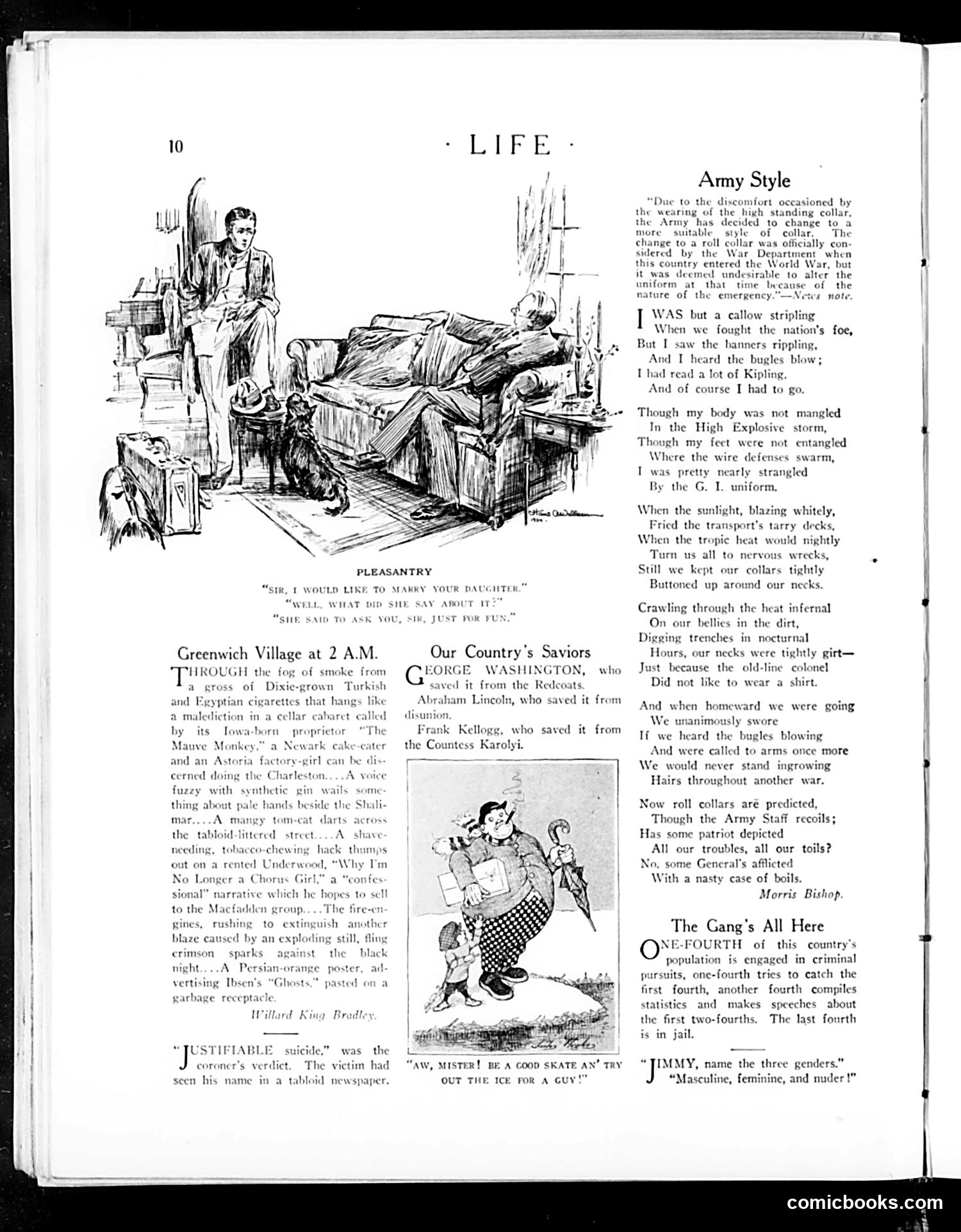
This page contains several WWI-era satirical pieces. The main cartoon "Pleasantry" depicts a domestic scene where a man in military uniform lies in bed while another soldier stands nearby—the caption suggests an awkward marriage proposal joke. The "Army Style" poem critiques the high collar uniform requirement imposed during WWI, mocking how soldiers were forced to wear uncomfortable, restrictive collars despite wartime hardships. The verse sarcastically notes that even in brutal conditions—heat, explosions, trench warfare—regulations demanded the collar remain fastened. Other brief pieces include "Greenwich Village at 2 A.M." (social commentary on bohemian life) and "Our Country's Saviors" (listing famous historical figures). The page reflects Life's characteristic blend of gentle domestic humor with pointed critiques of military regulations and wartime absurdities.
📄 Transcribed text from this page (OCR, searchable)
Machine-transcribed from the original scan — historical spelling and the odd misread are preserved.
PLEASANTRY “SiR, 1 WOULD LIKE TO MARKY YOUR DAUGHTER.” “WELL, WHAT DID SITE SAY ABOUT IT “SHE SAID TO ASK YOU, SIR, JUST POR FUN Greenwich Village at 2 A.M. Our Country's Saviors HROUGH the fog of smoke from EORGE WASHINGTON, who of Dixie-grown Turkish saved it from the Redcoats sham Lincoln, who saved it from and Egyptian cigarettes that hangs like a malediction in a cellar cabaret called orn proprietor “The who saved it from Newark cake-eater the Countess Karol; girl can be dis = and an / cerned di n. A voice fuzzy with synthetic n wails some about pale hands beside the Shali- A mangy tom-cat darts across «d-littered t A shave ack thumps & Why I'm mar the tab needing, tobacco-chewing out on a rented Ur No Longer a Chor sic al” narrative whi to the Macfadden USTIFIABLE coroner's verdict. The victim owas the Lo —_ “AW, MISTER! BE A GOOD SKATE AN’ TRY OUT THE Ice ror A GUY!” seen his name in a tabloid newspaper. Amy Style “Due to the discomfort occasioned by the wearing of the high standing colla the Army has decided to change to more suitable style of collar. The change to a roll collar was officially con sidered by the War Department) when this country entered the World War, but it was deemed undesirable to alter the uniform at tha ne because of the nature of the emergency."—News note. I WAS but a callow stripling When we fought the nation’s foe, But I saw the banners rippling, And I heard the bugles blow; Thad read a lot of Kipling, And of course I had to go, Though my body was not mangled In the High Explosive storm, Though my feet were not entangled Where the wire defenses swarm, I was pretty nearly strangled 3y the G. 1. uniform. When the sunlight, blazing whitely, ried the transport’s tarry decks, When the tropic heat would nightly Turn us all to nervous wrecks, Still we kept our collars tightly Buttoned up around our necks. Crawling through the heat infernal On our bellies in the dirt, Digging trenches in nocturnal Hours, our necks were tightly girt— Just because the old-line colonel Did not like to wear a shirt. And when homeward we were going We wu If we heard the bugles blowing And were called t ¢ more We would never stand ingrowing Hairs throughout another war. nimously swore arms on w roll collars aré predicted, Though the Army Staff recoils; Has some patriot depicted All our troubles, all our toils? some Gencral's afflicted With a nasty case of boils. Morris Bishop The Gang’s All Here NE-FOURTH of this country’s population is engaged in criminal pursuits, one-fourth tries to catch the first fourth, another fourth compiles statistics and makes speeches about the first two-fourths. The last fourth is in jail. “JIMMY, name the three genders.” “Masculine, feminine, and nuder !” comicbooks.com —t=