
Life, 1926-02-04 · page 27 of 40
Life — February 4, 1926 — page 27: what you’re looking at
What you’re looking at
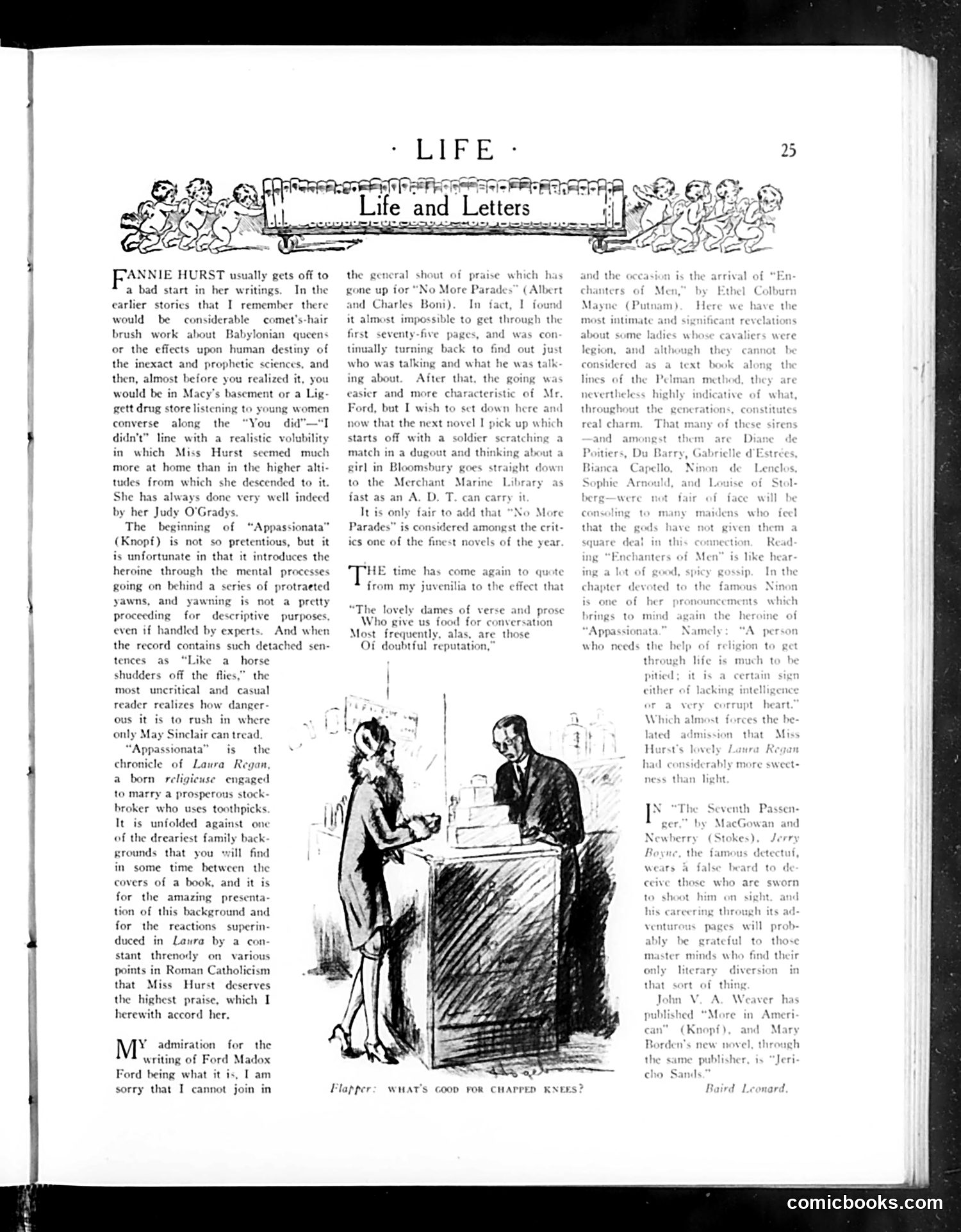
This is a **book review column** titled "Life and Letters," not a political cartoon. The page reviews new novels by author Fannie Hurst and others. The **illustration** (captioned "What's good for chapped knees?") appears to be a humorous sketch of a young woman (a "flapper," the fashionable youth of the 1920s) visiting a male doctor or pharmacist about a minor ailment—likely satirizing the era's obsession with beauty treatments and self-care products. The **text** critiques Hurst's writing style, noting her tendency toward melodrama and overly complex narratives. The reviewer praises her novel *Appassionata* for its portrayal of family dysfunction and Catholic identity, while criticizing other authors like Ford Madox Ford for confusing openings. The tone is literary criticism with gentle mockery of both authors and contemporary reading preferences.
📄 Transcribed text from this page (OCR, searchable)
Machine-transcribed from the original scan — historical spelling and the odd misread are preserved.
ae FANNIE HURST usually gets off to a bad start in her writings. In the earlier stories that I remember there would be considerable comet's-hair brush work about Bal lonian ¢ or the effects upon human destiny the inexact and pr then, almost be: would be eens f phetic sciences, and ny re you realized it, y in Macy’s asement or a Li gett drug store listening to young women converse along the “You did"—“I didn’t” line with a realistic volubility in which Miss Hurst seemed much more at home than in the higher al tudes from which she descended to it She has always dc by her Judy O'Gradys The beginning of “Appassionata” (Knopf) is not so pretentious, but it is unfortunate in that it introduces the heroine through the mental processes going on behind a series of protraeted very well indeed yawns, and yawning is noi a pretty proceeding for descriptive purposes even if handled by experts. And when the record contains such detached sen- tences as “Like a horse shudders off the flies,” the most uncritical and casual reader realizes how danger ous it is to rush in where only May Sinclair can tread “Appassionata” is — the chronicle of Laura Regan, a born relig cle engaged to marry a prosperous stock broker who uses toothpicks It is unfolded against one of the dreariest family back grounds that you will find in some time between the covers of a book, and it is for the amazing presenta- tion of this background and for the reactions superin- duced in Laura by a con stant. thren on various points in Roman Catholicism that Miss Hurst deserves the highest praise, which I herewith accord her. admiration for the M ig of Ford Madox ord being what it is, 1 am orry that I cannot join in wri Flapper p= agg fe shout of praise whic gone up ior "No More Par (Albert and Charles Boni). In iact, 1 found it almost impossible to get through the first seventy-five pages, and was tinually turning back to find out just who was talking and what he was ing about. After that, the going was easier and more characteristic of Mr. Ford, but I wish to set down | | now that the next novel I pick up which starts off with a soldier scrat match ina 1 think duge girl in Bloomsbury goes s 9 to the Merchant Marine Library as fast as an A. D. T. can car It is that Parades” is considered amongst the crit- ics one of the THE time has come again to quote from my juvenilia to the effect that y fair to ad finest novels of the year ¢ lovely dames of verse and pr Who give us food for conversation Most frequently are the Of doubtful repu swect- WHAT'S GOOD FOR CHAPPED KNEES? fi 1 Leonard.