
Life, 1926-02-04 · page 22 of 40
Life — February 4, 1926 — page 22: what you’re looking at
What you’re looking at
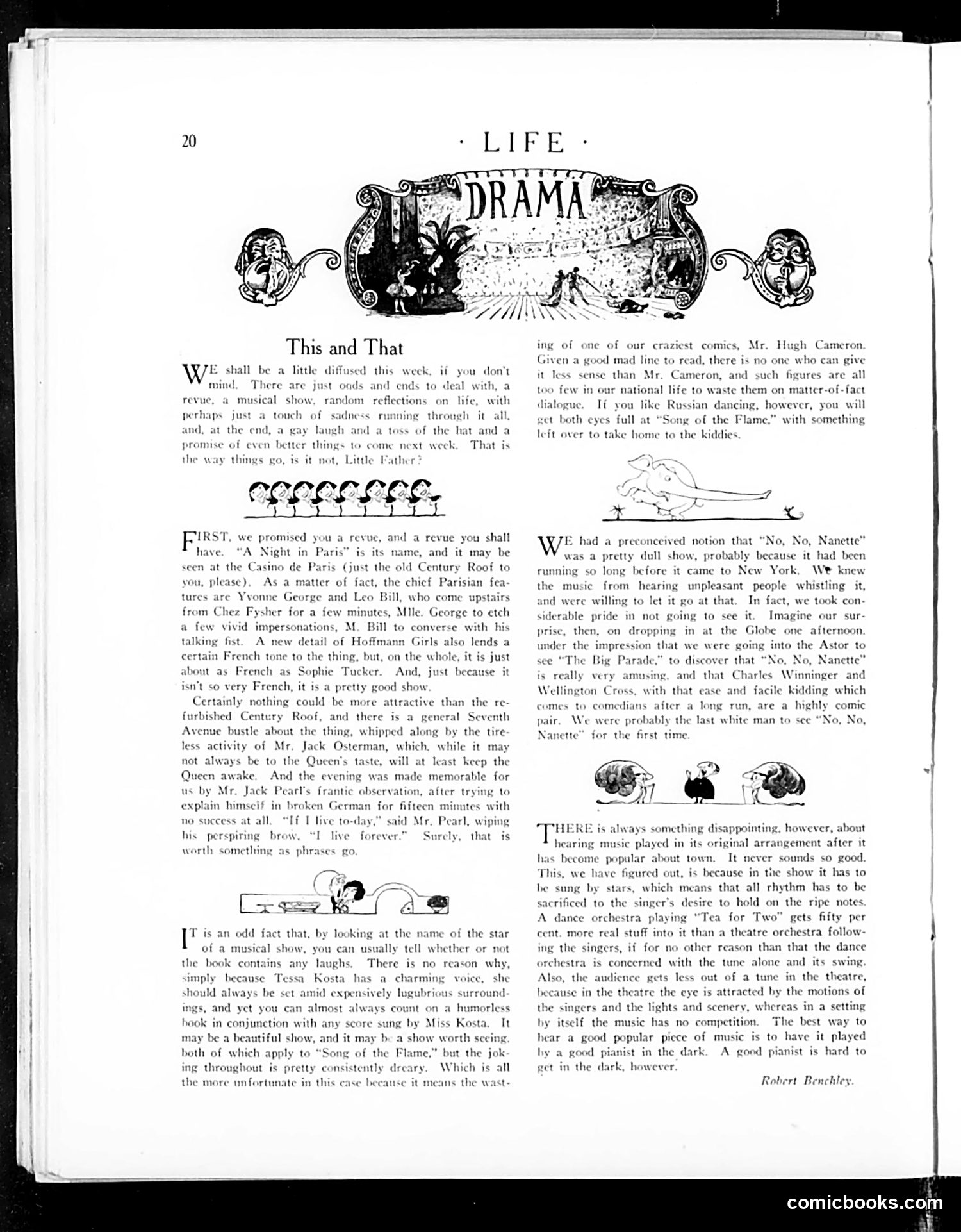
This is a theater review column covering Broadway shows. The author discusses several productions: **"A Night in Paris"** — a revue at the Casino de Paris featuring French performers (Yvonne George, Leo Bill) and the Hoffmann Girls. The piece satirizes its forced "Frenchness," noting that despite efforts by performer Sophie Tucker and energetic stage manager Jack Osterman, it succeeds more through American hustle than authentic Gallic charm. Jack Pearl's futile attempt to speak German is highlighted as comic relief. **"Song of the Flame"** — criticized for wasting comedian Hugh Cameron's talents on a show that's merely a vehicle for Russian dancing. **"No, No, Nanette"** — the reviewer admits initial snobbish dismissal of this long-running show, but found it genuinely funny upon finally attending. Charles Winninger and Wellington Cross's comedic timing is praised. The column concludes with observations about how popular songs lose their appeal when heard in theatrical orchestral arrangements rather than the simplified versions that spread through public whistling.
📄 Transcribed text from this page (OCR, searchable)
Machine-transcribed from the original scan — historical spelling and the odd misread are preserved.
This and That shall be a little diffused this week, if you don't mind. There are j oads and ends to deal with, a revue, a musical show, random reflections on life, with vit all, the hat and a promise of even better things to come next week, That is RST, we promised you a rev perhaps just a d, at the end uch of sadness r thro gay laugh and a toss ¢ he way things go, is it and a revue you shall have. “A Night in Paris” is its name, and it may be seer at the Casino de Paris (just the old Century Roof to you, please). As a matter of fact, the chief Parisian fea- ge and Leo E ez Fysher for a few minutes, Mlle. George to etch a few vivid impersonations, M. Bill to converse with his talking fist. An tures are Yvonne Ge ill, who come upstairs ‘om ( w detail of Hoffmann Girls also lends a certain French tone to the thing, bi on the whole, it is just sphie Tucker. And, just because it isn't so very French, it is a pretty good show Ce furbist about as French as § ainly nothing could be more attractive than the re- d Century Roof, and there is a general Seventh Avenue bustle about the thing, whipped along by the tire less activity of Mr. Jack Osterman, which, while it may not always be to the Queen's taste, will at least keep the Queen awake, And the evening was made memorable for by Mr. Jack Pearl's frantic explain himself in bre ervation, after trying to en German for fifteen minutes with no success at all. “If I live to y.” said Mr. Pearl, wiping his perspir x brow, “I live forever.” Surely, that is worth something as phrases go. =—-— [7 is an odd fact that, by looking at the name of the st f a musical show, you ¢ usually tell whether or not the book contains any laughs. There is no reason why, imply because Tessa Kosta has a charmi should always be set amid ext voice, she )rious surround asively lu in he in conjunction with any score sung by Miss may be a beautiful show, and it m: both of which apply to “Song of the Flame,” but the jok cary. Which is all ¢ it means the w s, and yet you can almost always count on a humorless costa. It bo a show worth sceing. ing throughout is pretty consistently ¢ the more unfortunate in this case becar ing of one of our craziest comics, Mr. Hugh Cameron. Given a good mad line to read, there is no one who cai it less sense than Mr. Cameron, and such figures are a too few in our national life to waste them on matter-of-fact Ii you like Russian dancing, however, you will get both eyes full at “Song of the I left over to take home to the kiddies, me,” with something had a preconceived notion that “No, No, Nanette” was a pretty dull show, probably because it had been running so long before it came to New York, We knew the music from hearing unpleasant people whistling it, and were willing to let it go at that. In fact, we took con- siderable pride in not going to see it. Imagine ur sur- prise, then, on dropping at the Globe one afternoon. under the impression that we were going into the Astor to sce “The Big Parade,” to discover that “No, No, Nanette is really very amusing, and that Charles Winninger and Wellington Cross, with that ease and facile kidding which comes to comedians after a long run, are a highly comic pair. We were probably the last white man to see “No, } Nanette” for the first time. HERE is always something disappointing, however, about hearing music played in its original arrangement after it has become popular about town. It never sounds so good. This, we have figured out, is because in the show it has to he sung by stars, which means that all rhythm has to be sacrificed to the singer's desire to hold on the ripe notes. A dance orchestra playing “Tea for Two” gets fifty per low- cent. more real stuff into it than a theatre orchestra fi ing the singers, if for no other reason than that the dance orchestra is concerned with the tune alone and its swing Also, the audience gets less out of a tune in the theatre, atre the eye is attracted by the motions of the singers and the lights and scenery, whereas in a setting hy itself the music has no competition. The best way to hear a good popular picce of music is to have it played hy a good pianist in the dark. A good pianist is hard to because in the get in the dark, however.