
A complete issue · 41 pages · 1925
Life — September 24, 1925
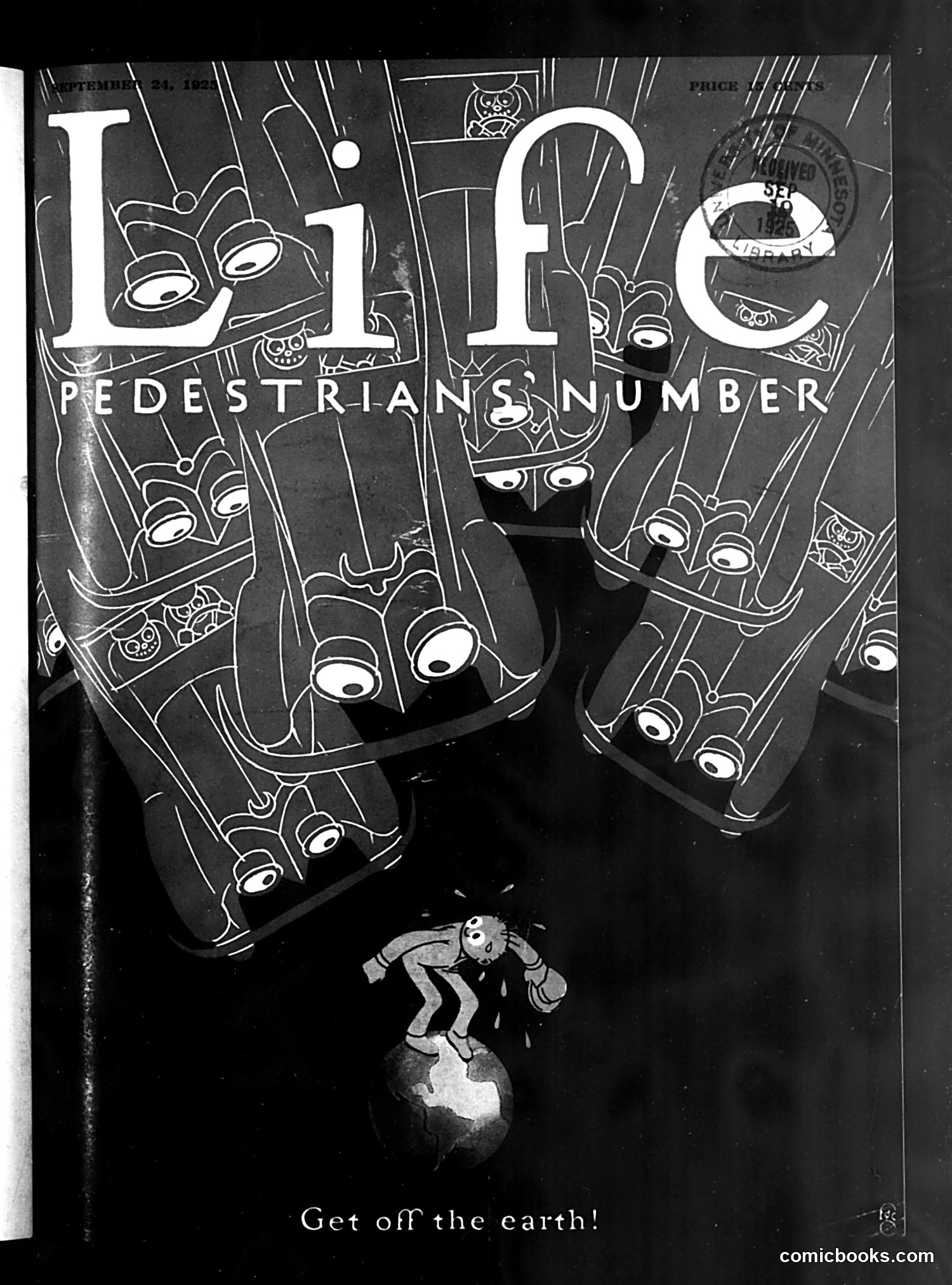
This appears to be a cover from *Life* magazine (dated September 21, based on visible text) titled "Life's Pedestrian's Number." The cover depicts a small figure at the bottom of the page standing on Earth, dwarfed by enormous feet and shoes descending from above with the caption "Get off the earth!" The imagery suggests pedestrians are being threatened or overwhelmed by traffic—likely automobiles, given the stylized wheels visible in the shoe designs. This is satirizing the danger posed by automobiles to pedestrians in early 20th-century cities. The cartoon critiques how motorized vehicles were becoming hazardous to people on foot, positioning cars and their drivers as an existential threat to ordinary citizens trying to navigate urban streets.
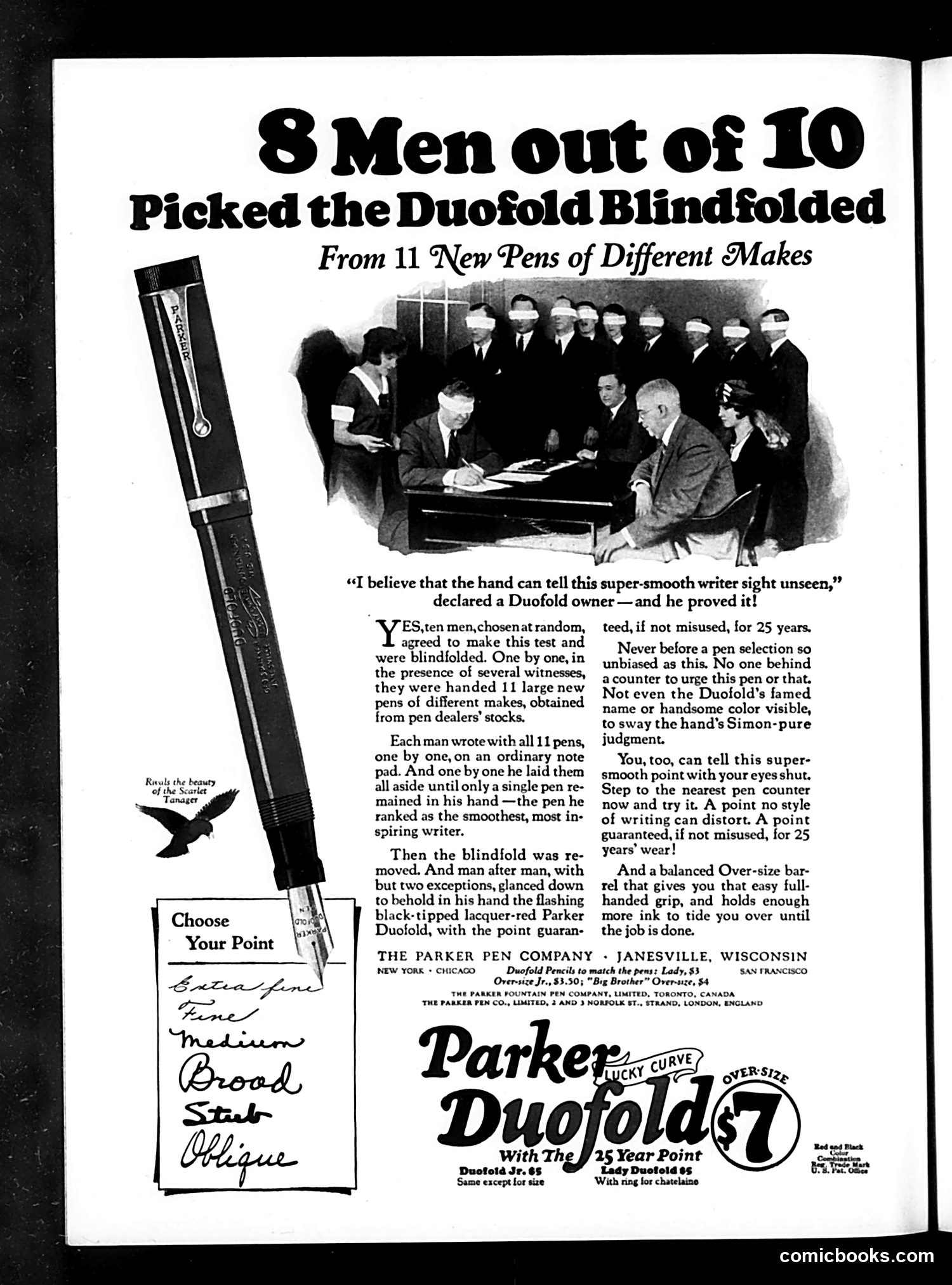
This is **not a political cartoon or satire**—it's a vintage **advertisement for Parker Duofold pens**, likely from the 1920s-1930s. The ad describes a blindfold test where ten men randomly selected from the public were given 11 different pen brands to write with. Eight men chose the Parker Duofold as the smoothest writer, without knowing which brand it was. The test aimed to prove the pen's superior quality through unbiased consumer preference rather than brand recognition. The image shows the test being conducted with witnesses present, lending credibility to the claim. The ad emphasizes the Duofold's smooth writing point, durability (25-year guarantee), and ergonomic design. This is straightforward product marketing using a pseudo-scientific demonstration as persuasion—common advertising strategy of that era.
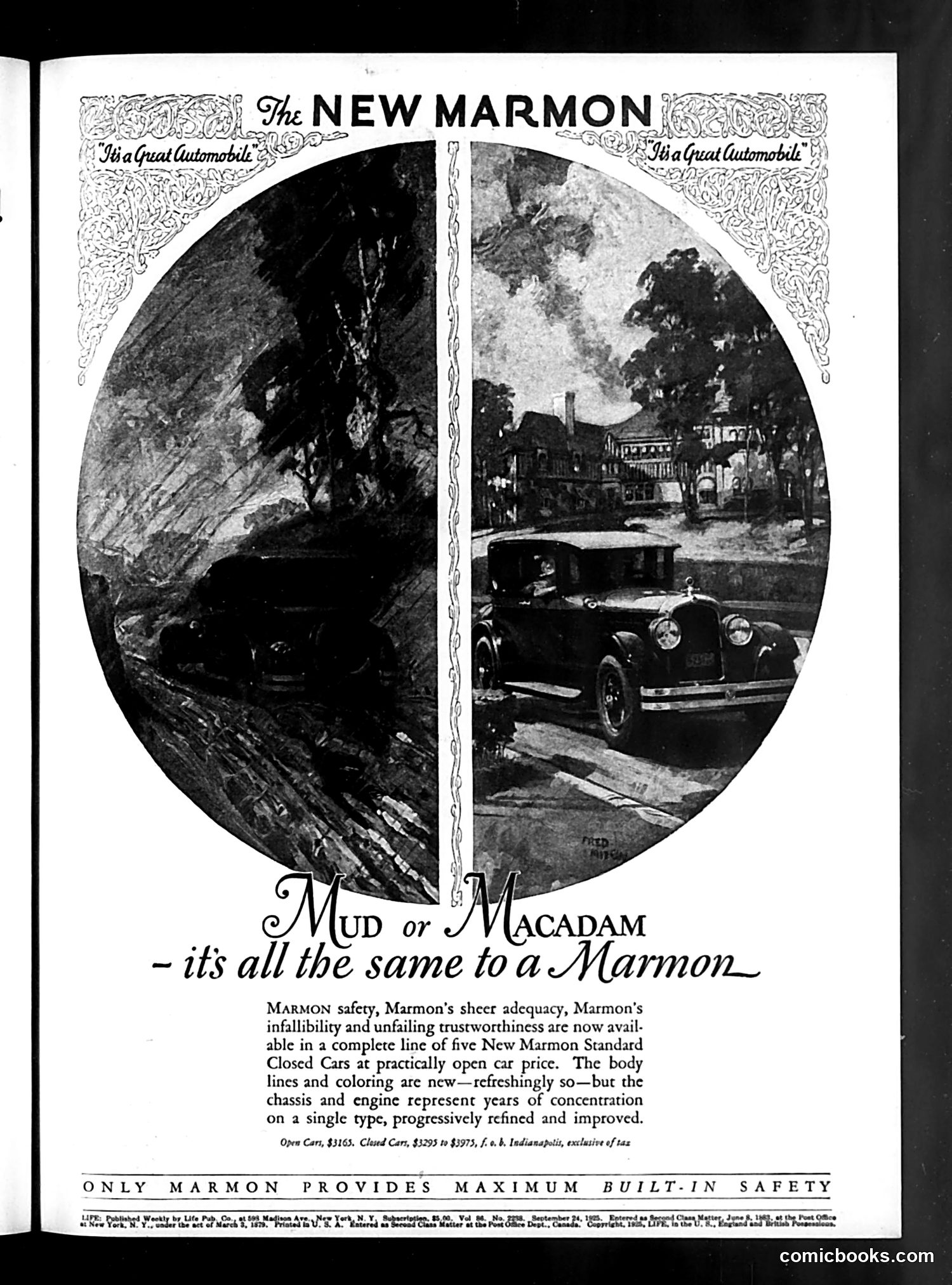
This is **not a political cartoon or satire** — it's a straightforward automobile advertisement for the Marmon car company. The page shows two oval photographs: on the left, a Marmon navigating treacherous mountain terrain; on the right, the same vehicle in an urban setting. The headline "Mud or Macadam—it's all the same to a Marmon" claims the car performs equally well on poor roads and paved streets. The advertising copy emphasizes Marmon's "safety," "sheet adequacy," and "infallible...trustworthiness," positioning the car as reliable across varied driving conditions. This was a genuine selling point during the 1920s-era automobile boom, when American road infrastructure was inconsistent. The slogan "Only Marmon provides maximum built-in safety" underscores the manufacturer's competitive positioning in an emerging automotive market.
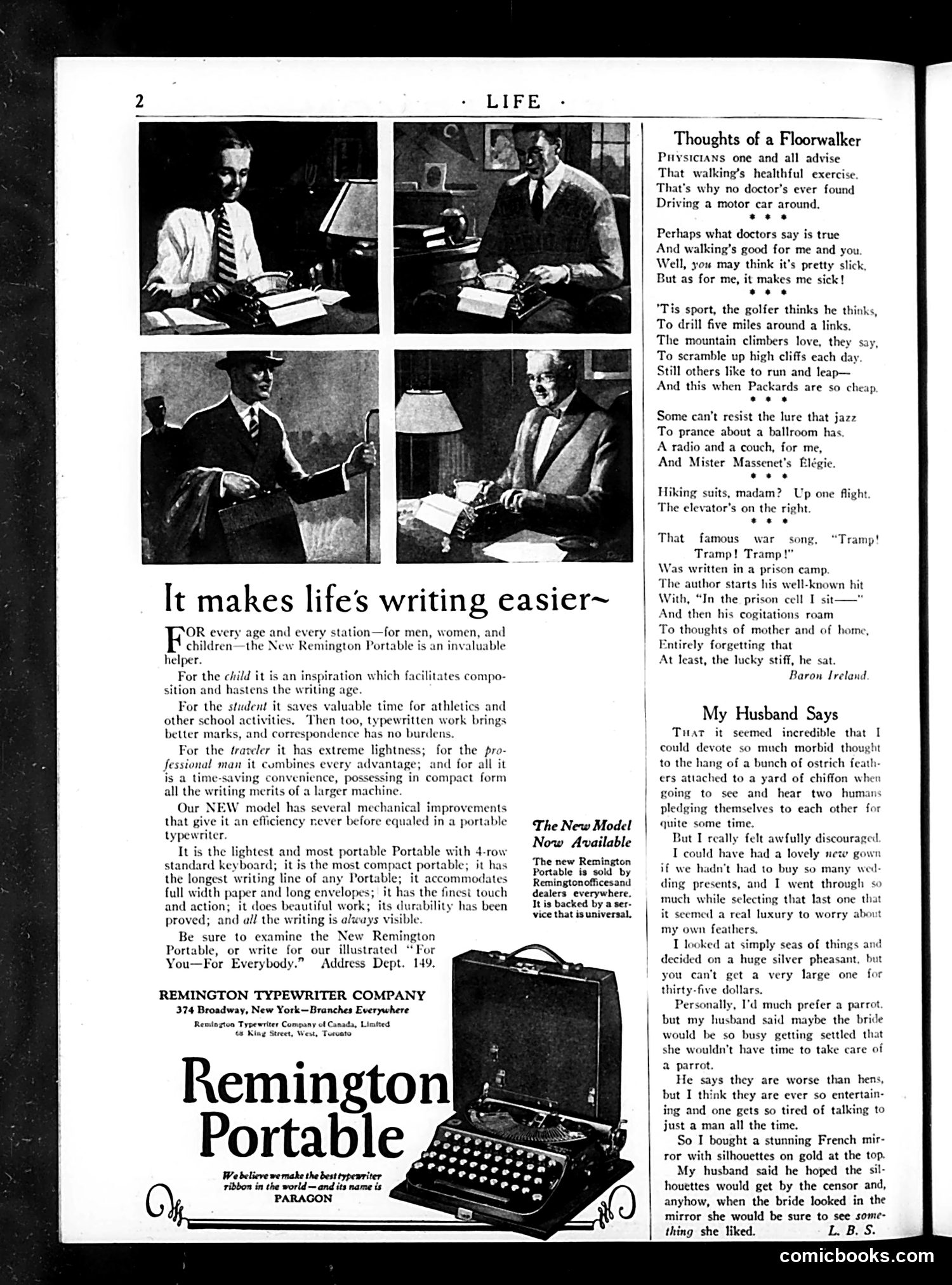
This page contains two distinct elements: **Left side:** A Remington Portable typewriter advertisement featuring four photographs of men at desks. The ad emphasizes the typewriter's usefulness "for every age and station—for men, women, and children." **Right side:** Two articles—"Thoughts of a Floorwalker" (humorous verse about exercise trends) and "My Husband Says" (a satirical domestic humor column). The latter mocks a wife's morbid desire to buy an ostrich feather accessory, with her husband's skeptical commentary on women's impulsive shopping and entertaining birds as pets. The content reflects 1920s American concerns: modern technology adoption, health fads, consumer culture, and gender dynamics in marriage. The satire targets both spousal arguments and women's consumer behavior.
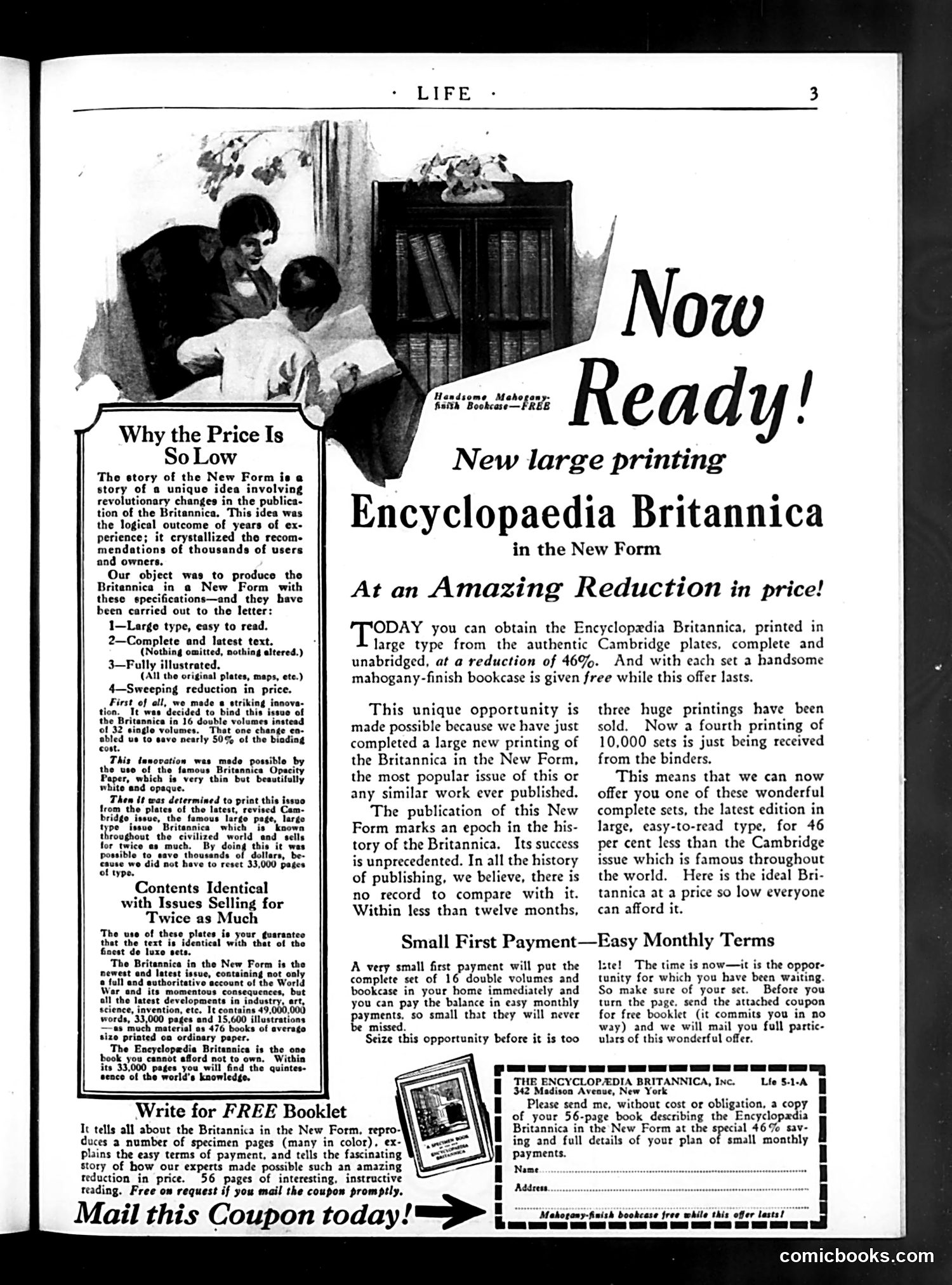
This page is **primarily a full-page advertisement** for Encyclopedia Britannica's "New Form" edition, not political satire or cartoon content. The image shows an adult instructing a child with a book, illustrating the product's educational purpose. The ad emphasizes affordability through a "large new printing" of 10,000 sets, claiming a "reduction of 46%" in price with "easy-to-read type" and "fully illustrated" content. The marketing hook is accessibility: a small first payment and easy monthly installments make the encyclopedia affordable to average American families. The ad includes a mail-in coupon for a free explanatory booklet. While this appears in *Life* magazine (known for satire), this particular page contains straightforward consumer advertising rather than political commentary or humor.
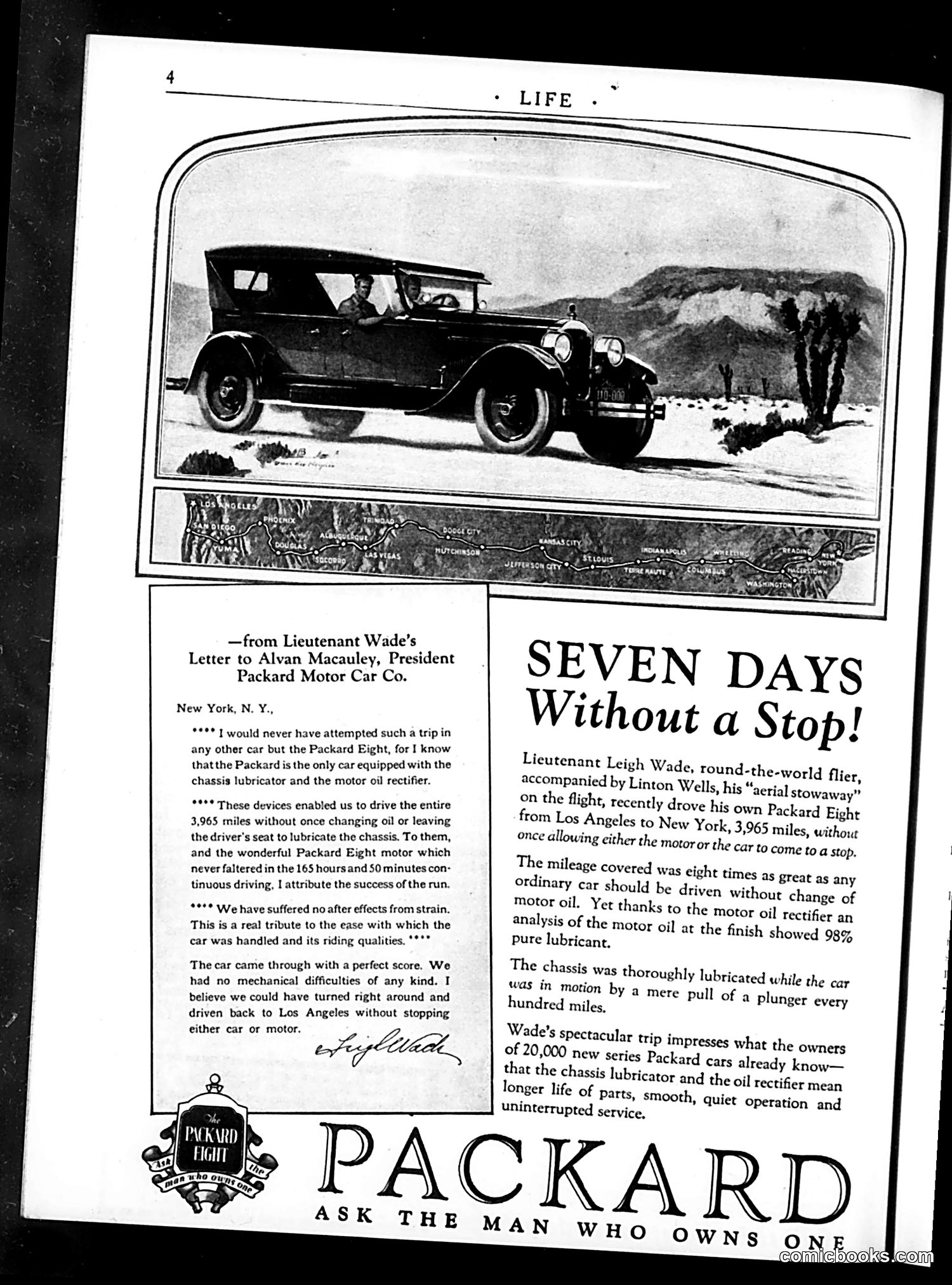
This is **primarily an advertisement**, not satirical content. It's a Packard automobile ad from Life magazine featuring a testimonial letter from Lieutenant Leigh Wade, a round-the-world aviator who recently flew a Packard Eight from Los Angeles to New York—3,965 miles in seven days without stopping the engine or changing oil. The ad highlights the car's engineering reliability: its chassis lubricator and motor oil rectifier performed so well that analysis showed 98% pure lubricant remained at journey's end. The accompanying photograph shows the 1920s-era Packard automobile in a desert landscape. The tagline "Ask the Man Who Owns One" was Packard's actual advertising slogan. This represents automotive advertising using celebrity endorsement and technical achievement to establish brand prestige—common early 20th-century marketing.
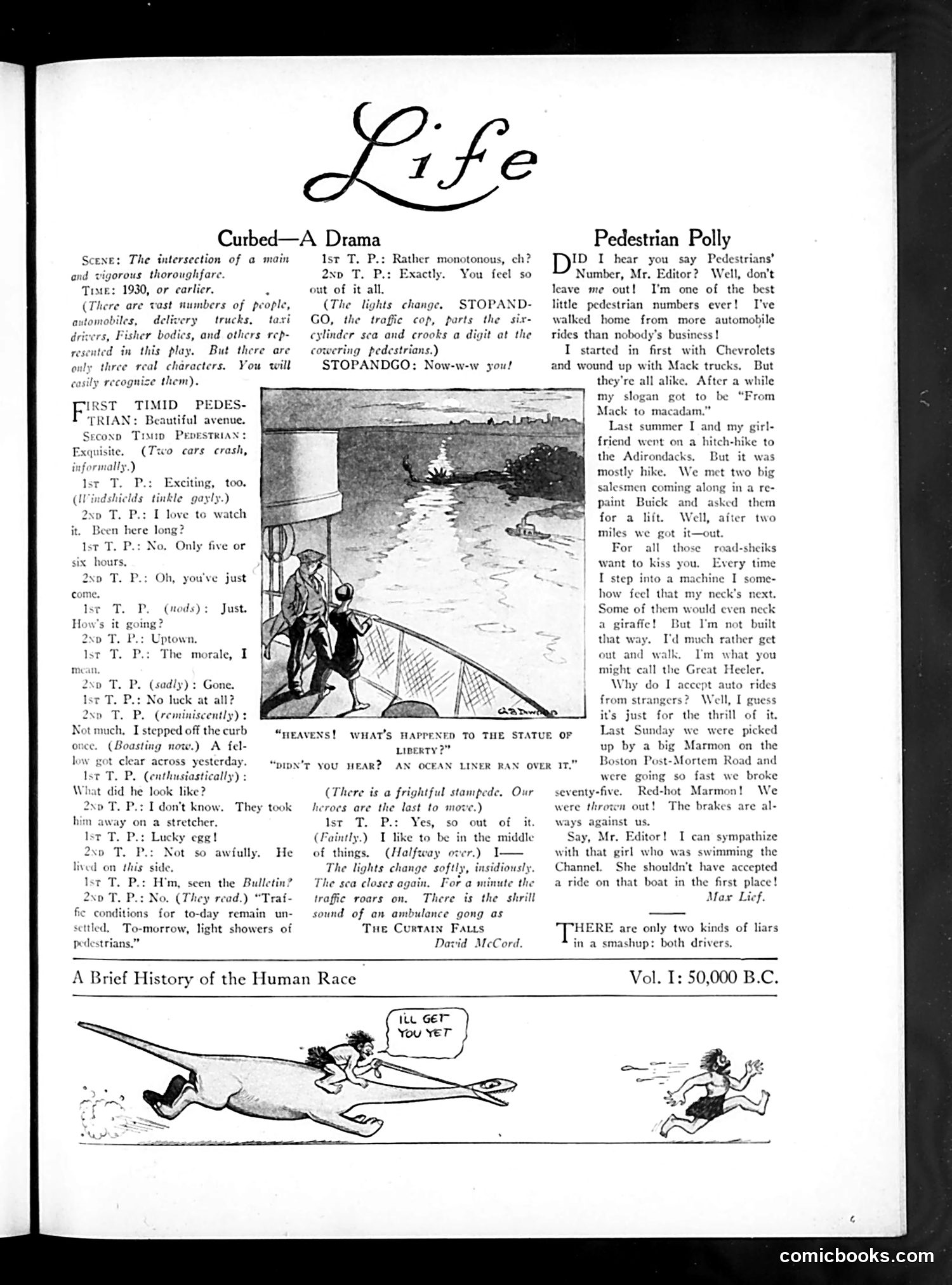
This page contains two pieces of 1920s satirical content: **"Curbed—A Drama"** is a short comedic sketch about pedestrian safety during the automobile age. It depicts a collision between cars at a street intersection, with characters expressing shock at the accident. The joke centers on the era's anxiety about motor vehicles—"traffic cops" and "cylinders" are mentioned as novel hazards. The sketch satirizes how quickly automobiles became urban dangers. **"Pedestrian Polly"** is a humorous essay about a woman's reluctance to ride in cars after nearly being hit by vehicles multiple times. She describes herself as "The Great Hesitator" and humorously suggests automobiles are predatory machines that deliberately target pedestrians. Both pieces mock early-20th-century automobile culture and society's struggle adapting to mechanized transportation as a everyday threat to safety.
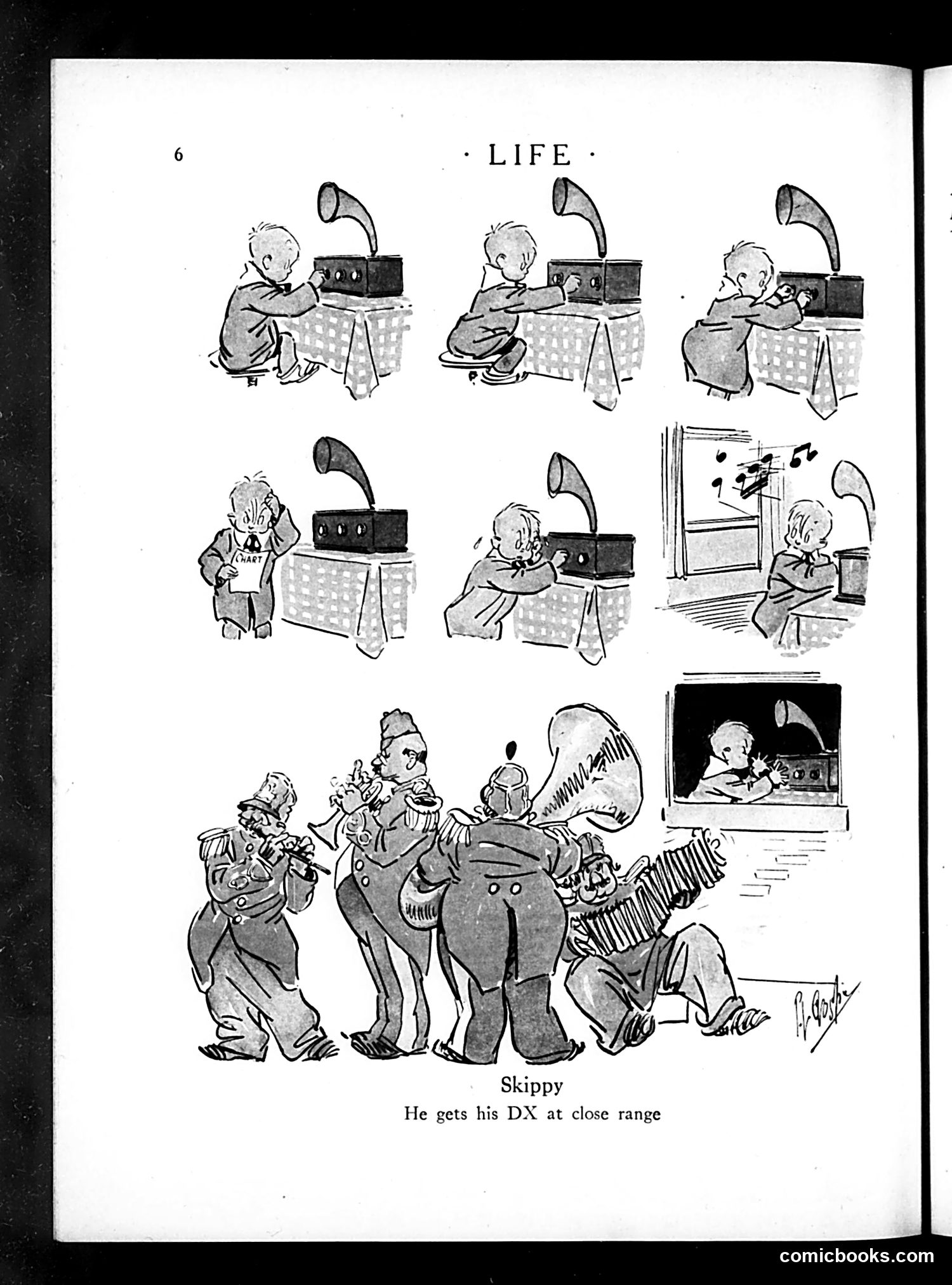
This page from *Life* magazine shows a comic strip sequence about a character named "Skippy." The strip depicts a young boy progressing through increasingly elaborate schemes involving what appears to be radio equipment (indicated by the horn/antenna visible in each panel). The final panel shows "Skippy" demonstrating his radio setup to military or uniformed figures, with the caption explaining he "gets his DX at close range." "DX" is amateur radio terminology for distant transmissions. The satire appears to target either radio hobbyists' obsessive pursuit of long-distance signals, or possibly wartime radio surveillance/espionage concerns. The progression from a child's innocent tinkering to involvement with authority figures suggests commentary on how civilian interests intersect with official interests—though the specific historical context remains unclear without additional dating information.
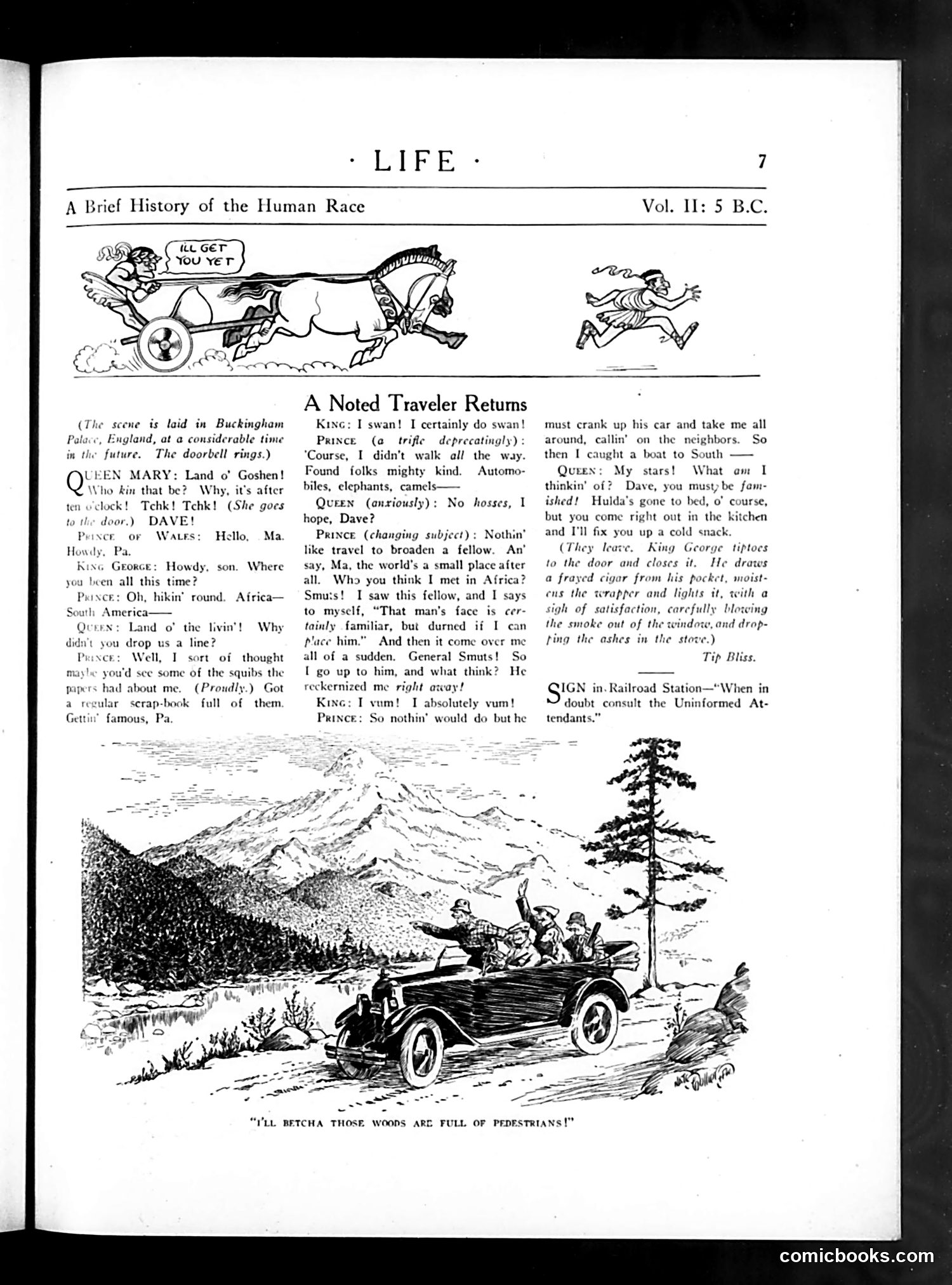
This is a humorous sketch about a wealthy traveler returning from abroad with exaggerated travel stories. The comedy hinges on the traveler's grandiose claims: he boasts of encountering exotic animals (elephants, camels) and a famous general named Smuts in Africa, but admits he's actually unfamiliar with these experiences and may have confused details. The main cartoon below depicts a car full of tourists in a scenic mountain landscape, with the caption "I'LL BETCHA THOSE WOODS ARE FULL OF PEDESTRIANS!" This satirizes urban Americans' disconnection from nature—they assume forests contain pedestrians like city streets, revealing their metropolitan ignorance of the wilderness they're visiting.
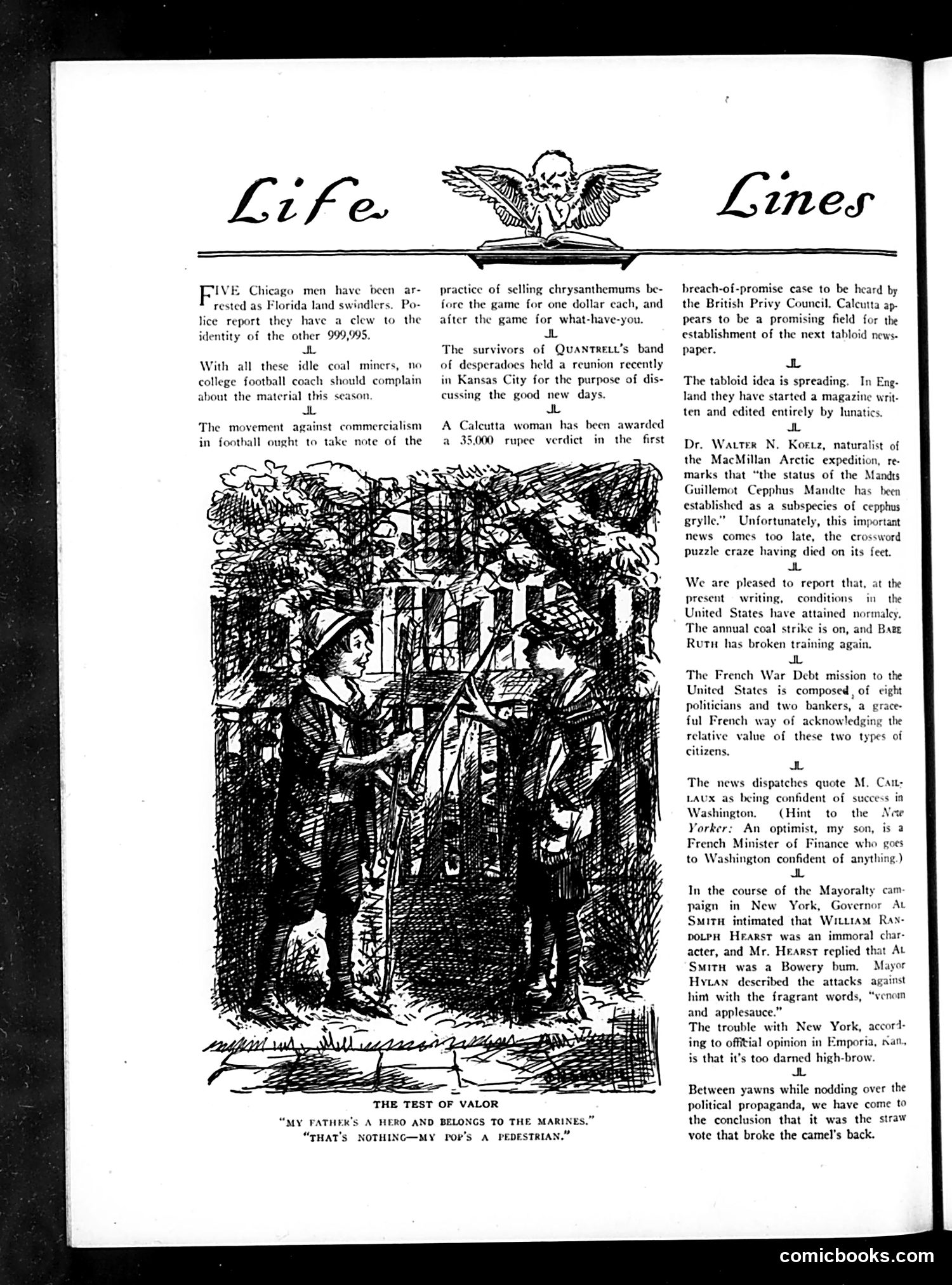
This illustration depicts a scene labeled "THE TEST OF VALOR," with a caption quoting: "MY FATHER'S A HERO AND BELONGS TO THE MARINES. THAT'S NOTHING—MY POP'S A PEDESTRIAN." The cartoon satirizes early 20th-century urban dangers by suggesting that surviving as a pedestrian in a city—navigating traffic and hazardous streets—requires as much courage as military service. The crowded, chaotic street scene reinforces this joke: civilian life in modern cities posed genuine risks. This reflects contemporary concerns about automobile accidents and pedestrian safety, which were emerging public health issues as motor vehicles became commonplace in American cities.
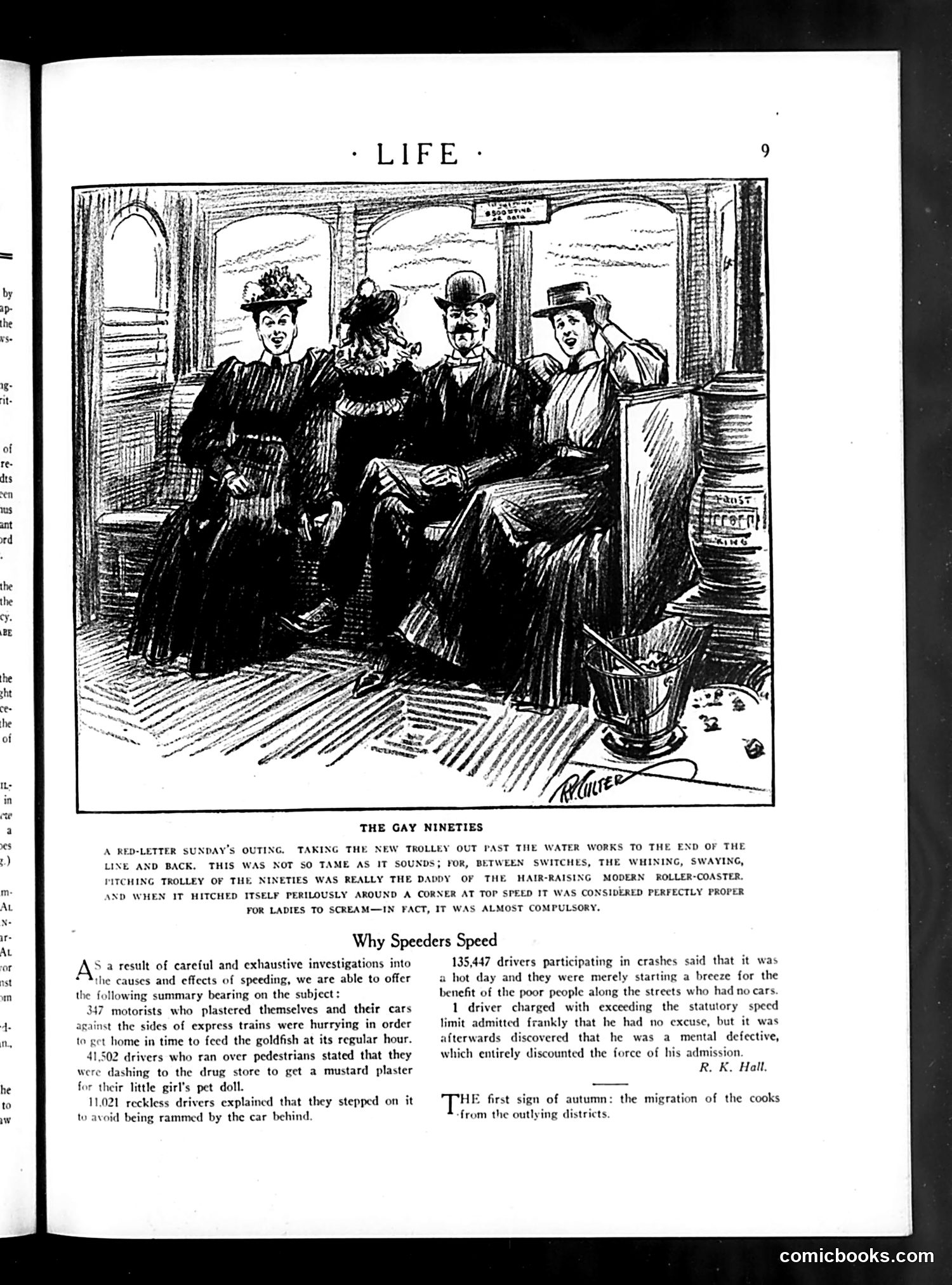
The cartoon depicts four fashionably dressed people on a trolley car taking an outing. The caption explains this is a "Red-Letter Sunday's Outing" where they've taken a new trolley past the water works. The joke centers on the trolley's wild, uncontrollable behavior—it pitched, swayed, and whined while racing around corners at dangerous speeds, creating what the text calls "hair-raising modern roller-coaster" thrills. The satire mocks both early electric trolleys (unreliable and unpredictable technology) and the era's leisure activities. The accompanying article "Why Speeders Speed" humorously offers absurd explanations for reckless driving—drivers claiming hot weather, mental defects, or needing to feed goldfish on time. The overall tone ridicules 1890s modern life's technological chaos and the public's dangerous behaviors.
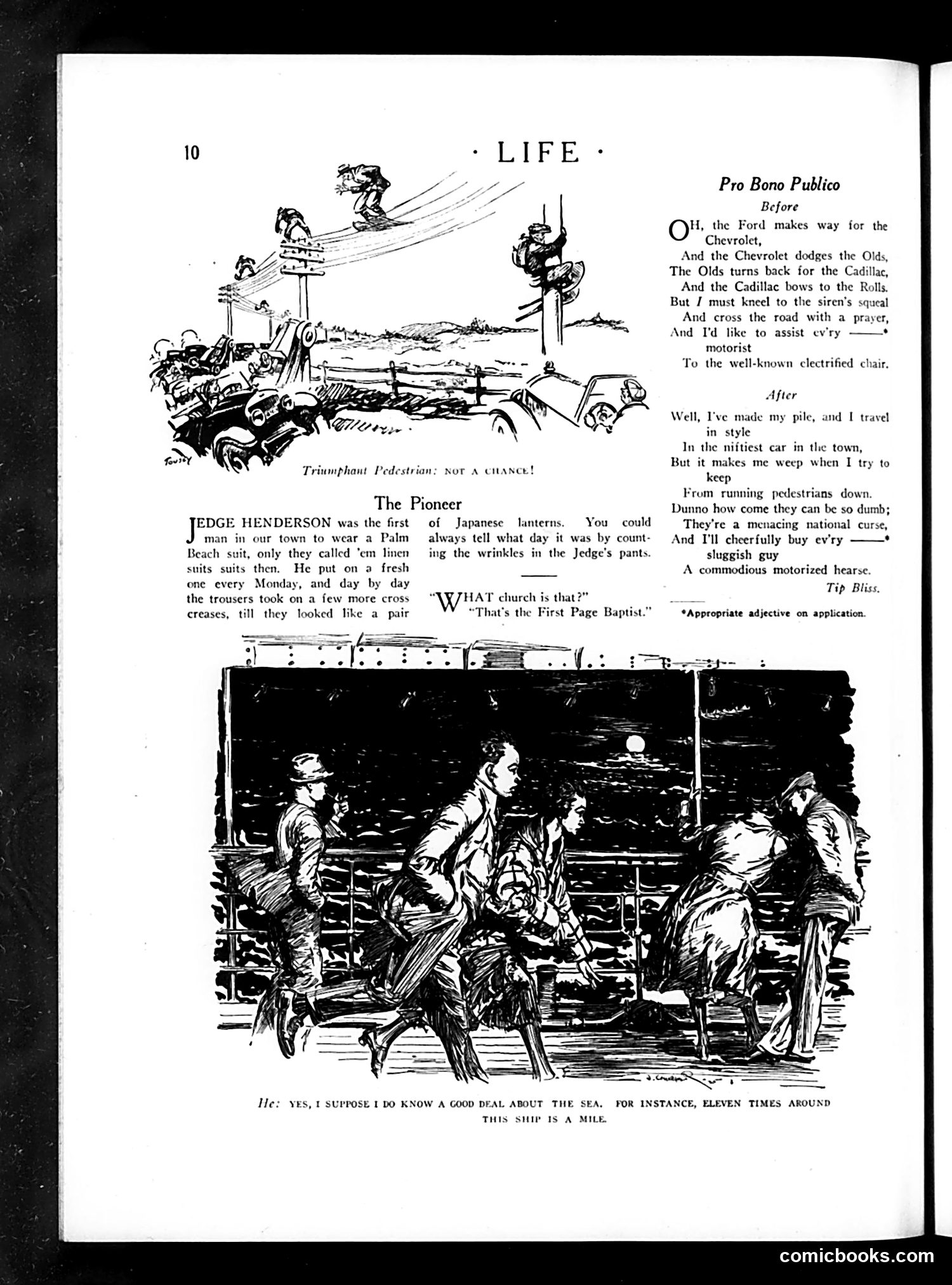
This page satirizes early automobile culture and pedestrian safety. The top cartoon, titled "Triumphant Pedestrian: Not a Chance!" shows people being struck by various cars (Ford, Chevrolet, Oldsmobile, Cadillac, Rolls-Royce), mocking the era's automobile dangers. The verse "Pro Bono Publico" sarcastically celebrates motorists while lamenting pedestrians' vulnerability—a "commodious motorized hearse" joke about cars as death traps. "The Pioneer" section mocks Jedge Henderson, an early adopter of Japanese lanterns and linen suits, representing pretentious fashion followers. The bottom illustration shows sailors aboard ship, with dialogue about sea knowledge, likely satirizing exaggerated boasting or false expertise among mariners. Overall, the page critiques 1920s automotive dangers and social pretension through humor.
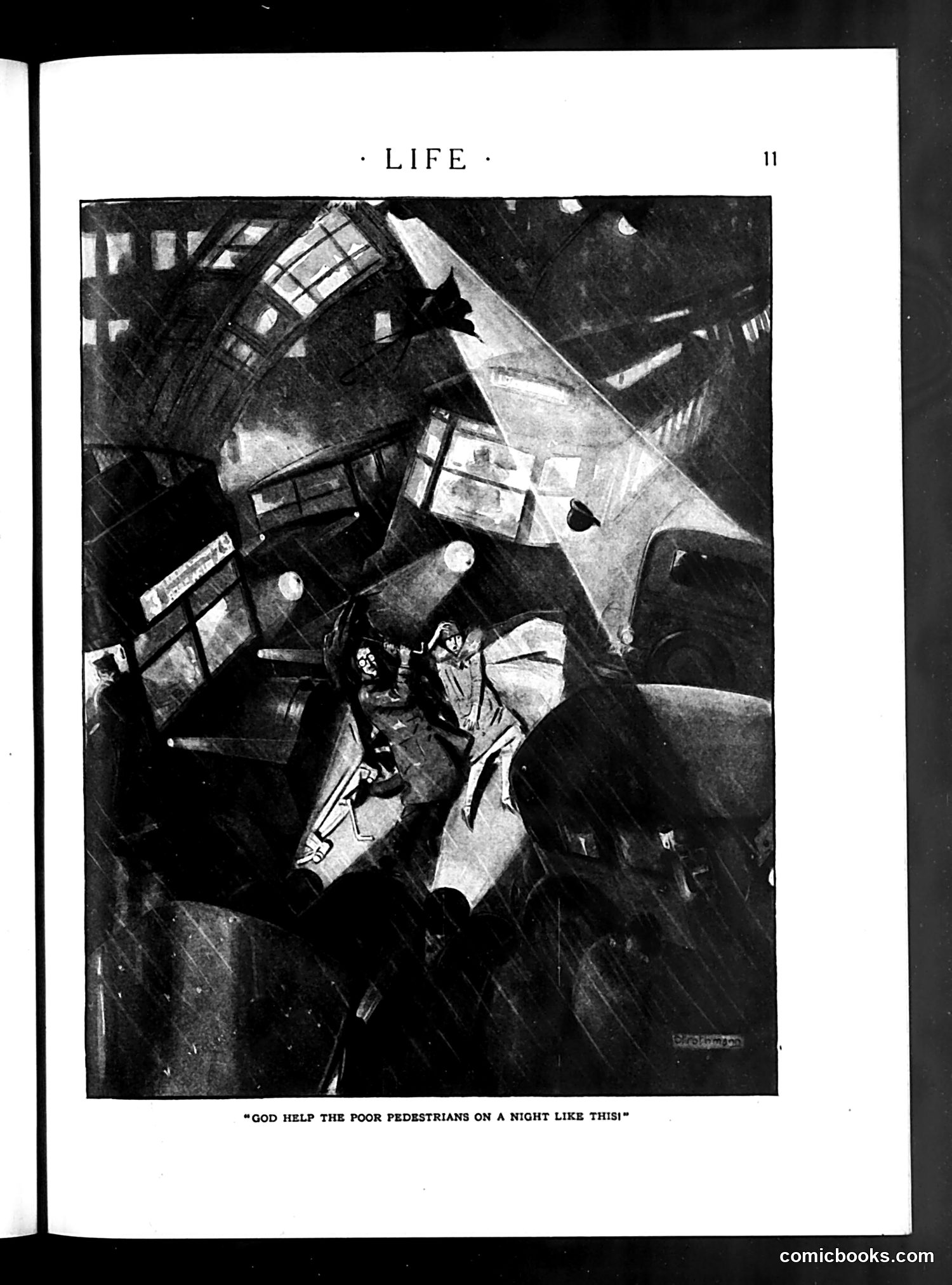
This is a satirical illustration from *Life* magazine showing an overhead view of a nighttime urban street scene with pedestrians and vehicles. The caption reads: "GOD HELP THE POOR PEDESTRIANS ON A NIGHT LIKE THIS!" The image depicts the chaos and danger of city streets at night—likely from the early-to-mid 20th century based on the style. The birds-eye perspective emphasizes the cramped, disorienting nature of urban navigation after dark, with various figures and what appear to be cars or streetcars creating a tangled, hazardous environment. The satire targets urban traffic safety and pedestrian vulnerability during nighttime conditions, when visibility is poor and accidents are more likely. The caption's invocation of divine help suggests the situation is dire or nearly hopeless for ordinary people trying to navigate crowded city streets safely.
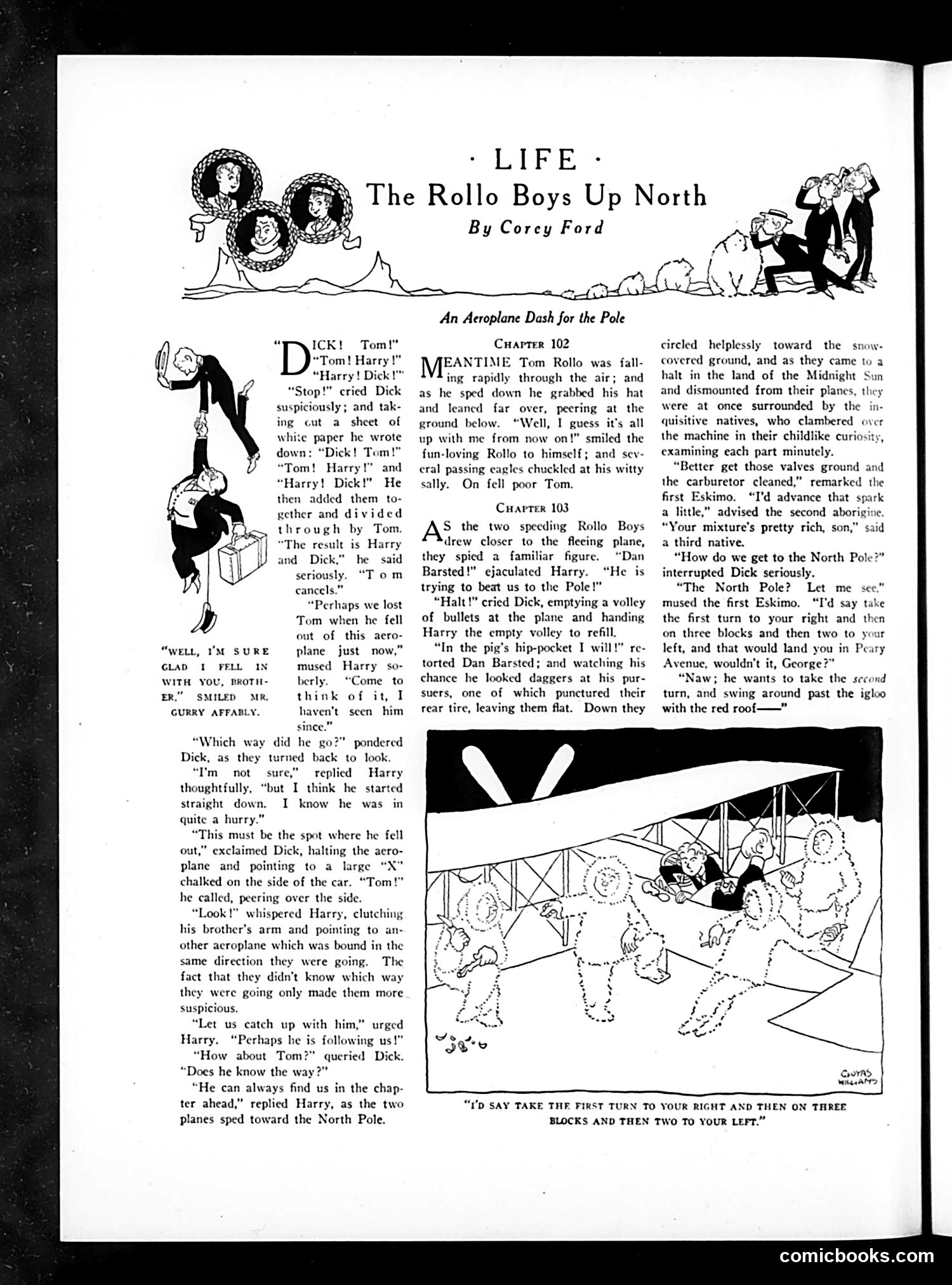
This is a serialized adventure story (Chapters 102-103) featuring characters named Tom, Harry, and Dick in an airplane race to the North Pole. The narrative describes their competitive flight, with one character falling from a plane and the others pursuing to catch up. The accompanying illustration shows the plane landing near what appears to be indigenous people in an Arctic setting, with the caption providing humorous navigation directions: "To say take the first turn to your right and then on three blocks and then two to your left." This appears to be light entertainment fiction rather than political satire—a comedic adventure story typical of *Life* magazine's humor section in this era.
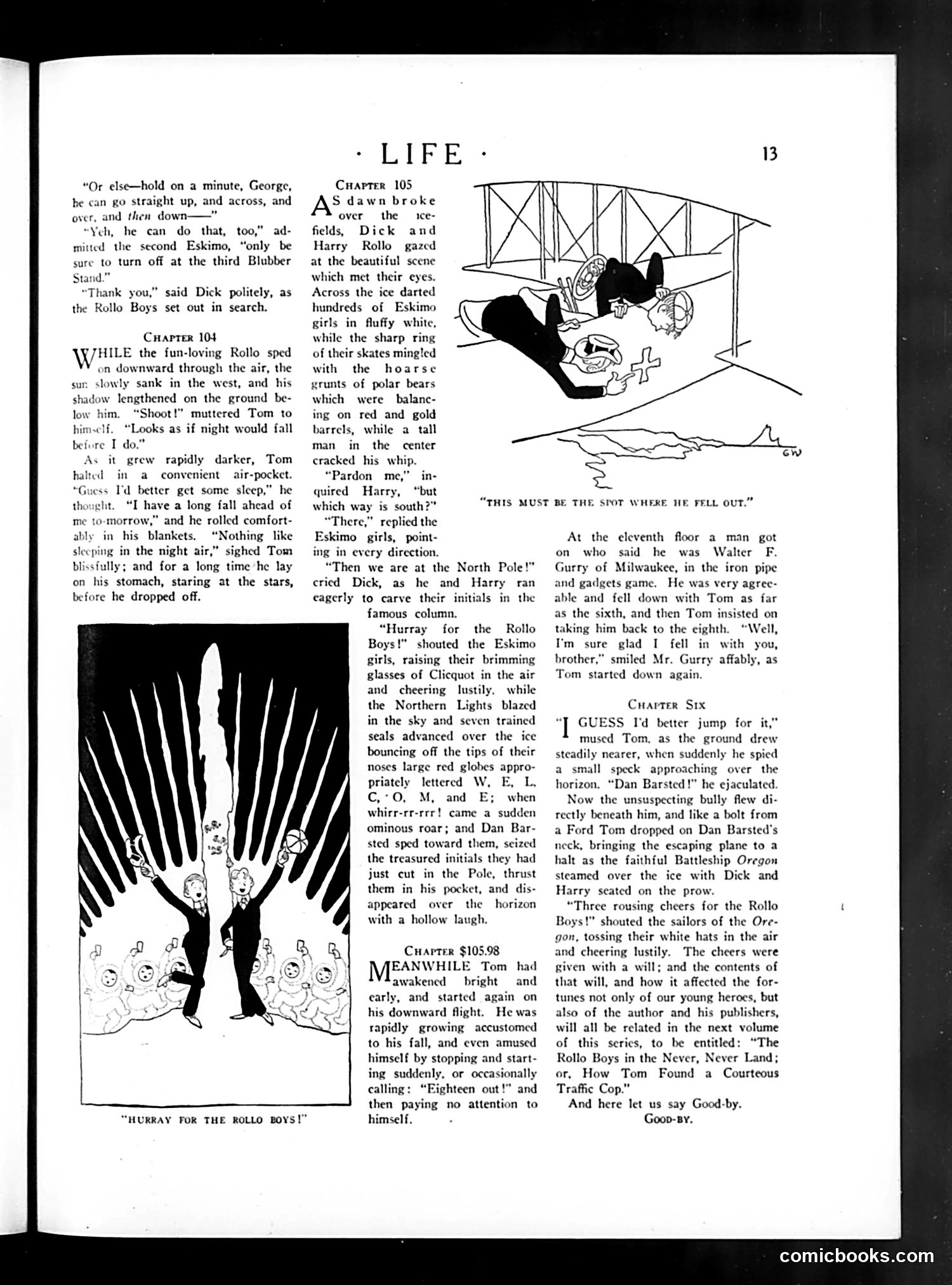
This page contains serialized fiction titled "The Rollo Boys" (chapters 104-106), not political satire. The narrative follows characters named Dick, Harry, and Tom in an Arctic adventure involving Eskimo girls, polar bears, and a dramatic falling sequence. The two illustrations are purely narrative: one depicts characters in an aircraft above ice fields; the other shows a figure falling past what appears to be a structure, with onlookers below—visual accompaniment to the story's action sequences. This is entertainment fiction rather than political commentary. The page demonstrates *Life*'s dual purpose as both a satirical magazine (on other pages) and a venue for serialized adventure stories aimed at general readership.
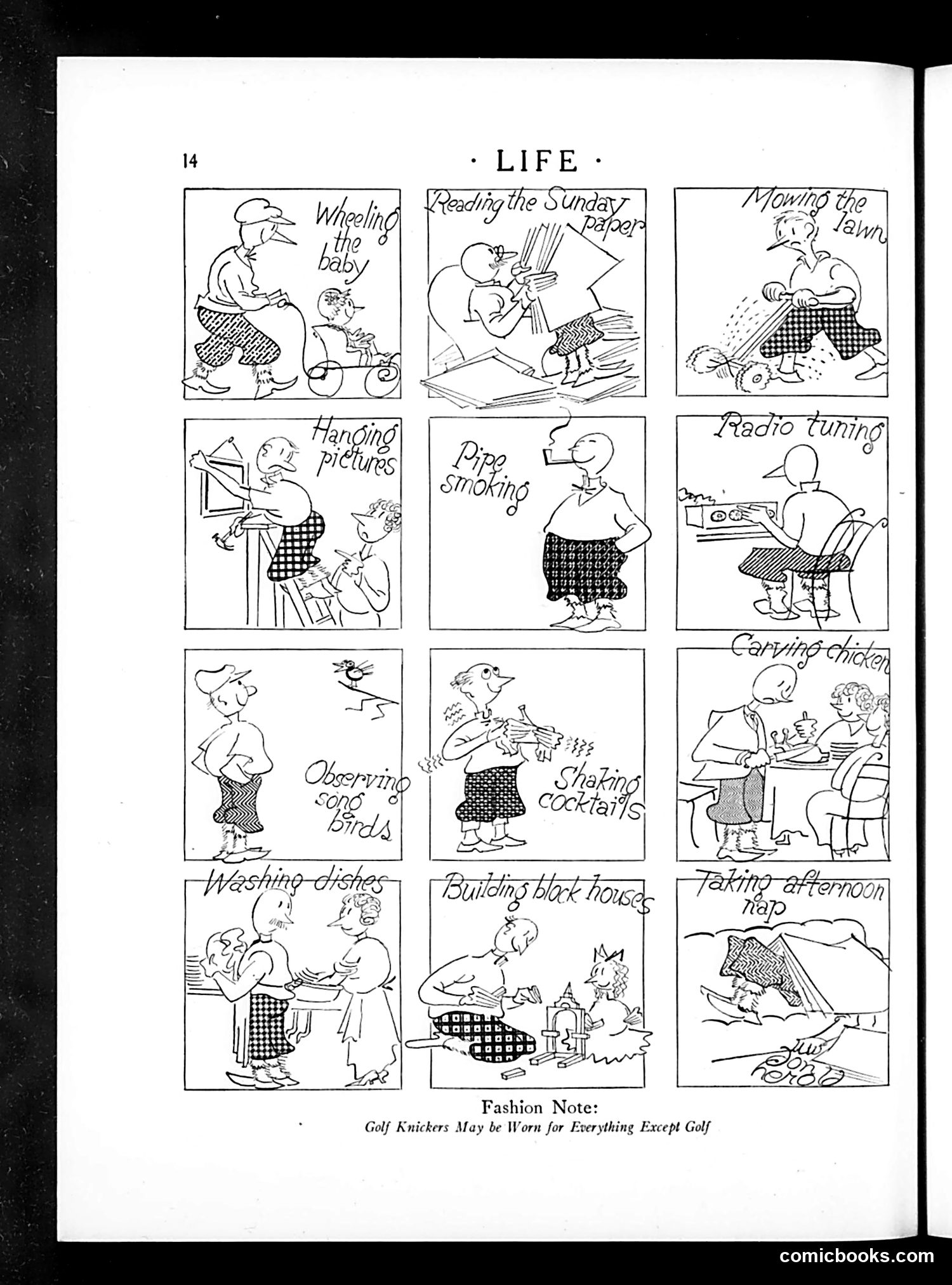
This page presents a comic strip titled "Life" depicting twelve domestic activities, each labeled with humorous titles. The strip satirizes everyday household routines and leisure activities of the period, including: - Traditional domestic tasks (wheeling a baby, reading the Sunday paper, mowing the lawn, hanging pictures, washing dishes) - Leisure pursuits (pipe smoking, radio tuning, observing birds) - Social activities (shaking cocktails, carving chicken, taking afternoon naps) - Child activities (building black houses/castles) The humor derives from exaggerated character expressions and postures during mundane activities. The fashion note at the bottom—"Golf Knickers May Be Worn for Everything Except Golf"—adds ironic commentary on contemporary fashion trends, suggesting women's athletic wear had become acceptable everyday clothing, paradoxically excluding its original purpose.
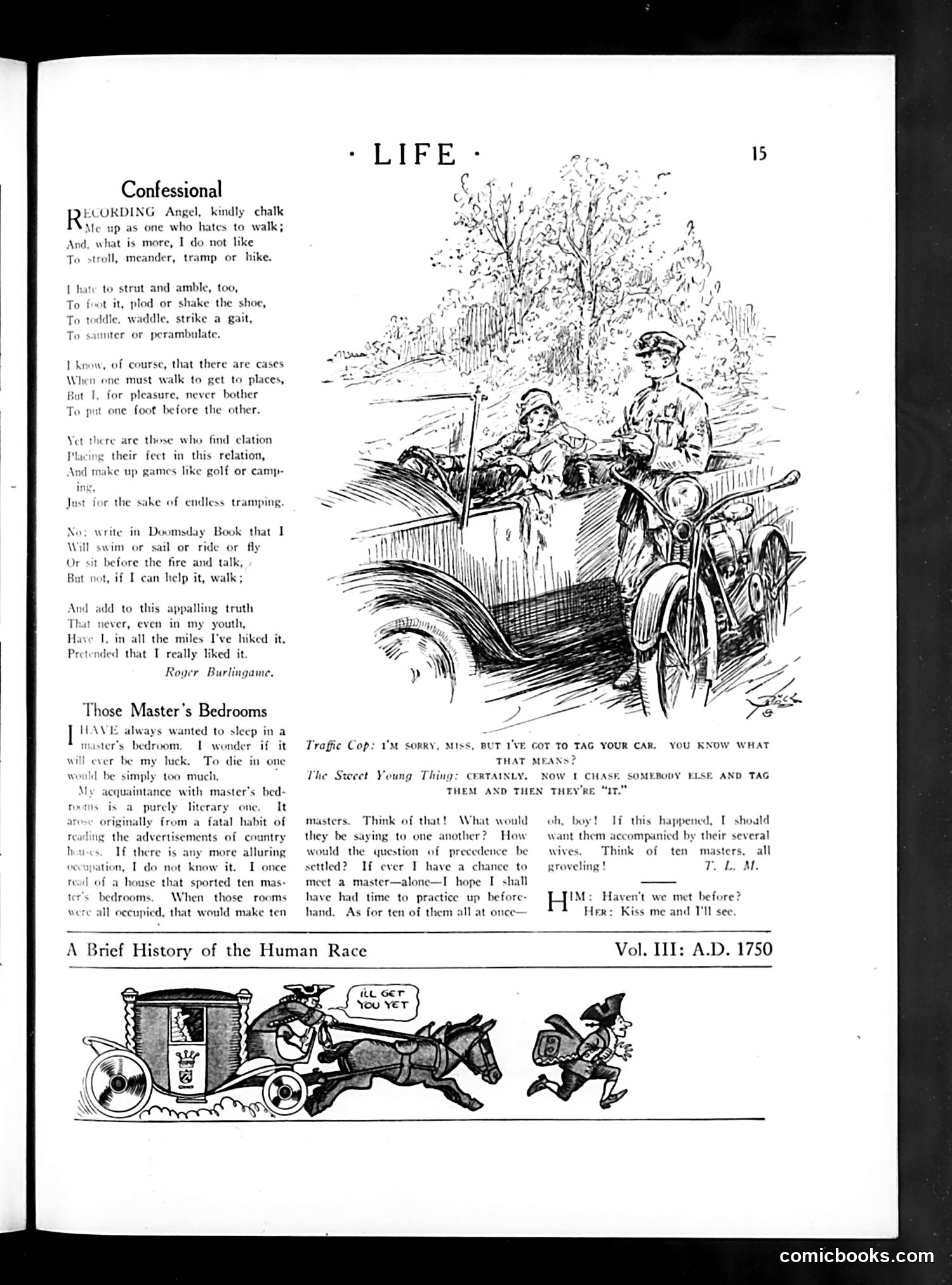
This page contains a humorous poem "Confessional" by Roger Barlinghame critiquing people who dislike walking, followed by a satirical section titled "Those Master's Bedrooms" about servants' aspirations. The main cartoon depicts a traffic stop: a police officer on motorcycle stops a car with passengers, telling the driver "I'm sorry, miss, but I've got to tag your car. You know what that means?" The "Sweet Young Thing" responds by proposing they play a chasing game with someone else's car instead—a flirtatious deflection joke typical of 1920s-era humor about young women evading consequences. The bottom section, "A Brief History of the Human Race Vol. III: A.D. 1750," shows a horse-drawn carriage with "I'LL GET YOU YET" dialogue, appearing to mock historical progress claims through absurdist visual humor.
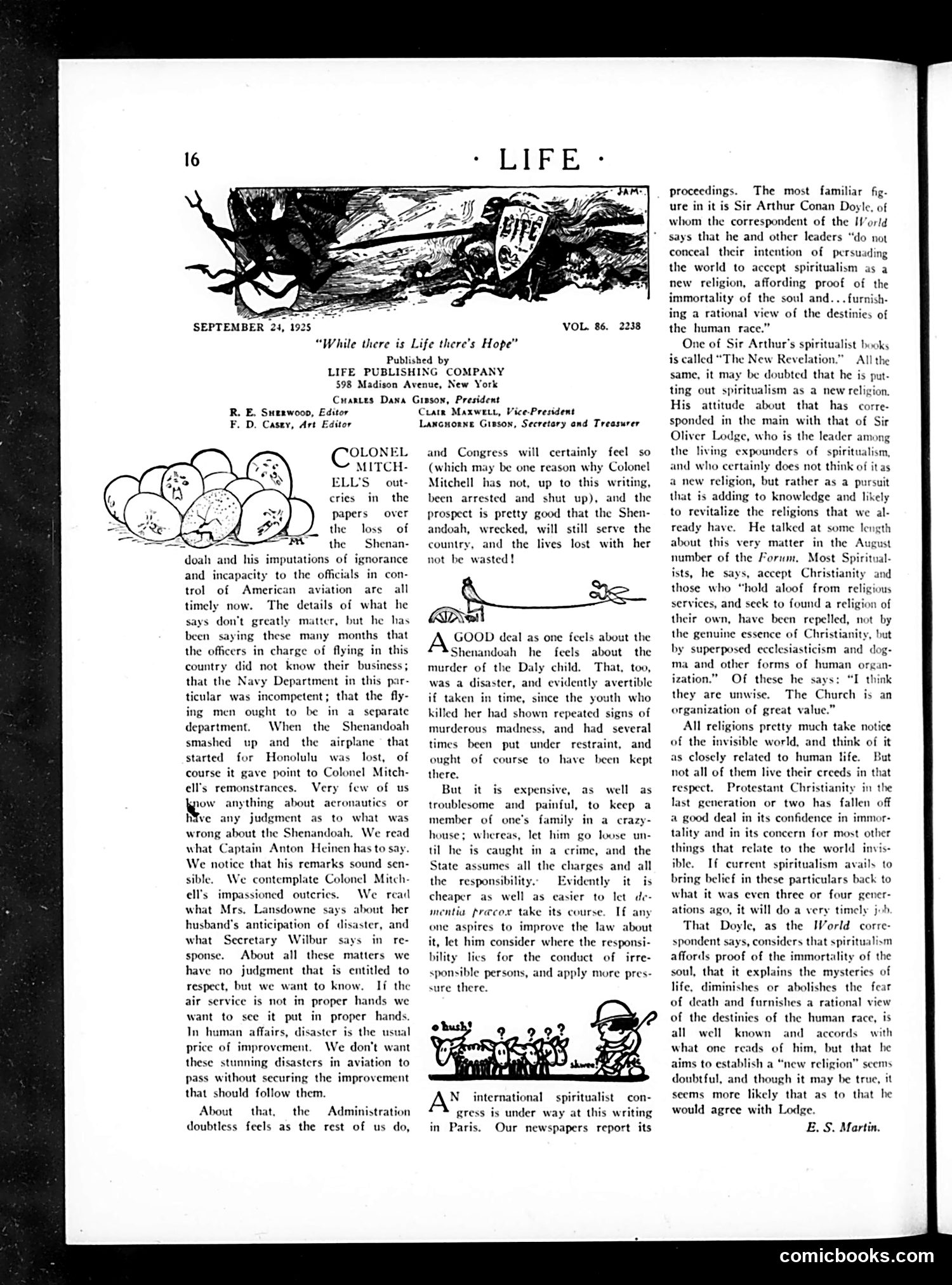
This page discusses **Colonel Mitchell's court-martial** regarding aviation policy disputes. The text criticizes Mitchell's "impassioned outcries" about naval aviation management while acknowledging his concerns had merit. The editorial argues that while Mitchell's complaints deserve attention, his methods—airing grievances publicly—were problematic. It notes the Navy Department should have been reorganized separately, and suggests Mitchell's case demonstrates the need for legal reforms protecting whistleblowers from retaliation. A secondary item discusses **spiritualism**, mentioning Sir Arthur Conan Doyle and international spiritualist conferences in Paris. The editorial skeptically examines spiritualism as a "new religion," questioning whether it truly offers rational explanations for human destiny versus traditional Christianity.
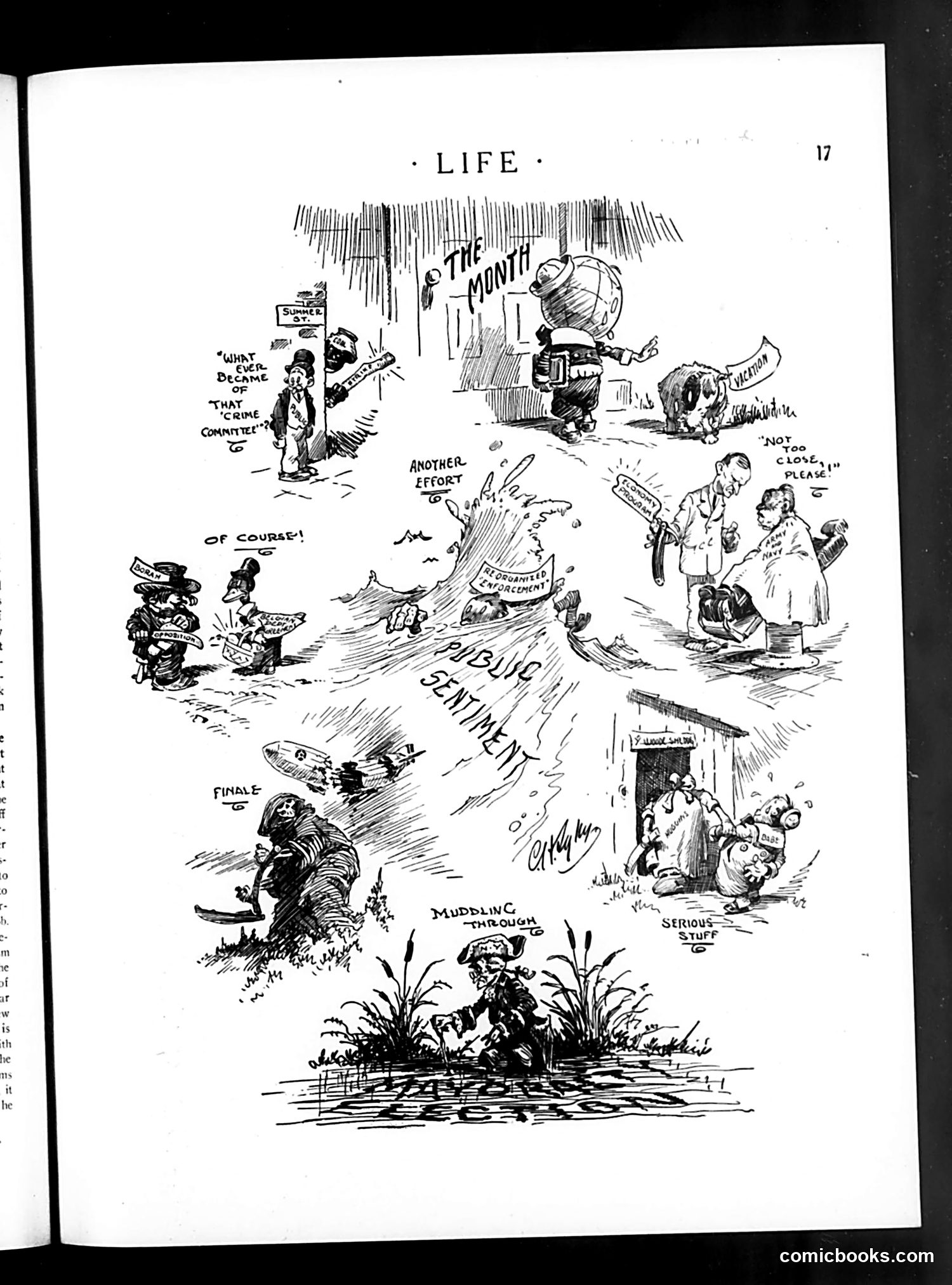
This is a satirical cartoon sequence depicting various stages of what appears to be a summer political campaign or initiative. The cartoon shows: - A politician or official ("What does the committee?") dealing with summer heat - References to "Month" activities and public sentiment ("Not too close, please") - A "Dying Sentiment" flowing downward, suggesting waning public support - Various scenes labeled "Another Effort," "Serious Stuff," and "Muddling Through" - A final scene showing someone "Muddling Through" literally stuck in mud/water The satire critiques political campaigns that lose momentum during summer months, with officials making failed attempts to maintain public interest while support gradually diminishes. The visual metaphor of drowning/sinking in mud emphasizes the futility of these efforts.
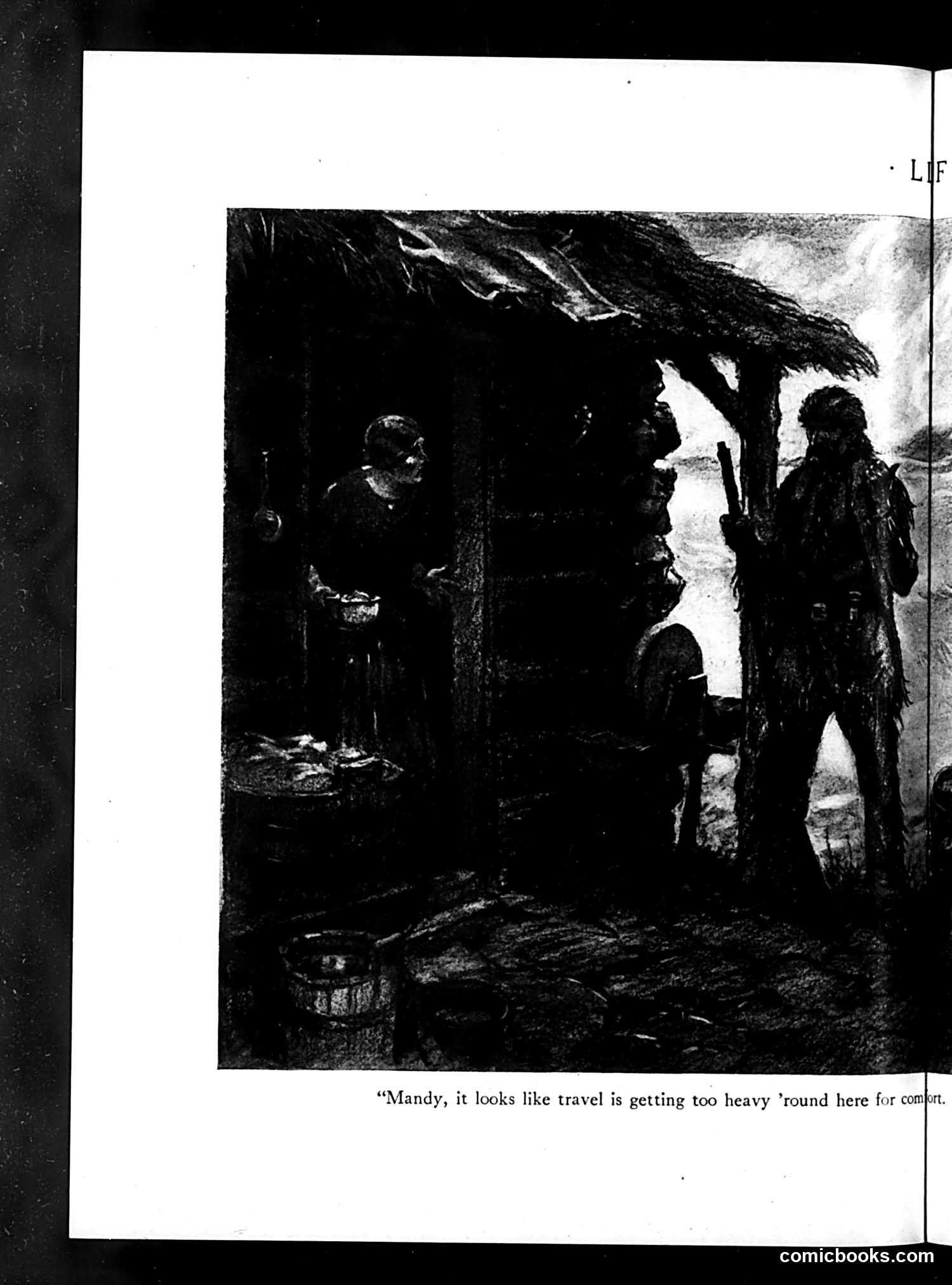
This appears to be a domestic scene from a Life magazine comic or illustration. The caption suggests a character named "Mandy" is commenting on travel becoming burdensome or uncomfortable in their area—though the OCR text is incomplete ("comport" seems cut off, possibly "comfort"). The black and white illustration shows figures in what appears to be a rustic or modest interior setting with a thatched roof. Without additional context about the publication date or surrounding articles, the specific satirical target remains unclear. The humor likely relies on period-specific references to travel conditions, local circumstances, or social commentary that would have been recognizable to Life's contemporary readers but requires historical context to fully decode.
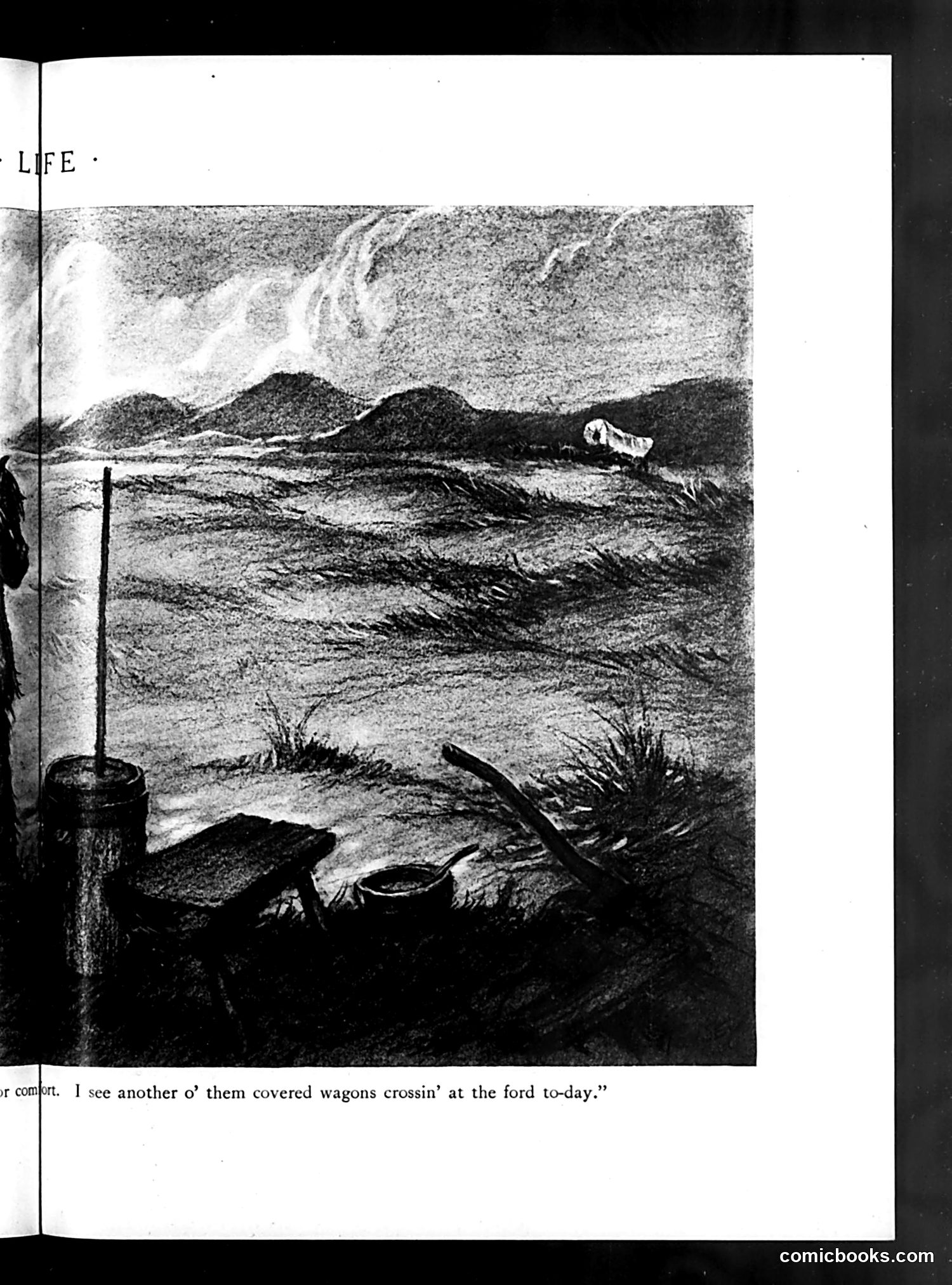
This page shows an illustration depicting frontier/pioneer life, featuring a campsite with cooking implements in the foreground and covered wagons visible crossing a ford in the distance. The accompanying text is a spoken line referencing "covered wagons crossing at the ford." The content appears to reference **westward expansion and pioneer migration** during America's settlement era. The illustration romanticizes frontier life through a nostalgic, artistic rendering of a campsite scene. Without additional context or visible attribution, the specific satirical point remains unclear. It may be commentary on continuous westward migration, frontier life nostalgia, or possibly something topical to *Life* magazine's publication date—but the image alone doesn't reveal the intended joke or social critique. The page heading "LIFE" suggests this is editorial or illustrative content rather than advertisement.
This page reviews "Outside Looking In," a play adapted by Maxwell Anderson from Jim Tully's memoir "Beggars of Life." The piece defends the play against anticipated moral objections from prudish readers. The satire targets genteel audiences who object to realistic portrayals of working-class "unsavory characters"—here, hobos and tramps. Life's editors mockingly warn complainers not to bother writing letters: they won't listen. The reference to "the world really is round and revolves around the sun" sarcastically suggests that accepting life's harsh realities (like poverty and tramping) should be as established as basic science. The review praises the casting of Charles Bickford and James Cagney in lead roles, calling Bickford's performance "the first important one of the year." The underlying point: honest art about real people matters more than bourgeois comfort.
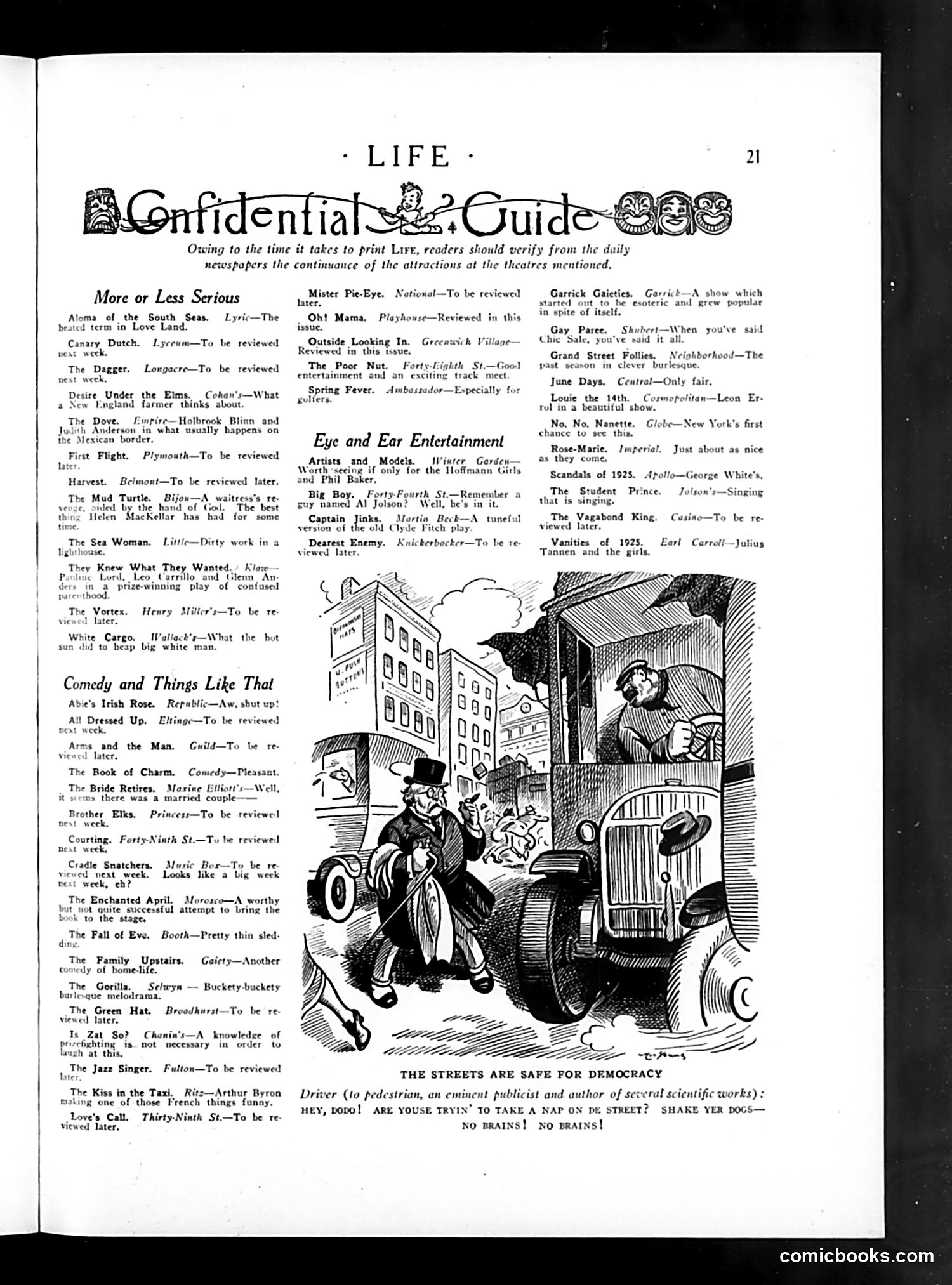
This single-panel cartoon satirizes reckless driving and urban safety in 1920s America. The image shows a driver in an old automobile nearly hitting a well-dressed pedestrian (identified in the caption as "an eminent publicist and author of several scientific works"). The driver's crude dialogue—"HEY, BOZO! ARE YOUSE TRYIN' TO TAKE A NAP ON DE STREET? SHAKE YER DOGS—NO BRAINS! NO BRAINS!"—employs working-class slang and insults the pedestrian's intelligence while being himself the reckless one. The bitter irony is the title: "The Streets Are Safe for Democracy." The joke suggests that in 1920s America, with all its talk of democracy and progress, the streets are actually quite *unsafe*—controlled by aggressive, uneducated drivers who endanger even educated citizens. It's social commentary on how technological progress (automobiles) has outpaced civic responsibility, and how working-class aggression trumps intellectual authority in public spaces.
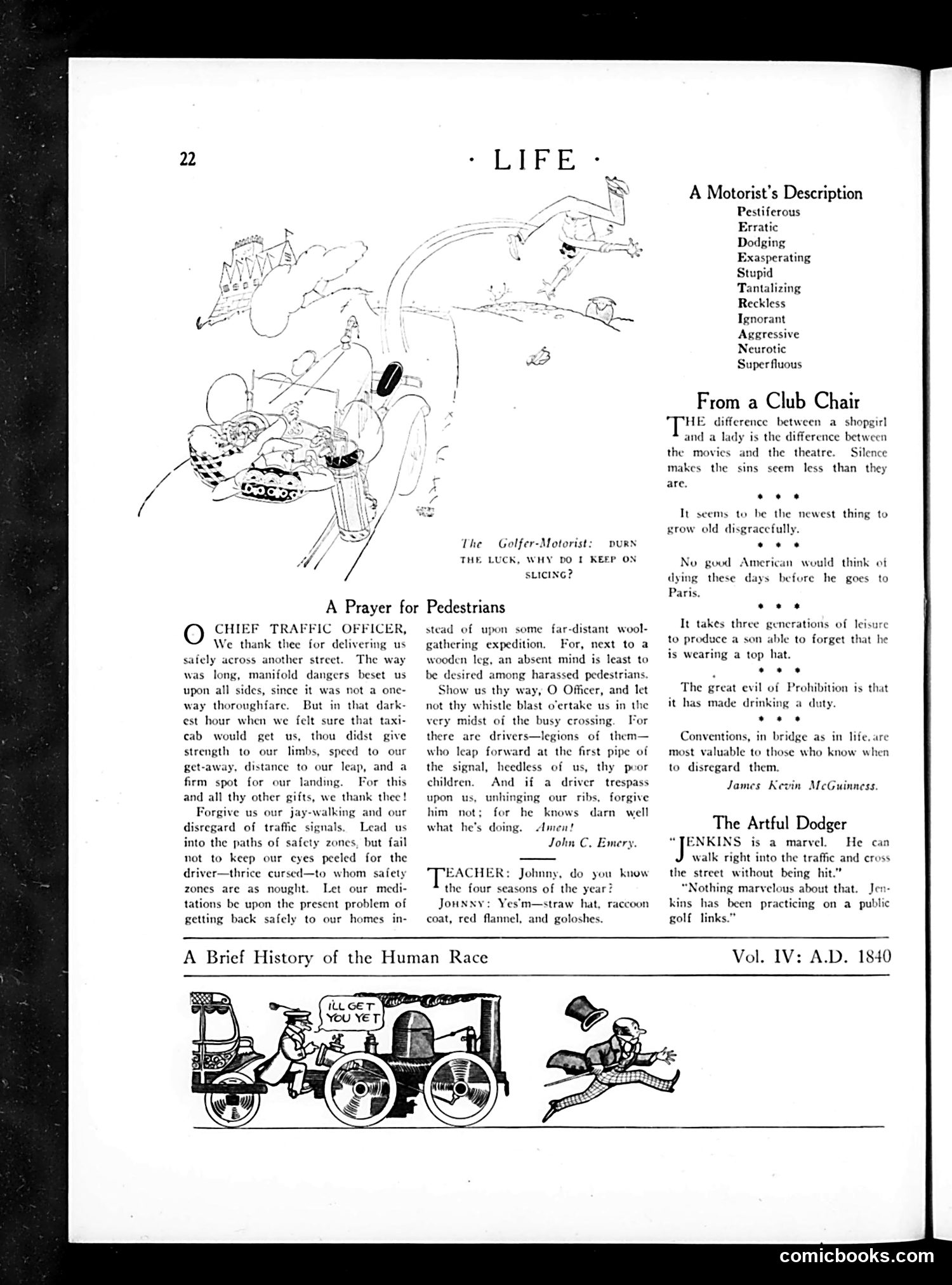
This satirical page mocks early automotive culture and pedestrian dangers. The top cartoon shows a golfer-motorist complaining about his slice—a joke about distracted driving, suggesting motorists are so absorbed in golf they can't focus on the road. "A Prayer for Pedestrians" parodies religious liturgy to express genuine anxiety about traffic dangers. The mock-prayer treats crossing streets as life-threatening ordeals requiring divine intervention, reflecting real concerns about reckless drivers who ignore pedestrians and traffic signals. The "Motorist's Description" list humorously catalogs pedestrians as nuisances from drivers' perspectives, inverting the typical complaint that motorists endanger pedestrians. "The Artful Dodger" anecdote jokes that Jenkins practices dodging traffic on golf links—implying both that golf courses are safer than city streets and that pedestrian navigation requires athletic skill. The brief "History" cartoon (undated but labeled 1840) appears to satirize technological progress, though details are unclear. Overall, the page reflects 1920s anxiety about automobiles as dangerous, disruptive urban forces.
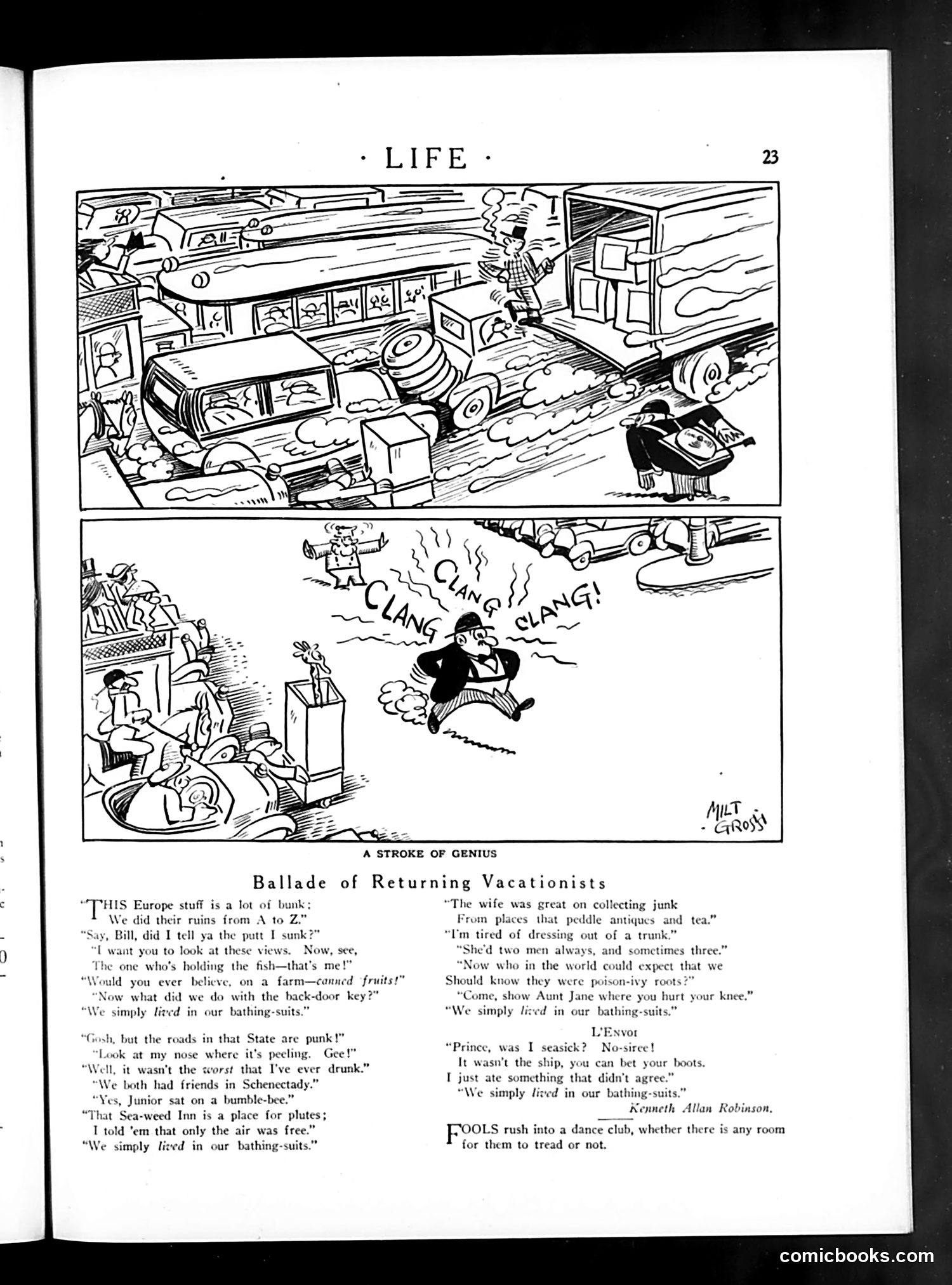
This page satirizes returning American vacationers of the early 20th century through two visual jokes and a poem. **The cartoon** (top) shows chaotic scenes of tourists arriving back home with excessive luggage, souvenirs, and belongings crammed everywhere—a visual joke about overconsumption and poor packing. **The "Ballade of Returning Vacationists"** is a humorous poem mocking tourists who endlessly brag about their trips while contradicting themselves. The recurring refrain "We simply lived in our bathing-suits" becomes ironic—they claim simple living yet complain about roads, collect junk antiques, get seasick, and have various mishaps (poison ivy, sunburn). The poem ridicules their pretentious storytelling and the gap between their vacation fantasy and reality. **The social satire** targets the newly wealthy middle class of the era who could afford European tours and vacations, portraying them as materialistic, tactless bores obsessed with souvenirs and one-upmanship. The joke is that despite vacationing sophisticatedly abroad, they remain fundamentally provincial and self-absorbed.
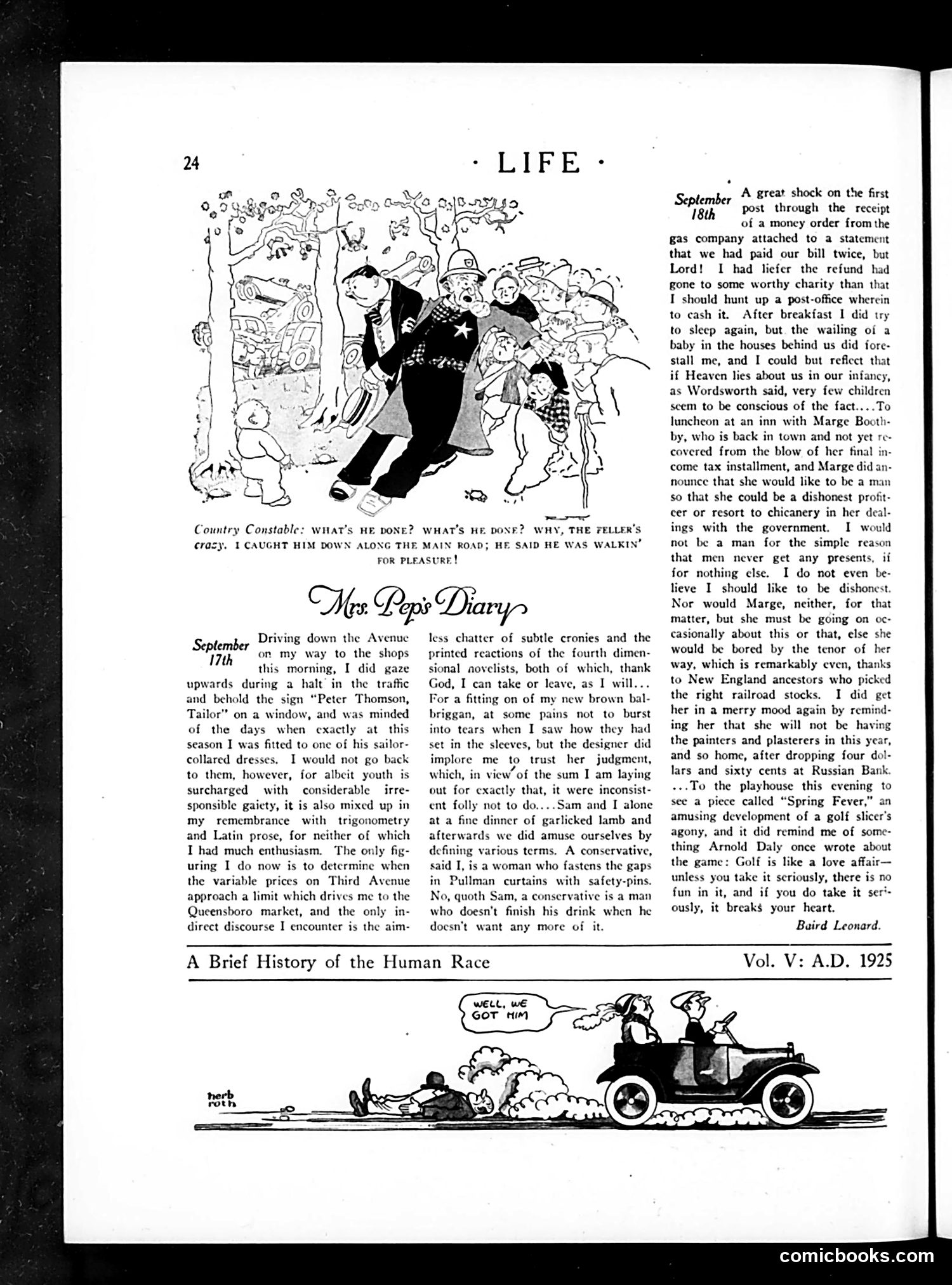
**Top Cartoon:** A country constable has arrested a man for walking "for pleasure" along a country road. The joke satirizes rural attitudes toward leisure—the constable finds recreational walking so suspicious that he deems the man "crazy." This mocks both rural conformity and the growing urban/rural cultural divide of the 1920s. **Main Content:** "Mrs. Pep's Diary" is a humorous daily journal by Baird Leonard documenting mundane middle-class life: shopping, tailors, dinner conversations, and theater-going. The entries satirize contemporary concerns (inflation, tax refunds, women's rights) through witty observation. One entry quotes a definition: a conservative is "a woman who fastens the gaps in Pullman curtains with safety-pins"—poking fun at the sexually repressive culture of the era. **Bottom Cartoon:** Shows a motorist passing a pedestrian with the caption "Well, we got him"—likely commenting on the automobile's triumph over walking in modern society, complementing the top cartoon's theme about walking. The page reflects 1920s anxieties about modernization, gender roles, and changing social values.
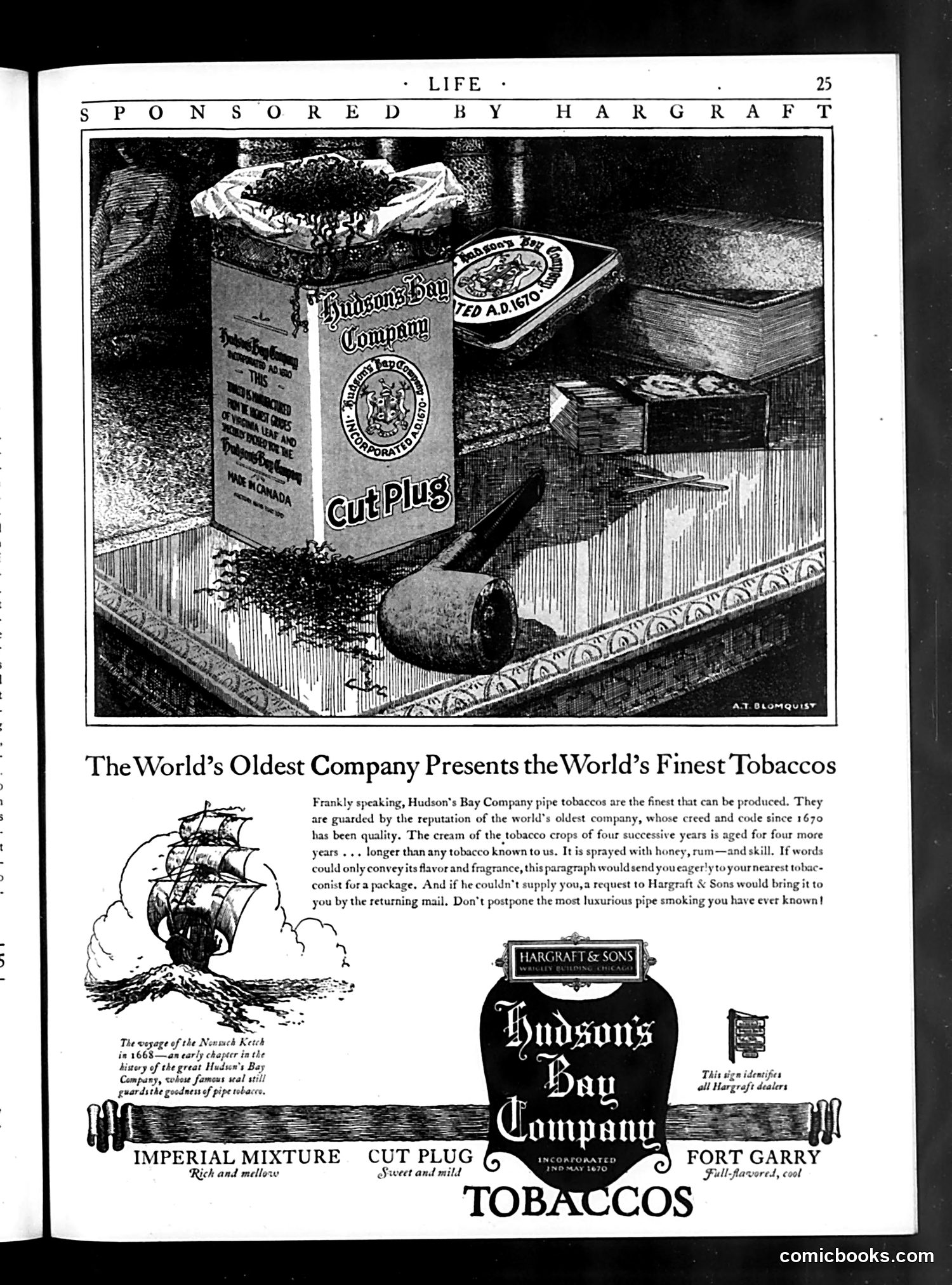
This is a **tobacco advertisement**, not a cartoon or satire. It promotes Hudson's Bay Company pipe tobacco through Hargraft & Sons. The ad uses the company's historical prestige as its selling point: Hudson's Bay Company, founded in 1670, is described as "the world's oldest company" whose reputation guarantees quality. The engraving of the Nonsuch ship references the company's 1668 origins in the fur trade. The advertisement claims their tobacco is aged longer than competitors, sprayed with honey and rum, and available in three varieties: Imperial Mixture, Cut Plug, and Fort Garry. For modern readers: this reflects early 20th-century advertising that unabashedly promoted smoking as "luxurious" without health warnings. The appeal to historical tradition and craftsmanship—aging tobacco for years—mirrors modern premium product marketing, though the product itself (pipe tobacco) is now largely obsolete.
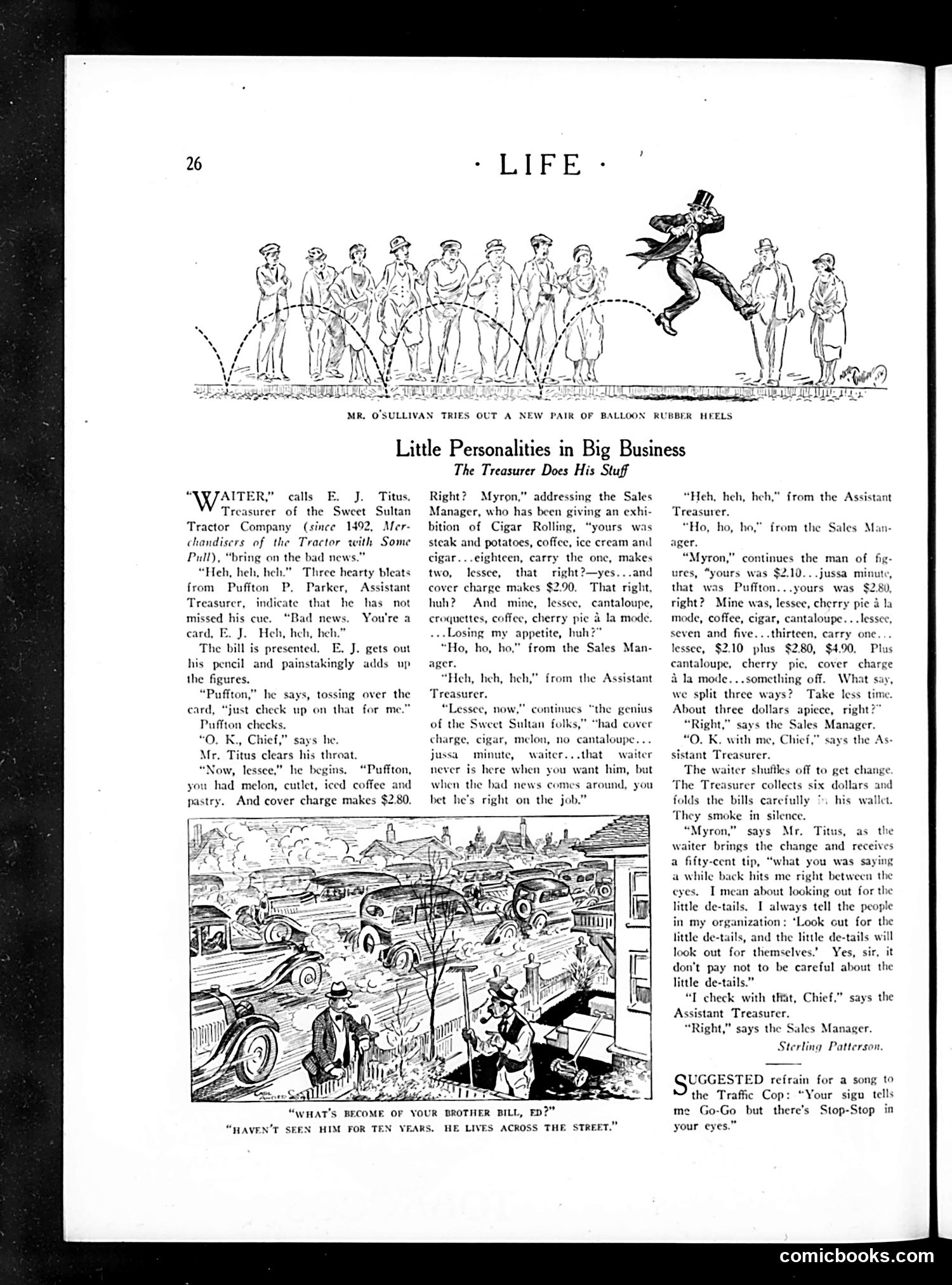
This satirical piece mocks the pretensions of mid-level corporate executives. E.J. Titus, treasurer of the "Sweet Sultan Tractor Company," orchestrates an elaborate restaurant bill-splitting ritual with subordinates Puffton Parker (Assistant Treasurer) and Myron (Sales Manager). The satire targets how these men perform false camaraderie through forced laughter ("Heh, heh, heh" and "Ho, ho, ho") while obsessively calculating a simple bill—revealing their actual concern is nickel-and-diming rather than genuine fellowship. Titus pedantically recalculates each person's share multiple times, then proposes splitting three ways to save effort, undermining his pretense of careful attention to detail. The humor lies in exposing the gap between how corporate managers see themselves (serious, detail-oriented professionals) and their actual pettiness. The concluding moral about watching "little de-tails" appears self-aware yet completely sincere—the characters remain oblivious to their own absurdity. The illustration above shows a man jumping over a crowd, titled "O'Sullivan Tries Out a New Pair of Balloon Rubber Heels"—a separate, unrelated visual gag about novelty footwear.
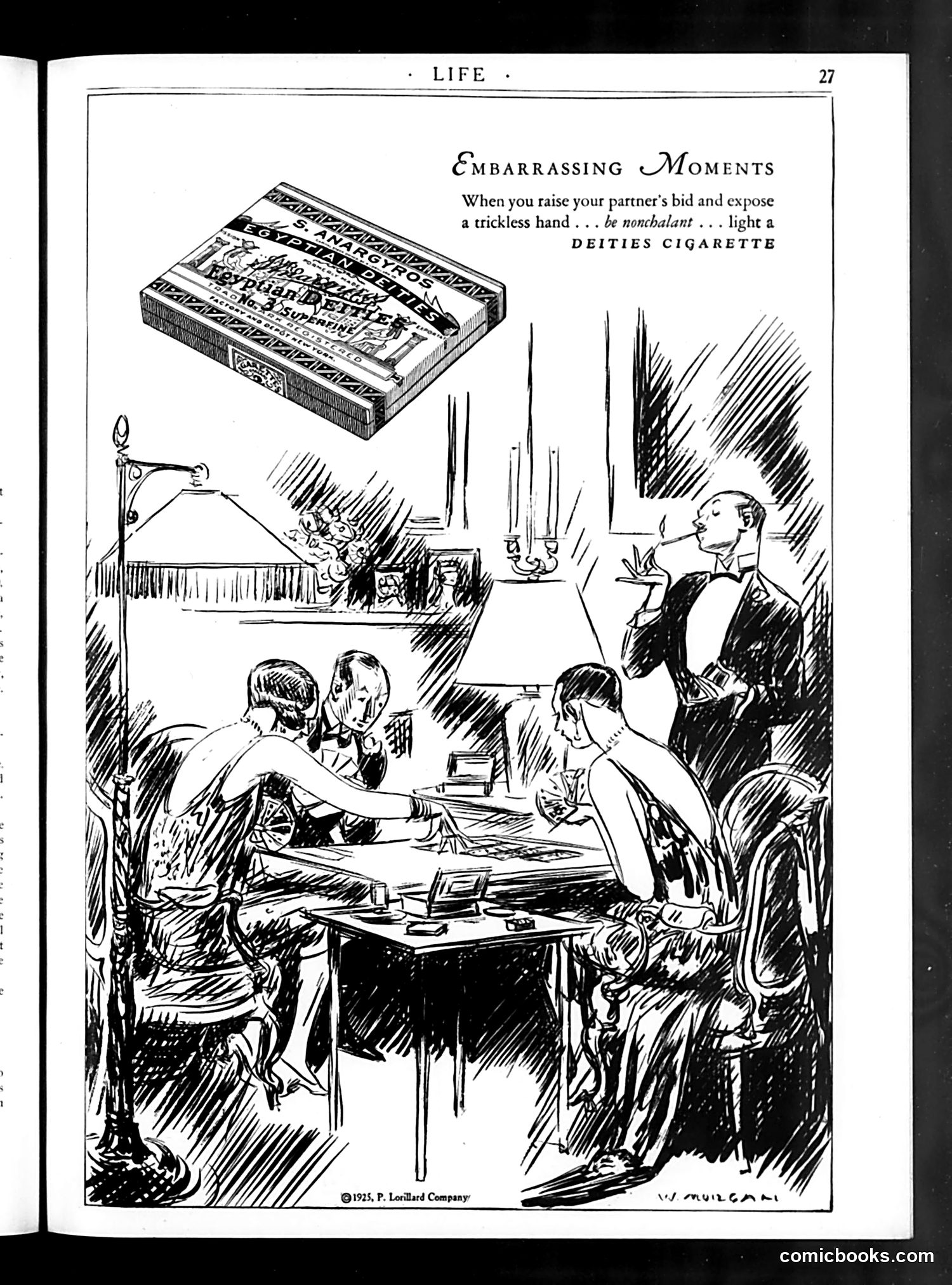
This is an advertisement disguised as humor, promoting Deities cigarettes. The cartoon depicts a bridge card game where one player has made a social blunder—raising their partner's bid despite holding a weak hand ("trickless"), which would cause the partnership to lose points. The satirical advice: if caught in this embarrassing moment at the card table, maintain composure by casually lighting a cigarette. The implication is that Deities cigarettes provide the sophisticated nonchalance needed to recover from social missteps among the upper-class card-playing set. The 1925 date places this in the Jazz Age, when bridge was a popular parlor game among the wealthy, and cigarette smoking was an accepted (even glamorous) social gesture. The humor relies on knowing bridge rules and the social anxiety of making public mistakes in polite company.
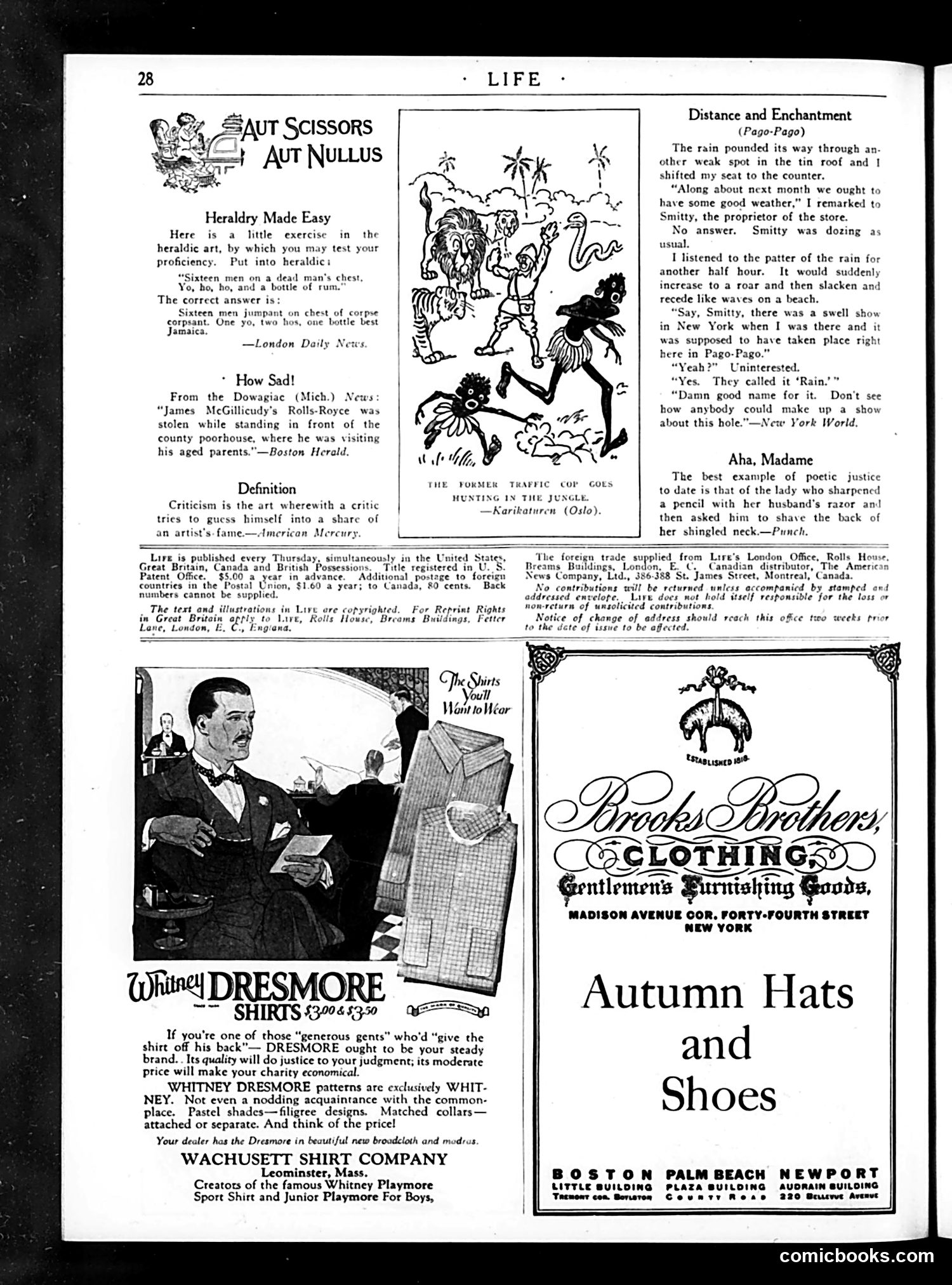
This page from *Life* magazine contains several short humorous pieces and advertisements, typical of the publication's satirical format. **"Heraldry Made Easy"** is a wordplay joke converting the pirate verse "Sixteen Men on a Dead Man's Chest" into mock-heraldic language—a parody of formal heraldic descriptions. **"How Sad!"** offers ironic social commentary: a wealthy man (owning a Rolls-Royce) visiting poor parents at a county poorhouse has his car stolen—the contrast between his apparent wealth and family poverty is the joke's point. **"The Former Traffic Cop Goes Hunting"** (cartoon) shows what appears to be a former police officer now hunting in a jungle setting, likely satirizing career changes or unemployment (context unclear without more information). **"Distance and Enchantment"** is a prose anecdote set in Pago-Pago about a man bored by tropical island life, commenting on how a theatrical production called "Rain" was supposedly set there—mocking the romanticization of exotic locations versus their mundane reality. **"Aha, Madame"** is a brief joke about poetic justice involving a woman who damaged her husband's razor. The page is primarily **advertising** for shirts, clothing, and shoes.
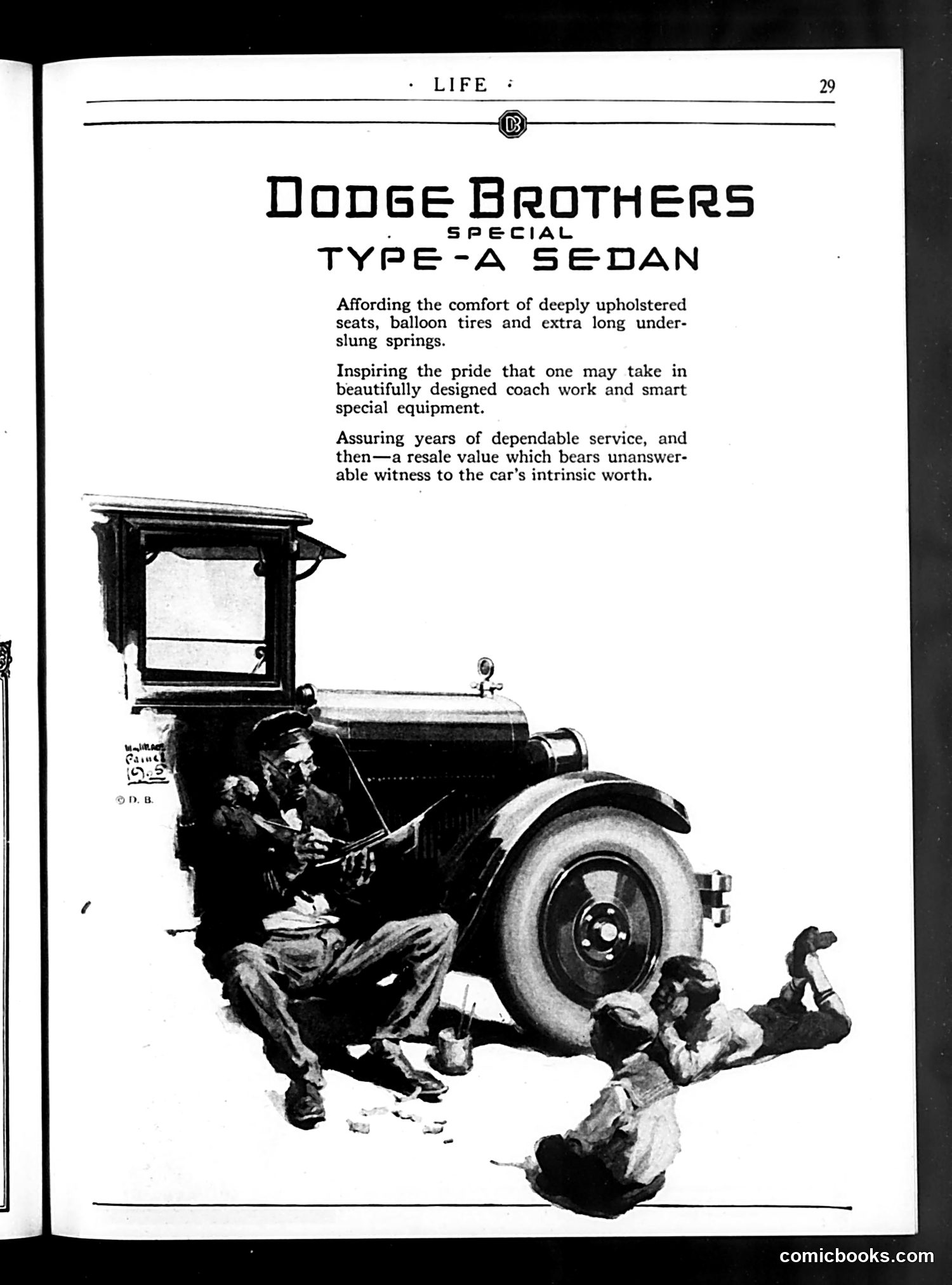
This is a **Dodge Brothers automobile advertisement**, not political satire. The page promotes the "Type-A Sedan" by highlighting its features: upholstered seats, balloon tires, underslung springs, attractive design, durability, and strong resale value. The illustration shows a man in a car surrounded by children, suggesting family reliability and trustworthiness. The ad copy emphasizes comfort, pride of ownership, and long-term value—typical marketing language for 1920s automobiles. This represents early automotive advertising in *Life* magazine, when cars were still relatively new luxuries and manufacturers marketed them as status symbols and practical investments rather than mere transportation.
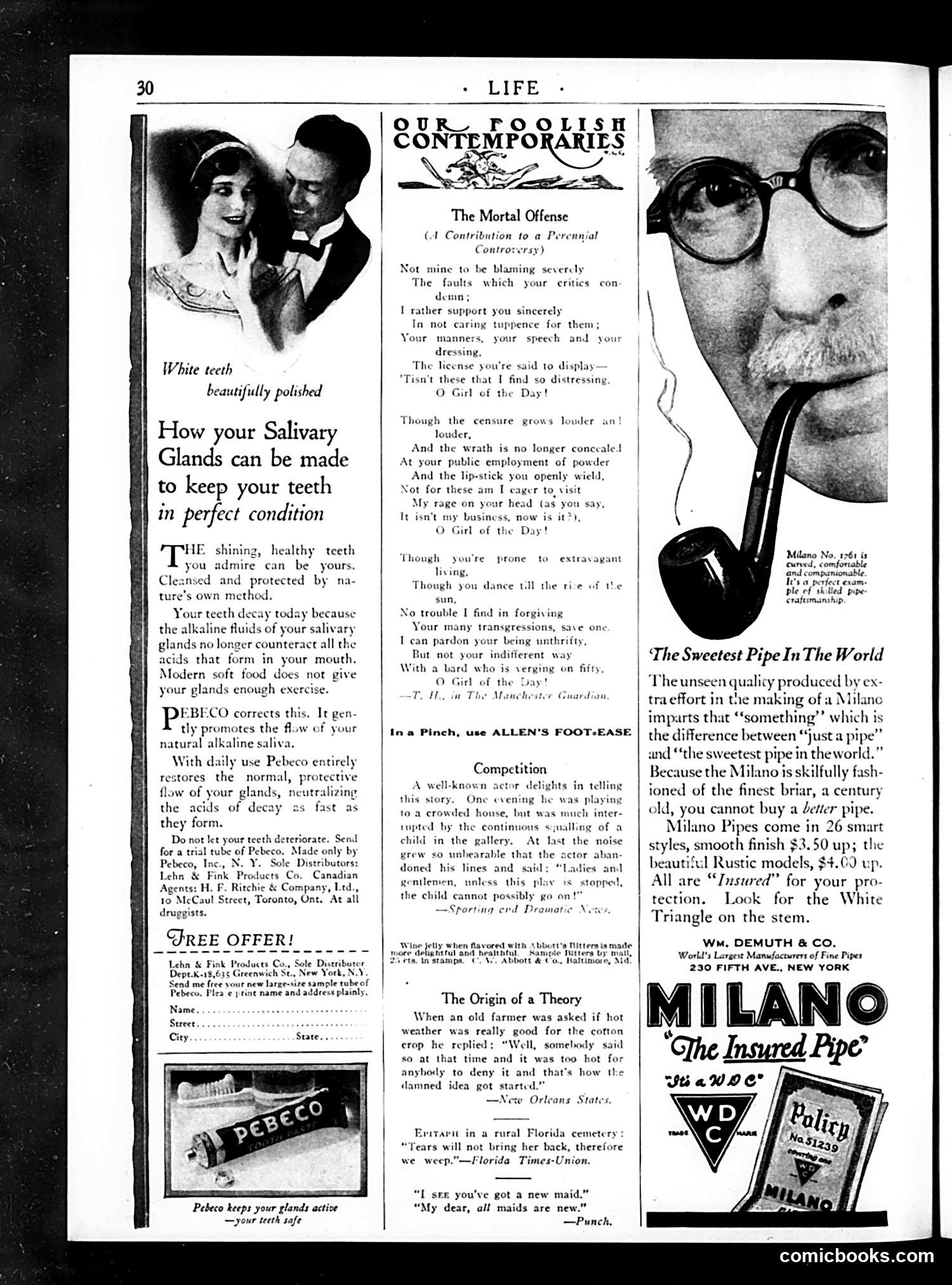
This page is predominantly **advertisements** with minimal satirical content. The main editorial piece is a poem titled "The Mortal Offense" — a humorous complaint about modern young women ("Girls of the Day"). The poet claims he doesn't mind their use of powder and lipstick, their extravagance, or late-night dancing, but rather resents their indifference toward aging men (specifically those "verging on fifty"). It's gentle social satire about generational disconnect and romantic disappointment, typical of 1920s humor about "modern" women's independence. The remaining content consists entirely of product advertisements: Pebeco toothpaste (promoting salivary gland health), Debeco dental product, Allen's Foot-Ease, and Milano pipes. There are also brief humorous anecdotes about an actor interrupted by a crying child and a farmer's theory about cotton crops. No political cartoons or caricatures appear on this page.
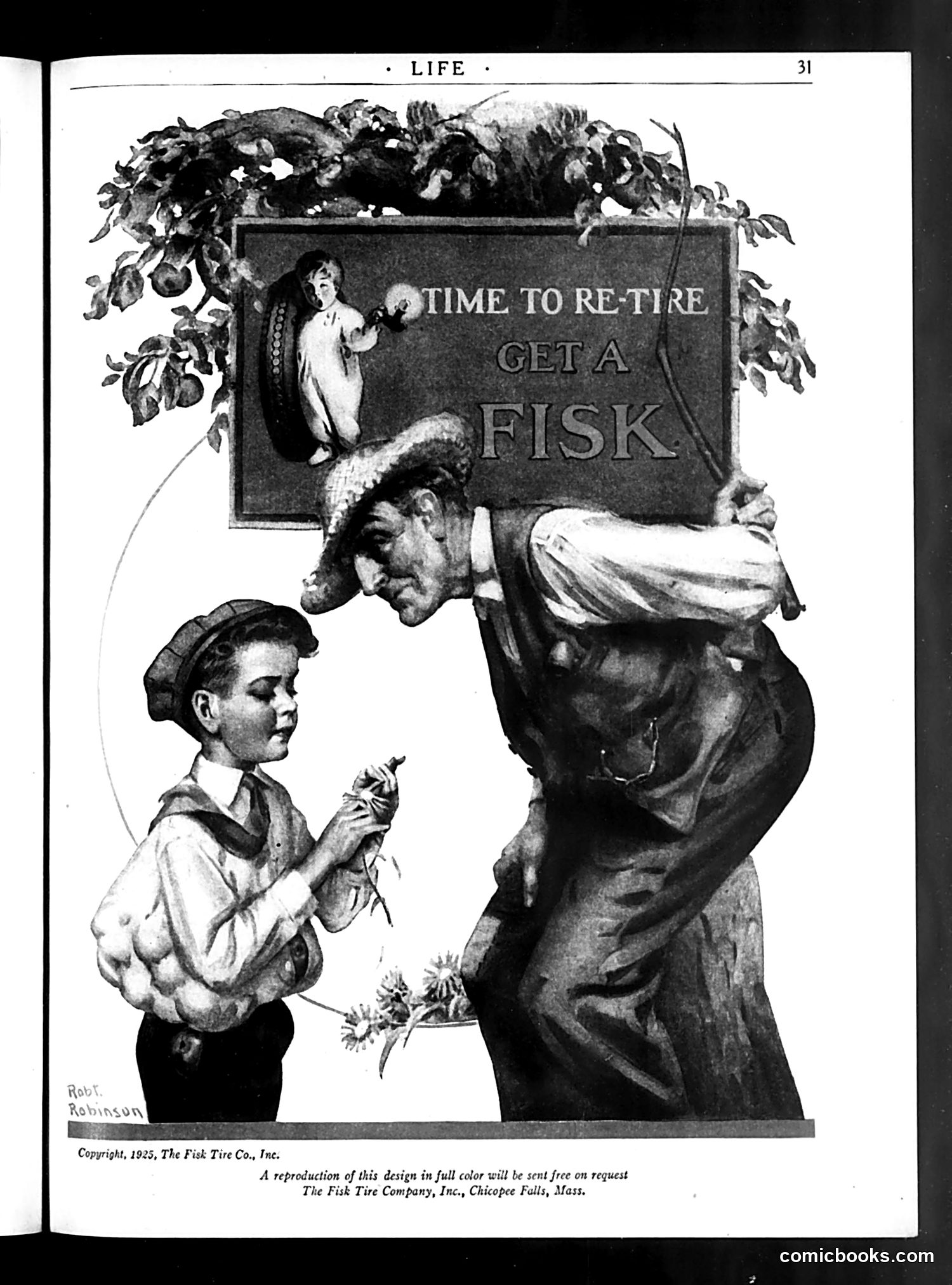
This is a 1925 advertisement for Fisk Tire Company. The cartoon depicts an elderly man holding a sign reading "TIME TO RE-TIRE / GET A FISK," with a young boy beside him holding fishing gear. The visual pun conflates "re-tire" (replace your worn tires) with "retire" (stop working). The old man's tired appearance and the phrase suggest he's worn out—like an old tire—and should rest. The boy and fishing equipment reinforce the retirement leisure theme. This represents vintage American advertising humor, using wordplay and visual metaphor to promote automobile tires during the early automotive era when tire replacement was a regular consumer concern.
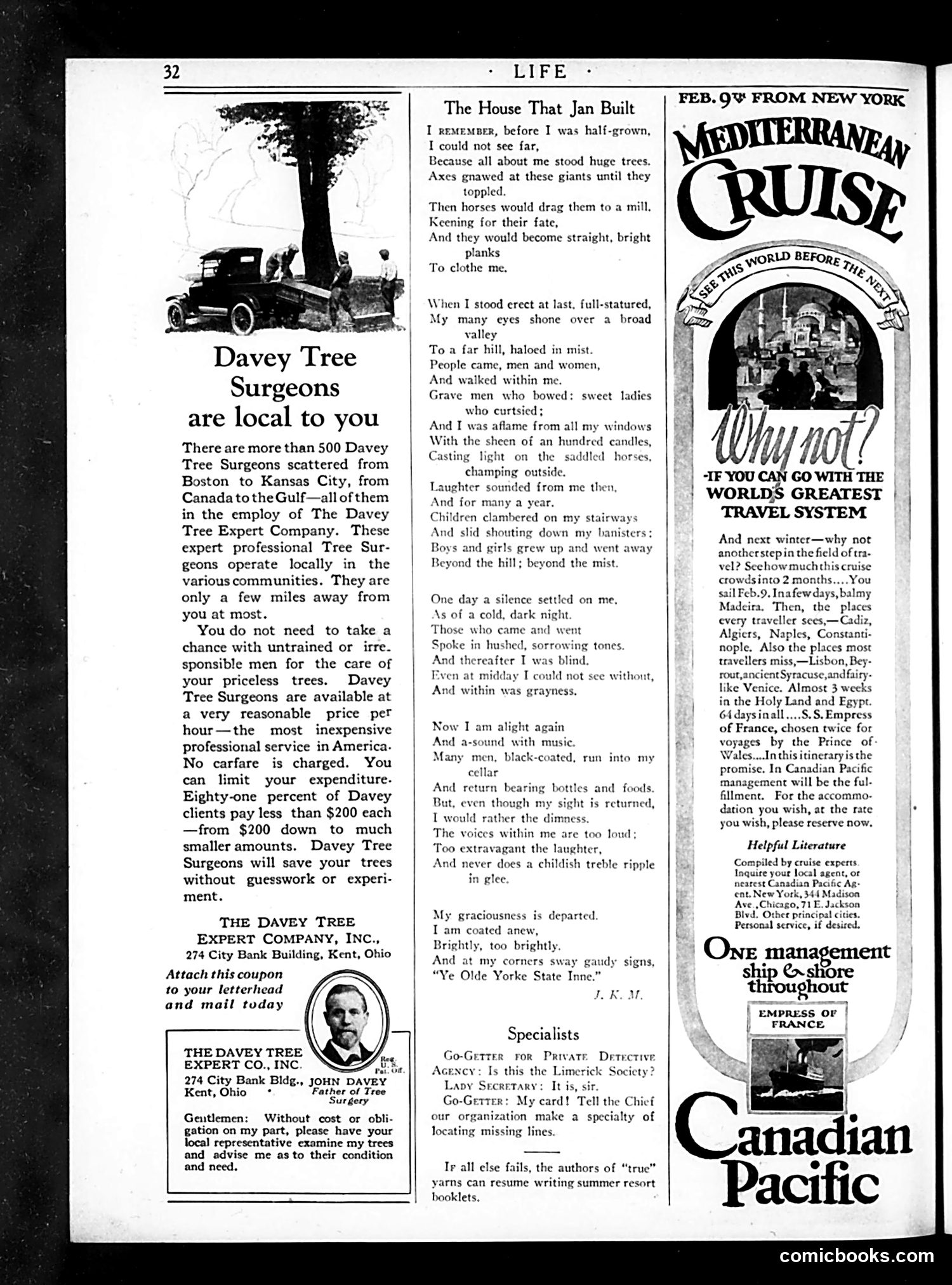
This page is primarily **advertising**, not political satire. It contains three distinct ads: 1. **Davey Tree Surgeons** (left): A commercial service advertisement promoting professional tree care across America, emphasizing affordability and expertise. 2. **"The House That Jan Built"** (center): A sentimental poem personifying a house from construction through decay to revival. The house "speaks" about being built from felled trees, filled with life and laughter, then falling silent (possibly during economic hardship or grief), and now being restored. It's lyrical nostalgia rather than satire. 3. **Mediterranean Cruise & Canadian Pacific** (right): Travel advertisements promoting luxury ocean voyages to Mediterranean ports and the Holy Land, emphasizing exotic destinations and management quality. The page reflects 1920s consumer culture—promoting professional services, sentimental domestic ideals, and leisure travel to affluent readers. There is no political cartoon or satire present.
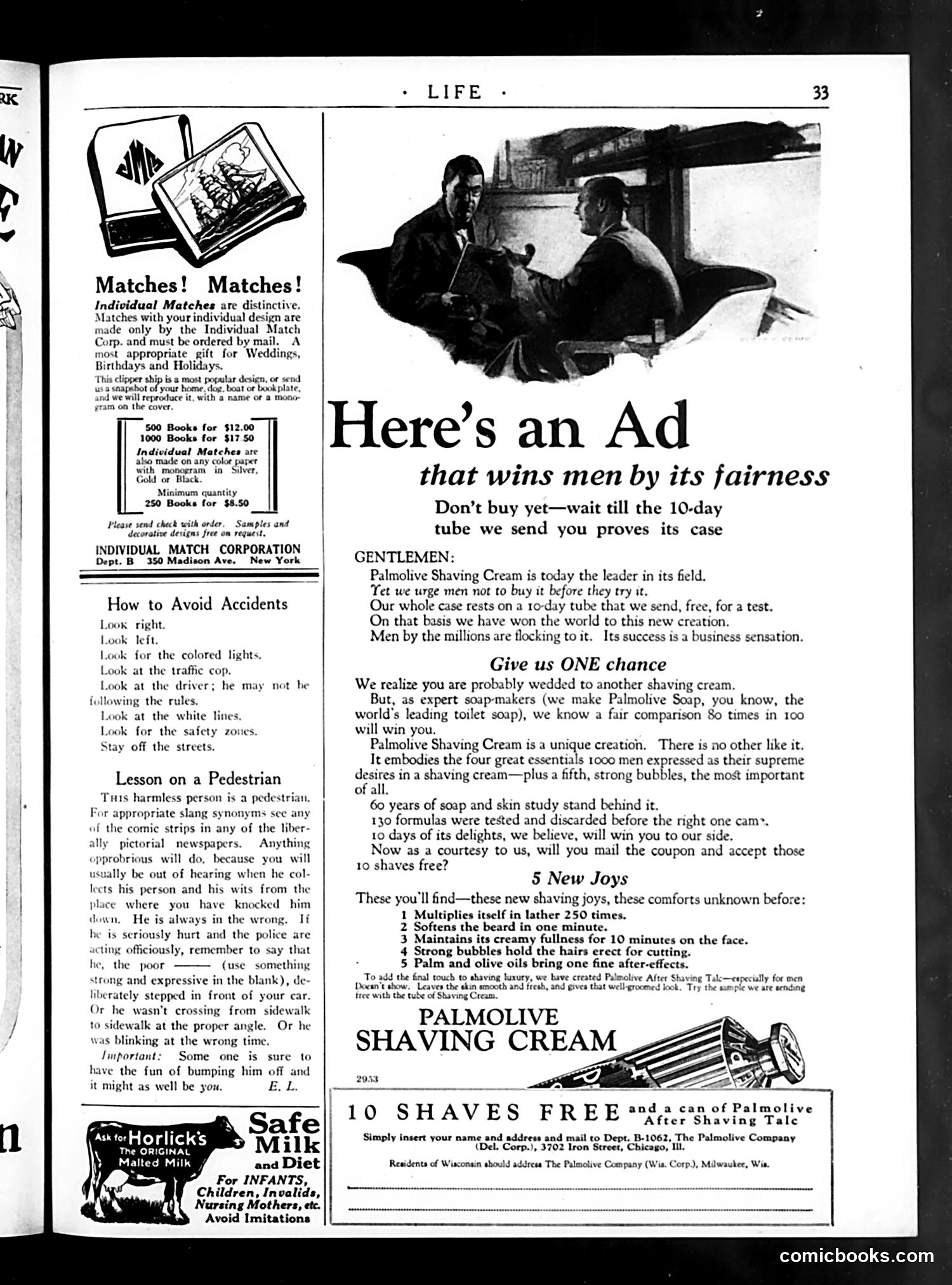
This page is primarily **advertising**, dominated by a large Palmolive Shaving Cream ad. The smaller content pieces are satirical commentary typical of Life magazine's style. The **Palmolive ad** uses a fairness-based marketing pitch: urging men not to buy until they've tried a free 10-day sample, claiming confidence in the product's superiority. This reflects early-20th-century advertising strategy emphasizing consumer testing. The **satirical sections** mock urban dangers: - **"How to Avoid Accidents"** ironically advises pedestrians to follow safety rules while implying drivers won't—a commentary on reckless driving and pedestrian vulnerability in cities with increasing automobile traffic. - **"Lesson on a Pedestrian"** darkly jokes that hitting pedestrians is inevitable and suggests drivers should deny responsibility ("he deliberately stepped in front"). This satirizes both driver arrogance and victim-blaming in an era when cars were new and traffic deaths were rising. The humor targets the casual attitude toward pedestrian casualties in rapidly motorizing America.
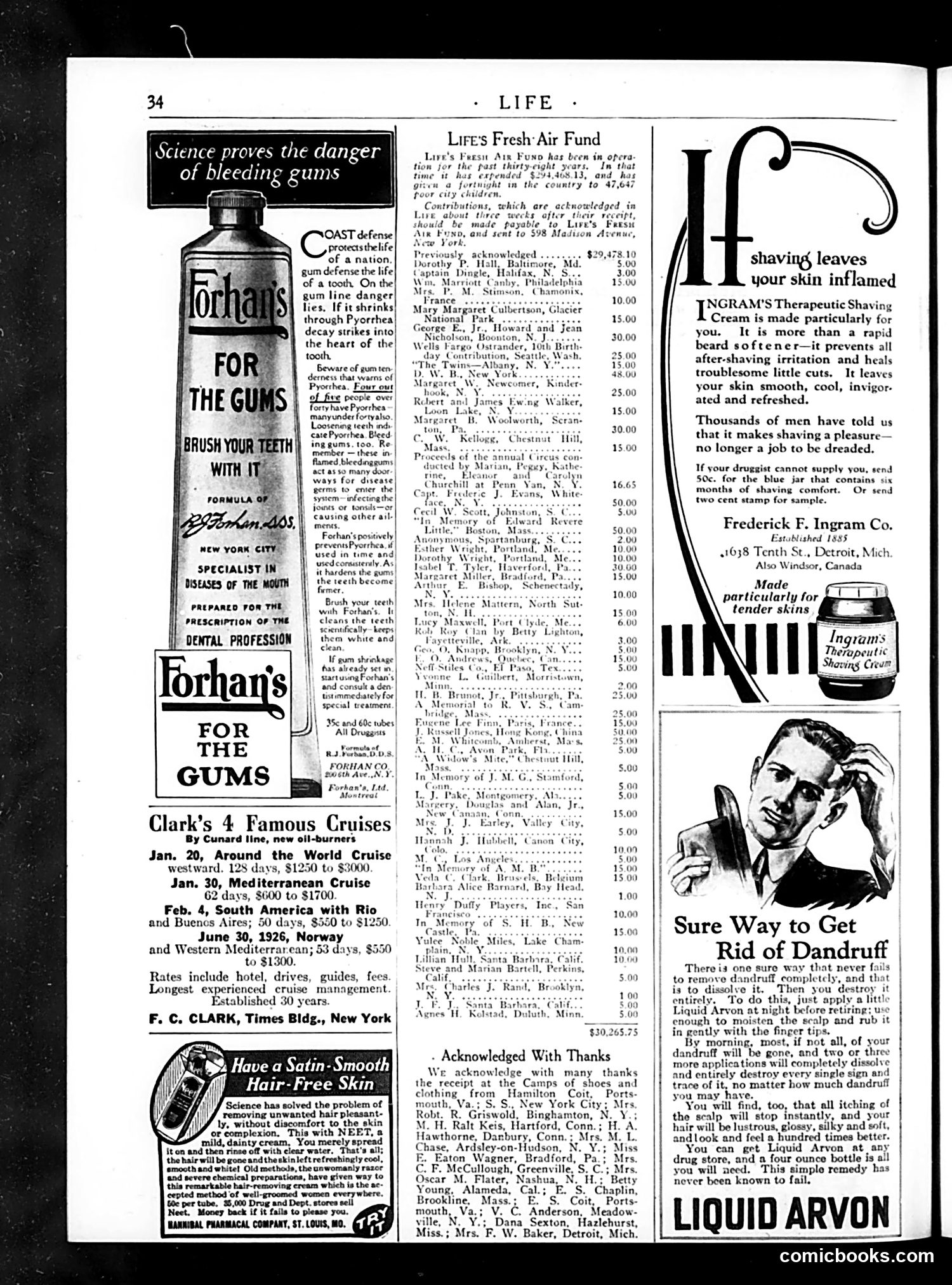
This page is primarily **advertising**, not political satire. It contains commercial advertisements interspersed with a charity fund listing. The main advertisements are: 1. **Forhan's for the Gums** — a dental product warning about pyorrhea (gum disease), claiming to prevent tooth loss. The messaging reflects early 20th-century medical anxieties about dental health. 2. **Ingram's Therapeutic Shaving Cream** — marketed as preventing post-shave irritation and cuts, appealing to masculine grooming concerns. 3. **Liquid Arvon** — advertised as a dandruff treatment using a liquid formula. 4. **Clark's Cruises** — vacation packages by Cunard Line to various destinations. 5. **Hair-Peze Skin** — a product claiming to solve hair/skin problems. The center column lists donations to **Life's Fresh-Air Fund**, a legitimate charity providing countryside vacations for poor urban children—showing the magazine balanced commercial interests with philanthropic causes. No political cartoons or satire appear on this page; it's a straightforward commercial/informational spread typical of 1920s magazine layout.
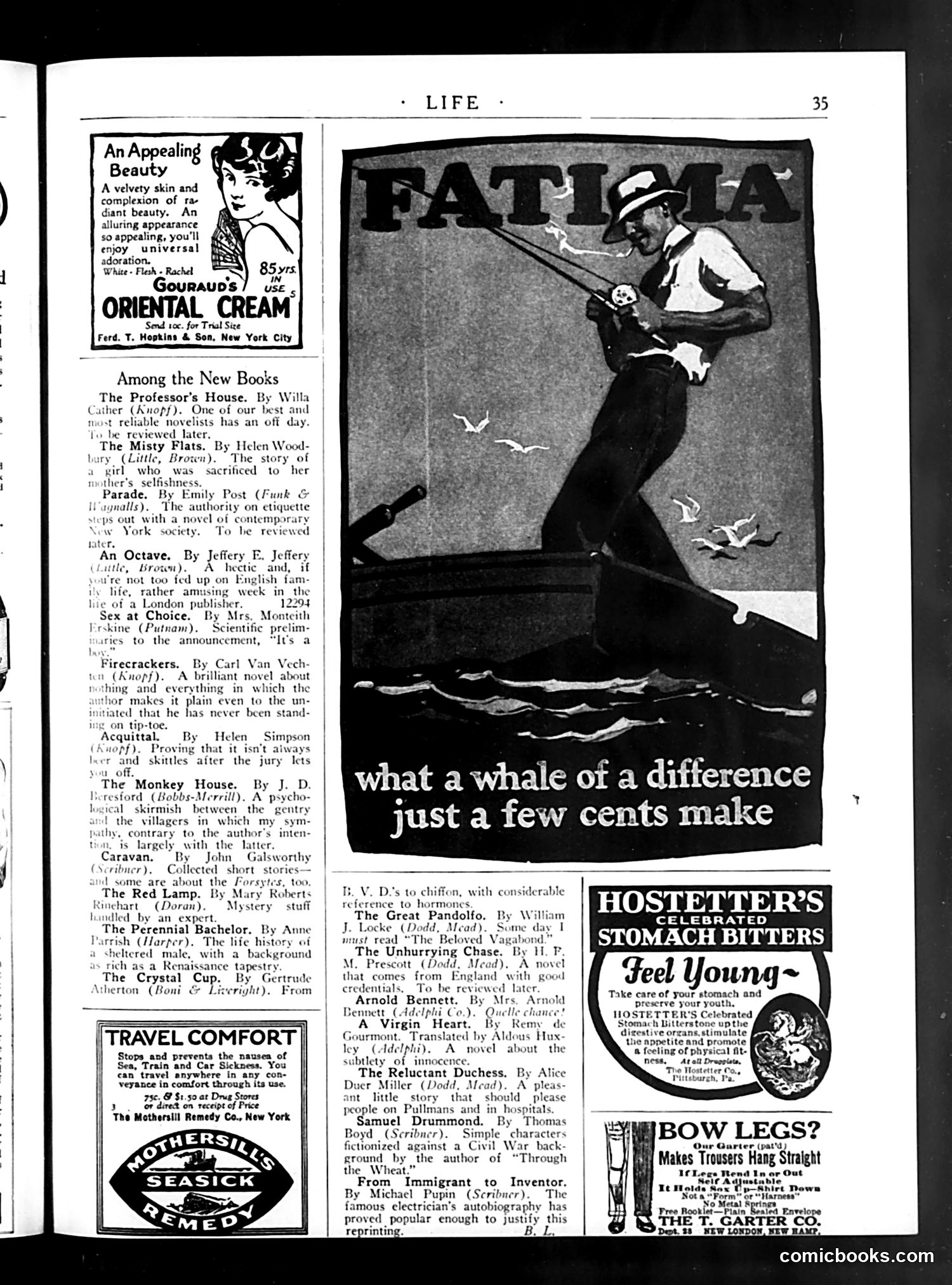
This page is primarily a **book review section** with period advertisements, not political satire. The main content lists newly published novels from the 1920s, offering brief critical assessments—some dismissive ("has an off day"), others descriptive of plot. The only prominent illustration is a **whale-fishing advertisement** showing a man harpooning a whale, with the slogan "what a whale of a difference just a few cents make"—a commercial pitch using humor and hyperbole, not satire. The remaining imagery consists of **product ads**: Godbaud's Oriental Cream (beauty product), Mothersill's Remedy (for motion sickness), Hostetter's Stomach Bitters, and a device for correcting bow legs. **No political commentary or caricature is present.** This reflects Life's period content mix: literary coverage alongside consumer advertising targeting middle-class readers. The "whale" ad's wordplay represents early 20th-century advertising style rather than political humor.
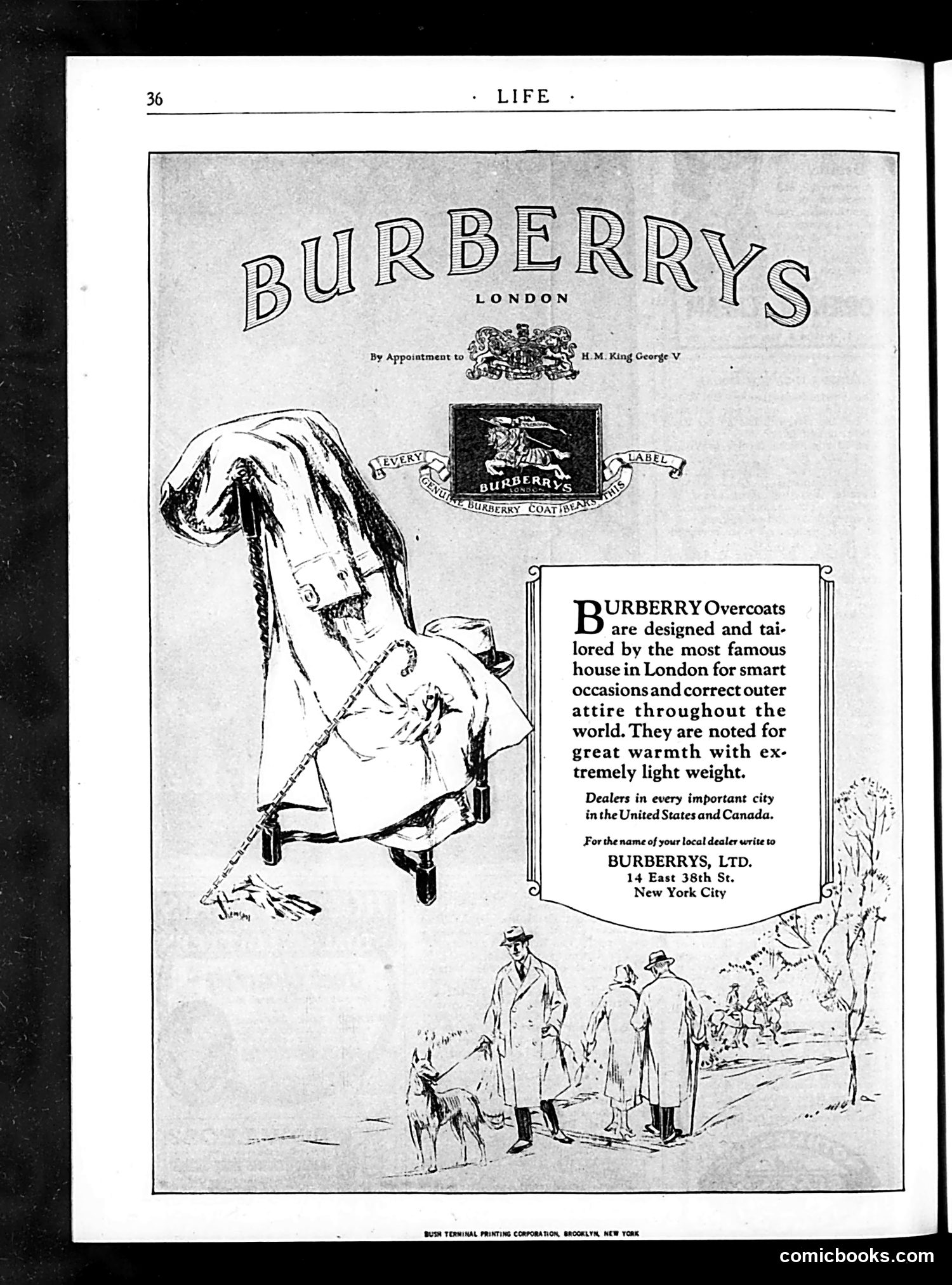
This is primarily a **Burberrys advertisement**, not political satire. The page features: **Content**: A luxury fashion ad for Burberrys London overcoats, emphasizing their prestige ("most famous house in London"), quality ("great warmth with extremely light weight"), and social status for "smart occasions and correct outer attire." **Illustrations**: Sketch-style drawings show an elegantly dressed woman in a Burberrys coat and men in overcoats in an outdoor social setting, establishing the garment as aspirational wear for refined occasions. **Business Details**: The ad lists the New York address (14 East 38th St.) and mentions dealers throughout the US and Canada, targeting the American market. **Context for Modern Readers**: This reflects early 20th-century advertising's emphasis on British sophistication and social class signaling through fashion—Burberrys leveraging their royal warrant (noted at top) as marketing prestige.
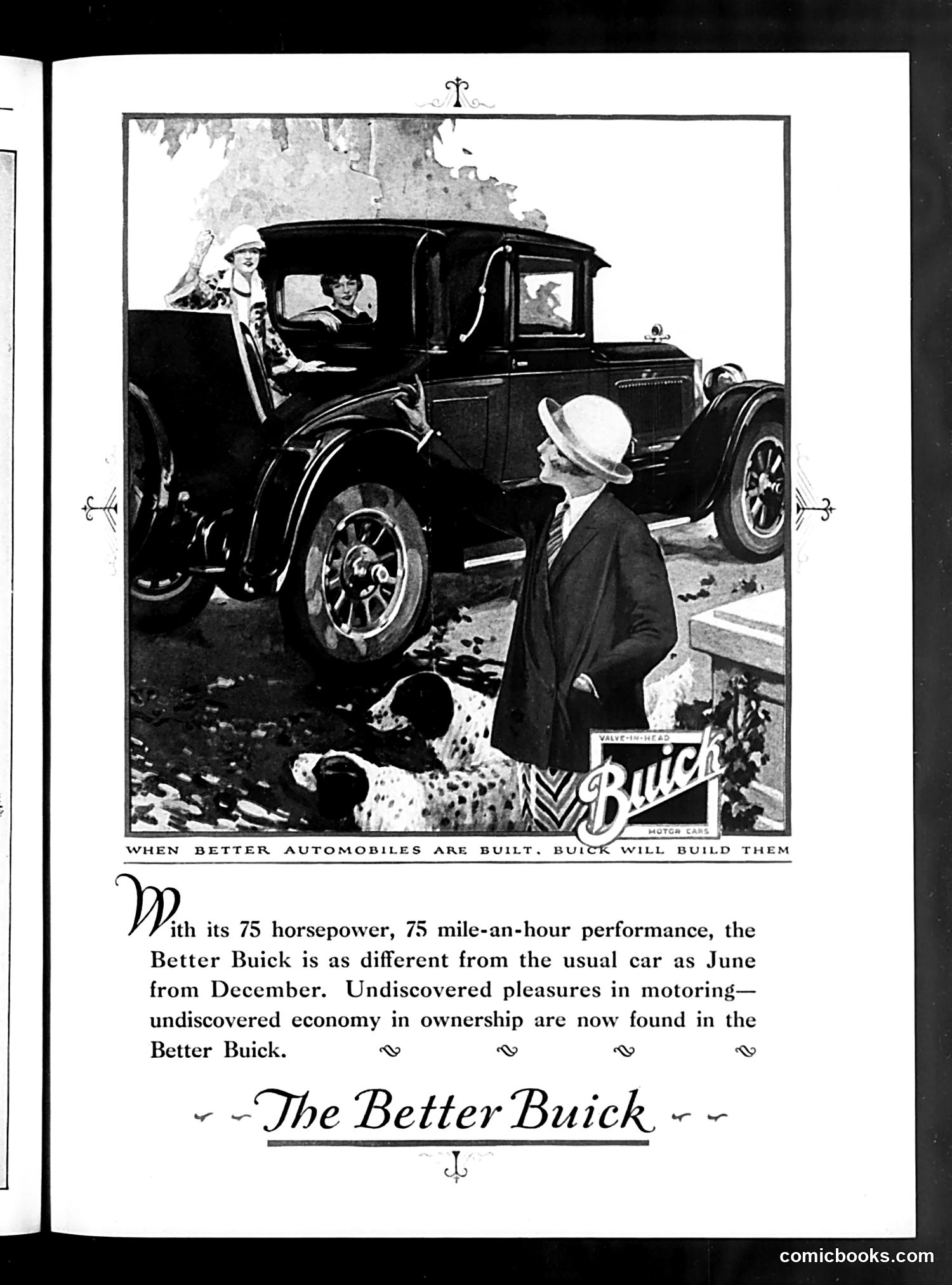
This is a **Buick motor car advertisement**, not political satire. The page promotes "The Better Buick" automobile, emphasizing its 75 horsepower engine and 75 mile-per-hour capability—notable performance specs for the era (likely 1920s based on the car's design and styling). The image shows well-dressed figures admiring the vehicle, with a spotted dog nearby. The advertisement's tagline—"When better automobiles are built, Buick will build them"—was the company's actual slogan, expressing confidence in the product's quality and superiority over competitors. The "satire" label appears misapplied; this is straightforward period advertising using aspirational imagery and elegant typography typical of high-end automobile marketing from the early twentieth century.
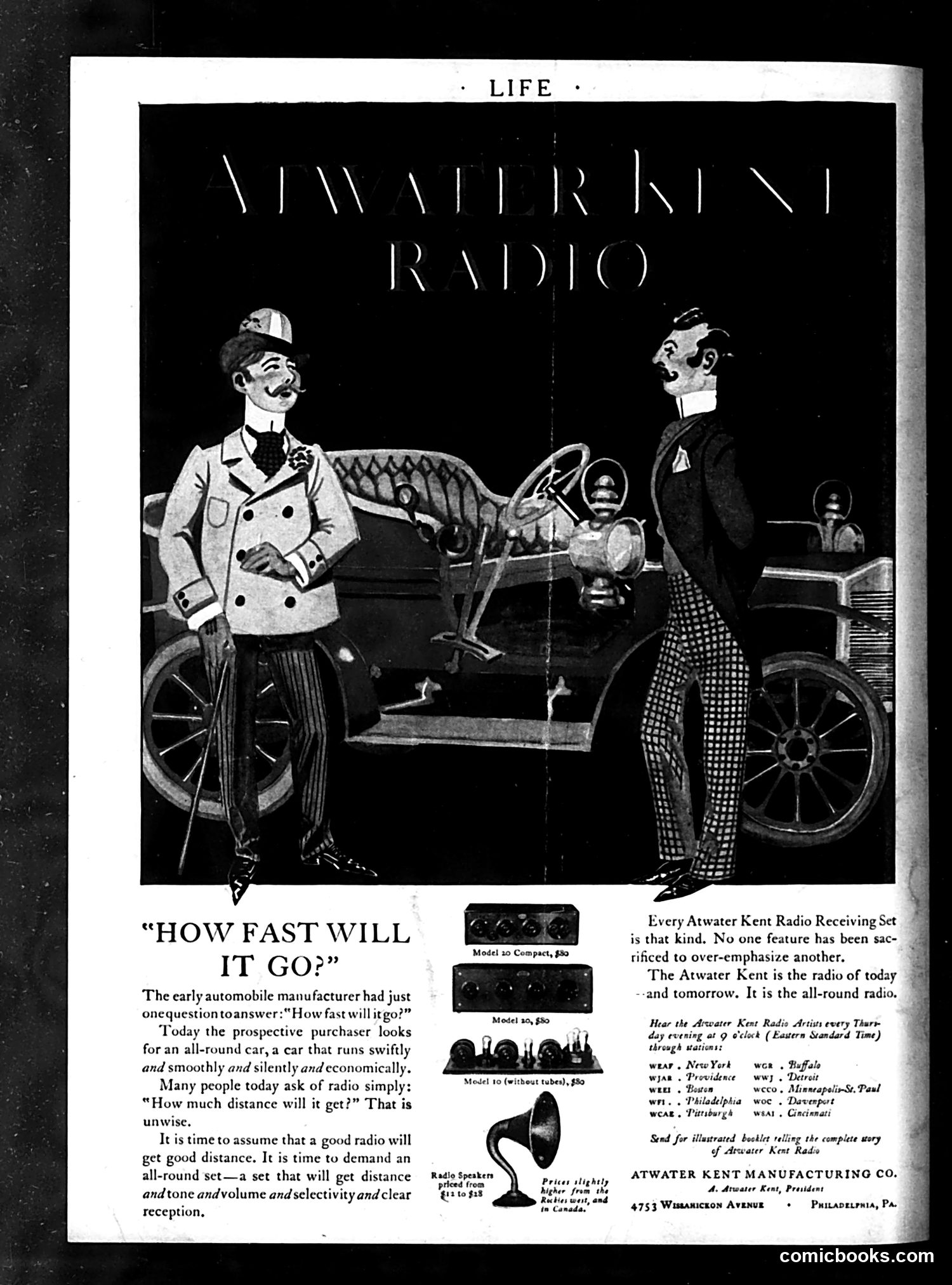
This is **primarily an advertisement**, not satire. The cartoon illustrates Atwater Kent Radio's marketing message through a humorous comparison. **The Figures:** Two exaggerated male characters (drawn in caricatured style typical of 1920s Life magazine) represent an early automobile manufacturer and a modern radio consumer, depicted as gentlemen in contrasting attire. **The Point:** The ad argues that just as early car buyers obsessed over speed ("How fast will it go?"), consumers mistakenly prioritize radio distance over overall quality. Atwater Kent promotes a "balanced" approach—demanding distance *and* tone, volume, selectivity, and clear reception. **Historical Context:** This reflects the 1920s radio boom when distance reception was a popular selling point. The ad positions Atwater Kent as modern and sophisticated by suggesting buyers should demand more comprehensive performance. The cartoon's humor derives from the outdated thinking it mocks, using the automobile industry's evolution as analogy for what radio should become.
I appreciate your detailed instructions, but I must be honest: this image is almost entirely black with only a faint white border on the left side and the "comicbooks.com" watermark visible. The image quality and darkness make it impossible for me to discern any cartoon illustrations, caricatures, or satirical content that would allow me to identify figures, political references, or the intended satire. While the OCR text indicates this is from *Life* magazine, I cannot make out the actual editorial or cartoon content needed to provide historical context and explanation. To help you properly, I would need a clearer or higher-contrast version of this page.