
Life, 1925-09-24 · page 22 of 41
Life — September 24, 1925 — page 22: what you’re looking at
What you’re looking at
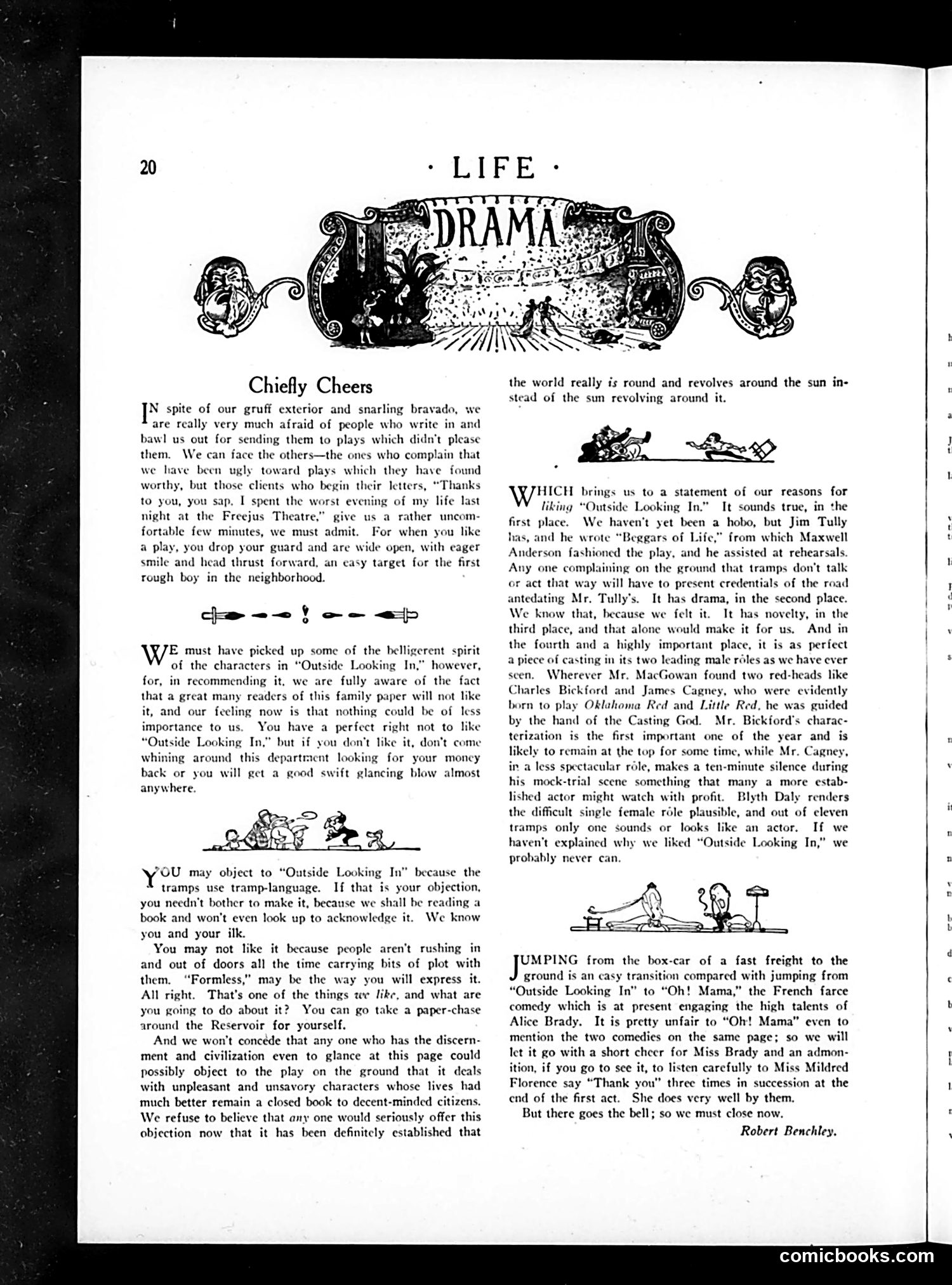
This page reviews "Outside Looking In," a play adapted by Maxwell Anderson from Jim Tully's memoir "Beggars of Life." The piece defends the play against anticipated moral objections from prudish readers. The satire targets genteel audiences who object to realistic portrayals of working-class "unsavory characters"—here, hobos and tramps. Life's editors mockingly warn complainers not to bother writing letters: they won't listen. The reference to "the world really is round and revolves around the sun" sarcastically suggests that accepting life's harsh realities (like poverty and tramping) should be as established as basic science. The review praises the casting of Charles Bickford and James Cagney in lead roles, calling Bickford's performance "the first important one of the year." The underlying point: honest art about real people matters more than bourgeois comfort.
📄 Transcribed text from this page (OCR, searchable)
Machine-transcribed from the original scan — historical spelling and the odd misread are preserved.
Chiefly Cheers N spite of our gruff exterior and snarling bravado, we are really very much afraid of people who write in and bawl us out for sending them to plays which didn’t please them. We can face the others—the ones who complain that we have been ugly toward plays which they have found worthy, but those clients who begin their letters, “Thanks to you, you sap, I spent the worst evening of my life 1: night at the Freejus Theatre,” give us a rather uncom- fortable few minutes, we must admit. For when you like a play, you drop your guard and are wide open, with eager smile and head thrust forward, an easy target for the first rough boy in the neighborhood. c--—— ! oe =<) WE must have picked up some of the belligerent spirit of the characters in “Outside Looking In,” however, for, in recommending it, we are fully aware of the fact that a great many readers of this family paper will not like it, and our feeling now is that nothing could be of less importance to us. You have a perfect right not to like “Outside Looking In,” but if you don't like it, don’t come whining around this department looking for your money back or you will get a good swift glancing blow almost anywhere. yeu may object to “Outside Looking In” because the * tramps use tramp-language. If that is your objection, you needn't bother to make it, because we shall be reading a book and won't even look up to acknowledge it. We know you and your ilk. You may not like it because people aren't rushing in and out of doors all the time carrying bits of plot with them. ‘Formless,” may be the way you will express it. All right. That's one of the things we like, and what are you going to do about it? You can go take a paper-chase around the Reservoir for yourself. And we won't concede that any one who has the discern- ment and civilization even to glance at this page could possibly object to the play on the ground that it deals with unpleasant and unsavory characters whose lives had much better remain a closed book to decent-minded citizens. We refuse to believe that any one would seriously offer this objection now that it has been definitely established that the world really is round and revolves around the sun in- stead of the sun revolving around it. 5) ew HICH brings us to a statement of our reasons for liking “Outside Looking In.” It sounds true, in the first place. We haven't yet been a hobo, but Jim Tully has, and he wrote “Beggars of Life,” from which Maxwell Anderson fashioned the play, and he assisted at rehearsals Any one complaining on the ground that tramps don’t talk or act that way will have to present credentials of the road antedating Mr. Tul It has drama, in the second place. We know that, because we felt it. It has novelty, in the third place, and that alone would make it for us. And in the fourth and a highly important place, it is as perfect a piece of casting in its two leading male réles as we have ever seen. Wherever Mr. MacGowan found two red-heads like Charles Bickford and James Cagney, who were evidently born to play Oklahoma Red and Little Red, he was guided by the hand of the Casting God. Mr. Bickford’s charac- erization is the first important one of the year and is likely to remain at the top for some time, while Mr. Cagney, ir a less spectacular role, makes a ten-minute silence during his mock-trial scene something that many a more estab- lished actor might watch with profit. Blyth Daly renders the difficult single female role plausible, and out of eleven tramps only one sounds or looks like an actor. If we haven't explained why we liked “Outside Looking In,” we probably never can. UMPING from the box-car of a fast freight to the ground is an casy transition compared with jumping from “Outside Looking In” to “Oh! Mama,” the French farce comedy which is at present engaging the high talents of Alice Brady. It is pretty unfair to “Oh! Mama” even to mention the two comedies on the same page; so we will Ict it go with a short cheer for Miss Brady and an admon- ition, if you go to see it, to listen carefully to Miss Mildred Florence say “Thank you" three times in succession at the end of the first act. She does very well by them. But there goes the bell; so we must close now. Robert Benchley, comicbooks.com