
Life, 1925-09-24 · page 18 of 41
Life — September 24, 1925 — page 18: what you’re looking at
What you’re looking at
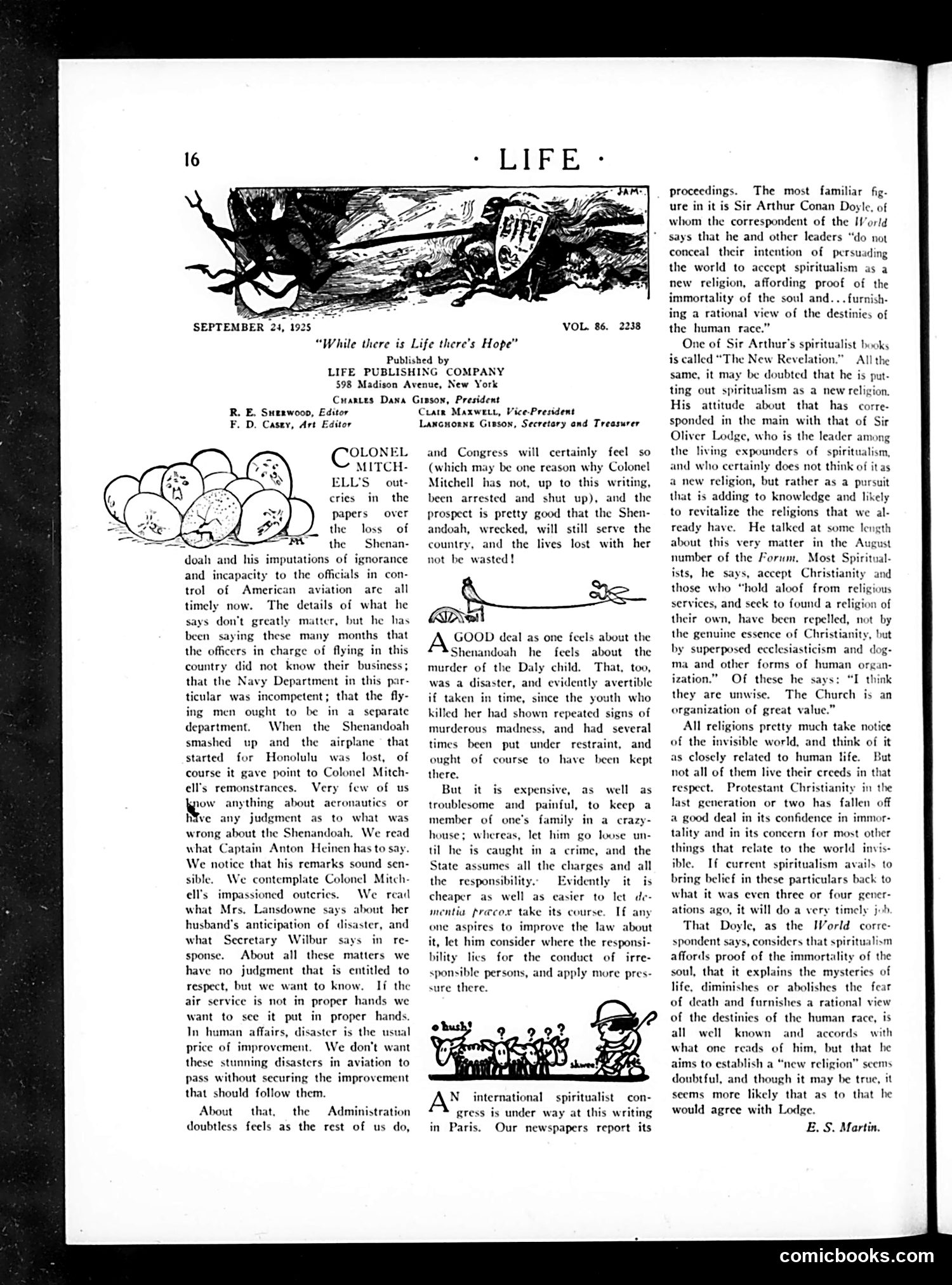
This page discusses **Colonel Mitchell's court-martial** regarding aviation policy disputes. The text criticizes Mitchell's "impassioned outcries" about naval aviation management while acknowledging his concerns had merit. The editorial argues that while Mitchell's complaints deserve attention, his methods—airing grievances publicly—were problematic. It notes the Navy Department should have been reorganized separately, and suggests Mitchell's case demonstrates the need for legal reforms protecting whistleblowers from retaliation. A secondary item discusses **spiritualism**, mentioning Sir Arthur Conan Doyle and international spiritualist conferences in Paris. The editorial skeptically examines spiritualism as a "new religion," questioning whether it truly offers rational explanations for human destiny versus traditional Christianity.
📄 Transcribed text from this page (OCR, searchable)
Machine-transcribed from the original scan — historical spelling and the odd misread are preserved.
SEPTEMBER 24, 1925. VOL. 86. 2238 “While there is Life there’s Hope” Published by LIFE PUBLISHING COMPANY 598 Madison Avenue, New York Cuartes Dana Ginson, President R. E. Surrwoop, Editor F. D. Caszy, Art Editor COLONEL MITCH- ELL'S _ out- cries in’ the papers over 4 +. the loss of “PAT the — Shenan- doah and his imputations of ignorance and incapacity to the officials in con- trol of American aviation are all timely now. The details of what he says don’t greatly matter, but he has been saying these many months that the officers in charge of flying in this country did not know their business; that the Navy Department in this par- ticular was incompetent; that the fly- ing men ought to be in a separate department. When the Shenandoah smashed up and the airplane that started for Honolulu lost, of course it gave point to Colonel Mitch- ell’s remonstrances. Very few of us wer anything about acronautics or h&ve any judgment as to what was wrong about the Shenandoah. We read what Captain Anton Heinen has to say. We notice that his remarks sound sen- We contemplate Colonel Mitch- ell's impassioned outcries. We rear what Mrs, Lansdowne says about her husband's anticipation of disaster, and what Secretary Wilbur says in re- sponse. About all these matters we have no judgment that is entitled to respect, but we want to know. Ii the air service is not in proper hands we want to see it put in proper hands. In human affairs, disaster is the usual price of improvement. We don’t want these stunning disasters in aviation to pass without securing the improvement that should follow them. About that, the © Administration doubtless feels as the rest of us do, was sible, Crater Maxwett, Vice-President Lancnorne Gison, Secretary and Treasurer and Congress will certainly feel so (which may be one reason why Colonel Mitchell has not, up to this writing, been arrested and shut up), and the prospect is pretty good that the Shen- andoah, wrecked, will still serve the country, and the lives lost with her not be wasted! Asi GOOD deal as one feels about the Shenandoah he feels about the murder of Daly child. That, too, was a disaster, and evidently avertible if taken in time, since the youth who killed her had shown repeated signs of murderous madness, and had several times been put under restraint, and ought of course to have been kept there. But it is expensive, as well as troublesome and painful, to keep a member of one’s family in a crazy- house ; let him go loose un- til he is caught in a crime, and the State assumes all the charges and all the responsibility. Evidently it is cheaper as well as easier to let de- mentia precox take its course. If any one aspires to improve the law about it, let him consider where the responsi- bi lies for the conduct of irre- sponsible persons, and apply more pres- sure there. whereas, international spiritualist con- gress is under way at this writing in Paris. Our newspapers report its proceedings. The most familiar fig- ure in it is Sir Arthur Conan Doyle, of whom the correspondent of the World says that he and other leaders “do not conceal their intention of persuading the world to accept spiritualism as a new religion, affording proof of the immortality of the soul and... furnish- ing a rational view of the destinies of the human race.” One of Sir Arthur's spiritualist books is called “The New Revelation.” All the same, it may be doubted that he is put- ting out spiritualism as a new religion. His attitude about that has corre- sponded in the main with that of Sir Oliver Lodge, who is the leader among the living expounders of spiritualism, and who certainly does not think of itas a new religion, but rather as a pursuit that is adding to knowledge and likely to revitalize the religions that we al- ready have. He talked at some len about this very matter in the August number of the Fortm, Most Spiritual- ists, he says, accept Christianity and those who “hold aloof from religious services, and seck to found a religion of their own, have been repelled, not by the genuine essence of Christianity, but by superposed ecclesiasticism and dog- ma and other forms of human organ- ization.” Of these he says: think they are unwise. The Church is an organization of great value.” All religions pretty much take notice of the invisible world, and think of it as closely related to human life. But not all of them live their creeds in that respect. Protestant Christianity in the last generation or two has fallen off a good deal in its confidence in immor- and in its concern for most other ings that relate to the world invis- If current spiritualism avails to bring belief in these particulars back to what it was even three or four gener- ations ago, it will do a very timely job. That Doyle, as the World corre- spondent says, considers that spiritualism affords proof of the immortality of the soul, that it explains the mysteries of life, diminishes or abolishes the fear of death and furnishes a rational view of the destinies of the human race, is all well known and accords what one reads of him, but that he aims to establish a “new religion” seems doubtful, and though it may be true, it seems more likely that as to that he would agree with Lodge. E. S. Martin. with comicbooks.com