
A complete issue · 36 pages · 1925
Life — September 3, 1925
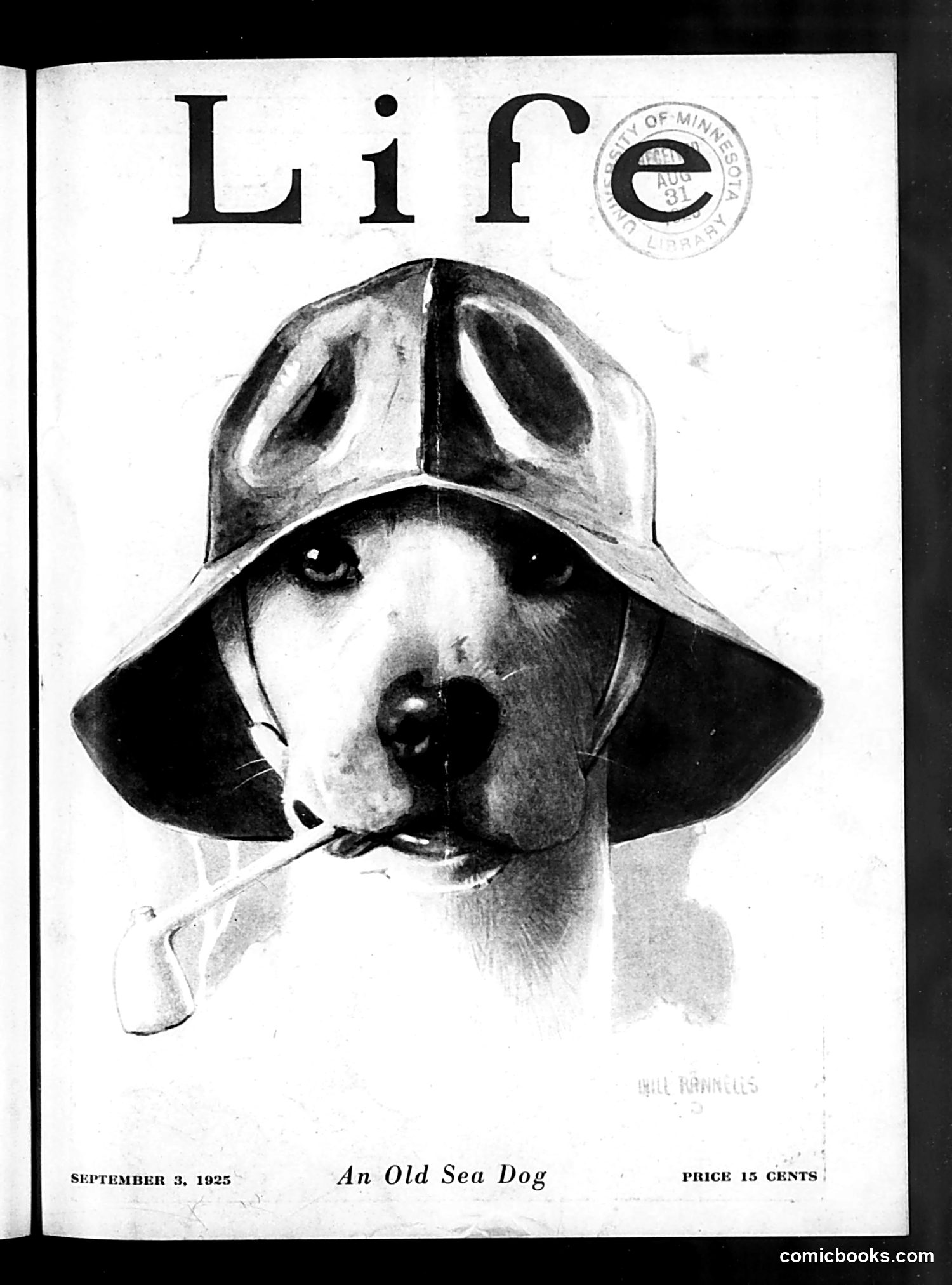
This cover features a dog wearing aviator goggles and a leather flying helmet, with a cigarette in its mouth. The illustration is a straightforward humorous image rather than political satire. The "sea dog" reference is a pun—literally depicting a canine as a nautical character. The aviator gear suggests this dog is styled as a daring pilot or adventurer, playing into 1920s fascination with aviation and the glamorous image of pilots as bold, risk-taking figures. The cigarette reinforces this tough, sophisticated persona. The joke relies on anthropomorphizing the dog in fashionable attire of the era, creating whimsical humor typical of Life magazine's satirical approach. No specific political figure or event appears to be referenced here.
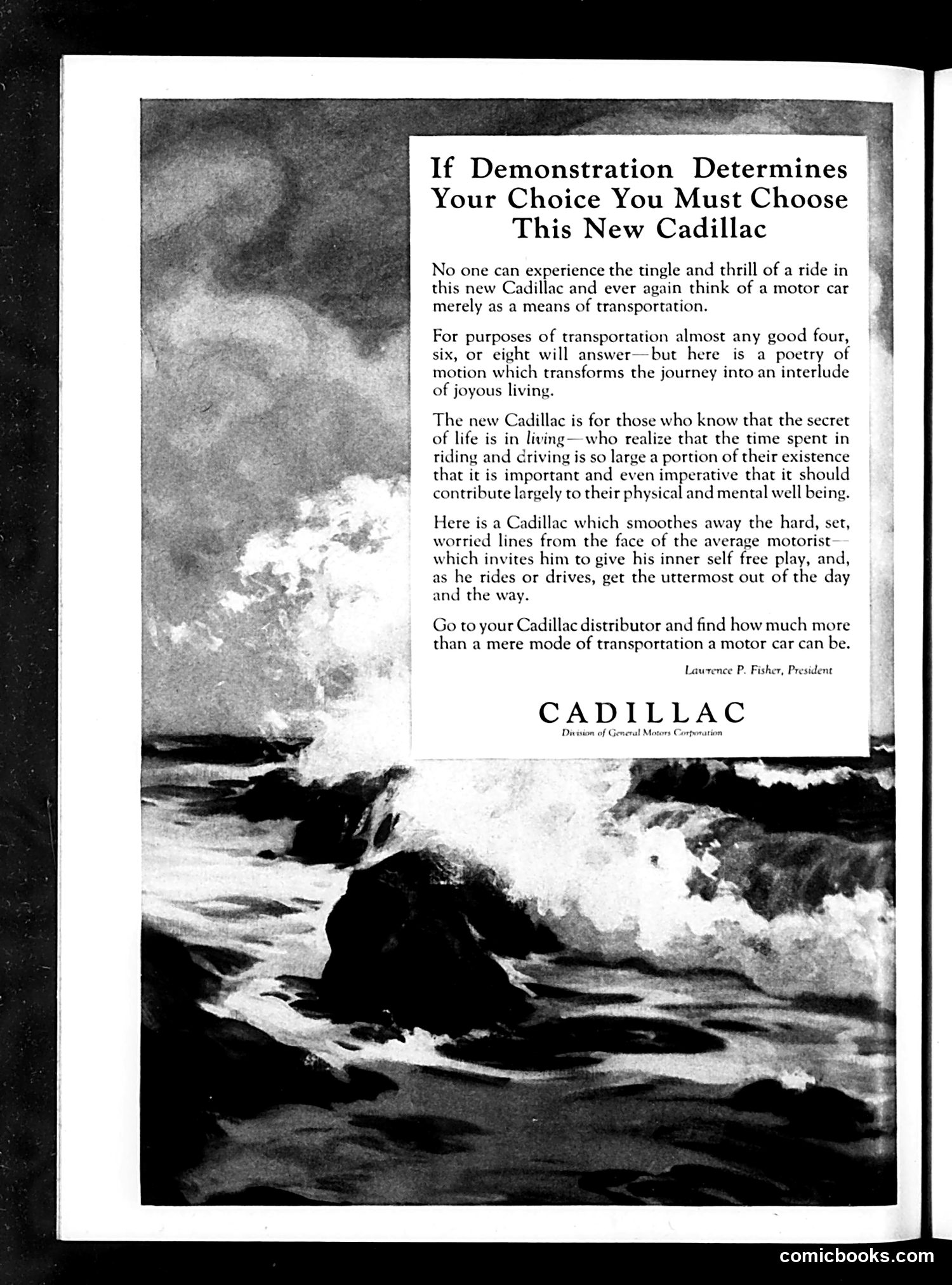
This is a **Cadillac advertisement**, not satire or political commentary. The page shows a luxury car ad from Life magazine featuring dramatic ocean wave imagery. The ad's headline promises that experiencing a Cadillac ride transforms driving from mere transportation into "an interlude of joyous living." The text, attributed to Lawrence P. Fisher (Cadillac's president), appeals to affluent readers who understand that driving time constitutes a significant portion of their lives—and therefore deserves to be pleasurable. The large photograph of crashing waves appears designed to convey power, motion, and freedom—qualities the advertiser wants associated with their vehicle. This is straightforward commercial messaging rather than satirical commentary on automotive culture or consumer society.
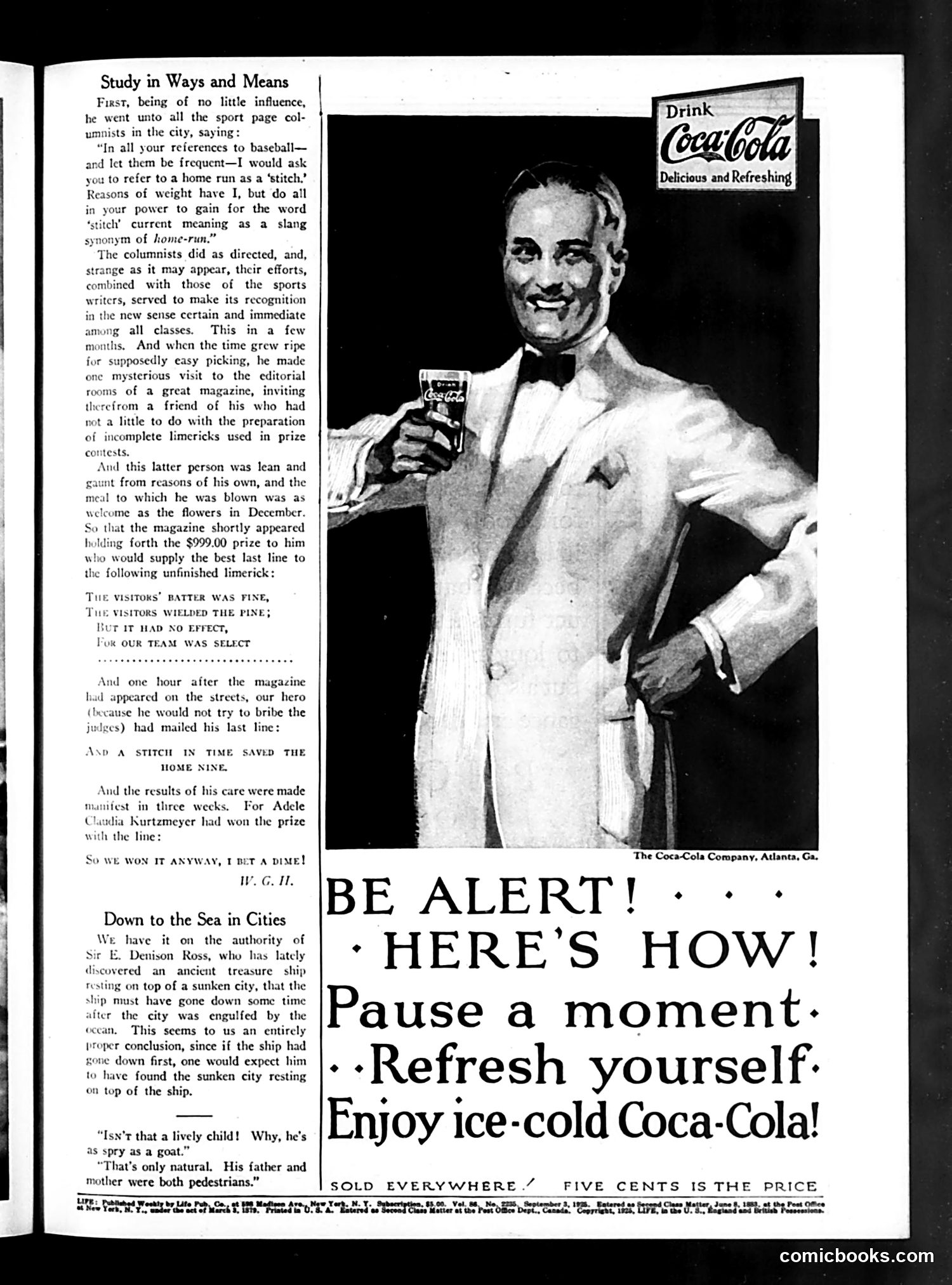
This page is primarily a **Coca-Cola advertisement** rather than political satire. The large illustration shows a muscular man in formal attire holding a Coca-Cola bottle, with the headline "BE ALERT! HERE'S HOW! Pause a moment. Refresh yourself. Enjoy ice-cold Coca-Cola!" The left column contains an unrelated short story titled "Study in Ways and Means" about baseball slang and a magazine contest involving limericks, followed by another brief story, "Down to the Sea in Cities," discussing a sunken treasure ship. There is **no political cartoon or satire** on this page. It's a period advertisement using the muscular male figure as an aspirational endorsement, characteristic of early-20th-century marketing that emphasized vigor and refreshment as selling points for the beverage.
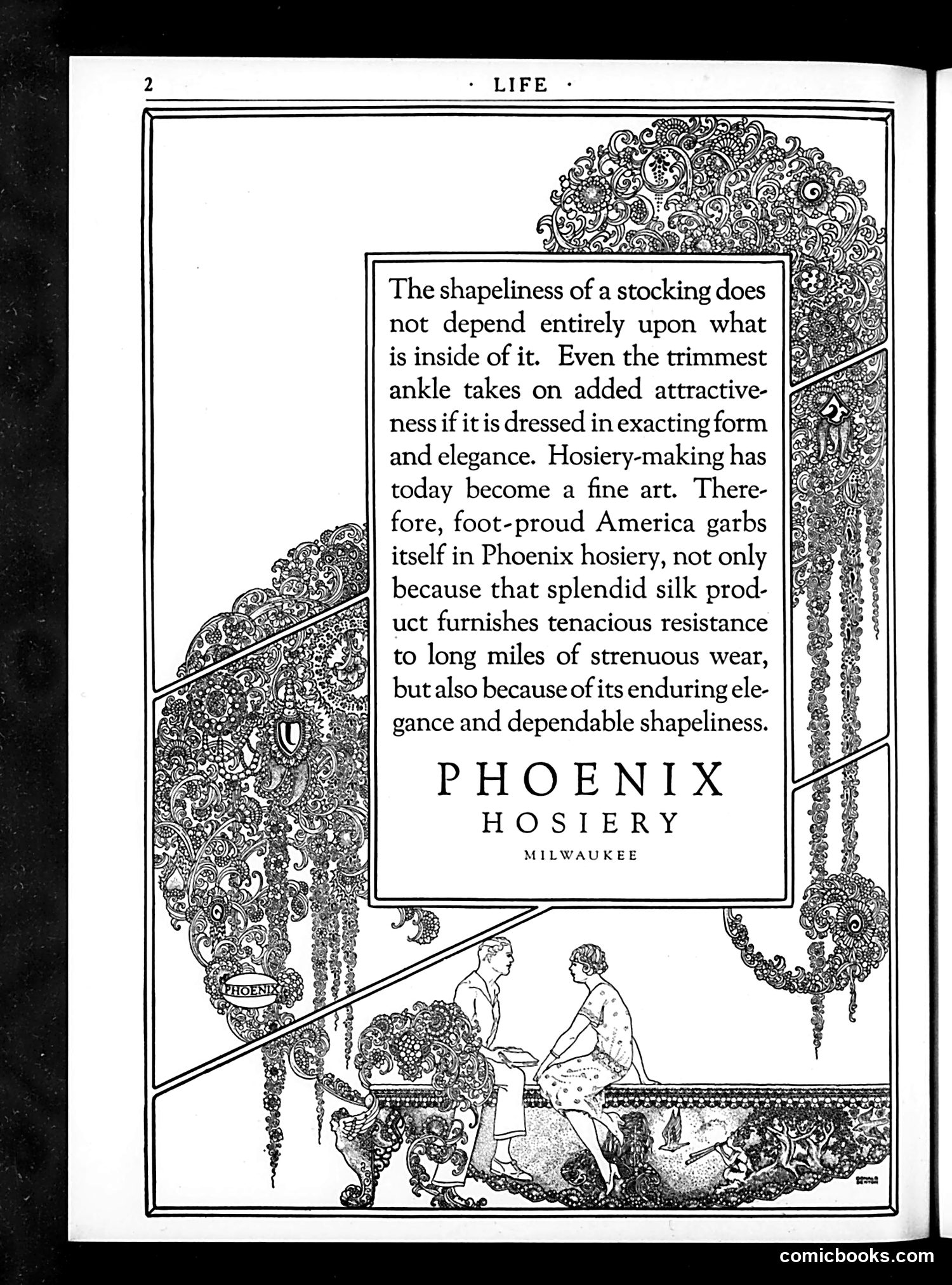
This page is **primarily an advertisement**, not satire or political commentary. It's a product advertisement for Phoenix Hosiery from Milwaukee, published in *Life* magazine. The ad uses decorative Art Deco/Art Nouveau styling with ornamental borders and hanging stockings as design elements. Two illustrated figures at the bottom appear to be examining or displaying hosiery. The text argues that hosiery quality depends not just on contents but on "form and elegance"—essentially marketing Phoenix stockings as a fine art product. It emphasizes durability ("tenacious resistance to long miles of strenuous wear") combined with "enduring elegance and dependable shapeliness." This reflects early 20th-century advertising strategy: positioning functional products as luxury goods through sophisticated design and aspirational messaging.
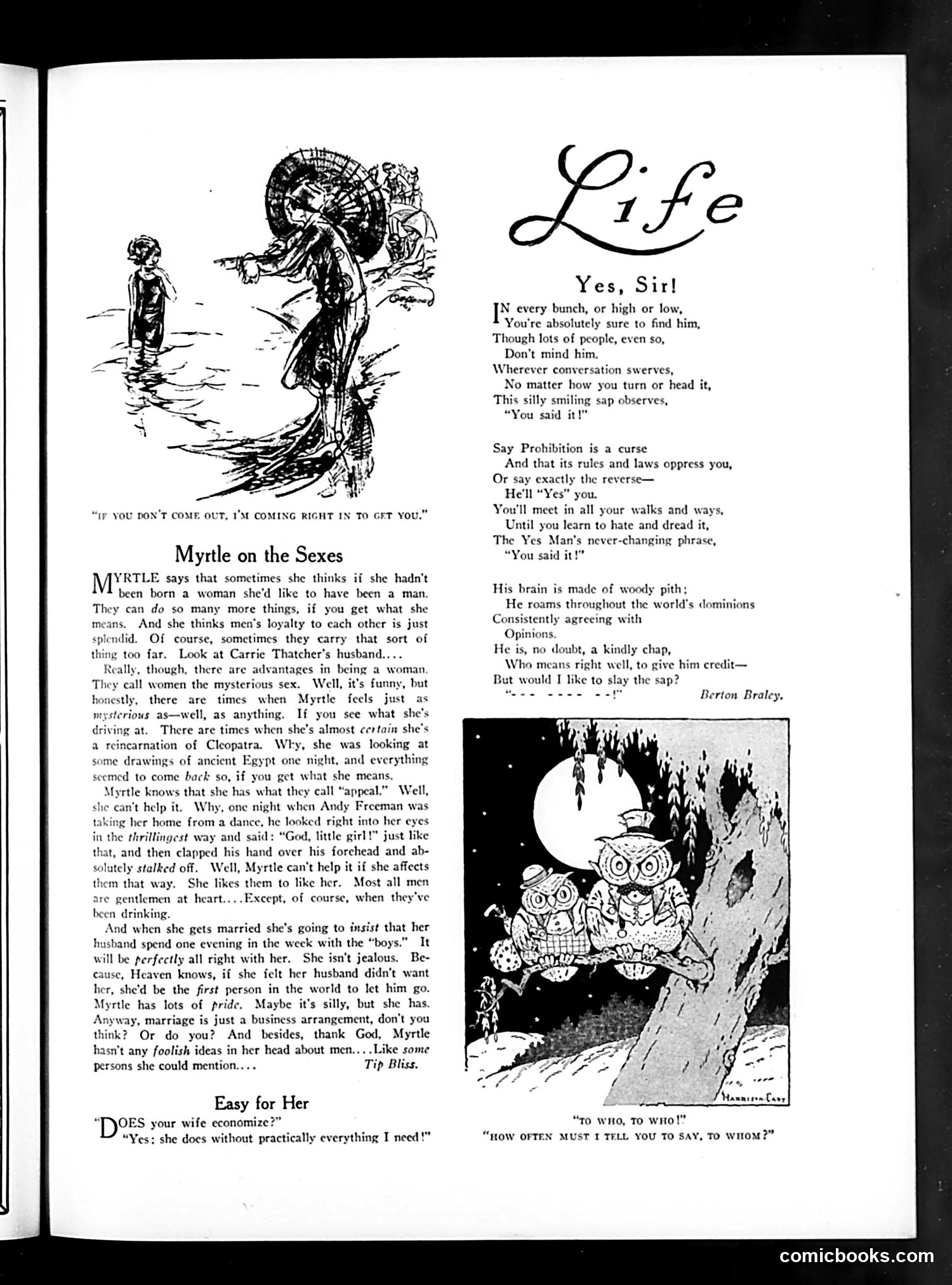
This page contains three distinct satirical pieces about gender relations and social conventions, likely from the early 20th century. **"Myrtle on the Sexes"** critiques women's social constraints through character "Myrtle," arguing women sometimes wish they were men to escape restrictions. The piece humorously notes men's loyalty to each other and suggests marriage should be a "business arrangement." **"Yes, Sir!"** (poem by Berton Braley) satirizes the "Yes Man"—a person who mindlessly agrees with everyone regardless of conviction. This references a widespread social criticism of conformity and lack of independent thought. **"Easy for Her"** presents a brief joke about wives managing household finances efficiently. The illustrations and overall tone mock both gender dynamics and social conformity of the era.
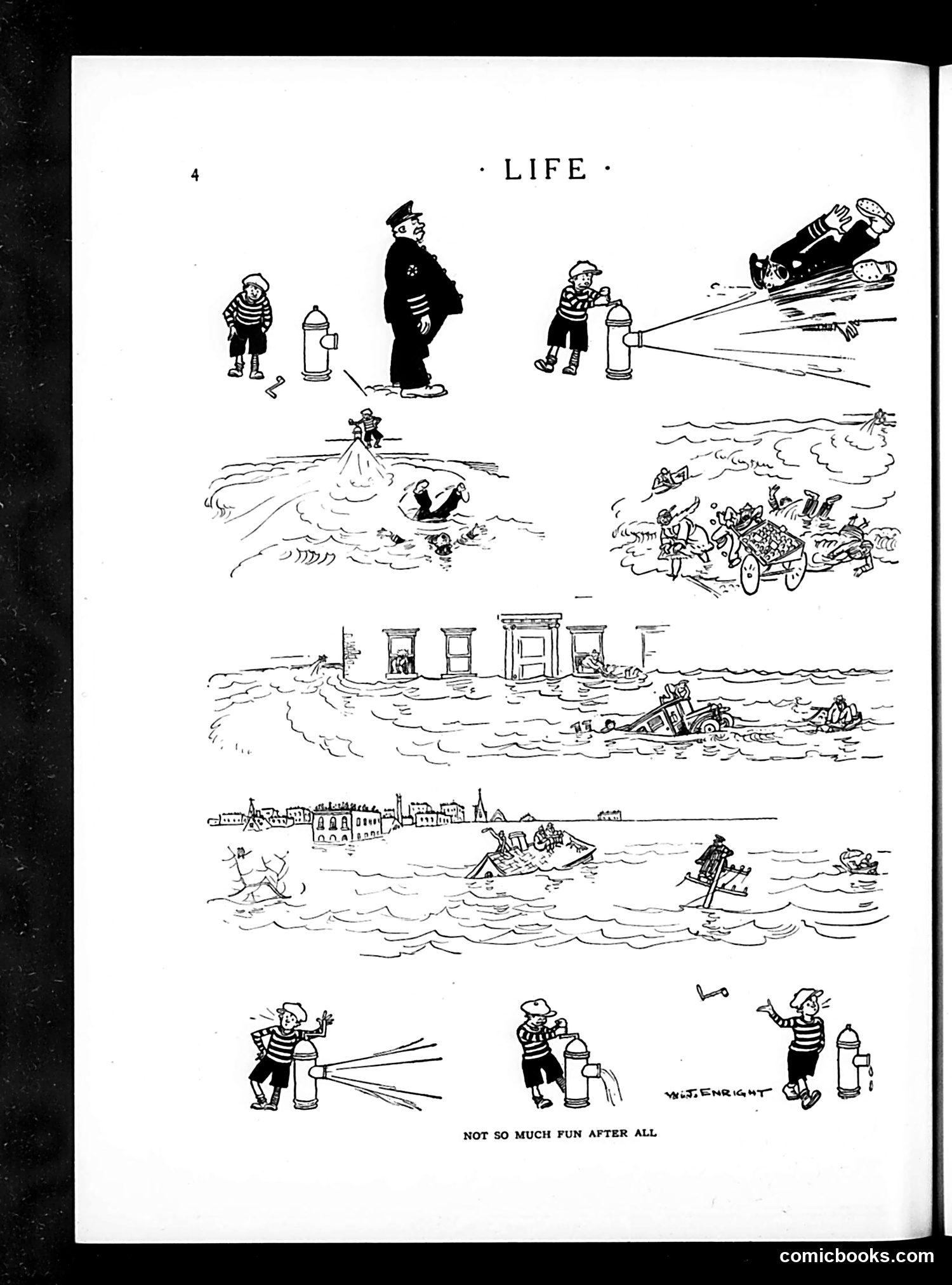
This satirical cartoon depicts the consequences of firefighting gone wrong. The sequence shows: 1. **Top panels**: A uniformed firefighter demonstrates proper hydrant use to children, who playfully spray water 2. **Middle sections**: Escalating chaos—the water spray causes flooding, destroys buildings, capsizes boats, and submerges the waterfront cityscape 3. **Bottom panels**: The children's "fun" ends as they're caught and punished by the firefighter The satire targets **childhood mischief and unsupervised access to public safety equipment**. The joke's dark humor lies in showing how innocent play with a fire hydrant can cause massive urban destruction. This likely reflects early 20th-century concerns about city infrastructure, public safety, and children's lack of supervision in urban environments—common Life magazine satirical subjects.
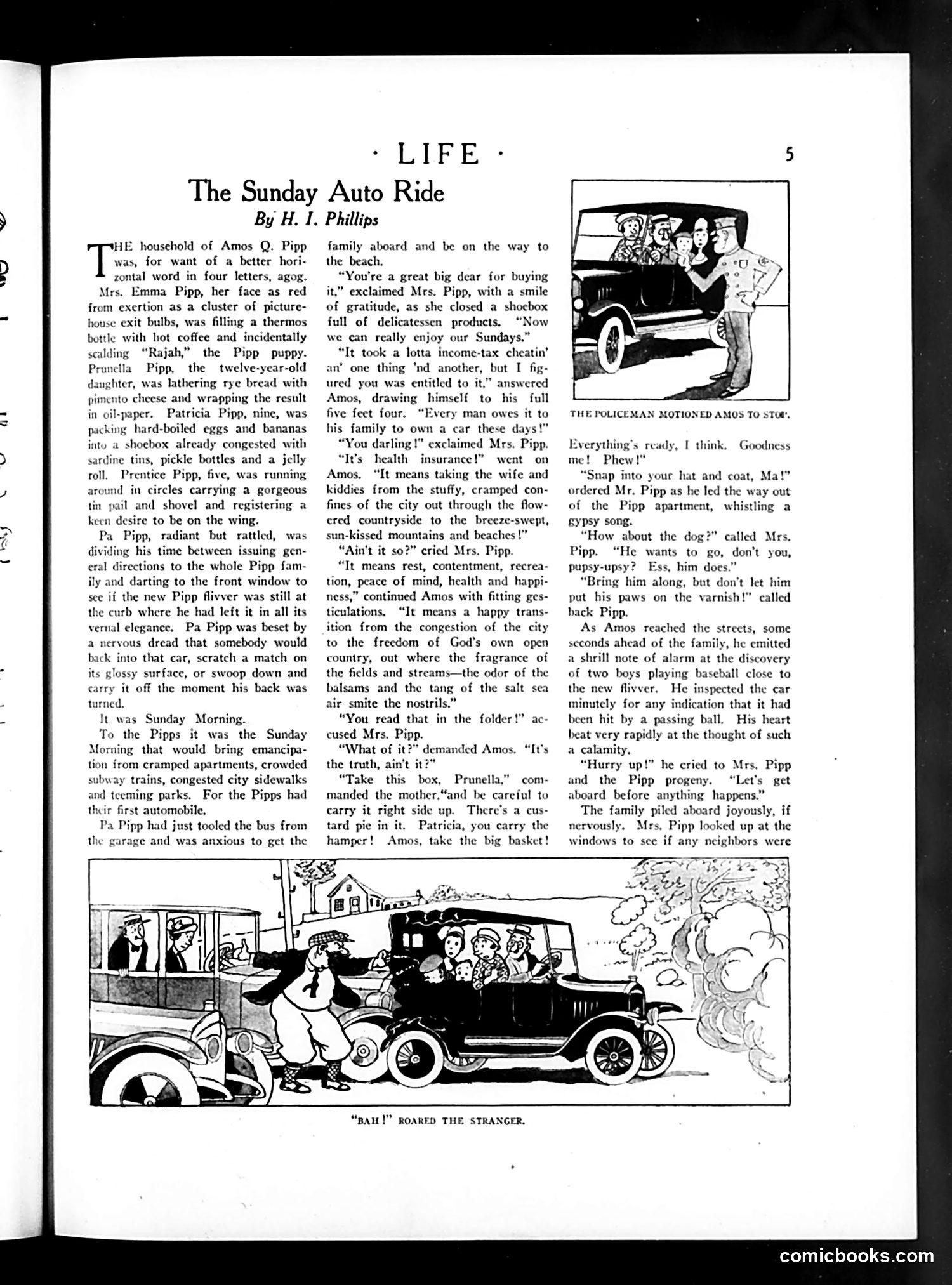
This satirical short story mocks the early automobile era's social pretensions. The Pipp family—working-class apartment dwellers—acquire their first car and embark on a Sunday outing, treating it as a status symbol and health cure. The satire targets how the automobile was marketed as a solution to urban congestion and poor health ("health insurance"), while the family's anxious behavior (worrying about neighbors watching) reveals insecurity about their newfound prosperity. The cartoon caption "BAH! ROARED THE STRANGER" depicts a traffic confrontation, likely satirizing early road etiquette conflicts. Overall, the piece humorously exposes the automobile's role in early 20th-century class anxiety and consumption, where owning a car signaled aspiration to respectability.
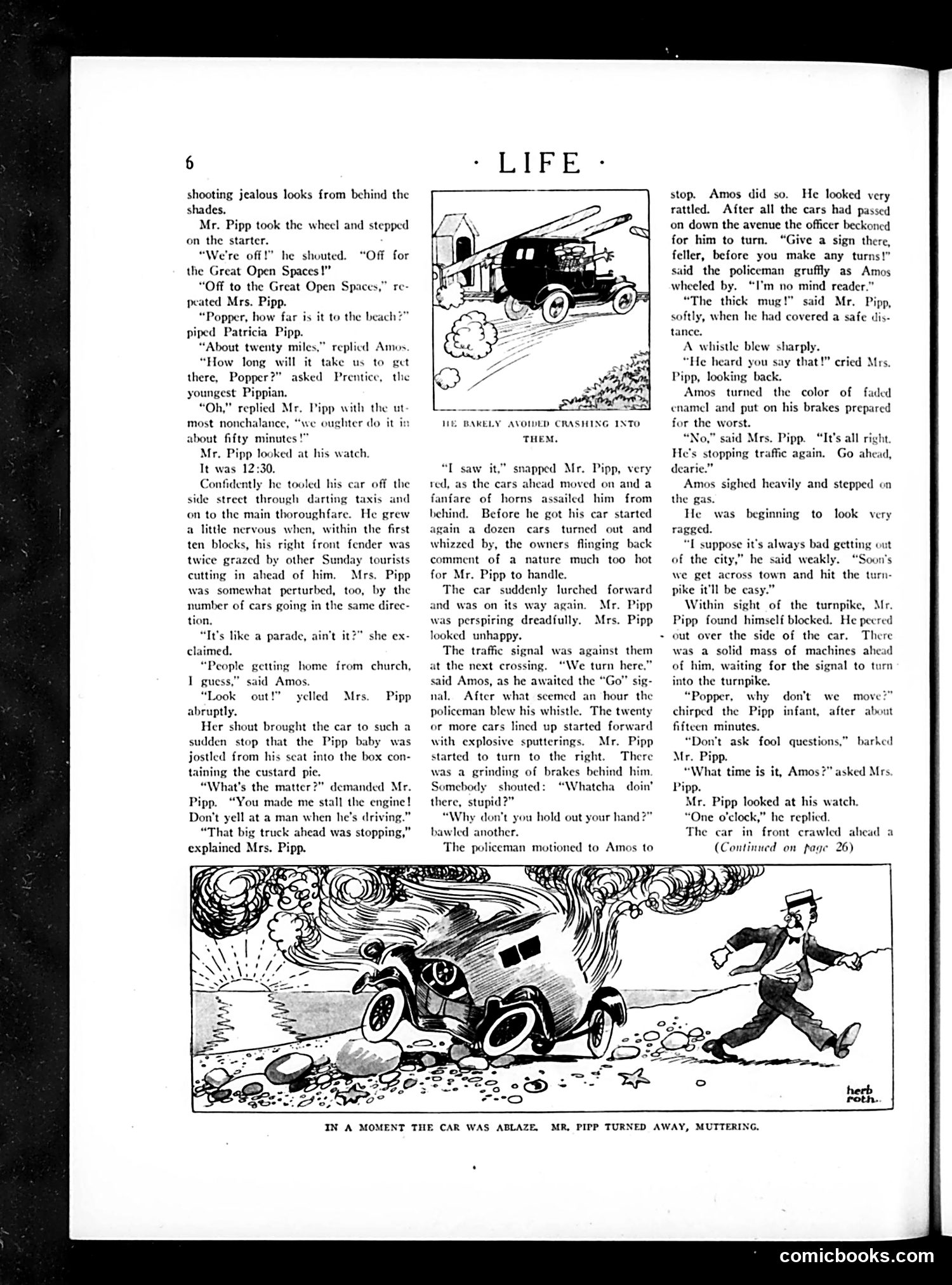
This page depicts a comedic traffic incident involving Mr. Pipp, Mrs. Pipp, and their son Amos. The narrative shows the family attempting to navigate Sunday automobile traffic in what appears to be the 1920s (based on the car styles and dialogue). The humor centers on early automobile culture anxieties: traffic congestion, driving hazards, and the chaos of crowded roads. Mr. Pipp's nervous driving, the policeman's whistle, and the multiple near-collisions satirize the dangers and confusion of nascent car culture. The bottom cartoon shows the car ablaze—a literal comic catastrophe—with Mr. Pipp "turning away, muttering." This exaggerates the frustrations of early motorists facing mechanical failure and traffic pandemonium, making fun of both automobile unreliability and driver stress during this transformative era.
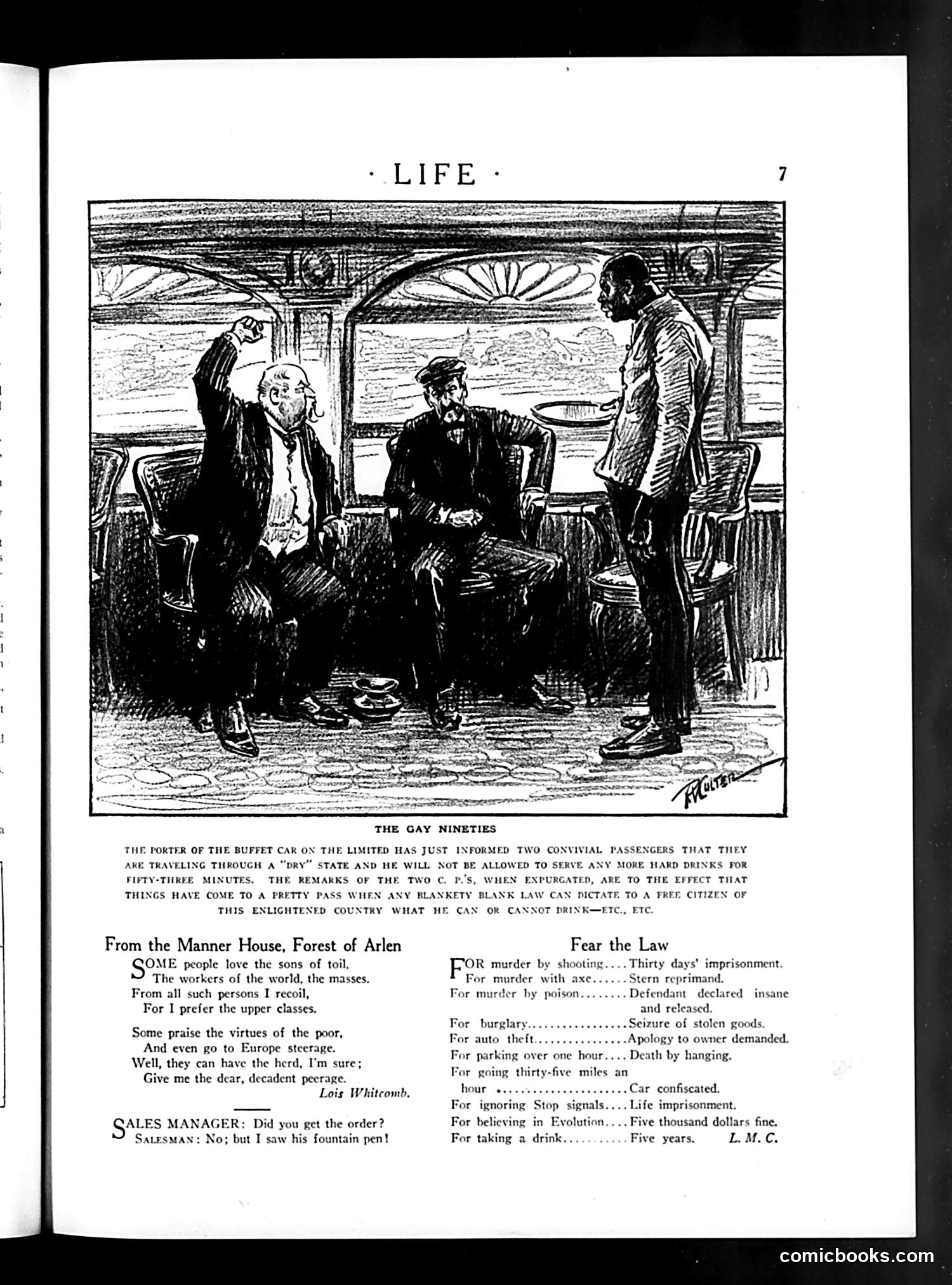
This cartoon depicts railroad officials informing passengers that they must pay extra fees for amenities. The satire critiques how monopolistic railroad companies (operating under minimal regulation) exploit captive customers during the "Gay Nineties" era. The accompanying text mocks excessive legal penalties for minor infractions while corporations face no consequences. "Fear the Law" lists absurd punishments: thirty days for murder by shooting, but life imprisonment for ignoring stop signals or five years merely for taking a drink. The satire's point: ordinary citizens face harsh laws while wealthy industries exploit people through unjust charges with impunity. The poems above reinforce this class critique, celebrating the poor while lamenting preferential treatment of the wealthy. This reflects Progressive Era anxieties about corporate power and legal inequality in unregulated capitalism.
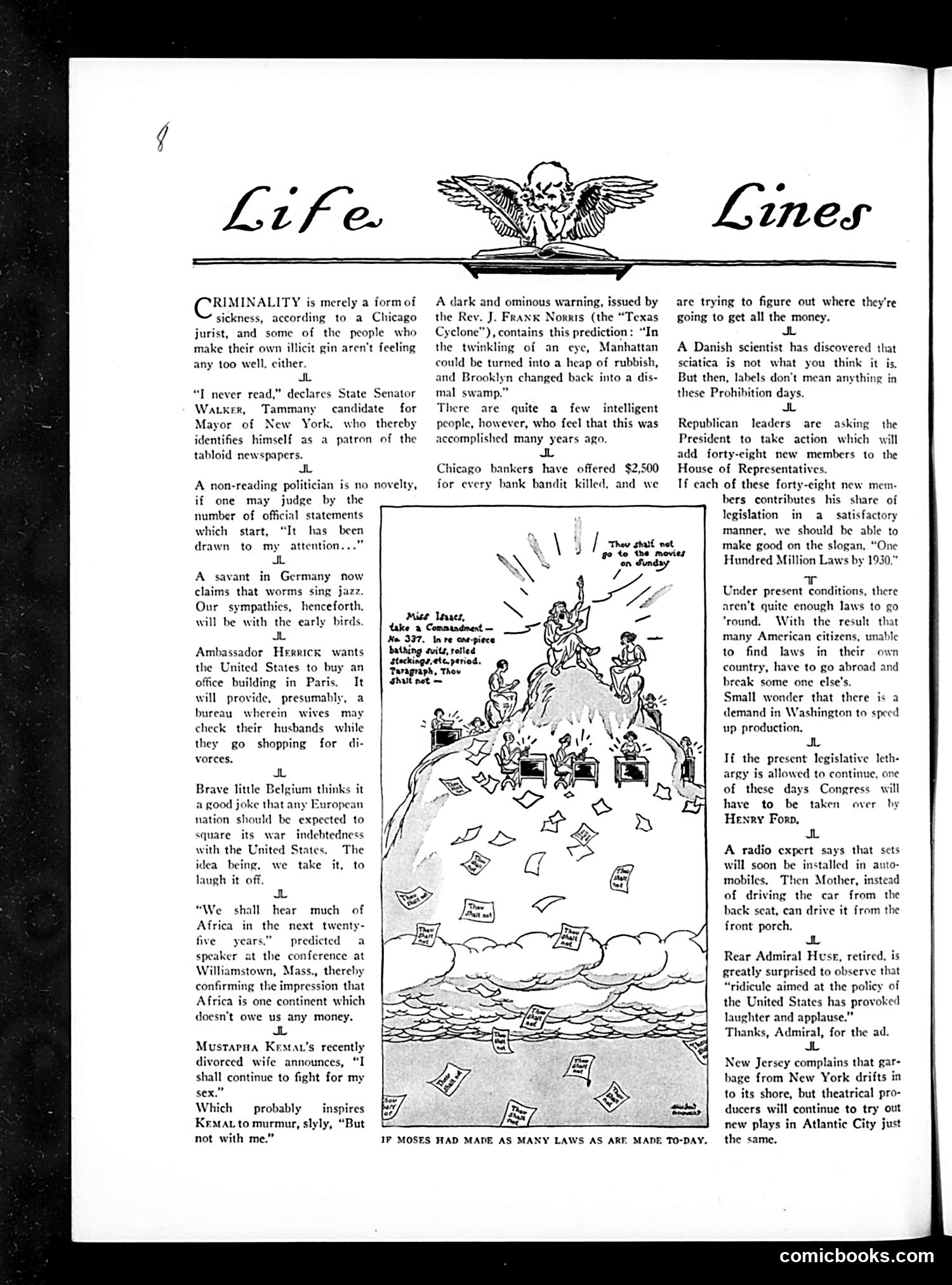
The central cartoon titled "If Moses Had Made As Many Laws As Are Made To-Day" depicts Moses on Mount Sinai receiving the Ten Commandments, but the mountain is literally buried under countless scattered papers and documents—representing modern legislation. The satire criticizes what the accompanying text calls excessive lawmaking. Referenced articles mock various government inefficiencies: too many laws exist to enforce ("aren't quite enough laws to go 'round"), politicians ignore reading official statements, and legislative overreach continues unchecked. The cartoon suggests that modern America produces laws at such an absurd rate that even Moses—the biblical lawgiver—would be overwhelmed. This reflects 1920s-30s frustration with Prohibition-era regulatory expansion and perceived governmental excess.
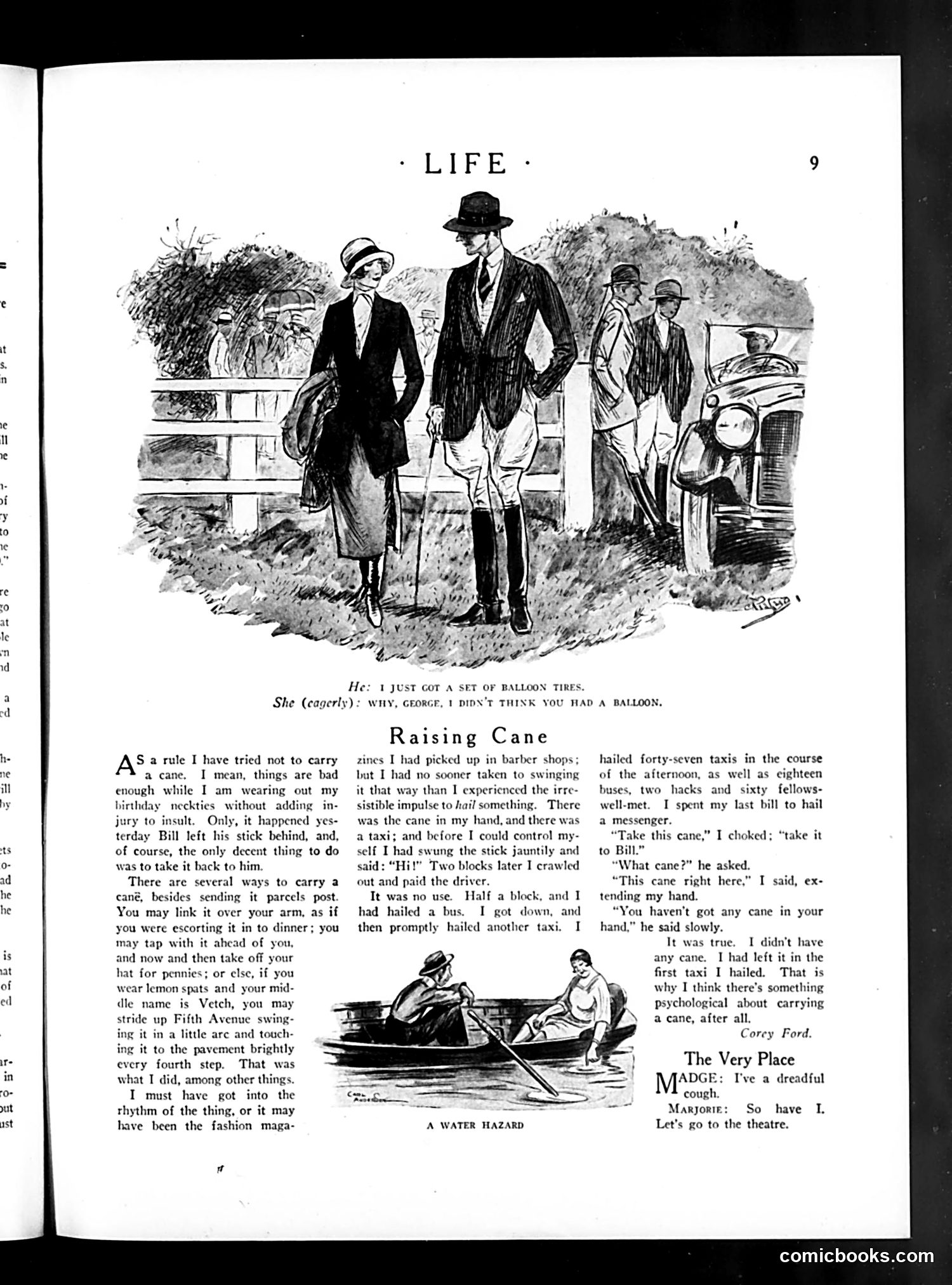
This page contains two separate humorous pieces rather than political commentary. **Top Cartoon:** A man proudly displays new balloon tires to a woman, who responds with mock enthusiasm, questioning why he didn't mention owning them before. The joke plays on the novelty of balloon tires—a relatively recent automotive innovation—suggesting men boast about new possessions. **"Raising Cane" Article:** A comedic essay about the impracticality of carrying a cane as a fashionable accessory. The author humorously catalogs problems: it gets in the way during daily activities, interferes with dining, and causes embarrassment. An accompanying sketch shows someone awkwardly managing a cane while in a rowboat ("A Water Hazard"). The satire targets masculine vanity and fashion trends—here, the affectation of carrying canes despite their obvious inconvenience.
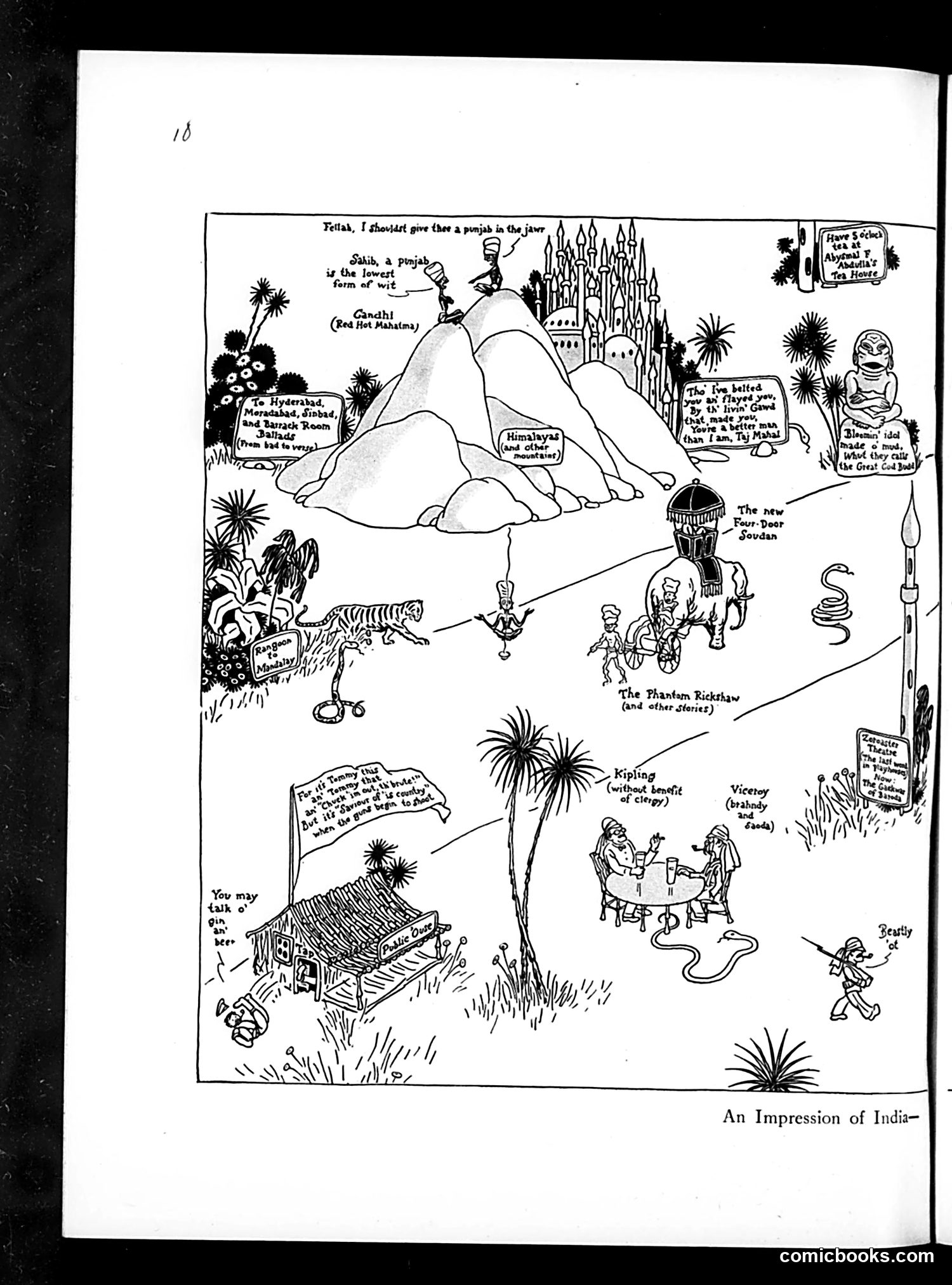
This satirical map presents India as an imaginary landscape populated by stereotypical colonial-era figures and references. The caption at top references "a panjah in the jaw," suggesting British colonial contempt. Labeled locations include: - **Gandhi** (depicted on a hill, representing the independence movement) - **Himalyas** - References to **Kipling** (the British author associated with India) - **The Phantom Rickshaw** and **Viceroy** (colonial administrative power) - Generic "native" figures with exaggerated features The cartoon reflects early 20th-century Western attitudes toward India—treating it as exotic, mysterious, and populated by caricatures rather than real people. It mocks both Indian independence aspirations and British colonial presence through crude stereotyping typical of the era's mainstream American satirical humor.
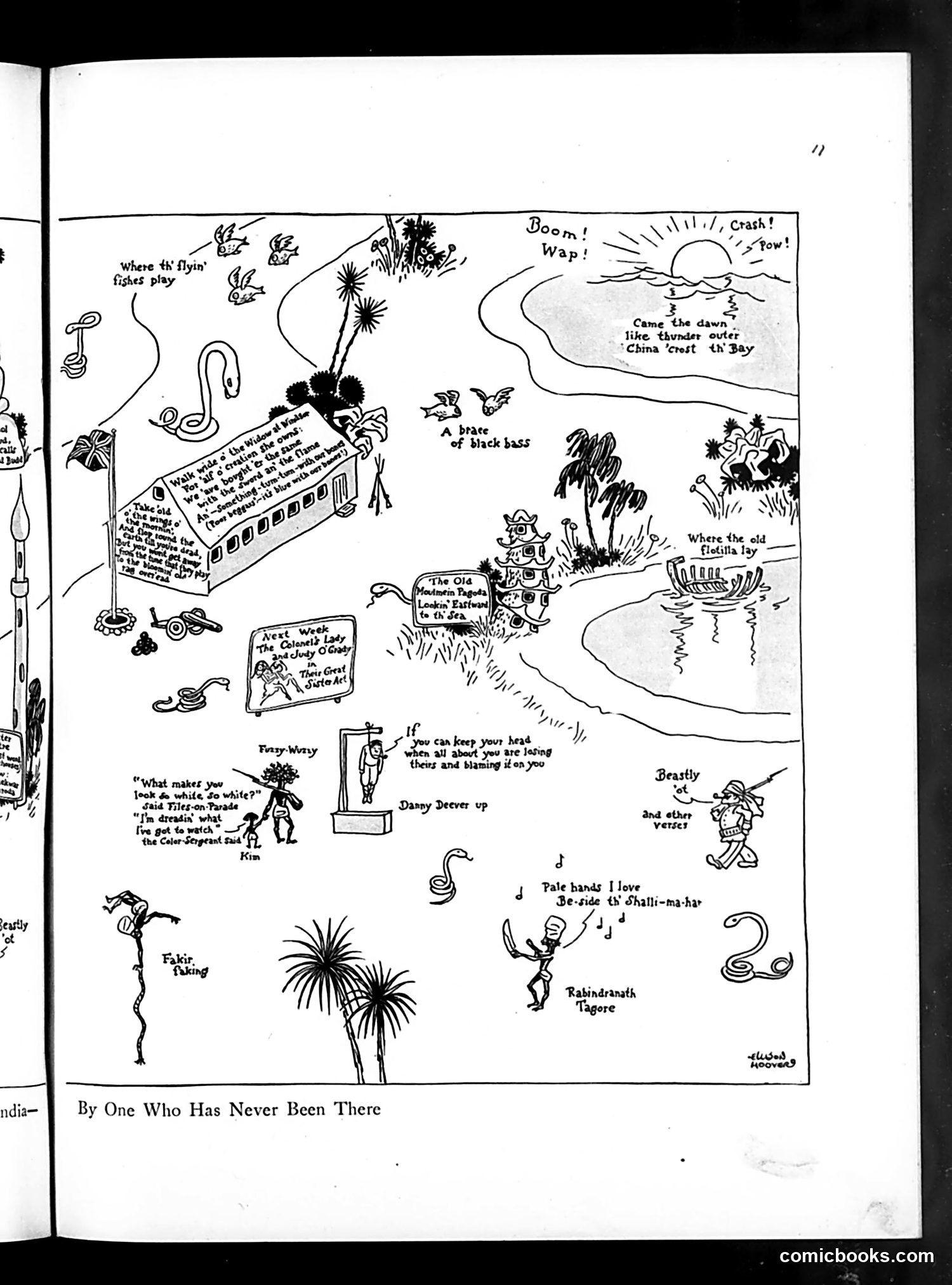
This satirical illustration mocks Western stereotypes and clichés about India. The cartoonist presents an exaggerated, fantastical vision of Indian geography, wildlife, and culture as imagined by someone unfamiliar with the actual country. The page includes absurd juxtapositions: "flying fishes," snakes, palm trees, and references to colonial-era British perceptions ("The Old Mahamarajah," "London-Eastcott"). Characters labeled with Indian names (Rabindranath Tagore, Fakir Tahing) appear alongside comedic caricatures and snake charmers—perpetuating Orientalist stereotypes. The title itself is the joke: the artist is satirizing how Westerners confidently describe places they've never visited, relying on secondhand stereotypes rather than actual knowledge. This reflects early-20th-century Life magazine's satirical approach to colonial attitudes.
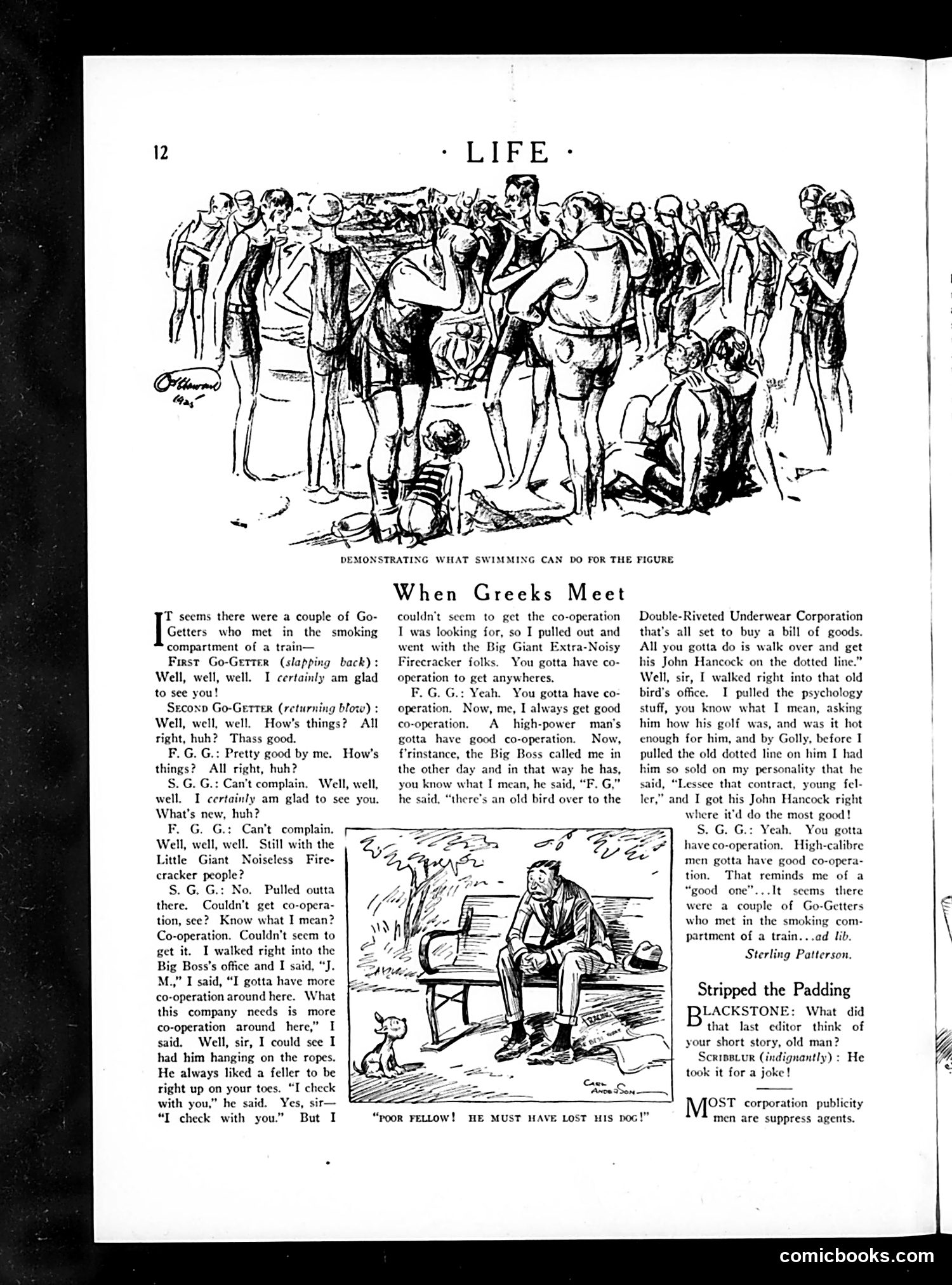
This page contains satirical dialogue between "Go-Getters" discussing corporate inefficiency and lack of cooperation. The humor centers on a businessman's complaint about needing better "co-operation" within his company—a complaint he ironically undermines by failing to cooperate himself with others. The accompanying sketch depicts a disheveled man on a bench with a small dog, captioned "Poor fellow! He must have lost his dog!"—a visual non-sequitur that plays on misunderstanding. The lower section, "Stripped the Padding," mocks corporate publicity departments as "suppress agents" who rejected a satirical short story as a joke, suggesting these departments actively censor negative portrayals of business. The satire targets early 20th-century corporate culture's emphasis on "co-operation" as management jargon while practices remained cutthroat and self-serving.
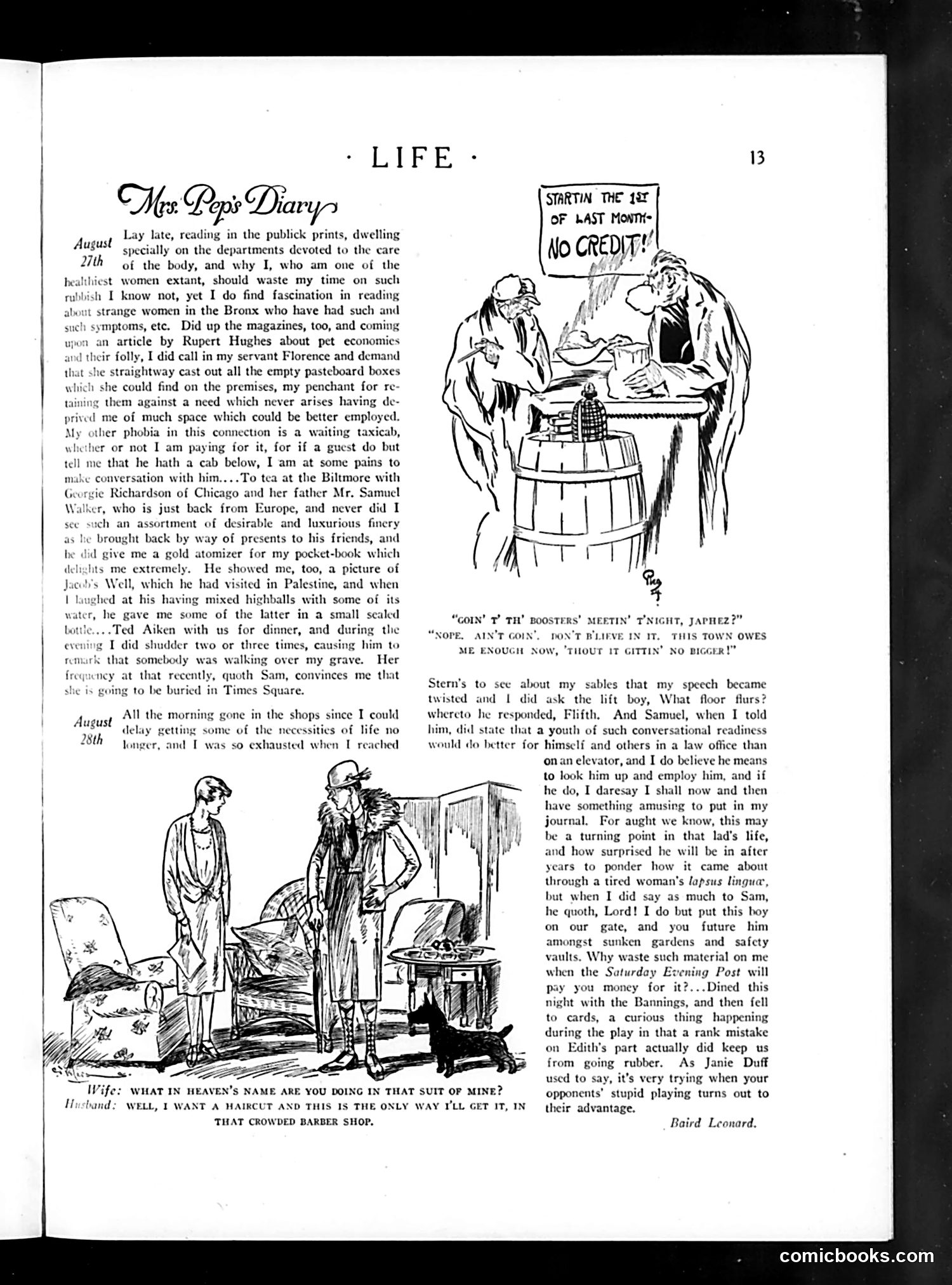
This page from *Life* magazine contains two elements: **Upper cartoon:** Shows two men at a table with a sign reading "STARTIN' THE 1ST OF LAST MONTH— NO CREDIT!" The caption suggests a conversation about financial hardship and credit denial, likely satirizing the economic struggles of ordinary people during a period of financial difficulty (possibly the 1920s-30s). **Lower cartoon:** Depicts a husband and wife in conversation about clothing. The husband protests wearing a suit to a barber shop, saying "I want a haircut and this is the only way I'll get it in that crowded barber shop." This satirizes how crowded public spaces were, forcing people into awkward situations. Both cartoons use humor to comment on everyday economic and social inconveniences of the era.
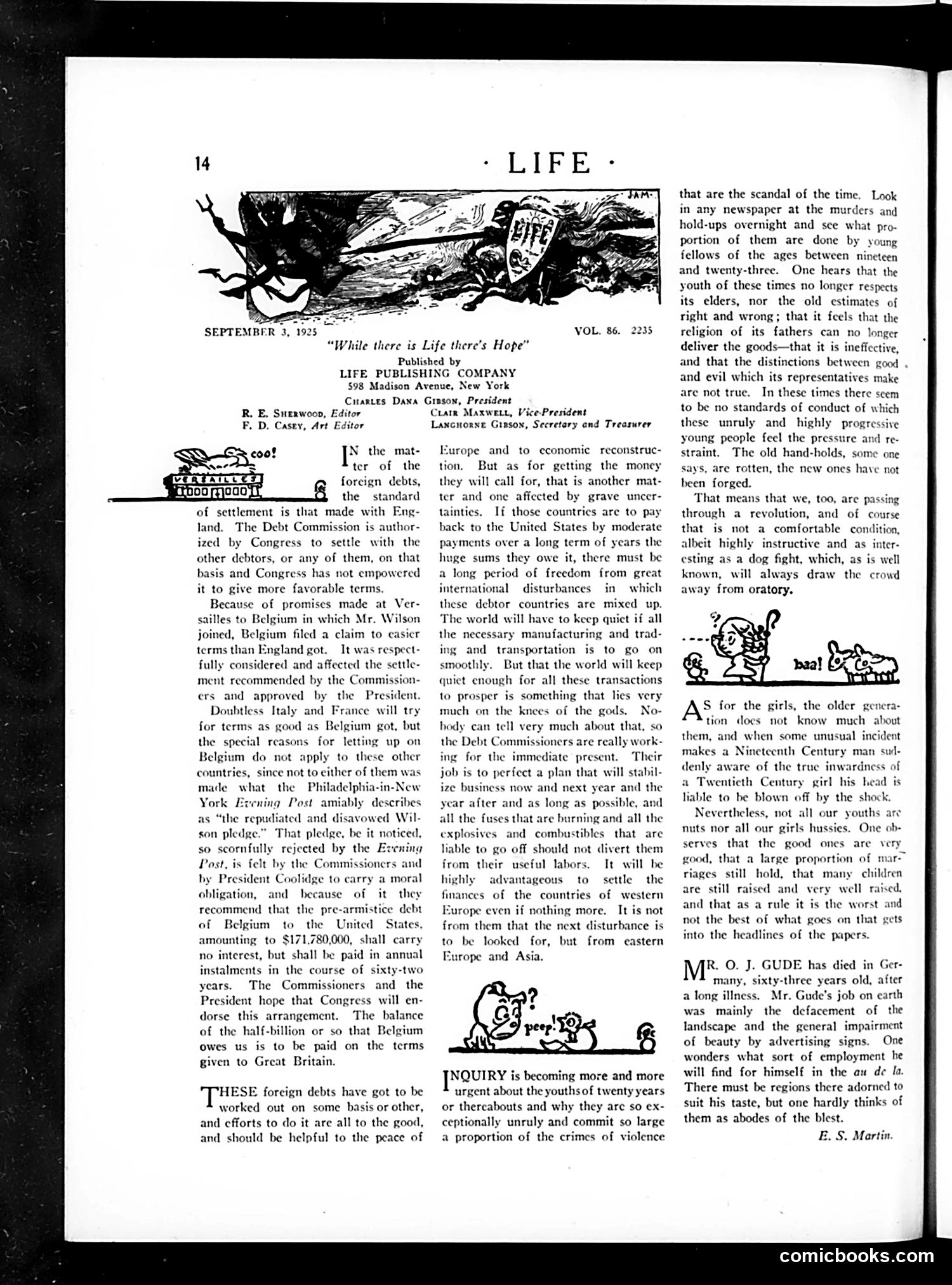
The page contains editorial commentary on post-WWI economic issues and youth behavior. The main cartoon (top) depicts a figure labeled "RIFF" apparently involved in violence or crime—likely referencing the Rif War in Morocco, where French colonial forces faced armed resistance. The text discusses foreign debt repayment from European nations, advocating for practical settlement terms. A secondary cartoon shows a domestic scene with animals, illustrating concerns about youth criminality and moral decline. The editorial expresses anxiety about young people (ages 19-23) who supposedly disrespect authority, commit murders and robberies, and reject traditional morality. The author attributes this to post-war social disruption and generational pressure, while suggesting most youth are still properly raised. The page reflects 1920s anxieties about crime, modernization, and generational conflict.
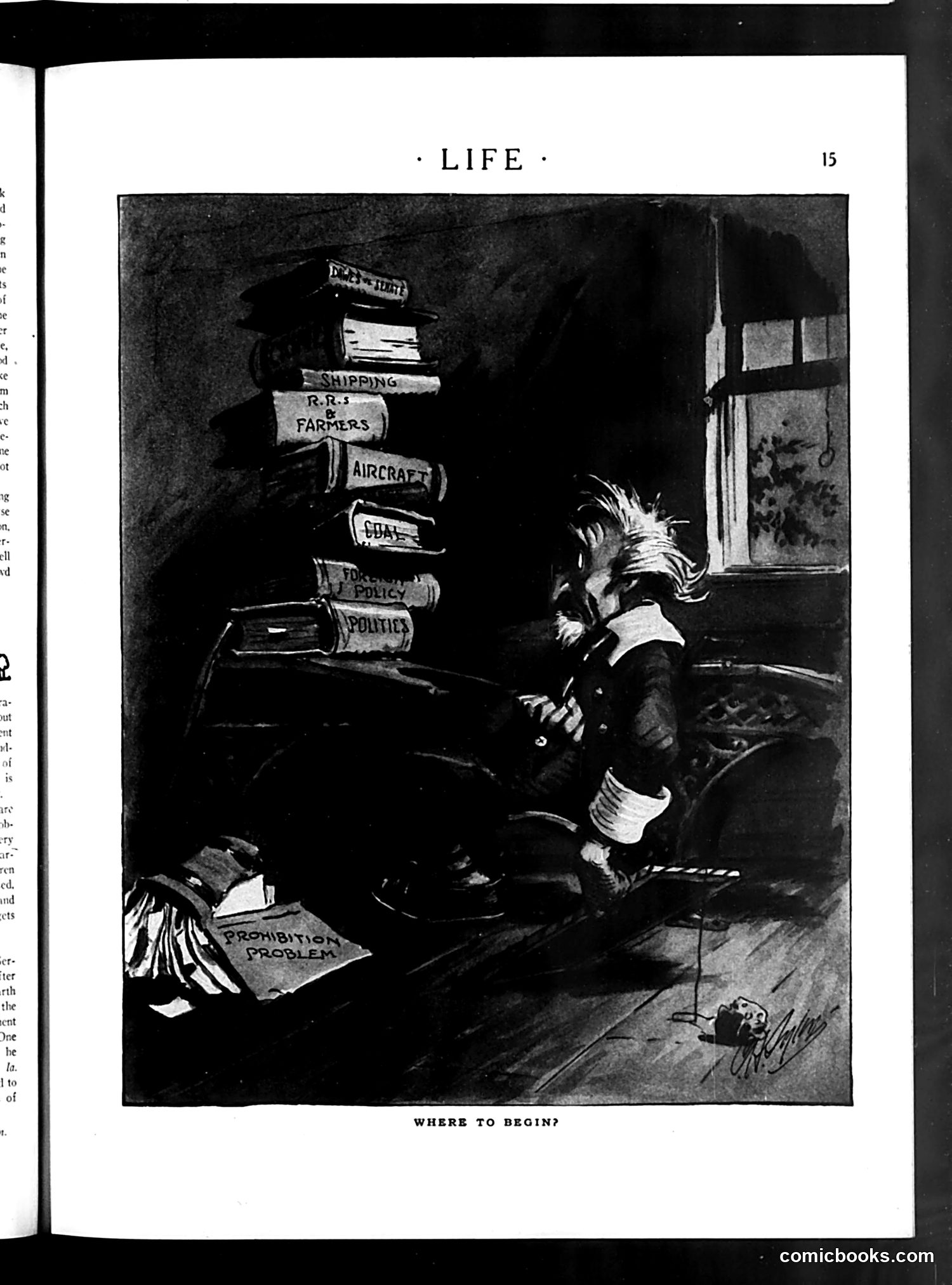
This satirical cartoon depicts Uncle Sam (identifiable by his distinctive hat and patriotic appearance) confronted by an enormous, unstable stack of labeled problems. The precariously balanced tower includes: "Prohibition Problem," "Politics," "Tax Policy," "Coal," "Aircraft," "Farmers," "Shipping," and other contemporary issues. The cartoon's caption—"Where to Begin?"—expresses the satirical point: the U.S. government faced so many urgent, interconnected crises simultaneously that addressing them seemed impossibly difficult. The image suggests these problems are dangerously stacked and liable to collapse. This appears to reference the 1920s post-WWI period when America grappled with prohibition enforcement, labor disputes, agricultural depression, and political corruption—overwhelming domestic challenges that made coherent policy-making seem nearly impossible.
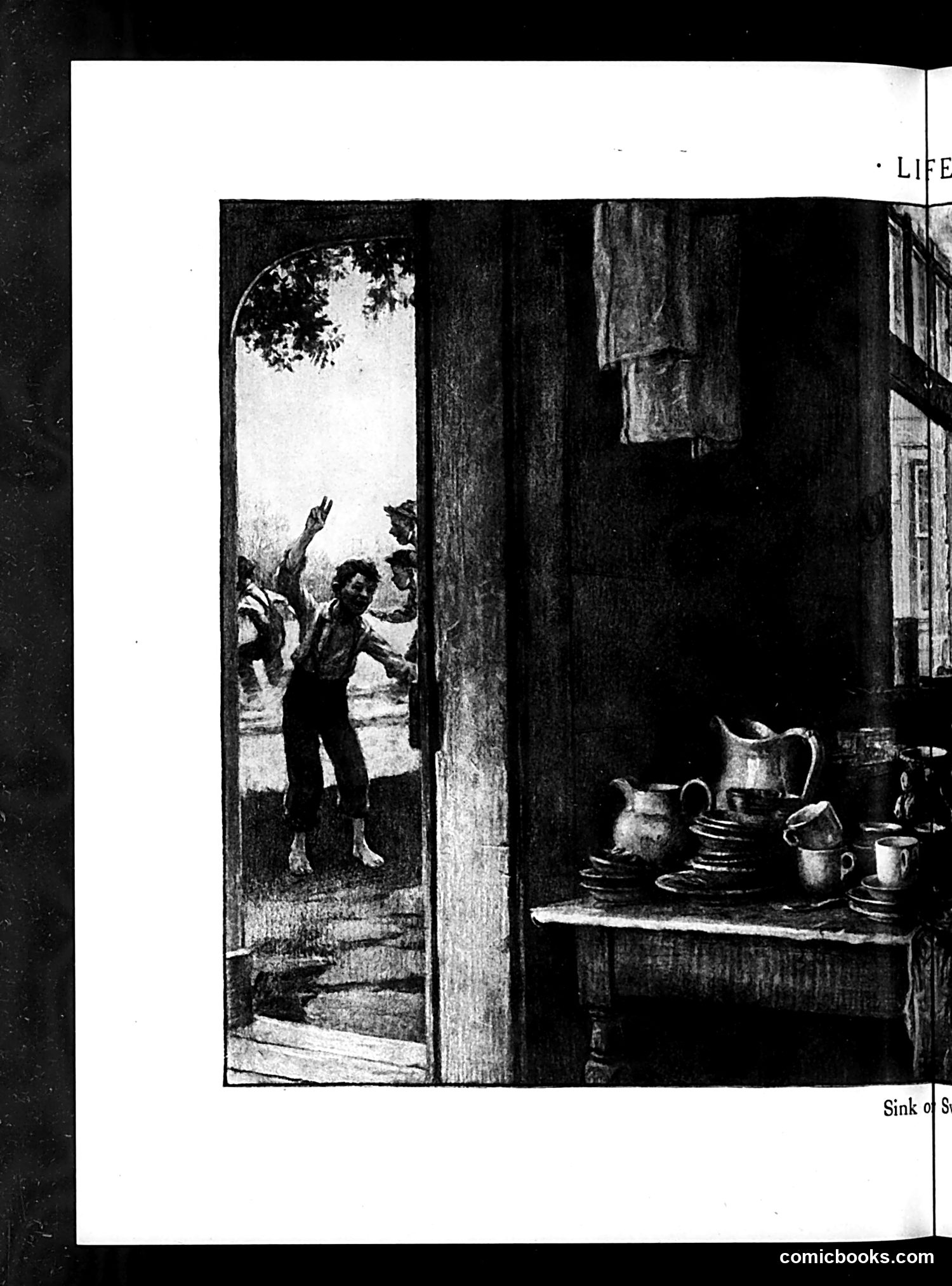
This appears to be a domestic scene illustration titled "Sink of S[omething]" (text cut off). The image shows a stark contrast: through an open door, a woman stands outside in bright daylight with her arm raised, apparently calling or gesturing; inside the dark kitchen, another figure works at a sink surrounded by dishes and household items. The satirical point likely critiques the isolation and drudgery of domestic labor—the woman trapped indoors doing endless dishwork while life and freedom exist just outside the door. The visual metaphor of the dark interior versus bright exterior emphasizes the confined, bleak nature of domestic servitude, a common theme in early 20th-century social commentary about women's roles and domestic expectations.
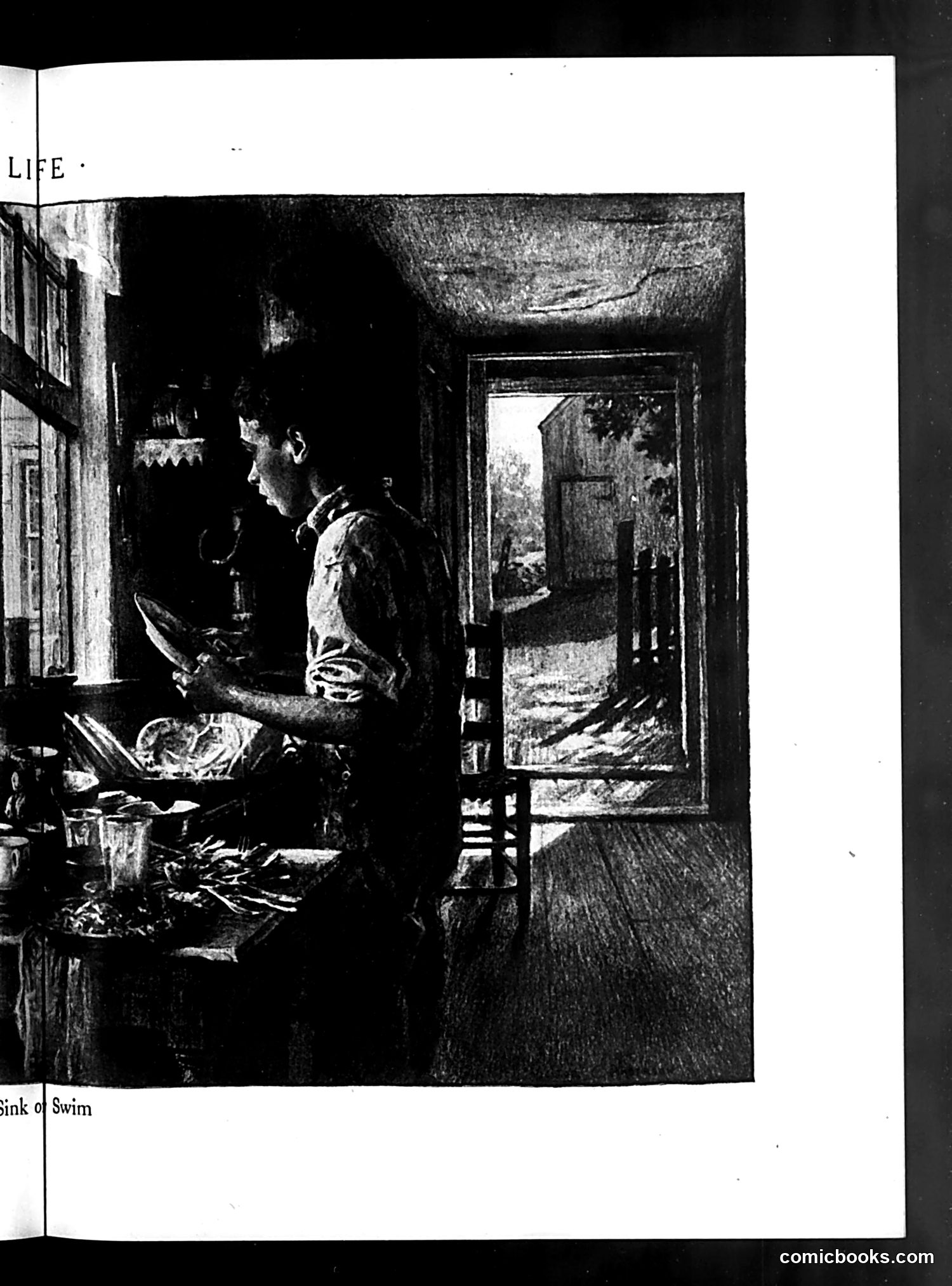
This appears to be a domestic scene from Life magazine, showing a woman at a kitchen sink near an open door. The caption reads "Sink or Swim," suggesting a play on words about household duties or domestic life circumstances. The image depicts modest, humble living conditions—a simple kitchen with basic furnishings visible through the doorway. The satire likely comments on economic hardship or the struggle of working-class or lower-income households, particularly women managing domestic responsibilities with limited resources. The "sink or swim" metaphor suggests facing adversity without assistance—a commentary on either economic conditions, social inequality, or the challenges of household management. Without additional context about the specific publication date, the precise satirical target remains unclear, though it appears critical of social or economic conditions affecting ordinary people.
This page reviews several Broadway plays from the 1925-26 season. The critic uses sharp satire to mock theatrical pretension and tired formulas. "The Little Poor Man"—a prize-winning "poetic drama" about St. Francis of Assisi with 29 cast members and eight bearded actors—is ridiculed as self-important drivel. The critic suggests the audience consisted mainly of members from the "Bide-a-Wee Home" (an animal shelter), implying the play attracted only strays. "A Lucky Break" features George MacFarlane as a returning rich man testing old friendships—a tired plot device. The critic mocks the desperate insertion of musical numbers, including one where MacFarlane grinds an ice-cream freezer in a hotel lobby while singing about a player organ. "It All Depends" features Katherine Alexander but suffers from the worn trope of a "long-suffering mother" shaming the younger generation. "The Family Upstairs" receives slightly more respect as honest, unpretentious middle-class comedy. The satire targets both formulaic plots and theatrical self-importance masquerading as art.
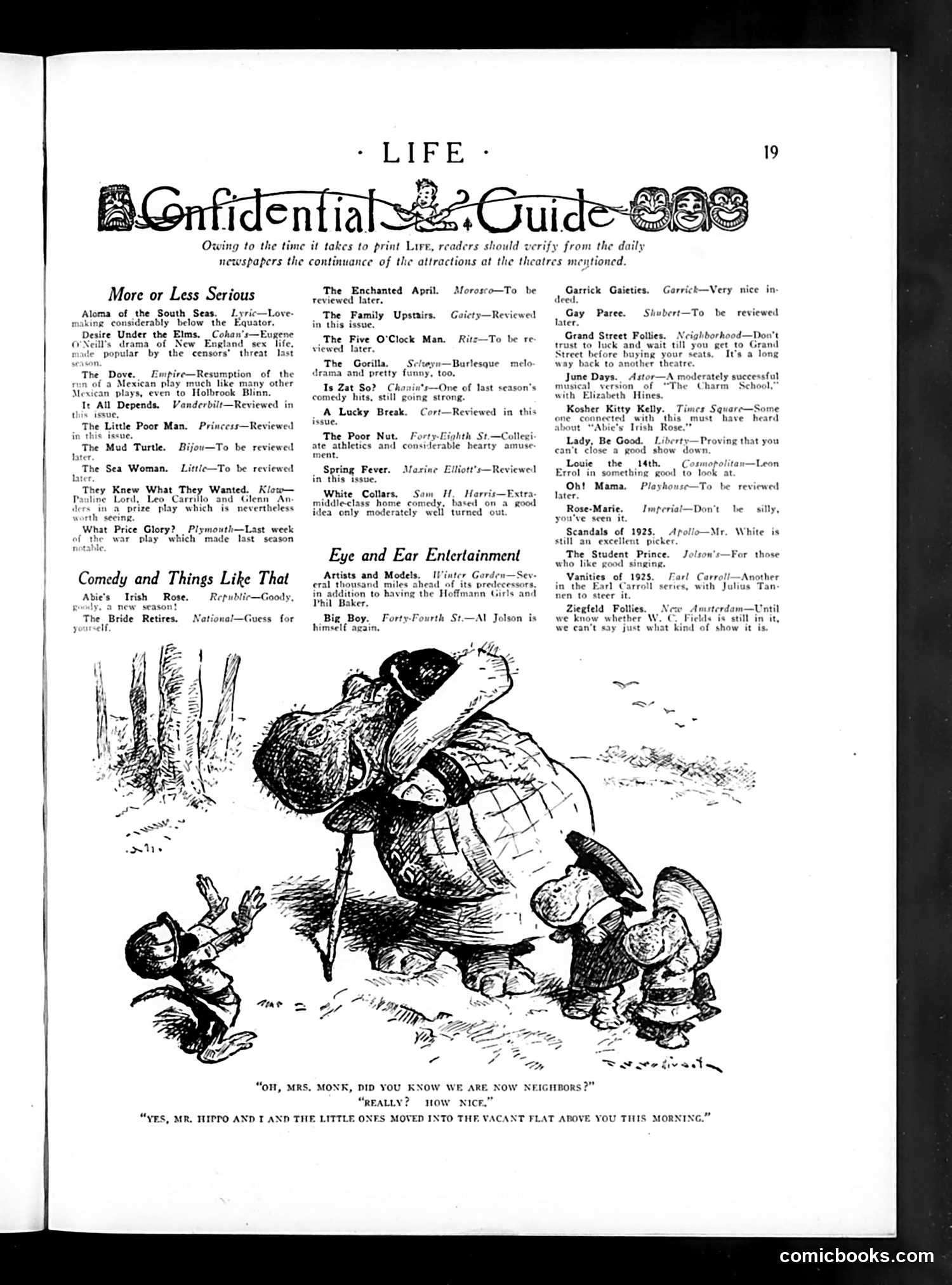
This page is a **theater listings and reviews section** for Broadway shows, typical of Life magazine's entertainment coverage in the 1920s. The OCR'd text provides brief, often witty reviews of current theatrical productions. The **cartoon at the bottom** depicts a large hippopotamus and two small gnomes or elves as neighbors. A woman (Mrs. Monk) expresses surprise at this new neighborhood arrangement, with the gnomes cheerfully confirming they've moved into the flat above her. The joke appears to be **absurdist humor**—the cartoon juxtaposes the mundane social ritual of neighbors greeting each other with the absurd scenario of a hippo and magical creatures as new residents. This reflects Life's tradition of whimsical, surreal humor rather than pointed political satire. The gag relies on the contrast between polite domestic pleasantries and the ridiculous impossible situation, typical of 1920s American magazine humor.
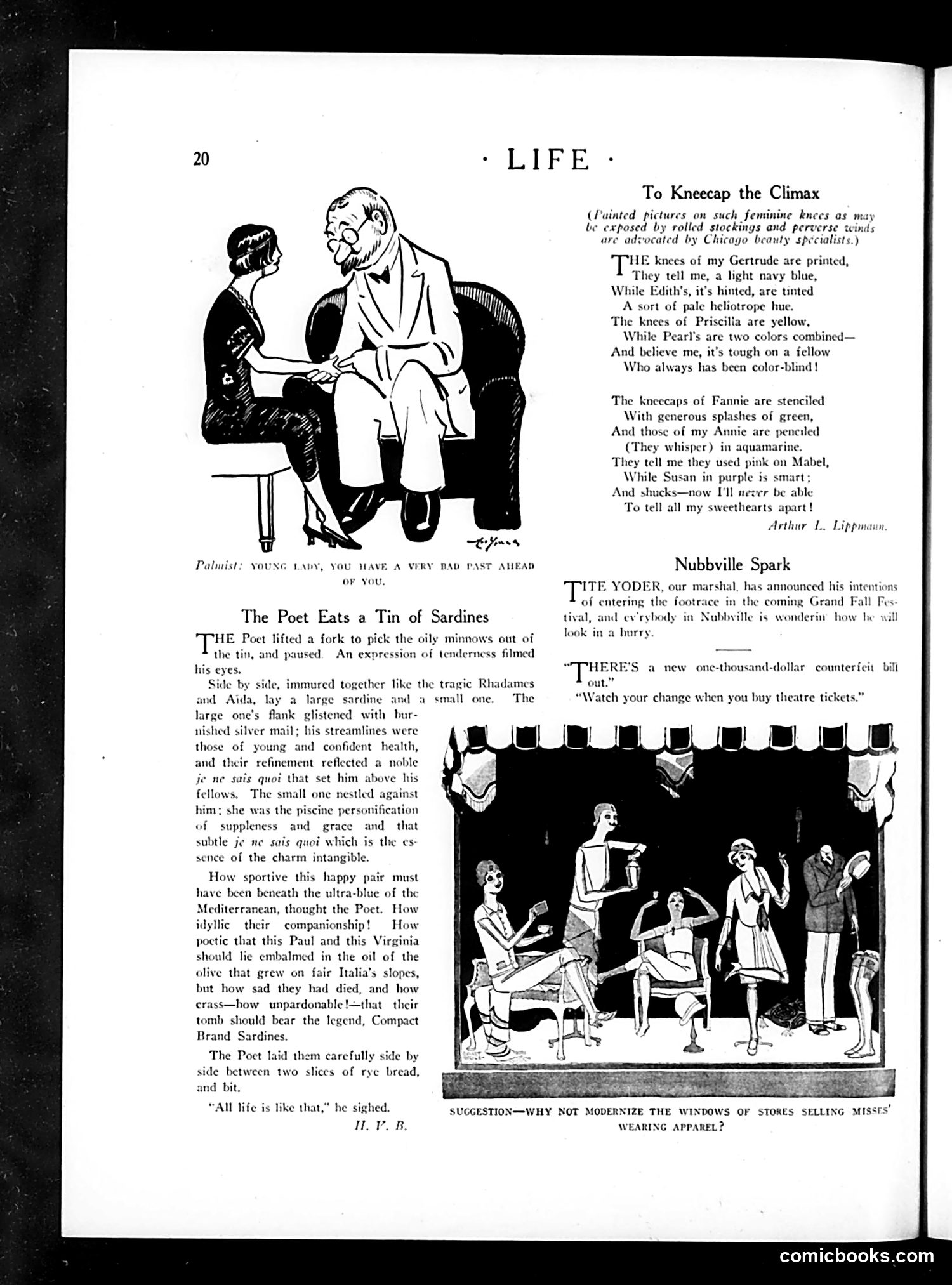
This page contains three satirical pieces typical of early 20th-century American humor: **"The Poet Eats a Tin of Sardines"** mocks overly sentimental, romantic poets. A poet finds two sardines in a tin and projects an elaborate tragic love story onto them (comparing them to operatic lovers Radames and Aida), only to eat them matter-of-factly. The joke: his pretentious philosophizing ("All life is like that") contrasts absurdly with the mundane reality of eating canned fish. **"To Kneecap the Climax"** satirizes a Chicago beauty trend where women painted decorative designs on their knees, exposed by rolled stockings (fashionable in the 1920s). The poem humorously complains that a color-blind man can no longer distinguish his various sweethearts by their painted kneecaps—mocking both the frivolous fashion and changing courtship customs. **"Nubbville Spark"** is a small-town gossip column joke about a counterfeit bill in circulation. All target contemporary social trends and vanities with gentle, sophisticated ridicule typical of Life's editorial voice.
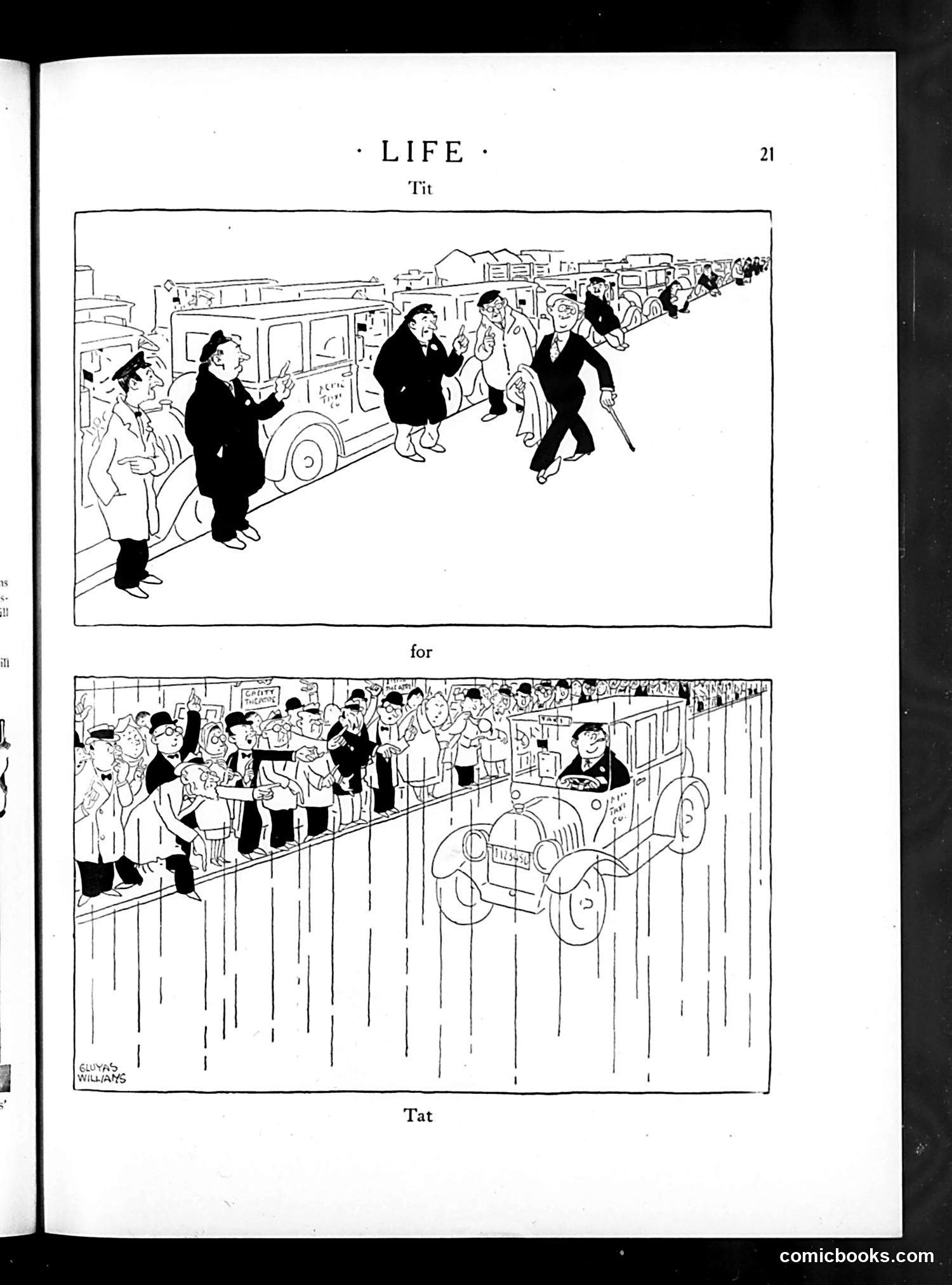
This page presents two contrasting scenes labeled "Tit for Tat," satirizing automobile traffic and behavior circa early-to-mid 20th century. **Top panel ("Tit"):** Shows a long queue of cars and pedestrians waiting patiently in an orderly line. **Bottom panel ("Tat"):** Depicts the same scenario reversed—a massive crowd of pedestrians waits behind a barrier while a single car speeds past on a race track. The cartoon satirizes the imbalance and growing power of automobiles in urban spaces. It suggests that drivers receive preferential treatment and expedited passage through city streets, while pedestrians must wait in lengthy queues. The "tit for tat" title implies a reciprocal arrangement that's decidedly unfair to foot traffic. This reflects early automotive-era tensions about urban congestion and competing claims on public streets.
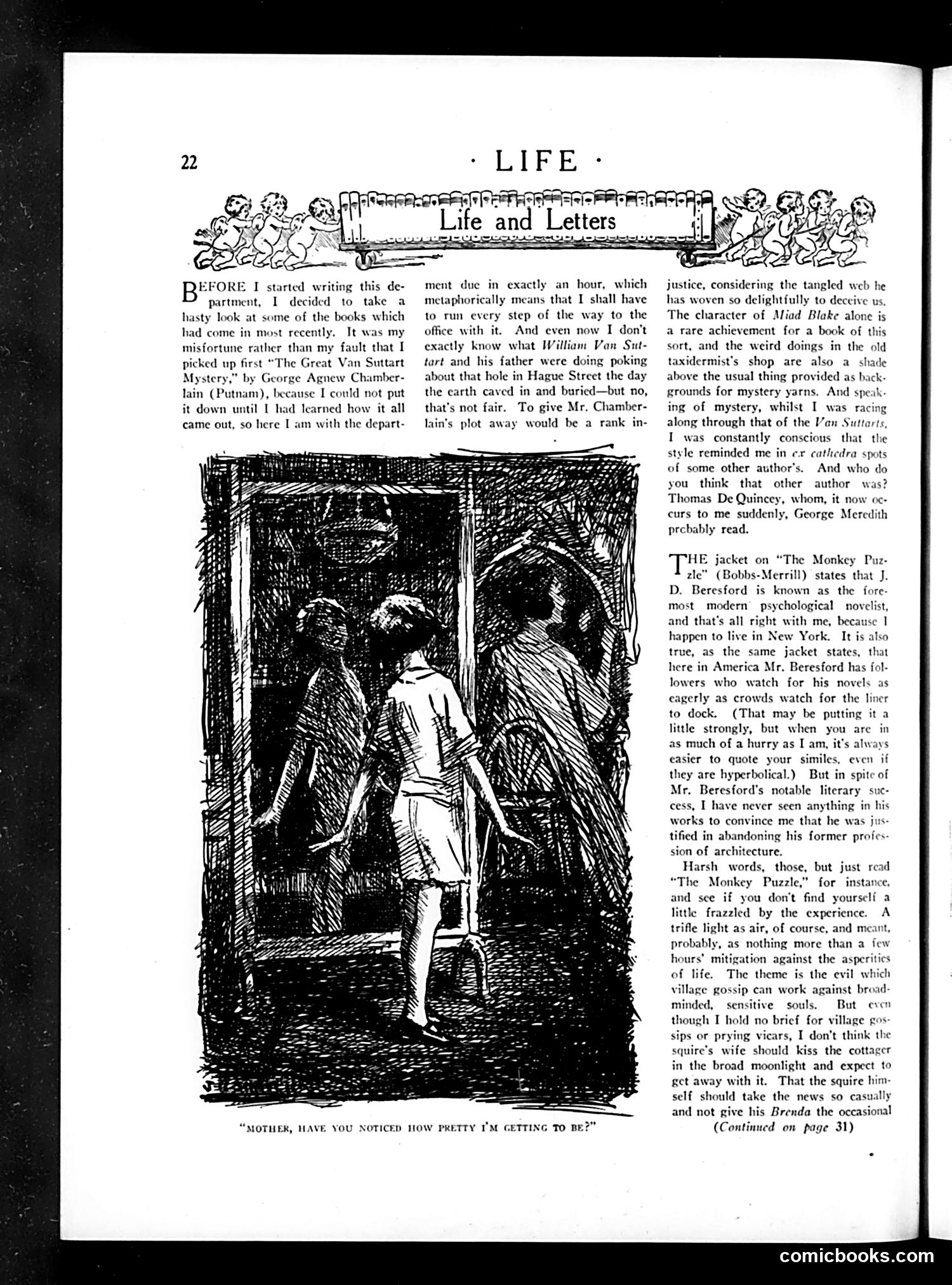
This page is a **book review column**, not political satire. The author reviews recent novels, including "The Great Van Suttart Mystery" by George Agnew Chamberlain and "The Monkey Puzzle" by J.D. Beresford. The illustration shows a woman entering a doorway, captioned "Mother, have you noticed how pretty I'm getting to be?"—likely depicting a scene from one of the reviewed books. The reviewer's tone is witty and dismissive. He praises the Van Suttart mystery's plotting but criticizes Beresford's "Monkey Puzzle" for its trivial theme about village gossip and moral impropriety (a woman kissing a cottager). The reviewer sarcastically questions why Beresford abandoned architecture for writing, suggesting his literary work is unimpressive despite his reputation as a "foremost modern psychological novelist." The satire targets pretentious literary reputations and shallow modern fiction rather than political figures.
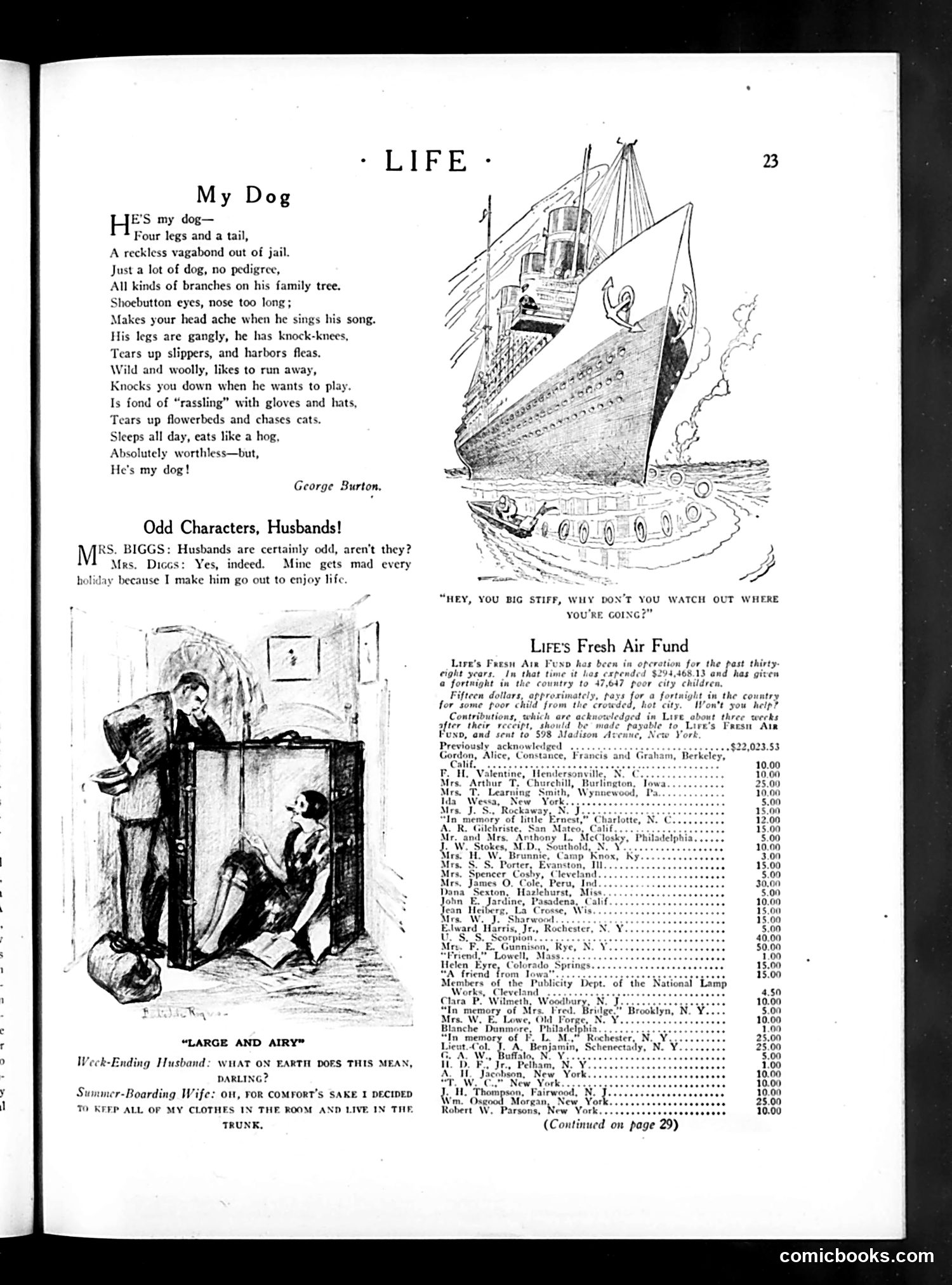
This page combines light domestic humor with a charity appeal. **"My Dog"** is a humorous poem by George Burton celebrating a mongrel dog—described as worthless, flea-ridden, destructive, and lazy—yet loved unconditionally by its owner. The affectionate contradiction was relatable to common-dog owners. **"Odd Characters, Husbands!"** features two brief comic dialogues mocking marital dynamics. One husband resents being forced to enjoy holidays; another discovers his summer-vacationing wife has compressed all her belongings into their shared trunk to maximize comfort—satirizing the absurdity of domestic compromise. **The main content** is **Life's Fresh Air Fund**, a charitable initiative providing poor city children two-week countryside vacations. Established thirty-eight years prior, it had funded 47,647 trips. The appeal solicits donations ($15 for one child's stay) and lists recent contributors. The page juxtaposes light entertainment with social responsibility—typical of Life's editorial approach, mixing satire and genuine philanthropic messaging.
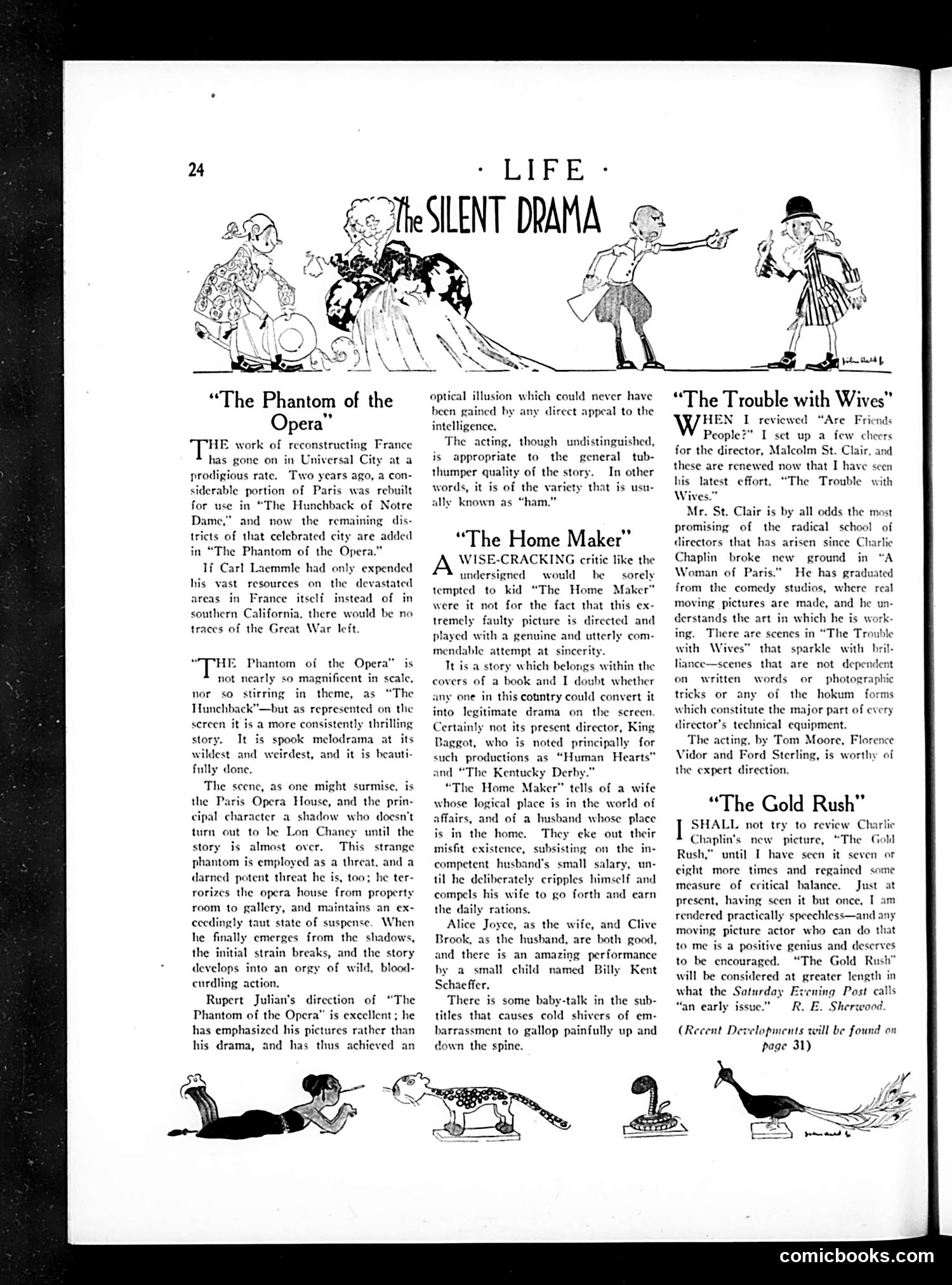
This page reviews four silent films, satirizing both the movies and Hollywood's priorities. **"The Phantom of the Opera"** receives praise for visual thrills despite weak drama. The reviewer quips that Universal Studios spent vast resources recreating Paris in California for sets when they could have rebuilt actual war-devastated France. **"The Home Maker"** is criticized as fundamentally unsuited to cinema—a book adapted poorly. The reviewer mocks the "baby-talk" subtitles that cause "cold shivers of embarrassment." **"The Trouble with Wives"** praises director Malcolm St. Clair as the most promising of the "radical school" since Chaplin, noting scenes that "sparkle with brilliance" without relying on words or "hokum." The cartoons at top and bottom appear to satirize silent cinema generally—exaggerated physical comedy and melodramatic acting that defined the era. The overall tone: silent films succeed through visual spectacle, not storytelling or dialogue.
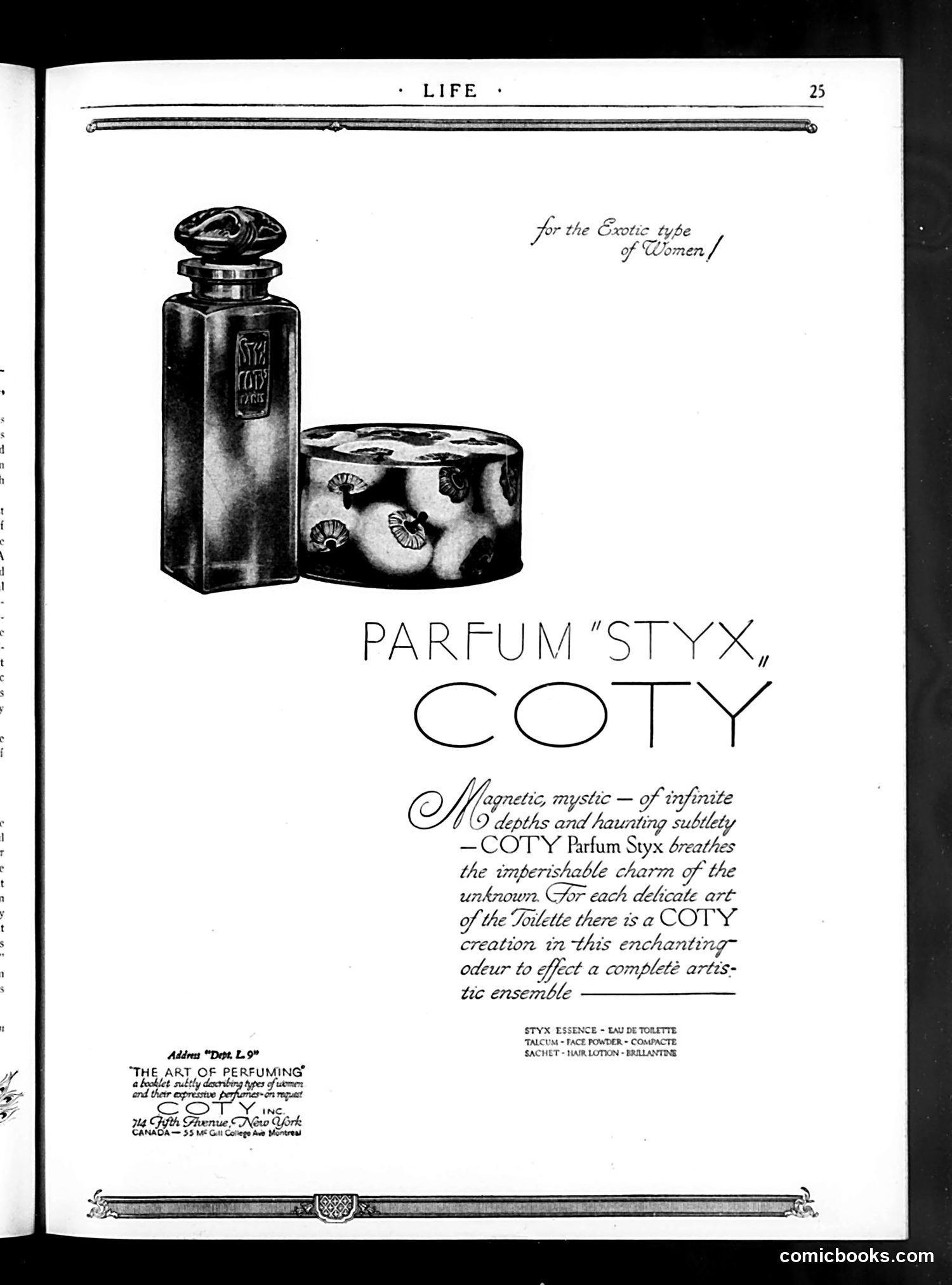
This is a **perfume advertisement**, not a political cartoon. It promotes Coty's "Styx" fragrance line to women. **The ad's appeal:** References to classical mythology ("Styx," the river in Greek underworld) combined with pseudo-mystical language ("magnetic, mystic—of infinite depths") to market perfume as exotic and sophisticated. The tagline "for the Exotic type of Women" targets women seeking glamorous, mysterious personas. **Visual elements:** A decorative bottle with ornate stopper and matching powder compact with fan motifs convey luxury and art-deco styling. **Historical context:** Early 20th-century perfume marketing often used classical allusions and appeals to feminine mystique to justify premium pricing. The full product line (essence, powder, lotion) suggests comprehensive beauty routines were becoming standardized consumer expectations. The "Art of Perfuming" booklet offer indicates manufacturers positioned fragrance as refined self-expression rather than mere hygiene.
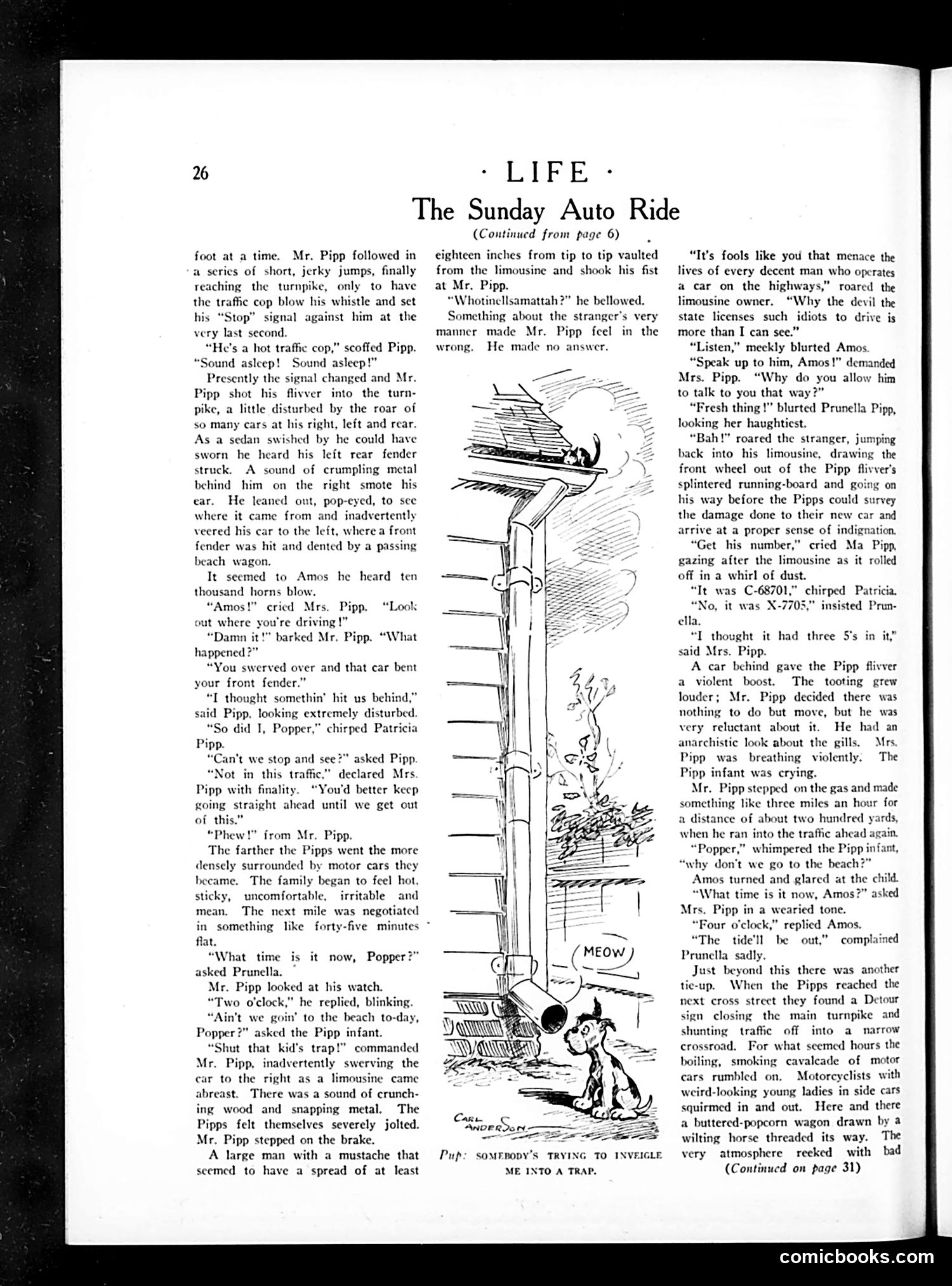
This is a humorous story satirizing early automobile culture and the chaos of Sunday driving. Mr. Pipp and his family attempt a leisurely beach trip in their "flivver" (cheap car), but encounter endless traffic congestion, multiple collisions, and aggressive fellow motorists. The satire targets several aspects of 1920s car culture: reckless driving, road rage, traffic accidents, and the strain automobiles place on families. The repeated collisions—each seeming minor yet accumulating—mock how commonplace car accidents had become. The family's bickering, Mr. Pipp's irritability, and inability to even identify the other driver's license plate satirize both driver incompetence and the general stress modern motoring inflicts. The accompanying illustration shows a car collision with a pole, reinforcing the joke: the Sunday drive meant to be leisurely becomes stressful, accident-prone, and unsuccessful.
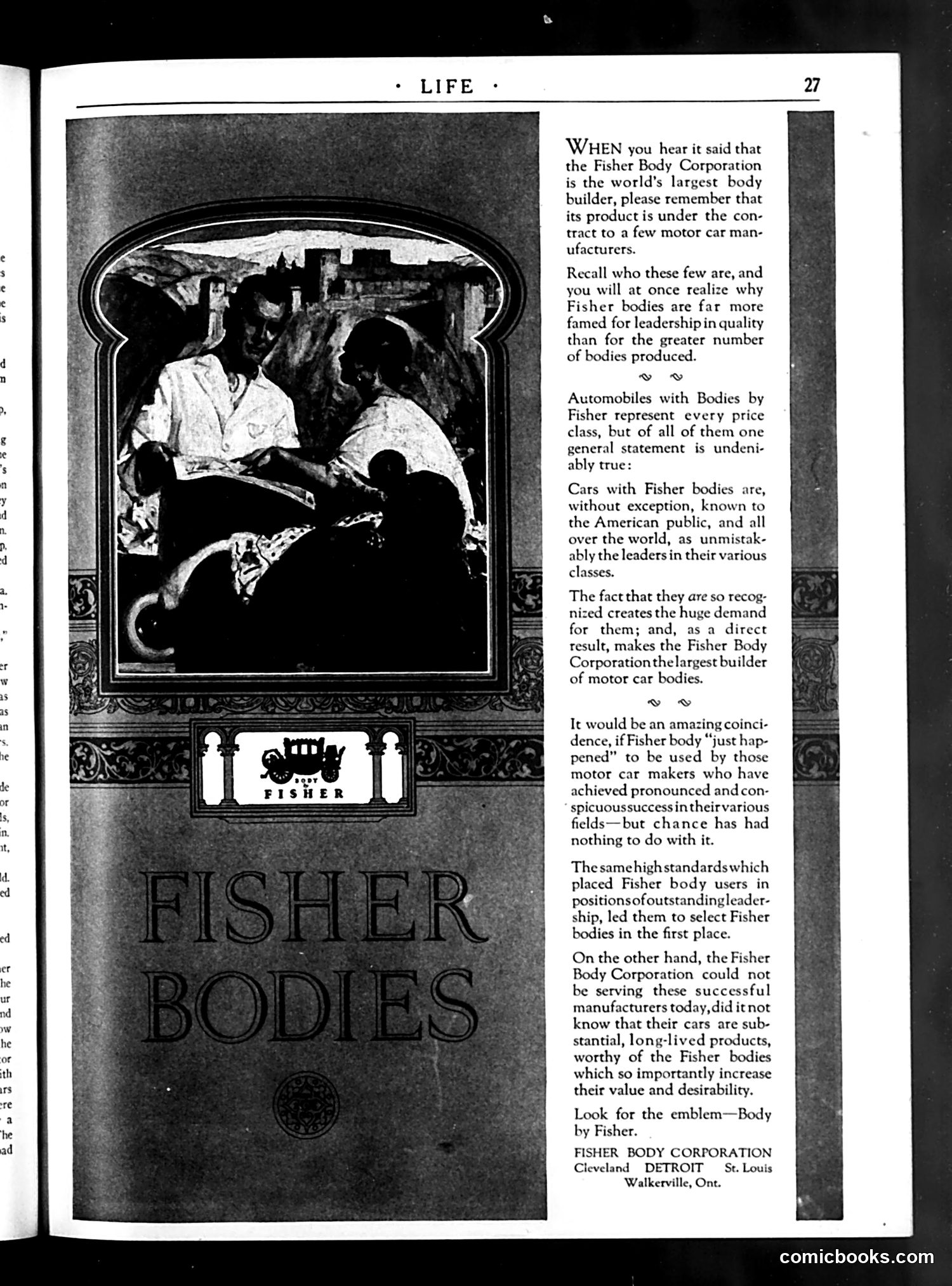
This is **not political satire** but rather a **corporate advertisement** for Fisher Body Corporation, a major automotive body manufacturer. The page features an elegant illustration of well-dressed passengers in a luxury automobile interior, positioned above the text "FISHER BODIES." The advertisement's argument is fundamentally about **quality and exclusivity**: Fisher Body claims to supply bodies only to elite motor manufacturers who have already achieved success, suggesting that using Fisher bodies is both a marker and consequence of automotive excellence. The text emphasizes that Fisher's reputation for quality (not quantity) drives demand from prestigious car makers, creating a mutually-reinforcing cycle of prestige. The "emblem—Body by Fisher" functioned as a luxury badge, similar to modern branding. This represents early 20th-century automobile marketing emphasizing craftsmanship and association with success.
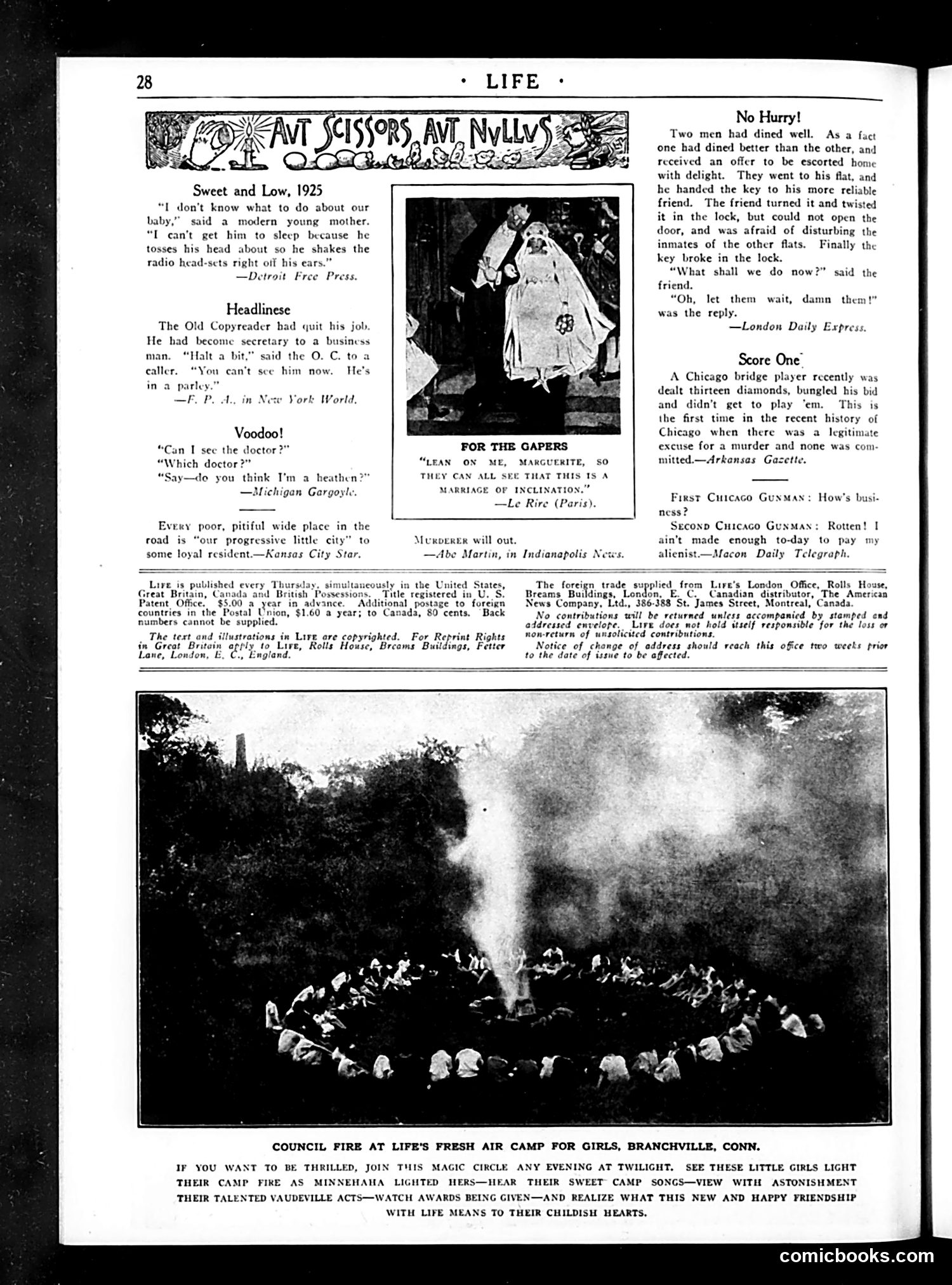
This page collects brief humorous anecdotes and satirical observations typical of Life's format. Key items include: **"Sweet and Low"**: Mocks modern parenting—a mother can't get her baby to sleep because he thrashes around shaking off radio headsets, satirizing both newfangled radio technology and absent parenting. **"Headlinese"**: Jokes about newspaper jargon, where an old copyeditor uses businesslike terminology ("parley") inappropriately. **"Voodoo!"**: A quick racial pun playing on the phrase "which doctor" (witch doctor), with the punchline deflecting offense. **"For the Gapers"**: A French cartoon captioned with dark humor about a couple performing their marriage affectionately for onlookers—suggesting performative rather than genuine love. **"No Hurry!"** and **"Score One"**: Brief anecdotes with cynical punch lines about drunkenness and bridge-playing aggravation. The large bottom photograph advertises Life's fresh air camp for girls, presenting wholesome Americana (council fires, camp songs). The page exemplifies Life's mix of urbane satirical commentary with nostalgic Americana imagery.
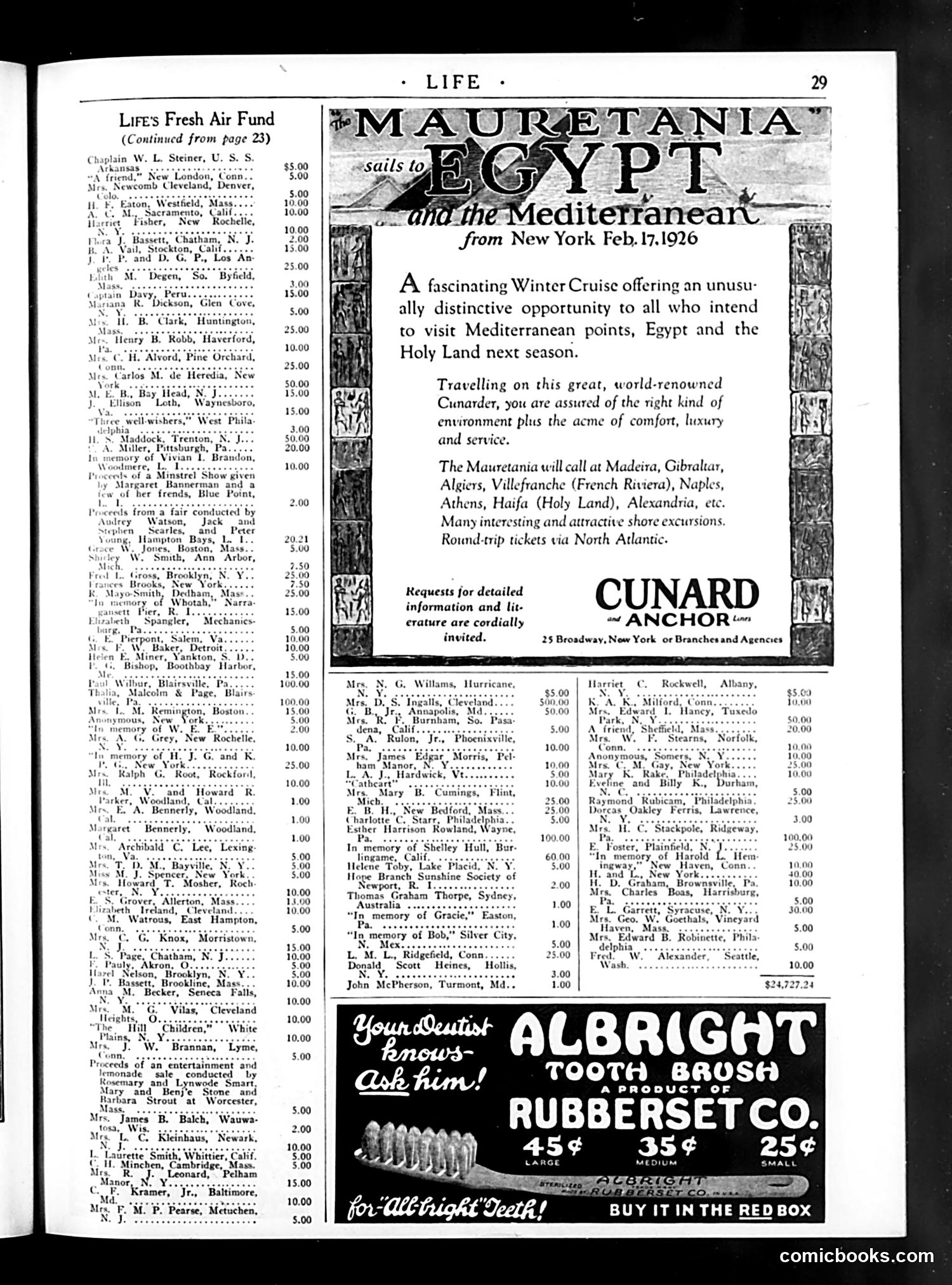
This page is primarily **advertising and donor listings**, not political satire or cartoon content. The main elements are: 1. **Life's Fresh Air Fund** (continued list): Donations from readers to send children to the countryside—a charitable cause common in early 20th-century America. 2. **Cunard cruise advertisement**: Promotes the S.S. *Mauretania* steamship offering winter Mediterranean cruises from New York to Egypt and the Holy Land (Feb. 1926). This targets wealthy tourists seeking luxury travel. 3. **Albright Toothbrush advertisement**: A consumer product ad at bottom, priced at 25¢-45¢. **No political cartoons or satire appears on this page.** It represents typical 1926 *Life* magazine content: charitable fundraising, luxury tourism marketing, and commercial advertising. The donations listed (mostly $1-25, occasionally $100) reflect Depression-era middle-class generosity toward children's welfare.
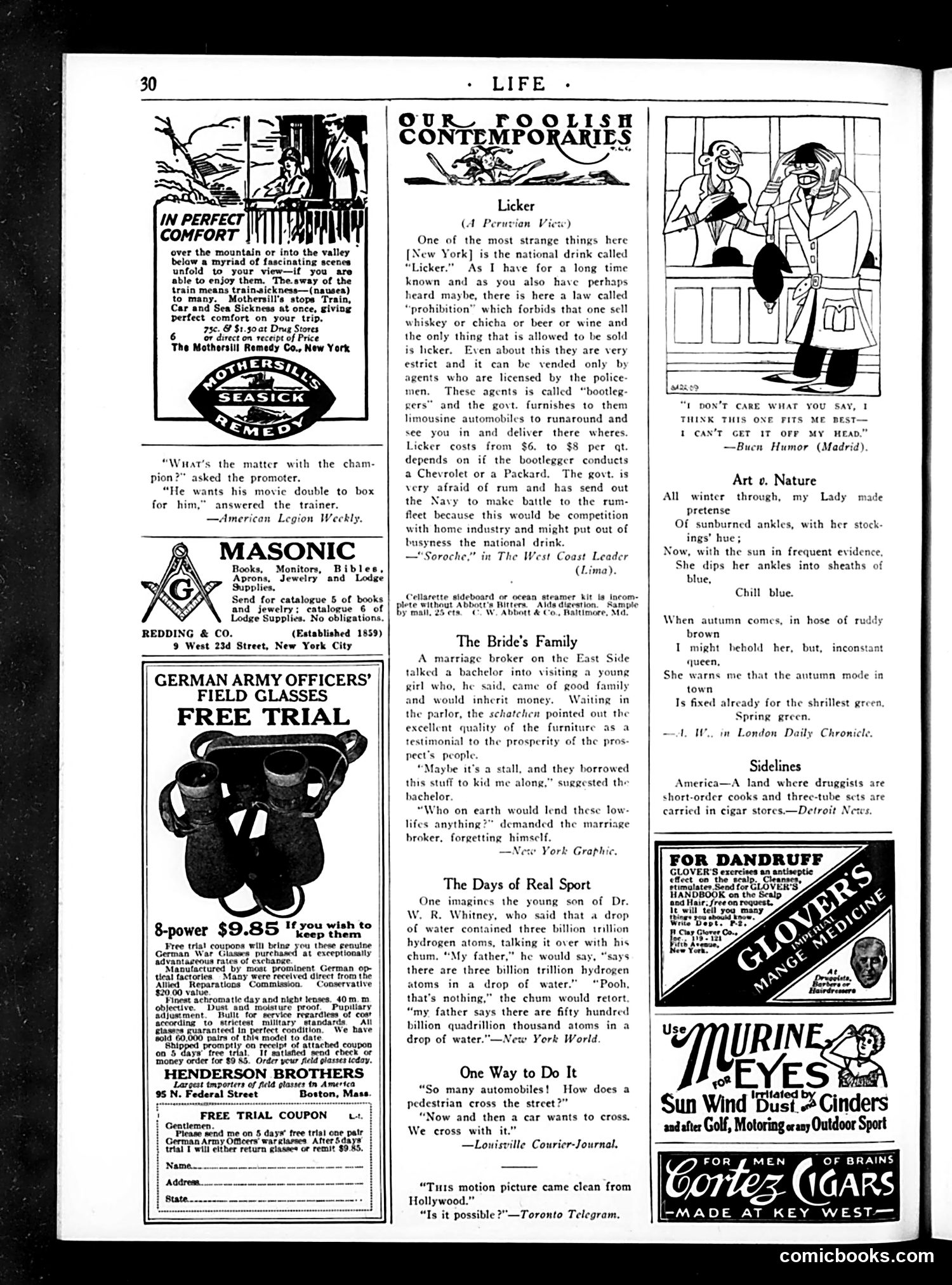
This is primarily an **advertising page** with a few short humor pieces scattered between ads. The main cartoon shows a boxing trainer explaining why his champion won't fight: the fighter wants his "movie double" to box for him instead. This satirizes Hollywood's growing influence in the 1920s—even professional athletes supposedly want to avoid actual work in favor of movie fame. The "Foolish Contemporaries" section mocks **Prohibition** through a faux-naive Peruvian correspondent's "observations" about American "licker" (bootleg alcohol). The joke relies on the writer pretending not to understand that the government secretly enables bootlegging—a pointed commentary on Prohibition's obvious failures and corruption. Other brief humor pieces poke fun at marriage brokers and wealth-signaling through furniture. The **advertisements** are noteworthy for their post-WWI context: German Army field glasses sold as bargains (exploiting war reparations), suggesting the page dates to the early 1920s when such items flooded the American market.
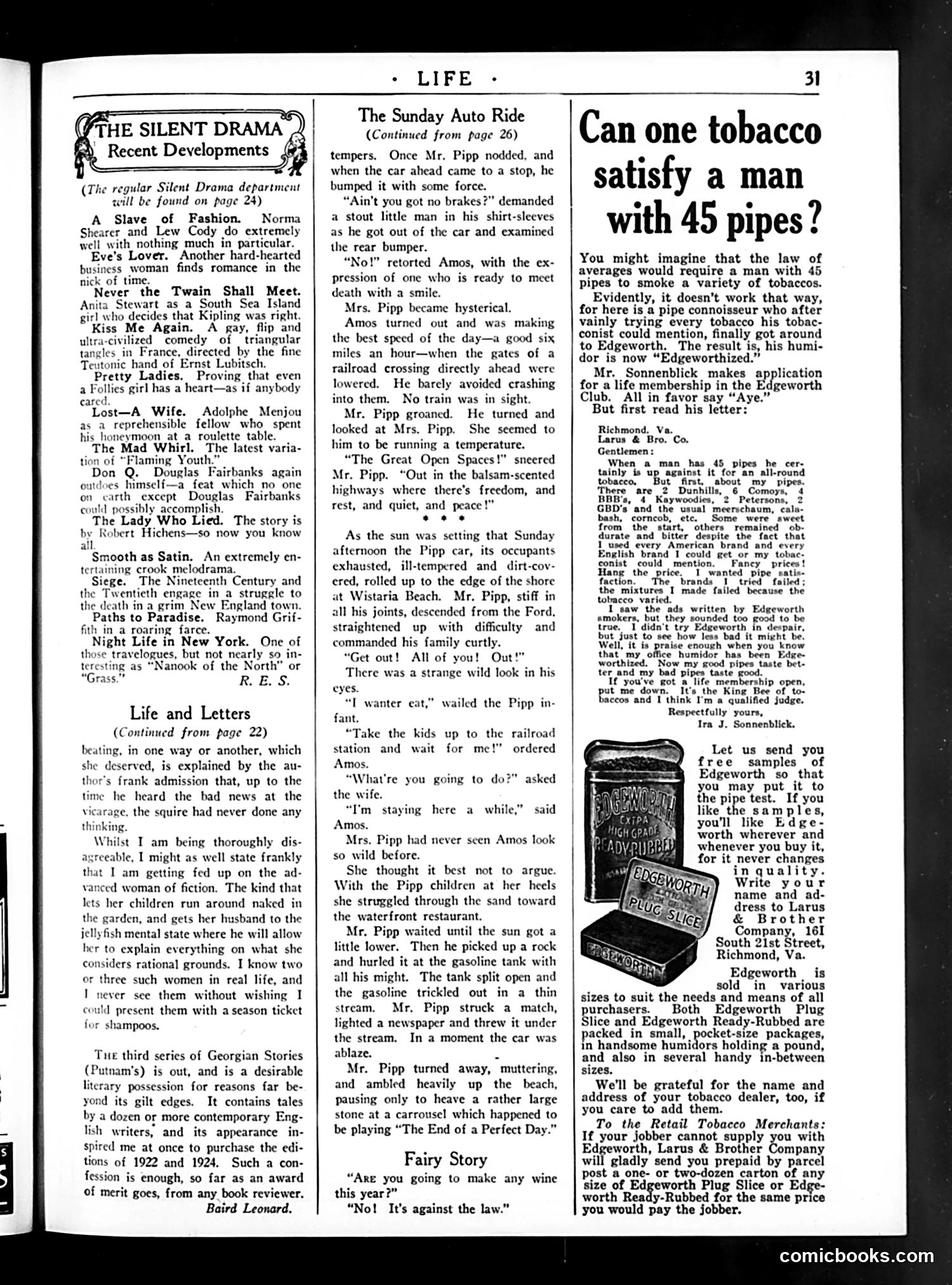
This page contains **movie reviews** (left column) and a **satirical short story** titled "The Sunday Auto Ride" (center/right), plus a **tobacco advertisement** (right). The story mocks the romantic notion of a country automobile outing. Mr. and Mrs. Pipp attempt a leisurely Sunday drive seeking "freedom, and rest, and quiet, and peace" in "the Great Open Spaces," but encounter only mishaps: a collision with another car, a near-miss with a lowered railroad crossing gate, and general frustration. The humor lies in the **contrast between the idealized rural escape and gritty reality**—the opposite of what the Pipps expected. The **Edgeworth tobacco advertisement** uses this expectation-versus-reality framework commercially: a man can supposedly satisfy himself with 45 pipes of one tobacco brand, positioning Edgeworth as supremely versatile. This inverts the story's irony—where escape fails, the product supposedly succeeds. The page reflects 1920s consumer culture anxieties about automobiles, leisure, and mass-marketed satisfaction.
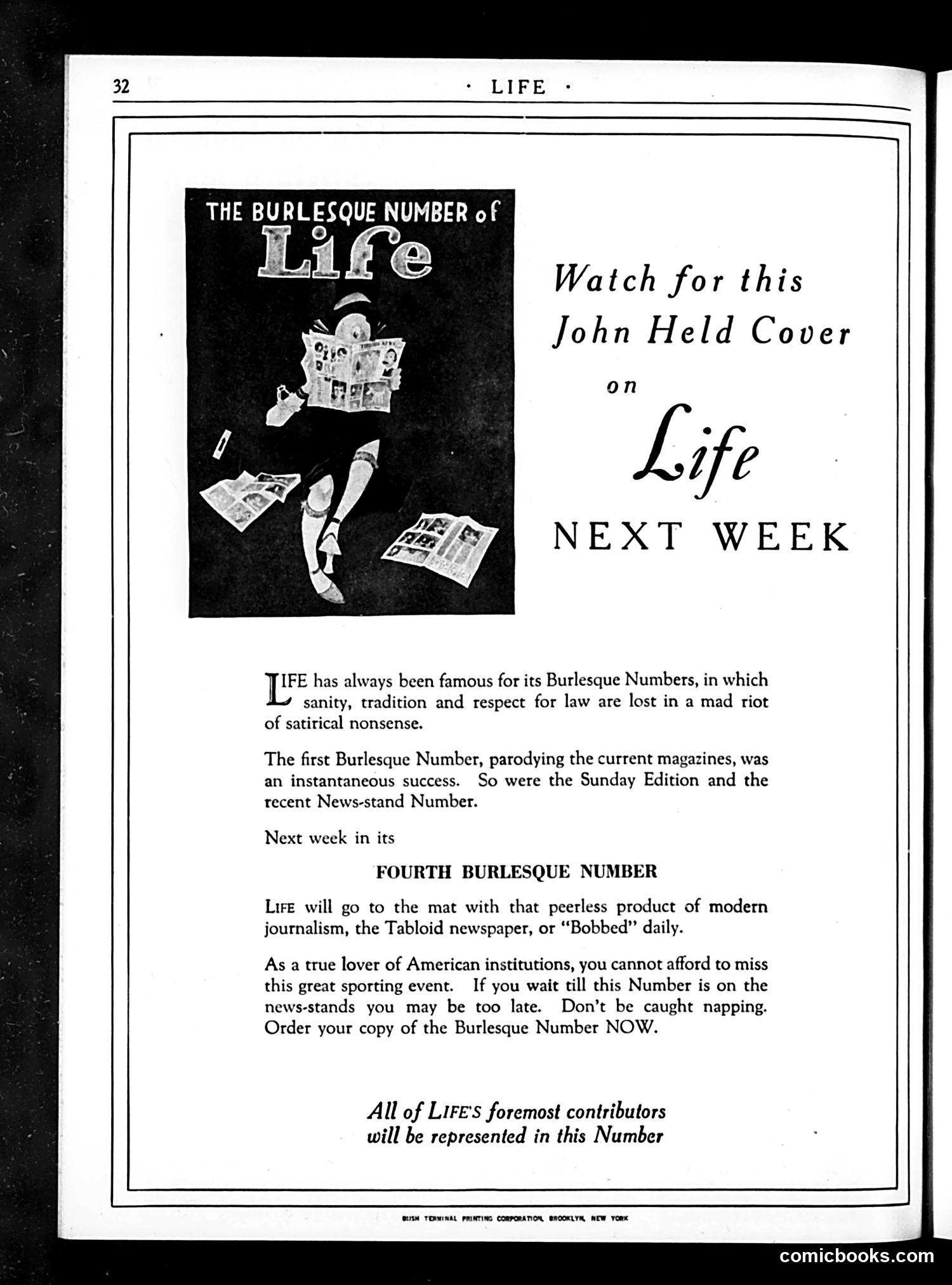
This is a **house advertisement** promoting Life magazine's upcoming "Fourth Burlesque Number"—a special satirical issue. The illustration shows a woman reading newspapers, visually representing the target of next week's satire. **What it means:** Life's "Burlesque Numbers" were special issues dedicated to parodying contemporary institutions and culture through exaggerated humor. This particular issue will mock **tabloid newspapers**, then a growing and controversial form of sensational journalism. The text calls these papers "Bobbed" dailies—a dated reference suggesting something frivolous or modernly trendy (like the "bobbed" hairstyle of the 1920s). **The satire's point:** Tabloids represented everything Life's editors found ridiculous about modern journalism—sensationalism over substance, brevity over depth. By declaring it a "sporting event" and urging readers to pre-order immediately, the ad itself parodies the hard-sell, fear-of-missing-out marketing tactics of the very media it's about to skewer. The cover features artist **John Held Jr.**, Life's prominent cartoonist.
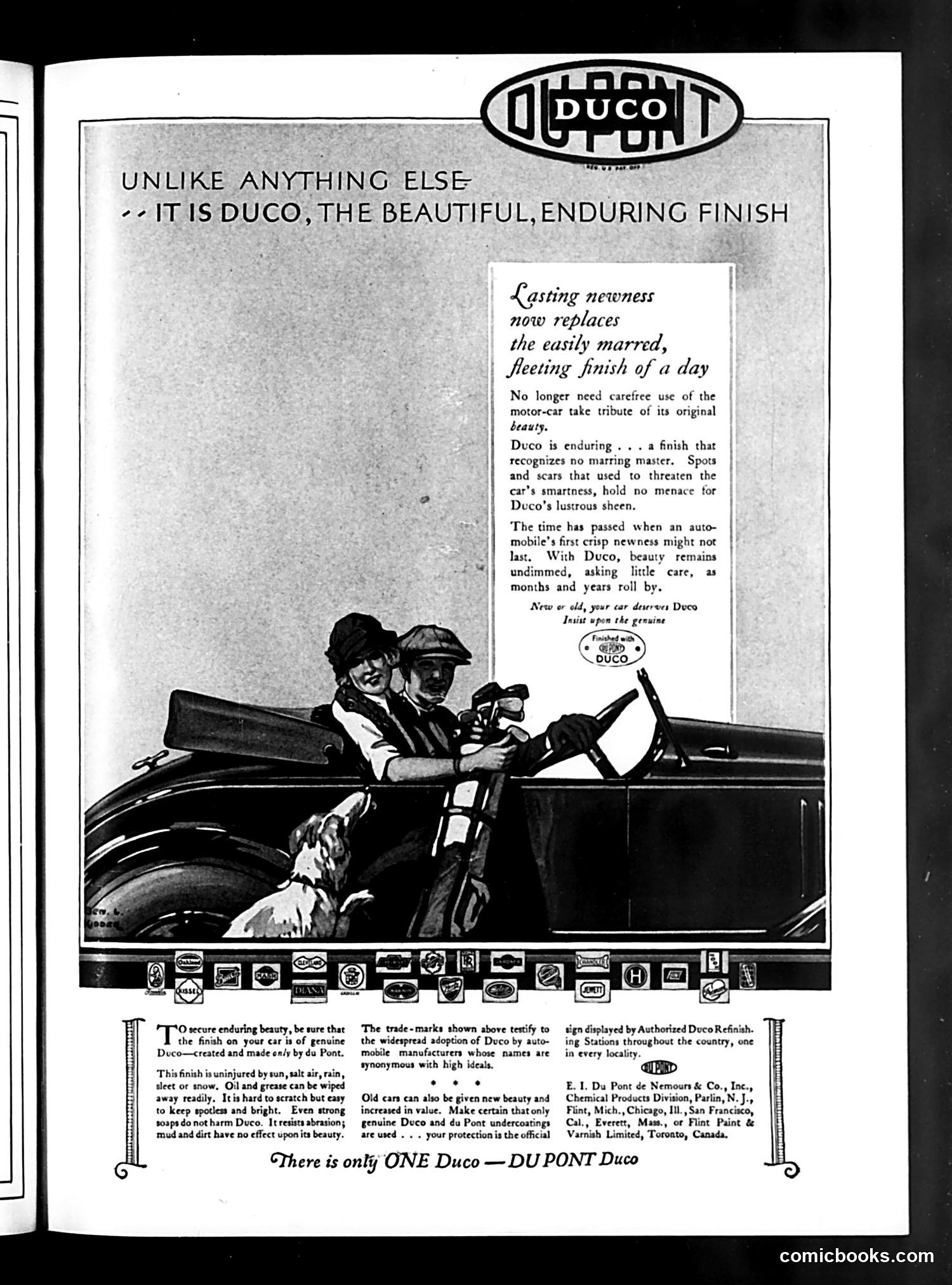
This is a **full-page advertisement**, not editorial satire. It promotes Duco, a du Pont automotive lacquer finish that was genuinely revolutionary in the 1920s-30s. The illustration shows two fashionably-dressed people in an open car, emphasizing the product's appeal to affluent motorists. The ad's central claim is that Duco provides a durable, scratch-resistant finish that maintains its "newness" far longer than competing products—a major selling point when car finishes typically dulled and required frequent maintenance. The copy emphasizes Duco's resistance to sun, salt, rain, and dirt, positioning it as a practical luxury. The multiple manufacturer logos at bottom indicate Duco's widespread adoption by major automakers, lending credibility. The advertisement also promotes Duco refinishing services for older vehicles, expanding the market. This represents early 20th-century consumer advertising emphasizing technological superiority and lasting quality as lifestyle aspirations.
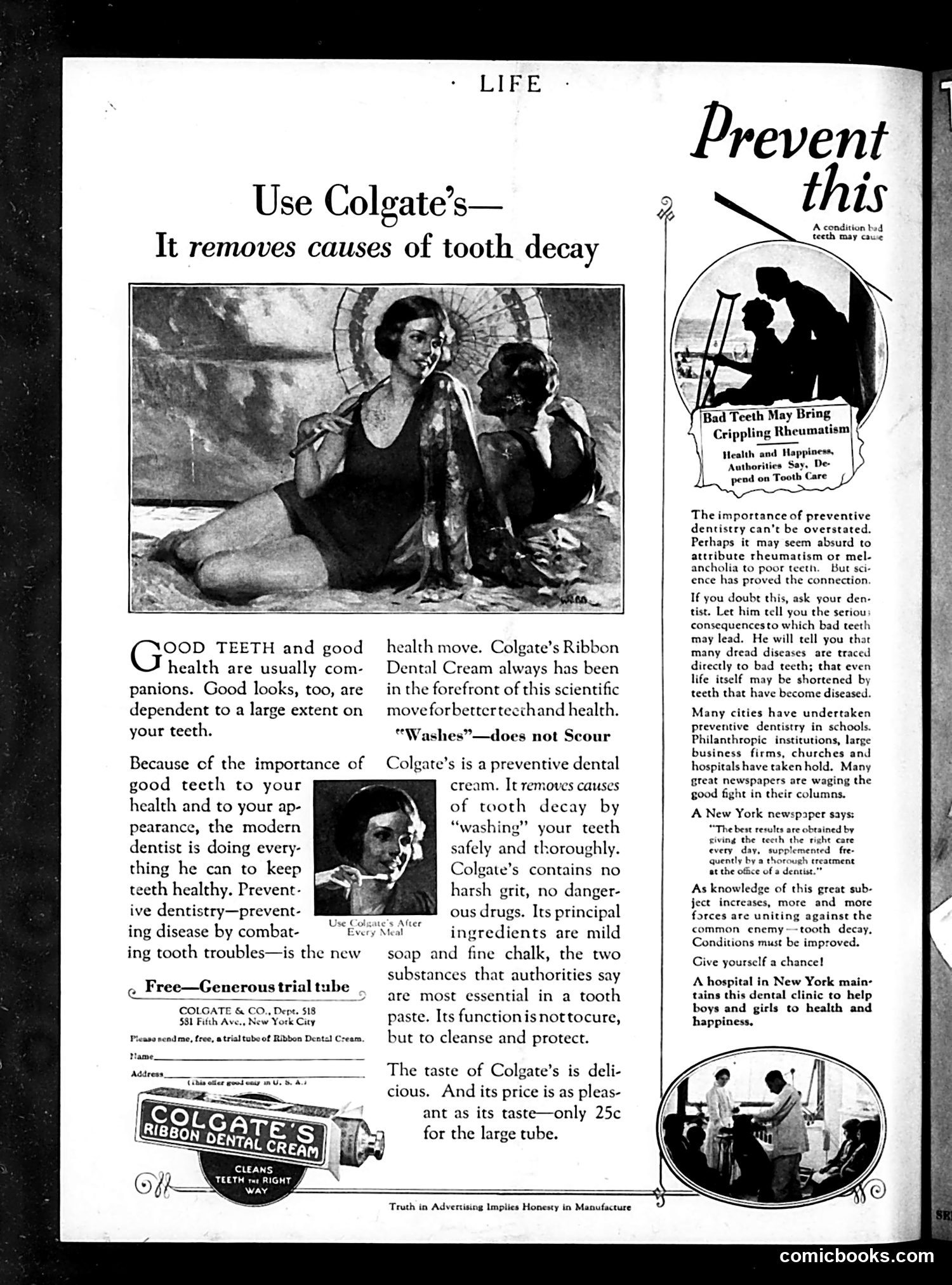
This is primarily a **toothpaste advertisement**, not satirical content. The page promotes Colgate's Ribbon Dental Cream through persuasive health messaging rather than satire. The left side features photographs of people (appears to be impoverished or working-class subjects) alongside claims that good teeth prevent serious diseases—rheumatism, melancholia, and shortened lifespans. The right side's "Prevent this" section emphasizes these consequences. The advertisement's strategy links dental hygiene to broader health and social mobility. Notably, it claims Colgate's "removes causes of tooth decay" through gentle cleansing rather than harsh scouring, positioning it as preventive rather than curative. The tagline "Truth in Advertising Implies Honesty in Manufacture" attempts to establish credibility. A free trial offer and low price (25¢) targeted mass-market consumers. The reference to hospitals and schools using preventive dentistry suggests this reflected genuine early-20th-century public health initiatives, making the ad a blend of genuine health advocacy and commercial promotion.