
Life, 1925-09-03 · page 24 of 36
Life — September 3, 1925 — page 24: what you’re looking at
What you’re looking at
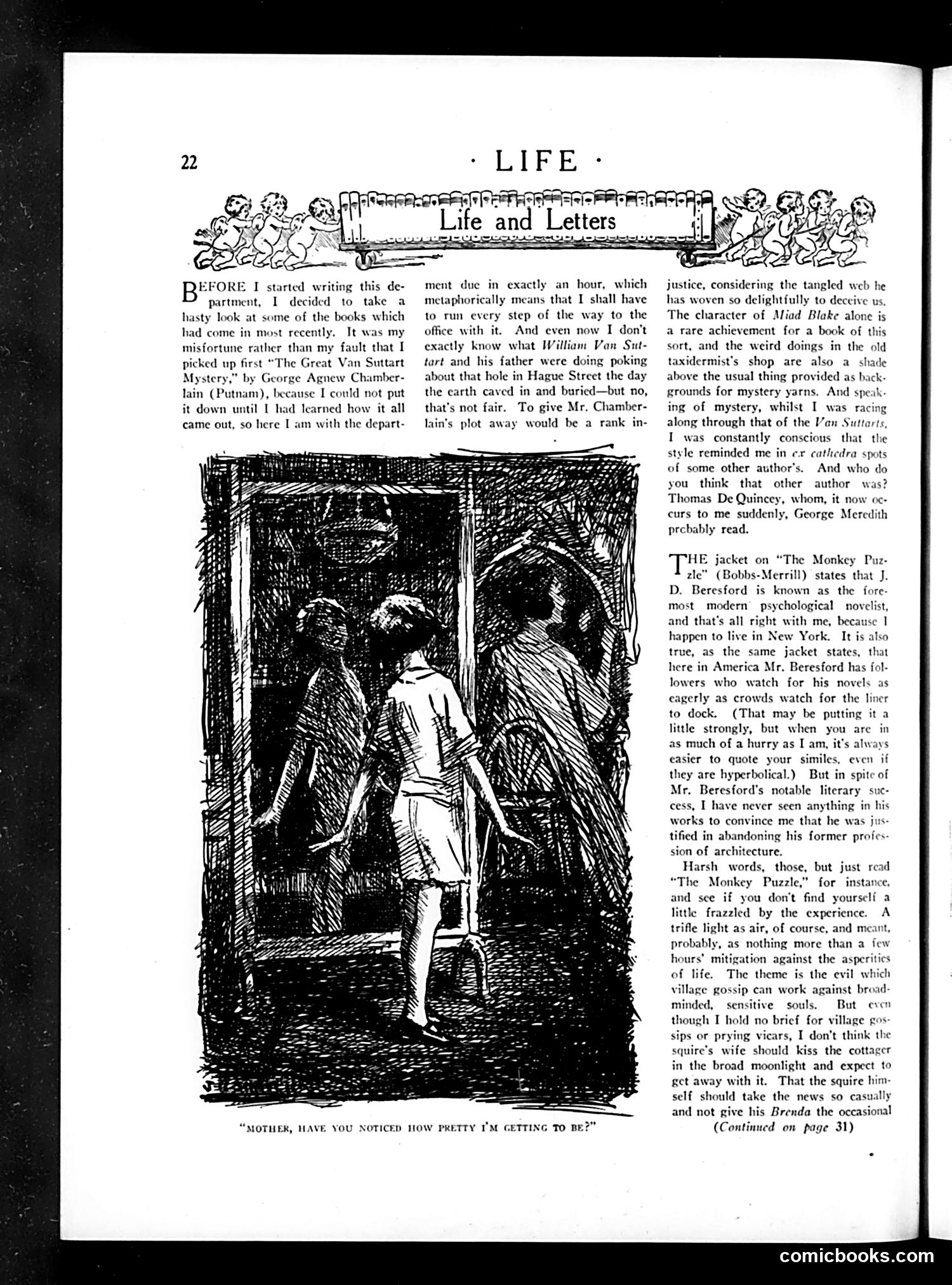
This page is a **book review column**, not political satire. The author reviews recent novels, including "The Great Van Suttart Mystery" by George Agnew Chamberlain and "The Monkey Puzzle" by J.D. Beresford. The illustration shows a woman entering a doorway, captioned "Mother, have you noticed how pretty I'm getting to be?"—likely depicting a scene from one of the reviewed books. The reviewer's tone is witty and dismissive. He praises the Van Suttart mystery's plotting but criticizes Beresford's "Monkey Puzzle" for its trivial theme about village gossip and moral impropriety (a woman kissing a cottager). The reviewer sarcastically questions why Beresford abandoned architecture for writing, suggesting his literary work is unimpressive despite his reputation as a "foremost modern psychological novelist." The satire targets pretentious literary reputations and shallow modern fiction rather than political figures.
📄 Transcribed text from this page (OCR, searchable)
Machine-transcribed from the original scan — historical spelling and the odd misread are preserved.
FORE I started writing this de- partment, I decided to take a asty look at some of the books which had come in most recently. It was my misfortune rather than my fault that I icked up first “The Great Van Suttart Mystery,” by George Agnew Chamber- lain (Putnam), because I could not put it down until L had learned how it all came out, so here [| am with the depart- “MOTHER, HAVE YOU NOTICED HOW ment due in exactly an hour, which metaphorically means that I shall have to run every step of the way to the office with it. And even now I don't exactly know what William Van Sut- tart and his father were doing poking about that hole in Hague Street the day the earth caved in and buried—but no, that’s not fair. To give Mr. Chamber- lain’s plot away would be a rank in- PRETTY I'M GETTING TO BI justice, considering the tangled web he has woven so delightfully to deceive us. The character of Miad Blake alone is a rare achievement for a book of this sort, and the weird doings in the old taxidermist’s shop are also a shade above the usual thing provided as back- grounds for mystery yarns. And speak- ing of mystery, whilst I was racing along through that of the Ven Suttarts, I was constantly conscious that the style reminded me in ex cathedra spots of some other author's. And who do you think that other author was? Thomas De Quincey, whom, it now oc- curs to me suddenly, George Meredith probably read. HE jacket on “The Monkey Puz- zle" (Bobbs-Merrill) states that J. D. Beresford is known as the fore- most modern psychological novelist, and that’s all right with me, because | happen to live in New York. It is also true, as the same jacket states, that here in America Mr. Beresford has fol- lowers who watch for his novels as eagerly as crowds watch for the liner to dock. (That may be putting it a little strongly, but when you are in as much of a hurry as I am, it’s always easier to quote your similes, even if they are hyperbolical.) But in spite of Mr. Beresford's notable literary suc- cess, I have never seen anything in his works to convince me that he was jus tified in abandoning his former profes- sion of architecture. Harsh words, those, but just read “The Monkey Puzzle,” for instance, and sce if you don't find yourself a little frazzled by the experience. A trifle light as air, of course, and meant, probably, as nothing more than a few hours’ mitigation against the asperitics of life. The theme is the evil which village gossip can work against broad minded, sensitive souls. But though I hold no brief for village gos sips or prying vicars, I don’t think the squire’s wife should kiss the cottager in the broad moonlight and expect to get away with it. That the squire him- self should take the news so casually and not give his Brenda the occasional (Continued on page 31) even comicbooks.com