
Life, 1925-09-03 · page 16 of 36
Life — September 3, 1925 — page 16: what you’re looking at
What you’re looking at
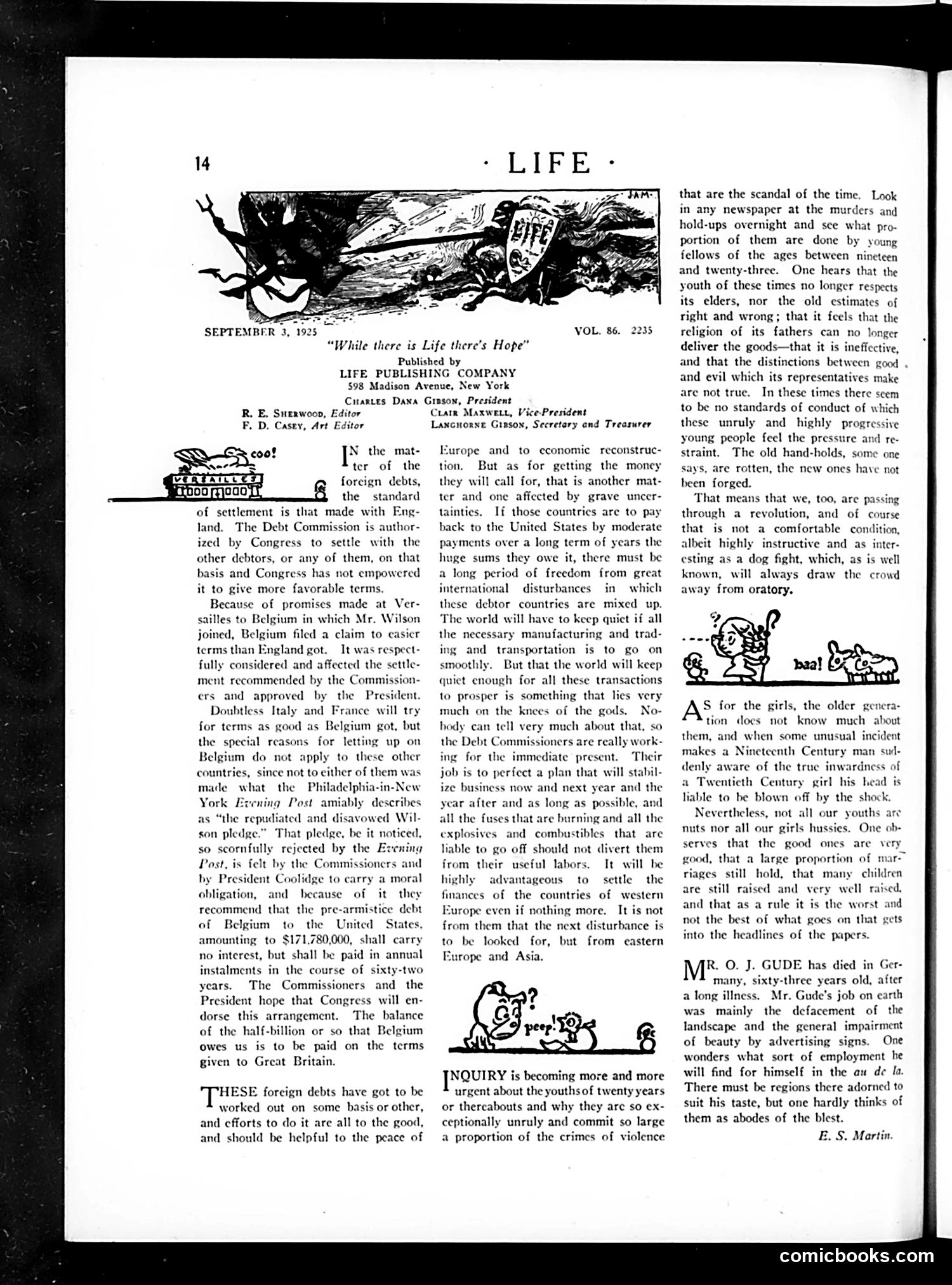
The page contains editorial commentary on post-WWI economic issues and youth behavior. The main cartoon (top) depicts a figure labeled "RIFF" apparently involved in violence or crime—likely referencing the Rif War in Morocco, where French colonial forces faced armed resistance. The text discusses foreign debt repayment from European nations, advocating for practical settlement terms. A secondary cartoon shows a domestic scene with animals, illustrating concerns about youth criminality and moral decline. The editorial expresses anxiety about young people (ages 19-23) who supposedly disrespect authority, commit murders and robberies, and reject traditional morality. The author attributes this to post-war social disruption and generational pressure, while suggesting most youth are still properly raised. The page reflects 1920s anxieties about crime, modernization, and generational conflict.
📄 Transcribed text from this page (OCR, searchable)
Machine-transcribed from the original scan — historical spelling and the odd misread are preserved.
‘While there is Life there’s Hope” Published by LIFE PUBLISHING COMPANY 598 Madison Avenue, New York Curartes Dana Grnson, President R. E. Surrwoon, Editor F, D. Casny, Art Editor N the mat- ter of the [ve a? foreign debts, Prooo reco, 4S the standard of settlement is that made with Eng- land. The Debt Commission is author- ized by Congress to settle with the other debtors, or any of them, on that basis and Congress has not empowered it to give more favorable terms. Because of promi: made at Ver- sailles to Belgium in which Mr. Wilson joined, Belgium filed a claim to casicr terms than England got. It was respec fully considered and affected the settl ment recommended by the Commission- ers and approved by the President. Doubtless Italy and France will try for terms as good as Belgium got, but the special reasons for letting up on Belgium do not apply to these other countries, since not to either of them was made what the Philadelphia-in-New York Evening Post amiably describes as “the repudiated and disavowed Wil- son pledge.” That pledge, be it noticed, so scornfully rejected by the Post, is felt by the Commissioners and hy President Coolidge to obligation, and because of it recommend that the pre-armistice debt of Belgium to the United States, amounting to $171,780,000, shall carry no interest, but shall be paid in annual instalments in the course of sixty-two years. The Commissioners and the President hope that Congress will en- dorse this arrangement. The balance of the half-billion or so that Belgium owes us is to be paid on the terms given to Great Britain. coo! ry a moral they 'HESE foreign debts have got to be worked out on some basis or other, and efforts to do it are all to the good, and should be helpful to the peace of Ctatr Maxwett, Vice-President Lancnorxe Ginsox, Secretary and Treasurer Europe and to economic reconstruc- tion. But as for getting the money they will call for, that is another mat- ter and one affected by grave uncer- taintics. If those countries are to pay back to the United States by moderate payments over a long term of years the huge sums they owe it, there must be a long period of freedom from great international disturbances in which these debtor countries are mixed up. The world will have to keep quict if all the necessary manufacturing and trad- ing and transportation is to go on smoothly. But that the world will keep quiet cnough for all these transactions to prosper is something that lies very much on the knees of the gods. No- body can tell very much about that, so the Debt Commissioners are really work- ing for the immediate present. Their job is to perfect a plan that will stabil- ize business now and next year and the year after and as long as possible, and all the fuses that are burning and all the explosives and combustibles are liable to go off should not divert them from their useful labors, It will be highly advantageous to settle the ances of the countries of western rope even if nothing more. It is not from them that the next disturbance is to be looked for, Europe and Asi: but from eastern pNourry is becoming more and more urgent about the youths of twenty years or thereabouts and why they arc so ex- ceptionally unruly and commit so large a proportion of the crimes of violence that are the scandal of the time. Look in any newspaper at the murders and hold-ups overnight and sce what pro- portion of them are done by young fellows of the ages between nineteen and twenty-three. One hears that the youth of these times no longer respects its elders, nor the old estimates of right and wrong; that it feels that the religion of its fathers can no longer deliver the goods—that it is ineficctive, and that the distinctions between good . and evil which its representatives make are not true. In these times there seem to be no standards of conduct of which these unruly and highly progressive young people feel the pressure and re- straint. The old hand-holds, some one says, are rotten, the new ones have not been forged. That means that we, too, are passing through a revolution, and of course that is not a comfortable condition, albeit highly instructive and as inter- esting as a dog fight, which, as is well known, will always draw the crowd away from oratory. S for the girls, the older ge tion not know much about them, and when some unusual incident makes a Nineteenth Century man sud- denly aware of the true in a Twentieth Century girl his head is liable to be blown off by the shock. Nevertheless, not all our youths nuts nor all our girls hussies. One ob- serves that the good ones are very good, that a large proportion of mar- riages still hold, that many children are still raised and very well raised, and that as a rule it is the worst and not the best of what goes on that gets into the headlines of the papers. does ardness of R. O. J. GUDE has died in Ger- many, sixty-three years old, after a long illness. Mr. Gude's job on earth was mainly the defacement of the landscape and the general impairment of beauty by advertising signs. One wonders what sort of employment he will find for himself in the au de la. There must be regions there adorned to suit his taste, but one hardly thinks of them as abodes of the blest. E. S. Martin. comicbooks.com