
Life, 1925-09-03 · page 20 of 36
Life — September 3, 1925 — page 20: what you’re looking at
What you’re looking at
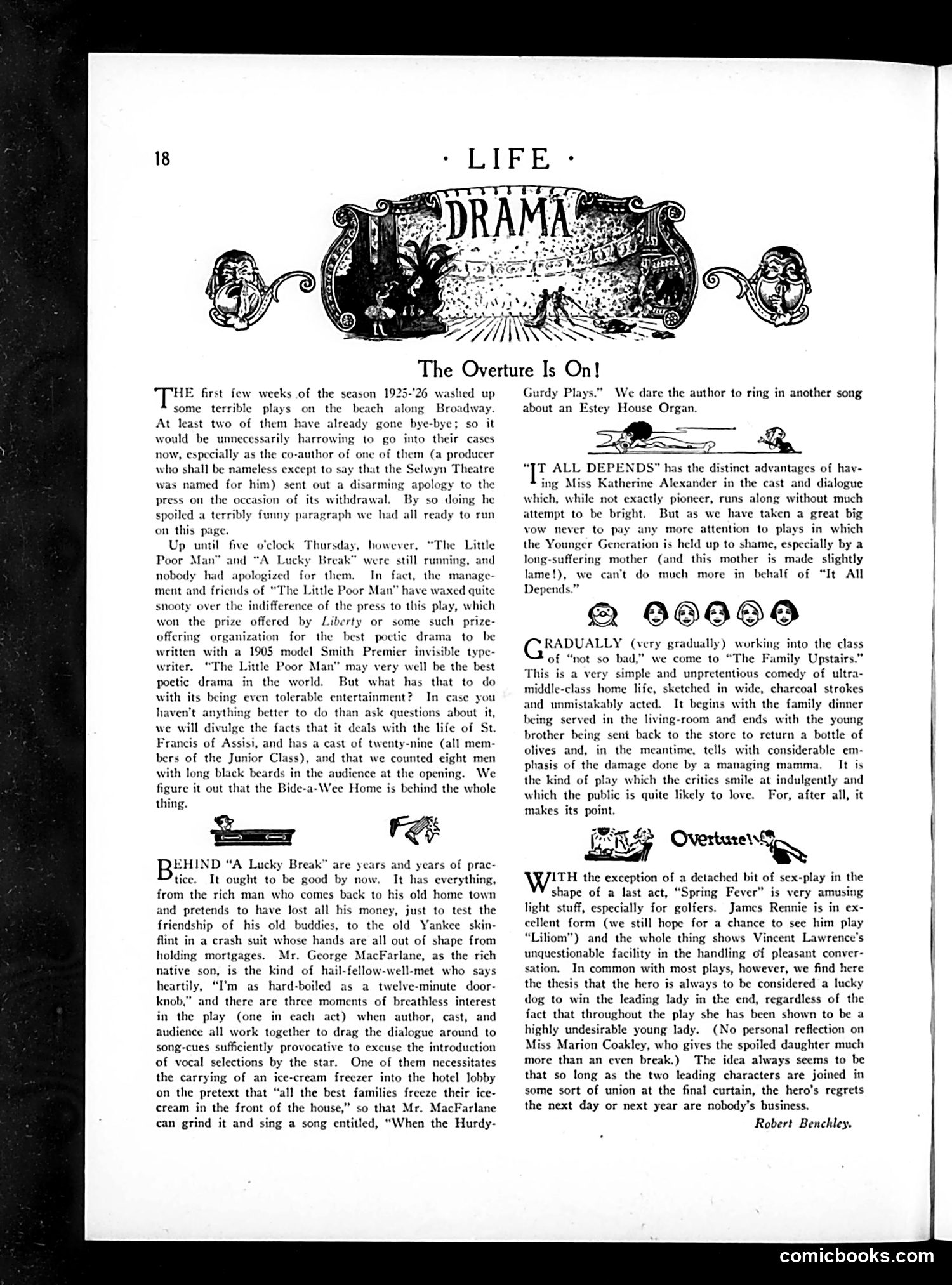
This page reviews several Broadway plays from the 1925-26 season. The critic uses sharp satire to mock theatrical pretension and tired formulas. "The Little Poor Man"—a prize-winning "poetic drama" about St. Francis of Assisi with 29 cast members and eight bearded actors—is ridiculed as self-important drivel. The critic suggests the audience consisted mainly of members from the "Bide-a-Wee Home" (an animal shelter), implying the play attracted only strays. "A Lucky Break" features George MacFarlane as a returning rich man testing old friendships—a tired plot device. The critic mocks the desperate insertion of musical numbers, including one where MacFarlane grinds an ice-cream freezer in a hotel lobby while singing about a player organ. "It All Depends" features Katherine Alexander but suffers from the worn trope of a "long-suffering mother" shaming the younger generation. "The Family Upstairs" receives slightly more respect as honest, unpretentious middle-class comedy. The satire targets both formulaic plots and theatrical self-importance masquerading as art.
📄 Transcribed text from this page (OCR, searchable)
Machine-transcribed from the original scan — historical spelling and the odd misread are preserved.
THe first few weeks of the season 1925-'26 washed up some terrible plays on the beach along Broadway. At least two of them have already gone bye-bye; so it would be unnecessarily harrowing to go into their cases now, especially as the co-author of one of them (a producer who shall be nameless except to say that the Selwyn Theatre was named for him) sent out a disarming apology to the press on the occasion of its withdrawal. By so doing he spoiled a terribly funny paragraph we had all ready to run on this page. Up until five o'clock Thursd: Poor Man” and “A Lucky Brea’ nobody had apologized for them. In fact, the manage- ment and friends of “The Little Poor Man” have waxed quite snooty over the indifference of the press to this play, which won the prize offered by Liberty or some such prize- offering organization for the best poctic drama to be written with a 1905 model Smith Premier invisible type- writer, “The Little Poor Man” may very well be the best poetic drama in the world. But what has that to do with its being even tolerable entertainment? In case you haven't anything better to do than ask questions about it, we will divulge the facts that it deals with the life of St. Francis of Assisi, and has a cast of twenty-nine (all mem- bers of the Junior Class), and that we counted eight men with long black beards in the audience at the opening. We figure it out that the Bide-a-Wee Home is behind the whole thing. Fé HIND “A Lucky Break” are years and years of prac- tice. It ought to be good by now. It has everything, from the rich man who comes back to his old home town and pretends to have lost all his money, just to test the friendship of his old buddies, to the old Yankee skin- flint in a crash suit whose hands are all out of shape from holding mortgages. Mr. George MacFarlane, as the rich native son, is the kind of hail-fellow-well-met who says heartily, “I'm as hard-boiled a twelve-minute door- knob,” and there are three moments of breathless interest in the play (one in each act) when author, cast, and audience all work together to drag the dialogue around to song-cues sufficiently provocative to excuse the introduction of vocal selections by the star. One of them necessitates the carrying of an ice-cream freezer into the hotel lobby on the pretext that “all the best families freeze their ice- cream in the front of the house,” so that Mr. MacFarlane can grind it and sing a song entitled, “When the Hurdy- however, “The Little were still running, and The Overture Is On! Gurdy Plays.” We dare the author to ring in another song about an Estey House Organ. has the distinct advantages of hav- T ALL DEPENDS” ing Miss Katherine Alexander in the cast and dialogue which, while not exactly pioneer, runs along without much attempt to be bright. But as we have taken a great big vow never to pay any more attention to plays in which the Younger Generation is held up to shame, especially by a long-suffering mother (and this mother is made slightly lame!), we can’t do much more in behalf of “It All Depends.” Q §6O©OH9 RADUALLY (very gradually) working into the class of “not so bad,” we come to “The Family Upstairs. This is a very simple and unpretentious comedy of ultra- middle-class home life, sketched in wide, charcoal strokes and unmistakably acted. It begins with the family dinner being served in the living-room and ends with the young brother being sent back to the store to return a bottle of olives and, in the meantime, tells with considerable em- phasis of the damage done by a managing mamma. It is the kind of play which the critics smile at indulgently and which the public is quite likely to love. For, after all, it makes its point. (= ns &3 Duets With the exception of a detached bit of sex-play in the shape of a last act, “Spring Fever” is very amusing light stuff, especially for golfers. Jamcs Rennie is in ex- cellent form (we still hope for a chance to see him play “Liliom”) and the whole thing shows Vincent Lawrence's unquestionable facility in the handling of pleasant conver- sation. In common with most plays, however, we find here the thesis that the hero is always to be considered a lucky dog to win the leading lady in the end, regardless of the fact that throughout the play she has been shown to be a highly undesirable young lady. (No personal reflection on Miss Marion Coakley, who gives the spoiled daughter much more than an even break.) The idea always seems to be that so long as the two leading characters are joined in some sort of union at the final curtain, the hero’s regrets the next day or next year are nobody’s business. Robert Benchley. comicbooks.com