
Life, 1925-09-03 · page 26 of 36
Life — September 3, 1925 — page 26: what you’re looking at
What you’re looking at
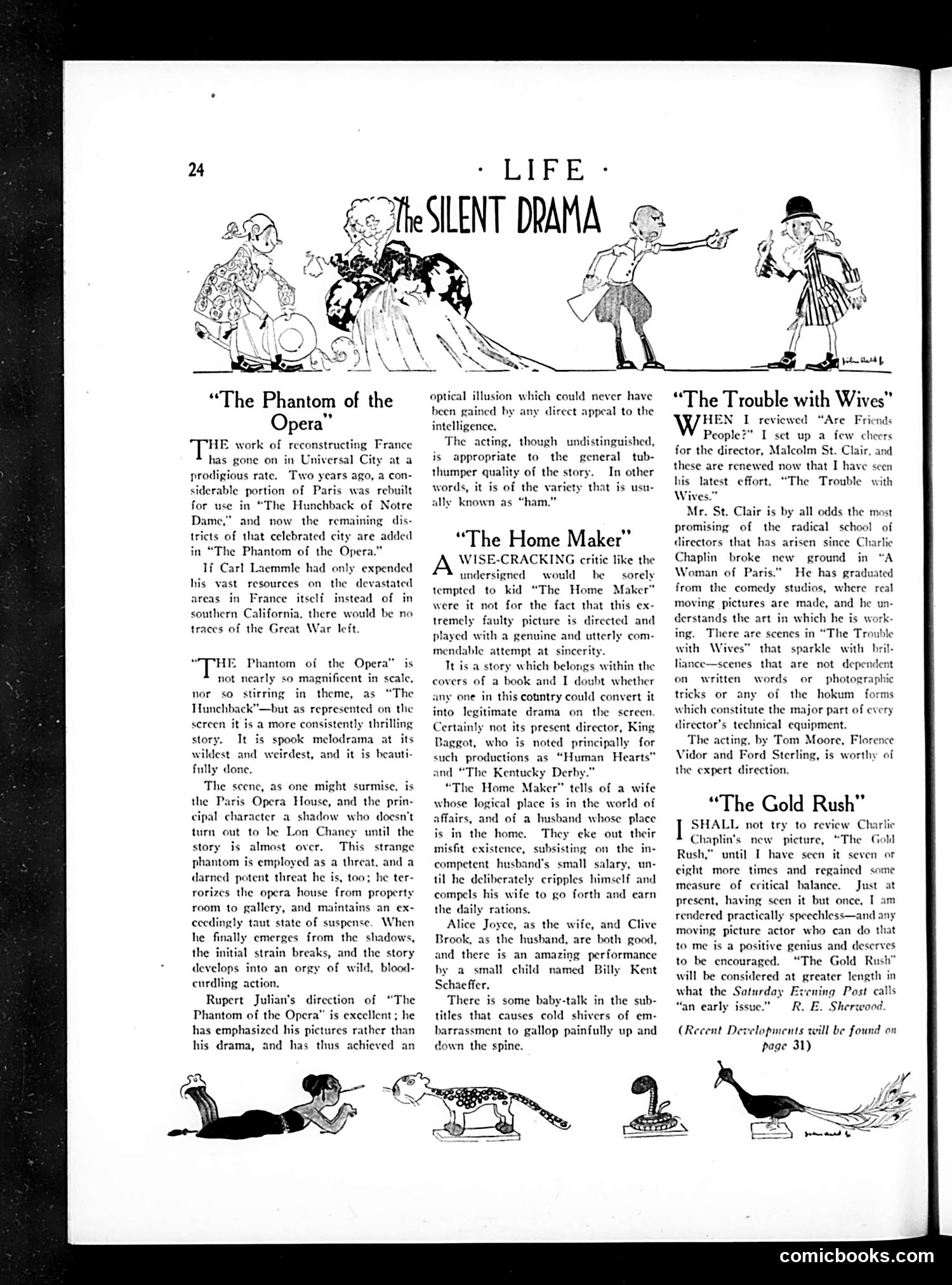
This page reviews four silent films, satirizing both the movies and Hollywood's priorities. **"The Phantom of the Opera"** receives praise for visual thrills despite weak drama. The reviewer quips that Universal Studios spent vast resources recreating Paris in California for sets when they could have rebuilt actual war-devastated France. **"The Home Maker"** is criticized as fundamentally unsuited to cinema—a book adapted poorly. The reviewer mocks the "baby-talk" subtitles that cause "cold shivers of embarrassment." **"The Trouble with Wives"** praises director Malcolm St. Clair as the most promising of the "radical school" since Chaplin, noting scenes that "sparkle with brilliance" without relying on words or "hokum." The cartoons at top and bottom appear to satirize silent cinema generally—exaggerated physical comedy and melodramatic acting that defined the era. The overall tone: silent films succeed through visual spectacle, not storytelling or dialogue.
📄 Transcribed text from this page (OCR, searchable)
Machine-transcribed from the original scan — historical spelling and the odd misread are preserved.
LIFE - VASES “The Phantom of the Opera” HE work of reconstructing France has gone on in Universal City at a prodigious rate. Two years ago, a con- siderable portion of Paris was rebuilt for use in “The Hunchback of Notre Dame,” and now the remaining dis- tricts of that celebrated city are added in “The Phantom of the Opera.” If Carl Laemmle had only expended his vast resources on the devastated areas in France itself instead of in southern California, there would be no traces of the Great War left. “THE Phantom of the Opera” is not nearly so magnificent in scale, Nor so stirring in theme, as “The Tunchback”—but as represented on the screen it is a more consistently thrilling story. It is spook melodrama at its wildest and weirdest, and it is beauti- fully done. The scene, as one might surmise, is the Paris Opera House, and the prin- cipal character a shadow who doesn’t turn out to be Lon Chaney until the story is almost over. This strange phantom is employed as a threat, and a darned potent threat he is, too; he ter- rorizes the opera house from property room to gallery, and maintains an ex- ceedingly taut state of suspense. When he finally emerges from the shadows, the initial strain breaks, and the story develops into an orgy of wild, blood- curdling action, Rupert Julian's direction of “The Phantom of the Opera” is excellent ; he has emphasized his pictures rather than his drama, and has thus achieved an optical illusion which could never have been gained by any direct appeal to the intelligence. The acting, though undistinguished, is appropriate to the general tub- thumper quality of the story. In other words, it is of the variety that is usu- ally known as “ham! “The Home Maker” WISE-CRACKING critic like the undersigned would be sorely tempted to kid “The Home Maker” were it not for the fact that this ex- tremely faulty picture is directed and played with a genuine and utterly com- mendable attempt at sincerity. Tt is a story which belongs within the covers of a book and I doubt whether any one in this country could convert it into legitimate drama on the screen. Certainly not its present director, King Baggot, who is noted principally for such productions as “Human Hearts” and “The Kentucky Derby “The Home Maker” tells of a wife whose logical place is in the world of affairs, and of a husband whose place is in the home. They eke out their misfit existence, subsisting on the in- competent husband's small salary, un- til he deliberately cripples himself and compels his wife to go forth and earn the daily rations, Alice Joyce, as the wife, and Clive Brook, as the husband, are both good, and there is an amazing performance by a small child named Billy Kent Schaeffer. There is some baby-talk in the sub- titles that causes cold shivers of em- barrassment to gallop painfully up and down the spine. “The Trouble with Wives” HEN I reviewed “Are Friend People?” I set up a few cheers for the director, Malcolm St. Clair. these are renewed now that I have seen his latest effort. “The Trouble Wive: Mr. St. Clair is by all odds the most promising of the radical school of directors that has arisen since Charlie Chaplin broke new ground in Woman of Paris.” He has graduated from the comedy studios, where real moving pictures are made, and he derstands the art in which he is work- ing. There are scenes in “The Trouble with Wives” that sparkle with | liance—scenes that are not dependent on written words or photographi tricks or any of the hokum forms which constitute the major part of every director's technical equipment. The acting, by Tom Moore, Florence Vidor and Ford Sterling, is worthy of the expert direction, “The Gold Rush” SHALL not try to review Charlie Chaplin's new picture, “The Goll Rush,” until I have seen it seven or eight more times and regained some measure of critical balance. Just at present, having scen it but once, [ am rendered practically speechless—and any moving picture actor who can do that to me is a positive genius and deserves to be encouraged. “The Gold Rush” will be considered at greater length in what the Saturday ning Post calls “an early issue.” R. E. Sherwood. with (Recent Developments will be found on page 31) comicbooks.com