
A complete issue · 37 pages · 1925
Life — February 19, 1925
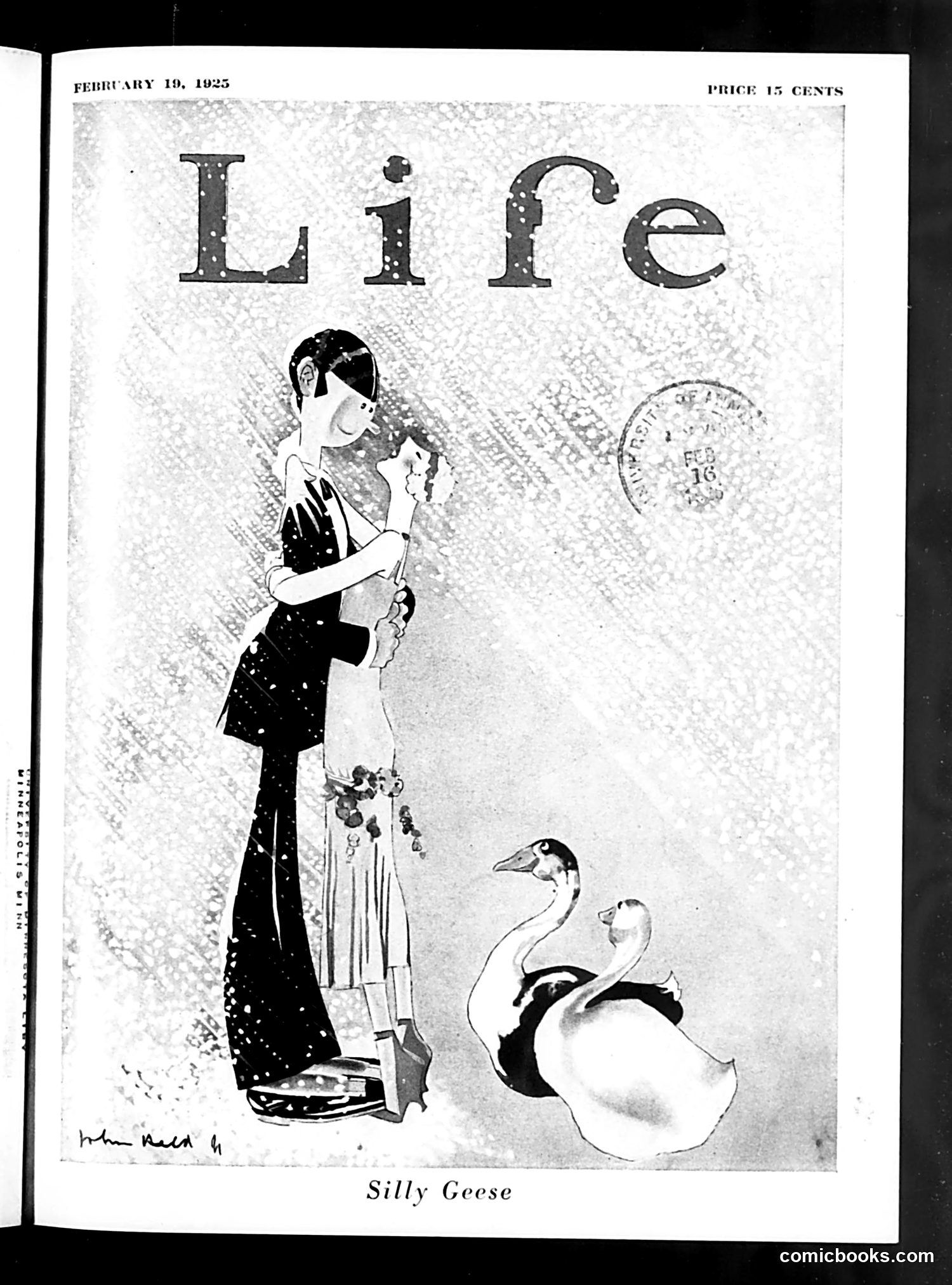
This cartoon presents a fashionable 1920s woman in an elegant dress, appearing to feed or interact with geese. The title "Silly Goose" plays on the era's common slang insult for foolish people, particularly women. The satire likely mocks women's fashion and behavior during the Jazz Age. The woman's stylized appearance—with her fashionable dress and affected posture—suggests she is the "silly goose" being ridiculed. The actual geese beside her create a humorous visual pun. The cartoon reflects 1920s anxieties about modern women's independence and changing social roles. By depicting a fashionable woman alongside literal geese, the illustration implies that such women were foolish or silly, a common satirical theme in period magazines mocking "flapper" culture and women's liberation.
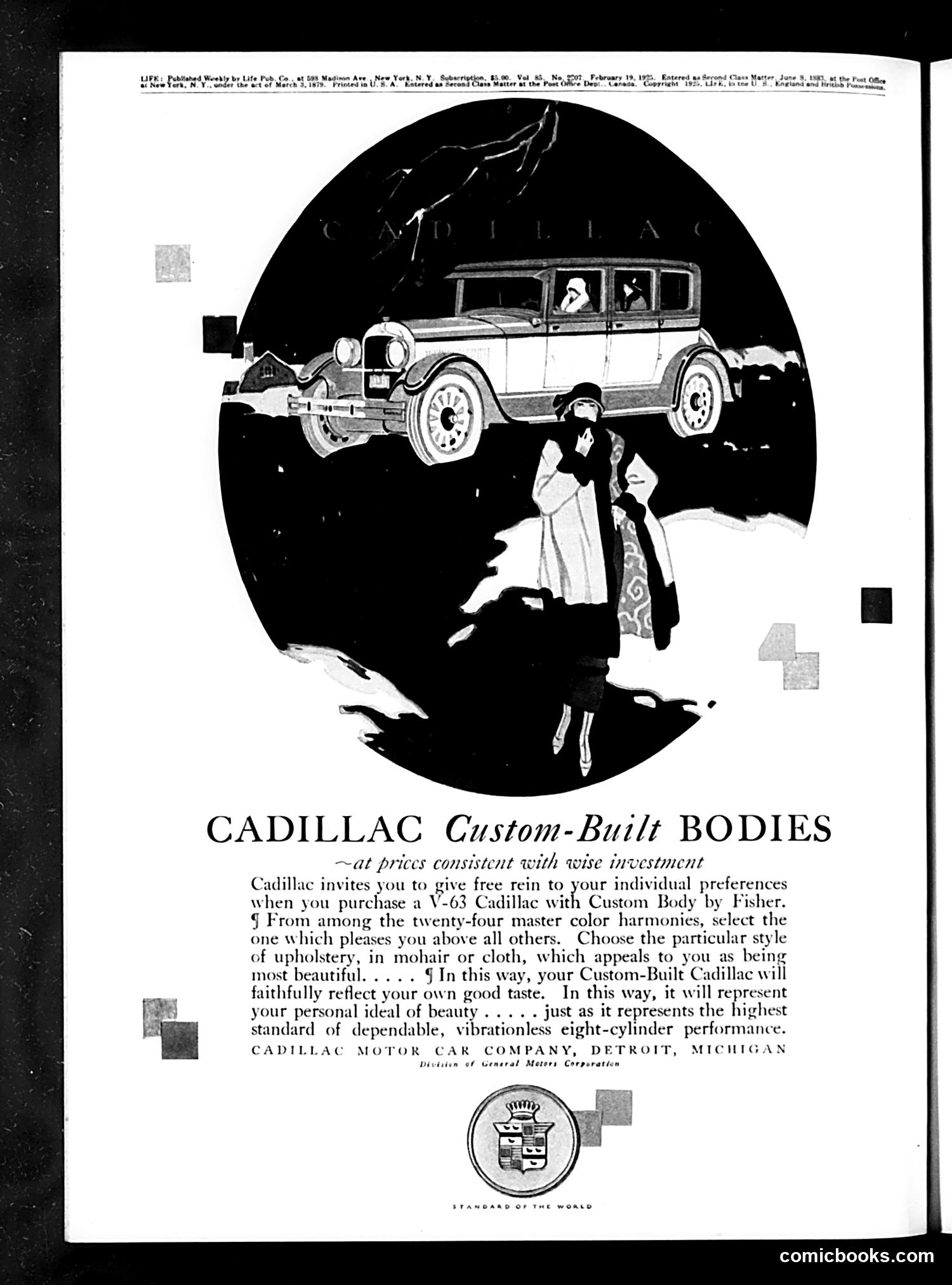
This page is **primarily an advertisement**, not satire or political commentary. It's a 1920s Cadillac ad promoting "Custom-Built Bodies" by Fisher. The image shows a stylized circular vignette depicting two elegantly dressed women admiring a V-63 Cadillac. The advertisement emphasizes customization options—twenty-four color harmonies, choice of upholstery materials (mohair or cloth)—positioning Cadillac as offering personalized luxury reflecting the owner's taste and "personal ideal of beauty." The ad targets affluent consumers, particularly women, highlighting how purchasing a Cadillac allows individual expression. The tagline "Standard of the World" reinforces brand prestige. This represents typical 1920s automobile marketing emphasizing both technical superiority (the eight-cylinder engine) and aesthetic customization as status symbols. No political cartoon or satire is present on this page.
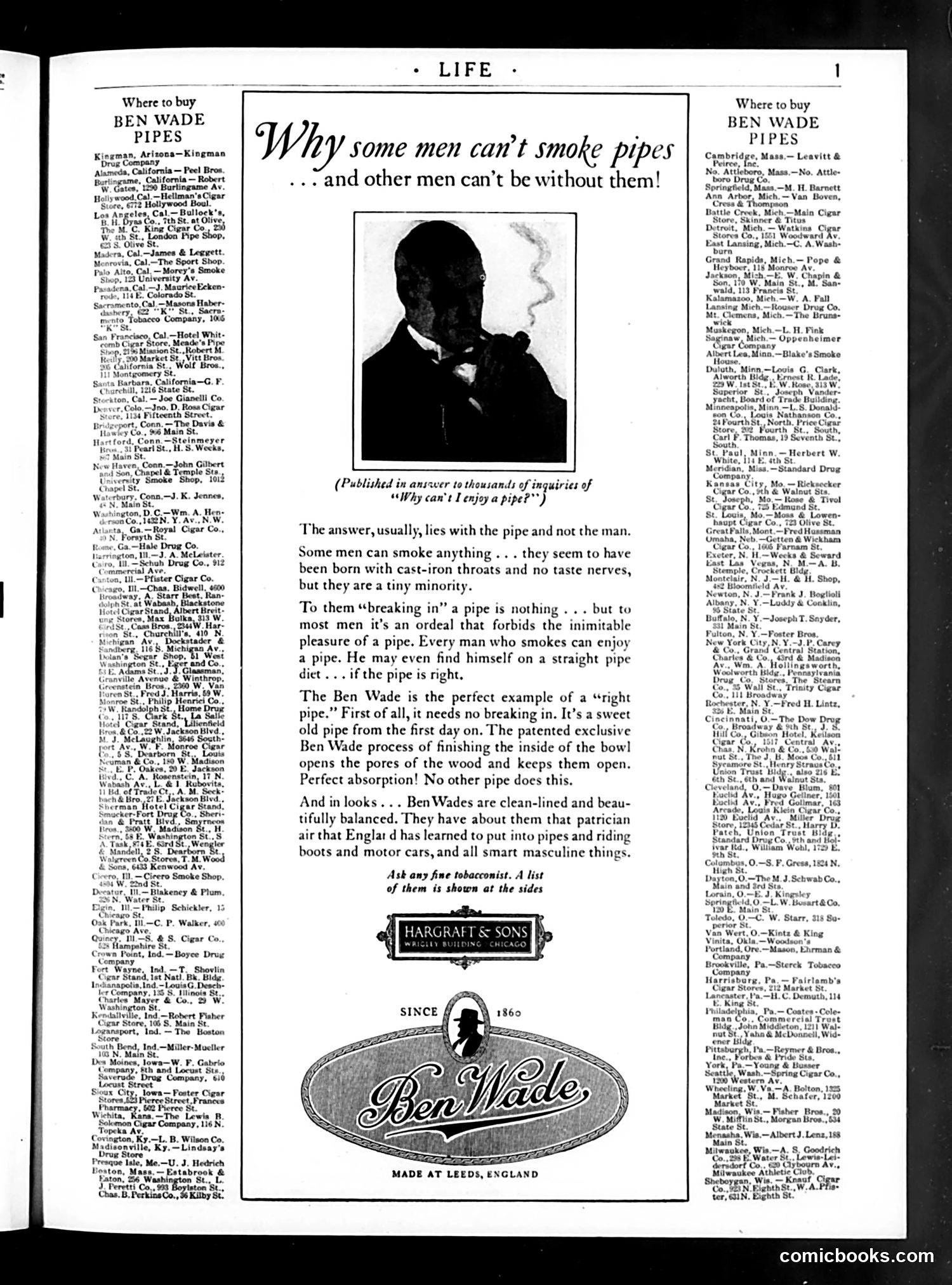
This page is primarily an **advertisement for Ben Wade pipes**, not a political cartoon. The central image shows a silhouetted man smoking a pipe with the headline "Why some men can't smoke pipes... and other men can't be without them!" The ad argues that pipe-smoking ability is innate—some men are born unable to enjoy pipes due to lacking "taste nerves," while others find them essential. It positions Ben Wade as "the perfect example of a right pipe," claiming superior design (exclusive finishing process, proper wood-pore treatment) makes the difference. The surrounding text consists entirely of retail locations selling Ben Wade pipes across North America. There is no political satire or social commentary here—this is straightforward commercial advertising using lifestyle appeal to sell a branded consumer product.
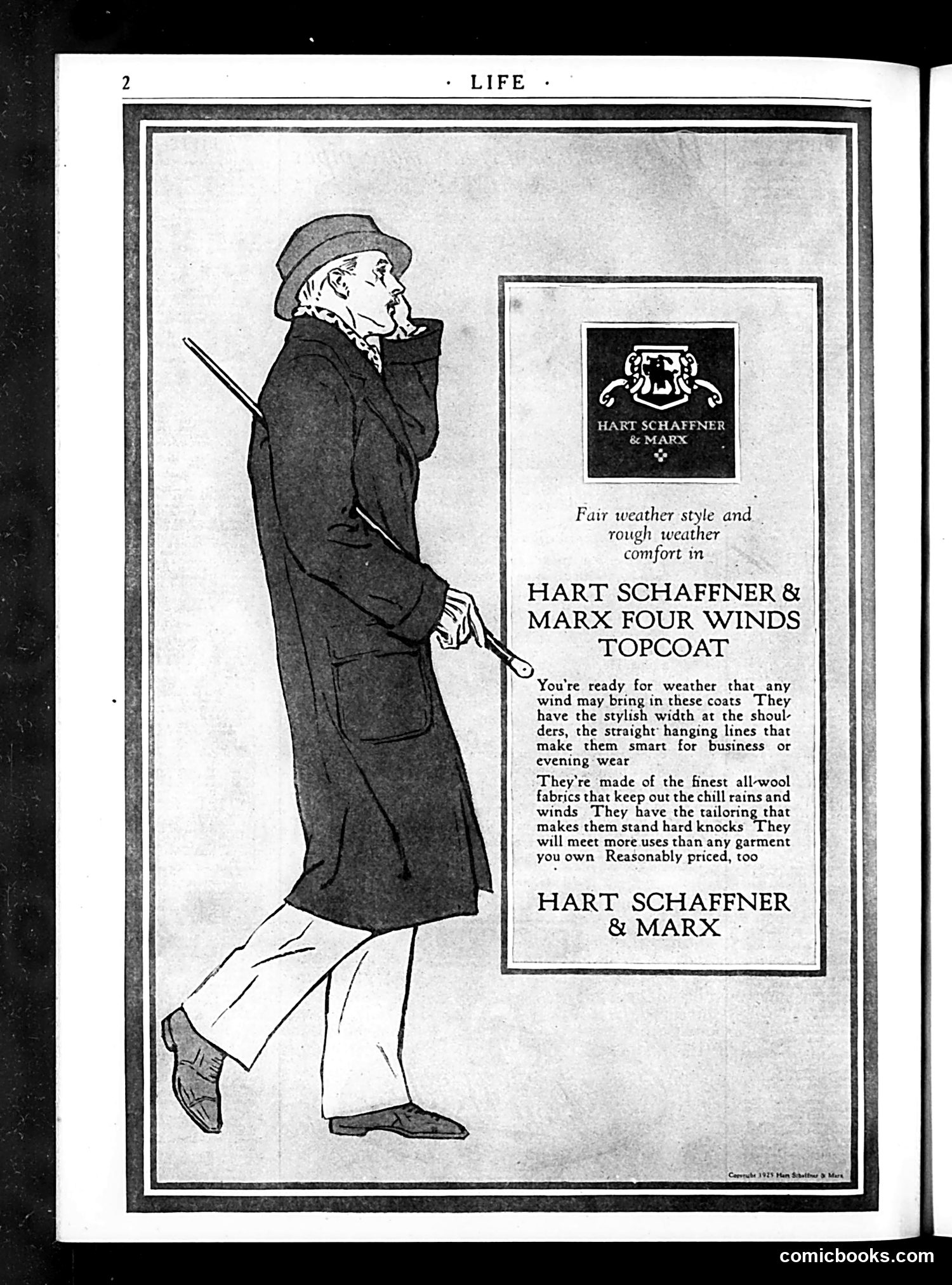
This page is **primarily an advertisement**, not political satire. It promotes Hart Schaffner & Marx's "Four Winds Topcoat" for men. The illustration shows a gentleman in profile wearing the advertised overcoat, depicted in a stylized manner typical of 1920s fashion advertising. He carries a cane and wears a hat, presenting an image of refined, businesslike respectability. The ad copy emphasizes the coat's practical virtues: it's suitable for "fair weather" and "rough weather," features quality wool construction to resist "chill rains and winds," and offers "smart" styling appropriate for "business or evening wear." The claim that it's "reasonably priced" suggests value positioning. There is **no apparent political or satirical content**—this is straightforward commercial advertising from Life magazine's revenue-generating pages.
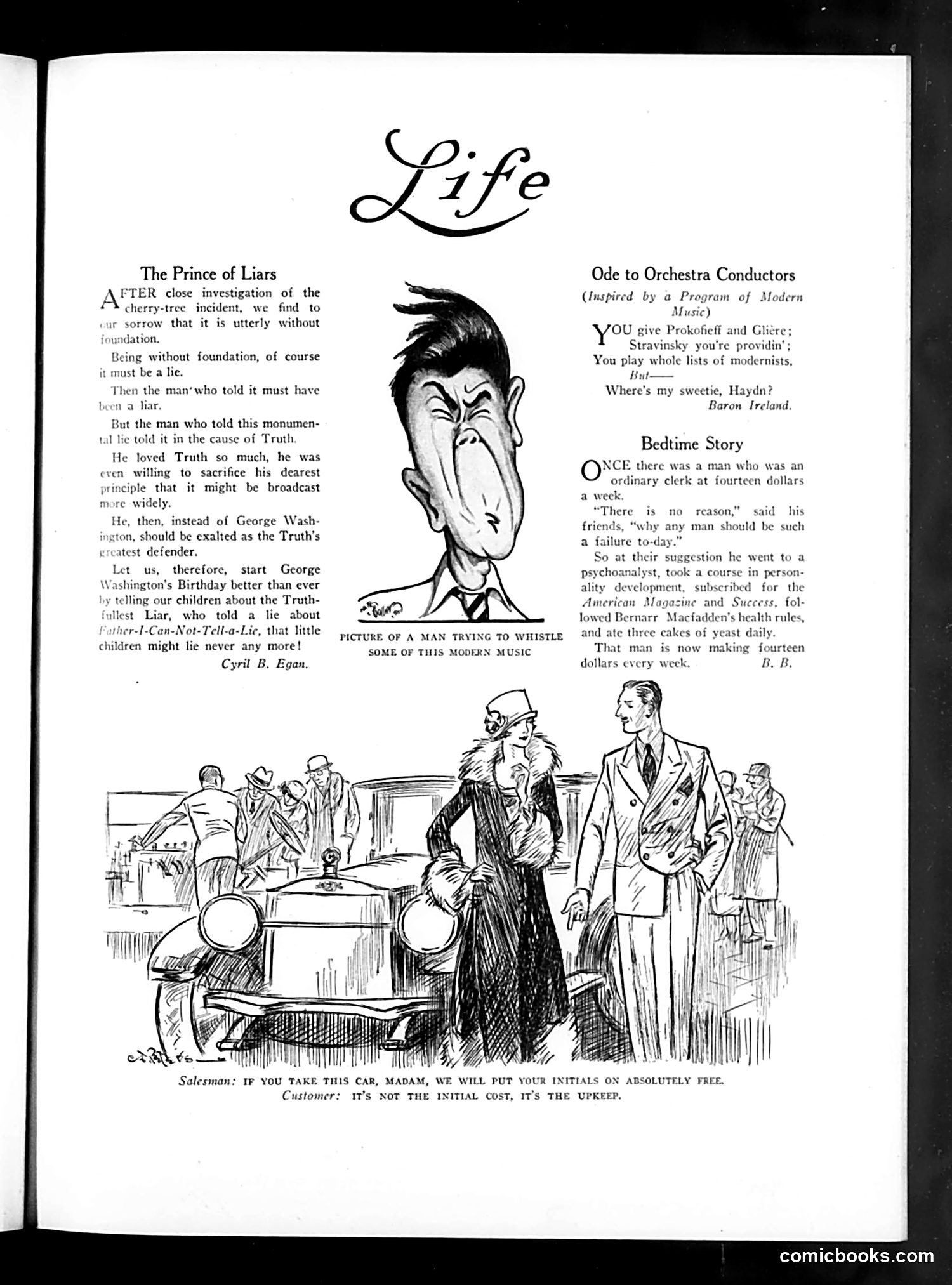
This page contains three distinct pieces of satire: 1. **"The Prince of Liars"** (left column): A philosophical commentary by Cyril B. Egan about truth-telling. It proposes George Washington as an exemplar of truth-telling, contrasting him with a "Truthful Liar" who broadcasts falsehoods widely. The piece advocates teaching children about Washington's honesty rather than lies. 2. **"Ode to Orchestra Conductors"** (top right): A humorous poem mocking modern classical music conductors, referencing composers like Prokofiev and Stravinsky, with a witty complaint about modernist compositions. 3. **Car Salesman Cartoon** (bottom): A sketch showing a salesman offering free initials on a car's upholstery, with the customer's sharp retort that the real cost is the "upkeep"—satirizing hidden expenses in automobile purchases.
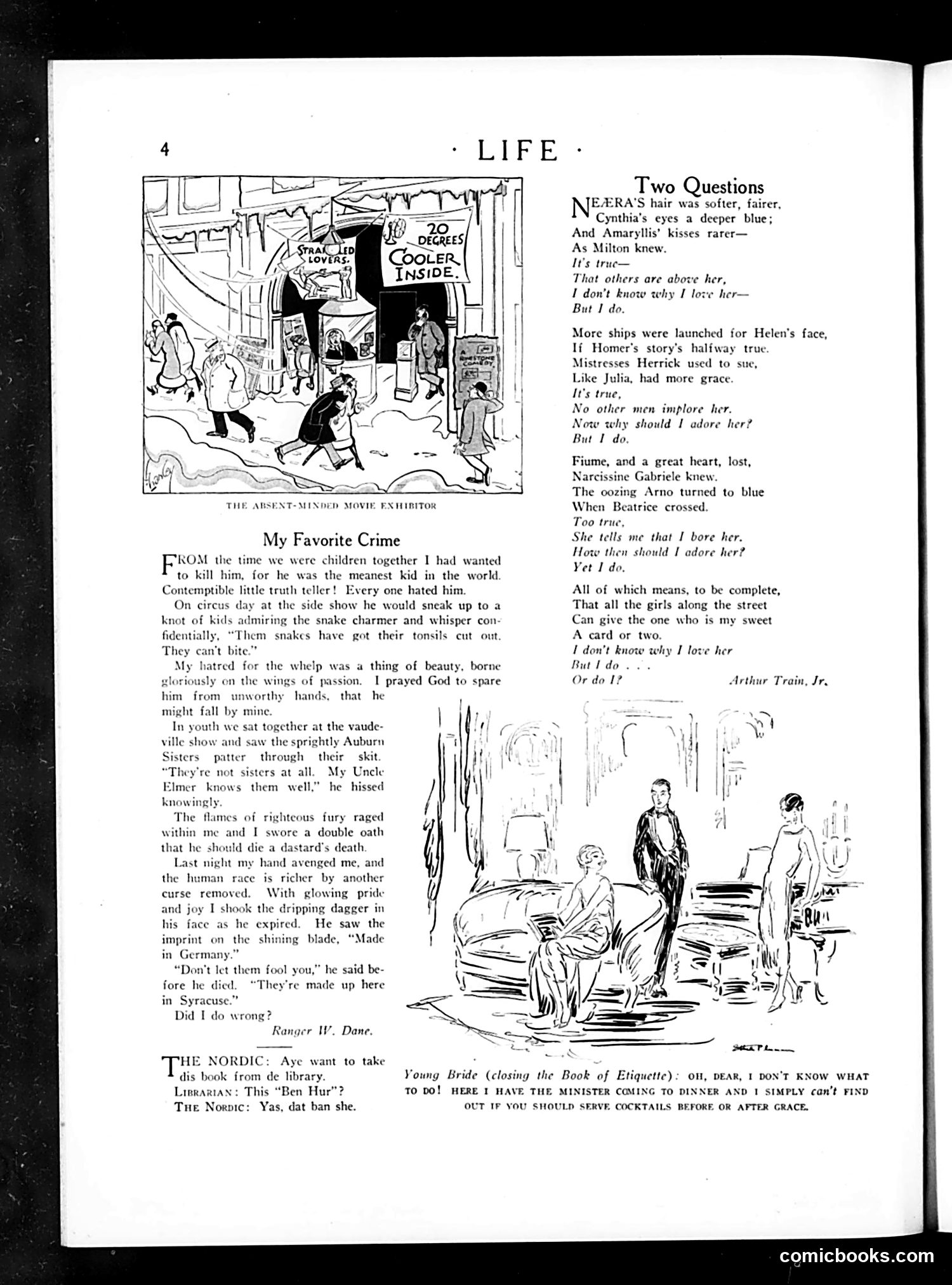
This page contains two distinct pieces from *Life* magazine: **"The Absent-Minded Movie Exhibitor"** (top cartoon): A silent-era joke about a movie theater operator who's posted signs advertising both "COOLER INSIDE" and "20 DEGREES," apparently contradicting himself. The humor relies on the absent-mindedness of the proprietor—he's promoting coolness while simultaneously advertising an improbably cold temperature that would be uncomfortable rather than appealing. **"My Favorite Crime"** (story) and **"Two Questions"** (poem): These are literary pieces reflecting on romantic attraction and human nature rather than political satire. The story recounts childhood resentment of a boy; the poem contemplates why one loves another despite others' superior qualities. **"Young Bride"** (bottom cartoon): A domestic humor scene about a bride confused about etiquette regarding cocktails and dinner service—a relatable social anxiety joke for the era. This page emphasizes *Life*'s satirical humor covering everyday modern life rather than explicit political commentary.
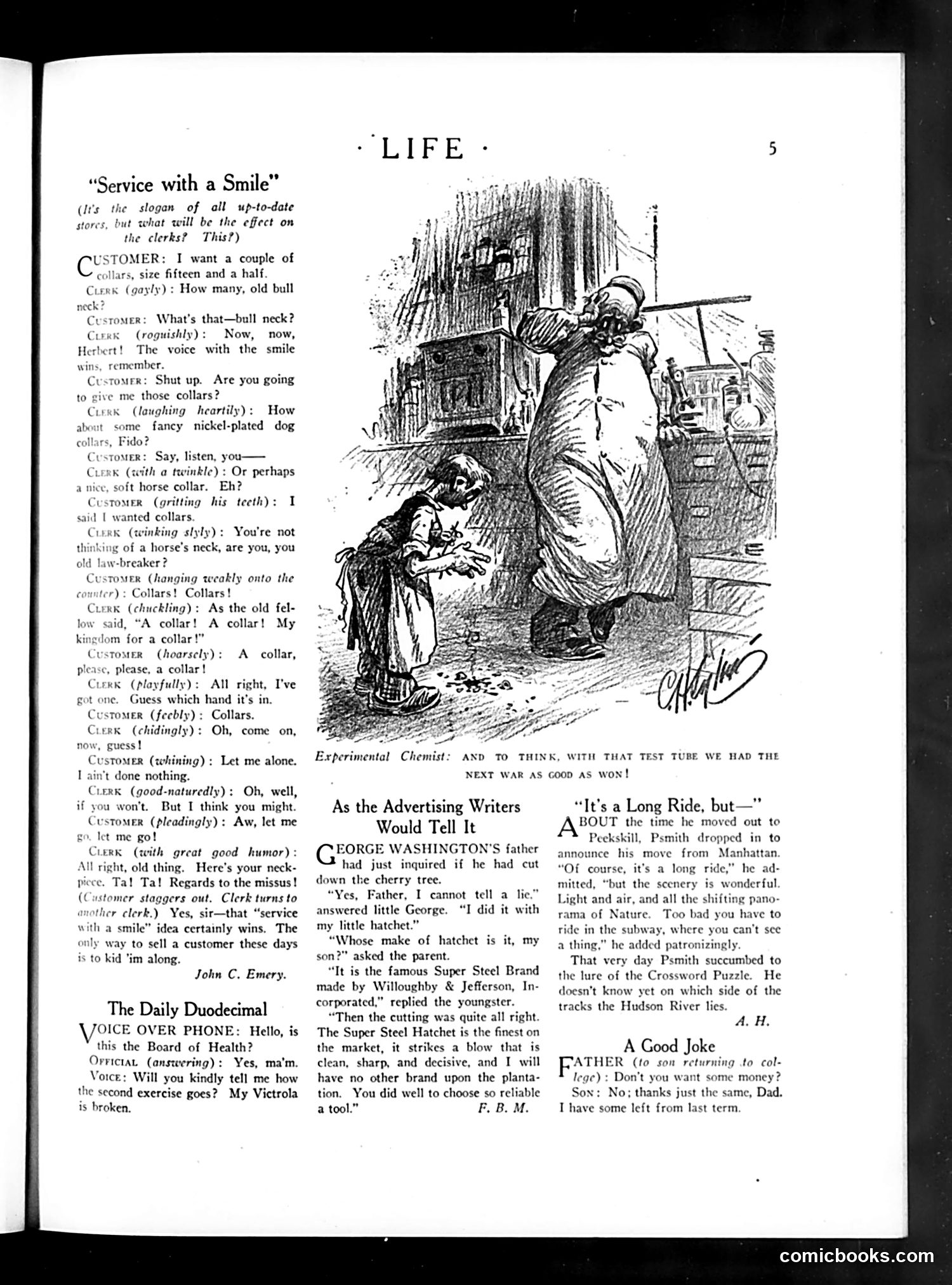
This page contains satirical humor pieces rather than political cartoons. The main illustration depicts a clerk in a store struggling with a customer over collars—a comedic dialogue about retail customer service. The humor relies on the clerk's frustration with the customer's indecisiveness and constantly changing requests for different collar styles. Below, "As the Advertising Writers Would Tell It" parodies advertising copy by retelling the cherry-tree anecdote about young George Washington in exaggerated, flowery promotional language—satirizing how advertisers dramatize mundane stories. The other brief pieces ("The Daily Duodecimal," "A Good Joke") are short humor columns unrelated to politics. This appears to be a general humor and satire page typical of early 20th-century Life magazine.
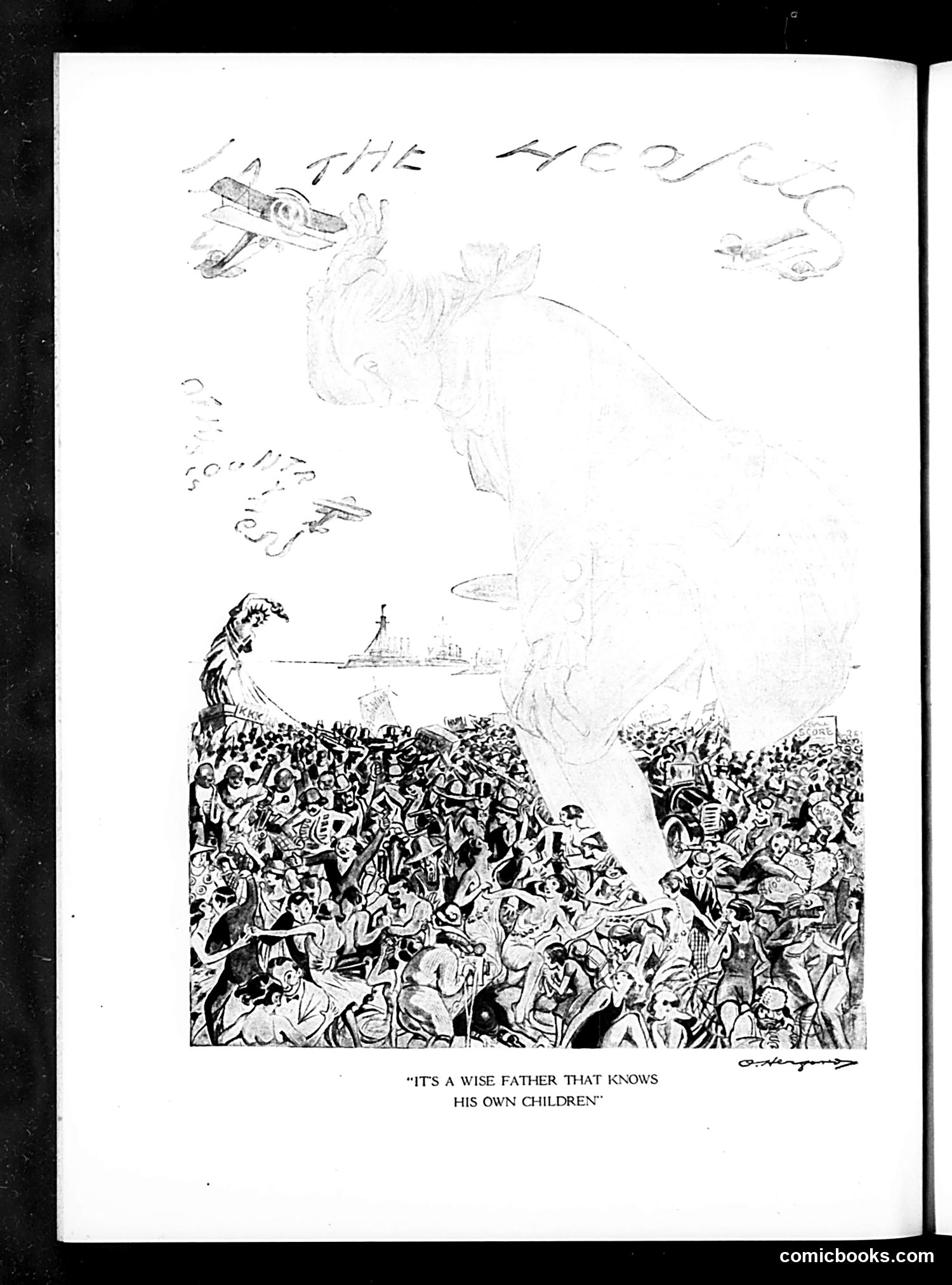
This political cartoon depicts a massive crowd of people below a giant, somewhat grotesque face emerging from smoke or clouds. Small aircraft fly overhead. The caption quotes the proverb about fathers knowing their children. The satire likely comments on **industrial or military proliferation**—suggesting that modern warfare, manufacturing, or state power has created so many competing factions or consequences that even their originators (the "father") cannot control or identify them. The crowd's chaotic density and the ominous face above suggest **unintended consequences of technological or political decisions**. The aircraft and military imagery suggest this addresses **wartime production or military expansion**, possibly from WWI or WWII era. The exact historical reference remains unclear without dating.
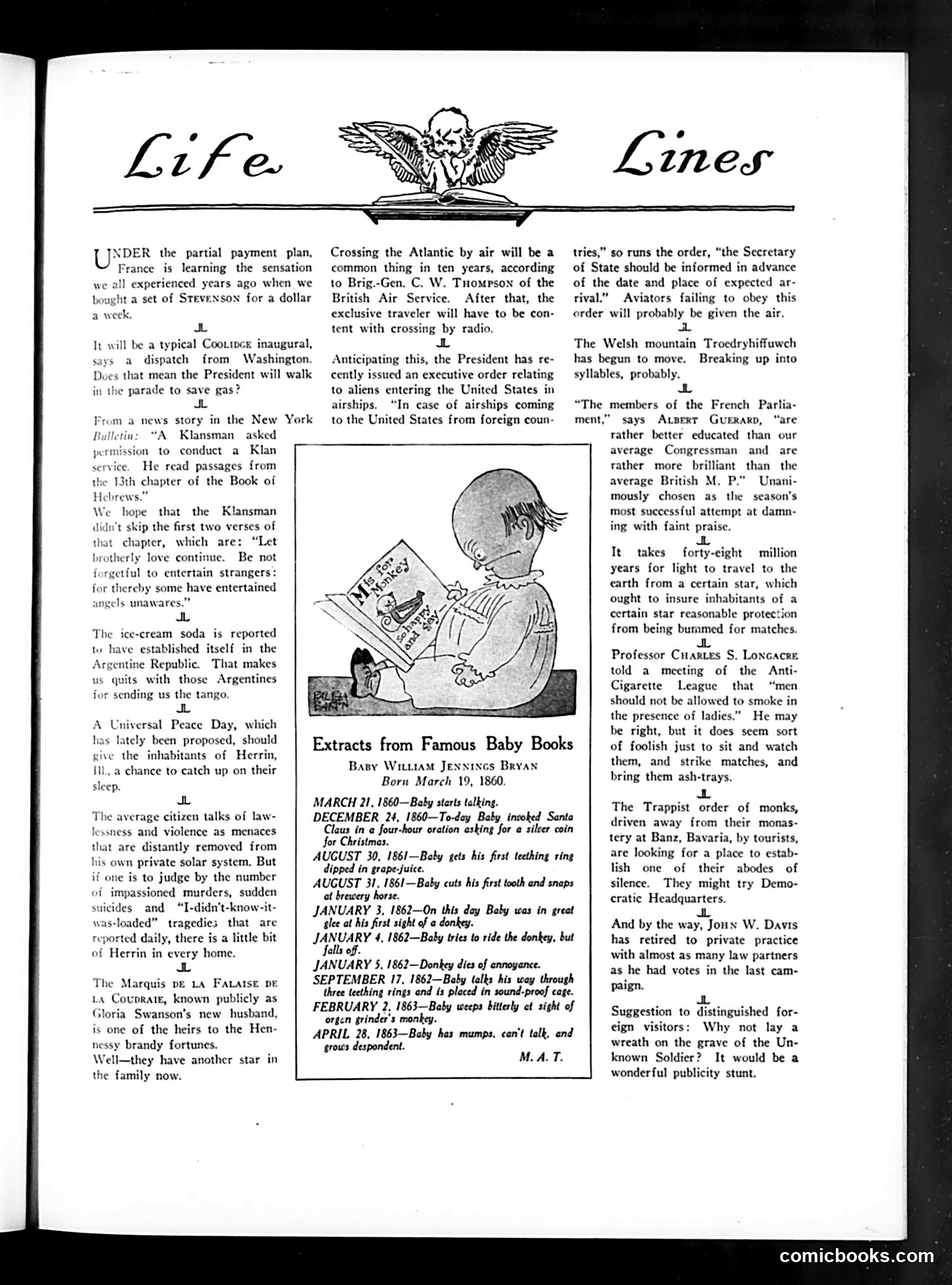
This page contains satirical commentary and a humorous illustration titled "Extracts from Famous Baby Books." The central cartoon depicts an infant reading what appears to be a newspaper or publication, satirizing how even babies are exposed to current events and media. The surrounding text offers brief social commentary on various topics: France's financial struggles, transatlantic aviation developments, and observations about the French Parliament versus Congress. The "Famous Baby Books" section parodies milestone entries from Baby William Jennings Bryan's diary (born March 19, 1860), with humorous annotations tracking supposedly precocious developmental moments—a jest at both parental exaggeration and the notable political figure Bryan himself. Overall, the page uses gentle satire to comment on modern life's pace and media saturation.
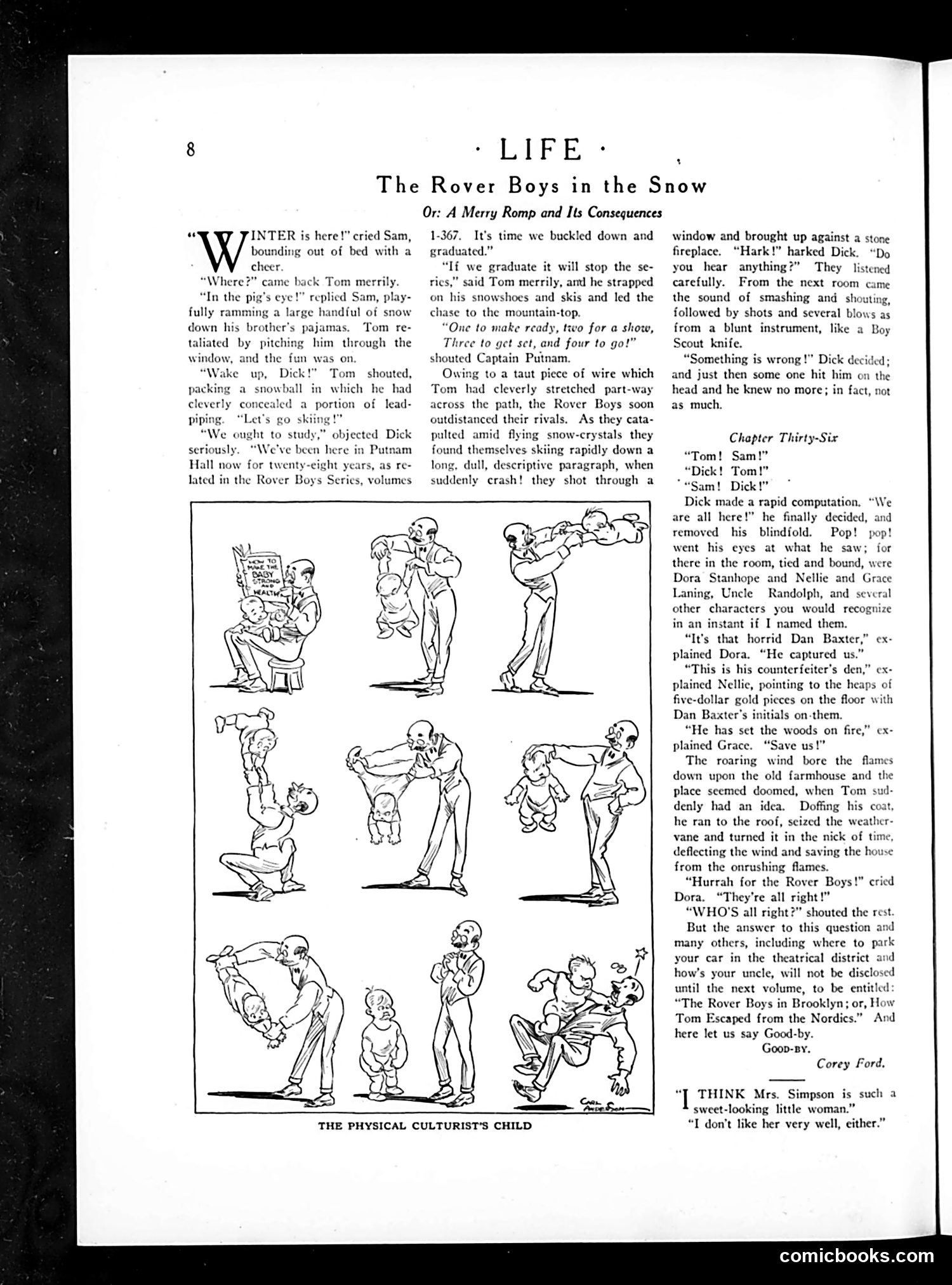
This page presents a serialized children's adventure story titled "The Rover Boys in the Snow: Or A Merry Romp and Its Consequences." The main feature is a series of comic illustrations captioned "THE PHYSICAL CULTURIST'S CHILD," depicting a young boy performing various athletic and gymnastic poses—stretching, balancing, tumbling, and exercising with an adult male figure. The satire targets the "physical culture" movement popular in early 20th-century America, which promoted rigorous exercise and physical development. The joke appears to be that an overzealous physical culturist has subjected his child to excessive, sometimes absurd athletic training, turning the boy into a contorted, hyperflexible performer rather than allowing normal childhood play. It mocks the era's obsession with scientific fitness applied to children.
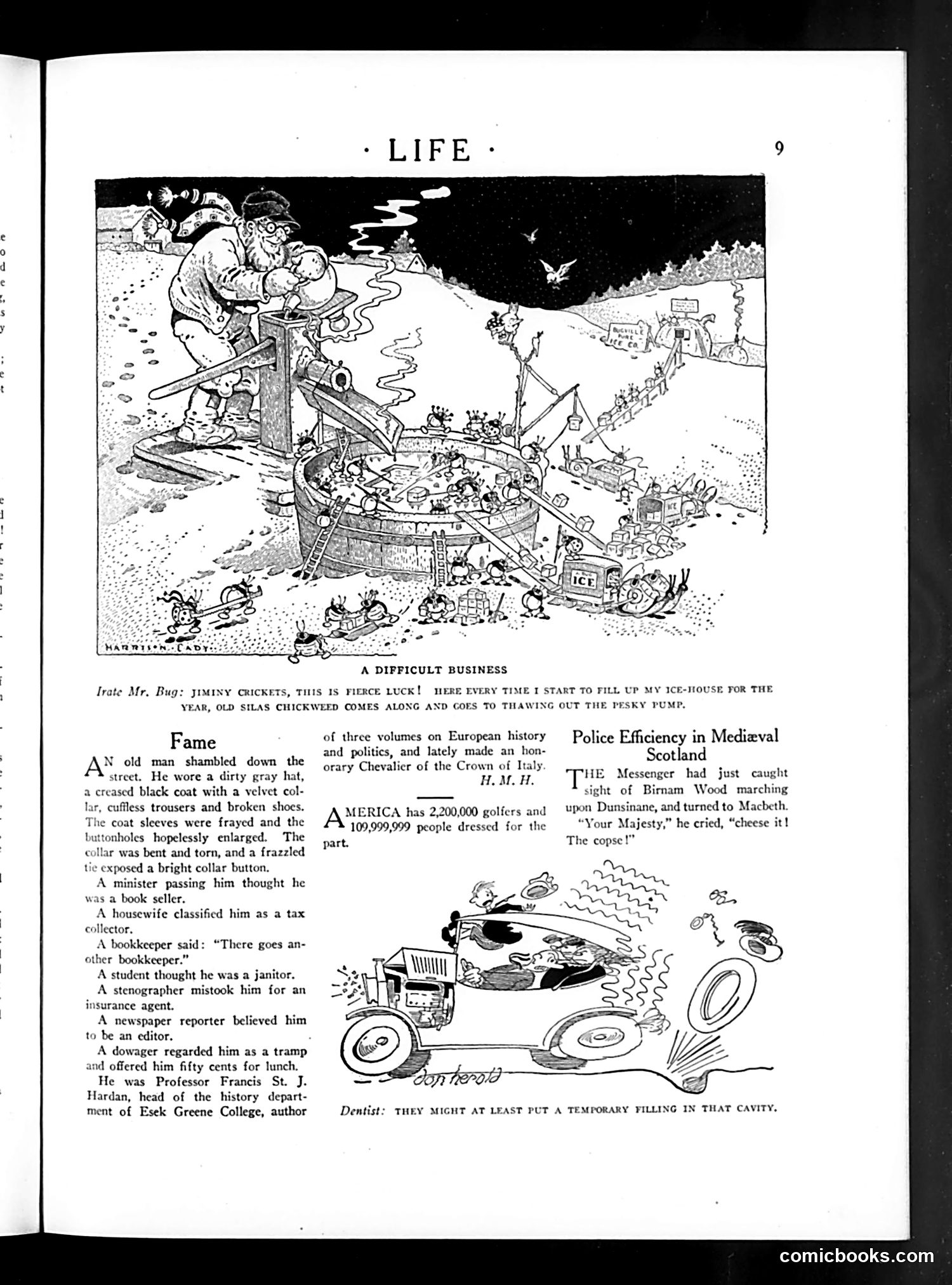
**Top Cartoon: "A Difficult Business"** Hamilton Cady's illustration depicts Santa Claus struggling with an ice-house pump, surrounded by elves engaged in winter labor. The caption jokes that Santa must refill his ice-house annually—a reference to the 19th-century practice of harvesting and storing ice for summer use. The humor lies in applying mundane household maintenance to Santa's magical operations, deflating the fantasy with practical domestic reality. **Bottom Content:** Brief anecdotes follow, including a joke about a dentist's poor work ("They might at least put a temporary filling in that cavity"). The section titled "Police Efficiency in Mediæval Scotland" references historical mishaps. The remaining text contains an anecdote about an elderly man's multiple mistaken identities, satirizing professional misidentification.
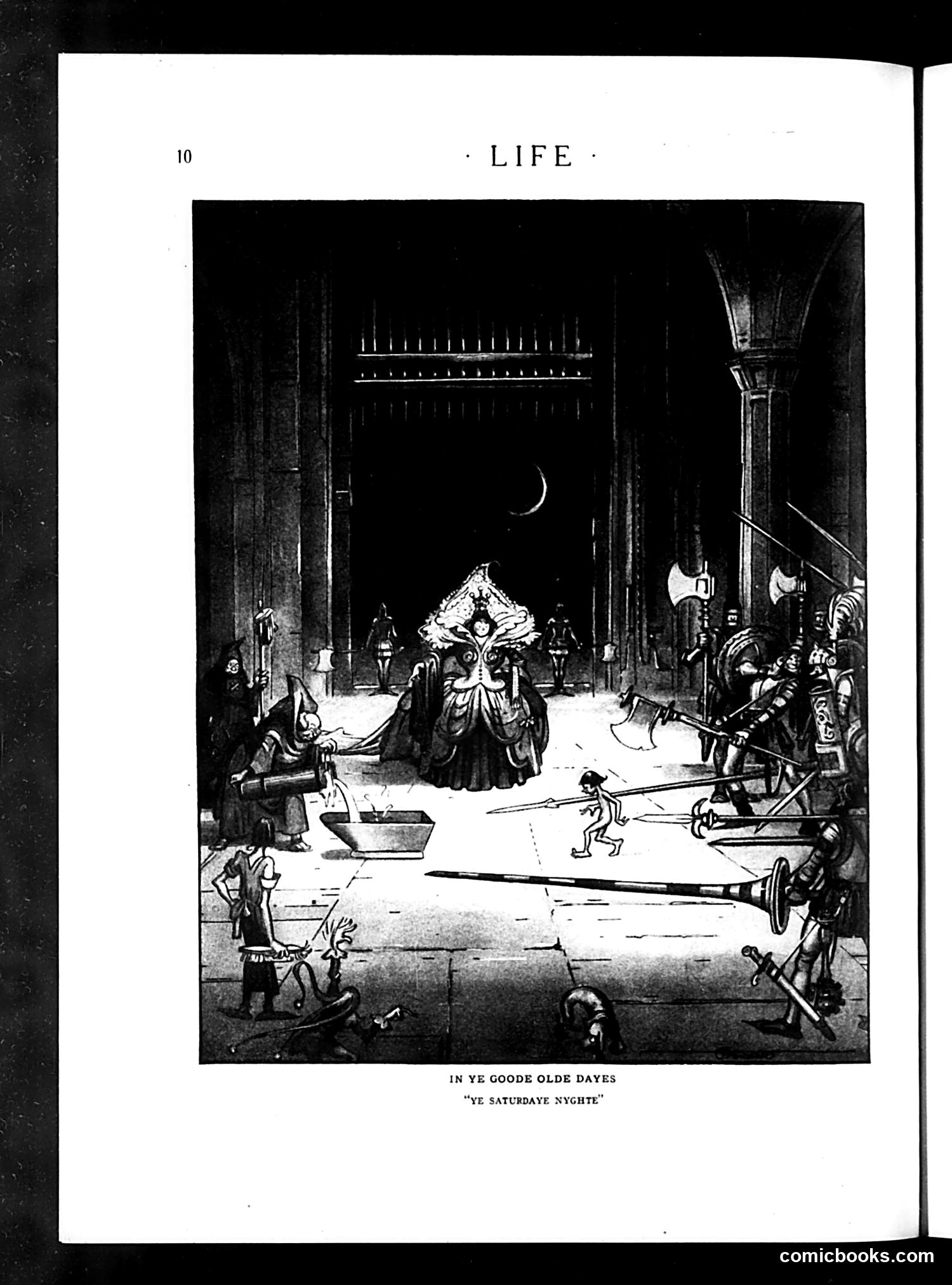
This illustration is titled "In Ye Goode Olde Dayes: 'Ye Saturday Nighte'" and depicts a medieval or Renaissance-era tavern scene. The image appears to satirize entertainment and social behavior in "olden days" through an elaborate theatrical staging—complete with costumed performers, musicians with axes and weapons, and a central female figure in ornate dress. The satire likely mocks nostalgic romanticization of historical periods, contrasting imagined "good old days" with actual historical reality. The theatrical staging itself becomes the joke: Life presents this as how modern audiences imagine the past, complete with elaborate costumes and dramatic posturing, suggesting that such nostalgic visions are more theatrical fantasy than historical fact. The caption emphasizes this is entertainment performance rather than authentic recreation.
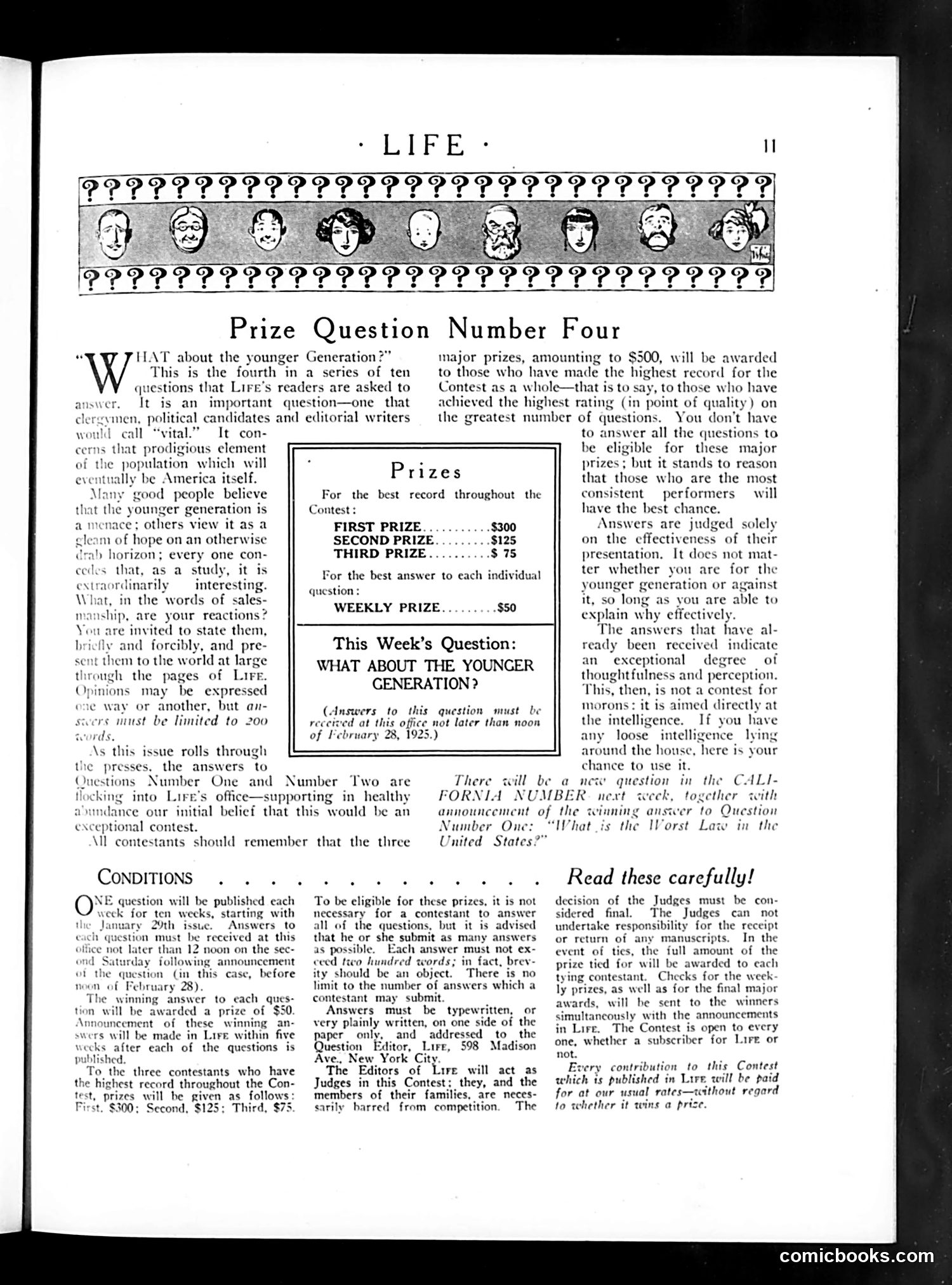
This page is primarily **instructional and advertising** rather than satirical content. It announces "Prize Question Number Four" — a contest asking readers "What about the younger generation?" with prizes up to $300 for the best answers. The top of the page features a **decorative header with nine illustrated faces** (mostly male, one female) topped by question marks, visually representing the contest's inquiry about generational characteristics. The text reveals this was a **recurring Life magazine contest series** designed to encourage reader participation. Answers had to be submitted by February 28, 1925, and would be judged on "effectiveness of presentation" rather than whether they favored youth or criticized them. This represents **early 20th-century magazine engagement strategies** — contests were popular mechanisms to build reader involvement and community.
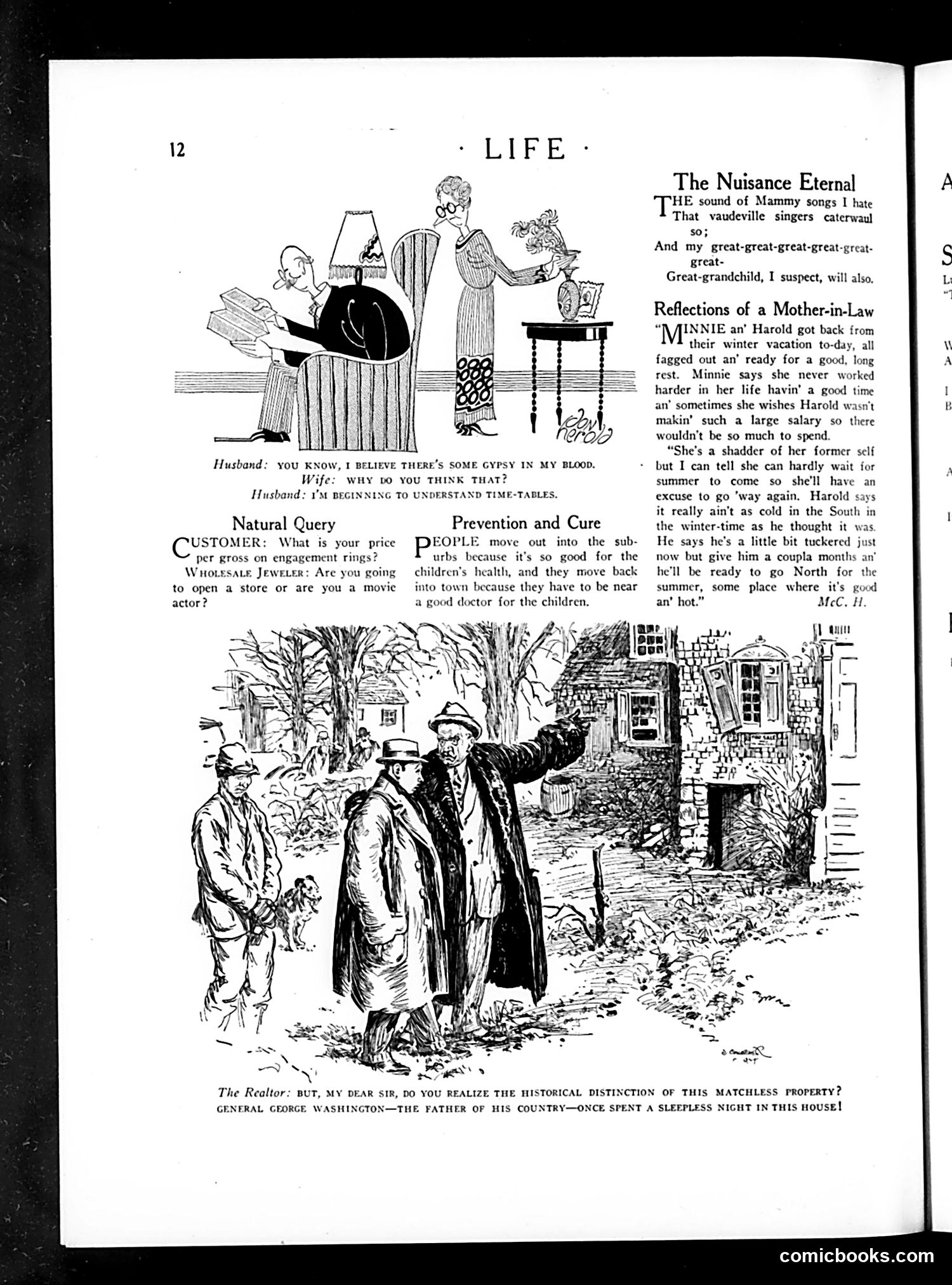
This page contains three satirical pieces typical of early 20th-century Life magazine humor: **"The Nuisance Eternal"** mocks Mammy songs and vaudeville performers, expressing distaste for popular entertainment of the era. **"Reflections of a Mother-in-Law"** presents domestic comedy about a woman named Minnie whose son Harold has brought her home for vacation. She complains about his salary and plans to visit cooler climates. **"Natural Query" and "Prevention and Cure"** are brief joke exchanges—one about jeweler pricing, another about suburban living and children's health. The largest cartoon depicts a real estate agent showing a property to potential buyers, with the realtor boasting that General George Washington once spent a sleepless night there—a humorous appeal to historical prestige as a selling point for an ordinary house.
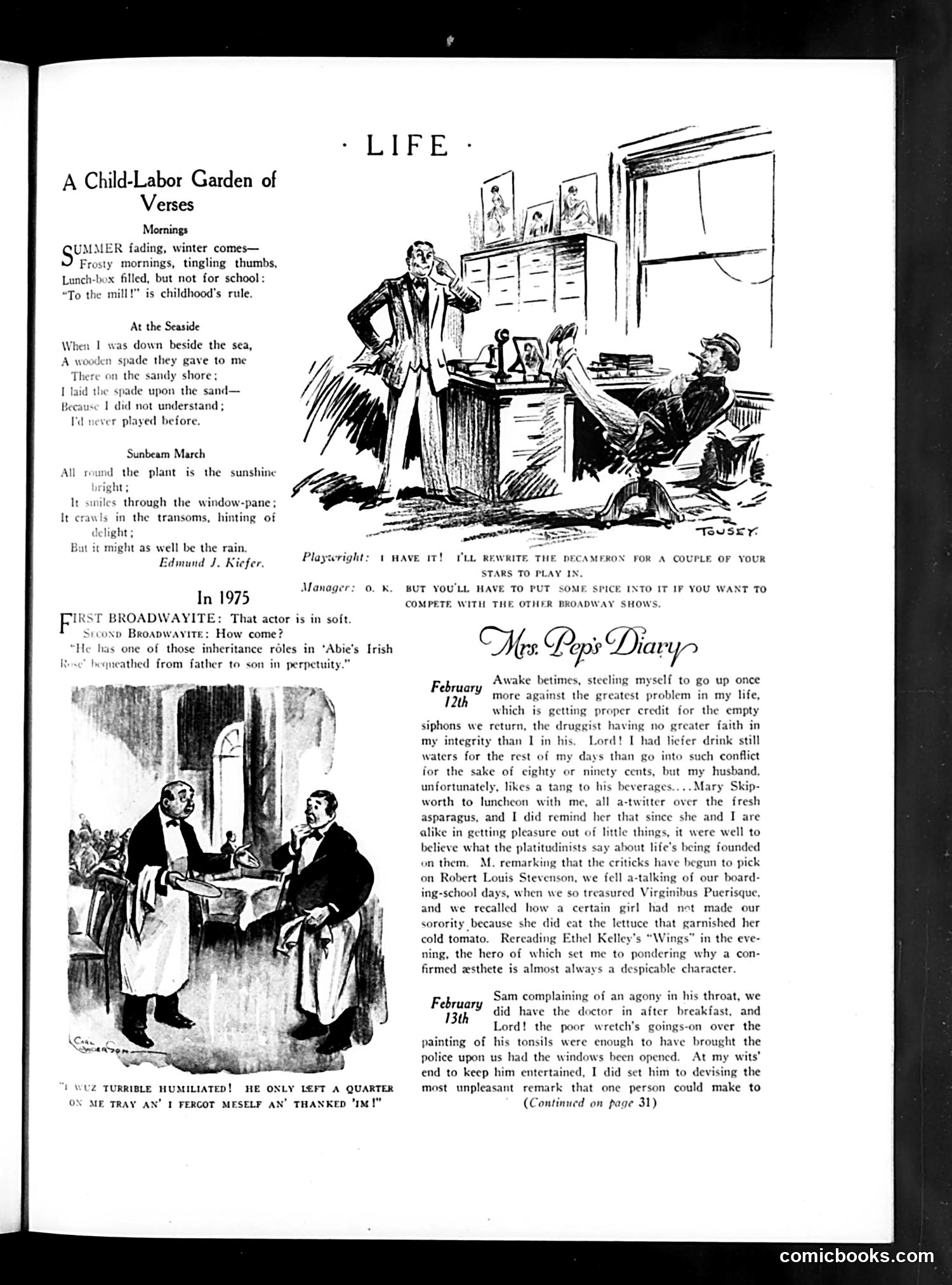
This page contains two distinct illustrations and literary content rather than explicit political satire. The top cartoon depicts a theatrical scene: a playwright (standing) confronts a theater manager about rewriting a play. The manager demands "spice" to compete commercially—a commentary on early 20th-century theater commercialism versus artistic integrity. The lower cartoon shows two men in what appears to be a dining dispute, captioned with working-class dialogue about a tip or payment disagreement. The caption's misspelling ("'IM" for "HIM") satirizes working-class speech patterns, typical of Life's era. "Mrs. Pep's Diary" is a domestic humor column about marital conflicts and household management. These pieces mock upper-middle-class anxieties about servants, social standing, and domestic propriety rather than target political figures.
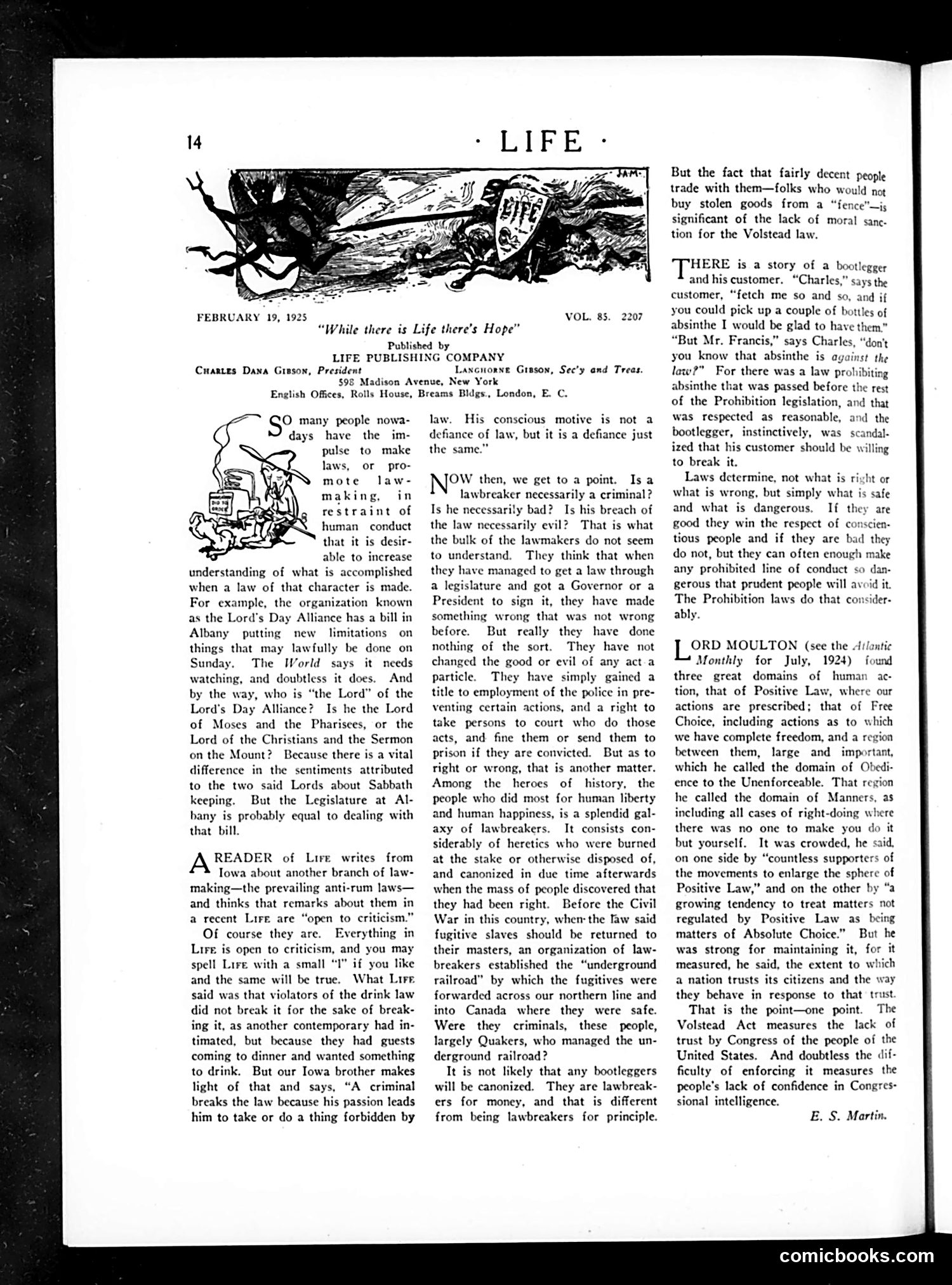
This page discusses Prohibition enforcement and bootlegging during the 1920s alcohol ban. The main cartoon (top left) depicts a bootlegger caught with contraband, illustrating the article's central debate: whether bootleggers are criminals or civil disobedients breaking an unjust law. The article argues that bootleggers operating from principle differ from those motivated purely by profit. It references historical precedents—fugitive slave rescuers and Quaker "underground railroads"—to suggest some lawbreaking can be morally justified. The piece critiques both Prohibition's overstep and bootleggers' opportunism, ultimately questioning Congressional authority to enforce unpopular measures lacking public confidence. The satire targets the fundamental tension between legal prohibition and practical American resistance to it.
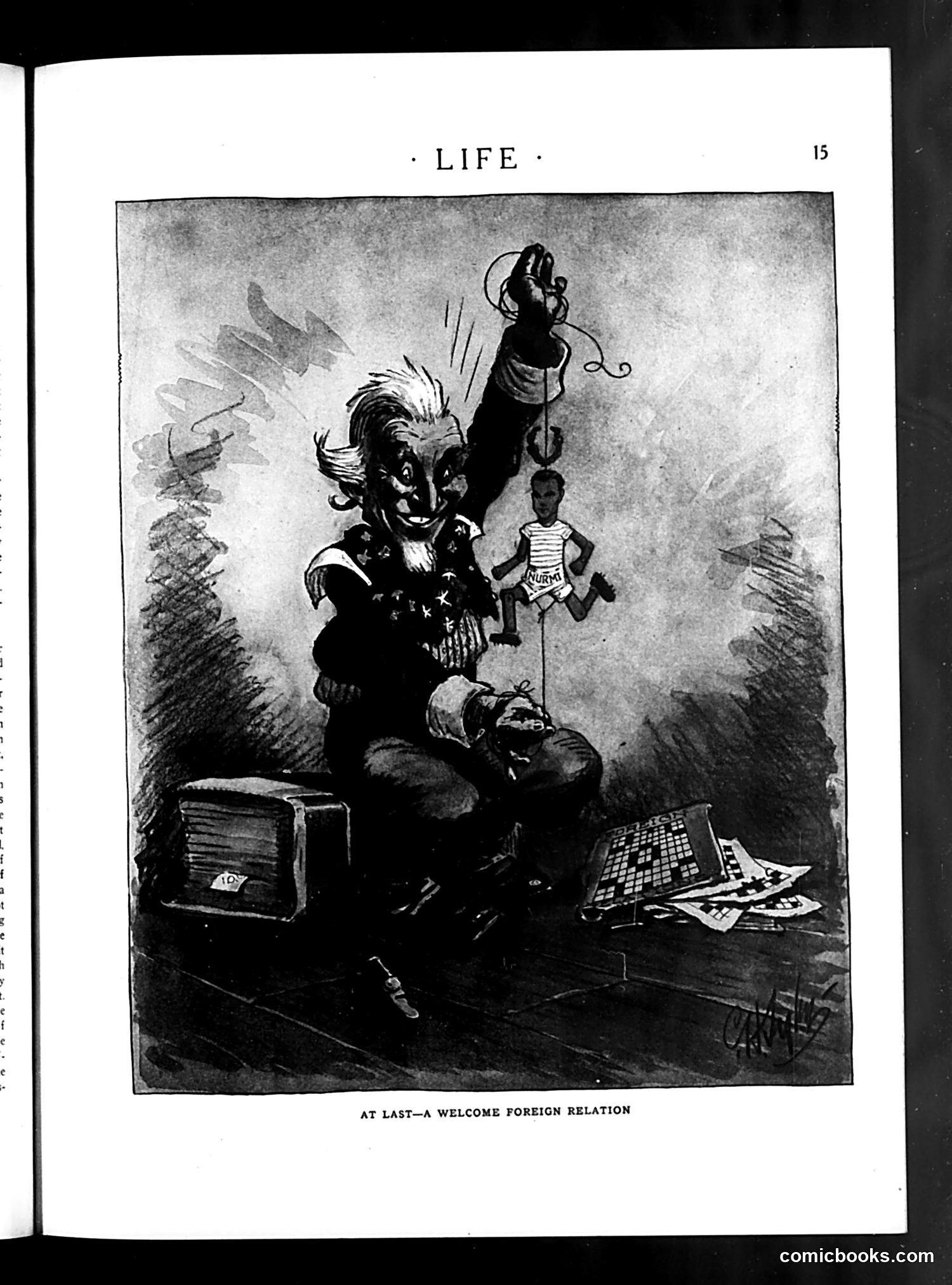
This political cartoon depicts Uncle Sam (identifiable by his stars-and-stripes outfit) as a puppet master manipulating a small child figure labeled "PROSPERITY." The caption suggests irony—that prosperity is finally a "welcome foreign relation," implying it's treated as a foreign visitor rather than something domestic. The caricatured figure controlling the strings appears malevolent, suggesting skepticism about who truly controls America's economic wellbeing. Surrounding items (a trunk, scattered papers/games) suggest instability or chaos underlying the facade of prosperity. The cartoon likely critiques 1920s economic conditions, suggesting that apparent prosperity was artificially maintained or controlled by powerful interests rather than representing genuine, sustainable American economic health. The satirical tone questions whether prosperity was real or merely manipulated appearance.
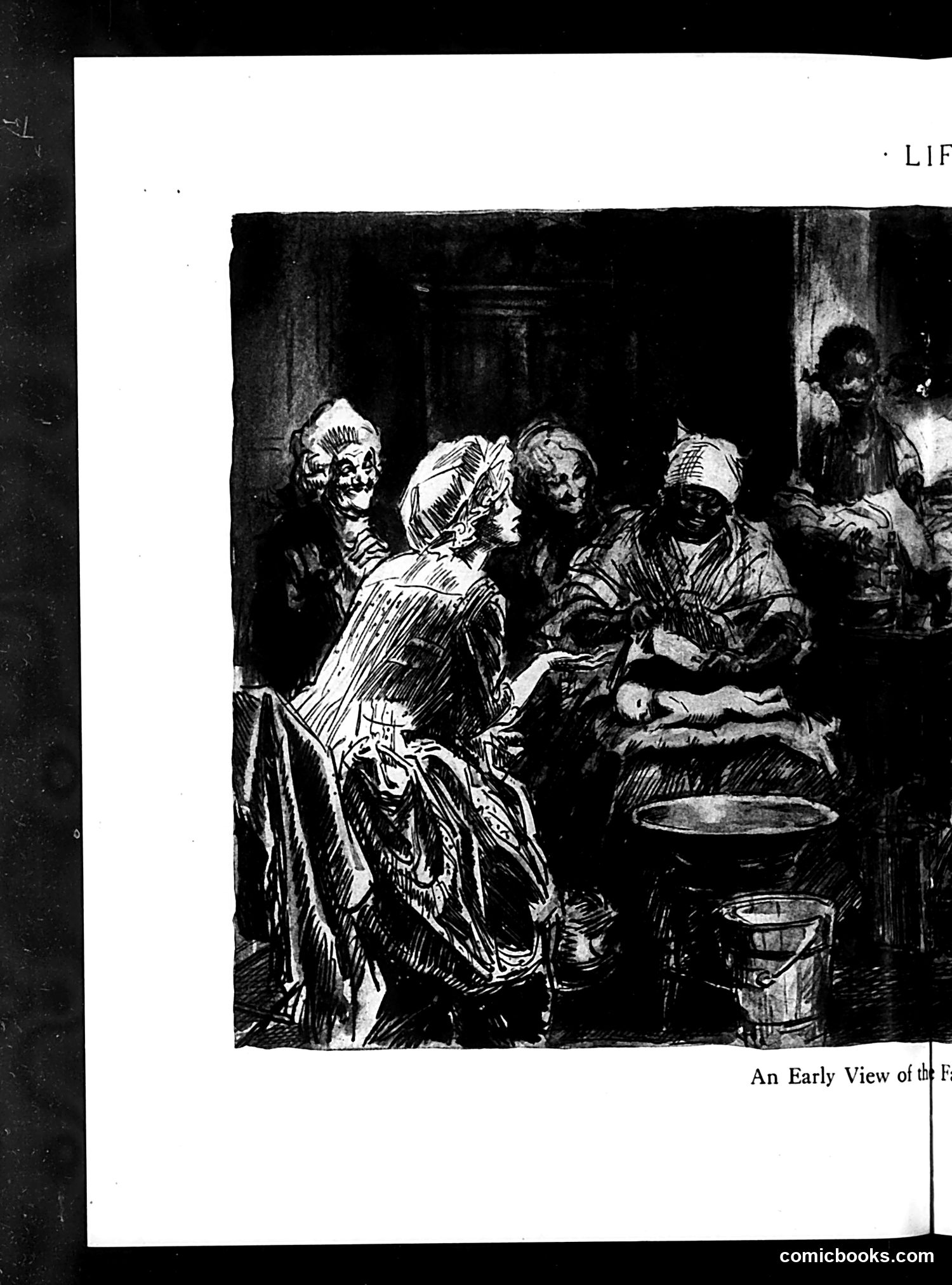
This appears to be a historical black-and-white illustration, likely from Life magazine's satirical archives. The caption reads "An Early View of th[e]" (text cut off), suggesting it depicts an historical scene being revisited or reinterpreted. The image shows a gathering of figures in what appears to be an interior setting. The central figure, a woman in period dress viewed from behind, faces a group of seated and standing figures with exaggerated facial features typical of period caricature. The style and execution suggest social or political satire, but without the complete caption or publication date visible, I cannot definitively identify which specific historical event, figures, or satirical point is being referenced. The dramatic lighting and composition suggest commentary on a significant historical moment.
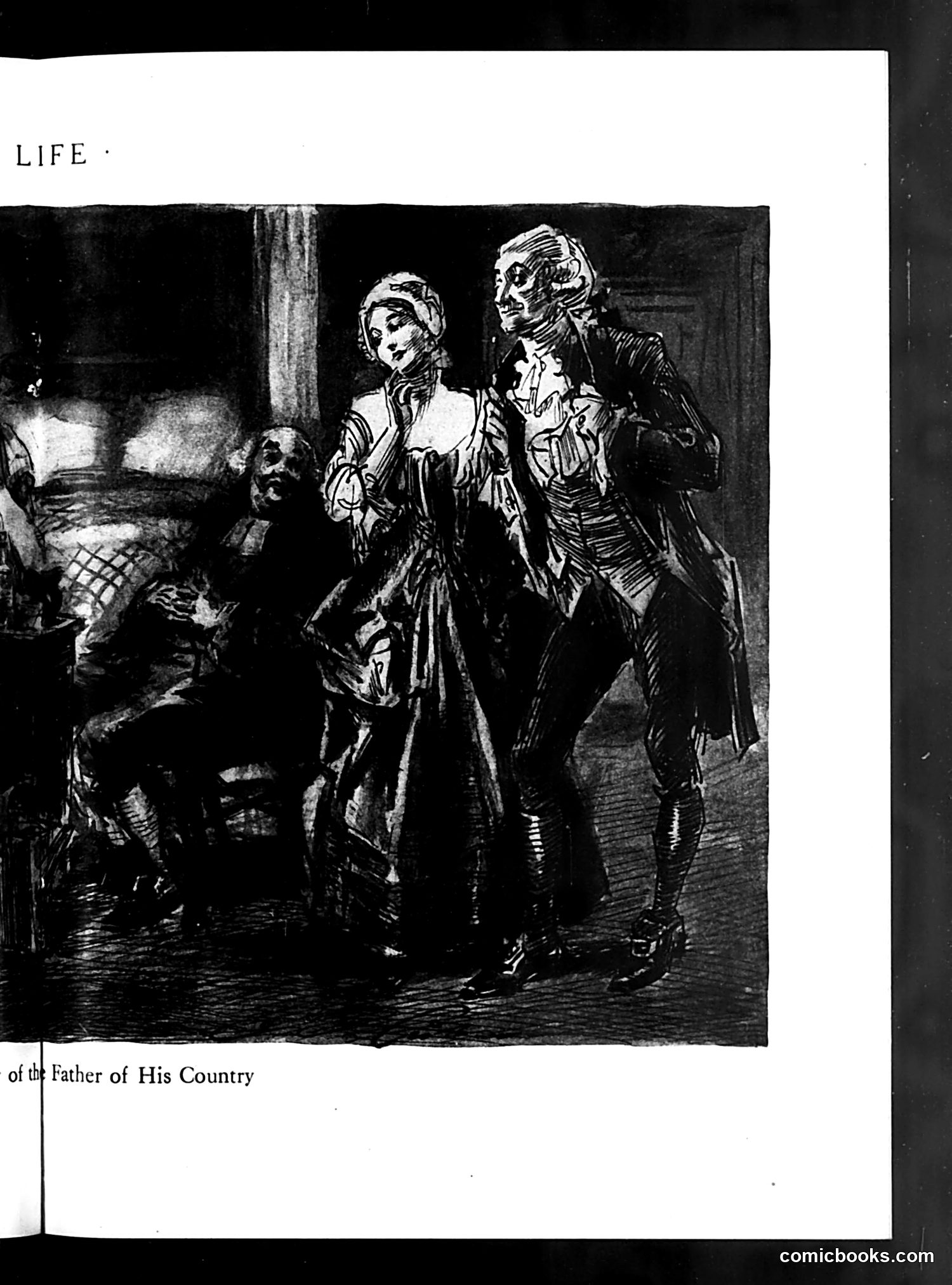
The page heading reads "LIFE" with a caption "of the Father of His Country" (referring to George Washington). The illustration shows a dramatic scene with period costume figures—a woman in an elegant dress with bonnet, a man in 18th-century formal attire, and what appears to be additional figures in the shadows. The satirical intent appears to comment on historical romanticization or perhaps a romantic/personal scandal involving Washington, suggested by the theatrical staging and intimate positioning. However, without more context or visible caption text, the specific social commentary remains unclear. The dramatic chiaroscuro and expressive line work are typical of Life magazine's satirical illustration style from the early 20th century.
This page contains theater criticism from Life magazine's "Drama" section. The reviewer adopts a benevolent tone toward two small, independent theater productions—"Out of Step" and "The Small Timers"—praising specific scenes and performances despite acknowledging the plays are amateurish and poorly written. The critic uses a "white bean" voting system (a whimsical rating method), awards praise to performers like Eric Dressler and Marcia Byron, and commends a particular vaudeville scene. The page mocks sophisticated New Yorkers who didn't recognize intentional satire in one scene. The reviewer also briefly discusses "The Depths" (starring Jane Cowl) and "Beyond" at the Provincetown Theatre. The tone throughout is patronizing but ultimately encouraging toward struggling theatrical ventures, reflecting an era of small, experimental theater companies in early 20th-century New York.
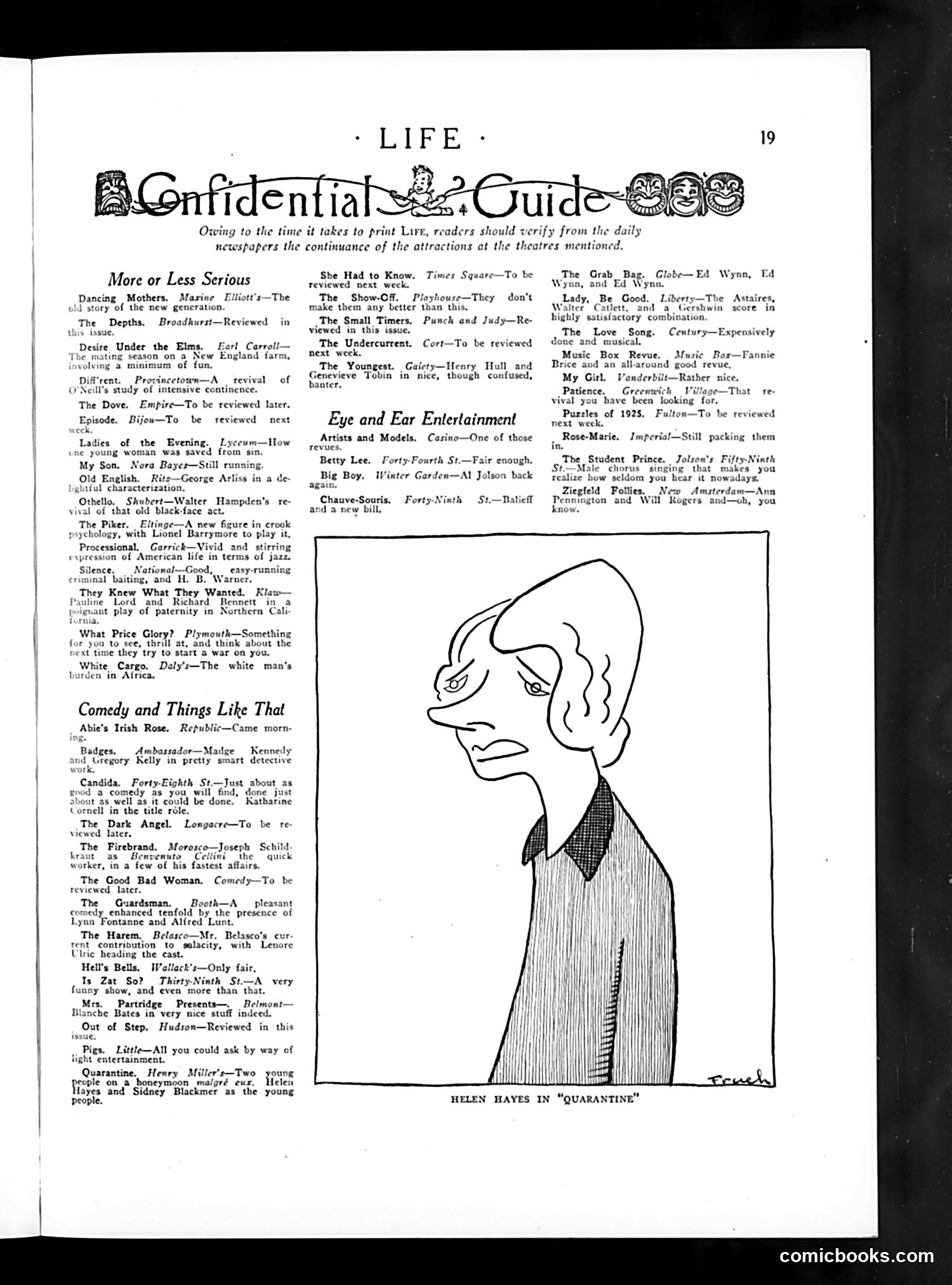
This page is a **theater review guide** for Broadway productions, not a political cartoon. The illustration shows a caricatured woman's face labeled "HELEN HAYES IN 'QUARANTINE'" — a promotional drawing for the Henry Miller's Theatre production featuring Helen Hayes and Sidney Blackmer. The "Confidential Guide" is a regular **entertainment column** listing current theatrical shows with brief critical assessments. Categories include "More or Less Serious" (dramatic works like *Othello*, *Desire Under the Elms*), "Comedy and Things Like That" (lighter fare), and "Eye and Ear Entertainment" (musicals and revues). The satirical tone typical of *Life* magazine appears in the **capsule reviews** themselves—witty one-liners mocking plots or performances (e.g., *What Price Glory?* as commentary on war). This was a standard weekly feature helping readers navigate Manhattan's theater district during the 1920s.
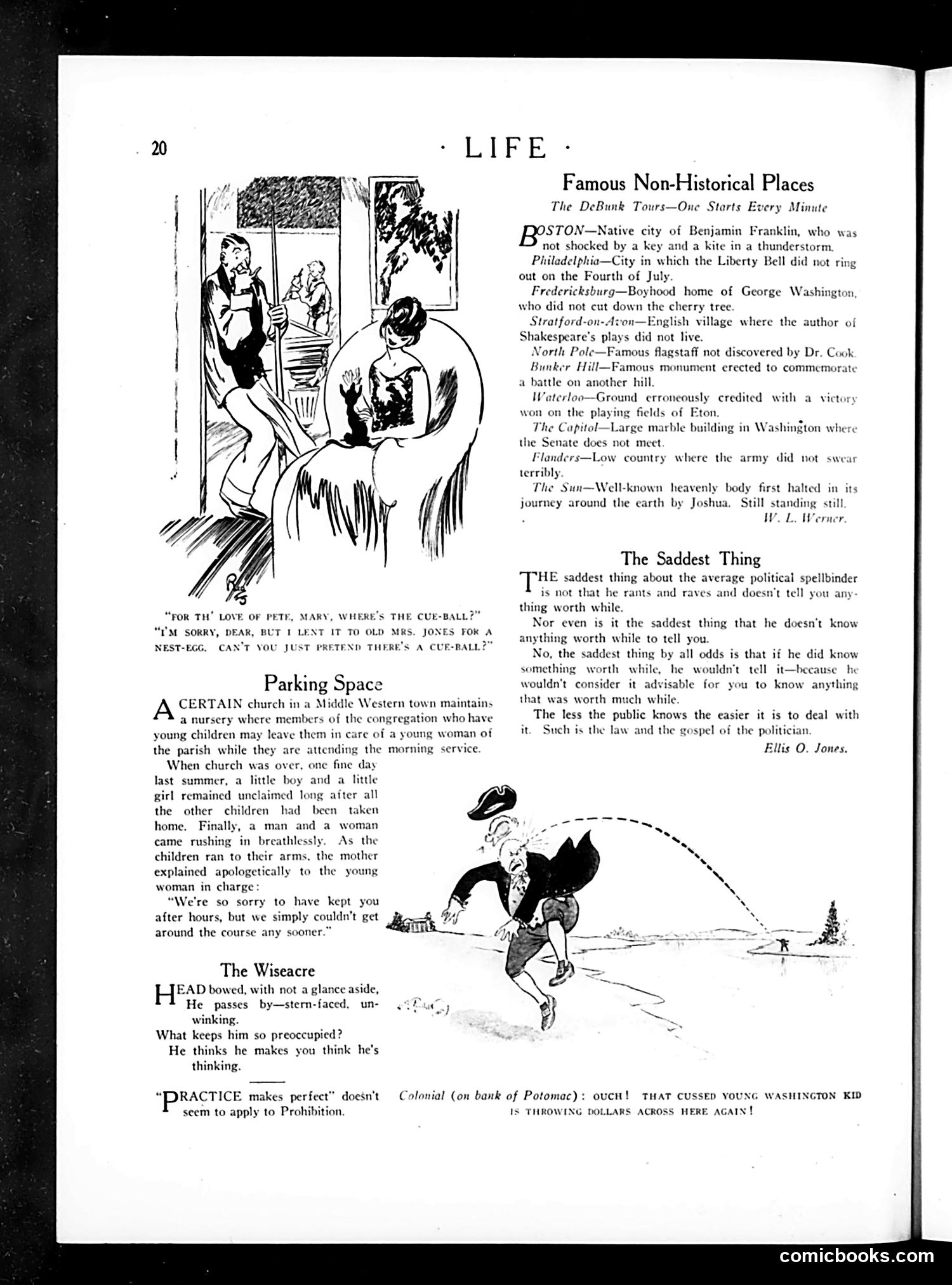
This page contains several pieces of political and social humor from Life's satirical tradition: **"Famous Non-Historical Places"** mocks historical mythology by listing well-known sites while debunking legends associated with them—Benjamin Franklin's kite, Washington's cherry tree, the Liberty Bell's Fourth of July ringing, etc. The joke undercuts American historical narratives we're taught in school. **"Parking Space"** jokes about golf obsession during Prohibition—parents miss church pickup because they're golfing, suggesting the leisure class prioritizes golf over family obligations. **"The Saddest Thing"** critiques political rhetoric, arguing the worst aspect of politicians isn't their dishonesty, but that they *wouldn't* share truth even if they knew it, because an informed public is harder to control. **The colonial cartoon** shows young Washington throwing money across the Potomac—another debunked legend, but the caption ironically treats it as real misbehavior. The overall theme: American myths are fabrications used to shape public behavior and belief.
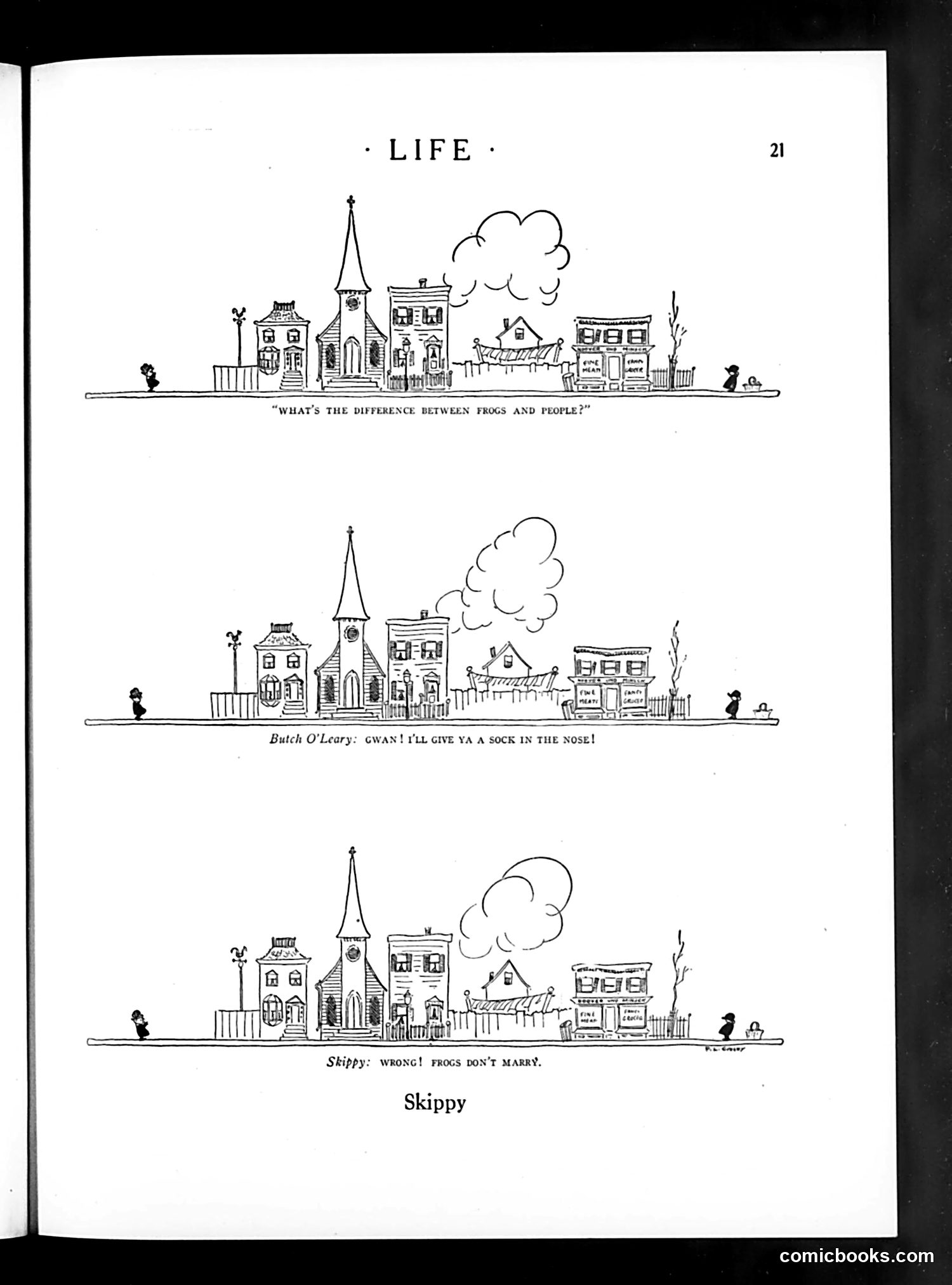
This is a three-panel comic strip from *Life* magazine featuring the character Skippy (a popular comic strip of the era). The humor plays on a child's naive question and literal-minded corrections. **The joke:** A child asks "What's the difference between frogs and people?" One character (Butch O'Leary) responds aggressively with a threat ("I'll give ya a sock in the nose!"), while Skippy corrects him by pointing out the factual distinction: "Wrong! Frogs don't marry." The satire contrasts human behavior—specifically the aggressive, crude response and presumably marriage customs—with animal behavior. Skippy's innocent, logical correction highlights the absurdity of adults' violent reactions to simple questions, suggesting that humans' capacity for marriage (and perhaps quarreling) distinguishes them from animals, though not necessarily in flattering ways.
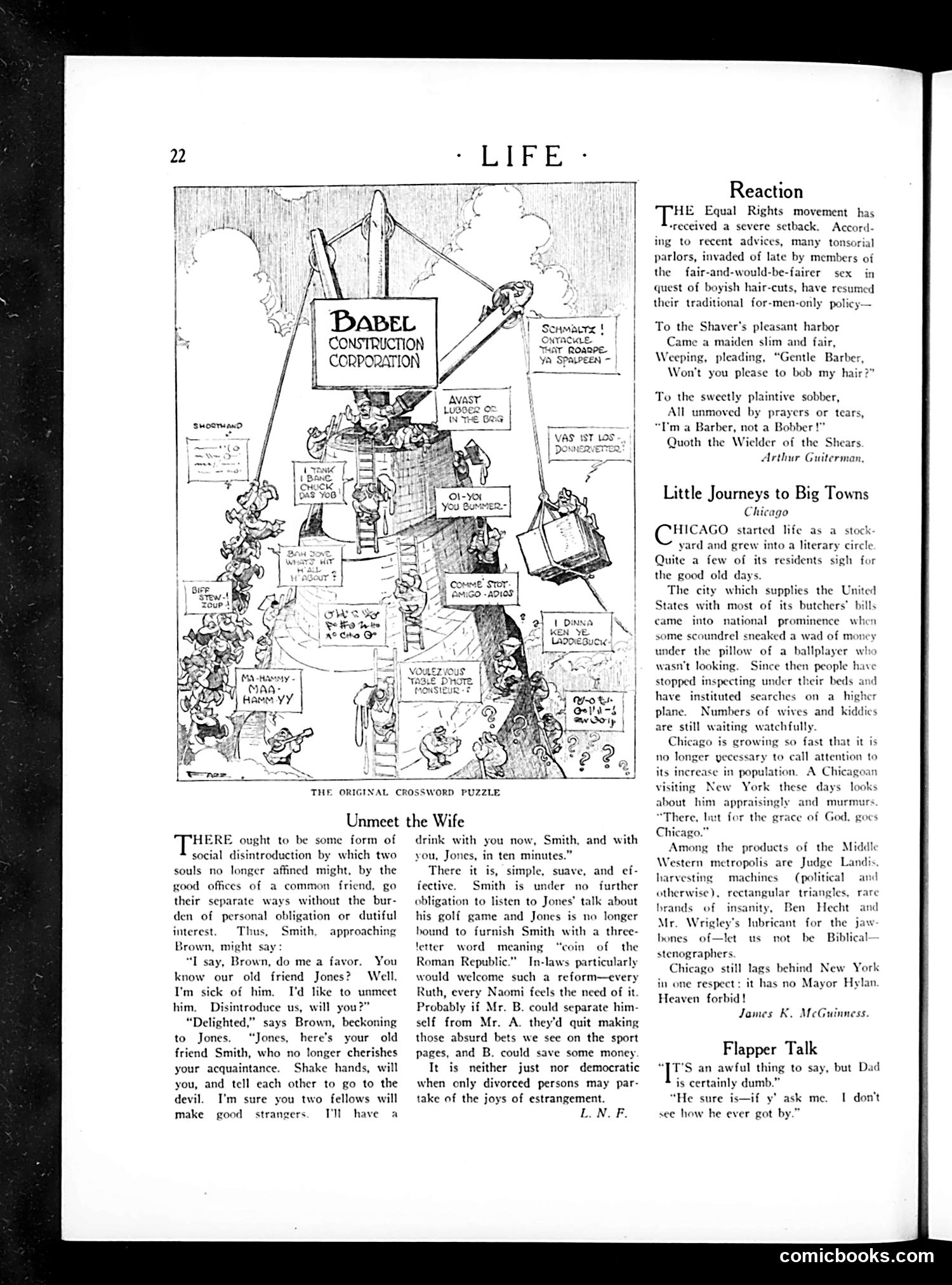
This page contains three satirical pieces reflecting 1920s social anxieties: **"The Original Crossword Puzzle"** cartoon mocks the Babel Construction Corporation—likely referencing the biblical Tower of Babel—as a chaotic, multilingual workplace. The cartoon suggests immigration concerns and workplace disorder through linguistic confusion. **"Unmeet the Wife"** proposes a humorous "social disintroduction" allowing people to formally end acquaintances without obligation. It satirizes social convention by suggesting divorce should extend beyond marriage—a commentary on 1920s divorce rates and rigid social etiquette. **"Reaction"** responds to the Equal Rights movement's setbacks in barbershops. The poem humorously describes a barber refusing to bob a woman's hair, framing it as a loss for women's equality. The barbershop traditionally excluded women, and the "boyish hair-cut" (bob) symbolized 1920s female liberation. **"Little Journeys to Big Towns: Chicago"** offers satirical observations about Chicago's rapid growth, bootlegging ("wad of money"), and aspirations to rival New York—reflecting Prohibition-era corruption and Midwestern ambitions.
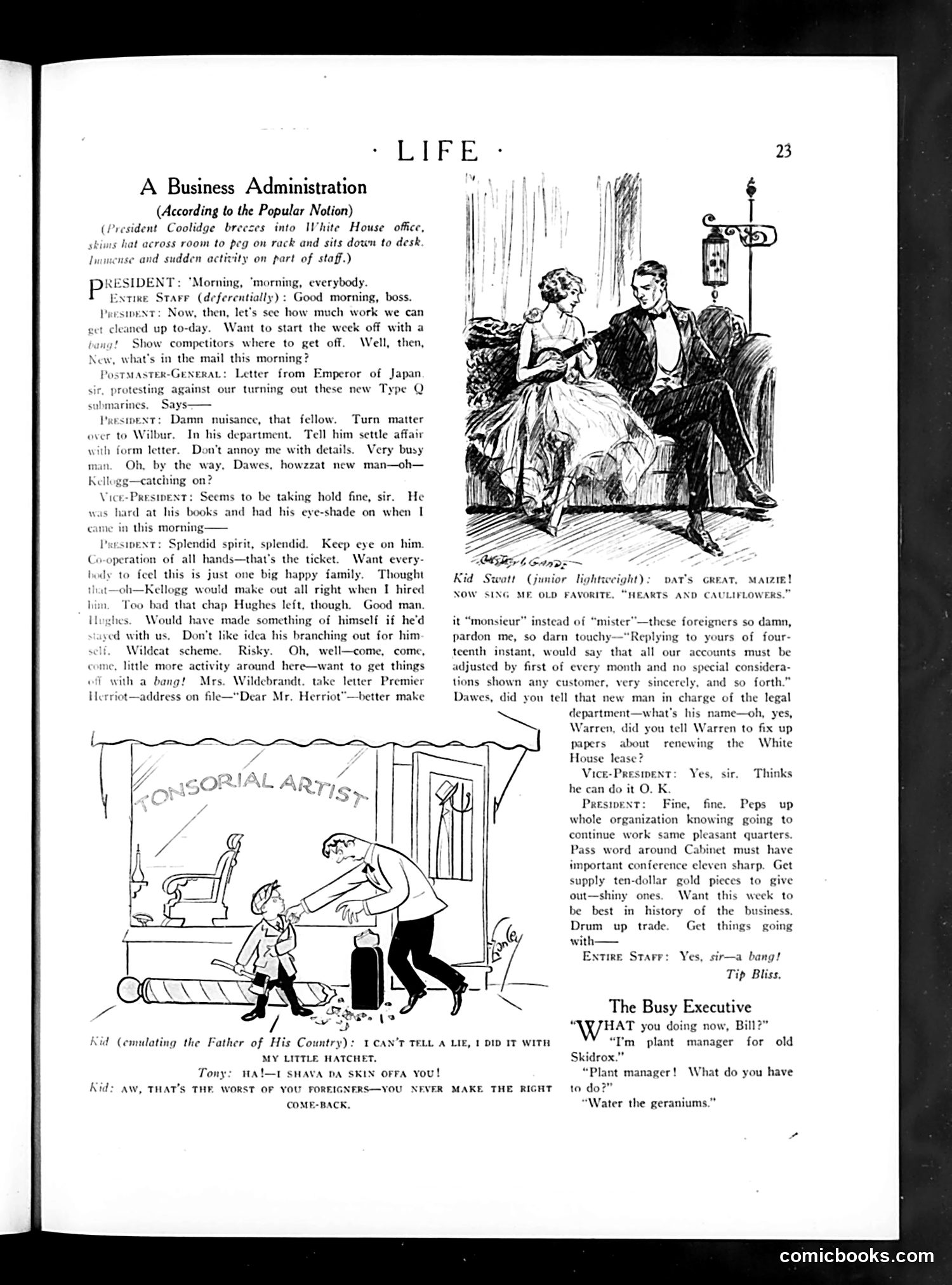
This page satirizes President Calvin Coolidge's management style in the White House. The top cartoon depicts Coolidge as casually dismissive and distracted—tossing his hat across the room, rushing through important matters (a Japanese diplomatic protest, hiring decisions), and issuing rapid-fire orders without engaging substantively. The satire mocks the "popular notion" that he runs the government through superficial efficiency rather than genuine attention to detail. The smaller cartoons below ridicule various subordinates and their fumbling attempts at competence. One shows a child mimicking George Washington's "I cannot tell a lie" speech while actually having broken something—suggesting government dishonesty masked by patriotic rhetoric. The final exchange about a "plant manager" who merely "waters geraniums" mocks the absurdity of inflated job titles for menial work—a jab at government bureaucratic bloat and incompetence. The overall target: Coolidge-era administrative governance as performative busyness concealing actual ineffectiveness.
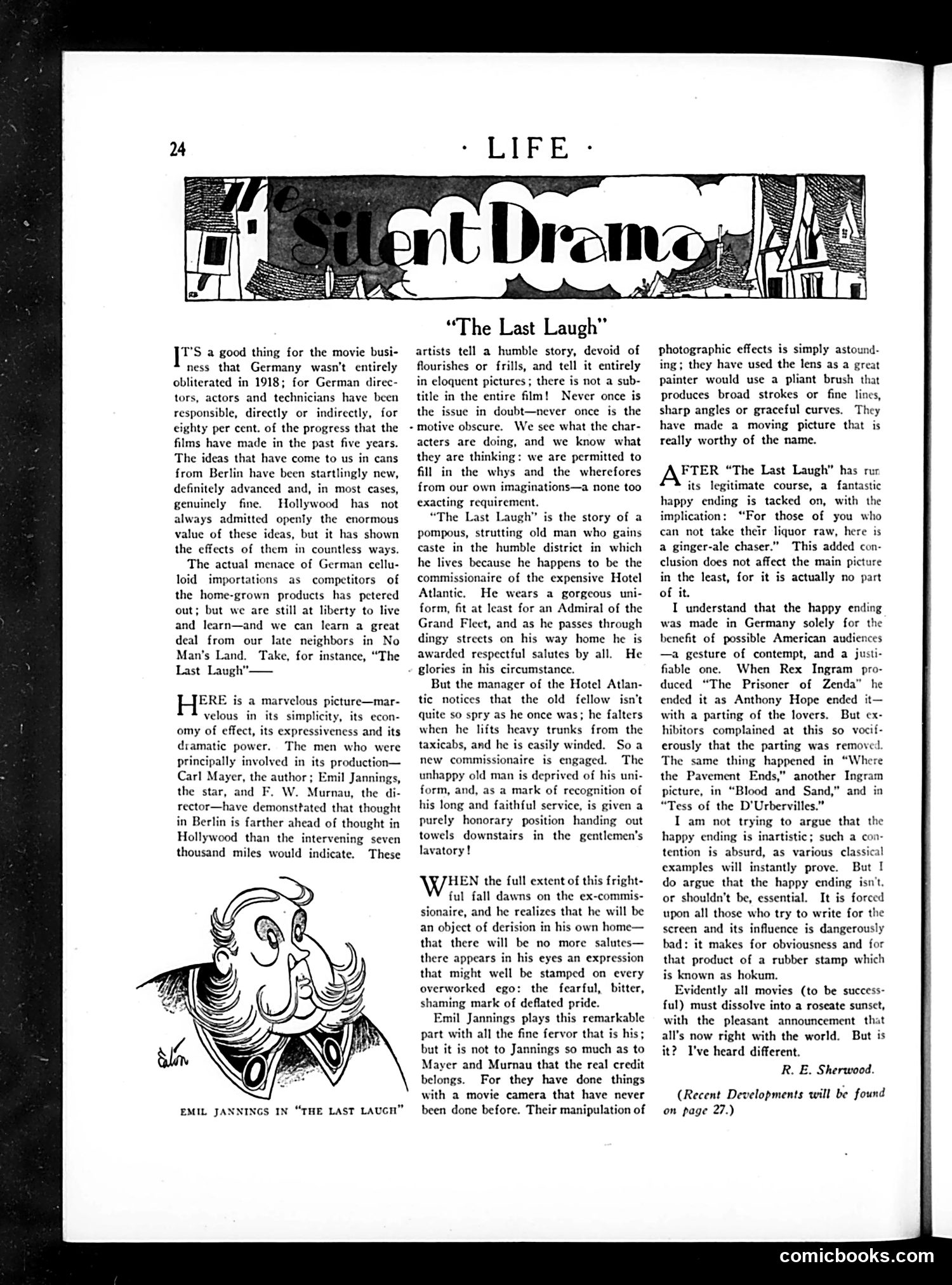
This is a film review praising a German silent film. The central cartoon depicts **Emil Jannings**, the lead actor, showing the character's deflated expression—the "mark of deflated pride" described in the text. **The plot**: An aging hotel doorman loses status when fired. His entire identity depended on his prestigious uniform; stripped of it, he becomes a lavatory attendant and faces humiliation in his humble neighborhood. **Historical context**: This 1924 review celebrates German cinema's influence on Hollywood post-WWI, despite earlier German-American tensions. The article argues Berlin filmmakers possessed superior artistic vision—using "the lens as a great painter would use a pliant brush." **The satire/point**: The film explores the fragility of working-class dignity tied to social position and uniform. It's fundamentally about how arbitrary status symbols sustain ego and community respect. The "fantastic happy ending" appended later suggests the filmmakers felt obligated to soften this bleak social commentary for audiences. The review treats this as serious artistic cinema addressing human vulnerability and pride.
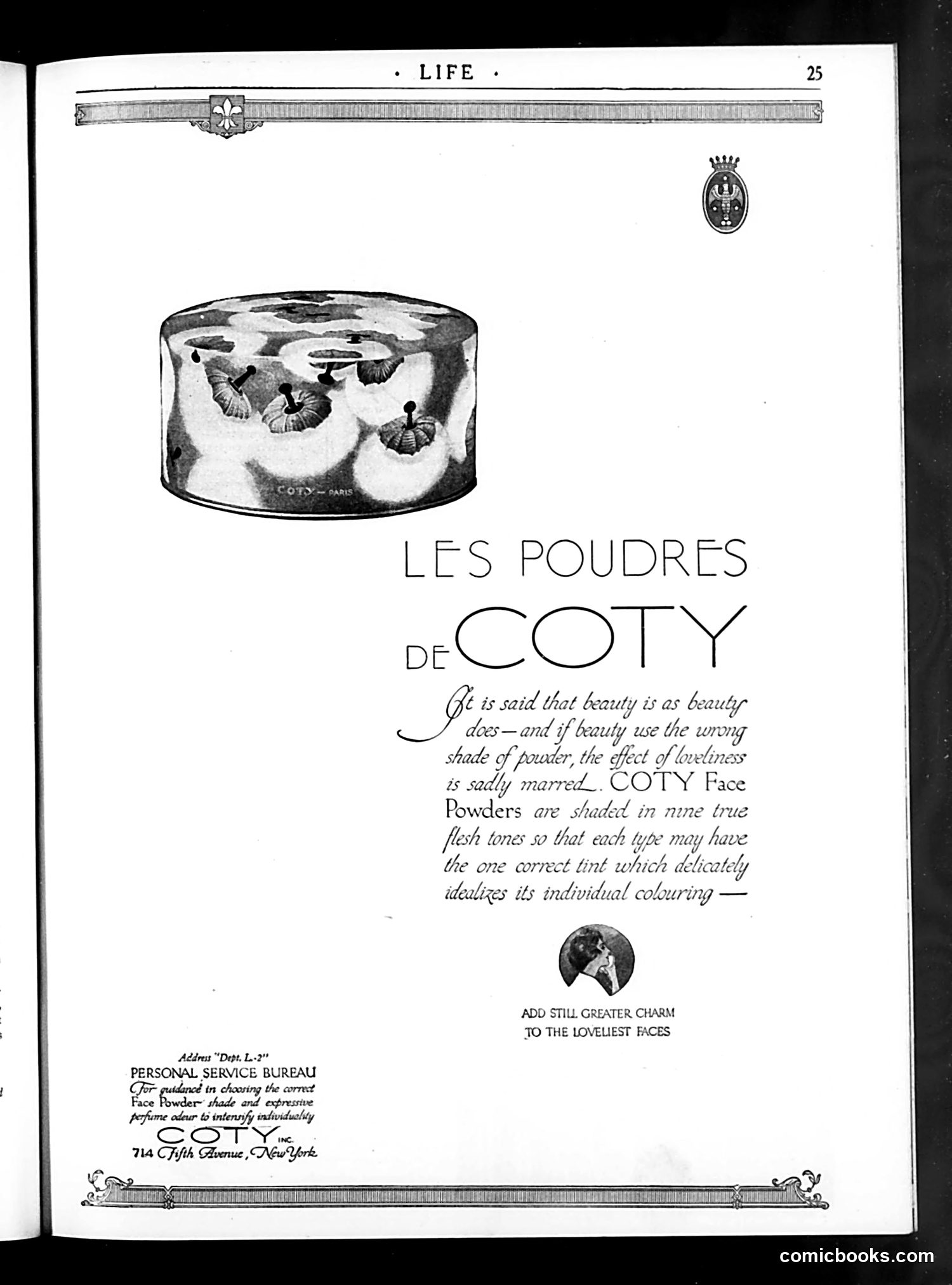
This is a **Coty cosmetics advertisement**, not political satire. It promotes "Les Poudres de Coty" face powder, featuring an ornate powder container with decorative design. The ad's pitch emphasizes that Coty powders come in "nine true flesh tones" so women can find the shade that "delicately idealizes its individual colouring." The underlying message—typical of 1920s beauty marketing—is that the *right* makeup shade enhances natural beauty rather than merely covering it. The copy warns that using the "wrong shade of powder" ruins one's appearance, positioning Coty's variety as solving this problem. The Personal Service Bureau offered guidance in choosing products. This reflects early-20th-century cosmetics industry strategy: legitimizing makeup use among middle-class women by framing it as scientific color-matching rather than theatrical artifice. No political figures or satire are present—this is straightforward period advertising.
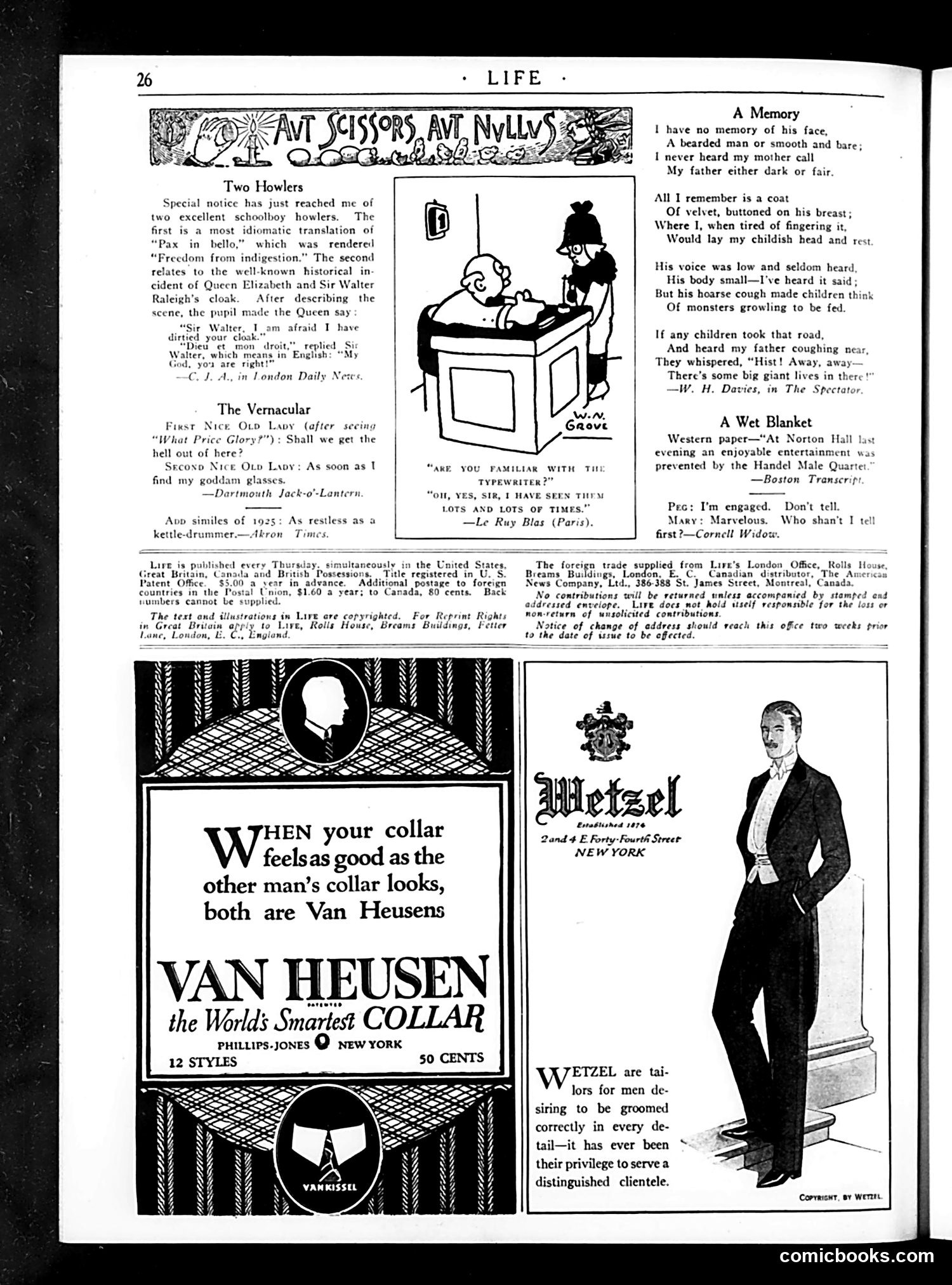
This page contains **humor pieces and advertisements** rather than political cartoons. **Main Content:** - **"Two Howlers"**: Humorous student translations/misinterpretations (e.g., "Pax in bello" rendered as "Freedom from indigestion" instead of "Peace in war"). These mock schoolboy mistakes. - **"The Vernacular"**: Brief jokes about colloquial speech, including a reference to the WWI film "What Price Glory?" - **Poetry section**: "A Memory" and "A Wet Blanket" appear to be literary submissions, with the latter presenting an ironic anecdote about a concert that was "prevented" by performers. - **Cartoon**: A small illustration showing someone asking about a typewriter, with the caption emphasizing familiarity with the device. **Advertisements**: Van Heusen collars and Wetzel tailors dominate the lower portion. This is a typical **early 1920s Life layout**—a mix of light humor, reader submissions, and advertising, reflecting the magazine's role as a humor/satire publication alongside commercial content.
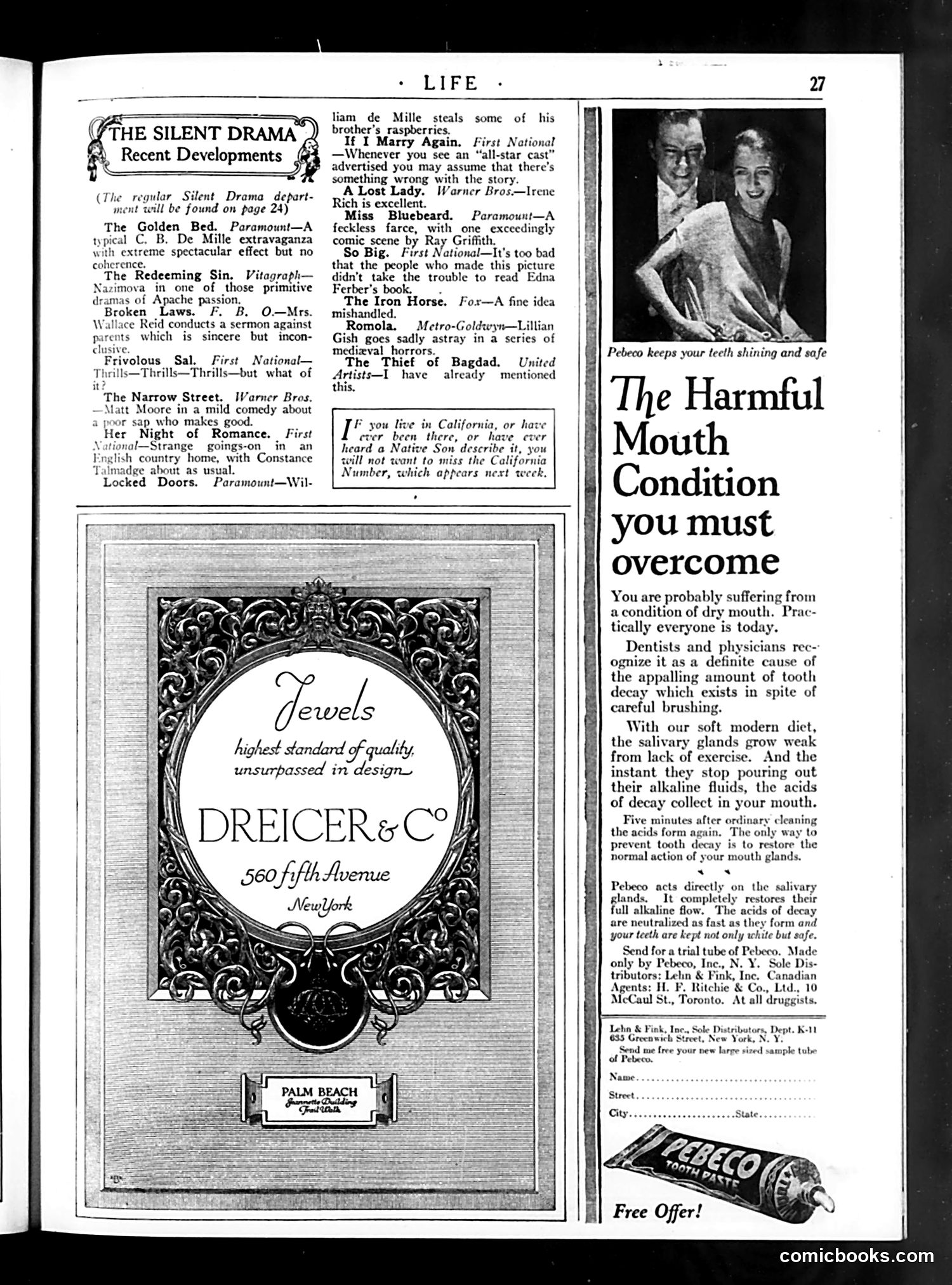
This page from *Life* magazine contains two main sections: **Left side:** Film reviews under "The Silent Drama: Recent Developments." These are brief, sardonic critiques of silent films from major studios (Paramount, Warner Bros., First National, etc.). The tone is consistently dismissive—reviewers mock the plots, acting, and production choices. For example, one film is criticized for being an "all-star cast" (implying such casting signals poor storytelling), another for not reading the source material, and another for "mishandling" a good idea. This reflects *Life*'s satirical purpose: poking fun at the emerging Hollywood film industry. **Right side:** A full-page advertisement for Pebeco toothpaste. It addresses "dry mouth condition," claiming modern soft diets have weakened salivary glands, causing tooth decay despite brushing. The ad promises Pebeco restores alkaline saliva to prevent decay. This is vintage pharmaceutical advertising making health claims now considered dubious or unverifiable by modern standards. The juxtaposition reflects typical magazine layout of this era: editorial satire alongside commercial pitches.
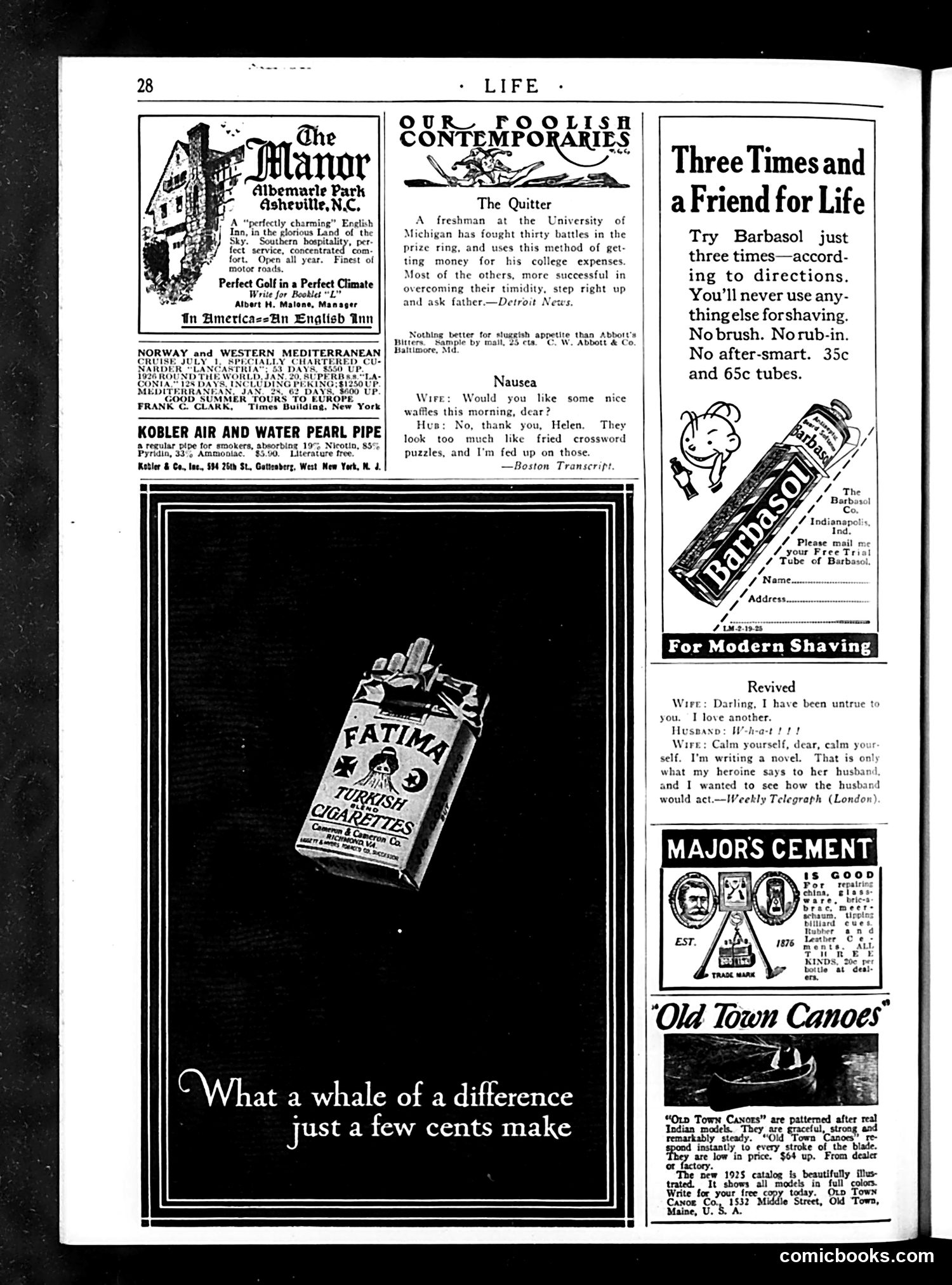
This page is primarily **advertising** with brief humorous commentary pieces typical of Life magazine's satirical format. The large **Fatima Cigarettes advertisement** dominates the center, showing a cigarette package with the tagline "What a whale of a difference just a few cents make"—emphasizing price competitiveness in the cigarette market. The right column contains **brief comedic anecdotes**: - "Our Foolish Contemporaries" mocks a University of Michigan student boxing to pay tuition rather than asking his father - "Nausea" jokes about waffles resembling crossword puzzles - "Revived" satirizes a wife's confession of infidelity as merely rehearsal for her novel-writing Other advertisements include **Barbasol shaving cream**, **Majors Cement**, and **Old Town Canoes**. The left sidebar advertises **The Manor hotel** in Asheville, N.C., and travel services. The humor reflects 1920s concerns: college financing, domestic relationships, and consumer product marketing. No political cartoons appear on this page—it's primarily commercial space with light social satire.
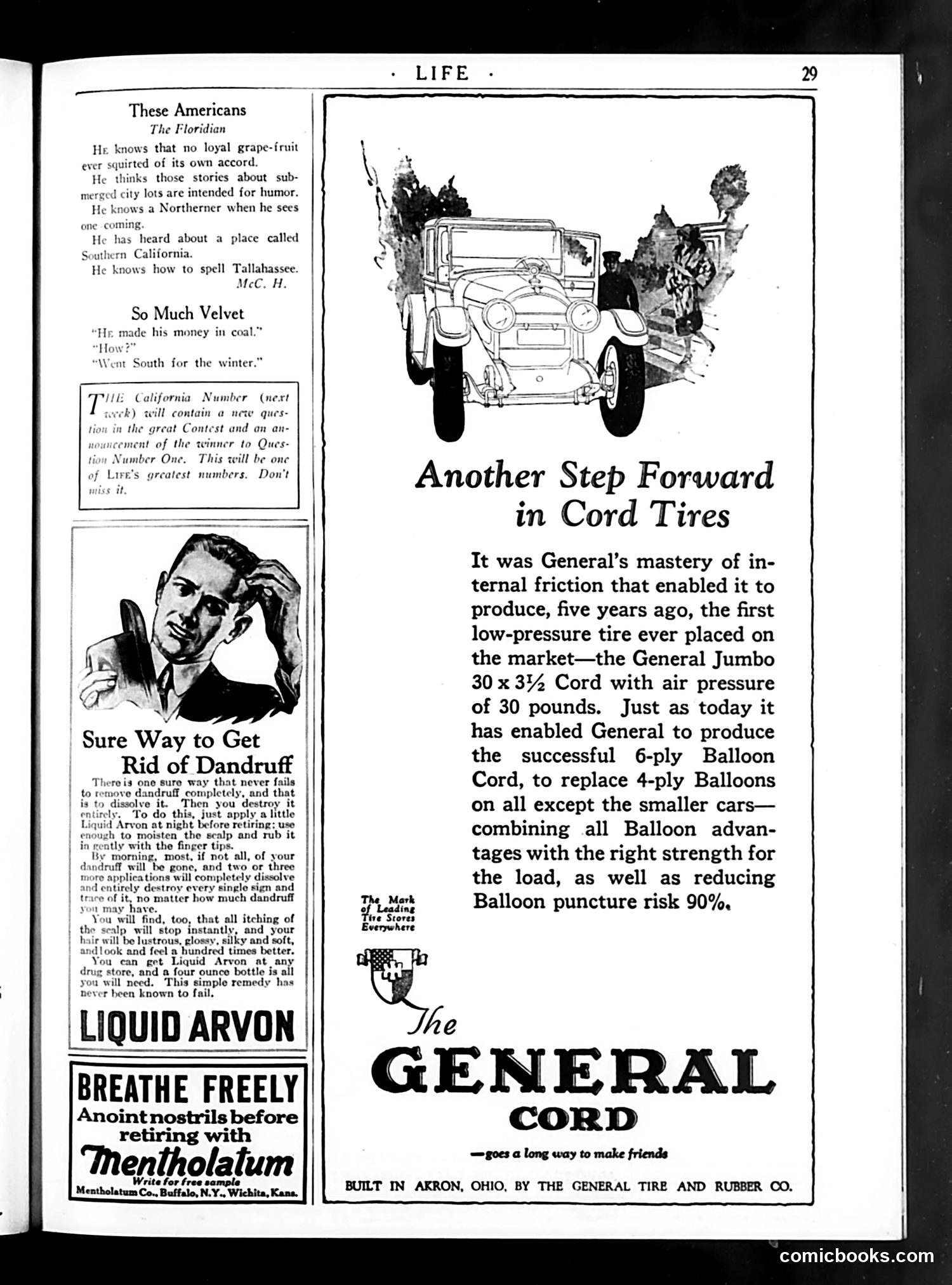
This page mixes humor with period advertising. The left column contains a brief satirical sketch titled "These Americans: The Floridian"—a humorous character study of a Florida resident who knows genuine local facts (correct spelling of Tallahassee, understanding that grapefruit doesn't self-squirt) and skepticism toward Northern tall tales about Florida real estate. The joke targets both Florida's reputation for dubious land schemes and Northern gullibility. The remaining left-side content is straightforward product advertising: Liquid Arvon (a dandruff remedy) and Mentholalum (a menthol salve), using common period medical-product marketing language. The right page features a full-page advertisement for General Cord Tires, emphasizing technological advancement in tire manufacturing—specifically their 6-ply Balloon Cord design reducing puncture risk. The illustration shows a vintage automobile, and the tagline "goes a long way to make friends" uses a pun on tire durability as social currency. The page is primarily advertising with modest satirical content.
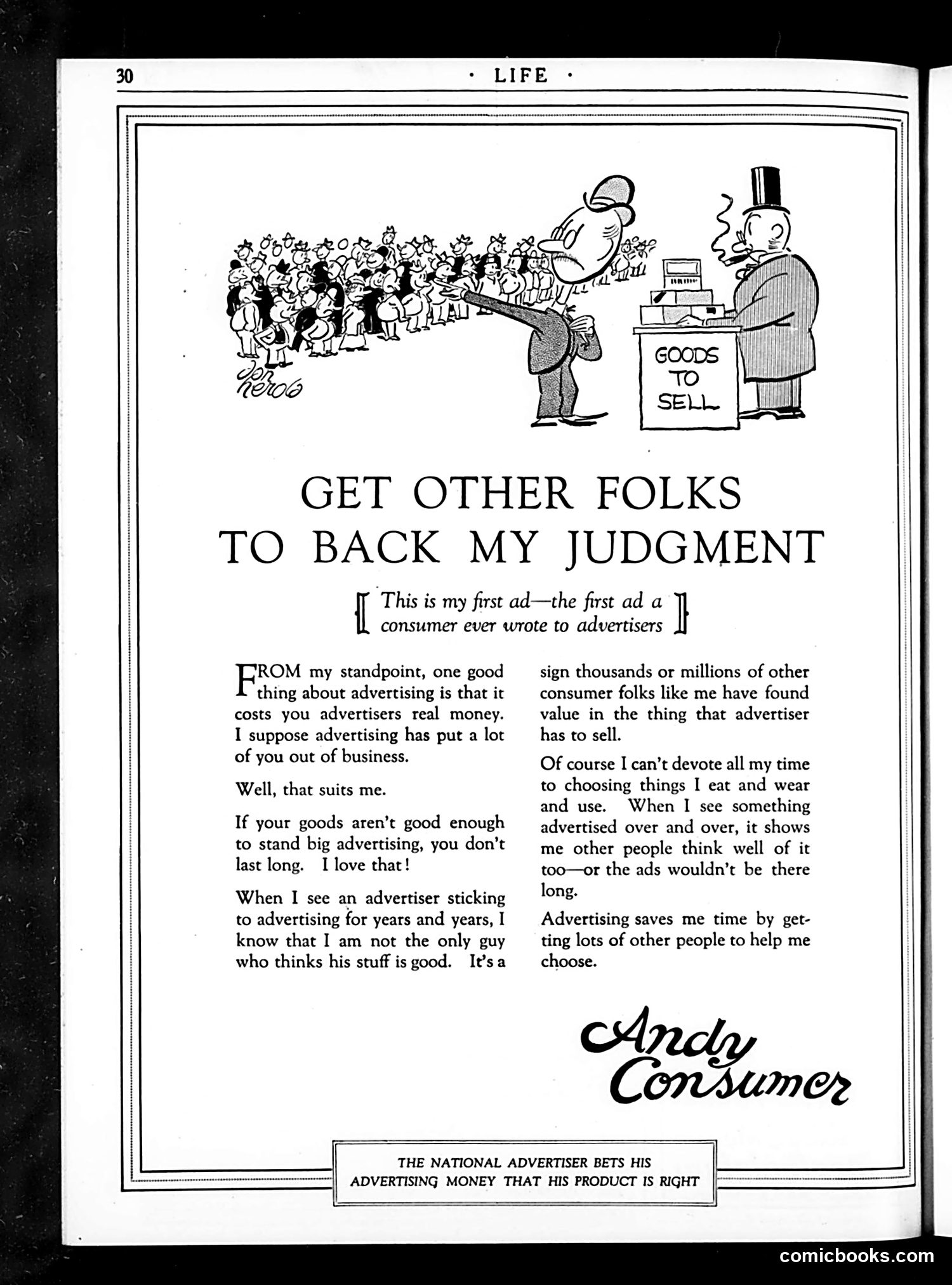
This page presents a consumer's defense of advertising—seemingly the first consumer-written ad to advertisers themselves. The cartoon shows a salesman with a megaphone addressing a crowd, illustrating the concept of persuasion through numbers. "Andy Consumer" argues that persistent advertising paradoxically *proves* product quality: if goods were poor, companies couldn't afford years of ads. Repeated advertising signals that many others value the product, so he trusts their collective judgment. Advertising, he claims, outsources his decision-making to a crowd-tested consensus. The satire appears gentle but contains irony: a consumer celebrating how advertising manipulates him into trusting products based on *how much money was spent promoting them*—rather than on the product's actual merit. The caption frames this as advertisers "betting" their money proves their product right, inverting the logic of what advertising actually demonstrates.
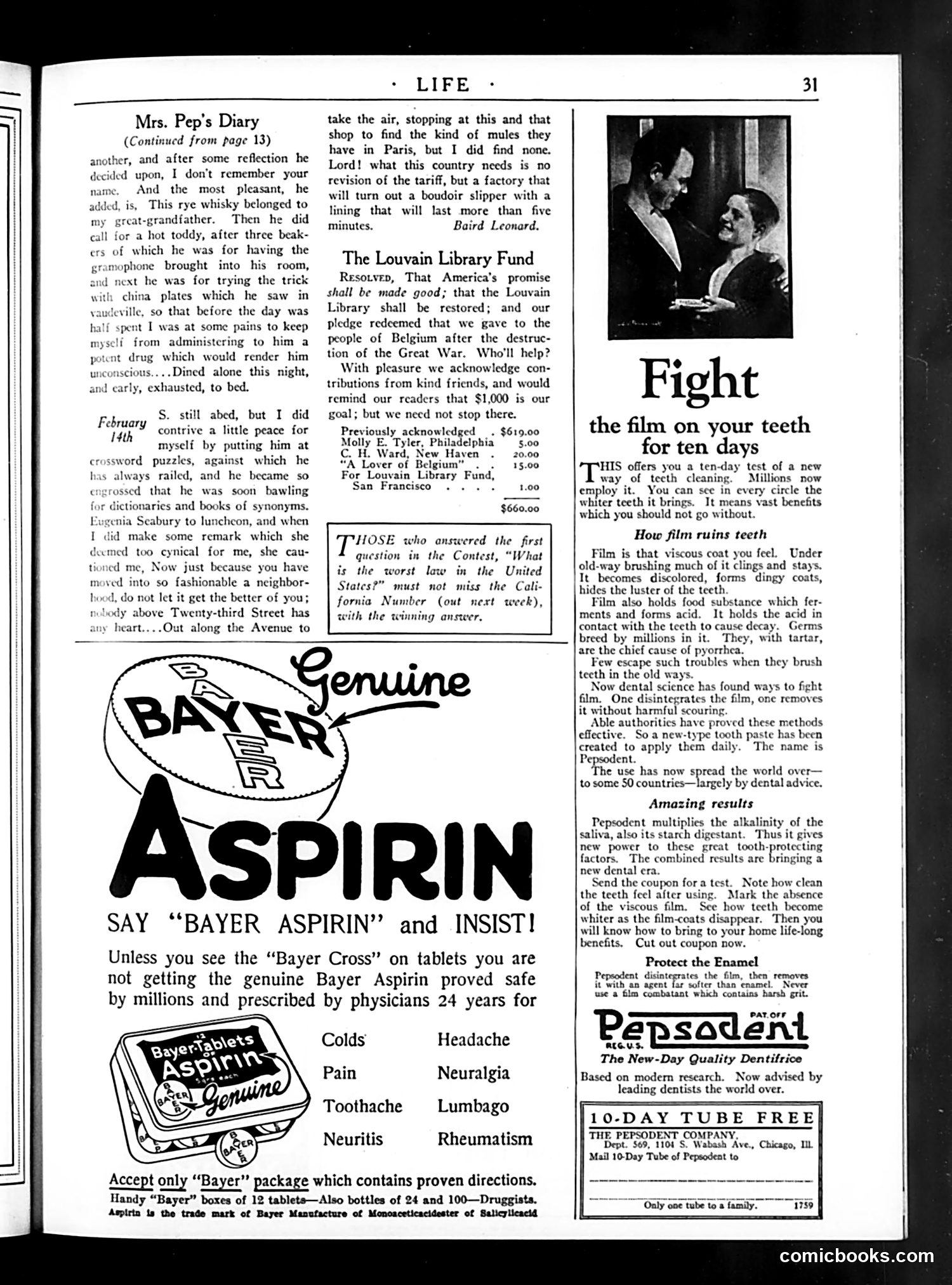
This page is primarily **advertising**, though it contains some editorial content. The main satire appears in **"Mrs. Pep's Diary"** (continued from prior pages), a humorous domestic column depicting marital annoyances. The unnamed husband is portrayed as an irritating houseguest who drinks whisky, demands entertainment (phonograph music), performs crude vaudeville tricks with china plates, and refuses to acknowledge social propriety—he's "not let it get the better of you; nobody above Twenty-third Street has my heart." The page's dominant feature is a large **Bayer Aspirin advertisement** emphasizing brand authenticity ("Say 'Bayer Aspirin' and Insist!"). Below it, a **Pepsodent toothpaste ad** promotes a new "film-removal" method for teeth cleaning, claiming superiority over old brushing techniques. A smaller notice announces contributions to the **Louvain Library Fund**, a post-WWI Belgian relief initiative, reflecting contemporary American charitable concerns about European reconstruction after World War I. The content reflects 1920s consumer culture prioritizing branded products and modern dental/medical science.
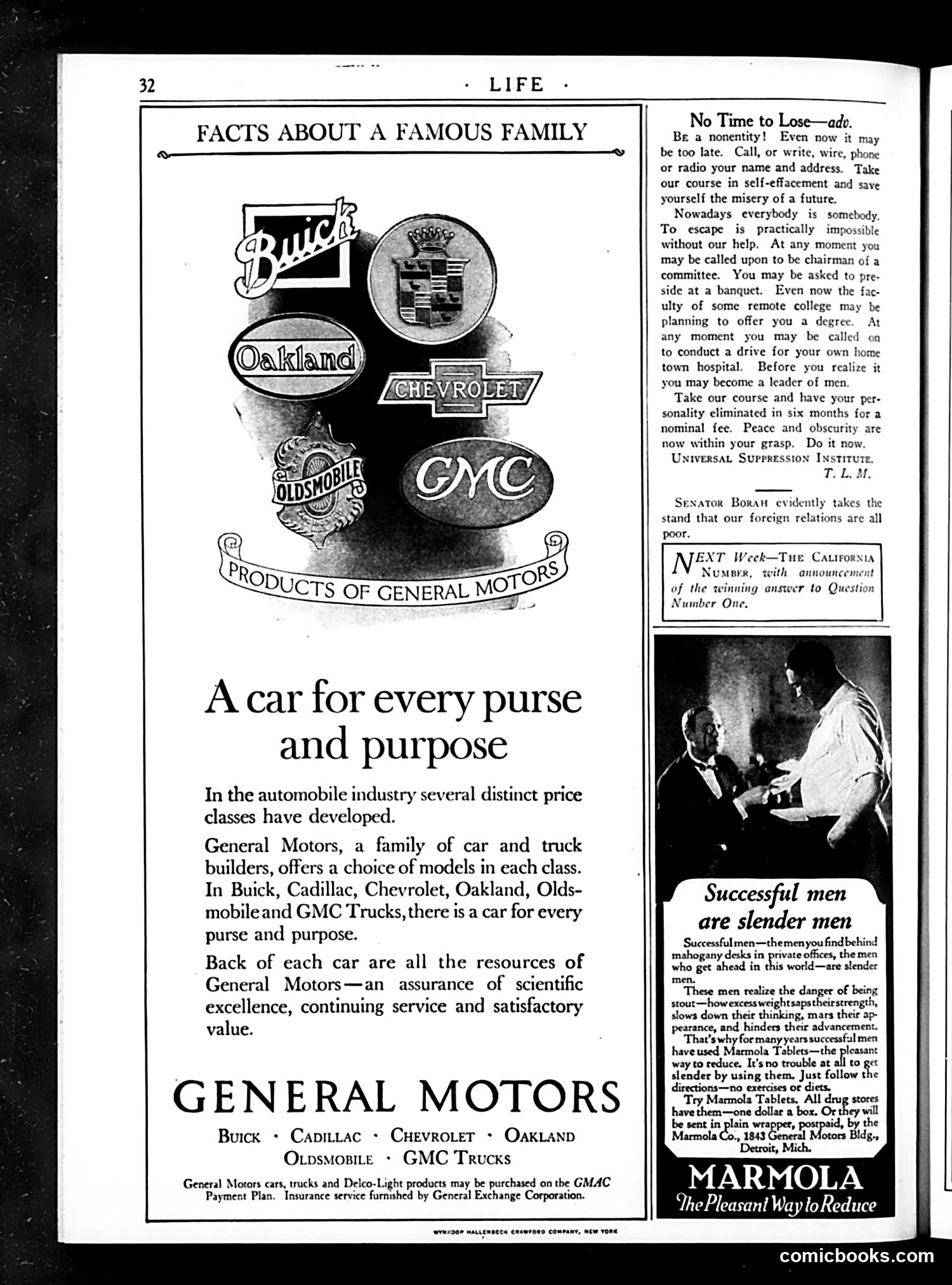
This page contains two distinct advertisements separated by satirical editorial content. **Left side**: A General Motors advertisement showcasing their car brands (Buick, Cadillac, Chevrolet, Oakland, Oldsmobile, GMC) with the slogan "a car for every purse and purpose." **Right side satirical content**: A mock advertisement for the "Universal Suppression Institute" satirizing the anxiety of modern success. The piece humorously warns that avoiding prominence is "practically impossible"—one risks being drafted as committee chair, banquet speaker, or hospital drive conductor. It offers a "course in self-effacement" to achieve "peace and obscurity." This is likely satirizing 1920s-30s social pressure and the increasing demands placed on successful people to participate in civic duties. **Bottom right**: A Marmola weight-loss tablet advertisement claiming "successful men are slender men," linking physical appearance to business achievement. The page reflects period anxieties about social obligation, status anxiety, and commercialized solutions to modern problems.
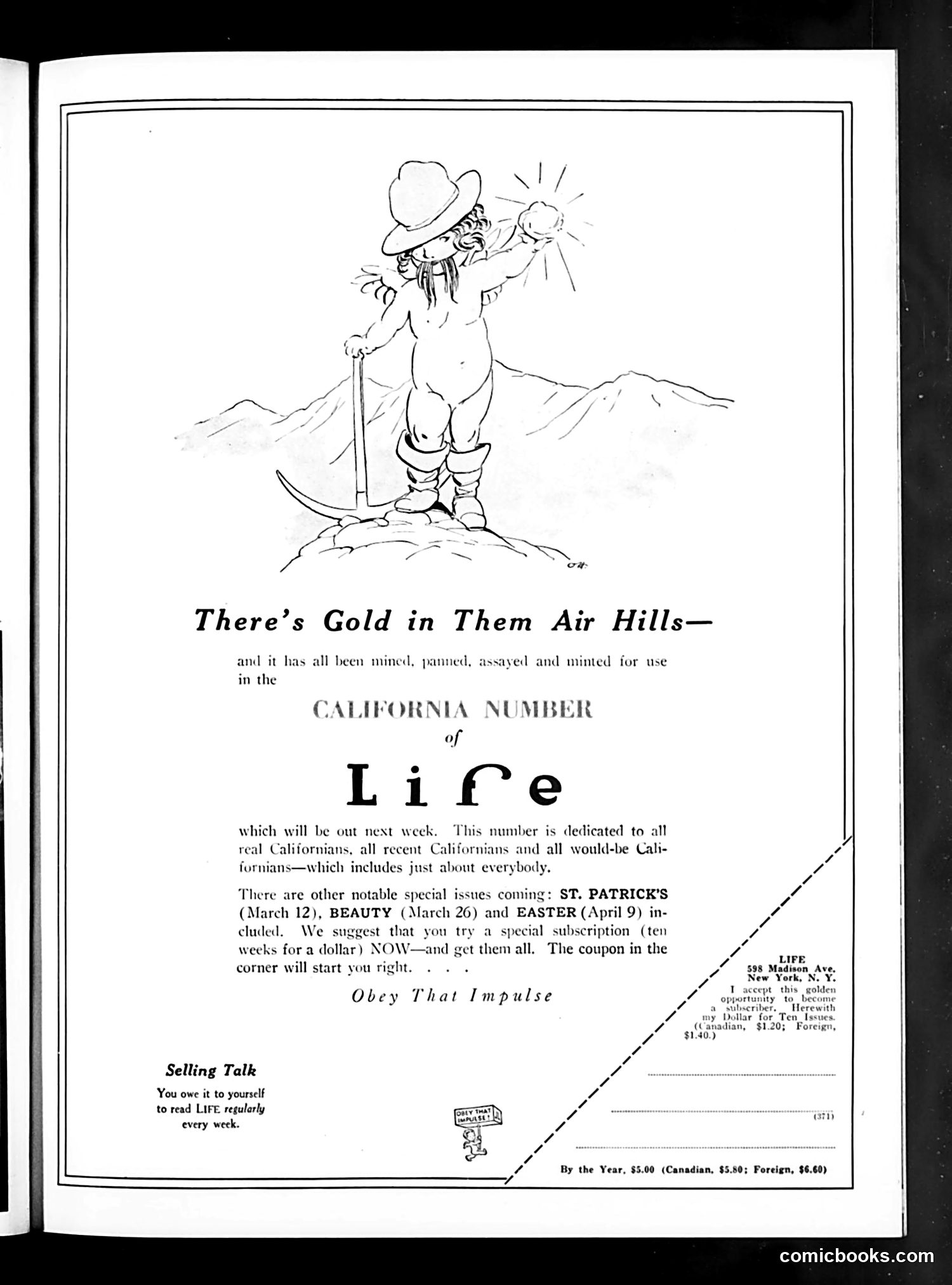
This is primarily an advertisement for *Life* magazine's upcoming "California Number." The cartoon depicts a prospector in the Gold Rush era, standing triumphantly on a hilltop with a pickaxe and holding up a nugget—a visual metaphor for the magazine's special issue. The satire works on two levels: First, it humorously suggests that *Life* magazine has "mined" California's essence and refined it into publishable content ("mined, panned, assayed and minted"). Second, the text's inclusive definition of Californians—"real Californians, all recent Californians and all would-be Californians"—ironically suggests that almost everyone qualifies, mocking both California's rapid population growth and the magazine's broad appeal strategy. The page also promotes other themed issues (St. Patrick's Day, Beauty, Easter) and encourages subscription, using the "Obey That Impulse" slogan as a playful call-to-action. This is essentially a house advertisement encouraging readers to subscribe and collect special issues.
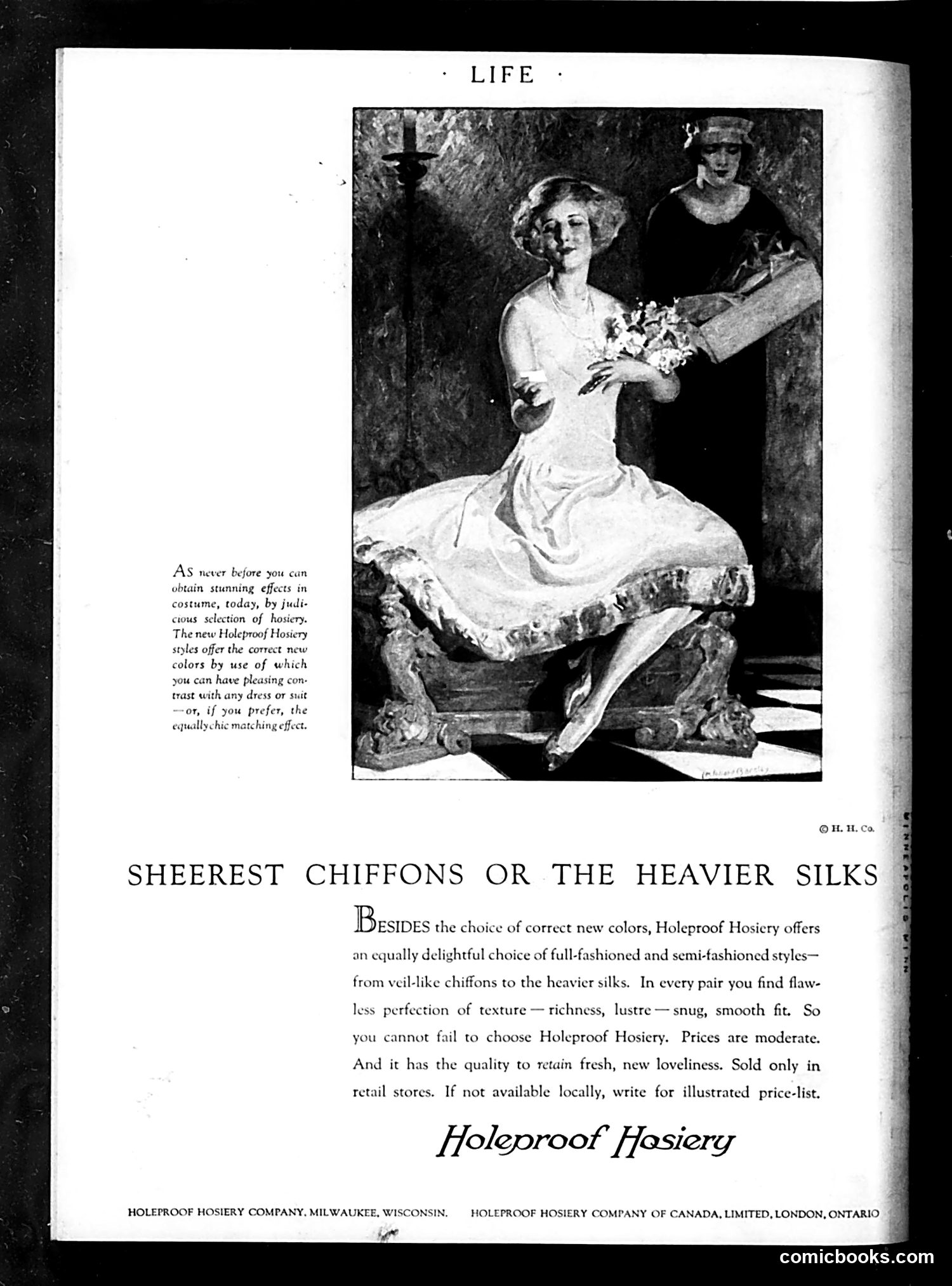
This is **advertising, not satire or political commentary**. The page features a Holeproof Hosiery company advertisement from *Life* magazine. The image shows a woman in an elegant white dress seated with attendants, designed to convey luxury and sophistication. The ad emphasizes that hosiery is crucial for achieving fashionable costume effects—a significant concern in early 20th-century women's fashion, when stockings were visible and important style elements. The advertisement's pitch centers on color coordination ("correct new colors") and fabric quality ("sheerest chiffons or heavier silks"), targeting women concerned with matching or contrasting their stockings with dresses. The moderate pricing claim and retail availability suggest this was aspirational yet accessible merchandise for middle-class women. There is no political satire here—merely a commercial pitch using elegant imagery and persuasive copy typical of *Life* magazine's advertising section.

I can see this is a page from Life magazine, but the image quality is too poor for me to reliably read the OCR text or make out specific cartoon details clearly. The page appears very dark, with some faint imagery visible on the right side that might include figures or caricatures, but I cannot discern them with sufficient clarity to identify who they represent or what political/social commentary they're making. To properly explain the satire and historical context to a modern reader—as your instructions require—I would need to assert only what I can actually see, and I genuinely cannot make out the specific content with confidence. I'd recommend consulting a higher-resolution version of this page to provide you an accurate analysis.