
Life, 1925-02-19 · page 26 of 37
Life — February 19, 1925 — page 26: what you’re looking at
What you’re looking at
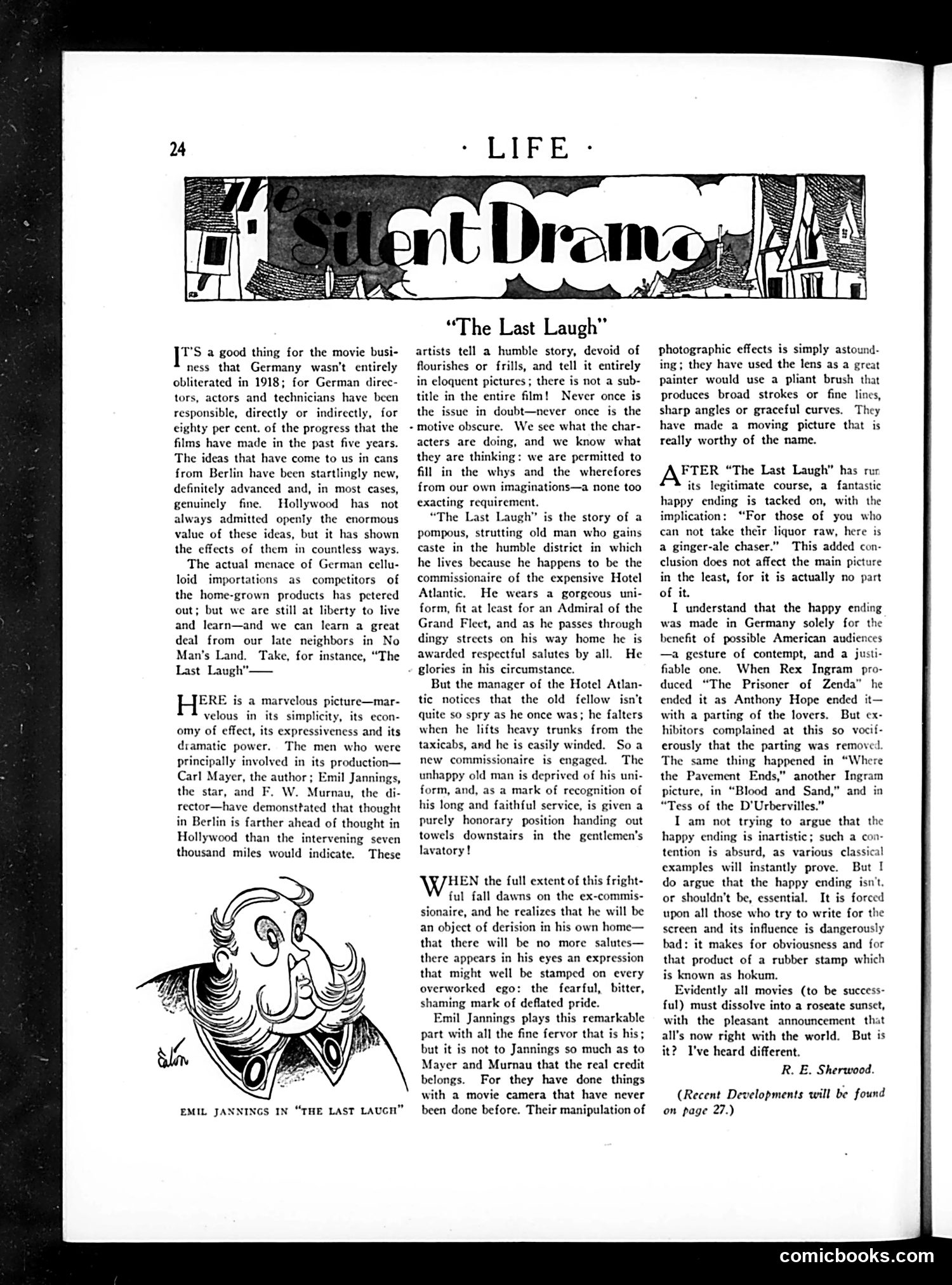
This is a film review praising a German silent film. The central cartoon depicts **Emil Jannings**, the lead actor, showing the character's deflated expression—the "mark of deflated pride" described in the text. **The plot**: An aging hotel doorman loses status when fired. His entire identity depended on his prestigious uniform; stripped of it, he becomes a lavatory attendant and faces humiliation in his humble neighborhood. **Historical context**: This 1924 review celebrates German cinema's influence on Hollywood post-WWI, despite earlier German-American tensions. The article argues Berlin filmmakers possessed superior artistic vision—using "the lens as a great painter would use a pliant brush." **The satire/point**: The film explores the fragility of working-class dignity tied to social position and uniform. It's fundamentally about how arbitrary status symbols sustain ego and community respect. The "fantastic happy ending" appended later suggests the filmmakers felt obligated to soften this bleak social commentary for audiences. The review treats this as serious artistic cinema addressing human vulnerability and pride.
📄 Transcribed text from this page (OCR, searchable)
Machine-transcribed from the original scan — historical spelling and the odd misread are preserved.
rs a good thing for the movie busi- ness that Germany wasn’t entirely obliterated in 1918; for German direc- tors, actors and technicians have been responsible, directly or indirectly, for eighty per cent. of the progress that the films have made in the past five years. The ideas that have come to us in cans from Berlin have been startlingly new, definitely advanced and, in most cases, genuinely fine. Hollywood has not always admitted openly the enormous value of these ideas, but it has shown the effects of them in countless ways. The actual menace of German cellu- loid importations as competitors of the home-grown products has petered out; but we are still at liberty to live and learn—and we can learn a great deal from our late neighbors in No Man's Land. Take, for instance, “The Last Laugh"—— ERE is a marvelous picture—mar- velous in its simplicity, its econ- omy of effect, its expressiveness and its dramatic power. The men who were principally involved in its production— Carl Mayer, the author ; Emil Jannings, the star, and F. W. Murnau, the di- rector—have demonsttated that thought in Berlin is farther ahead of thought in Hollywood than the intervening seven thousand miles would indicate. These EMIL JANNINGS IN “THE LAST LAUGH” “The Last Laugh” artists tell a humble story, devoid of flourishes or frills, and tell it entirely in eloquent pictures ; there is not a sub- title in the entire film! Never once is the issue in doubt—never once is the motive obscure. We see what the char- acters are doing, and we know what they are thinking: we are permitted to fill in the whys and the wherefores from our own imaginations—a none too exacting requirement. “The Last Laugh” is the story of a pompous, strutting old man who gains caste in the humble district in which he lives because he happens to be the commissionaire of the expensive Hotel Atlantic. He wears a gorgeous uni- form, fit at least for an Admiral of the Grand Fleet, and as he passes through dingy streets on his way home he is awarded respectful salutes by all. He glories in his circumstance. But the manager of the Hotel Atlan- tic notices that the old fellow isn't quite so spry as he once was; he falters when he lifts heavy trunks from the taxicabs, and he is easily winded. So a new commissionaire is engaged. The unhappy old man is deprived of his uni- form, and, as a mark of recognition of his long and faithful service, is given a purely honorary position handing out towels downstairs in the gentlemen's lavatory! WHEN the full extent of this fright- ful fall dawns on the ex-commis- sionaire, and he realizes that he will be an object of derision in his own home— that there will be no more salutes— there appears in his eyes an expression that might well be stamped on every overworked ego: the fearful, bitter, shaming mark of deflated pride. Emil Jannings plays this remarkable part with all the fine fervor that is his; but it is not to Jannings so much as to Mayer and Murnau that the real credit belongs. For they have done things with a movie camera that have never been done before. Their manipulation of photographic effects is simply astound- ing; they have used the lens as a great painter would use a pliant brush that produces broad strokes or fine lines, sharp angles or graceful curves. They have made a moving picture that is really worthy of the name. FTER “The Last Laugh” has rur its legitimate course, a fantastic happy ending is tacked on, with the implication: “For those of you who can not take their liquor raw, here is a ginger-ale chaser.” This added con- clusion does not affect the main picture in the least, for it is actually no part of it. I understand that the happy ending was made in Germany solely for the benefit of possible American audiences —a gesture of contempt, and a justi- fiable one. When Rex Ingram pro- duced “The Prisoner of Zenda” he ended it as Anthony Hope ended it— with a parting of the lovers. But ex- hibitors complained at this so vocif- erously that the parting was removed. The same thing happened in “Where the Pavement Ends,” another Ingram picture, in “Blood and Sand,” and in “Tess of the D'Urbervilles.” I am not trying to argue that the happy ending is inartistic; such a cor tention is absurd, as various classical examples will instantly prove. But I do argue that the happy ending isn’t. or shouldn't be, essential. It is forced upon all those who try to write for the screen and its influence is dangerously bad: it makes for obviousness and for that product of a rubber stamp which is known as hokum. Evidently all movies (to be success- ful) must dissolve into a roseate sunset, with the pleasant announcement that all's now right with the world. But is it? I've heard different. R. E. Sherwood. (Recent Developments will be found on page 27.) comicbooks.com