
Life, 1925-02-19 · page 16 of 37
Life — February 19, 1925 — page 16: what you’re looking at
What you’re looking at
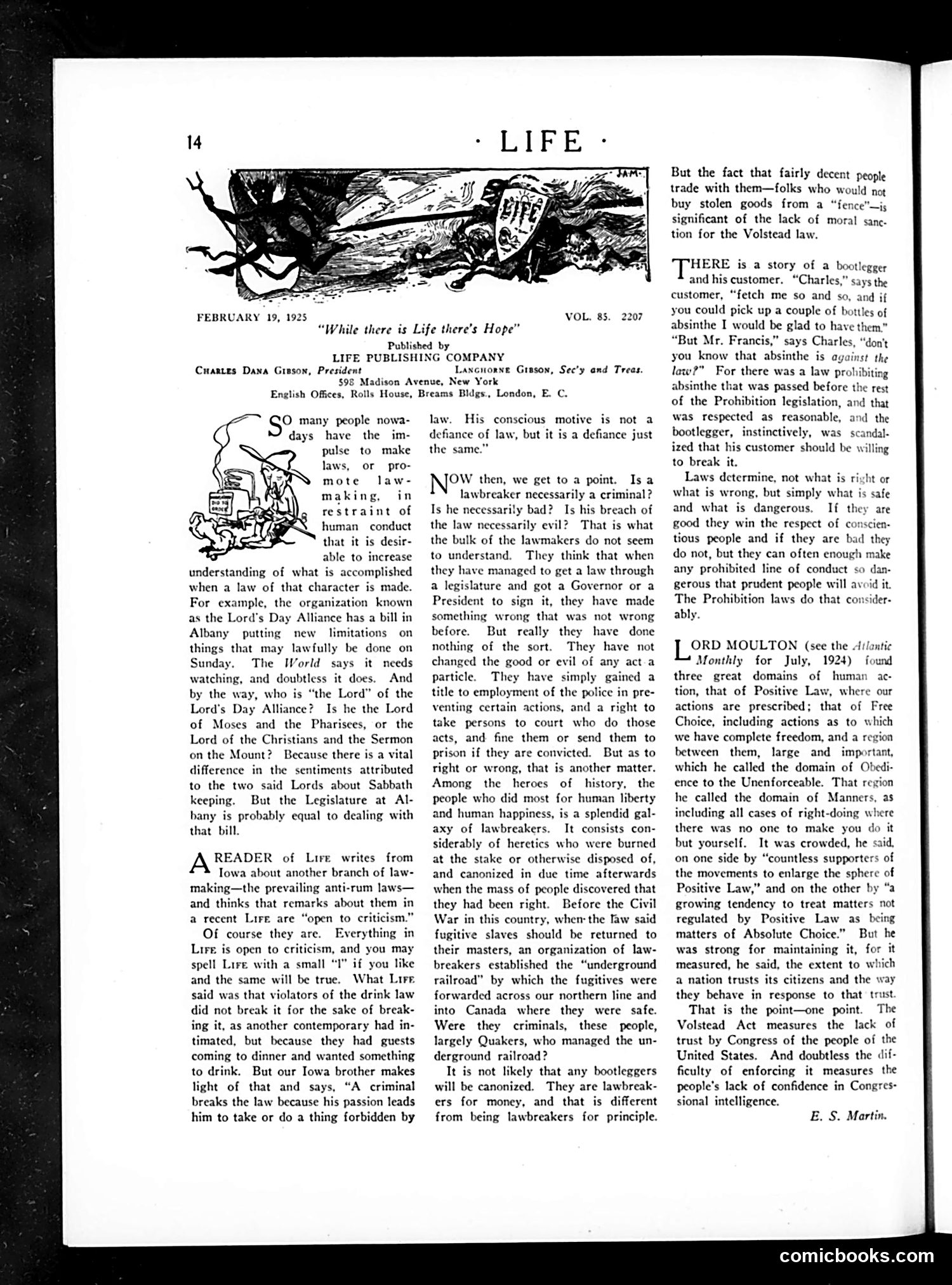
This page discusses Prohibition enforcement and bootlegging during the 1920s alcohol ban. The main cartoon (top left) depicts a bootlegger caught with contraband, illustrating the article's central debate: whether bootleggers are criminals or civil disobedients breaking an unjust law. The article argues that bootleggers operating from principle differ from those motivated purely by profit. It references historical precedents—fugitive slave rescuers and Quaker "underground railroads"—to suggest some lawbreaking can be morally justified. The piece critiques both Prohibition's overstep and bootleggers' opportunism, ultimately questioning Congressional authority to enforce unpopular measures lacking public confidence. The satire targets the fundamental tension between legal prohibition and practical American resistance to it.
📄 Transcribed text from this page (OCR, searchable)
Machine-transcribed from the original scan — historical spelling and the odd misread are preserved.
FEBRUARY 19, 1925 “While there is Life there’s Hope” Published by LIFE PUBLISHING COMPANY Cuantes Dana Giason, President Laxcuorne Gtason, Sec’y and Treas. $98 Madison Avenue, New York English Offices, Rolls House, Breams Bldgs, London, E. C. a So many people nowa- days have the im- pulse to make laws, or pro- mote law- making, in restraint of human conduct that it is desir- able to increase understanding of what is accomplished when a law of that character is made. For example, the organization known as the Lord's Day Alliance has a bill in Albany putting new limitations on things that may lawfully be done on Sunday. The World says it needs watching, and doubtless it does. And by the way, who is “the Lord” of the Lord's Day Alliance? Is he the Lord of Moses and the Pharisees, or the Lord of the Christians and the Sermon on the Mount? Because there is a vital difference in the sentiments attributed to the two said Lords about Sabbath keeping. But the Legislature at Al- bany is probably equal to dealing with that bill. READER of Lire writes from Towa about another branch of law- making—the prevailing anti-rum laws— and thinks that remarks about them in a recent Lire are “open to criticism.” Of course they are. Everything in Lire is open to criticism, and you may spell Lire with a small if you like and the same will be true. What Lire said was that violators of the drink law did not break it for the sake of break- ing it, as another contemporary had in- timated, but because they had guests coming to dinner and wanted something to drink. But our Iowa brother makes light of that and says, “A criminal breaks the law because his passion leads him to take or do a thing forbidden by law. His conscious motive is not a defiance of law, but it is a defiance just the same.” OW then, we get to a point. Isa lawbreaker necessarily a criminal? Is he necessarily bad? Is his breach of the law necessarily evil? That is what the bulk of the lawmakers do not seem to understand. They think that when they have managed to get a law through a legislature and got a Governor or a President to sign it, they have made something wrong that was not wrong before. But really they have done nothing of the sort. They have not changed the good or evil of any act.a particle. They have simply gained a title to employment of the polic pre- venting certain actions, and a right to take persons to court who do those acts, and fine them or send them to prison if they are convicted. But as to right or wrong, that is another matter. Among the heroes of history, the people who did most for human liberty and human happiness, is a splendid gal- axy of lawbreakers. It consists con- siderably of heretics who were burned at the stake or otherwise disposed of, and canonized in due time afterwards when the mass of people discovered that they had been right. Before the Civil War in this country, when: the Taw said fugitive slaves should be returned to their masters, an organization of law- breakers established the “underground railroad” by which the fugitives were forwarded across our northern line and into Canada where they were safe. Were they criminals, these people, largely Quakers, who managed the un- derground railroad? It is not likely that any bootleggers will be canonized. They are lawbreak- ers for money, and that is different from being lawbreakers for principle. But the fact that fairly decent people trade with them—folks who would not buy stolen goods from a “fence’~is significant of the lack of moral sane- tion for the Volstead law. “THERE is a story of a bootlegger and his customer. “Charles,” says the customer, “fetch me so and so, and if you could pick up a couple of bottles of absinthe I would be glad to have “But Mr. Francis,” says Charles, “ you know that absinthe is ag lat For there was a law prohibiting absinthe that was passed before the rest of the Prohibition legislation, and that was respected as reasonable, and the bootlegger, instinctively, was scandal- ized that his customer should be willing to break it. Laws determine, not what is right or what is wrong, but simply what is safe and what is dangerous. If they are good they win the respect of conscien- tious people and if they are bad they do not, but they can often enough make any prohibited line of conduct so dan- gerous that prudent people will avoid it. The Prohibition laws do that consider- ably. ORD MOULTON (see the Ailantic Monthly for July, 1924) found three great domains of human ac- tion, that of Positive Law, where our actions are prescribed; that of Free Choice, including actions as to which we have complete freedom, and a region between them, large and important, which he called the domain of Obedi- ence to the Unenforceable. That region he called the domain of Manners, as including all cases of right-doing where there was no one to make you do it but yourself. It was crowded, he said, on one side by “countless supporters of the movements to enlarge the sphere of Positive Law,” and on the other by “a growing tendency to treat matters not regulated by Positive Law as being matters of Absolute Choice.” But he was strong for maintaining it, for it measured, he said, the extent to which a nation trusts its citizens and the way they behave in response to that trust That is the point—one point. The Volstead Act measures the lack of trust by Congress of the people of the United States. And doubtless the dif- ficulty of enforcing it measures the people's lack of confidence in Congres- sional intelligence. E. S. Martin. comicbooks.com