
Life, 1925-02-19 · page 20 of 37
Life — February 19, 1925 — page 20: what you’re looking at
What you’re looking at
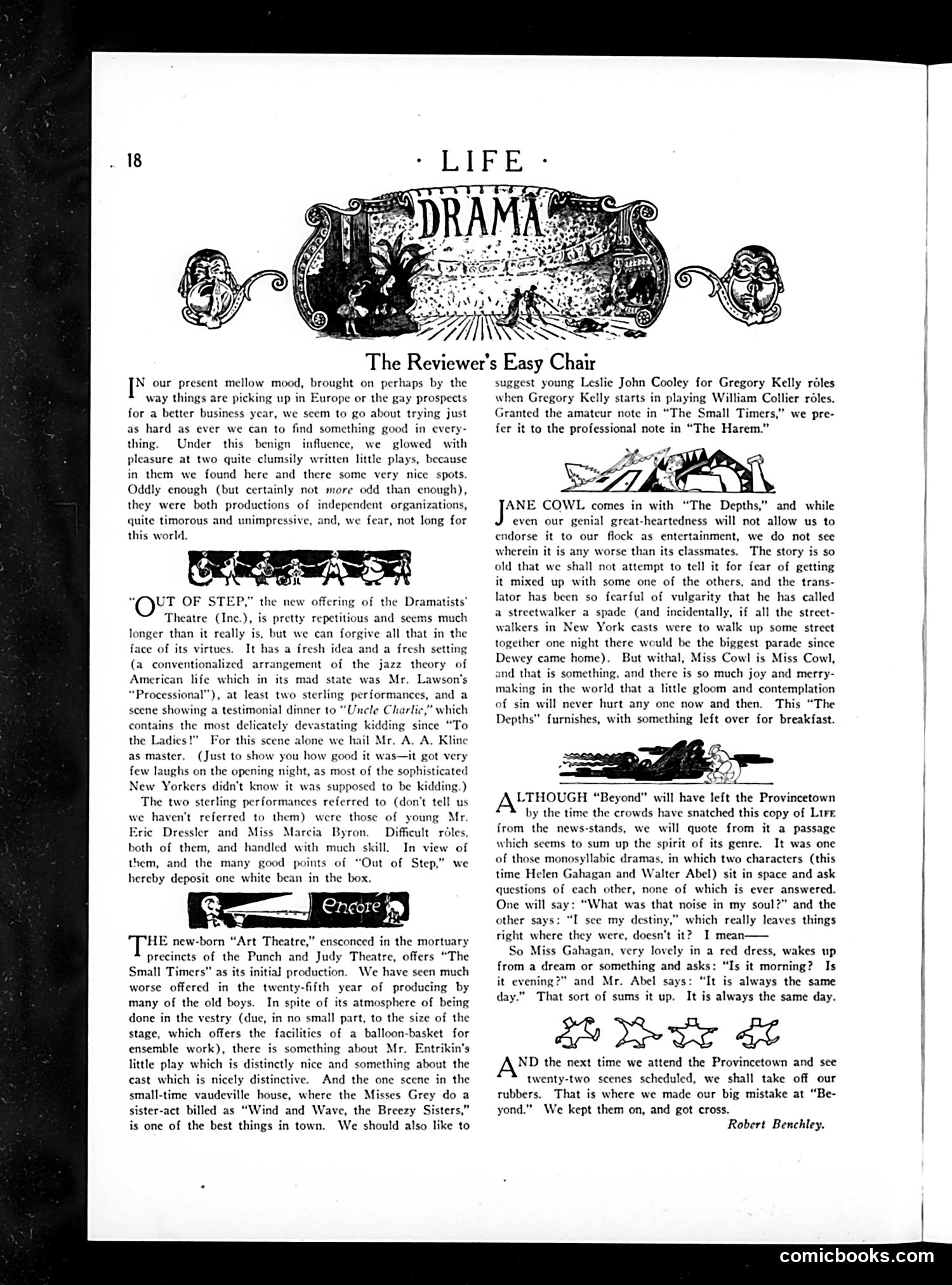
This page contains theater criticism from Life magazine's "Drama" section. The reviewer adopts a benevolent tone toward two small, independent theater productions—"Out of Step" and "The Small Timers"—praising specific scenes and performances despite acknowledging the plays are amateurish and poorly written. The critic uses a "white bean" voting system (a whimsical rating method), awards praise to performers like Eric Dressler and Marcia Byron, and commends a particular vaudeville scene. The page mocks sophisticated New Yorkers who didn't recognize intentional satire in one scene. The reviewer also briefly discusses "The Depths" (starring Jane Cowl) and "Beyond" at the Provincetown Theatre. The tone throughout is patronizing but ultimately encouraging toward struggling theatrical ventures, reflecting an era of small, experimental theater companies in early 20th-century New York.
📄 Transcribed text from this page (OCR, searchable)
Machine-transcribed from the original scan — historical spelling and the odd misread are preserved.
I our present mellow mood, brought on perhaps by the way things are picking up in Europe or the gay prospects for a better business year, we seem to go about trying just as hard as ever we can to find something good in every- thing. Under this benign influence, we glowed with pleasure at two quite clumsily written little plays, because in them we found here and there some very nice spots. Oddly enough (but certainly not more odd than enough), they were both productions of independent organizations, quite timorous and unimpressive, and, we fear, not long for this world. UT OF STEP,” the new offering of the Dramatists’ Theatre (Inc.), is pretty repetitious and seems much longer than it really but we can forgive all that in the face of its virtues. It has a fresh idea and a fresh setting (a conventionalized arrangement of the jazz theory of American life which in its mad state was Mr. Lawson's “Processional”), at least two sterling performances, and a scene showing a testimonial dinner to “Uncle Charlie,” which contains the most delicately devastating kidding since “To the Ladies!" For this scene alone we hail Mr. A. A. Kline as master. (Just to show you how good it was—it got very few laughs on the opening night, as most of the sophisticated New Yorkers didn’t know it was supposed to be kidding.) The two sterling performances referred to (don’t tell us we haven't referred to them) were those of young Mr. Eric Dressler and Miss Marcia Byron. Difficult roles, both of them, and handled with much skill. In view of them, and the many good points of “Out of Step,” we hereby deposit one white bean in the box. | Gee Cr) 'HE new-born “Art Theatre,” ensconced in the mortuary precincts of the Punch and Judy Theatre, offers “The Small Timers” as its initial production. We have seen much worse offered in the twenty-fifth year of producing by many of the old boys. In spite of its atmosphere of being done in the vestry (due, in no small part, to the size of the stage, which offers the facilities of a balloon-basket for ensemble work), there is something about Mr. Entrikin's little play which is distinctly nice and something about the cast which is nicely distinctive. And the one scene in the small-time vaudeville house, where the Misses Grey do a sister-act billed as “Wind and Wave, the Breezy Sisters,” is one of the best things in town. We should also like to suggest young Leslie John Cooley for Gregory Kelly réles when Gregory Kelly starts in playing William Collier réles. Granted the amateur note in “The Small Timers,” we pre- fer it to the professional note in “The Harem.” even our genial great-heartedness will not allow us to endorse it to our flock as entertainment, we do not see wherein it is any worse than its classmates. The story is so old that we shall not attempt to tell it for fear of getting it mixed up with some one of the others, and the trans- lator has been so fearful of vulgarity that he has called a streetwalker a spade (and incidentally, if all the street- walkers in New York casts were to walk up some strect together one night there would be the biggest parade since Dewey came home). But withal, Miss Cowl is Miss Cowl, and that is something, and there is so much joy and merry- making in the world that a little gloom and contemplation of sin will never hurt any one now and then. This “The Depths” furnishes, with something left over for breakfast. RB. - ASS, A{ THOUGH “Beyond” will have left the Provincetown by the time the crowds have snatched this copy of Lirr from the news-stands, we will quote from it a passage which seems to sum up the spirit of its genre. It was one of those monosyllabic dramas, in which two characters (this time Helen Gahagan and Walter Abel) sit in space and ask questions of cach other, none of which is ever answered. One will say: “What was that noise in my soul?” and the other says: “I see my destiny,” which really leaves things right where they were, doesn’t it? I mean—— So Miss Gahagan, very lovely in a red dress, wakes up from a dream or something and asks: “Is it morning? Is it evening?” and Mr. Abel says: “It is always the same day.” That sort of sums it up. It is always the same day. BY Teves et VD the next time we attend the Provincetown and see twenty-two scenes scheduled, we shall take off our rubbers. That is where we made our big mistake at “Be- yond.” We kept them on, and got cross. Robert Benchley. comicbooks.com