
A complete issue · 37 pages · 1925
Life — January 8, 1925
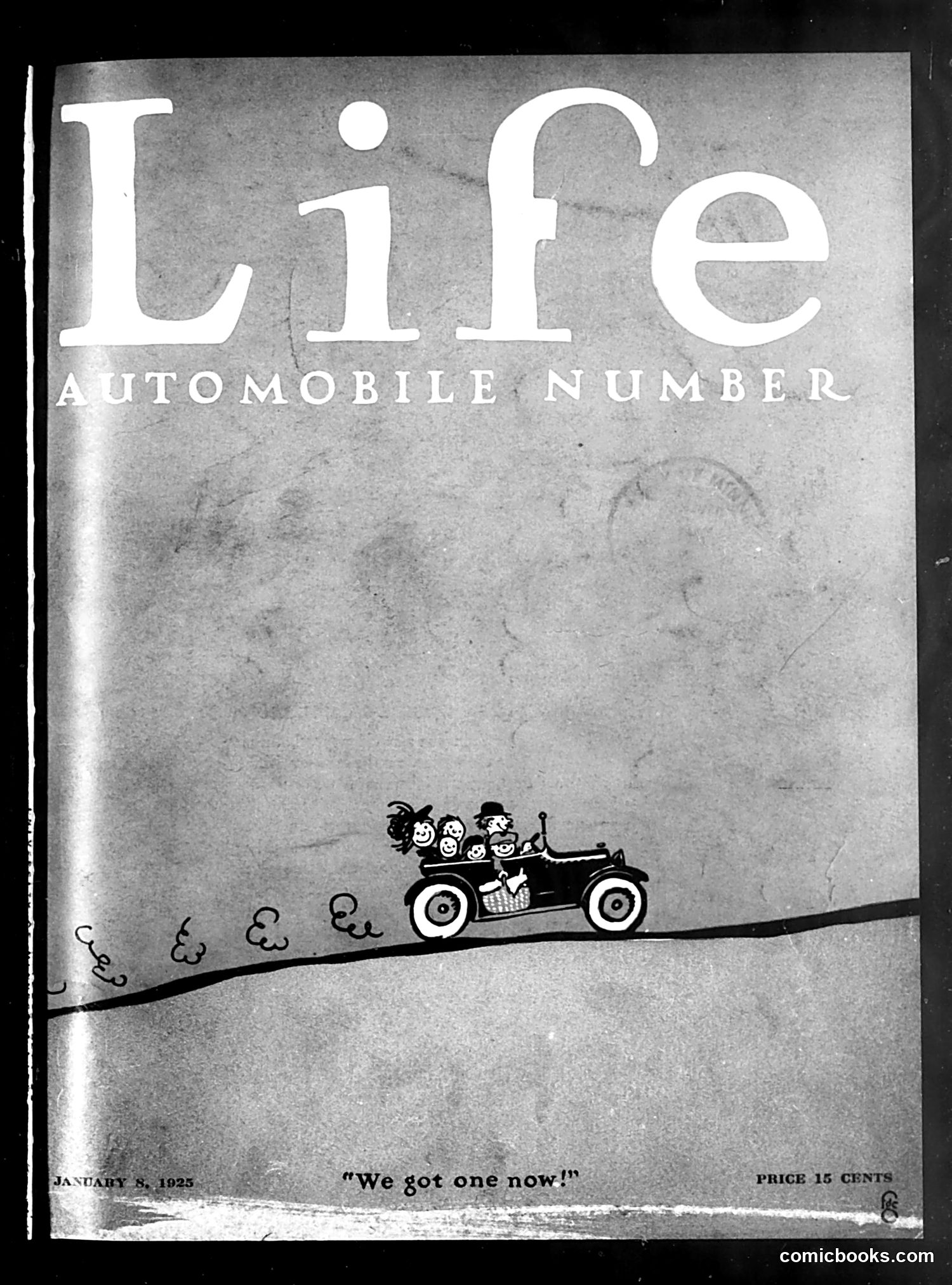
This cover celebrates the affordable automobile era. The large text "Life Automobile Number" and tagline "We got one now!" reflect widespread car ownership becoming accessible to average Americans in the 1920s. The illustration shows a car overflowing with cheerful passengers—likely representing a typical family or group enjoying their newfound mobility. The stylized figures and celebratory tone capture the optimism and social excitement surrounding mass-produced automobiles, particularly the Ford Model T. The cover cost 15 cents and represents a moment when car ownership transitioned from luxury item to common possession, fundamentally changing American society and suburban development. The magazine's satirical approach gently pokes fun at the era's car-culture enthusiasm.
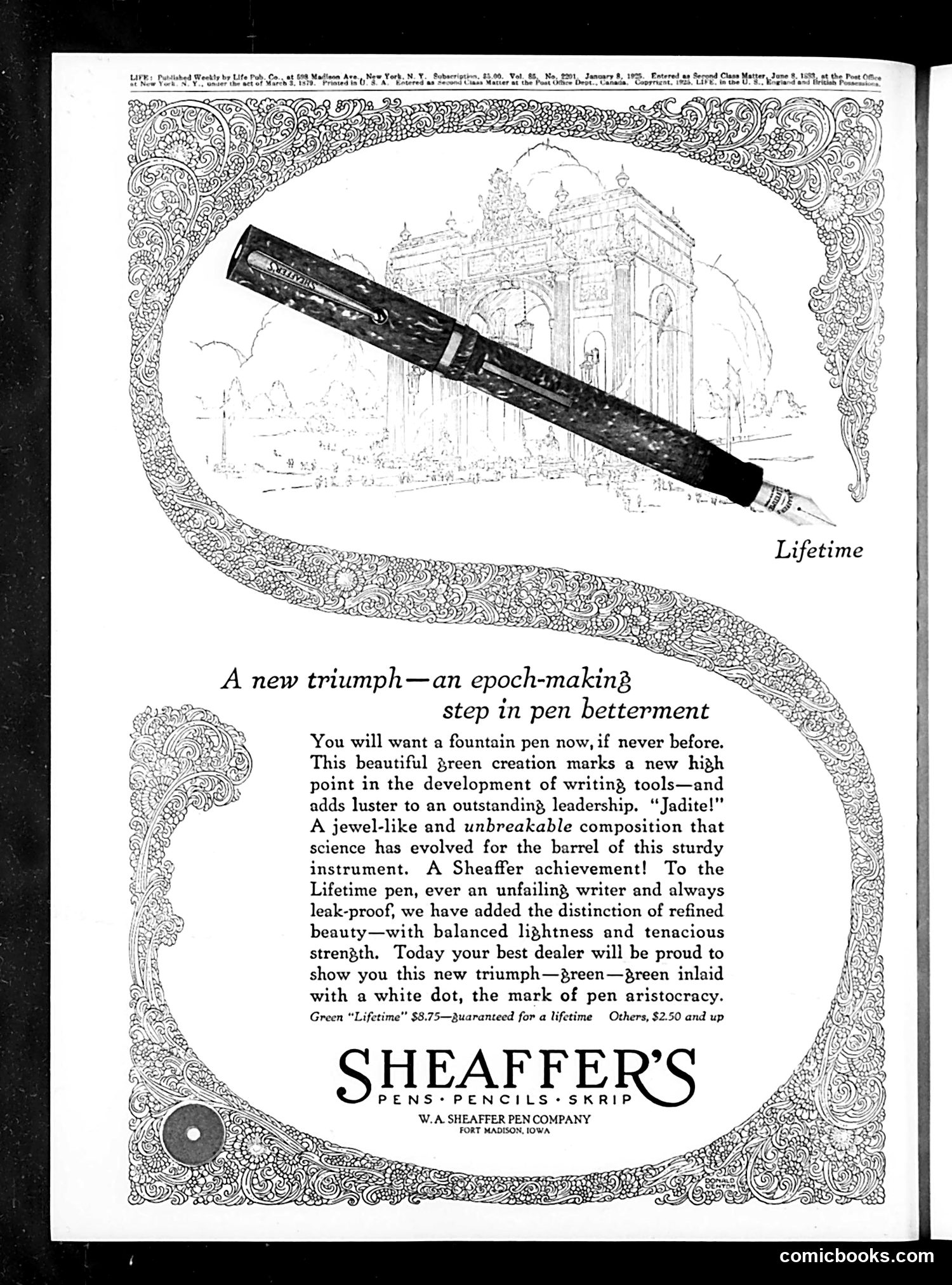
This page is **primarily an advertisement**, not political satire. It promotes Sheaffer's "Lifetime" fountain pen, a green model priced at $3.75. The ad uses the architectural sketch of what appears to be the Taj Mahal as decorative background imagery—likely evoking exotic elegance and timeless beauty to associate with the product's quality and durability. The headline claims this pen represents "an epoch-making step in pen betterment," emphasizing its "unbreakable composition" and leak-proof design. The pen is shown at top, angled diagonally across the illustration. The marketing targets middle-to-upper-class consumers ("ladies") seeking writing instruments that combine refined aesthetics with functional reliability. There is **no political or social satire present**—this is straightforward commercial promotion from an era when quality pens were luxury goods.
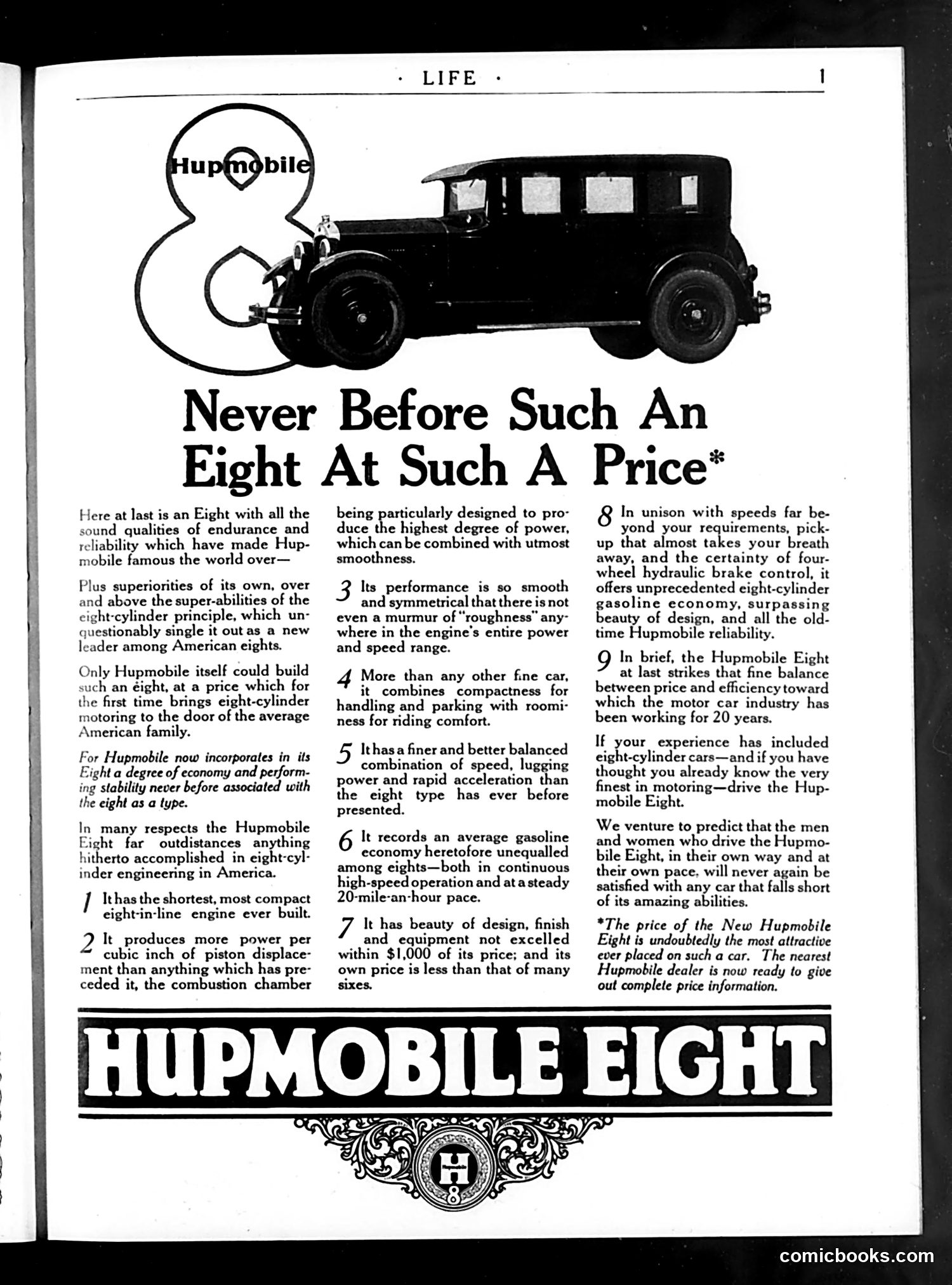
This is **not a cartoon or satire** — it's a straightforward automobile advertisement from *Life* magazine, likely from the 1920s. The page promotes the Hupmobile Eight, an eight-cylinder car, emphasizing nine key selling points: durability, smooth performance, compact design, power efficiency, balanced handling, fuel economy, aesthetic appeal, and affordability (price under $1,000). The illustrated car and the Hupmobile logo are product imagery, not caricatures. The text uses numbered points and marketing rhetoric typical of early automotive advertising, claiming superiority over competitors by combining "eight-cylinder" technology (then relatively advanced) with reasonable pricing for middle-class American families. This represents ordinary commercial content rather than satirical commentary.
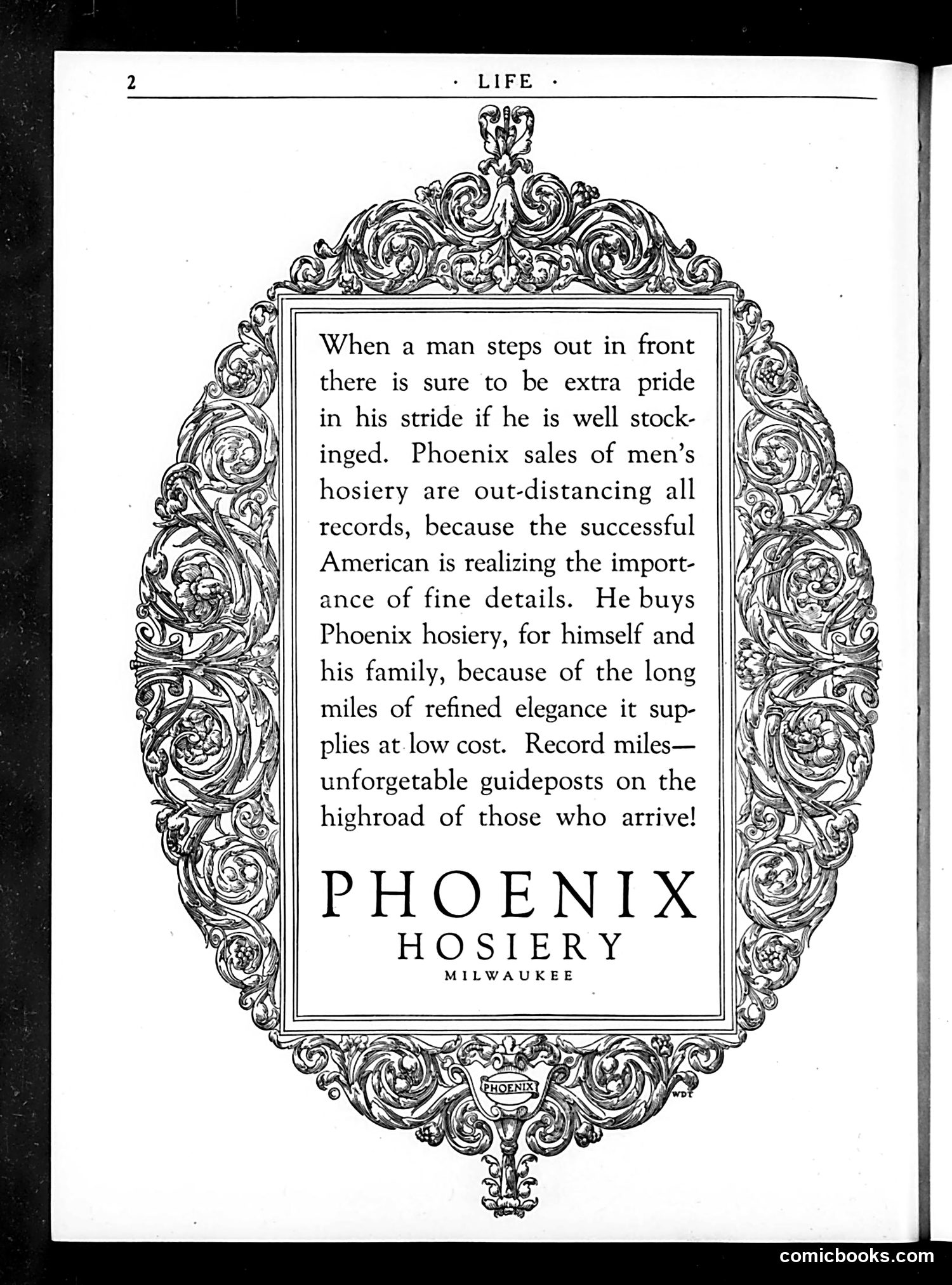
This is primarily a **product advertisement**, not satire or political commentary. The ornate decorative border frames a pitch for Phoenix Hosiery from Milwaukee. The ad appeals to masculine pride and aspirational success, suggesting that well-dressed men—particularly "successful Americans"—demonstrate their refinement through quality hosiery. The language emphasizes "fine details" and "refined elegance" as markers of arrival and respectability. The phrase "Record miles—unforgettable guideposts on the highroad of those who arrive!" uses journey metaphors to connect proper grooming with social achievement. This reflects **early 20th-century consumer culture** where mass-manufactured goods were marketed as signs of class status. The ad targets middle-class men anxious about displaying respectability through visible markers of quality.
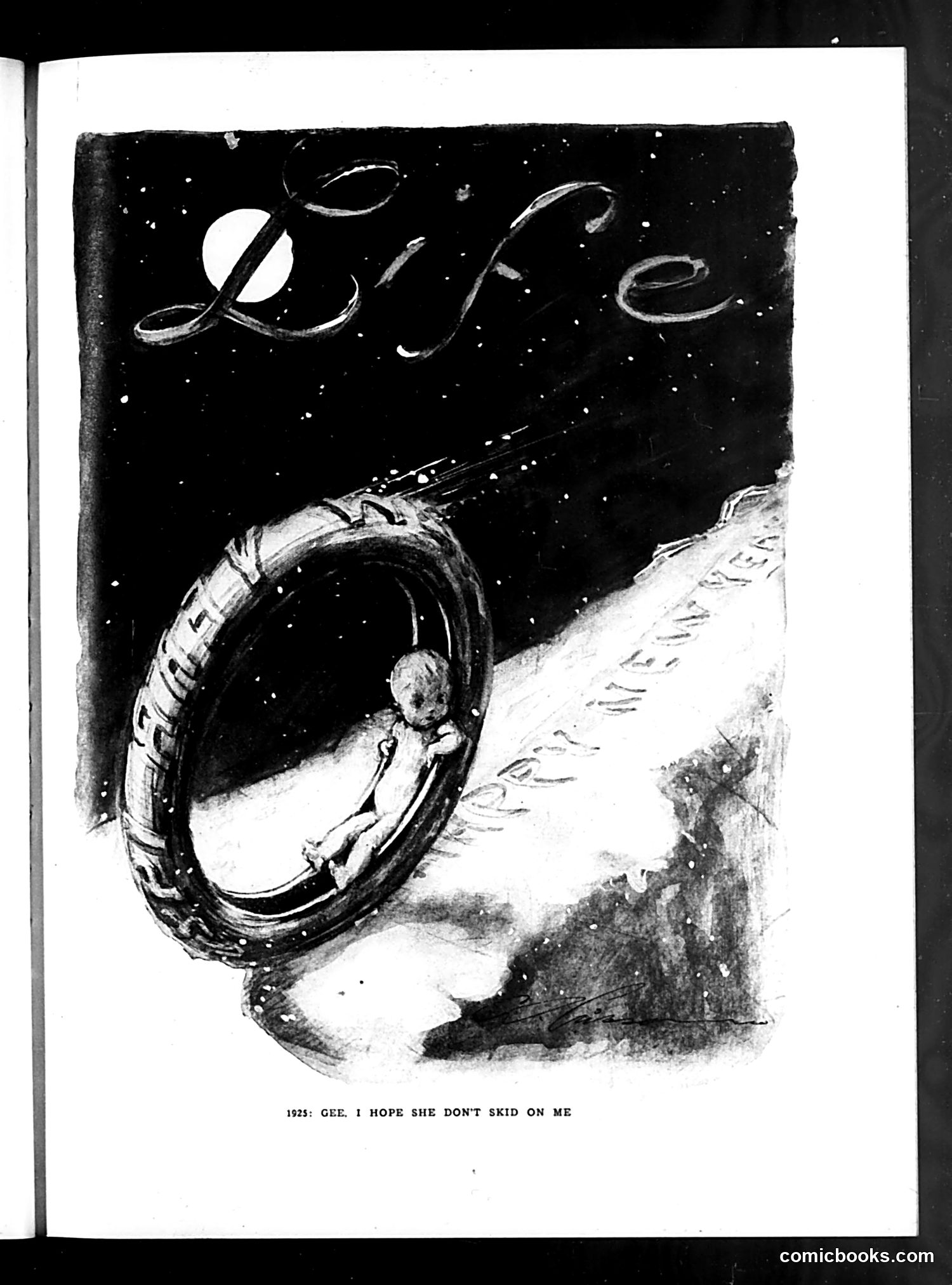
The page shows a 1923 cartoon titled "Gee, I Hope She Don't Skid on Me." It depicts a tire with a worried face as a woman in a car approaches it. The "Life" masthead appears at top. This is a visual pun playing on automotive anxiety. The tire personifies itself as nervous about being driven on—"skidding" suggests both loss of traction and potential damage. The joke reflects early 1920s car culture concerns: as automobile ownership expanded, tire safety and durability were genuine consumer worries. The gendered element (implying female drivers were reckless or unpredictable) reflects period stereotypes about women drivers. The cartoon uses anthropomorphization to humorously express mechanical vulnerability.
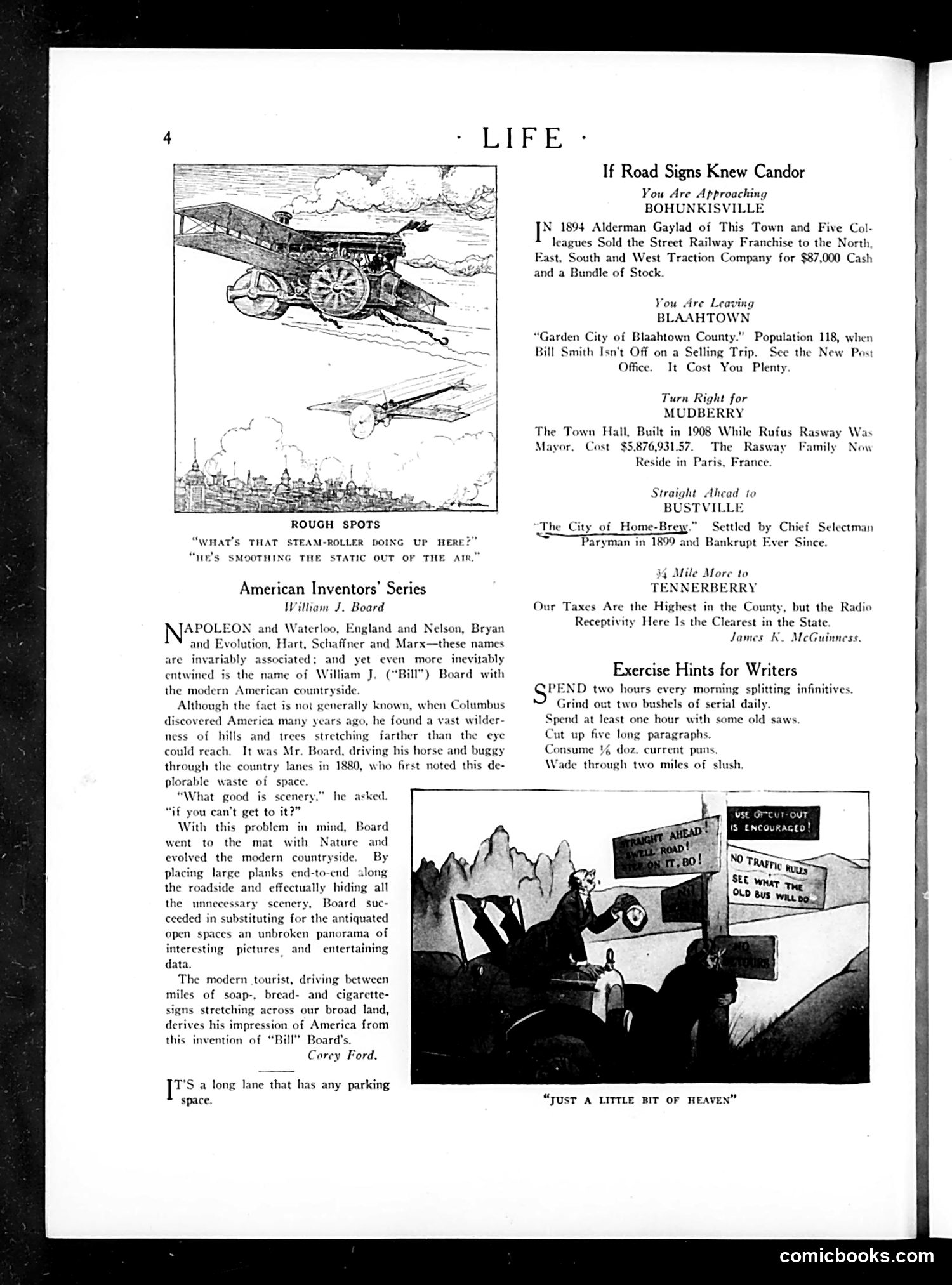
This page contains two distinct sections: **"Rough Spots" Section**: A satirical piece on William J. Board, an American inventor who created roadside billboard advertising. The cartoon mocks Board's solution to making rural American highways more visually interesting—placing large planks along roads to create "scenic" backdrops hiding the actual landscape. The humor targets both Board's invention and the broader concept of artificially manipulating tourist experiences. The caption "What's that steam-roller doing up here?" and the joke about "smoothing the static out of the air" mock the absurdity of this approach. **Right Column**: Travel directions to various towns with humorous commentary about each location's notable (or lack thereof) features—typical satirical guidebook humor common to Life magazine's style during this era. The overall tone ridicules both commercial tourism marketing and small-town America.
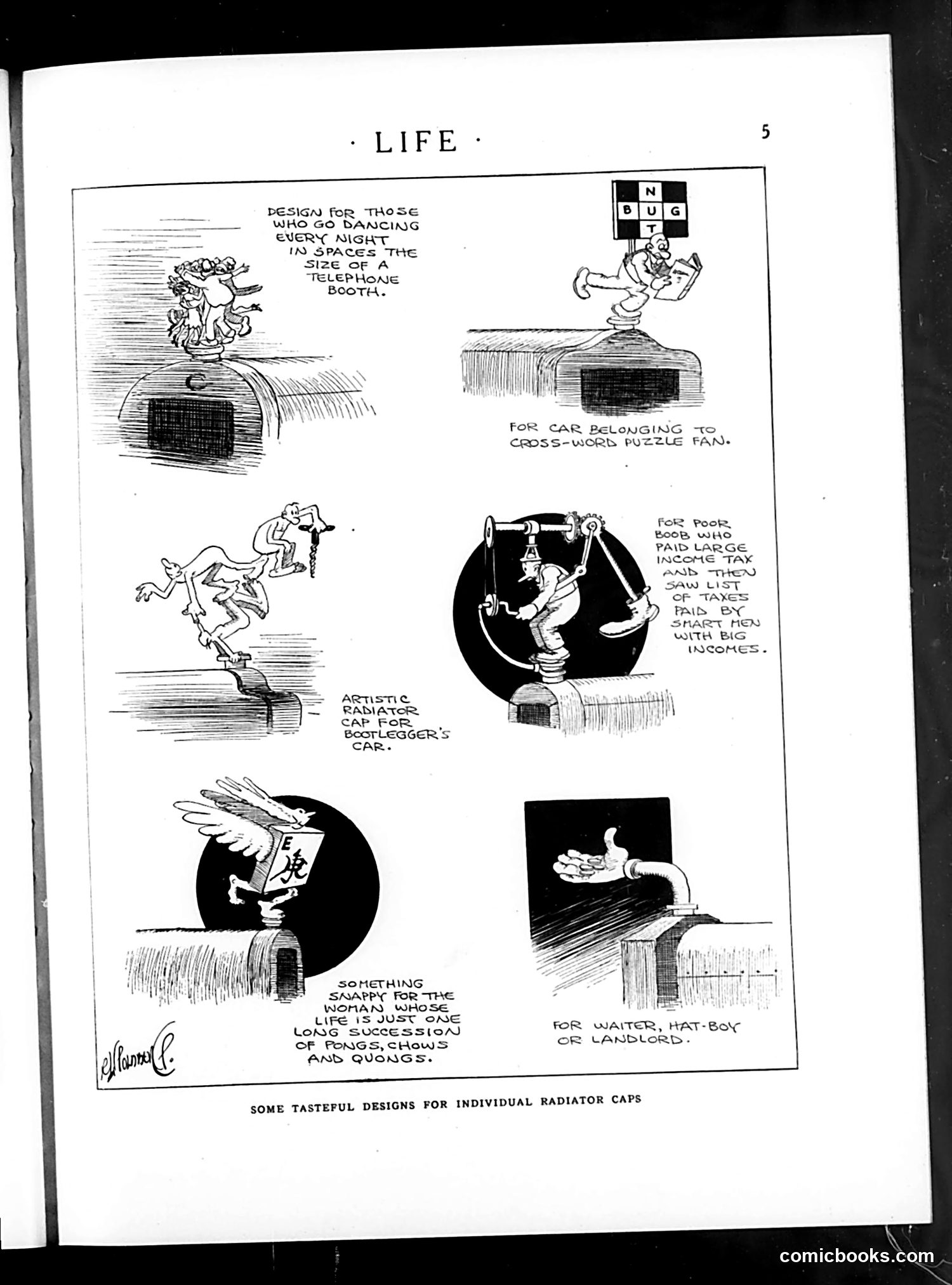
This is a humorous design page satirizing personalized car accessories, specifically radiator cap ornaments—decorative toppers popular in the 1920s-30s. Each design mockingly targets a specific social type: - A dancing couple (for those who dance nightly in cramped spaces) - A "bug" figure (for crossword puzzle enthusiasts) - An artist's radiator cap (for bootleggers) - Scales of justice (for those paying large taxes) - A book with wings (for the woman who loves pong, chows, and quongs—unclear reference) - A watering can (for waiters, hat-box carriers, or landlords) The satire suggests that car owners were using these ornaments as status symbols or personality expressions, which the cartoonist mocks by matching absurd designs to absurdly specific stereotypical occupations and hobbies.
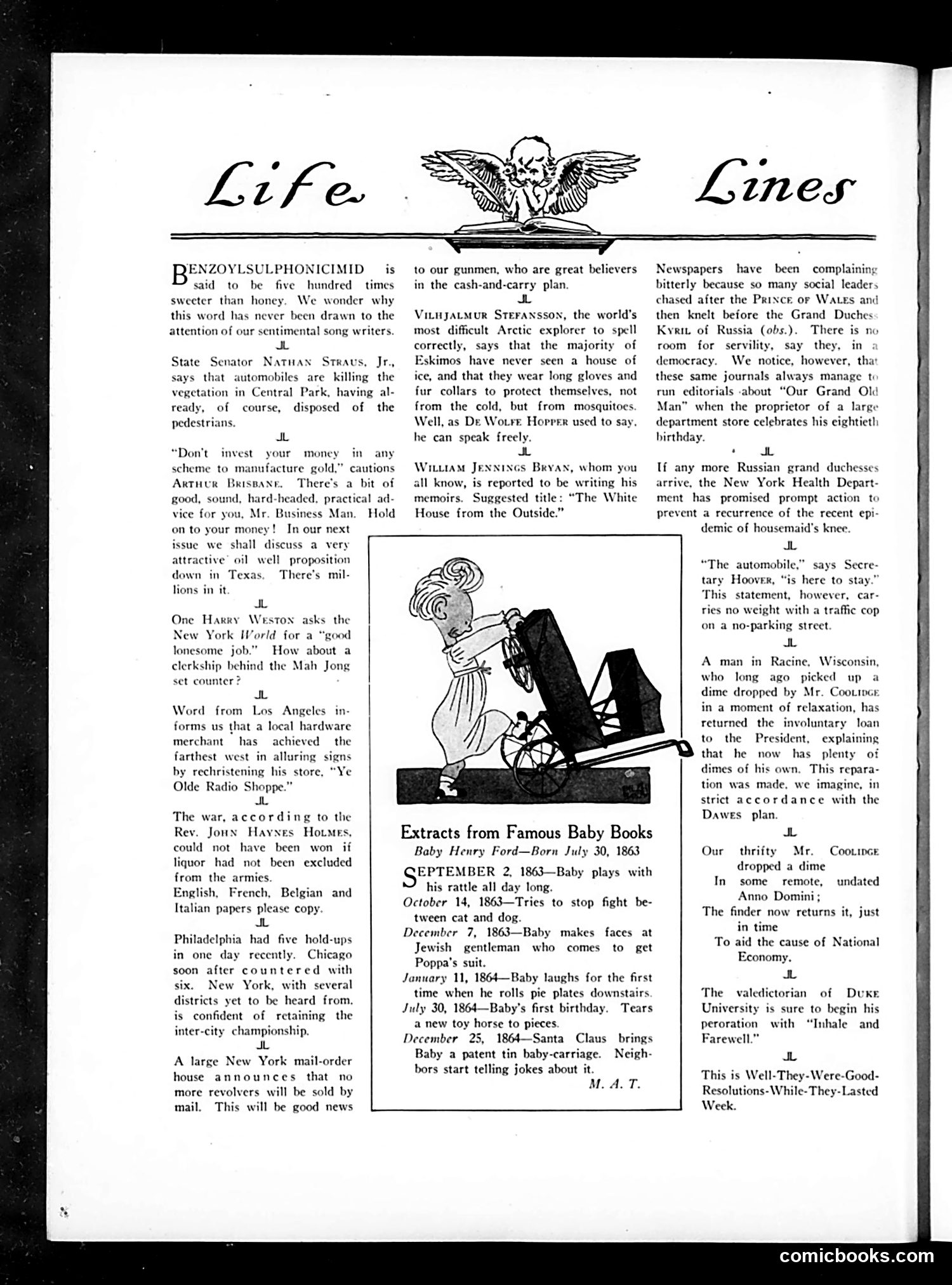
This page from Life magazine contains brief satirical commentary and anecdotes rather than political cartoons. The central illustration shows a stylized figure with an ornate headdress, labeled "Extracts from Famous Baby Books" — humorously chronicling Baby Henry Ford's milestones from 1863-1864. The surrounding "Life Lines" section mocks various contemporary figures and trends: Senator Nathan Straus is criticized for promoting vegetarianism in Central Park; there's wordplay about Arthur Brisbane's business advice; and jokes about lonesome jobs and mail-order revolvers. The satire targets social pretension, questionable business schemes, and newspapers' fawning coverage of wealthy figures like the Prince and Princess of Wales. The tone is light, gossipy commentary rather than serious political critique.
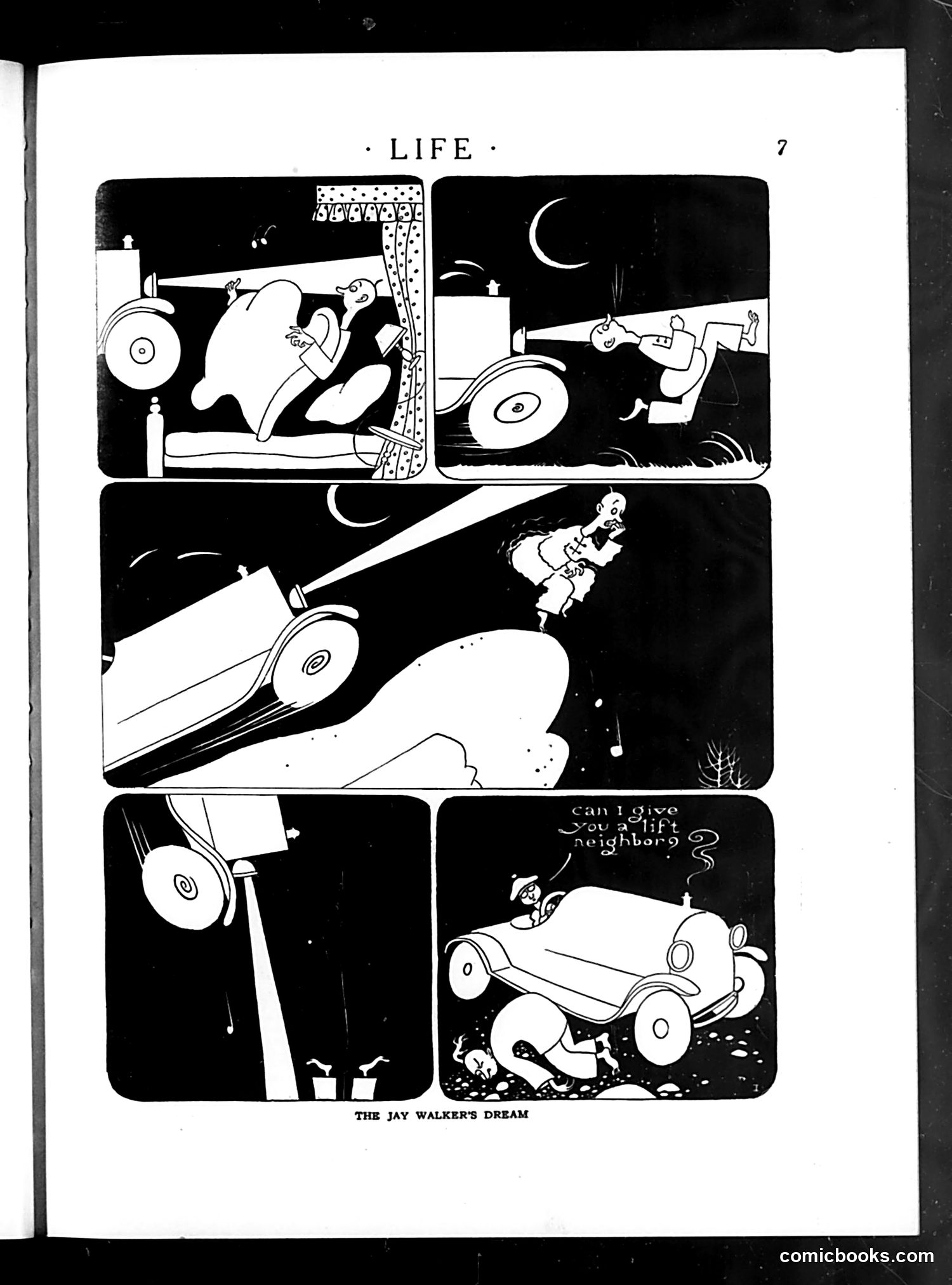
This is a comic strip titled "The Jay Walker's Dream" satirizing reckless pedestrians in early 20th-century urban traffic. The protagonist appears to be a distracted or careless pedestrian ("jay walker"—slang for someone crossing streets illegally or unsafely). The strip depicts a nightmarish sequence where the character is repeatedly struck by or narrowly avoids a large automobile tire. The progression shows the tire growing larger and more menacing as the dream intensifies, culminating in a chaotic final panel where the character questions whether they can "give you a lift, neighbor?" The satire targets both pedestrian negligence and the anxieties Americans felt about the new dangers posed by automobiles in urban environments. The "dream" device allows dark humor about traffic accidents.
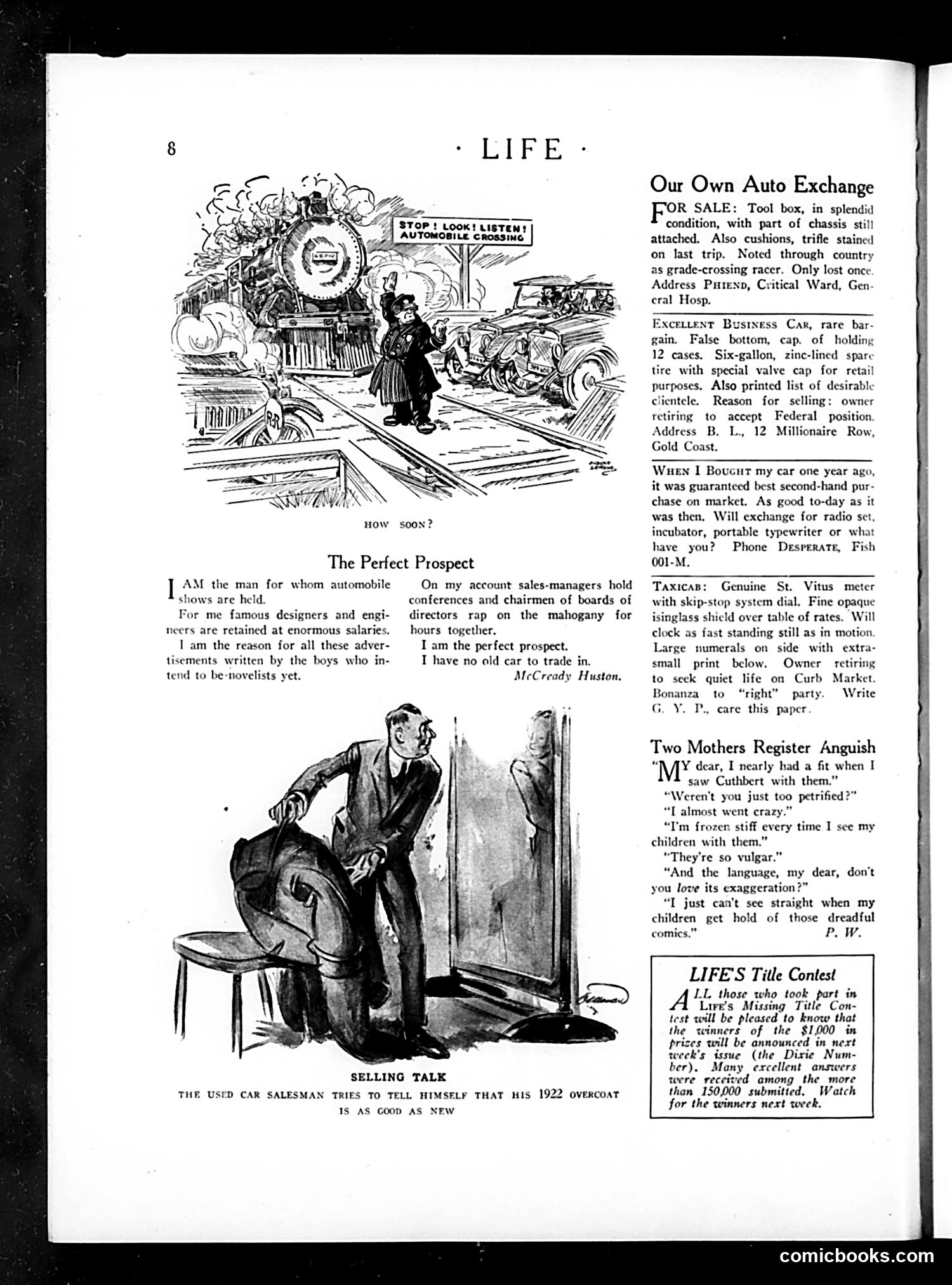
This page contains humor pieces and classified ads rather than political cartoons. The main illustrated content includes: **"The Perfect Prospect"** - A humorous article about automobile salesmen, featuring a sketch of a salesman attempting to convince a customer that a used 1922 overcoat is "as good as new." The joke satirizes dishonest sales tactics common in the used car trade during the 1920s-1930s. **"Two Mothers Register Anguish"** - A brief humor piece about mothers disapproving of their children reading comic books, complaining about vulgarity and crude language. The "Our Own Auto Exchange" section contains genuine classified advertisements for used cars and parts, reflecting the period's casual automotive marketplace. The page primarily offers social satire of consumer culture and parenting anxieties rather than political commentary.
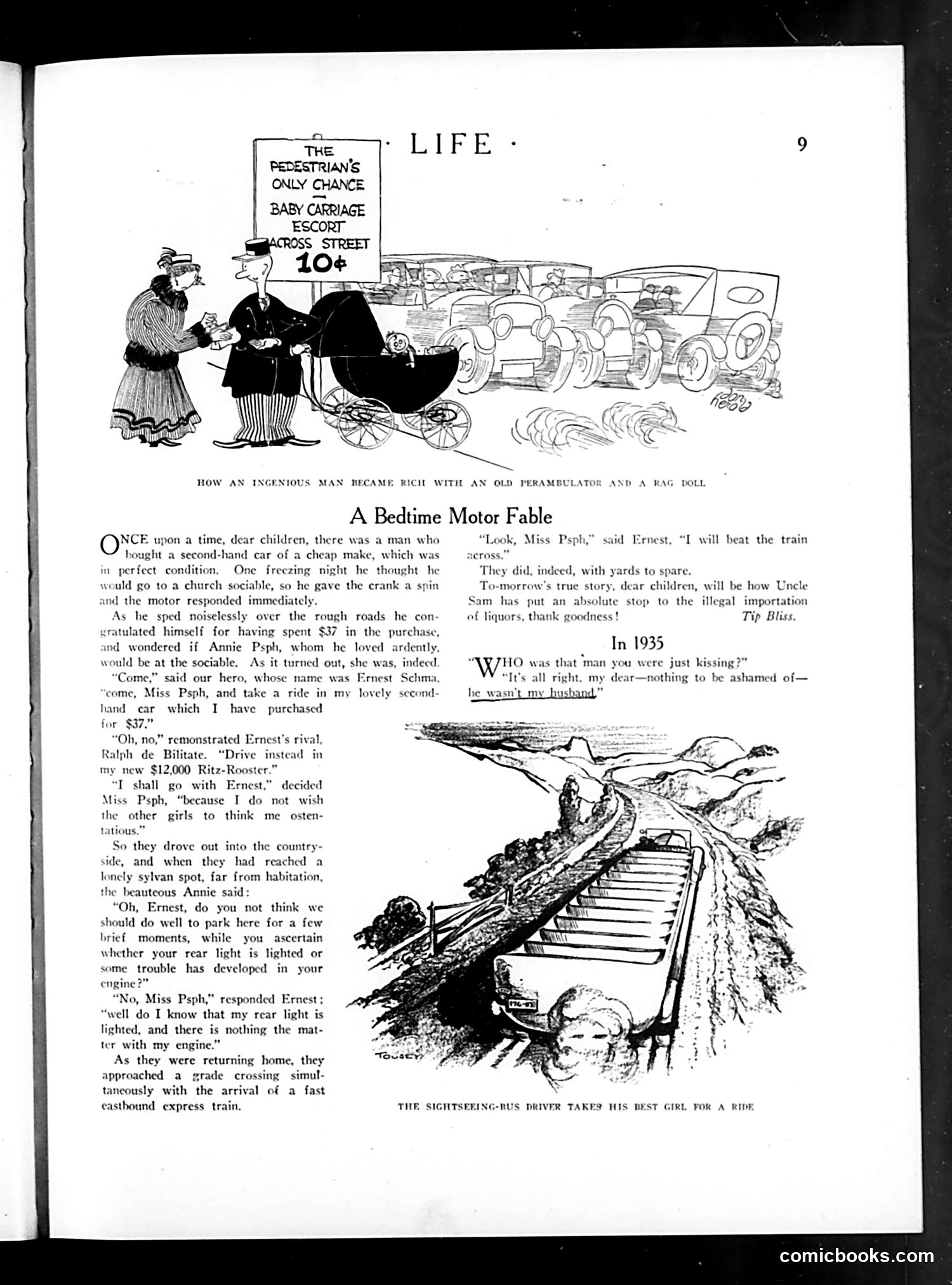
This is a satirical story-fable about courtship and automobiles in the 1930s. The narrative centers on Ernest Schma, a man who buys a second-hand car to impress Miss Psych, a woman he loves. His rival, Ralph de Billtate, owns an expensive $12,000 Roadster and initially has the advantage. The satire targets masculine competition and materialism—Ernest's attempt to win affection through a vehicle purchase. The twist involves a near-tragedy at a railroad crossing that reverses social fortunes. The fable mocks the era's assumption that cars and money determine romantic desirability, while suggesting that character (Ernest's mechanical knowledge and safety awareness) ultimately matters more than wealth. The illustration shows a sightseeing bus—unclear how this relates directly to the plot.
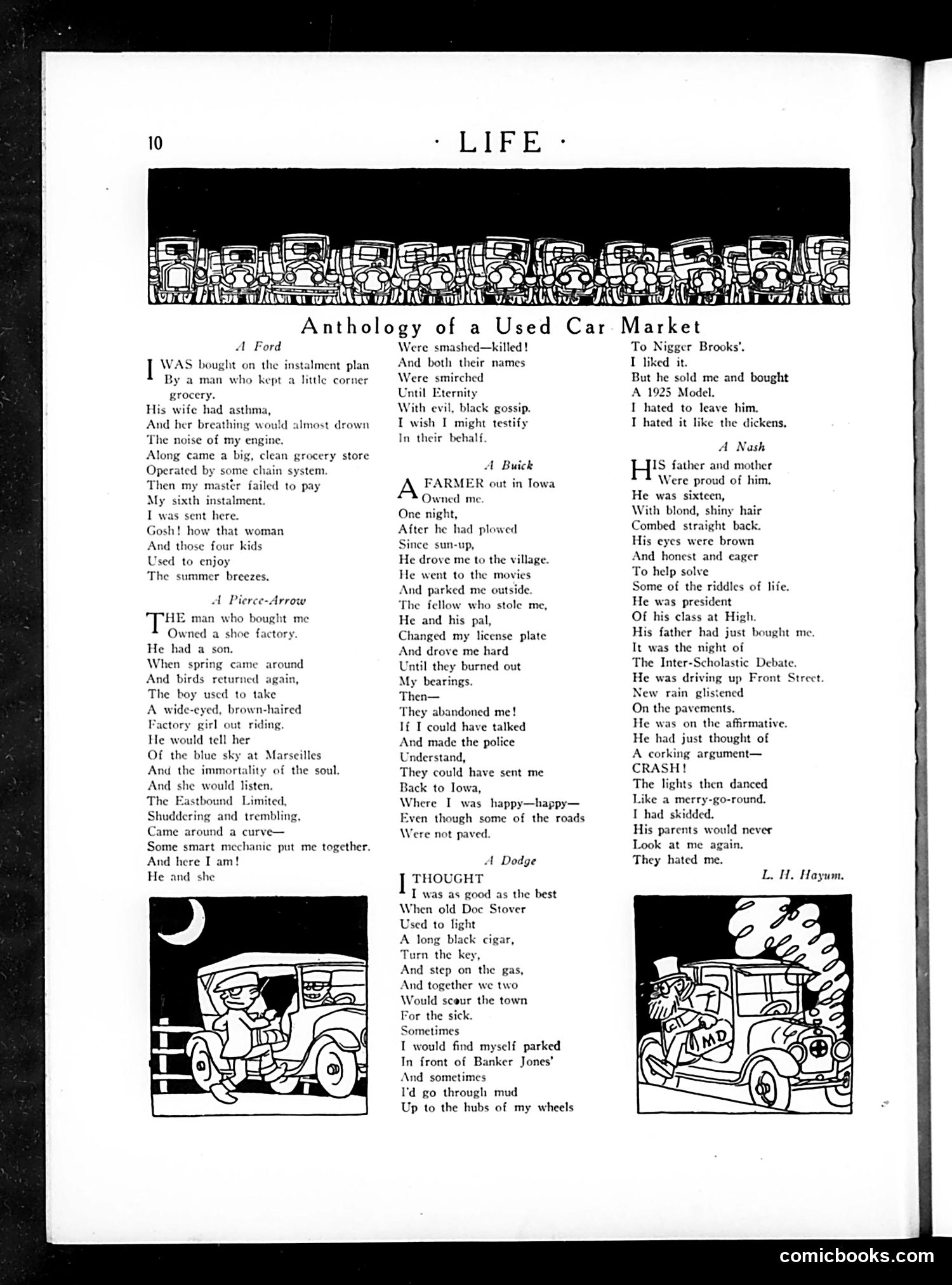
This page presents humorous poems about the lives of used cars, each personified as having a distinct history. The poems describe cars that experienced various misfortunes—repossession, abandonment, mechanical failure, and resale through multiple owners. The satire targets the used car market itself: the installment-payment system that enabled working-class people to buy cars but often led to default; unscrupulous dealers; and the degrading conditions cars endured between owners. Each poem's voice—whether a Ford, Buick, Pierce-Arrow, Nash, or Dodge—emphasizes the car's perspective as a mistreated object passed between owners who couldn't afford new vehicles. The accompanying cartoons show humorous situations: nighttime driving and a collision, reinforcing the chaos of used-car ownership. The satire critiques both the economic system making car ownership precarious and buyers' carelessness with secondhand vehicles.
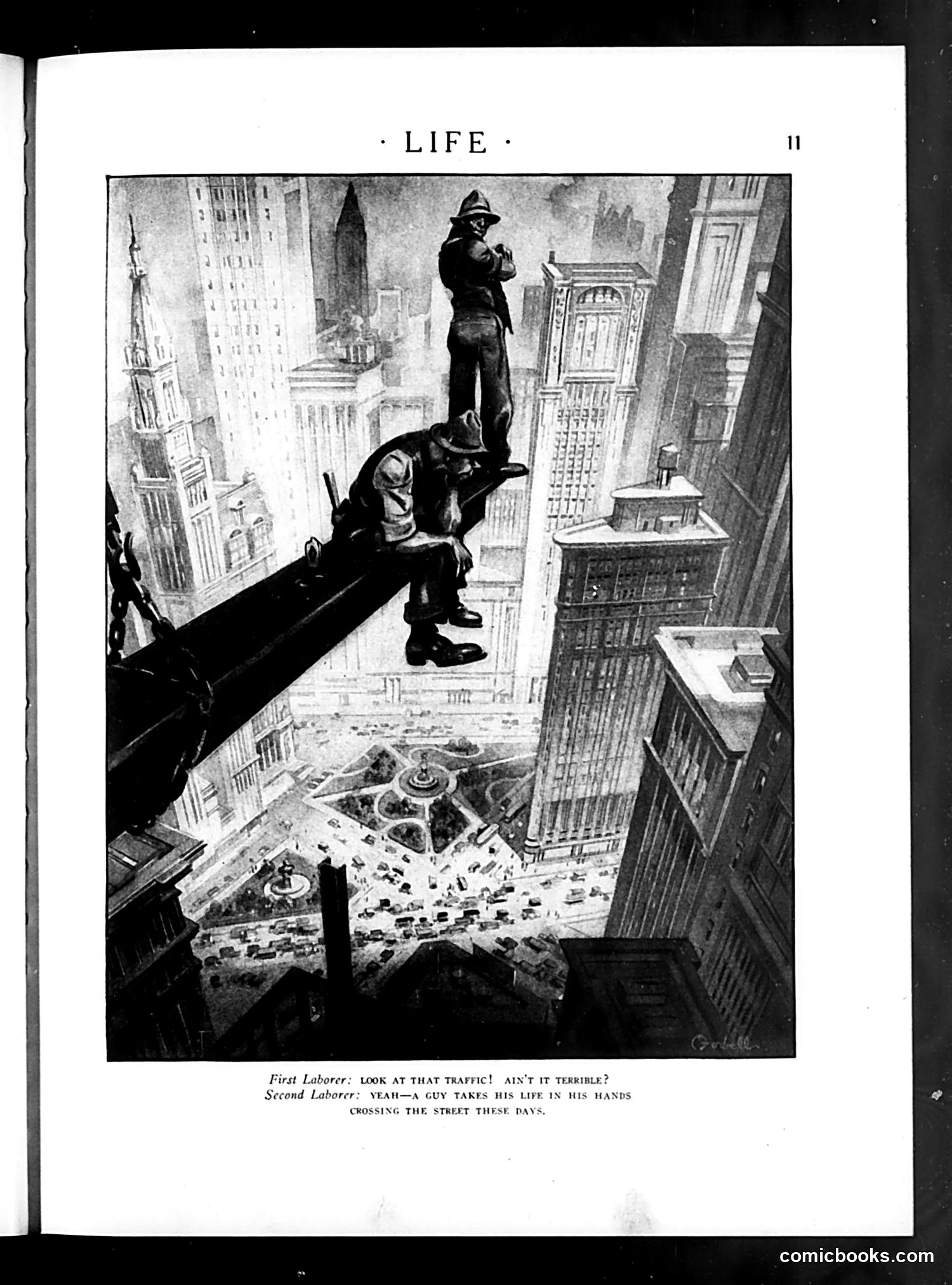
This is a satirical cartoon about urban labor and workplace danger. Two workers stand on a high steel beam suspended between skyscrapers, looking down at a busy street far below. The first laborer expresses shock at the traffic chaos, while the second responds that crossing streets has become genuinely life-threatening in modern cities. The satire critiques the hazards of contemporary urban life—particularly for working-class men engaged in dangerous construction work. The joke inverts typical safety concerns: rather than fearing their precarious position high above the city, the workers are more anxious about the mundane task of crossing a street safely. This highlights how automobile traffic had become an unexpected and serious threat to pedestrians in early-twentieth-century American cities, rivaling traditional workplace dangers.
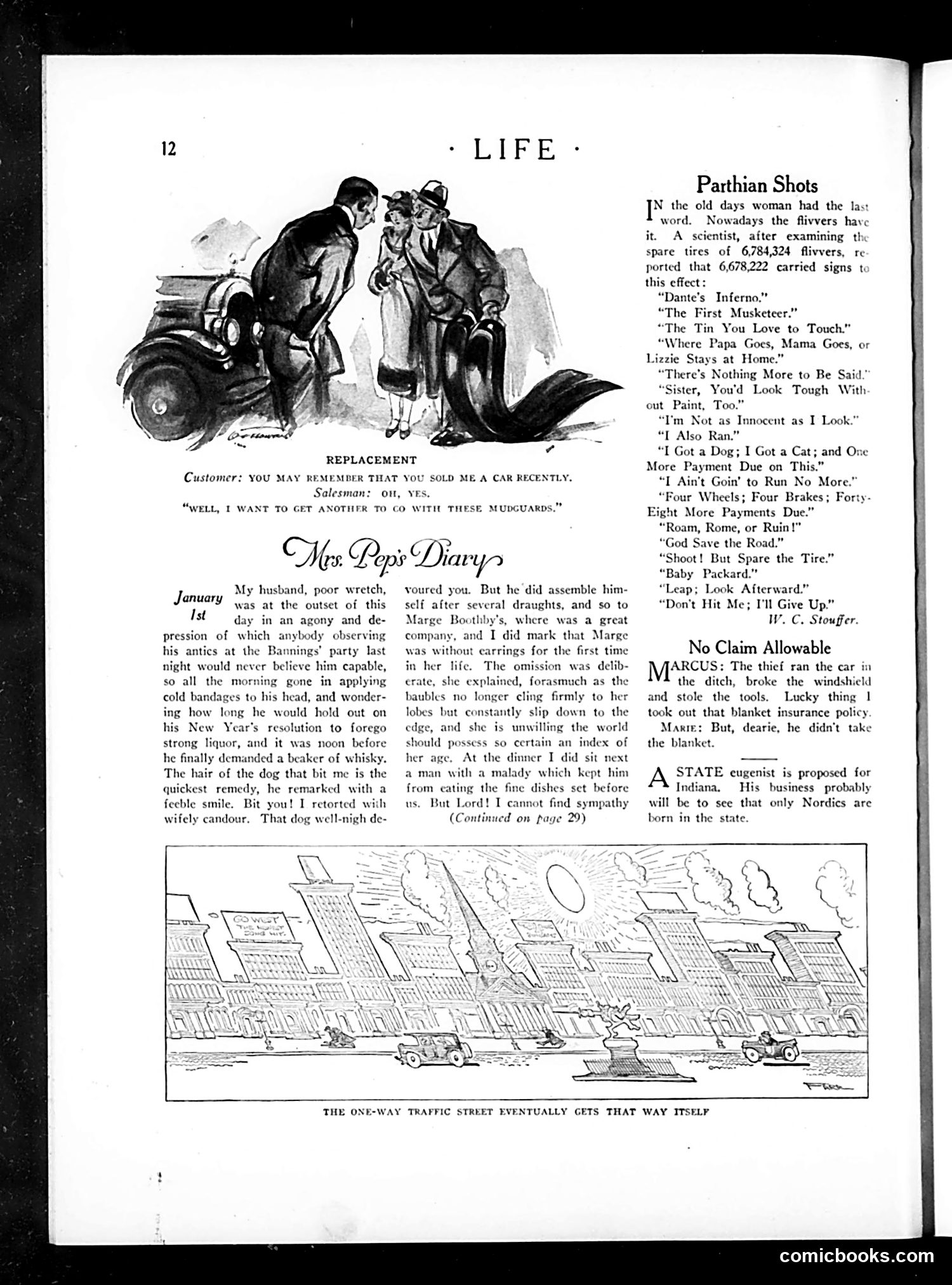
**Top Cartoon ("Replacement"):** A salesman tries to sell mudguards to a customer who bought a car from him recently. The customer complains the car needs replacement parts constantly. This satirizes early automobiles' notorious unreliability—a common complaint in the 1910s-1920s when cars required frequent repairs and replacements. The joke mocks both the shoddy manufacturing and salesmen's attempts to profit from defective vehicles. **"Mrs. Pep's Diary":** A humorous domestic column describing marital frustrations—the husband's drinking, her housekeeping struggles, and their financial difficulties. **"No Claim Allowable":** A brief joke about insurance denying a claim for windshield damage. **Bottom Cartoon:** Satirizes one-way traffic streets becoming so congested they eventually clog themselves—a commentary on urban traffic problems and infrastructure failures.
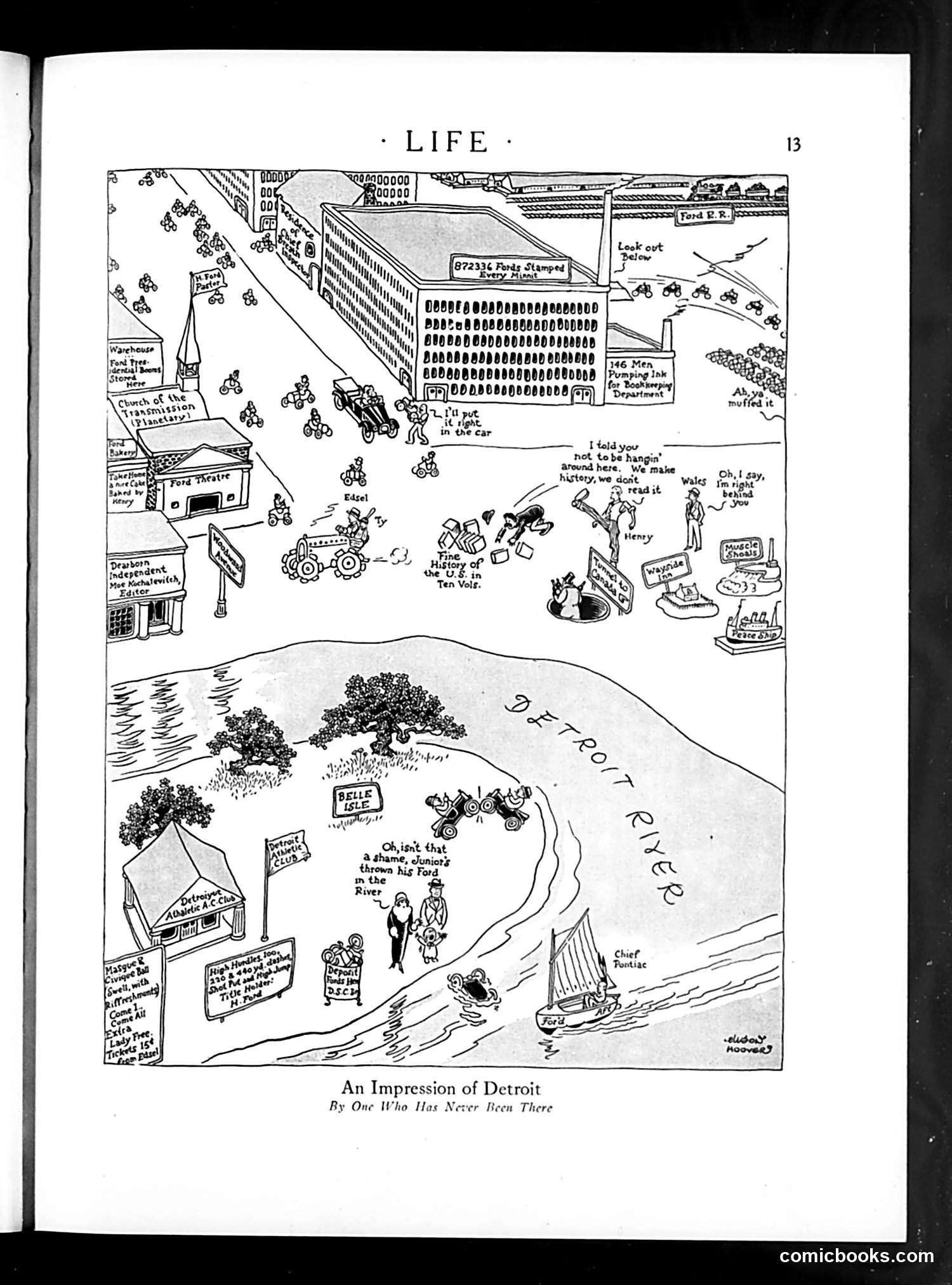
This is a satirical map-cartoon of Detroit that mocks the city through exaggeration and stereotype. The upper section shows an industrial/manufacturing hub crowded with Ford factories, motorcycles, and automobiles—reflecting Detroit's dominant identity as an automotive manufacturing center. The lower section depicts the Detroit River with a crude, dismissive portrayal of Native American and frontier imagery (a tepee labeled "Belle Isle," figures in stereotypical dress), suggesting the cartoonist is satirizing how outsiders might imagine Detroit's history while having "never been there." The overall joke is that this amateur's imagined Detroit combines industrial modernity with outdated frontier mythology—mocking both the city's actual character and uninformed outsider perceptions of it.
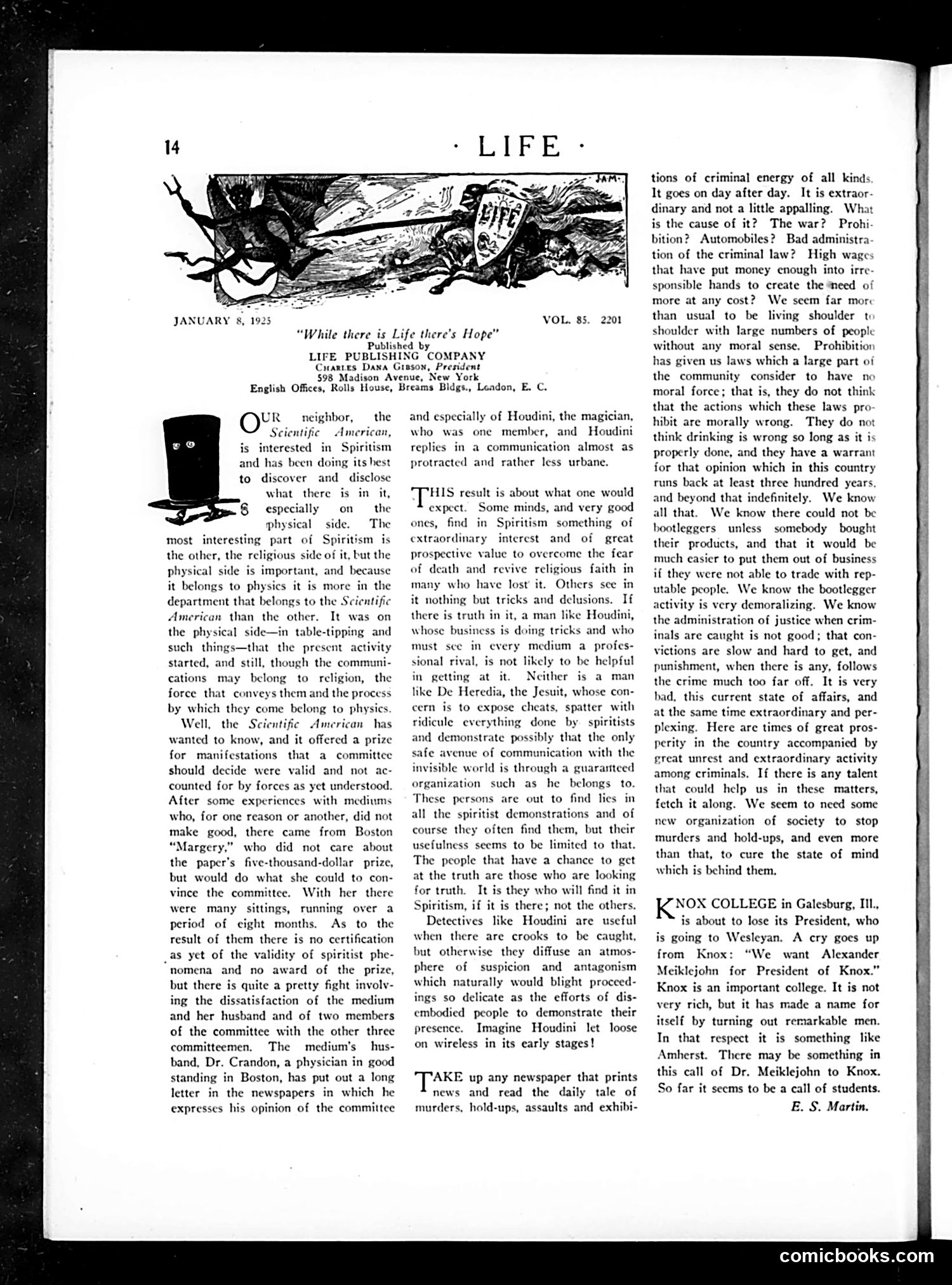
The masthead cartoon depicts a skeletal figure labeled "LIFE" lying in what appears to be a coffin or death bed, illustrating the editorial's theme about crime and lawlessness in America. The accompanying article discusses the epidemic of murders, hold-ups, and criminal activity plaguing the country. The author argues that Prohibition, automobiles, high wages, and poor law enforcement have enabled criminal behavior and demoralized society. The piece criticizes how bootleggers and criminals operate with impunity while law enforcement struggles to contain them. A secondary item mentions Knox College losing its president to Wesleyan and appeals to Dr. Meiklejohn to accept a position there instead—a call for academic leadership during uncertain times.
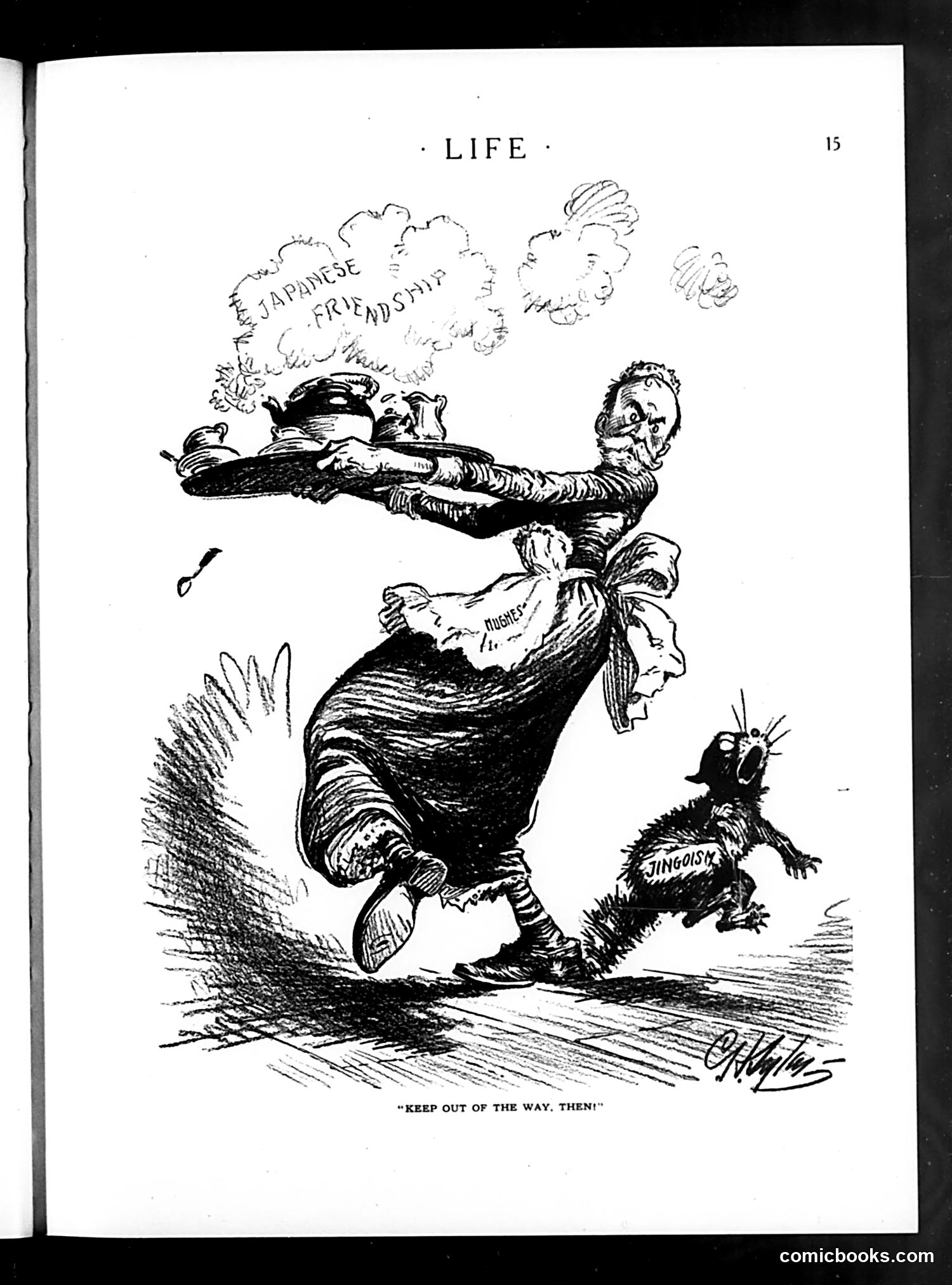
This is a satirical cartoon from *Life* magazine showing a caricatured figure juggling teapots labeled "Japanese Friendship" while being chased by a small creature labeled "Jingoism." The caption reads "Keep Out of the Way, Then!" The cartoon appears to comment on U.S.-Japan diplomatic relations, likely from the early 20th century. The juggling figure represents either a diplomat or political leader attempting to maintain peaceful relations with Japan ("Japanese Friendship") while being pursued by "Jingoism"—aggressive nationalism or warmongering sentiment. The central figure seems to be saying that jingoists should stay out of diplomatic affairs to prevent the delicate balance from collapsing. The cartoon satirizes tensions between those seeking peaceful coexistence and those advocating aggressive nationalism.
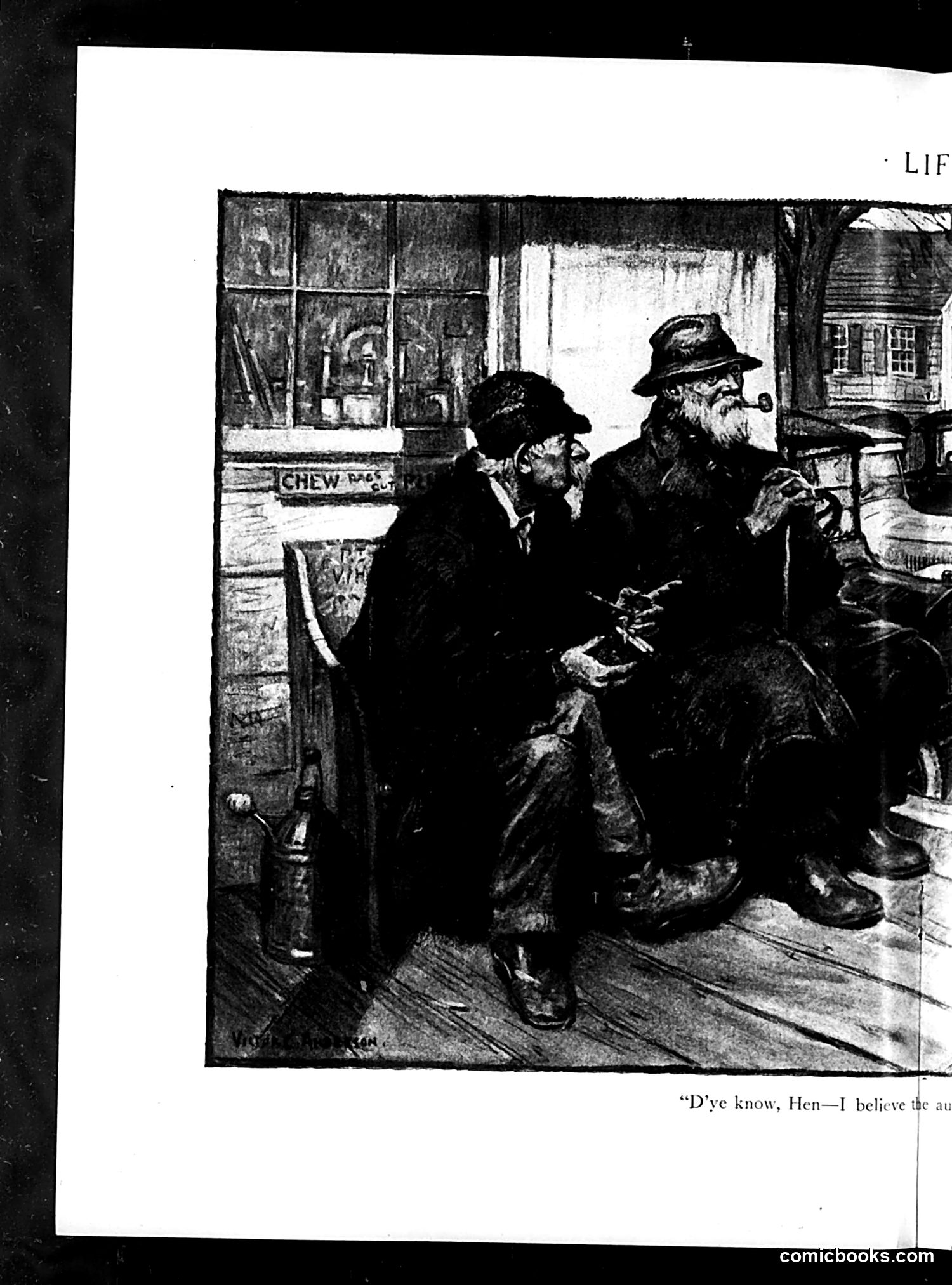
This appears to be a satirical illustration from *Life* magazine showing three men in period clothing (early 20th century) standing outside a storefront marked "CHEW P[?]" (likely "CHEW PLUG" or similar tobacco product). The caption begins: "D'ye know, Hen—I believe th au[thor]..." but is cut off. The image depicts what appears to be working-class or working men in conversation, seemingly commenting on or gossiping about an author. The satire likely mocks either the men's pretentiousness in discussing literature they may not understand, or critiques a particular author's work or public persona. Without the complete caption and context, the specific target is unclear, though the humor appears rooted in class commentary—contrasting these ordinary men with literary sophistication.
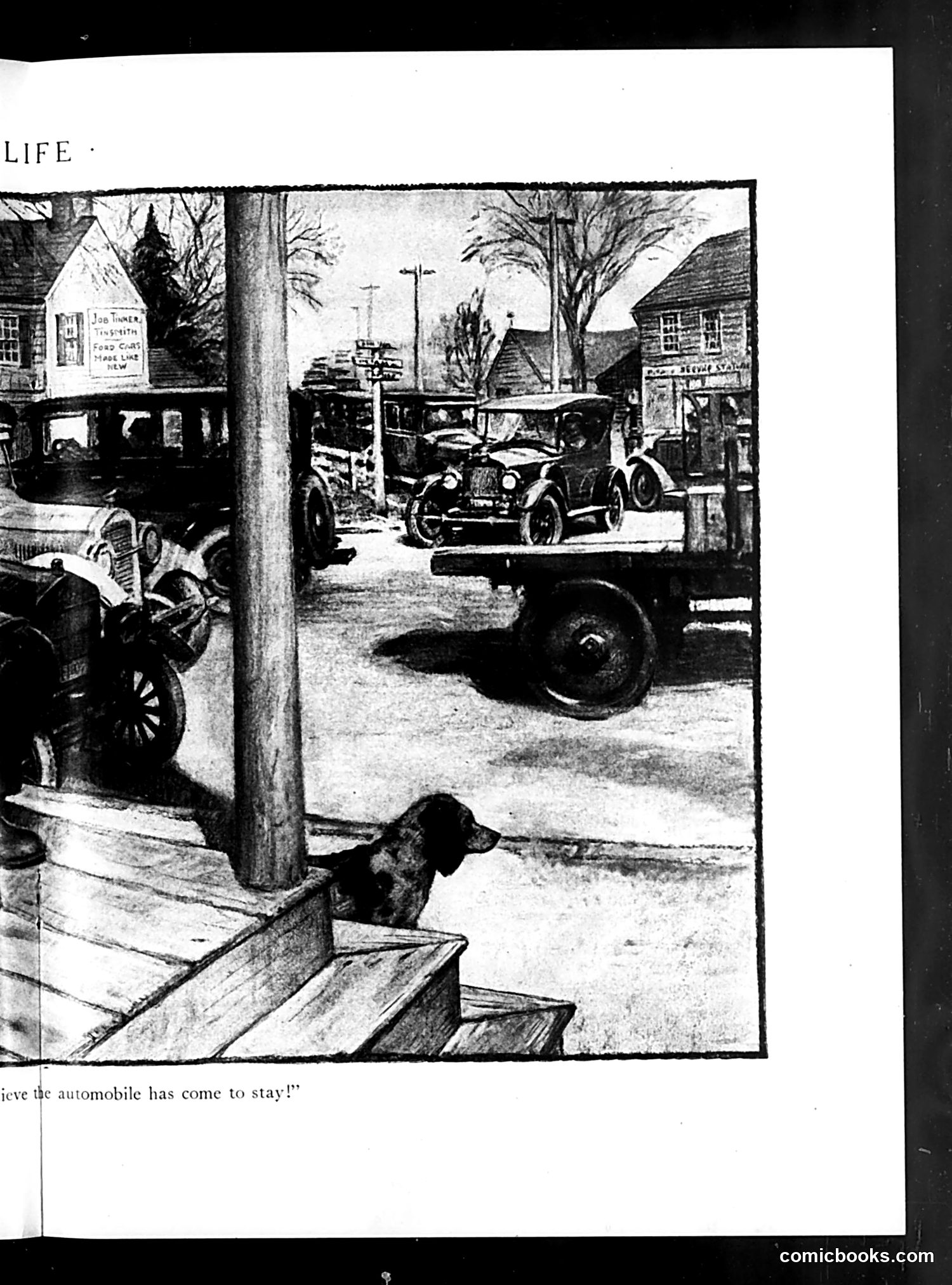
This is a satirical illustration from *Life* magazine depicting an early-20th-century American street scene. The image shows several automobiles parked on a residential street, with shops and houses visible in the background. A dog lounges in the foreground on what appears to be a porch or storefront. The caption reads: "believe the automobile has come to stay!" The satire appears to mock the skepticism some people held about automobiles' permanence. The scene presents automobiles as now thoroughly integrated into everyday American life and commerce—suggesting that despite earlier doubts about whether this technology was merely a fad, the automobile has definitively established itself as a permanent fixture of modern society. The casual presence of the dog and the ordinary domestic setting emphasize this normalization of automotive culture.
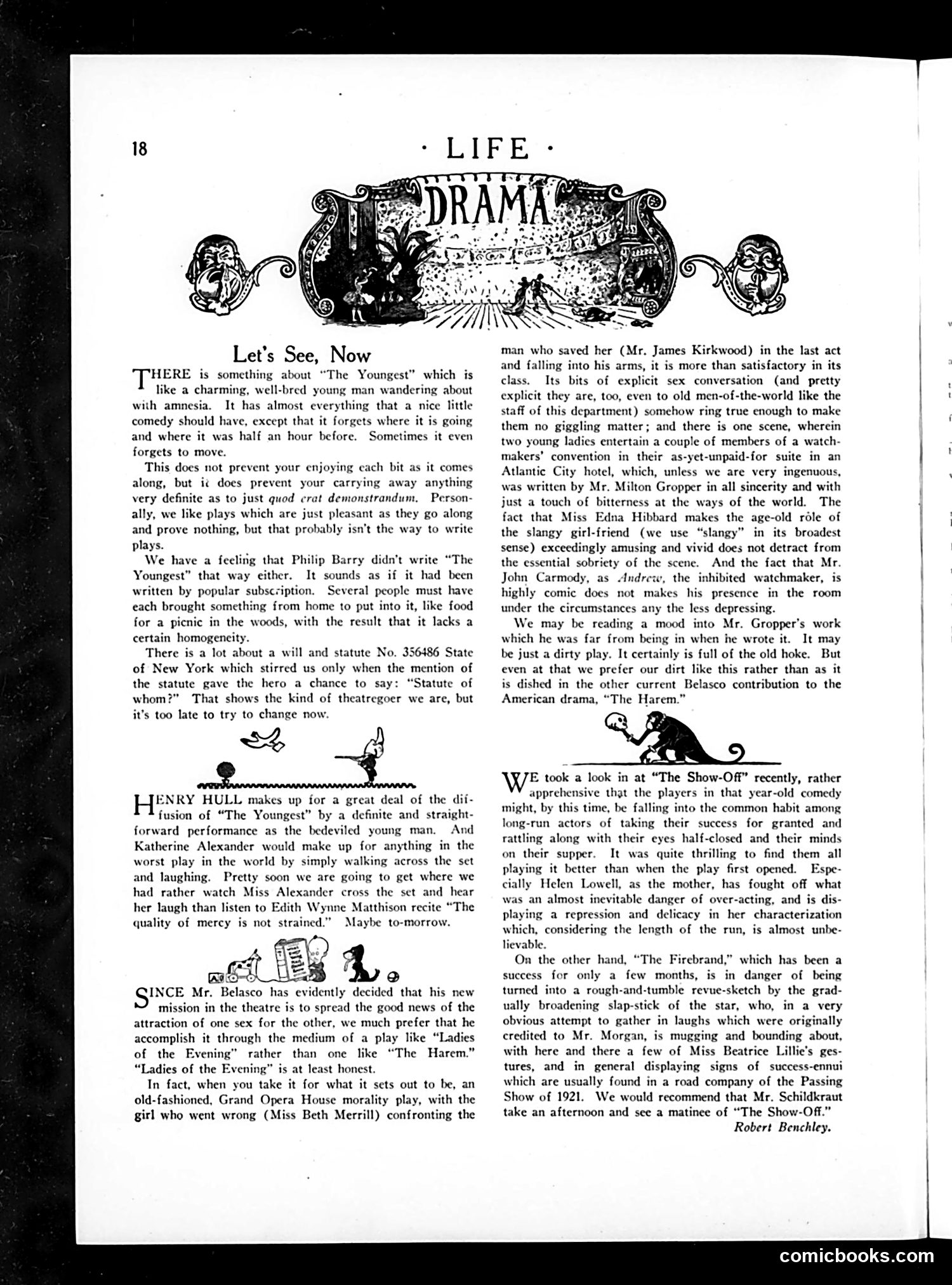
This is a theater review column discussing three Broadway plays. The critic (Robert Benchley, based on the signature) evaluates: 1. **"The Youngest"** by Philip Barry — criticized as structurally incoherent, comparing it to a potluck picnic where different people contributed random elements. Though entertainingly performed by Henry Hull and Katherine Alexander, the play lacks unified purpose. 2. **"Ladies of the Evening"** — a morality play about a "fallen woman" (Miss Beth Merrill) reunited with her savior (James Kirkwood). Benchley praises its honest portrayal of sex and working-class life, particularly a scene where two young women entertain watch-makers in an Atlantic City hotel, written by Milton Gropper with "bitterness at the ways of the world." 3. **"The Harem"** — dismissed as Belasco's competing vehicle for similar themes, treated less favorably. The small illustrations show theatrical performers in period costume. Benchley's tone is witty and permissive about adult subject matter, characteristic of 1920s theatrical criticism.
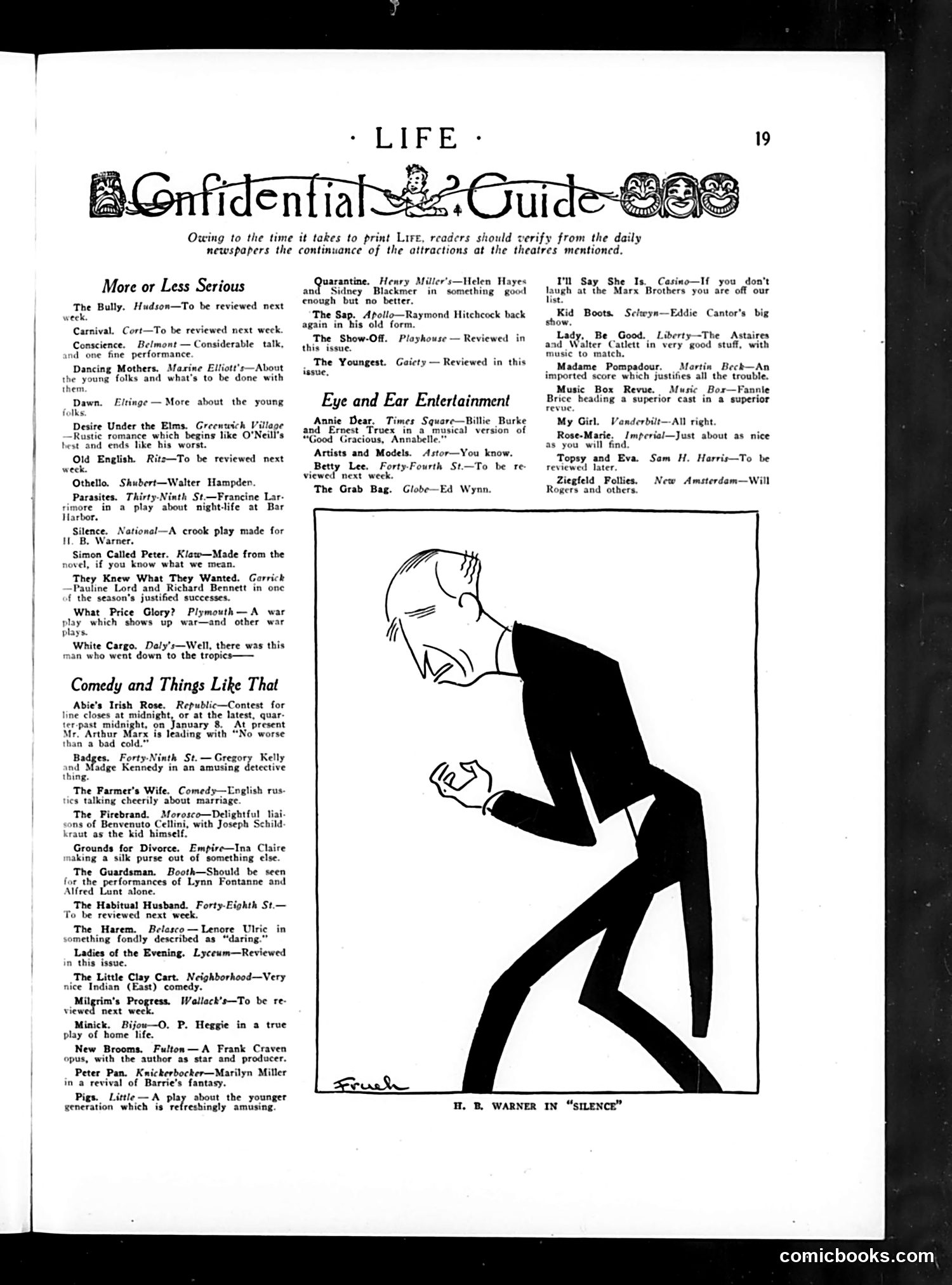
This page functions as Life magazine's theater guide with capsule reviews of Broadway productions. The illustration shows **H. B. Warner** (identified in the caption) in the play "Silence"—depicted as a character in a dramatic crouch or emotional moment, rendered in bold black-and-white line art typical of period theatrical illustration. The reviews themselves reveal early 1920s theatrical tastes: dramas like "What Price Glory?" (a war play), classical revivals (Walter Hampden in "Othello"), and light comedies featuring popular stars like the Marx Brothers ("I'll Say She Is"), Eddie Cantor ("Kid Boots"), and the Astaires ("Lady, Be Good"). The tone is gossipy yet informative—reviews use shorthand ("if you know what we mean" about "Simon Called Peter") and frankly assess quality. References like "Abie's Irish Rose" (a contest-line joke) and "White Cargo" (described vaguely as tropics-themed) indicate what audiences found entertaining. The guide serves practical readers wanting current entertainment options in New York.
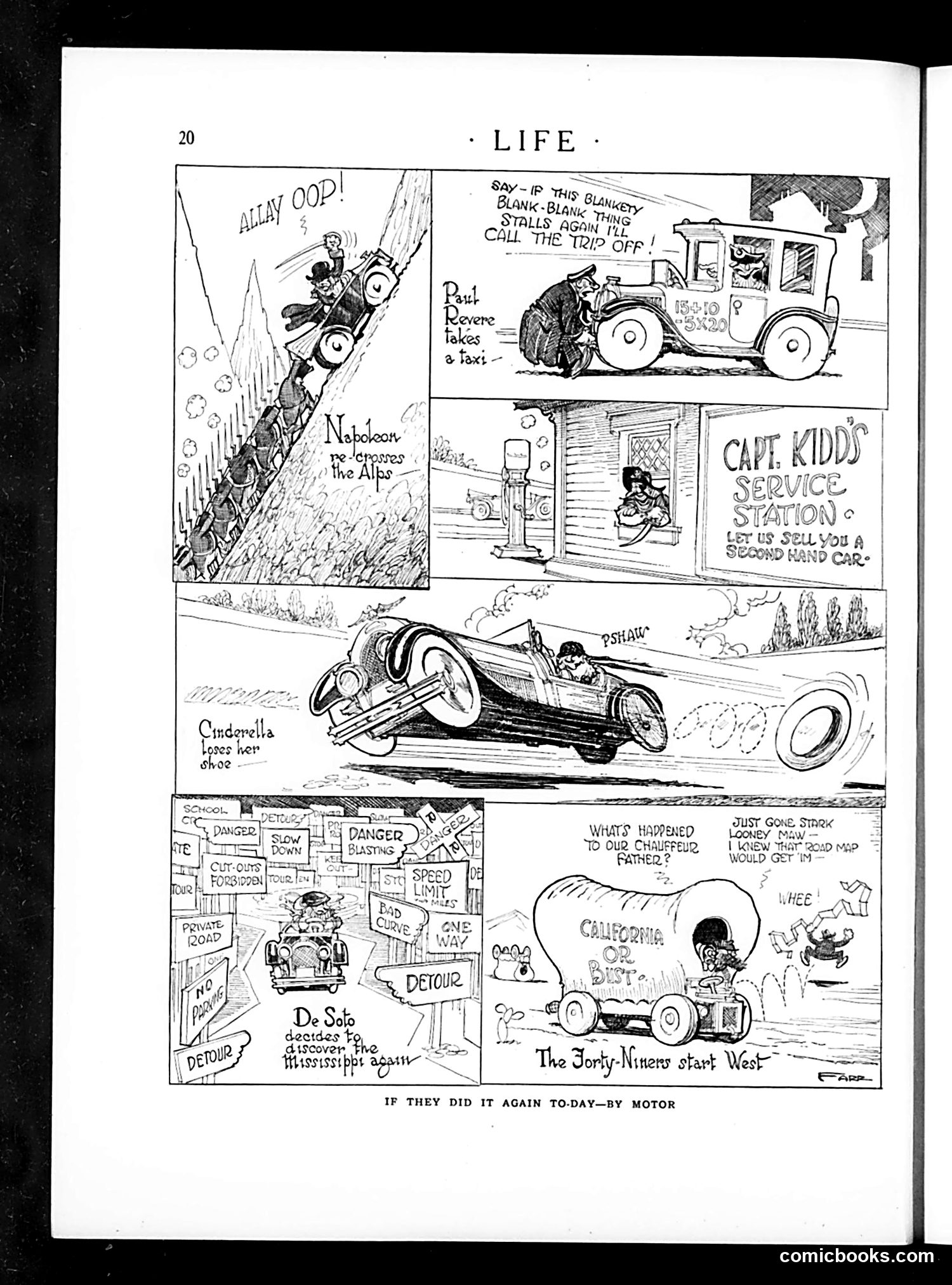
This satirical comic reimagines classic historical scenes using modern (early 20th-century) automobiles. The panels show: - **Napoleon crossing the Alps** in a car with passengers - **Paul Revere** as a taxi driver - **Cinderella** losing a shoe from a speeding vehicle - **De Soto** discovering the Mississippi in a car - **The Forty-Niners** heading west in a motorized wagon The joke critiques how automobiles were transforming society—suggesting that famous historical achievements would become mundane motor-vehicle incidents if repeated in the modern motorized age. It's both celebrating technological progress and gently mocking society's obsession with cars as solutions to everything. The humor relies on incongruity between historic gravitas and casual automotive mishaps.
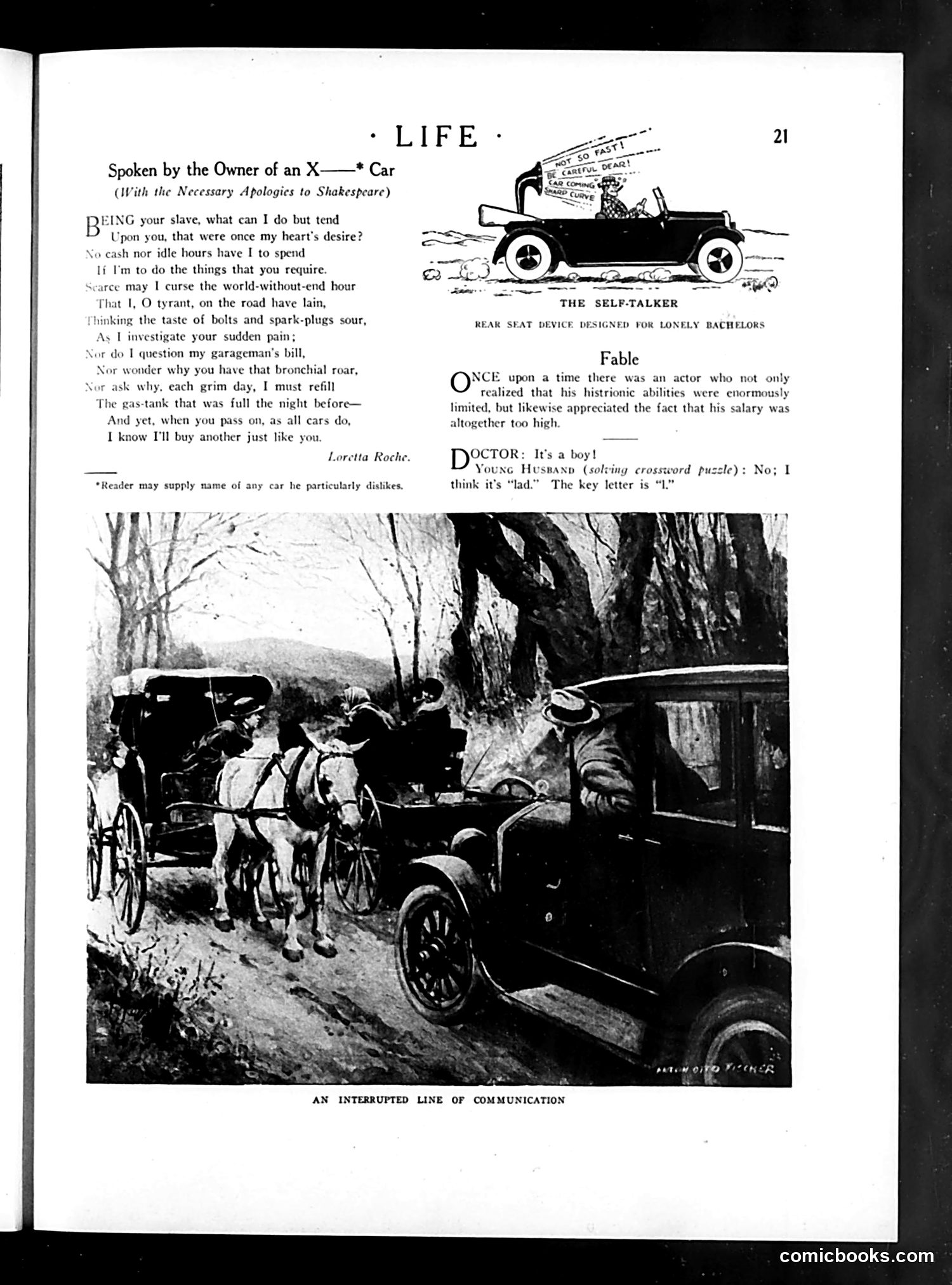
This page satirizes early automobile culture through two distinct pieces: **"Spoken by the Owner of an X-Car"** parodies Shakespeare's sonnets to mock car owners' servitude to their vehicles. The poem suggests cars demand constant attention, money, and maintenance—drivers are enslaved to repair costs and breakdowns. The joke: despite all frustration, owners will buy another identical car. This critiques both automobile dependency and the emerging consumer culture of the 1920s. **"An Interrupted Line of Communication"** depicts a horse-drawn carriage meeting an automobile on a rural road. The humor lies in the collision of old and new transportation technologies—the horse-drawn vehicle literally cannot communicate with the modern car, representing generational/technological conflict. The "Self-Talker" device is a joke about lonely bachelor drivers talking to themselves during solitary drives—a comment on both automotive isolation and urban loneliness. All three pieces mock how automobiles were transforming American life, creating new anxieties and dependencies.
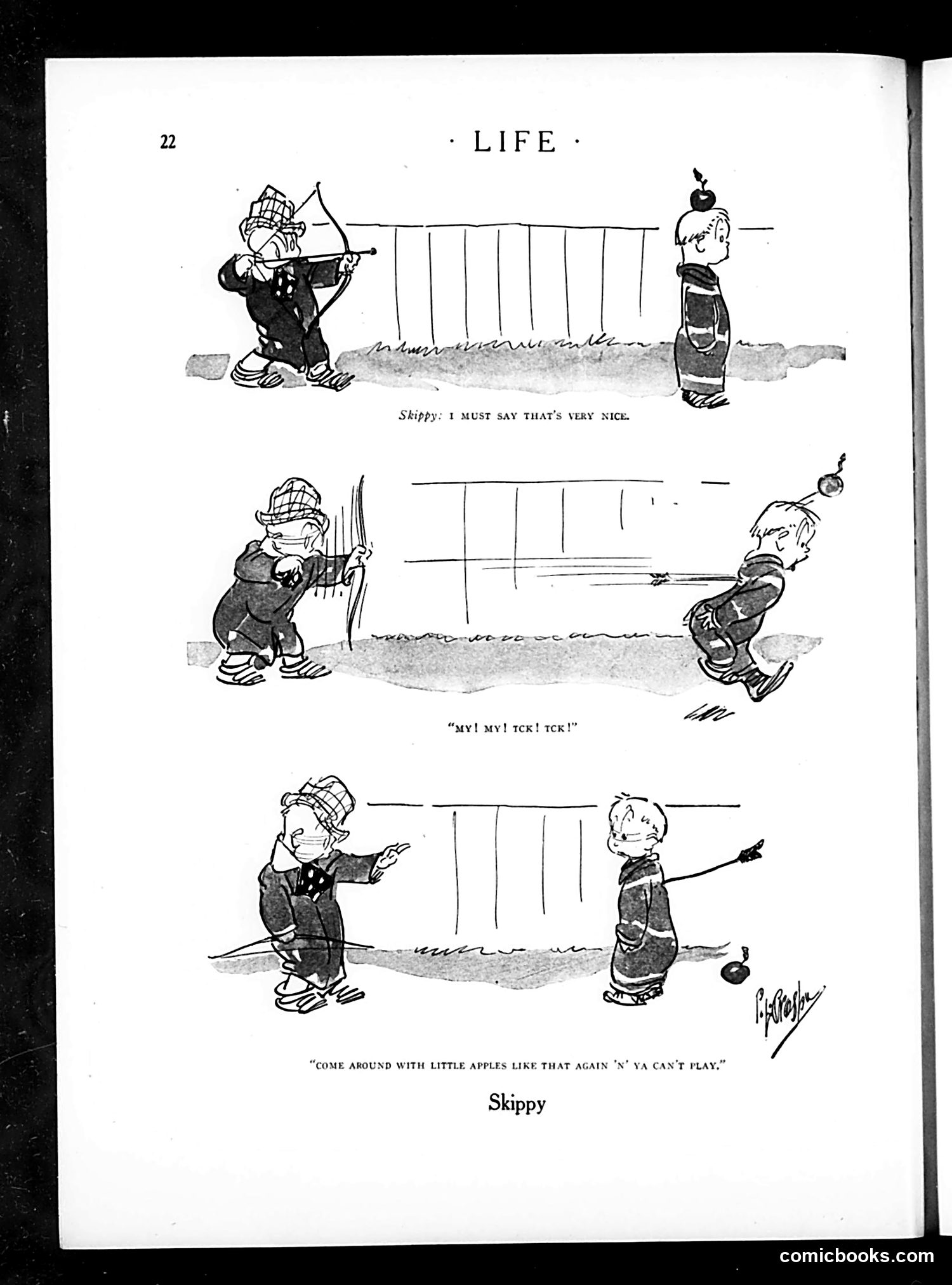
This is a comic strip titled "Skippy" featuring a child character playing with a toy bow and arrow at a fence. In the first panel, Skippy compliments his friend's fence-drawing. The middle panel shows excited sound effects as the other child shoots an arrow. The final panel reveals the joke: Skippy's friend has accidentally shot an apple off Skippy's head, and Skippy—rather than being angry—tells him he can't play anymore *unless* he brings apples like that again. The humor relies on a child's twisted logic: instead of recognizing danger, Skippy treats a near-miss arrow incident as acceptable so long as it comes with apples. It's gentle comedy about childhood innocence and misplaced priorities.
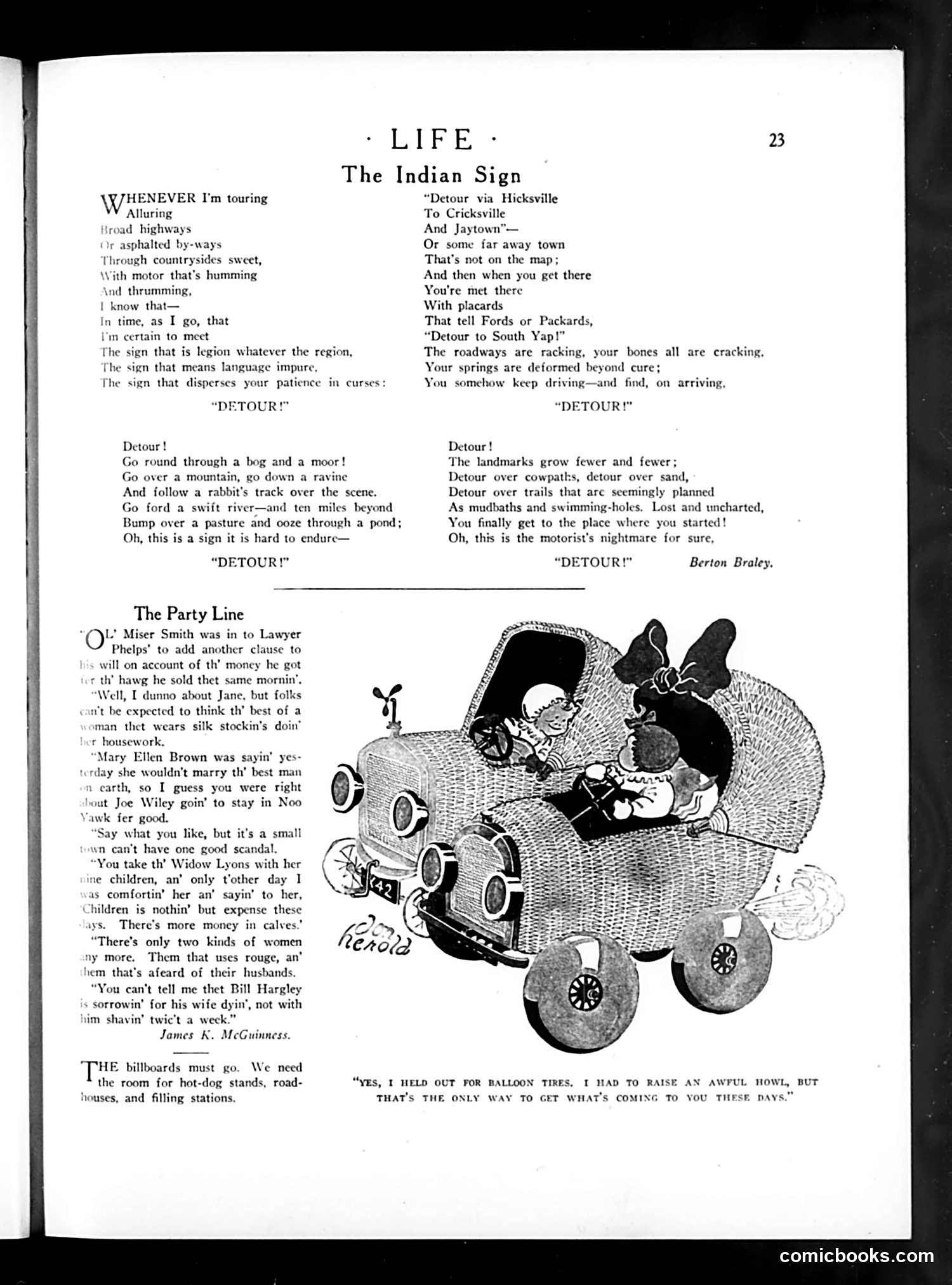
This page satirizes 1920s American automobile culture through two pieces: **"The Indian Sign"** (poems by Berton Braley) mocks the ubiquitous "DETOUR" signs plaguing motorists. The humor targets the explosion of road construction during the auto boom—drivers encounter endless detours that send them through swamps, over terrible terrain, and sometimes back where they started. The "Indian sign" (a folk curse) represents these maddening construction barriers. **"The Party Line"** (by James K. McGuinness) satirizes small-town gossip through rural dialect. It's a monologue of interconnected rumors—about people's marriages, finances, and morality—typical of rural community gossip spreading through shared telephone lines (hence "party line"). **The cartoon** shows a motorist with balloon tires (advertised as superior) encountering road hazards. The caption jokes that drivers must "hold out" for better equipment just to survive deteriorating roads during the construction era. Together, these pieces mock the growing pains of automobile infrastructure and small-town social conformity.
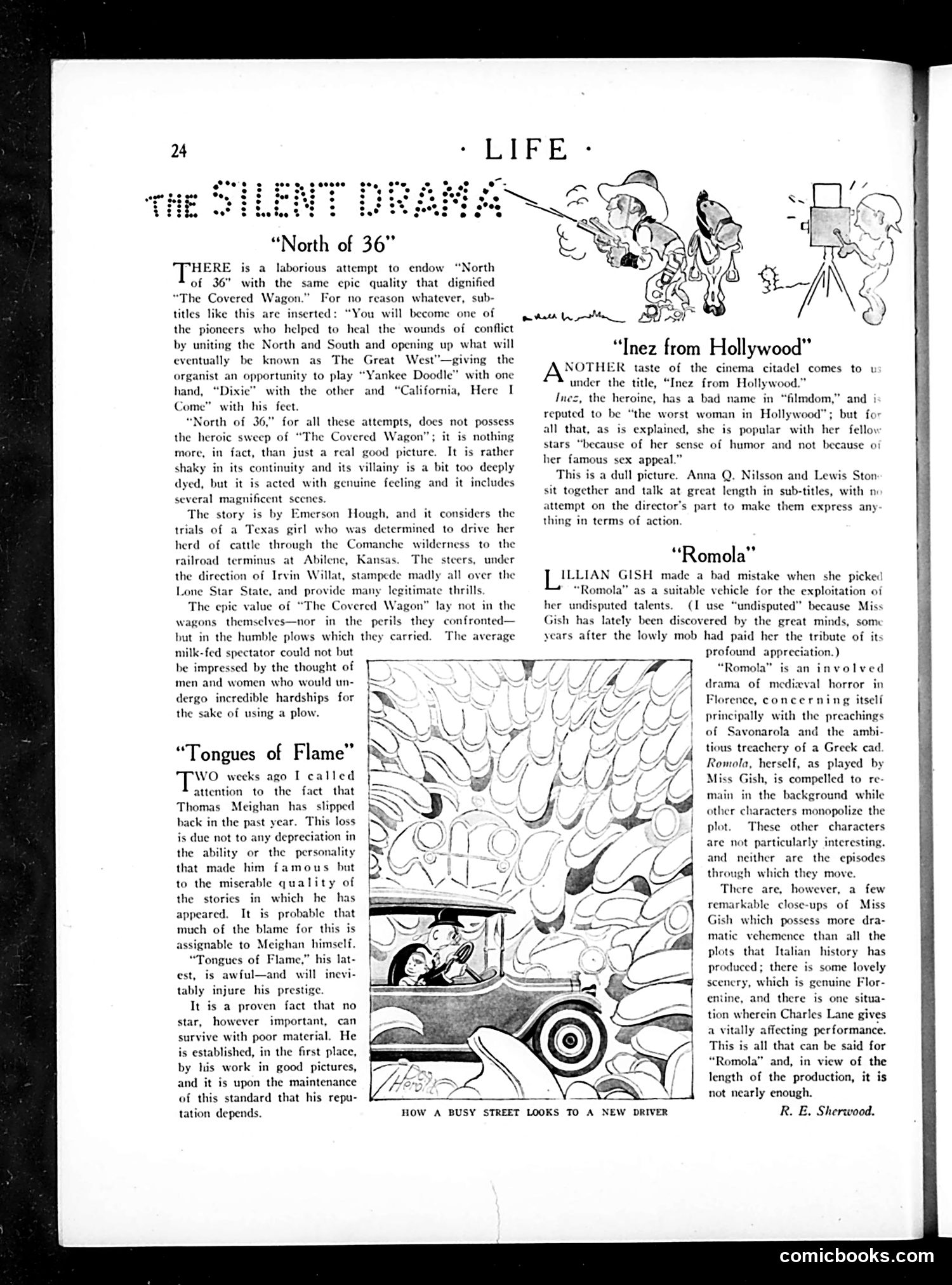
This page contains four film reviews from Life's satirical cinema column. The critic is reviewing recent silent films with characteristic acerbity: **"North of 36"** attempts grandeur but falls short—a Western about driving cattle through the Comanche wilderness. The reviewer mocks the pretentious title cards trying to equate it with "The Covered Wagon," and ridicules the theater organist playing "Yankee Doodle," "Dixie," and "California, Here I Come" simultaneously to manufacture epic feeling. **"Inez from Hollywood"** stars Anna Q. Nilsson as a woman with a scandalous reputation. The reviewer finds it dull—merely characters talking in title cards rather than acting out drama. **"Romola"** features Lillian Gish in a medieval Florence drama. The critic argues Gish made a poor career choice; she's relegated to background while other characters monopolize the plot, though her close-ups display "dramatic vehemence." **"Tongues of Flame"** stars Thomas Meighan, whose career the reviewer believes has declined due to poor material—establishing the principle that no star, however talented, survives weak scripts.
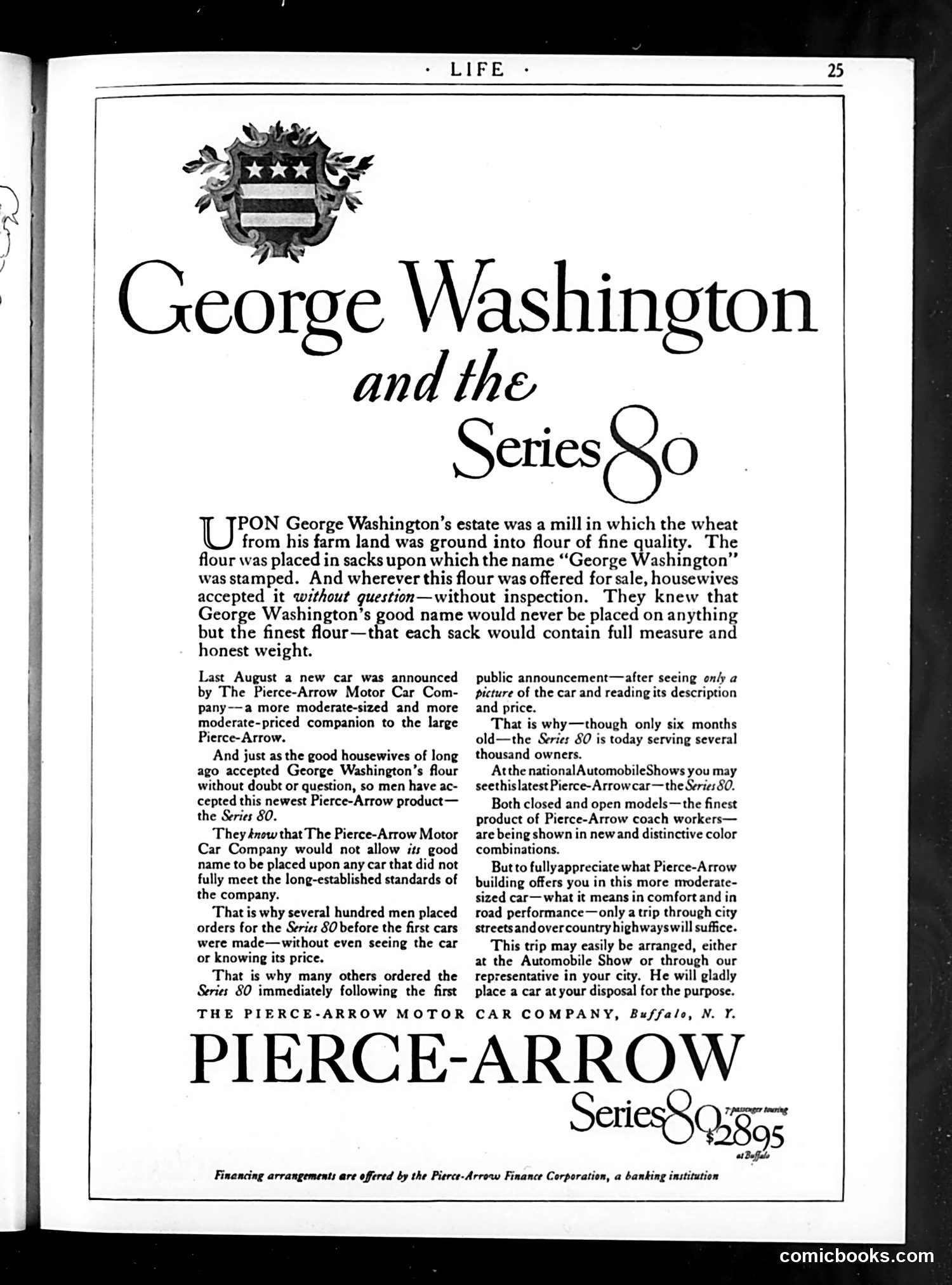
This is primarily an advertisement for Pierce-Arrow automobiles, not satire. The page uses a historical analogy rather than political cartoon. The ad compares the Pierce-Arrow Series 80 car to George Washington's flour mill operation. Just as early American housewives trusted flour bearing Washington's name without inspection—knowing his reputation guaranteed quality—the ad argues modern men should trust Pierce-Arrow vehicles based on the company's established reputation. The implication: Pierce-Arrow's brand name carries such weight that customers have ordered the new Series 80 without even seeing it, relying solely on the manufacturer's standing. This is aspirational branding, not humor or satire. It leverages Washington's iconic status as a symbol of trustworthiness and honest dealing to associate those qualities with the automobile company. The "joke" (if present) is gentle—the comparison between 18th-century flour and 1920s automobiles—but the primary purpose is straightforward corporate persuasion through association with American values.
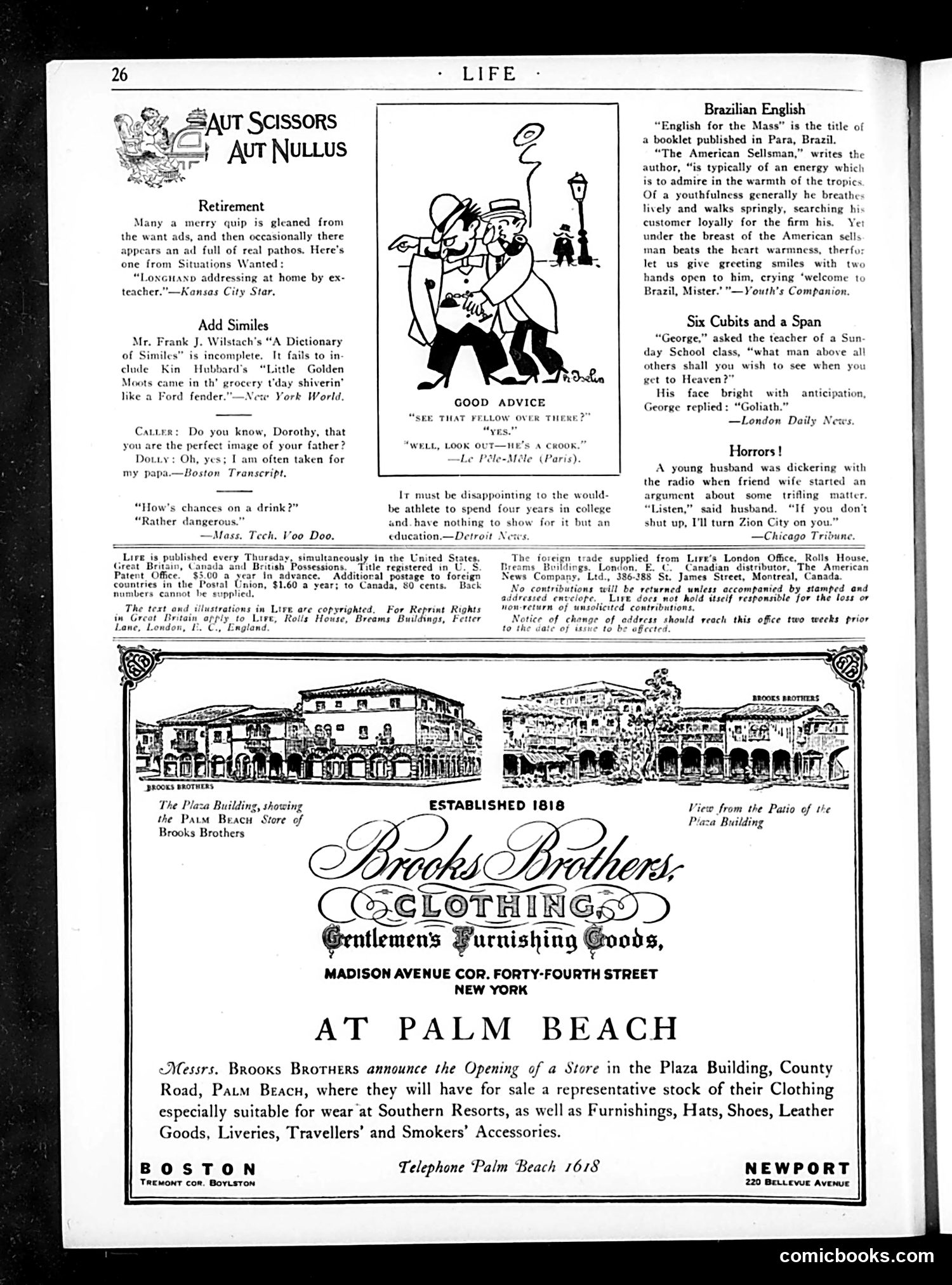
This page from *Life* magazine combines short humor pieces with advertising. The main cartoon shows a man receiving "good advice" to avoid a crook—a simple visual gag about street wisdom. The text snippets are brief satirical observations on contemporary life: - **"Retirement"** jokes about classified ads capturing pathos - **"Add Similes"** mocks a new dictionary of similes, including a humorous quote from a Brazilian English-language booklet with awkward phrasing about American salesmen ("heart warmness," "greeting smiles with two hands") - **"Six Cubits and a Span"** is a Sunday School joke where a boy answers "Goliath" to the teacher's question - Other quips target college education's lack of practical value and a husband threatening to turn on "Zion City" radio to silence his wife The dominant feature is a Brooks Brothers advertisement announcing a new Palm Beach store, with illustrations of their Manhattan and Florida locations, targeting wealthy seasonal visitors to the resort. The humor is genteel and observational—typical of *Life*'s satirical style during this period.
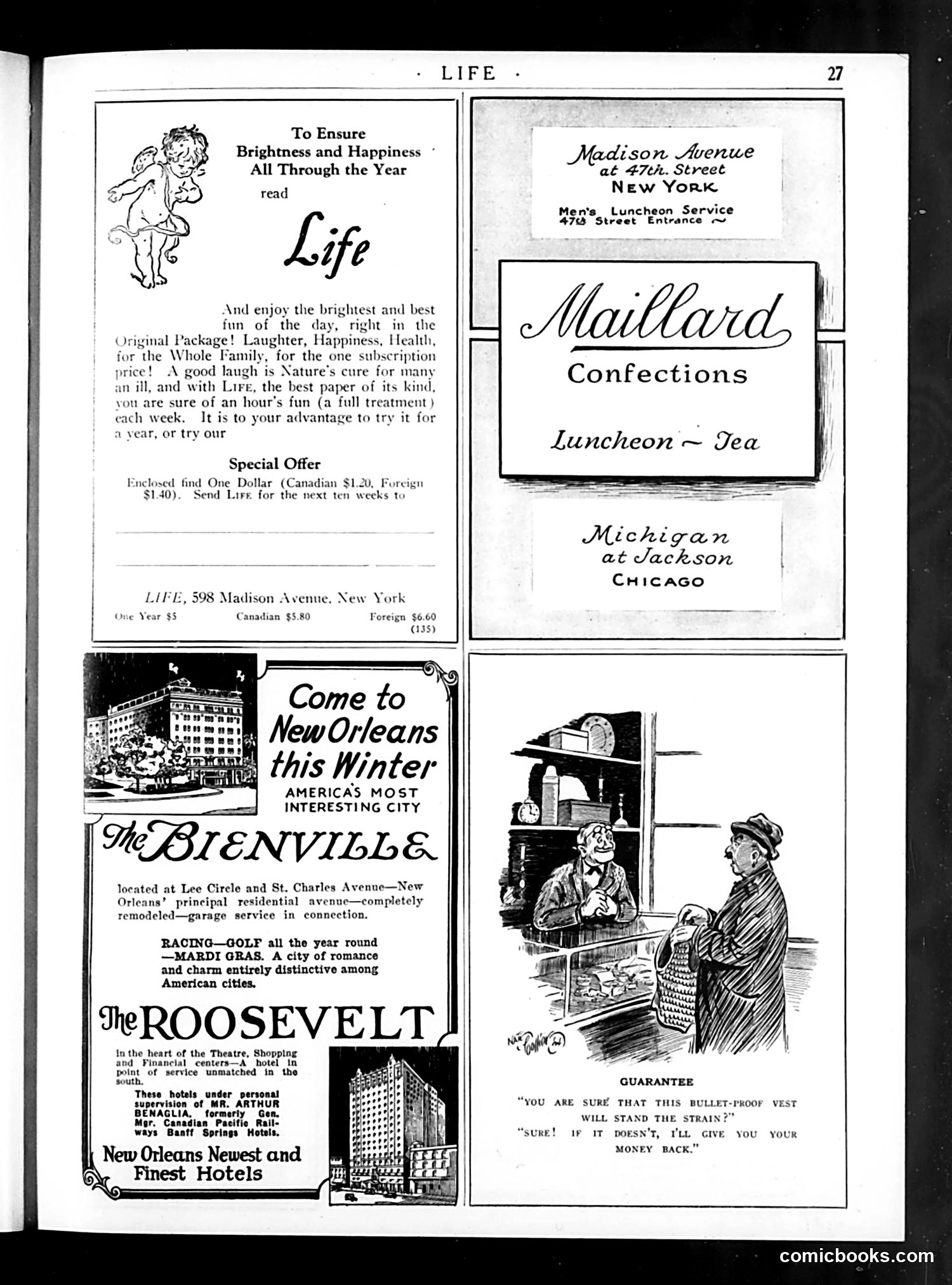
This page is primarily **advertising**, typical of early 20th-century magazines. Key content: **Top left:** Life magazine promotes itself as wholesome family entertainment, emphasizing laughter as "Nature's cure" for ailments—reflecting contemporary beliefs about humor's therapeutic value. **Right side:** Three upscale establishment ads (restaurants, confectioneries) target wealthy urban readers. **Bottom left:** New Orleans winter tourism ads promote hotels (the Bienville and Roosevelt) alongside Mardi Gras and racing—positioning the city as an exclusive leisure destination. **Bottom right:** The only actual cartoon shows a vendor selling a "bullet-proof vest" to a customer. The vendor's guarantee—"if it doesn't [work], I'll give you your money back"—is darkly comedic. This likely references Prohibition-era violence or general crime concerns, satirizing a huckster's absurd confidence in a product that might literally save someone's life. The joke undercuts the guarantee's worthlessness if the vest fails.
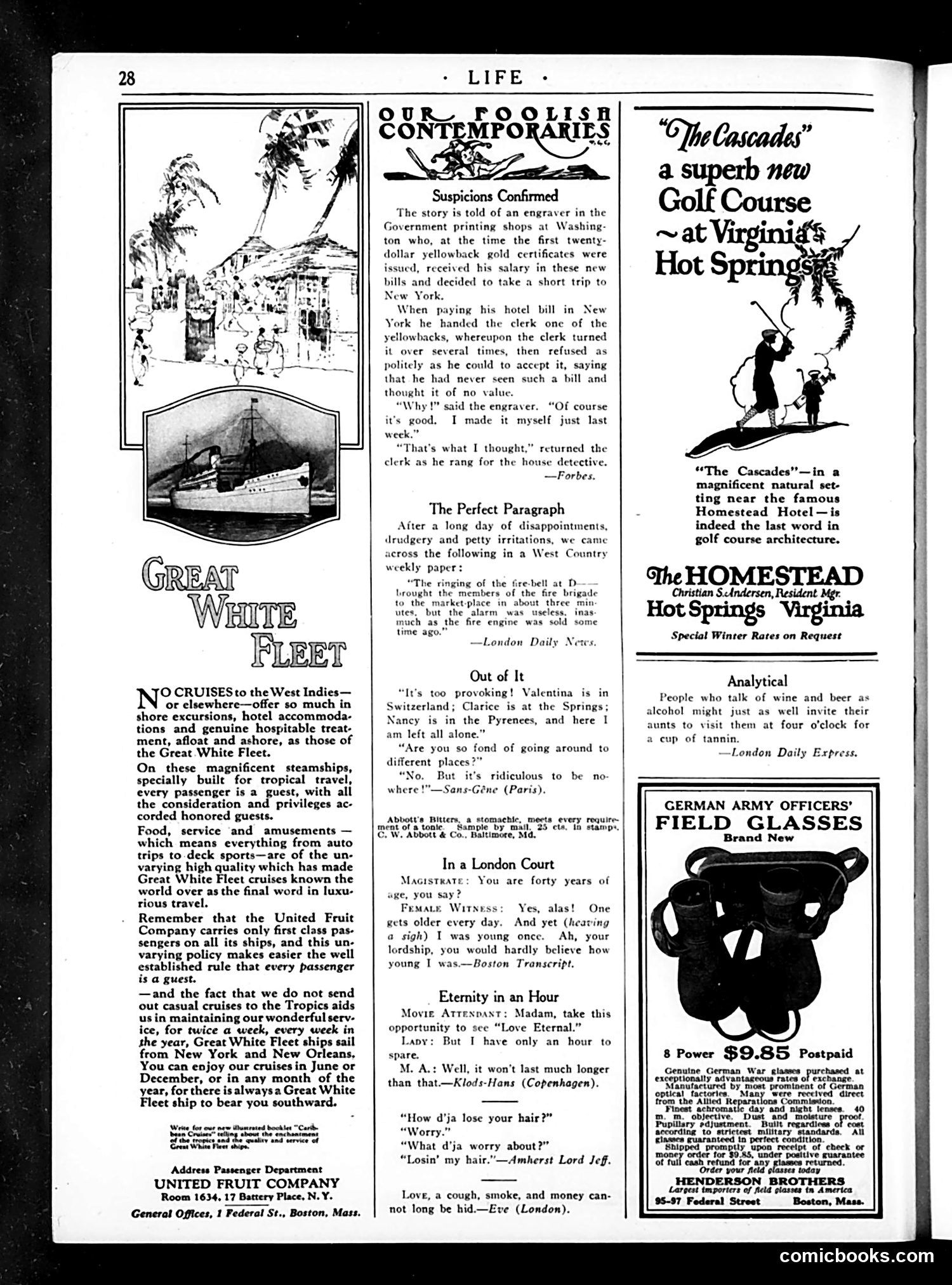
This page is primarily **advertising and humor content**, not political satire. The main elements are: **The Large Cartoon (left):** Illustrates the "Suspicions Confirmed" anecdote below it—a humorous story about a government engraver who pays his hotel bill with newly-printed twenty-dollar bills. The hotel clerk, unfamiliar with this new currency design, refuses it and calls the house detective, suspecting fraud. The joke plays on public unfamiliarity with fresh currency designs and the clerk's suspicion that the engraver is passing counterfeit money—ironically, he's the one who actually made them. **The Rest:** Consists of brief humorous anecdotes clipped from various newspapers and magazines, covering everyday absurdities (a fire engine being sold before use, social disappointments, aging witnesses, movie theater timing). These are gentle, domestic humor pieces typical of the era. **Advertising:** United Fruit Company's "Great White Fleet" cruise ships and other commercial advertisements fill the remaining space. No significant political commentary is present on this page.
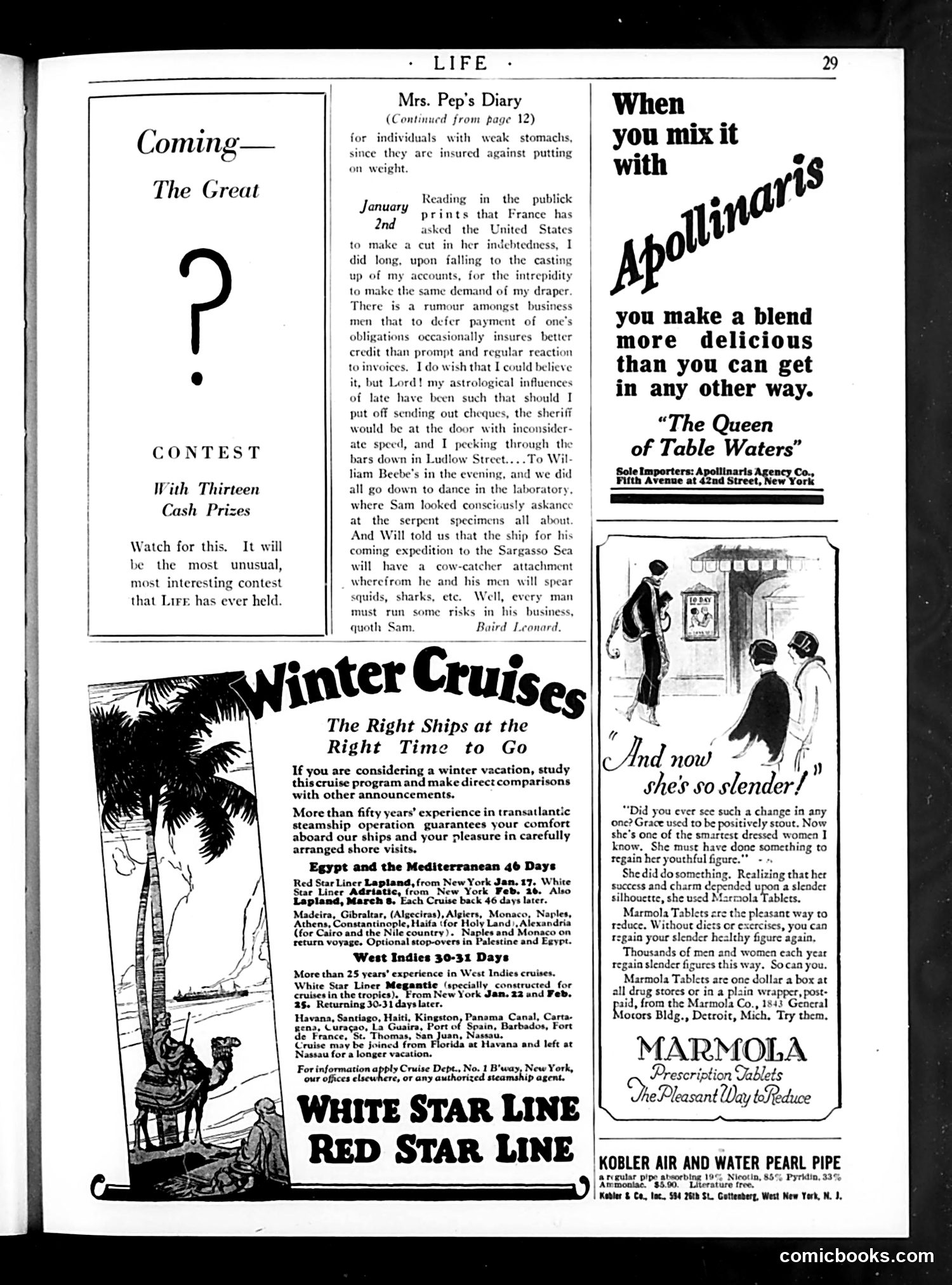
This page contains primarily **advertisements and society gossip**, not political satire. **Mrs. Pep's Diary** (continued column) offers humorous domestic observations from an upper-class woman—she compares France's debt problems to her own draper's bills, and gossips about William Beebe's upcoming Sargasso Sea expedition. The tone is light social commentary on finances and adventure. The major advertisements promote **Winter Cruises** (White Star/Red Star Lines), **Apollinaris** (a carbonated mineral water), and **Marmola Tablets** (a weight-loss drug). The Marmola ad features a "before and after" narrative about "Grace" becoming slender—reflecting 1920s beauty standards and the era's enthusiasm for pharmaceutical solutions to appearance. A teaser announces a forthcoming **"Great Contest"** with cash prizes, though details aren't provided. This appears to be a typical **lifestyle/advertising-heavy magazine page** from the 1920s, mixing society humor with consumer product pitches to affluent readers.
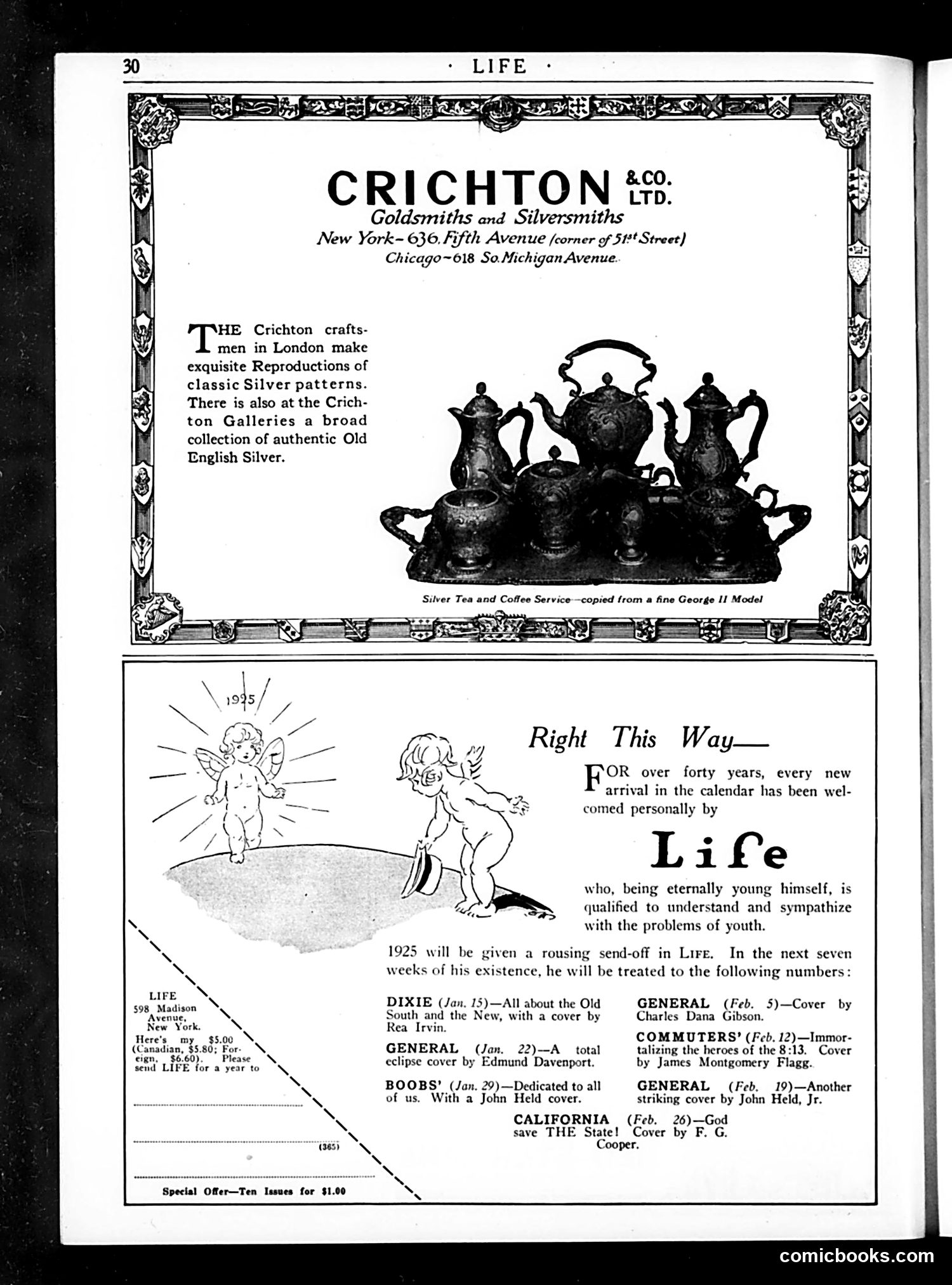
This is primarily an **advertisement page** for Life magazine itself, circa 1925. The top section advertises Crichton & Co., a luxury silversmith business, showing an ornate tea service. The main content is Life's self-promotional pitch for the new year. The cartoon depicts **Father Time (a cherub with "1925")** greeting **the personified year** arriving as a baby—a standard visual metaphor for welcoming the New Year. Life claims to have been "welcoming" each new calendar year for over forty years because the magazine itself is "eternally young" and understands youth's problems. This is self-congratulatory branding. The text then previews upcoming special issues planned for the next seven weeks, featuring covers by noted illustrators like John Held Jr., Edmund Davenport, and Charles Dana Gibson—emphasizing Life's cultural prestige and relevance to modern readers. The "Special Offer" at bottom ($1 for ten issues) was typical subscription promotion of the era.
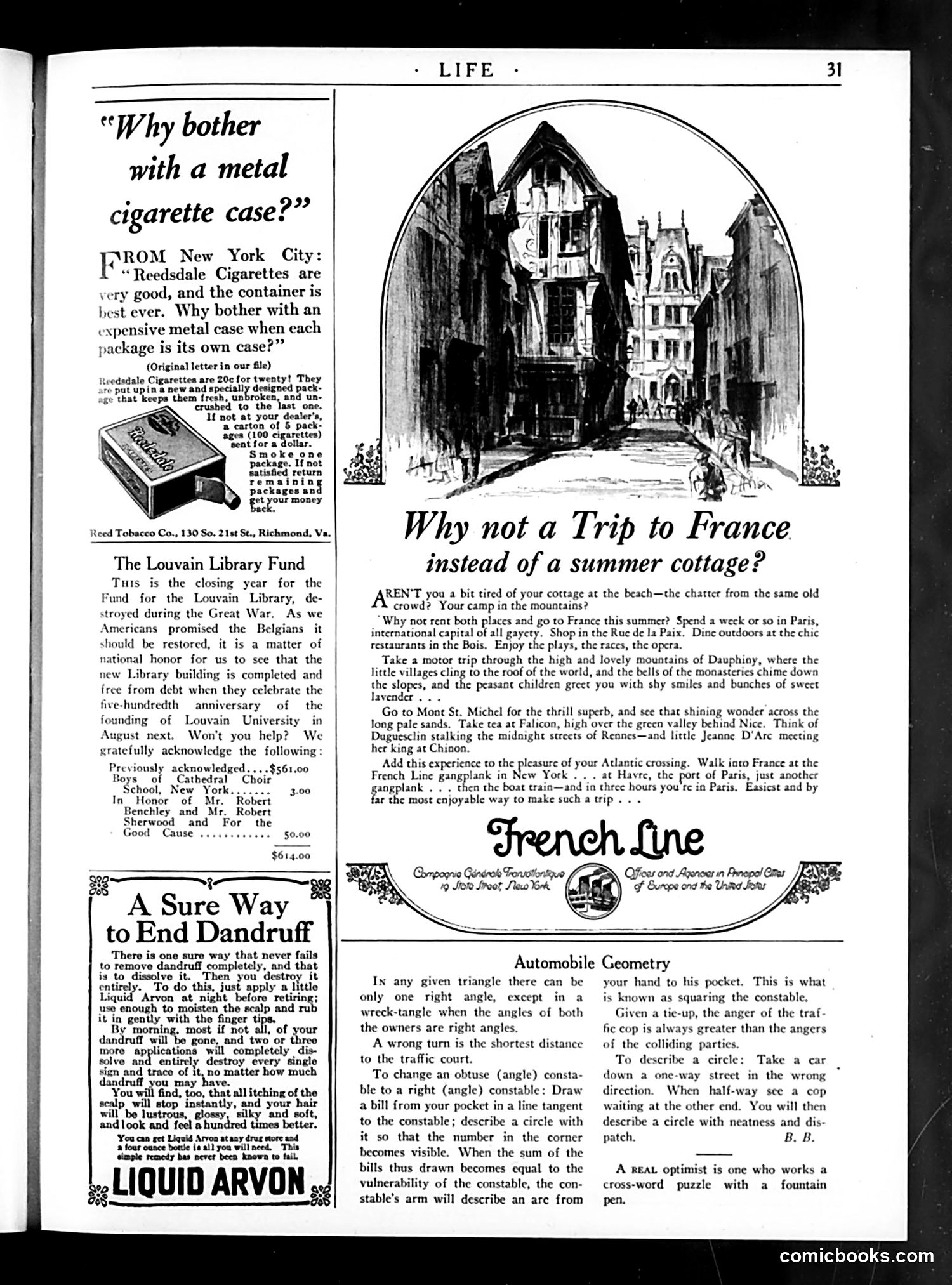
This page is primarily **advertising** with minimal editorial content. The main advertisements are: 1. **Reedsdale Cigarettes**: Uses a fake reader letter claiming the cigarette package itself serves as adequate packaging, eliminating need for expensive metal cases—a cost-saving pitch during economically conscious times. 2. **French Line Shipping**: Promotes European travel to France as superior to domestic summer cottages, appealing to affluent readers seeking cultural experiences (Paris, Mont St. Michel, opera). 3. **Liquid Arvon**: A dandruff remedy promising complete cure, typical of patent medicine advertising from this era. There's also a **Louvain Library Fund** donation appeal (post-WWI Belgian reconstruction) and a humorous "**Automobile Geometry**" piece playing on traffic accidents as geometric shapes. The page reflects 1920s consumer culture, leisure travel aspirations for the wealthy, and ubiquitous medical product advertising—content that reveals period attitudes toward class, consumption, and remedies now considered dubious.
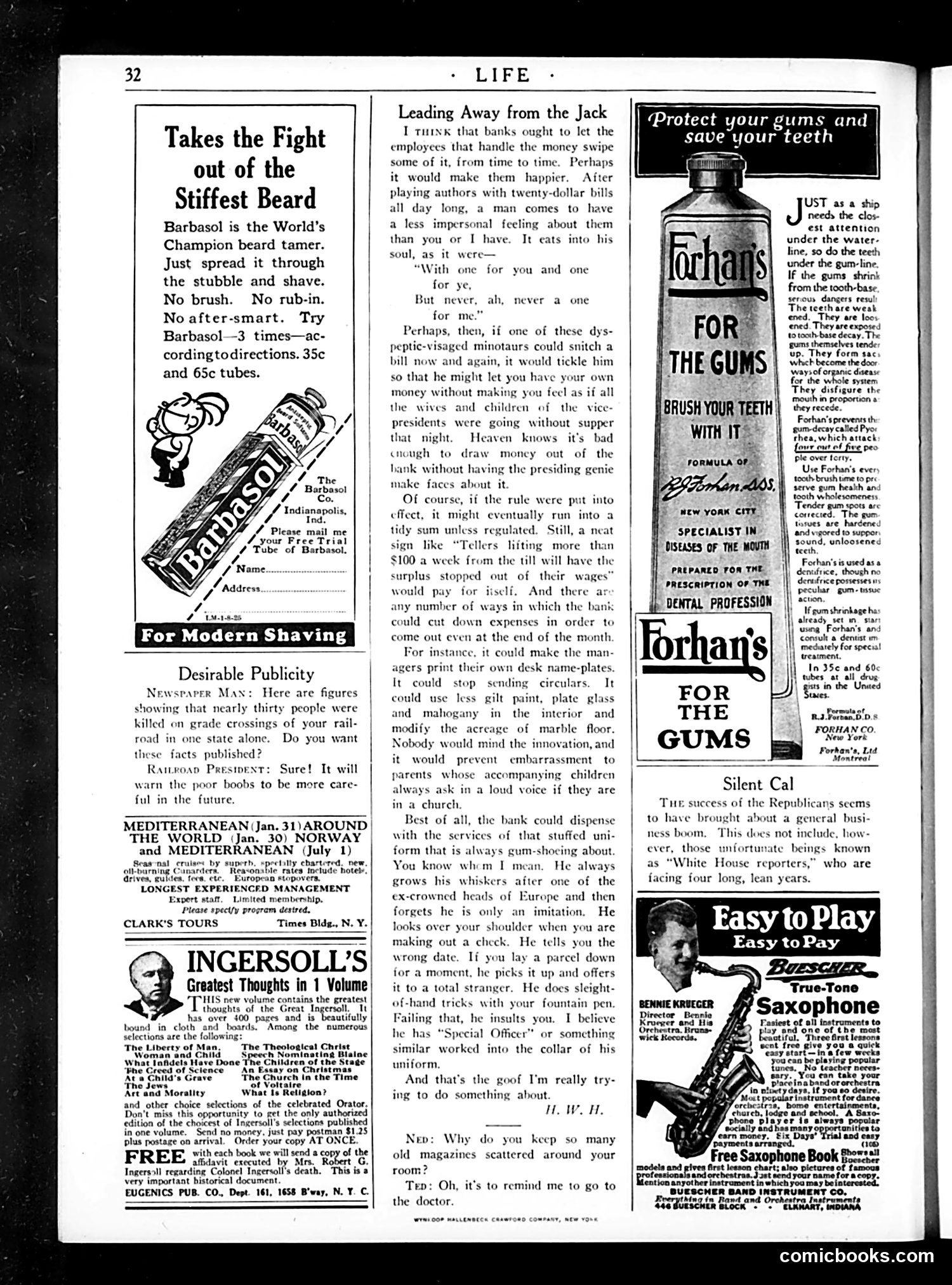
This is a humorous editorial piece critiquing bank management practices. The author ironically suggests that banks should allow tellers to steal small amounts of money periodically—supposedly to improve employee morale and make them happier handling cash all day. The satire works by exaggerating the absurdity: if tellers could pocket $100 weekly without consequence, they'd be less resentful and more cooperative with customers. The author then extends the joke, proposing banks could offset this by cutting other "unnecessary" expenses—eliminating decorative marble floors, fancy furnishings, and security guards (the "stuffed uniform" guard with whiskers). The underlying critique targets bank stinginess and the dehumanizing treatment of employees who handle money without sharing in profits. By proposing increasingly ridiculous cost-cutting measures, the author satirizes corporate penny-pinching while highlighting worker dissatisfaction—a relevant concern during this economic era.
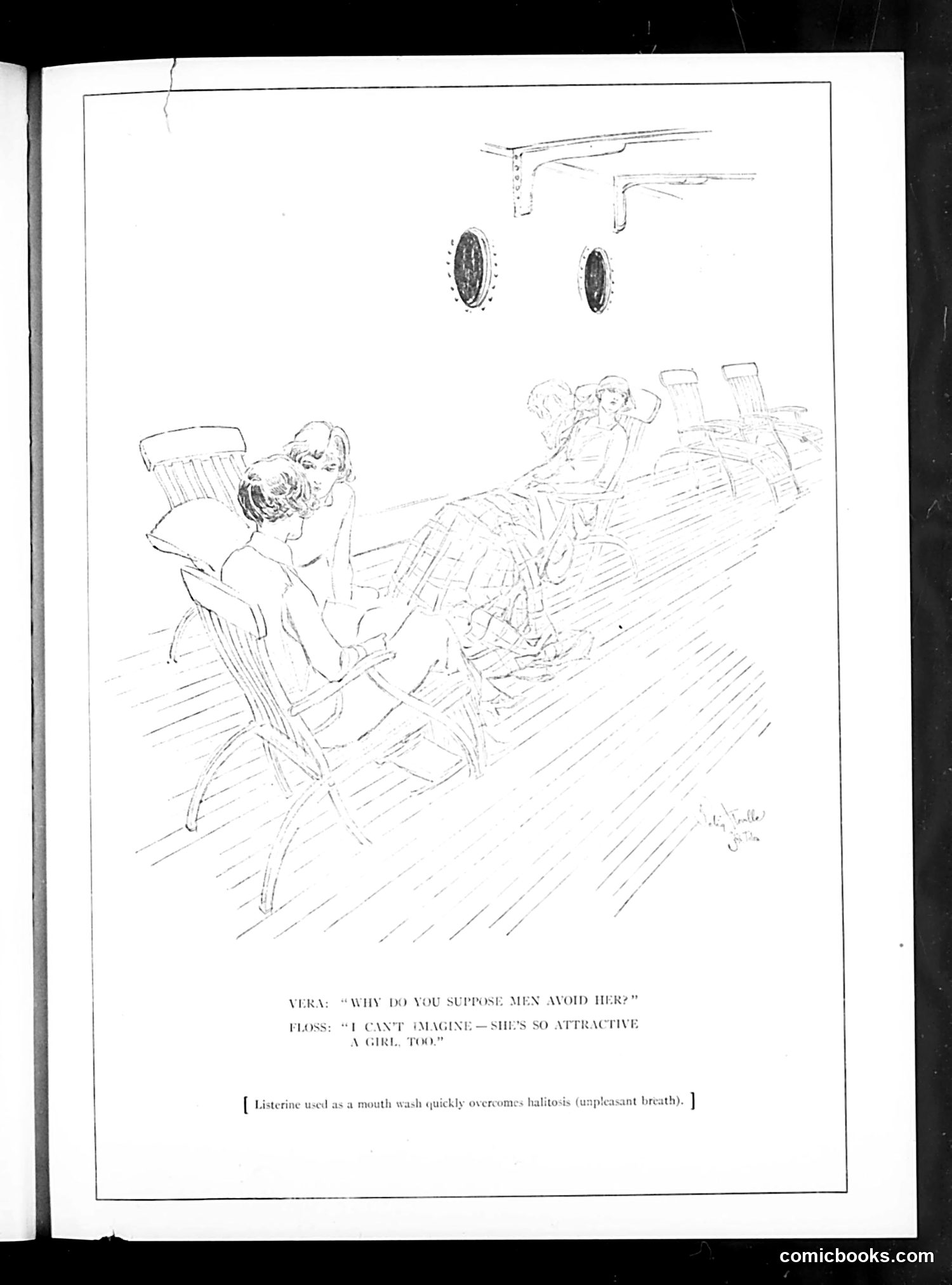
This is an advertisement disguised as a satirical cartoon from Life magazine. Two women, Vera and Floss, discuss why men avoid an attractive third woman. Floss expresses bewilderment, claiming the woman is so attractive—but the punchline reveals the unstated reason: halitosis (bad breath). The cartoon satirizes social dynamics and male-female attraction while advertising Listerine mouthwash. The humor operates on the assumption that even an attractive woman can be socially avoided due to poor oral hygiene—a common advertising trope from the early-to-mid 20th century that used social embarrassment and romantic rejection as motivation to purchase hygiene products. The three female figures and their seated poses suggest a social gathering where romantic desirability determines social worth. Modern readers would recognize this as employing shame-based marketing to sell consumer goods.
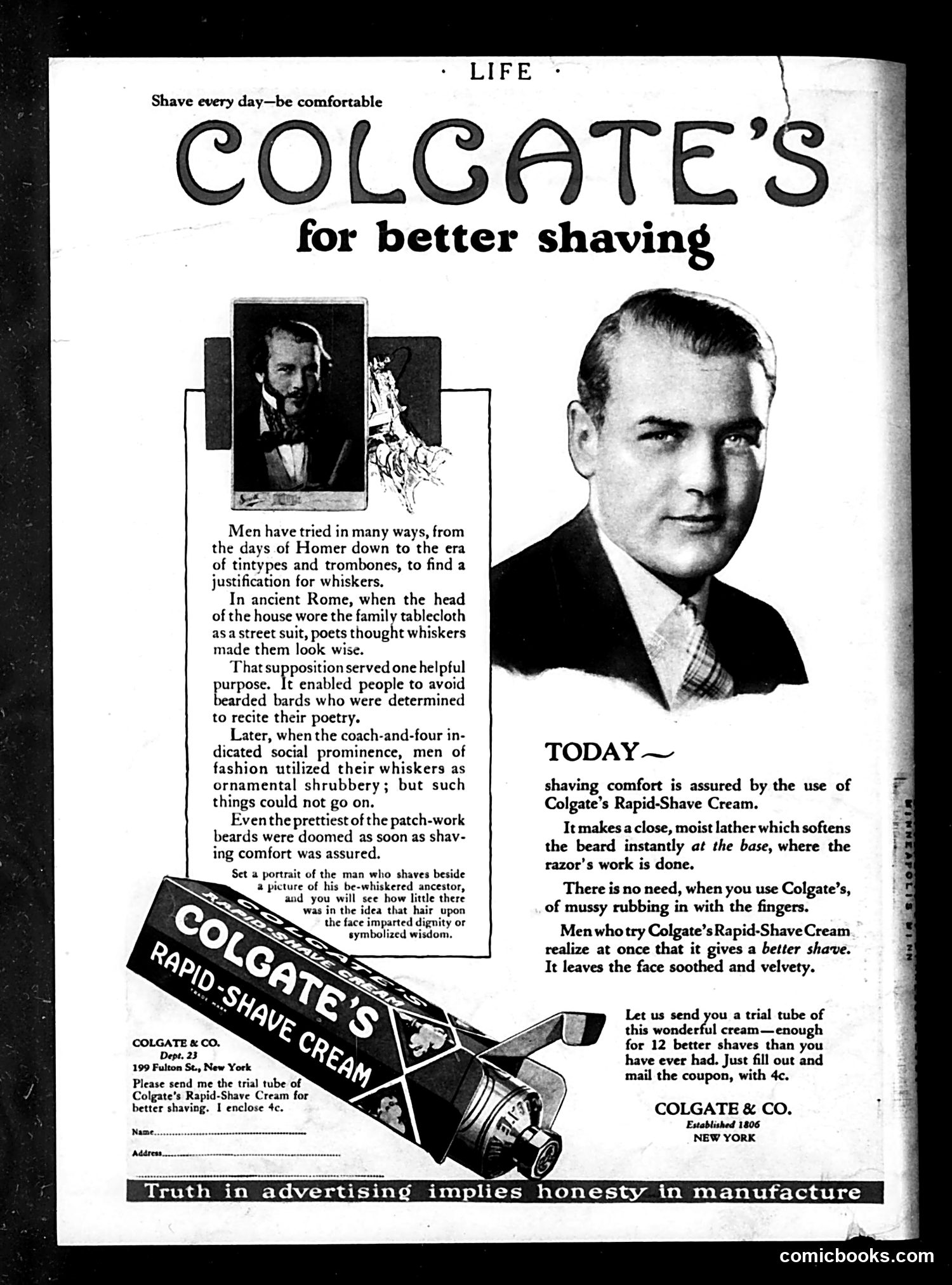
This is primarily a **product advertisement**, not political satire. The page uses humorous historical commentary to promote Colgate's shaving cream to a male audience. The "satire" is gentle and commercial: the text mocks men's historical justifications for beards—from ancient Rome (where whiskers supposedly signified wisdom) through the coach-and-four era (when they were "ornamental shrubbery"). The joke is that these reasons were always absurd; modern men should simply shave daily for comfort using Colgate's product. The portrait on the left appears to show a bearded man from an earlier era, contrasted implicitly with the clean-shaven man photographed on the right—the modern ideal. The advertisement promises that Colgate's cream makes shaving easier and leaves skin "soothed and velvety," positioning daily shaving as the mark of contemporary sophistication rather than outdated facial hair. The bottom tagline—"Truth in advertising implies honesty in manufacture"—suggests this was part of early 20th-century advertising standards emphasizing product reliability.

I can see this is a mostly black page from Life magazine with "comicbooks.com" visible at the bottom right corner. The image quality is extremely poor—the page appears to be either heavily darkened, underexposed, or severely degraded. While I can make out what appears to be a white edge on the left side and some faint variations in the darkness suggesting there may be content present, I cannot reliably discern any cartoon figures, text, caricatures, or satirical elements with enough clarity to identify them or explain their meaning. To provide you with an accurate historical analysis as requested, I would need a clearer or higher-contrast version of this page. I cannot responsibly invent details about the content.