
Life, 1925-01-08 · page 16 of 37
Life — January 8, 1925 — page 16: what you’re looking at
What you’re looking at
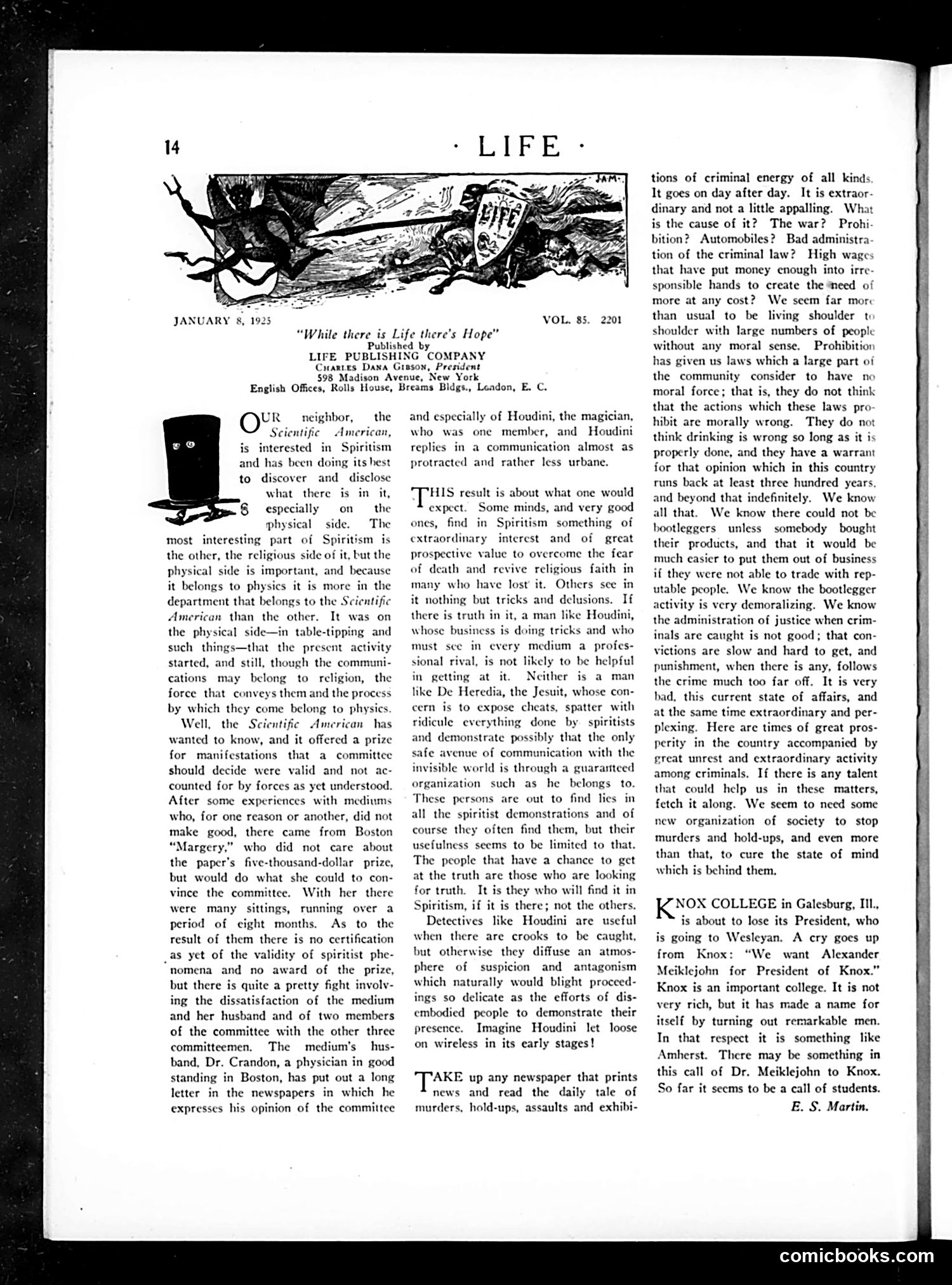
The masthead cartoon depicts a skeletal figure labeled "LIFE" lying in what appears to be a coffin or death bed, illustrating the editorial's theme about crime and lawlessness in America. The accompanying article discusses the epidemic of murders, hold-ups, and criminal activity plaguing the country. The author argues that Prohibition, automobiles, high wages, and poor law enforcement have enabled criminal behavior and demoralized society. The piece criticizes how bootleggers and criminals operate with impunity while law enforcement struggles to contain them. A secondary item mentions Knox College losing its president to Wesleyan and appeals to Dr. Meiklejohn to accept a position there instead—a call for academic leadership during uncertain times.
📄 Transcribed text from this page (OCR, searchable)
Machine-transcribed from the original scan — historical spelling and the odd misread are preserved.
VOL. 85. 2201 “While there is Life there's Hope” Published by LIFE PUBLISHI Cuartes Dana Gi COMPANY son, President $98 Madison Avenue, New York English Offices, Rolls House, Breams Bldgs., Leadon, E. C. UR neighbor, — the Scientific American, is interested in Spiritism and has been doing its hest to discover and disclose what there is in it, § especially on the physical side. The most interesting part of Spiritism is the other, the religious side of it, but the physical side is important, and because it belongs to physics it is more in the department that belongs to the Scientific American than the other. It was on the physical side—in table-tipping and such things—that the present activity started, and still, though the commun cations may belong to religion, the force that conveys them and the process by which they come belong to physics. Well, the Scientific American has wanted to know, and it offered a prize for manifestations that a committce should decide were valid and not ac- counted for by forces as yet understood. After some experiences with mediums who, for one reason or another, did not make good, there came from Boston “Margery,” who did not care about the paper's five-thousand-dollar prize, but would do what she could to con- vince the committee. With her there were many sittings, running over a period of cight months. As to the result of them there is no certification as yet of the validity of spiritist phe- nomena and no award of the prize, but there is quite a pretty fight involv- ing the dissatisfaction of the medium and her husband and of two members of the committee with the other three committeemen. The medium's —hus- band, Dr. Crandon, a physician in good standing in Boston, has put out a long letter in the newspapers in which he expresses his opinion of the committee and especially of Houdini, the magician, who was member, and Houdini replies in a communication almost as protracted and rather less urbane. one HIS result is about what one would xpect. Some minds, and very good ones, find in Spiritism something of extraordinary interest and of great prospective value to overcome the fear of death and revive religious faith in many who have lost it. Others see in it nothing but tricks and delusions. If there is truth in it, a man like Houdini, whose business is doing tricks and who must sce in every medium a_profes- sional rival, is not likely to be helpful in getting at it. Neither is a man like De Heredia, the Jesuit, whose con- cern is to expose cheats, spatter with ridicule everything done by. spiritists and demonstrate possibly that the only safe avenue of communication with the invisible world is through a guaranteed organization such as he belongs to. These persons are out to find lies in all the spiritist demonstrations and of course they often find them, but their usefulness seems to be limited to that. The people that have a chance to get at the truth are those who are looking for truth. It is they who will find it in Spiritism, if it is there; not the others. Detectives like Houdini are useful when there are crooks to be caught, but otherwise they diffuse an atmos- phere of suspicion and antagonism which naturally would blight proceed- ings so delicate as the efforts of dis- embodied people to demonstrate their prese Imagine Houdini let loose on wireless in its early stages! TAKE up any newspaper that prints news and read the daily tale of murders, hold-ups, assaults and exhibi- tions of criminal energy of all kinds It goes on day after day. It is extraor- dinary and not a little appalling. What is the cause of it? The war? Prohi- bition? Automobiles? Bad administra tion of the criminal law? High wages that have put money cnough into irre- sponsible hands to create the need of more at any cost? We seem far morc than usual to be living shoulder t shoulder with large numbers of people without any moral sense. Prohibition has given us laws which a large part of the community consider to have no moral force; that is, they do not think that the actions which these laws pro. hibit are morally wrong. They do not think drinking is wrong so long as it is properly done, and they have a warrant for that opinion which in this country runs back at least three hundred years, and beyond that indefinitely. We know all that. We know there could not be hootleggers unless somebody bought their products, and that it would be much easier to put them out of business if they were not able to trade with rep- utable people. We know the bootlegger activity is very demoralizing. We know the administration of justice when crim- inals are caught is not good; that con- victions are slow and hard to get, and punishment, when there is any, follows the crime much too far off. It is very had, this current state of affairs, and at the same time extraordinary and per- plexing. Here are times of great pros- perity in the country accompanied by great unrest and extraordinary activity among criminals. If there is any talent that could help us in these matters, fetch it along. We seem to need some new organization of society to stop murders and hold-ups, and even more than that, to cure the state of mind which is behind them, KNox COLLEGE in Galesburg, III. is about to lose its President, who is going to Wesleyan. A cry goes up from Knox: Meiklejohn “We Alexander for President of Knox.” Knox is an important college. It is not very rich, but it has made a name for itself by turning out remarkable men. In that respect it is something like Amherst. There may be something in this call of Dr. Meiklejohn to Knox. So far it secms to be a call of students. E. S. Martin. want comicbooks.com