
Life, 1925-01-08 · page 26 of 37
Life — January 8, 1925 — page 26: what you’re looking at
What you’re looking at
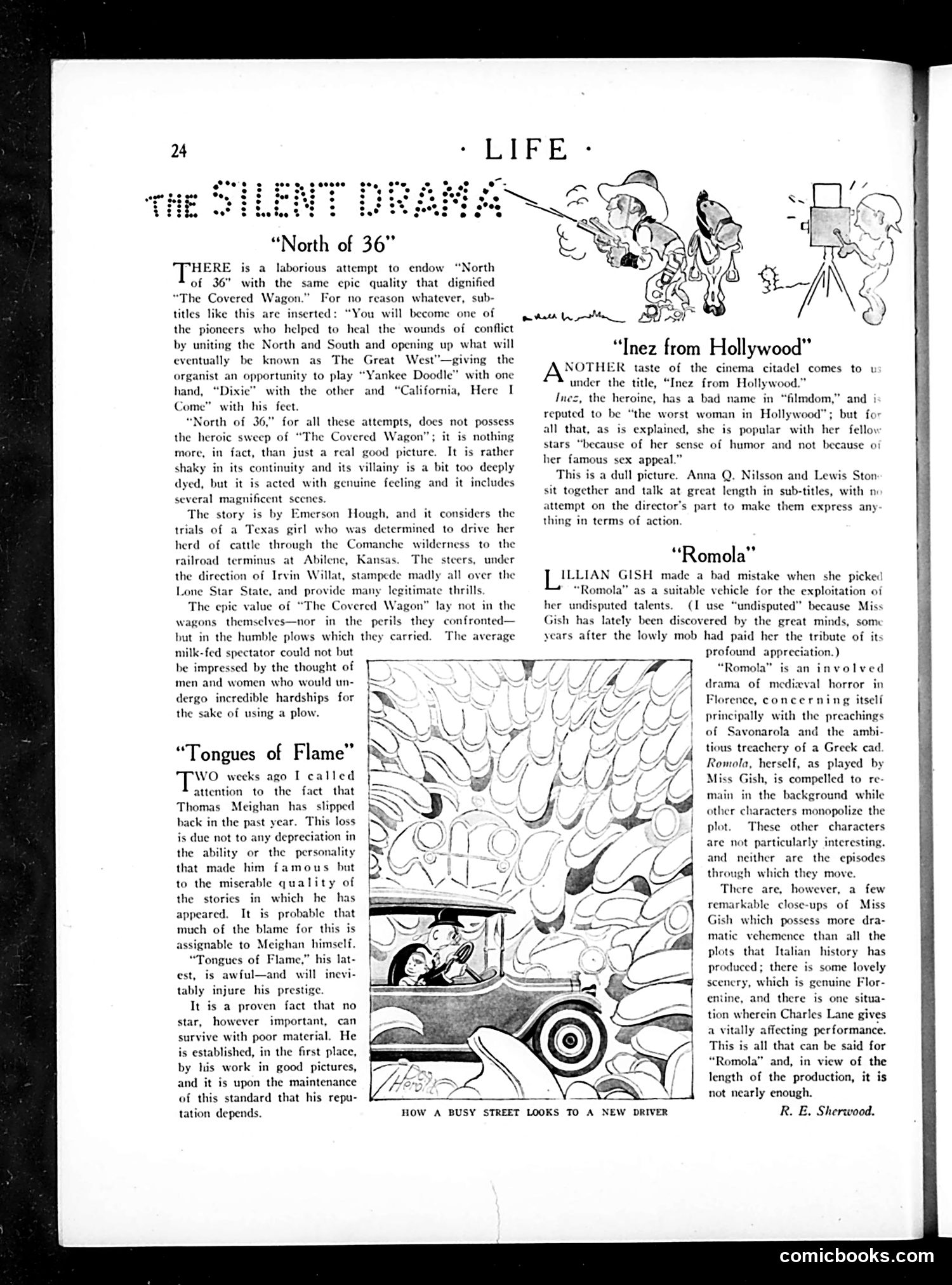
This page contains four film reviews from Life's satirical cinema column. The critic is reviewing recent silent films with characteristic acerbity: **"North of 36"** attempts grandeur but falls short—a Western about driving cattle through the Comanche wilderness. The reviewer mocks the pretentious title cards trying to equate it with "The Covered Wagon," and ridicules the theater organist playing "Yankee Doodle," "Dixie," and "California, Here I Come" simultaneously to manufacture epic feeling. **"Inez from Hollywood"** stars Anna Q. Nilsson as a woman with a scandalous reputation. The reviewer finds it dull—merely characters talking in title cards rather than acting out drama. **"Romola"** features Lillian Gish in a medieval Florence drama. The critic argues Gish made a poor career choice; she's relegated to background while other characters monopolize the plot, though her close-ups display "dramatic vehemence." **"Tongues of Flame"** stars Thomas Meighan, whose career the reviewer believes has declined due to poor material—establishing the principle that no star, however talented, survives weak scripts.
📄 Transcribed text from this page (OCR, searchable)
Machine-transcribed from the original scan — historical spelling and the odd misread are preserved.
“North of 36” HERE is a laborious attempt to endow “North of 36” with the same epic quality that dignified “The Covered Wagot For no reason whatever, sub- titles like this are inserted: “You will become one of the pioneers who helped to heal the wounds of conflict by uniting the North and South and opening up what will eventually be known as The Great West"—giving the organist an opportunity to play “Yankee Doodle” with one hand, “Dixie” with the other and “California, Here I Come” with his feet. “North of 36,” for all these attempts, does not possess the heroic sweep of he Covered Wagon"; it is nothing more, in fact, than just a real good picture. It is rather shaky in its continuity and its villainy is a bit too deeply dyed, but it is acted with genuine fecling and it includes several magnificent scenes. The story is by Emerson Hough, and it considers the trials of a 7 s girl who was determined to drive her herd of cattle through the Comanche wilderness to the railroad terminus at Abilenc, Kansas. The steers, under the direction of Irvin Willat, stampede madly all over the Lone Star State, and provide many legitimate thrills, The epic value of “The Covered Wagon” lay not in the wagons themselyes—nor in the perils they confronted— but in the humble plows which they carried milk-fed spectator could not but The average wane AT} “Inez from Hollywood” NOTHER taste of the cinema citadel comes to under the title, “Inez from Hollywood.” the heroine, has a bad name in “filmdom,” and reputed to be “the worst woman in Hollywood"; but for all that, as is explained, she is popular with her felloy stars “because of her sense of humor and not because o/ her famous sex appeal.” This is a dull picture. Anna Q. Nilsson and Lewis Ston: sit together and talk at great length in sub-titles, with nv attempt on the director's part to make them express any thing in terms of action. “Romola” ILLIAN GISH made a bad mistake when she pickec “Romola” as a suitable vehicle for the exploitation of her undisputed talents. (1 use “undisputed” because Miss Gish has lately been discovered by the great minds, some years after the lowly mob had paid her the tribute of its profound appreciation.) he impressed by the thought of men and women who would un- dergo incredible hardships for the sake of using a plow. “Tongues of Flame” WO weeks ago I called attention to the fact that Thomas Meighan has_ slipped hack in the past year. This loss is due not to any depreciation in the ability or the personality that made him famous but to the miserable quality of the stories in which he has appeared. It is probable that much of the blame for this is assignable to Meighan himself. “Tongues of Flame,” his lat- est, is awful—and will inevi- tably injure his prestige. It is a proven fact that no star, however important, can survive with poor material. He is established, in the first place, by his work in good pictures, and it is upon the maintenance of this standard that his repu- “Romola” is an involved drama of medieval horror in Florence, concerning itself principally with the preachings of Savonarola and the ambi- tious treachery of a Greek cad Romola, herself, as played by Miss Gish, is compelled to re- main in the background while characters monopolize the These other characters are not particularly interesting. and neither are the episodes through which they move. There are, however, a few remarkable close-ups of Miss Gish which possess more dra- matic vehemence than all the plots that Italian history has produced; there is some lovely scenery, which is genuine Flor- eniine, and there is one situa- tion wherein Charles Lane gives a vitally affecting performance. This is all that can be said for “Romola” and, in view of the length of the production, it is not nearly enough. tation depends. HOW A BUSY STREET LOOKS TO A NEW DRIVER R. E. Sherwood. comicbooks.com