
A complete issue · 37 pages · 1924
Life — December 18, 1924
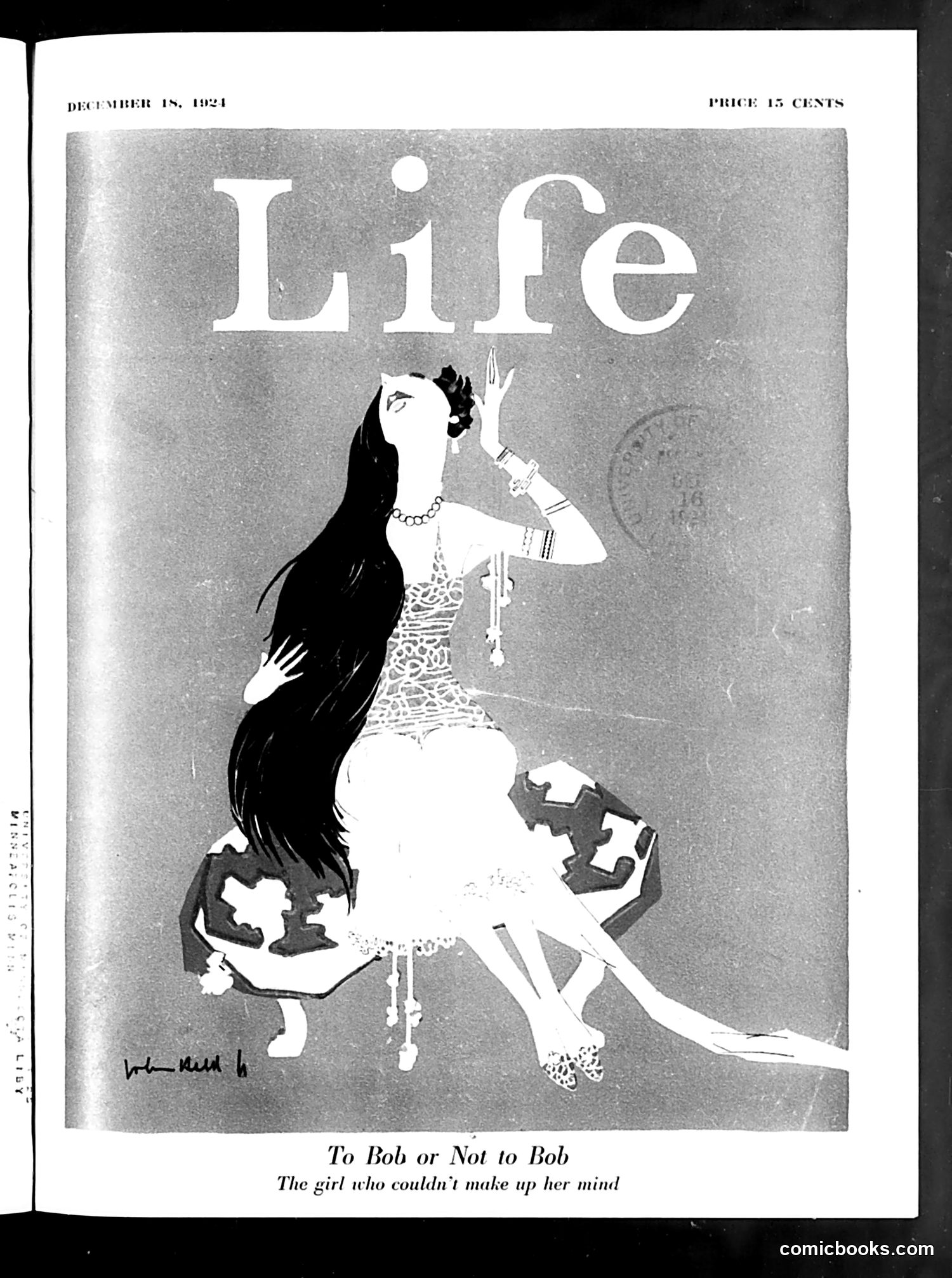
This cover satirizes the "bobbed hair" controversy of the 1920s. The illustration shows a fashionable woman with long dark hair and a cigarette, dressed in modern attire with fur stole and patterned dress, seemingly unable to decide whether to adopt the trendy bobbed (short) hairstyle. "The girl who couldn't make up her mind" references the cultural debate dividing 1920s society: bobbed hair represented youth rebellion, modernity, and women's liberation, while traditional long hair symbolized conventional femininity and morality. The title's Shakespearean reference ("To Bob or Not to Bob") humorously frames this as a weighty existential decision. Life magazine's satire gently mocks both the fashion trend's intensity and women's social pressure regarding appearance standards.
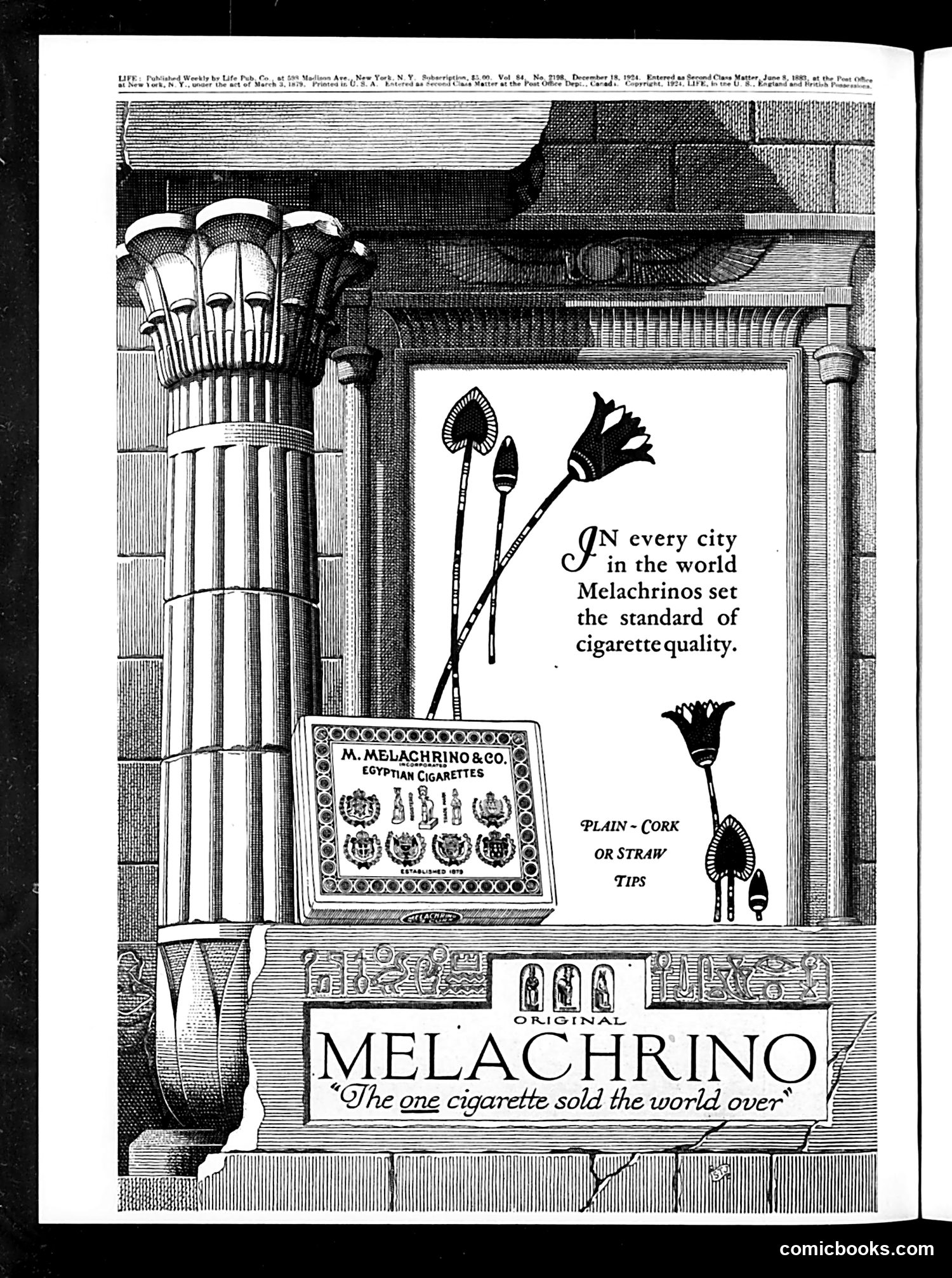
This is primarily a **cigarette advertisement**, not satire. It promotes Melachrino Egyptian cigarettes, featuring an ornate product box and decorative botanical illustrations of stylized flowers. The classical architectural framing—a fluted column with Egyptian-style capitals—references the cigarettes' "Egyptian" branding, evoking luxury and exoticism. The tagline "The one cigarette sold the world over" claims global dominance and quality leadership. The ad emphasizes available tip options ("Plain - Cork or Straw Tips"), a selling point for early 20th-century smokers. This appears in *Life* magazine's December 1924 issue, when cigarette advertising was commonplace and unregulated in mainstream publications. There is no political cartoon or satire here—merely a period advertisement reflecting the era's casual attitude toward tobacco marketing.
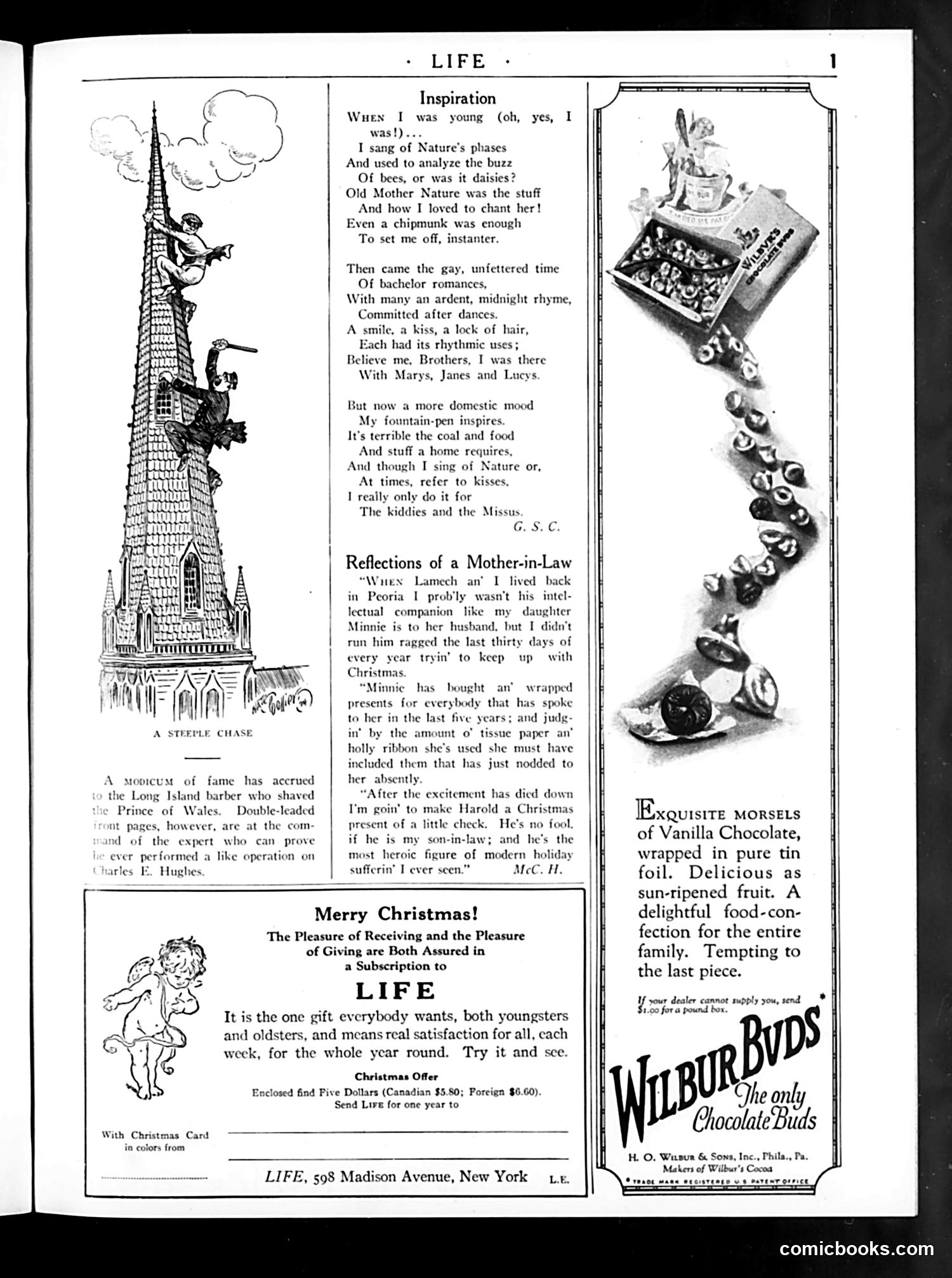
This page is primarily **literary and advertising content** rather than political satire. The left column features "Inspiration," a poem by G.S.C. reflecting on aging—from youthful nature poetry and romantic pursuits to domestic concerns. Below it, "Reflections of a Mother-in-Law" humorously describes a woman's son-in-law and Christmas gift-giving anxieties. The illustration "A Steeple Chase" shows figures climbing a church spire—likely a visual pun on the term "steeple chase." The page includes a **Life magazine subscription advertisement** and a **Wilbur Buds chocolate advertisement** (right side). A historical note mentions a Long Island barber who shaved the Prince of Wales, crediting barber Charles E. Hughes with performing the procedure. This is typical early 20th-century Life magazine content: light humor, personal essays, and advertisements.
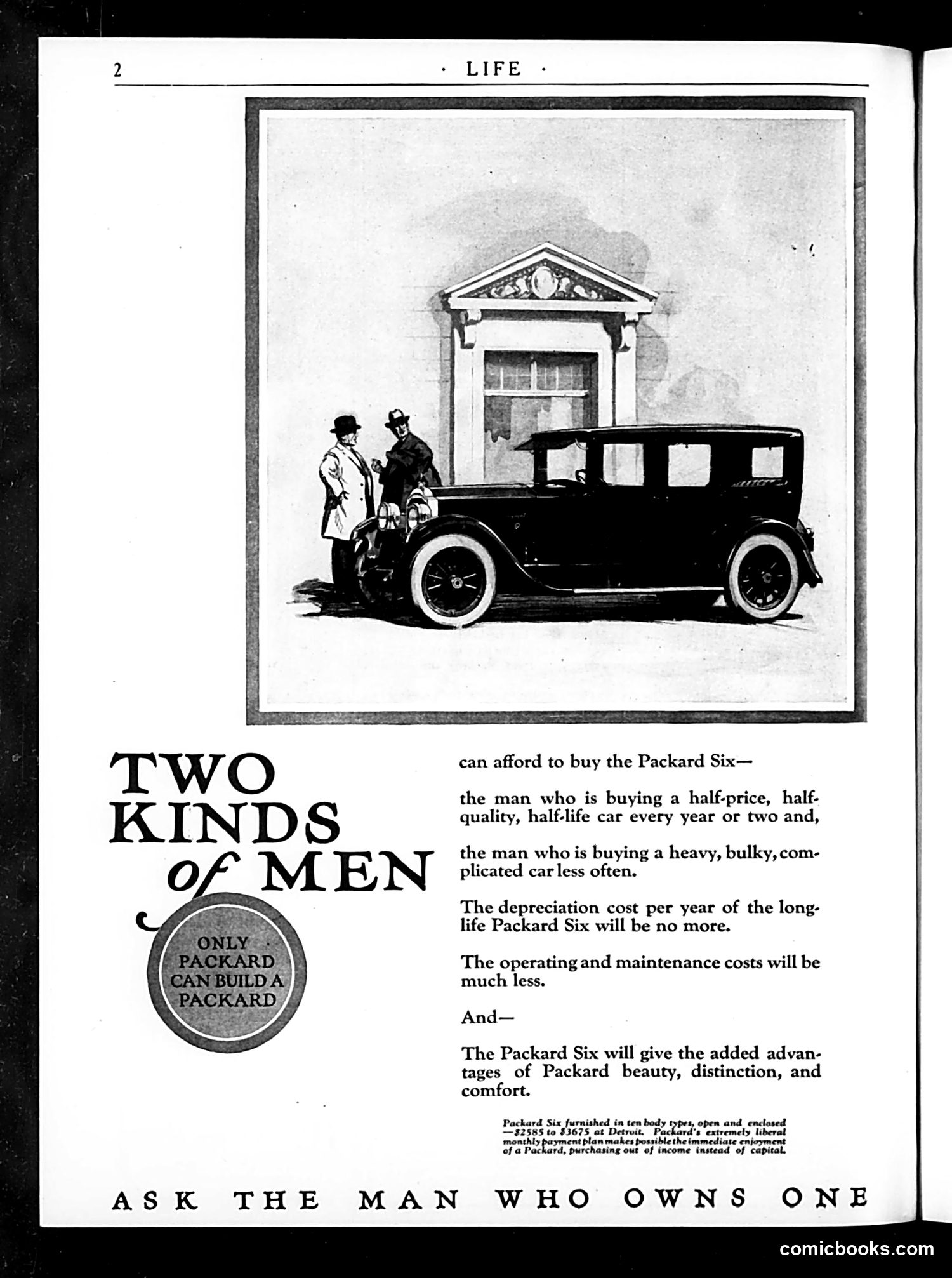
This is a **Packard automobile advertisement**, not political satire. The ad targets two distinct buyer types: 1. **Budget-conscious buyers** who replace cheaper cars frequently 2. **Wealthy buyers** who purchase heavy, complex vehicles less often The advertisement's central argument is economic: a Packard Six's annual depreciation costs no more than constantly replacing cheaper cars, while offering superior operating costs and maintenance. The tagline "Only Packard can build a Packard" emphasizes exclusivity. The illustration shows two well-dressed men examining a Packard sedan outside a classical building, positioning the car as aspirational and prestigious. The ad concludes "Ask the man who owns one"—a famous Packard marketing slogan. This reflects 1920s-era luxury car marketing targeting upper-middle-class professionals.
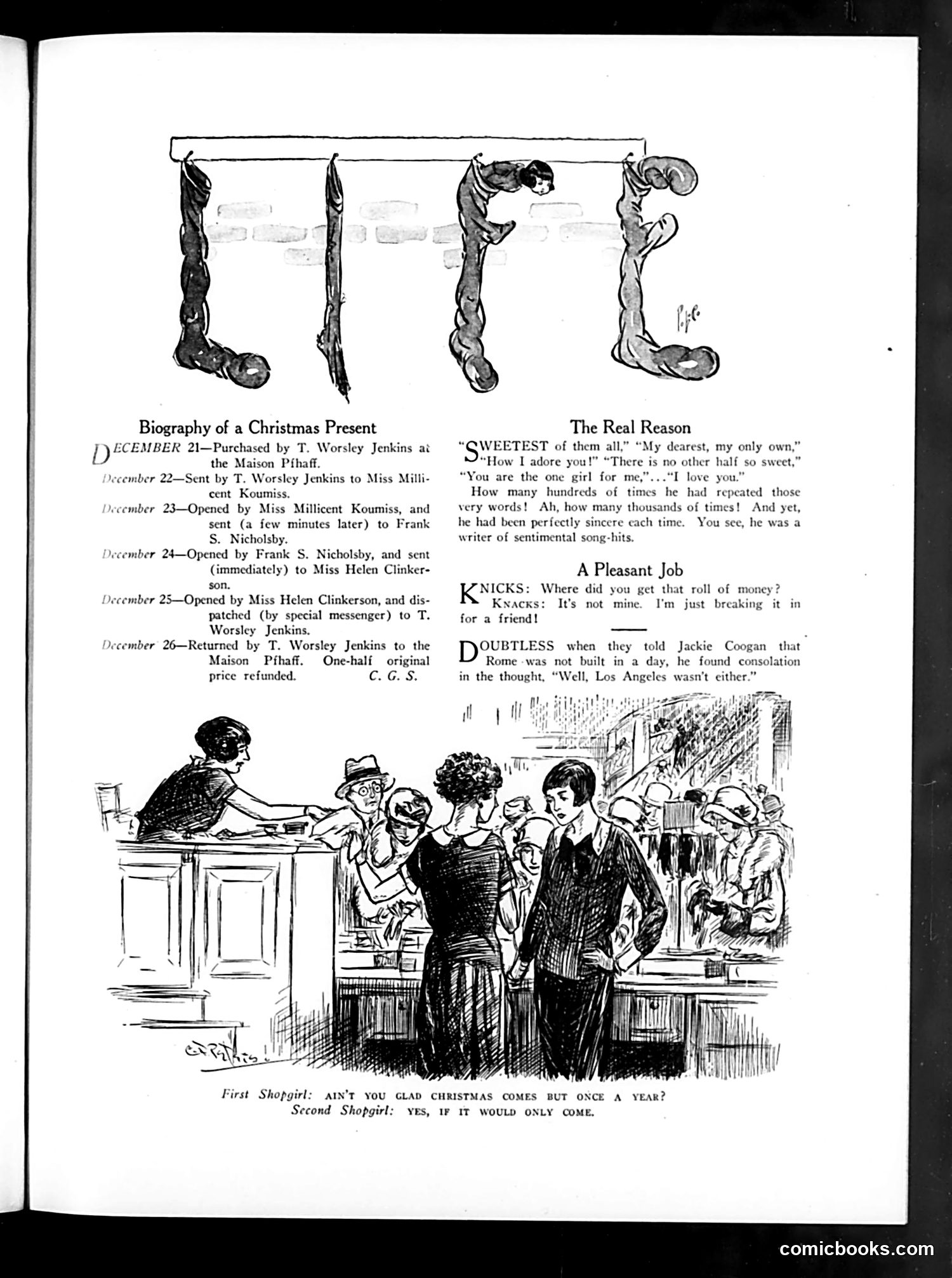
This page contains three separate humorous pieces: 1. **"Biography of a Christmas Present"** (top): A visual joke showing a gift's journey through six pairs of hands between December 21-26, with each person's posture suggesting they're passing it along rather than keeping it. The satire mocks regifting and the impersonal nature of holiday gift-giving. 2. **"The Real Reason"** (right): A sentimental parody about repetitive love declarations, mocking overwrought romantic language in popular songs. 3. **"A Pleasant Job"** (bottom): A cartoon showing shopgirls during holiday retail chaos. The punchline jokes about Christmas occurring only once yearly, with one shopgirl wishing it would come more frequently—satirizing the exhausting commercial demands of the season on retail workers. The page's overall theme critiques commercialism and insincerity surrounding Christmas.
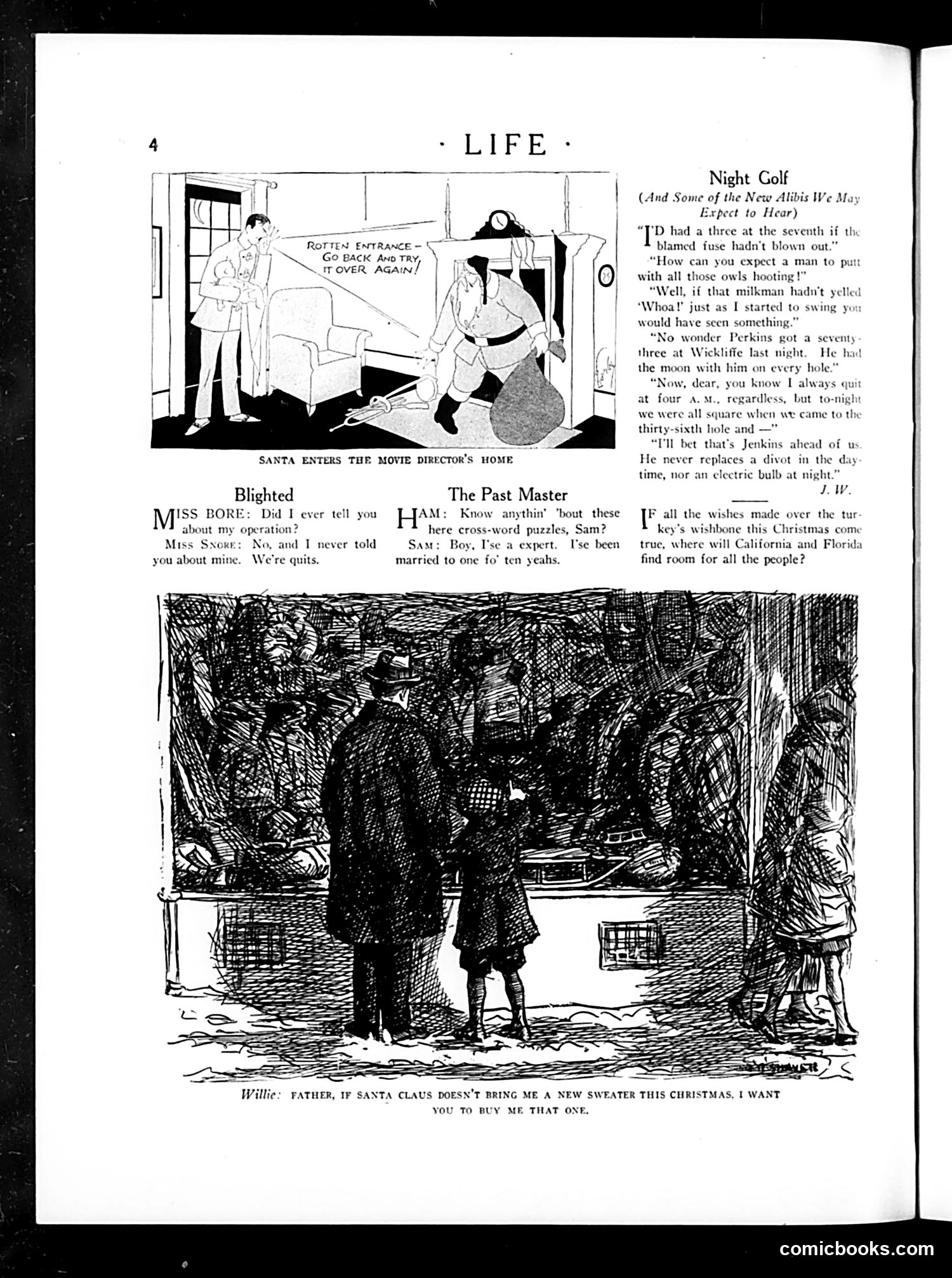
This page contains three separate humor pieces: 1. **"Santa Enters the Movie Director's Home"** - A cartoon mocking a film director's domestic life, showing Santa being turned away at the door with the caption "Rotten entrance—go back and try it over again!" This satirizes how directors obsess over every detail, even in their home life. 2. **"Blighted"** and **"The Past Master"** - Brief comedic dialogues about marriage and divorce, typical of Life's domestic humor. 3. **"Night Golf"** - A longer piece describing a humorous golf outing at night, poking fun at obsessive golfers. 4. **The main cartoon** shows a child speaking to Santa Claus in a store window, requesting a sweater rather than the typical toy. This reflects Depression-era pragmatism when families prioritized necessity over luxury gifts.
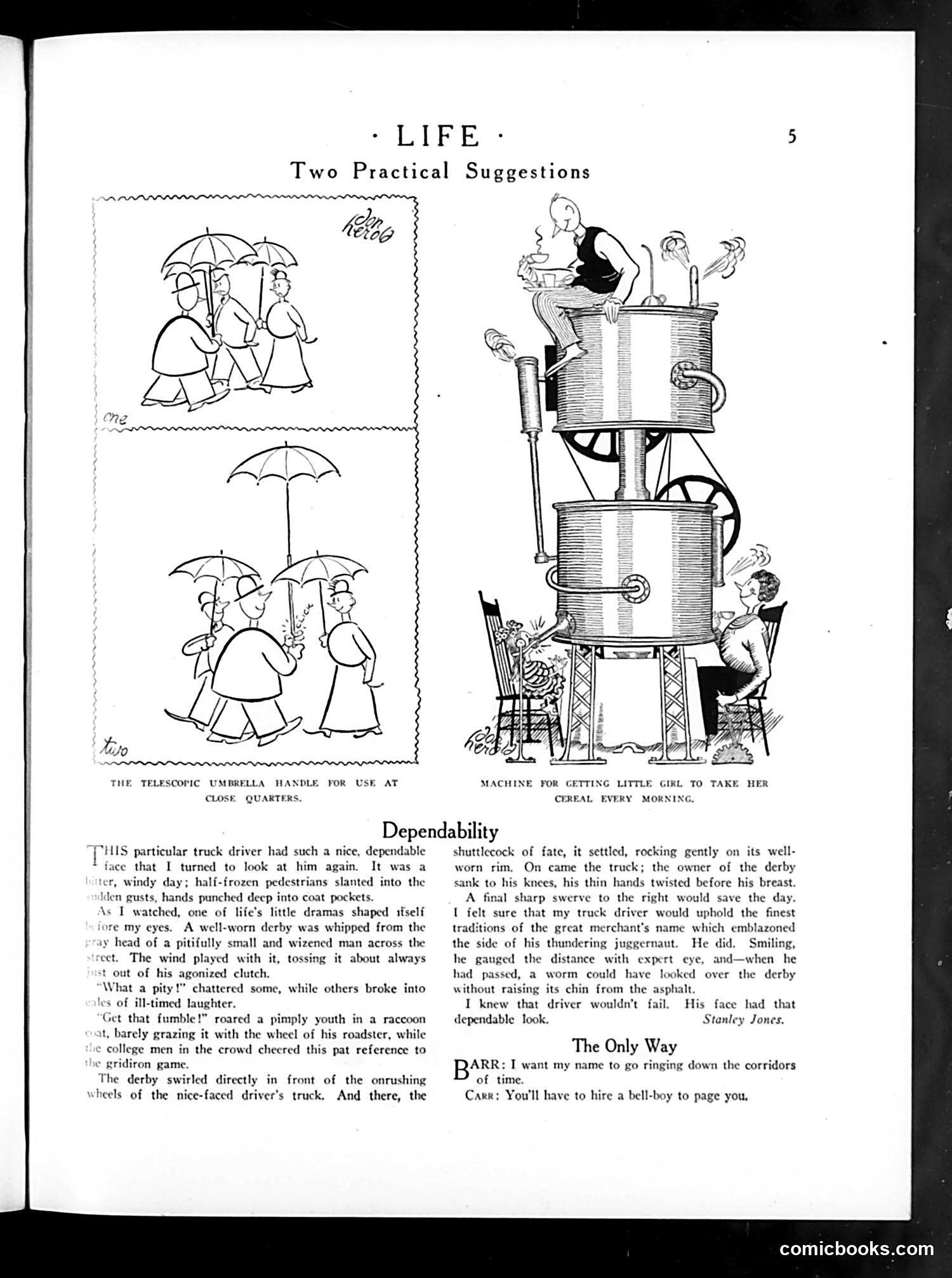
**Top Section - Two Cartoons:** The left panel shows "The Telescopic Umbrella Handle for Use at Close Quarters" — depicting people with impossibly long umbrella handles to maintain distance while sharing shelter. The right panel illustrates a "Machine for Getting Little Girl to Take Her Cereal Every Morning" — an elaborate contraption with pulleys and mechanical arms to force-feed a child breakfast. **Bottom Section - Humor Pieces:** "Dependability" is a anecdotal story about a reliable truck driver whose steady demeanor during a derby race saves the day. "The Only Way" is a brief comic dialogue where someone wanting their name "ringing down the corridors of time" is told they must hire a bell-boy to page them. All content satirizes everyday domestic and commercial absurdities through exaggeration and mechanical solutions to mundane problems.
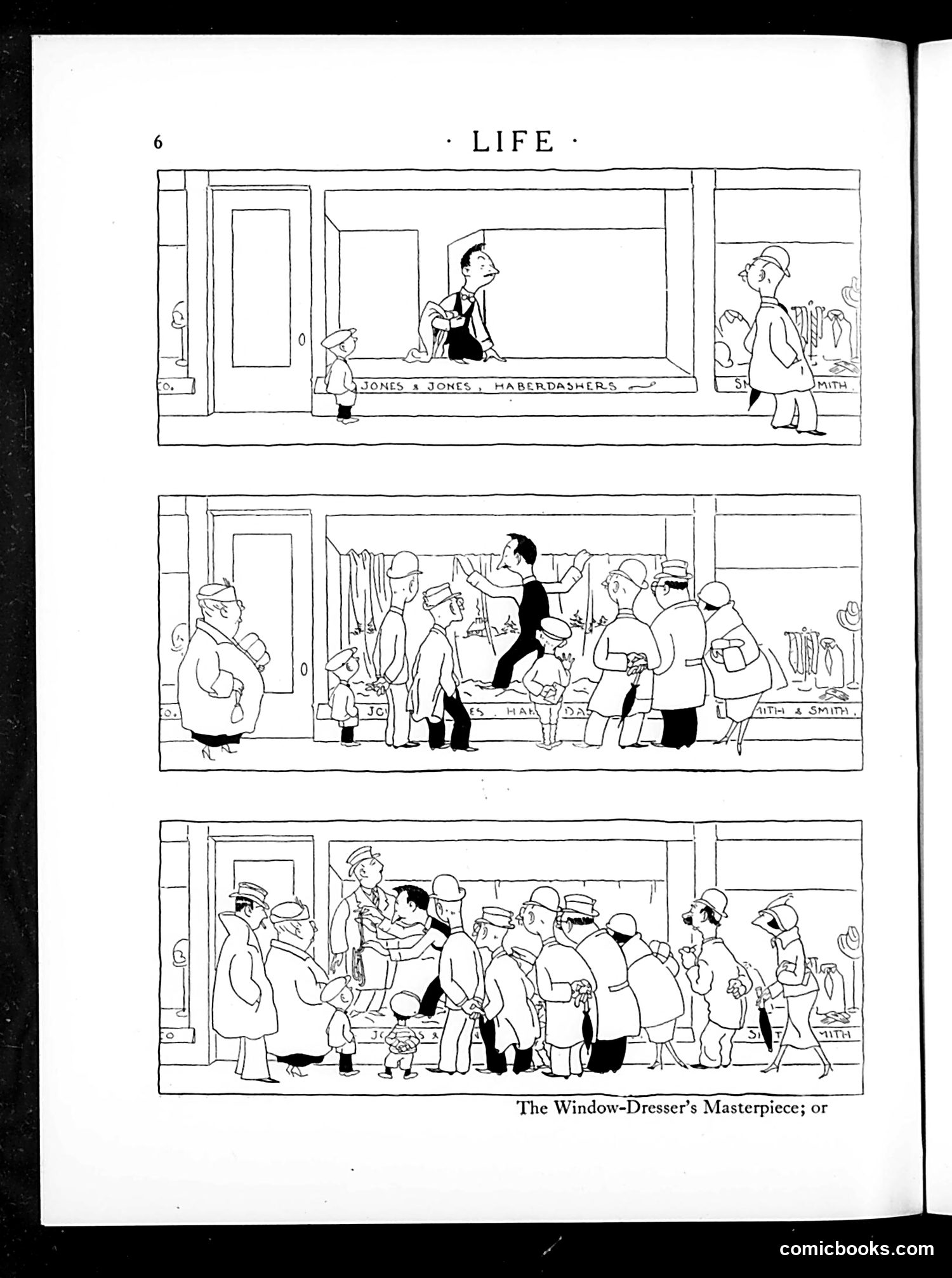
This three-panel comic depicts an increasingly chaotic scene at a "Jones & Jones, Haberdashers" storefront. In the first panel, a well-dressed window-dresser admires his work from inside. The second shows pedestrians stopping to look, crowding the sidewalk. By the third panel, a massive mob has assembled outside, creating pandemonium. The satire mocks the power of skilled window display to attract crowds and drive commercial success. The "masterpiece" of arranging hats and merchandise proves so compelling that it transforms orderly passersby into an uncontrollable throng. This reflects early 20th-century fascination with consumer culture, advertising techniques, and retail's psychological manipulation of the public—suggesting that commercial appeal can overwhelm rational behavior.
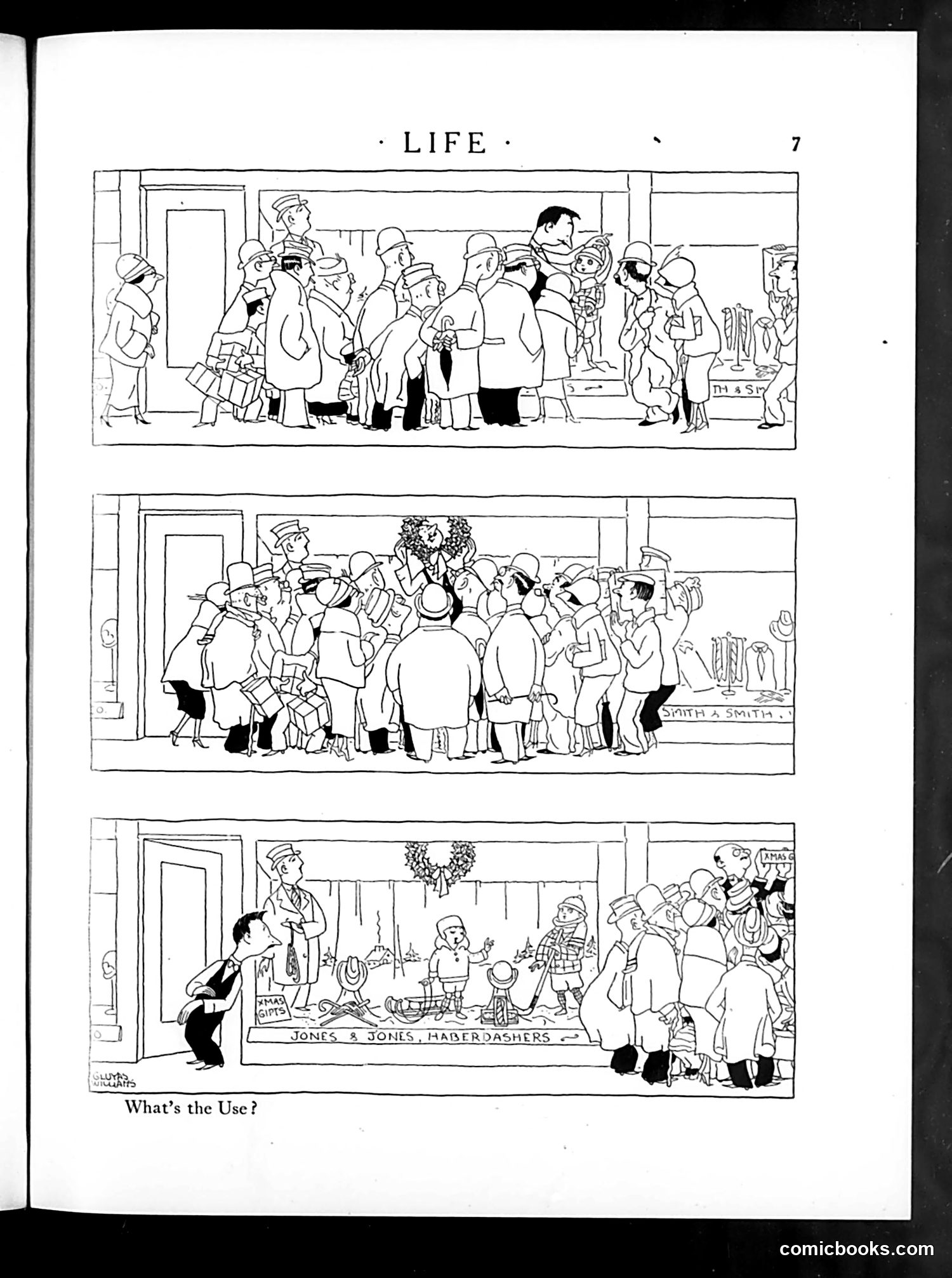
This three-panel cartoon satirizes Christmas shopping at department stores. The progression shows: 1. **Top panel**: A crowd of shoppers gathered outside a store entrance 2. **Middle panel**: The crowd has densely packed *inside* the store, jostling around displays 3. **Bottom panel**: A man stands outside an elegant window display (labeled "JONES & JONES, HABERDASHERS"), looking at Christmas gifts while crowds press against the glass The title "What's the Use?" suggests the cartoon's cynical message: despite elaborate holiday window displays and retail temptation, the crowded, chaotic shopping experience negates any pleasure in gift-buying or holiday spirit. The satire mocks both consumer culture's commercialization of Christmas and the undignified mob mentality shopping induces.
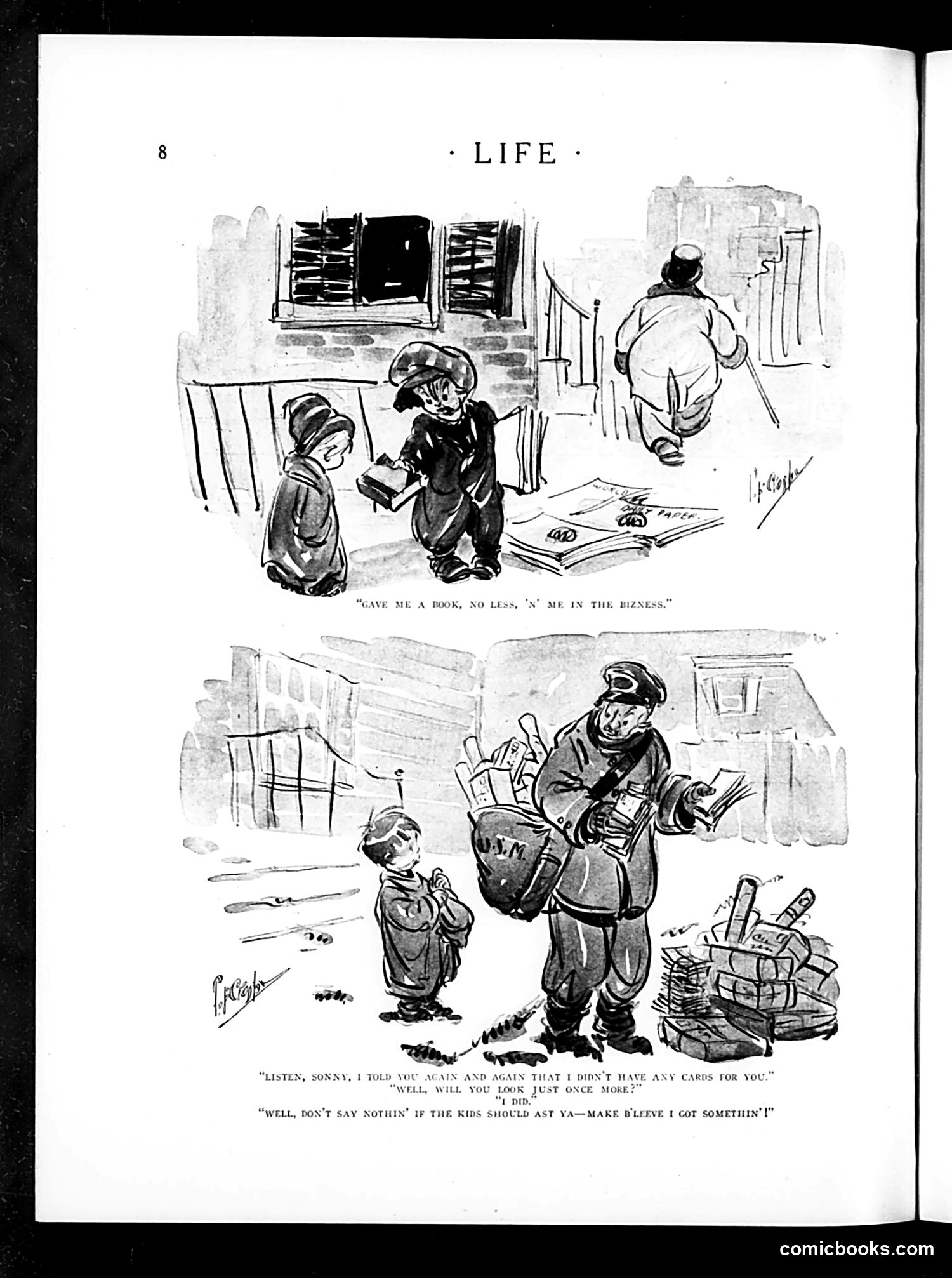
This page contains two satirical cartoon vignettes about poverty and generosity. **Top cartoon:** A street urchin asks another child for "a book, no less, 's' me in the bizness"—sarcastically requesting a book to enter "the business" (likely crime or hustling). The humor mocks how poverty-stricken children might prioritize survival over education. **Bottom cartoon:** A street vendor or ragman carrying a large sack labeled "JAM" encounters a child. The dialogue reveals the adult repeatedly denying the child cards (likely trading cards, a period-appropriate collectible), claiming he has none. When asked if he'll get some "just once more," the man sarcastically responds that he'll "make believe I got somethin'"—implying he has nothing to give and mocks the child's persistent hoping. Both cartoons satirize urban poverty and the gap between children's desires and harsh reality.
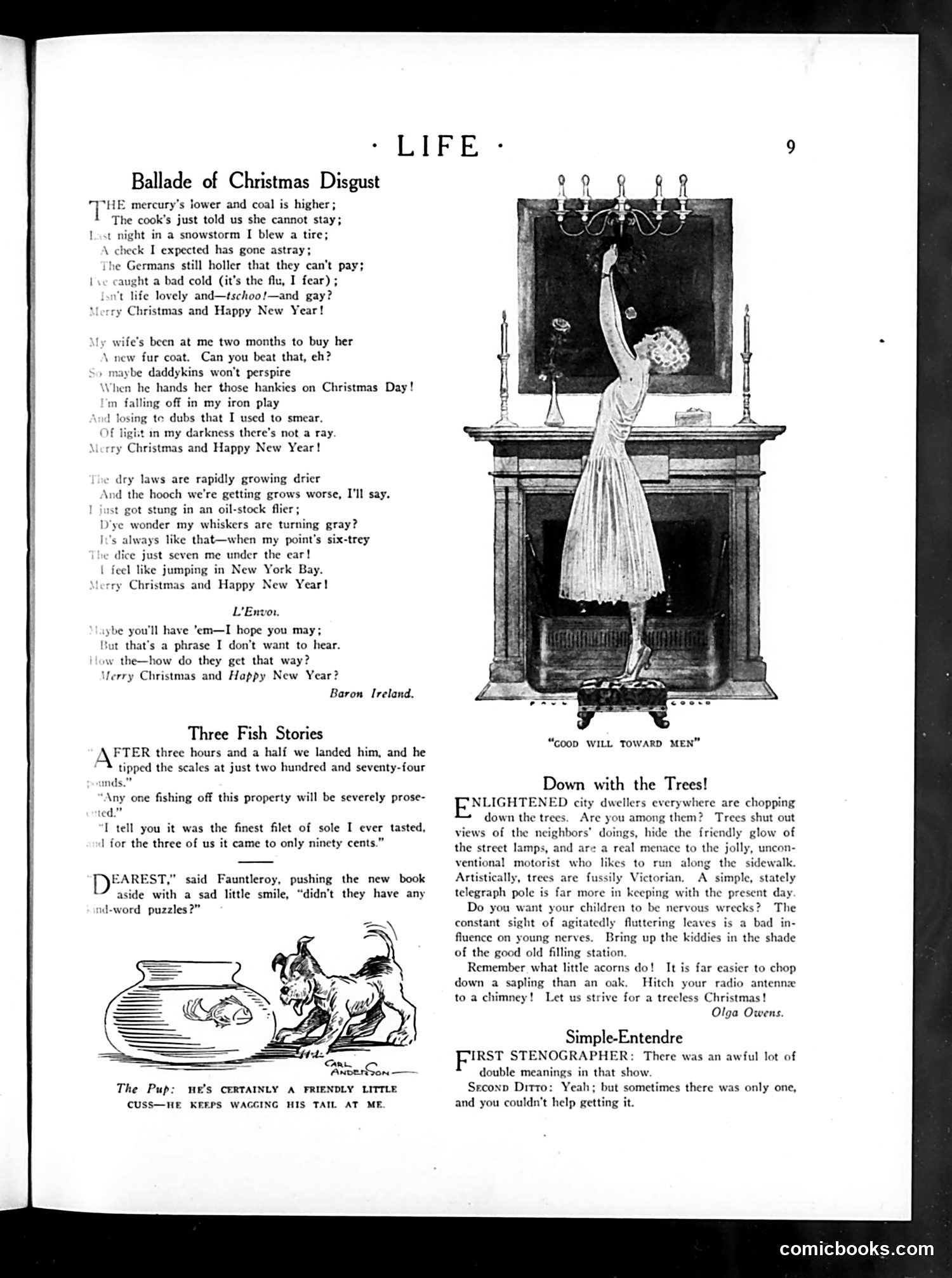
This page contains three distinct pieces of satirical content: 1. **"Ballade of Christmas Disgust"** by Baron Ireland: A poem lamenting wartime hardships during what appears to be WWI—rising prices, shortages (mercury, coal), illness, and domestic frustrations. It's framed as bitter complaints disguised with forced holiday cheer. 2. **"Three Fish Stories"**: A brief humorous anecdote about landing fish and discussing their weight, with a cartoon showing a friendly dog in a fishbowl. The joke appears to be about exaggeration or misunderstanding. 3. **"Down with the Trees!"** by Olga Owens: Satirizes urban residents' calls to remove street trees, arguing they obstruct views and harbor insects. She sarcastically defends trees' value and suggests cutting radio antennas instead—mocking misplaced priorities. All reflect wartime anxieties and social complaints.
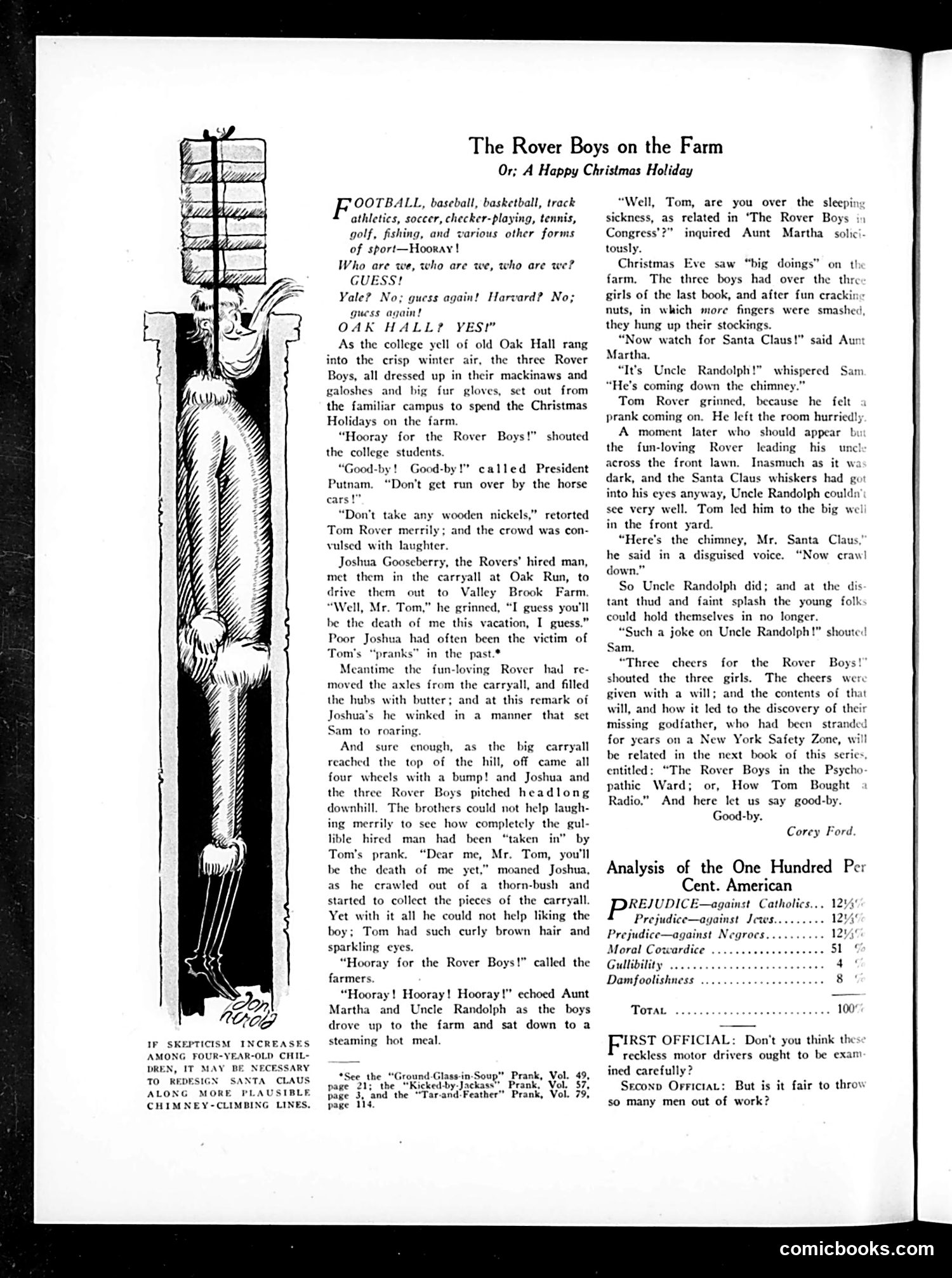
This page presents "The Rover Boys on the Farm," a short story by Corey Ford appearing in *Life* magazine. The accompanying illustration shows a tall structure (likely a chimney or tower) with a figure climbing it. The story humorously depicts three college boys home for Christmas holidays engaging in pranks—including overturning a carryall (horse-drawn wagon) and pranking their hired man. The narrative parodies the popular "Rover Boys" adventure series, which typically featured wholesome tales of young men. Ford's satire deflates this earnest formula through slapstick comedy and practical jokes. The page also includes an "Analysis of the One Hundred Per Cent American," listing prejudices and character flaws, and concludes with editorial commentary about motor drivers and employment.
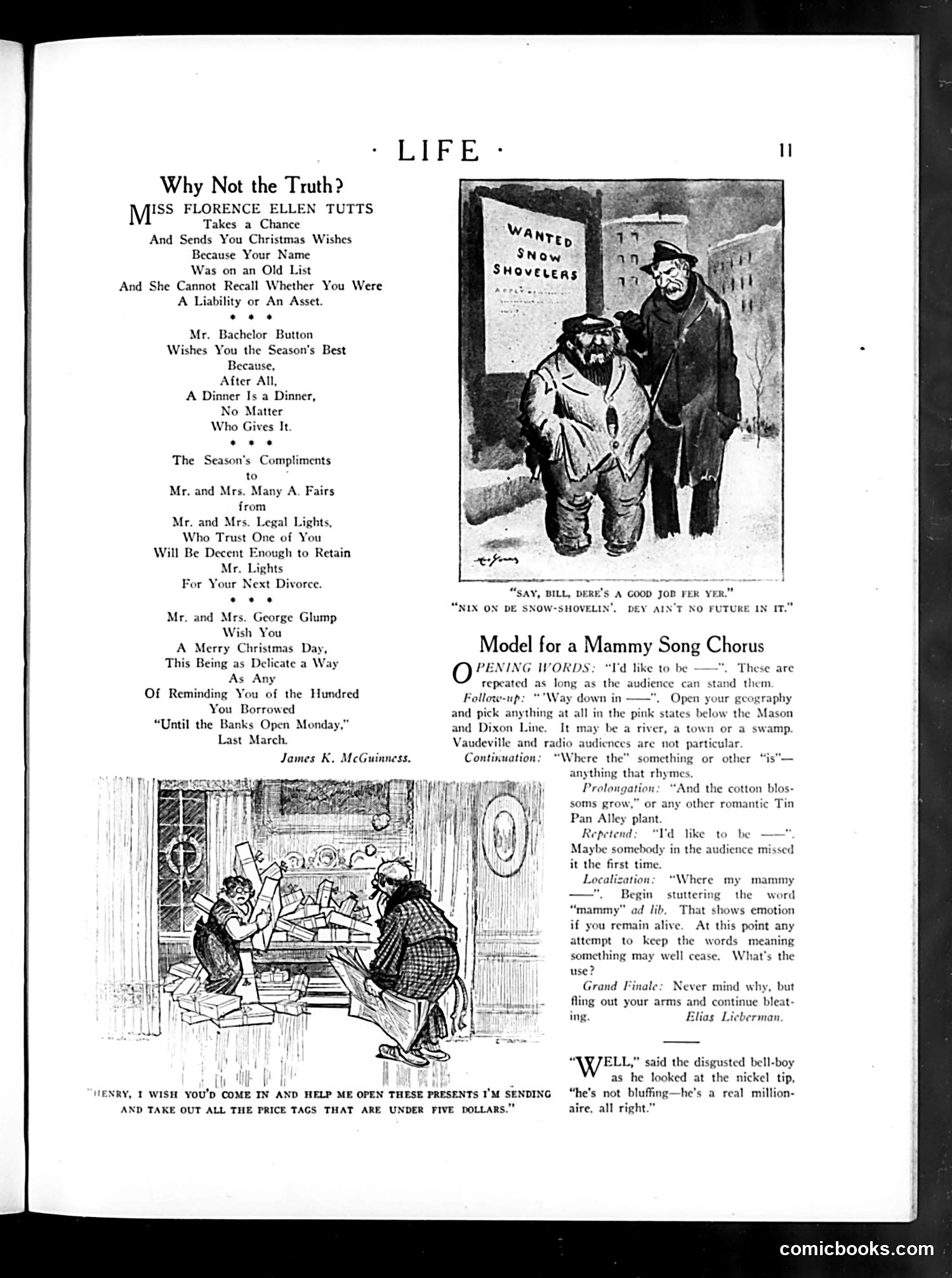
This page contains Christmas wishes and humorous illustrations typical of Life's satirical content. **Top cartoon**: Shows two poorly-dressed men beside a "Wanted: Snow Shovelers" sign. The joke, captioned "Say, Bill, dere's a good job fer yeer," mocks the desperation of unemployed workers during winter who would accept any labor, no matter how temporary or poorly paid. **Lower left illustration**: Depicts someone asking a friend to help open wrapped presents and remove price tags—satirizing the awkwardness of receiving cheap or marked-down gifts, suggesting the giver is either stingy or indifferent. **Right column**: Instructions for a "Mammy Song Chorus," providing stage directions for performing a minstrel-style song. This reflects period entertainment conventions, though the content reflects problematic historical practices.
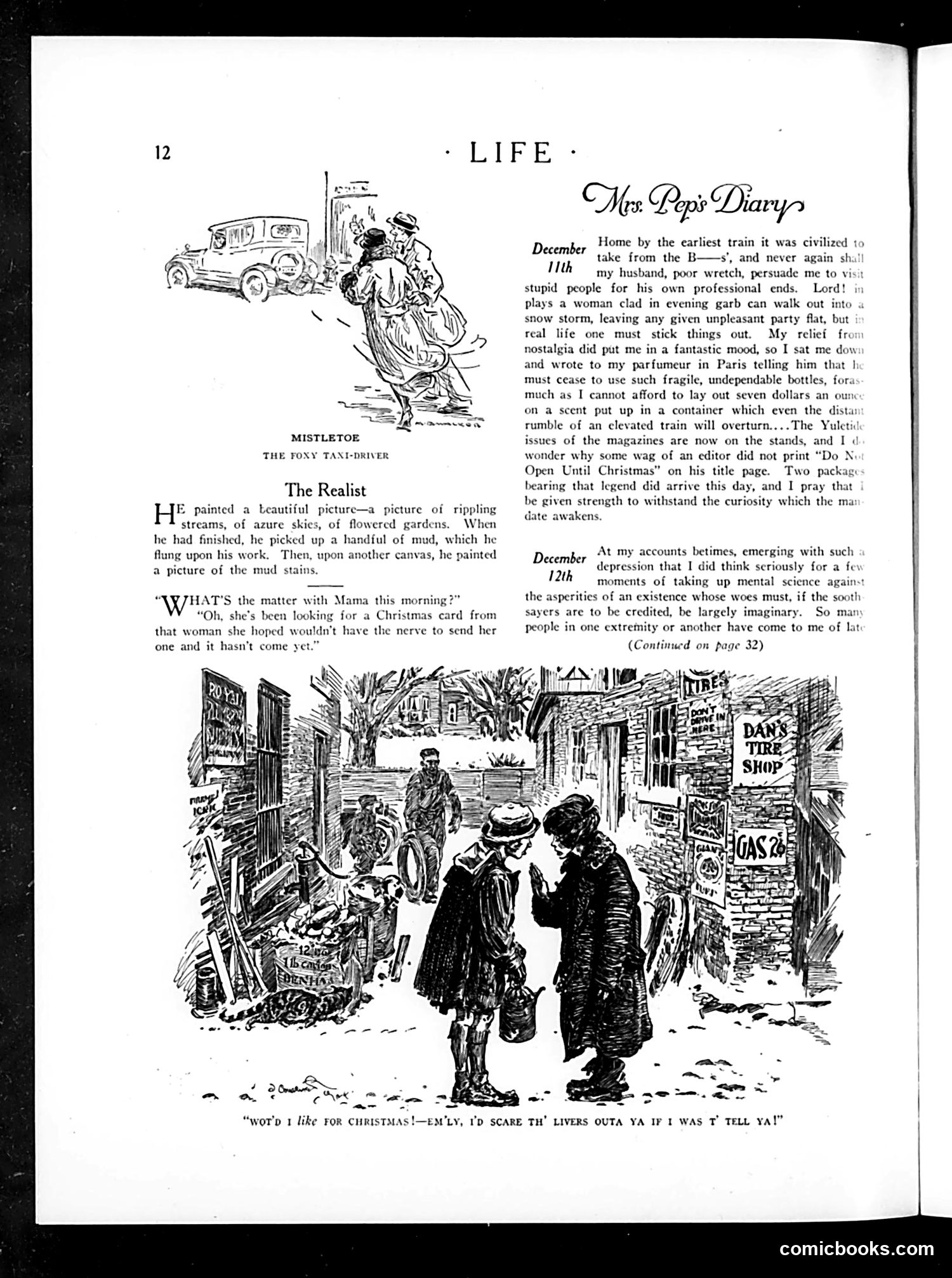
This page contains a satirical diary entry dated December 11th-12th, alongside illustrations. The top cartoon shows "Mistletoe: The Foxy Taxi-Driver"—a humorous sketch of an automobile accident involving a taxi. The main story, "The Realist," depicts an artist painting mud stains rather than idealized landscapes, satirizing artistic pretension. The lower illustration shows two street children in an urban alley, with dialogue: "WOR'D LIKE FOR CHRISTMAS!—EMILY, I'D SCARE TH' LIVERS OUTA YA IF I WAS T' TELL YA!" This cartoon satirizes class disparities during the Christmas season, contrasting children's innocent holiday hopes with urban poverty's grim realities. The dialogue suggests children have learned cynicism from their harsh circumstances rather than maintaining innocent Christmas wishes.
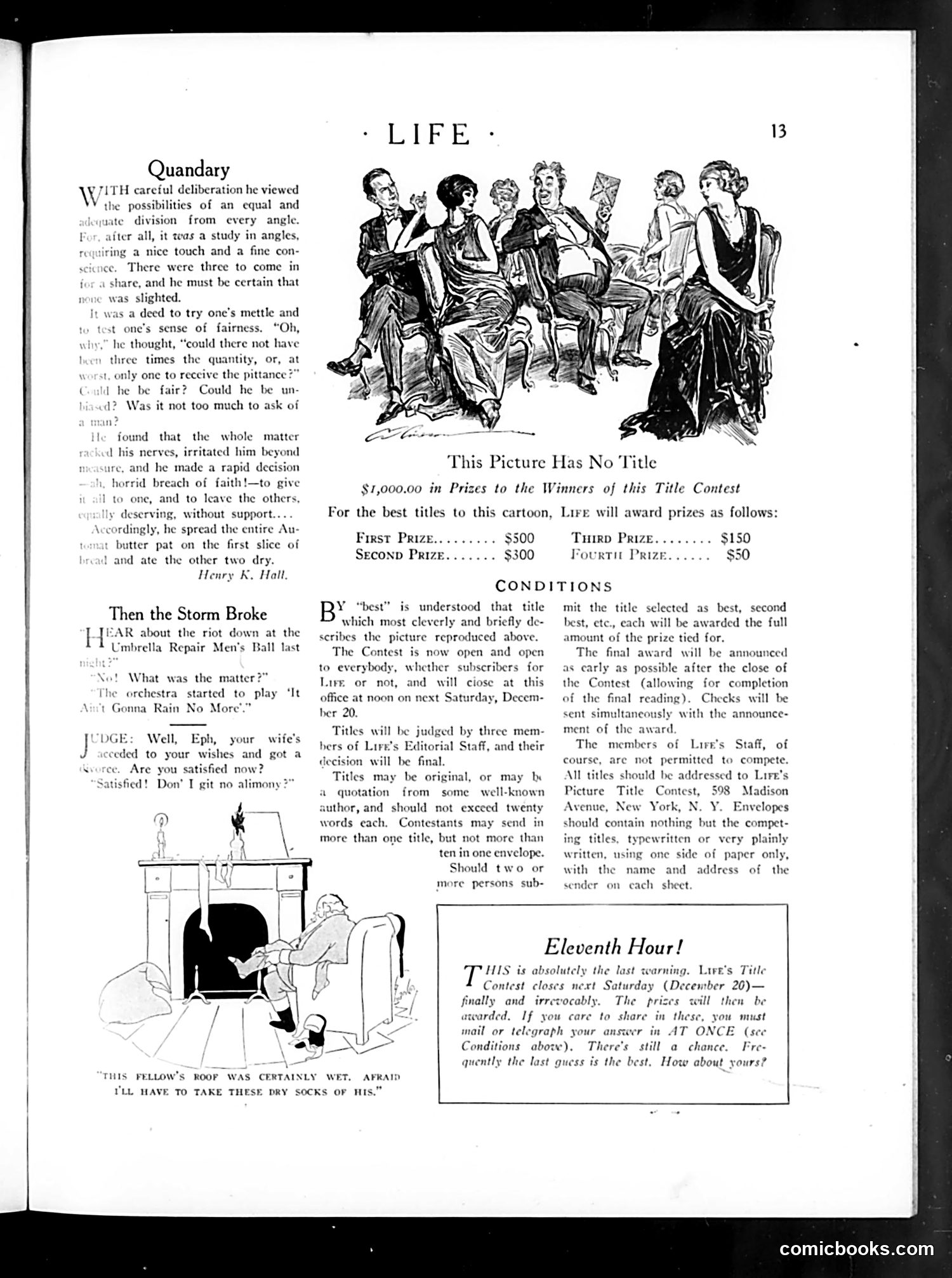
This page contains **two distinct humor pieces**: 1. **"This Picture Has No Title"** - A contest inviting readers to submit titles for a cartoon showing a social gathering of well-dressed men and women in what appears to be an elegant setting. The satire likely mocks upper-class social conventions or romantic entanglements, though the specific joke is unclear without context. 2. **"Then the Storm Broke"** - A short comic dialogue where a judge questions a man about his wife's behavior during a rainstorm. The cartoon shows a man's feet sticking up—apparently he's been knocked down. The humor plays on domestic conflict and the woman's independence or temper. Both pieces exemplify Life's characteristic early-20th-century satire of American manners and relationships.
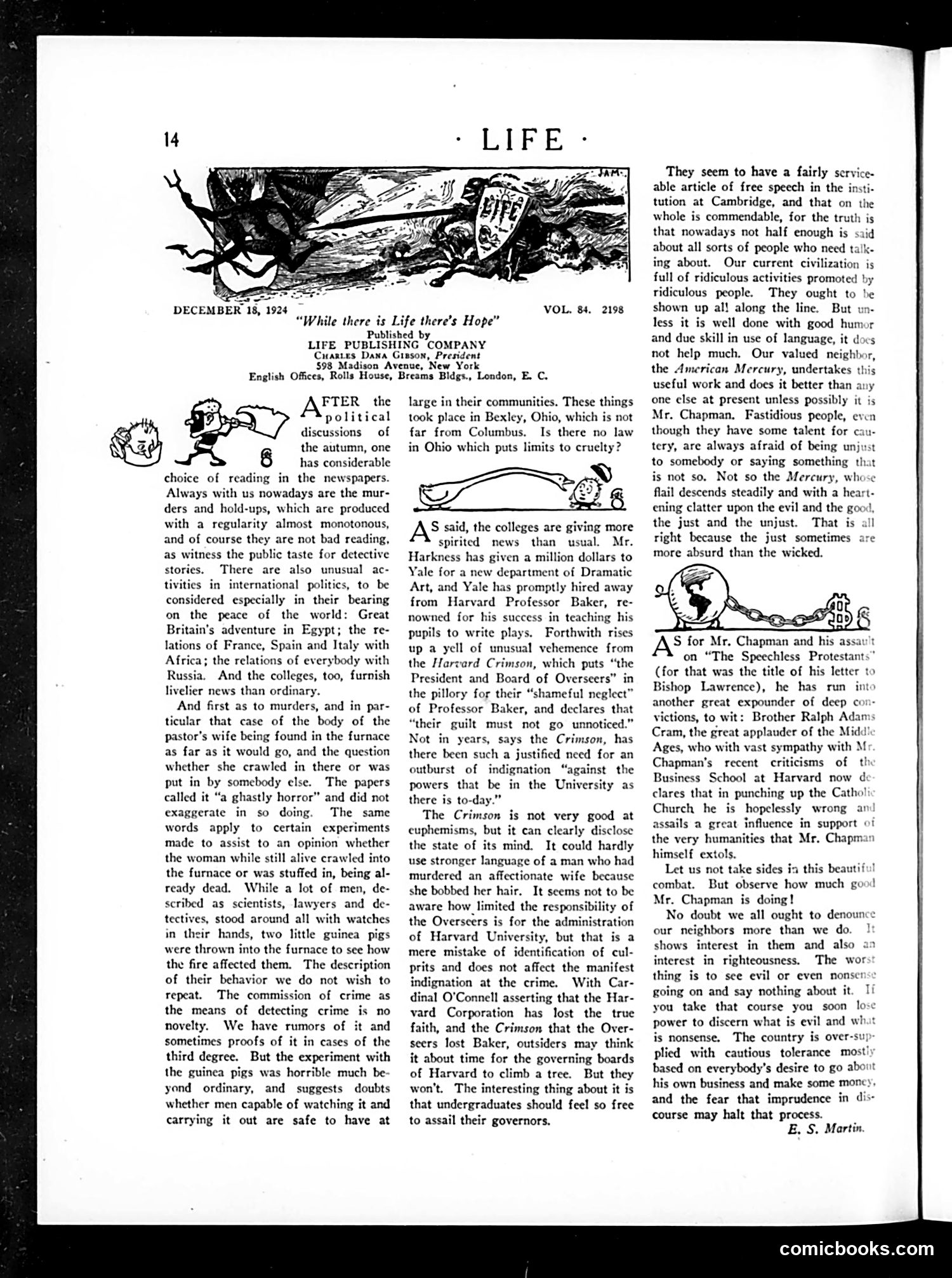
This page contains editorial commentary rather than political cartoons. The small decorative illustrations show figures in casual poses but aren't specific caricatures. The main text discusses university governance controversies, particularly at Harvard and Yale. It criticizes the "Harvard Crimson" (the student newspaper) for its editorial attacking Harvard's Board of Overseers regarding Professor Baker's treatment. The writer, E.S. Martin, argues the Crimson wrongly blamed administrators rather than recognizing limited institutional responsibility. The piece also praises Yale for funding a new Dramatic Arts department and hiring Professor Baker away from Harvard. The satire targets student newspapers' tendency toward moral indignation without understanding administrative complexities, and champions institutional pragmatism over youthful idealism.
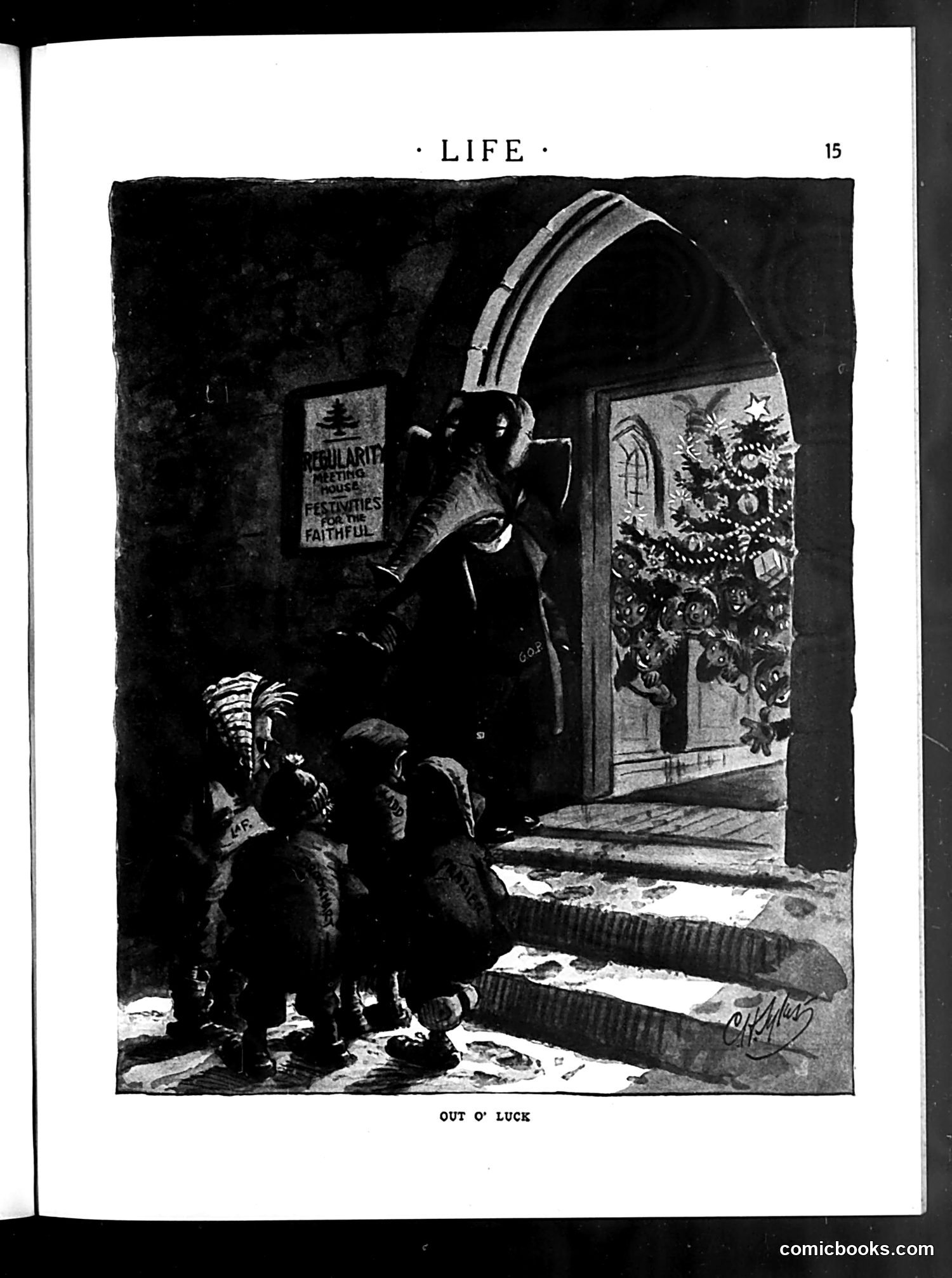
This cartoon depicts children peering through an arched doorway into a church decorated for Christmas, with a decorated tree visible inside. The title "Out O' Luck" suggests these are poor or homeless children excluded from holiday celebration. The visible text on the church wall appears to reference "charity," "festivities," and "faithful"—likely indicating the church's charitable mission. The stark contrast between the warm, festive interior (shown in light) and the dark exterior where the children stand illustrates economic inequality and exclusion during the Christmas season. This appears to be social commentary on poverty and class division in early-to-mid 20th century America, using the holiday as a lens to critique who has access to warmth, community, and celebration.
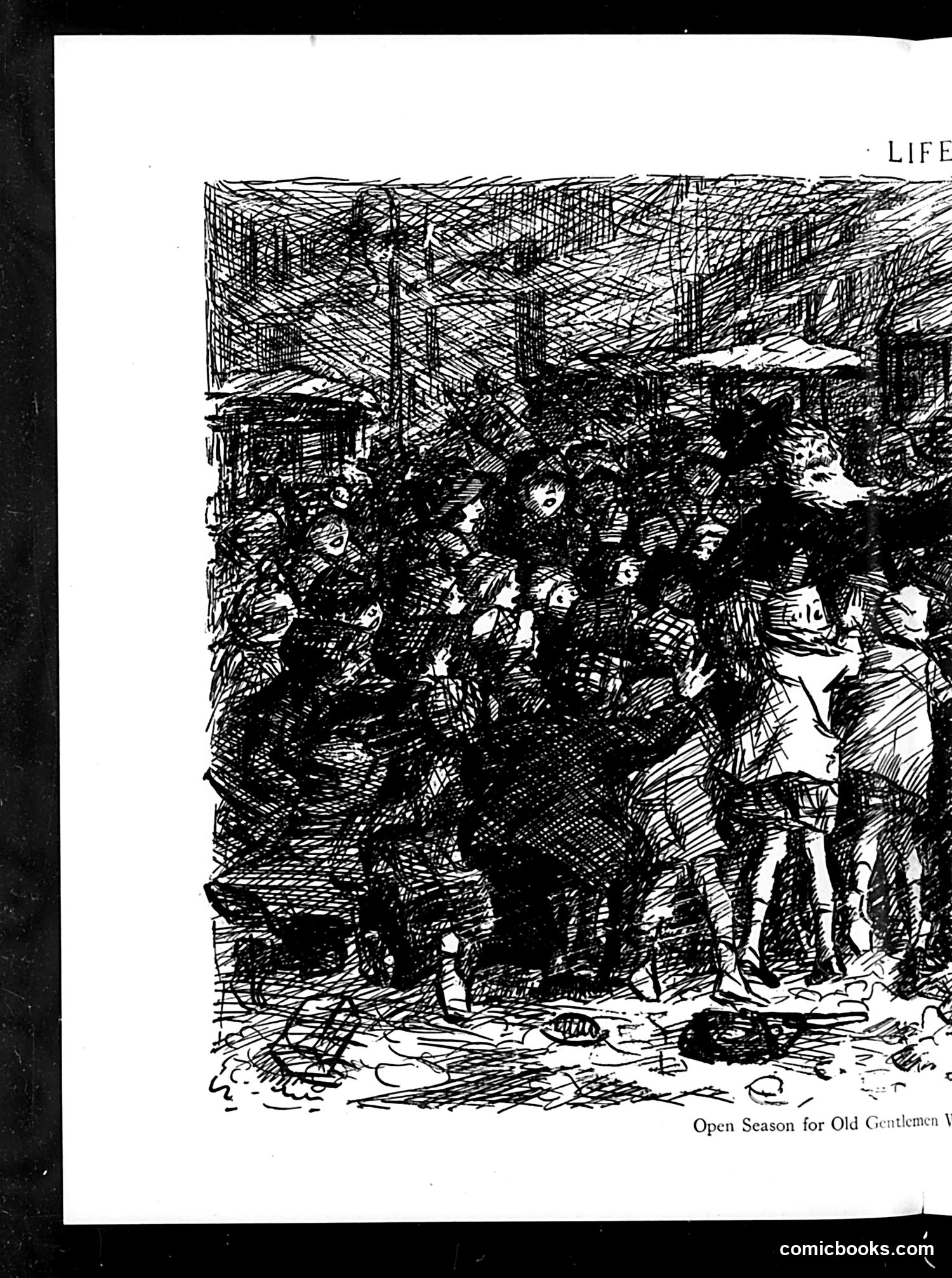
This appears to be a satirical illustration from *Life* magazine showing a crowded, chaotic scene with multiple figures gathered together. The caption reads "Open Season for Old Gentlemen," suggesting commentary on hunting or targeting elderly men. The dense crosshatching and jumbled composition emphasizes confusion or pandemonium. Without clearer visual identification of specific individuals or additional context, the exact satirical target remains unclear—it could reference retirement, social attitudes toward aging, or a specific contemporary event or practice. The "open season" language implies something previously restricted is now permitted, likely meant as social commentary on how society treats or takes advantage of older men. The quality of the OCR text prevents identifying more specific details.
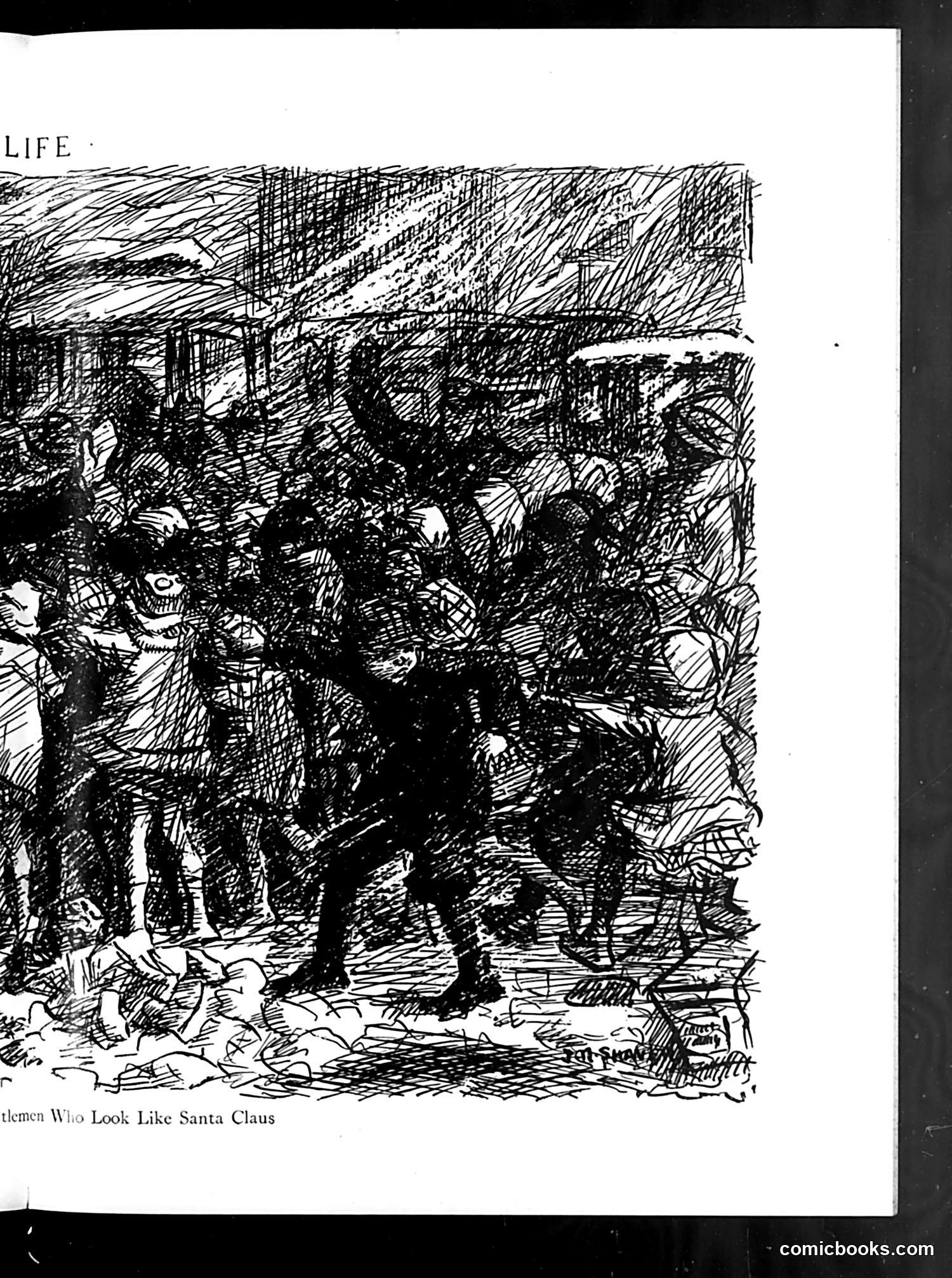
This satirical cartoon depicts a crowded gathering of men with full beards and rotund physiques — physical characteristics matching Santa Claus's appearance. The chaotic pen-and-ink style emphasizes their numbers and congestion. The joke appears to satirize either a specific group or social phenomenon of bearded, heavyset gentlemen, possibly mocking their prominence in society or a particular profession/organization. Without the complete caption or publication date visible, the specific target remains unclear — it could reference politicians, business leaders, or another identifiable class. The humor derives from the incongruity of "serious" men resembling a figure associated with jolly frivolity, suggesting either that these individuals are ridiculous or that appearance doesn't determine character or competence.
This satirical theater review attacks audiences who laugh at the *wrong moments* in the play "Close Harmony" (written by Dorothy Parker and Elmer Rice). The critic argues the mandolin-and-piano scene between characters James Spottswood and Wanda Lyon is genuinely tragic—depicting an unhappy marriage and emotional infidelity—yet some theatergoers laughed because the musical performance was technically poor. The joke: Life threatens violent retribution against these tone-deaf audience members, claiming they're biologically incapable of proper emotional response and should be eliminated. It's darkly comedic social commentary about cultural refinement—mocking both unsophisticated audiences *and* the pretentious expectation that theater-goers should feel prescribed emotions. The review then praises the Fourth Music Box Revue and performers like Fannie Brice, contrasting intelligent comedy with the earlier play's botched tragedy.
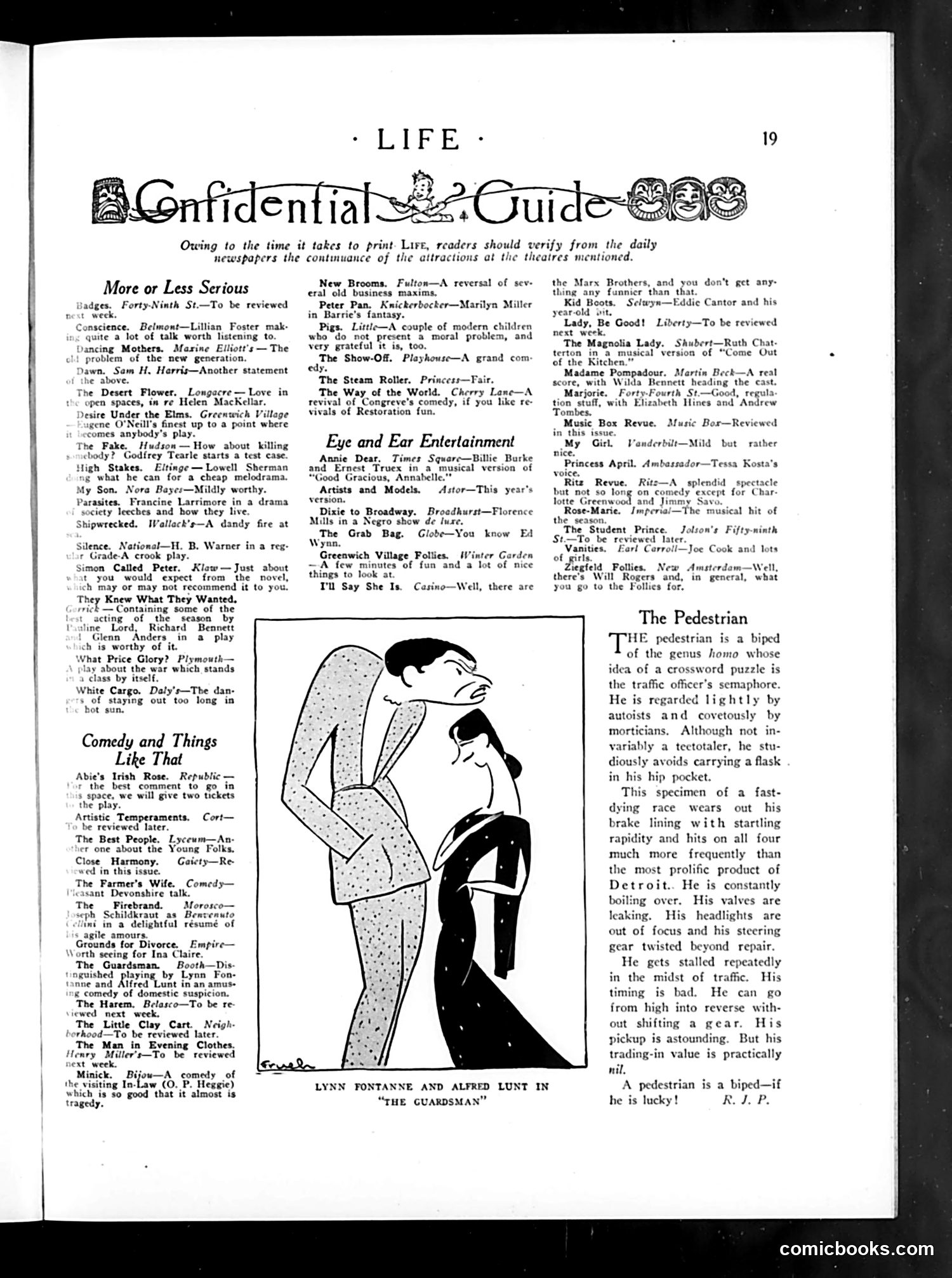
This page is primarily a **theater review section** from Life magazine, listing Broadway shows with brief critiques. The cartoon illustrates one show: Lynn Fontanne and Alfred Lunt in "The Guardsman." The image depicts a tall woman in a polka-dotted outfit towering over a much smaller man in evening clothes—a visual joke about marital dynamics and theatrical melodrama. "The Guardsman" was a comedy of "domestic suspicion" (as noted in the text), so the size disparity likely satirizes the power imbalance or comedic conflict between spouses in the play. The accompanying essay, "The Pedestrian," is unrelated satire mocking Detroit drivers—incompetent, accident-prone motorists who can't navigate traffic. This is primarily **entertainment journalism** rather than political satire, reflecting 1920s Broadway culture and the emerging automobile age.
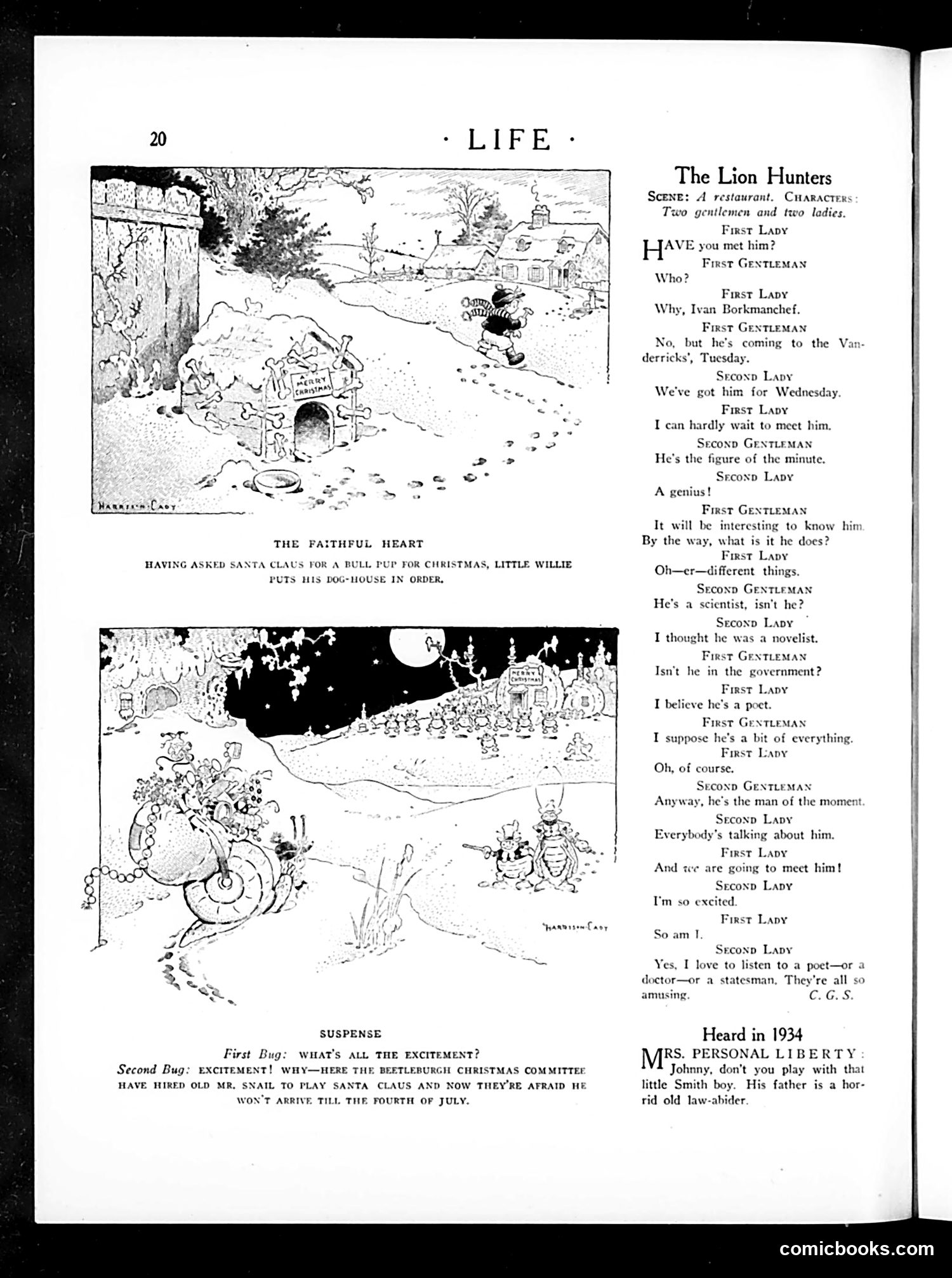
This satirical sketch mocks high-society social climbing and intellectual pretension. Two couples at a restaurant are breathlessly discussing meeting "Ivan Borkmanchef," a fashionable celebrity of the moment. The humor lies in their complete ignorance: when asked what he does, they offer contradictory answers—scientist, novelist, government official, poet—suggesting he's famous for being famous, not for any actual accomplishment. The women are especially portrayed as superficially eager to associate with him, calling him "the figure of the minute" and "a genius" while knowing nothing substantive about him. The sketch satirizes how the wealthy socially pursue celebrities indiscriminately, treating intellectual pursuits as mere amusing social accessories rather than serious endeavors.
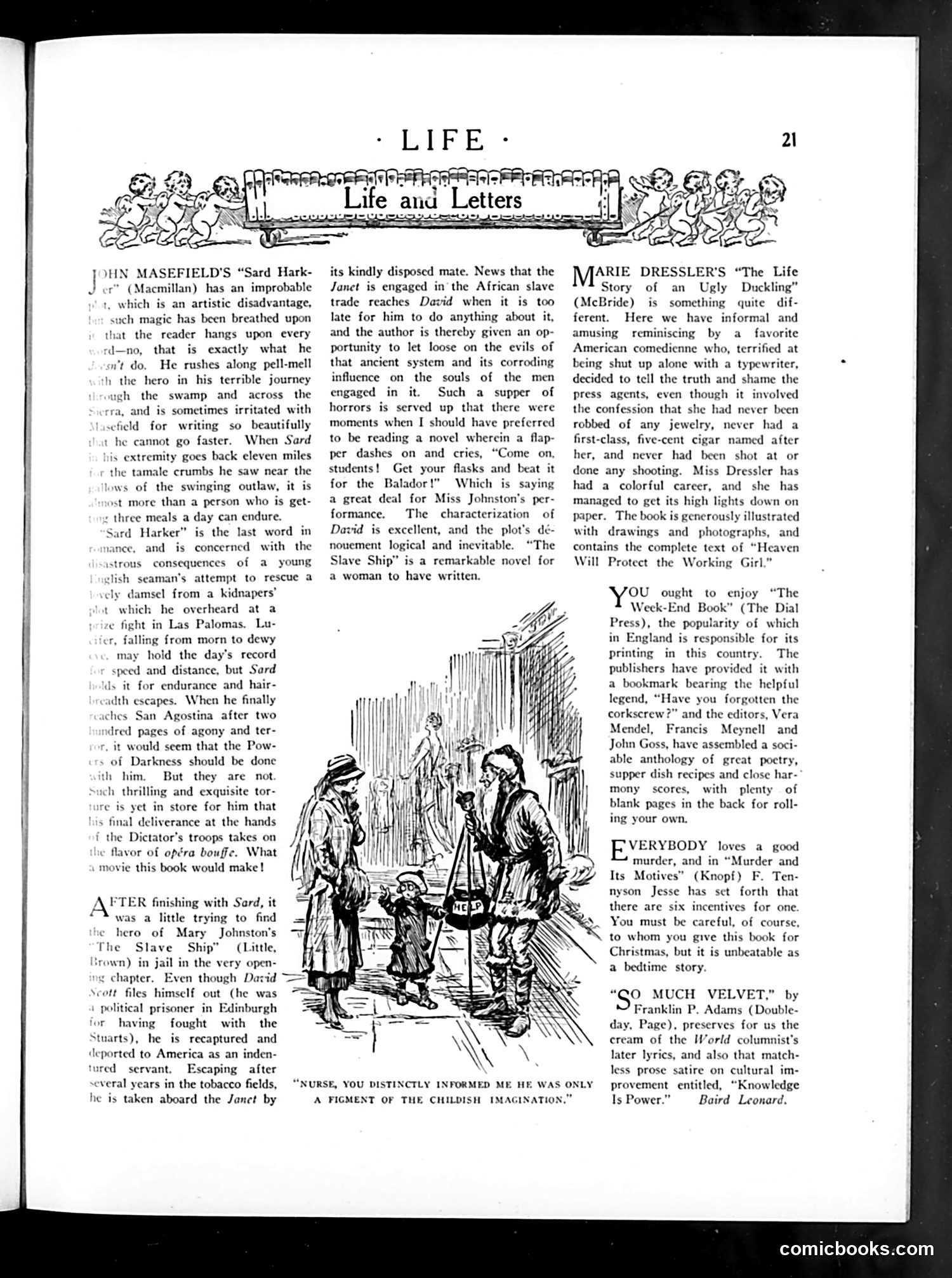
This page from *Life* magazine presents book reviews with one prominent cartoon. The cartoon depicts a nurse confronting a doctor, with the caption: "NURSE, YOU DISTINCTLY INFORMED ME HE WAS ONLY A FIGMENT OF THE CHILDISH IMAGINATION." **The Satire:** The joke satirizes medical practitioners who dismiss patients' complaints or symptoms as imaginary or psychological rather than real. The nurse has caught the doctor in a contradiction—he previously claimed the patient's ailment was imaginary, yet apparently the patient has now become tangible enough to require the nurse's care. This mocks doctors who use pseudo-scientific dismissal to avoid treating patients, particularly those from lower social classes or those presenting with symptoms the doctor finds inconvenient. **Historical Context:** Early 20th-century medicine frequently attributed patients' symptoms to hysteria or imagination, especially for women and working-class patients. The cartoon critiques this condescending medical practice. The page also reviews several books, including *Sard Harker* by John Masefield and *The Slave Ship* by Mary Johnston, but the cartoon is the primary visual humor.
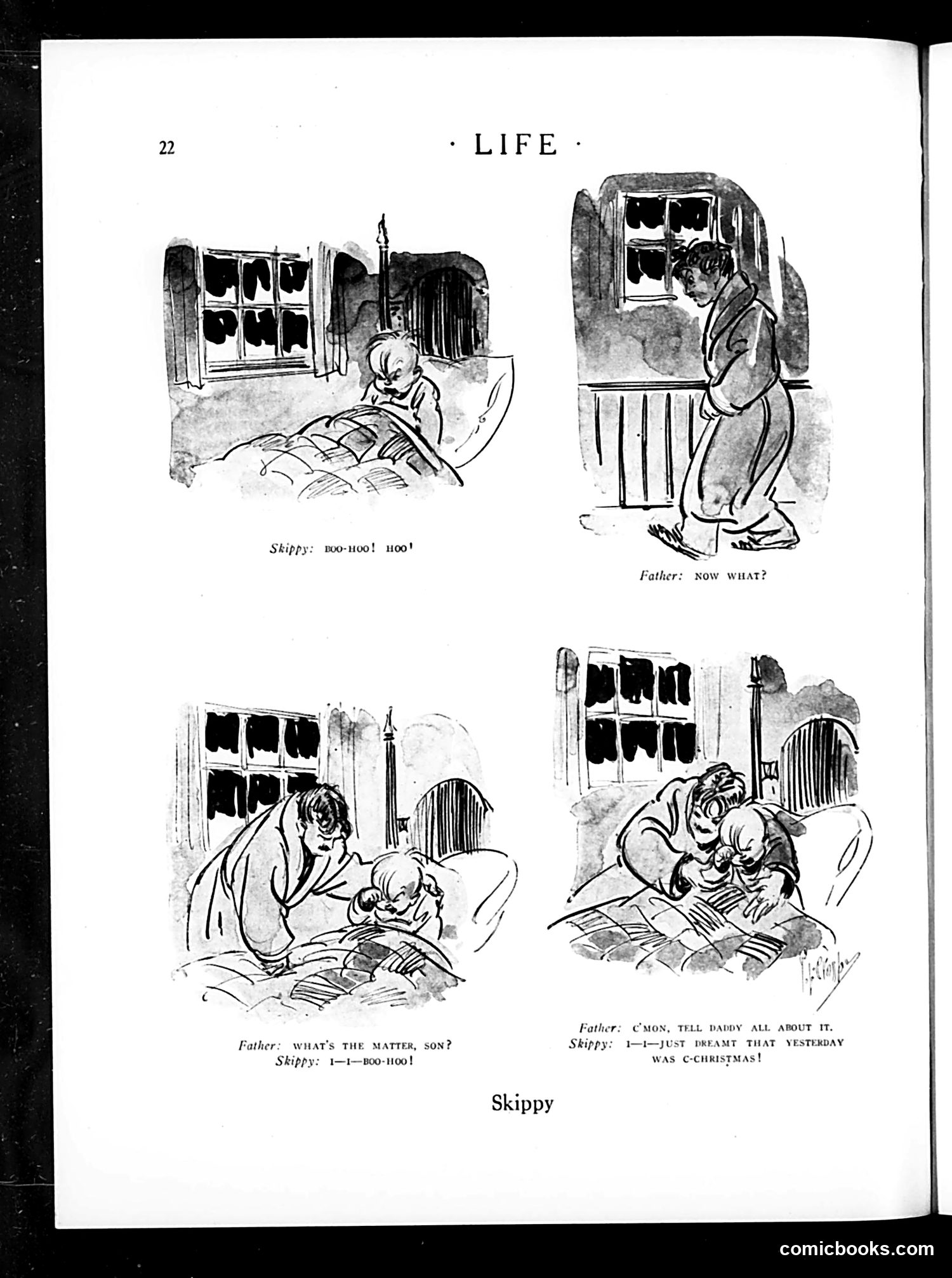
This is a four-panel comic strip featuring a child named Skippy and his father. The humor centers on a child's nightmare: dreaming that the previous day *was* Christmas—meaning he missed it entirely while sleeping. In the first panel, Skippy wakes up distressed, making excited noises ("woo-hoo! hoo!"). His father responds by asking what's wrong. In subsequent panels, Skippy explains through stutters and tears that he had a terrible dream where he slept through Christmas Day itself. The joke plays on children's anxiety about missing major holidays and the comedic exaggeration of that fear. The strip satirizes nothing political; it's simply domestic humor about childhood worries, likely appealing to parents and children readers of *Life* magazine during this era.
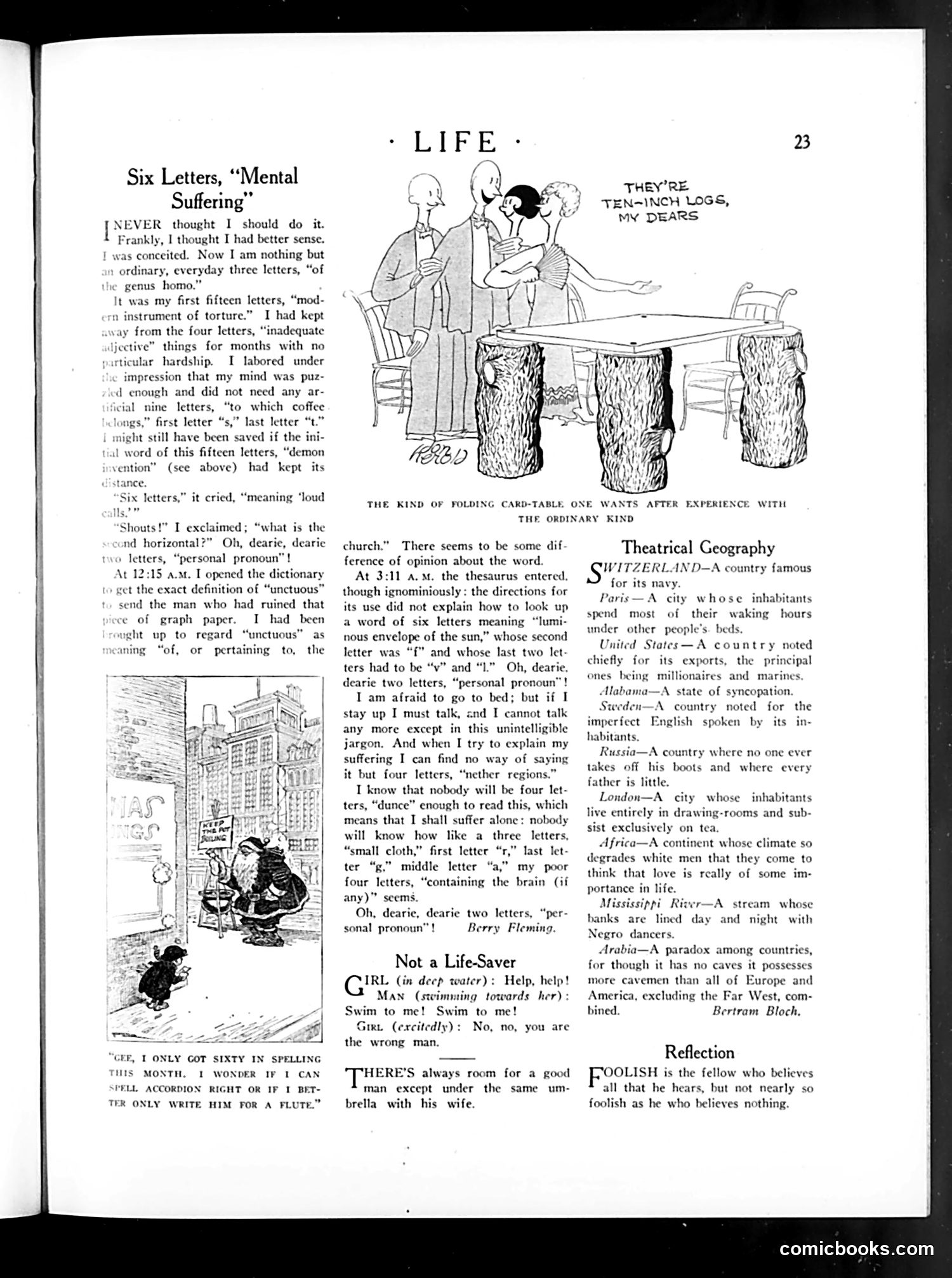
**"Mental Suffering" Column (left):** A humorous lament about attempting crossword puzzles. The author describes the mental anguish of struggling with cryptic clues involving wordplay—like a six-letter word meaning "loud calls" (SHOUTS) or trying to define obscure words like "unctuous." By 3:11 a.m., they're consulting dictionaries and thesauruses in desperation. The satire mocks both the puzzle's difficulty and the author's obsessive nature. **"Not a Life-Saver" (center):** A drowning woman calls for help, but when a man swims toward her, she refuses him—he's "the wrong man." The joke suggests marital discord: she'd apparently rather drown than be rescued by her husband. **"Theatrical Geography" (right):** Satirical definitions of countries and cities mocking national stereotypes—Swiss banks, Parisian apartment layouts, American millionaires, London's tea culture, African colonial attitudes, and Arabia's paradoxes. Standard early-20th-century stereotyping humor. The page reflects 1920s middlebrow magazine humor targeting educated readers familiar with puzzles, geography, and domestic comedy.
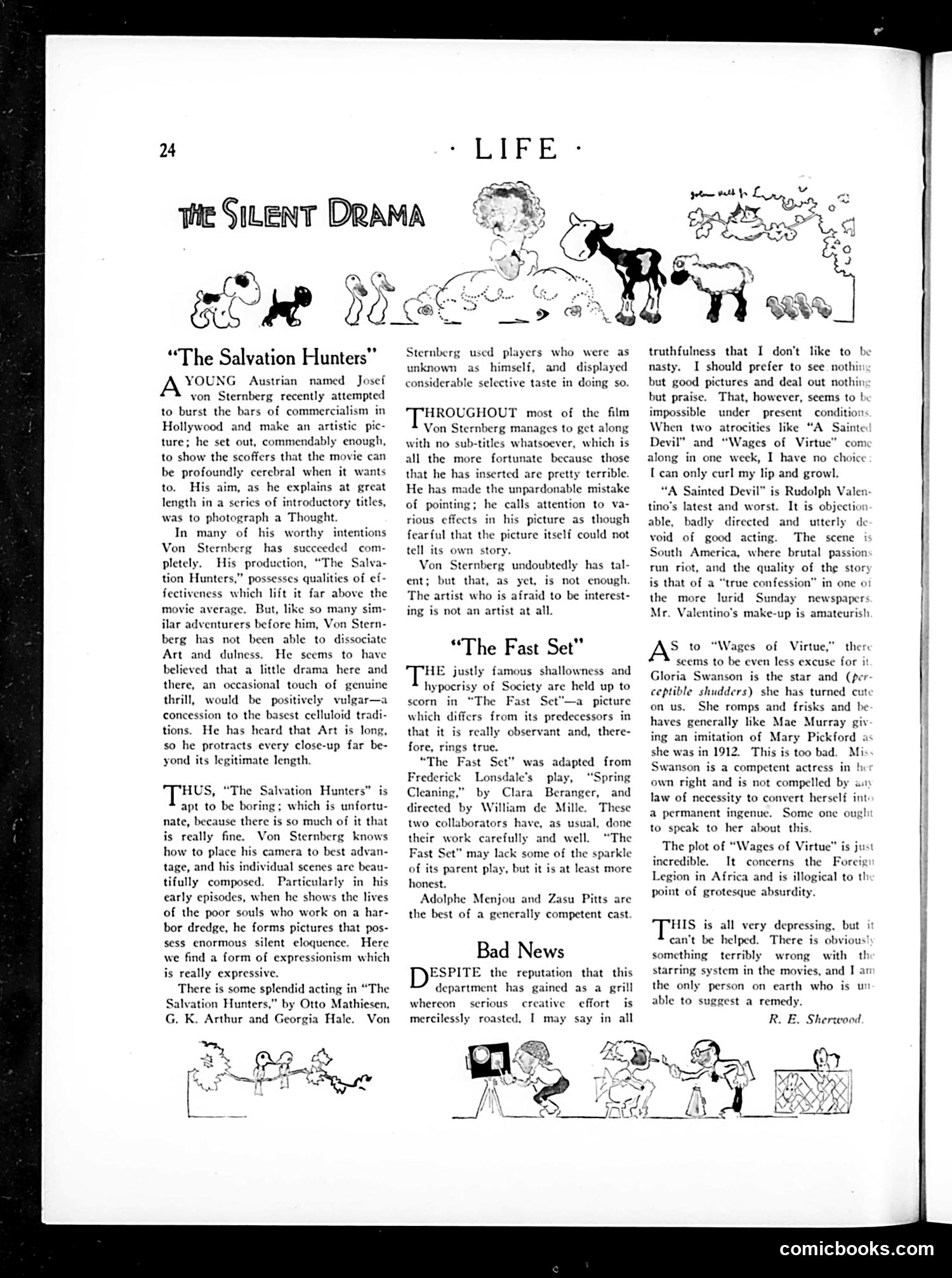
This is a 1920s film criticism page reviewing three movies. The reviews critique directors' artistic pretensions versus entertainment value: **"The Salvation Hunters"**: Director Josef von Sternberg attempted an "artistic" film to prove cinema could be intellectually serious. The critic praises his visual composition and expressionist cinematography but faults him for confusing "art" with tedium—he holds scenes too long, avoids drama thinking it's "vulgar," and over-explains his effects with clumsy title cards. The verdict: talented but self-defeating through excessive seriousness. **"The Fast Set"**: A society comedy adapted from a play, praised for actually being honest about upper-class hypocrisy rather than glorifying it. Competently made and more successful than its source material. **"Bad News"**: The critic resignedly reviews two "atrocities"—Rudolph Valentino's "A Sainted Devil" and "Wages of Virtue"—both apparently melodramatic failures. The tone is exasperated resignation that serious creative films share the screen with garbage. The overall satire targets artistic pretension in silent cinema.
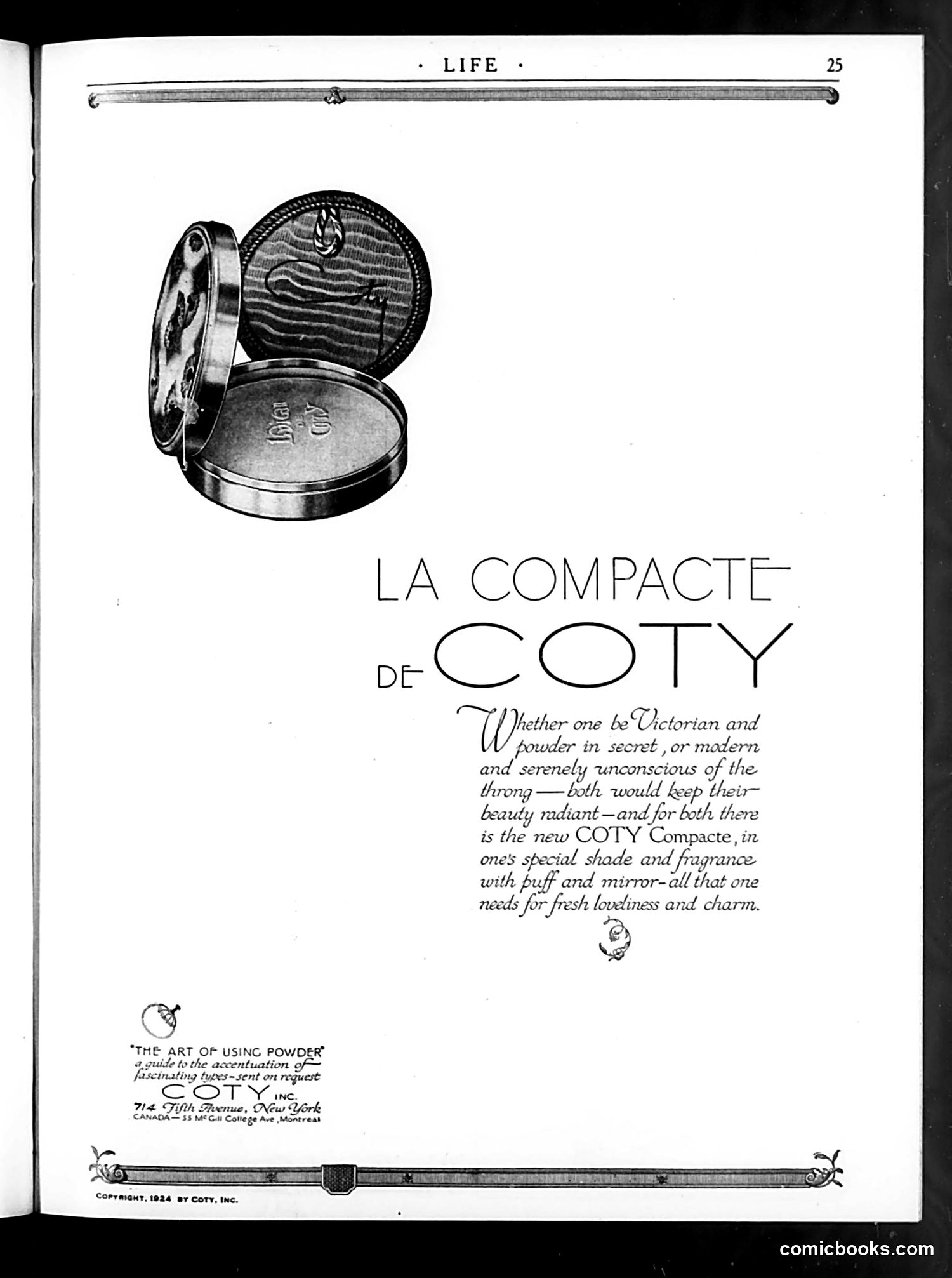
This is a **cosmetics advertisement**, not a political cartoon. It promotes Coty's compact powder case, published in Life magazine (copyright 1924). The ad uses social commentary to market the product: it contrasts "Victorian" women who powder secretly with "modern" women who openly apply makeup without shame. Rather than satirizing either group, the ad suggests Coty's compact serves both—enabling discreet beauty maintenance regardless of one's social attitudes toward cosmetics. The imagery shows an open compact with mirror and puff. The accompanying text emphasizes practicality ("puff and mirror—all that one needs") while appealing to vanity ("fresh loveliness and charm"). This reflects 1920s social shifts: the "modern" woman represented changing attitudes about makeup, which was becoming socially acceptable after decades of association with impropriety. The ad cleverly positions the product as bridging old and new standards of femininity.
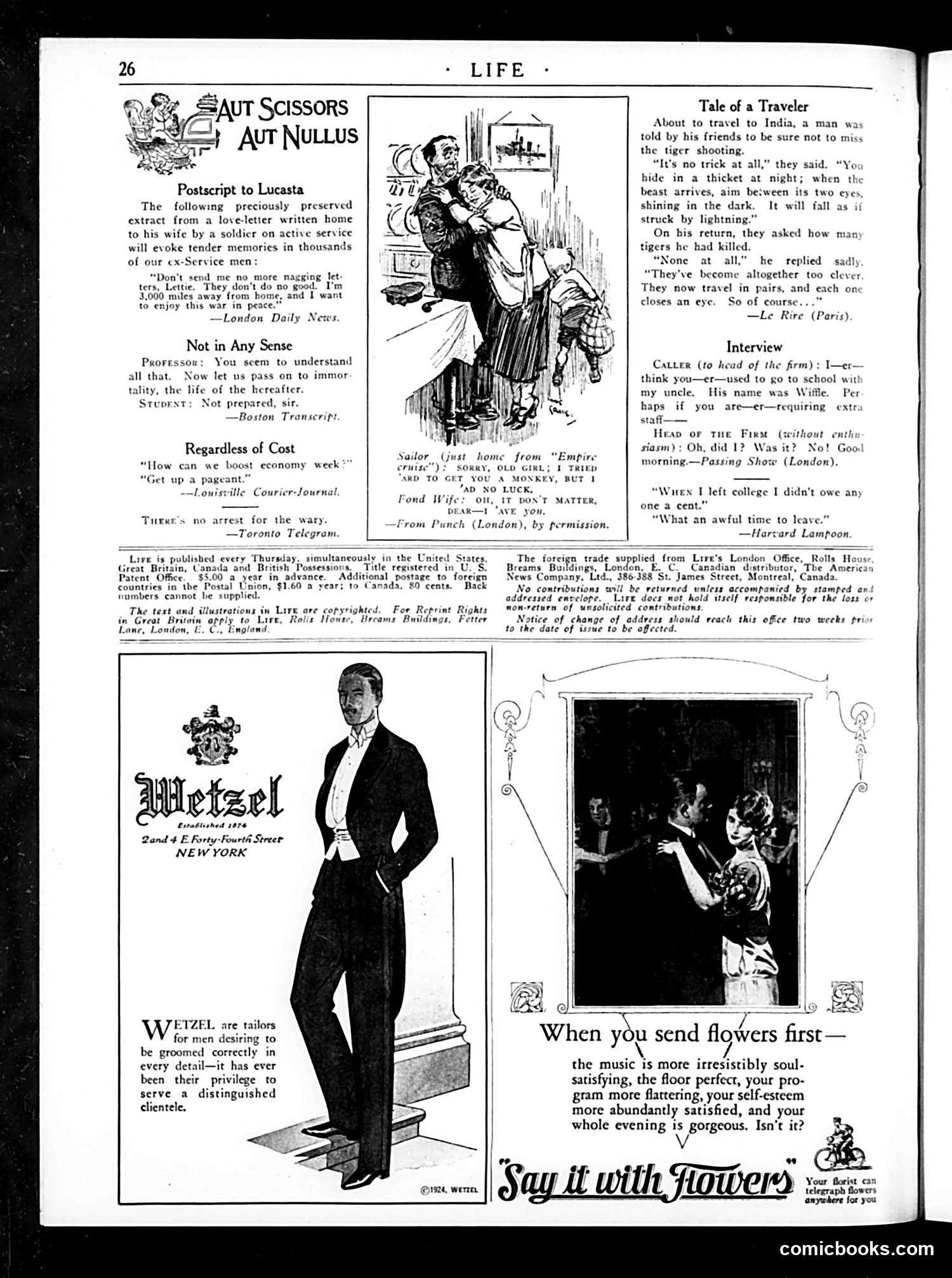
This page from the satirical magazine *Life* contains several short humorous pieces targeting post-WWI society: **"Postscript to Lucasta"** mocks soldiers' attitudes, presenting a letter where a serviceman complains that his wife's nagging letters don't help him 3,000 miles away—he wants to "enjoy this war in peace," satirizing soldiers' detachment from home concerns. **"Not in Any Sense"** jokes about a student unprepared to discuss the afterlife, playing on the disconnect between academic knowledge and spiritual matters. **"Regardless of Cost"** criticizes empty "economy week" campaigns. The **sailor cartoon** shows a returning serviceman apologizing to his wife for failing to bring her a monkey souvenir; she responds that his presence matters more—sentimental humor about wartime reunions. The page also includes standard advertisements (Wetzel tailors, florist services) and miscellaneous short jokes from various publications, typical of *Life's* format mixing satire with commercial content. The overall tone reflects post-war adjustment and social commentary common to 1920s humor.
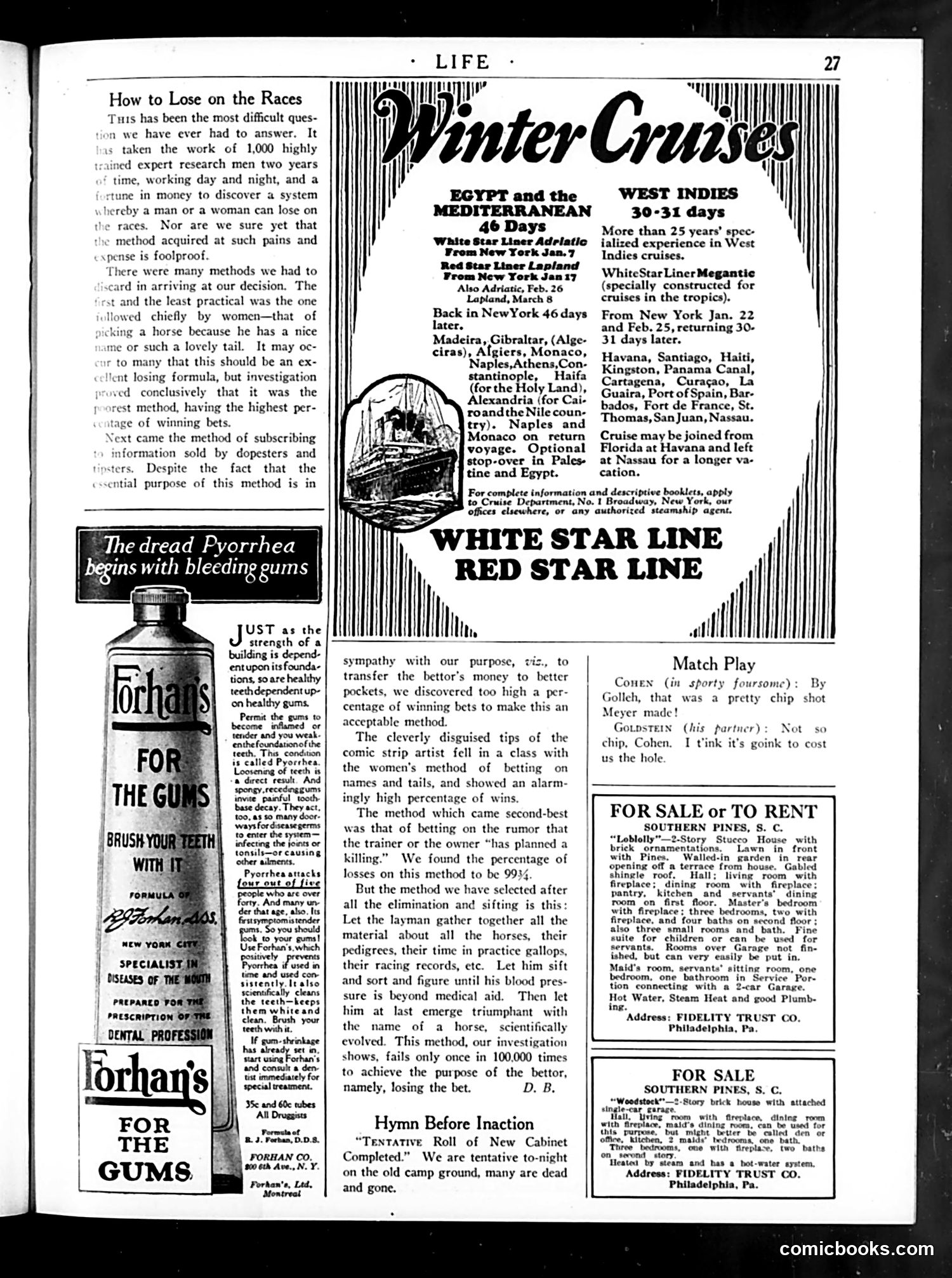
This satirical article mock-seriously investigates methods for *losing* money at horse racing—inverting typical gambling advice. The humor lies in presenting extensive "research" on betting strategies that actually *win*, then dismissively rejecting them as unsuitable for the goal of losing money. The piece ridicules common betting methods: women choosing horses by name/appearance (which surprisingly wins often), buying tips from "dopesters," and heeding comic strip advice. It claims the most reliable loss-producing method is careful analysis of horses' records and pedigrees—implying that systematic study ironically defeats the gambler's purpose. The satire critiques both gambling culture and the era's proliferation of dubious "expert" tipsters and systems. By framing losing as the actual goal, Life highlights how futile and self-defeating betting truly is. This reflects Progressive-era skepticism toward get-rich-quick schemes and gambling's false promises of success.
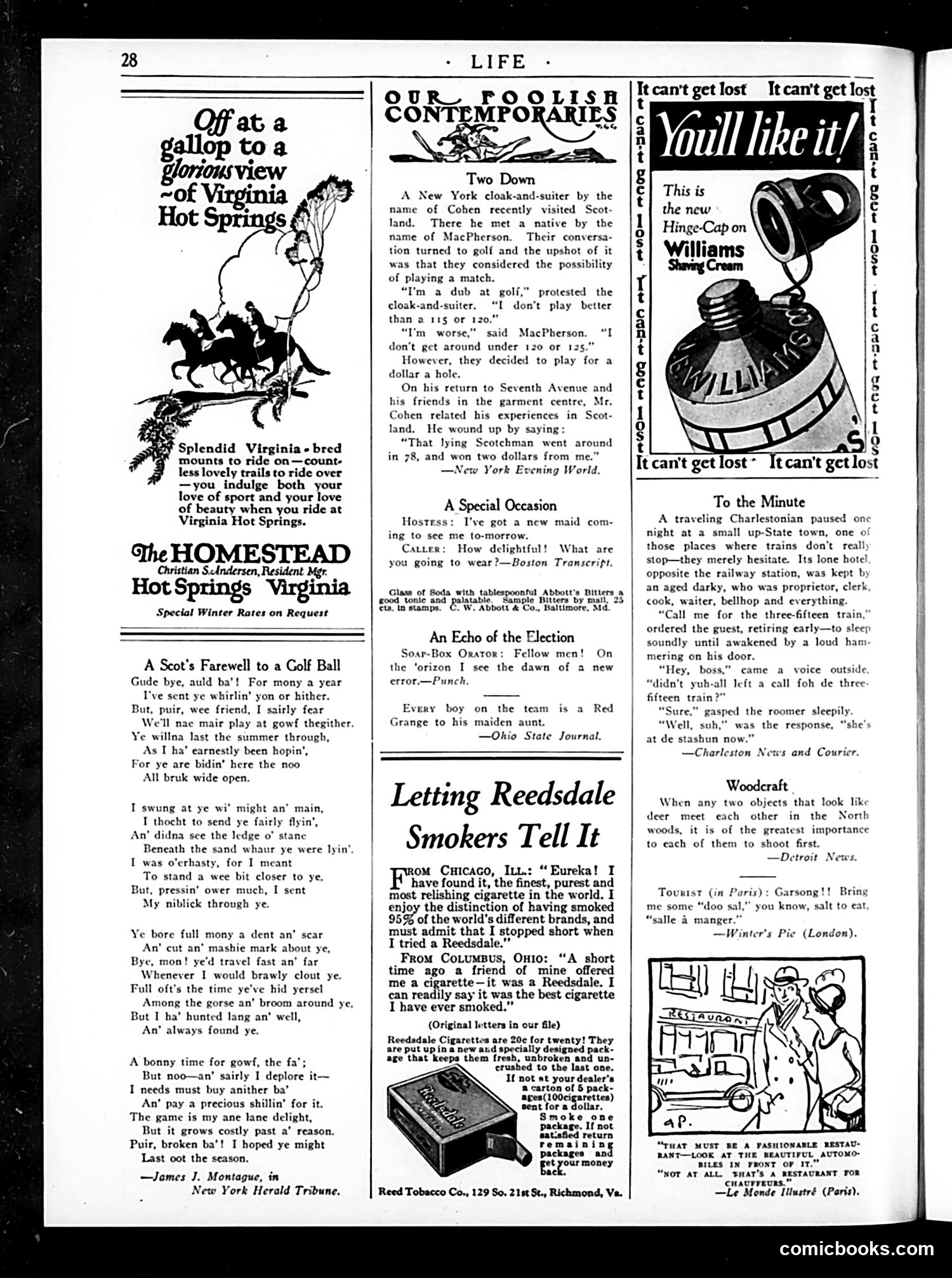
This page combines humorous content with advertising. The main cartoons and pieces satirize: **"A Scot's Farewell to a Golf Ball"**: A Scottish poem lamenting a worn-out golf ball, using dialect humor to mock golf's expense as a hobby ("I needs must buy anither ba' / An' pay a precious shil for it"). **"Two Down"**: A joke about ethnic stereotypes—a New York Jewish garment-industry man ("Cohen") plays golf against a Scottish native ("MacPherson"). The punchline plays on the "dishonest Scotsman" stereotype: Cohen claims MacPherson shot 78 and won money, implying the Scot cheated and lied about his score. **"An Echo of the Election"**: A political cartoon joke referencing a recent election, though the specific context is unclear without dating the issue. The page is primarily **advertising** for Virginia Hot Springs resort, Reedsdale cigarettes, and Williams Shaving Cream, interspersed with these satirical pieces targeting working-class leisure activities and ethnic humor typical of 1920s-era Life magazine.
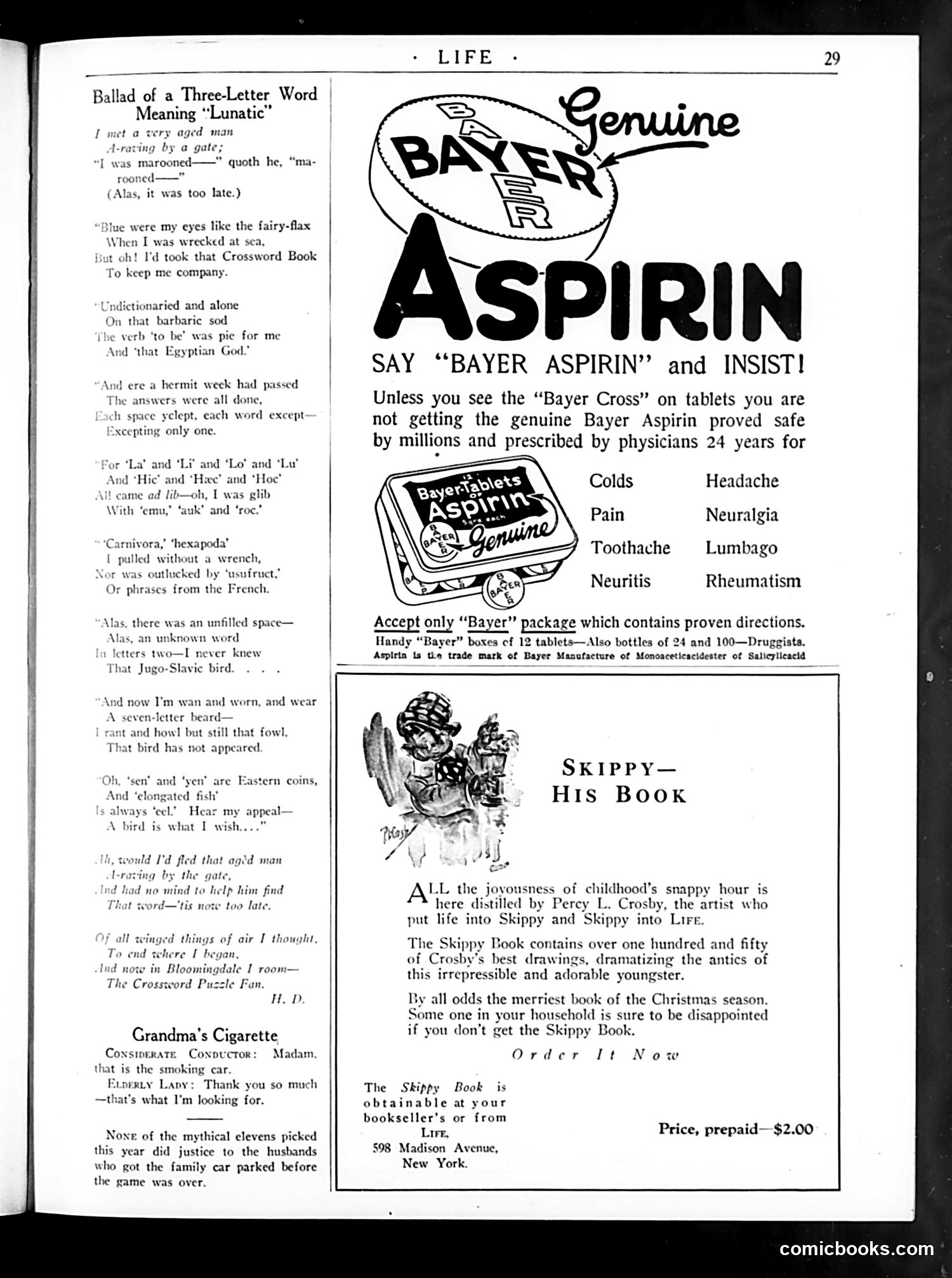
This page contains two distinct elements: **Left side - "Ballad of a Three-Letter Word Meaning 'Lunatic'"**: A satirical poem mocking the crossword puzzle craze of the 1920s-30s. The elderly narrator describes becoming obsessed with crossword solving after being shipwrecked, eventually going mad searching for obscure three-letter words. The humor targets how addictive and mentally consuming these puzzles had become—a genuine cultural phenomenon of the era. **Right side - Advertisements**: The bulk of the page features a Bayer Aspirin ad (emphasizing the "Bayer Cross" trademark and warning against counterfeits) and a promotion for "Skippy: His Book," a children's collection by artist Percy L. Crosby featuring the popular comic strip character. The page reflects Life's formula: satirical literary content alongside period advertising. The crossword satire suggests these puzzles were widely mocked as an intellectual obsession among Americans, while the ads reflect early 20th-century consumer culture and brand-name awareness.
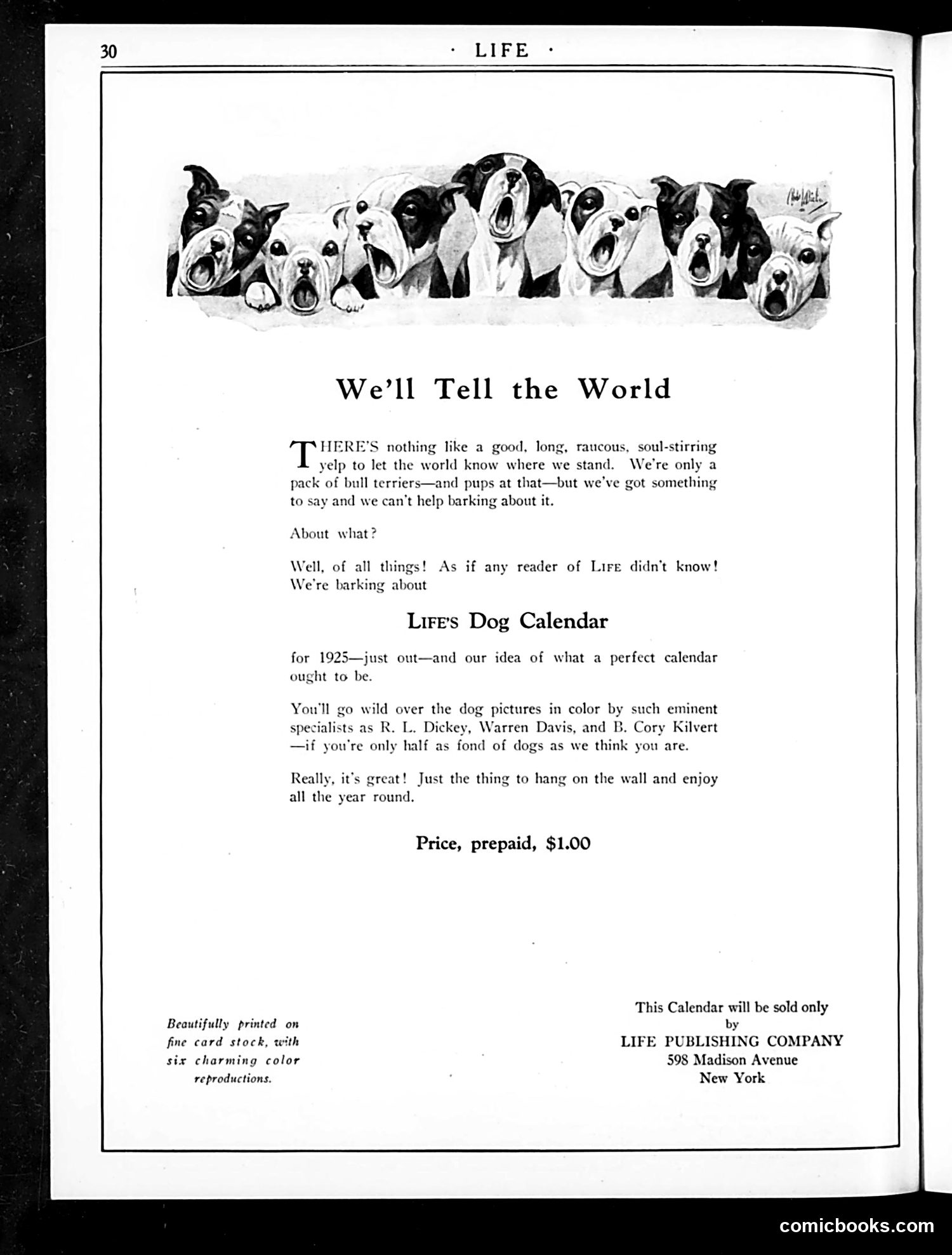
This is primarily an **advertisement** for Life magazine's 1925 Dog Calendar, not a political cartoon. The illustration shows a group of bull terriers and puppies with exaggerated expressions, barking in unison—a visual metaphor for the magazine itself "making noise" to promote its product. The humor is self-referential: Life personifies itself as a "pack of bull terriers" that must "bark" (advertise loudly) to get attention. The text playfully acknowledges this is an ad while treating the calendar as essential merchandise. The calendar features dog illustrations by named artists (R.L. Dickey, Warren Davis, B. Cory Kilvert) and cost one dollar prepaid. This reflects early 20th-century magazine culture where satirical publications like Life mixed editorial content with product promotion. The "barking" conceit connects the magazine's sharp, vocal satirical voice to the literal noise-making of dogs—positioning Life as bold and attention-demanding.
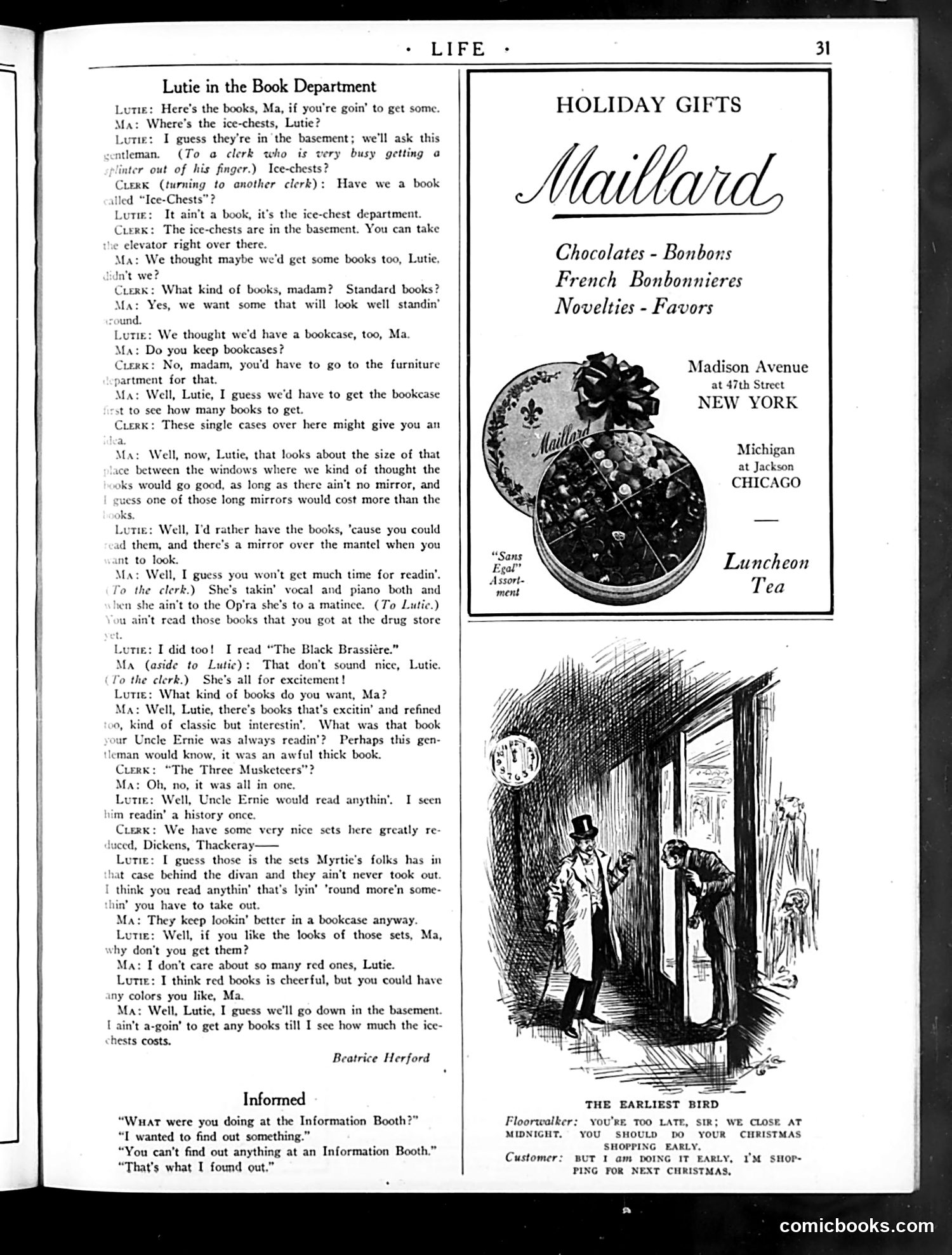
This page contains two satirical pieces from *Life* magazine's humor section: **"Lutie in the Book Department"** mocks early-20th-century consumer culture and female domesticity. Ma and her daughter Lutie visit a department store seeking books, but their priorities reveal materialism over literacy: Ma cares primarily about how books look as furniture ("they keep lookin' better in a bookcase"), not reading them. The clerk's confusion and the family's detour to price ice-chests first underscore the absurdity—books are decorative status symbols, not intellectual tools. Lutie's mother constantly interrupts with judgments about propriety ("That don't sound nice, Lutie"), highlighting the era's restrictive social expectations for women. **"The Earliest Bird"** and **"Informed"** are brief joke cartoons playing on common expressions. The first subverts "the early bird catches the worm" by showing someone shopping for *next* Christmas in December—extreme early planning. The second mocks the obvious uselessness of information booths. The page also features a Maillard chocolate advertisement.
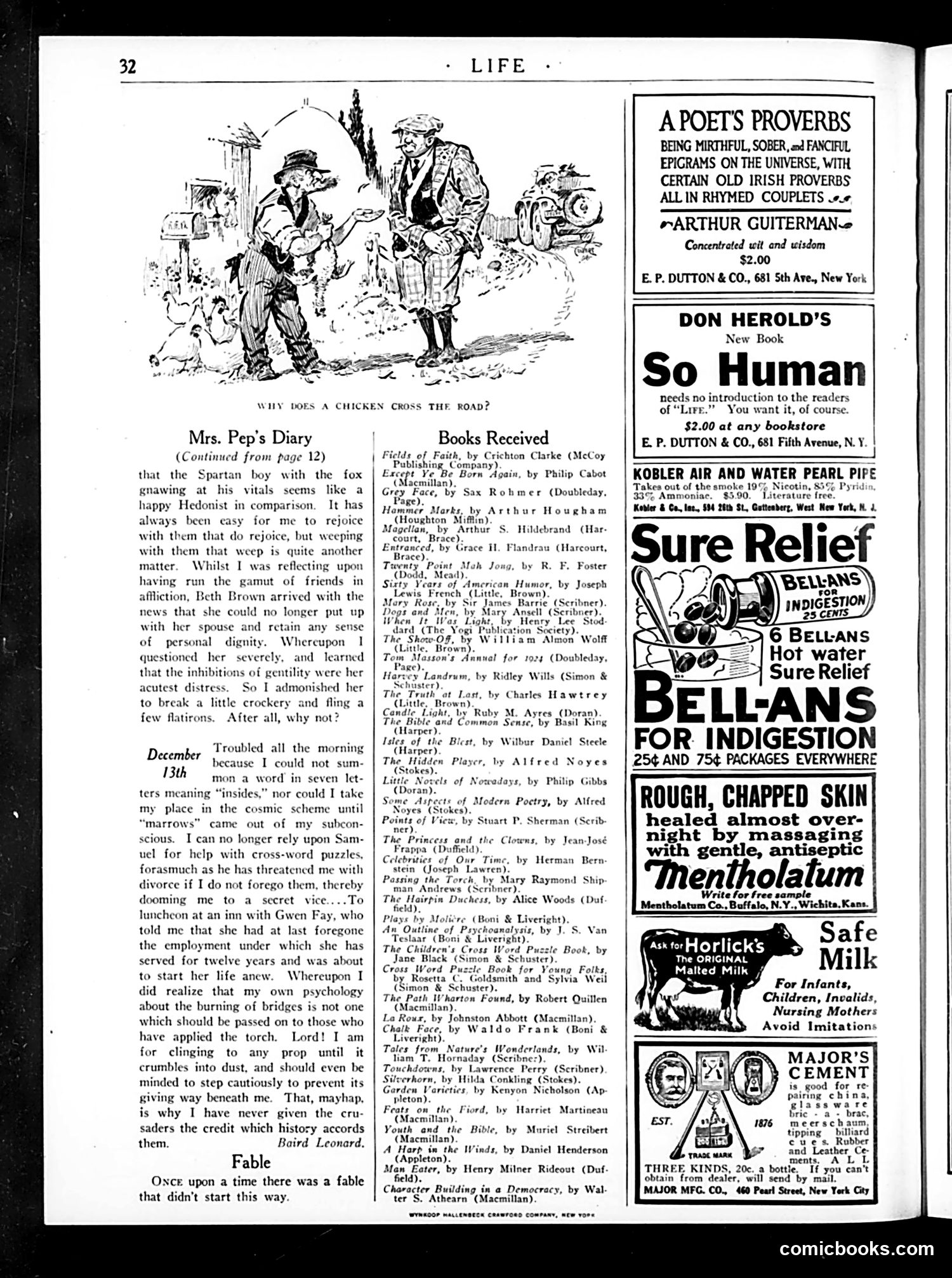
The main cartoon illustrates the joke "Why Does a Chicken Cross the Road?"—a classic riddle that was apparently popular enough in the 1920s to warrant satirical commentary in *Life* magazine. The image shows well-dressed men in period clothing observing a chicken crossing a street, treating the mundane sight as if it were a profound philosophical or social event worthy of serious analysis. The satire mocks how people over-intellectualize trivial matters, turning a simple occurrence into something requiring elaborate explanation. The accompanying text about "Mrs. Pep's Diary" concerns domestic life, personal psychology, and social propriety—typical *Life* magazine content. The page is otherwise filled with book advertisements and literary reviews from 1924. The joke's humor relies on the contrast between the chicken's simple action and the gentlemen's apparent gravity—poking fun at contemporary pretentiousness and the human tendency to complicate the obvious.
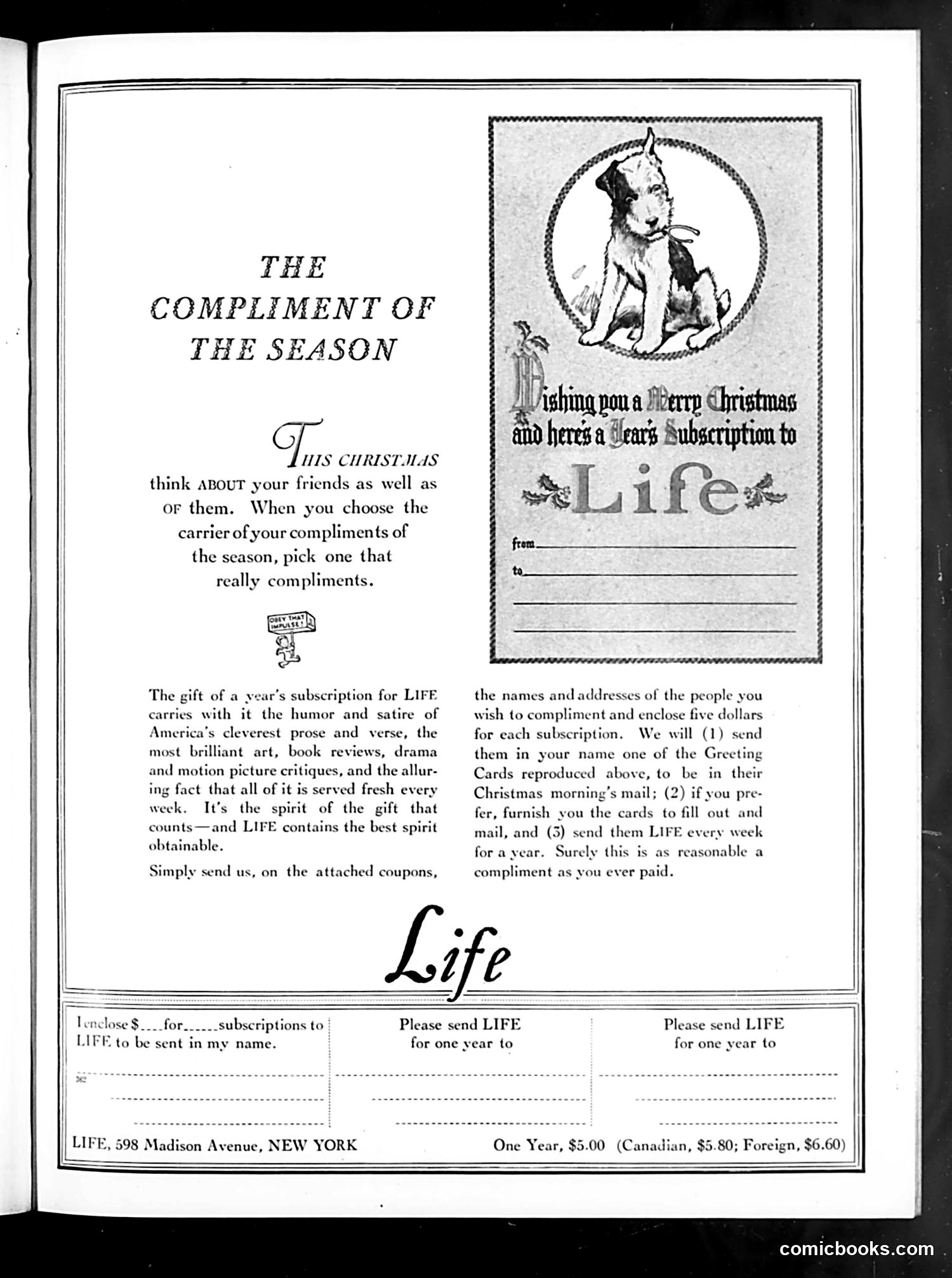
This is primarily a **Christmas gift advertisement** for Life magazine subscriptions, not a political cartoon. The page promotes giving a year-long Life subscription as a holiday gift. The main visual is a **greeting card design** featuring a small dog wearing a bow tie, with old-English lettering wishing recipients "a Merry Christmas and here's a Year's Subscription to Life." The sales pitch emphasizes Life's appeal: it offers humor, satire, book reviews, drama and film criticism—"served fresh every week." The advertisement suggests this gift reflects thoughtfulness toward friends. The mechanics are straightforward: senders enclose $5 per subscription, provide recipient names and addresses, and Life will either mail the pre-printed greeting cards or furnish blanks for personalization, then deliver the magazine weekly for a year. The cost was $5 annually (with Canadian and foreign rates noted as higher). The address given is Life's New York office at 598 Madison Avenue.
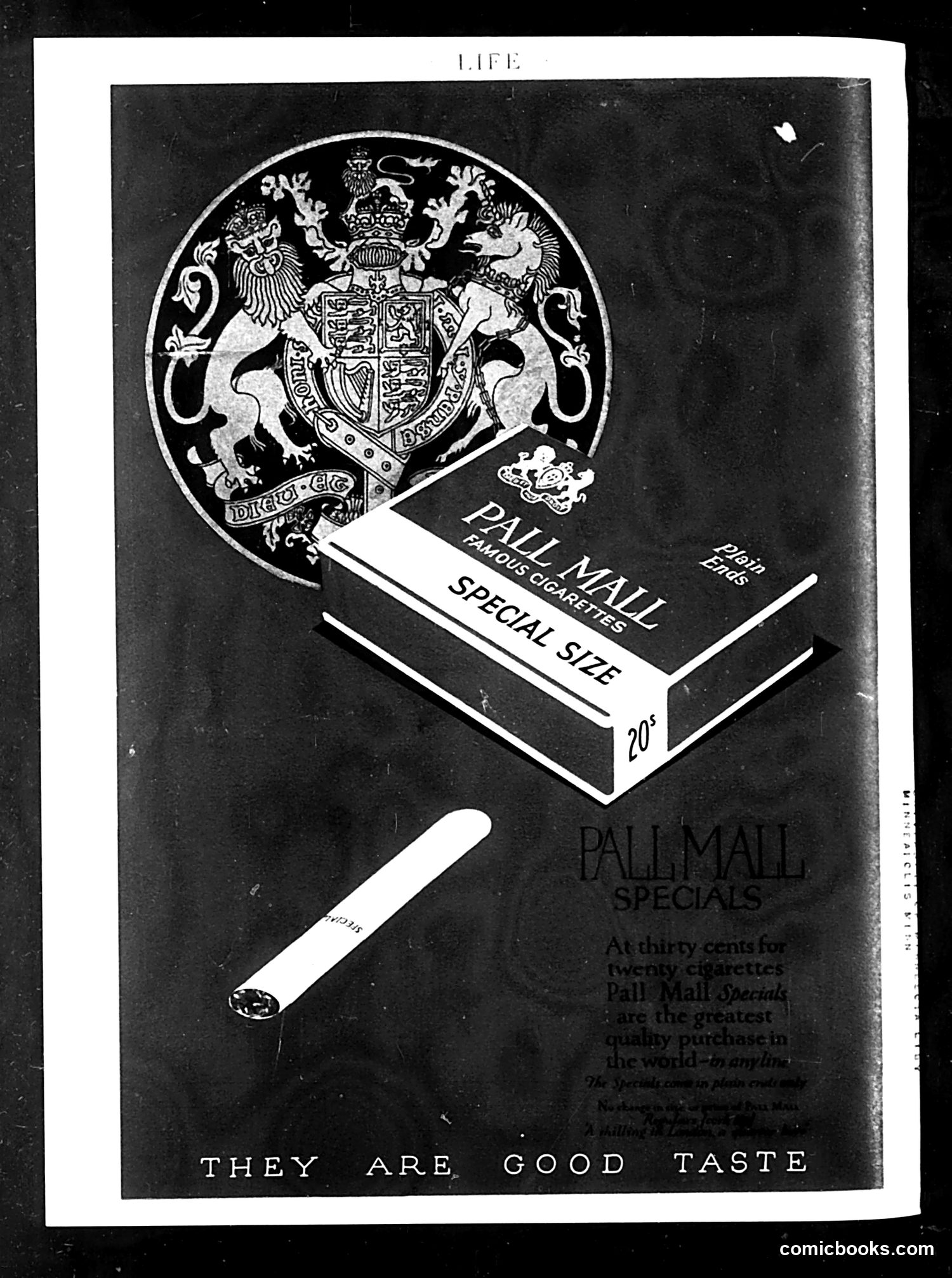
This is a **cigarette advertisement**, not a political cartoon or satire. The page advertises "Pall Mall Special Size" cigarettes at thirty cents for twenty cigarettes. The design features the British Royal Coat of Arms (the lions, unicorn, and heraldic shield), which appears meant to suggest quality, prestige, and aristocratic association. The advertisement claims these cigarettes represent "the greatest quality purchase in the world." The tagline "They Are Good Taste" plays on the dual meaning of taste—both flavor and refined social judgment. By associating the product with British royal imagery, the ad appeals to aspirational consumers seeking to signal sophistication and class through cigarette choice. This reflects early-to-mid 20th century advertising practices of using national symbols and status markers to market consumer goods.

I can see this is a very dark, heavily degraded scan from what appears to be a historical publication. The image quality is extremely poor—the page is nearly black with only faint outlines visible in the right portion that might suggest some kind of illustration or cartoon, though the details are impossible to discern clearly. The only legible text is "comicbooks.com" at the bottom right, which appears to be a watermark from the source website rather than original page content. Without readable OCR text content or visible cartoon details, I cannot reliably identify specific figures, political references, or explain the satire intended. The scan quality prevents accurate historical analysis of this page.