
Life, 1924-12-18 · page 23 of 37
Life — December 18, 1924 — page 23: what you’re looking at
What you’re looking at
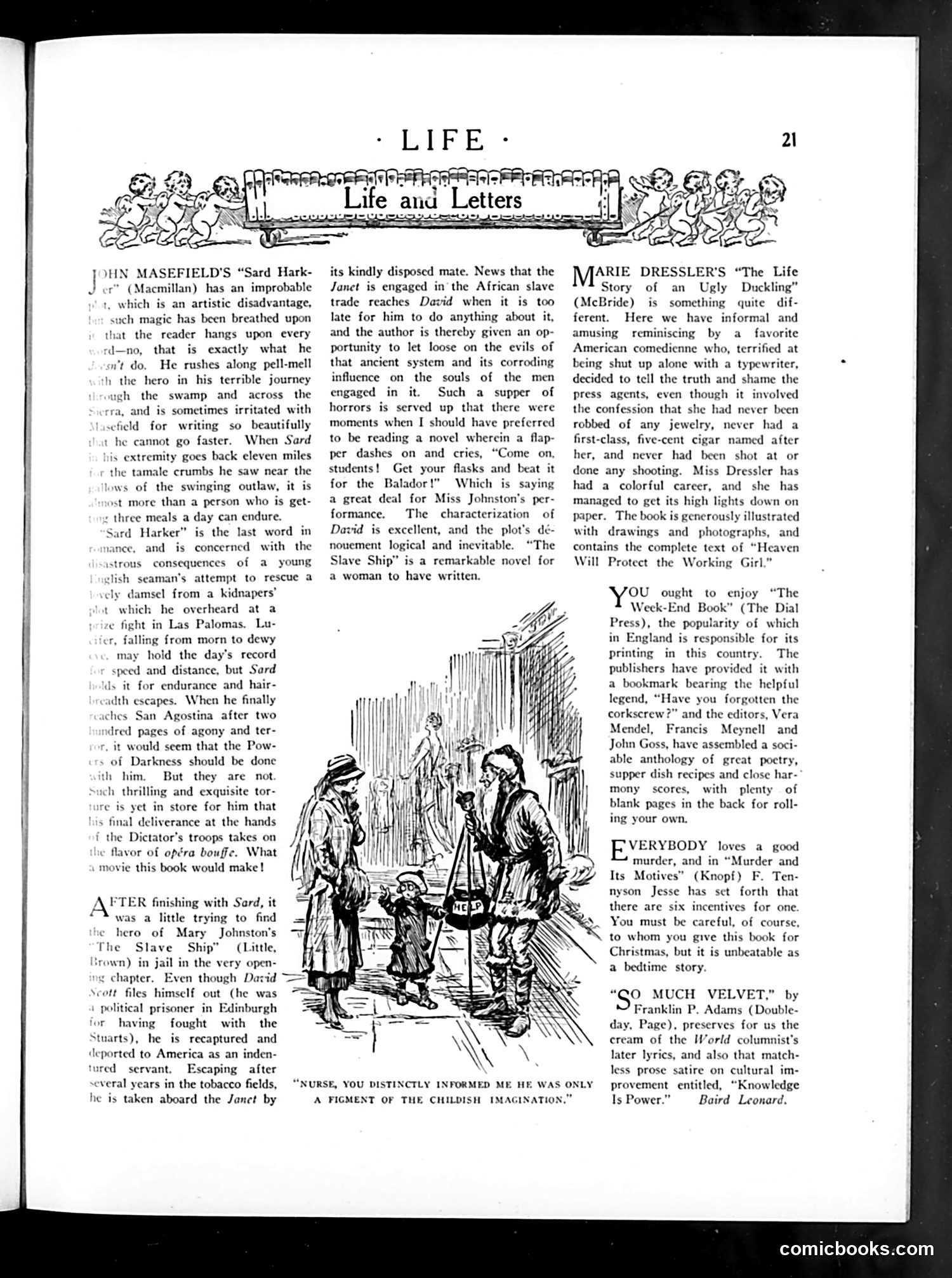
This page from *Life* magazine presents book reviews with one prominent cartoon. The cartoon depicts a nurse confronting a doctor, with the caption: "NURSE, YOU DISTINCTLY INFORMED ME HE WAS ONLY A FIGMENT OF THE CHILDISH IMAGINATION." **The Satire:** The joke satirizes medical practitioners who dismiss patients' complaints or symptoms as imaginary or psychological rather than real. The nurse has caught the doctor in a contradiction—he previously claimed the patient's ailment was imaginary, yet apparently the patient has now become tangible enough to require the nurse's care. This mocks doctors who use pseudo-scientific dismissal to avoid treating patients, particularly those from lower social classes or those presenting with symptoms the doctor finds inconvenient. **Historical Context:** Early 20th-century medicine frequently attributed patients' symptoms to hysteria or imagination, especially for women and working-class patients. The cartoon critiques this condescending medical practice. The page also reviews several books, including *Sard Harker* by John Masefield and *The Slave Ship* by Mary Johnston, but the cartoon is the primary visual humor.
📄 Transcribed text from this page (OCR, searchable)
Machine-transcribed from the original scan — historical spelling and the odd misread are preserved.
é for having fought with the Stuarts), he is recaptured and ‘leported to America as an inden- tured servant. Escaping after everal years in the tobacco fields, “NURSE, YOU DISTINCTLY INFORMED ME HE WAS ONLY provement entitled, “Knowledge A FIGMENT OF THE CHILDISH IMAGINATION.” Is Power.” Baird Leonard. )HN MASEFIELD'S “Sard Hark- ©” (Macmillan) has an improbable which is an artistic disadvantage, ch magic has been breathed upon t the reader hangs upon every no, that is exactly what he n't do. He rushes along pell-mell h the hero in his terrible journey ugh the swamp and across the ra, and is sometimes irritated with scfield for writing so beautifully t he cannot go faster. When Sard is extremity goes back eleven miles the tamale crumbs he saw near the lows of the swinging outlaw, it is yst more than a person who is get- « three meals a day can endure. rd Harker” is the last word in and is concerned with the consequences of a young glish seaman’s attempt to rescue a msel from a kidnapers’ he overheard at a ¢ fight in Las Palomas. Lu- r, falling from morn to dewy may hold the day’s record speed and distance, but Sard ds it for endurance and hair- idth escapes. When he finally whes San Agostina after two dred pages of agony and ter- it would seem that the Pow- s of Darkness should be done th him. But they are not ch thrilling and exquisite tor- re is yet in store for him that s final deliverance at the hands f the Dictator’s troops takes on ¢ flavor of opéra bouffe. What movie this book would make! FTER finishing with Sard, it was a little trying to find ¢ hero of Mary Johnston's fhe Slave Ship” (Little, trown) in jail in the very ope ¢ chapter. en though David t files himself out (he was political prisoner in Edinburgh he is taken aboard the Janet by its kindly disposed mate. News that the Janet is engaged in the African slave trade reaches David when it is too late for him to do anything about it, and the author is thereby given an op- portunity to let loose on the evils of that ancient system and its corroding influence on the souls of the men engaged in it. Such a supper of horrors is served up that there were moments when I should have preferred to be reading a novel wherein a flap- per dashes on and cries, “Come on, students! Get your flasks and beat it for the Balador!” Which is saying a great deal for Miss Johnston's per- formance. The characterization of David is excellent, and the plot's dé- nouement logical and inevitable. “The Slave Ship” is a remarkable novel for a woman to have written. ARIE DRESSLER’S “The Life Story of an Ugly Duckling” (McBride) is something quite dif- ferent. Here we have informal and amusing reminiscing by a favorite American comedienne who, terrified at being shut up alone with a typewriter, decided to tell the truth and shame the press agents, even though it involved the confession that she had never been robbed of any jewelry, never had a first-class, five-cent cigar named after her, and never had been shot at or done any shooting. Miss Dressler has had a colorful career, and she has managed to get its high lights down on paper. The book is generously illustrated with drawings and photographs, and contains the complete text of “He Will Protect the Working Girl.” OU ought to enjoy “The Week-End Book” (The Dial Press), the popularity of which in England is responsible for its printing in this countr, The publishers have provided it with a bookmark bearing the helpful legend, “Have you forgotten the corkscrew nd the editors, Vera Mendel, Francis Meynell and John Goss, have assembled a soci- able anthology of great poctry, supper dish recipes and close har- mony scores, with plenty of blank pages in the back for roll- ing your own. VERYBODY loves a good murder, and in “Murder and Its Motives” (Knopf) F. Ten- nyson Jesse has set forth that there are six incentives for one. You must be careful, of course, to whom you give this book for Christmas, but it is unbeatable as a bedtime story. “GO MUCH VELVET,” by Franklin P. Adams (Double- day, Page), preserves for us the cream of the World columnist's later lyrics, and also that match- less prose satire on cultural im- comicbooks:com