
Life, 1924-12-18 · page 26 of 37
Life — December 18, 1924 — page 26: what you’re looking at
What you’re looking at
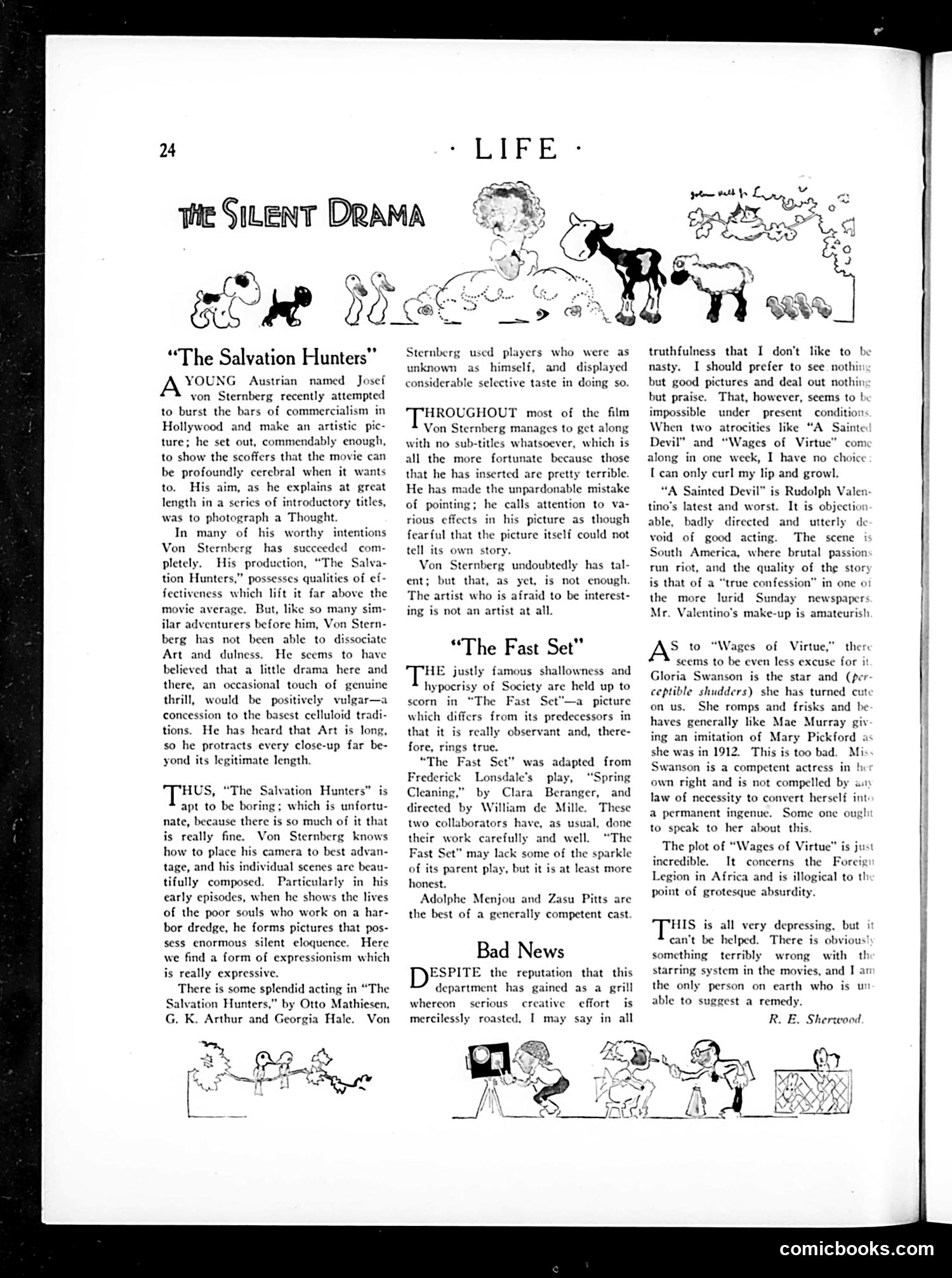
This is a 1920s film criticism page reviewing three movies. The reviews critique directors' artistic pretensions versus entertainment value: **"The Salvation Hunters"**: Director Josef von Sternberg attempted an "artistic" film to prove cinema could be intellectually serious. The critic praises his visual composition and expressionist cinematography but faults him for confusing "art" with tedium—he holds scenes too long, avoids drama thinking it's "vulgar," and over-explains his effects with clumsy title cards. The verdict: talented but self-defeating through excessive seriousness. **"The Fast Set"**: A society comedy adapted from a play, praised for actually being honest about upper-class hypocrisy rather than glorifying it. Competently made and more successful than its source material. **"Bad News"**: The critic resignedly reviews two "atrocities"—Rudolph Valentino's "A Sainted Devil" and "Wages of Virtue"—both apparently melodramatic failures. The tone is exasperated resignation that serious creative films share the screen with garbage. The overall satire targets artistic pretension in silent cinema.
📄 Transcribed text from this page (OCR, searchable)
Machine-transcribed from the original scan — historical spelling and the odd misread are preserved.
24 “The Salvation Hunters” YOUNG Austrian named Josef von Sternberg recently attempted to burst the bars of commercialism in Hollywood and make an artistic pic- ture; he set out, commendably enough, to show the scoffers that the movie can be profoundly cerebral when it wants to. His aim, as he explains at great length in a series of introductory titles, was to photograph a Thought. In many of his worthy intentions Von Sternberg has succeeded com- pletely. His production, “The Salva- tion Hunters,” possesses qualities of ef- fectiveness which lift it far above the movie average. But, like so many sim- ilar adventurers before him, Von Stern- berg has not been able to dissociate Art and dulness. He scems to have believed that a little drama here and there, an occasional touch of genuine thrill, would be positively vulgar—a concession to the basest celluloid tradi- tions. He has heard that Art is long, so he protracts every close-up far be- yond its legitimate length. HUS, “The Salvation Hunters” is apt to be boring; which is unfortu- nate, because there is so much of it that is really fine. Von Sternberg knows how to place his camera to best advan- tage, and his individual scenes are beau- tifully composed. Particularly in his early episodes, when he shows the lives of the poor souls who work on a har- bor dredge, he forms pictures that pos- sess enormous silent eloquence. Here we find a form of expressionism which is really expressive, There is some splendid acting in “The Salvation Hunters,” by Otto Mathiesen, G. K. Arthur and Georgia Hale. Von Tie SILENT DRAMA thd) a@ tos, MOR Ce Sternberg used players who were as unknown as himself, and displayed considerable selective taste in doing so. HROUGHOUT most of the film Von Sternberg manages to get along with no sub-titles whatsoever, which is all the more fortunate because those that he has inserted are pretty terrible. He has made the unpardonable mistake of pointing; he calls attention to va- rious effects in his picture as though fearful that the picture itself could not tell its own story. Von Sternberg undoubtedly has tal- ent; but that, as yet, is not enough. The artist who is afraid to be interest- ing is not an artist at all. “The Fast Set” HE justly famous shallowness and hypocrisy of Society are held up to “The Fast Set"—a picture which differs from its predecessors in that it is really observant and, there- fore, rings true. “The Fast Sct” was adapted from Frederick Lonsdale’s play, “Spring Cleaning,” by Clara Beranger, and directed by William de Mille. These two collaborators ¢, as usual, done their work carefully and well. “The Fast Set” may lack some of the sparkle of its parent play, but it is at least more honest. Adolphe Menjou and Zasu Pitts are the best of a generally competent cast. Bad News ESPITE the reputation that this department has gained as a grill whereon creative effort is mercilessly roasted, I may say in all scorn in serious °o ERED, r OPS See te 4 wae truthfulness that I don't like to be nasty. I should prefer to see nothi: but good pictures and deal out nothin but praise. That, however, seems to | impossible under present conditions When two atrocities like “A Sainte Devil” and “Wages of Virtue” come along in one week, I have no choice [can only curl my lip and growl. ‘A Sainted Devil” is Rudolph Val tino’s latest and worst. It is objection able, badly directed and utterly de void of good acting. The scene South America, where brutal passion run riot, and the quality of the story is that of a “true confession” in one o the more lurid Sunday newspapers Mr. Valentino's make-up is amateurish to “Wages of Virtue,” there A rems to be even less excuse for it Gloria Swanson is the star and (per ceptible shudders) she has turned cut on us. She romps and frisks and be haves generally like Mae Murray giv ing an imitation of Mary Pickford as she was in 1912. This is too bad. Mi Swanson is a competent actress in hi own right and is not compelled by a law of necessity to convert herself int a permanent ingenue. Some one oug! to speak to her about this. The plot of “Wages of Virtue” is just incredible. It concerns the Foreig Legion in Africa and is illogical to th point of grotesque absurdity. THs is all very depressing, but it can't be helped. There is obvious something terribly wrong with th starring system in the movies, and I atv the only person on earth who is un able to suggest a remedy. R. E. Sherwood. comicbooks.com