
Life, 1924-12-18 · page 20 of 37
Life — December 18, 1924 — page 20: what you’re looking at
What you’re looking at
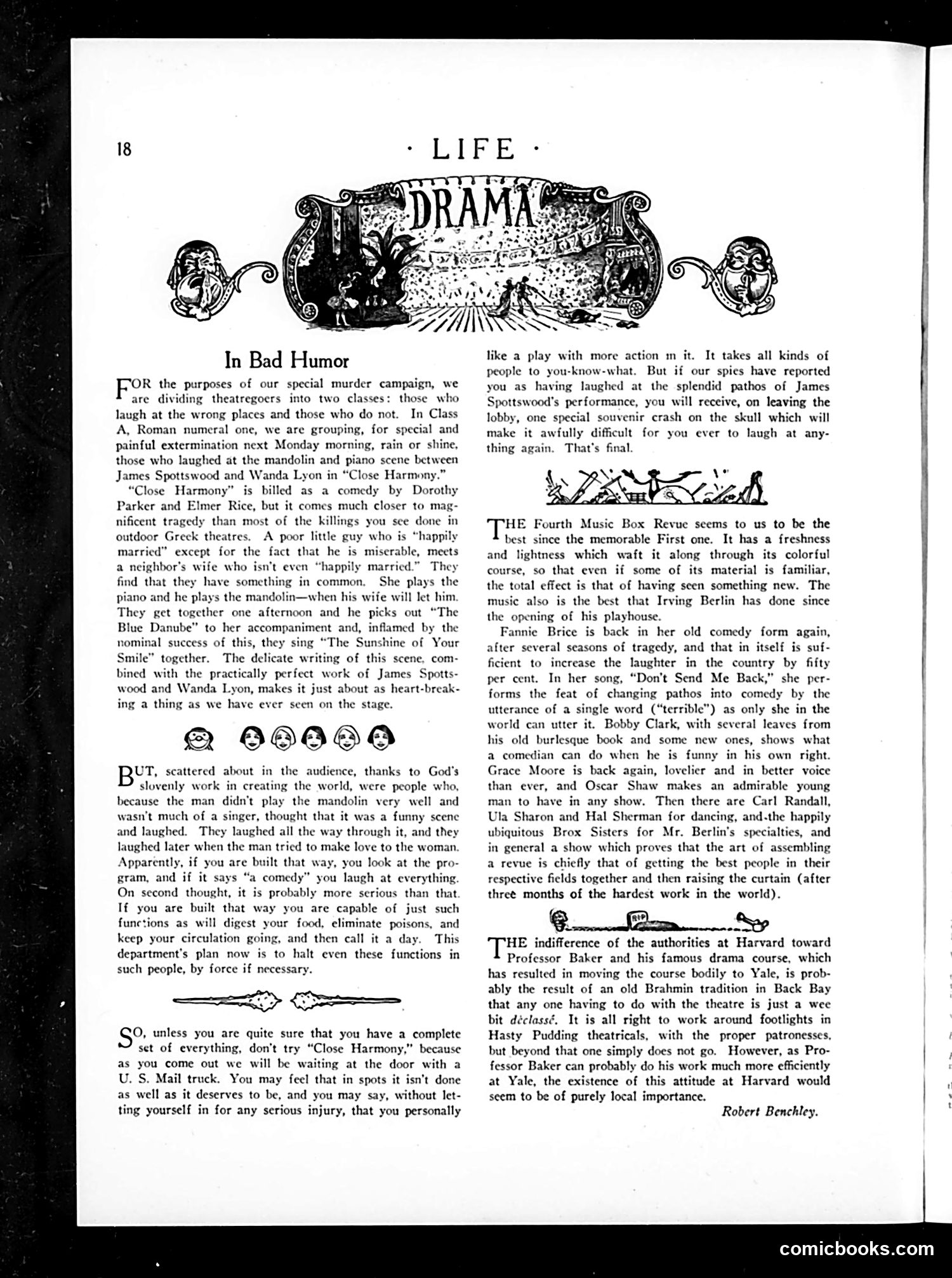
This satirical theater review attacks audiences who laugh at the *wrong moments* in the play "Close Harmony" (written by Dorothy Parker and Elmer Rice). The critic argues the mandolin-and-piano scene between characters James Spottswood and Wanda Lyon is genuinely tragic—depicting an unhappy marriage and emotional infidelity—yet some theatergoers laughed because the musical performance was technically poor. The joke: Life threatens violent retribution against these tone-deaf audience members, claiming they're biologically incapable of proper emotional response and should be eliminated. It's darkly comedic social commentary about cultural refinement—mocking both unsophisticated audiences *and* the pretentious expectation that theater-goers should feel prescribed emotions. The review then praises the Fourth Music Box Revue and performers like Fannie Brice, contrasting intelligent comedy with the earlier play's botched tragedy.
📄 Transcribed text from this page (OCR, searchable)
Machine-transcribed from the original scan — historical spelling and the odd misread are preserved.
In Bad Humor For the purposes of our special murder campaign, we are dividing theatregoers into two clas those who laugh at the wrong places and those who do not. In Cla: A, Roman numeral one, we are grouping, for special and painful extermination next Monday morning, rain or shine, those who laughed at the mandolin and piano scene between James Spottswood and Wanda Lyon in “Close Harmony.” ‘Close Harmony” is billed as a comedy by Dorothy Parker and Elmer Rice, but it comes much closer to mag- nificent tragedy than most of the killings you see done in outdoor Gri theatres, poor little guy who is “happily married” except for the fact that he is miserable, meets a neighbor's wife who isn't even “happily married.” They find that they have something in common, She plays the piano and he plays the mandolin—when his wife will let him. They get together one afternoon and he picks out “The Blue Danube” to her accompaniment and, inflamed by the nominal success of this, they sing “The Sunshine of Your Smile” together. The delicate writing of this scene, com- bined with the practically perfect work of James Spotts- wood and Wanda Lyon, makes it just about as heart-break- ing a thing as we have ever seen on the stage. QQ §8G6BO4 UT, scattered about in the audience, thanks to God's lovenly work in creating the world, were people who, because the man didn't play the mandolin very well and wasn't much of a singer, thought that it was a funny scene and laughed. They laughed all the way through it, and they laughed later when the man tried to ¢ love to the woman. Apparently, if you are built that way, you look at the pro- gram, and if it says “a comedy” you laugh at everything. On second thought, it is probably more serious than that. If you are built that way you are capable of just such functions as will digest your food, eliminate poisons, and keep your circulation going, and then call it a day. This department's plan now is to halt even these functions in such people, by force if necessary. S°: unless you are quite sure that you have a complete set of everything, don’t try “Close Harmony,” because as you come out we will be waiting at the door with a U. S. Mail truck. You may feel that in spots it isn’t done as well as it deserves to be, and you may say, without let- ting yourself in for any serious injury, that you personally like a play with more action im it. It takes all kinds of people to you-know-what. But if our spies have reported you as having laughed at the splendid pathos of James Spottswood’s performance, you will receive, on leaving the lobby, one special souvenir crash on the skull which will make it awfully difficult for you ever to laugh at any- thing again. That's final. HE Fourth Music Box Revue seems to us to be the best since the memorable First one. It has a freshness and lightness which waft it along through its colorful course, so that even if some of its material is familiar, the total effect is that of having seen something new. The music also is the best that Irving Berlin has done since the opening of his playhouse. Fannie Brice is back in her old comedy form again, after several seasons of tragedy, and that in itself is suf- ficient to increase the laughter in the country by fifty per cent. In her song, “Don't Send Me Back,” she per- forms the feat of changing pathos into comedy by the utterance of a single word (“terrible”) as only she in the world can utter it. Bobby Clark, with several leaves from his old burlesque book and some new ones, shows what a comedian can do when he is funny in his own right. Grace Moore is back again, lovelier and in better voice than ever, and Oscar Shaw makes an admirable young man to have in any show. Then there are Carl Randall, Ula Sharon and Hal Sherman for dancing, and.the happily ubiquitous Brox Sisters for Mr. Berlin's specialties, and in general a show which proves that the art of assembling a revue is chiefly that of getting the best people in their respective fields together and then raising the curtain (after three months of the hardest work in the world). @___Giam_. Sy 'HE indifference of the authorities at Harvard toward Professor Baker and his famous drama course, which has resulted in moving the course bodily to Yale, is prob- ably the result of an old Brahmin tradition in Back Bay that any one having to do with the theatre is just a wee bit déclassé. It is all right to work around footlights in Hasty Pudding theatricals, with the proper patronesses, but beyond that one simply does not go. However, as Pro- fessor Baker can probably do his work much more efficiently at Yale, the existence of this attitude at Harvard would seem to be of purely local importance. Robert Benchley. comicbooks.com