
Life, 1924-12-18 · page 16 of 37
Life — December 18, 1924 — page 16: what you’re looking at
What you’re looking at
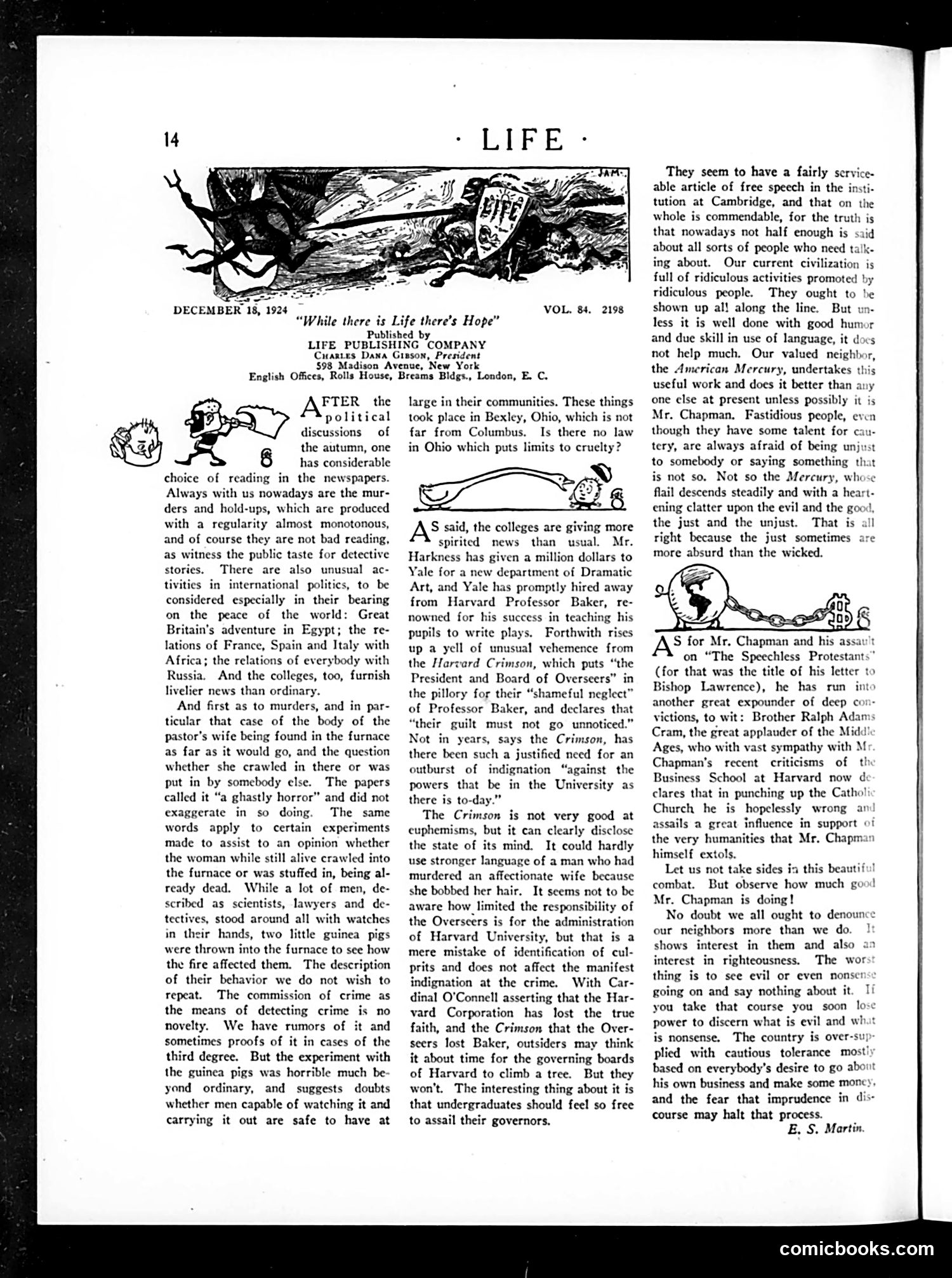
This page contains editorial commentary rather than political cartoons. The small decorative illustrations show figures in casual poses but aren't specific caricatures. The main text discusses university governance controversies, particularly at Harvard and Yale. It criticizes the "Harvard Crimson" (the student newspaper) for its editorial attacking Harvard's Board of Overseers regarding Professor Baker's treatment. The writer, E.S. Martin, argues the Crimson wrongly blamed administrators rather than recognizing limited institutional responsibility. The piece also praises Yale for funding a new Dramatic Arts department and hiring Professor Baker away from Harvard. The satire targets student newspapers' tendency toward moral indignation without understanding administrative complexities, and champions institutional pragmatism over youthful idealism.
📄 Transcribed text from this page (OCR, searchable)
Machine-transcribed from the original scan — historical spelling and the odd misread are preserved.
VOL. 84. 2198 “While there is Life there’s Hope” Published by. LIFE PUBLISHING COMPANY Cuantes Dawa Giason, President $98 Madison Avenue, New York English Offices, Rolls House, Breams Bldgs., London, E. C. FTER the political discussions of the autumn, one 6 has considerable choice of reading in the newspapers. Always with us nowadays are the mur- ders and hold-ups, which are produced with a regularity almost monotonous, and of course they are not bad reading, as witness the public taste for detective stories. There are also unusual ac- tivities in international politics, to be considered especially in their bearing on the peace of the world: Great Britain's adventure in Egypt; the re- lations of France, Spain and Italy with Africa; the relations of everybody with Russia. And the colleges, too, furnish livelier news than ordinary And first as to murders, and in par- ticular that case of the body of the pastor's wife being found in the furnace as far as it would go, and the question whether she crawled in there or was put in by somebody else. The papers called it “a ghastly horror” and did not exaggerate in so doing. The same words apply to certain experiments made to assist to an opinion whether the woman while still alive crawled into the furnace or was stuffed in, being al- ready dead. While a lot of men, de- scribed as scientists, lawyers and de- tectives, stood around all with watches in their hands, two little guinea pigs were thrown into the furnace to see how the fire affected them. The description of their behavior we do not wish to repeat. The commission of crime as the means of detecting crime is no novelty. We have rumors of it and sometimes proofs of it in cases of the third degree. But the experiment with the guinea pigs was horrible much be- yond ordinary, and suggests doubts whether men capable of watching it and carrying it out are safe to have at large in their communities. These things took place in Bexley, Ohio, which is not far from Columbus. Is there no law in Ohio which puts limits to cruelty? S said, the colleges are giving more spirited news than usual. Mr. Harkness has given a million dollars to Yale for a new department of Dramatic Art, and Yale has promptly hired away from Harvard Professor Baker, re- nowned for his success in teaching his pupils to write plays. Forthwith rises up a yell of unusual vehemence from the Harvard Crimson, which puts “the President and Board of Overseers” in the pillory for their “shameful neglect” of Professor Baker, and declares that “their guilt must not go unnoticed.” Not in years, says the Crimson, has there been such a justified need for an outburst of indignation “against the powers that be in the University as there is to-day.” The Crimson is not very good at euphemisms, but it can clearly disclose the state of its mind. It could hardly use stronger language of a man who had murdered an affectionate wife because she bobbed her hair. It seems not to be aware how limited the responsibility of the Overscers is for the administration of Harvard University, but that is a mere mistake of identification of cul- prits and does not affect the manifest indignation at the crime. With Car- dinal O'Connell asserting that the Har- vard Corporation has lost the true faith, and the Crimson that the Over- seers lost Baker, outsiders may think it about time for the governing boards of Harvard to climb a tree. But they won't. The interesting thing about it is that undergraduates should feel so free to assail their governors. They seem to have a fairly servi able article of free speech in the in: tution at Cambridge, and that on the whole is commendable, for the truth is that nowadays not half enough is said about all sorts of people who need talk- ing about. Our cur civilization is full of ridiculous activities promoted by ridiculous people. They ought to be shown up al! along the line. But un- less it is well done with good humor and due skill in use of language, it docs not help much. Our valued neighbor, the American Mercury, undertakes useful work and does it better than any one clse at present unless possibly it is Mr. Chapman. Fastidious people, even though they have some talent for cau- tery, are always afraid of being unj to somebody or saying something that is not so. Not so the Mercury, whose flail descends steadily and with a hear ening clatter upon the evil and the good, the just and the unjust. That is right because the just sometimes more absurd than the wicked. S for Mr. Chapman and his assay on “The Speechless Protestants” (for that was the title of his letter to Bishop Lawrence), he has run into another great expounder of deep con- victions, to wit: Brother Ralph Adams Cram, the great applauder of the Midd Ages, who with vast sympathy with M Chapman's recent criticisms of th Business School at Harvard now d clares that in punching up the Catholi Church he is hopelessly wrong ar assails a great influence in support the very humanities that Mr. Chapm: himself extols. Let us not take sides in this beautiful combat. But observe how much goo! Mr. Chapman is doing! No doubt we all ought to denounce our neighbors more than we do. shows interest in them and also a9 interest in righteousness. The wor thing is to see evil or even nonser going on and say nothing about it. Ii you take that course you soon lose power to discern what is evil and whut is nonsense. The country is over-su/ plied with cautious tolerance most! based on everybody's desire to go abc his own business and make some moncy, and the fear that imprudence in dis- course may halt that process. E, S. Martin comicbooks.com