
A complete issue · 42 pages · 1924
Life — November 13, 1924
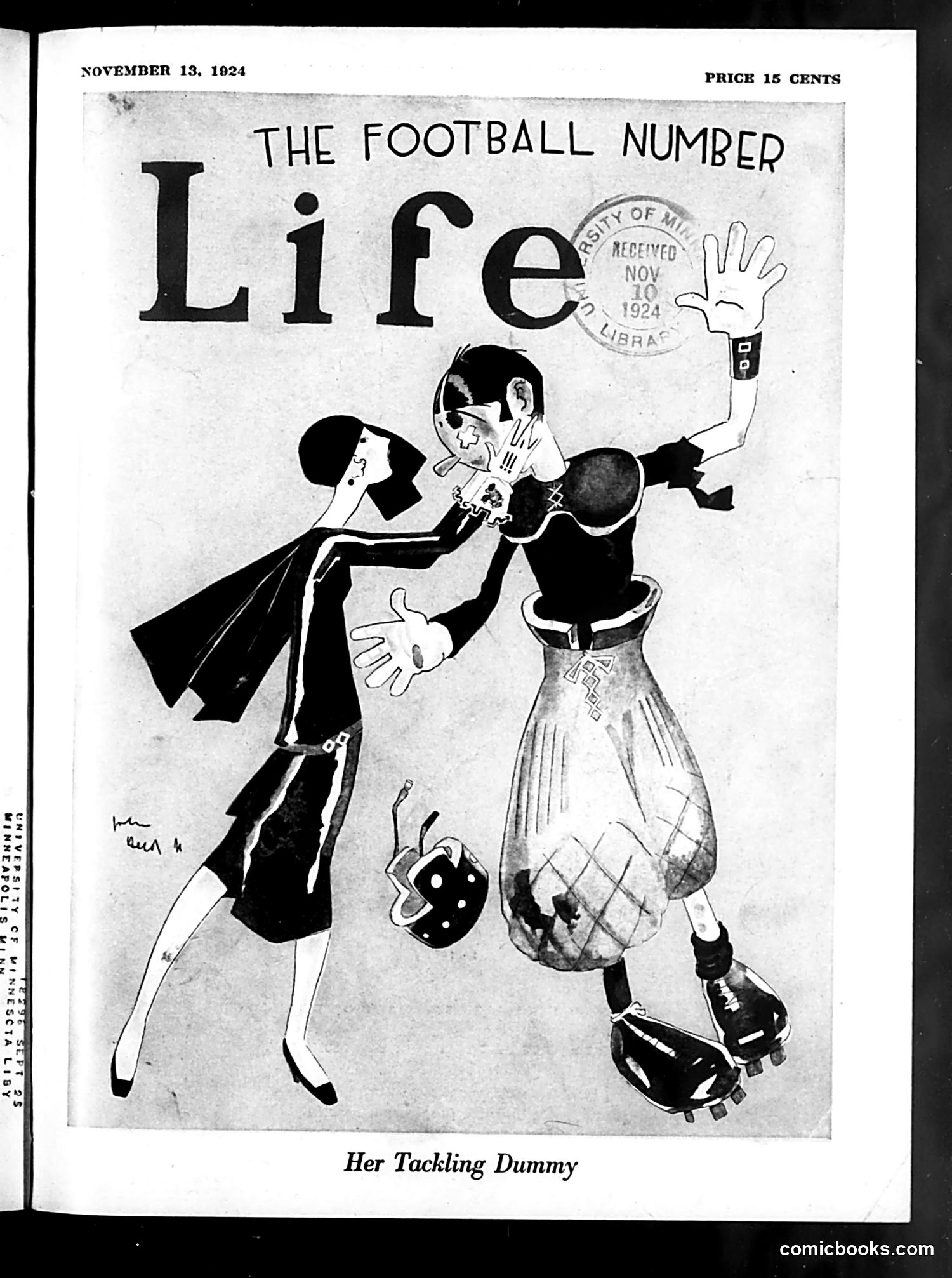
This satirical cover depicts a woman in 1920s attire using a male football player as a "tackling dummy" — a training device. The woman appears to be the aggressor, actively tackling and controlling the man, who is rendered passive and defensive. The satire reflects anxieties about changing gender roles in the 1920s. The "New Woman" — characterized by bobbed hair, fashionable clothing, and newfound independence following women's suffrage (1920) — is humorously portrayed as physically dominating men. The football metaphor invokes masculine sport while inverting traditional power dynamics. The joke targets contemporary concerns that modern women were becoming too assertive, emasculating men. It's period satire on gender role disruption during the Jazz Age.
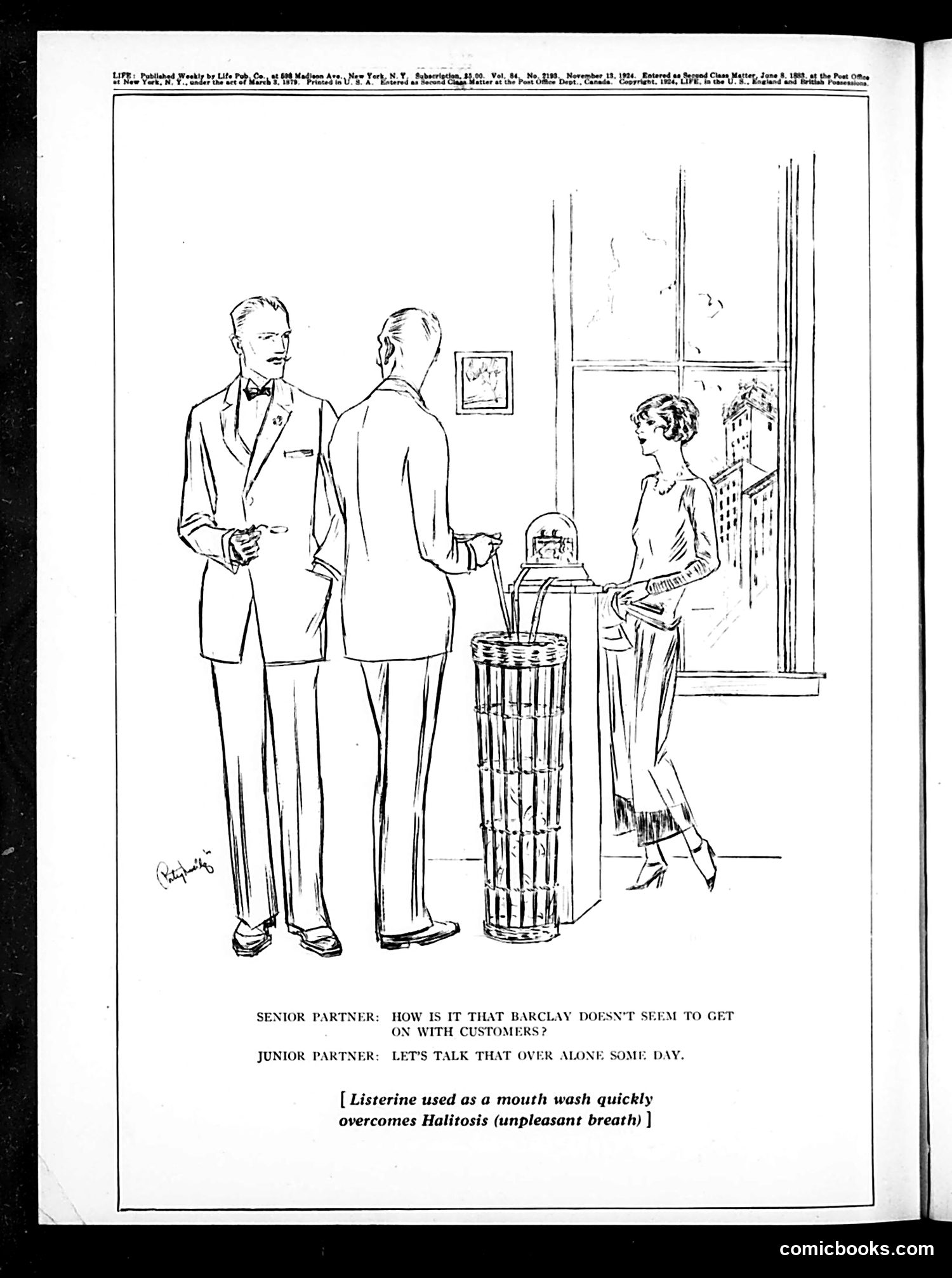
This is primarily a **Listerine advertisement disguised as satirical humor**. The cartoon depicts two well-dressed businessmen (a senior and junior partner at what appears to be a law firm) discussing a colleague named Barclay who "doesn't seem to get on with customers." The junior partner suggests they discuss the problem privately "some day." The implicit joke: Barclay's problem is **halitosis** (bad breath)—a social liability that prevents business success. The advertisement below explicitly states that Listerine mouthwash "quickly overcomes Halitosis." This exemplifies early 20th-century advertising strategy: wrapping product messaging in relatable social anxiety. The cartoon frames bad breath as a serious professional handicap, positioning Listerine as essential for career advancement and social acceptability.
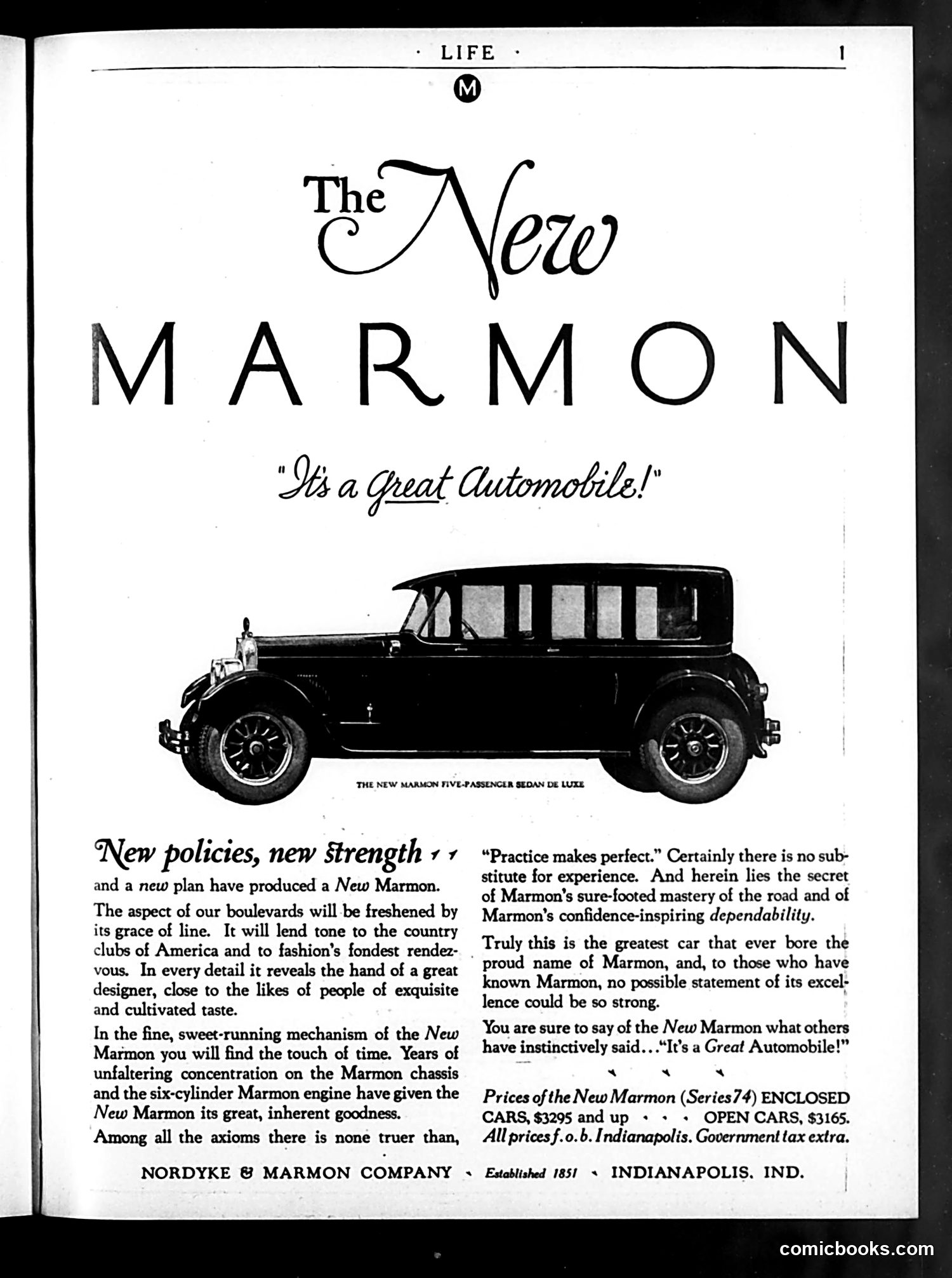
This is **not a political cartoon or satire** — it's a straightforward **automobile advertisement** for the Marmon motor car, published in *Life* magazine. The page features a side-view illustration of the "New Marmon" five-passenger sedan and promotional text emphasizing its design elegance, mechanical reliability, and craftsmanship. The tagline "It's a Great Automobile!" frames the sales pitch. Key selling points highlighted include the car's "grace of line," appeal to country clubs and fashion-conscious buyers, and the reliability of its six-cylinder engine and chassis. Pricing information is provided at bottom ($3,295 for enclosed cars; $3,165 for open models). This represents typical 1920s luxury automobile marketing, positioning Marmon as a prestigious vehicle for affluent, cultivated Americans. No satire or political commentary is present.
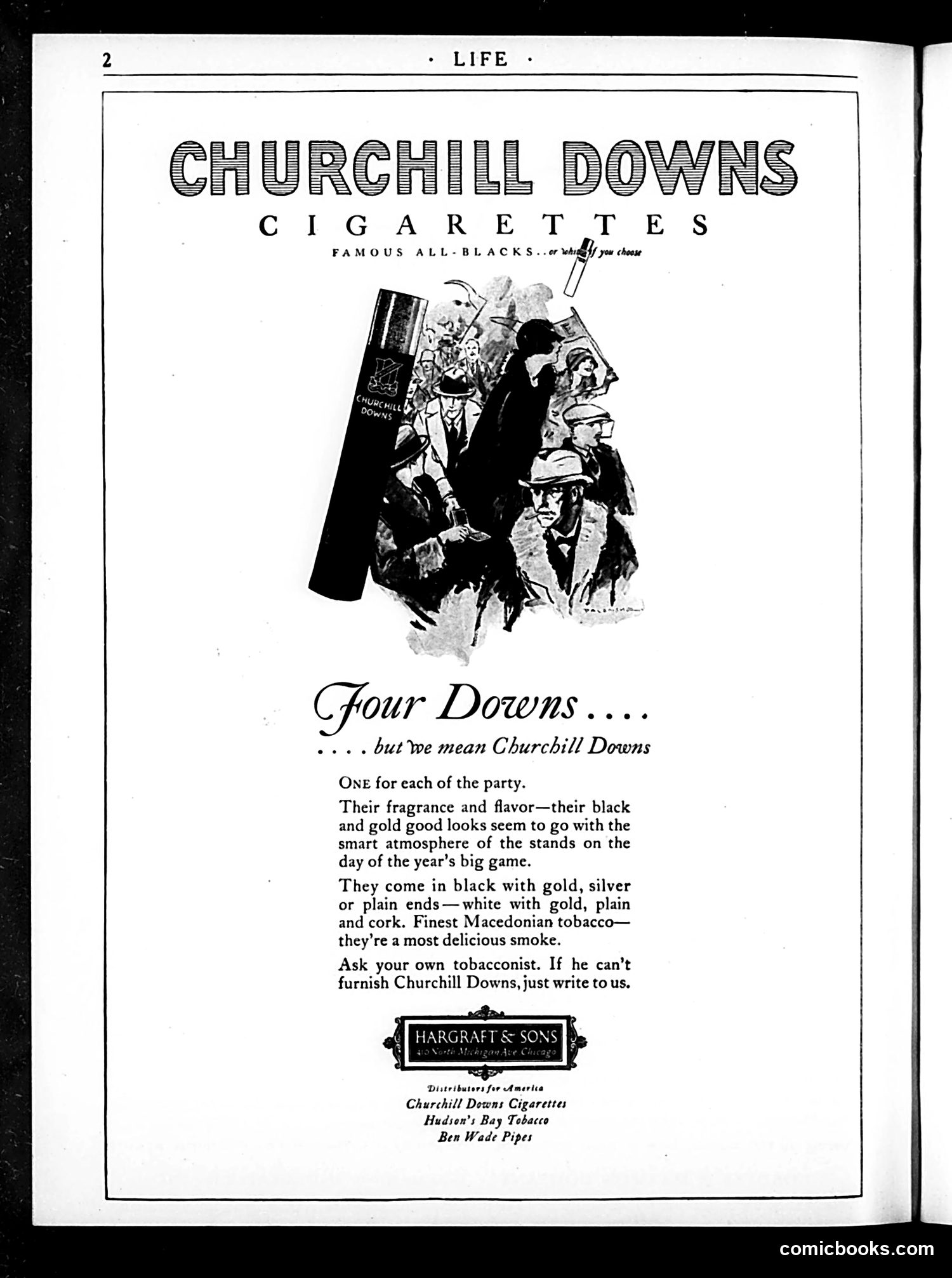
This is primarily a **cigarette advertisement**, not political satire. It promotes "Churchill Downs" cigarettes by Hargraff & Sons, playing on the famous Kentucky horse-racing venue's name. The illustration shows well-dressed spectators at a sporting event (likely horse racing), emphasizing the cigarettes' association with sophisticated leisure and social standing. The tagline "Four Downs... but we mean Churchill Downs" makes a casual pun on American football terminology. The ad highlights the cigarettes' packaging ("black with gold, silver or plain ends") and Macedonian tobacco quality. It directs readers to ask tobacconists for the product, or contact the distributor directly if unavailable. This reflects early 20th-century advertising strategies linking consumer products to sporting prestige and upscale social venues.
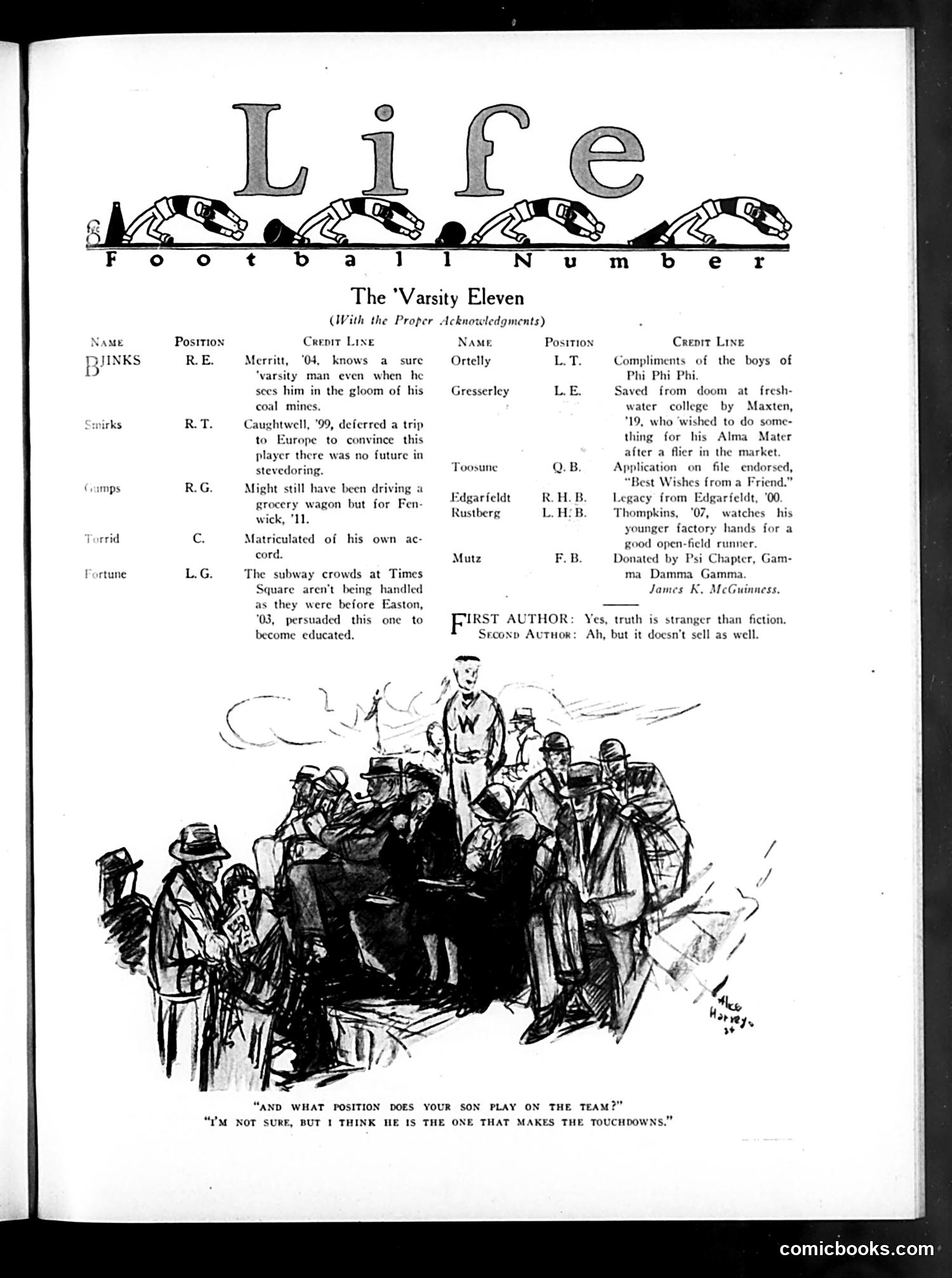
This page satirizes early 1900s college football culture. "The Varsity Eleven" lists players with humorous "credit lines" explaining how each joined the team—poking fun at recruitment practices. The main cartoon below depicts a social gathering where a parent asks about their son's position on the team. The son's vague response—"I think he is the one that makes the touchdowns"—satirizes parental ignorance about football and the sport's growing prominence in college life. The overall message critiques how football dominated collegiate institutions and how families invested social prestige in their sons' athletic roles, often without understanding the game itself. This reflects Progressive Era anxieties about commercialization and priorities in American higher education.
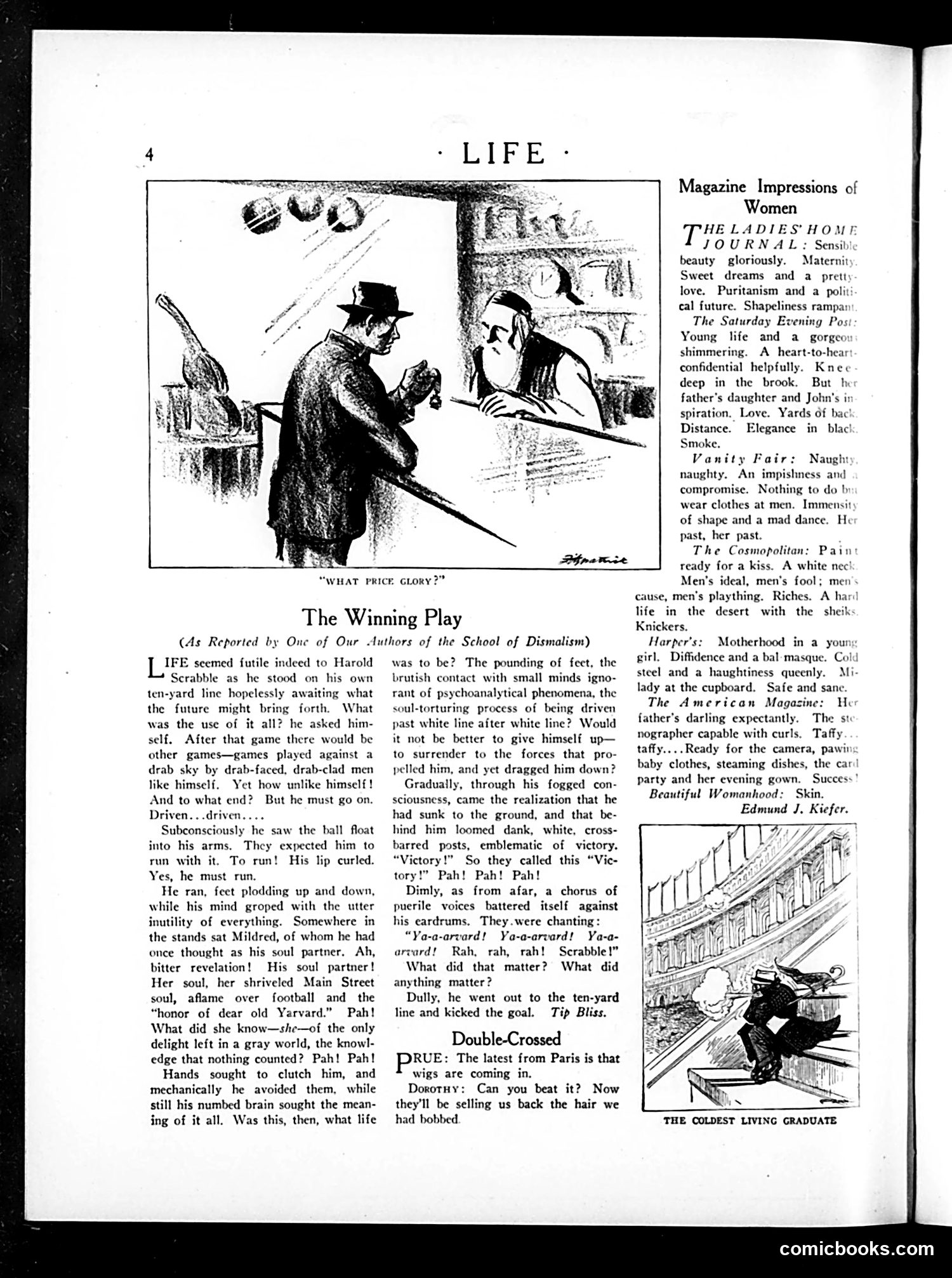
This cartoon depicts two men in what appears to be a WWI-era trench or military setting. The figure on the left wears a military uniform and helmet, while the figure on the right appears to be an officer or superior. The caption "WHAT PRICE GLORY?" references the famous 1924 play about WWI combat. The accompanying article, "The Winning Play," describes a football game as analogous to warfare—using military language ("driven," "scrabble," "victory") to satirize competitive sports. The cartoon likely comments on the glorification of combat and competition, questioning the actual human cost of such "victories," whether military or athletic. The satire critiques how society romanticizes conflict while ignoring its brutality.
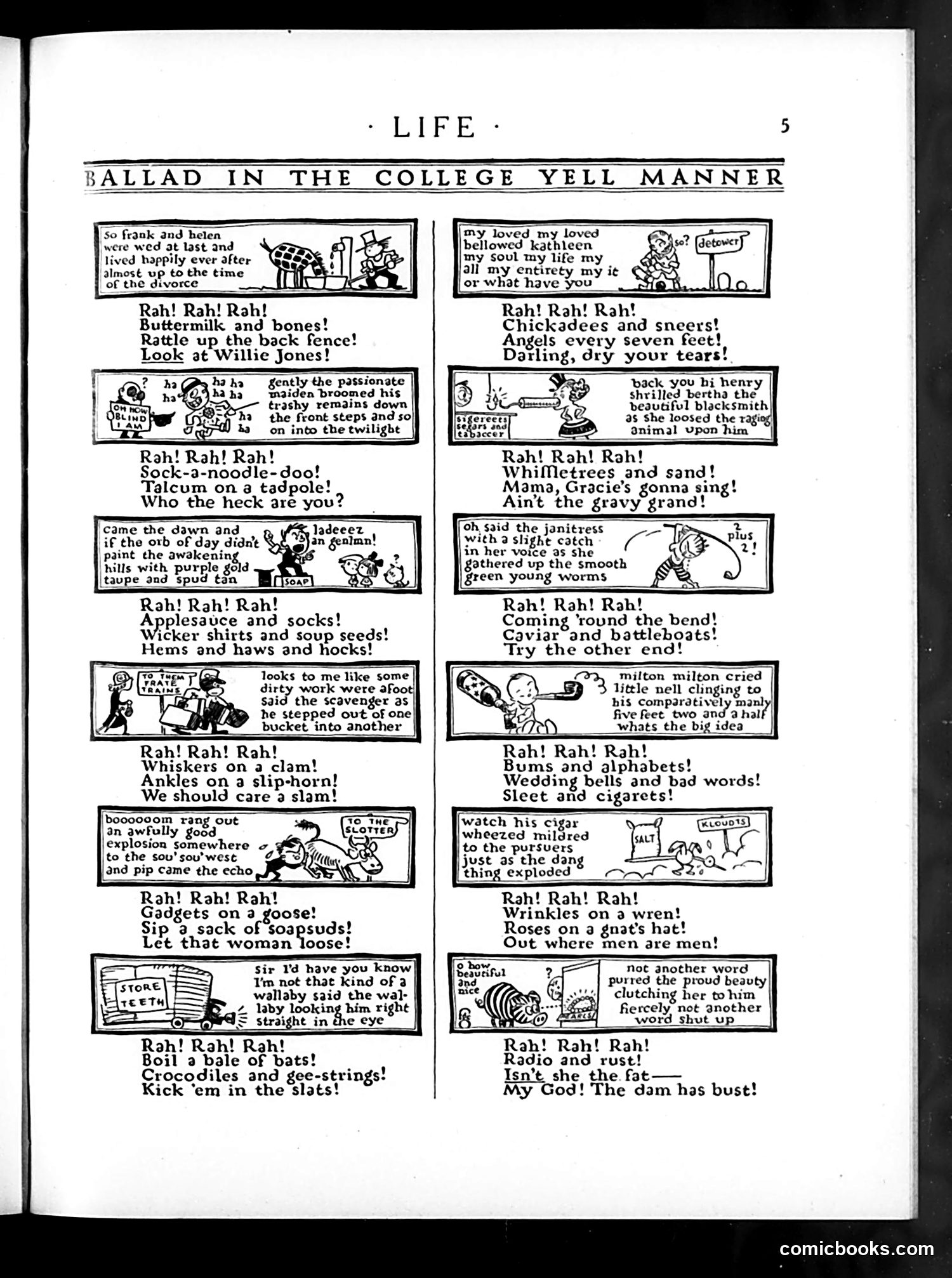
This is a satirical poem presented as a mock college fight song, combining traditional collegiate cheer formats with absurdist humor. The page pairs repetitive "Rah! Rah! Rah!" chants with surreal, increasingly nonsensical lyrics—shifting from recognizable college references (buttermilk, talcum powder, soup) to the bizarre (purple gold taupe, spud tin, crocodiles and gee-strings). The satire targets the emptiness of collegiate enthusiasm and school spirit, suggesting that college yells are performative noise masking meaninglessness. Small cartoon panels between stanzas provide visual absurdism reinforcing this critique. The joke is that if you replace standard cheer content with random words while maintaining the loud, enthusiastic format, the essential structure remains—implying college spirit itself is hollow performance rather than genuine sentiment.
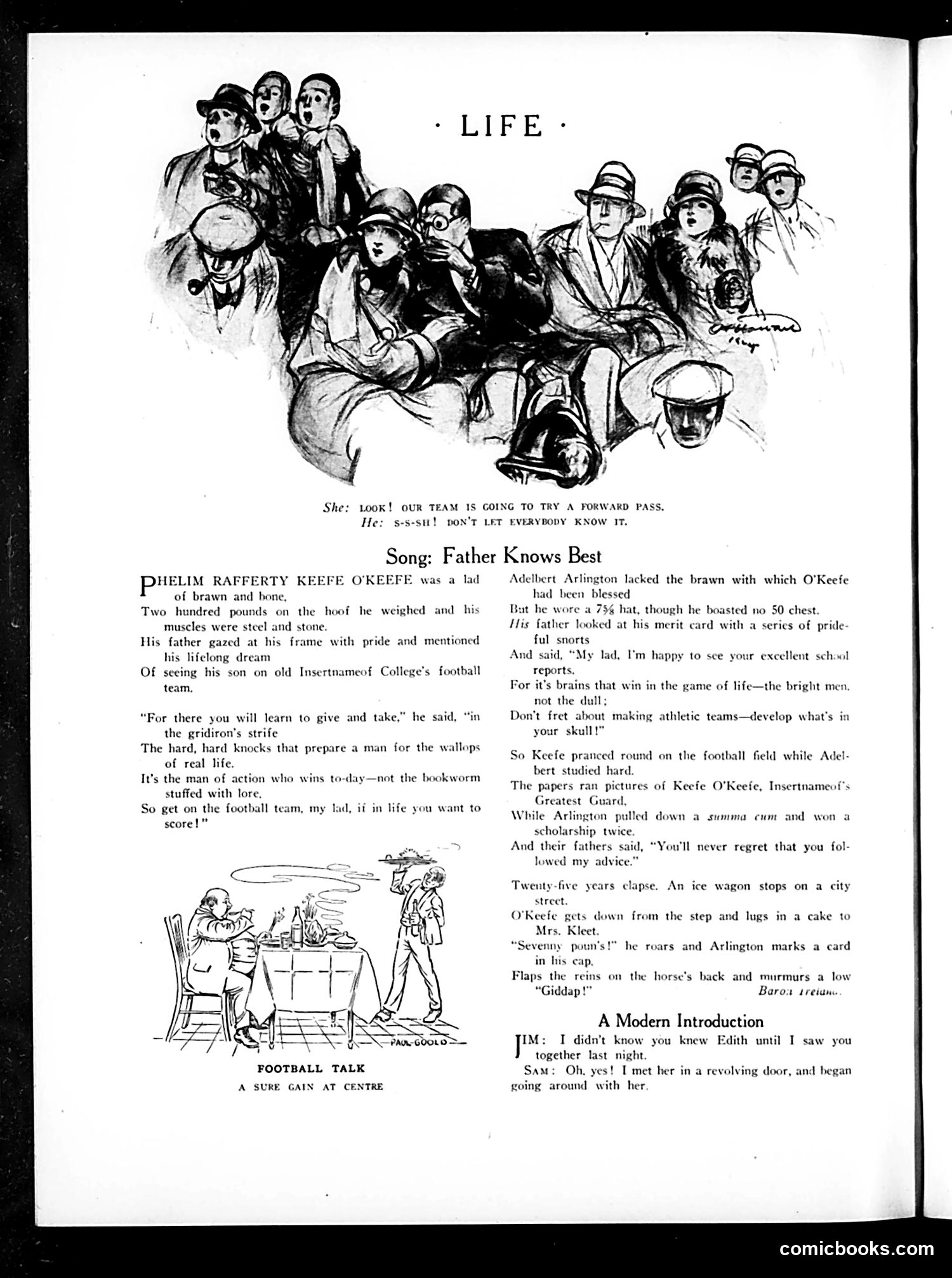
This page contains two separate pieces of humor: **"Song: Father Knows Best"** tells of Phelim Rafferty Keefe O'Keefe, a college football player whose father advises him that athletic success teaches life lessons better than academics. The narrative follows O'Keefe's football career and later success, validating the father's wisdom. The satire targets the era's celebration of athletics over intellectual development, particularly in Irish-American contexts where the story's ethnic naming suggests commentary on class and social mobility through sports. **"Football Talk" cartoon** shows three men discussing the sport—a visual pun about football strategy at table rather than field. **"A Modern Introduction"** is a brief comedic dialogue about meeting someone through a revolving door, representing modern urban social encounters. The page satirizes early 20th-century attitudes toward education, masculinity, and social advancement.
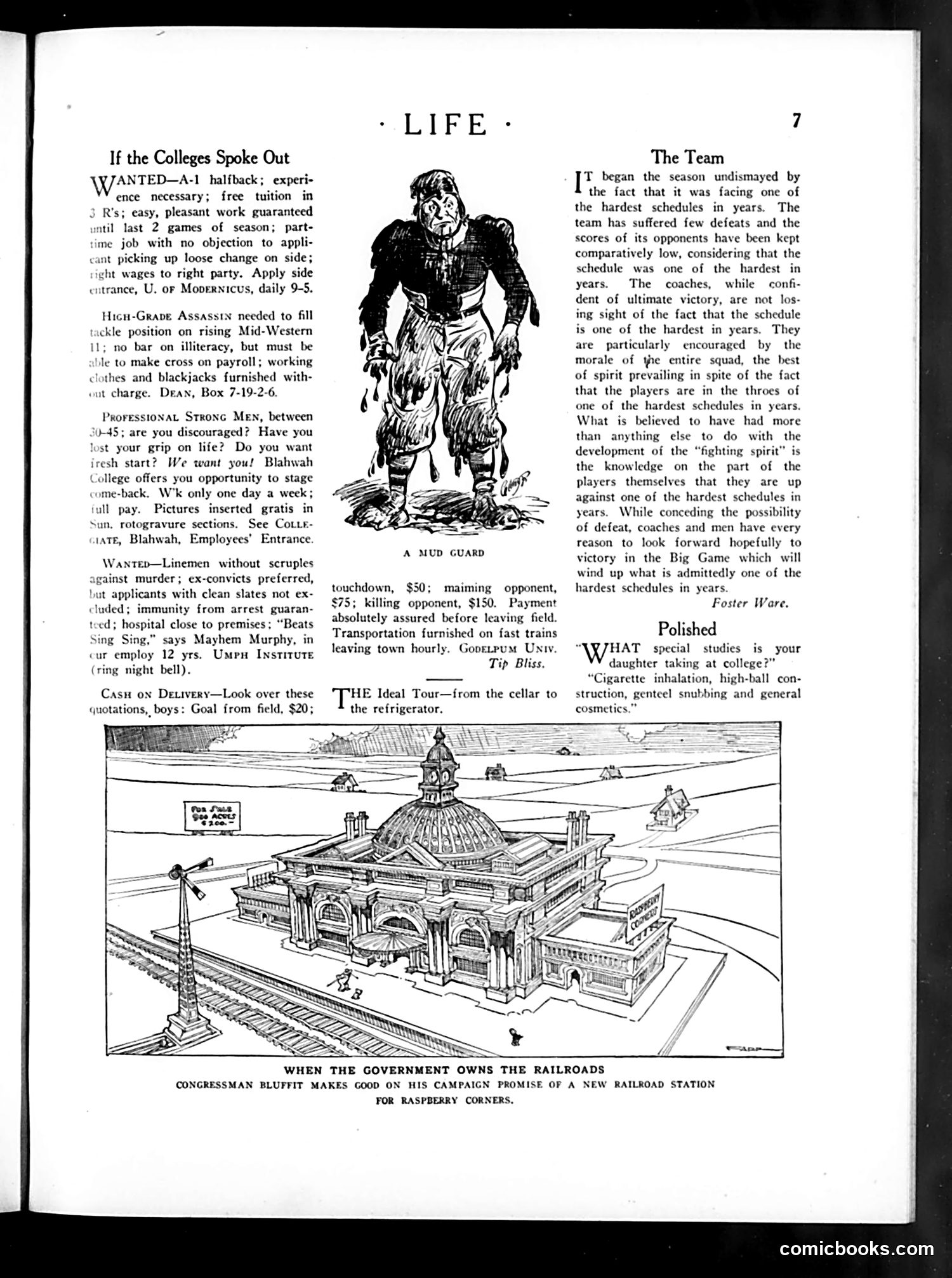
This page contains two main elements: **"A Mud Guard" illustration** (top): A caricatured football player in a defensive stance, likely satirizing the brutality or mess of college football in this era. **"When the Government Owns the Railroads" cartoon** (bottom): A grand, ornate railroad station, satirizing political promises. The caption explains a congressman has fulfilled a campaign pledge to build a new station—but the joke appears to be that it's an absurdly elaborate structure for a small location ("Raspberry Corners"), mocking politicians who make grandiose infrastructure promises to win votes but deliver impractical or disproportionate results. The page also contains classified-style job ads, typical of *Life* magazine's satirical format mixing commentary with humor and advertising.
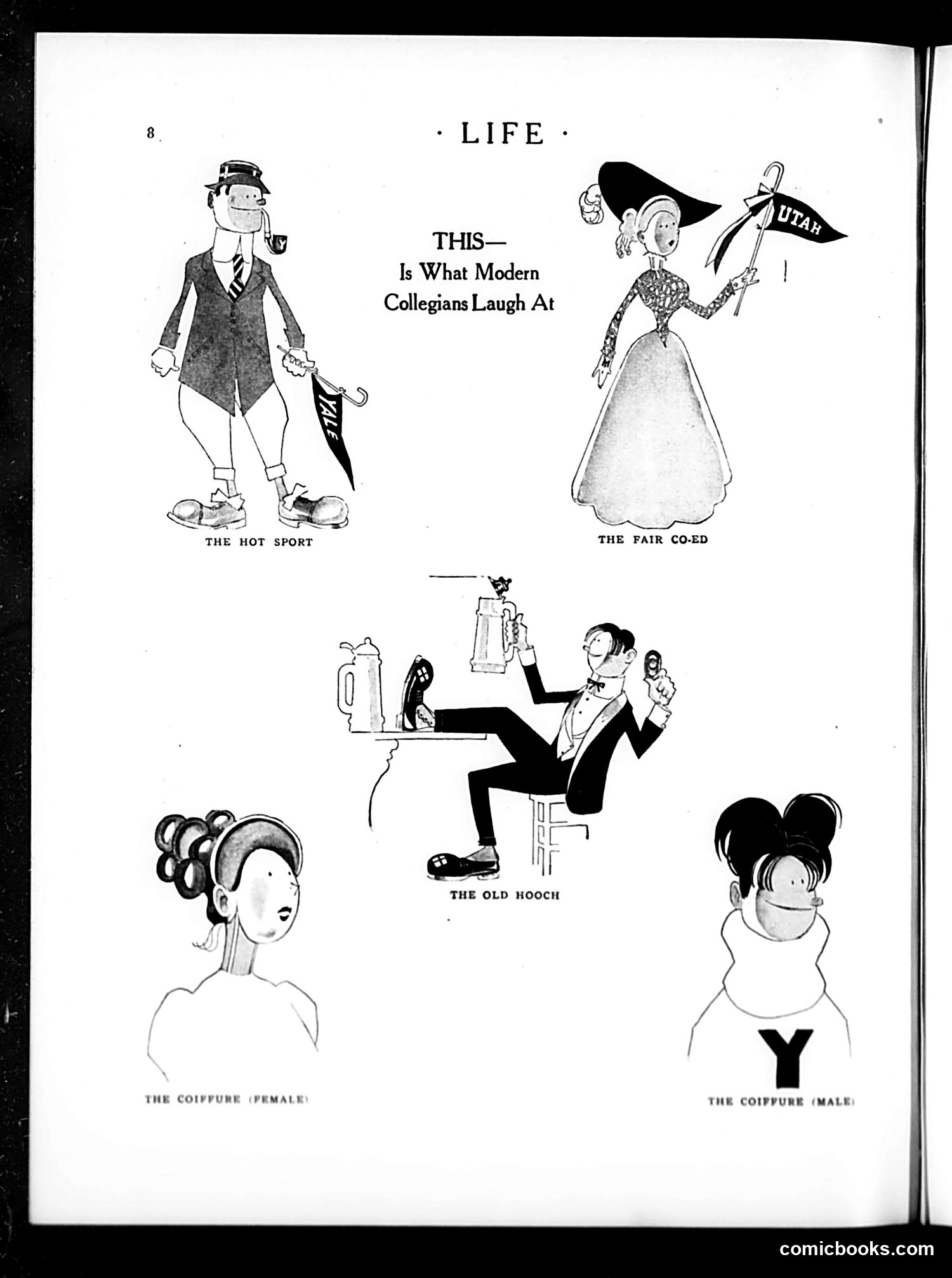
This Life magazine page satirizes 1920s college student fashion and behavior trends. "The Hot Sport" mocks the well-dressed male collegian with his umbrella and formal attire. "The Fair Co-ed" caricatures the fashionable female student with exaggerated features and a "Utah" pennant—likely referencing collegiate spirit or regional stereotypes. "The Old Hooch" depicts a man intoxicated during Prohibition, when alcohol was illegal (1920-1933). "The Coiffure" entries mock extreme hairstyles—the female version shows elaborate rolled curls, while the male version displays a comically large "Y"-shaped part. The page's overall tone suggests generational mockery, with older Life readers finding contemporary college student culture ridiculous or amusing.
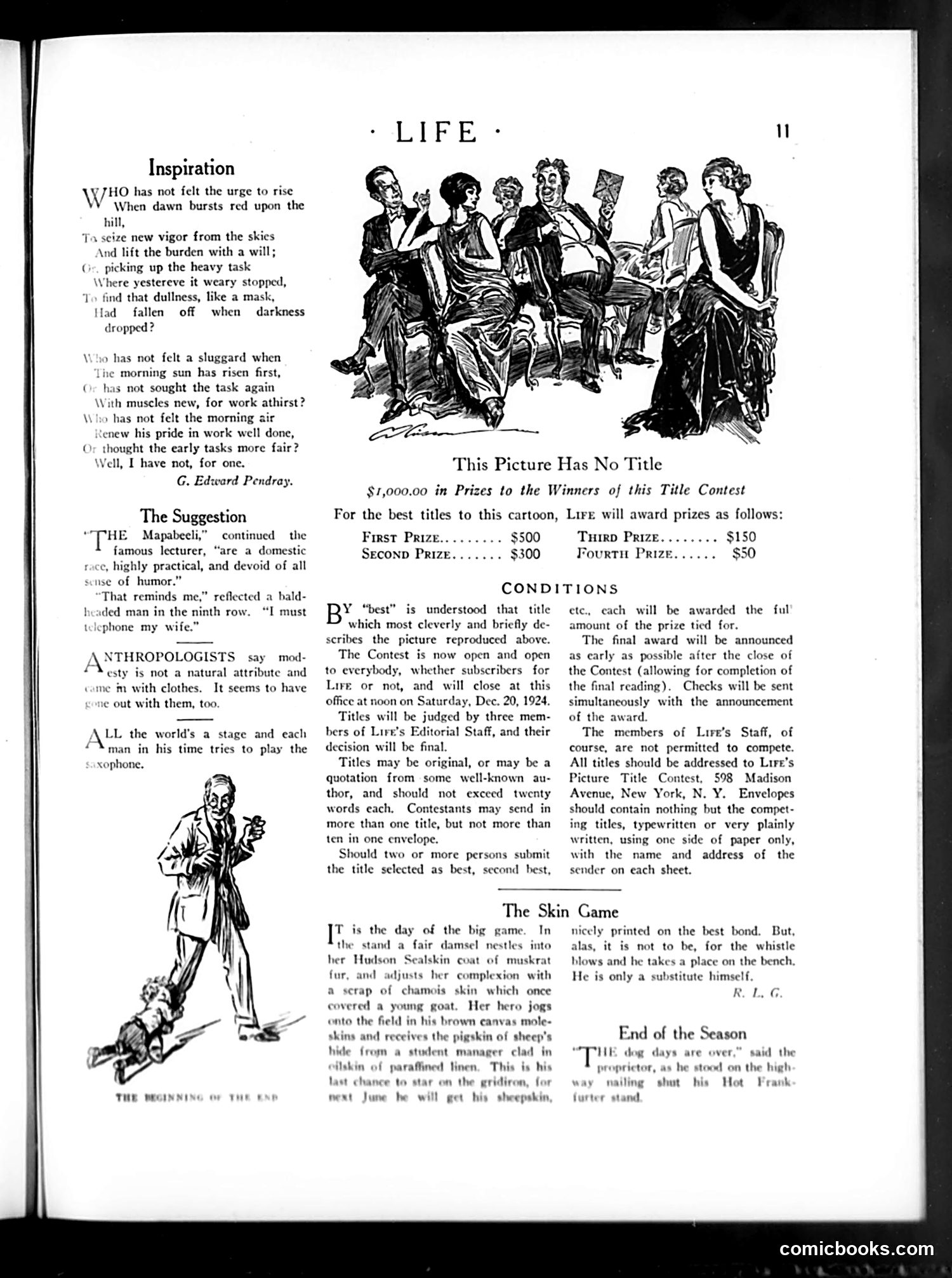
This page combines poetry, humor, and a contest announcement rather than traditional political cartoons. **"Inspiration"** (top left poem by G. Edward Pendray) uses motivational language about dawn and labor—typical early-20th-century inspirational verse with no clear satirical target. **The main cartoon** shows a social gathering of well-dressed people. The caption "This Picture Has No Title" announces a $1,000 contest inviting readers to submit titles, with Life's editorial staff as judges. This was a common magazine engagement strategy. **Other sketches** ("The Suggestion," "The Skin Game," "End of the Season") appear to be brief humorous stories or anecdotes about domestic/social situations, typical of Life's miscellaneous humor content. The page is primarily **entertainment and reader participation**, not political satire.
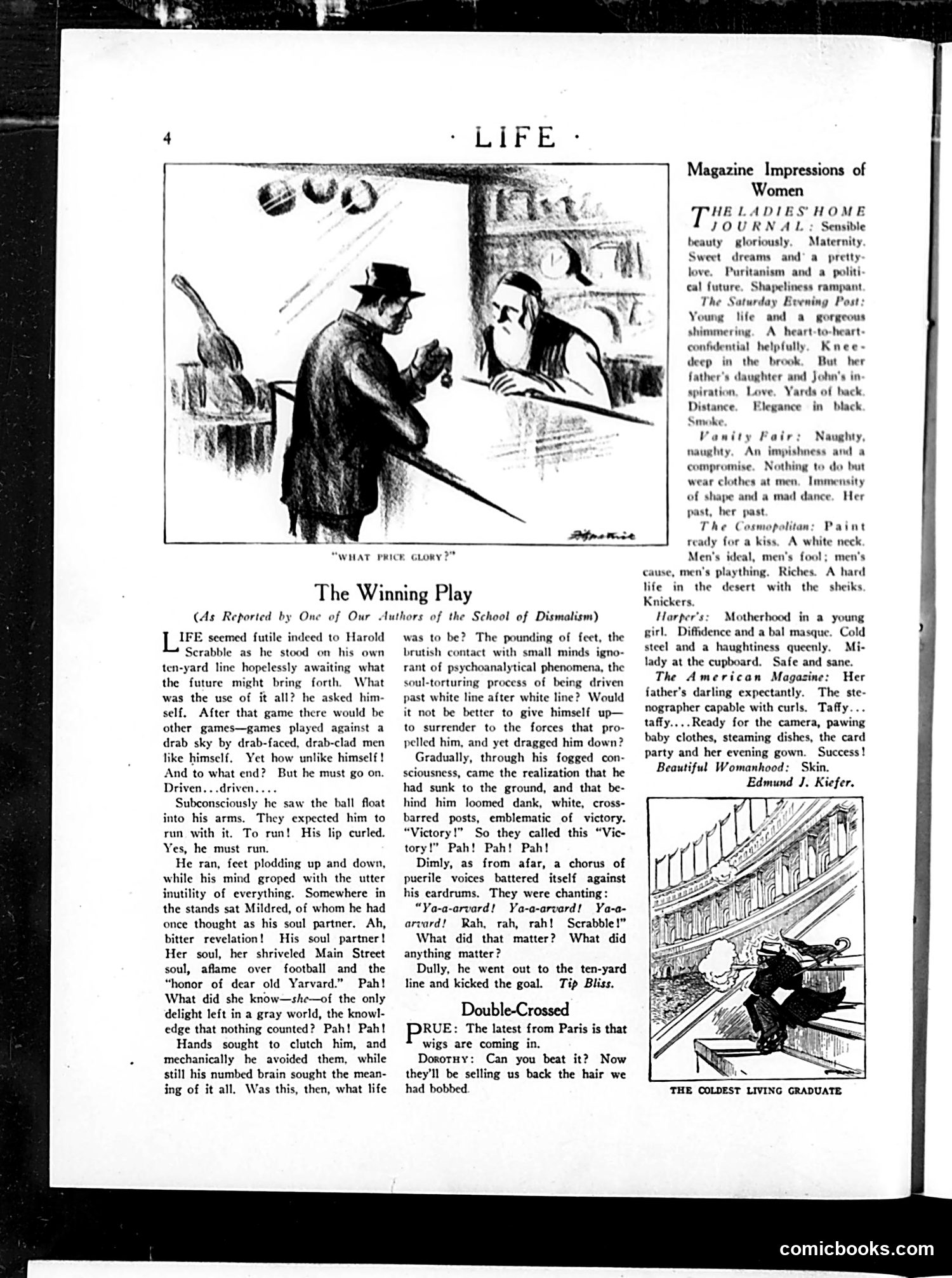
**Main Cartoon ("What Price Glory?"):** Shows two men in what appears to be a theatrical or office setting. The sketch style and caption suggest this illustrates a scene from a play or dramatic work, though the specific reference is unclear from the image alone. **"The Winning Play" Article:** A satirical piece about a character named Lee experiencing an existential crisis during a football game. The narrator mocks Lee's internal struggle—his anxiety about life's meaning contrasts absurdly with the trivial reality of the sporting event. The satire targets overwrought sentimentality and the gap between dramatic self-perception and actual circumstances. **Right Column:** Contains brief commentary on various magazines' contents, followed by a small illustration labeled "The Coldest Living Graduate."
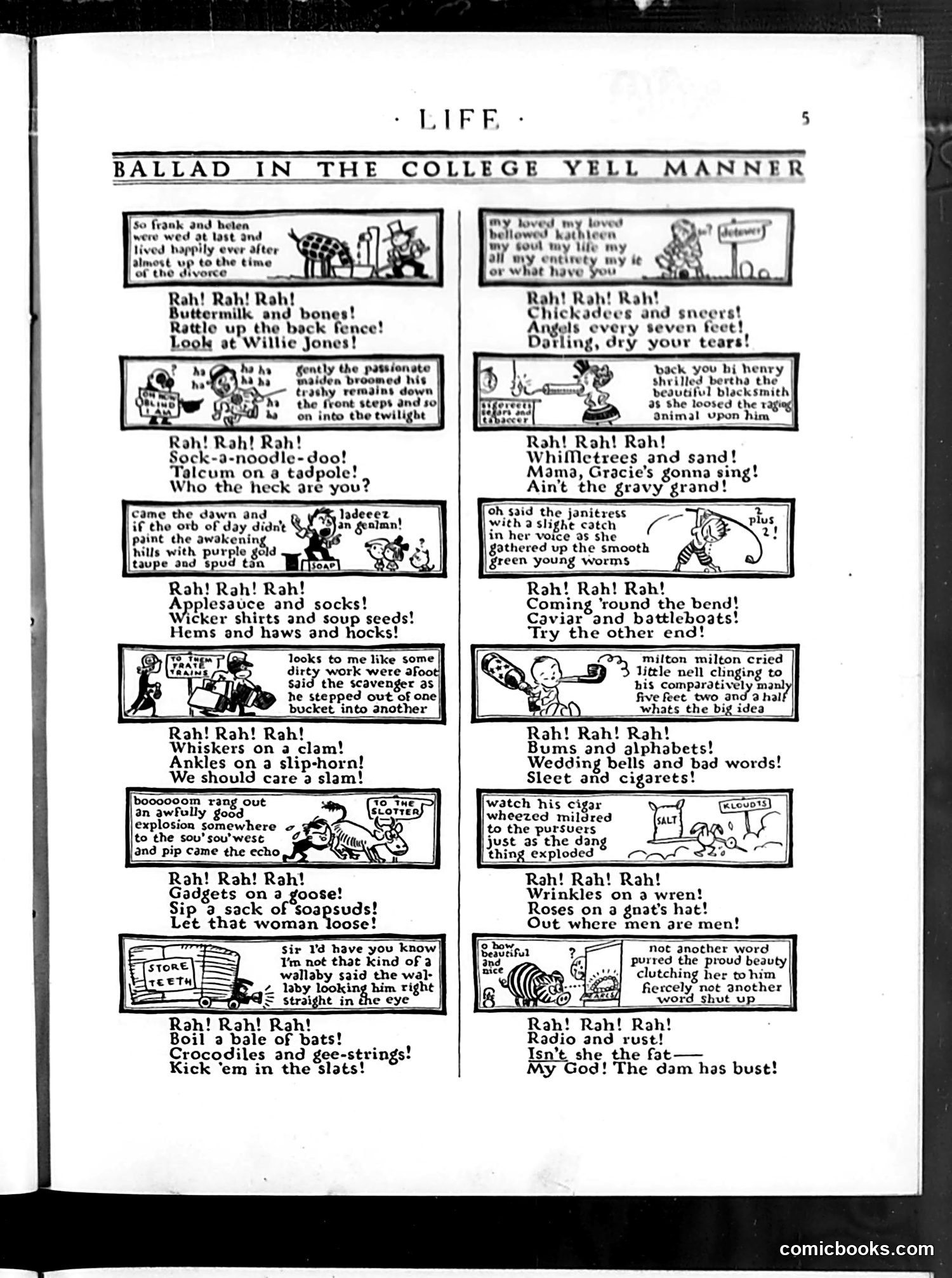
This page presents a humorous satire of college traditions by presenting absurd "college yells"—rhythmic chants that were popular at American universities in the early 20th century. The satire mocks these yells by replacing typical athletic cheers with nonsensical or darkly comic phrases ("Buttermilk and bones!" "Sock-a-noodle-doo!"). Each yell is accompanied by small comic illustrations showing ridiculous scenarios. The humor targets the blind conformity and arbitrary traditions of college culture—suggesting that students enthusiastically shout meaningless things simply because it's tradition. The increasingly absurd content (references to infidelity, explosions, cigarettes) escalates the satire, implying college yells have no inherent logic or value beyond peer pressure and institutional habit.
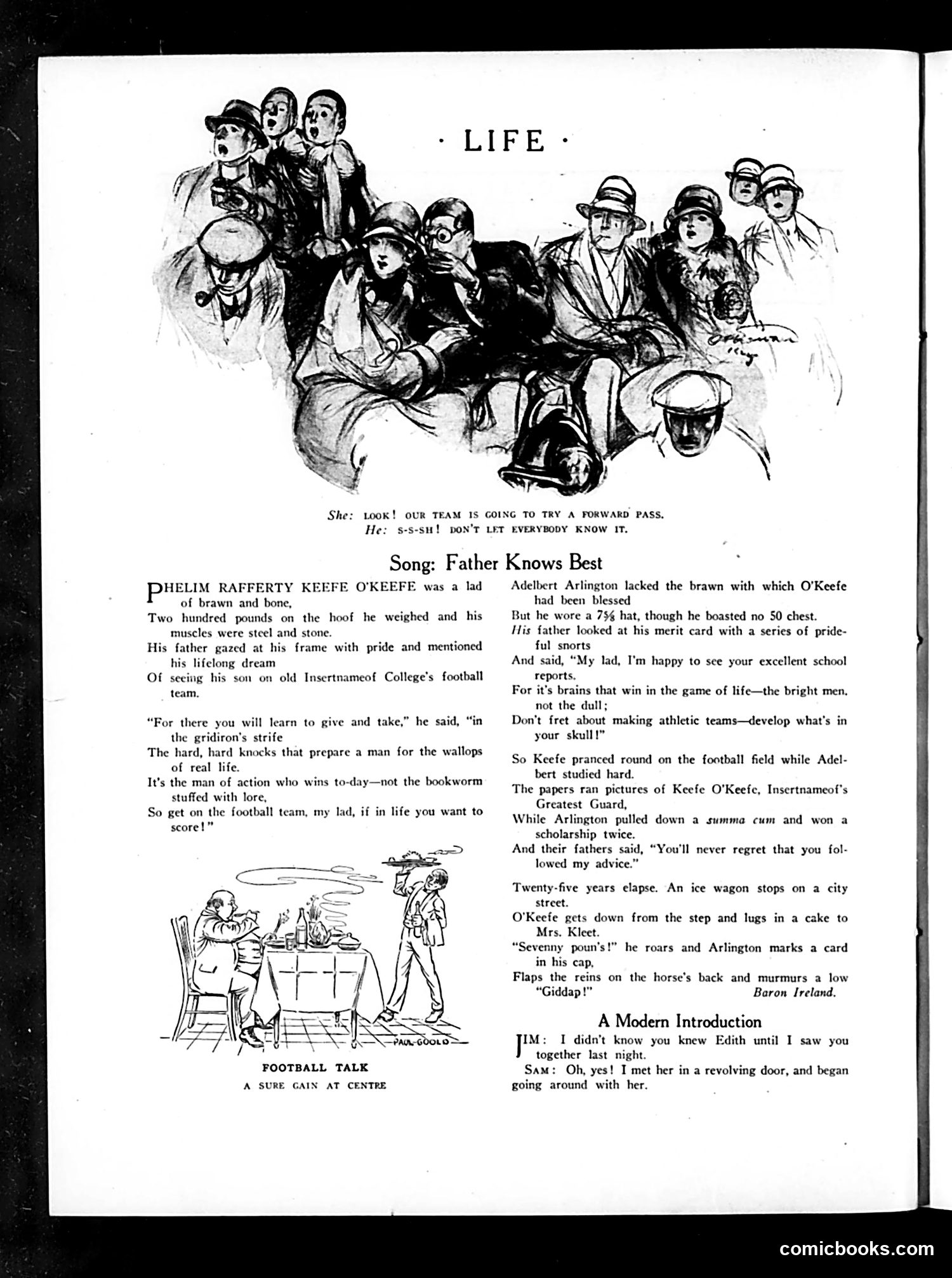
This page contains a humorous story and illustrations about football and life advice, rather than political satire. **Main Content:** "Father Knows Best" - a narrative poem about Phelim Rafferty Keefe O'Keefe, a large Irish boy (200 pounds) whose father advises him to join the football team at Insertnameof College to develop strength and character for "the wallops of real life." **The Joke:** The story follows O'Keefe's football career over 25 years, ending with him as an adult ice-wagon driver in the city—suggesting his father's grand advice about football preparing him for life didn't lead to impressive outcomes. **Social Context:** This reflects early 20th-century American attitudes about athletics building character and the immigrant Irish experience in urban America. The humor relies on the disconnect between aspirational parental guidance and ordinary working-class reality.
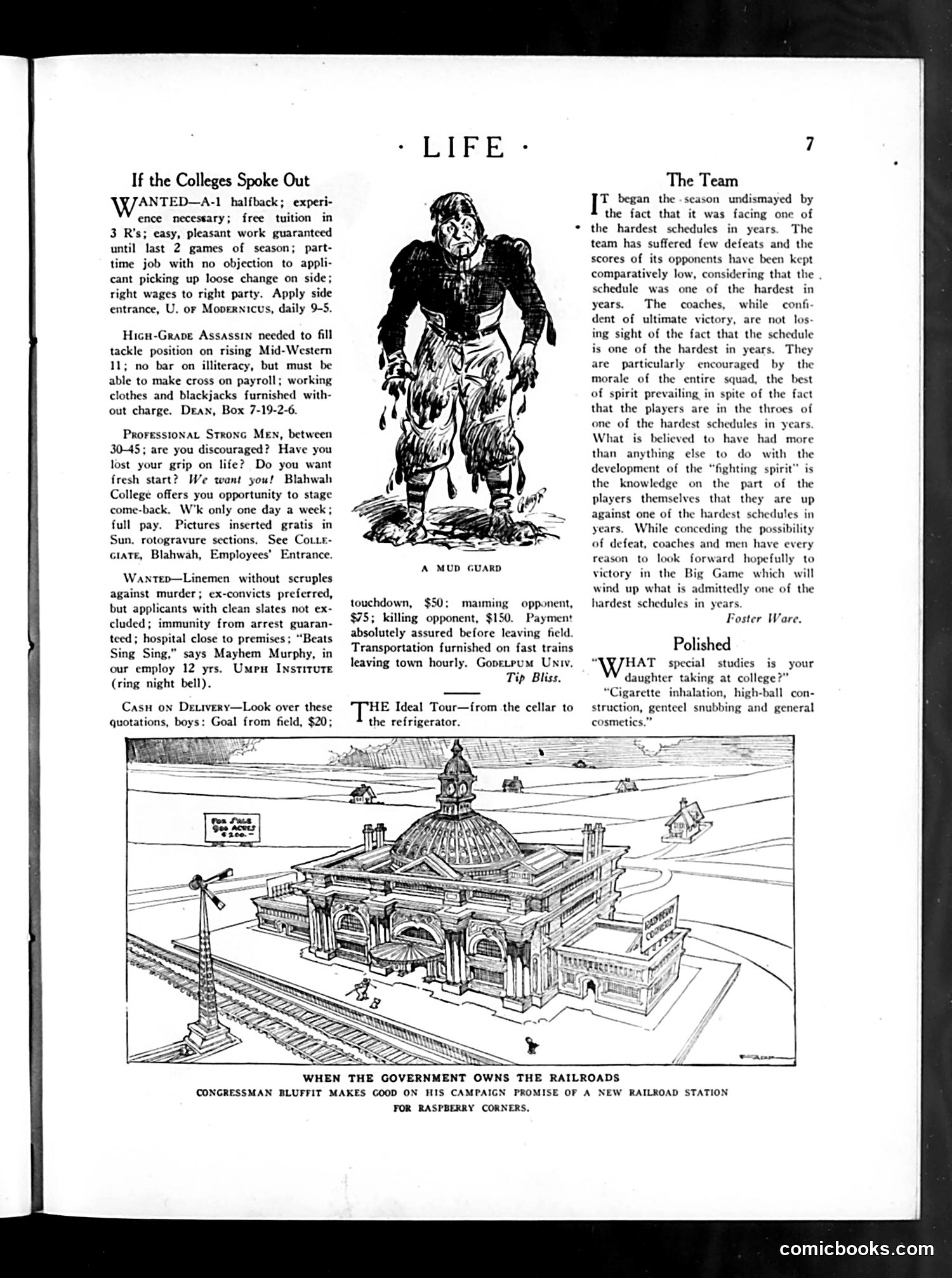
This page from *Life* magazine contains a satirical cartoon titled "When the Government Owns the Railroads," depicting an elaborate classical railroad station. The caption reads: "Congressman Bluffit makes good on his campaign promise of a new railroad station for Raspberry Corners." The satire targets political rhetoric about government railroad ownership—a contentious issue in early 20th-century America. The joke suggests that politicians make grand promises about public infrastructure development, but delivery is questionable or exaggerated. The ornate, impractical architectural design (with its large dome and classical styling) implies the absurdity of such promises for a small town like "Raspberry Corners," mocking both political overreach and voters' gullibility regarding campaign pledges about government-managed utilities.
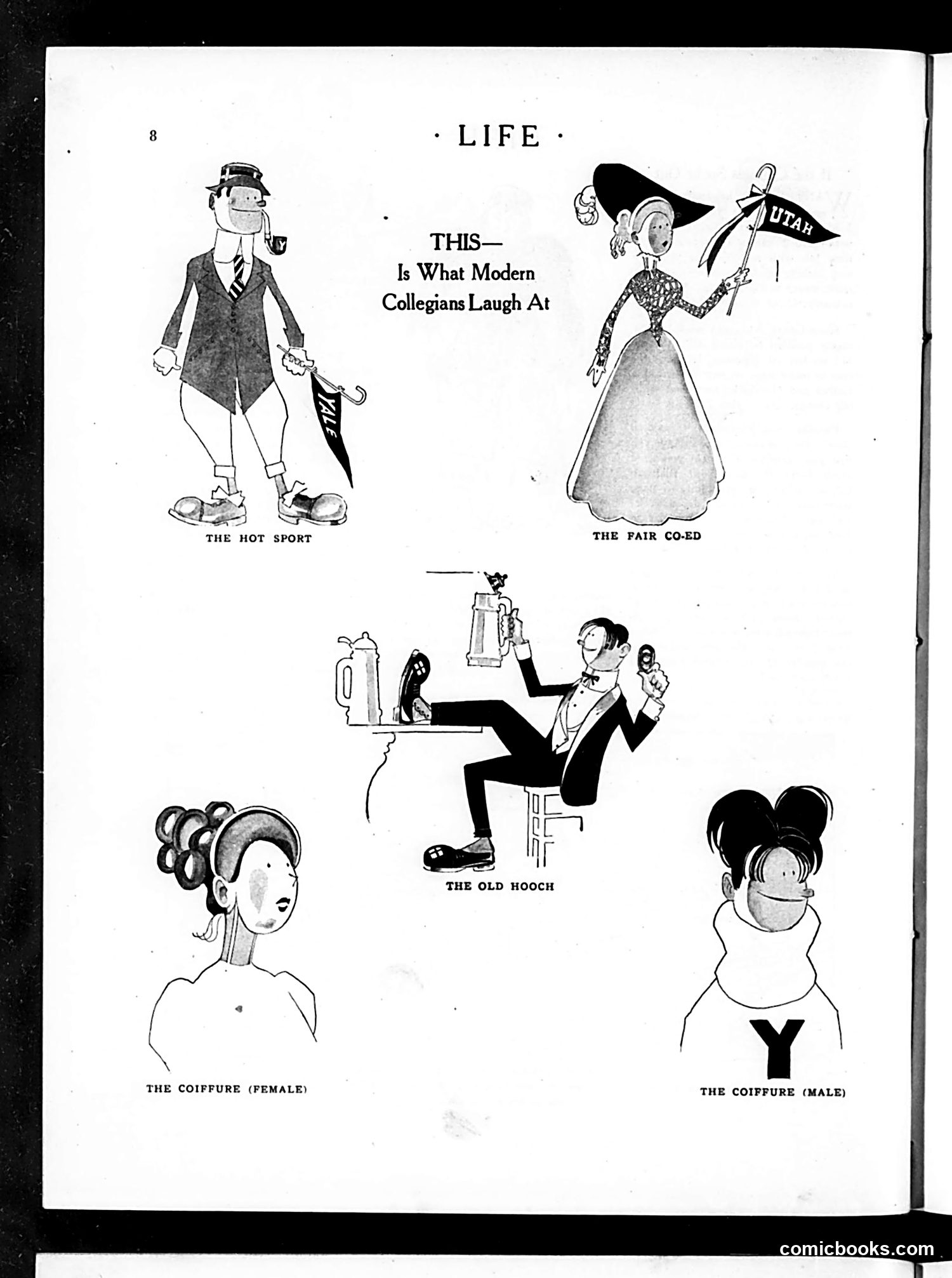
This satirical page mocks college social trends of its era with the heading "This Is What Modern Collegians Laugh At." The five cartoons ridicule fashions and behaviors: 1. **"The Hot Sport"** - A man in formal attire with umbrellas, likely satirizing an affected or pretentious college style 2. **"The Pair Co-ed"** - A woman holding a Utah pennant, mocking female college students 3. **"The Old Hooch"** - A man at a table with bottles, referencing Prohibition-era drinking on campus 4. **"The Coiffure (Female)" and "(Male)"** - Exaggerated hairstyles, with the male version showing a large "Y" shape, satirizing contemporary hair fashions The page targets what the magazine considered absurd modern college culture—excessive drinking despite Prohibition, fashionable pretension, and particularly ridiculous hairstyles among both sexes.
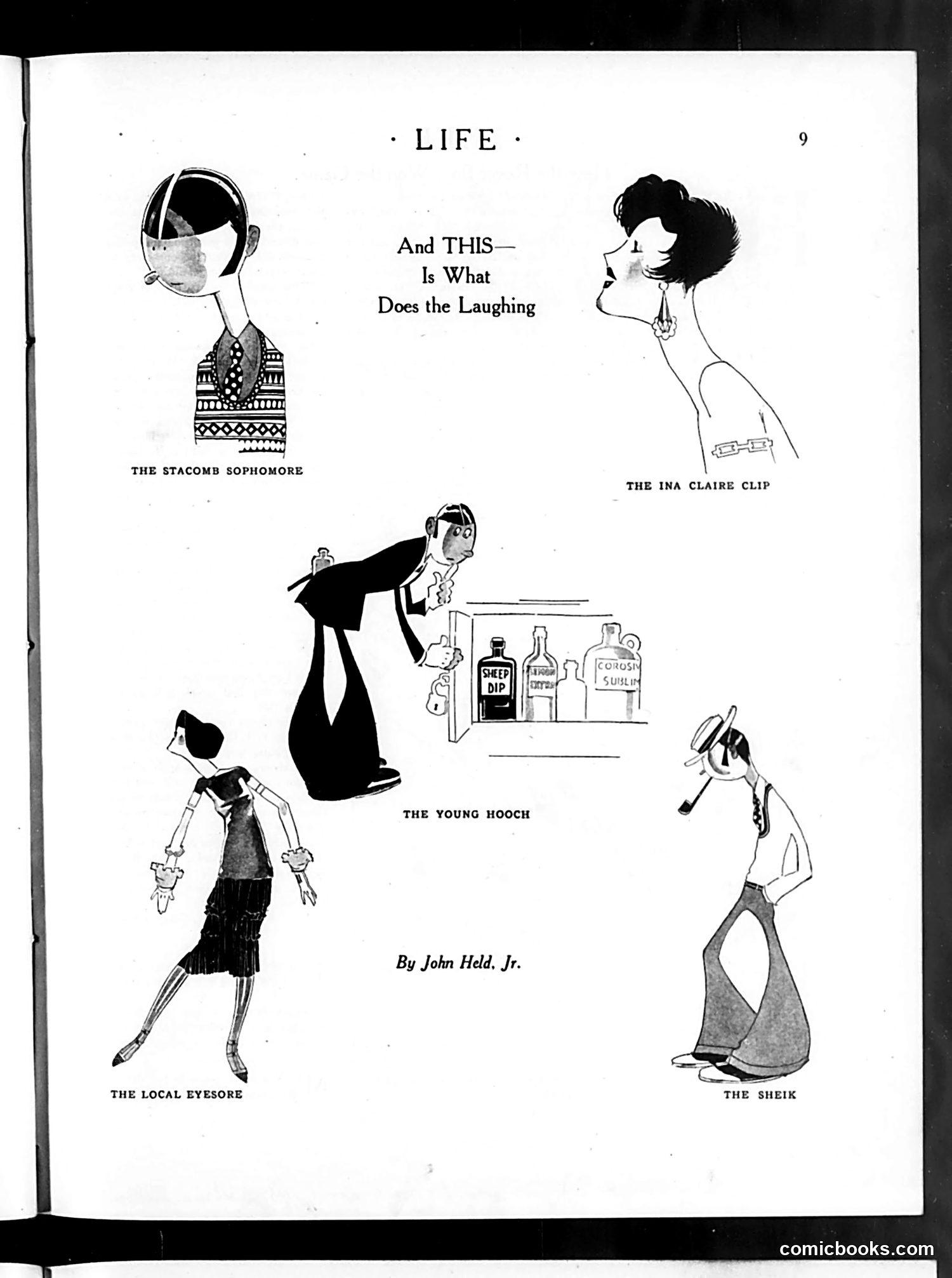
This page from *Life* magazine presents a series of satirical character sketches titled "And THIS—Is What Does the Laughing" by John Held Jr., a prominent cartoonist of the 1920s-30s era. The five caricatured figures appear to represent social types of the Jazz Age: - **The Stacomb Sophomore**: A vain youth obsessed with hair pomade - **The Ina Claire Clip**: References actress Ina Claire; likely satirizes women's fashion/hairstyles - **The Young Hooch**: A man raiding a liquor cabinet, referencing Prohibition-era bootlegging - **The Local Eyesore**: A woman in fashionable but garish dress - **The Sheik**: A fashionable man, referencing Rudolph Valentino's film persona The humor targets contemporary vanity, fashion excess, and Prohibition-era drinking culture. Held satirizes how these archetypal figures prioritize appearance and illicit pleasures while considering themselves sophisticated.
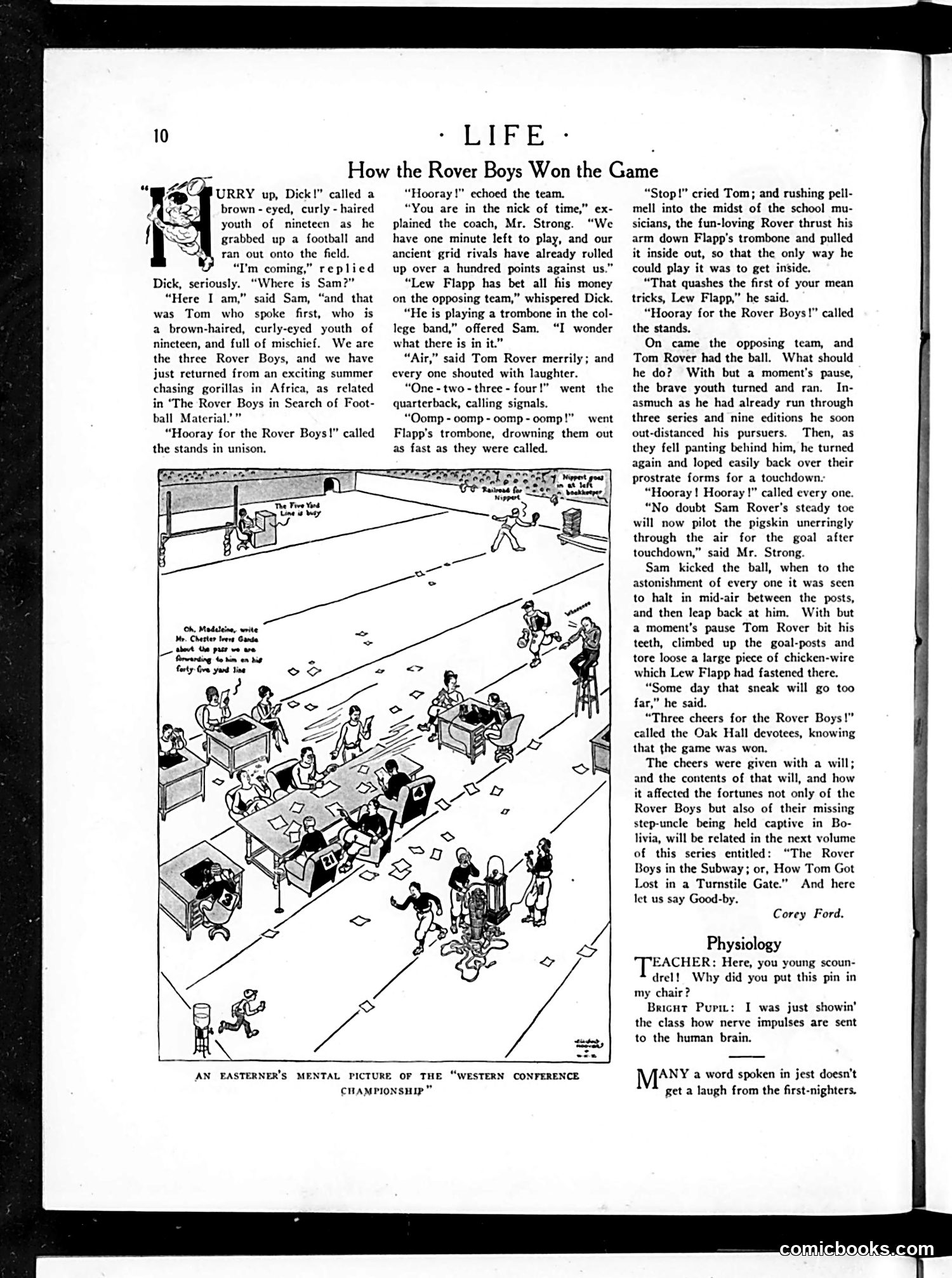
This page satirizes the wildly popular **Rover Boys adventure series** (early 1900s pulp fiction for boys), which featured three brothers solving mysteries and having improbable adventures. The satire mocks the series' formulaic plotting and absurd coincidences by imagining the Rover Boys playing football. The joke: everything mysteriously works out perfectly for our heroes through improbable means. Tom runs through enemies despite already running through "three series and nine editions." An opponent sabotages the game with chicken-wire, but Tom conveniently discovers and removes it. The illustration shows an "Easterner's mental picture" of Midwestern college football—suggesting East Coast readers found the Midwest's football obsession comically overblown. The humor depends on knowing the Rover Boys' reputation for contrived heroics. The brief "Physiology" joke at bottom is unrelated filler humor typical of Life magazine. The satire targets both the series' implausible plotting and American football culture's intense popularity.
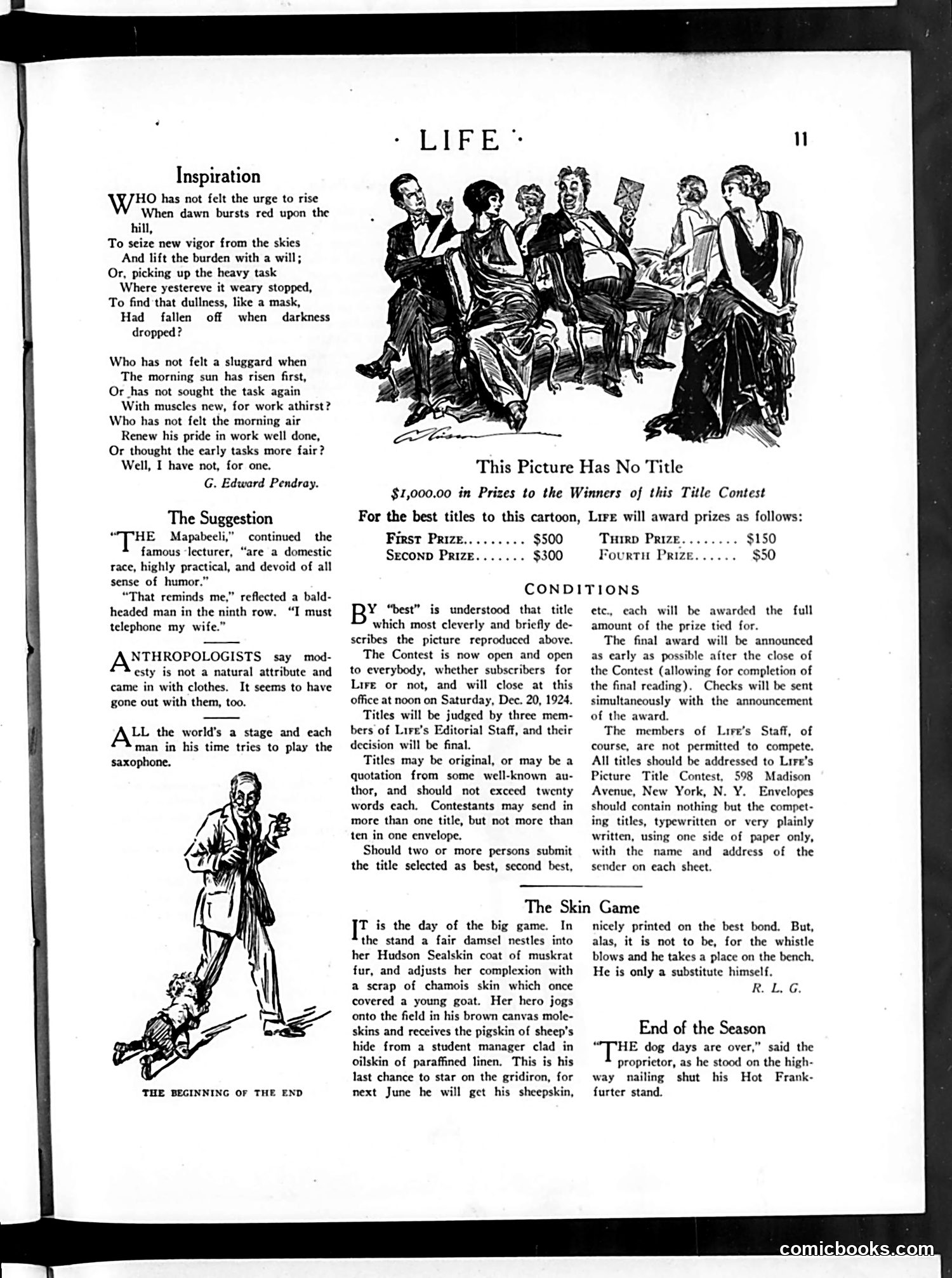
This page from *Life* magazine (dated December 1924) features a title-contest cartoon and several short humorous pieces typical of the era's satirical magazine format. **Main Cartoon ("This Picture Has No Title"):** Shows a group of well-dressed people in social settings. *Life* is running a $1,000 prize contest asking readers to suggest titles, with first prize at $500. The cartoon's satire isn't immediately clear from the image alone, but the format—inviting public naming—suggests it comments on contemporary social behavior or fashions. **Supporting Humor:** - "Inspiration" poem mocks those who claim morning energizes them for work - "The Suggestion" jokes about a husband distracted by marital obligation while hearing a lecture - "The Skin Game" catalogs various animal skins used in modern life (fur coats, footballs, diplomas), satirizing both consumerism and hypocrisy - "End of the Season" offers a brief Depression-era joke about seasonal business closing The page exemplifies *Life's* format: combining satirical poetry, cartoons, and brief comedic observations on everyday middle-class American life and social pretension.
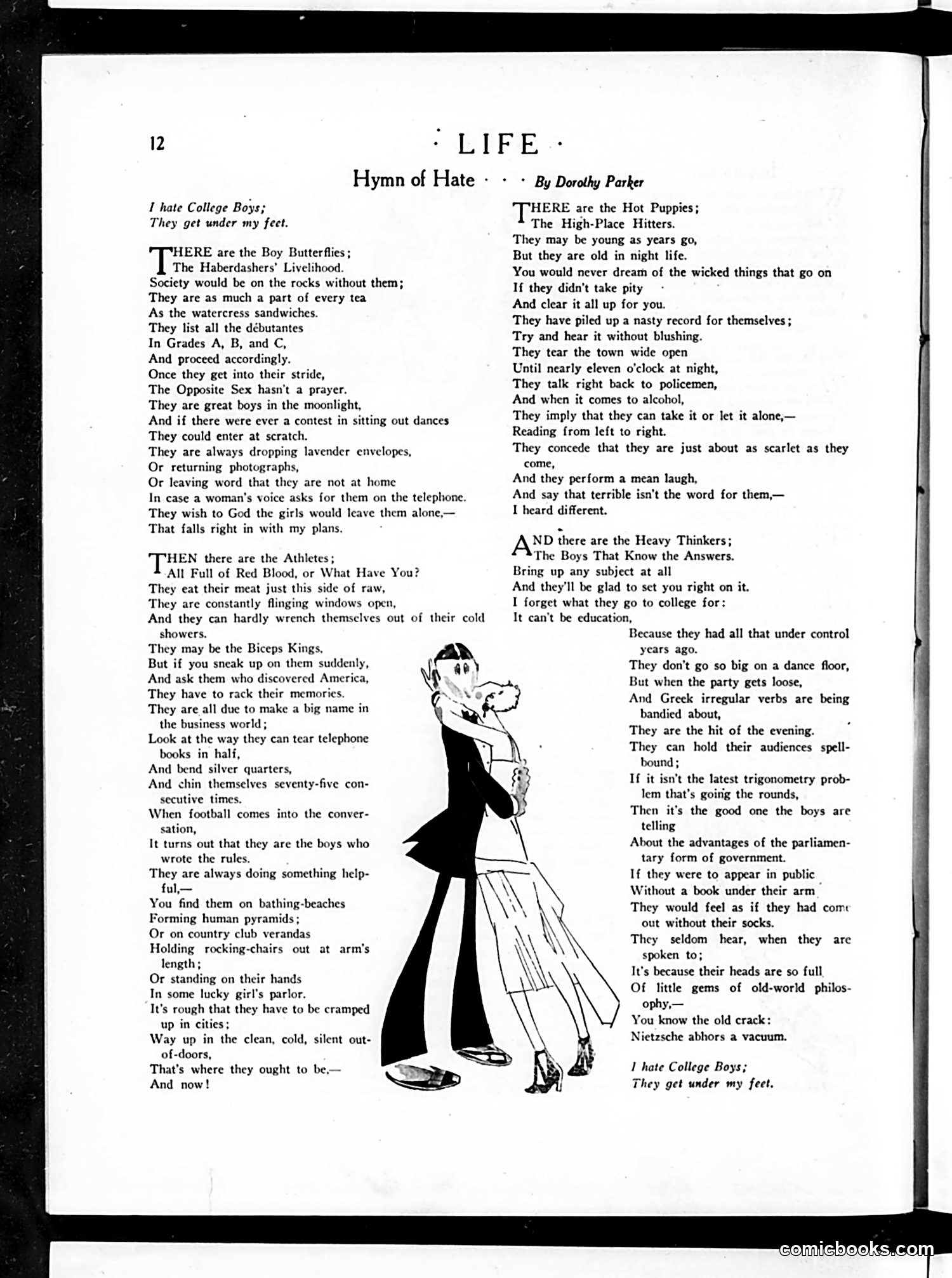
This is satirical social commentary on college-aged men of the 1920s, presented as character types. Parker mocks several stereotypes: **"Boy Butterflies"** — shallow, fashion-conscious social climbers obsessed with debutantes and romance, constantly flirting and leaving notes. **"Athletes"** — physically strong but intellectually vacant; they eat raw meat, do stunts (tearing phone books, chinning bars), yet can't answer basic questions like "who discovered America." Portrayed as best suited for outdoor life rather than cities. **"Hot Puppies"** — young men who exaggerate their sophistication and wild behavior, claiming to party late (until 11 PM) and break rules, though Parker suggests they're actually boring. **"Heavy Thinkers"** — pedantic show-offs who dominate conversations with obscure knowledge (Greek verbs, trigonometry, philosophy) to impress rather than educate, and feel naked without a book. The refrain "I hate College Boys; They get under my feet" frames all these types as annoying nuisances. The satire targets pretension, superficiality, and the performance of masculinity among privileged youth.
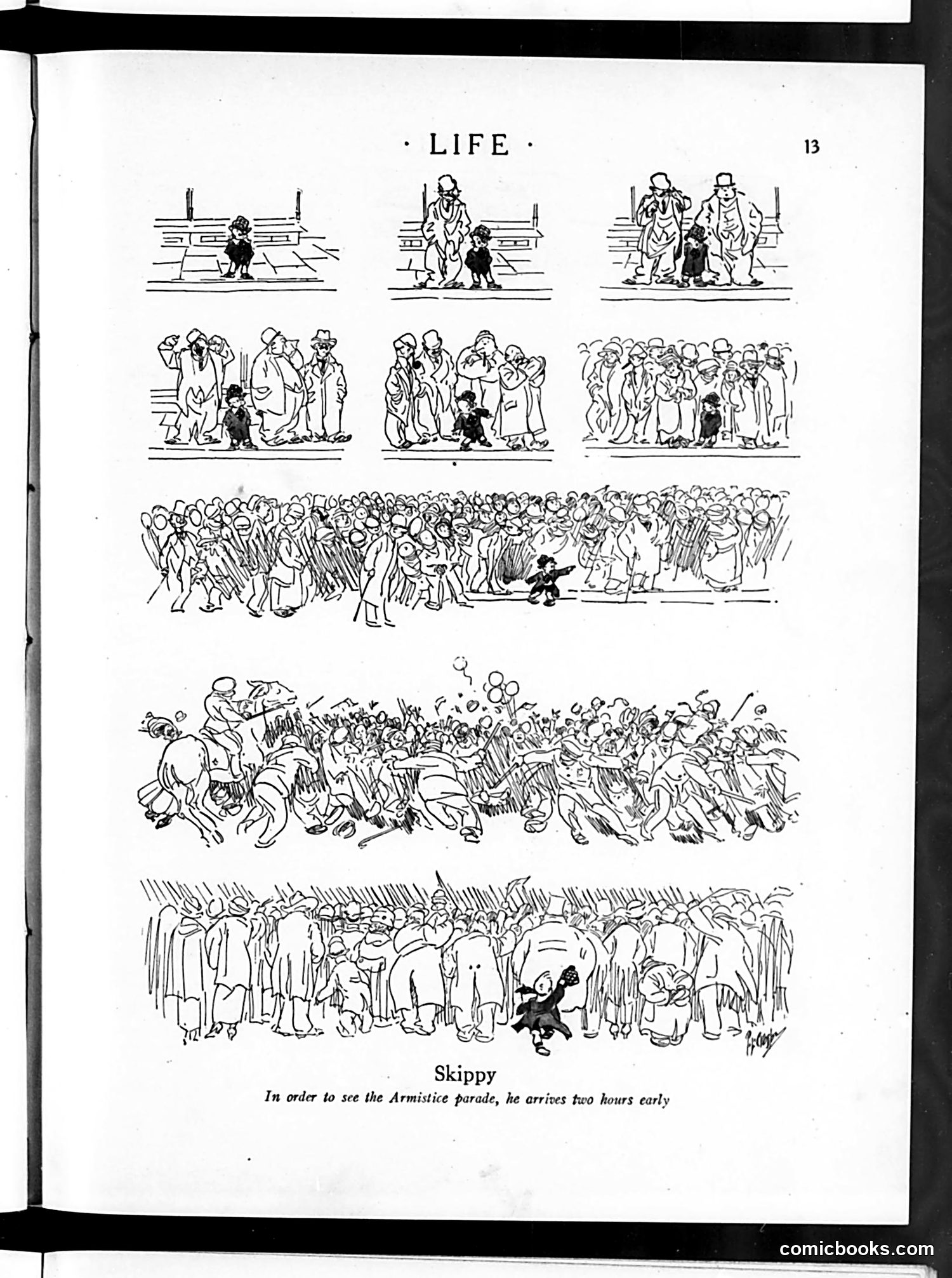
This page from *Life* magazine presents a visual narrative titled "Skippy" showing a small boy progressively pushing through increasingly larger crowds. The caption explains: "In order to see the Armistice parade, he arrives two hours early." The satire depicts the massive public enthusiasm for an Armistice Day parade (likely November 11th, commemorating WWI's end). Each panel shows Skippy arriving earlier and earlier, yet still encountering enormous crowds—the final panels showing him utterly dwarfed by dense masses of people. The joke is that even arriving two hours early proves insufficient to secure a good viewing spot due to overwhelming public interest. This reflects post-WWI America's celebration culture and the unexpected scale of civic gatherings during this period.
This is primarily an editorial essay by E. S. Martin, not a political cartoon. The piece reflects on the 1924 U.S. presidential election (Calvin Coolidge won), criticizing campaigns for encouraging personal attacks while noting voters seemed disengaged from actual issues. **Key references:** - **Coolidge**: Treated as a "sacred cow" during the campaign—opponents avoided harsh criticism, compared to the frontier saying "Do not shoot the organist, he is doing his best" - **General indifference**: Martin observes that voters cared more about basic economics (food, housing, fuel) than political ideology or party promises - **Percy Haughton**: A Harvard football coach who died of angina while still coaching, used as an example of dedication to duty **The satire's point**: Elections feel hollow when voters are apathetic and politicians seem irrelevant to real concerns. Martin suggests even controversial religious figures like Rev. Harry Emerson Fosdick might generate more genuine engagement than politics does.
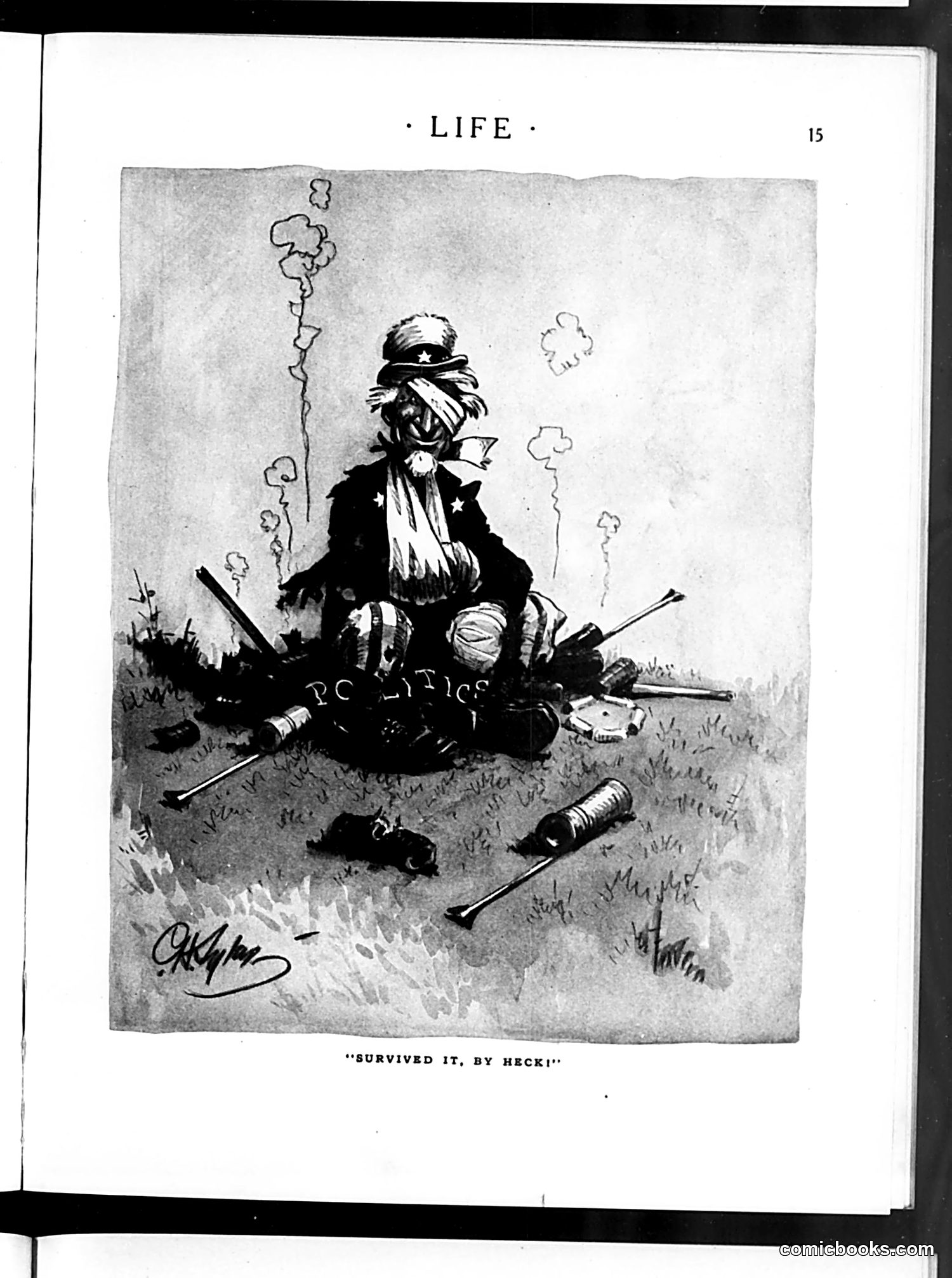
This cartoon depicts Uncle Sam (identifiable by his characteristic top hat with stars and striped clothing) sitting amid the wreckage of war—scattered artillery shells, rifles, and other military debris. The figure appears battered and exhausted but defiant. The caption "Survived it, by heck!" suggests resilience after military conflict. The flowers sprouting around him likely symbolize hope or renewal after destruction. This appears to be commentary on American survival through a major war, presumably World War I based on the artistic style and Life magazine's historical context. The satire celebrates American endurance while acknowledging the devastation of modern warfare. The overall tone is one of grim satisfaction—victory achieved at significant cost.
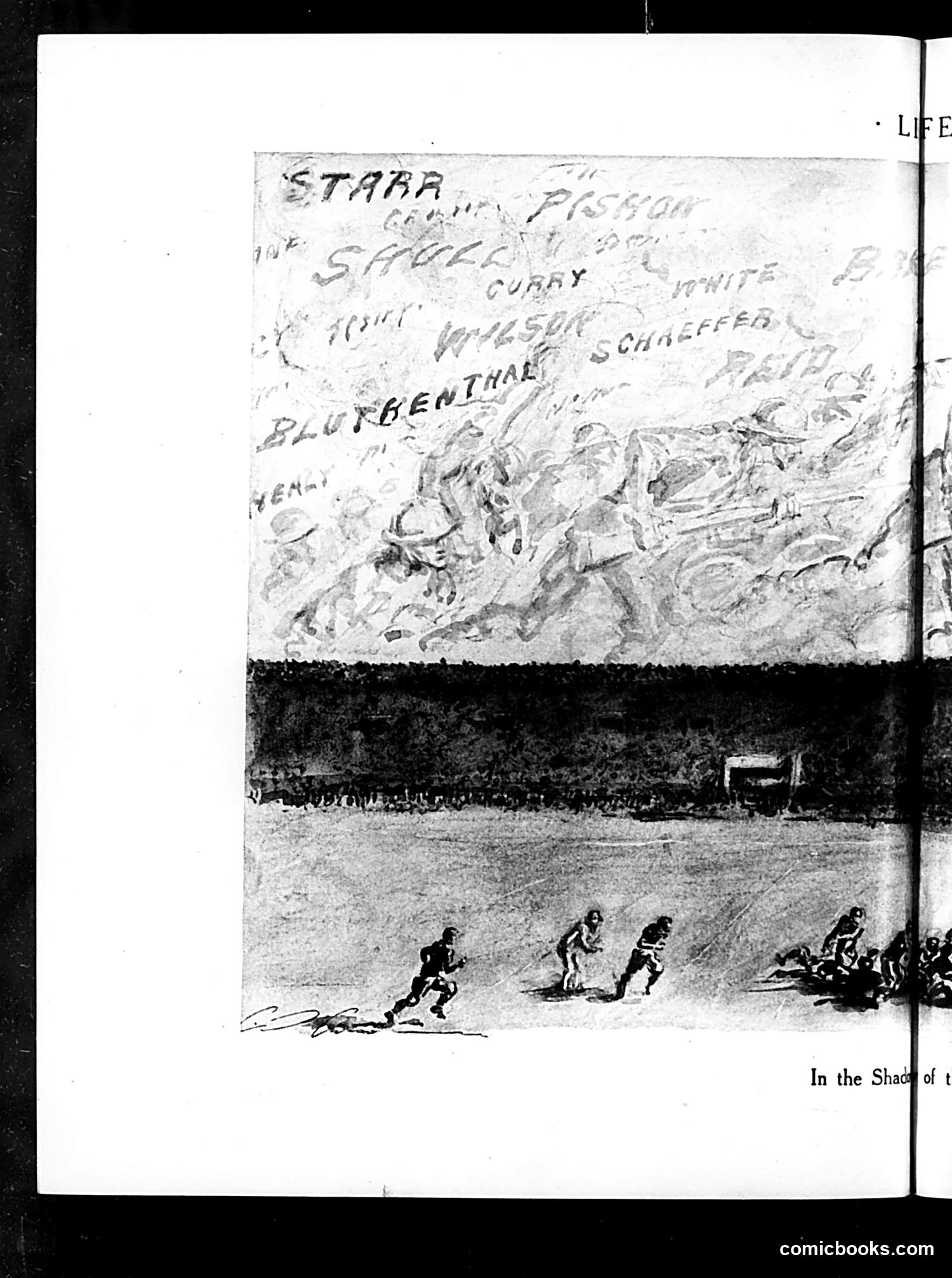
This appears to be a page from *Life* magazine showing a satirical cartoon. The upper portion contains handwritten text labeling various figures, though the handwriting is difficult to read with certainty. Visible names appear to include "STABB," "SCHAEFER," "BLUMENTHAL," and references to "STOCK," "FASHION," "CURRY," and "WHITE." The lower portion depicts silhouetted figures in what seems to be a dramatic scene—possibly soldiers or workers in conflict or action. However, without clearer visibility of dates, specific figure identifications, or the complete caption, I cannot confidently identify the precise political or social references this cartoon addresses. The page quality and OCR limitations prevent definitive interpretation of the satire's specific target or meaning.
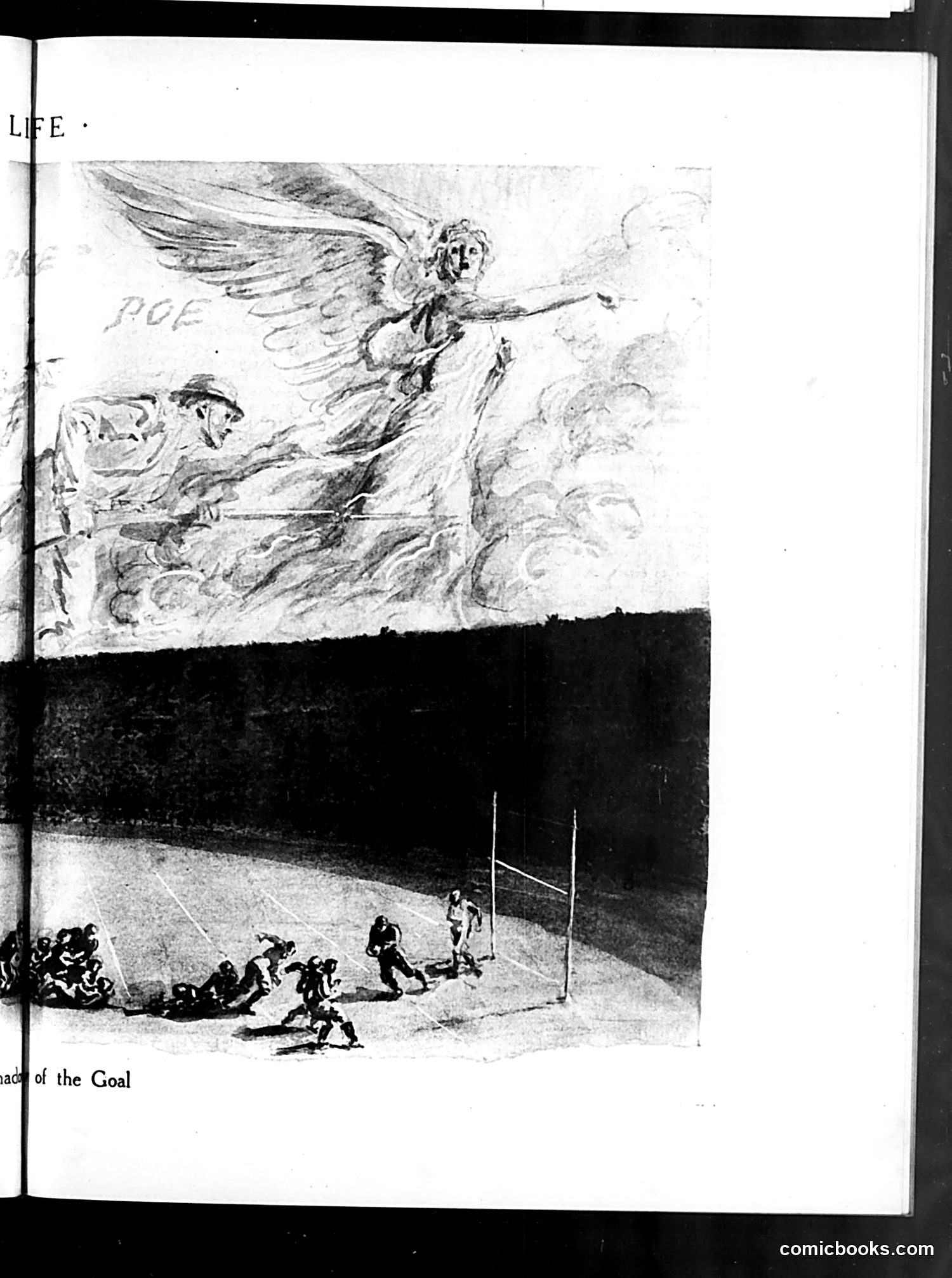
This page from *Life* magazine shows two distinct images under the heading "LIFE": **Upper image**: A sketch labeled "POE" depicts what appears to be an angelic or supernatural figure with wings hovering above two earthly figures, one wearing a hat. This likely references Edgar Allan Poe's literary themes of the macabre and the ethereal. **Lower image**: Titled "...of the Goal," shows people playing volleyball or a similar sport, with a winged angelic figure hovering above the net. This appears to be satirical commentary on the contrast between earthly, mundane activities and higher aspirations or divine intervention. The overall theme seems to juxtapose the spiritual/supernatural with everyday American life, though without additional context, the specific satirical target remains unclear.
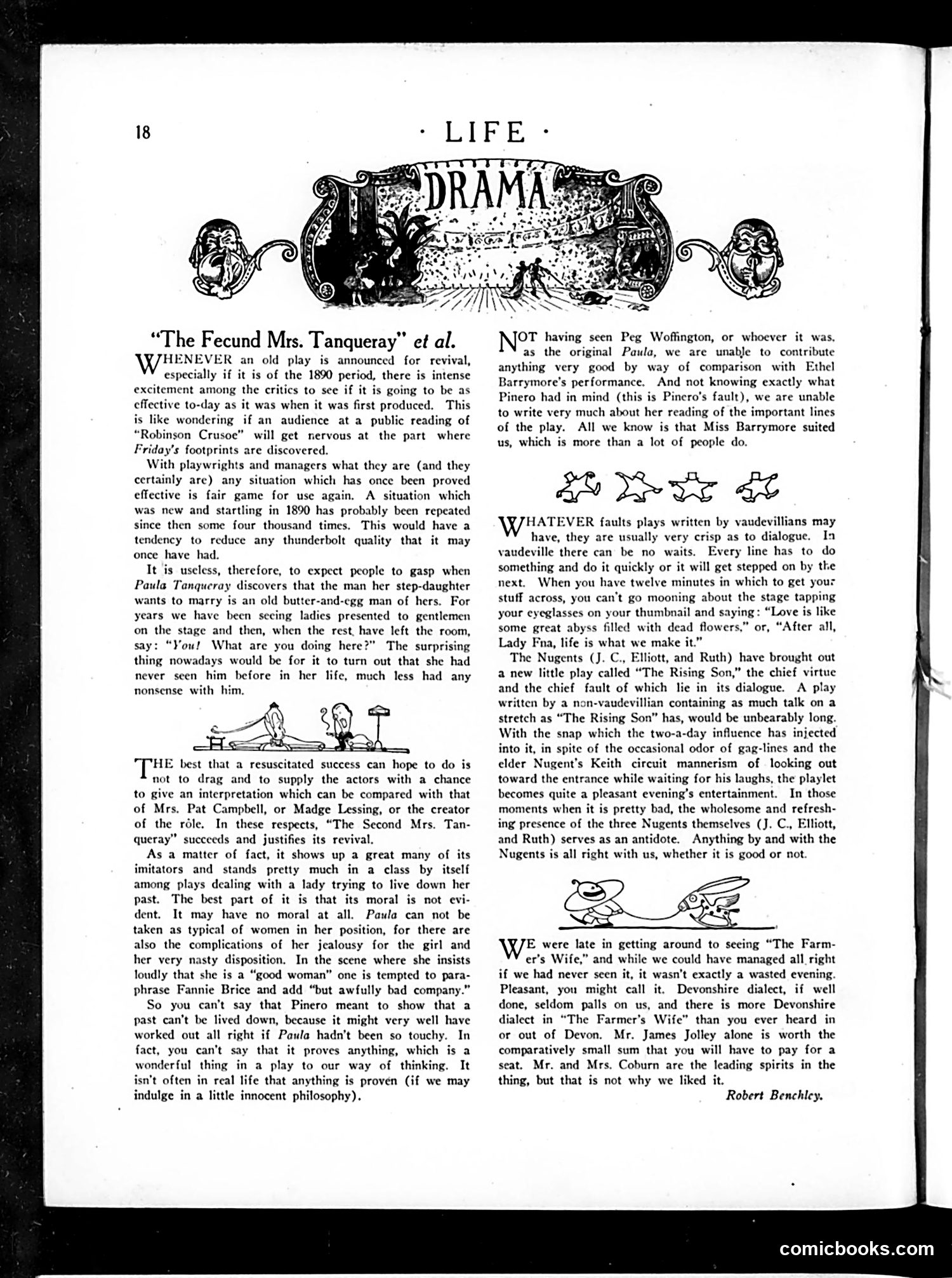
This is a theater review page from *Life* magazine's drama section. The critic discusses two plays: **"The Second Mrs. Tanqueray"**: A 1890s revival featuring Ethel Barrymore. The reviewer notes that audiences familiar with decades of similar theatrical plots—where a woman with a past is discovered by chance acquaintances—shouldn't expect shock value. The play's enduring quality, however, is that it resists simple moralizing; Paula Tanqueray's problems stem partly from her own difficult personality rather than proving anything universal about redemption. **"The Rising Son"**: Written by vaudevillians (the Nugent family—J.C., Elliott, and Ruth), the review praises the crisp dialogue typical of vaudeville, where every line must serve a purpose within strict time constraints, unlike conventional theater's tendency toward florid monologues. The small cartoons appear to illustrate theatrical gestures and poses rather than specific political satire. The page emphasizes how commercial theatrical recycling of proven situations had become tiresome by this era.
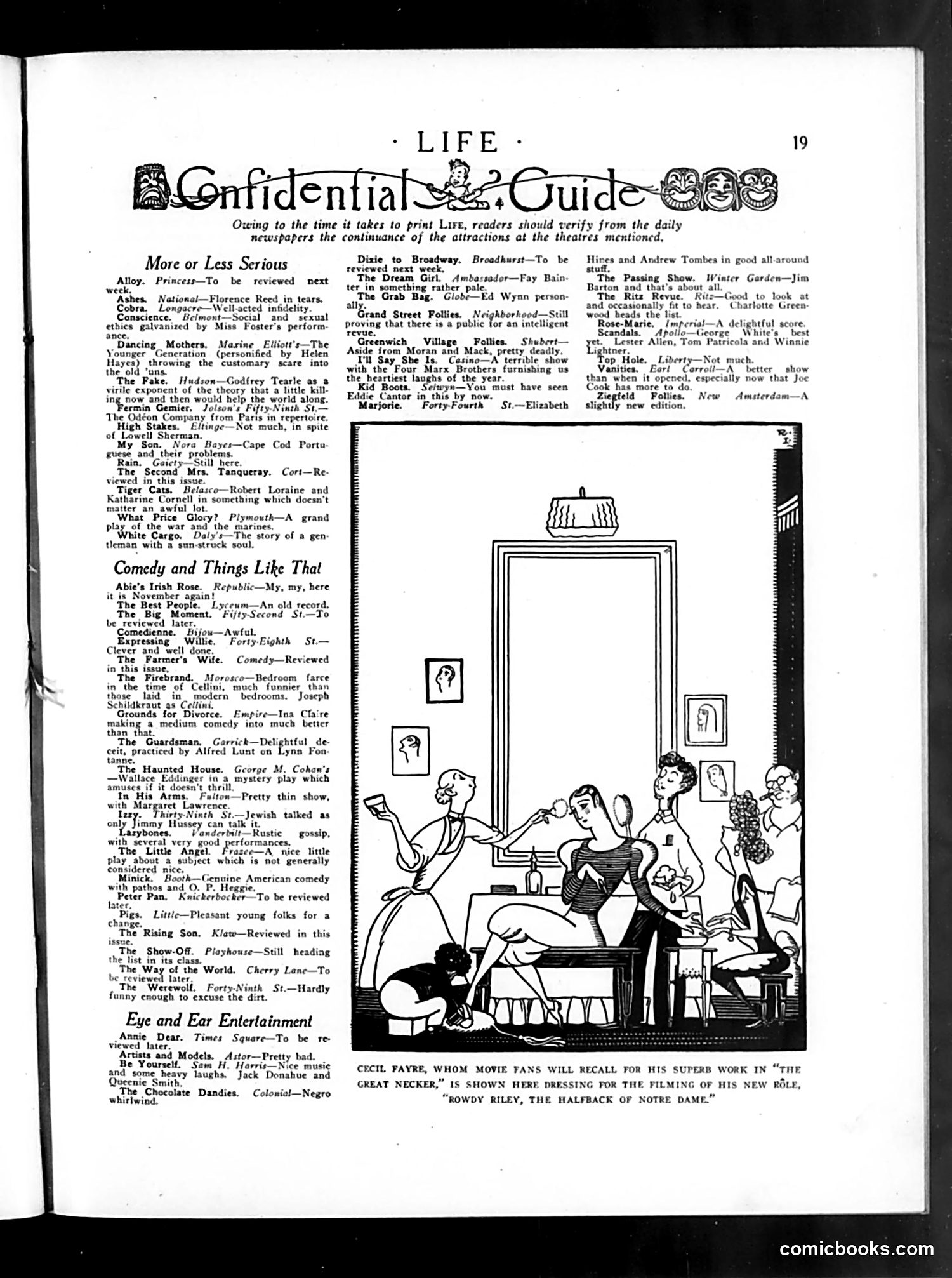
This page is a **theater review guide** for Broadway and other New York productions, not a political cartoon. The heading "Confidential Guide" indicates it's Life magazine's satirical commentary on current theatrical offerings. The illustration shows a **theatrical dressing room scene** with Cecil Fayre (a silent film actor known for "The Great Necker") preparing for his role in a new film called "Rowdy Riley, the Halfback of Notre Dame." The cartoon mocks the contrast between cinema and stage work—Fayre, a movie star, is shown in theatrical surroundings, suggesting the blending of entertainment mediums in the 1920s. The text consists of brief, witty capsule reviews of shows running in fall 1923, using satirical one-liners to skewer productions. For instance, "Cobra" is dismissed as "Well-acted infidelity," and "What Price Glory?" is praised as "A grand play of the war and the marines"—reflecting contemporary concerns and theatrical trends of the period.
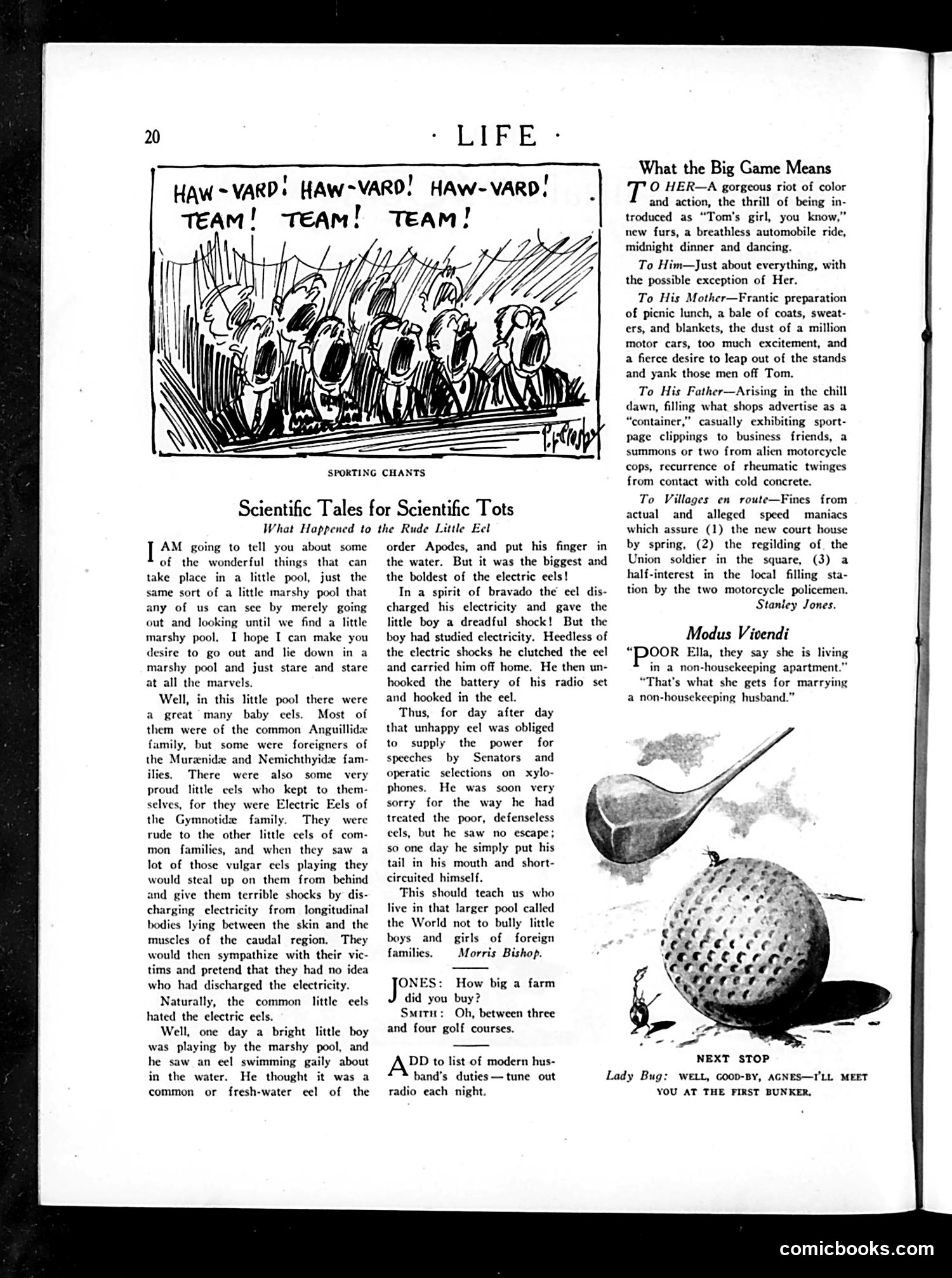
**Top Cartoon ("Sporting Chants"):** This is satire about Harvard football fans. The repeated "HAW-VARD! TEAM!" mimics the exaggerated, braying enthusiasm of college sports supporters—the "haw" sound suggests they sound like donkeys. It mocks the intense school spirit and crowd mentality surrounding big football games. **"Scientific Tales for Scientific Tots":** A humorous fable by Morris Bishop using electric eels as social commentary. A rude electric eel bullies common eels, then shocks a boy. The boy captures it and uses it to power his radio—forcing the eel into servitude. The moral: bullies get their comeuppance. This likely satirizes arrogant elites ("electric eels") who mistreat ordinary people ("common eels") and face eventual consequences. **"What the Big Game Means":** Satirical perspectives on attending a big football game from different viewpoints—the girlfriend enjoys glamour, the boyfriend bears all expenses, his mother worries endlessly, his father wakes early, and villagers profit through traffic fines. It mocks how one event has vastly different meanings depending on perspective.
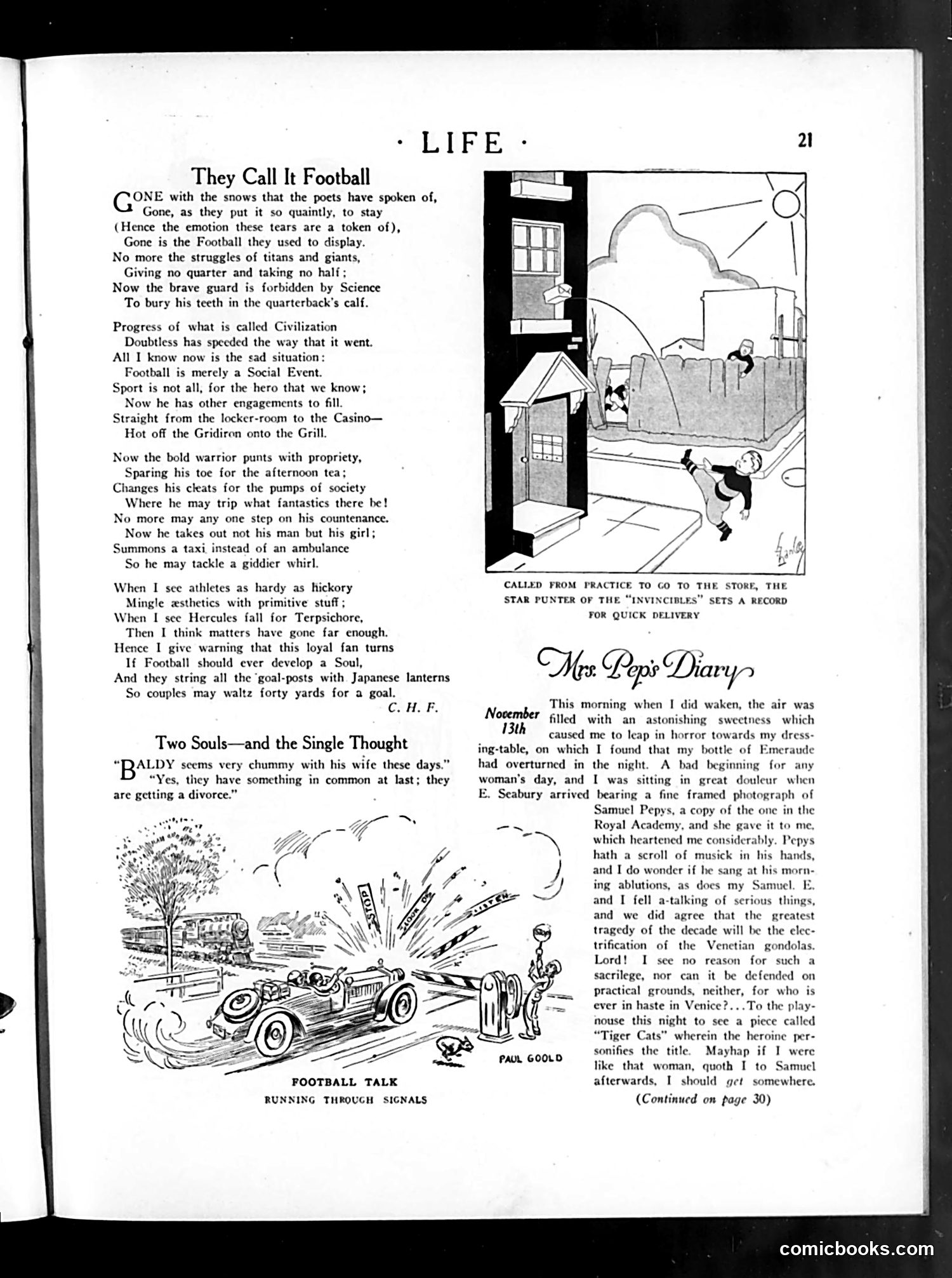
This page contains two satirical pieces lamenting the "modernization" of American football and society. **"They Call It Football"** (poem by C.H.F.) nostalgically criticizes how football has lost its rough, competitive character. The author mourns that players no longer engage in brutal play (like "bury his teeth in the quarterback's calf") due to scientific progress and "Civilization." Instead, athletes now pursue social activities—casino visits, afternoon tea, dancing—treating football as merely a "Social Event" rather than serious sport. The concluding threat warns that if football develops a "Soul," with romantic couples waltzing to goal-posts decorated with Japanese lanterns, he'll abandon fandom. **The cartoon** shows a star punter leaving practice to deliver something from a store, sarcastically mocking how modern athletes juggle commercial obligations alongside sport. **"Mrs. Peps Diary"** is a gossipy society column parodying Samuel Pepys's historical diary, mixing trivial vanities (spilled perfume) with pseudo-intellectual concerns (electrifying Venetian gondolas). Together, these pieces satirize early 20th-century anxiety about modernization eroding traditional masculine values and authentic experience.
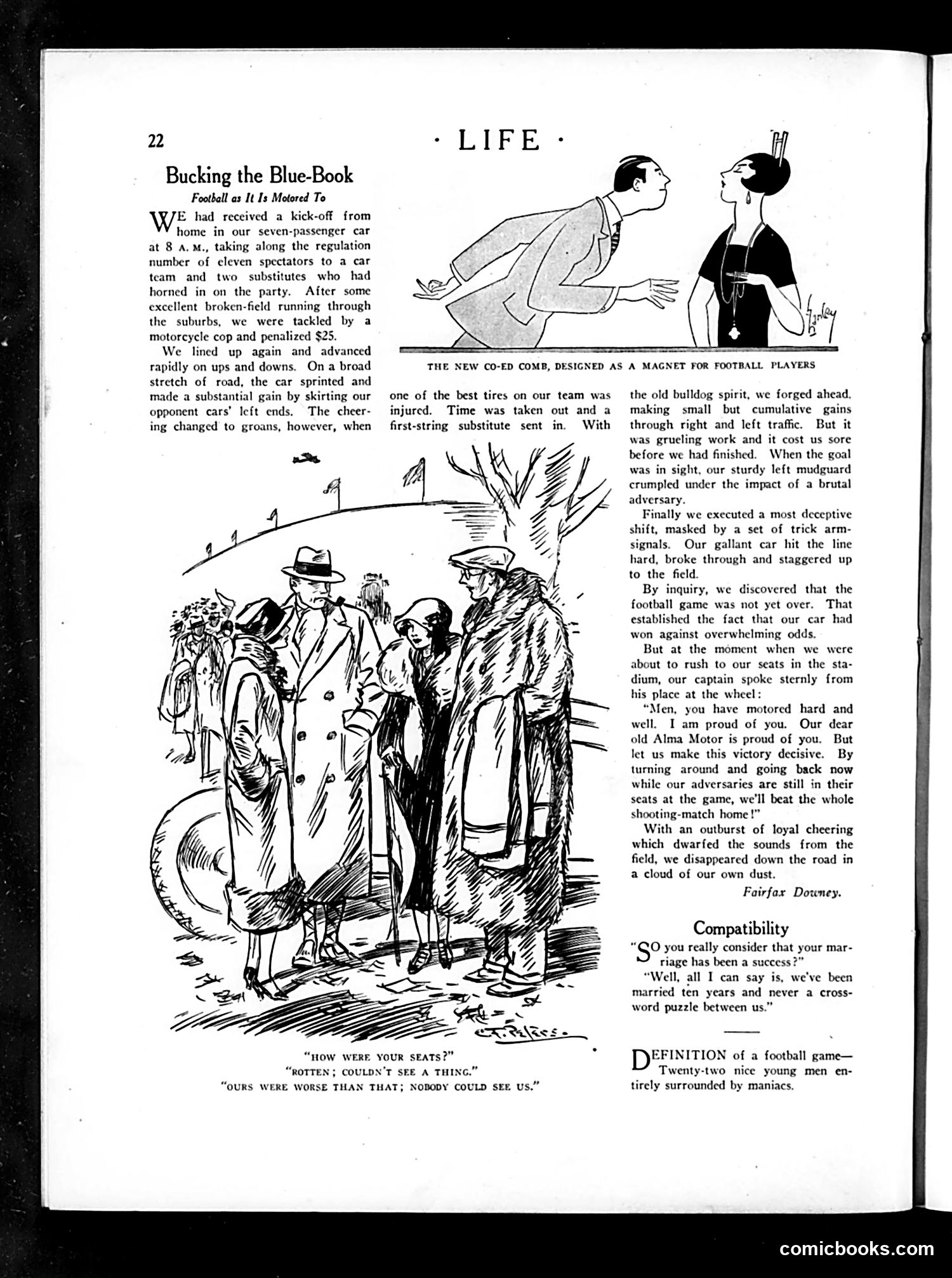
This satirical piece mocks the era's automobile craze by treating a car trip to a football game as if it *were* the football game itself. The humor relies on: **The Main Joke:** The narrative describes their journey in football terminology—the car "sprinting," gaining yardage, suffering injuries (a flat tire), executing trick plays, and finally "winning" by reaching the stadium. The punchline is their captain orders them to leave immediately and race home instead of watching the actual game, treating the drive itself as the real competition. **Social Context:** This reflects 1920s America's fascination with automobiles as status symbols and recreation. "Motoring" was entertainment; getting somewhere mattered less than the journey itself. **The Co-ed Comb cartoon** (top) is a separate joke about attracting female football fans with a fashionable hair comb. **The dialogue jokes** mock spectators' poor stadium views and marriage compatibility, the latter being unrelated filler content typical of *Life* magazine.
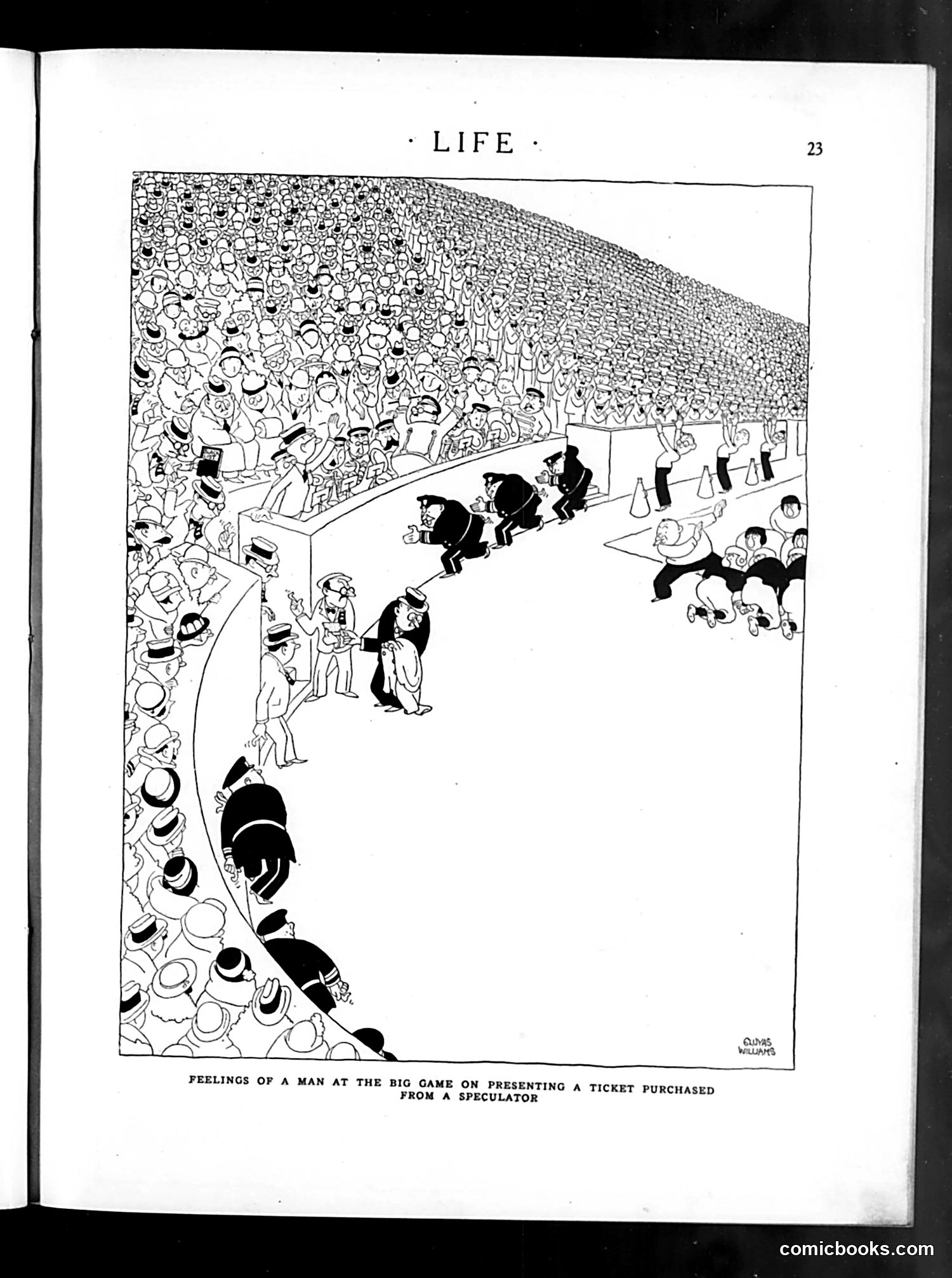
This Cluyas Williams cartoon satirizes the experience of attending a major sporting event (likely baseball, given the era) after buying a ticket from a speculator—a scalper charging inflated prices. The humor contrasts the man's emotional journey: he enters confidently with his expensive ticket (bottom left), but as he navigates through massive crowds toward his seat (the stadium shown in aerial perspective), his confidence visibly deflates. The progression suggests mounting disappointment—likely discovering his overpriced ticket grants poor seating or viewing angles amid thousands of other spectators. The satire targets both the speculator system that exploits fans and the gap between ticket cost and actual enjoyment at crowded public events. The exaggerated crowd density emphasizes how the paying customer gets lost in the mass.
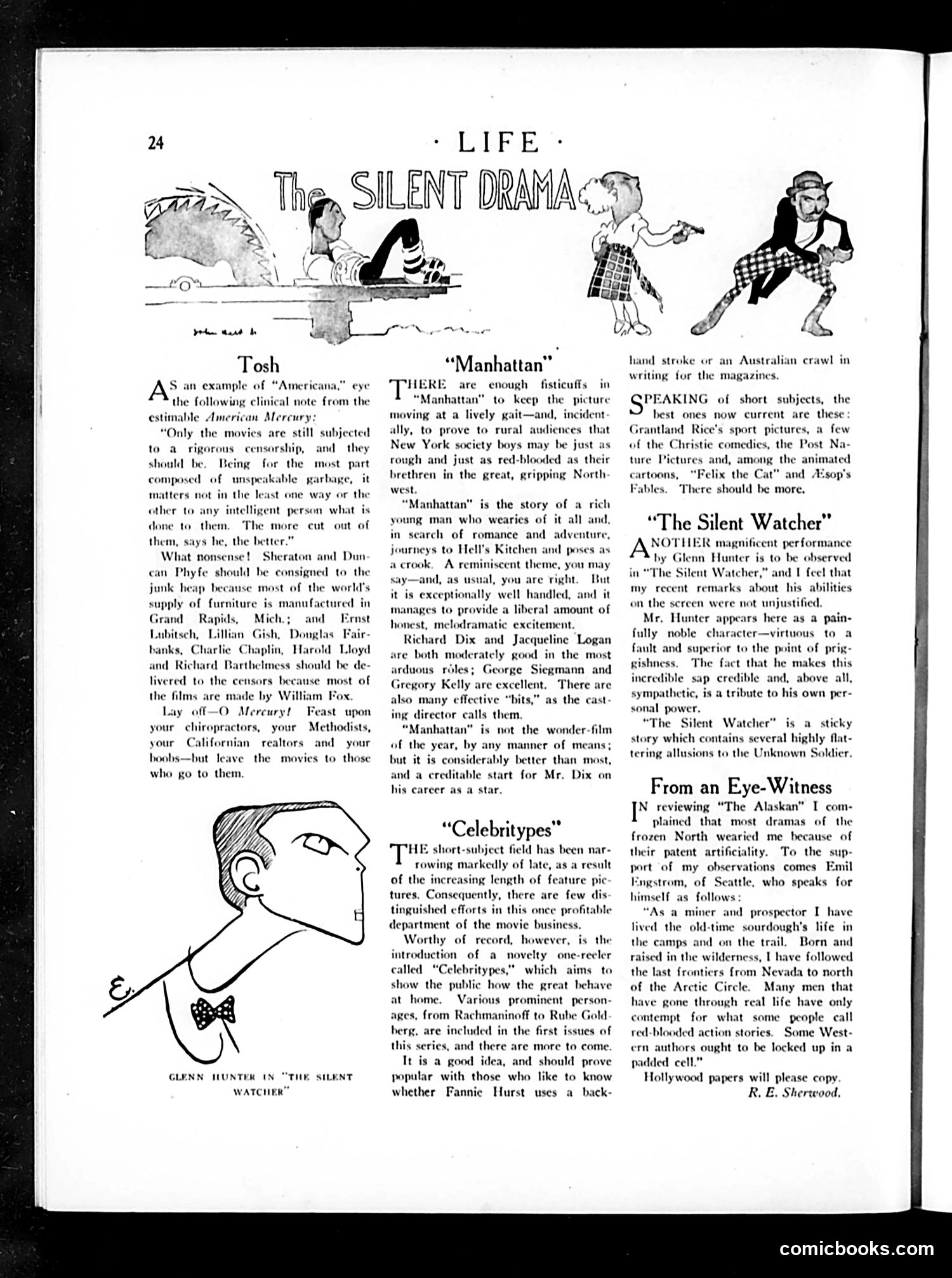
This page from *Life* magazine reviews contemporary silent films while satirizing American censorship attitudes. The opening "Tosh" section mocks the *American Mercury's* claim that movies are "garbage" unworthy of censorship protection. The author argues absurdly that if films deserve censoring, then furniture designers like Sheraton and famous filmmakers (Chaplin, Lloyd, Gish) should also be discarded—exposing the hypocrisy of selective moral policing. The reviews discuss three films: "Manhattan" (a society-to-underworld adventure), "Celebritypes" (a novelty short showing famous people at home), and "The Silent Watcher" (starring Glenn Hunter). The satire on "Celebritypes" jokes that audiences will watch anything, even trivial shots of celebrities bathing or writing. The caricature of Glenn Hunter illustrates the era's visual style. Overall, the page defends cinema as legitimate art against puritanical censors.
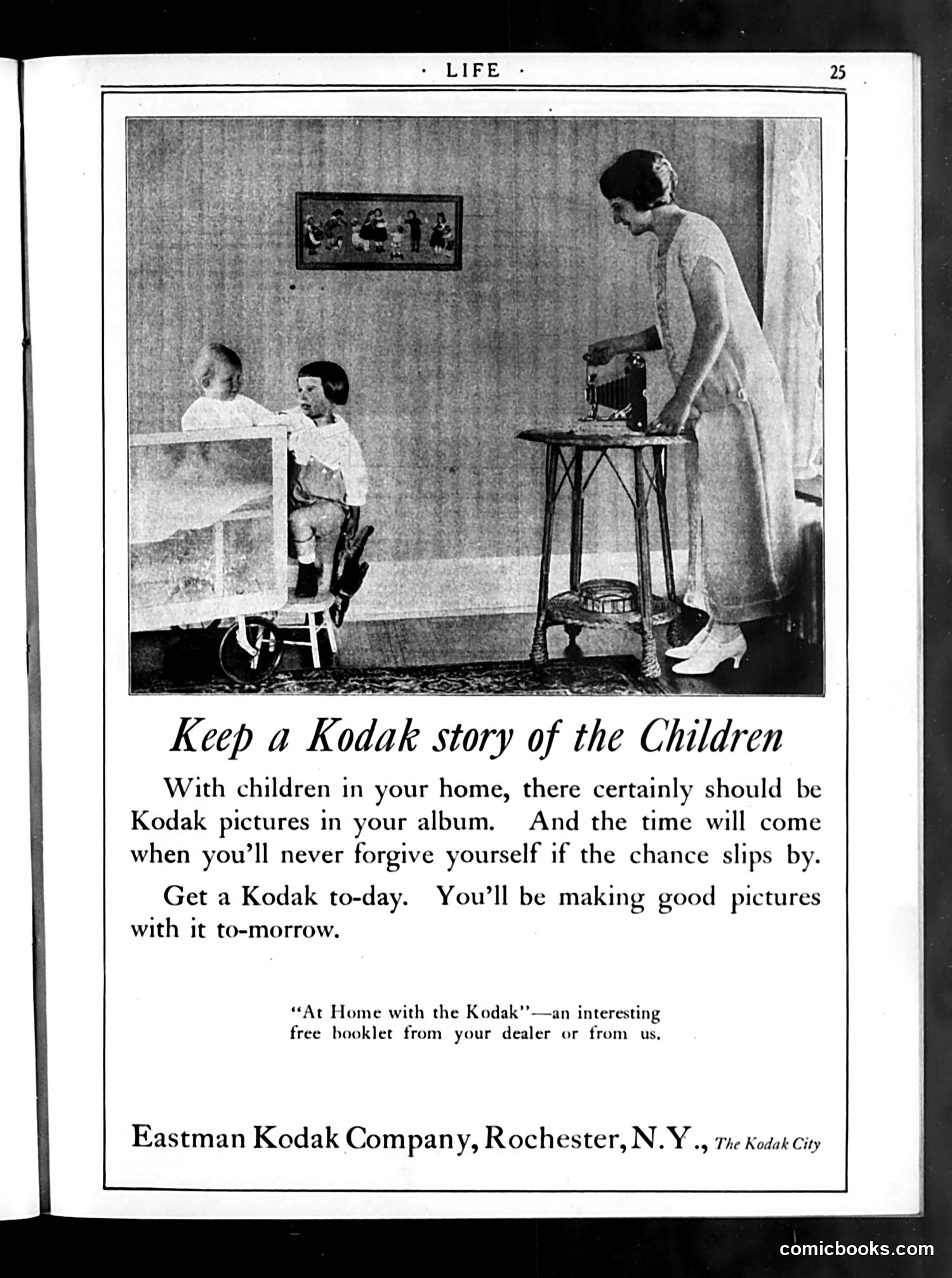
This is a **product advertisement**, not political satire. It promotes Kodak cameras to parents by appealing to emotional nostalgia and parental anxiety. The image shows a woman photographing two young children indoors with a large-format camera on a tripod. The ad's message targets parents: capturing childhood moments is precious and fleeting—if you don't photograph your children now, you'll regret it forever. This represents an early **marketing strategy that manufactured emotional need**. Rather than selling cameras as technical tools, Kodak framed photography as essential family record-keeping and sentiment preservation. The tagline "You'll be making good pictures with it to-morrow" promises ease of use to amateur photographers. The ad reflects early-20th-century assumptions about women's domestic roles and motherhood while normalizing the camera as standard household equipment.
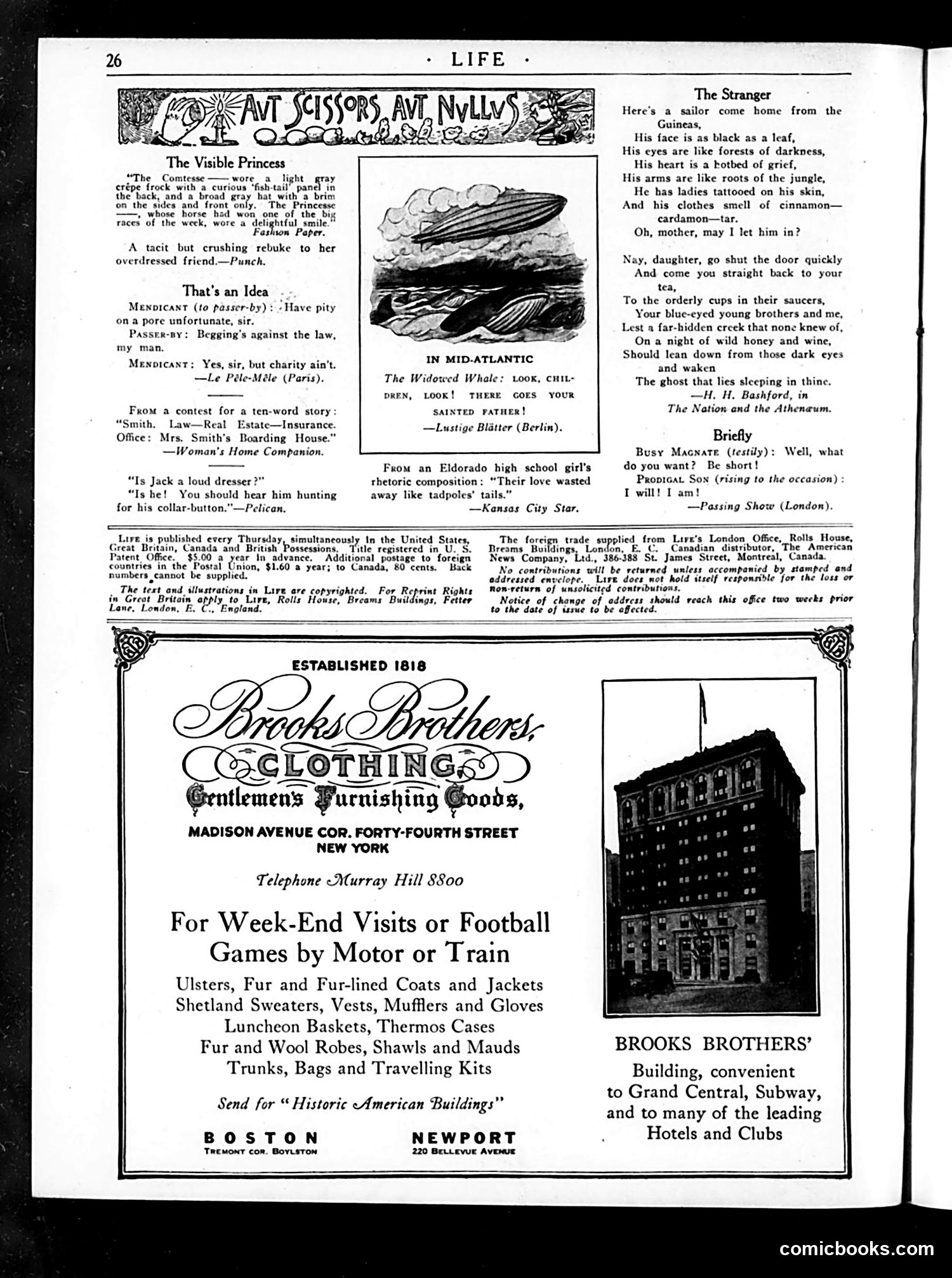
This page from Life magazine contains several brief satirical items and advertisements, mostly lacking political content. **The cartoons/jokes:** - "The Visible Princess" mocks fashion obsession: a woman in elaborate dress is subtly criticized by another woman who wears simpler clothing but owns a winning racehorse—implying inner accomplishment trumps outer display. - "That's an Idea" presents a beggar's logical retort to someone citing begging laws: charity isn't illegal, only begging is. - "The Widowed Whale" (from Berlin) shows a whale pointing to a dead whale, calling it the children's "sainted father"—dark humor about loss. - "The Stranger" is a poem warning against allowing a dark-skinned sailor into a proper home, expressing xenophobic and racist anxieties common to the era about foreign "otherness" corrupting domestic virtue. The bulk of the page is a Brooks Brothers advertisement for gentlemen's clothing and travel goods, reflecting the magazine's affluent readership.
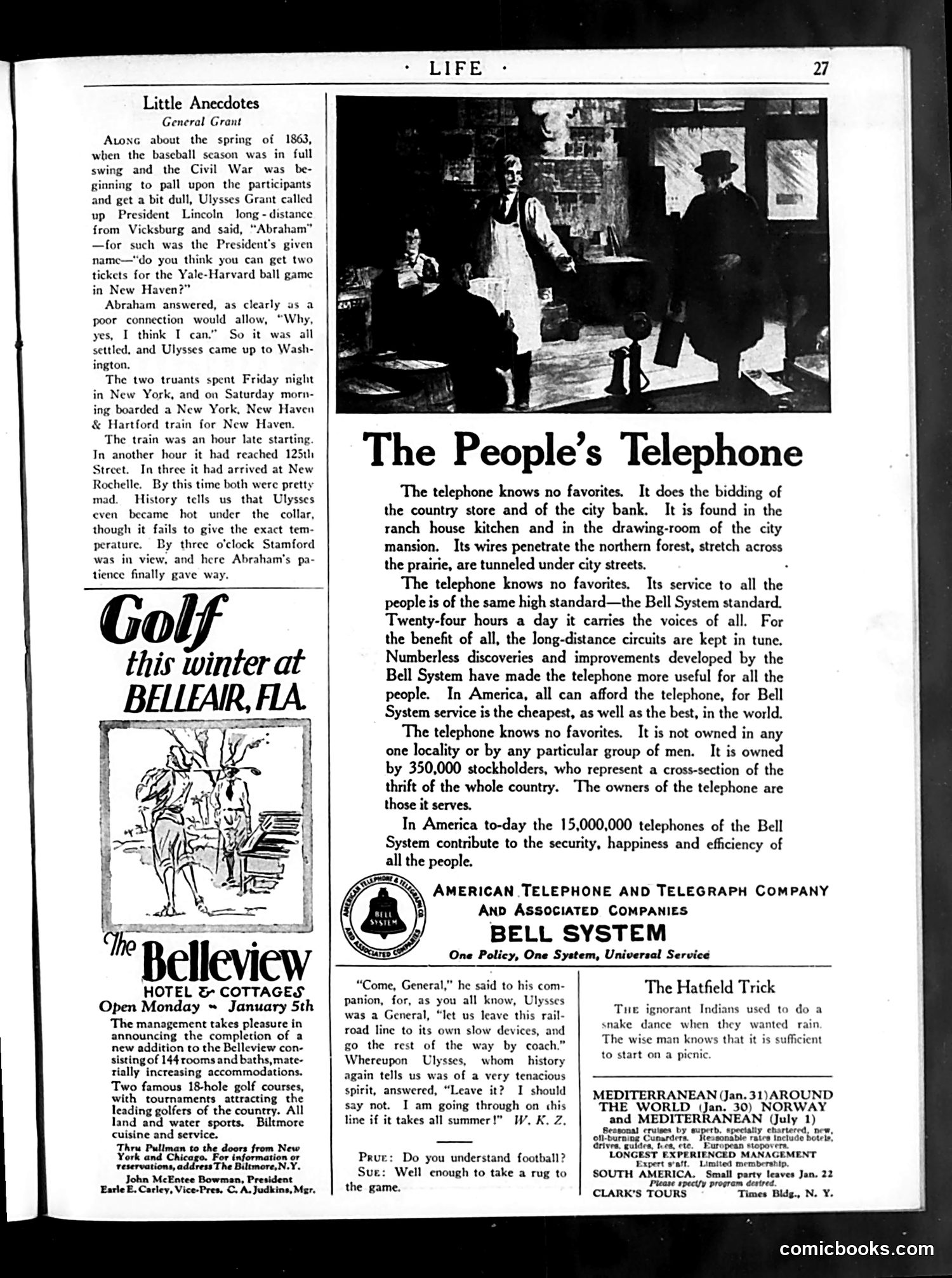
This page contains a humorous anecdote about **General Ulysses S. Grant** during the Civil War (spring 1863). The joke depicts Grant calling President Lincoln long-distance from Vicksburg to request Yale-Harvard baseball tickets. When a slow train delays their trip to New Haven, Grant becomes impatient. Lincoln famously says he'll leave "if it takes all summer"—a wry reference to Grant's actual historical reputation for prolonged military campaigns and grinding attrition tactics. The satire mocks Grant's stubbornness and the slow pace of both the war and 19th-century rail travel. It's gentle Civil War-era humor playing on public figures' known personalities. The page is primarily **advertising**: the Bell System telephone company's corporate pitch about universal service, plus hotel and golf resort ads. The small "Hatfield Trick" and "Prue & Sue" items are minor filler jokes typical of Life magazine's format.
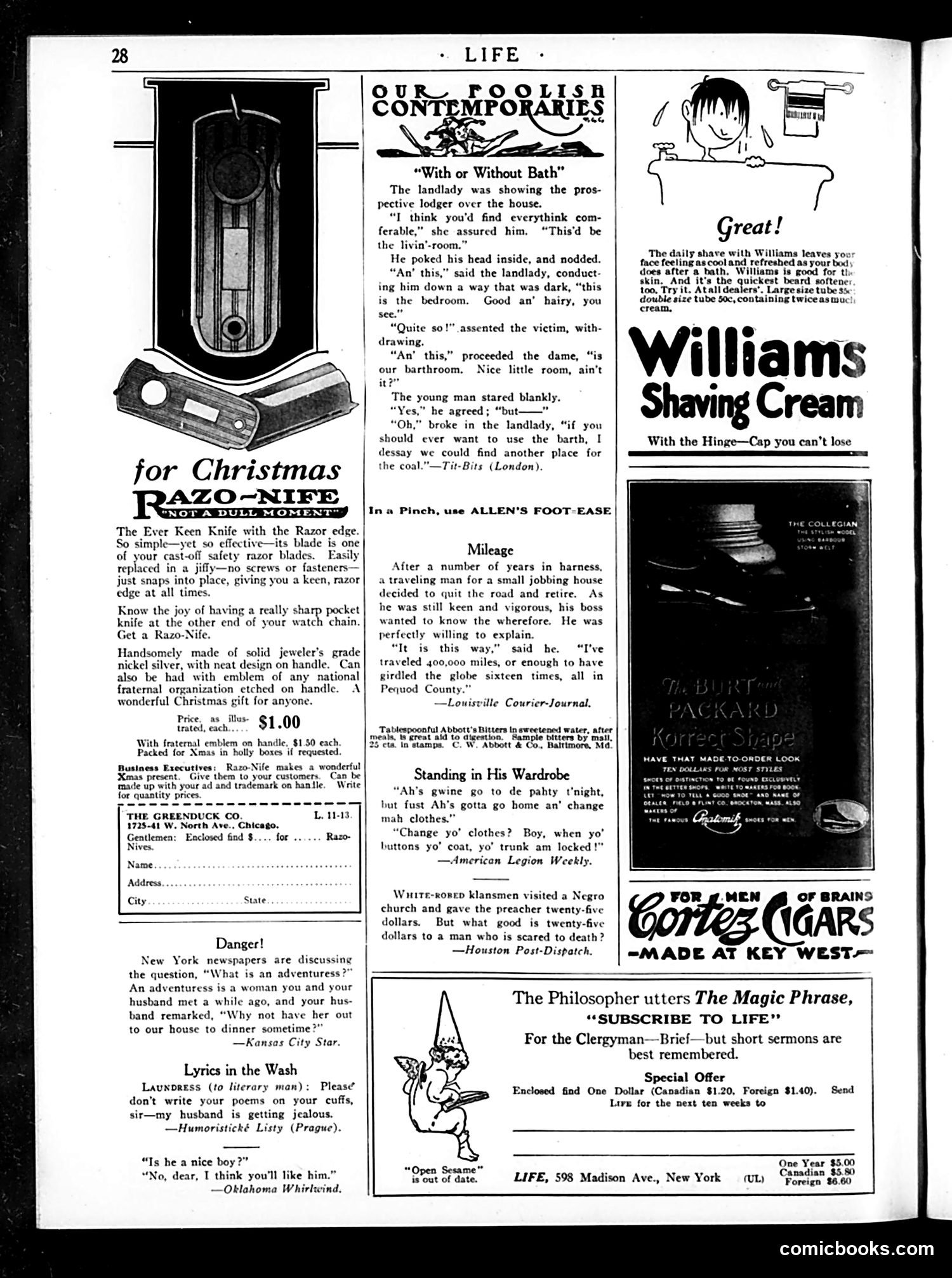
This is primarily an **advertising and humor page** from Life magazine (undated, but likely 1920s based on styling). The page contains several **brief satirical anecdotes** about contemporary life: - A landlady's malapropism ("barth" for "bath," offering to move coal from the bathroom) - A traveling salesman retiring after circling his small county 16 times in 400,000 miles—mocking the tedium of sales work - A Black man locked out of his clothes trunk as a joke about poverty/thin wardrobes - A reference to **White-robed Klansmen** giving money to a Black preacher, sarcastically questioning the utility of money to a frightened man—this is **anti-KKK satire**, criticizing the Klan's racial terrorism The bulk of the page is **product advertising**: Razo-Nife pocket knives, Williams Shaving Cream, Cortes Cigars, Allen's Foot-Ease, and Abbott's Bitters. The Klan reference is the most historically significant content, reflecting Life's satirical stance against 1920s racial violence.
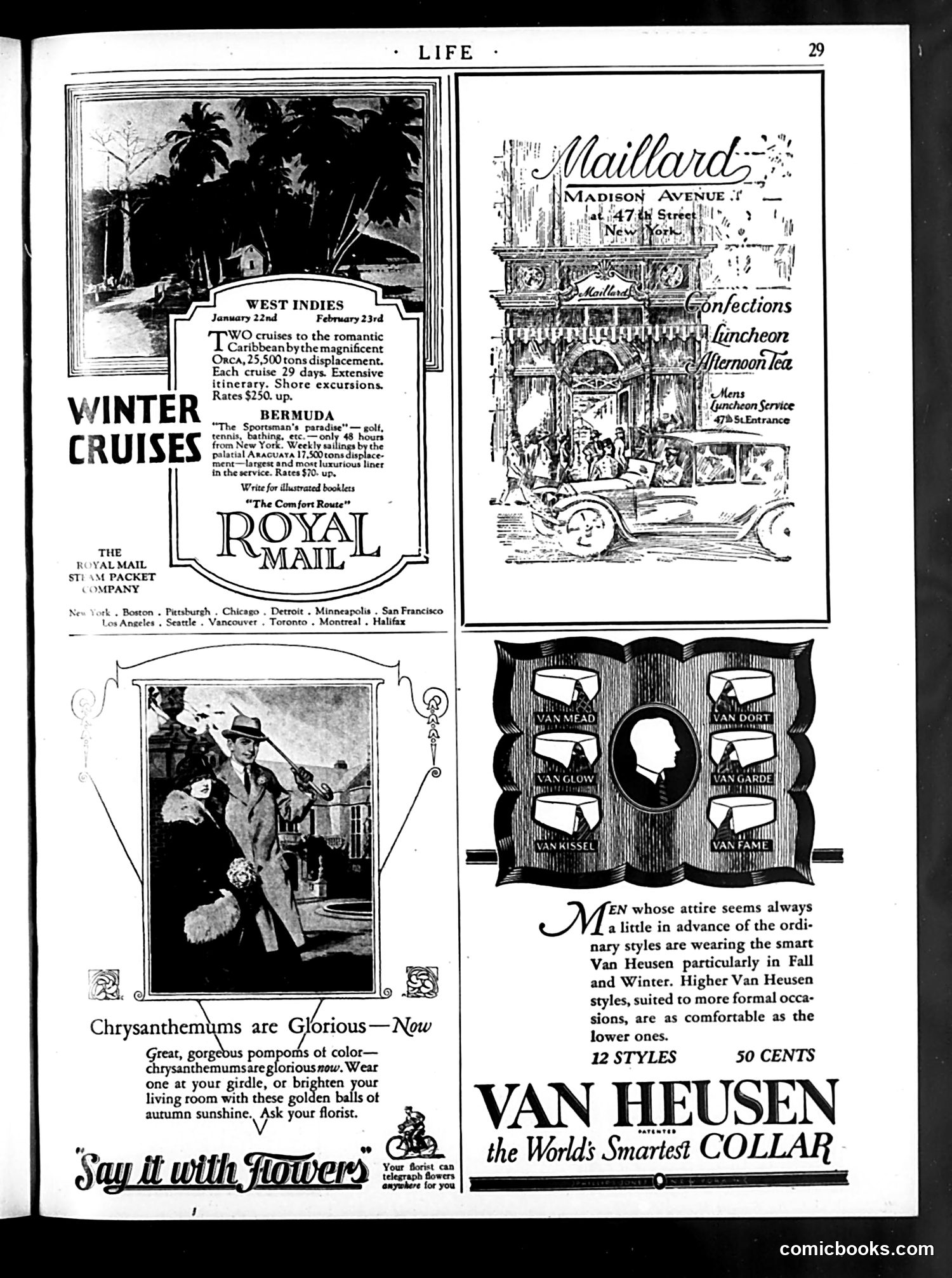
This page is primarily **advertising content**, not political satire. It contains: 1. **Royal Mail cruise advertisements** (top-left): Promoting winter Caribbean and Bermuda voyages on luxury ocean liners—a leisure activity for the wealthy during the 1920s era. 2. **Maillard confectionery ad** (top-right): Upscale New York chocolatier at Madison Avenue and 47th Street offering luncheon service. 3. **Chrysanthemum florist advertisement** (bottom-left): Promoting seasonal flowers with period styling. 4. **Van Heusen collar advertisement** (bottom-right): Men's formal wear emphasizing that smart collars are fashionable in "Fall and Winter," available in 12 styles for 50 cents—positioning the product as accessible yet sophisticated. The page reflects 1920s consumer culture targeting middle-to-upper-class readers with travel, luxury goods, and fashion. There is no evident political cartoon or satire present.
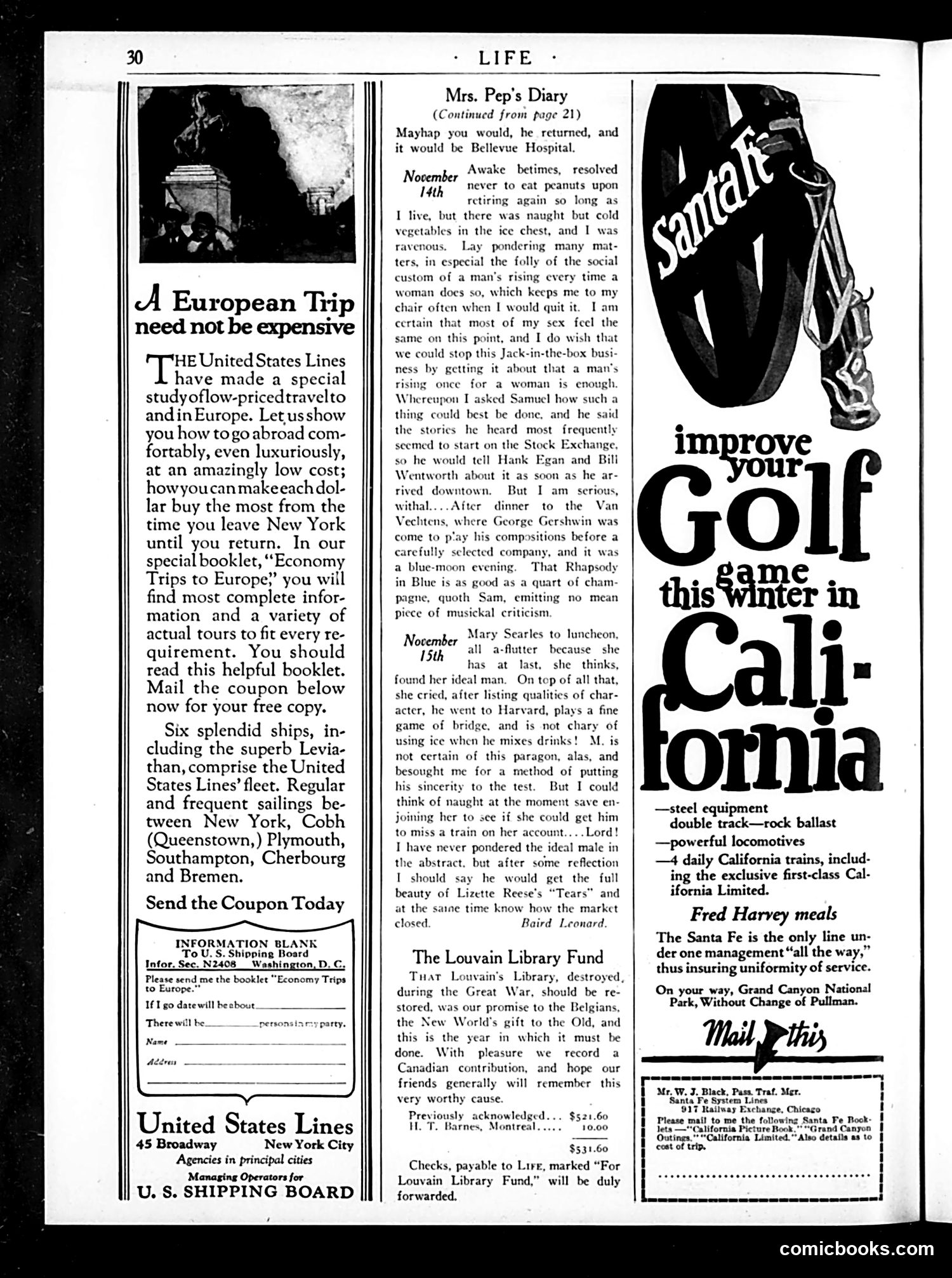
This page is primarily **advertising and miscellaneous content**, not political satire. **Left side:** United States Lines advertisement promoting affordable European travel on luxury ships like the Leviathan, targeting post-WWI Americans interested in tourism. **Center:** "Mrs. Pep's Diary" — a humor column depicting a society woman's observations. Notable entries mention **George Gershwin** performing his "Rhapsody in Blue" at a dinner party (a contemporary cultural reference), and satirizes upper-class social conventions like men rising when women enter rooms. The diary mocks both gender customs and the contemporary marriage market. **Right side:** Advertisement for winter golf in California and Santa Fe Railway promotion. **Bottom center:** Appeal for donations to **rebuild the Louvain Library in Belgium**, destroyed during WWI—reflecting post-war American philanthropy and commitment to European reconstruction. The page reflects 1920s concerns: transatlantic travel, modern music, gender etiquette debates, and European war recovery.
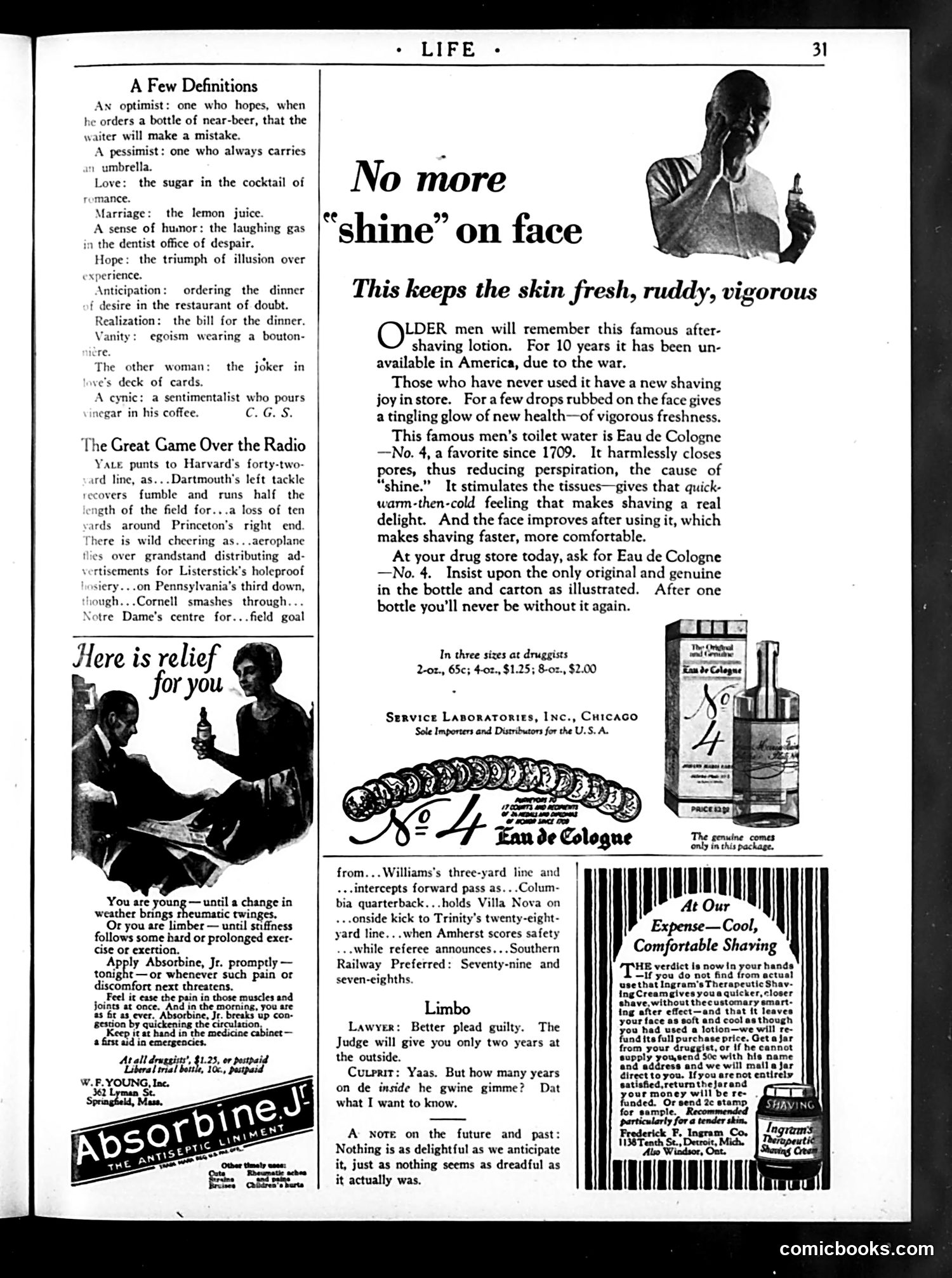
This page mixes humor and advertisements typical of Life magazine's satirical style. The "Few Definitions" section uses witty wordplay to mock contemporary anxieties—particularly Prohibition ("near-beer"), marriage troubles, and romantic disillusionment. These reflect 1920s social concerns about alcohol bans and changing relationships. "The Great Game Over the Radio" satirizes how sports broadcasts interrupt themselves with advertisements, creating absurd non-sequiturs (football plays interrupted by shaving cream ads). This mocks early radio's commercial chaos. The "Limbo" joke features a Black defendant using dialect humor (common in period publications, now considered offensive), depicting courtroom interactions. The advertisements dominate—promoting Absorbine Jr., Eau de Cologne No. 4 (unavailable during WWI, now returned), and Ingram's Shaving Cream. The Cologne ad emphasizes it's the "original and genuine," suggesting post-war scarcity and product anxiety. These ads reflect post-WWI consumer culture reasserting itself.
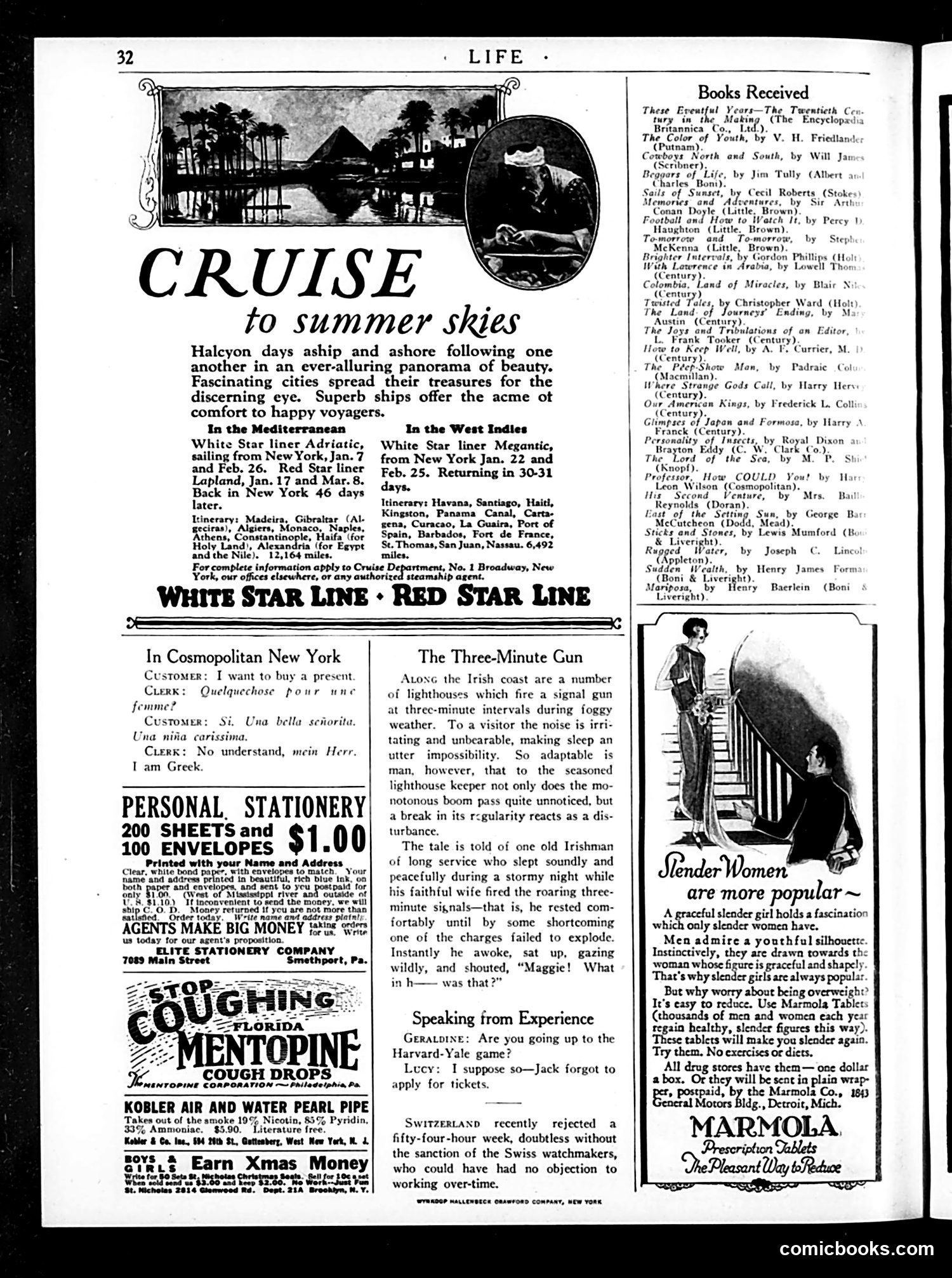
This page is primarily **advertisements and miscellaneous content** rather than political satire. The main items include: 1. **Cruise ship advertisements** for White Star Line and Red Star Line, promoting luxury Mediterranean and West Indies voyages—typical 1920s leisure marketing. 2. **A brief humorous dialogue** ("In Cosmopolitan New York") playing on **immigrant/language barriers**: A customer asks a Greek clerk for a gift, speaking in Spanish/Italian about a "beautiful señorita" and "dear girl," while the clerk claims not to understand, saying "I am Greek." The joke trades on the stereotype of confused communication between immigrants of different backgrounds in New York. 3. **"The Three-Minute Gun"** anecdote: A lighthearted Irish story about a lighthouse keeper so accustomed to hearing foghorn signals every three minutes that he wakes alarmed when one *fails* to sound—illustrating human adaptation to routine. 4. **Small advertisements** for stationery, cough drops, and other products. 5. **Books Received** listing contemporary titles. No significant political content or recognizable caricatures appear on this page.
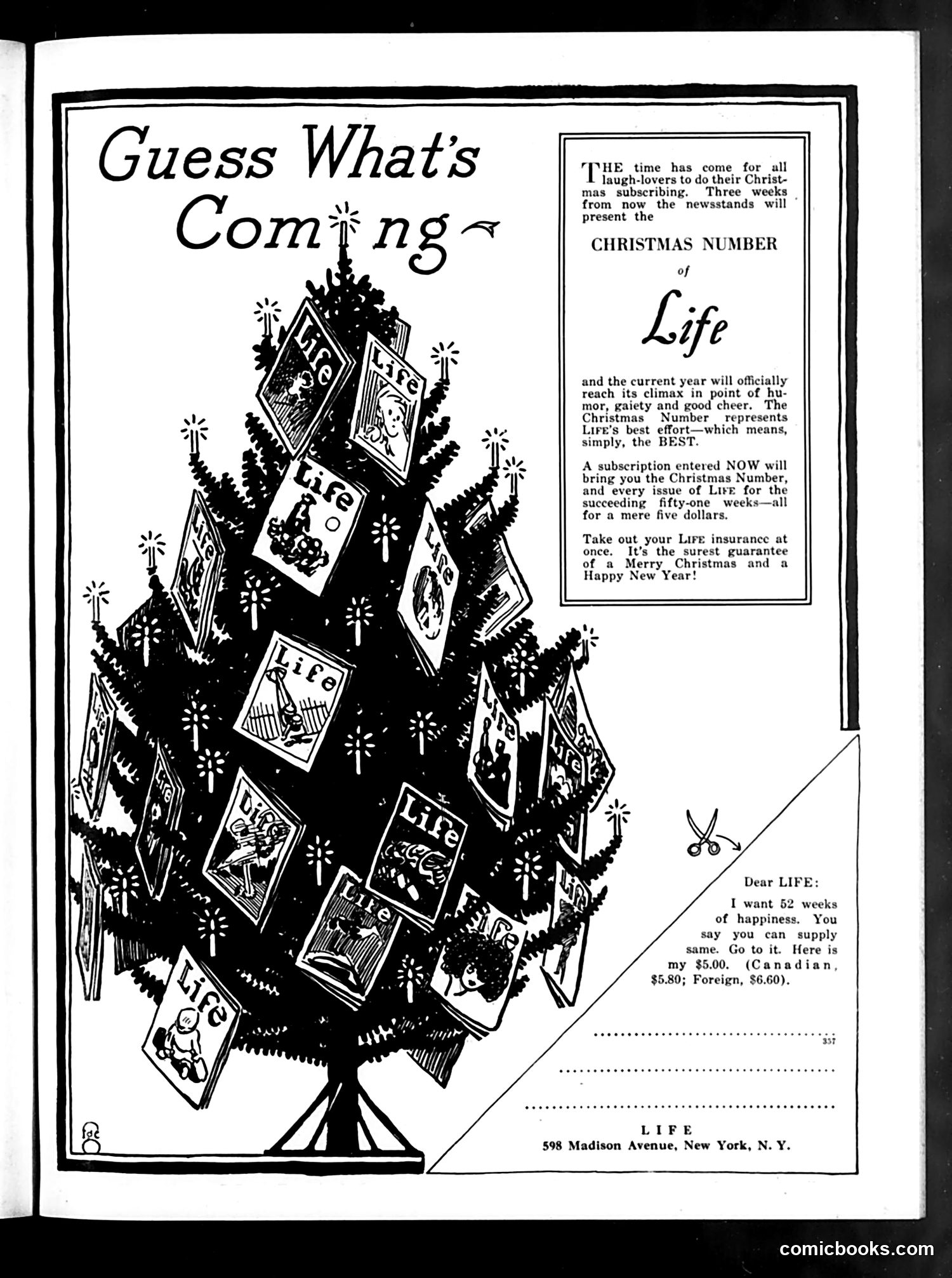
This is primarily a **subscription advertisement** for *Life* magazine's Christmas issue, not a political cartoon. The page uses festive imagery to promote magazine subscriptions. **The Visual:** A Christmas tree decorated with copies of *Life* magazine instead of ornaments, with stars on top. This is a playful visual pun: the magazine itself becomes the holiday decoration, suggesting *Life* is the gift that keeps giving throughout the year. **The Pitch:** The advertisement promises that *Life's* upcoming Christmas Number will represent "the BEST" in humor and cheer. For $5.00, subscribers receive 52 weekly issues plus the special Christmas edition—framed as "Life insurance" (a pun on the magazine's name) guaranteeing "a Merry Christmas and a Happy New Year." **The Joke:** The humor relies on the double meaning of "Life" as both the magazine's title and literal life/happiness, suggesting that subscribing to the magazine literally insures one's happiness and holiday cheer. This is **advertising content**, not satire or political commentary.
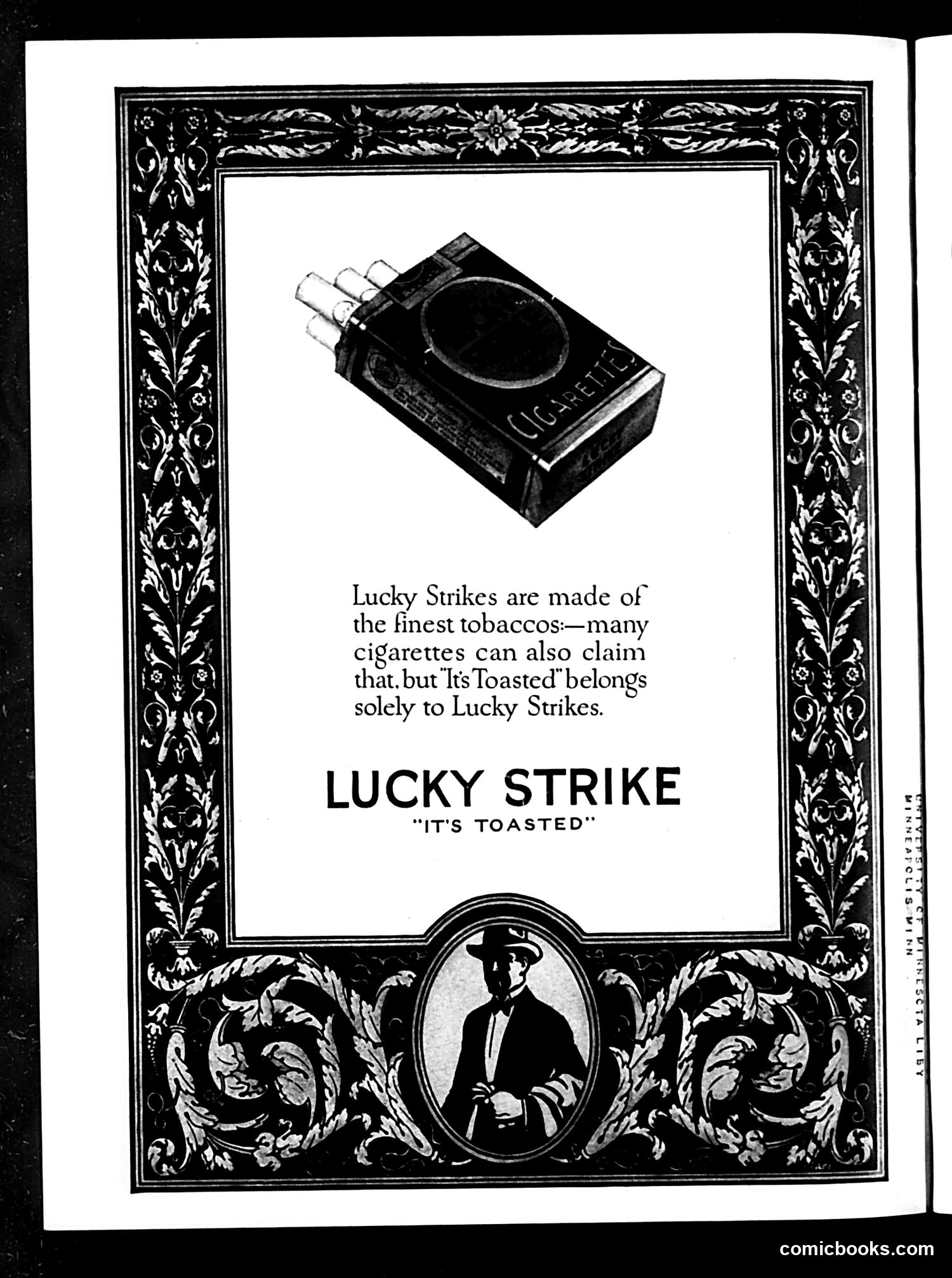
This is a **cigarette advertisement**, not satire or political content. It promotes Lucky Strike cigarettes, emphasizing their distinctive "It's Toasted" manufacturing process as a unique selling point that competitors cannot claim. The ad features: - A pack of Lucky Strike cigarettes at top - Marketing copy asserting that while other brands use fine tobacco, only Lucky Strikes have the proprietary "toasting" process - An ornate decorative border typical of early 20th-century advertising - A portrait medallion at bottom (possibly a brand mascot or founder, unclear which) This represents straightforward product advertising from an era when cigarettes were openly promoted in major publications without health warnings. The "It's Toasted" slogan was Lucky Strike's actual, famous marketing claim during this period.