
Life, 1924-11-13 · page 26 of 42
Life — November 13, 1924 — page 26: what you’re looking at
What you’re looking at
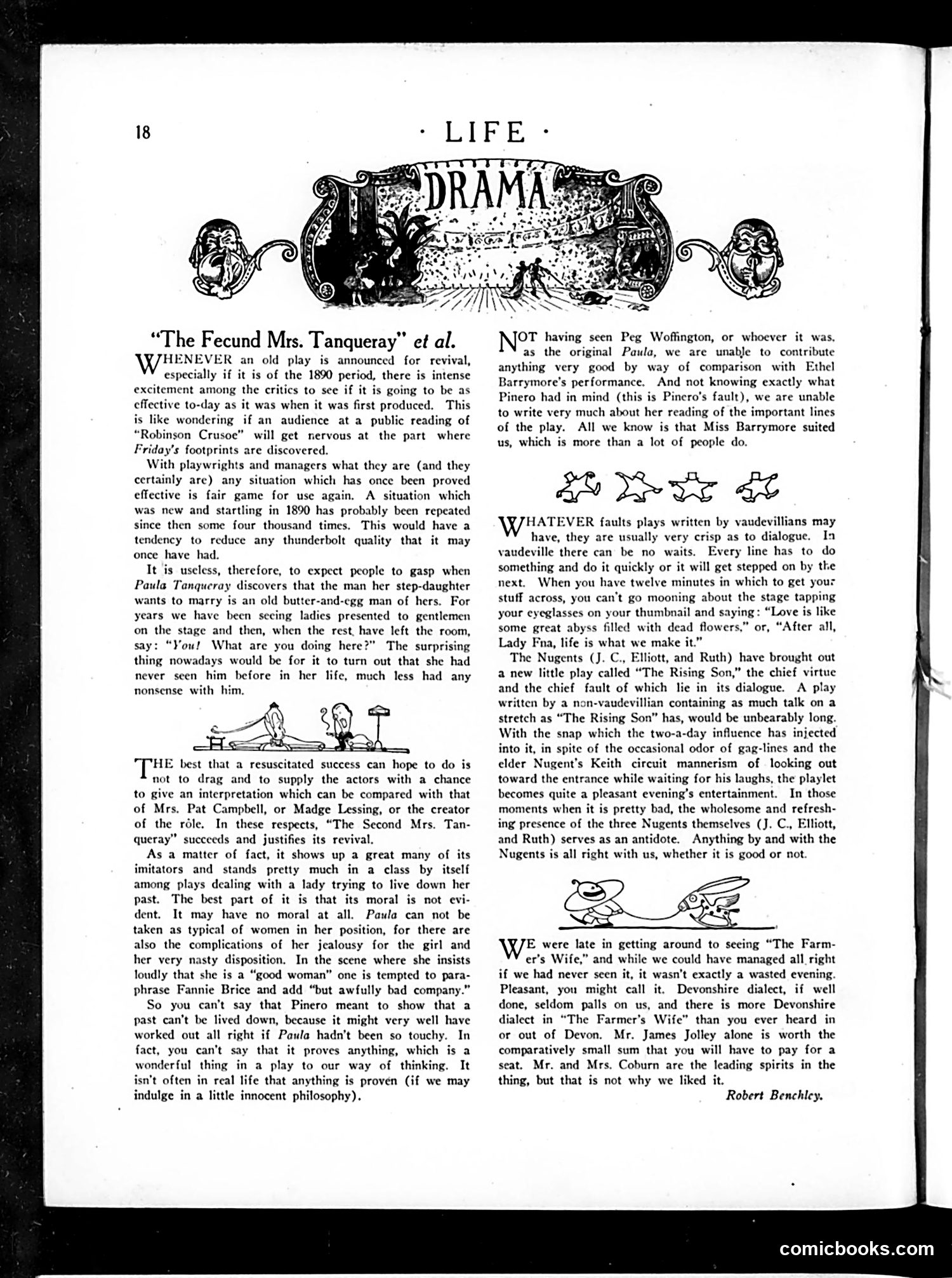
This is a theater review page from *Life* magazine's drama section. The critic discusses two plays: **"The Second Mrs. Tanqueray"**: A 1890s revival featuring Ethel Barrymore. The reviewer notes that audiences familiar with decades of similar theatrical plots—where a woman with a past is discovered by chance acquaintances—shouldn't expect shock value. The play's enduring quality, however, is that it resists simple moralizing; Paula Tanqueray's problems stem partly from her own difficult personality rather than proving anything universal about redemption. **"The Rising Son"**: Written by vaudevillians (the Nugent family—J.C., Elliott, and Ruth), the review praises the crisp dialogue typical of vaudeville, where every line must serve a purpose within strict time constraints, unlike conventional theater's tendency toward florid monologues. The small cartoons appear to illustrate theatrical gestures and poses rather than specific political satire. The page emphasizes how commercial theatrical recycling of proven situations had become tiresome by this era.
📄 Transcribed text from this page (OCR, searchable)
Machine-transcribed from the original scan — historical spelling and the odd misread are preserved.
“The Fecund Mrs. Tanqueray” et al. WHENEVER an old play is announced for revival, especially if it is of the 1890 period, there is intense excitement among the critics to see if it is going to be as effective to-day as it was when it was first produced. This is like wondering if an audience at a public reading of “Robinson Crusoe” will get nervous at the part where Friday's footprints are discovered. With playwrights and managers what they are (and they certainly are) any situation which has once been proved effective is fair game for use again. A situation which was new and startling in 1890 has probably been repeated since then some four thousand times, This would have a tendency to reduce any thunderbolt quality that it may once have had. It is useless, therefore, to expect people to gasp when Paula Tanqueray discovers that the man her step-daughter wants to marry is an old butter-and-egg man of hers. For years we have been secing ladies presented to gentlemen on the stage and then, when the rest, have left the room, say: “You! What are you doing here?” The surprising thing nowadays would be for it to turn out that she had never seen him before in her life, much less had any nonsense with him, HE best that a resuscitated success can hope to do is not to drag and to supply the actors with a chance to give an interpretation which can be compared with that of Mrs. Pat Campbell, or Madge Lessing, or the creator of the réle. In these respects, “The Second Mrs. Tan- queray” succeeds and justifies its revival. As a matter of fact, it shows up a great many of its imitators and stands pretty much in a class by itself among plays dealing with a lady trying to live down her past. The best part of it is that its moral is not evi- dent. It may have no moral at all. Paula can not be taken as typical of women in her position, for there are also the complications of her jealousy for the girl and her very nasty disposition. In the scene where she insists loudly that she is a “good woman” one is tempted to para- phrase Fannie Brice and add “but awfully bad company.” So you can’t say that Pinero meant to show that a past can’t be lived down, because it might very well have worked out all right if Paula hadn't been so touchy. In fact, you can’t say that it proves anything, which is a wonderful thing in a play to our way of thinking. It isn't often in real life that anything is proven (if we may indulge in a little innocent philosophy). N° having seen Peg Woffington, or whoever it was, as the original Paula, we are unable to contribute anything very good by way of comparison with Ethel Barrymore's performance. And not knowing exactly what Pinero had in mind (this is Pinero’s fault), we are unable to write very much about her reading of the important lines of the play. All we know is that Miss Barrymore suited us, which is more than a lot of people do. BM True af WHATEVER faults plays written by vaudevillians may have, they are usually very crisp as to dialogue. In vaudeville there can be no waits. Every line has to do something and do it quickly or it will get stepped on by the next. When you have twelve minutes in which to get your stuff across, you can't go mooning about the stage tapping your eyeglasses on your thumbnail and saying: “Love is like some great abyss filled with dead flowers,” or, “After all, Lady Fna, life is what we make it.” The Nugents (J. C., Elliott, and Ruth) have brought out a new little play called “The Rising Son,” the chief virtue and the chief fault of which lie in its dialogue. A play written by a non-vaudevillian containing as much talk on a stretch as “The Rising Son” has, would be unbearably long. With the snap which the two-a-day influence has injected into it, in spite of the occasional odor of gag-lines and the elder Nugent’s Keith circuit mannerism of looking out toward the entrance while waiting for his laughs, the playlet becomes quite a pleasant evening’s entertainment. In those moments when it is pretty bad, the wholesome and refresh- ing presence of the three Nugents themselves (J. C., Elliott, and Ruth) serves as an antidote. Anything by and with the Nugents is all right with us, whether it is good or not WE were late in getting around to seeing “The Farm- er’s Wife,” and while we could have managed all right if we had never seen it, it wasn’t exactly a wasted evening. Pleasant, you might call it. Devonshire dialect, if well done, seldom palls on us, and there is more Devonshire dialect in “The Farmer’s Wife” than you ever heard in or out of Devon. Mr. James Jolley alone is worth the comparatively small sum that you will have to pay for a seat. Mr. and Mrs. Coburn are the leading spirits in the thing, but that is not why we liked it. Robert Benchley. comicbooks.com