
Life, 1924-11-13 · page 22 of 42
Life — November 13, 1924 — page 22: what you’re looking at
What you’re looking at
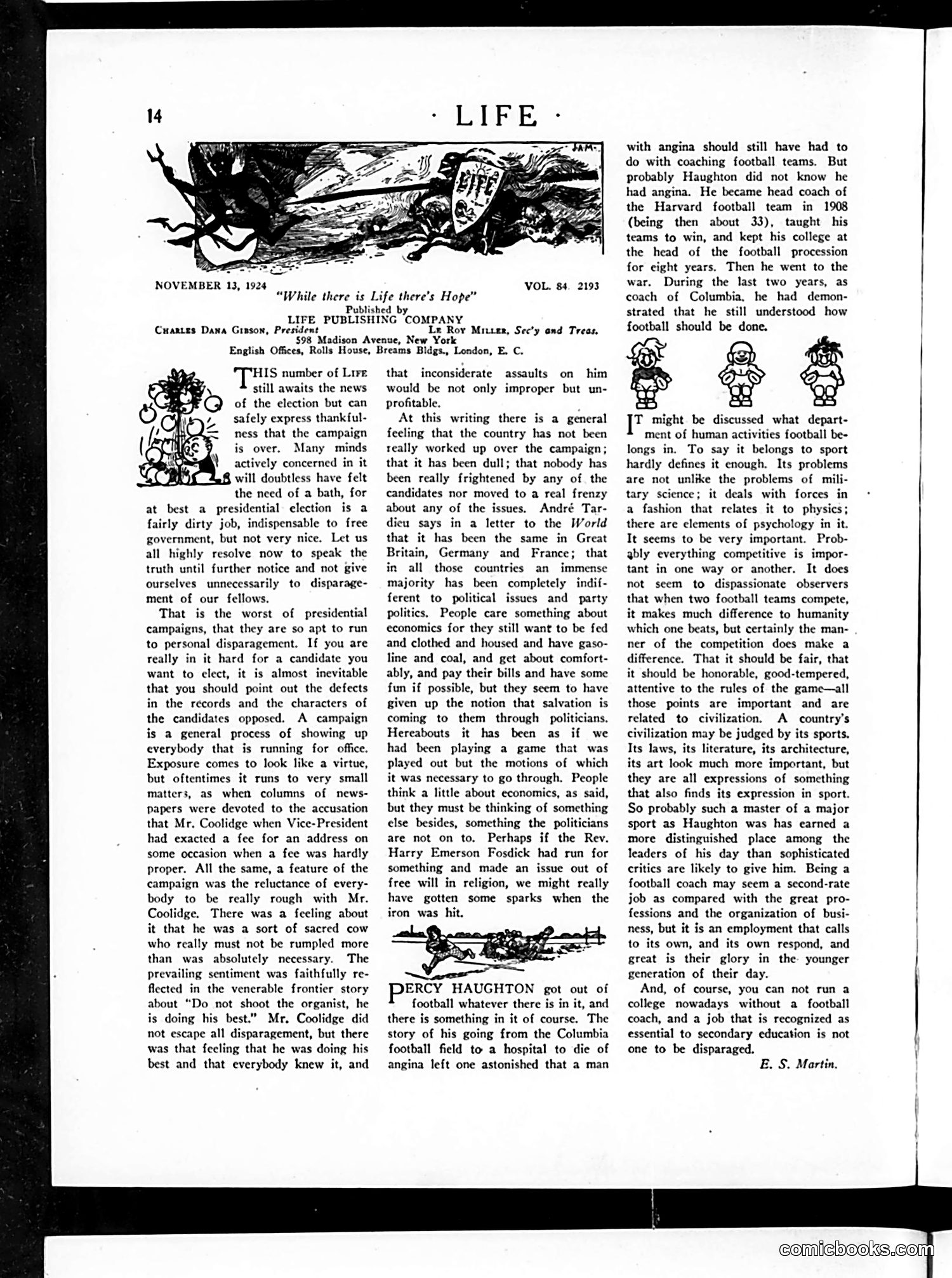
This is primarily an editorial essay by E. S. Martin, not a political cartoon. The piece reflects on the 1924 U.S. presidential election (Calvin Coolidge won), criticizing campaigns for encouraging personal attacks while noting voters seemed disengaged from actual issues. **Key references:** - **Coolidge**: Treated as a "sacred cow" during the campaign—opponents avoided harsh criticism, compared to the frontier saying "Do not shoot the organist, he is doing his best" - **General indifference**: Martin observes that voters cared more about basic economics (food, housing, fuel) than political ideology or party promises - **Percy Haughton**: A Harvard football coach who died of angina while still coaching, used as an example of dedication to duty **The satire's point**: Elections feel hollow when voters are apathetic and politicians seem irrelevant to real concerns. Martin suggests even controversial religious figures like Rev. Harry Emerson Fosdick might generate more genuine engagement than politics does.
📄 Transcribed text from this page (OCR, searchable)
Machine-transcribed from the original scan — historical spelling and the odd misread are preserved.
NOVEMBER 13, 1924 VOL. 84. 2193 “While there is Life there's Hope” Published by LIFE PUBLISHING COMPANY Cuartes Dana Ginson, President Le Roy Mrizer, Sec’y and Treas. $98 Madison Avenue, New York English Offices, Rolls House, Breams Bldgs., London, E. C. HIS number of Lire still awaits the news of the election but can safely express thankful- ness that the campaign is over. Many minds actively concerned in it 8 will doubtless have felt the need of a bath, for at best a presidential election is a fairly dirty job, indispensable to free government, but not very nice. Let us all highly resolve now to speak the truth until further notice and not give ourselves unnecessarily to disparage- ment of our fellows. That is the worst of presidential campaigns, that they are so apt to run to personal disparagement. If you are really in it hard for a candidate you want to elect, it is almost inevitable that you should point out the defects in the records and the characters of the candidates opposed. A campaign is a general process of showing up everybody that is running for office. Exposure comes to look like a virtue, but oftentimes it runs to very small matters, as when columns of news- papers were devoted to the accusation that Mr. Coolidge when Vice-President had exacted a fee for an address on some occasion when a fee was hardly proper. All the same, a feature of the campaign was the reluctance of every- body to be really rough with Mr. Coolidge. There was a feeling about it that he was a sort of sacred cow who really must not be rumpled more than was absolutely necessary. The prevailing sentiment was faithfully re- flected in the venerable frontier story about “Do not shoot the organist, he is doing his best.” Mr. Coolidge did not escape all disparagement, but there was that feeling that he was doing his best and that everybody knew it, and that inconsiderate assaults on him would be not only improper but un- profitable. At this writing there is a general feeling that the country has not been really worked up over the campaign; that it has been dull; that nobody has been really frightened by any of the candidates nor moved to a real frenzy about any of the issues. André Tar- dieu says in a letter to the World that it has been the same in Great Britain, Germany and France; that in all those countries an immense majority has been completely indif- ferent to political issues and party politics, People care something about economics for they still want to be fed and clothed and housed and have gaso- line and coal, and get about comfort- ably, and pay their bills and have some fun if possible, but they seem to have given up the notion that salvation is coming to them through politicians. Hereabouts it has been as if we had been playing a game that was played out but the motions of which it was necessary to go through. People think a little about economics, as said, but they must be thinking of something else besides, something the politicians are not on to. Perhaps if the Rev. Harry Emerson Fosdick had run for something and made an issue out of free will in religion, we might really have gotten some sparks when the iron was hit. ice ERCY HAUGHTON got out of football whatever there is in it, and there is something in it of course. The story of his going from the Columbia football field to a hospital to die of angina left one astonished that a man with angina should still have had to do with coaching football teams. But probably Haughton did not know he had angina. He became head coach of the Harvard football team in 1908 (being then about 33), taught his teams to win, and kept his college at the head of the football procession for eight years. Then he went to the war. During the last two years, as coach of Columbia, he had demon- strated that he still understood how football should be done. & T might be discussed what depart- ment of human activities football be- ls in. To say it belongs to sport hardly defines it enough. Its problems are not unlike the problems of mili- tary science; it deals with forces in a fashion that relates it to physics; there are elements of psychology in it. It seems to be very important. Prob- ably everything competitive is impor- tant in one way or another. It does not seem to dispassionate observers that when two football teams compete, it makes much difference to humanity which one beats, but certainly the man- ner of the competition does make a difference. That it should be fair, that it should be honorable, good-tempered, attentive to the rules of the game—all those points are important and are related to civilization. A country’s civilization may be judged by its sports. Its laws, its literature, its architecture, its art look much more important, but they are all expressions of something that also finds its expression in sport. So probably such a master of a major sport as Haughton was has earned a more distinguished place among the leaders of his day than sophisticated critics are likely to give him. Being a football coach may seem a second-rate job as compared with the great pro- fessions and the organization of busi- ness, but it is an employment that calls to its own, and its own respond, and great is their glory in the younger generation of their day. And, of course, you can not run a college nowadays without a football coach, and a job that is recognized as essential to secondary education is not one to be disparaged. E. S. Martin, comichooks.con)