
Life, 1924-11-13 · page 32 of 42
Life — November 13, 1924 — page 32: what you’re looking at
What you’re looking at
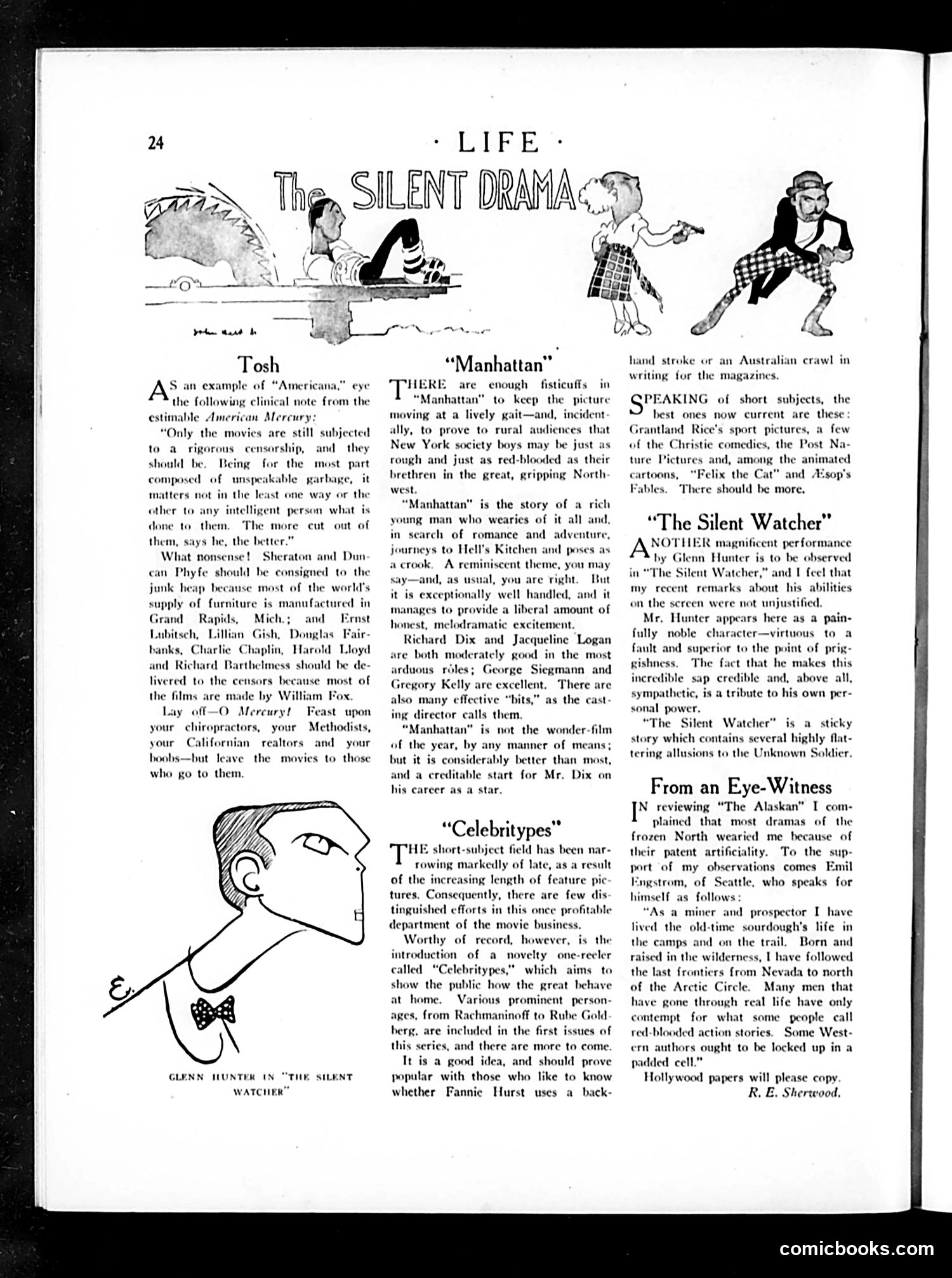
This page from *Life* magazine reviews contemporary silent films while satirizing American censorship attitudes. The opening "Tosh" section mocks the *American Mercury's* claim that movies are "garbage" unworthy of censorship protection. The author argues absurdly that if films deserve censoring, then furniture designers like Sheraton and famous filmmakers (Chaplin, Lloyd, Gish) should also be discarded—exposing the hypocrisy of selective moral policing. The reviews discuss three films: "Manhattan" (a society-to-underworld adventure), "Celebritypes" (a novelty short showing famous people at home), and "The Silent Watcher" (starring Glenn Hunter). The satire on "Celebritypes" jokes that audiences will watch anything, even trivial shots of celebrities bathing or writing. The caricature of Glenn Hunter illustrates the era's visual style. Overall, the page defends cinema as legitimate art against puritanical censors.
📄 Transcribed text from this page (OCR, searchable)
Machine-transcribed from the original scan — historical spelling and the odd misread are preserved.
24 (7 Vey 7 a6 We ead ae Tosh S an example of “Americana,” eye the following clinical note from the estimable American Mercury: “Only the movi to a fi should be, sare still subjected censorship, they Being for the part composed of unspeakable garbage, it ms and most matters not in the least one way or the other to any it them. elligent: person what is Th cut out of them, says he, the better.” What nonsense! Sheraton and Dun can Phyfe should be consigned to the done to more junk heap because most of the world’s supply of furniture is manufactured in Grand Mich.; ar Ernst Lubitsch, Lillian Gish, Doug! ‘ai banks, Charlie Chaplin, Harold Lloyd and Richard Barthelmess should be de- ‘apids, ase most of m Fox ast upon Methodists, altors and livered to the censors bee the films are made by Willi: O Mercury! your chiropractors, y your Lay off lifornian the your hoobs—but leave movies to those who go to them, GLENN WUNTER IN “THE SILENT WATCHER’ ‘dhibPE SILENT ORMA CSS in “Manhattan” HERE enough fisticuffs in Manhattan” to keep the picture moving at a lively gait—and, incident ally, to prove to rural audiences that New York society boys may be just as rough and just as red-blooded as their brethren in the great, gripping North. west, “Manhattan” is the story of a rich young man who wearies of it all and, in search of romance and adventure, journeys to Hell's Kitchen and poses as a crook, A reminiscent theme, you may usual, you are right. But nally well handled, and it manages to provide a liberal amount of honest, melodramatic excitement. Richard Dix and Jacqueline Logan are both moderately good in the most arduous roles; George Siegmann and Gregory Kelly are excellent. There are also many effective “bits,” as the cast ing director calls them, “Manhattan” is not the wonder-film of the year, by any manner of means; but it is considerably better than most, and a creditable start for Mr. Dix on his are ‘areer as a star. “Celebritypes” HE short-subject field has been nar- rowing markedly of late, as a result of the increasing length of feature pic tures. Consequently, there are few dis tinguished efforts in this once profitable department of the movie busines: Worthy of record, however, is the introduction of a novelty one-recler called “Celebritypes,” which aims to show the public how the great behave at home. Various prominent person- ages, from Rachmaninoff to Rube Gold berg, are included in the first issues of this series, and there are more to come. Tt is a good ide: nd should prove popular with those who like to know whether Fannie Hurst uses a back- = v1 hand stroke or an Australian crawl in writing for the magazines. SEEABING of short subjects, the best ones now current are these: Grantland Rice's sport pictures, a few of the Christie comedies, the Post Na- ture Pictures and, among the animated ix the 1 AZsop's There should be more, “The Silent Watcher” NOTHER magnificent performance by Glenn Hunter is to be observed in “The Silent Watcher,” and I feel that my recent remarks about his abilities on the sereen were not unjustified. Mr, Hunter appears here as a pain- fully noble character—virtuous to fault and superior to the point of prig- The fact that he makes this incredible sap credible sympathet: a tribute to his own per- sonal power. “The Silent Watcher” is a sticky story which contains several highly flat- tering allusions to the Unknown Soldier, cartoons, Cat gishness, and, above all, From an Eye-Witness IX reviewing “The Alaskan” IT com- plained that most dramas of the frozen North wearied me because of their patent artificiality. To the sup- port of my observations comes Emil Engstrom, of Seattle, who speaks for himself as follows “As a miner and prospector I have lived the old-time sourdough’s life in the camps and on the trail. Born and raised in the wilderness, It followed the last frontiers from Nevada to north of the Arctic Circle. Many men that have gone through real life have only contempt for what some people call red-blooded action stories. Some West- ern authors ought to be locked up in a padded cell, Hollywood papers will please copy R. E, Sherwood. comicbooks.com