
Life, 1924-11-13 · page 29 of 42
Life — November 13, 1924 — page 29: what you’re looking at
What you’re looking at
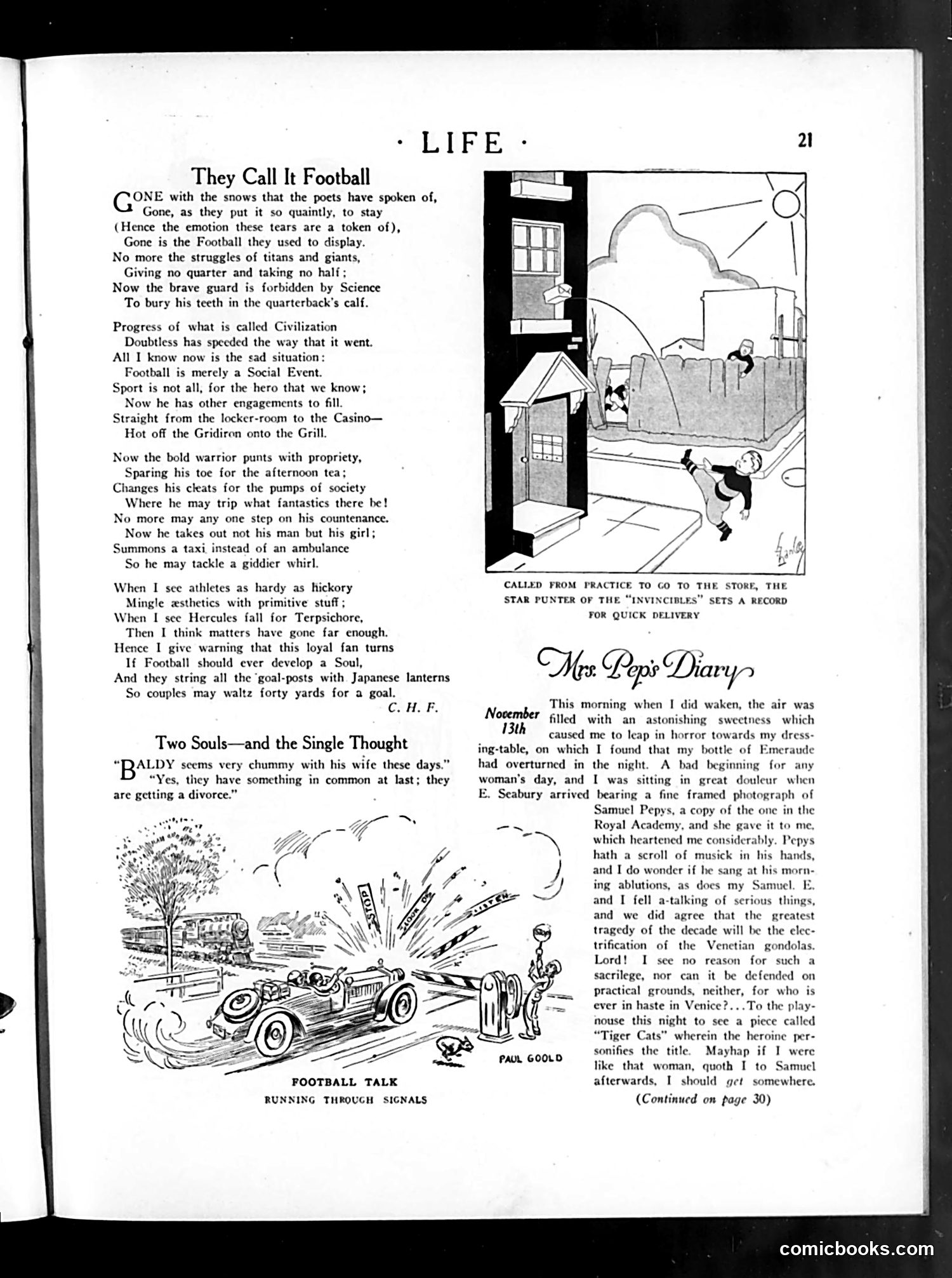
This page contains two satirical pieces lamenting the "modernization" of American football and society. **"They Call It Football"** (poem by C.H.F.) nostalgically criticizes how football has lost its rough, competitive character. The author mourns that players no longer engage in brutal play (like "bury his teeth in the quarterback's calf") due to scientific progress and "Civilization." Instead, athletes now pursue social activities—casino visits, afternoon tea, dancing—treating football as merely a "Social Event" rather than serious sport. The concluding threat warns that if football develops a "Soul," with romantic couples waltzing to goal-posts decorated with Japanese lanterns, he'll abandon fandom. **The cartoon** shows a star punter leaving practice to deliver something from a store, sarcastically mocking how modern athletes juggle commercial obligations alongside sport. **"Mrs. Peps Diary"** is a gossipy society column parodying Samuel Pepys's historical diary, mixing trivial vanities (spilled perfume) with pseudo-intellectual concerns (electrifying Venetian gondolas). Together, these pieces satirize early 20th-century anxiety about modernization eroding traditional masculine values and authentic experience.
📄 Transcribed text from this page (OCR, searchable)
Machine-transcribed from the original scan — historical spelling and the odd misread are preserved.
ERE, ¢ They Call It Football GORE with the snows that the poets have spoken of, Gone, as they put it so quaintly, to stay (Hence the emotion these tears are a token of), Gone is the Football they used to display. No more the struggles of titans and giants, Giving no quarter and taking no half; Now the brave guard is forbidden by Science To bury his teeth in the quarterback’s calf. Progress of what is called Civilization Doubtless has speeded the way that it went. All I know now is the sad situation: Football is merely a Social Event. Sport is not all, for the hero that we know; Now he has other engagements to fill. Straight from the locker-room to the Casino— Hot off the Gridiron onto the Grill. Now the bold warrior punts with propriety, Sparing his toe for the afternoon tea; Changes his cleats for the pumps of society Where he may trip what fantastics there be! No more may any one step on his countenance. Now he takes out not his man but his girl; Summons a taxi instead of an ambulance So he may tackle a giddier whirl. When I see athletes as hardy as hickory Mingle esthetics with primitive stuff ; When I see Hercules fall for Terpsichore, Then I think matters have gone far enough. Hence I give warning that this loyal fan turns If Football should ever develop a Soul, And they string all the ‘goal-posts with Japanese lanterns So couples may waltz forty yards for a goal. C. H. F. Two Souls—and the Single Thought “Baby seems very chummy with his wife these days.” “Yes, they have something in common at last; they are getting a divorce.” FOOTBALL TALK RUNNING THROUGH SIGNALS CALLED FROM PRACTICE TO GO TO THE STORE, THE STAR PUNTER OF THE “INVINCIBLES” SETS A RECORD FOR QUICK DELIVERY Me: 3 Reps Diary This morning when I did waken, the air was filled with an astonishing sweetness which caused me to leap in horror towards my dress- ing-table, on which I found that my bottle of Emeraude had overturned in the night. A bad beginning for any woman's day, and I was sitting in great douleur when E. Seabury arrived bearing a fine framed photograph of Samuel Pepys, a copy of the one in the Royal Academy, and she gave it to me, which heartened me considerably. Pepys hath a scroll of musick in his hands, and I do wonder if he sang at his morn- ing ablutions, as does my Samuel. E. and I fell a-talking of serious things, and we did agree that the greatest tragedy of the decade will be the elec- trification of the Venetian gondolas. Lord! I see no reason for such a sacrilege, nor can it be defended on practical grounds, neither, for who is ever in haste in Venice?...To the play- nouse this night to see a piece called “Tiger Cats” wherein the heroine per- sonifies the title. Mayhap if I were like that woman, quoth I to Samucl afterwards, I should get somewhere. (Continued on page 30) PAUL GOOLD comicbooks.com