
A complete issue · 36 pages · 1924
Life — September 11, 1924
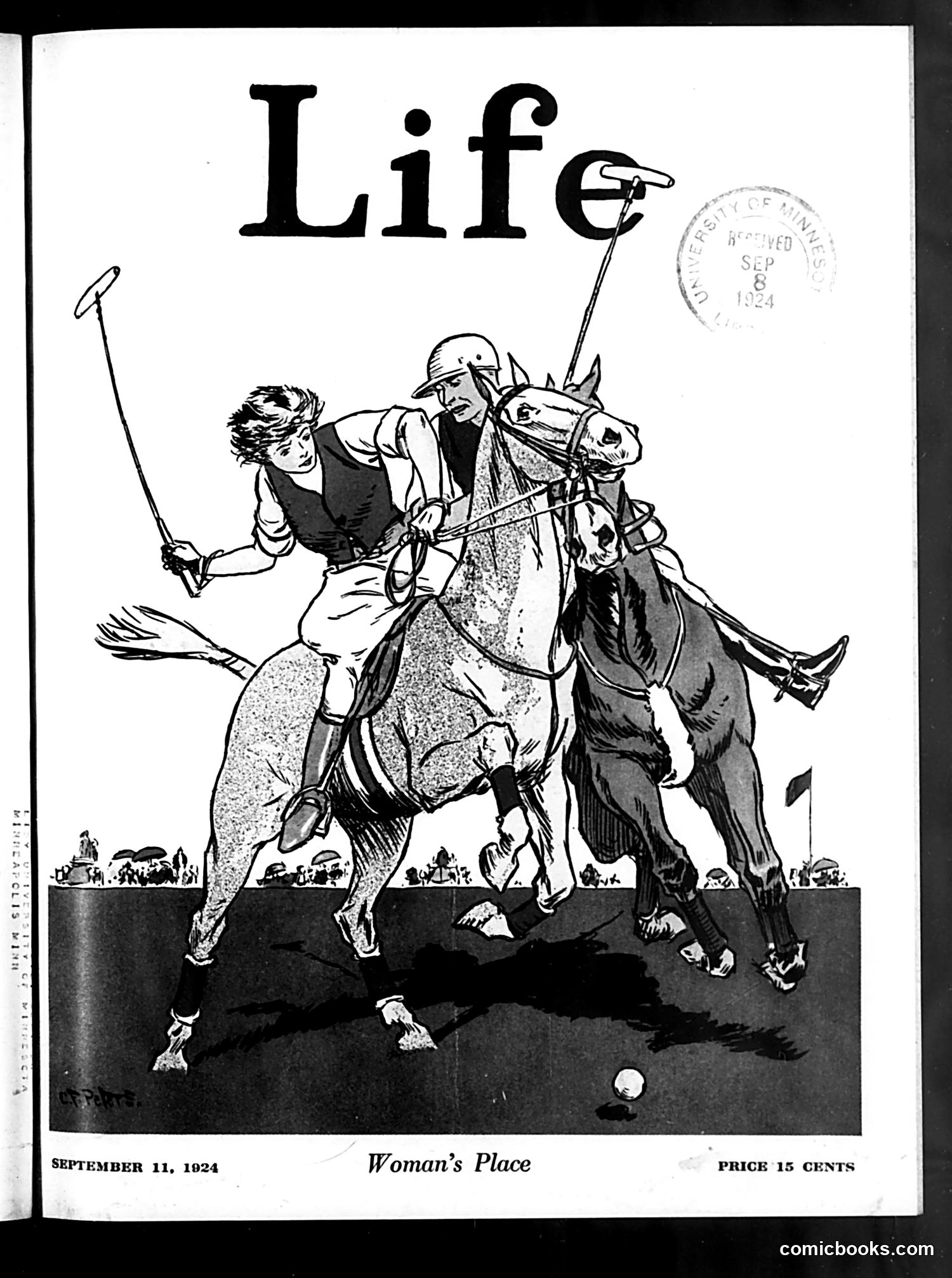
This satirical cover depicts a woman playing polo—a sport traditionally dominated by wealthy men—while riding a horse alongside two male polo players. The title "Woman's Place" is ironic: rather than confining women to domestic roles, the image shows a woman actively participating in an elite, athletic sport. This reflects 1920s debates about women's expanding social roles following their 1920 voting rights victory. The cartoon appears to satirize both progressive attitudes (celebrating women's newfound freedoms and athletic participation) and conservative concerns about women entering traditionally male-dominated spaces. The "Woman's Place" subtitle sarcastically suggests that modern women's place includes competitive sports and social equality, challenging conventional domestic expectations.
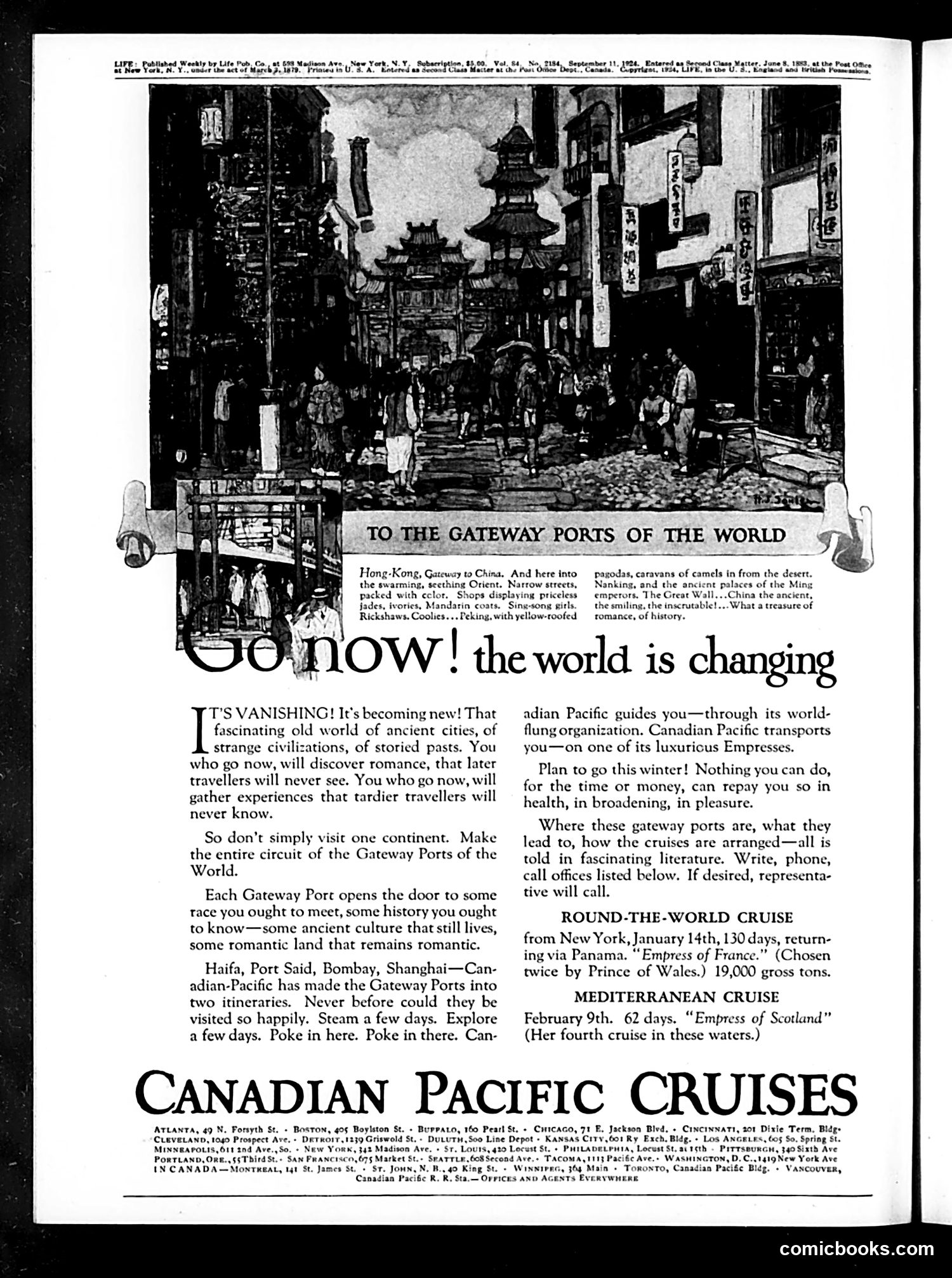
This page is **primarily an advertisement**, not political satire. It promotes Canadian Pacific Cruises' "Gateway Ports of the World" travel packages. The top photograph shows Hong Kong's harbor district with Asian architecture and street life. The ad's pitch targets wealthy Americans with nostalgia, urging them to visit "ancient cities" and "strange civilizations" before they vanish: "It's vanishing! It's becoming new!" The text emphasizes exclusivity—travelers will gain experiences "tardier travellers will never see." Two specific cruises are advertised: a 130-day round-world voyage from New York (January 14th) and a Mediterranean cruise (February 9th). The ad reflects early 20th-century attitudes toward non-Western cultures as exotic, disappearing relics worth consuming as tourist experiences before "modernization" destroys them.
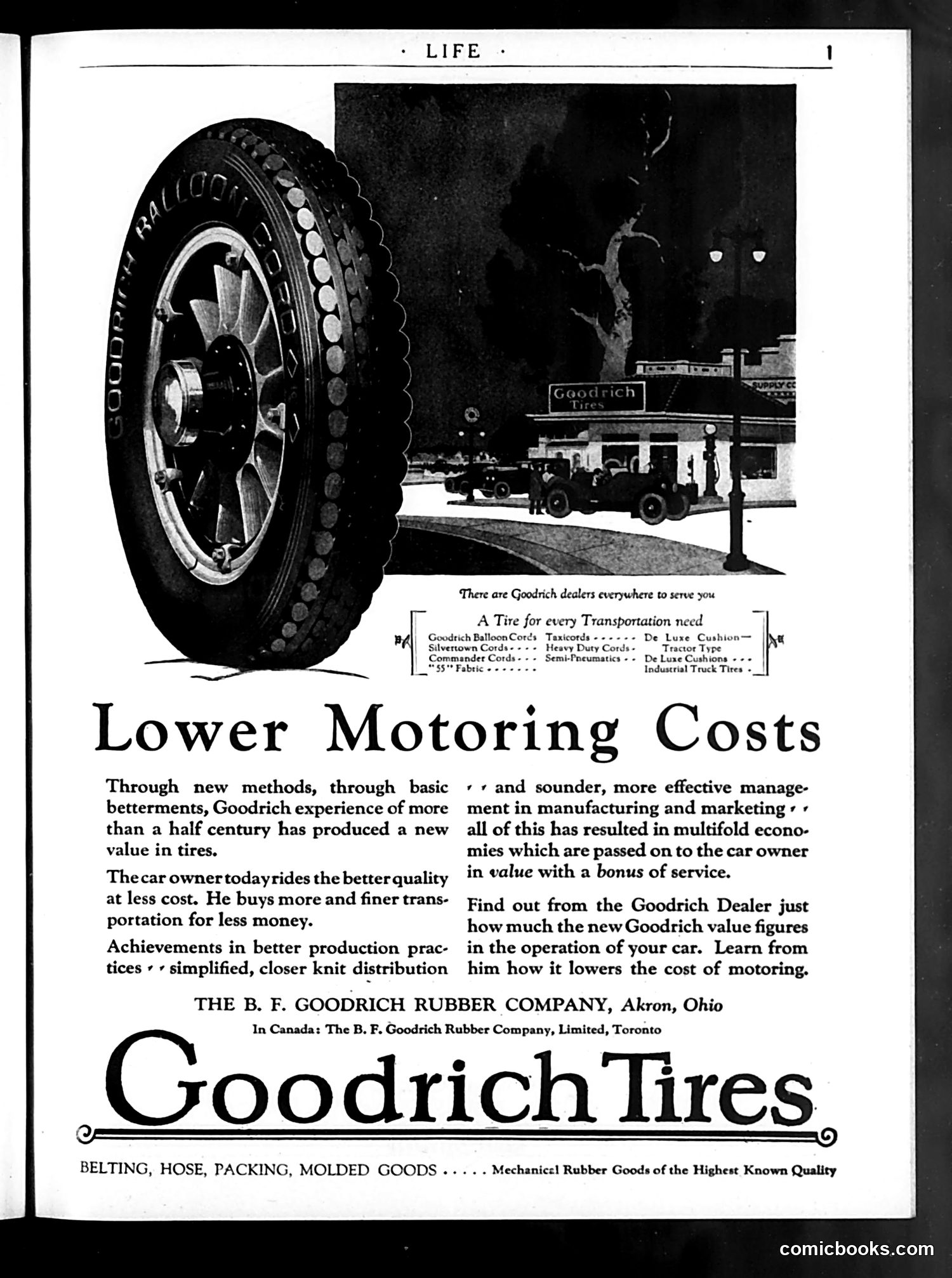
This page is **primarily an advertisement**, not satirical content. It's a Goodrich Tires ad from The B. F. Goodrich Rubber Company (Akron, Ohio). The ad uses a large tire image and a Goodrich dealership scene to promote their product line. The headline "Lower Motoring Costs" appeals to car owners by claiming Goodrich tires offer better quality at reduced expense through improved manufacturing. The text emphasizes value and service—the company promises that cost savings from tire efficiency get "passed on to the car owner." The ad directs readers to visit local Goodrich dealers to learn specific savings figures. This is straightforward commercial messaging typical of 1920s-era trade advertising, with no apparent political satire or social commentary intended.
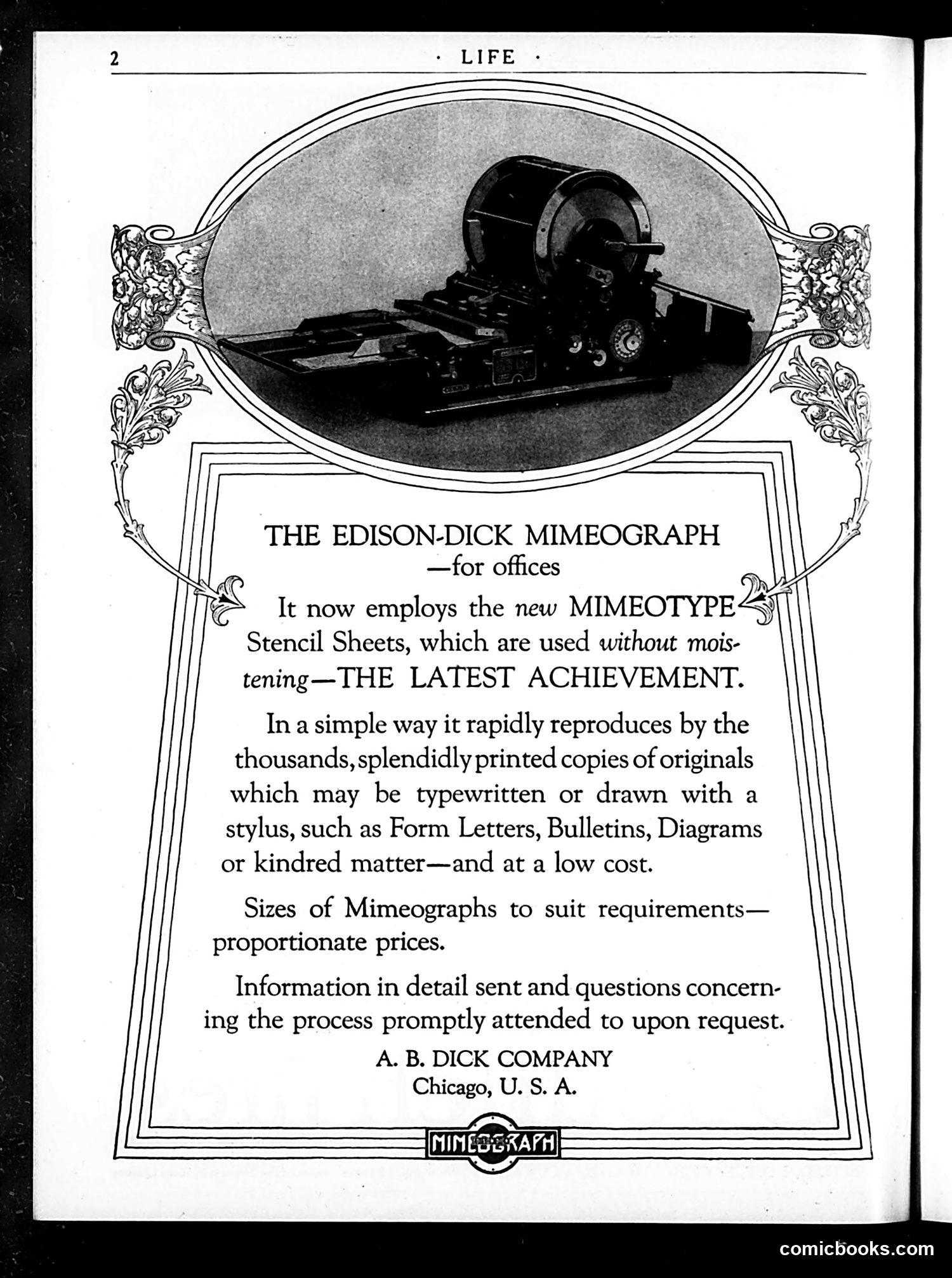
This page is primarily an advertisement, not a political cartoon or satire. It promotes the Edison-Dick Mimeograph, an office reproduction device manufactured by the A.B. Dick Company in Chicago. The ad emphasizes the machine's technological innovation: it uses new "Mimeotype Stencil Sheets" that require no moistening—"THE LATEST ACHIEVEMENT." The text highlights practical benefits for offices: rapid reproduction of thousands of copies from typewritten or hand-drawn originals (forms, bulletins, diagrams) at low cost, with flexible sizing options. The ornate decorative border and formal layout are typical of early-twentieth-century magazine advertising design. This represents standard commercial content rather than editorial commentary or satire.
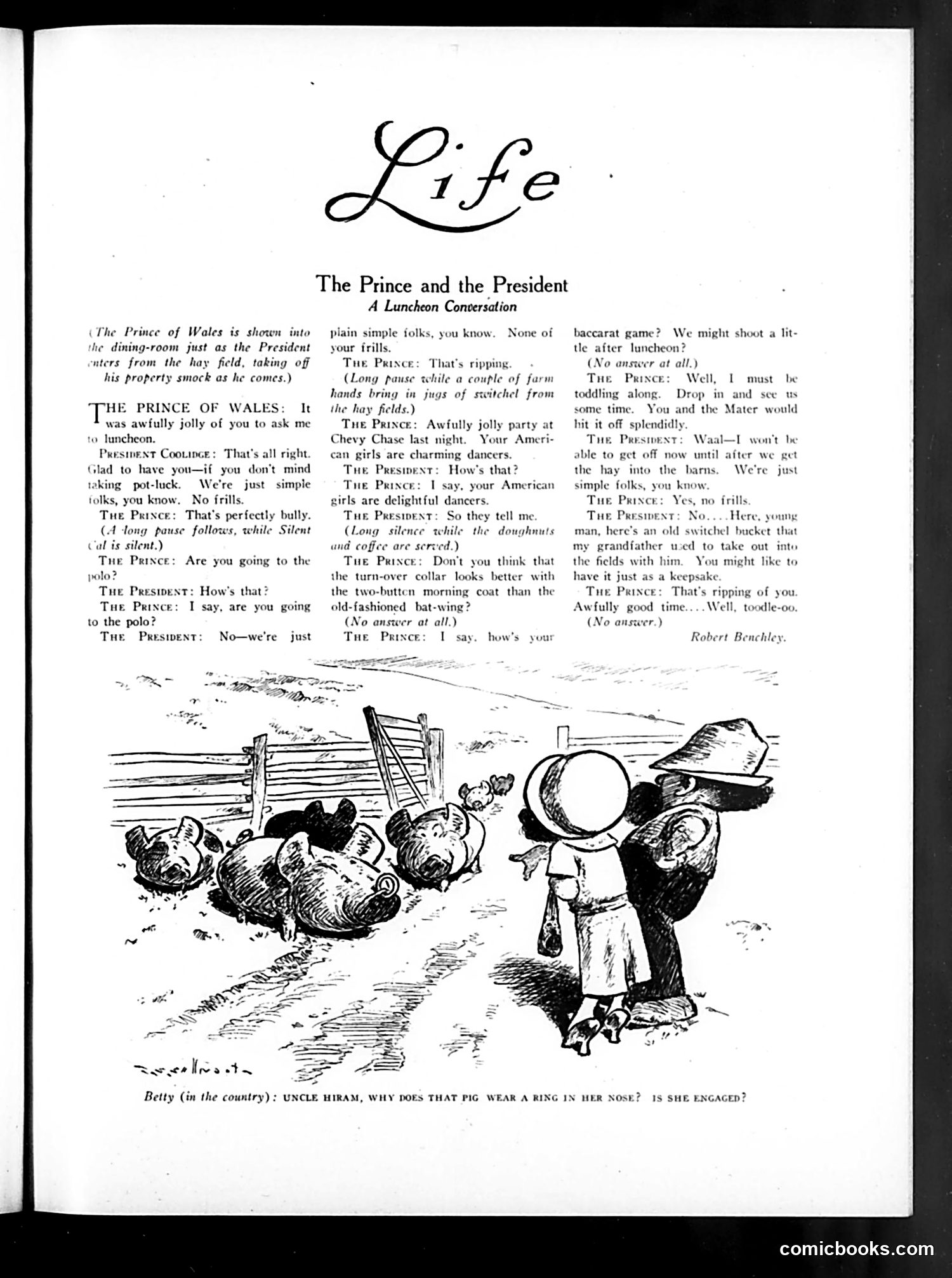
This page from *Life* magazine presents "The Prince and the President: A Luncheon Conversation"—a satirical dialogue between the Prince of Wales and the U.S. President (likely from the 1920s-30s based on style). The humor mocks both figures' pretensions and cultural differences. The Prince boasts about aristocratic pursuits (polo, fancy dress codes, farm life), while the President represents American pragmatism and simplicity. Their exchanges highlight class distinctions and transatlantic cultural stereotypes—the Prince's affected British mannerisms versus American directness. The bottom cartoon's caption ("Betty in the country: Uncle Hiram, why does that pig wear a ring in her nose?") extends the satire, suggesting rural American confusion about aristocratic affectation, implying even farm life has more sense than upper-class pretense.
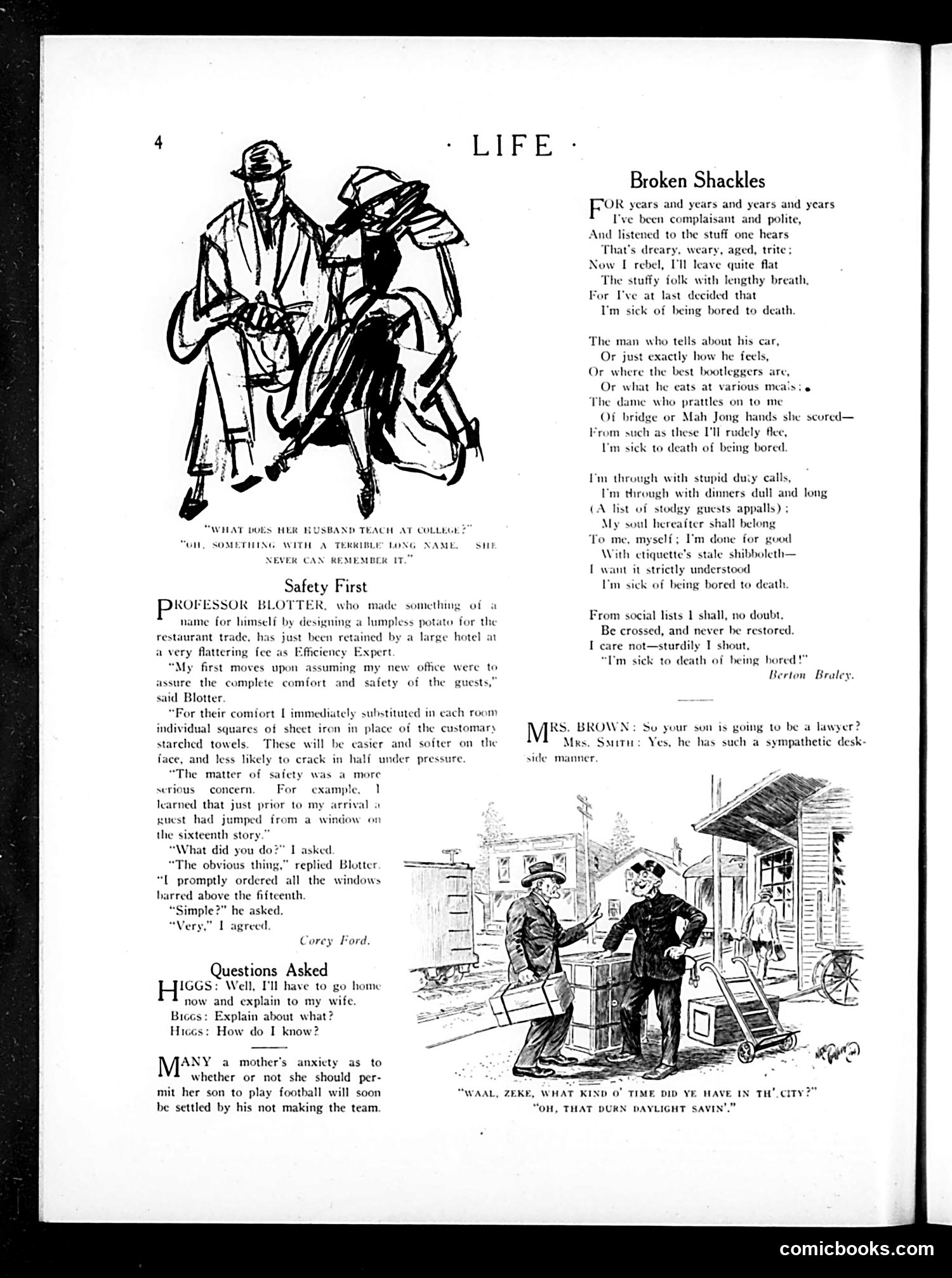
This page contains three distinct pieces of humor: 1. **Top cartoon** ("What does her husband teach at college"): Shows a woman teaching something to a man, with the caption implying marital instruction—likely satirizing women's emerging public roles or asserting domestic authority over educated men. 2. **"Safety First"** (middle section): A humorous anecdote by Corey Ford mocking Professor Blotter, a fictional "efficiency expert" who obsessively replaces hotel linens with sheet iron to prevent cracking. It's absurdist corporate-speak satire. 3. **Bottom cartoon**: Two working-class men discussing time management, with one asking about "daylight saving"—likely referencing the wartime or postwar implementation of daylight saving time, a contentious practical policy change. The page satirizes modern life's absurdities: gender dynamics, corporate efficiency obsession, and government time regulations.
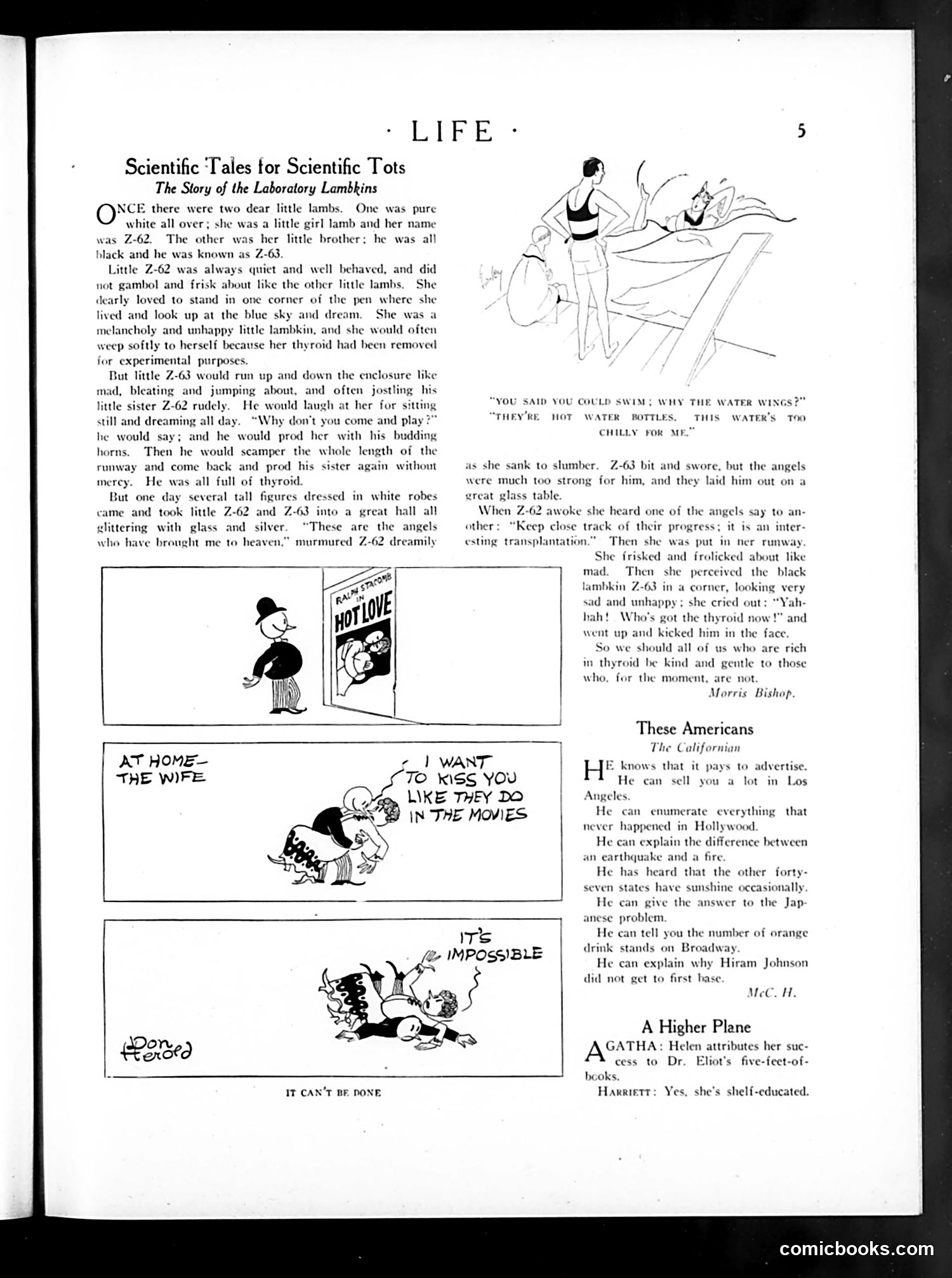
This page contains satirical content including "Scientific Tales for Scientific Tots," a humorous story about laboratory lambs Z-62 and Z-63 that mocks scientific experimentation and animal testing. The three small cartoons below appear to be domestic humor strips showing a husband and wife in various scenarios—one referencing movie kissing, another showing the wife hitting the husband, captioned "IT CAN'T BE DONE." These are generic domestic comedy gags common to 1920s-30s humor magazines, poking fun at marriage dynamics and gender relations without specific political reference. The right column contains brief humorous observations titled "These Americans" and "A Higher Plane"—typical Life magazine filler commentary on contemporary American life and culture. No specific political figures or events are identifiable from the content shown.
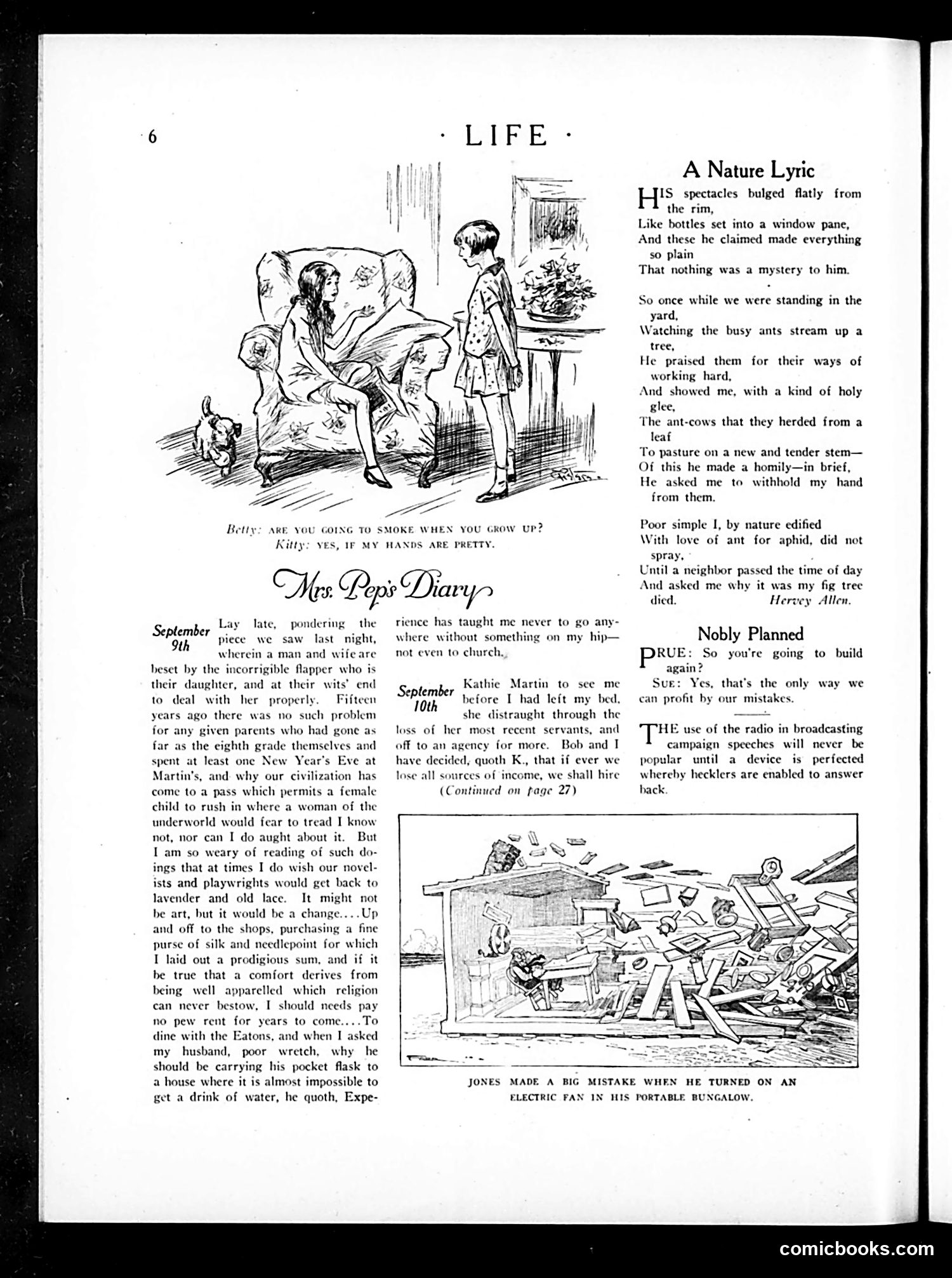
This page contains three separate pieces: 1. **"A Nature Lyric"** — A poem about a man who praises ants for their industriousness and asks the narrator not to harm them, only to have a neighbor later ask why the man's fig tree died. The satire targets hypocritical sentimentality about nature. 2. **"Mrs. Pep's Diary"** — A dated entry (September 9th-10th) containing gossip about servants and financial matters. This appears to be a recurring domestic humor column mocking upper-class social concerns. 3. **"Noblely Planned"** — A brief dialogue about building a garage, followed by commentary on radio broadcasting and hecklers. 4. **Bottom cartoon** — Shows a chaotic domestic scene captioned about someone making "a big mistake" with an electric fan in a portable bungalow—slapstick humor about modern conveniences.
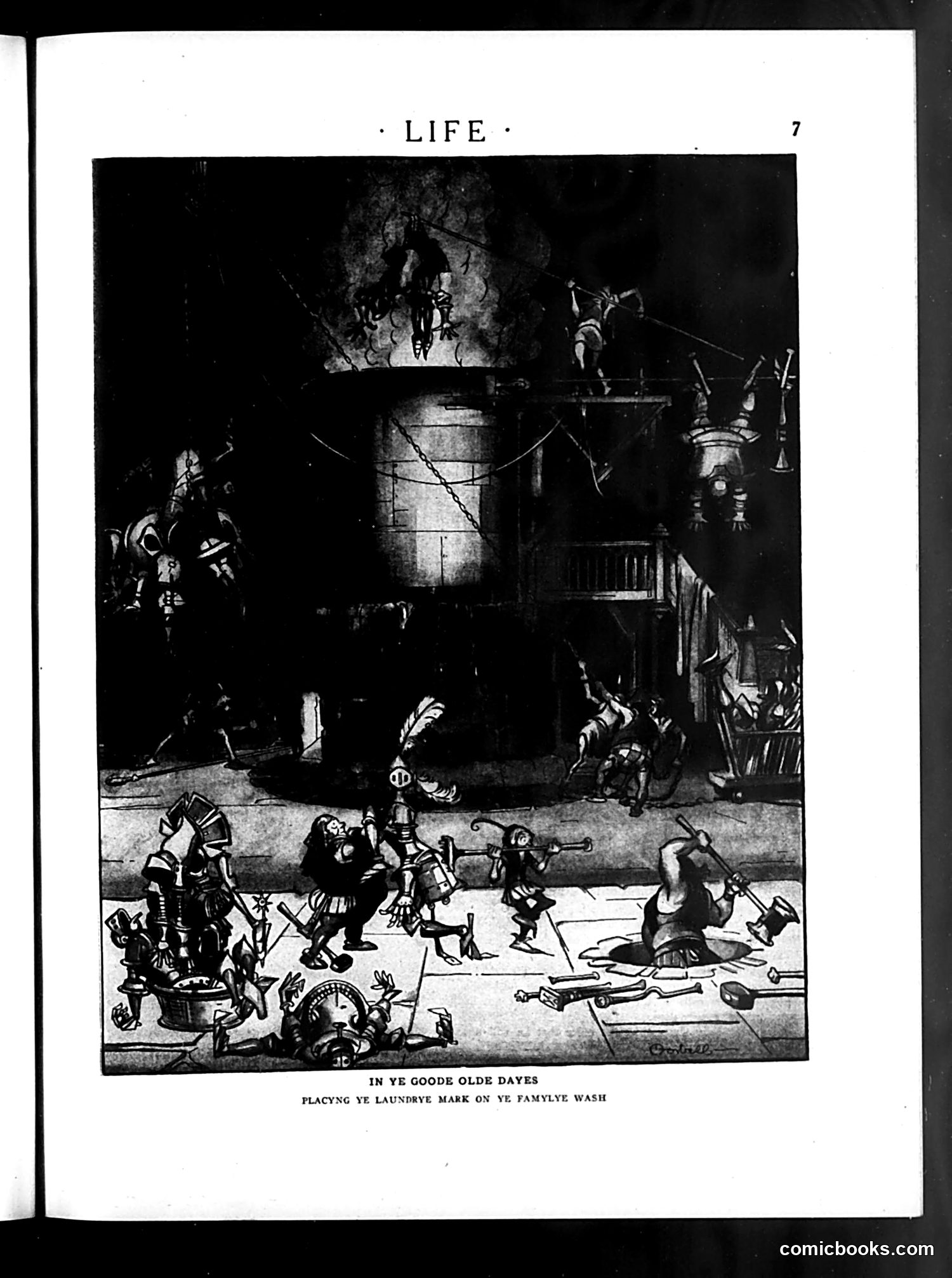
This satirical illustration depicts medieval or Renaissance-era figures engaged in laundry work—"playing ye laundry mark on ye familye wash." The cartoon appears to satirize the genteel pretenses of the past by showing armored nobles and aristocrats performing menial domestic labor. The joke likely mocks the romantic nostalgia for "good old days" by revealing the unglamorous reality: even nobility had to handle mundane household tasks. The elaborate period costumes and ornate setting contrast sharply with the unglamorous work depicted, creating ironic humor. The cartoonist uses this anachronistic scene to deflate historical romanticism, suggesting that past eras were neither as refined nor elevated as modern sentimentality imagines. Life magazine frequently employed such visual satire to critique contemporary attitudes and pretensions.
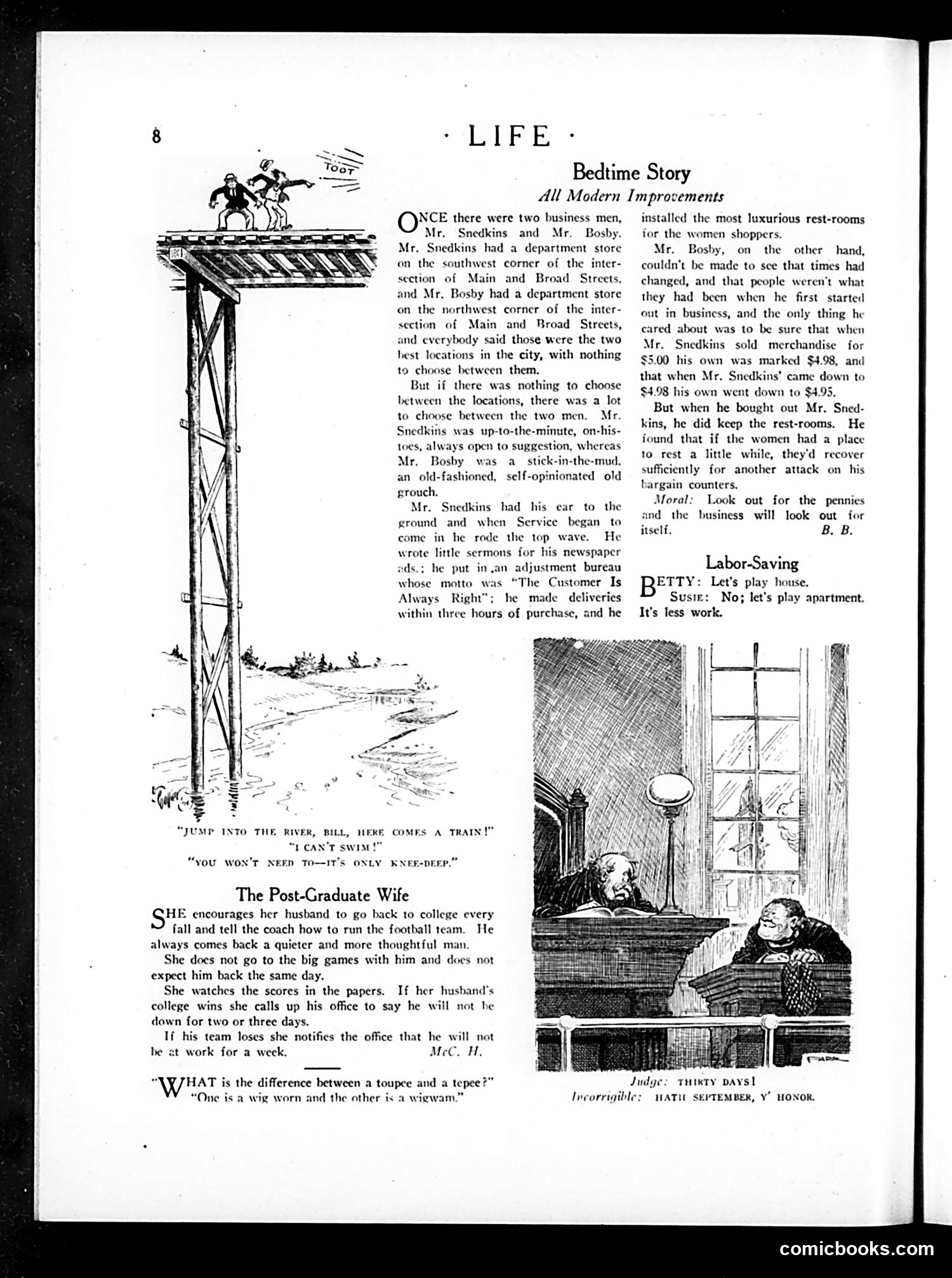
This page contains three separate humorous pieces typical of *Life* magazine's satirical style: 1. **"Bedtime Story: All Modern Improvements"** - A satirical anecdote about two competing department store owners (Snedkins and Bosby) engaged in a race-to-the-bottom price war, undercutting each other's markups. The moral mocks excessive business competition and obsession with undercutting rivals. 2. **"The Post-Graduate Wife"** - Satire of a college football coach's wife who manages her husband's career through strategic absence from games and absence-notices to his employer—mocking manipulative spousal behavior and college football culture. 3. **"Labor-Saving"** - A brief joke contrasting "playhouse" versus "apartment" living arrangements, implying domestic labor differences. The cartoons and jokes reflect 1920s-era anxieties about business competition, changing gender roles, and modern domestic life.
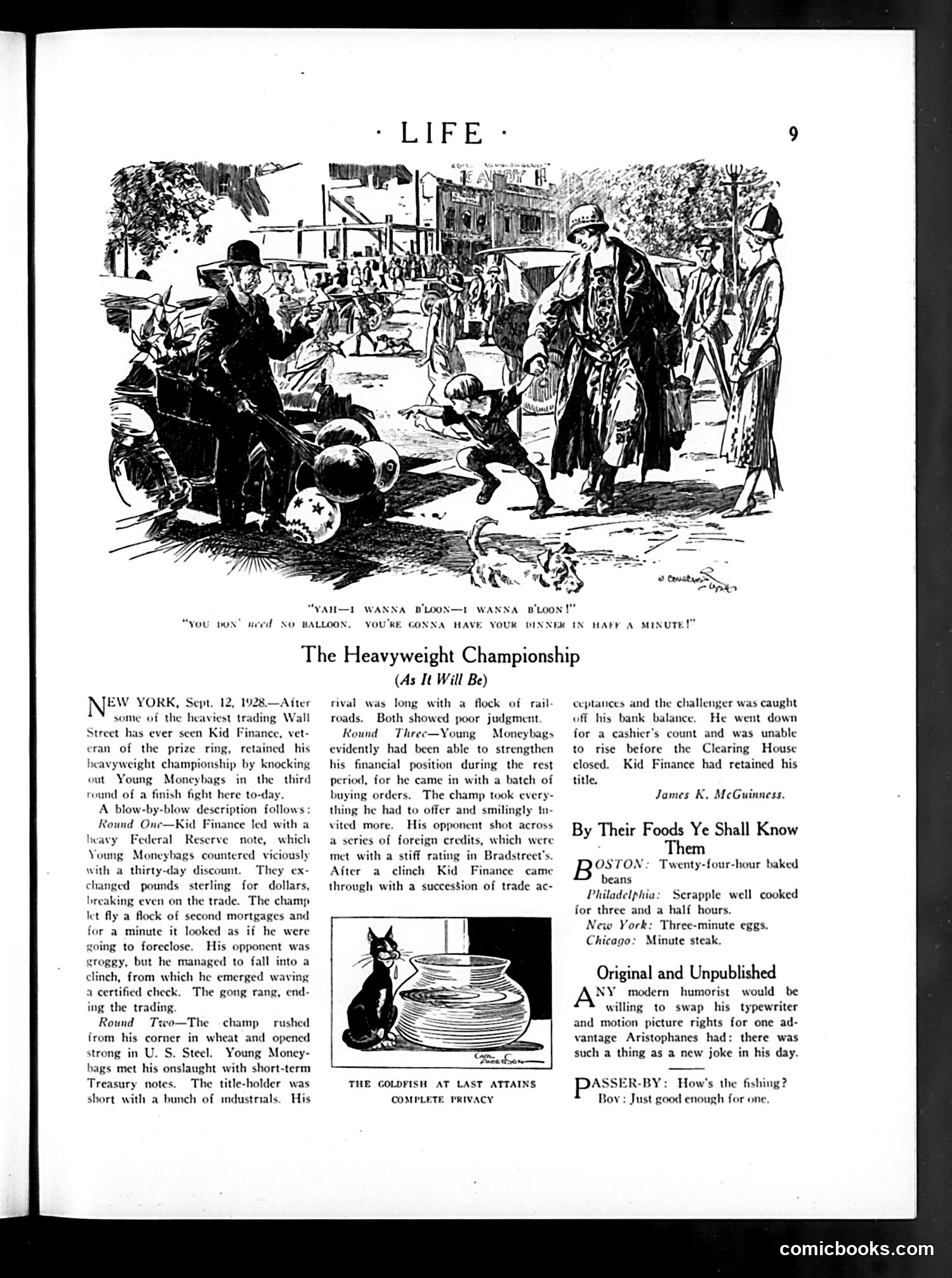
The main cartoon illustrates "The Heavyweight Championship (As It Will Be)," satirizing the 1928 boxing match between Kid Finance and Young Moneybags. The image shows these personified financial entities in a street brawl, with one figure on a horse and another wielding what appears to be a balloon labeled with a dollar sign. The satire mocks the 1920s financial speculation and rampant capitalism of the Jazz Age. The "balloons" and theatrical staging reference the period's inflated asset values and get-rich-quick schemes. The accompanying text confirms Kid Finance initially held advantages but ultimately lost his position—likely commentary on market vulnerability and overextension during the pre-1929 crash era. The humor relies on treating abstract economic forces as competing prizefighters.
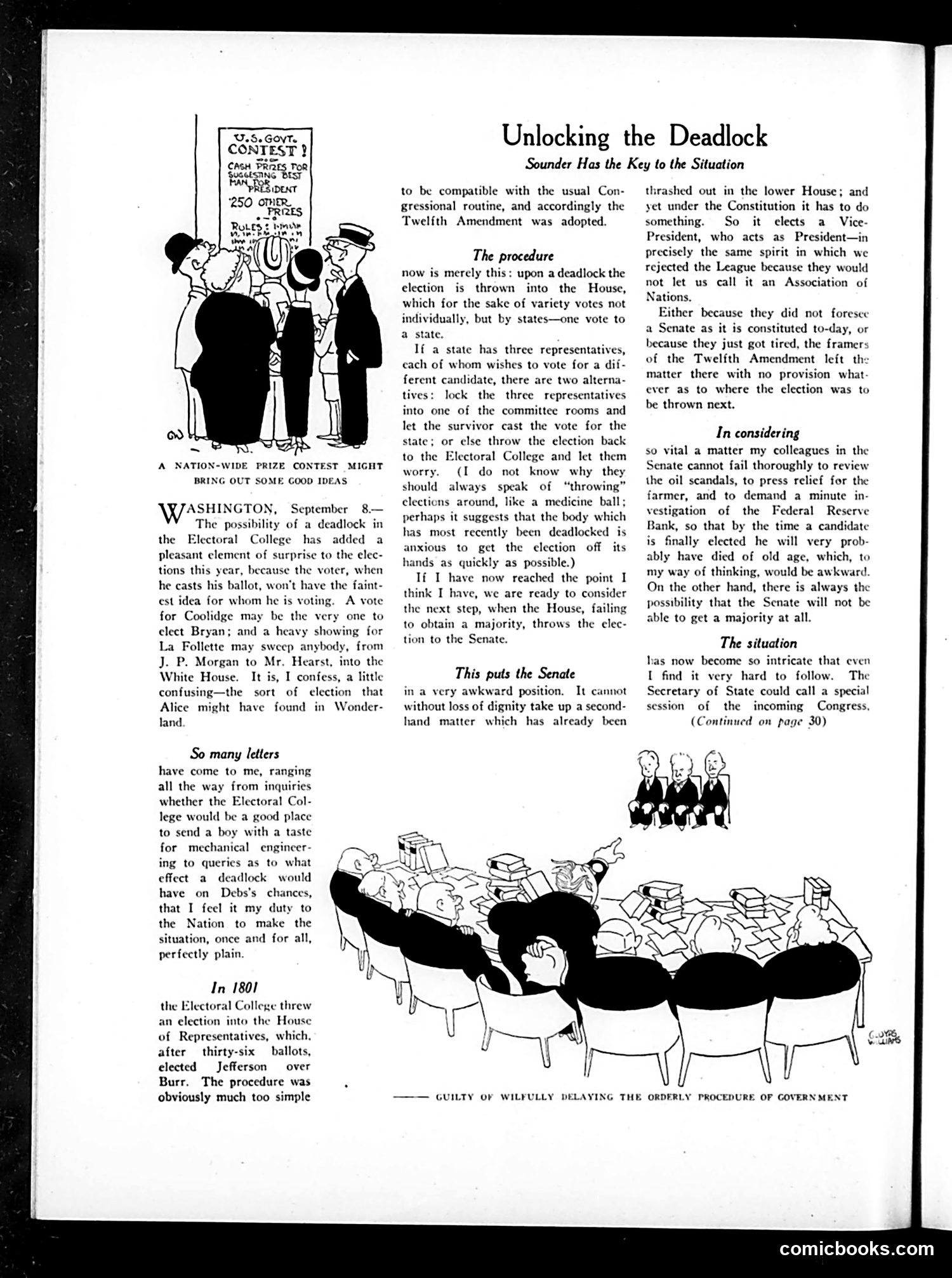
This article and cartoons satirize the 1924 presidential election deadlock. The text explains that if no candidate wins an Electoral College majority, the election goes to the House of Representatives—voting by state, one vote per state. The top cartoon shows politicians debating the Electoral College's utility. The bottom cartoon depicts a Senate committee meeting buried under mountains of paperwork, captioned "GUILTY OF WILFULLY DELAYING THE ORDERLY PROCEDURE OF GOVERNMENT." This satirizes Senate obstruction and the complexity created by the deadlocked election process. The article argues the Twelfth Amendment left unclear procedures for such deadlocks, creating confusion and gridlock in government. The satire critiques both the Electoral College system's inefficiency and Congress's inability to resolve the resulting constitutional crisis promptly.
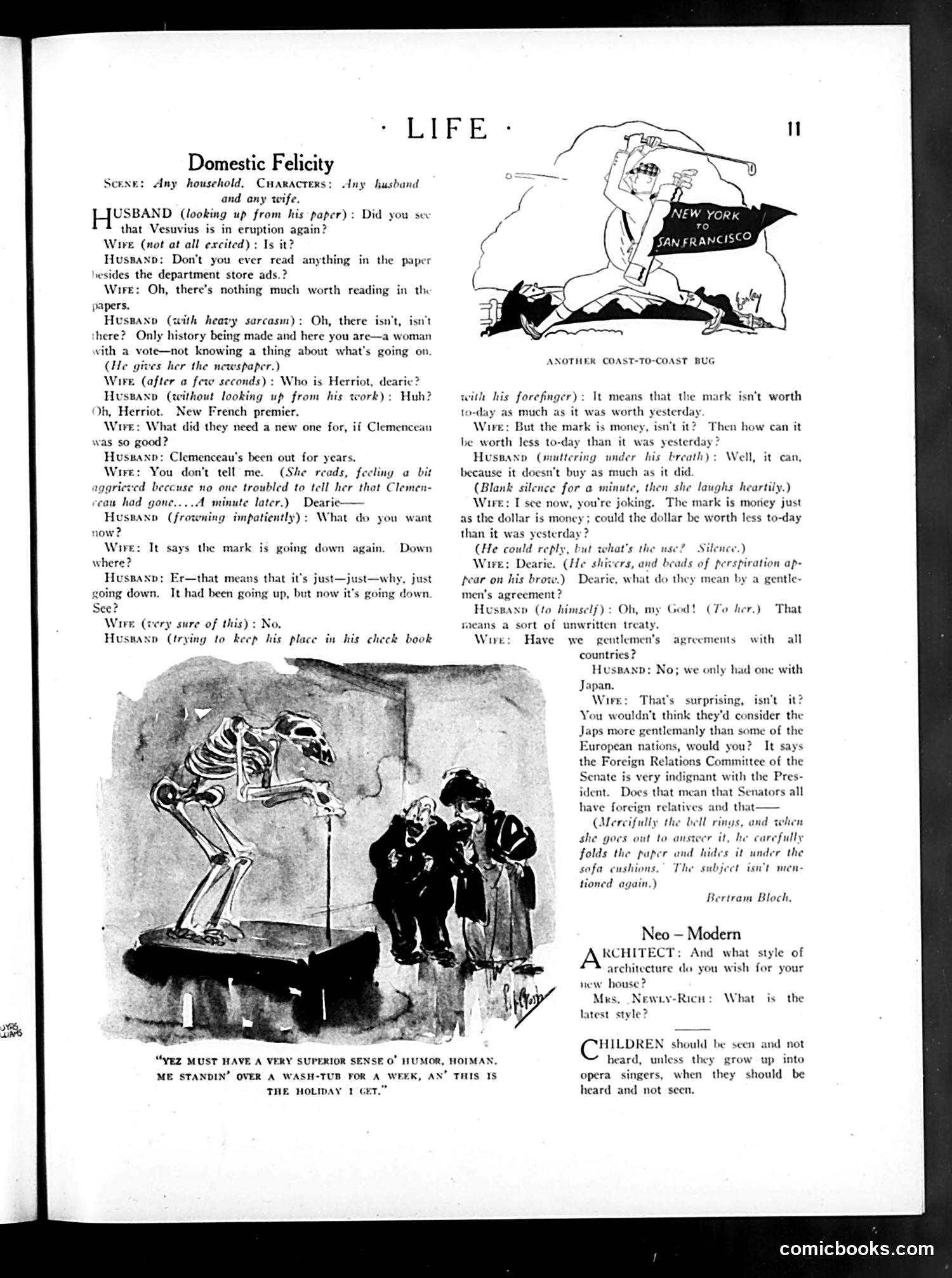
This page satirizes domestic life and stock market anxiety. The "Domestic Felicity" dialogue shows a husband dismissive of newspaper reading, then anxious about Vesuvius and stock prices—specifically "Clemenceau" stock, which is "going down." The wife provides practical perspective, while the husband frets over financial losses. The cartoon below depicts a skeleton (representing Death or ruin) looming over a couple at what appears to be a wash-tub, with the caption about needing "superior sense of humor" while "standin' over a wash-tub" during holiday season—satirizing marital strain and domestic drudgery. The page reflects early 20th-century concerns: stock market volatility, marital tension, and class anxiety. "Clemenceau" likely references French political/economic news of the era.
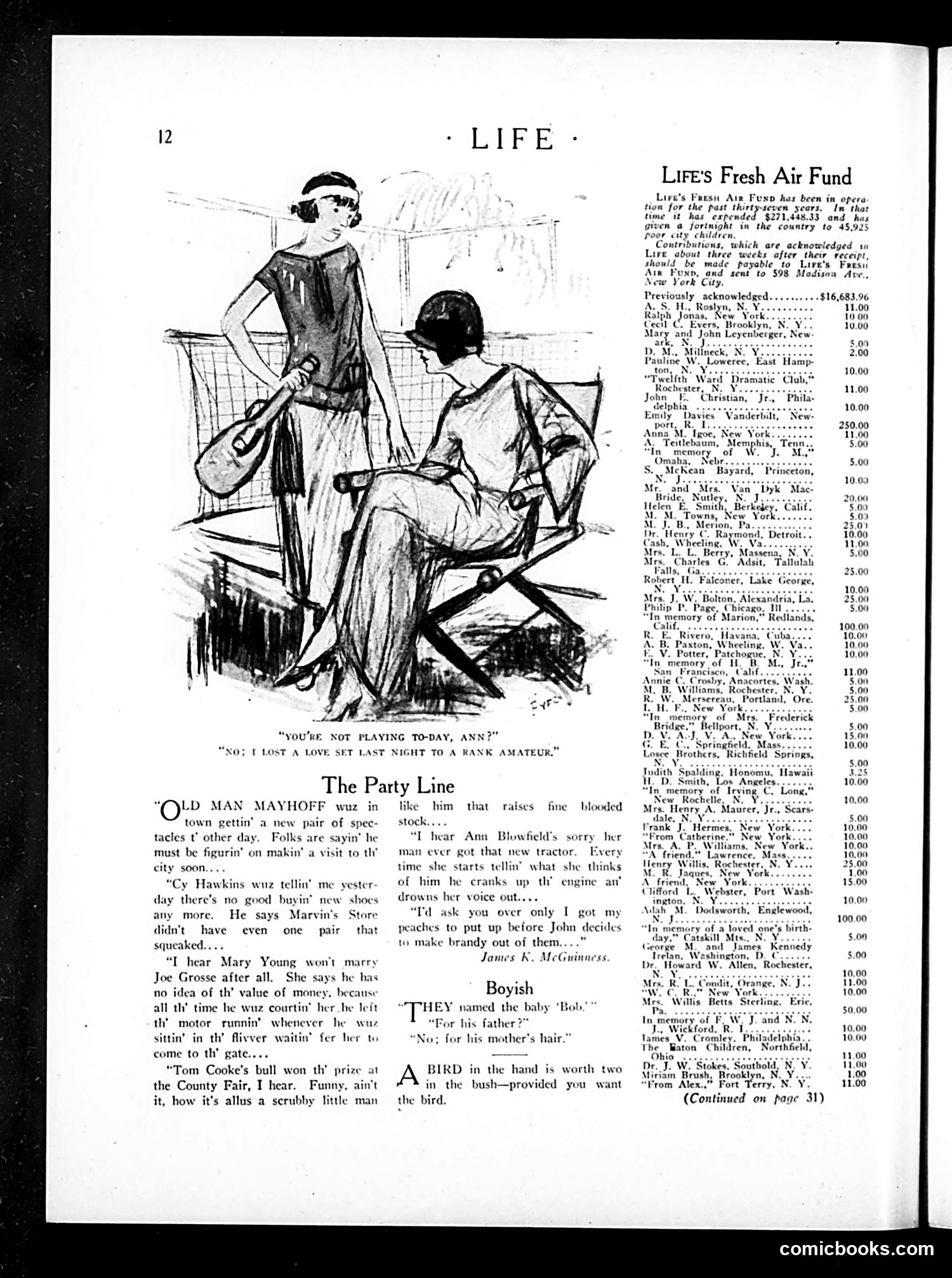
This page features a satirical article titled "The Party Line" alongside a sketch of two women in conversation. The cartoon illustrates rural gossip culture through dialogue about neighbors' affairs—one woman discussing another's romantic entanglement and tractor acquisition. The accompanying text uses vernacular speech to mock small-town social dynamics: residents obsessing over trivial matters like new shoes, marriage prospects, and farm equipment. References to "Mary Young," "Joe Grosse," and "Tom Cooke's bull" suggest specific local scandal, though their historical identities are unclear. The satire targets rural communities' preoccupation with others' personal business and the social pressure placed on women regarding marriage and propriety. It's typical 1920s Life magazine humor mocking rural American life as unsophisticated and gossip-driven.
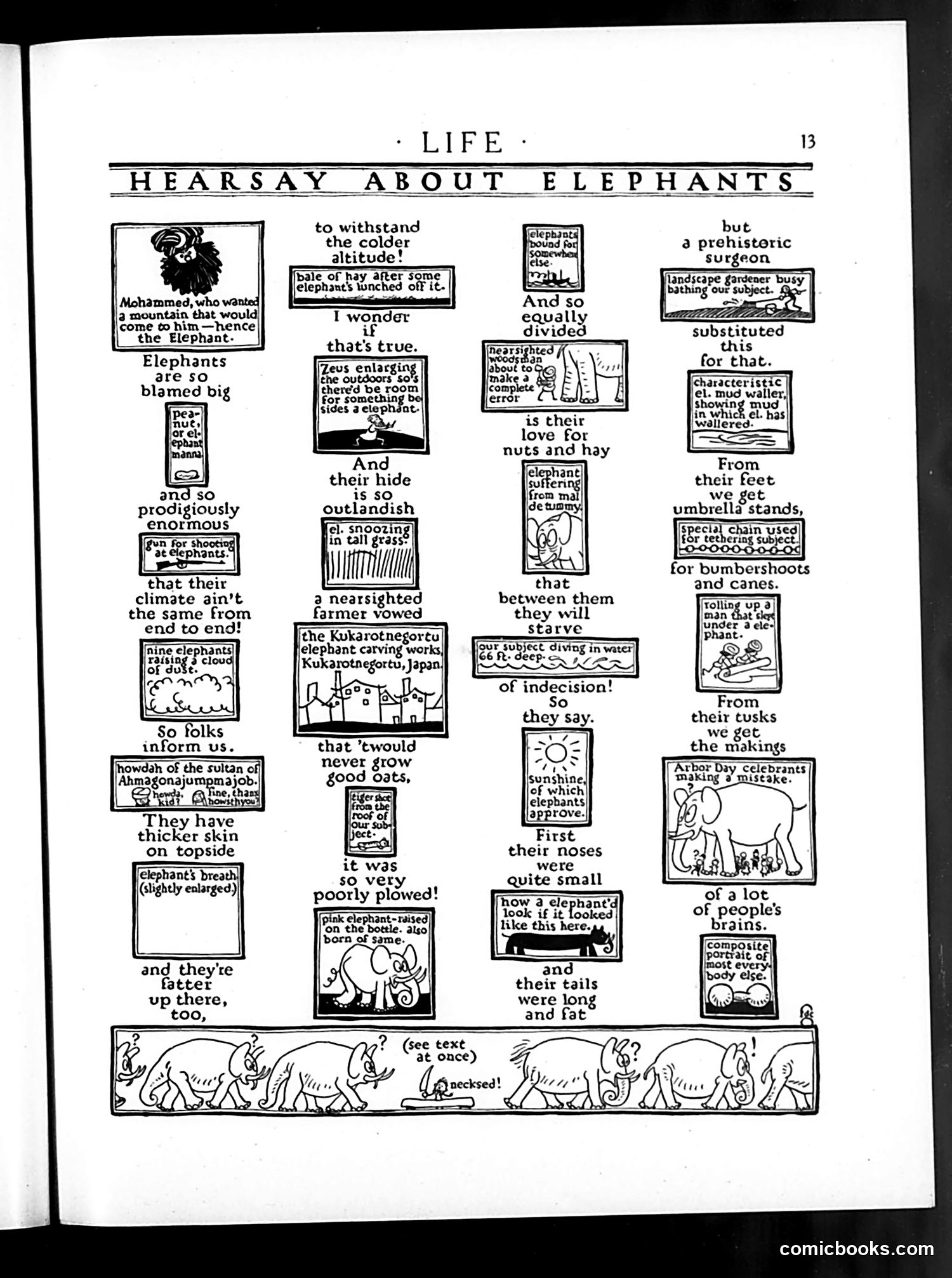
This satirical piece mocks the spread of exaggerated or false claims about elephants. The page collects various humorous "hearsay" statements—such as that elephants are enormous, afraid of mice, or that their noses were historically small—presented as folklore or rumor. The satire targets how misinformation propagates: claims are repeated as fact without verification (one panel references "a nearsighted farmer vowed" something "that 'twould never grow good oats"). The piece appears to mock credulous acceptance of tall tales and the way unverified claims become accepted "wisdom." The bottom panel showing elephants in a line suggests the herd mentality involved in spreading such rumors. It's a lighthearted commentary on human tendency to believe and repeat unverified information—relevant to any era.
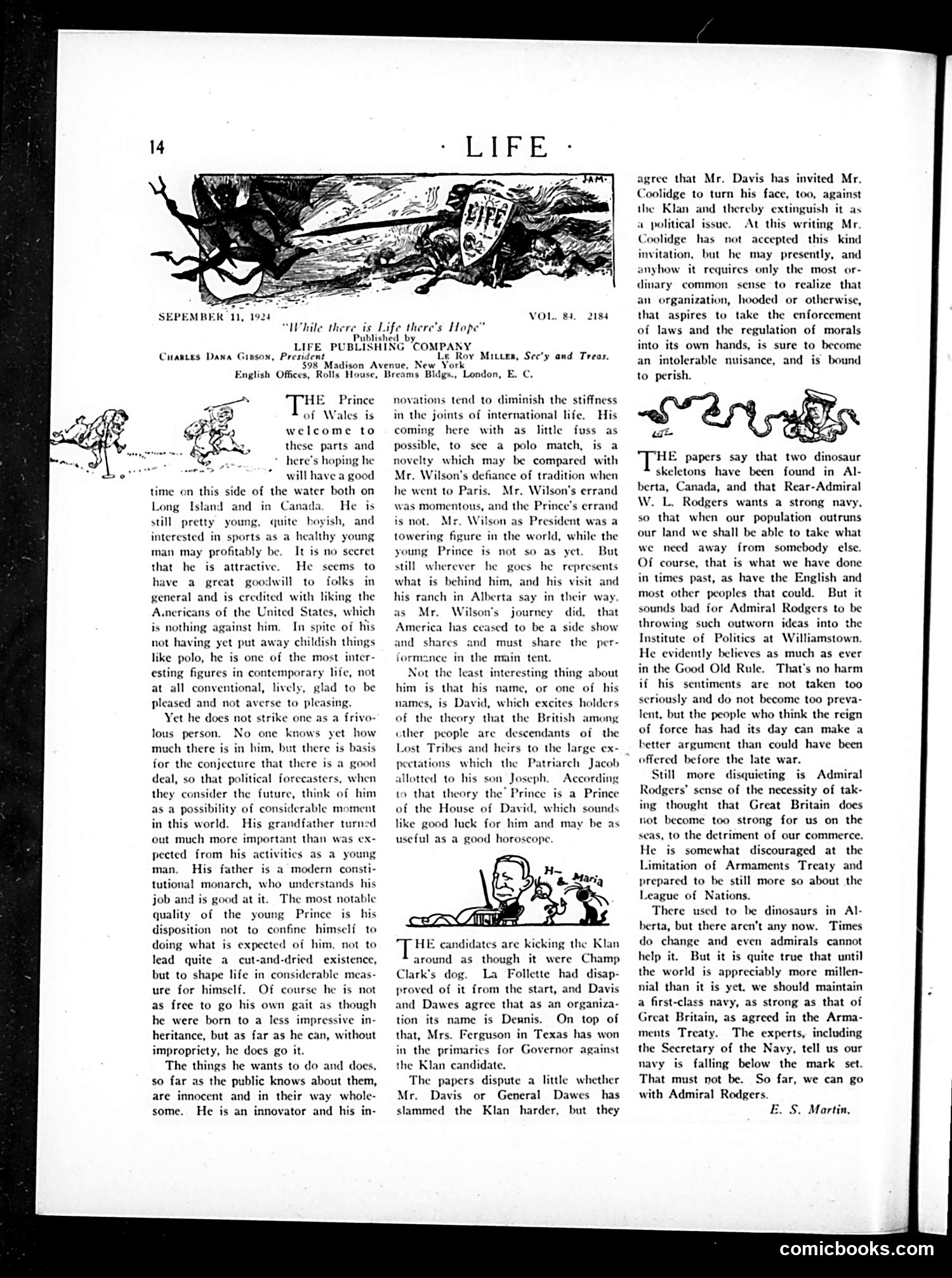
The main cartoon depicts **the Prince of Wales** (later Edward VIII) visiting North America. The text praises his informality and accessibility compared to his father, noting he "seems to have a goodwill to talk in general and is credible with liking the sovereign of the United States." The article discusses American politics, mentioning the **Ku Klux Klan** as a campaign issue. It references candidates "kicking the Klan around as though it were Champ Clark's dog," suggesting the KKK had become a contentious political topic in 1924 elections. The satirical tone criticizes political figures for exploiting the Klan issue while avoiding substantive engagement with it—treating serious matters frivolously during the campaign season.
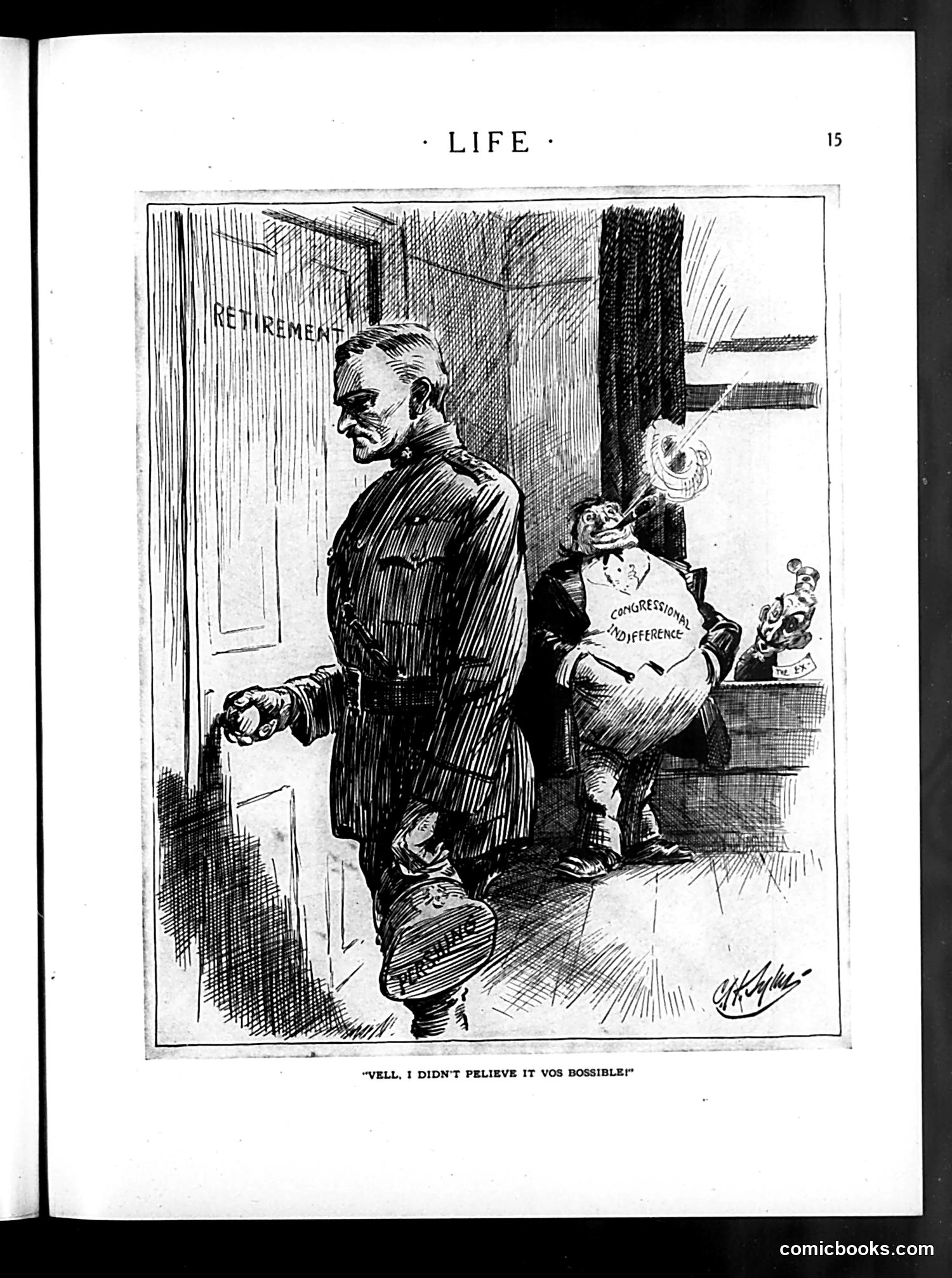
This single-panel political cartoon depicts a military officer entering a "Retirement" room, confronted by a portly figure labeled "Congressional Indifference." The officer expresses surprise: "Well, I didn't believe it was possible!" The satire targets Congressional neglect of military affairs or veterans' concerns. The artist suggests that Congressional indifference to military matters is so pervasive it seems almost unbelievable—yet here it is, personified as an actual obstacle the officer must face. The cartoon likely references early 20th-century debates over military funding, readiness, or veterans' benefits. The "Retirement" setting may indicate concerns about inadequate pension provisions or post-service care for military personnel. The satire's point: Congress's indifference to military needs is shockingly real and frustratingly inevitable.
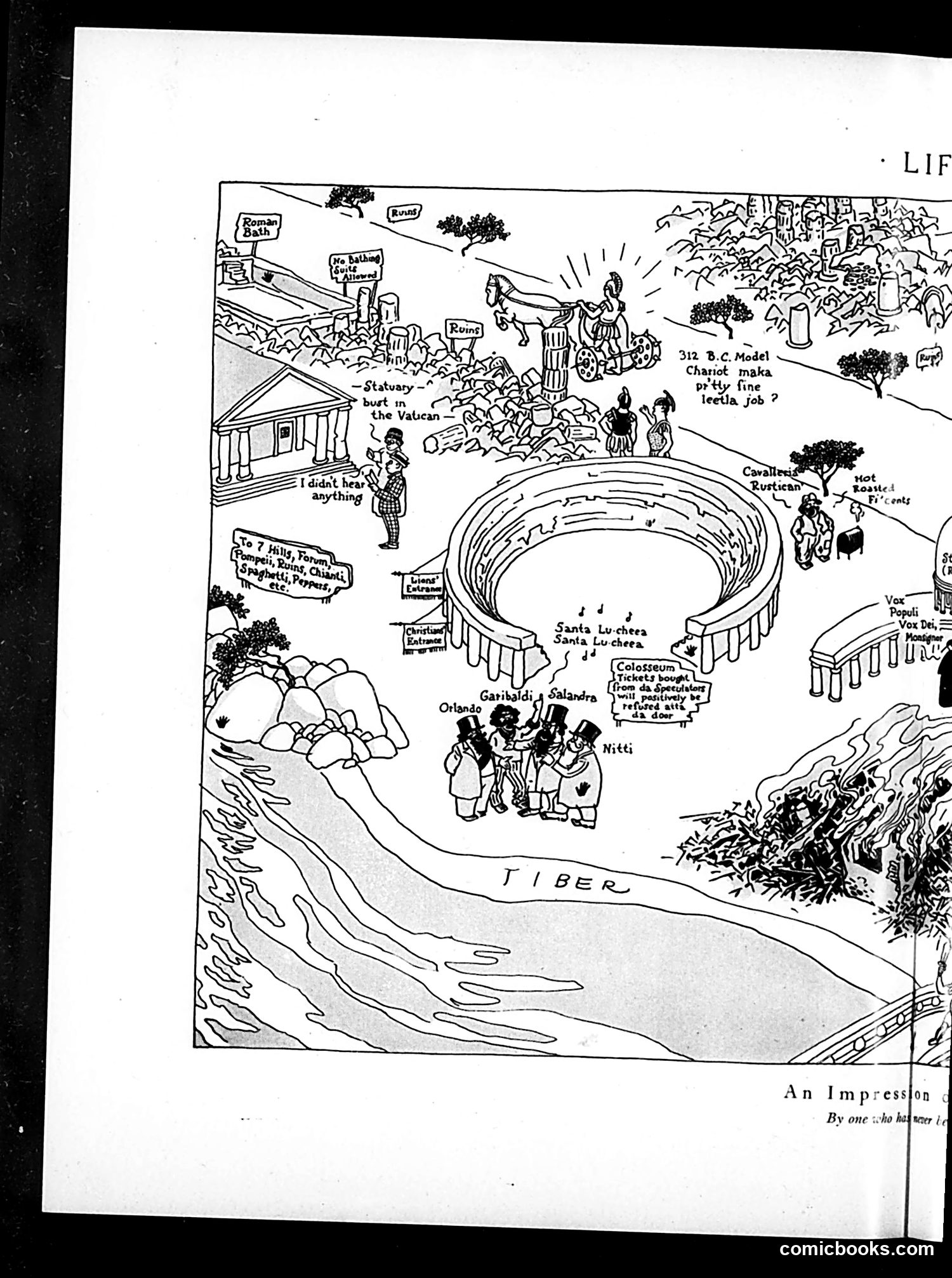
This cartoon satirizes tourists experiencing Rome's ancient sites. The large central structure is the Colosseum, labeled with visitor commentary about ticket prices and crowds. Around it are famous Roman landmarks: the Pantheon (labeled "Statuary burst in the Vatican"), the Tiber River, and various classical buildings. The humor lies in tourists reducing grand historical monuments to trivial concerns—complaining about costs, making jokes about chariot rides, and missing the cultural significance entirely. Characters like "Santa Lu-cheera" and "Orlando" appear to be generic tourist types making silly observations. The title "An Impression by one who has never..." suggests this depicts someone's imaginative, uninformed version of Rome—where ancient civilization is reduced to tourist attractions and comic relief rather than historical importance. It's early satire of mass tourism and cultural ignorance.
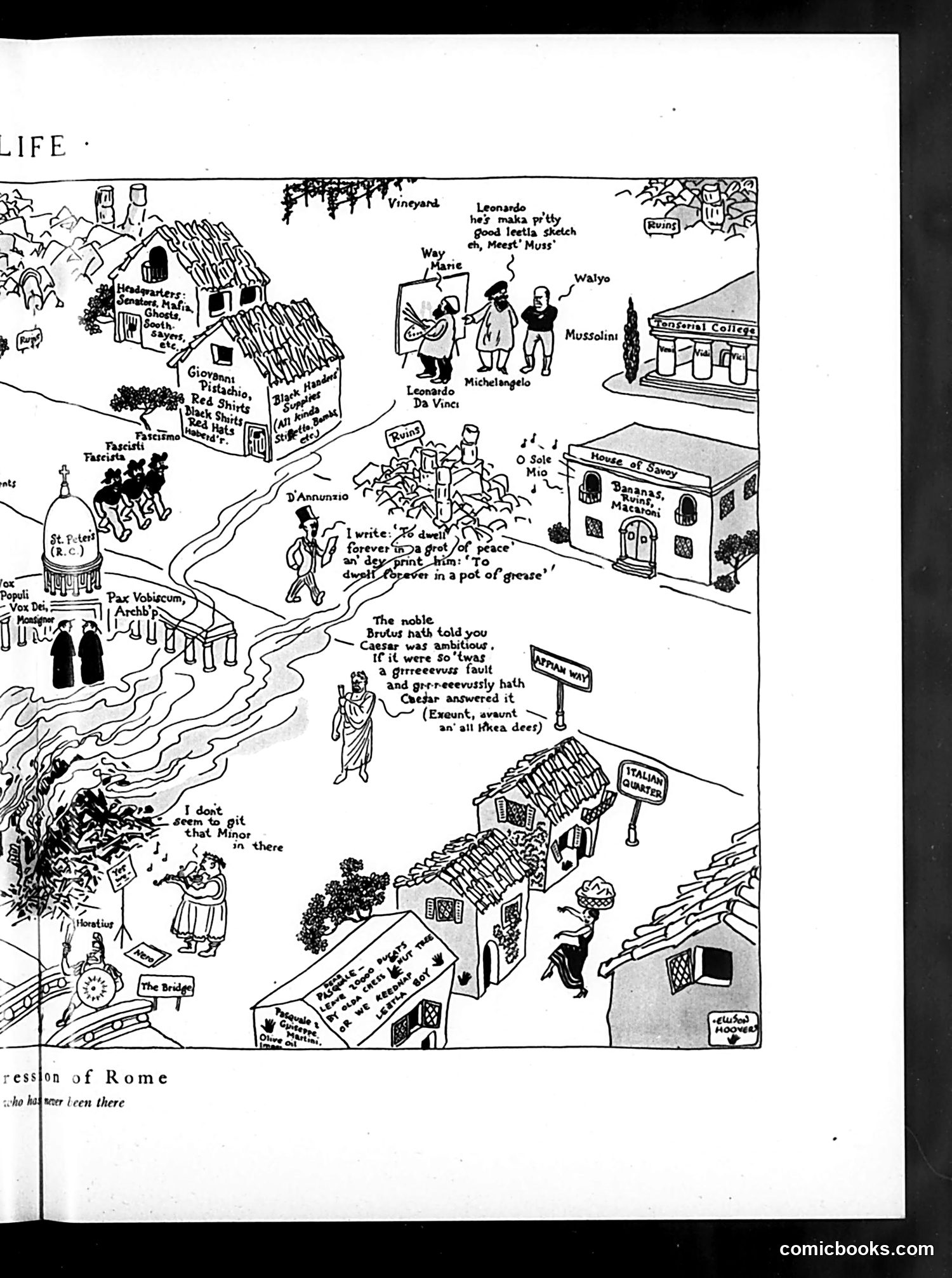
This is a humorous illustrated map of Rome presented as a tourist guide, with satirical commentary mixed into the landmarks. The page references **Mussolini** (labeled among the figures) and uses a Shakespeare quote from *Julius Caesar* about Caesar's ambition as sardonic commentary—likely critiquing Mussolini's own imperial ambitions by comparing him to the historically ambitious Caesar. The map includes actual Roman sites (the Bridge, Arch, Imperial College) alongside fictional tourist attractions and comedic observations. The Shakespeare quote about ambition being a "grievous fault" suggests the cartoonist is using classical Rome as a mirror to comment on contemporary fascist Italy and its leader's expansionist pretensions. The overall tone is mocking: presenting Rome's classical grandeur while inserting modern political figures, implying that Mussolini's regime merely apes ancient glory without genuine substance.
This is a theater review column critiquing two Broadway plays. The reviewer discusses "The Werewolf," a Continental translation featuring notably blonde actors (Leslie Howard, Laura Hope Crews) cast as Spanish characters with names like "Florencio de Viana"—the satire being that such casting is absurdly unconvincing. The critic mockingly notes that characters use stilted dialogue like "despite his great spiritual qualities," representing the awkward translation conventions that plague such imports. The second review targets "The Best People," an Avery Hopwood comedy. The reviewer dismisses it as derivative and tired, claiming it contains no original material—every joke and slang phrase has been recycled from stock company productions decades earlier. The reference to Admiral Dewey suggests even someone from that earlier era would recognize the worn-out material. The satire critiques plays masquerading as sophisticated while delivering nothing fresh.
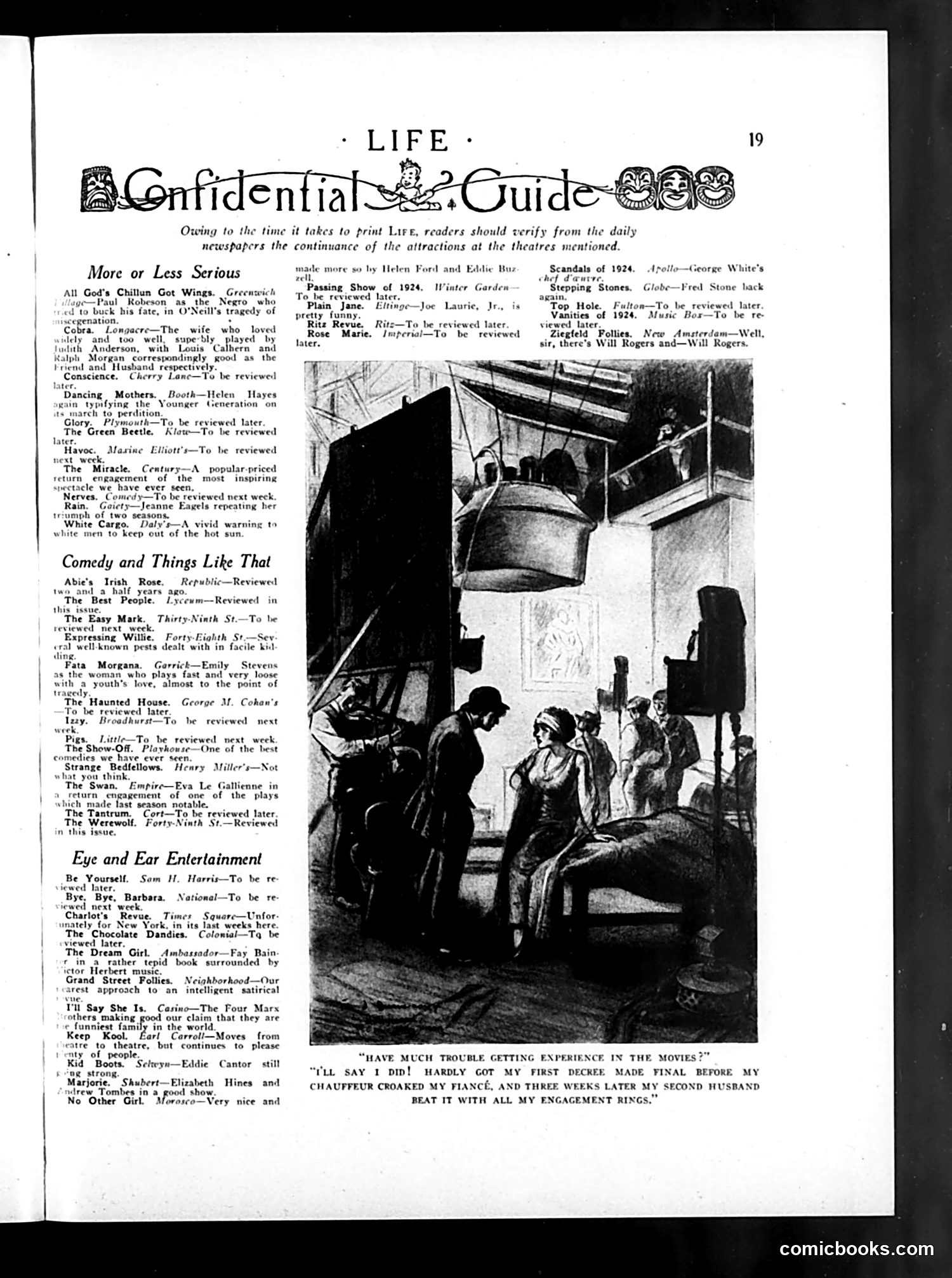
This page is a theater and entertainment guide listing Broadway shows and movies currently playing in New York. The image shows a film set scene, likely from a 1924 silent movie production. The cartoon caption below the photograph is satirical social commentary. A woman character, apparently an actress or socialite, boasts about her troubled romantic life: she divorced quickly, her fiancé died, and her second husband ran off with her jewelry. She frames these personal disasters as "experience" for movie acting—suggesting she's conflating real-life trauma with professional credentials. The satire targets 1920s "Scandals of 1924" celebrity culture—the era's fascination with stars' dramatic personal lives, divorces, and jewelry. It mocks both the woman's delusional perspective and society's tendency to sensationalize actresses' romantic mishaps as entertainment value.
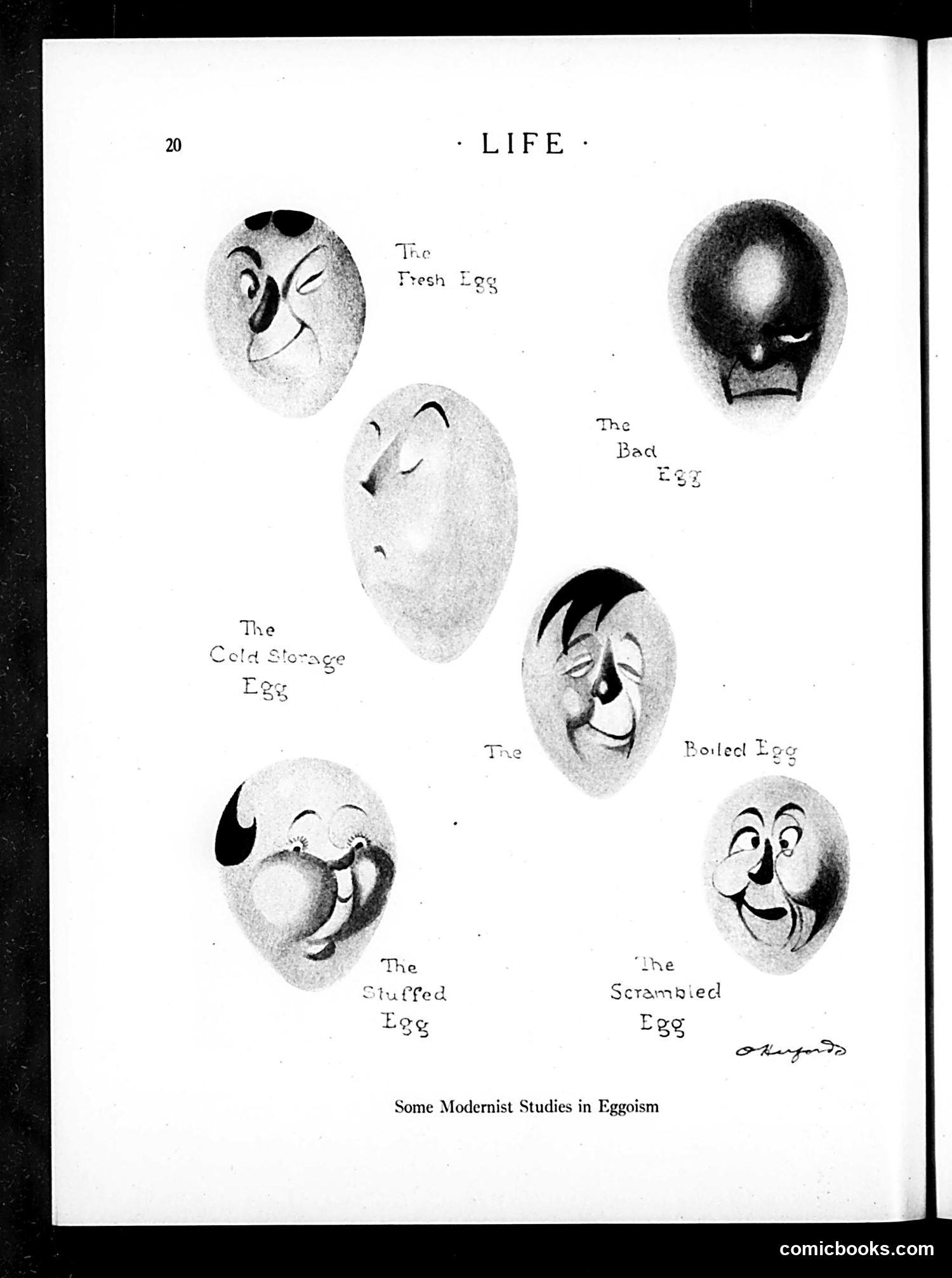
This page is a humorous cartoon essay titled "Some Modernist Studies in Eggoism." It depicts six eggs with anthropomorphic faces, each labeled to represent different egg preparations: Fresh, Bad, Cold Storage, Boiled, Stuffed, and Scrambled. The satire appears to mock Modernist artistic movements—likely Cubism, Expressionism, and Futurism—by presenting eggs with exaggerated, distorted facial features as if they were avant-garde "studies." The joke treats pretentious artistic innovation as trivial, comparing the self-absorbed aesthetics of Modernism to eggs obsessed with themselves ("eggoism"). This reflects early-20th-century skepticism toward experimental art movements, mocking both their visual distortion and intellectual pretension through absurdist humor.
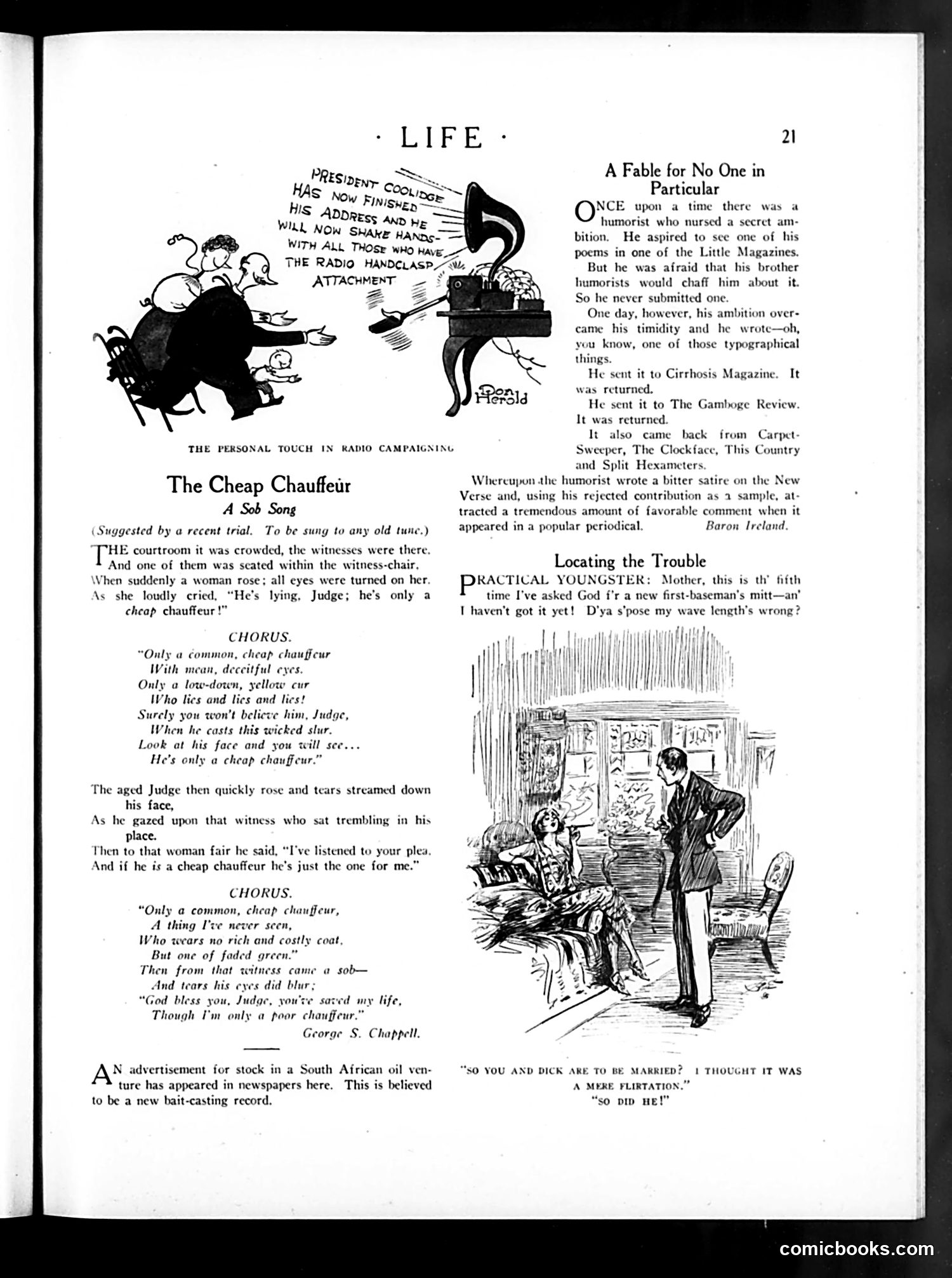
This page contains three satirical pieces reflecting 1920s American concerns: **"The Cheap Chauffeur"** is a sentimental ballad (by George S. Chappell) mocking courtroom drama. It references "a recent trial"—likely involving a chauffeur as witness or defendant—where class prejudice becomes central. The joke: a judge dismisses social bias against working-class testimony, declaring the "cheap chauffeur" trustworthy *because* of his humble status. The sob-song format parodies melodramatic popular entertainment. **"A Fable for No One in Particular"** satirizes literary pretension. A humorist fears peer mockery for submitting experimental poetry ("typographical things") to little magazines. His rejected work becomes famous *as satire* when published in mainstream venues attacking modernist verse. The irony: his shame prevented honest literary ambition. **"Locating the Trouble"** is a brief joke playing on 1920s radio terminology. A child asks God repeatedly for a baseball glove, then wonders if his "wave length" is wrong—humorously applying radio broadcasting language to prayer. The top cartoon satirizes political radio campaigning using technical jargon as empty spectacle.
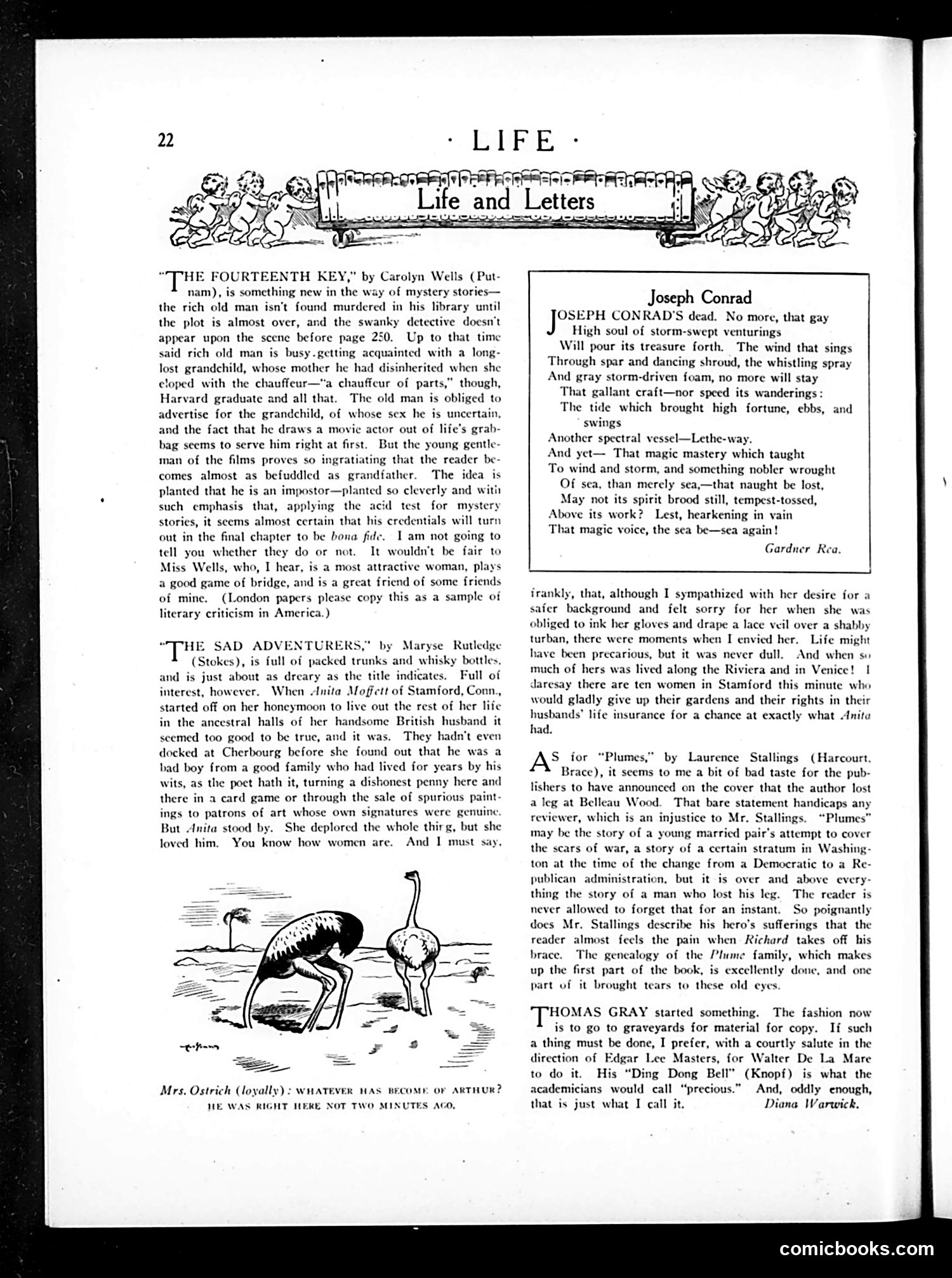
This page contains **book reviews and literary commentary** rather than political cartoons. The single illustration shows **two ostriches**, captioned with a domestic joke: "Mrs. Ostrich (loyally): Whatever has become of Arthur? He was right here not two minutes ago." The ostrich gag plays on the cliché that ostriches bury their heads in sand—here suggesting Mrs. Ostrich's obliviousness to her husband's whereabouts, a mild marital humor typical of 1920s magazines. The reviews discuss contemporary novels by Carolyn Wells, Maryse Rutledge, and Laurence Stallings. A tribute to **recently deceased author Joseph Conrad** appears in the right column, mourning "the high soul of storm-swept venturings" and his literary mastery of the sea. The page exemplifies Life's literary criticism feature—witty, gossipy commentary on popular fiction for educated readers.
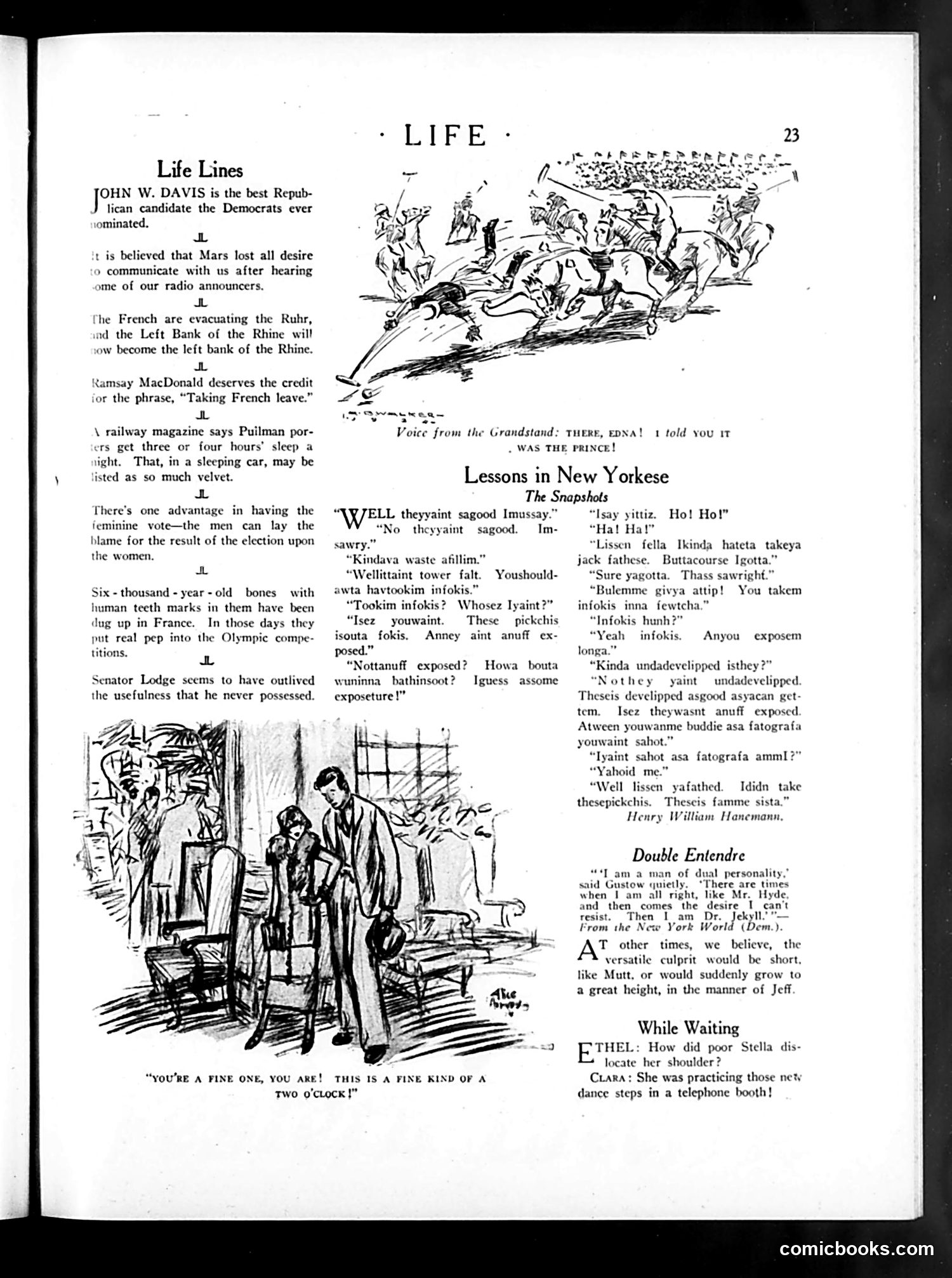
This page from *Life* magazine (a pre-1920s satirical publication) contains three distinct sections: **"Life Lines"** presents brief political jabs: John W. Davis mocked as a Republican-nominated Democrat; Senator Henry Cabot Lodge dismissed as having "outlived usefulness he never possessed"; and a joke about women voters as convenient scapegoats for election outcomes. **The cartoon** depicts spectators at a sporting event (likely horse racing), with one exclaiming they told someone "it was the prince"—suggesting upper-class gossip about royalty attending public events. **"Lessons in New Yorkese"** satirizes working-class New York dialect and pronunciation ("theyyaint sagood," "infokis" for "in focus"), mocking how locals mangled English through rapid, careless speech. The remaining items—"Double Entendre," "While Waiting," and "Lessons in New Yorkese"—are brief humorous vignettes typical of *Life*'s formula: social observation, wordplay, and gentle ridicule of contemporary manners.
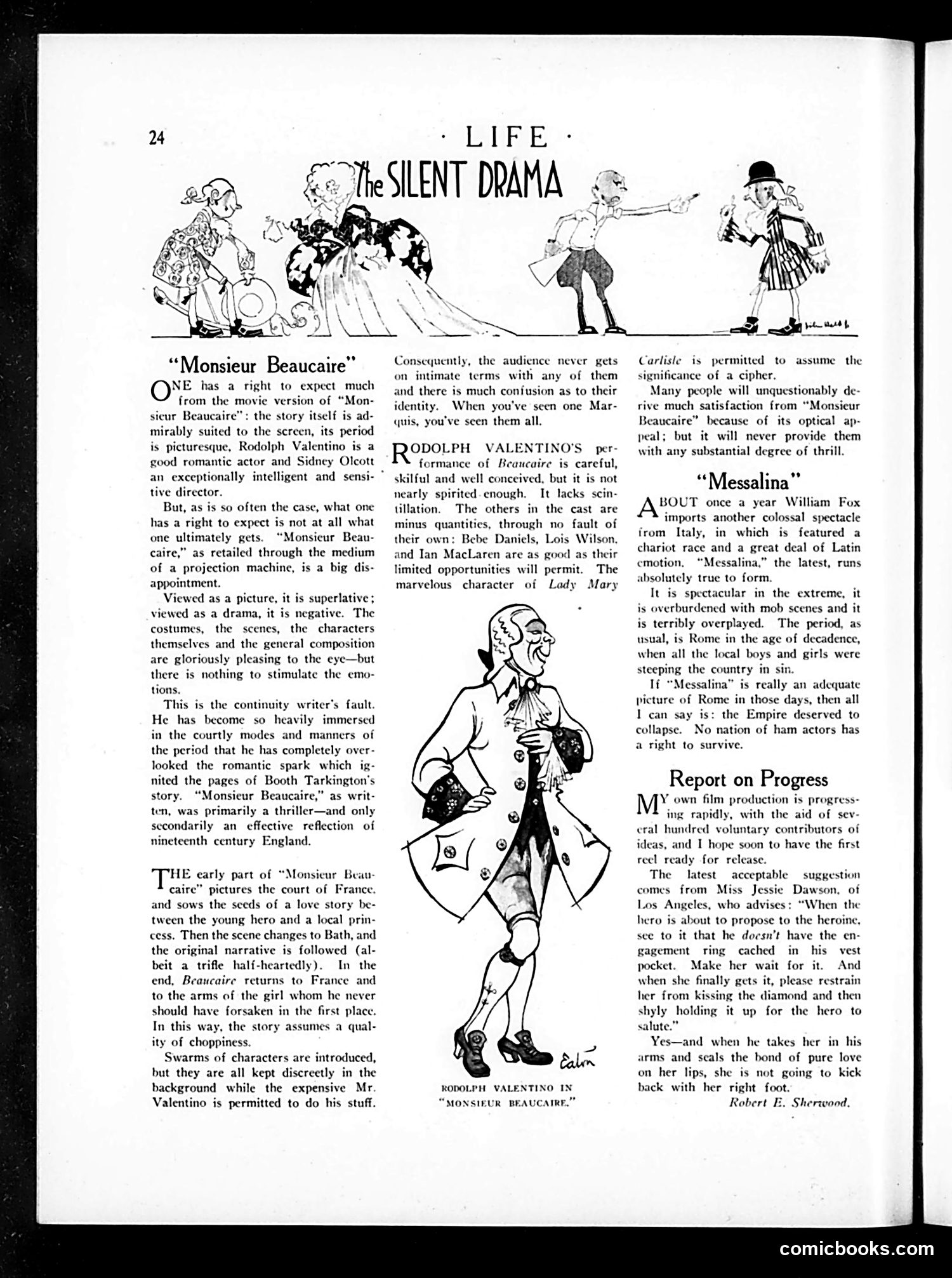
This page contains two film reviews from Life's cinema column. The main review critiques **"Monsieur Beaucaire,"** a Rodolph Valentino vehicle adapted from Booth Tarkington's novel. The reviewer praises its visual aesthetics and period costumes but condemns the screenplay for losing the original story's romantic tension. Valentino himself is criticized as technically competent but lacking "scintillation"—the spark needed for drama. Supporting actors like Bebe Daniels are reduced to background players. A second brief review mocks **"Messalina,"** a William Fox import from Italy depicting decadent Rome. The reviewer uses biting satire, suggesting the film's "ham actors" performing historical excess so unconvincingly that if Rome actually resembled this depiction, "the Empire deserved to collapse." The cartoonish illustration at top depicts typical silent-film characters in period costume. The satire targets how spectacle and star power can overwhelm storytelling—a recurring complaint about early cinema.
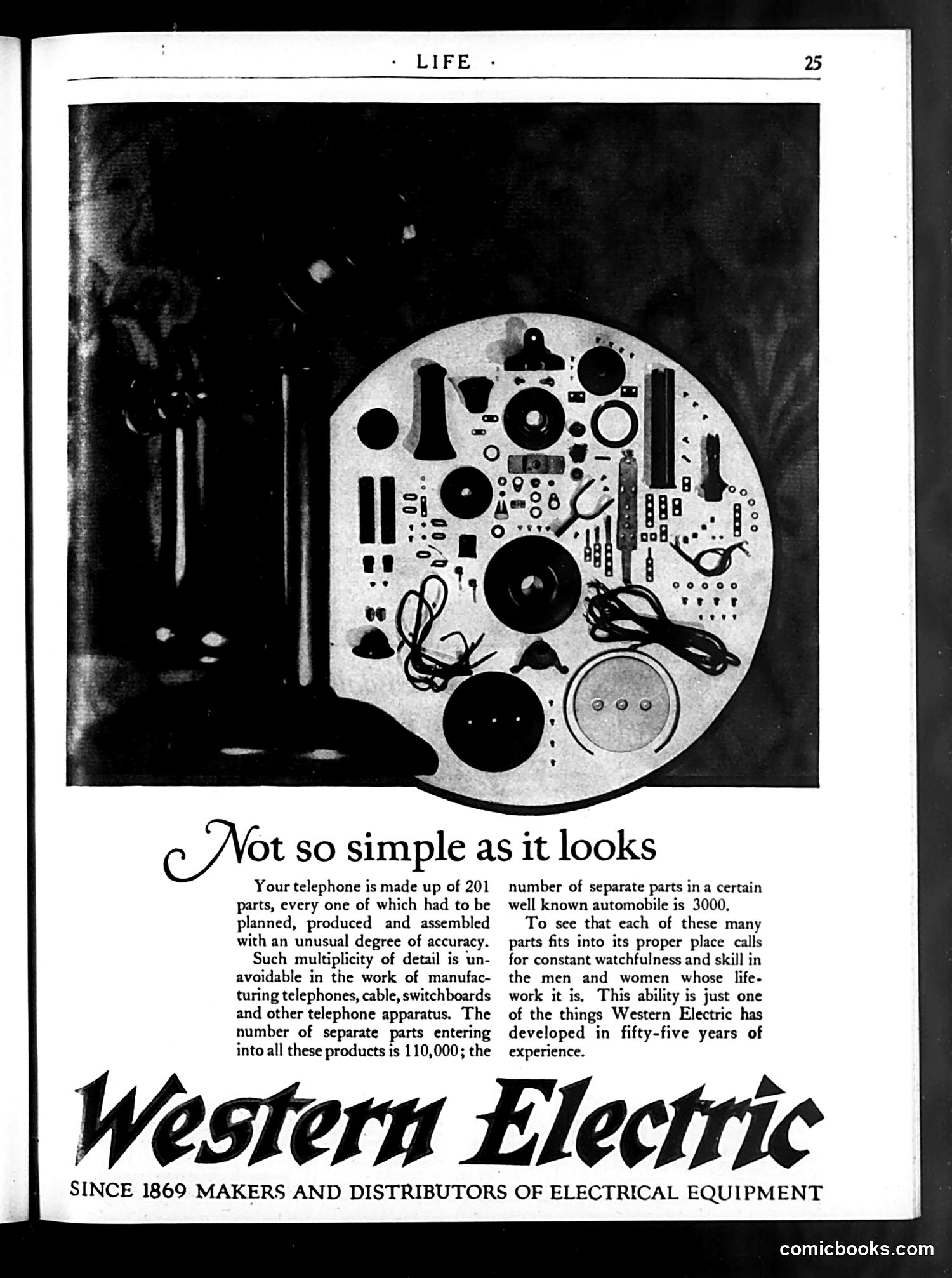
This is a **corporate advertisement**, not a political cartoon. Western Electric, a major telephone equipment manufacturer, uses a disassembled telephone as its central visual—showing all 201 component parts laid out on a circular surface. The ad's message is straightforward marketing: the headline "Not so simple as it looks" emphasizes manufacturing complexity as a selling point. The text argues that telephone production requires far more precision than automobile manufacturing (110,000 parts vs. 3,000), demanding exceptional skill and care from workers. This is **advertising dressed as educational content**—a common early 20th-century strategy. By highlighting technical sophistication and worker expertise, Western Electric positions itself as a premium, trustworthy manufacturer. The 1869 founding date in the tagline reinforces this authority claim. There is **no satire or political commentary**. The page simply showcases industrial pride and corporate brand-building through technical demonstration.
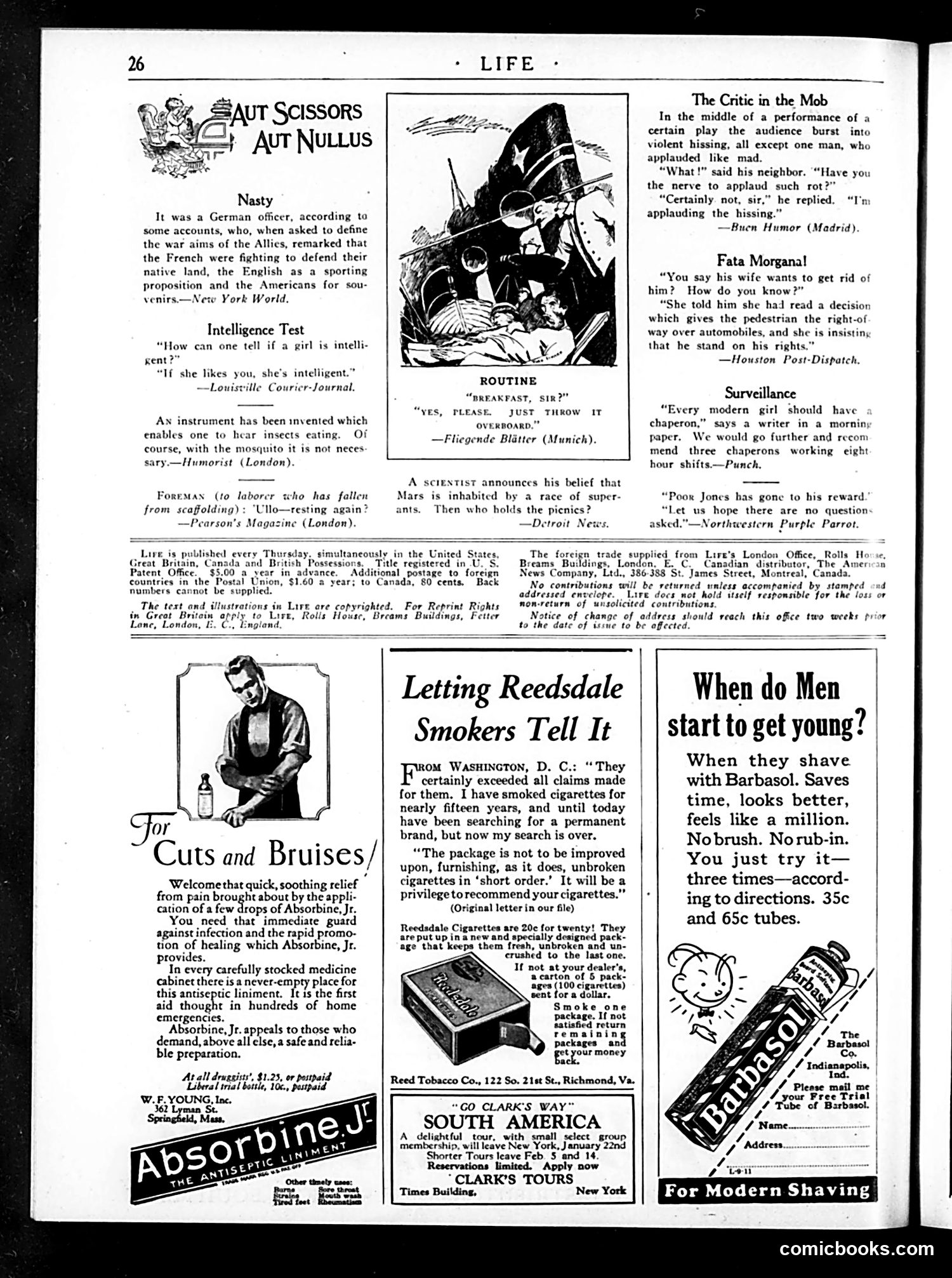
This page is primarily **advertising and humor columns** rather than political cartoons. The content consists of: **Humor Sections ("Aut Scissors, Aut Nullus"):** Short jokes reprinted from various international publications. Notable: a German officer's quip about Allied war aims—suggesting Americans fought WWI for "souvenirs" rather than noble causes. This reflects contemporary American skepticism about U.S. involvement in the Great War. **The Central Cartoon:** Titled "ROUTINE," it depicts a servant at breakfast offering to "just throw it overboard"—likely satirizing wartime rationing or food waste during WWI, presented as absurdist humor. **Remaining Content:** Mostly period advertisements (Absorbine liniment, Barbasol shaving cream, cigarettes, tours) with scattered joke items about topics like Mars, theater audiences, and marriages. **Historical Context:** This appears to be a WWI-era *Life* magazine, when the publication was primarily a humor and satire weekly, not the photo-journalism magazine it later became.
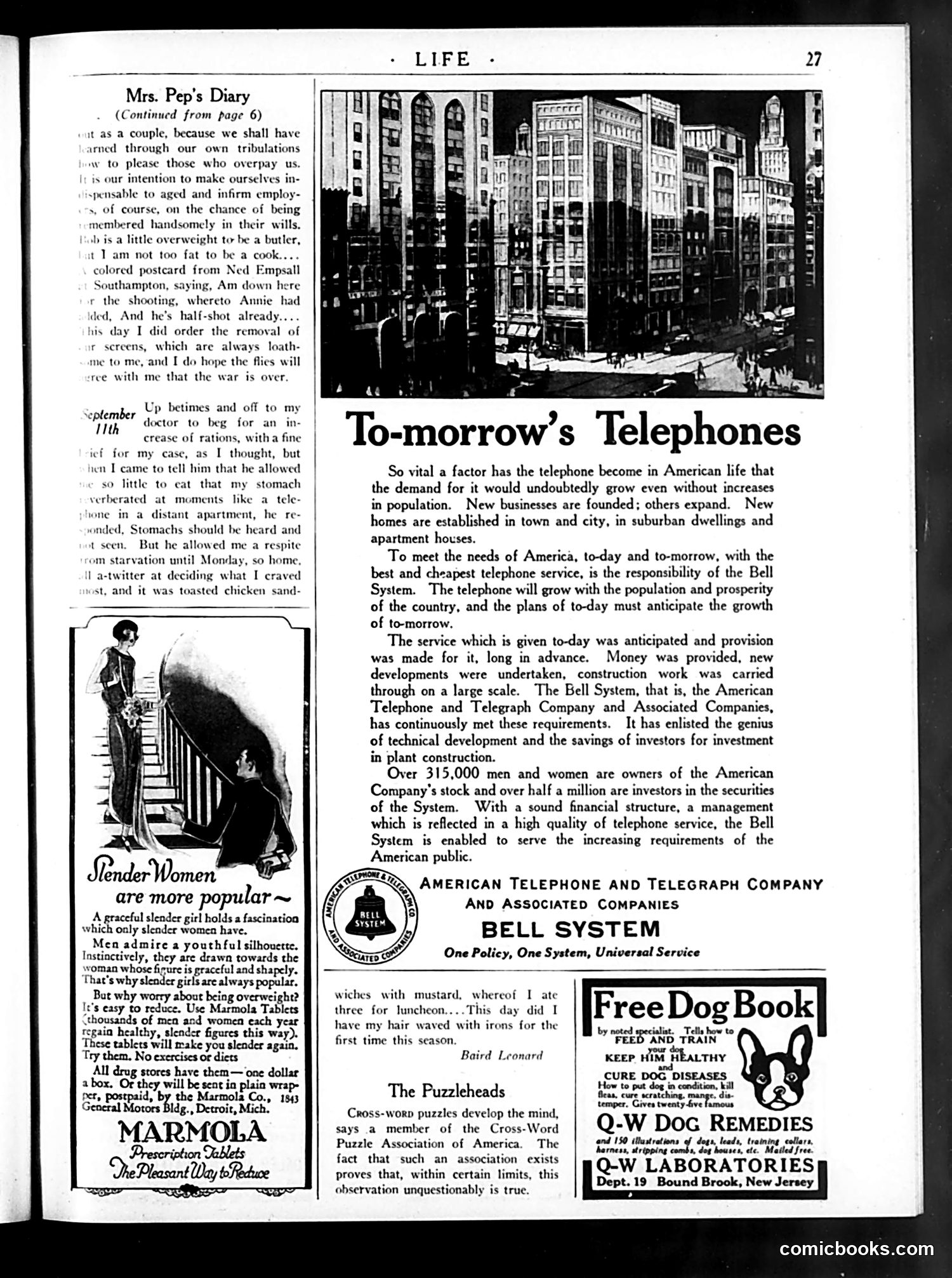
This page contains three main elements: **Mrs. Pep's Diary** (top left): A humorous serialized column depicting the mundane complaints and social observations of an upper-class British woman during what appears to be the post-WWI period. The tone is satirical—she discusses household staff incompetence, rationing ("so little to eat"), and casual references to shooting trips, mocking the pretensions and self-absorption of the wealthy leisure class. **"Slender Women Are More Popular"** (left): An advertisement for Marmola weight-loss tablets. The copy appeals to women's anxieties about attractiveness, claiming slenderness is essential to male approval. This represents period attitudes about female body standards and the aggressive marketing of dubious pharmaceutical remedies to women's insecurities. **"To-morrow's Telephones"** (right): A substantial Bell System corporate advertisement presenting the telephone company's infrastructure investments and stock ownership as patriotic American enterprise. It emphasizes the company's forward-thinking planning and financial soundness to investors and the public. The page reflects 1920s consumer culture, class dynamics, and corporate self-promotion.
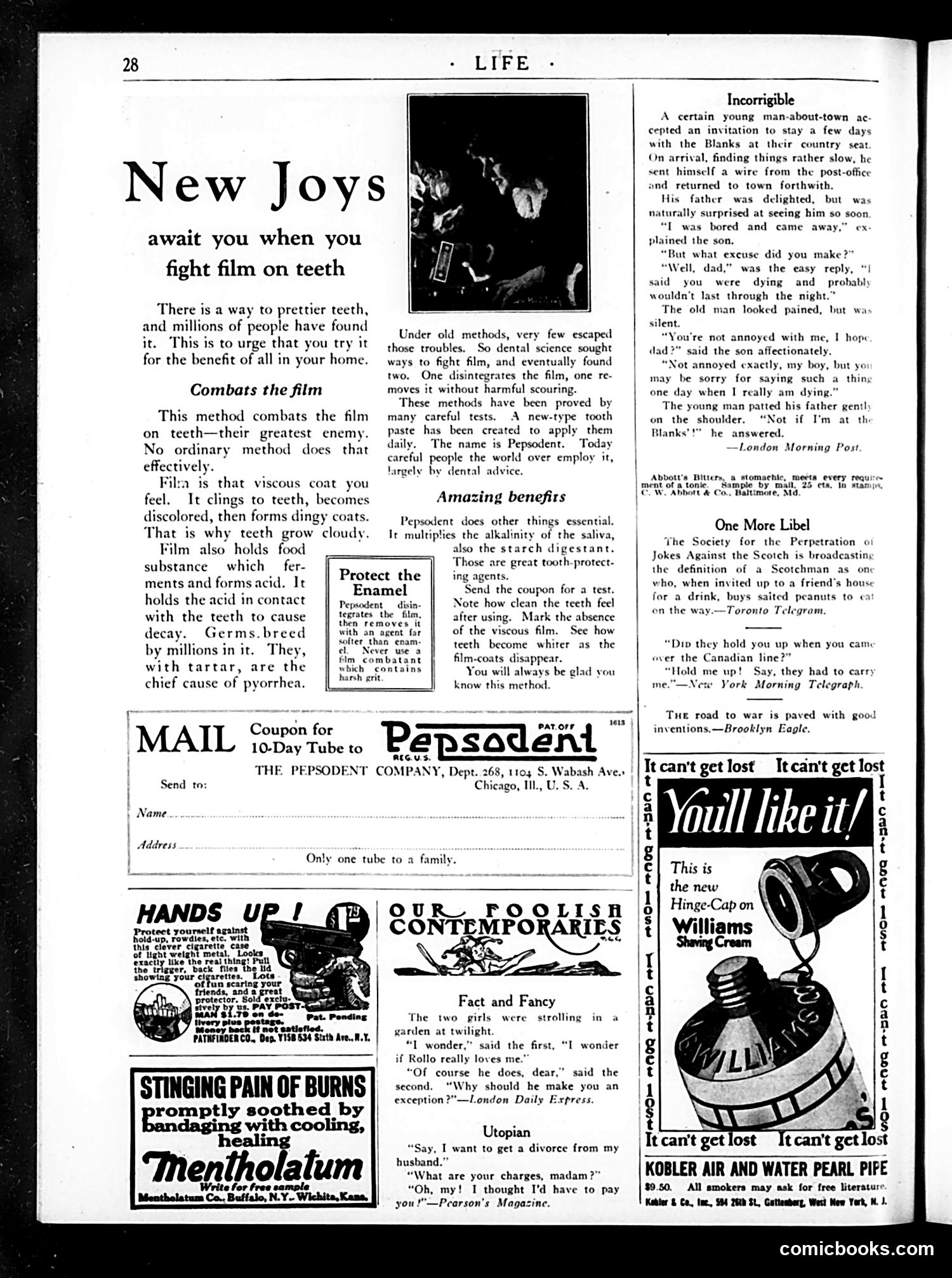
This page is primarily **advertising disguised as editorial content**. The dominant feature is a Pepsodent toothpaste advertisement presented as health advice about fighting "film" (plaque) on teeth. The ad uses pseudo-scientific language to promote the product's benefits, claiming it disintegrates film and whitens teeth—marketing tactics standard for early 20th-century patent medicine advertising. The page also contains brief humor pieces and jokes typical of *Life* magazine's satirical section, including anecdotes about social pretension ("Incorrigible" about a young man faking a family emergency to escape boredom) and romantic/marital comedy. The other advertisements (Williams Shaving Cream, Mentholatum, etc.) use similar fear-based messaging common to vintage advertising: emphasizing problems (burns, pain, poor hygiene) to sell solutions. The content reflects early 1900s consumer culture and advertising ethics before modern FDA regulations.
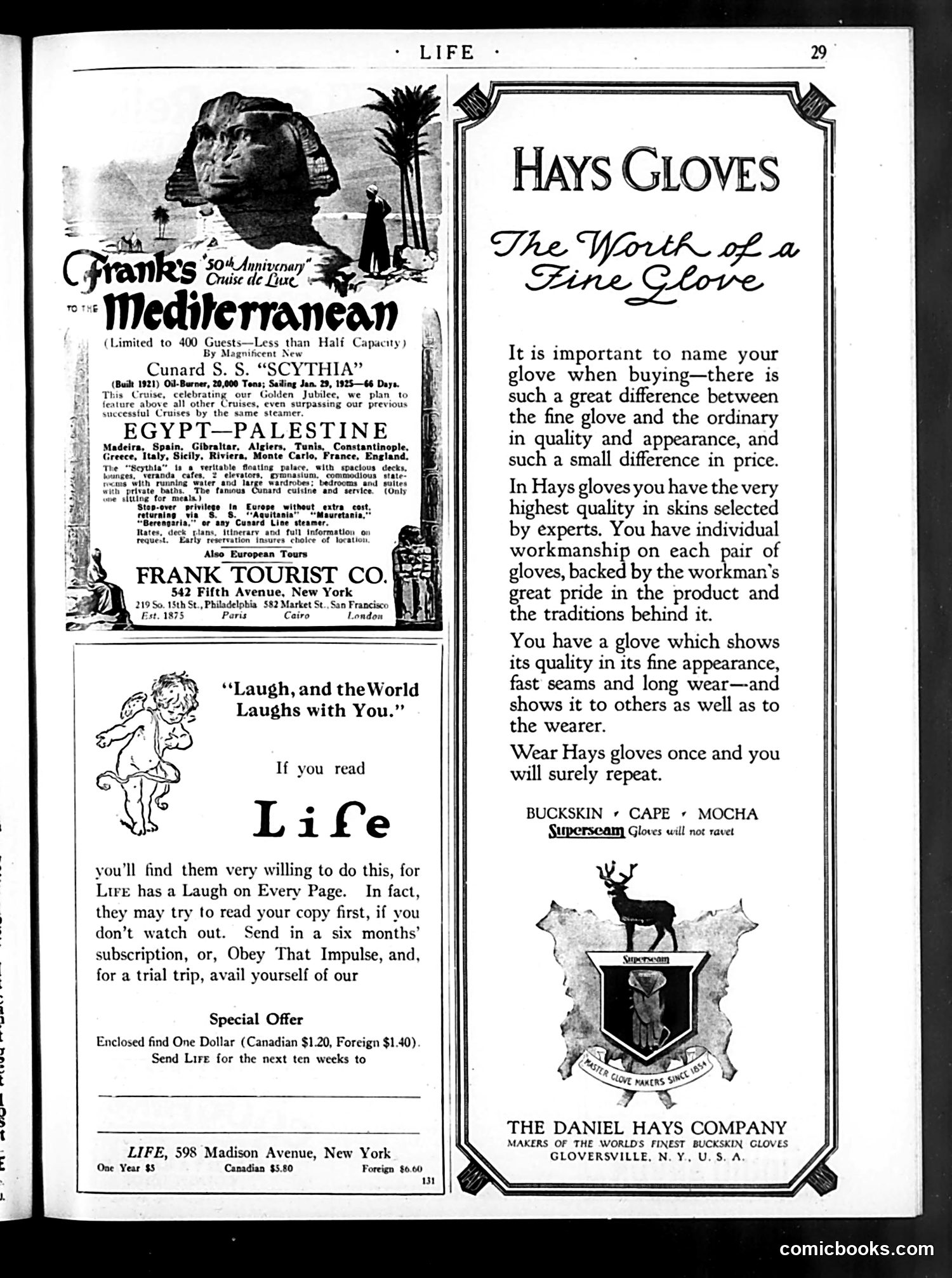
This page contains primarily **advertisements rather than satirical content**. The left side features a Frank Tourist Company cruise advertisement promoting a Mediterranean voyage on the Cunard S.S. "Scythia" visiting Egypt and Palestine, alongside a Life magazine subscription pitch using the slogan "Laugh, and the World Laughs with You." The right side advertises **Hays Gloves**, emphasizing quality craftsmanship and materials (buckskin, cape, mocha) with the tagline "Superseam Gloves will not ravel." The glove advertisement stresses that fine gloves justify their slightly higher price through superior workmanship and durability. The Sphinx image on the cruise ad references Egypt as a destination. There is no political satire or cartoon content visible; this is a straightforward advertising page typical of 1920s Life magazine, which combined humor with commercial content.
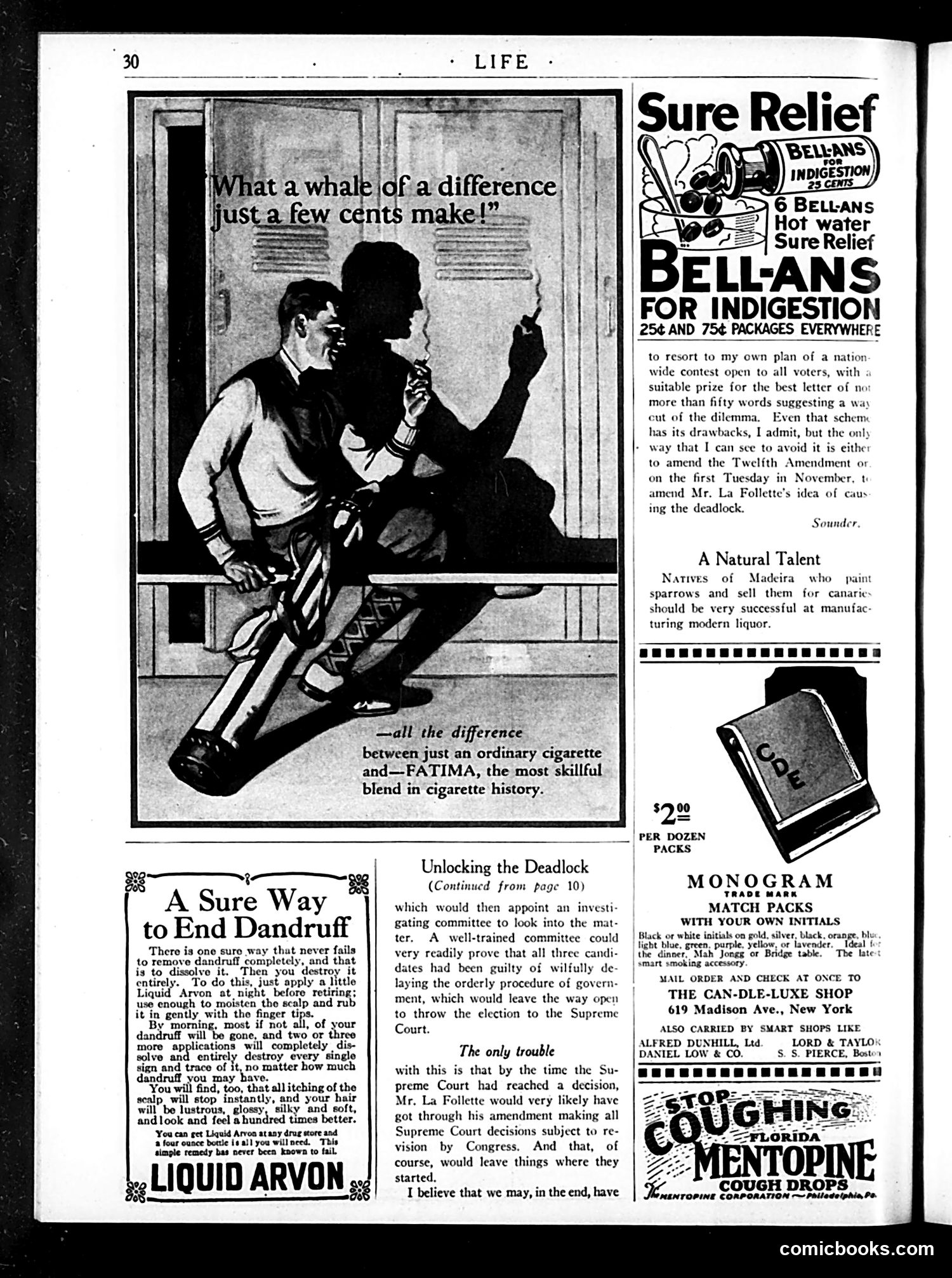
This page contains a political cartoon (main image, left) satirizing a constitutional crisis, likely from the 1924 presidential election involving Robert La Follette. The cartoon depicts two figures in what appears to be a deadlock situation, with the caption "What a whale of a difference just a few cents make" and references "all the difference between just an ordinary cigarette and—FATIMA." The accompanying article "Unlocking the Deadlock" (continued from page 10) discusses a constitutional problem: a presidential election where no candidate secured an Electoral College majority, potentially throwing the decision to the Supreme Court. The author proposes solutions but notes La Follette's proposed amendments to make Supreme Court decisions subject to Congressional revision would complicate matters further, leaving "things where they started." The cartoon uses the cigarette comparison as metaphor for how small changes (amendments) might seem significant but fail to resolve the fundamental deadlock. The page also contains period advertisements for patent medicines and consumer goods typical of 1920s Life magazine.
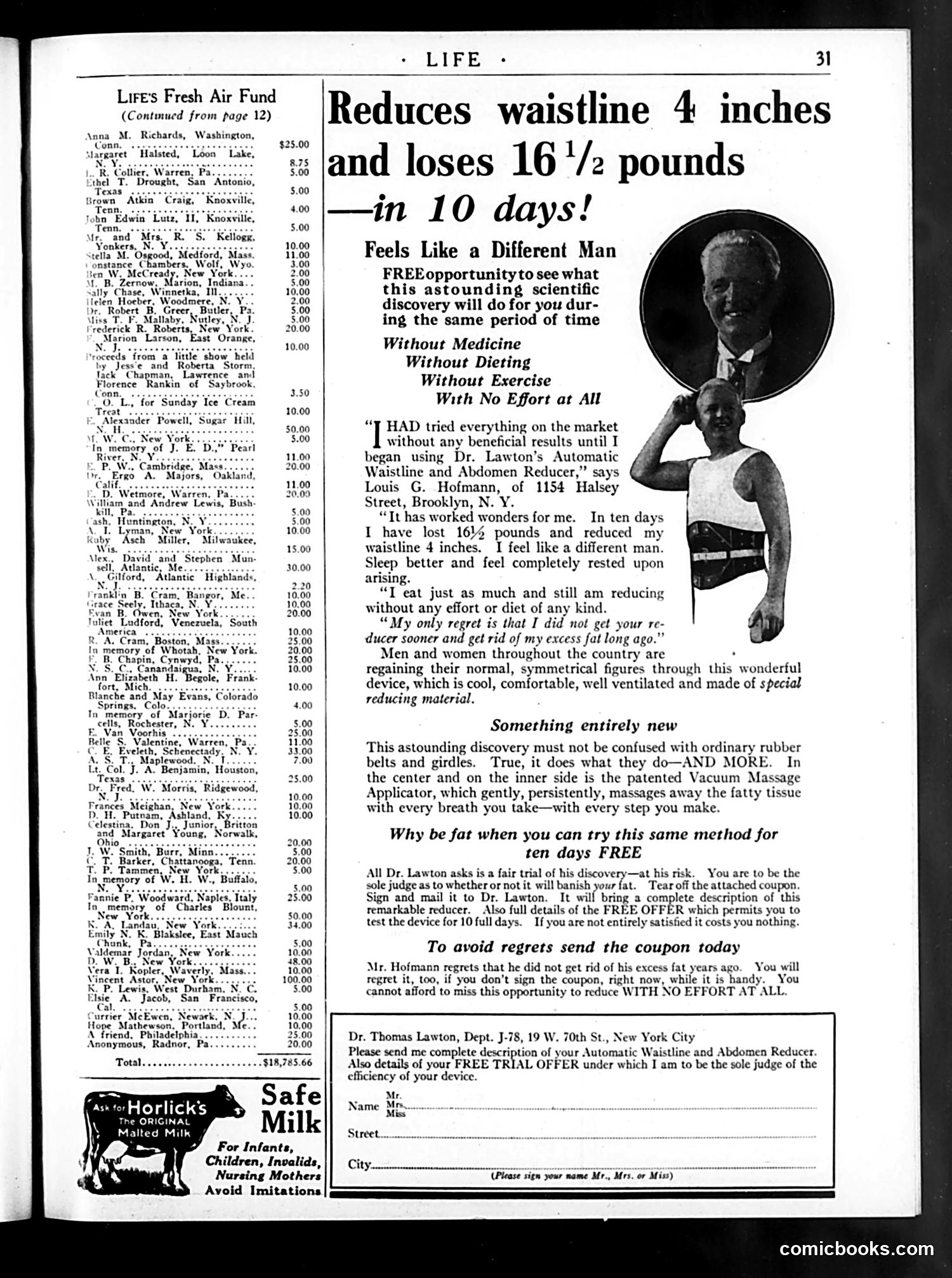
This page is primarily **advertising**, not satire or political commentary. It features a testimonial advertisement for "Dr. Lawton's Automatic Waistline and Abdomen Reducer"—a weight-loss device marketed in the early 20th century. The image shows a man (identified as Louis G. Hofmann of Brooklyn) demonstrating the device, claiming he lost 16½ pounds and 4 inches of waistline in 10 days without medicine, dieting, or exercise. The ad emphasizes the device uses a "Vacuum Massage Applicator" to massage away fat. The page also includes "Life's Fresh Air Fund"—a charitable listing of donations (visible on the left), which was a legitimate philanthropic feature of Life magazine during this era. **Context for modern readers**: This represents the long history of dubious weight-loss products sold through exaggerated testimonials and pseudoscientific claims—a practice that continues today, though now regulated more strictly.
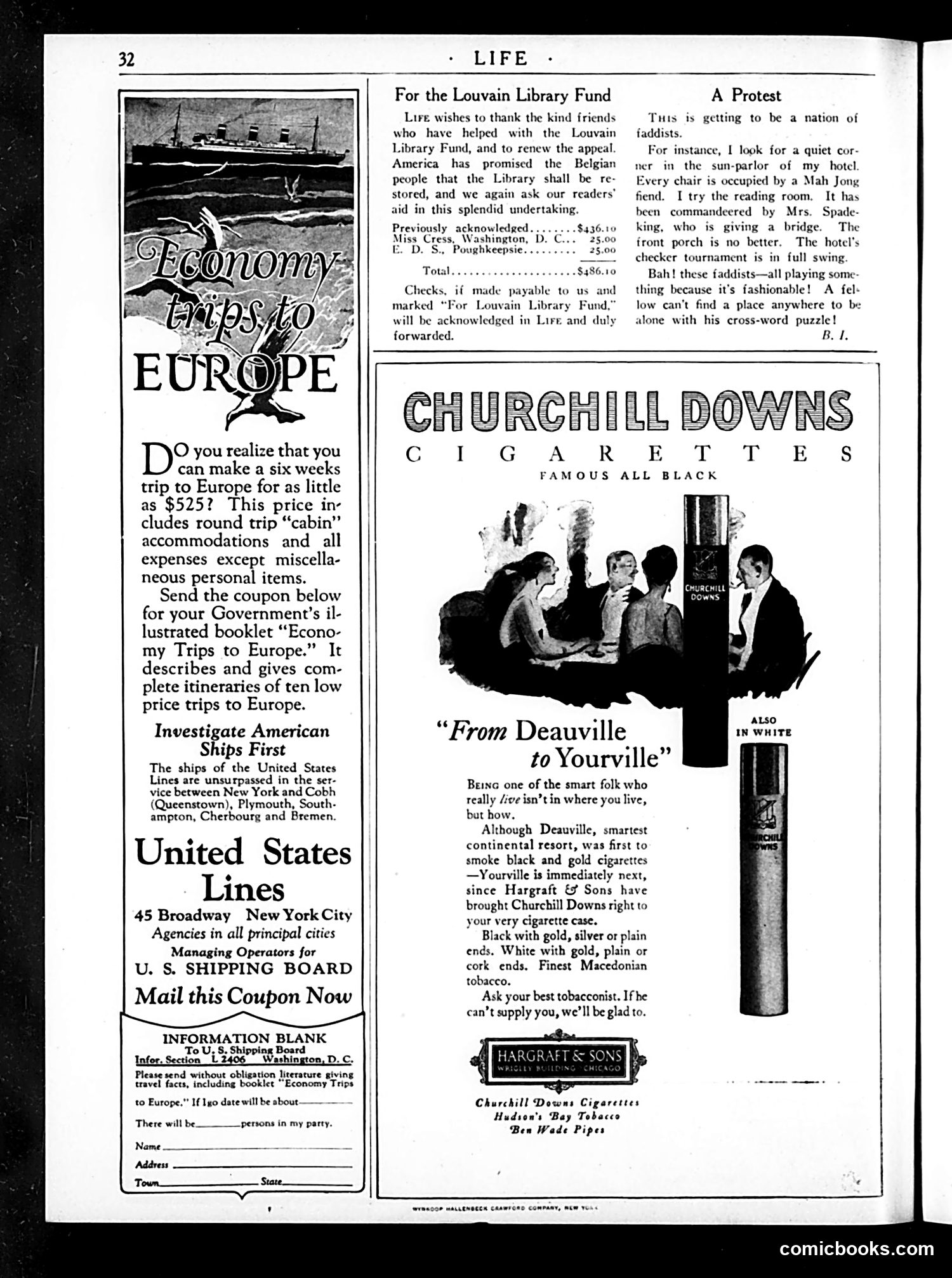
This page is primarily **advertising and notices** rather than political satire. The main content includes: - A **United States Lines ad** promoting affordable European travel ($525 for six weeks), likely from the 1920s post-WWI era when transatlantic tourism was expanding - A **fundraising notice** for the Louvain Library Fund, referencing Belgium's library damaged in World War I, showing America's postwar reconstruction commitments - A humorous **"Protest" column** satirizing 1920s faddism—complaining that hotels are overrun with Mah Jong players, bridge players, and checkers enthusiasts, leaving no quiet space for the writer's crossword puzzle - A **Churchill Downs cigarette advertisement** promoting "smart" smoking, with a social commentary that real sophistication comes from "how" you live, not "where" The satire targets shallow trendiness and status-seeking behavior typical of the Jazz Age, but this is lighthearted social observation rather than serious political critique.
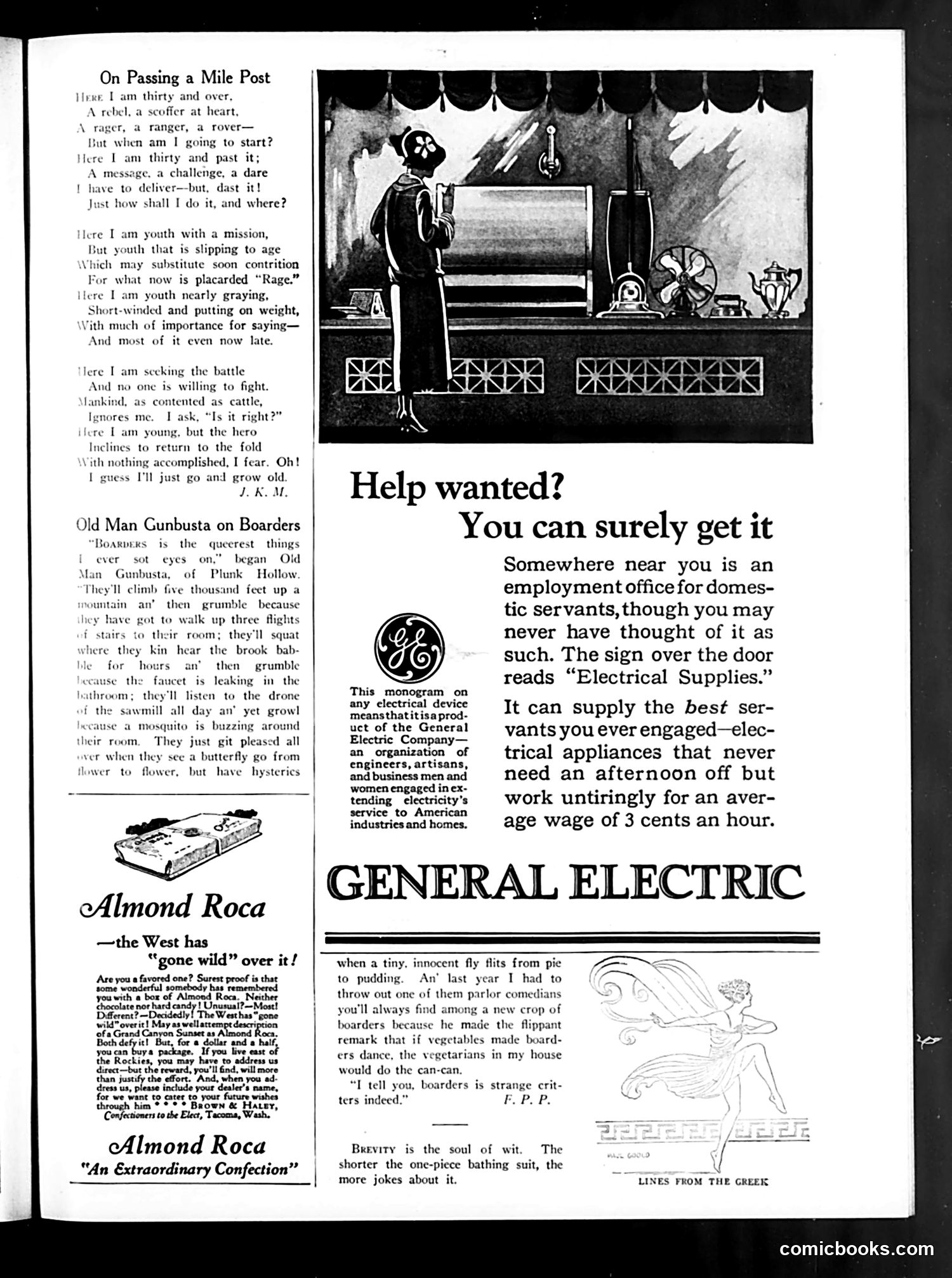
This page contains satirical poetry and advertising reflecting early 20th-century American anxieties. **"On Passing a Mile Post"** depicts a young man's existential crisis—he's over thirty, identifies as a rebellious "rover," yet remains paralyzed by indecision about his life's purpose. The repeated "Here I am" structure emphasizes his stagnation. He fantasizes about heroic action but confronts apathy from society ("Mankind, as contented as cattle"). The satire targets aimless youth clinging to romantic rebellion while accomplishing nothing, ultimately surrendering to aging. **"Old Man Gunbusta on Boarders"** humorously catalogs boarders' contradictions: they love natural beauty (butterflies, brooks) but complain about minor inconveniences (mosquitoes, leaky faucets). The joke mocks pretentious tourists or city folk visiting rural areas, finding them hypocritical and temperamental. **The General Electric advertisement** sarcastically reframes electrical appliances as "servants" working for 3 cents hourly—marketing automation as domestic labor replacement during an era of servant-hiring culture, suggesting modernity makes human help obsolete.
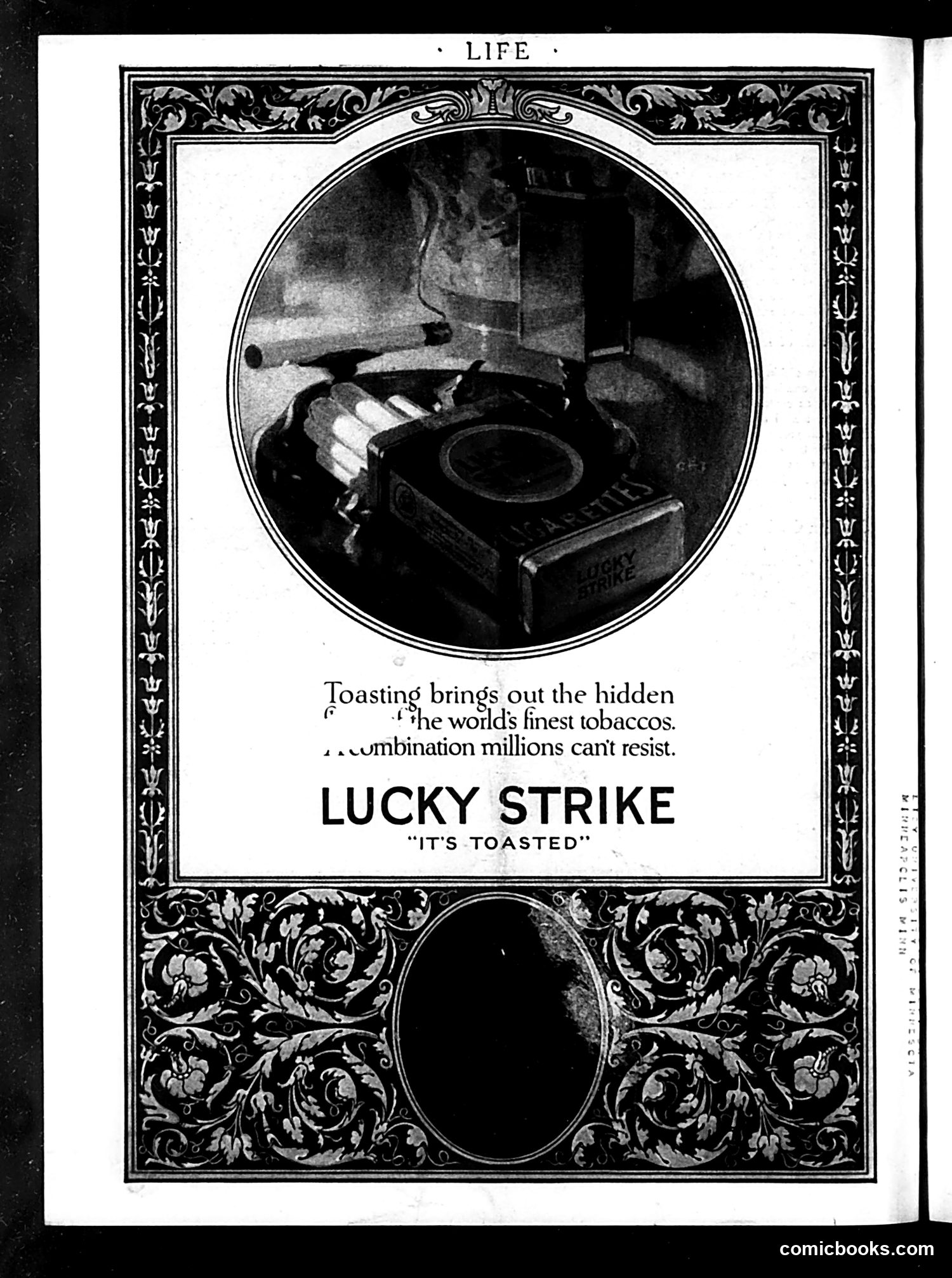
This is primarily a **cigarette advertisement**, not political satire. The page features Lucky Strike cigarettes, promoting their "It's Toasted" slogan—a genuine marketing claim from that era distinguishing their toasting process. The advertisement shows hands toasting tobacco over a flame, with text claiming this process brings out hidden qualities in "the world's finest tobaccos" and creates an irresistible combination. The ornate border and circular photographic frame were typical design elements of early 20th-century magazine advertising. This represents the pre-regulation era when cigarette ads appeared freely in mainstream publications like Life, before tobacco health warnings became mandatory. The "toasting" method was Lucky Strike's actual (if now-questionable) competitive advantage in marketing.