
Life, 1924-09-11 · page 24 of 36
Life — September 11, 1924 — page 24: what you’re looking at
What you’re looking at
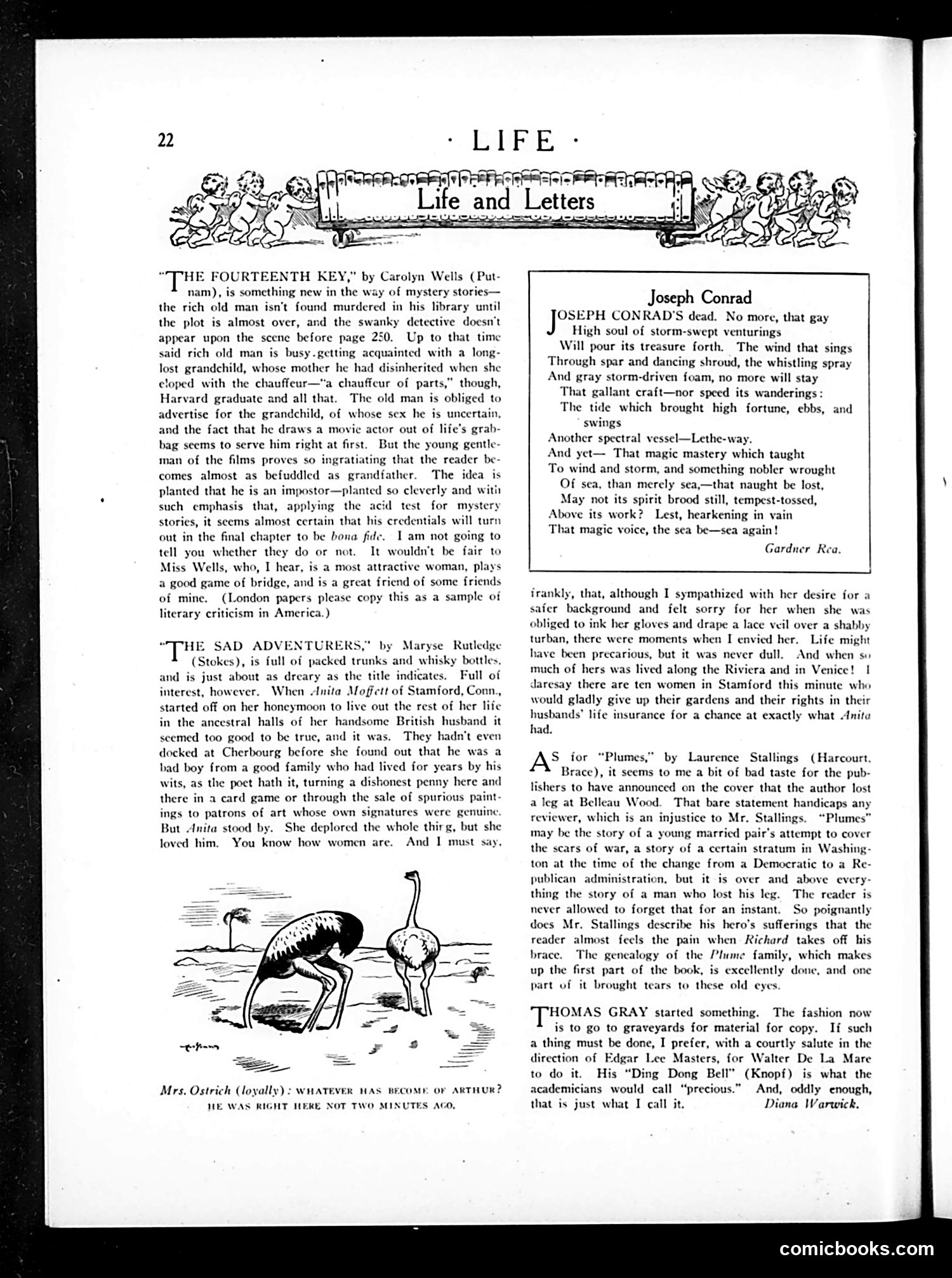
This page contains **book reviews and literary commentary** rather than political cartoons. The single illustration shows **two ostriches**, captioned with a domestic joke: "Mrs. Ostrich (loyally): Whatever has become of Arthur? He was right here not two minutes ago." The ostrich gag plays on the cliché that ostriches bury their heads in sand—here suggesting Mrs. Ostrich's obliviousness to her husband's whereabouts, a mild marital humor typical of 1920s magazines. The reviews discuss contemporary novels by Carolyn Wells, Maryse Rutledge, and Laurence Stallings. A tribute to **recently deceased author Joseph Conrad** appears in the right column, mourning "the high soul of storm-swept venturings" and his literary mastery of the sea. The page exemplifies Life's literary criticism feature—witty, gossipy commentary on popular fiction for educated readers.
📄 Transcribed text from this page (OCR, searchable)
Machine-transcribed from the original scan — historical spelling and the odd misread are preserved.
- LIFE he FERRER RR eT fe and Letters HE FOURTEENTH KEY,” by Carolyn Wells (Put- nam), is something new in the way of mystery stories— the rich old man isn’t found murdered in his library until the plot is almost over, and the swanky detective doesn’t appear upon the scene before page Up to that time said rich old man is busy.getting acquainted with a long- lost grandchild, whose mother he had disinherited when she eloped with the chauffeur—"“a chauffcur of parts,” though, H ‘d graduate and all that. The old man is obliged to advertise for the grandchild, of whose sex he is uncertain, and the fact that he draws a movie actor out of life's grab- bag seems to serve him right at first. But the young gentle- man of the films proves so ingratiating that the reader be: comes almost as befuddled as grandfather. The idea is planted that he is an impostor—planted so cleverly and witit such emphasis that, applying the acid test for mystery stories, it seems almost certain that his credentials will turn out in the final chapter to be bona fide. I am not going to tell you whether they do or not. It wouldn't be fair to Miss Wells, who, I hear, is a most attractive woman, plays a good game of bridge, and is a great friend of some friends of mine. (London papers please copy this as a sample of literary criticism in America.) HE SAD ADVENTURERS,” by Maryse Rutledge (Stokes), is full of packed trunks and whisky bottles, «1 is just about as dreary as the title indicates. Full of interest, however. When Anita Moffett of Stamford, Conn., started off on her honeymoon to live out the rest of her life in the ancestral halls of her handsome British husband it scemed too good to be true, and it was. They hadn't even docked at Cherbourg before she found out that he was a bad boy from a good family who had lived for years by his wits, as the poct hath it, turning a dishonest penny here and there in a card game or through the sale of spurious paint- ings to patrons of art whose own signatures were genuinc But Anita stood by. She deplored the whole thirg, but she loved him. You know how women are. And I must say, Mrs. Ostrich (loyally) : WHATEVER MAS BECOME OF ARTHUR? HE WAS RIGHT HERE NOT TWO MINUTES ACO, Joseph Conrad OSEPH CONRAD'S dead. No more, that ga High soul of storm-swept venturings Will pour its treasure forth. The wind that sings Through spar and dancing shroud, the whistling spray And gray storm-driven foam, no more will stay That gallant craft—nor speed its wanderings : The tide which brought high fortune, ebbs, and swings Another spectral vessel—Lethe-way. And yet— That magic mastery which taught To wind and storm, and something nobler wrought Of sea, than merely sea,—that naught be lost, May not its spirit brood still, tempest-tossed, Above its work? Lest, hearkening in vain That magic voice, the sea be—sea again! Gardner Rea. irankly, that, although I sympathized with her desire for a safer background and felt sorry for her when she was obliged to ink her gloves and drape a lace veil over a shabby turban, there were moments when I envied her. Life might have been precarious, but it was never dull. And when su much of hers was lived along the Riviera and in Venice! | daresay there are ten women in Stamford this minute who would gladly give up their gardens and their rights in their husbands’ life insurance for a chance at exactly what Anite had. AS i ” ” by Laurence Stallings (Harcourt. Brace), it seems to me a bit of bad taste for the pub- lishers to have announced on the cover that the author lost a leg at Belleau Wood. That bare statement handicaps any reviewer, which is an injustice to Mr. Stallings. “Plumes” be the story of a young married pair's attempt to cover the scars of war, a story of a certain stratum in Washing- ton at the time of the change from a Democratic to a Re- publican administration, but it is over and above every- thing the story of a man who lost his leg. The reader is never allowed to forget that for an instant. So poignantly does Mr. Stallings describe his hero's sufferings that the reader almost feels the pain when Richard takes off his brace. The genealogy of the Plume family, which makes up the first part of the book, is excellently dor part of it brought tears to these old eyes. and one HOMAS GRAY started something. The fashion now is to go to graveyards for material for copy. If such a thing must be done, I prefer, with a courtly salute in the direction of Edgar Lee Masters, for Walter De La Mare to do it. His “Ding Dong Bell” (Knopf) is what the academicians would call “precious.” And, oddly enough, that is just what I call it. Diana Warwick. comicbooks.com