
Life, 1924-09-11 · page 16 of 36
Life — September 11, 1924 — page 16: what you’re looking at
What you’re looking at
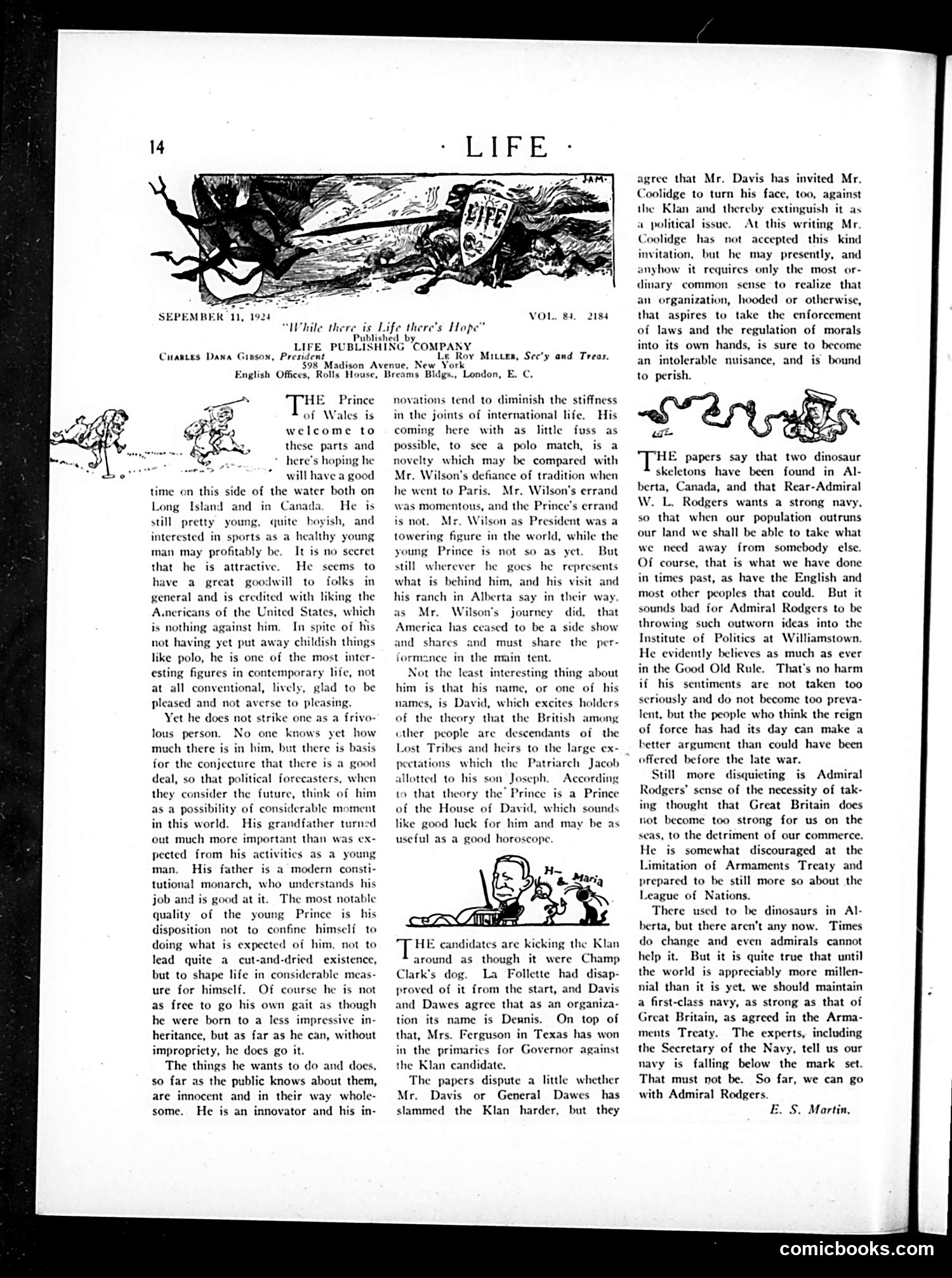
The main cartoon depicts **the Prince of Wales** (later Edward VIII) visiting North America. The text praises his informality and accessibility compared to his father, noting he "seems to have a goodwill to talk in general and is credible with liking the sovereign of the United States." The article discusses American politics, mentioning the **Ku Klux Klan** as a campaign issue. It references candidates "kicking the Klan around as though it were Champ Clark's dog," suggesting the KKK had become a contentious political topic in 1924 elections. The satirical tone criticizes political figures for exploiting the Klan issue while avoiding substantive engagement with it—treating serious matters frivolously during the campaign season.
📄 Transcribed text from this page (OCR, searchable)
Machine-transcribed from the original scan — historical spelling and the odd misread are preserved.
erg A ah SEPEMBER 11, 1924 “While the Pr LIFE PUB Cuartes Dana Ginson, President, 84. Y, COMPANY Le Roy Mitten, Sec’y and Treas. $98 Madison Avenue, New York English Offices, Rolls House, Breams Bldgs., London, E. C, HE Prince of Wales is welcome to these parts and here's hoping he will have a good time on this side of the water both on Long Island and in Can He is still, pretty interested in sports as a healthy young man may profitably be. It is no secret that he is attractive. He seems to have a great goodwill to folks in general and is credited with liking the A.nericans of the United States, which is nothing against him. In spite of his not having yet put away childish things like polo, he is one of the most inter- esting figures in contemporary life, not at all conventional, lively, glad to be pleased and not averse to pleasing. Yet he does not strike one as a frivo- lous person. No one knows yet how much there is in him, but there is basis for the conjecture that there is a good deal, so that political forecasters, when they consider the future, think of him as a possibility of considerable moment in this world. His grandfather turned out much more important than was ex- pected from his activities as a young man. His father is a modern cons' tutional monarch, who understands his job and is good at it. The most notable quality of the young Prince is his disposition not to confine himself to doing what is expected of him, not to lead quite a cut-and-dried existence, but to shape life in considerable ure for himself. Of course he is not as free to go his own gait as though he were born to a less impressive in- heritance, but as far as he can, without impropriety, he does go it. The things he wants to do and does, so far as the public knows about them, are innocent and in their way whole- some. He is an innovator and his in- young, quite boyish, and meas- novations tend to diminish the stiffness in the joints of international life. His coming here with as little fuss as possible, to sce a polo match, is a novelty which may be compared with Mr. Wilson’s defiance of tradition when he went to Paris. Mr. Wilson's errand was momentous, and the Prince's errand is not. Mr, Wilson as President was a towering figure in the world, while the young Prince is not so as yet. But still represents what is behind him, and his visit and his ranch in Alberta say in their . as Mr. Wilson's journey did, America has ceased to be a side show and must share the formance in the main tent. ot the least interesting thing about him is that his name, or one of his names, is David, which excites holders of the theory that the British among other people are descendants of the Lost Tribes and heirs to the large ex- pectations which the Patriarch Jacob lotted to his son Joseph. Ac to that theory the’ Prince is a Prince of the House of David, which sounds like good luck for him and may be as useful as a good horoscope wherever he gocs he that shares and per- ording HE candidates are kicking the Klan around as though it were Champ Clark's dog. La Follette had disap- proved of it from the start, and Davis and Dawes agree that as an organiza- tion its name is Dennis. On top of that, Mrs. Ferguson in Texas has won in the primaries for Governor against the Klan candidate. The papers dispute a little whether Mr. Davis or General Dawes has slammed the Klan harder, but they agree that Mr. Davis has invited Mr. Coolidge to turn his face, too, against the Klan and thereby extinguish it as a political issue, At this writing Mr. Coolidge has not accepted this kind invitation, but he may presently, and anyhow it requires only the most or- dinary common sense to realize that an organization, hooded or otherwise, that aspires to take the enforcement of laws and the regulation of morals into its own hands, is sure to become an intolerable nuisance, and is bound to perish. HE papers say that two dinosaur skeletons have been found in Al- berta, Canada, and that Rear-Admiral W. L. Rodgers wants a strong navy. so that when our population outruns our land we shall be able to take what we need away from somebody else. Of course, that is what we have done in times past, as have the English and most other peoples that could. But it sounds bad for Admiral Rodgers to be throwing such outworn ideas into the Institute of Politics at Williamstown. He evidently believes as much as ever in the Good Old Rule. That's no harm if his sentiments are not taken too scriously and do not become too preva- lent, but the people who think the reign of force has had its day can make a better argument than could have been offered before the late war. Still, more disquieting is Admiral Rodgers’ sense of the necessity of tak- ing thought that Great Britain does not become too strong for us on the s, to the detriment of our commerce. He is somewhat discouraged at the Limitation of Armaments Treaty and prepared to be still more so about the League of Nations. There used to be dinosaurs in Al- berta, but there aren’t any now. Times do change and even admirals cannot help it. But it is quite true that until the world is appreciably more millen- nial than it is yet, we should maintain a first-class navy, as strong as that of Great Britain, as agreed in the Arma- ments Treaty. The experts, including the Secretary of the Navy, tell us our navy is falling below the mark set. That must not be. So far, we can go with Admiral Rodgers. E comicbooks.com