
Life, 1924-09-11 · page 20 of 36
Life — September 11, 1924 — page 20: what you’re looking at
What you’re looking at
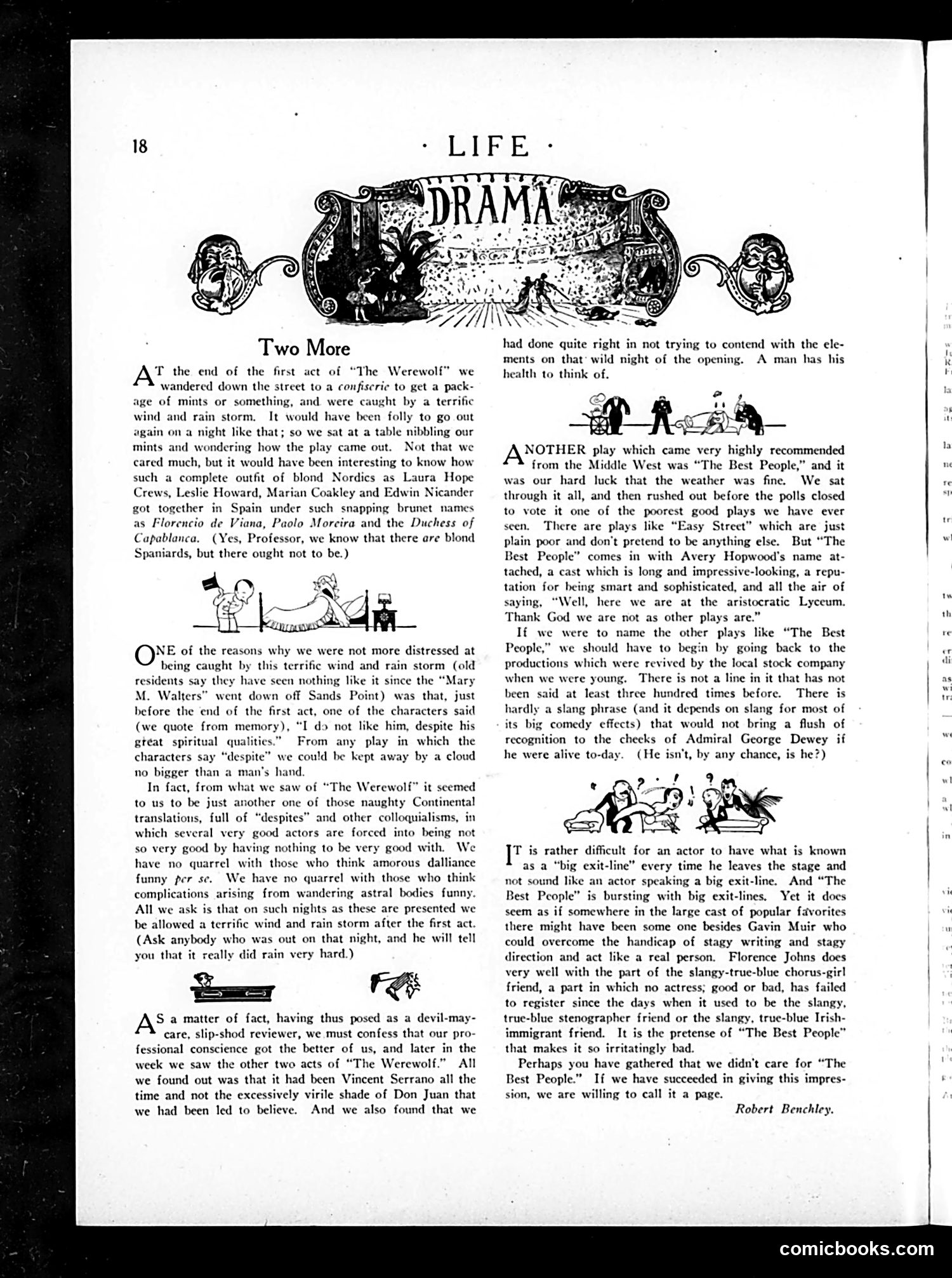
This is a theater review column critiquing two Broadway plays. The reviewer discusses "The Werewolf," a Continental translation featuring notably blonde actors (Leslie Howard, Laura Hope Crews) cast as Spanish characters with names like "Florencio de Viana"—the satire being that such casting is absurdly unconvincing. The critic mockingly notes that characters use stilted dialogue like "despite his great spiritual qualities," representing the awkward translation conventions that plague such imports. The second review targets "The Best People," an Avery Hopwood comedy. The reviewer dismisses it as derivative and tired, claiming it contains no original material—every joke and slang phrase has been recycled from stock company productions decades earlier. The reference to Admiral Dewey suggests even someone from that earlier era would recognize the worn-out material. The satire critiques plays masquerading as sophisticated while delivering nothing fresh.
📄 Transcribed text from this page (OCR, searchable)
Machine-transcribed from the original scan — historical spelling and the odd misread are preserved.
T the end of the first act of “The Werewolf” we wandered down the street to a confiserie to get a pack- age of mints or something, and were caught by a terrific wind and rain storm. It would have been folly to go out again on a night like that; so we sat at a table nibbling our mints and wondering how the play came out. Not that we cared much, but it would have been interesting to know how such a complete outfit of blond Nordics as Laura Hope Crews, Leslie Howard, Marian Coakley and Edwin Nicander got together in Spain under such snapping brunet names as Florencio de Viana, Paolo Morcira and the Duchess of Capablanca, (Yes, Professor, we know that there are blond Spaniards, but there ought not to be.) NE of the reasons why we were not more distressed at being caught by this terrific wind and rain storm (old residents say they have seen nothing like it since the “Mary M. Walters” went down off Sands Point) was that, just before the end of the first act, one of the characters said (we quote from memory), “I do not like him, despite his great spiritual qualities.” From any play in which the characters say “despite” we could be kept away by a cloud no bigger than a man’s hand. In fact, from what we saw of “The Werewolf” it scemed to us to be just another one of those naughty Continental translations, full of “despites” and other colloquialisms, in which several very good actors are forced into being not so very good by having nothing to be very good with. We have no quarrel with those who think amorous dalliance funny per se. We have no quarrel with those who think complications arising from wandering astral bodies funny. All we ask is that on such nights as these are presented we be allowed a terrific wind and rain storm after the first act. (Ask anybody who was out on that night, and he will tell you that it really did rain very hard.) Saar —sd S a matter of fact, having thus posed as a devil-may- care, slip-shod reviewer, we must confess that our pro- fessional conscience got the better of us, and later in the week we saw the other two acts of “The Werewolf.” All we found out was that it had been Vincent Serrano all the time and not the excessively virile shade of Don Juan that we had been led to believe. And we also found that we had done quite right in not trying to contend with the ele- ments on that’ wild night of the opening. A man has his health to think of. ANOTHER play which came very highly recommended from the Middle West was “The Best People,” and it was our hard luck that the weather was fine. We sat through it all, and then rushed out before the polls closed to vote it one of the poorest good plays we have ever seen. There are plays like “Easy Street” which are just plain poor and don’t pretend to be anything else. But “The Best People” comes in with Avery Hopwood’s name at- tached, a cast which is long and impressive-looking, a repu- tation for being smart and sophisticated, and all the air of saying, “Well, here we are at the aristocratic Lyceum. Thank God we are not as other plays are.” If we were to name the other plays like “The Best People,” we should have to begin by going back to the productions which were revived by the local stock company when we were young. There is not a line in it that has not been said at least three hundred times before. There is hardly a slang phrase (and it depends on slang for most of its big comedy effects) that would not bring a flush of recognition to the checks of Admiral George Dewey if he were alive to-day. (He isn't, by any chance, is he?) £ 5 o T is rather difficult for an actor to have what is known as a “big exit-line” every time he leaves the stage and not sound like an actor speaking a big exit-line. And “The Best People” is bursting with big exit-lines. Yet it does seem as if somewhere in the large cast of popular favorites there might have been some one besides Gavin Muir who could overcome the handicap of stagy writing and stagy direction and act like a real person. Florence Johns does very well with the part of the slangy-true-blue chorus-girl friend, a part in which no actress; good or bad, has fai to register since the days when it used to be the slangy, true-blue stenographer friend or the slangy, true-blue Irish- immigrant friend. It is the pretense of “The Best People” that makes it so irritatingly bad. Perhaps you have gathered that we didn't care for “The Best People.” If we have succeeded in giving this impres- sion, we are willing to call it a page. Robert Benchley. comicbooks.com