
Life, 1924-09-11 · page 26 of 36
Life — September 11, 1924 — page 26: what you’re looking at
What you’re looking at
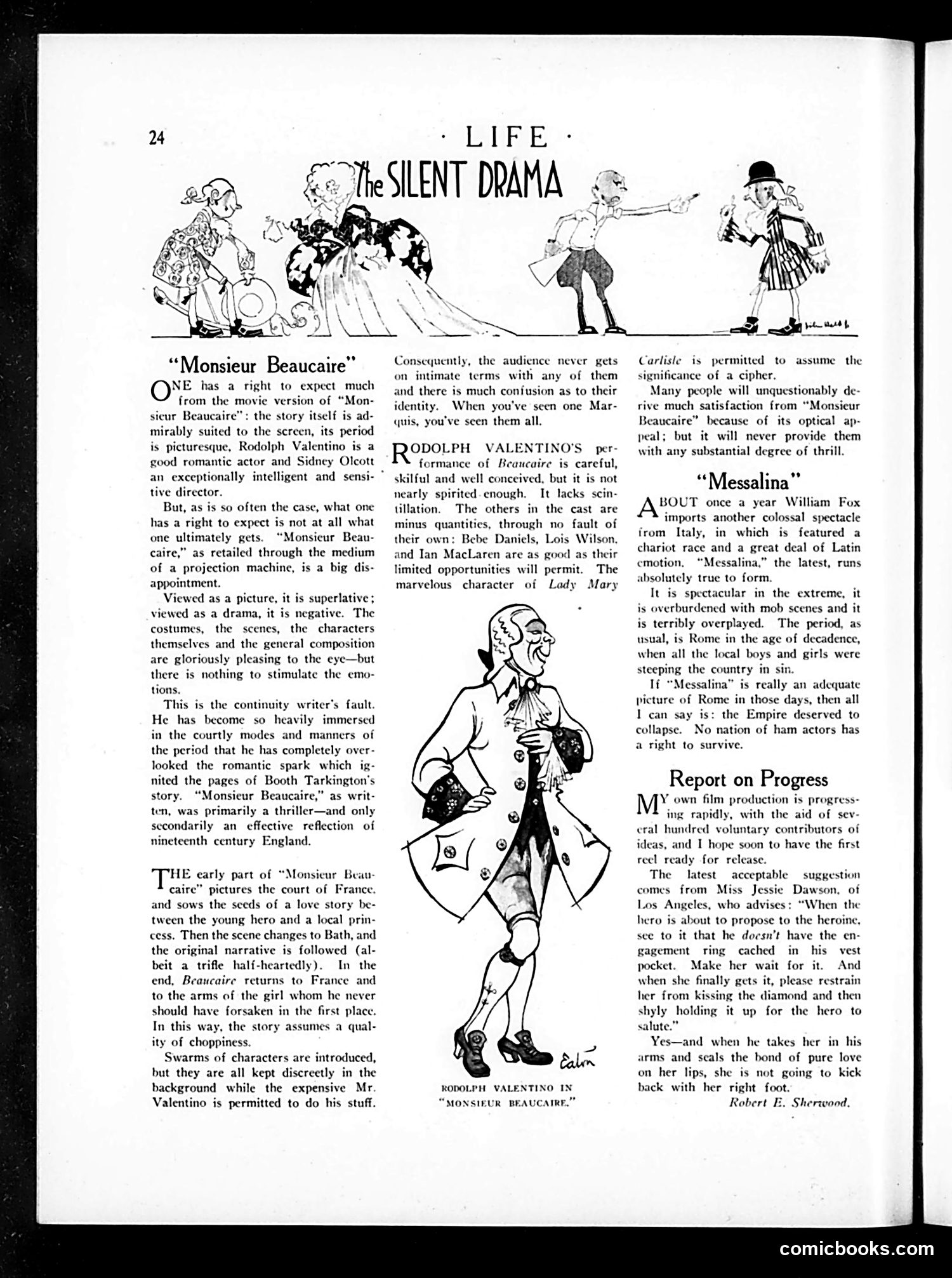
This page contains two film reviews from Life's cinema column. The main review critiques **"Monsieur Beaucaire,"** a Rodolph Valentino vehicle adapted from Booth Tarkington's novel. The reviewer praises its visual aesthetics and period costumes but condemns the screenplay for losing the original story's romantic tension. Valentino himself is criticized as technically competent but lacking "scintillation"—the spark needed for drama. Supporting actors like Bebe Daniels are reduced to background players. A second brief review mocks **"Messalina,"** a William Fox import from Italy depicting decadent Rome. The reviewer uses biting satire, suggesting the film's "ham actors" performing historical excess so unconvincingly that if Rome actually resembled this depiction, "the Empire deserved to collapse." The cartoonish illustration at top depicts typical silent-film characters in period costume. The satire targets how spectacle and star power can overwhelm storytelling—a recurring complaint about early cinema.
📄 Transcribed text from this page (OCR, searchable)
Machine-transcribed from the original scan — historical spelling and the odd misread are preserved.
+ STARE, * . see “Monsieur Beaucaire NE has a right to expect much from the movie version of “Mon- sieur Beaucair he story itself is ad- mirably suited to the screen, its period is picturesque, Rodolph Valentino is a good romantic actor and Sidney Olcott an exceptionally intelligent and sensi- tive director. But, as is so often the case, what one has a right to expect is not at all what one ultimately gets. “Monsieur Beau- caire,” as retailed through the medium of a projection machine, is a big dis- appointment. Viewed as a picture, it is superlative; viewed as a drama, it is negative. The costumes, the scenes, the characters themselves and the general composition are gloriously pleasing to the eye—but there is nothing to stimulate the emo- tions, This is the continuity writer's fault. He has become so heavily immersed in the courtly modes and manners of the period that he has completely over- looked the romantic spark which ig- nited the pages of Booth Tarkington's story. “Monsieur Beaucaire,” as writ- ten, was primarily a thriller—and only secondarily an effective reflection of nineteenth century England. HE early part of “Monsieur Beau- caire” pictures the court of France. and sows the seeds of a love story be- tween the young hero and a local prin- cess. Then the scene changes to Bath, and the original narrative is followed (al- beit a trifle half-heartedly). In the end, Beaucaire returns to France and to the arms of the girl whom he never should have forsaken in the first place. In this way, the story assumes a qual- ity of choppiness. Swarms of characters are introduced, but they are all kept discreetly in the background while the expensive Mr. Valentino is permitted to do his stuff. Consequently, the audience never gets on intimate terms with any of them and there is much coniusion as to their identity. When you've seen one Mar- quis, you've scen them all. ODOLPH VALENTINO’S | per- formance of Beaucaire is careful, skilful and well conceived, but it is not nearly spirited-enough. It lacks scin- tillation. The others in the cast are minus quantities, through no fault of their own: Bebe Daniels, Lois Wilson, and Ian MacLaren are as good as their limited opportunities will permit. The marvelous character of Lady Mary PH VALENTINO IN “MONSIEUR BEAUCAIR! Carlisle is permitted to assume the significance of a cipher. Many people will unquestionably de- rive much satisfaction from “Monsieur Beaucaire” because of its optical ap- peal; but it will never provide them with any substantial degree of thrill. “Messalina” BOUT once a year William Fox imports another colossal spectacle from Italy, in which featured a chariot race and a great deal of Latin emotion, “Messalina,” the latest, runs absolutely true to form. It is spectacular in the extreme, it is overburdened with mob scenes and it is terribly overplayed. The period, as usual, is Rome in the age of decadence, when all the local boys and girls were steeping the country in sin. If “Messalina” is really an adequate picture of Rome in those days, then all I can say is: the Empire deserved to collapse. No nation of ham actors has a right to survive. Report on Progress Y own film production is progress- ing rapidly, with the aid of sev- eral hundred voluntary contributors of ideas, and I hope soon to have the first reel ready for release. The latest acceptable suggestion comes from Miss Jessie Dawson, of Los Angeles, who advises: “When the hero is about to propose to the heroine, ve to it that he docsn’t have the en- gagement ring cached in his vest pocket. Make her wait for it. And when she finally gets it, please restrain her from kissing the diamond and then shyly holding it up for the hero to salute.” Yes—and when he takes her in his arms and scals the bond of pure love on her lips, she is not going to kick back with her right foot. Robert Sherwood. comicbooks.com