
A complete issue · 36 pages · 1924
Life — May 22, 1924
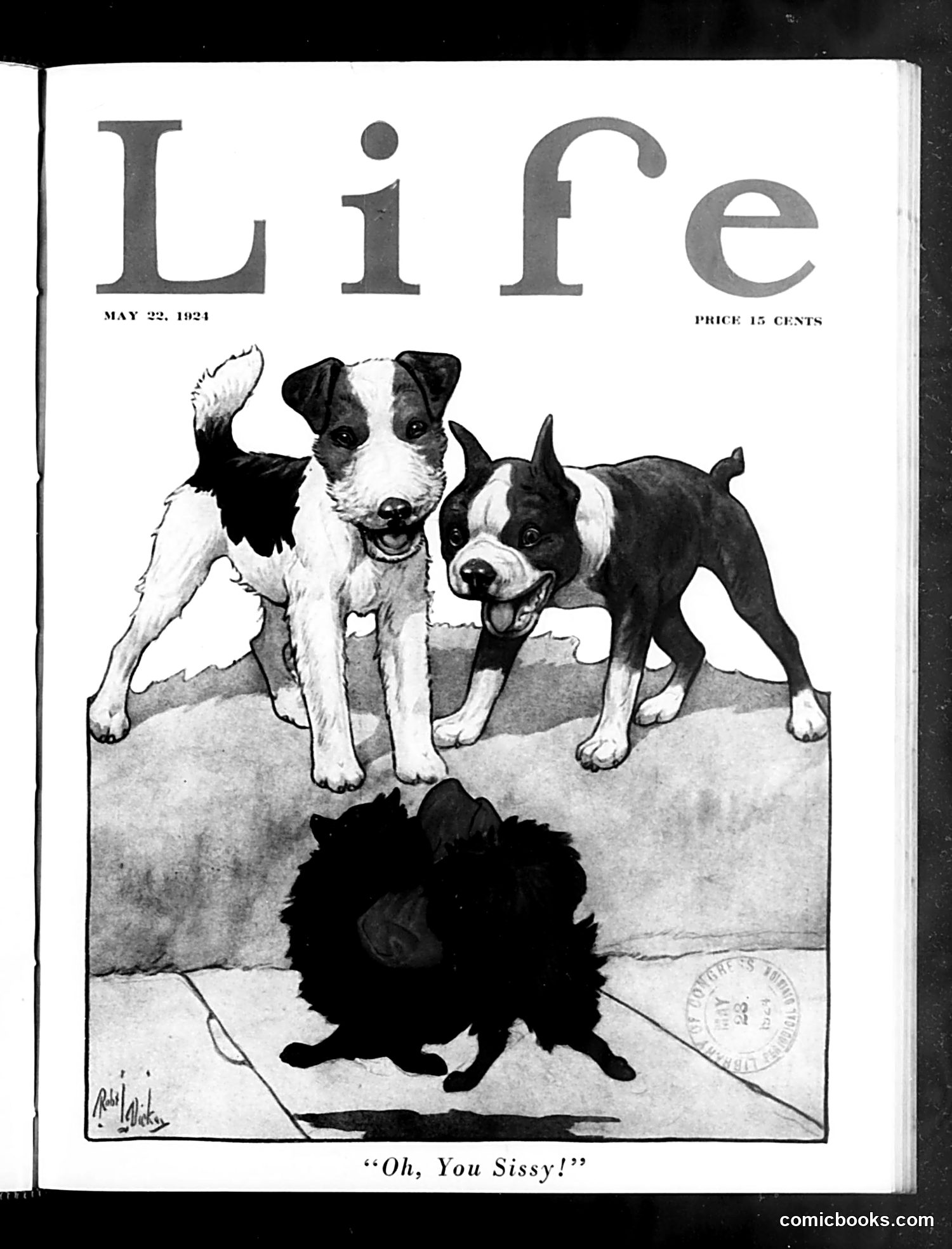
This cover depicts three dogs on what appears to be a couch or furniture, with the caption "Oh, You Sissy!" The illustration likely satirizes fashionable urban social behavior of the 1920s—specifically how pampered, well-bred dogs were treated as status symbols and fashion accessories by wealthy socialites. The "sissy" reference suggests mockery of the feminized, coddled treatment these lap dogs received. The two standing dogs appear to be observing or reacting judgmentally to the smaller black dog, implying commentary on breed pretension or social class distinctions among pet owners. This reflects early 1920s anxieties about changing gender roles and consumer culture during the Jazz Age, when "sissy" was commonly used as derisive slang for perceived weakness or excessive refinement.
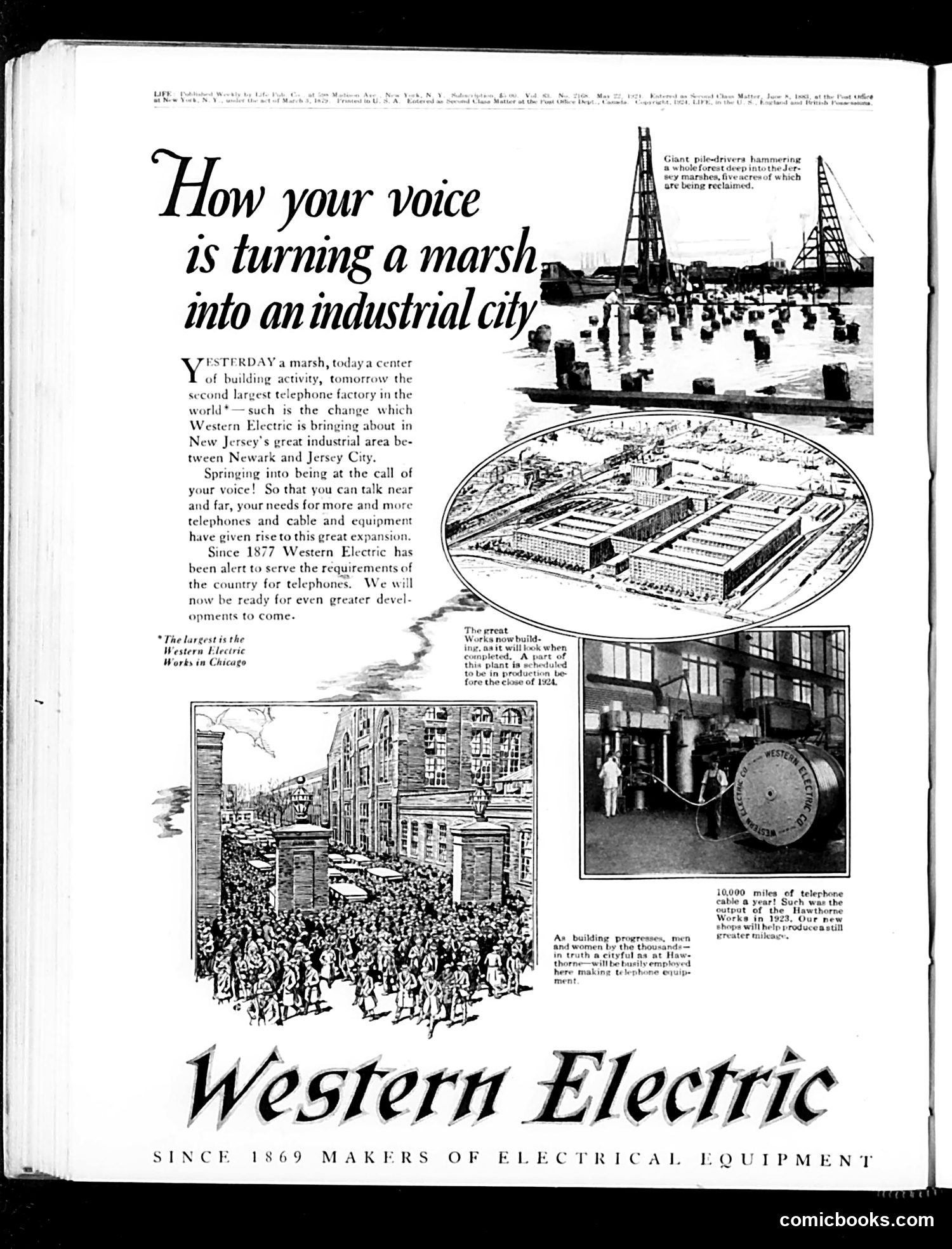
This is **primarily an advertisement**, not satirical content. Western Electric is promoting its expansion into New Jersey, specifically the construction of a major telephone equipment factory between Newark and Jersey City. The page uses dramatic imagery to emphasize industrial growth: marshland being developed, construction sites, manufacturing facilities, and crowds of workers. The headline "How your voice is turning a marsh into an industrial city" frames infrastructure development as progress enabled by telephone technology. The ad appeals to civic pride and technological optimism—common themes in 1920s-30s corporate messaging. There's no political satire here; rather, it's earnest promotion of Western Electric's role in modernizing American industrial capacity and connecting the nation through telecommunications infrastructure.
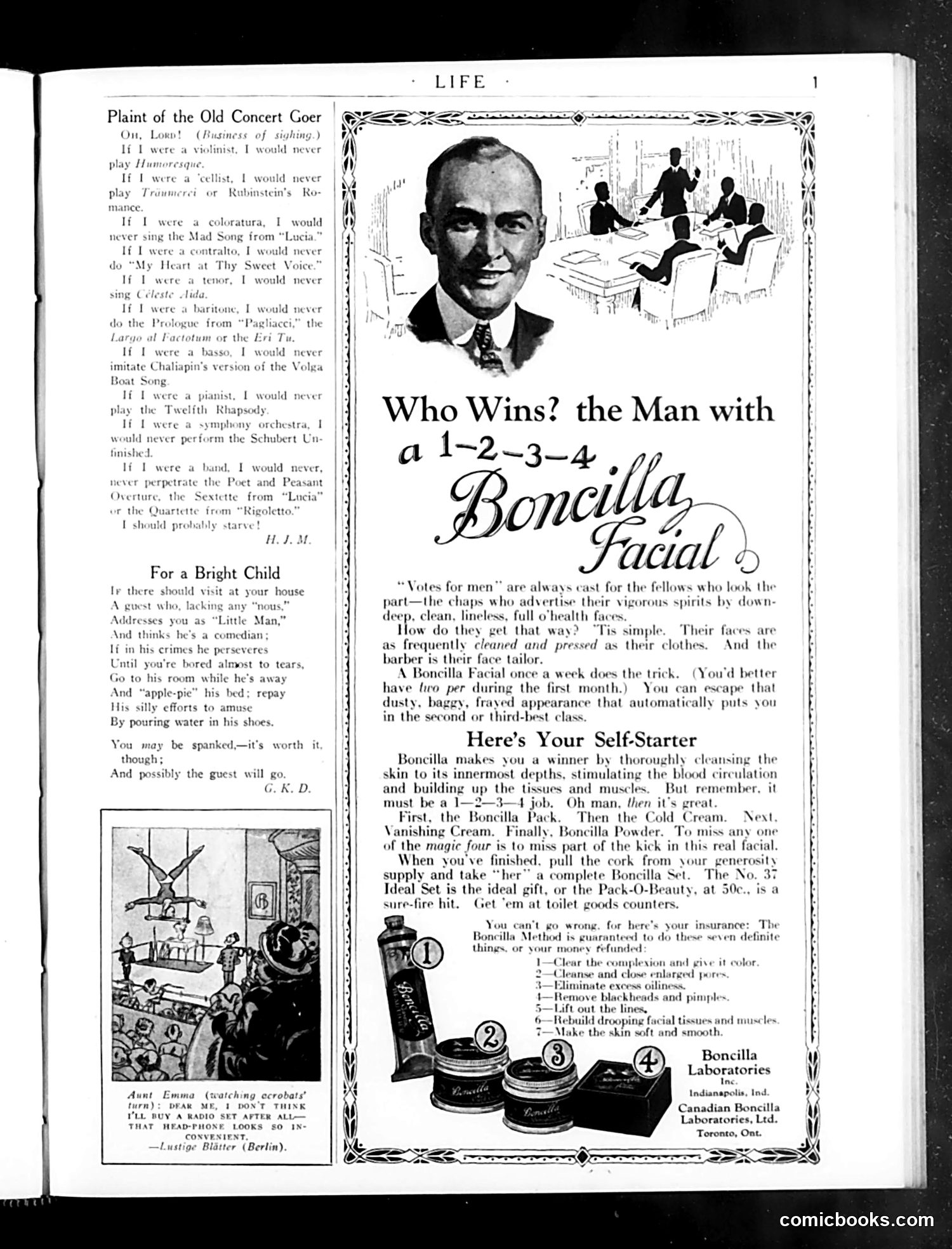
This page is primarily **advertising**, not political satire. The main content is a Boncilla Facial advertisement occupying the right half, promoting a skincare routine with numbered steps (cleanser, cold cream, vanishing cream, powder). The left side contains unrelated satirical poems: "Plaint of the Old Concert Goer" mocks someone complaining about modern musical performances, and "For a Bright Child" humorously depicts an annoying guest child. A small cartoon below shows "Aunt Emma" operating a headphone device, captioned as an inconvenient contraption. The Boncilla ad's headline—"Who Wins? the Man with a 1-2-3-4 Boncilla Facial"—uses competitive masculine language typical of 1920s advertising, suggesting skincare as a "winning" strategy for men's appearance and success.
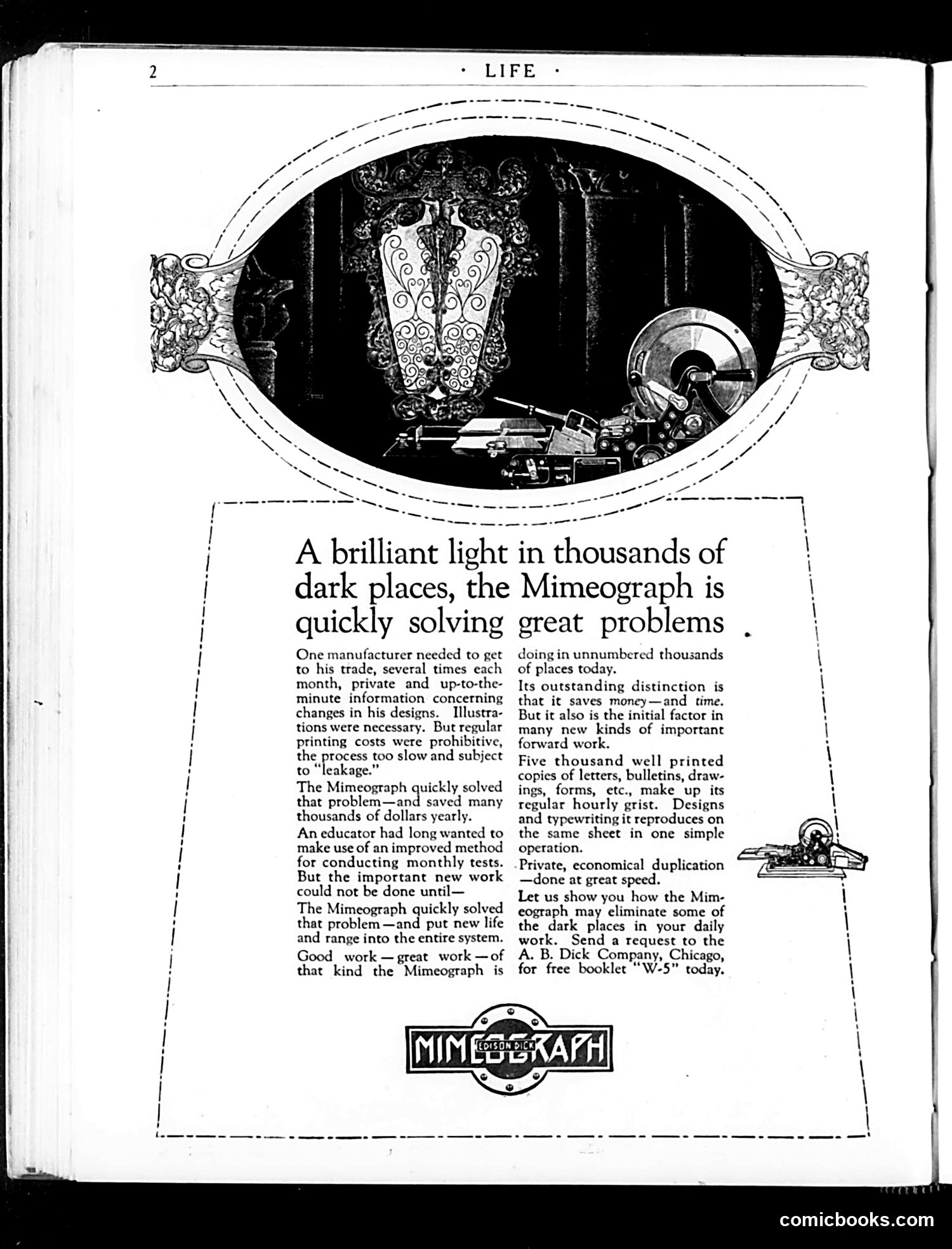
This is primarily an **advertisement for the Mimeograph machine** (by A.B. Dick Company of Chicago), not political satire. The ornate oval frame and decorative borders mimic Life magazine's typical layout style, but the content is commercial. The ad highlights the mimeograph's practical business applications: duplicating documents quickly and cheaply to solve workplace efficiency problems. It emphasizes saving time and money compared to traditional printing—solving problems for manufacturers, educators, and offices needing multiple copies of letters, bulletins, drawings, and forms. The decorative machine shown represents early 20th-century office technology. This reflects the historical context when mimeographs were revolutionary tools for business documentation before photocopiers existed.
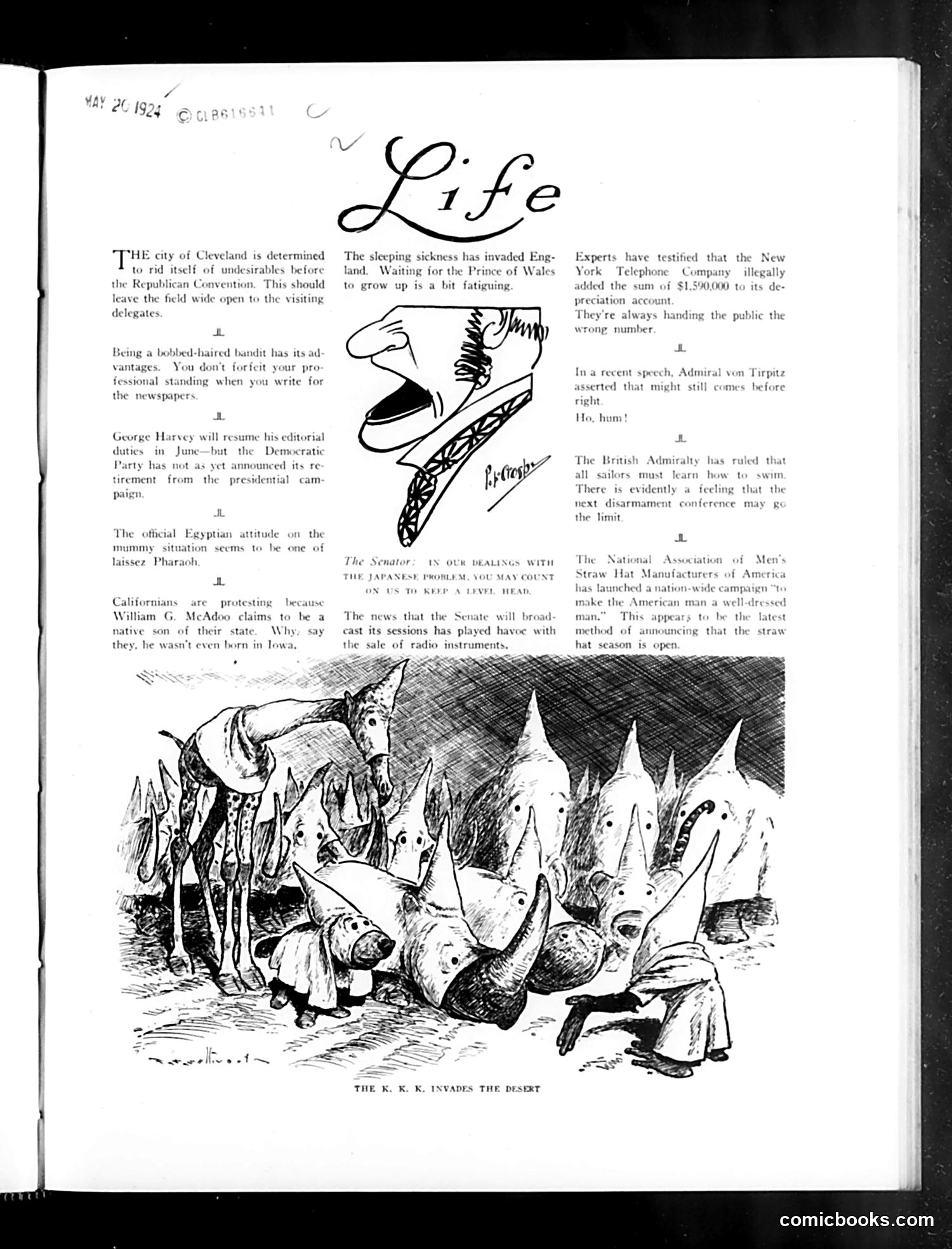
This 1924 *Life* magazine page contains political satire. The main cartoon depicts "The K.K.K. Invades the Desert"—showing Ku Klux Klan members (identifiable by their distinctive robes and pointed hoods) marching through a desert landscape. The satire appears to mock the KKK's expansionist activities during the 1920s, when the organization experienced a resurgence and attempted to spread its influence nationwide. By placing them in an unexpected setting (a desert), the cartoonist ridicules their ambitions. The text snippets address various contemporary topics: Cleveland's Republican Convention, Egyptian mummy politics, radio instruments, and the British Navy's swimming requirements—typical *Life* magazine commentary on current events and absurdities of the era.
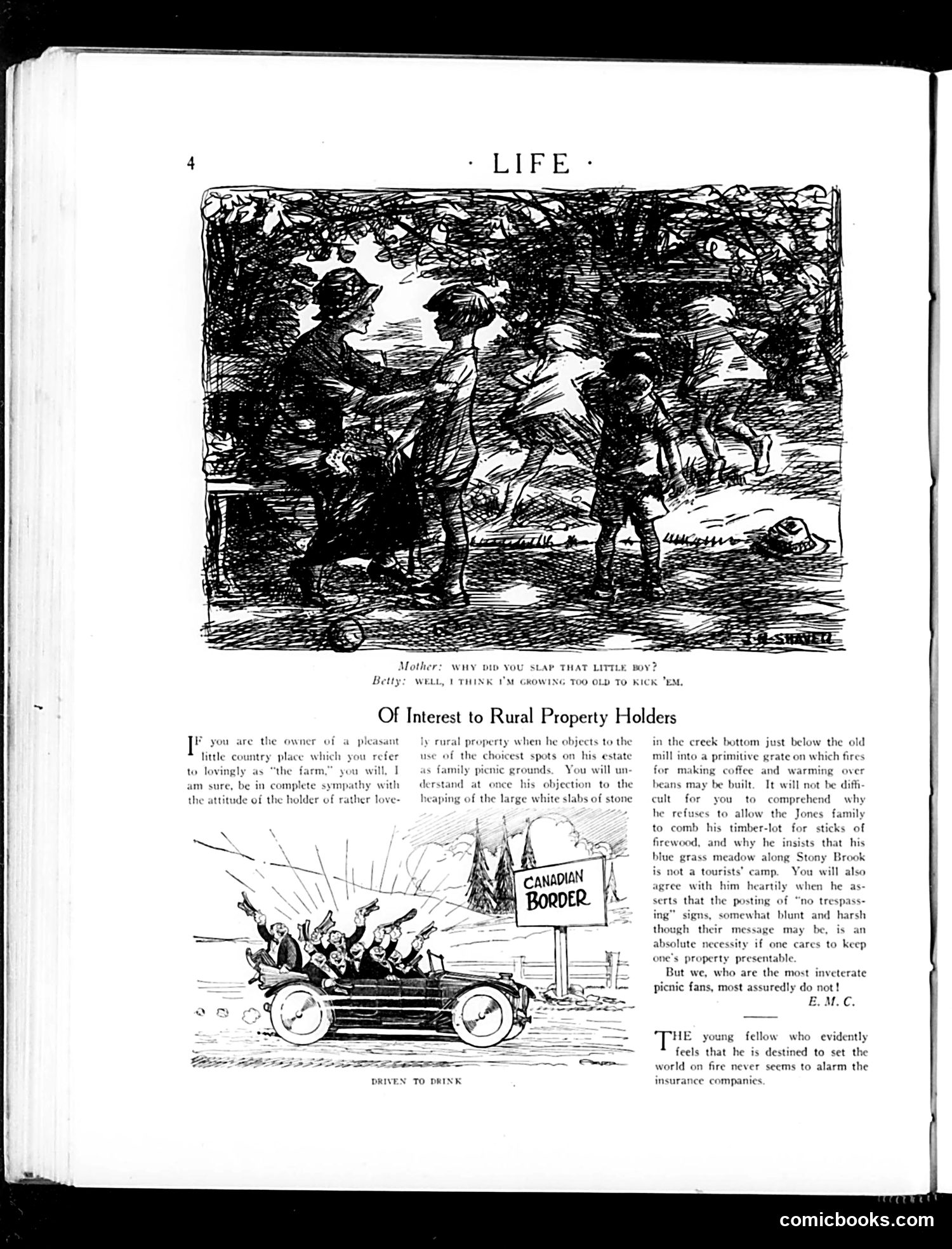
**Top Cartoon:** Shows a mother scolding a child who has hit a younger boy. The child responds "Well, I think I'm growing too old to kick 'em"—suggesting the child is transitioning from childhood roughhousing to more mature behavior. It's gentle domestic humor about child development. **Main Article & Cartoon:** "Of Interest to Rural Property Holders" discusses tensions between country landowners and recreational visitors. The illustration of a car crossing the Canadian border, labeled "Driven to Drink," satirizes how rural property owners' frustrations with trespassing picnickers and tourists drive them to distraction. The article sympathizes with landowners defending their estates from unwanted intrusion—a recurring early-20th-century conflict between rural privacy and urban recreational expansion.
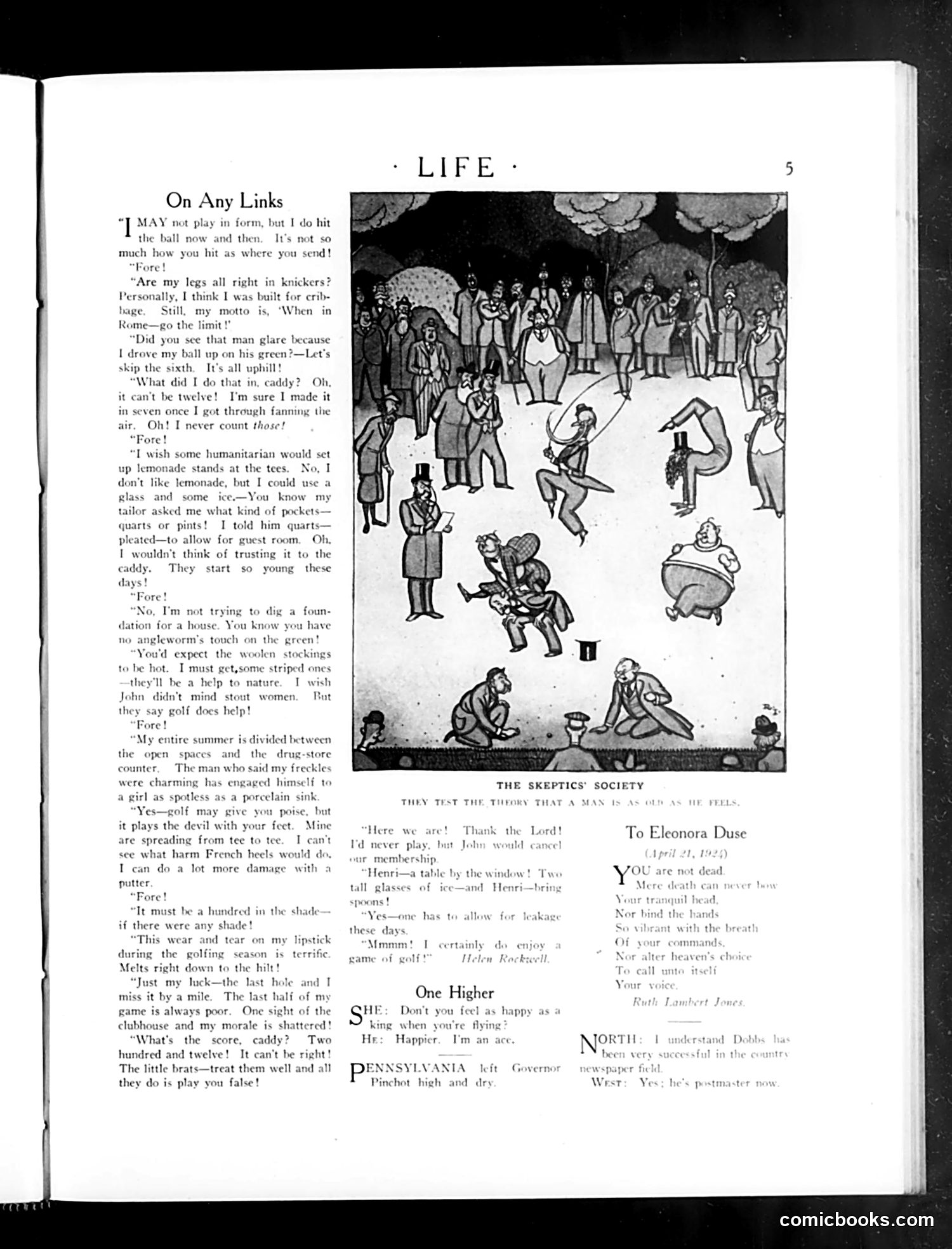
This page features "The Skeptics' Society," a satirical cartoon depicting golf as a pseudo-scientific theory. The illustration shows well-dressed men gathered around someone demonstrating golf techniques, with the caption suggesting they're testing "the theory that a man is as dumb as he feels." The accompanying text consists of golf anecdotes and humorous commentary on the sport's absurdities—players complaining about their form, discussing handicaps, and making excuses for poor performance. The satire targets golf's pretentiousness: wealthy gentlemen treating an essentially simple game as though it requires elaborate justification and pseudo-intellectual debate. The "Skeptics' Society" framing mocks how seriously golfers take themselves while playing what is fundamentally a leisure activity.
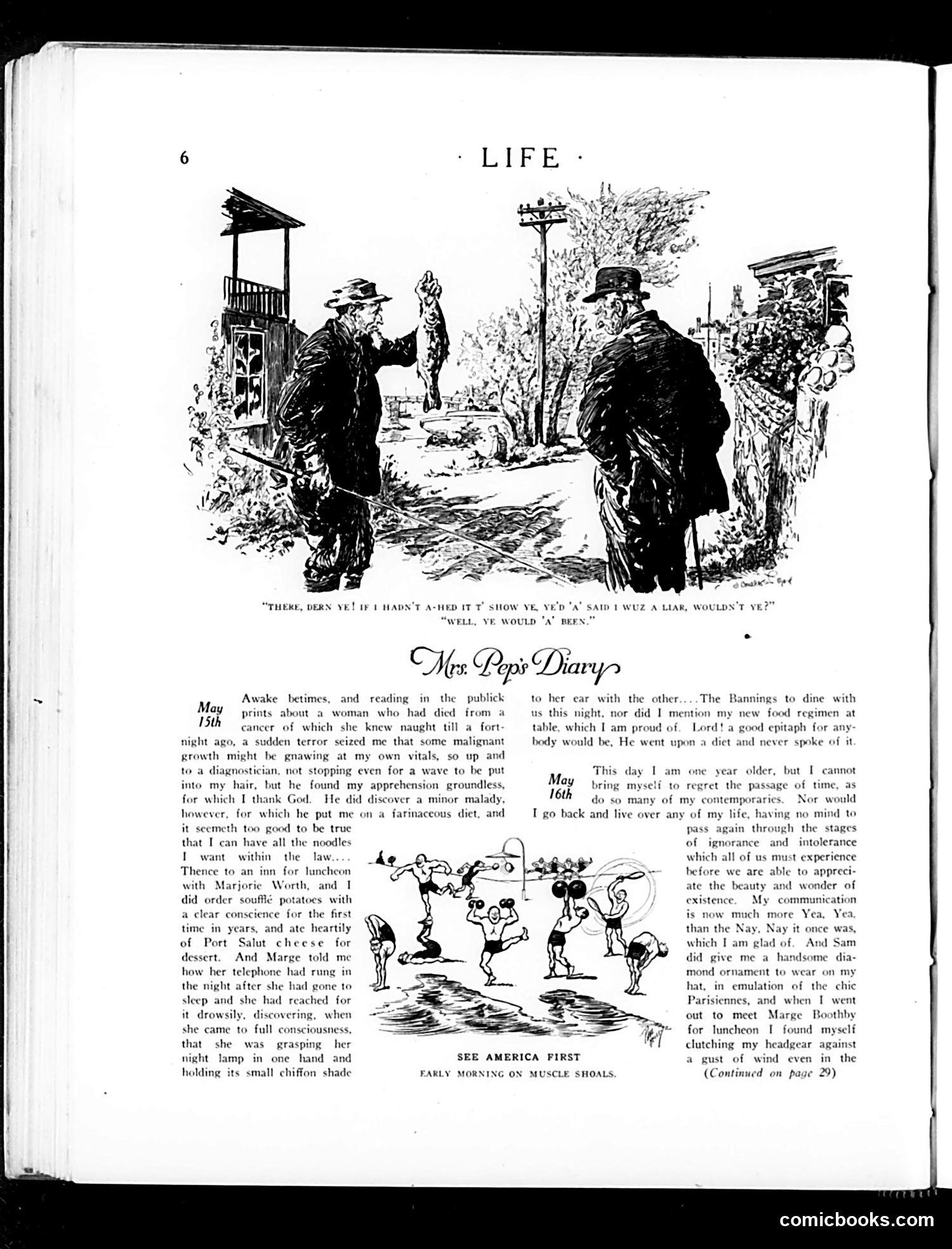
This page features "Mrs. Pep's Diary," a humor column with two distinct sections: **Top Illustration**: Two men in an alleyway appear to be engaged in a dispute over a fish, with dialect-heavy dialogue suggesting working-class or immigrant characters. The joke likely plays on miscommunication or class differences. **Bottom Illustration**: Titled "See America First—Early Morning on Muscle Shoals," depicts numerous nude or semi-nude figures exercising or bathing in water. This is satirical commentary on promoting American tourism and public recreation, possibly mocking the Muscle Shoals area (Alabama) as a destination. The cartoon suggests either overcrowding or absurdity in American leisure culture. The diary entries (May 15th and 16th) are personal anecdotes reflecting on aging and social observations, typical of the era's genteel humor columns.
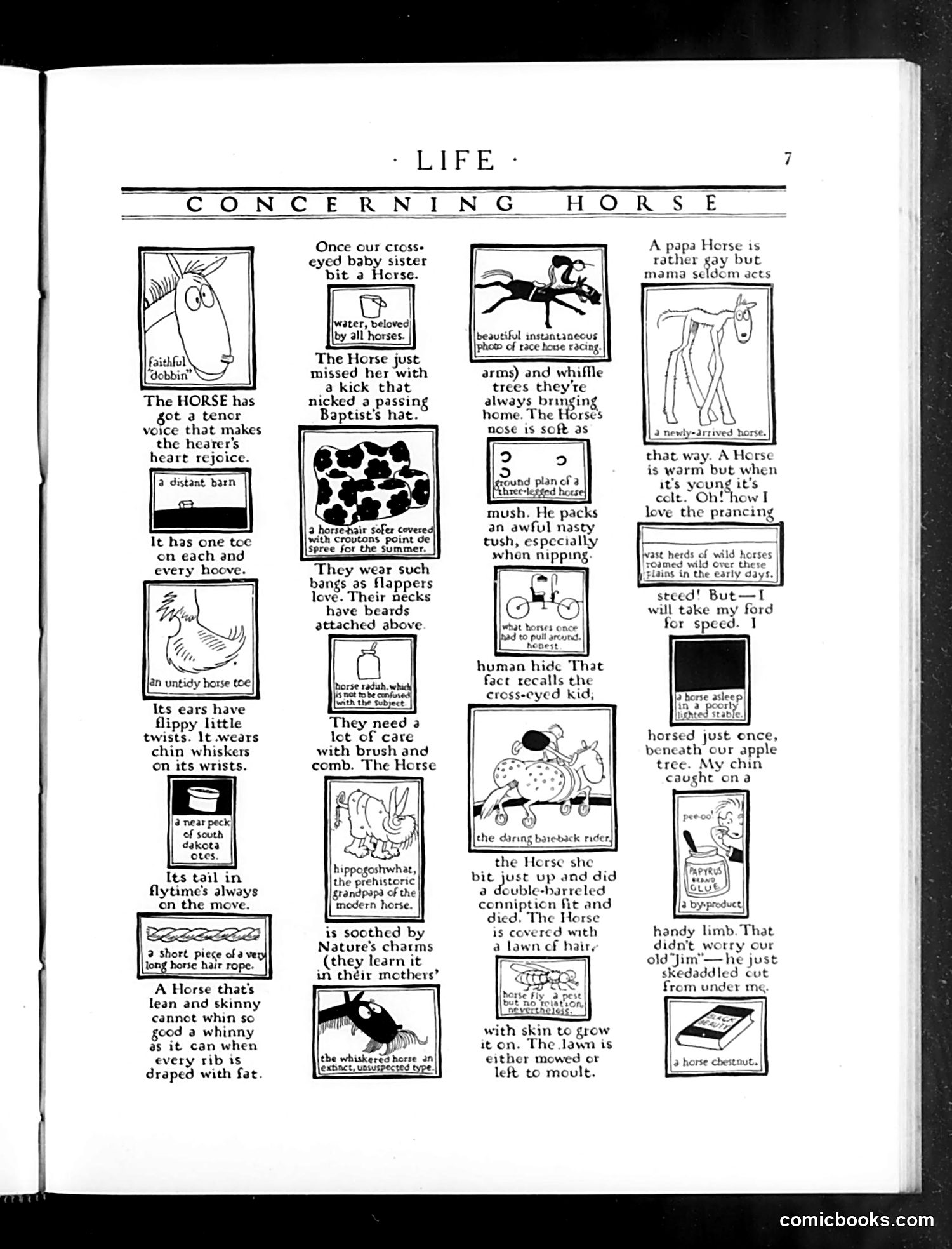
This is a humorous essay with illustrations about horses' characteristics and behaviors. The piece uses deadpan, matter-of-fact descriptions paired with simple line drawings to satirize pseudo-scientific or overly earnest nature writing—a common target of *Life* magazine's satire. The joke relies on absurd juxtapositions: describing horses in exaggerated, anthropomorphic terms ("a distinct barn voice," "untidy horse tee") while presenting genuinely bizarre claims (horses need "a neat peck of soda dakota otes," their tails are used for "whipping") as fact. The format mimics serious naturalist essays from the period, making the satire gentle rather than biting. It's essentially mocking pretentious animal behavior guides and the magazine's own nature-writing conventions through knowing parody.
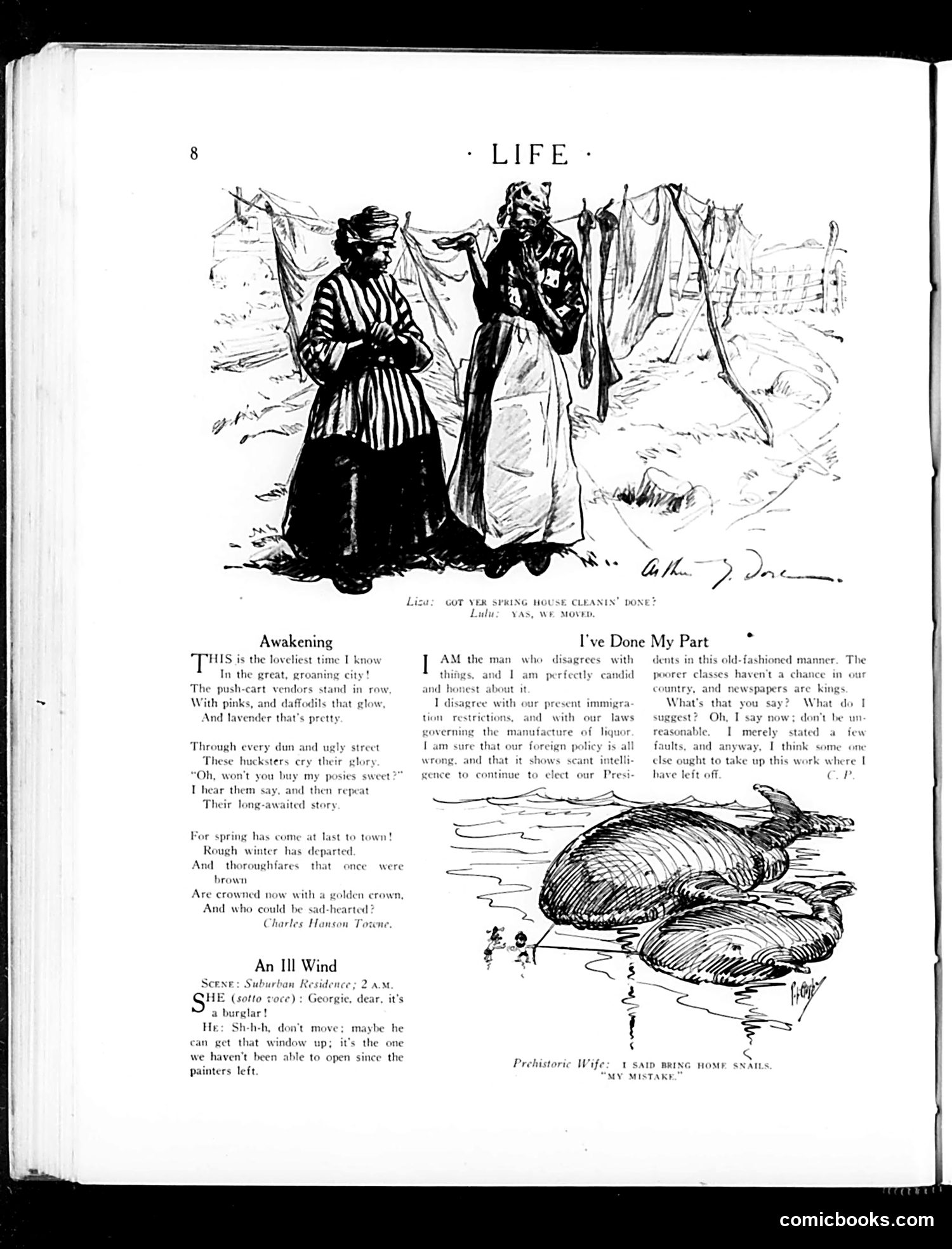
This page contains three distinct pieces of satire: 1. **Top cartoon** ("Spring House Cleaning"): Two women discuss moving, with laundry hanging in background—likely satirizing domestic life and the seasonal ritual of spring cleaning. 2. **"Awakening"** (poem by Charles Hanson Towne): Critiques urban poverty and social inequality, referencing "hucksters" and "rough winter," celebrating spring's arrival for the destitute classes. 3. **"I've Done My Part"**: A dialogue mocking someone's dismissive attitude toward immigration restrictions and foreign policy, suggesting complacency about serious national issues. 4. **"An Ill Wind"**: A brief comedic scene about a burglary interrupted by a stuck window—straightforward humorous domestic fiction. 5. **Bottom illustration**: Prehistoric wife bringing home snails, captioned "My Mistake"—visual joke about primitive domesticity and gender roles. The page blends social commentary with light humor typical of early 20th-century satirical journalism.
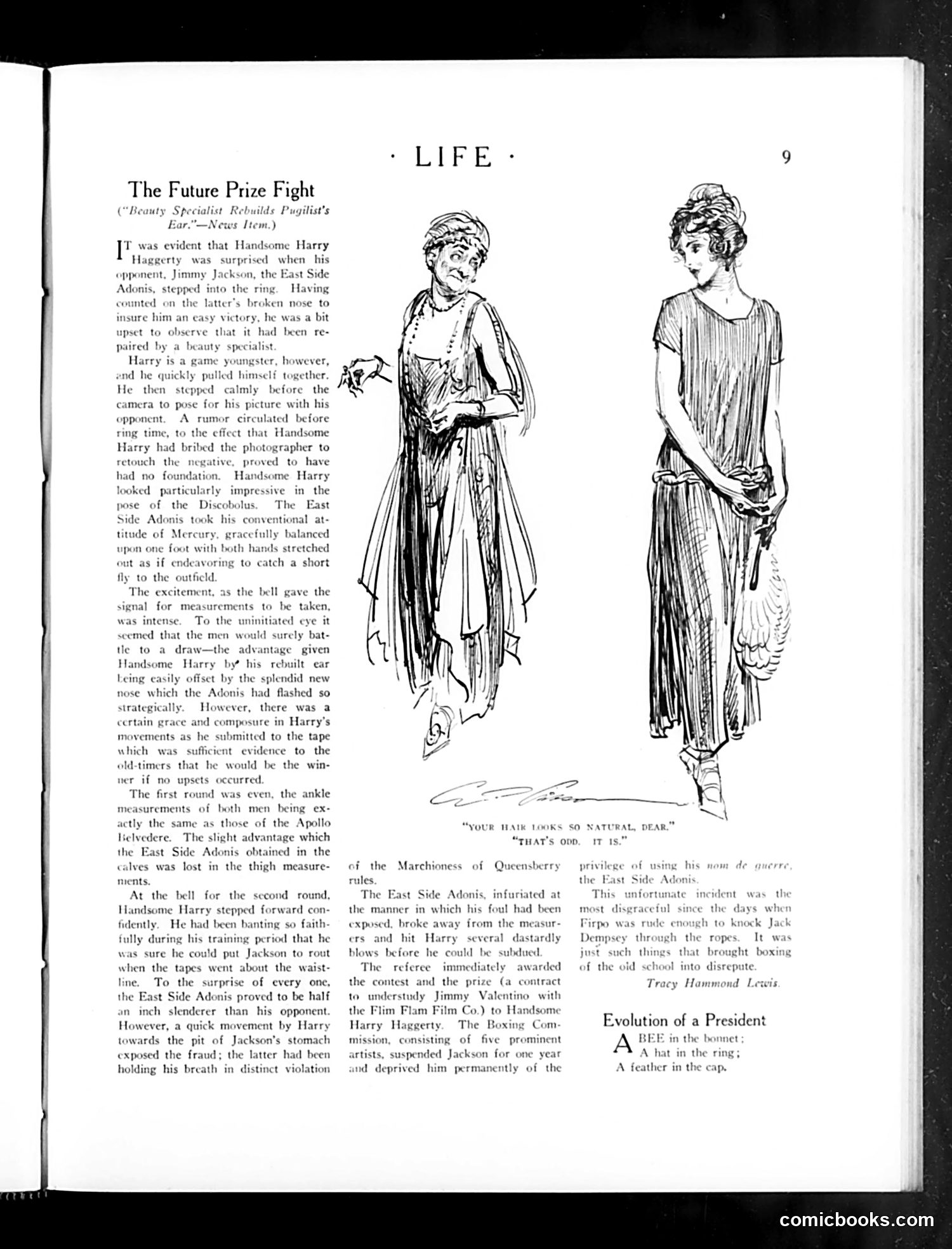
This satirical piece mocks a boxing match between "Handsome Harry" Haggerty and "Jimmy Jackson of the East Side Adonis." The humor centers on Haggerty being paired with a "beauty specialist" rather than a serious boxing trainer, suggesting he's absurdly unprepared for serious competition. The illustration shows two fashionably-dressed women in 1920s style, captioned "YOUR HAIR LOOKS SO NATURAL, DEAR. THAT'S ODD, IT IS." This suggests the satire critiques commercialized vanity and artificial beauty culture infiltrating unexpected domains—here, professional boxing. The piece appears to mock how celebrity culture and cosmetic concerns were becoming increasingly prominent, even in traditionally masculine pursuits like prizefighting. The joke is that Haggerty's "advantages" are superficial rather than athletic.
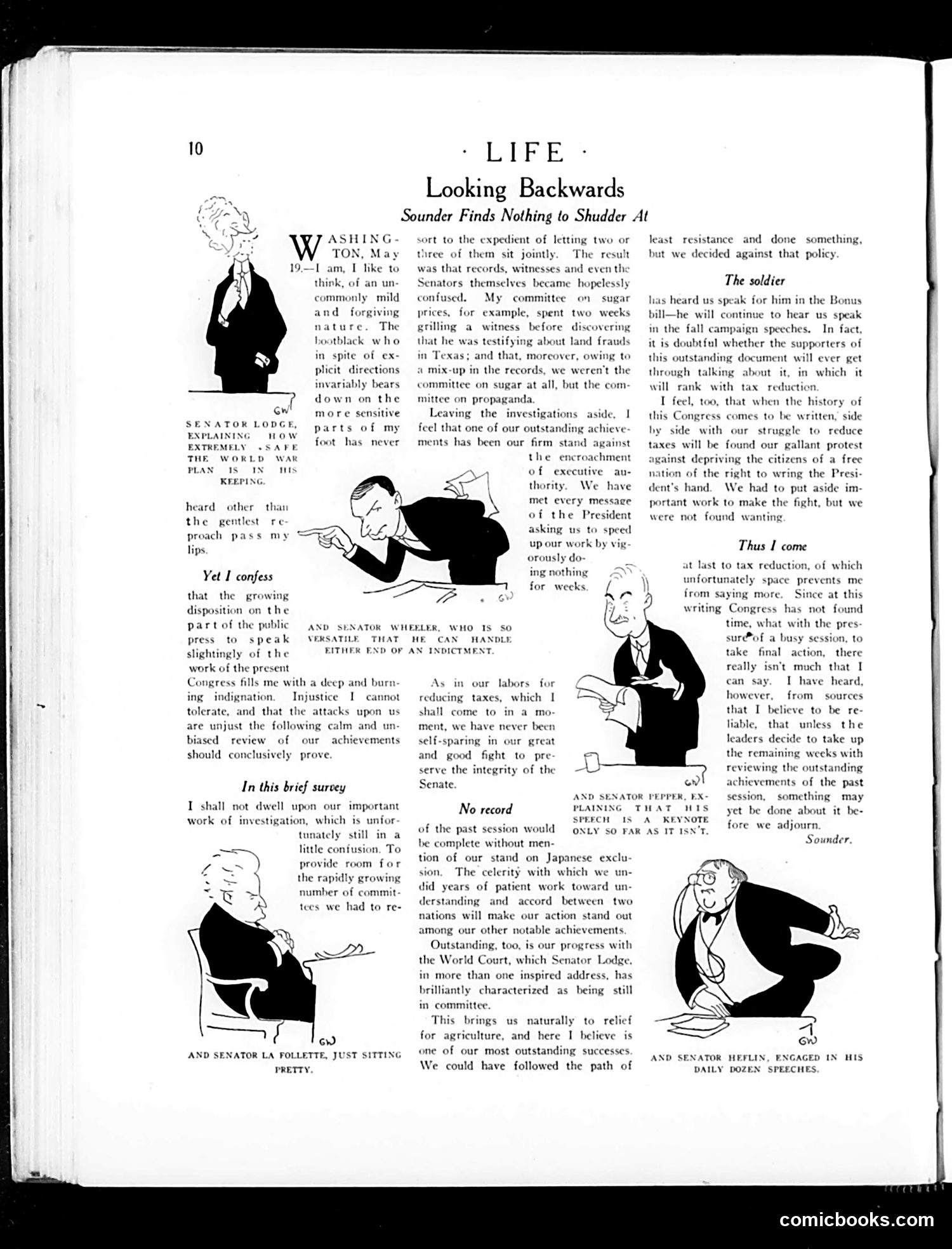
This satirical piece critiques congressional investigations during what appears to be the post-WWI era. The cartoons mock senators conducting inquiries into various matters—sugar prices, land frauds, and taxes—depicting them as ineffectual and long-winded. The captions identify specific senators: Lodge, Wheeler, Pepper, La Follette, and Hefflin. The text suggests these investigations were procedurally bungled, with conflicting testimony and poor record-keeping undermining credibility. The humor targets senatorial pomposity: investigations drag on interminably, witnesses contradict each other, and committees accomplish little despite grand rhetoric. The cartoons show senators gesticulating and pontificating while achieving minimal results. The article contrasts these failed inquiries with Congress's actual accomplishments—notably progress on the World Court and agricultural relief—suggesting senators talk excessively while doing little substantive work.
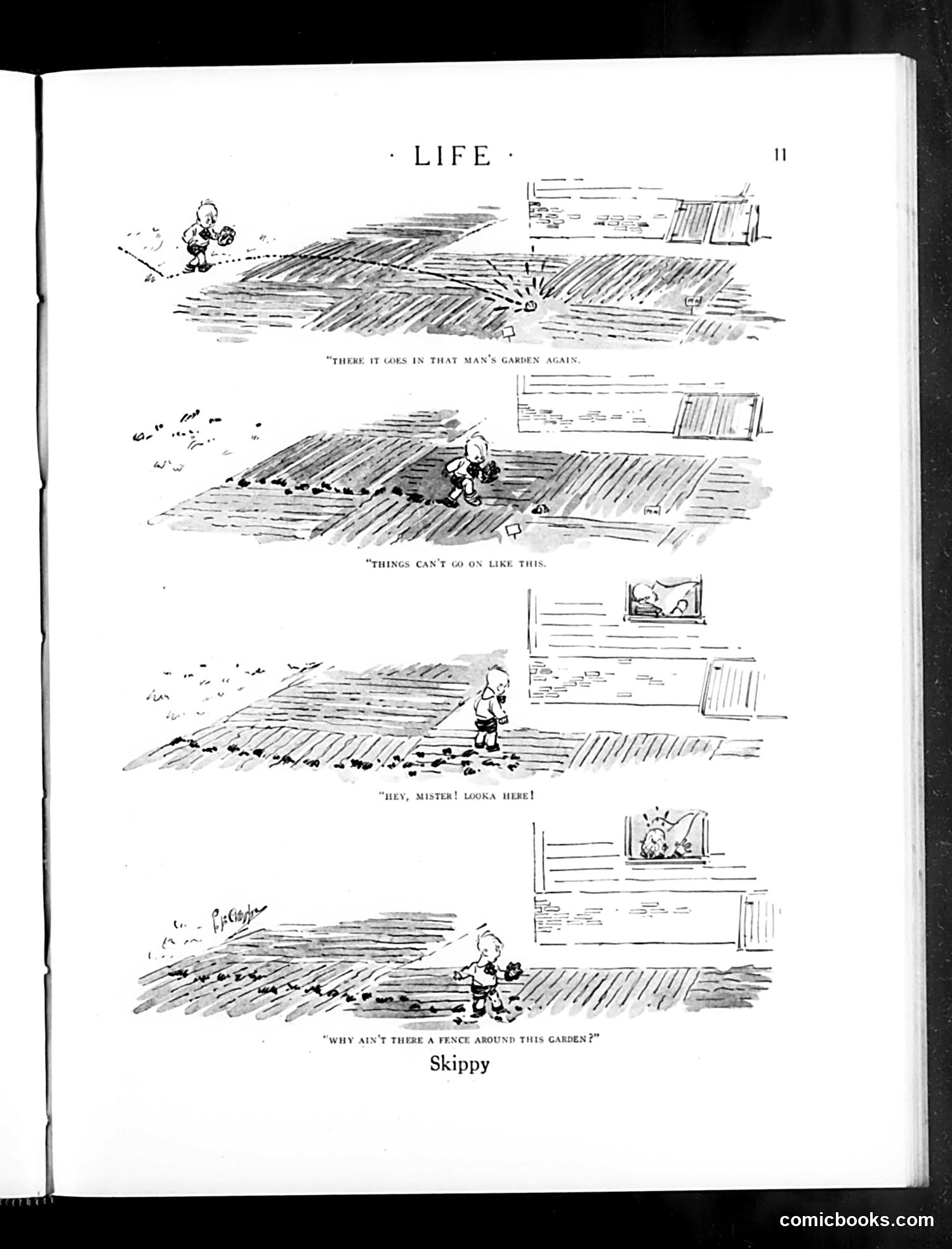
This is a four-panel comic strip titled "Skippy" depicting a young boy repeatedly entering a vegetable garden despite mounting problems. The strip's humor relies on escalating chaos: 1. **Panel 1**: "There it goes in that man's garden again" — The boy chases something into the garden. 2. **Panel 2**: "Things can't go on like this" — Shows damage to the garden. 3. **Panel 3**: "Hey, mister! Looka here!" — The boy attempts to alert the garden's owner. 4. **Panel 4**: "Why ain't there a fence around this garden?" — The boy questions why there's no protection, ironically seeming oblivious to his own role in the destruction. The satire targets childhood logic and deflection of responsibility—the boy creates the problem but blames the property owner for lacking preventative measures.
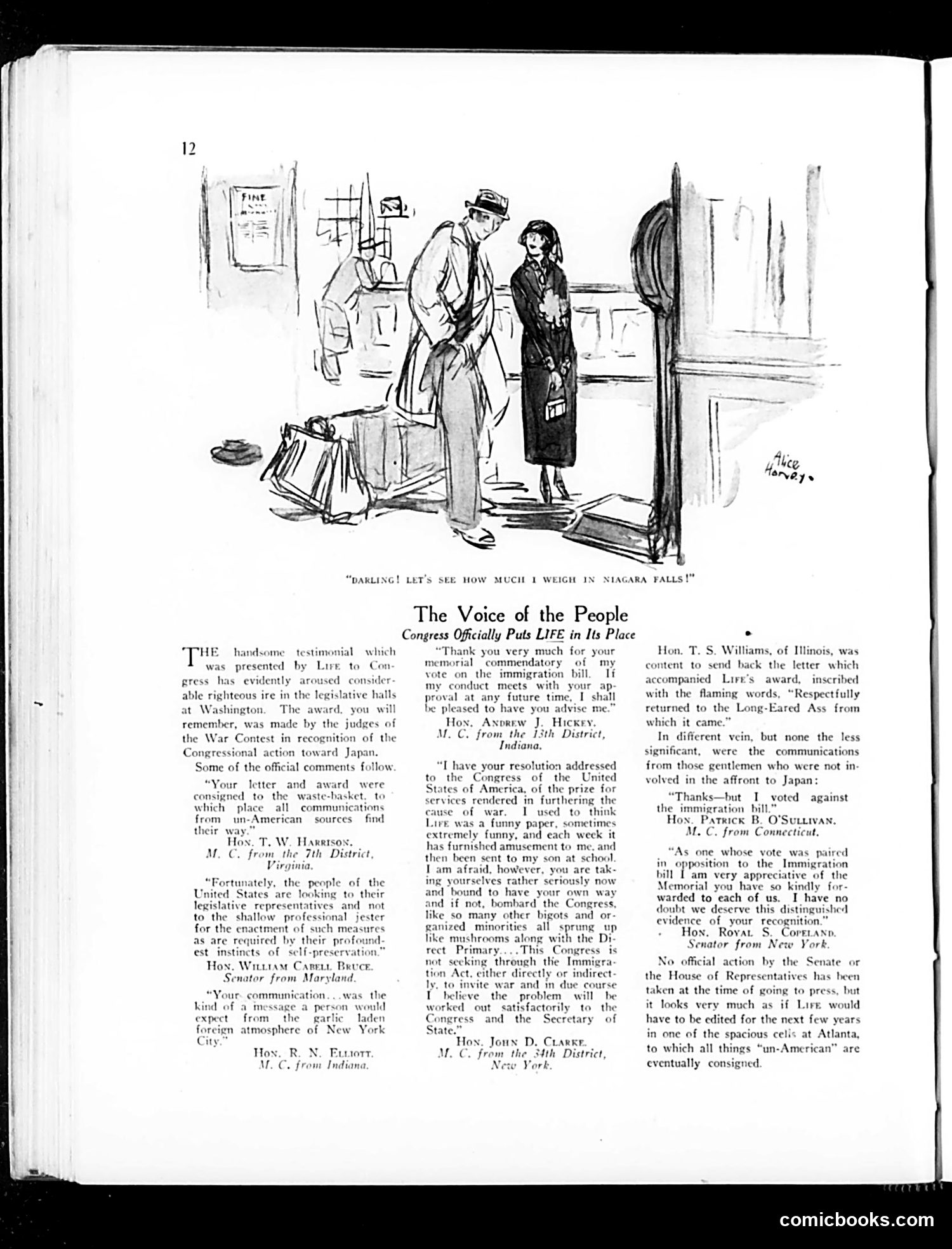
This page features a cartoon and congressional testimonies about an immigration bill award. The sketch shows a man at a scale with a woman, captioned "DARLING! LET'S SEE HOW MUCH I WEIGH IN NIAGARA FALLS!" — likely satirizing tourists at this famous destination. Below, "The Voice of the People" presents letters from various congressmen responding to Life's award recognizing the magazine's influence on legislative debate. The politicians' comments suggest Life's satirical cartoons were taken seriously as political commentary that shaped congressional opinion on immigration policy. The page demonstrates Life magazine's self-acknowledged role as a powerful voice in American political discourse during the early 20th century.
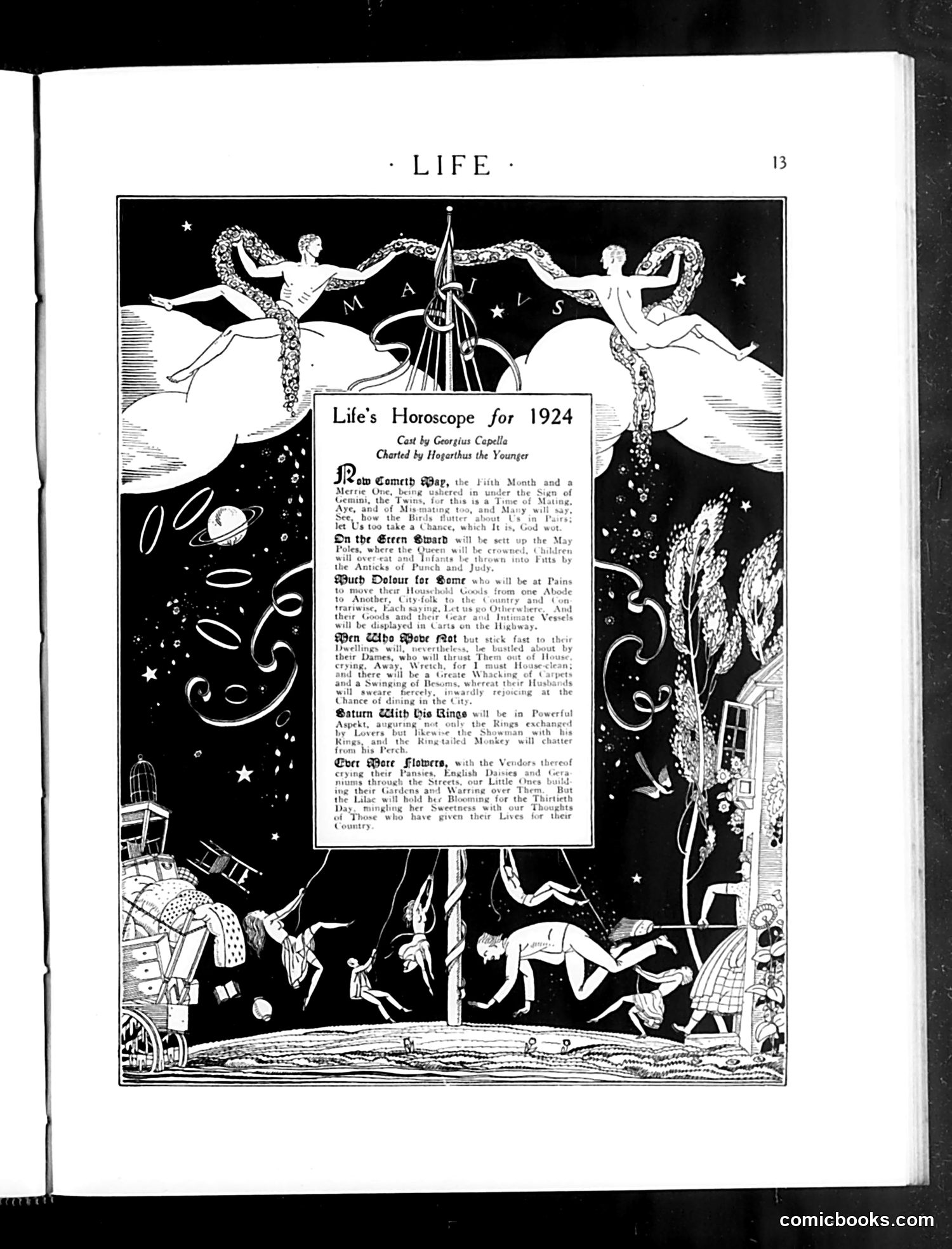
This is a satirical horoscope illustrated by Georgius Cupella and charted by "Hejartha the Younger." The artwork depicts an elaborate zodiac-themed illustration with classical figures and cosmic imagery. The horoscope makes playful predictions for various groups throughout 1924, including entries for "Red Cometh Now," "On the Green Guard," "Blind Dolour for Some," and "Over Mere Flowers." The text uses ornate, mock-mystical language typical of astrological predictions while clearly mocking them. The elaborate decorative border, celestial symbols, and classical allegorical figures (including cherubs and maidens) create a whimsical, tongue-in-cheek tone. This appears to be *Life* magazine's humorous take on the popular horoscope trend of the 1920s, satirizing both astrology and contemporary social concerns through fanciful predictions.
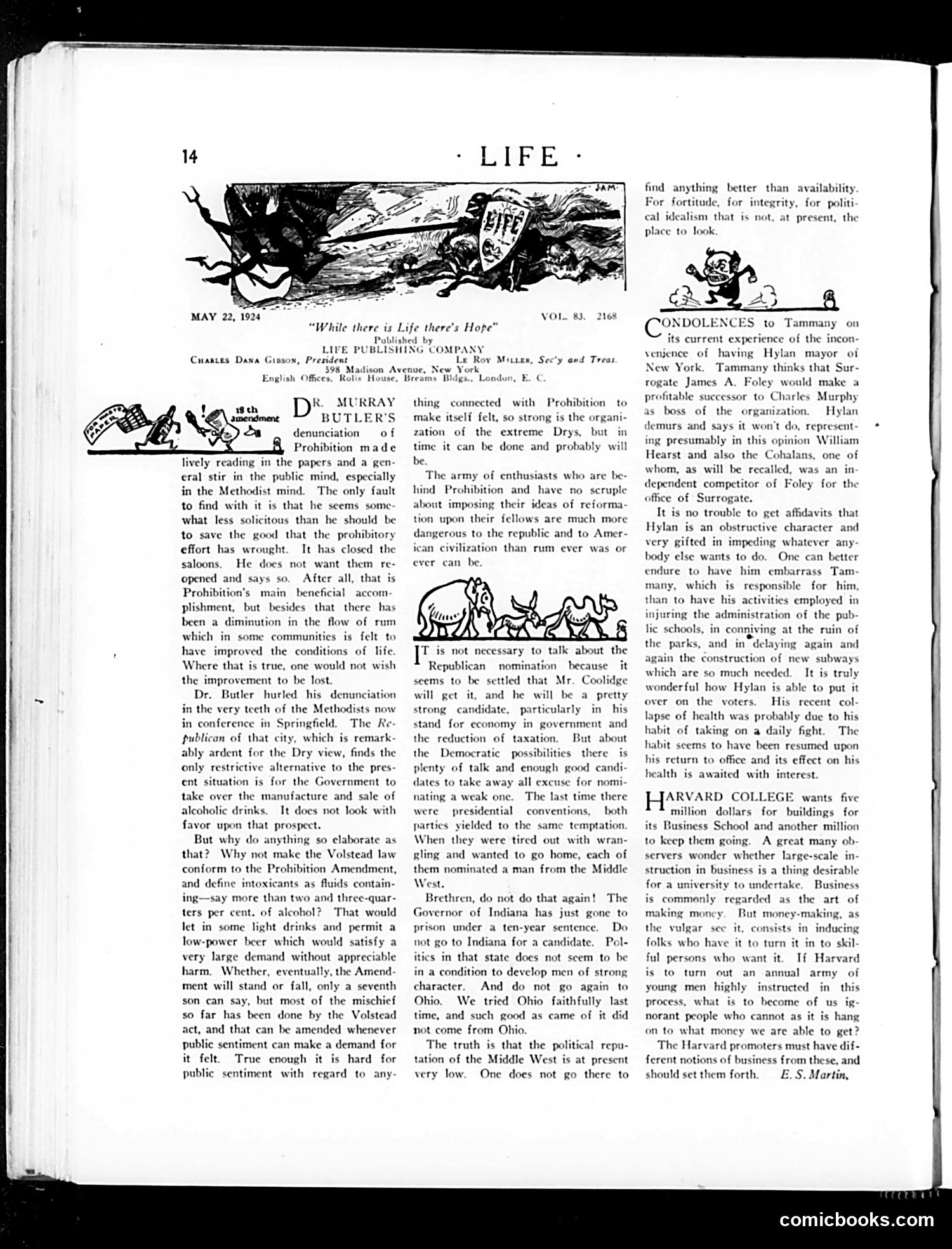
This page contains editorial commentary on Prohibition and politics, accompanied by a small cartoon at the top. The main text critiques Dr. Murray Butler's denunciation of Prohibition, arguing the policy—while imperfect—has genuinely improved public conditions by closing saloons. The author contends that rather than abandoning Prohibition, the government should regulate alcohol manufacture and sales. The second section discusses the 1924 Republican presidential nomination, noting that Coolidge appears likely to win. It mocks the parties' nominating processes, referencing candidates from the Middle West and Indiana specifically. The commentary suggests the political reputation of that region is currently "very low." The small cartoons serve as visual punctuation to these satirical observations about American governance and alcohol policy.
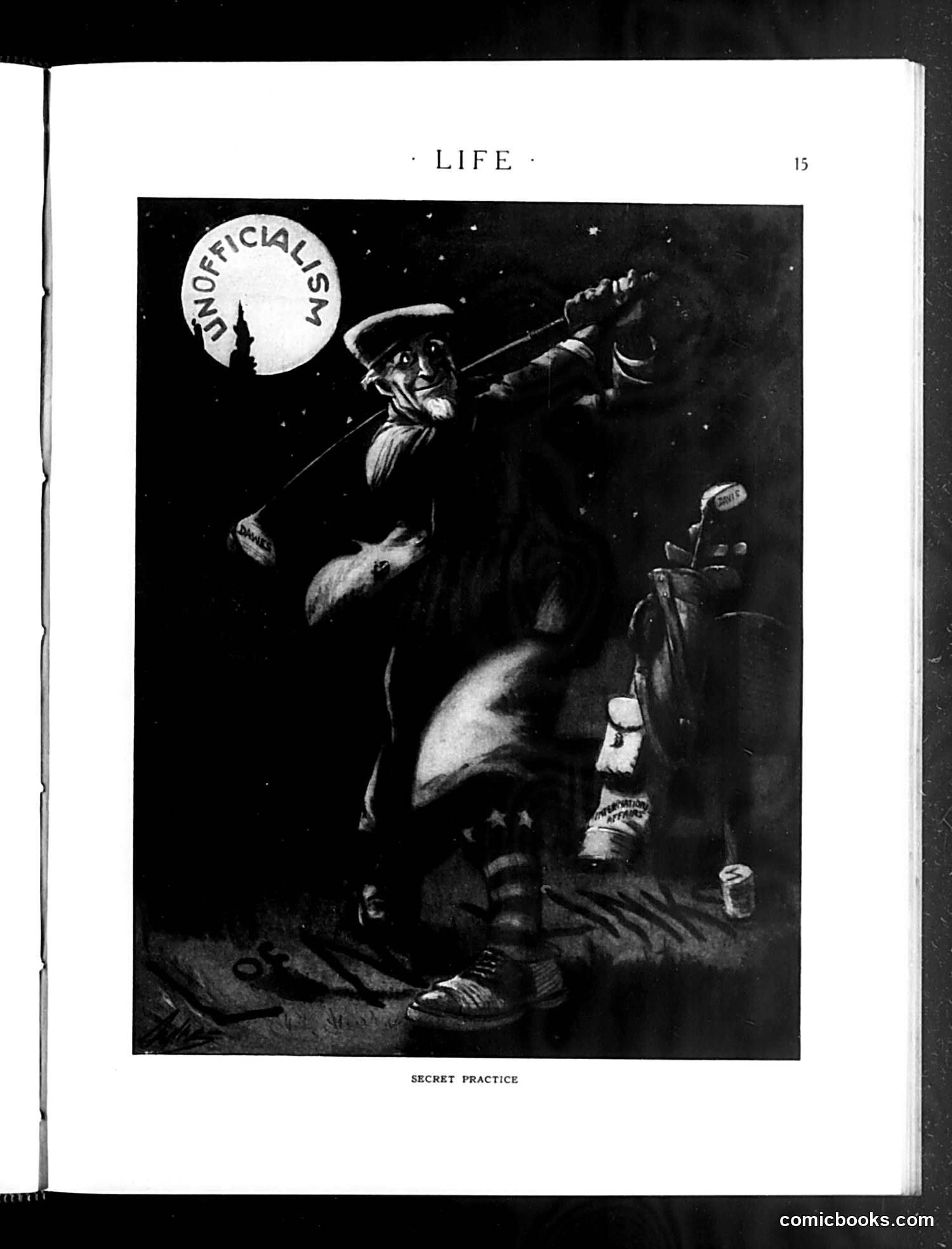
This satirical cartoon depicts an old man in a hat and coat pointing a telescope or rifle skyward at a moon labeled "UNOFFICIALS." The figure appears to be engaging in some form of covert activity or "secret practice" as the caption states. The joke likely targets unofficial or unauthorized individuals attempting to influence matters they shouldn't—the moon labeled "UNOFFICIALS" suggesting they're aiming at or targeting things beyond their legitimate sphere. The nighttime, secretive setting and the old man's furtive posture emphasize the underhanded nature of the activity being mocked. Without additional context about the specific historical period and political circumstances of this Life magazine issue, the exact targets of this satire remain unclear, though it appears to critique improper or illegitimate interference in some matter.
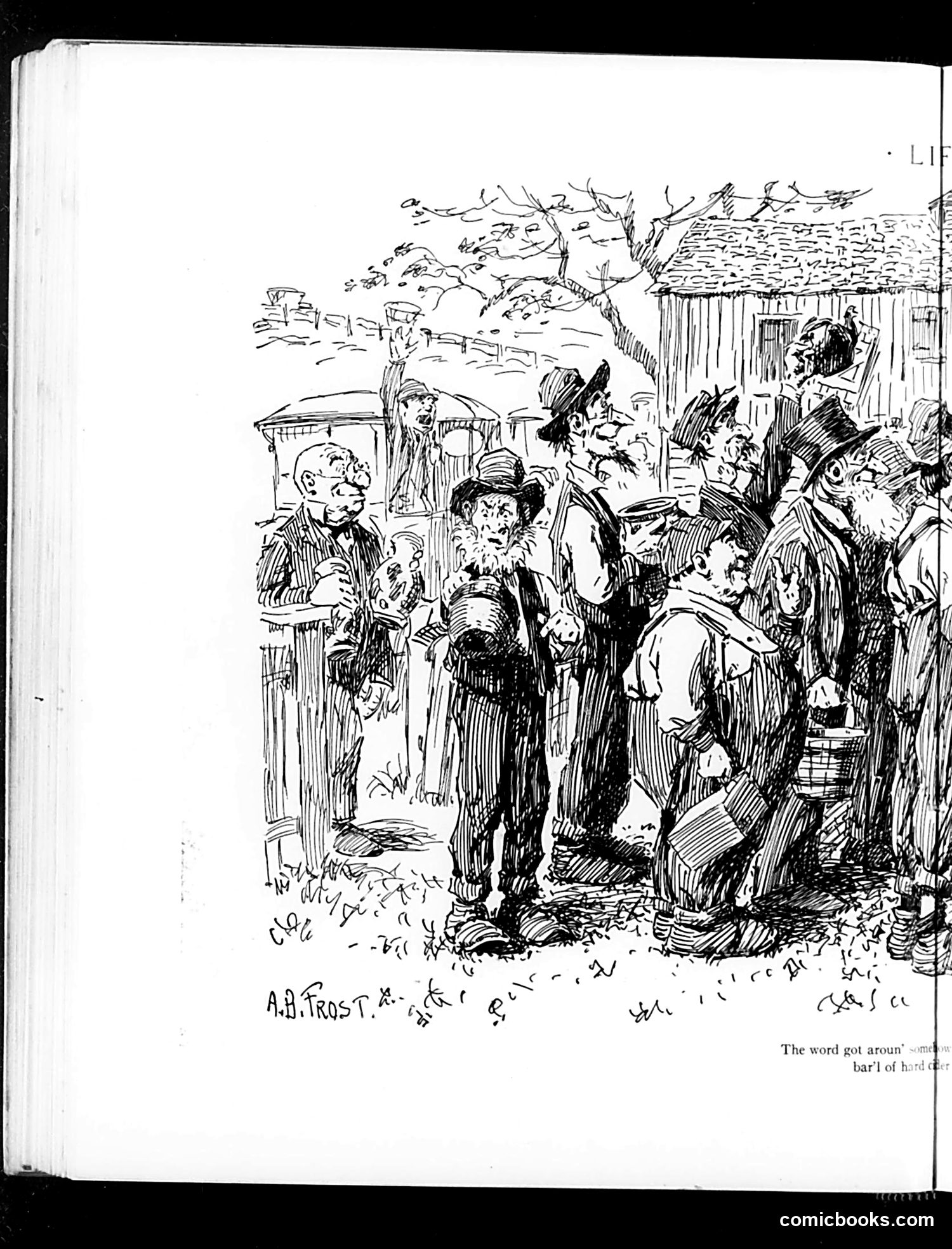
This is a satirical sketch by A.B. Frost showing a crowd of working-class men gathered in a rural setting near a farmhouse. The figures wear period clothing (hats, vests) suggesting late 19th-century America. The OCR'd text is too corrupted to yield clear meaning, but the caption fragment "The word got aroun'...bar'l of hard c[ider]" suggests the cartoon depicts gossip or rumor-spreading in a rural community, possibly about alcohol or local news. The crowded composition and animated gestures convey social energy and communication. Without clearer caption text, the precise satirical target remains unclear—though it likely comments on rural social dynamics, drinking culture, or how information spreads through working communities. The sketch's loose, energetic line work is characteristic of Frost's humorous illustration style.
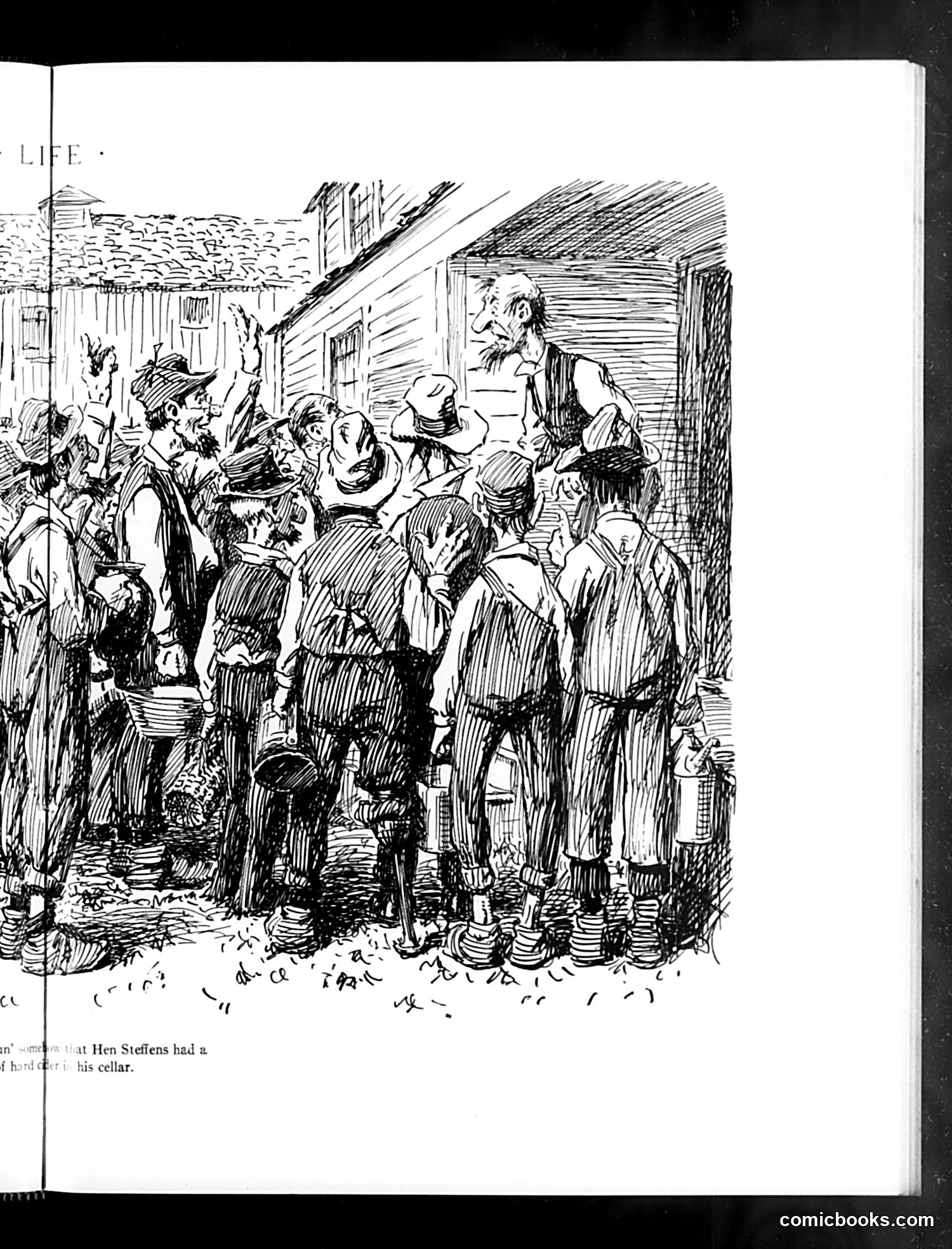
This is a satirical illustration from *Life* magazine depicting what appears to be a crowd scene outside a building. The visible OCR text references "Hen Steffens" and "his cellar," though the text is fragmentary and partially illegible. The sketch shows multiple figures gathered, seemingly in confrontation or investigation. Without clearer text or caption, the specific historical or political reference remains unclear. "Hen Steffens" may refer to Lincoln Steffens, the famous muckraking journalist known for exposing corruption, but I cannot confirm this from the incomplete text alone. The illustration's style and crowd composition suggest social commentary typical of *Life*'s satirical approach—possibly regarding corruption, scandal, or criminal activity—but the exact subject and satirical point cannot be reliably determined from this fragmented page.
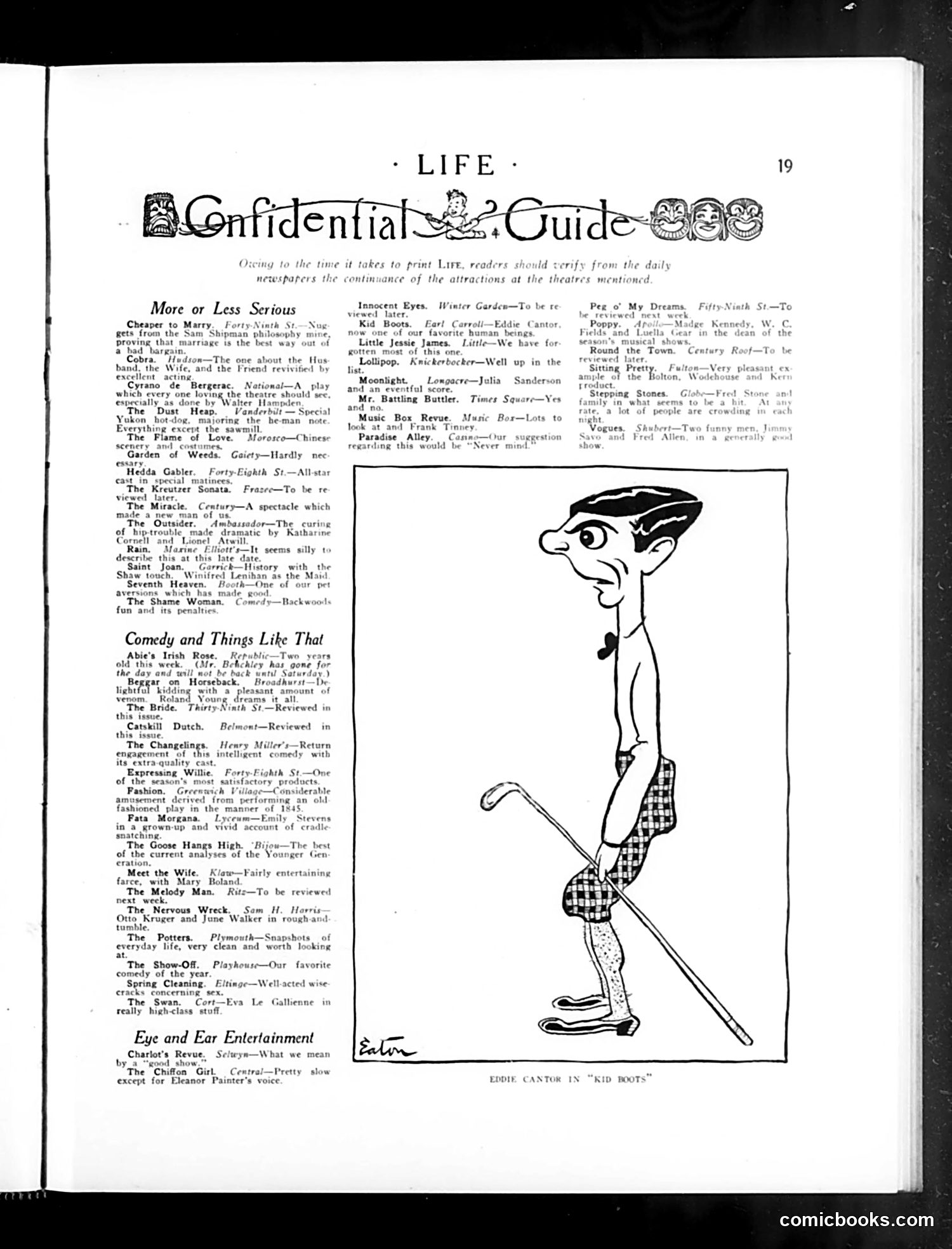
This page from *Life* magazine features a caricature of **Eddie Cantor** in the musical comedy "Kid Boots" (noted in the caption). The cartoon exaggerates Cantor's distinctive physical features—his thin, elongated face and lanky body—in a style typical of 1920s theatrical caricature. Cantor was a famous comedian and performer known for his energetic stage presence. The joke appears straightforward: it's a visual gag playing on Cantor's characteristically thin frame and exaggerated proportions, likely referencing either his stage appearance or a specific comedic bit from the show. The figure's awkward posture and comic design would have been recognizable entertainment gossip to *Life*'s readers, who expected theatrical caricatures in this "Confidential Guide" section reviewing current Broadway productions.
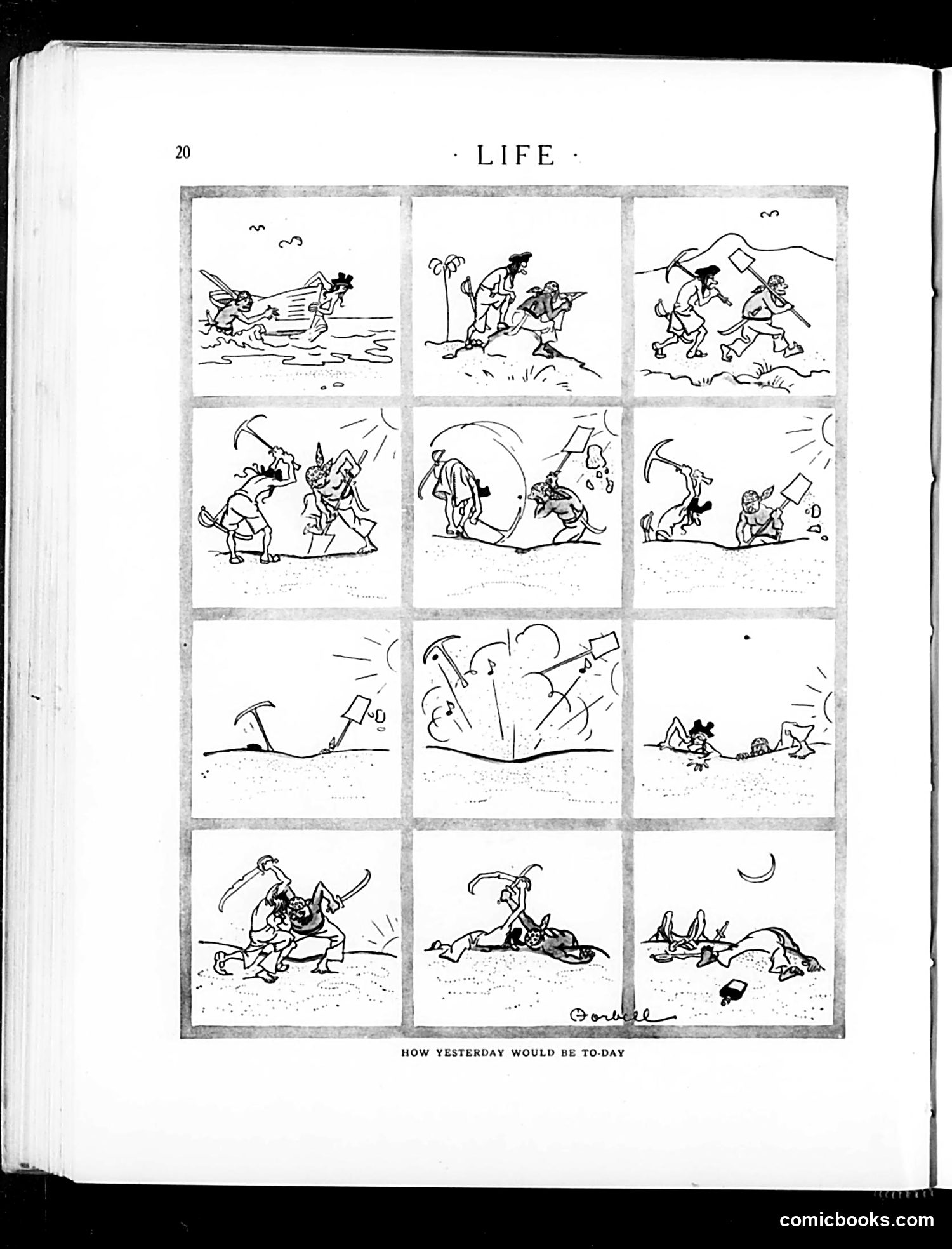
This is a 12-panel comic strip showing a satirical reversal of historical progress. The title suggests it depicts what modern life would look like if yesterday's primitive conditions persisted into the present day. The panels show figures using contemporary tools and activities—like digging, fighting, and laboring—but in a primitive, caveman-like manner. The progression humorously illustrates that modern conveniences (picks, shovels, structured conflict) exist, but people still struggle and suffer as if still in prehistoric times. The satire appears to critique either human nature's unchanging brutality despite technological advancement, or social conditions that make "progress" feel illusory. The caveman aesthetic suggests civilized behavior remains superficial over our fundamental savage nature.
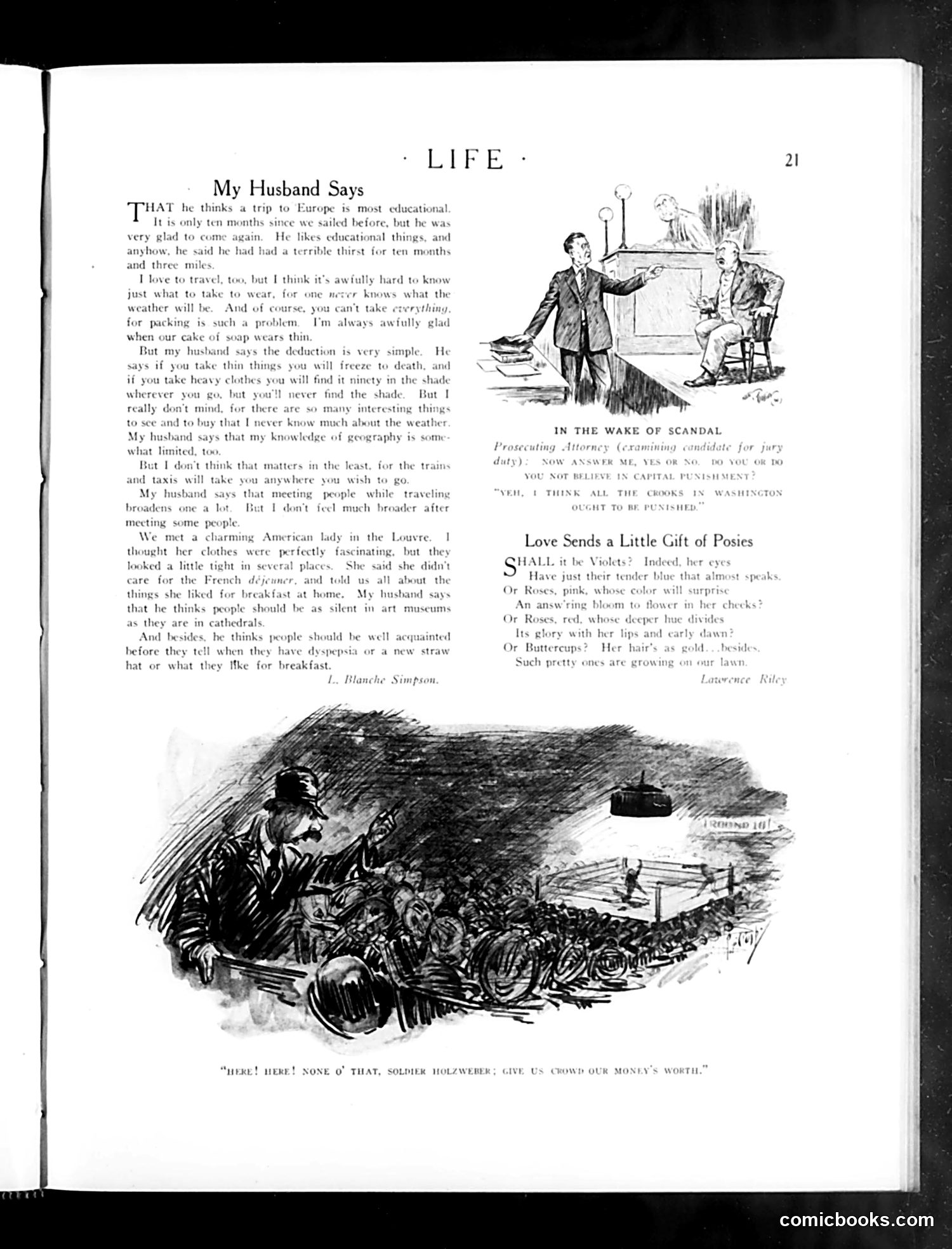
**"My Husband Says"** (by L. Blanche Simpson) is a domestic humor column mocking marital disagreements about European travel. The wife finds packing impossible and lacks geographical knowledge, while her husband insists on "logical" solutions (thin clothes freeze you, heavy ones are too hot). The satire targets husbands who believe they're rational problem-solvers when the real issue—unpredictable weather and practical uncertainty—defies their theories. The joke: his "deductions" are useless. **"In the Wake of Scandal"** (top right cartoon) shows a prosecuting attorney questioning a jury candidate about capital punishment, likely referencing a contemporary scandal or trial. One candidate's response—"I think all the crooks in Washington ought to be punished"—suggests political corruption satire, though the specific scandal is unclear without date context. **"Love Sends a Little Gift of Posies"** (by Lawrence Riley) is a brief poetic tribute to flowers and female beauty, unrelated to the satire above.
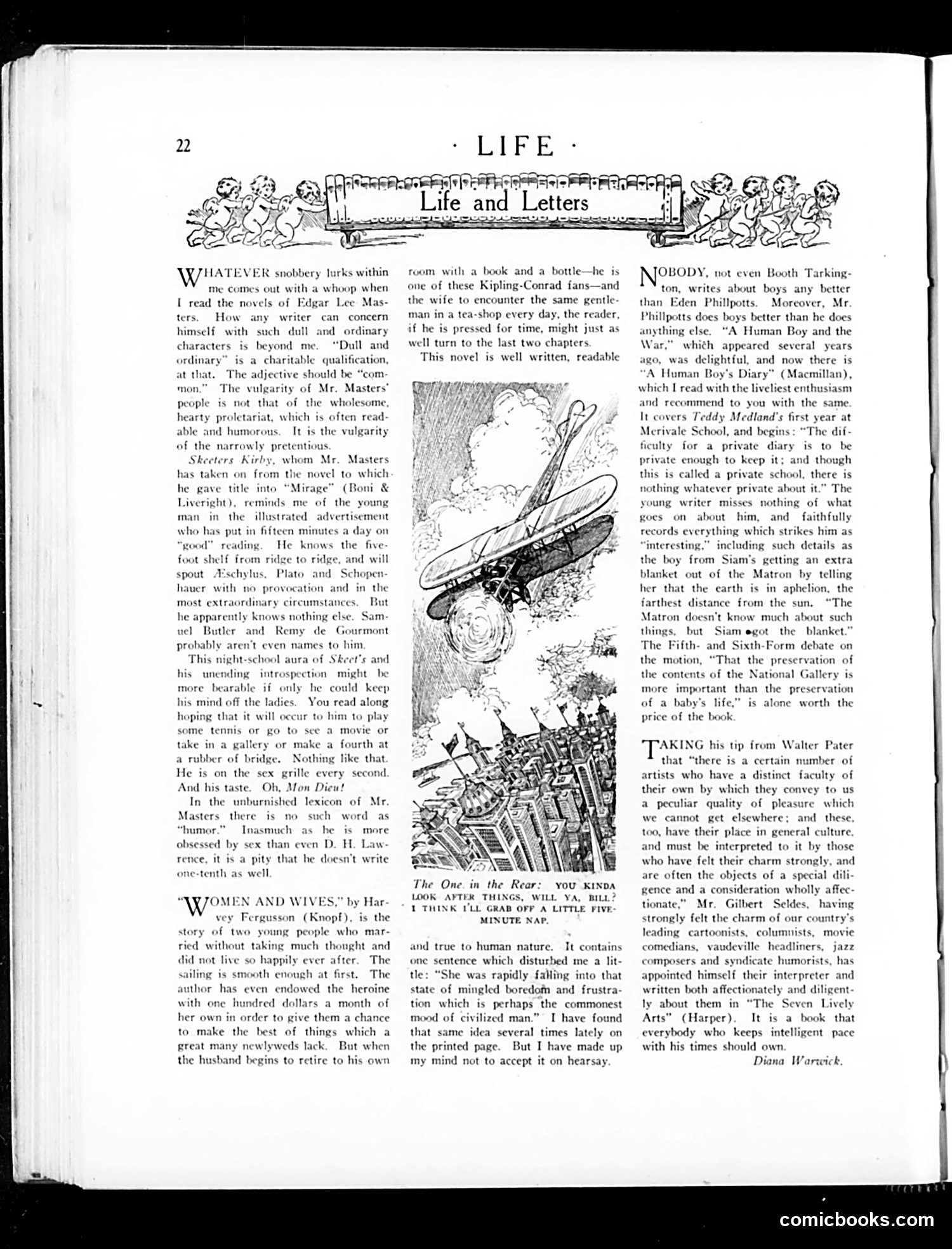
This is a literary review section titled "Life and Letters." The page critiques several novels, with one illustration showing a man napping in what appears to be a train or vehicle while another man asks to take his turn watching things. The reviews discuss: 1. **Edgar Lee Masters' work** — criticized for featuring vulgar, pretentious working-class characters lacking depth or sophistication 2. **"Women and Wives" by Harvey Fergusson** — about a young married couple whose relationship falters when the husband becomes a reclusive book-and-alcohol enthusiast (a Kipling-Conrad fan), while the wife encounters the same gentleman daily in a tea-shop 3. **Eden Phillpotts' "A Human Boy's Diary"** — praised for authentic depiction of a schoolboy's first year at Merivale School, faithfully recording amusing details The cartoon's simple joke (bottom left) shows exhaustion during travel—one man requests relief from watching belongings so he can nap. The page reflects early 20th-century literary taste and class consciousness regarding character portrayal in fiction.
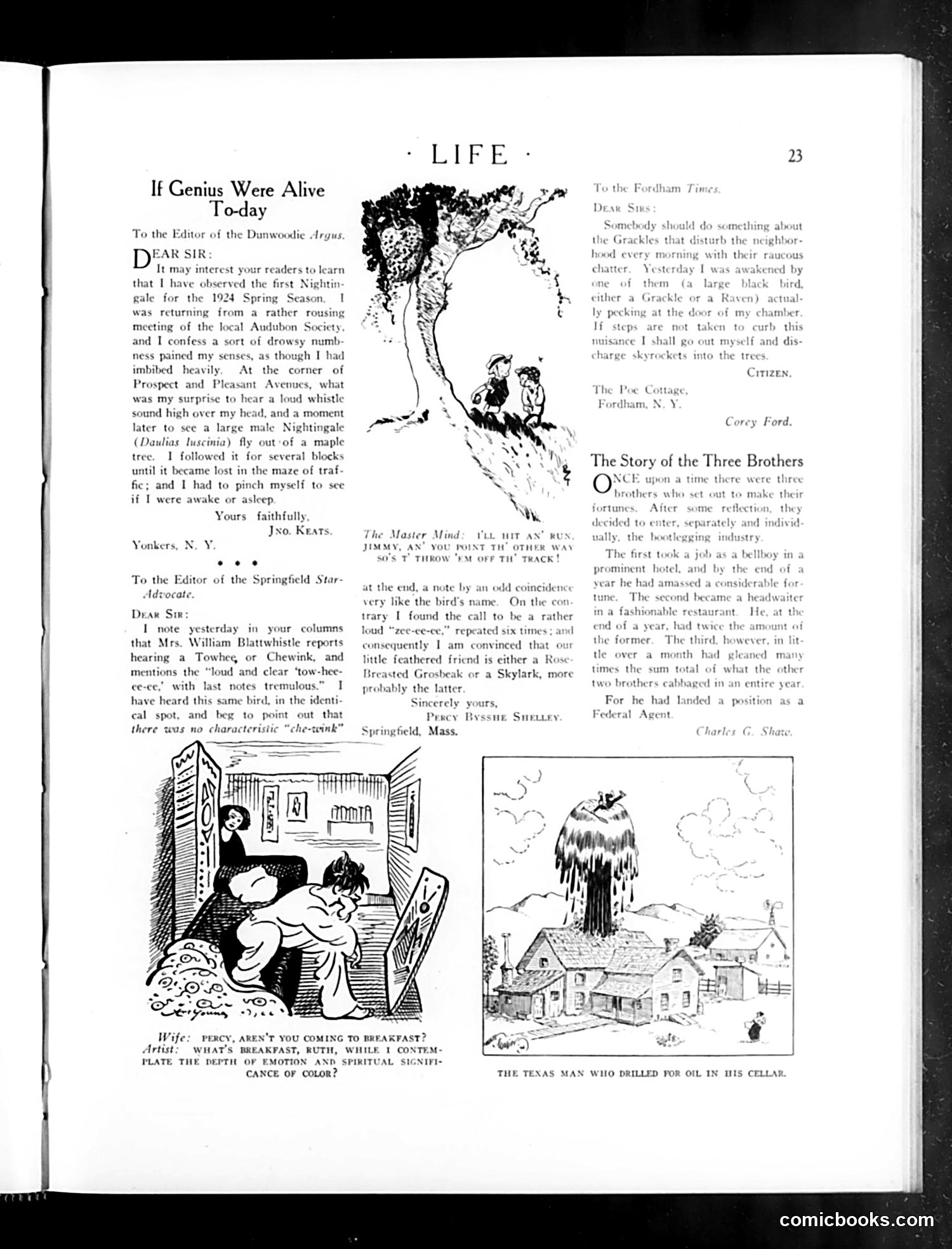
This page satirizes romantic literary nostalgia by having readers report sightings of famous poets' subjects in mundane 1924 America. The first letter, signed "Jno. Keats," references John Keats's poem "To a Nightingale"—claiming to have spotted a nightingale near suburban Prospect and Pleasant Avenues, complete with drowsy numbness matching the poem's opening. The second letter, signed "Percy Bysshe Shelley," discusses a bird with a call resembling its name, echoing Romantic-era poetic fancy about nature. The joke: these idealized literary subjects (the melancholic nightingale, nature's sublime voice) supposedly persist unchanged in prosaic modern life, yet the writers obsess over mundane details (exact bird calls, species identification) that miss the poetry entirely. The satire mocks both sentimentalists clinging to Romantic literature AND modern readers' inability to appreciate genuine artistry—they're more concerned with ornithological accuracy than inspiration.
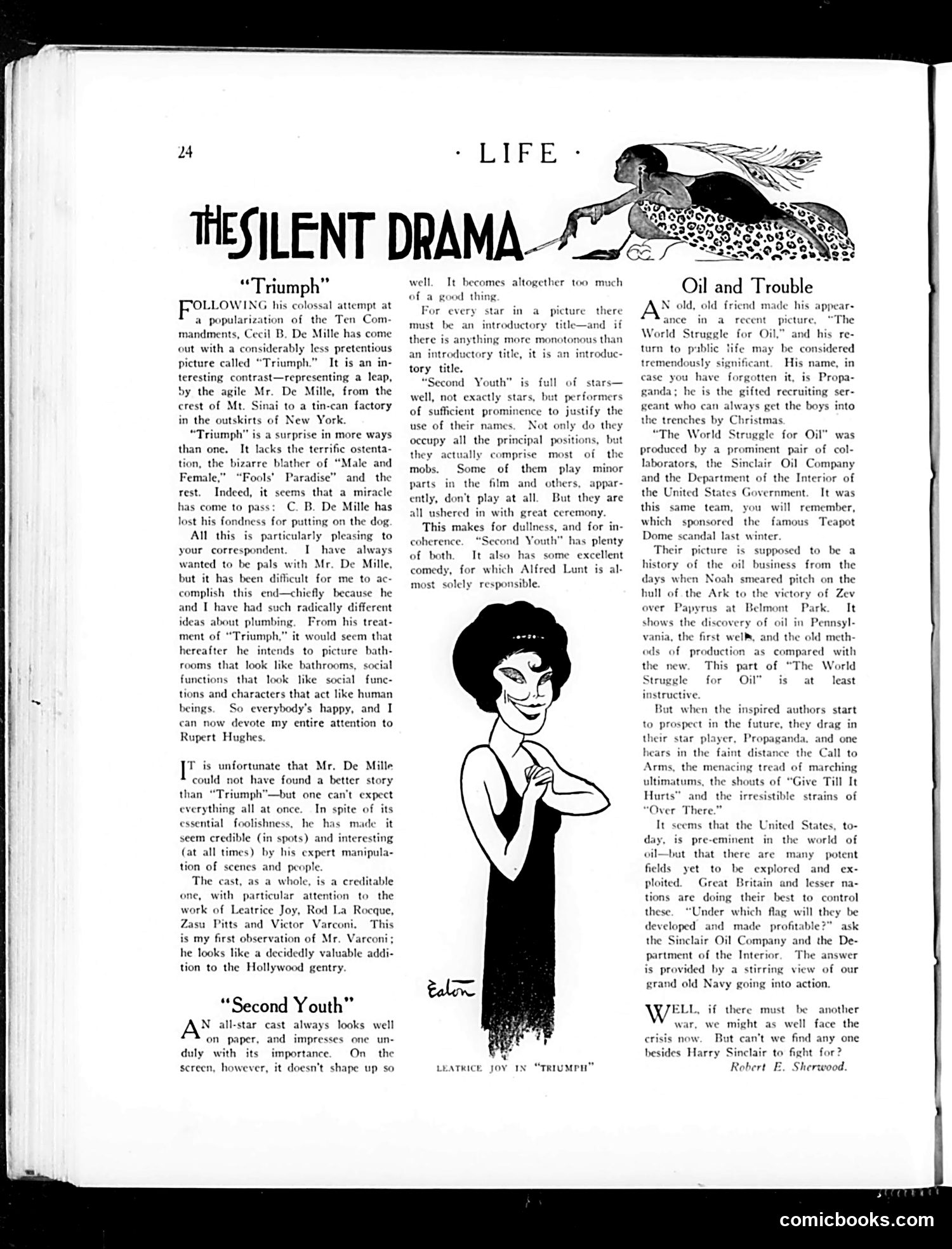
This Life magazine page reviews three films and satirizes one through its "Oil and Trouble" section. The main satire targets **"The World Struggle for Oil,"** produced jointly by the Sinclair Oil Company and the U.S. Department of the Interior. The reviewer mocks this as transparent propaganda—a film designed to recruit public support for oil industry interests under government cover. The reference to **Teapot Dome scandal** is crucial: this was a major 1920s corruption case where Secretary of the Interior Albert Fall secretly leased federal oil reserves to private companies. The reviewer sarcastically notes the same "team" (Interior Department + oil companies) that orchestrated that scandal now sponsors this film, suggesting the government-industry partnership remains self-serving propaganda rather than genuine public interest. The film's historical framing (Noah to modern times) is presented as cynical mythologizing designed to legitimize oil exploitation. The reviewer's tone is sharply critical of what he sees as shameless political manipulation dressed as entertainment.
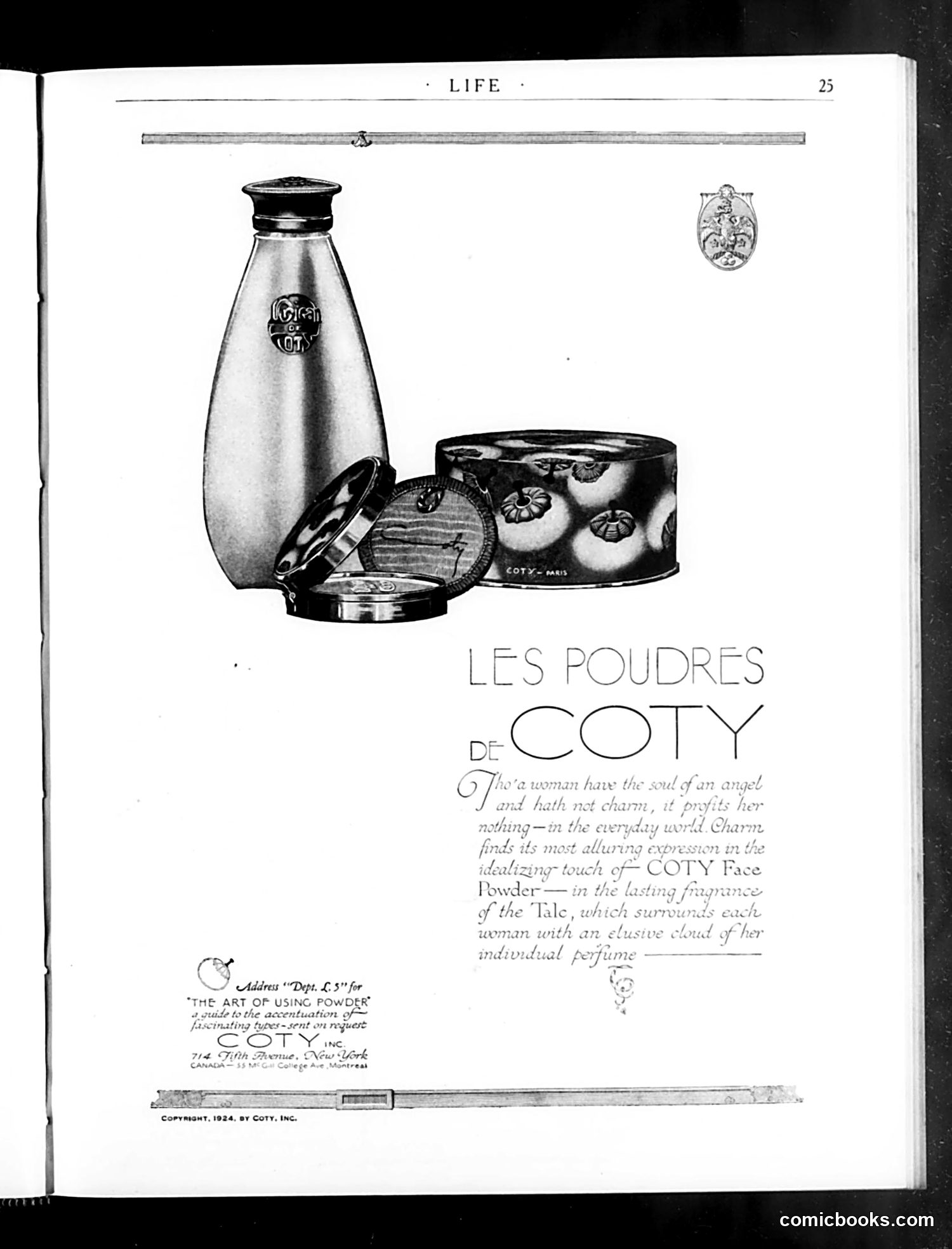
This is a **beauty product advertisement**, not a political cartoon. The page promotes "Les Poudres de Coty," a face powder brand, from 1924. The ad uses romantic, aspirational language typical of 1920s cosmetics marketing. It claims that Coty Face Powder allows women to express "charm" and create "an elusive cloud of her individual perfume" — suggesting that powder application is an art form enhancing feminine appeal. The visual shows the product (powder compacts and perfume bottle) alongside what appears to be a small oval portrait or emblem at top right. For modern readers, this reflects early-20th-century gender marketing that equated cosmetics with beauty, charm, and personal identity — common advertising rhetoric before modern critiques of beauty standards emerged.
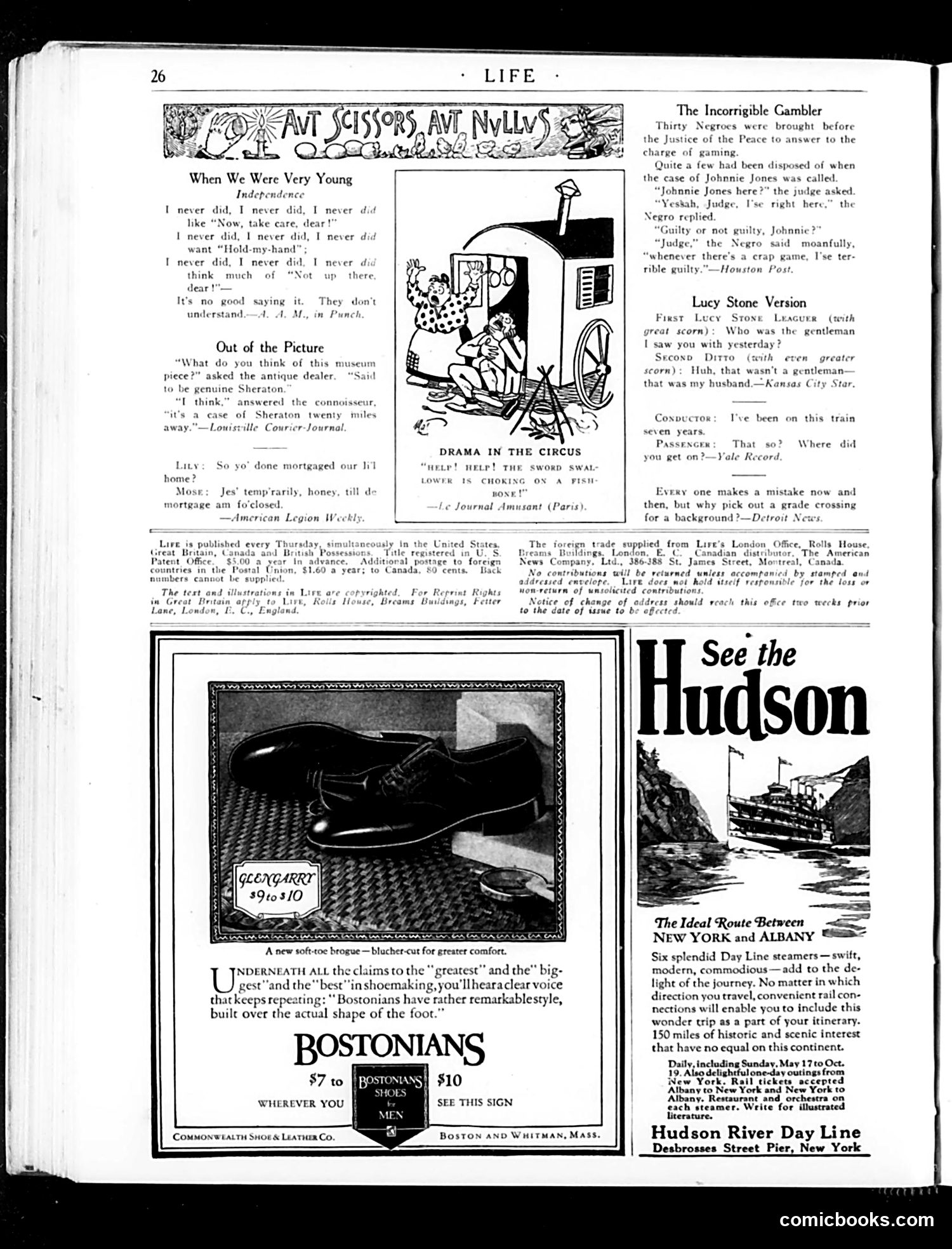
This page contains several brief humorous pieces typical of Life's satirical format: **"When We Were Very Young"** presents a poem about childhood independence, likely mocking sentimental nostalgia. **"Out of the Picture"** jokes about an antique dealer's assessment—the connoisseur dismisses a "genuine Sheraton" as worthless, inverting expectations about expertise and value. **"Drama in the Circus"** references a sword-swallower choking on a fish—absurdist humor about performance gone wrong. **"The Incorrigible Gambler"** depicts a court scene with a Black defendant ("Johnnie Jones") charged with gambling/crap games, using dialect humor common to the era. The "Lucy Stone Version" parodies this with a middle-class woman's analogous marital complaint. The remaining items are conversational humor snippets. The page is primarily filled with period advertisements (Bostonians shoes, Hudson River Day Line steamers), making this a typical commercial-editorial mix from this era of Life magazine.
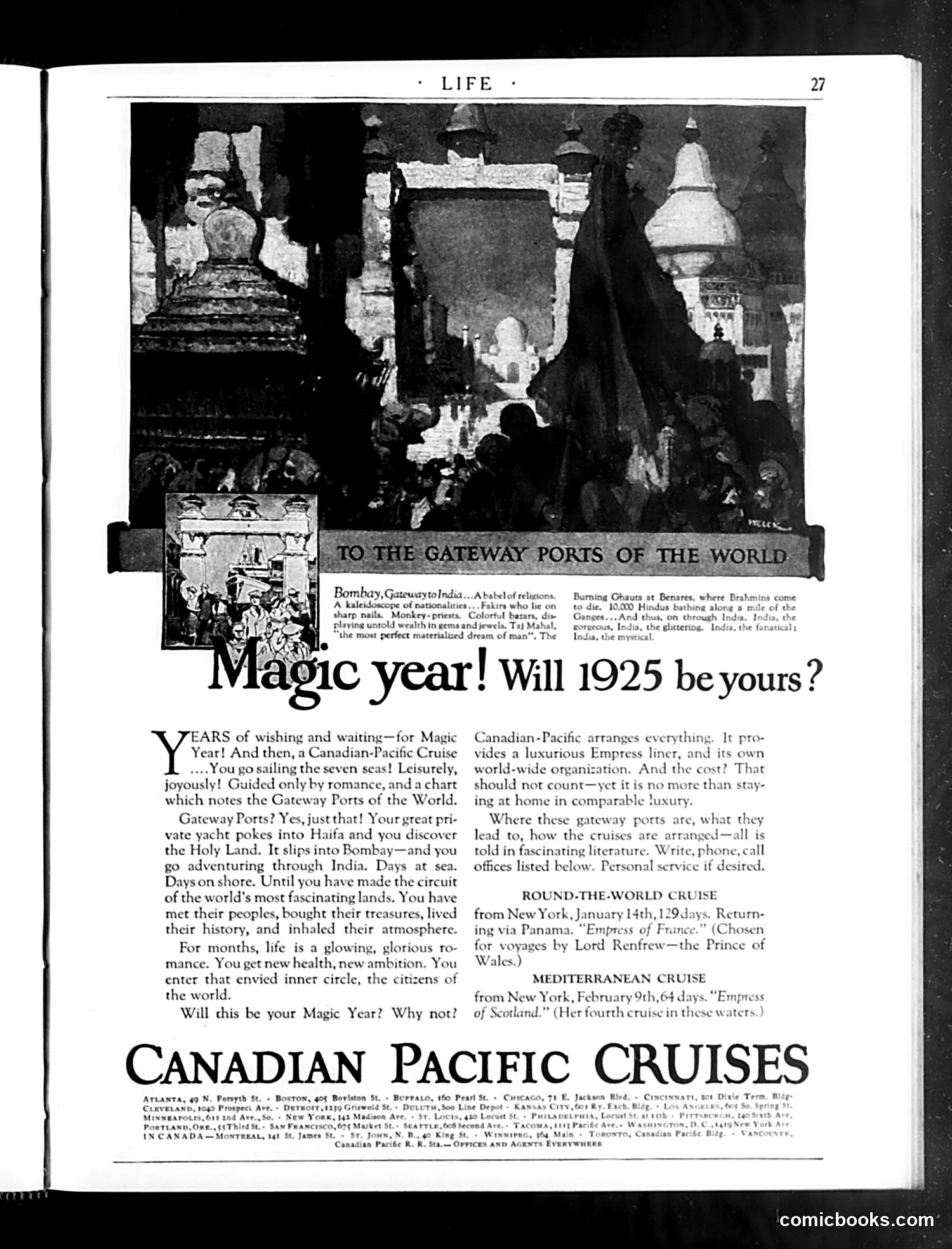
This is primarily a **luxury travel advertisement**, not political satire. The "Magic Year" headline appeals to wealthy Americans with exotic cruise fantasies—visiting "Gateway Ports of the World" including Haifa, Bombay, and Benares. The small illustration at top shows **romanticized colonial-era imagery**: Indian architecture (domes, minarets), temples, and monuments like the Taj Mahal. The text beneath uses orientalist language—"babel of religions," "fakirs," "burning ghats"—that frames India as mysterious, spiritual, and picturesque for Western consumption. The satire (if any) is implicit: the ad promises escapism and prestige ("envied inner circle, the citizens of the world") while reducing entire cultures to scenic backdrops for wealthy tourists. The phrase "your great private yacht" and dismissive "the cost? That should not count" reflects 1920s class privilege during the Jazz Age. **No specific political figures or caricatures are present.** This is lifestyle advertising aimed at affluent readers.
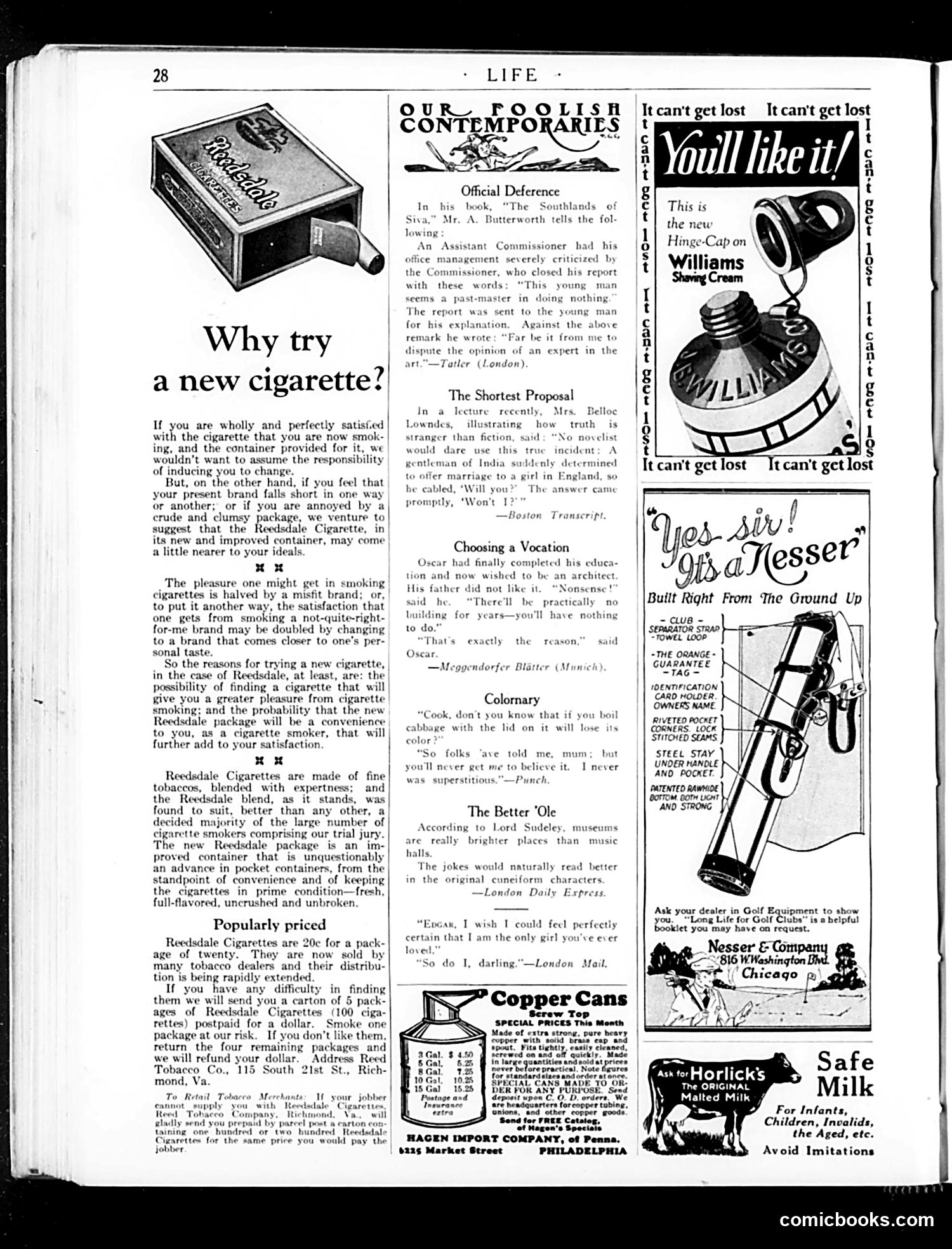
This page consists primarily of **advertisements interspersed with brief satirical anecdotes**, labeled "Our Foolish Contemporaries." The dominant ad is for **Reedsdale Cigarettes**, featuring a standard persuasive pitch about superior quality and convenient packaging—typical early 20th-century tobacco marketing. The satirical section offers short humorous stories mocking human behavior. Examples include an official's overly deferential response to criticism ("I wouldn't presume to challenge an expert"), a comically blunt marriage proposal ("Won't I?"), a father's circular logic discouraging his son from architecture, and a cook insisting she's not superstitious. These anecdotes target bureaucratic absurdity, social awkwardness, and working-class speech patterns. Other product ads on the page include **Hinge-Cap Williams Shaving Cream**, **Cooper Cans**, and **Horlick's Malted Milk**—all presented with period-appropriate graphics. The page reflects *Life*'s mix of consumer advertising and gentle satirical commentary on contemporary manners and speech.
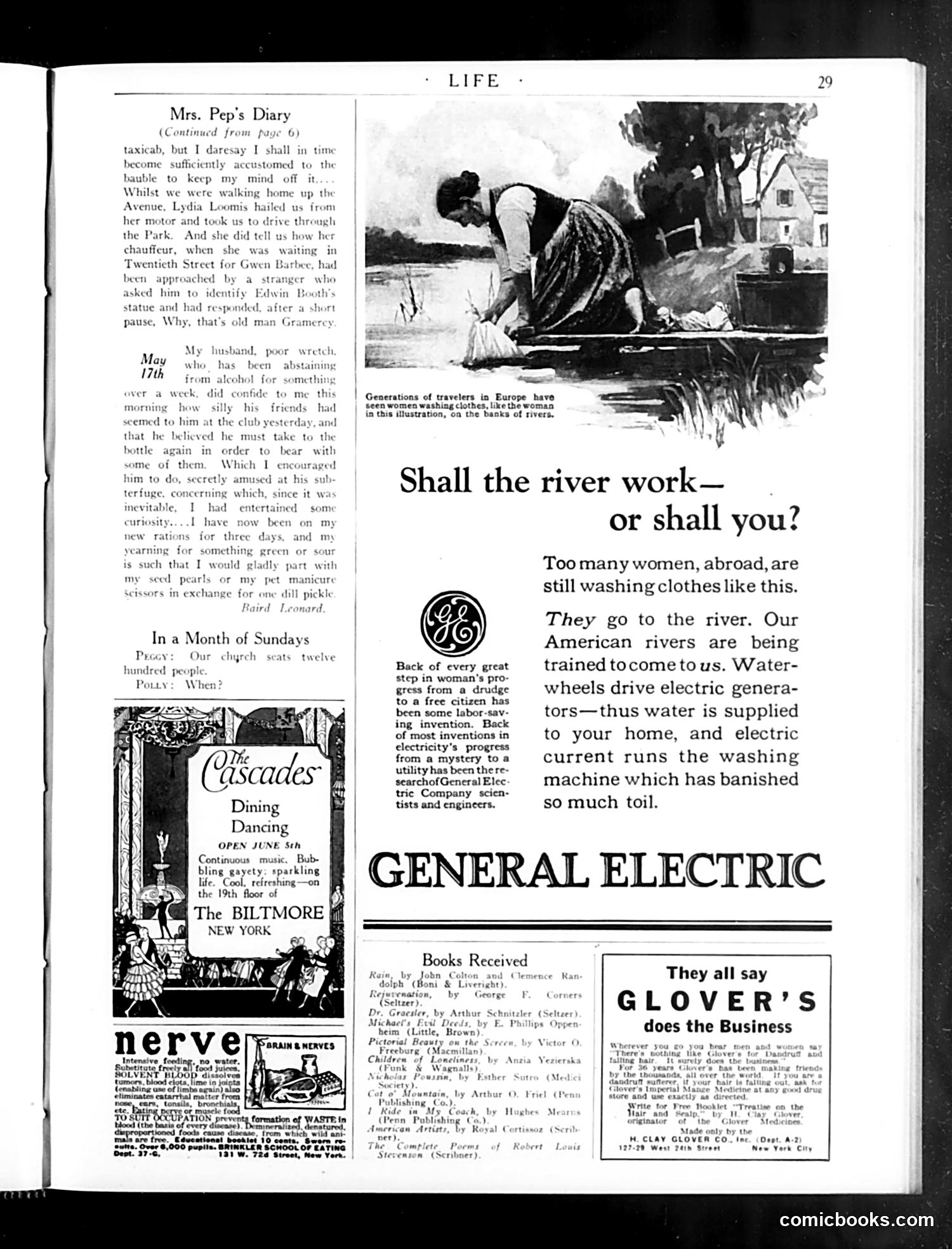
This page contains a **General Electric advertisement** disguised as editorial content, using implicit cultural comparison to promote electric washing machines to American women. The advertisement shows a photograph of a European woman hand-washing clothes in a river—presented as a visual of "backward" labor. The headline "Shall the river work—or shall you?" creates a rhetorical contrast: European women still rely on rivers and manual labor, while American women can embrace modernity through electric-powered home washing machines. The satire is directed at **gender roles and technological progress**: the ad suggests that American women's liberation from drudgery depends on adopting electric appliances. It frames washing machines not merely as conveniences but as symbols of American superiority and female advancement. The implication is that "civilized" women use electricity; others remain trapped in primitive, exhausting labor. This reflects early 20th-century marketing that conflated consumerism with female empowerment and American modernity.
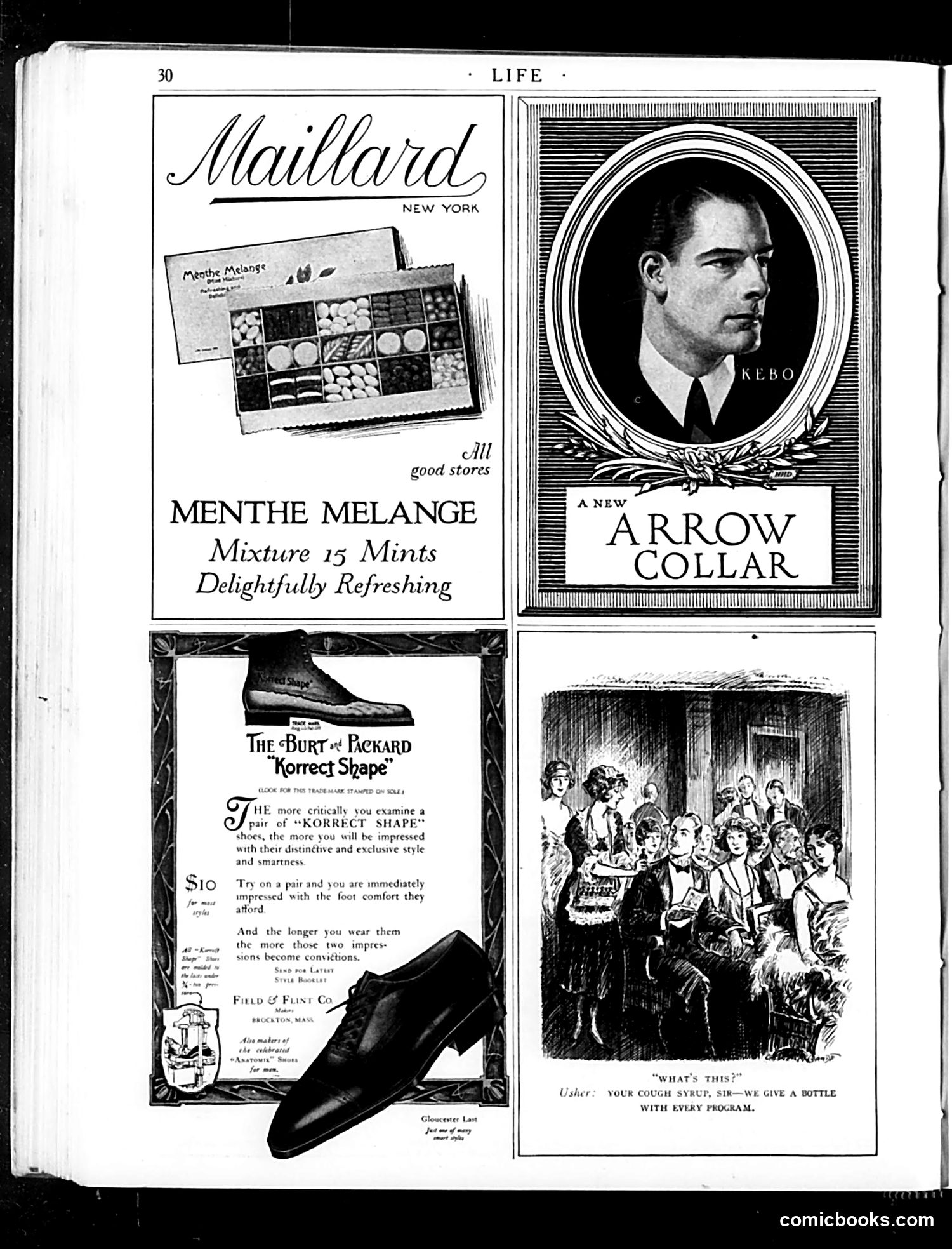
This is primarily a **advertisements page** from Life magazine, not satirical content. The page contains four commercial ads: 1. **Maillard** candy (top left): "Menthe Melange" mints 2. **Arrow Collar** (top right): Features a man in profile wearing the collar—a major brand of the era 3. **Burt & Packard shoes** (bottom left): "Korrect Shape" footwear priced at $10 4. **Cough syrup promotion** (bottom right): A cartoon showing an usher offering complimentary cough syrup with theater program purchases The only humorous element is the bottom cartoon, which jokes about theaters giving away cough syrup—implying audiences coughed frequently during performances, making the "gift" both practical and gently mocking. This reflects early 20th-century advertising practices and consumer goods marketed to middle-class Americans.
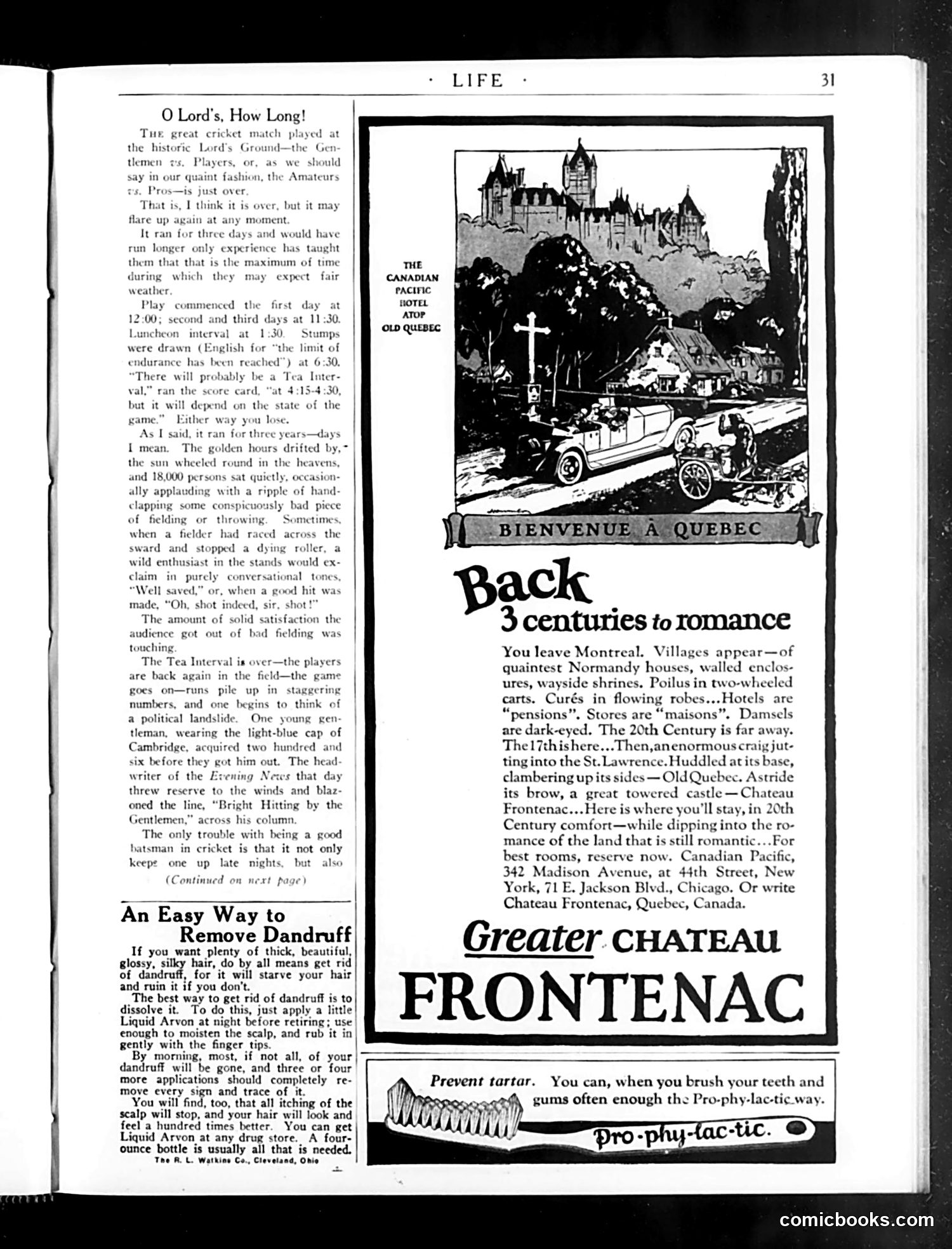
This page from *Life* magazine contains primarily **advertisements** rather than political satire or editorial cartoons. The main content is a humorous article about cricket at Lord's Ground, satirizing the sport's tedious length—the match ran three days with multiple scheduled interruptions (lunch, tea), yet produces minimal entertainment. The satire mocks British cricket culture: spectators sit quietly for hours, applauding politely, while the article implies the sport is more about endurance than excitement. The remaining space features **commercial advertisements**: a dandruff remedy (Liquid Arvon), a toothpaste (Pro-phy-lac-tic), and a prominent travel ad for the Chateau Frontenac hotel in Quebec, marketing "romance" and old-world charm to American tourists. No political figures or caricatures appear on this page. The humor is situational—poking fun at British sporting conventions—rather than satirical commentary on current events or public figures.
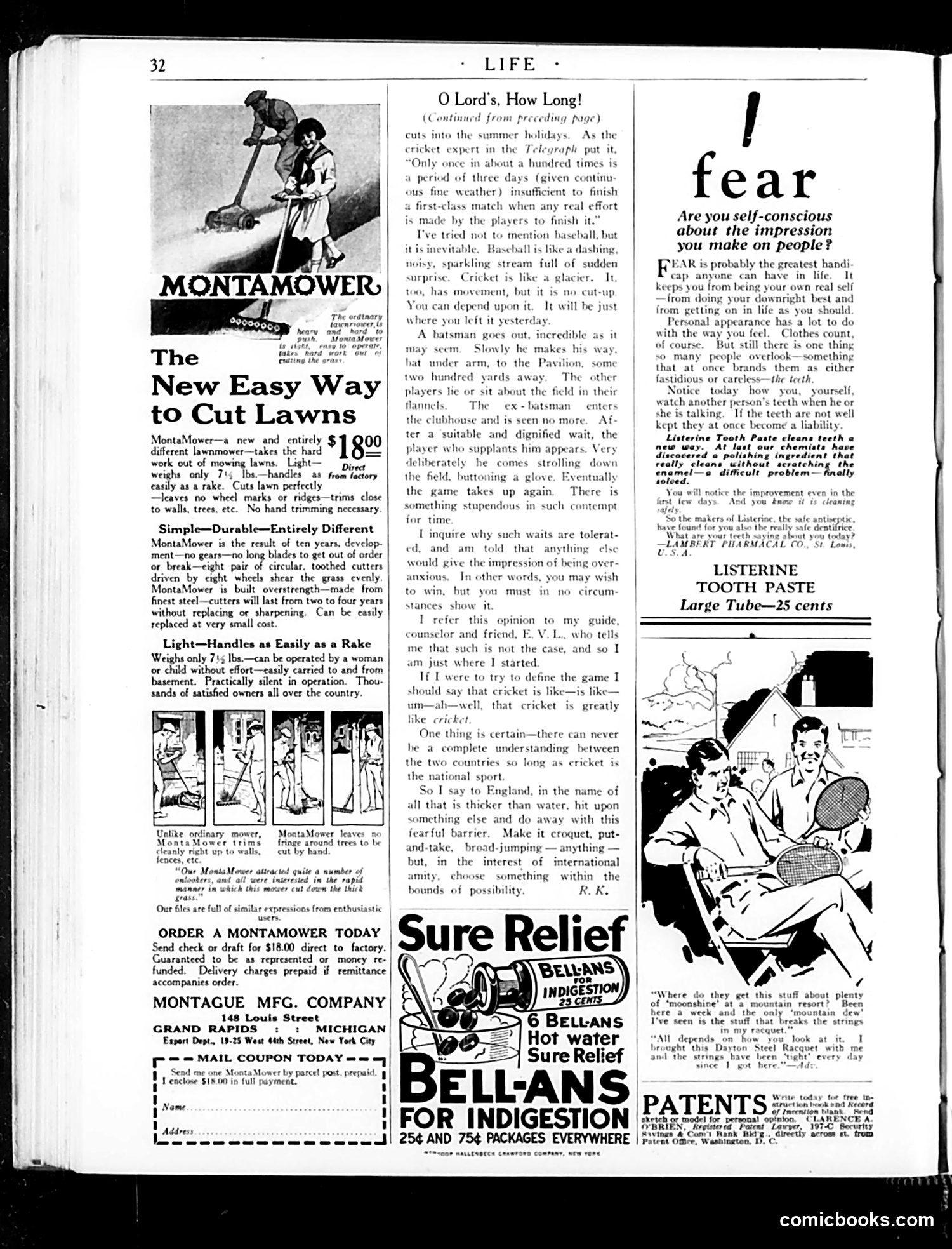
This page contains British cricket satire alongside advertisements. The main article, "O Lord's, How Long!" (continued from a previous page) compares cricket unfavorably to baseball. The author expresses bewilderment at cricket's glacial pace—matches can last three days of continuous fine weather and still not finish. He contrasts this with baseball's "dashing, noisy, sparkling" energy. The satire targets cricket's cultural importance in Britain and Anglo-American cultural differences. The author humorously suggests England should abandon cricket for croquet or another sport to improve international relations, since Americans (and apparently he) find cricket incomprehensibly tedious. The page also features advertisements for the MontaMower (an early mechanical lawnmower), Listerine toothpaste, and Bellans indigestion remedy—typical early 20th-century products aimed at middle-class readers concerned with modern convenience and personal grooming.
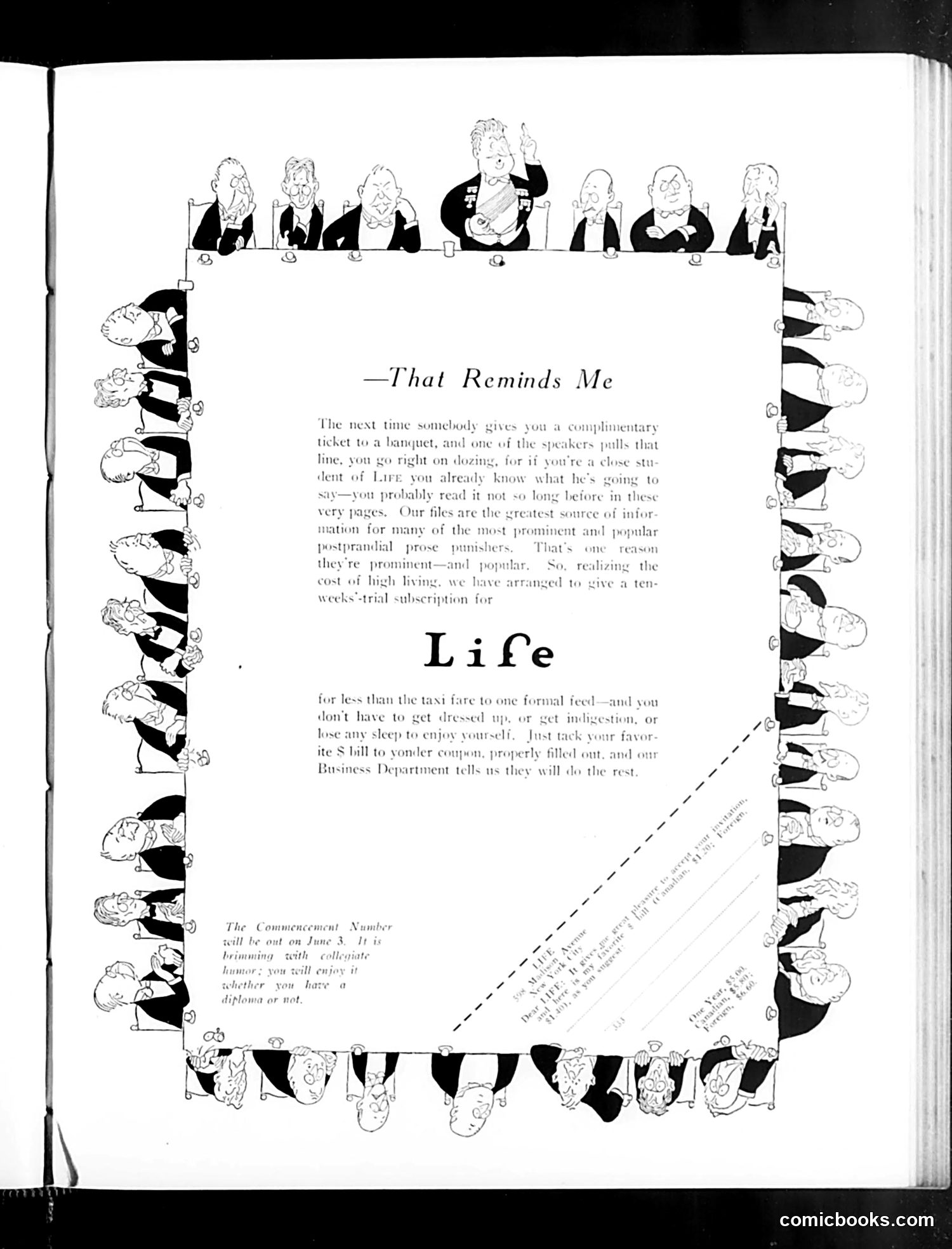
This page is primarily an **advertisement for Life magazine subscriptions**, not a political cartoon. The border features caricatured heads of men in formal attire (tuxedos), likely representing prominent public figures or types of banquet attendees—suggesting Life's appeal to an educated, sophisticated audience. The text humorously pitches a subscription by claiming Life's "files are the greatest source of information" about prominent figures and events. It suggests that rather than enduring tedious banquet speeches, readers should simply subscribe to Life for ten weeks at minimal cost to stay informed. The joke plays on the reader's assumption they already know what speakers will say at formal events, making Life a more efficient alternative to attending such gatherings. This reflects early-to-mid 20th century advertising strategy targeting affluent, socially-engaged readers.
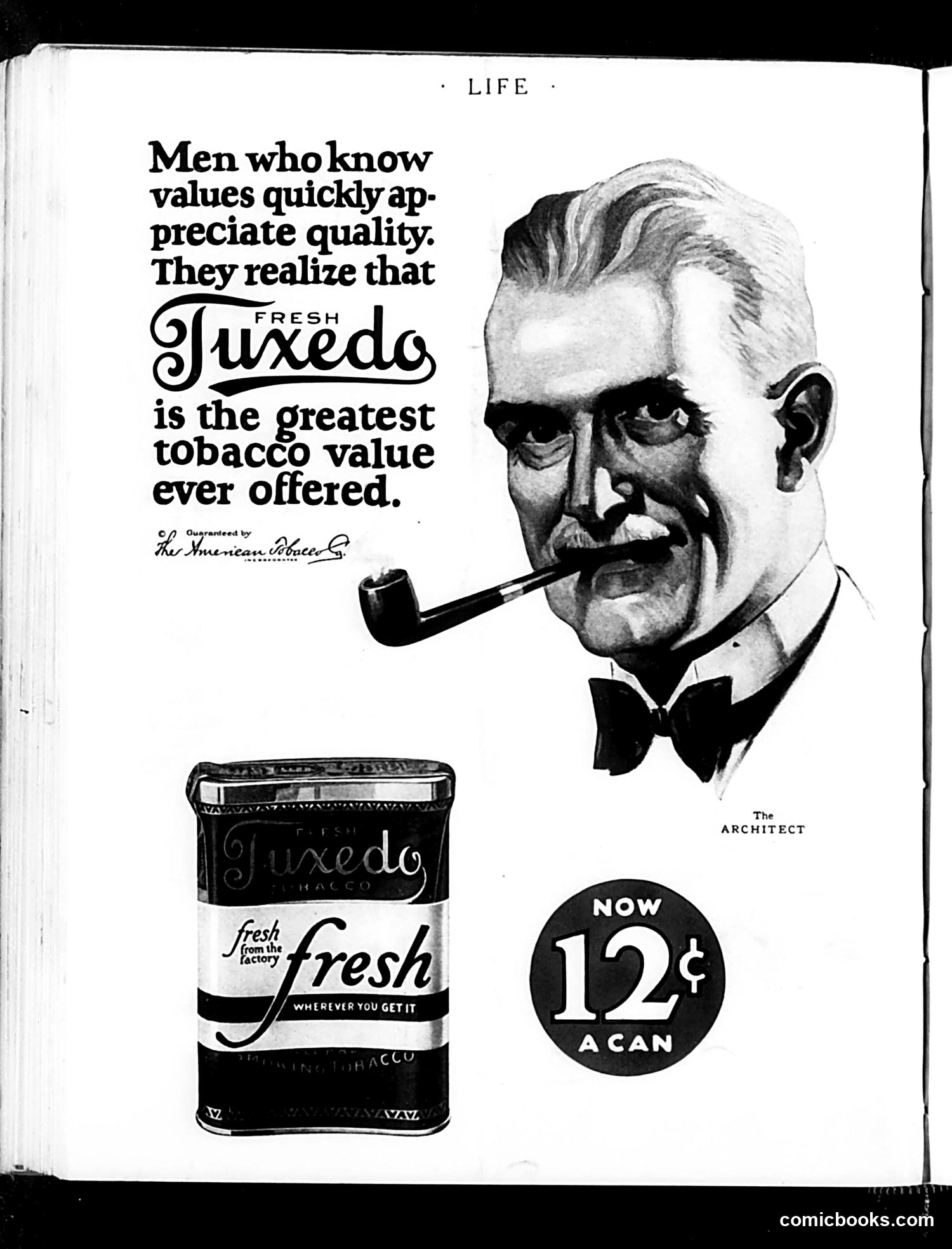
This is a **tobacco advertisement**, not political satire. It features a man in formal attire (bow tie, smoking pipe) labeled "The Architect," presented as an authority figure who appreciates quality. The ad's central claim is that "Fresh Tuxedo" tobacco represents exceptional value for discerning men. The phrase "Men who know values quickly appreciate quality" appeals to masculine pride and expertise. The price point—"NOW 12¢ A CAN"—suggests this was promotional advertising during an era (likely early-to-mid 20th century) when tobacco was heavily marketed without health warnings. The "Architect" persona implies refinement and good judgment, attempting to associate the product with professional success and sophisticated taste. This reflects period advertising conventions before tobacco advertising restrictions were implemented.