
Life, 1924-05-22 · page 16 of 36
Life — May 22, 1924 — page 16: what you’re looking at
What you’re looking at
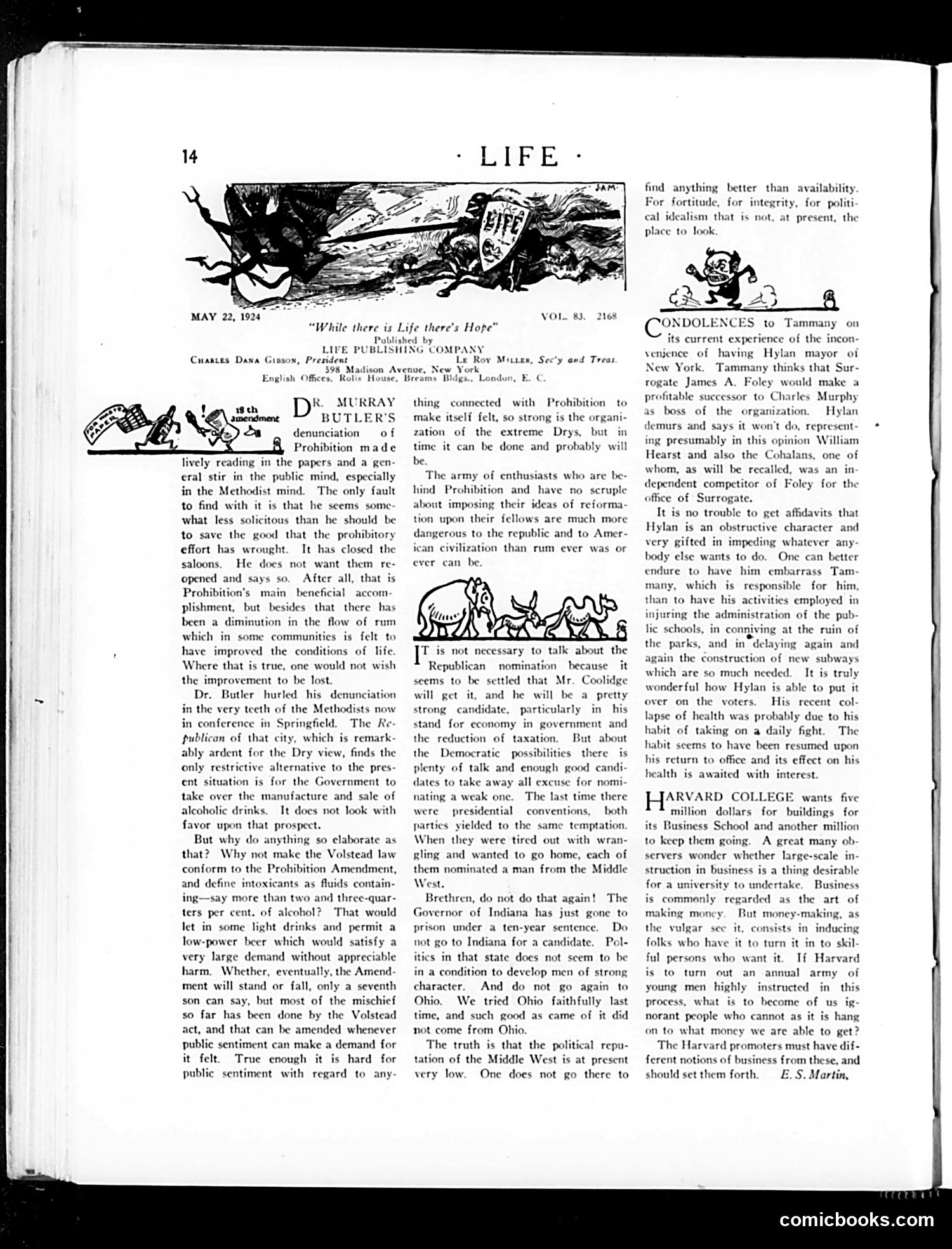
This page contains editorial commentary on Prohibition and politics, accompanied by a small cartoon at the top. The main text critiques Dr. Murray Butler's denunciation of Prohibition, arguing the policy—while imperfect—has genuinely improved public conditions by closing saloons. The author contends that rather than abandoning Prohibition, the government should regulate alcohol manufacture and sales. The second section discusses the 1924 Republican presidential nomination, noting that Coolidge appears likely to win. It mocks the parties' nominating processes, referencing candidates from the Middle West and Indiana specifically. The commentary suggests the political reputation of that region is currently "very low." The small cartoons serve as visual punctuation to these satirical observations about American governance and alcohol policy.
📄 Transcribed text from this page (OCR, searchable)
Machine-transcribed from the original scan — historical spelling and the odd misread are preserved.
While there is Life there's Hope” Published by LIFE PUBLISHING COMPANY Cuanies Dawa Ginsox, President Le Roy Mien, Sec'y and Treas $98 Madison Avenue, New York English Offices, Rolis House, D* MURRAY BUTLER’S denunciation of Prohibition made lively reading in the papers and a gen- eral stir in the public mind, especially in the Methodist mind. The only fault to find with it is that he seems some what less solicitous than he should be to save the good that the prohibitory effort has wrought. It has closed the saloons. He does not want them re- opened and says so. After all, that is Prohibition’s main beneficial accom- plishment, but besides that there has been a diminution in the flow of rum which in some communities is felt to have improved the conditions of life. Where that is true, one would not wish amendment the improvement to be lost. Dr. Butler hurled his denunciation in the very teeth of the Methodists now in conference in Springfield, The Re- publican of that city, which is remark ably ardent for the Dry view, finds the only restrictive alternative to the pres- ent situation is for the Government to take over the manufacture and sale of alcoholic drinks. It does not look with vor upon that prospect. But why do anything so elaborate as that? Why not make the Volstead law conform to the Prohibition Amendment, and define intoxicants as fluids contain- ing—say more than two and three-quar- ters per cent. of alcohol? That would let in some light drinks and permit a low-power beer which would satisfy a very large demand without appreciable harm. Whether, eventually, the Amend- ment will stand or fall, only a seventh son can say, but most of the mischief so far has been done by the Volstead act, and that can be amended whenever public sentiment can make a demand for it felt. True enough it is hard for public sentiment with regard to any- Breams Bldgs., London, E. ( thing connected with Prohibition to make itself felt, so strong is the organi- zation of the extreme Drys, but in time it can be done and probably will be. The army of enthusiasts who are be- hind Prohibition and have no scruple about imposing their ideas of reforma- tion upon their fellows are much more dangerous to the republic and to Amer- ican civilization than rum ever was or ever can be. Ce, PM) Sa fio TZ PROP eR I" is not necessary to talk about the Republican nomination because it seems to be settled that Mr. Coolidge will get it, and he will be a pretty strong candidate, particularly in his stand for economy in government and axation. But about the Democratic possibilities there is the reduction of plenty of talk and enough good candi- dates to take away all excuse for nomi- nating a weak one. The last time there were presidential conventions, both parties yielded to the same temptation. When they were tired out with wran- gling and wanted to go home, each of them nominated a man from the Middle West. Brethren, do not do that again! The Governor of Indiana has just gone to prison under a ten-year sentence. Do go to Indiana for a candidate. Pol- s in that state does not scem to be in a condition to develop men of strong character. And do not go again to Ohio. We tried Ohio faithfully last time, and such good as came of it did not come from Ohio. The truth is that the politi repu- tation of the Middle West is at present very low. One does not go there to find anything better than availability For fortitude, for integrity, for politi cal idealism that is not, at present, the place to look Ee ES) CONDOLENCES to Tammany on its current experience of the incor venjence of having Hylan mayor of New York. Tammany thinks that Sur- rogate James A. Foley would make a profitable successor to Charles Murphy as boss of the organization. Hylan demurs and says it won't do, represent- ing presumably in this opinion William Hearst and also the Cohalans, one of whom, as will be recalled, was an in dependent competitor of Foley for the office of Surrogate. It is no trouble to get affidavits that Hylan is an obstructive character and very gifted in impeding whatever any body else wants to do. One can better endure to have him embarrass Tam- many, which is responsible for him, than to have his activities employed in injuring the administration of the pub- lic schools, in conniving at the ruin of the parks, and in*delaying again and again the construction of new subways which are so much needed. It is truly wonderful how Hylan is able to put it over on the voters. His recent col lapse of health was probably due to his habit of taking on a daily fight. The habit seems to have been resumed upon his return to office and its effect on his health is awaited with interest. HArvarp COLLEGE wants five million dollars for buildings for its Business School and another million to keep them going. A great many ob servers wonder whether large-scale in- struction in business is a thing desirable for a university to undertake. Business is commonly regarded as the art of making money. But money-makin the vulgar see it, consists in inducing folks who have it to turn it in to skil ful persons who want it. If Harvard is to turn out an annual army of young men highly instructed in this process, what is to become of us i; norant people who cannot as it is hang on to what money we are able to get? The Harvard promoters must have dif- ferent notions of business from these, and should set them forth E. S. Martin, comicbooks.com