
Life, 1924-05-22 · page 24 of 36
Life — May 22, 1924 — page 24: what you’re looking at
What you’re looking at
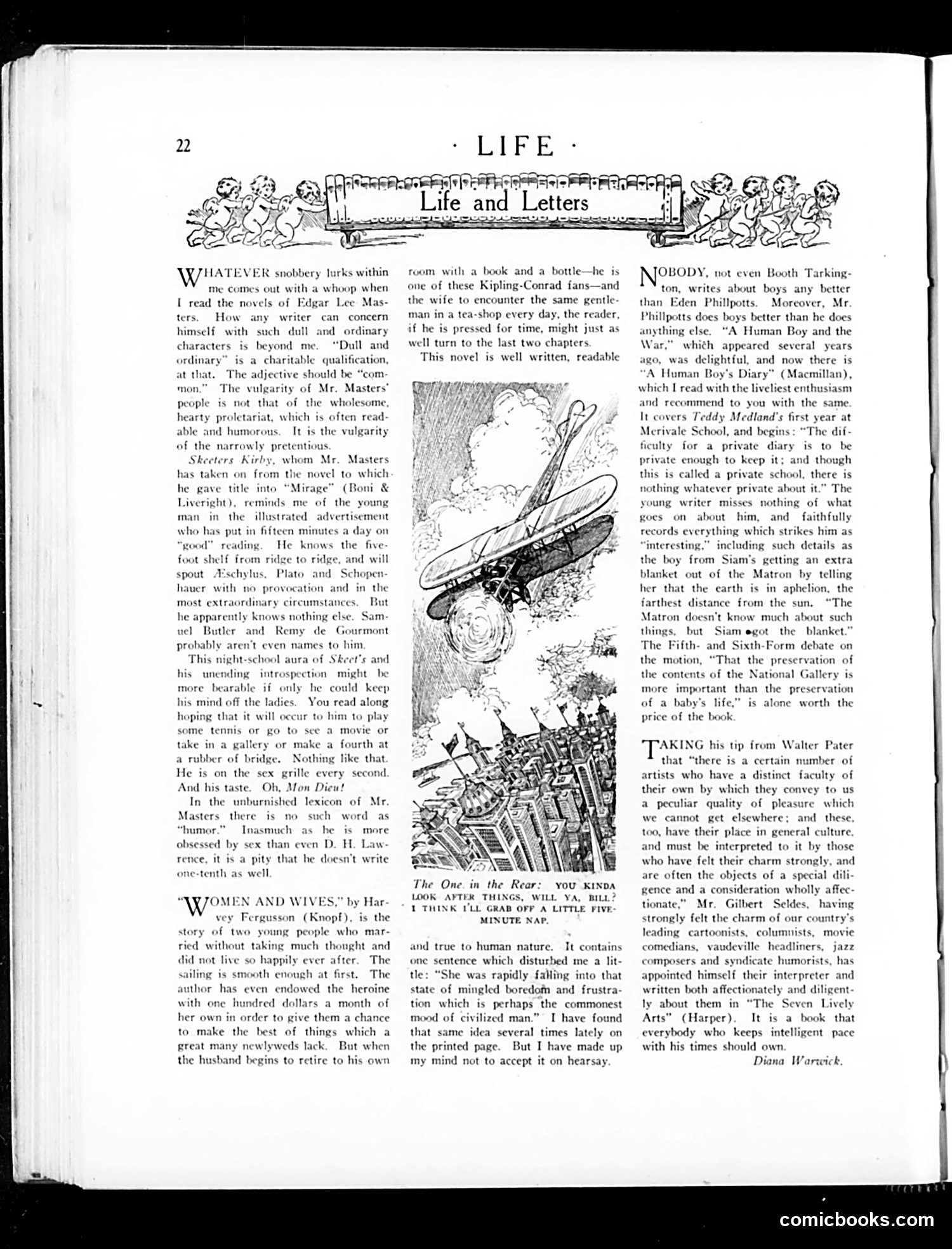
This is a literary review section titled "Life and Letters." The page critiques several novels, with one illustration showing a man napping in what appears to be a train or vehicle while another man asks to take his turn watching things. The reviews discuss: 1. **Edgar Lee Masters' work** — criticized for featuring vulgar, pretentious working-class characters lacking depth or sophistication 2. **"Women and Wives" by Harvey Fergusson** — about a young married couple whose relationship falters when the husband becomes a reclusive book-and-alcohol enthusiast (a Kipling-Conrad fan), while the wife encounters the same gentleman daily in a tea-shop 3. **Eden Phillpotts' "A Human Boy's Diary"** — praised for authentic depiction of a schoolboy's first year at Merivale School, faithfully recording amusing details The cartoon's simple joke (bottom left) shows exhaustion during travel—one man requests relief from watching belongings so he can nap. The page reflects early 20th-century literary taste and class consciousness regarding character portrayal in fiction.
📄 Transcribed text from this page (OCR, searchable)
Machine-transcribed from the original scan — historical spelling and the odd misread are preserved.
ER snobbery lurks within me comes out with a whoop when I read the novels of Edgar Lee Mas- ters. How any concern himself with such dull and ordinary characters is beyond me. “Dull and ordinary” is a charitable qualification, at that. The adjective should be “com The vulgarity of Mr. Masters’ peopl that of the wh hearty proletariat, which is often read writer can is not lesome able and humorous. It is the vulgarity of the narrowly pretentious Skeeters Kirby, whom Mr has taken on from the novel to which he gave title into “Mirage” (Boni & Liveright), reminds me of the young man in the illustrated advertisement who has put in fifteen minutes a ¢ knows the five and will Masters “good” reading. He foot shelf from ridge to ridge Aeschyl Plato and hauer with no provec spout Schopen tion and in. the nary circumstances. But Sam- most extraord he apparently knows nothing else. uel Butler and Gourmont obably aren't even Remy de mes to him. his night-school aura of Skeet’s and his unending introspection might be more bearable if only he could keep his mind off the ladies. You read along hoping that it will occur to him to play some movie or take in a gallery or make a fourth at idge. Nothing like that sex grille every Oh, Mon Die unburnished lexicon of Mr. tennis or go to sce a rubber of b He is on the And his taste. In_ the Masters “humor.” — In. second. there is no such word as much as he is more obsessed by sex than even D. H. Law- rence, it is a pity that he doesn’t write one-tenth as well “VYJOMEN AND WIVES,” by Har vey Fergusson (Knopf), is the story ef two young people who mar- ried without taking much thought and did not live so happily ever after. The The author has even endowed the heroine with one hundred dollars a month of her own in order to give them a chance to make the best of things which a great many newlyweds lack. But when the husband begins to retire to his own ailing is smooth enough at first. LIFE - eu, lsife and Letters room with a book and a bottle—he is one of these Kipling-Conrad fans—and the wife to encounter the same gentle man in a tea-shop every day, the reader, if he is pressed for tim ht just as well turn to the last two chapters This novel is well written, readable The One. in the Rear: you KINDA LOOK AYTER THINGS, WILL YA, BILL? 1 THINK ULL GRAB OFF A LITTLE FIVE MINUTE Nap. human nature. It contains one sentence which disturbed me a lit- tle: “She was rapidly falling into that state of mingled boredofMm and frustra- tion which is perhaps the commonest mood of civilized man.” I have found that same idea several times lately on the printed page. But I have made up my mind not to accept it on hearsay and true Nosovy. not even Booth Tarking- ton, writes about boys any better than Eden Phillpotts. Moreover, Mr Phillpotts does boys better than he does anything else. “A Human Boy and the War,” whith appeared several years », was delightful, and now there is “A Human Boy's Diary” (Macmillan), which I read with the liveliest enthusiasm and recommend to you with the same. It covers Teddy Medland’s first year at Merivale School, and begins he dif- ficulty for a private diary is to be private enough to keep it; and though this is called a private school, there is nothing whatever private about it.” The young thing of what him, and faithfully records everything which strikes him as “interesting,” including such details as the boy from Siam’s getting an extra blanket out of the Matron by telling her that the earth is in aphelion, the farthest distance from the sun. “The Matron doesn't know much about such things, but am egot the blanket.” The Fifth- and Sixth-Form debate on the motion, “That the preservation ¢ the contents of the National Gallery is writer misses 1 goes on about more important than the preservation of a baby’s life,” is alone worth the price of the book KING his tip from Walter Pater that “there is a certain number of artists who have a distinct ity of their own by which they convey to us a peculiar quality of pl we cannot get elsewhere too, have their place in general culture. and must be interpreted to it by those who have felt their charm strongly, and are often the objects which these, asure a special dili- gence and a consideration wholly affe tionate,” Mr. Gilbert Seldes, having strongly felt the charm of our country’s leading cartoonists, columnists, comedians, vaudeville jazz composers and syndicate humorists, has appointed himself their interpreter and written both affec ately and diligent- ly about them in “The Seven Lively Arts” (Harper). It is a book that everybody who keeps intelligent pace with his times should own. Diana Wa movie headliners, comicbooks.com