
Life, 1924-05-22 · page 20 of 36
Life — May 22, 1924 — page 20: what you’re looking at
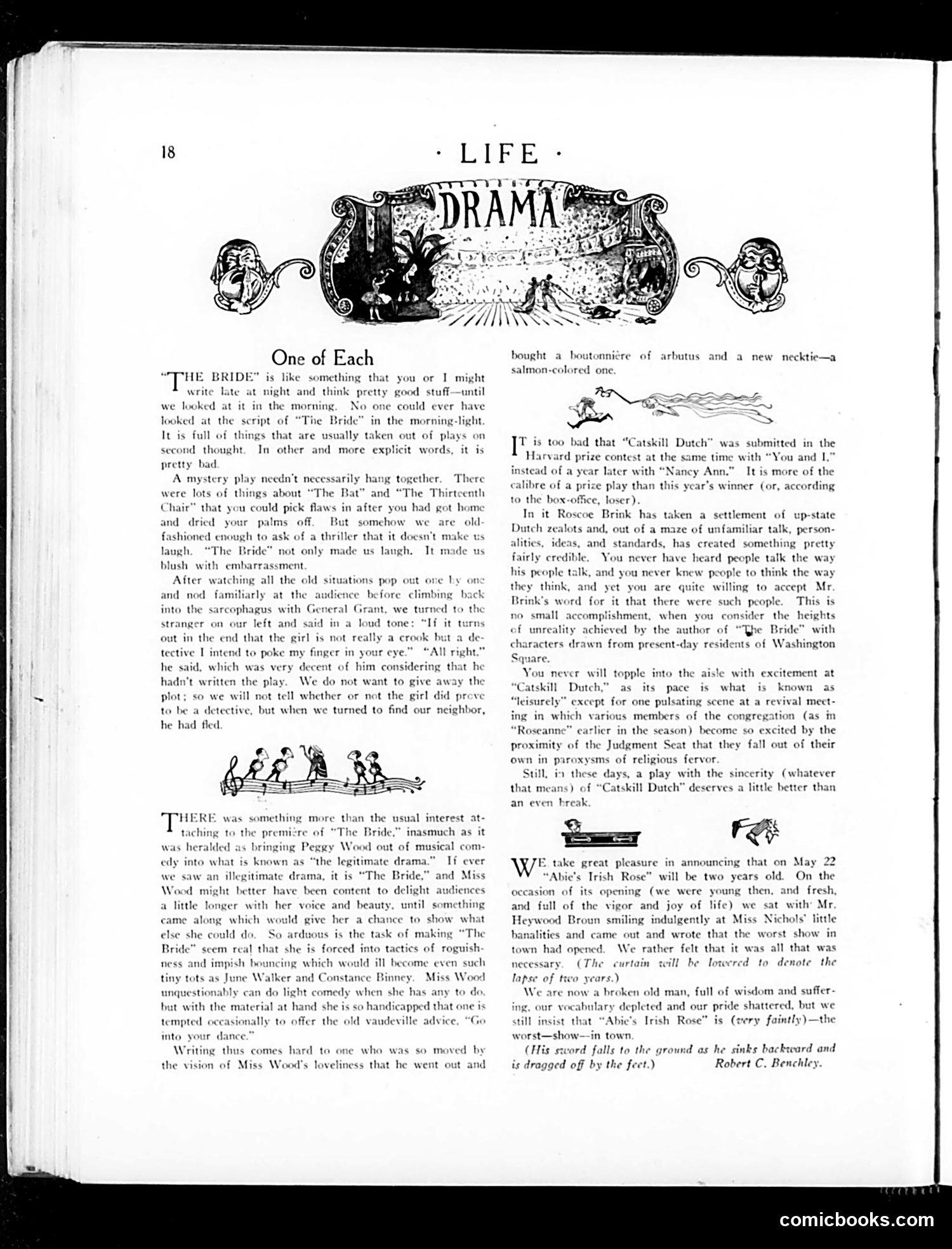
A restored page from Life, 1924-05-22. Page through the whole issue in the reader above.
📄 Transcribed text from this page (OCR, searchable)
Machine-transcribed from the original scan — historical spelling and the odd misread are preserved.
One of Each 4 fists BRIDE” is like something that you or I might write late at night and think p: od stuff—until we looked at it in the morning could ever have looked at the script of “The Bride” in the morning-light: It is full of things that are usually taken out of In other and more explicit words, it is plays on second thought pretty bad A mystery play needn't necessarily hang together. There were lots of things about “The Bat" and “The Thirteenth Chair” that you could pick flaws in after you had got hom and dried your palms off. But somehow we are old fashioned enough to ask of a thriller that it doesn't make us “The Tt made us blush with embarrassment After watching all the old situations pop and nod familiarly at the into the sarcophagus with General Grant. we turned to the loud tone: “If it t a crook but a de tective I intend to poke my finger in your eye.” “AI right.” n considering that he laugh, ride” not only made us laugh. one by on: udience before climbing back stranger on our left and said in in the end that the girl is not reall: he said, which was very decent of hadn't written the play. We do not want to give away the plot; so we will not tell whether or not the girl did prove to be a detective, but when we turned to find our neighbor, he had fled. HER taching to the premizre of © Bride.” was something me inasmuch was heralde s bringing Peggy Wood out of musical com- he legitimate drama.” we saw an ille mate drama, it is “The Bride,” and Miss Wood might better have been content to delight nces edy into what is known as Ii ever a little longer with her voice and beauty, until something came along which would give her a chance to show what S is the task of making “The cs of roguish else she could do. So are Bride” seem real that she is forced into ta uld ill become even such Miss Wood unquestionably can do light comedy when she has any to but with the material at hand she is so handicapped that one is tempted occasionally to r the old vaudeville advice, “Go ness and impish bouncing which w tiny tots as June Walker and Constance Binney into your dance.” Writing thus comes hard to one who was so moved by the vision of Miss Wood's loveliness that he went and bought a boutonniére of arbutus and a new necktie- salmon-colored one. I" ad that “Catskill Dutch” was submitted in the Harvard prize contest at the same time with “You and 1,” 4 year later with “Nancy Ann.” It is more of the a prize play than this year’s winner (or, according to the box-office, loser) instead o calibre In it Roscoe Brink has taken a settlement of up-state Dutch zealots and, out of a maze of unfamiliar talk, person- ties, ideas, and standards, has created something pretty fairly credible. You never have heard people talk the way his people talk, and you never knew people to think the way willing to accept Mr “s word for it that there were such people. This is small accomplishment, when you consider the heights f unreality achieved by the author of “Qhe Bride” with acters drawn from present-day residents of Washington they think, and yet you are You never will topple into the aisle with excitement at “Catskill, Dutch,” as its pace is what is “leisurely” except for one pulsating scene at a revival meet- known as ing in which various members of the congregation (as in “Roseanne” earlier in the season) become so excited by the proximity of the Judgment Seat that they fall out of their own in paroxysms of religious fervor Still, in these days, a play with the sincerity (whatever that means) of “Catskill Dutch” deserves a little better than an ev 22 take great pleasure in announcing that on May 22 Abic’s Irish Rose” will be two years old. On the W occasion of its opening (we were young then, and fresh, 1 of the vigor and joy of life) we sat with’ Mr eywood Broun smiling indulgently at Miss Nichols’ little alities and came out and wrote that the worst show in We rather felt that it was all that was iN be lowered to denote the town had oper necessary. (The curta’ lapse of We are now a broken old man, full ¢ ng. our vocabulary depleted and our pride shattered, but we ng still insist that bie’s Irish Rose” is (very faintly)—the vo years.) wisdom and suffer- worst—show—in town (His sword falls to the ground as he sinks backward and is dragged off by the feet.) Robert C. Benchle: comicbooks.com