
Life, 1924-05-22 · page 26 of 36
Life — May 22, 1924 — page 26: what you’re looking at
What you’re looking at
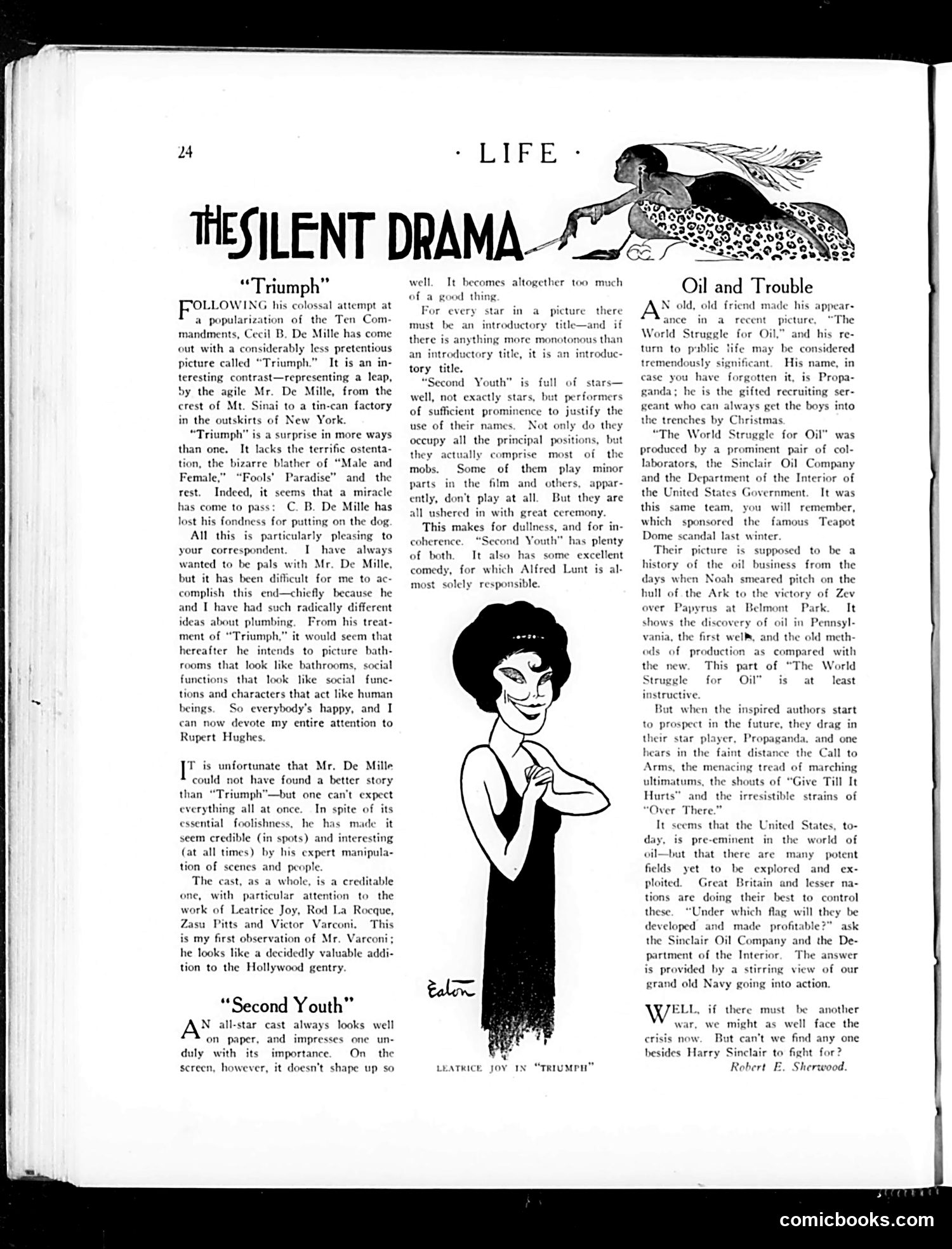
This Life magazine page reviews three films and satirizes one through its "Oil and Trouble" section. The main satire targets **"The World Struggle for Oil,"** produced jointly by the Sinclair Oil Company and the U.S. Department of the Interior. The reviewer mocks this as transparent propaganda—a film designed to recruit public support for oil industry interests under government cover. The reference to **Teapot Dome scandal** is crucial: this was a major 1920s corruption case where Secretary of the Interior Albert Fall secretly leased federal oil reserves to private companies. The reviewer sarcastically notes the same "team" (Interior Department + oil companies) that orchestrated that scandal now sponsors this film, suggesting the government-industry partnership remains self-serving propaganda rather than genuine public interest. The film's historical framing (Noah to modern times) is presented as cynical mythologizing designed to legitimize oil exploitation. The reviewer's tone is sharply critical of what he sees as shameless political manipulation dressed as entertainment.
📄 Transcribed text from this page (OCR, searchable)
Machine-transcribed from the original scan — historical spelling and the odd misread are preserved.
24 LIFE - TES|LENT DRAMA — “Triumph” ‘OLLOWING his colossal attempt at a popularization of the Ten Com- mandments, Cecil B, De Mille has come out with a considerably less pretentious picture called “Triumph.” It is an in- teresting contrast—representing a leap, by the agile Mr. De Mille, from the crest of Mt. Sinai to a tin-can factory in the outskirts of New York. “Triumph” is a surprise in more ways than one. It lacks the terrific ostenta- tion, the bizarre blather of “Male and Female,” “Fools’ Paradise” and the rest. Indeed, it seems that a miracle has come to pass: C. B. De Mille has lost his fondness for putting on the dog All this is particularly pleasing to your correspondent. I have always wanted to be pals with Mr. De Mille, but it has been difficult for me to ac- complish this end—chiefly because he and I have had such radically different ideas about plumbing. From his treat- ment of “Triumph,” it would seem that hereafter he intends to picture bath- rooms that look like bathrooms, social functions that look like social fune- tions and characters that act like human beings. So everybody's happy, and I can now devote my entire attention to Rupert Hughes. I is unfortunate that Mr. De Mille could not have found a better story than “Triumph”—but one can't expect everything all at once. In spite of its essential foolishness, he has made it seem credible (in spots) and interesting (at all times) by his expert manipula- tion of scenes and people. The cast, as a whole, is a creditable one, with particular attention to the work of Leatrice Joy, Rod La Rocque, Zasu Pitts and Victor Varconi. This is my first observation of Mr. Varconi; he looks like a decidedly valuable addi- tion to the Hollywood gentry. “Second Youth” AN altsstar cast always looks wel 1 paper, and impresses one un- duly with its importance. On_ the screen, however, it doesn't shape up so well. It becomes altogether too much of a good thing For every star in a picture there must be an introductory title—and if nas than tory title, it is an introduc- there is an intre tory title. cond Youth” is full of well, not exactly stars, of sufficient prominence to justify the use of their names, Not only do they occupy all the principal positions, but they act ly comprise most of the mobs. me of them play minor parts in the film and others, appar- ently, don’t play at all. But they are I ushered in with great ceremony. This makes for dullness, and for in- coherence. “Second Youth” has plenty of both It also has some excellent comedy, for which Alfred Lunt is al- most solely responsible. nything more monot« stars— performers LEATKICE JOY IN “TRIUMPH” Oil and Trouble A’ old, old frien ance in a recent picture World Struggle for Oil,” and his re- turn to. publ tremendously sign made his a be considered His name, in wrgotten it, is Propa- nda; he is the gifted recruiting ser- case you have int who can always get the boys into trenches by Christma “The World Struggle for Oil” was produced by a prominent pair of col- laborators, the Sinclair Oil Company and the Department of the Interior of the United States Government. It was. this same team, you will remember, which sponsored the Teapot Dome scandal last winter. famous Their picture is supposed to be a history of the oil business from the days when Noah smeared pitch on the hull of the Ark to the victory of Zev over Papyrus at Park It shows the discovery of oil in Pennsyl- vania, the first well, and the old meth- ods of production as compared with new. This part of “The World Struggle for Oil” is at least instructive, Belmont But when the inspired authors start to prospect in the future, they drag in their star player, Propaganda, and one hears in the faint distance the Call to Arms, the menacing tread of marching ultimatums, the shouts of “Give Till It Hurts” and the irresistible strains of “Over There.” It seems that the United States, to- day, is pre-eminent in the world of oil—but that there are potent fields yet to be explored and ex- ploited. Gre many Britain and lesser na- tions are doing their best to control “Under which flag will they be developed and made profit: ask the Sinclair Oil Company and the De- partment of the Interior, The answer is provided by a stirring view of our grand old Navy goir these, into action. V ELL, if there must be another war, we might as well face the crisis now. But n't we find any one besides Harry Sinclair to fight for? comicbooks.com