
A complete issue · 36 pages · 1923
Life — November 8, 1923
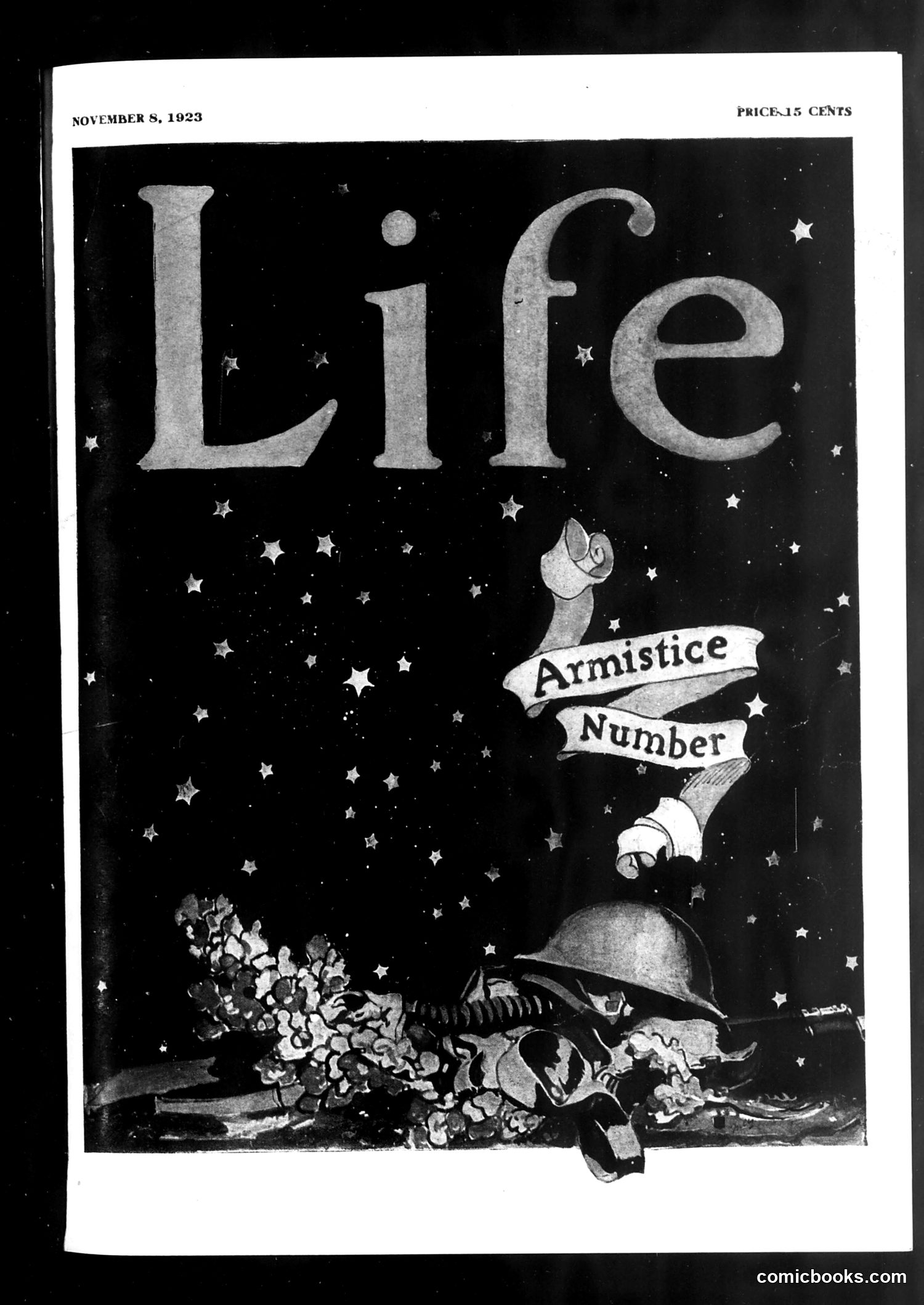
This is an Armistice Number special issue commemorating the anniversary of World War I's end (November 11, 1918). The cover depicts a soldier emerging from a trench surrounded by stars, holding a banner reading "Armistice Number." Below are military items—a helmet, flowers, and what appears to be barbed wire or battlefield debris. The image celebrates peace and remembrance of the war's conclusion. The soldier figure represents those who fought in WWI, while the flowers suggest memorial tributes to fallen soldiers. This was a common commemorative approach in the 1920s, when Armistice Day celebrations remained prominent American cultural events before shifting to Veterans Day observance.
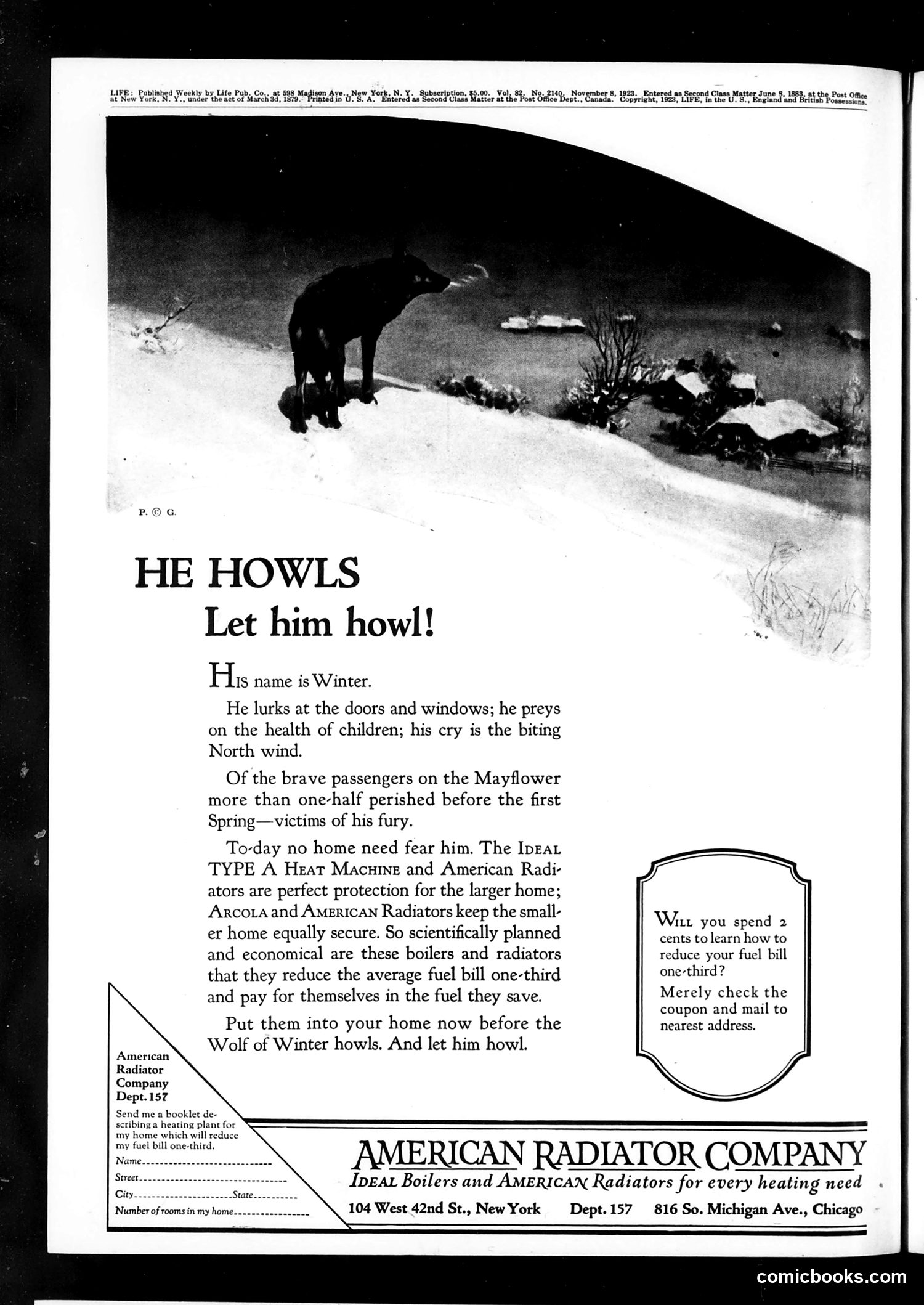
This is primarily **advertising, not satire**. The page contains a 1925 advertisement for American Radiator Company heating systems. The creative strategy uses personification: "Winter" is depicted as a threatening wolf prowling near homes. The ad references the historical **Mayflower**, claiming "more than one-half perished before the first Spring—victims of his fury," to emphasize winter's historical danger to human survival. The advertisement's pitch is straightforward: modern heating technology (Ideal Type A Heat Machines and American Radiators) now protects homes from winter's threat, while reducing fuel costs by one-third. There is no political commentary or social satire here—it's a direct sales appeal leveraging fear of winter cold to motivate purchase of heating equipment.
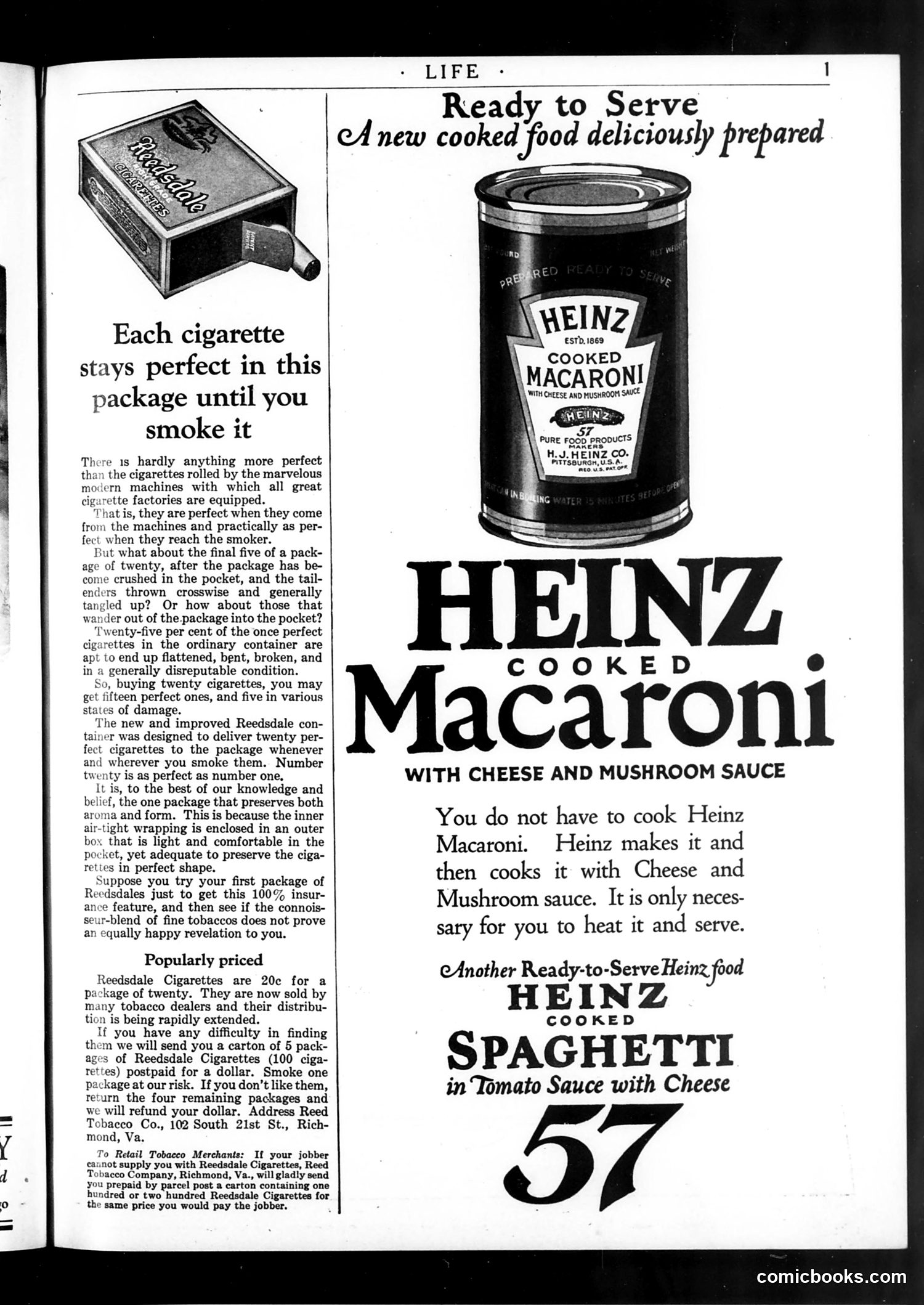
This page contains **two separate advertisements**, not political cartoons or satire. There is no satirical content to analyze. The left side advertises **Reedsdale Cigarettes** (20¢ per pack of 20), emphasizing the package's ability to keep cigarettes in perfect condition until smoking. The ad notes the product is "popularly priced" and offers bulk purchasing options. The right side advertises **Heinz brand ready-to-serve foods**: cooked macaroni with cheese and mushroom sauce, and cooked spaghetti in tomato sauce with cheese. Both products require only heating before serving—a selling point for convenience. This appears to be a typical Life magazine advertising page from the early-to-mid 20th century, showcasing consumer products without satirical intent.
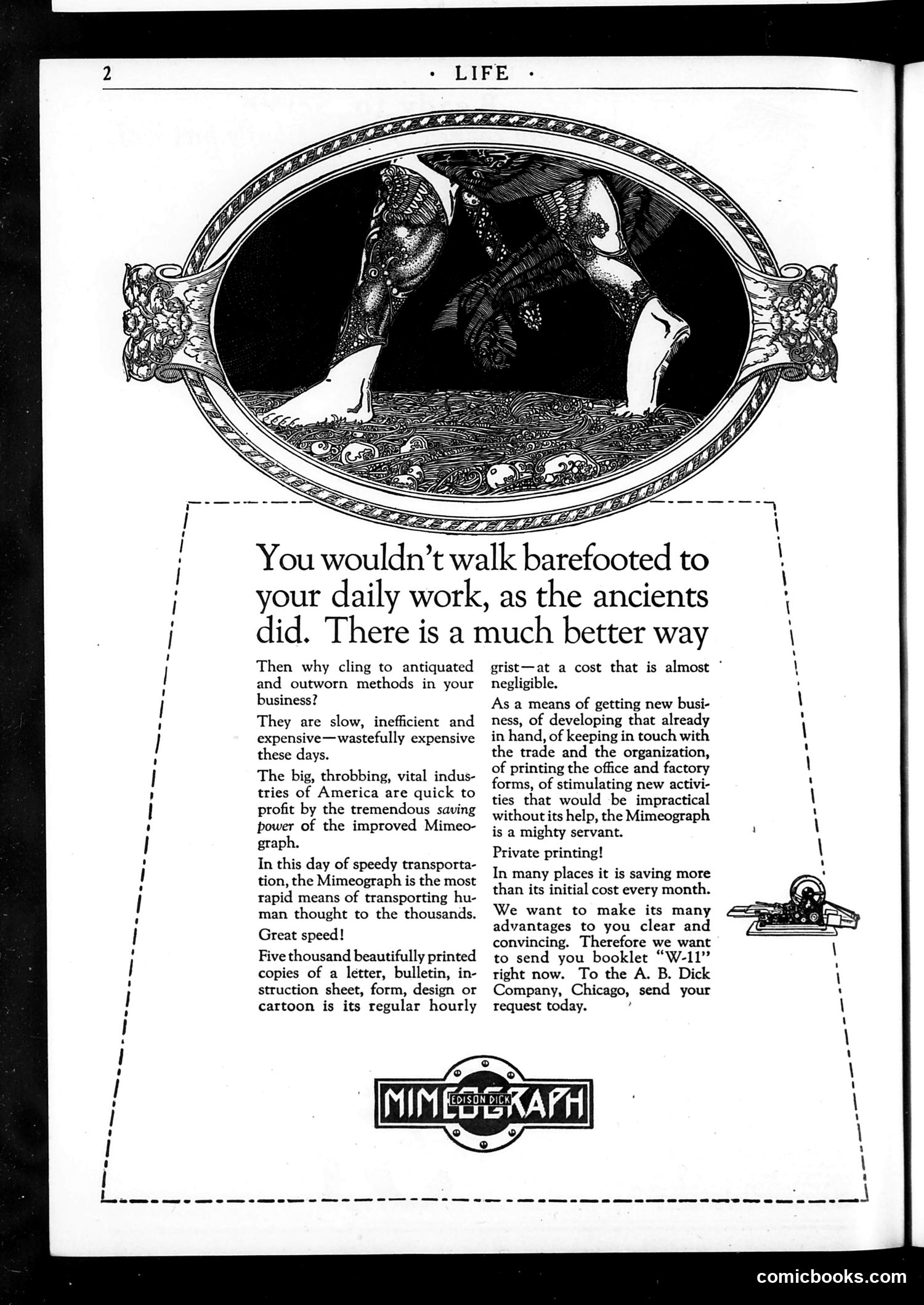
This is primarily a **Mimeograph machine advertisement** dressed as editorial content. The illustration shows two figures in period dress examining what appears to be a printing device, framed ornamentally at the top of the page. The advertisement argues that businesses should abandon "antiquated" methods (represented by the barefoot "ancients") and adopt the Mimeograph for efficient, cost-effective document reproduction. It emphasizes speed—claiming the device can produce 5,000 copies hourly—and positions the Mimeograph as essential for modern business operations like distributing forms, bulletins, and organizational materials. The "satire" is gentle: the ad sarcastically compares old methods to ancient barefoot labor, positioning the Mimeograph as progress. This reflects early 20th-century business culture promoting office modernization. The A.B. Dick Company, Chicago, manufactured Mimeographs.
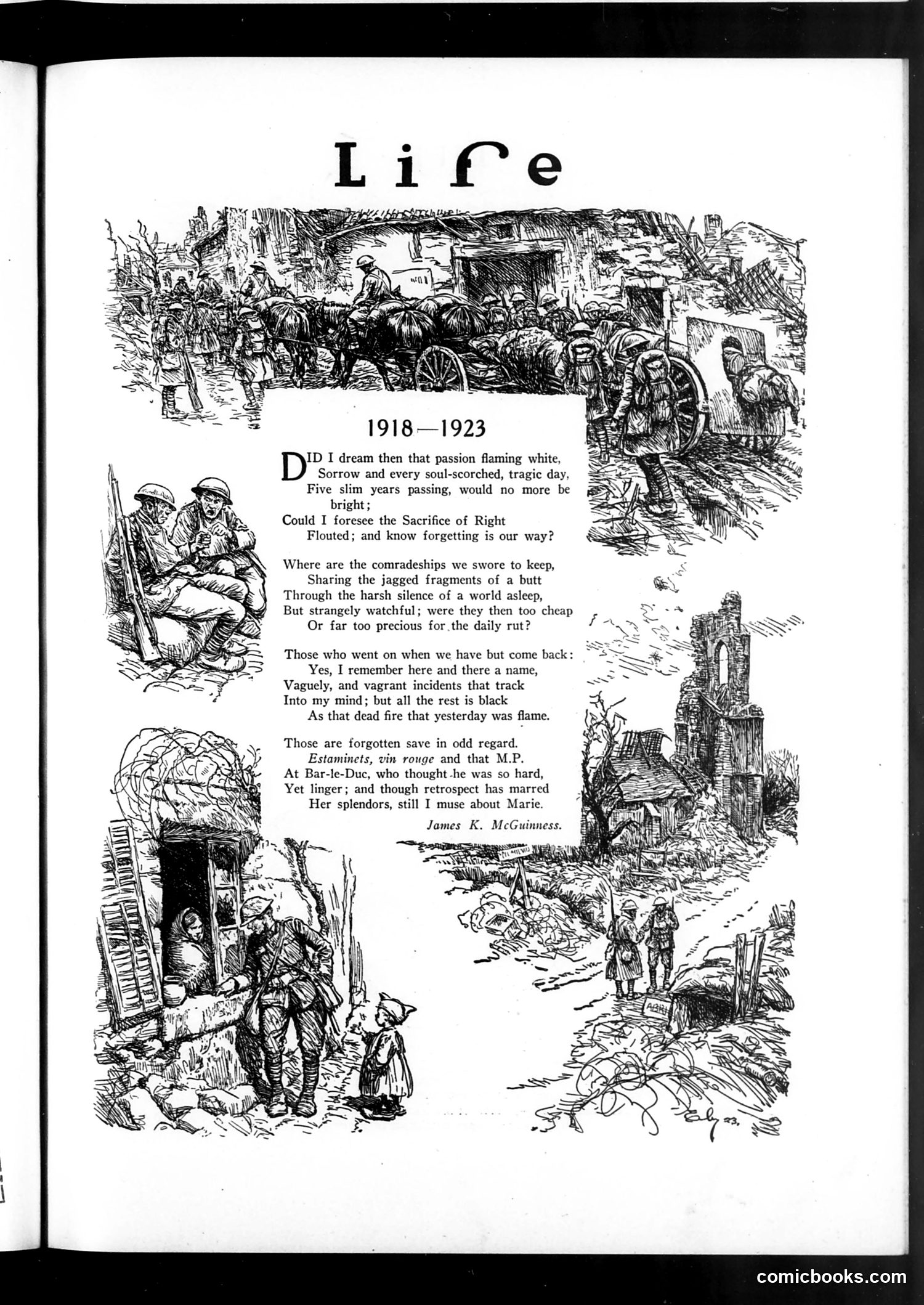
This is a commemorative poem by James K. McGuinness reflecting on the post-World War I period. The sketches depict scenes of wartime destruction and suffering—soldiers in trenches, ruined buildings, and displaced civilians. The poem mourns comrades lost in combat and laments fading memories of sacrifice. It references specific individuals (Marie, an M.P. at Bar-le-Duc) while acknowledging that most war details have been forgotten or are now "black / As that dead fire that yesterday was flame." The overall message critiques how society quickly forgets wartime horrors and the comradeship formed during conflict. The illustrations emphasize the human cost of war through depictions of devastation and loss, contrasting with civilians' apparent indifference post-armistice.
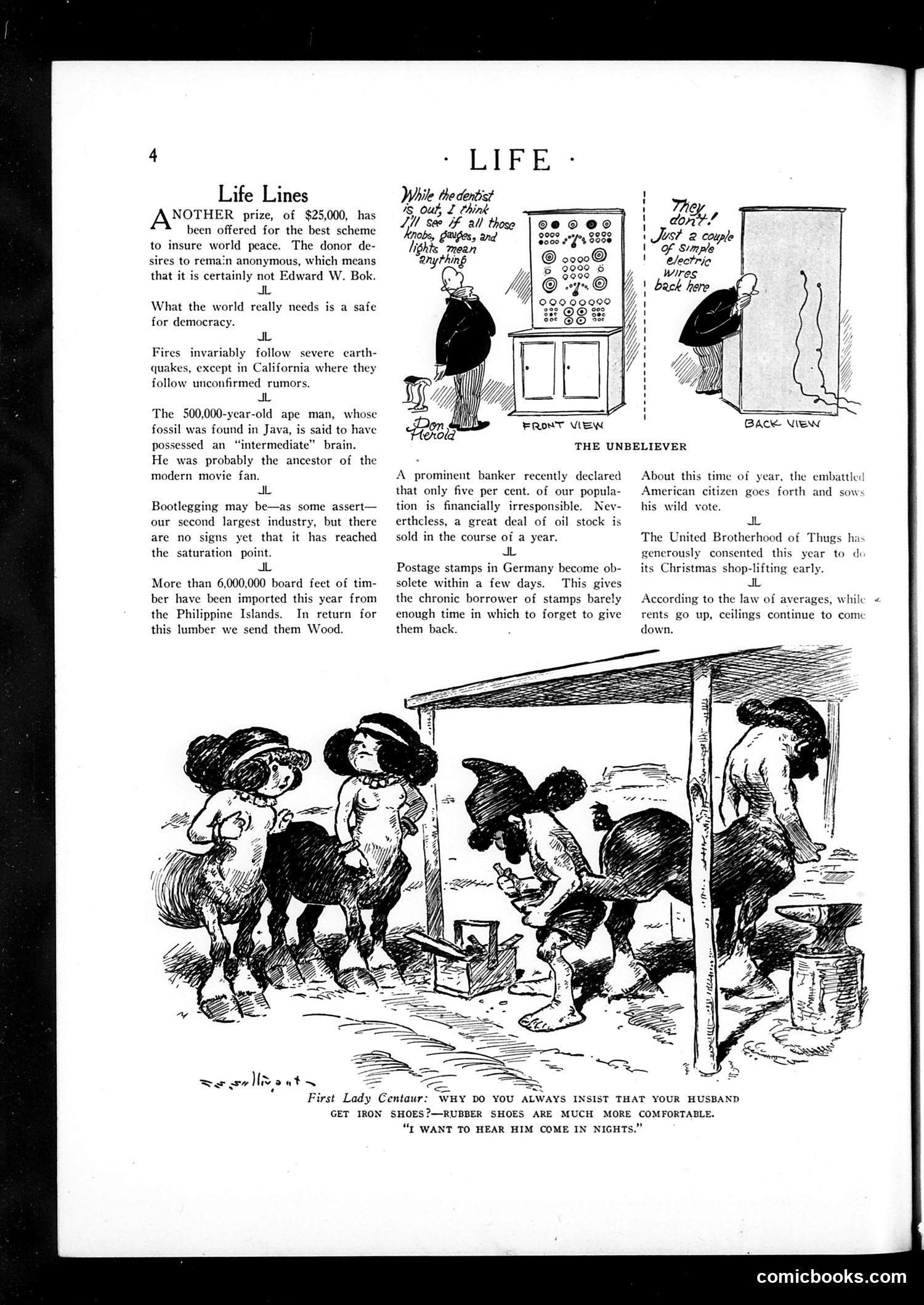
**"The Unbeliever" cartoon** (top): Depicts a man examining an electrical device while skeptically rejecting its function. The satire mocks people who doubt new technology—here, early electrical innovations. His dismissive attitude ("just a couple of wires") represents public resistance to emerging electric conveniences. **"First Lady Centaur" cartoon** (bottom): Shows a centaur (half-human, half-horse creature) couple, with the female insisting her husband wear iron shoes instead of rubber ones because "I want to hear him come in nights." The joke satirizes wives' controlling behavior through an absurdist lens—using mythological imagery to mock domestic power dynamics and surveillance of spouses' movements. Both cartoons employ visual exaggeration to critique human behavior: technological skepticism and marital suspicion.
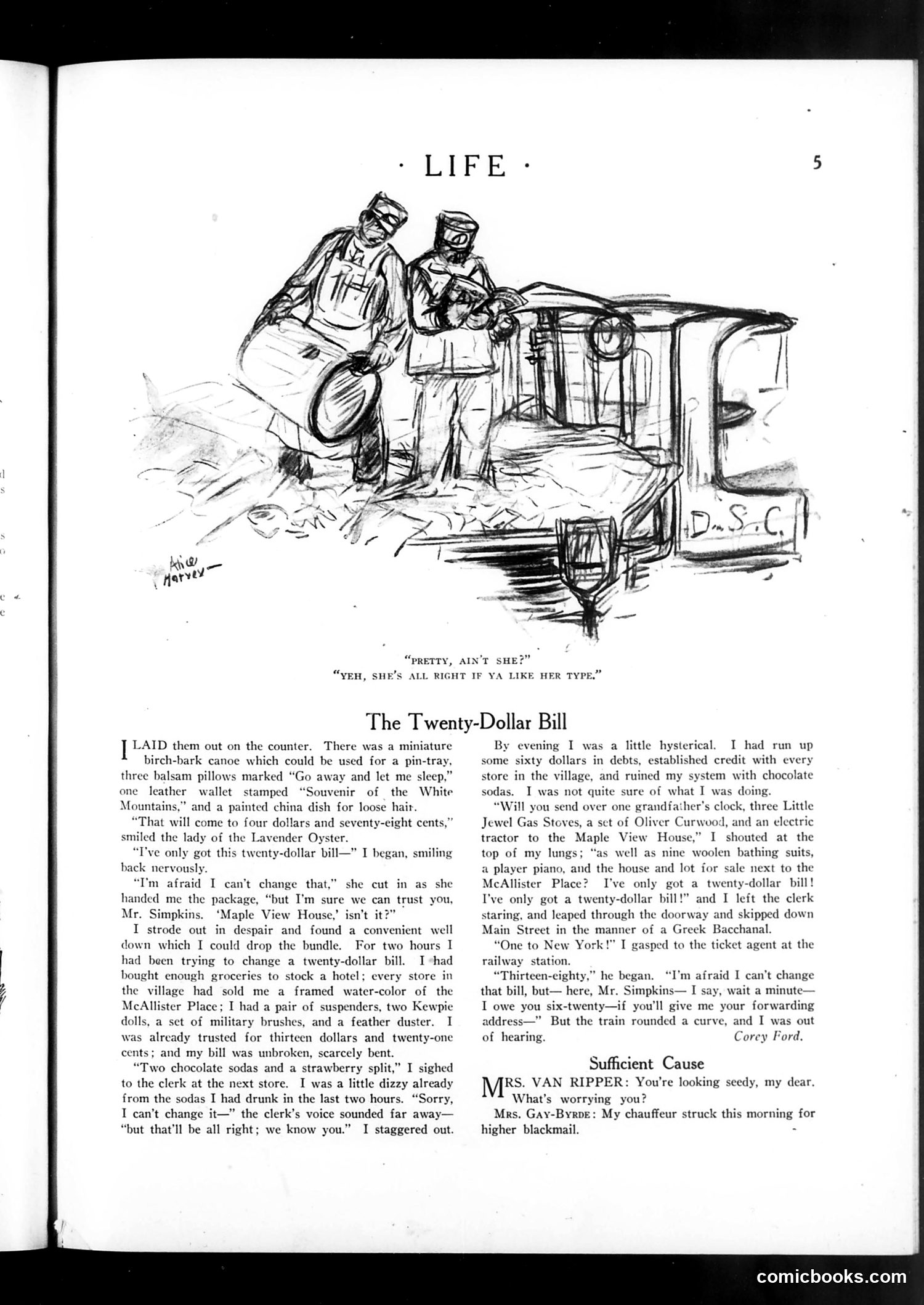
The cartoon at top depicts two figures examining an automobile, with caption dialogue about a woman's appearance ("Pretty, ain't she?" / "Yeh, she's all right if ya like her type"). This is a visual pun comparing a woman to a car—a satire on how men objectify women by treating them as interchangeable commodities, like automobiles. Below are two prose stories: "The Twenty-Dollar Bill" (by Corey Ford) concerns financial desperation and inability to change a bill, and "Sufficient Cause" features characters Mrs. Van Ripper and Mrs. Gay-Byrne discussing a chauffeur and blackmail. The page reflects early-20th-century satirical humor targeting consumer culture, gender relations, and middle-class anxieties about money and social standing.
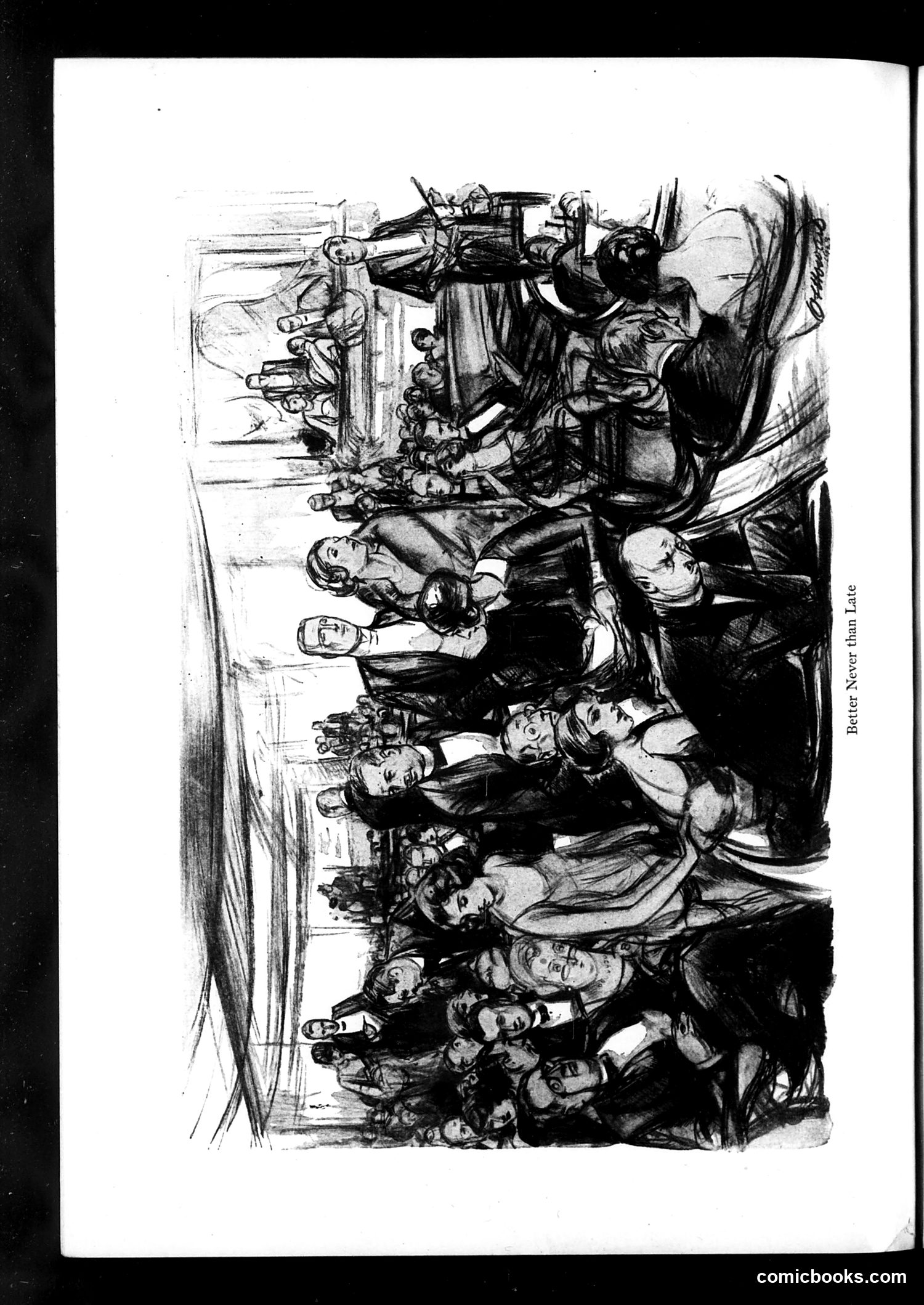
This appears to be a satirical illustration titled "Better than Life" (visible on the right margin). The image is oriented sideways and depicts a crowded theatrical or entertainment scene with multiple figures arranged in a chaotic composition. The satire likely comments on theatrical performance or entertainment being superior to—or more interesting than—real life itself. The densely packed crowd of characters and the dynamic, somewhat frenzied arrangement suggests the excitement and spectacle of staged entertainment contrasted with ordinary existence. Without additional context from the magazine issue, the specific political or social targets remain unclear, though the composition emphasizes how theater captivates audiences and represents an idealized or exaggerated version of human experience compared to mundane reality.
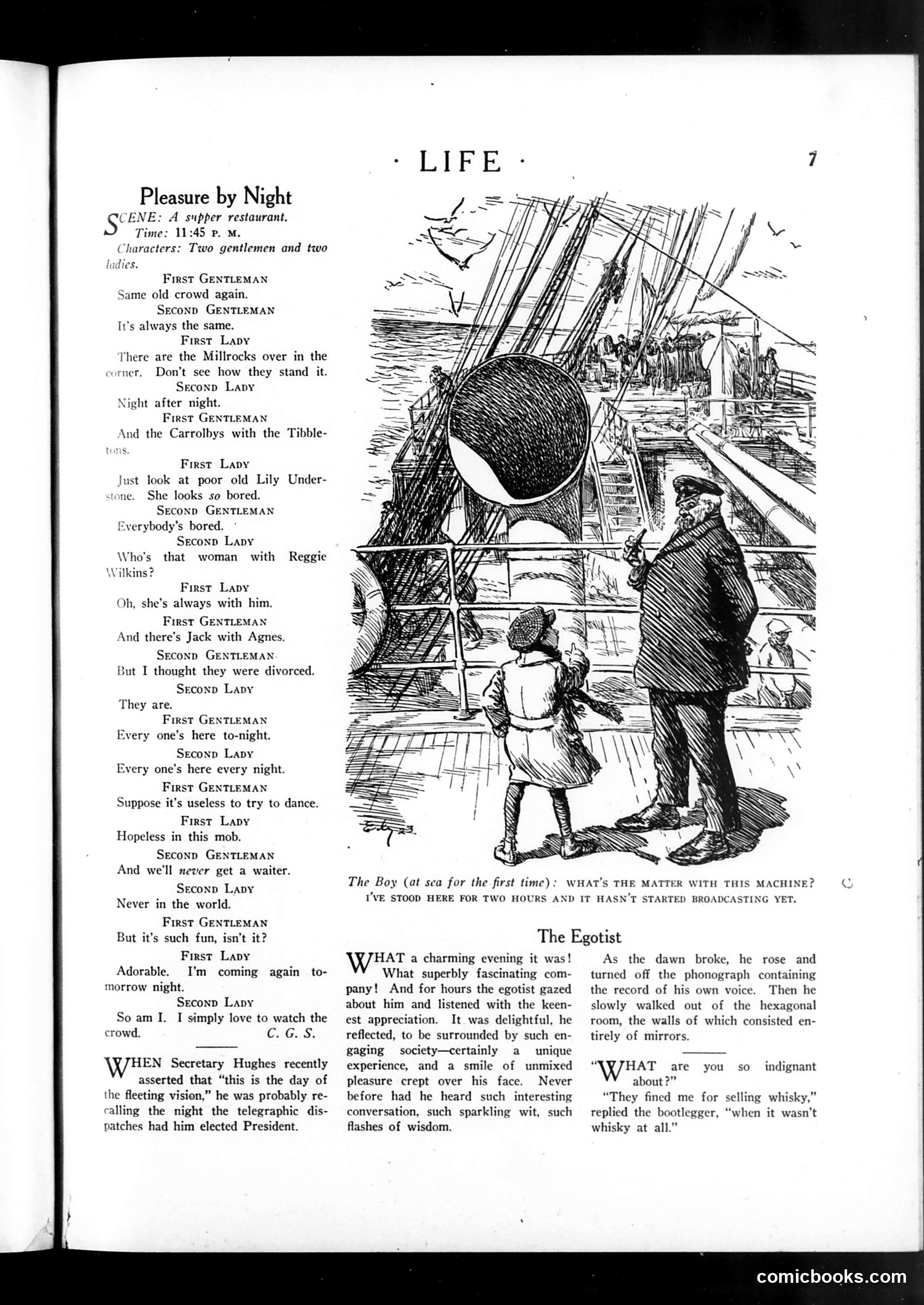
This page contains two distinct pieces: **"Pleasure by Night"** (left): A satirical stage dialogue mocking upper-class social life. The characters gossip about socialites and their companions at a supper restaurant at 11:45 p.m., discussing divorced couples, boring social events, and attempts to find entertainment ("dance," "waiter"). The satire targets the monotony and superficiality of wealthy nightlife circles. **"The Egotist"** (right): A cartoon and accompanying story about a vain man who obsesses over a phonograph recording of his own voice. The humor derives from his self-absorption—he spends hours listening to himself rather than enjoying the evening, then becomes indignant when criticized. The satire mocks excessive egotism and vanity, likely referencing early 20th-century phonograph culture and narcissistic behavior.
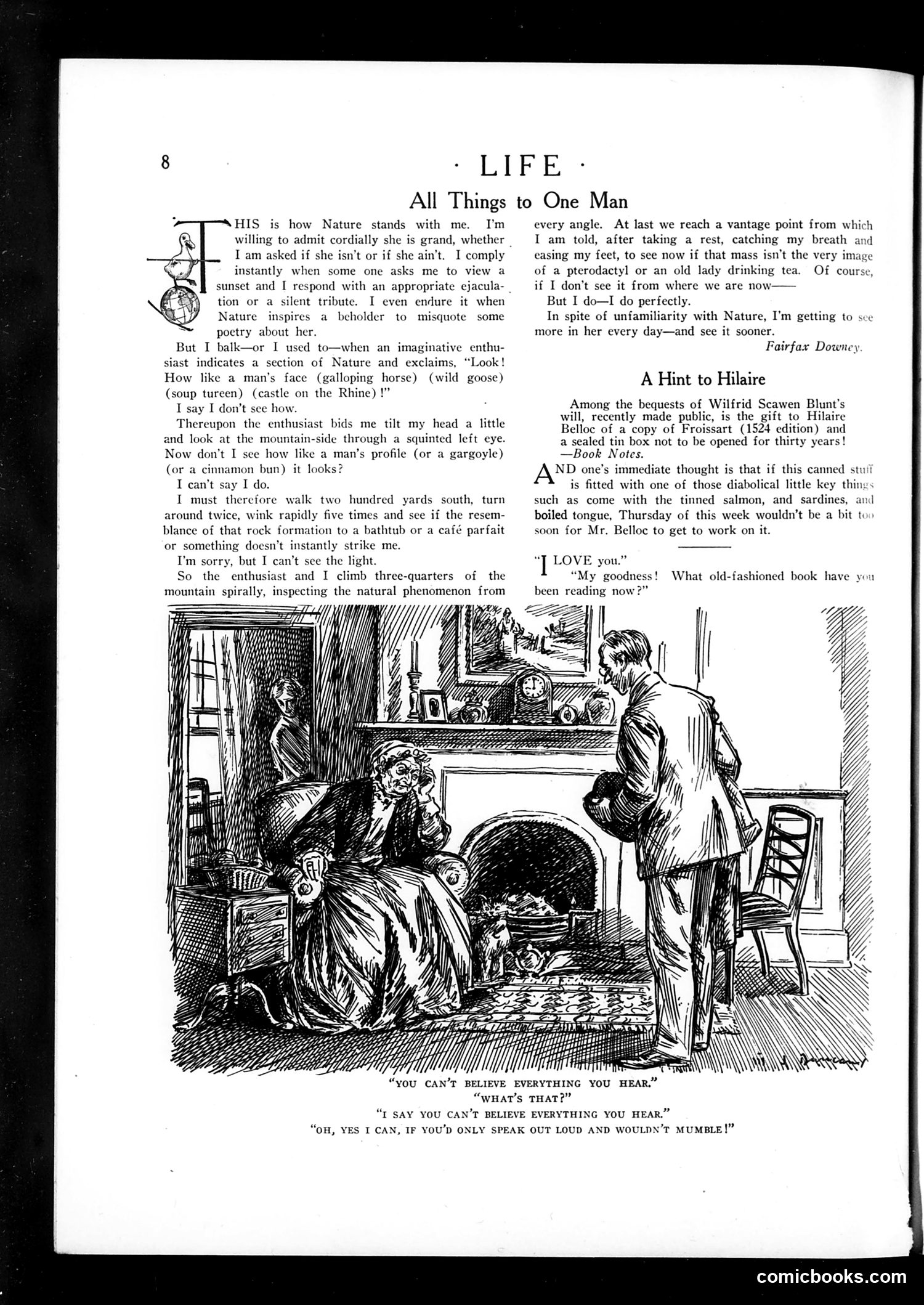
This page contains two distinct pieces. The upper section, "All Things to One Man," is an essay-style article where the author describes their relationship with Nature—claiming they're willing to accept it as-is, while admitting they struggle to appreciate it without explanation or obvious meaning. The lower section, "A Hint to Hilaire," appears to be a brief literary note mentioning Wilfred Scawen Blunt's will and a reference to a 1524 edition of Froissart. The main illustration depicts a domestic scene with dialogue about hearing and belief—an elderly woman sitting by a fireplace speaking with a standing man, with humorous captions suggesting the woman cannot hear clearly and asks the man to speak louder.
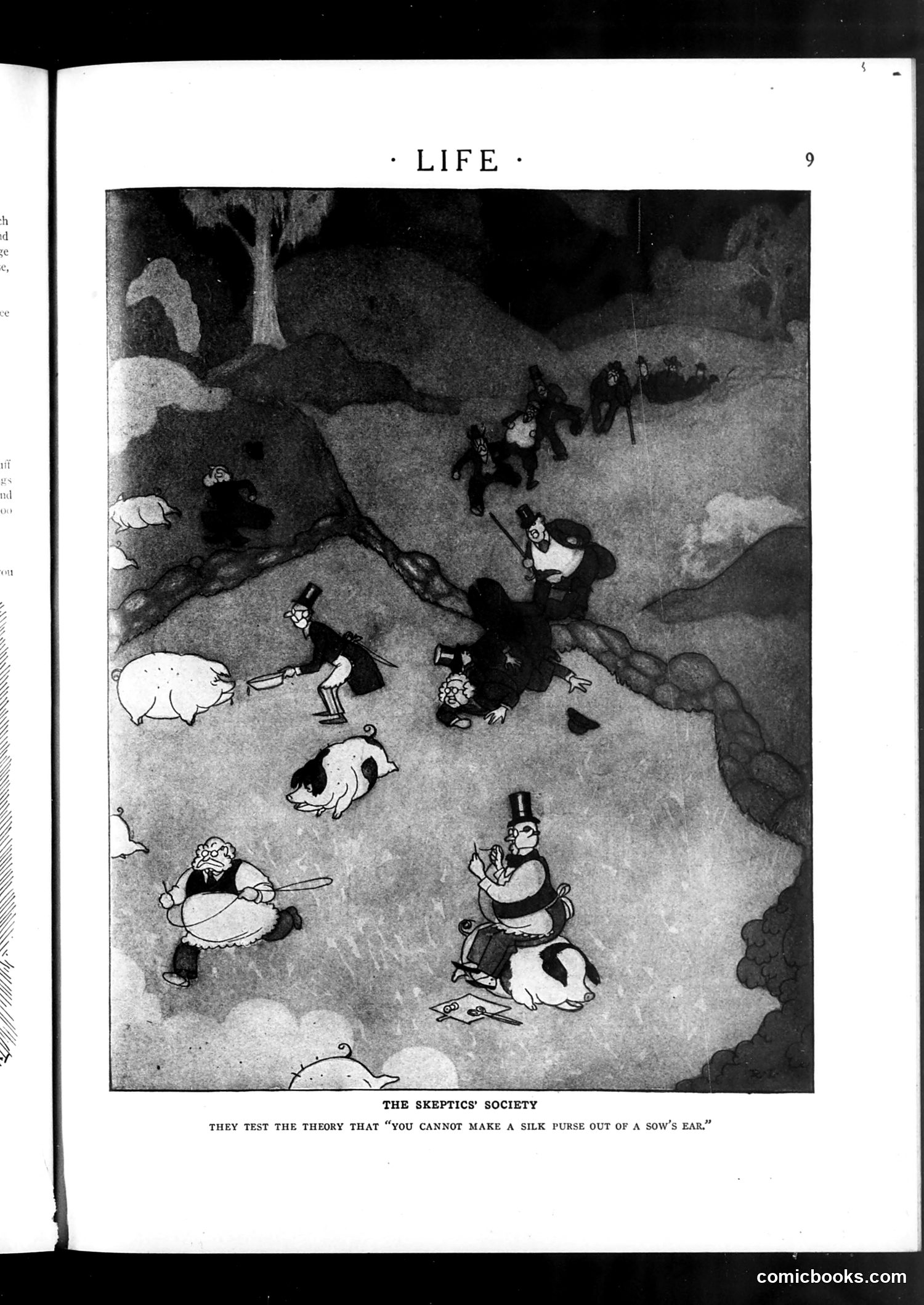
This satirical cartoon depicts a group of well-dressed men conducting an absurd experiment: attempting to make a silk purse from a sow's ear, testing the old proverb "you cannot make a silk purse out of a sow's ear." The cartoon mocks skepticism and scientific rationalism taken to ridiculous extremes. The "Skeptics' Society" appears to be pursuing an impossible task with complete seriousness, suggesting the satire targets those who dismiss conventional wisdom or traditional sayings through pseudo-scientific methodology. The figures are caricatured gentlemen in formal attire using fishing rods and other implements on pig-like creatures, emphasizing the futility and absurdity of their endeavor. The joke criticizes either excessive skepticism of folk wisdom or, conversely, foolish pseudo-intellectualism masquerading as rational inquiry.
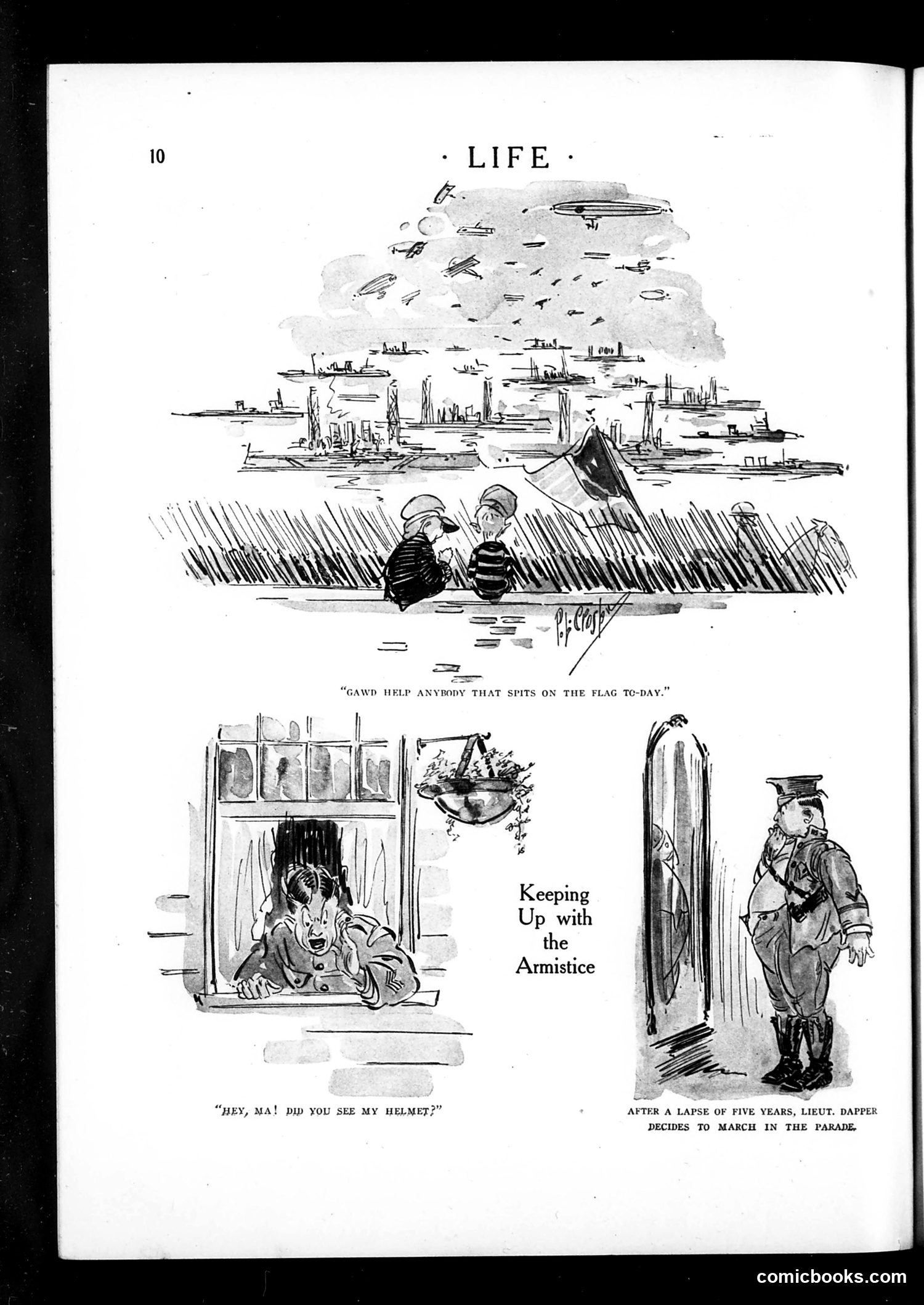
This page contains three WWI-era satirical cartoons addressing post-armistice life: **Top cartoon**: Two soldiers in a trench overlook an industrial cityscape, discussing the flag. The caption "Gawd help anybody that spits on the flag to-day" suggests anxiety about domestic patriotism and potential civil unrest following the war's end. **Bottom left**: A disheveled figure peers through a window, captioned "Hey, Ma! Did you see my helmet?" — likely mocking soldiers returning home, struggling to reintegrate into civilian life or dealing with shell shock. **Bottom right**: A military officer stands at attention indoors, captioned "After a lapse of five years, Lieut. Dapper decides to march in the Parade" — satirizing soldiers' delayed participation in victory parades, possibly critiquing bureaucratic delays or suggesting some soldiers' reluctance to participate in celebrations. The overall theme concerns post-WWI readjustment and patriotic tensions.
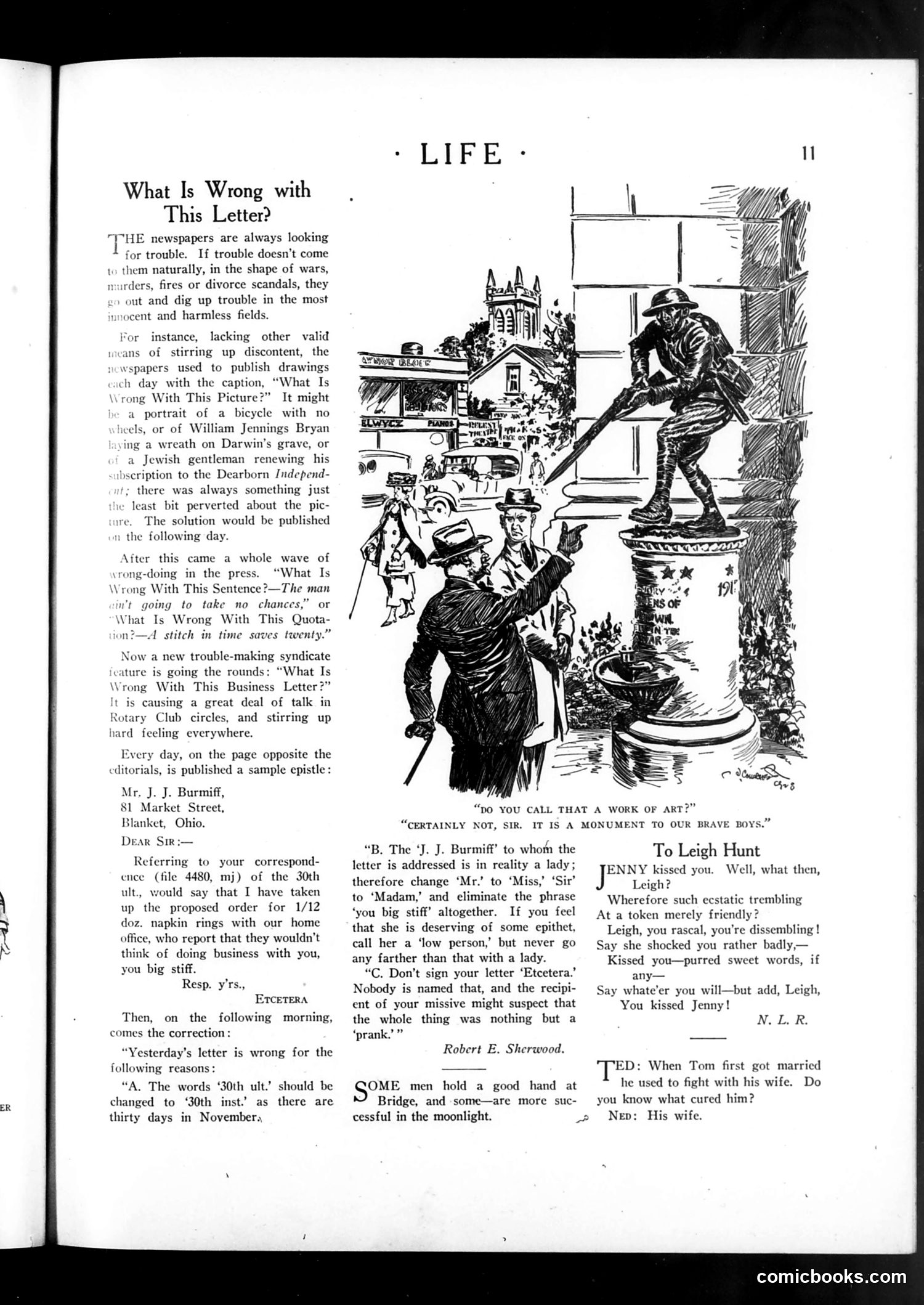
This page satirizes newspapers' practice of publishing reader letters with intentional errors, then asking audiences "what's wrong?" The main illustration shows a chaotic urban scene with various figures and monuments, meant to contain hidden absurdities for readers to spot. The article mocks this trend as artificial trouble-making by newspapers lacking genuine news. It references a specific letter-writing format that sparked multiple "what's wrong" variations in the press, including quotations and sentences. The satire criticizes how this creates unnecessary controversy, particularly in Rotary Club circles. The page also includes unrelated humorous verses ("To Leigh Hunt") and a brief joke about married couples fighting. This represents Life's typical satirical approach: poking fun at media sensationalism and popular fads.
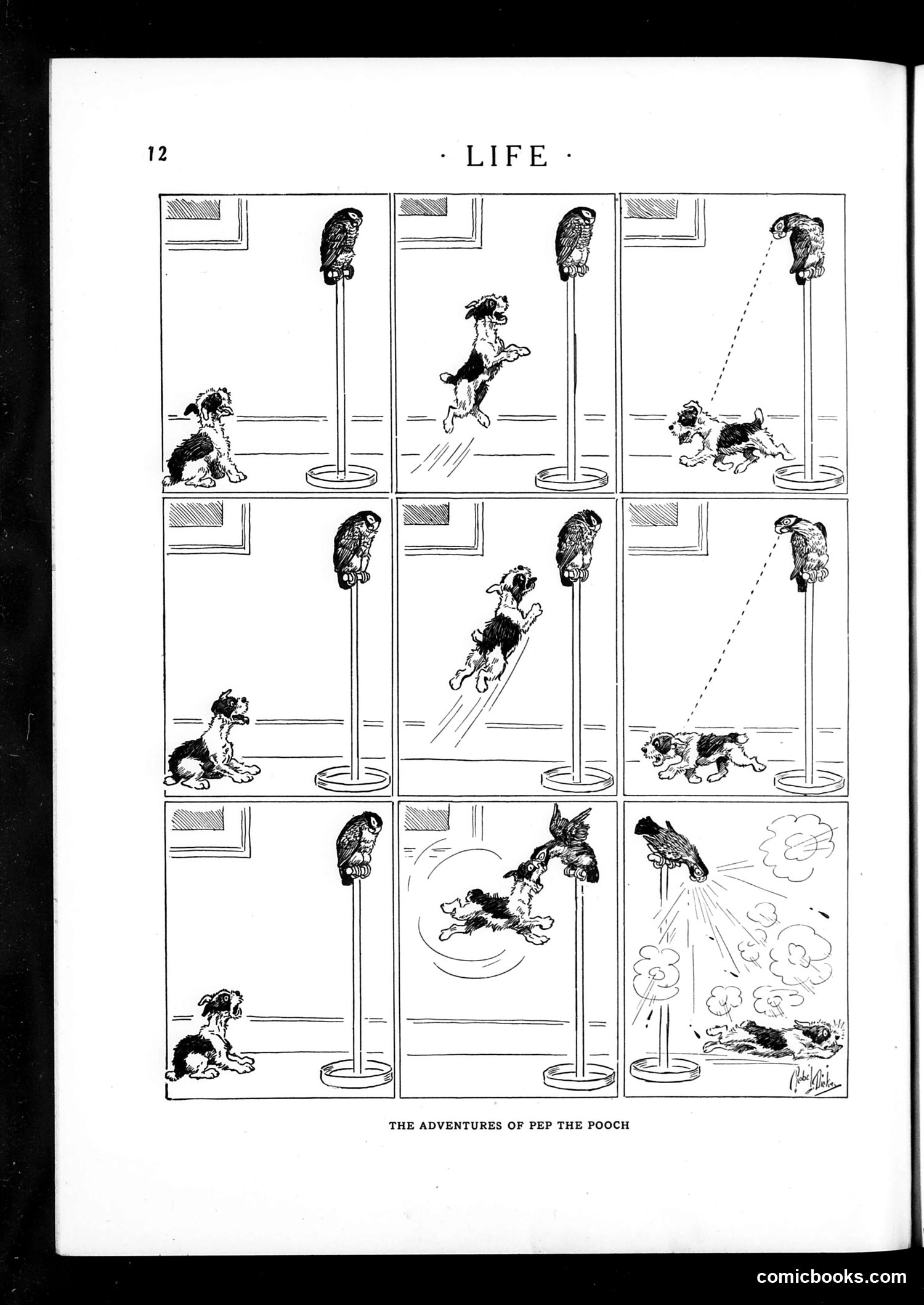
This is a comic strip featuring a small dog named Pep attempting to catch a perched owl. The narrative progression shows: 1. **Panels 1-3 (top rows):** Pep spots the owl on a high pole and makes increasingly desperate jumping attempts to reach it. 2. **Panels 4-6 (middle):** Pep's efforts intensify with more violent leaps and crashes. 3. **Final panel:** The climactic payoff—Pep's jump overshoots spectacularly, launching the owl skyward while Pep crashes into the ground, surrounded by impact clouds. The humor relies on slapstick and physical comedy: the dog's persistent, futile struggle against gravity and basic physics, culminating in an absurdly exaggerated outcome. This appears to be simple entertainment rather than political satire—typical early 20th-century comic humor emphasizing visual gags and animal antics.
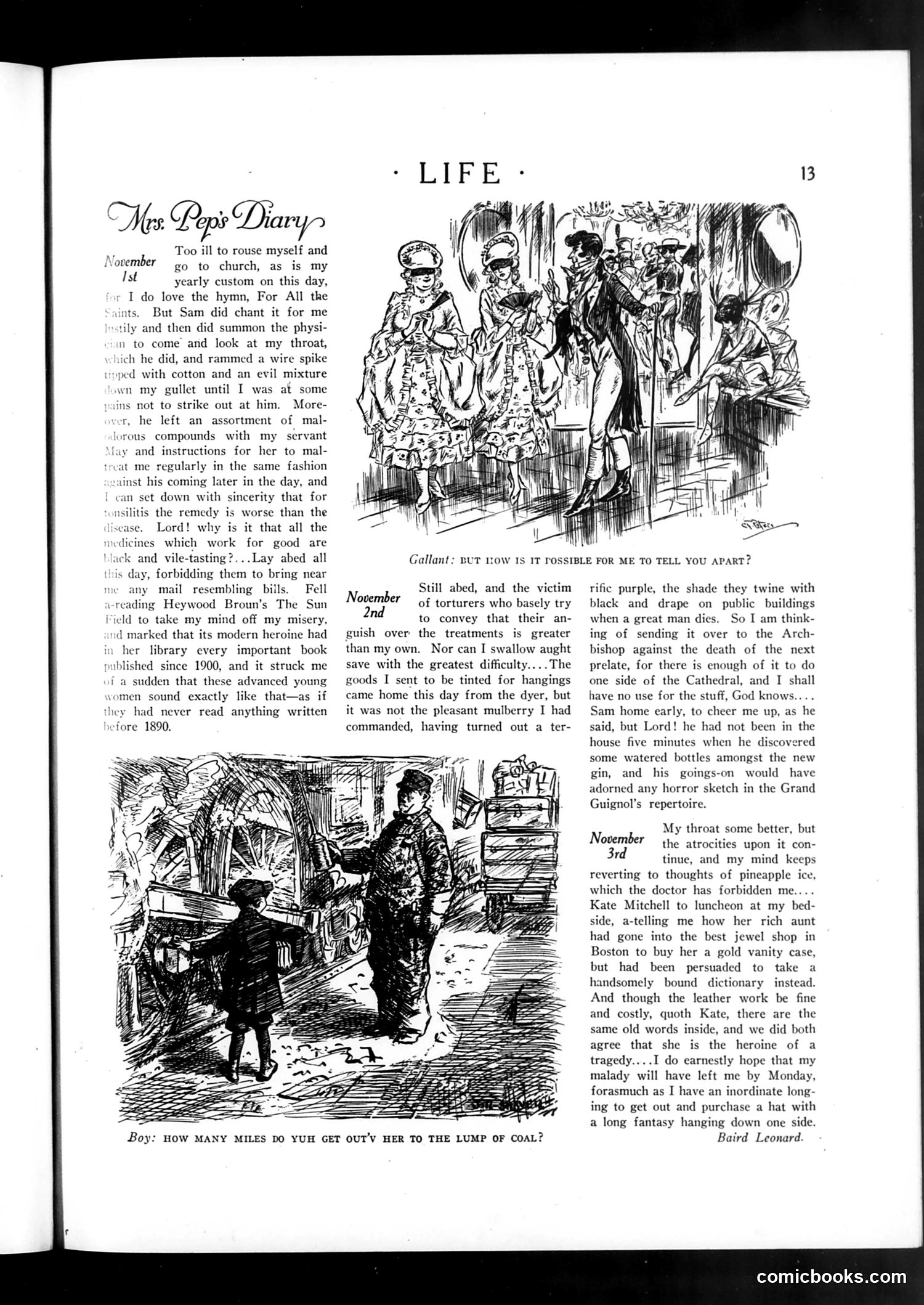
This page presents a satirical diary entry mocking upper-class women's domestic complaints and hypochondria. The writer complains about throat ailments and medical treatments while describing her servant's malicious compounds and her husband Sam's indifference to her suffering. The top cartoon shows fashionably dressed women gossiping, captioned with innuendo about impropriety ("BUT HOW IS IT POSSIBLE FOR ME TO TELL YOU APART?"). The lower cartoon depicts a street scene with the caption "HOW MANY MILES DO YUH GET OUT'Y HER TO THE LUMP OF COAL?" — likely mocking working-class dialect and the contrast between wealthy women's frivolous concerns and working people's harsh realities. The satire targets privileged women's self-centered preoccupations and servants' resistance to their employers' demands.
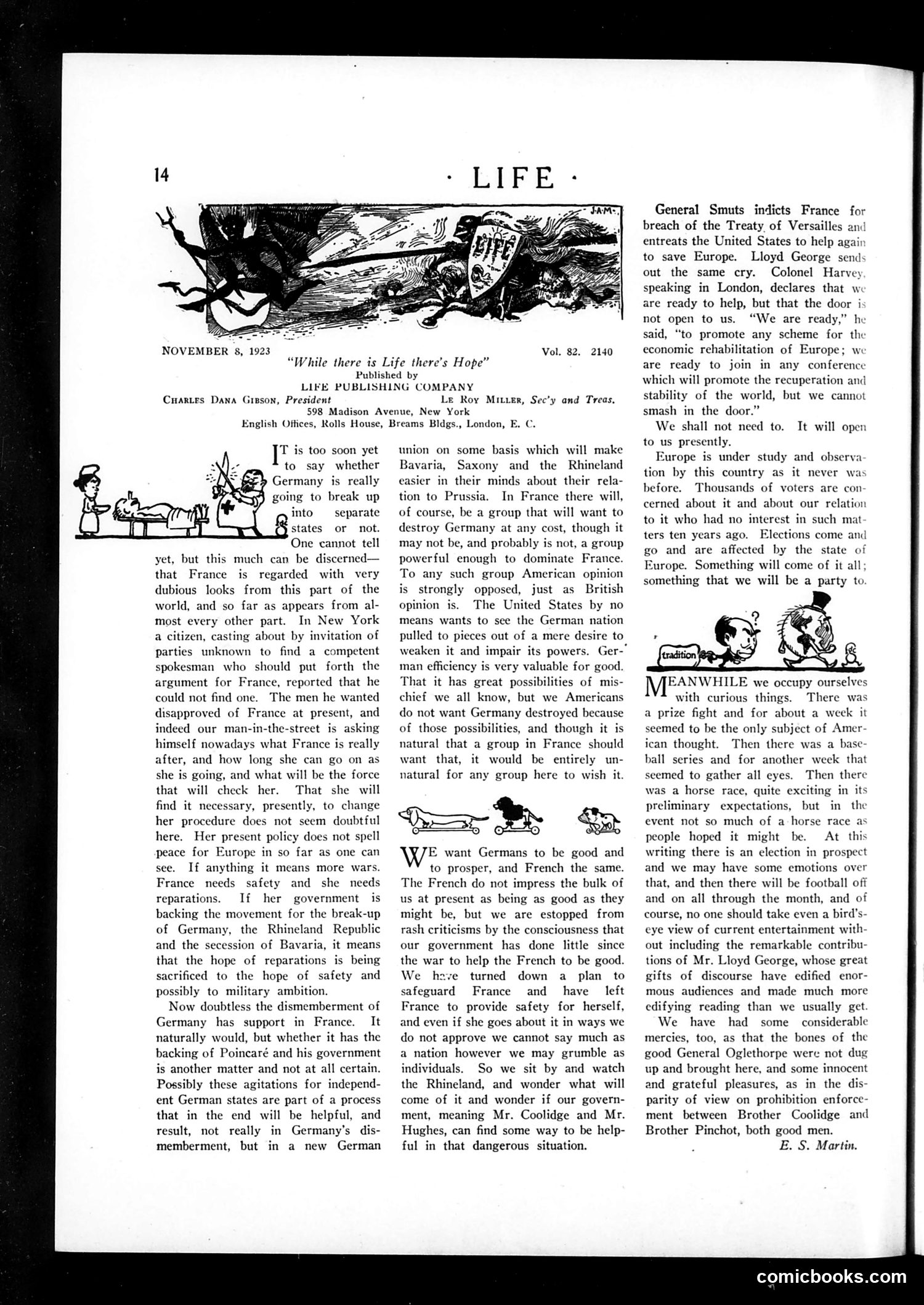
The main cartoon at top depicts Germany "breaking into separate pieces"—a visual metaphor for the political fragmentation occurring in post-WWI Germany. The illustration shows a figure (representing Germany) literally splintering apart, reflecting anxieties about the Rhineland Republic and Bavarian independence movements discussed in the article. The accompanying text discusses whether France can remain unified while Germany splinters, and debates American policy toward European reconstruction. The article expresses skepticism about both German and French intentions while advocating American caution in European affairs. The smaller cartoon below depicts various modes of transportation (horse, car, motorcycle), likely illustrating the article's discussion about diverse American interests and perspectives on European matters. The satire critiques post-war European instability and American isolationism.
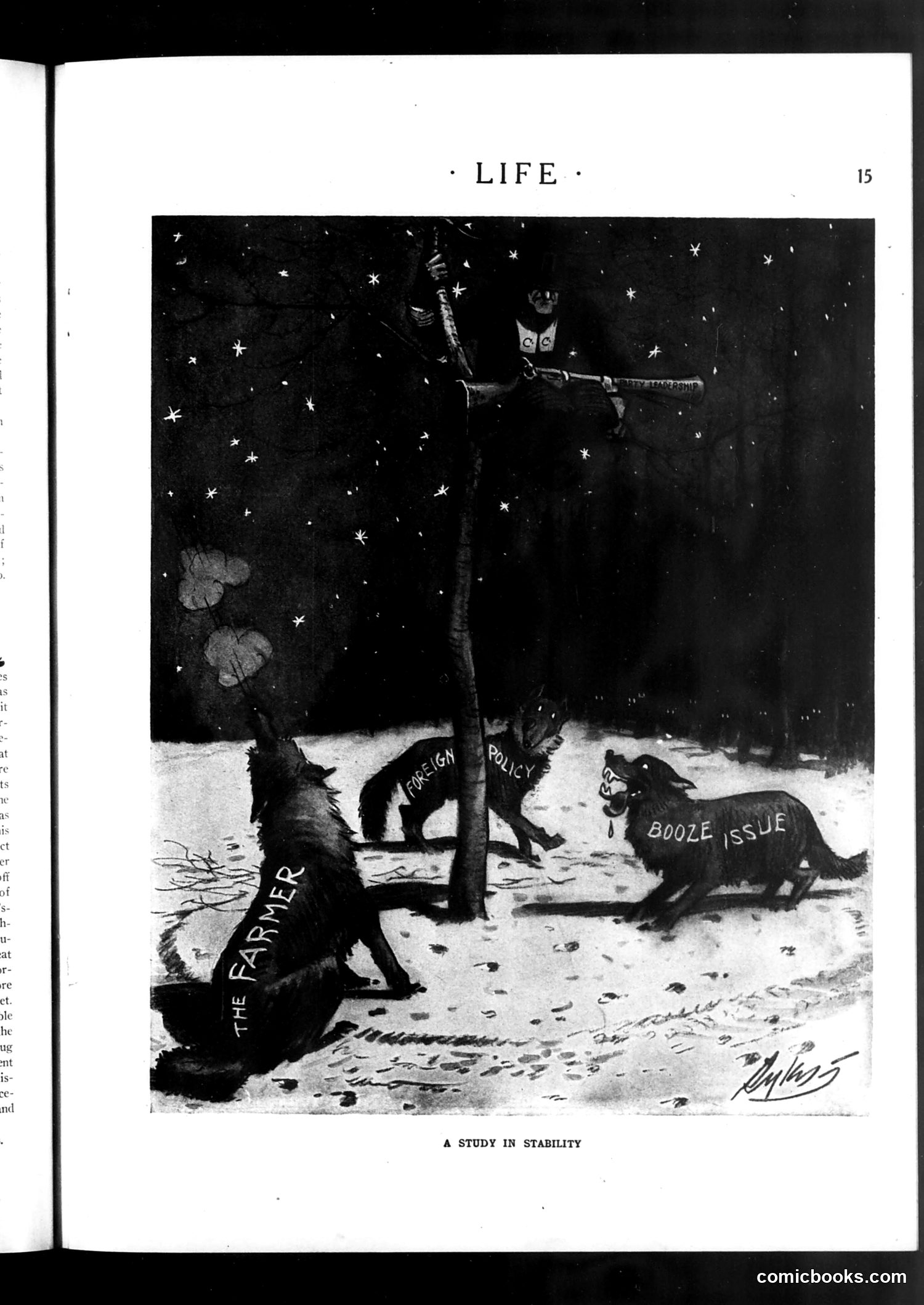
This political cartoon depicts three wolves standing beneath a pole on a snowy night. Each wolf is labeled with a contemporary issue: "The Farmer," "Foreign Policy," and "Booze Issue." A figure perched atop the pole (likely representing a political leader or government) holds a rifle pointed downward. The satire suggests that despite multiple serious domestic and foreign crises—agricultural hardship, international relations, and Prohibition enforcement—the government maintains precarious control, like someone balancing on a pole. The wolves circling below represent these mounting pressures threatening to destabilize the administration. The cartoon critiques governmental inability to adequately address multiple simultaneous crises, instead maintaining only a tenuous, unstable grip on power.
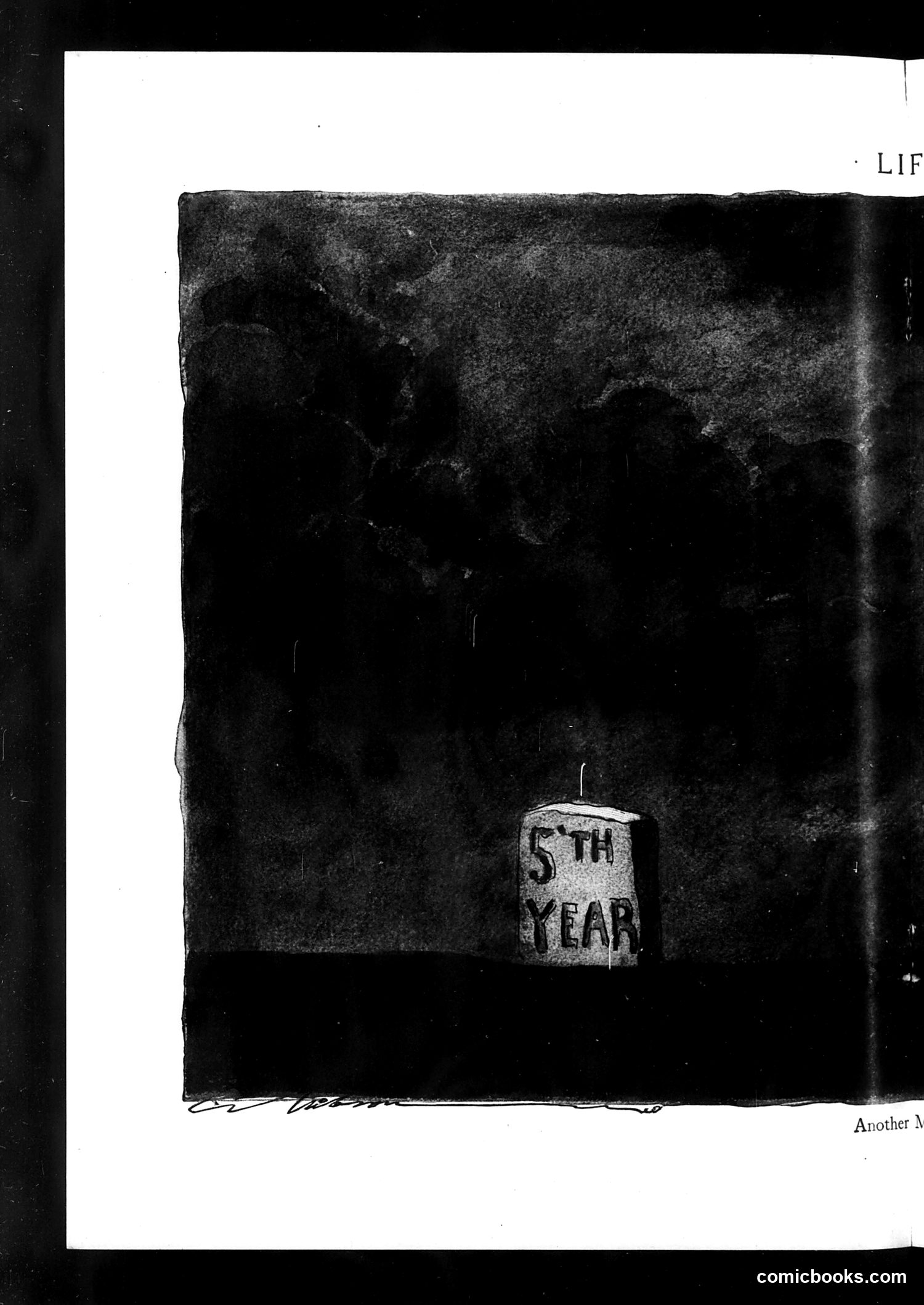
This appears to be a page from *Life* magazine featuring a single cartoon image. The central element is a gravestone or marker labeled "5TH YEAR," positioned against a dark, shadowy background with indistinct figures looming above it. The cartoon likely satirizes a prolonged conflict or situation extending into its fifth year—most probably World War II, given *Life*'s satirical focus during that era. The gravestone imagery suggests commentary on the war's continuing toll, human cost, or the grim continuation of fighting. The ominous shadowy figures above could represent leaders, militaries, or abstract forces perpetuating the conflict. Without additional context or visible attribution, the precise satirical target remains somewhat unclear, though the visual metaphor of death/burial tied to duration is unmistakable.
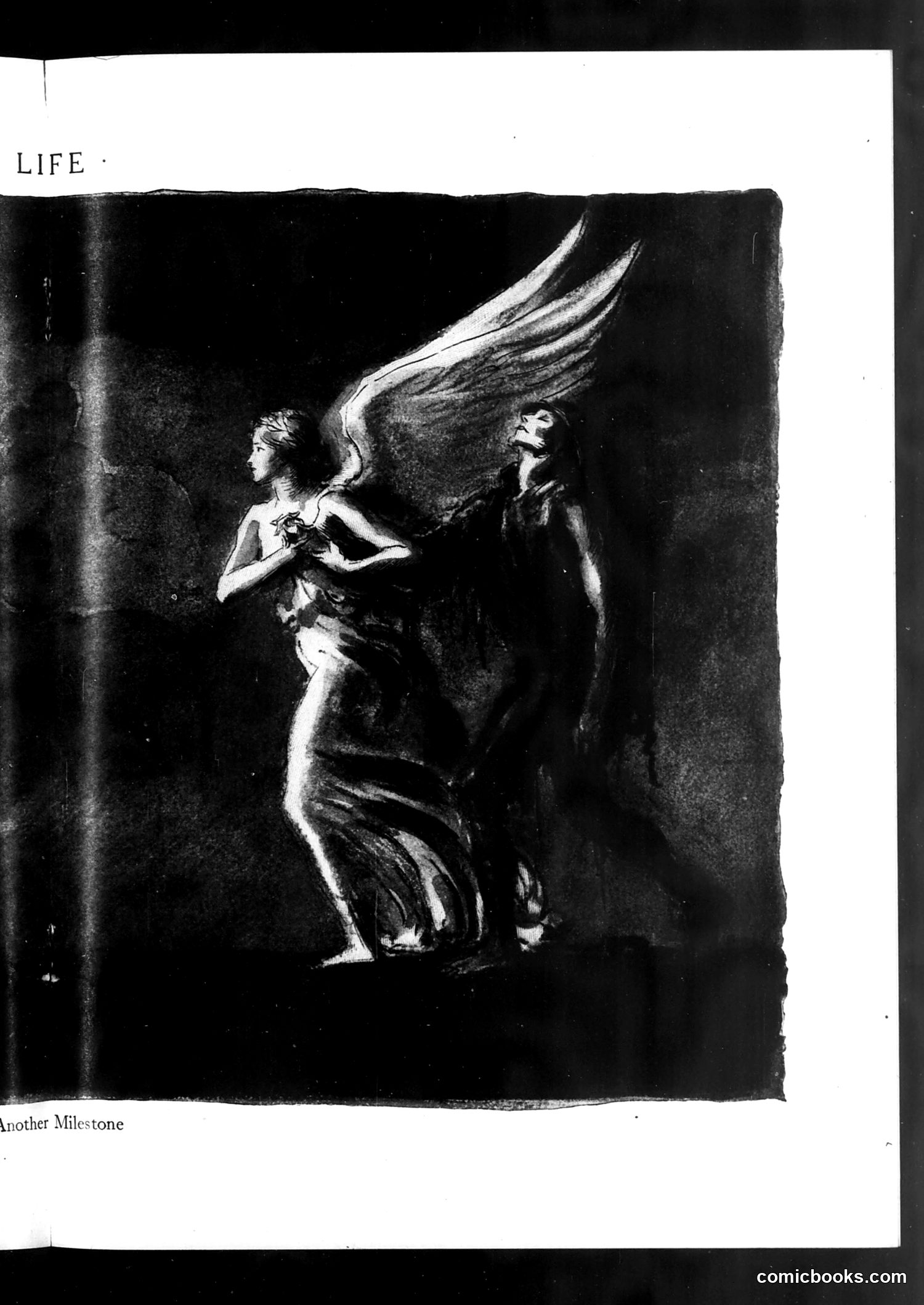
This page from *Life* magazine shows a dramatic illustration titled "Another Milestone" featuring a winged female figure (likely representing Liberty or Progress) alongside a male figure in profile. The allegorical style and caption suggest this celebrates some significant achievement or historical moment. However, the OCR text is too corrupted to identify the specific event or context being referenced. Without legible text explaining the "milestone," I cannot determine what historical development this satirizes or commemorates. The classical allegorical imagery suggests an important national or social achievement from the early-to-mid 20th century, but identifying which one would require speculation beyond what the visible page supports.
This is a satirical theater review mocking the Ziegfeld Follies' final edition. The author humorously describes attending standing-room only ($3.30), forced to crane their neck through gaps between other spectators for five hours, while paying patrons who sat down ($22) complained the show was dull. The joke is the reviewer's physical discomfort versus seated viewers' boredom—inverting expectations about who had the worse experience. The piece then praises specific acts: an "Amateur Night" sketch, Bert and Betty Wheeler's "Mammy" song, Fannie Brice's performances, shadowgraph, and Paul Whiteman's band. It critiques contemporary serious plays ("The Dancers," "The Shame Woman," "Nobody's Business") for repetitive moralizing about chastity, suggesting they're indistinguishable from one another. The satire targets both theatrical excess and period preoccupations with sexual propriety.
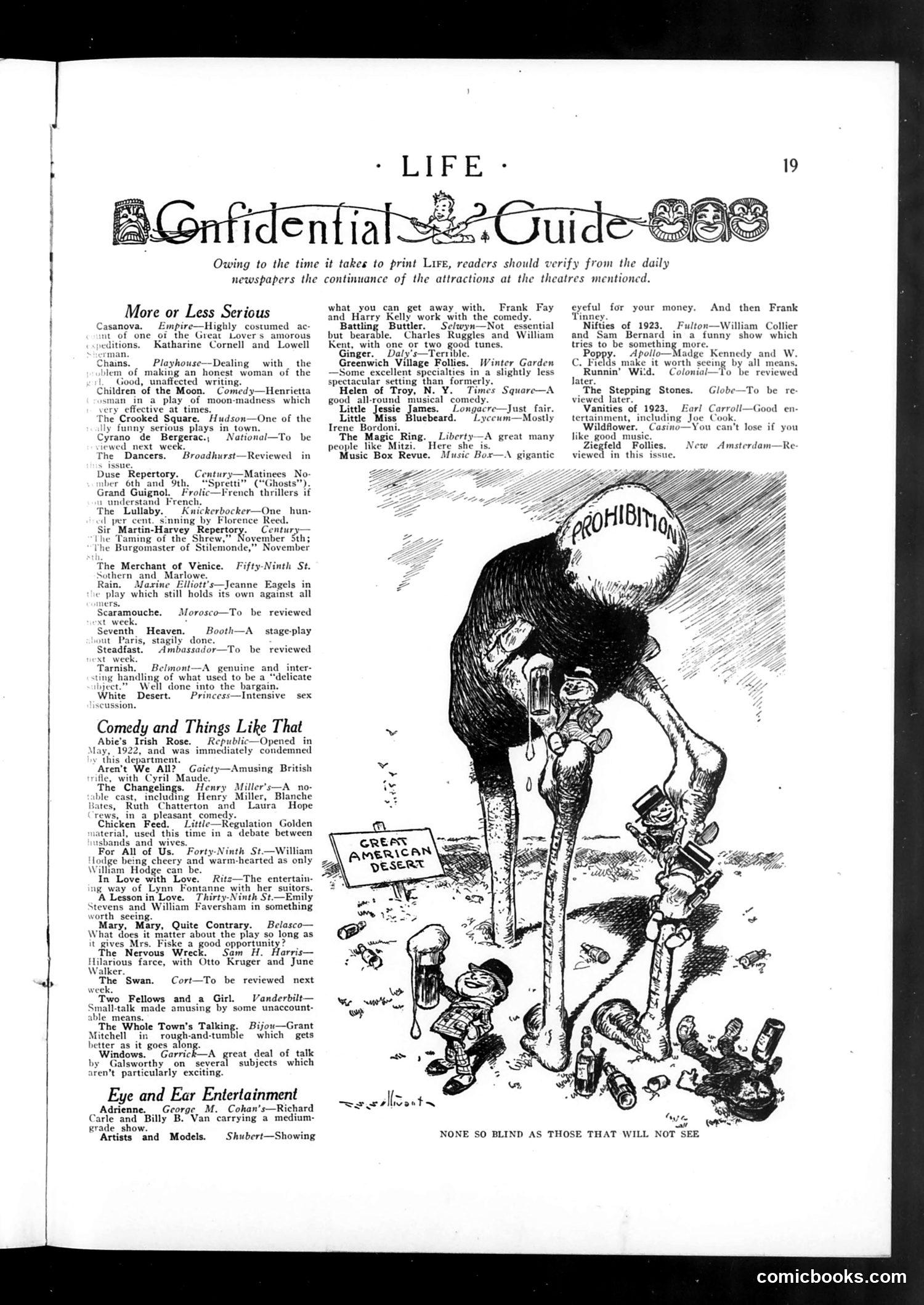
The large cartoon depicts a bloated, grotesque figure labeled "PROHIBITION" crushing small human figures beneath its weight. At the base lies a sign reading "GREAT AMERICAN DESERT," surrounded by scattered bottles and debris. This is anti-Prohibition propaganda from the early 1920s, likely published shortly after the 18th Amendment's ratification (1919) or Volstead Act's enforcement (1920). The cartoon satirizes Prohibition as a destructive, overbearing force that crushes American life and commerce. The "Great American Desert" reference suggests the policy creates economic wasteland and death. The tiny figures represent ordinary citizens and businesses destroyed by alcohol's ban. The scattered bottles symbolize the failed attempt to eliminate drinking. **The satire's point**: Prohibition, presented as tyrannical and inhumane, will devastate American society rather than improve it. This reflects the contemporary anti-Prohibition viewpoint—that the policy caused more harm (organized crime, corruption, economic loss) than benefit. The caption "NONE SO BLIND AS THOSE THAT WILL NOT SEE" mocks supporters for ignoring obvious negative consequences.
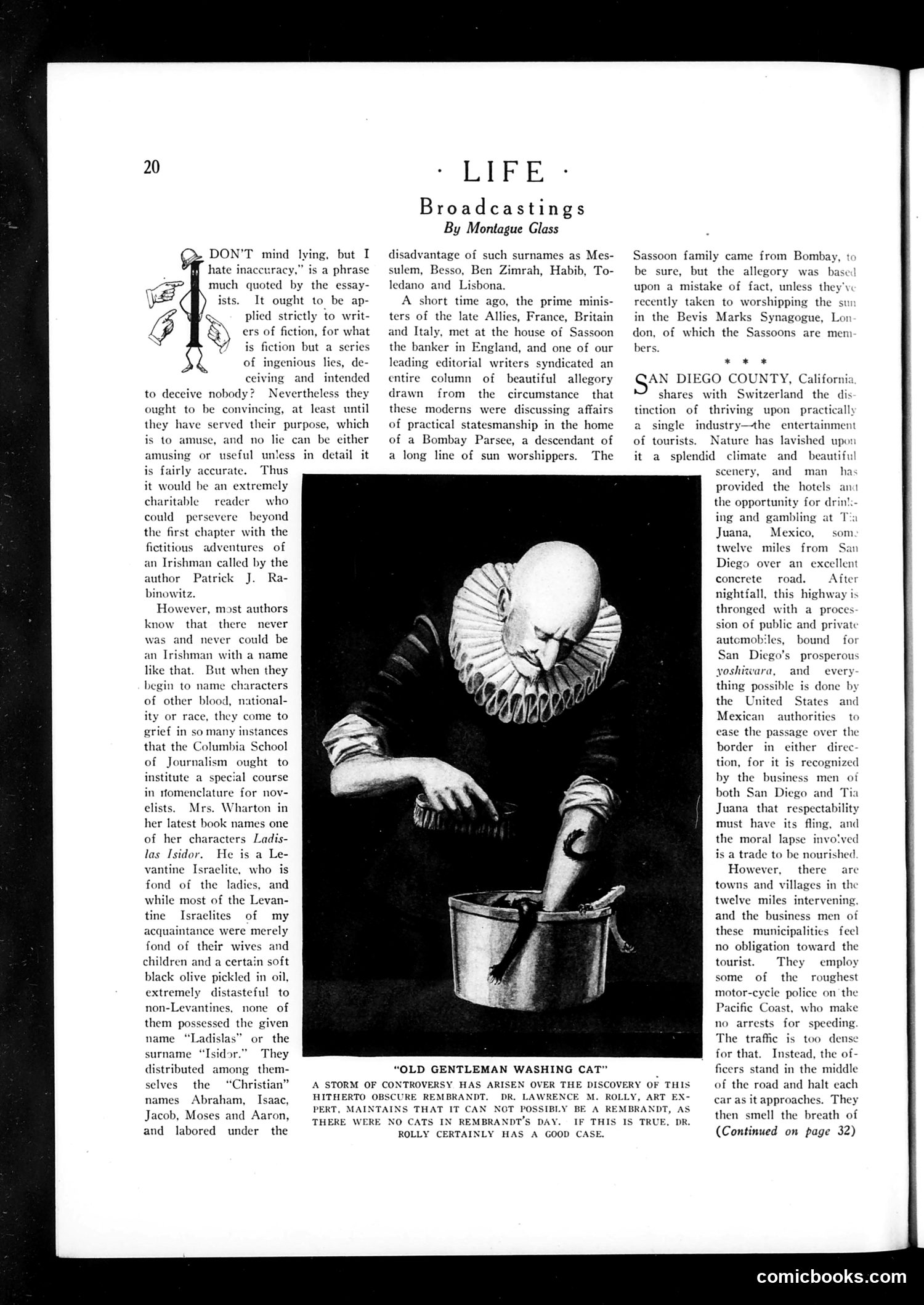
This page from Life magazine contains an essay by Montague Glass criticizing fiction writers' careless use of ethnic and religious character names. The essay mocks novelist Edith Wharton for naming a Levantine Jewish character "Ladislas Isidor"—names Glass argues were never actually used by such communities. He contrasts this with actual surnames of Levantine Jewish families (Messulem, Besso, Ben Zimrah, etc.). Glass also critiques an unnamed editorial writer who created an "allegory" about Allied prime ministers (post-WWI) meeting at banker Sassoon's English estate, wrongly implying Sassoons were sun-worshipping Zoroastrians rather than Jews. The satire targets authors' lazy, inaccurate ethnic characterization—failing basic research about naming conventions and cultural/religious practices of groups they portray. This reflects early 20th-century anxieties about literary authenticity and representation. The "Old Gentleman Washing Cat" image appears unrelated to the text, illustrating a separate feature about art authentication.
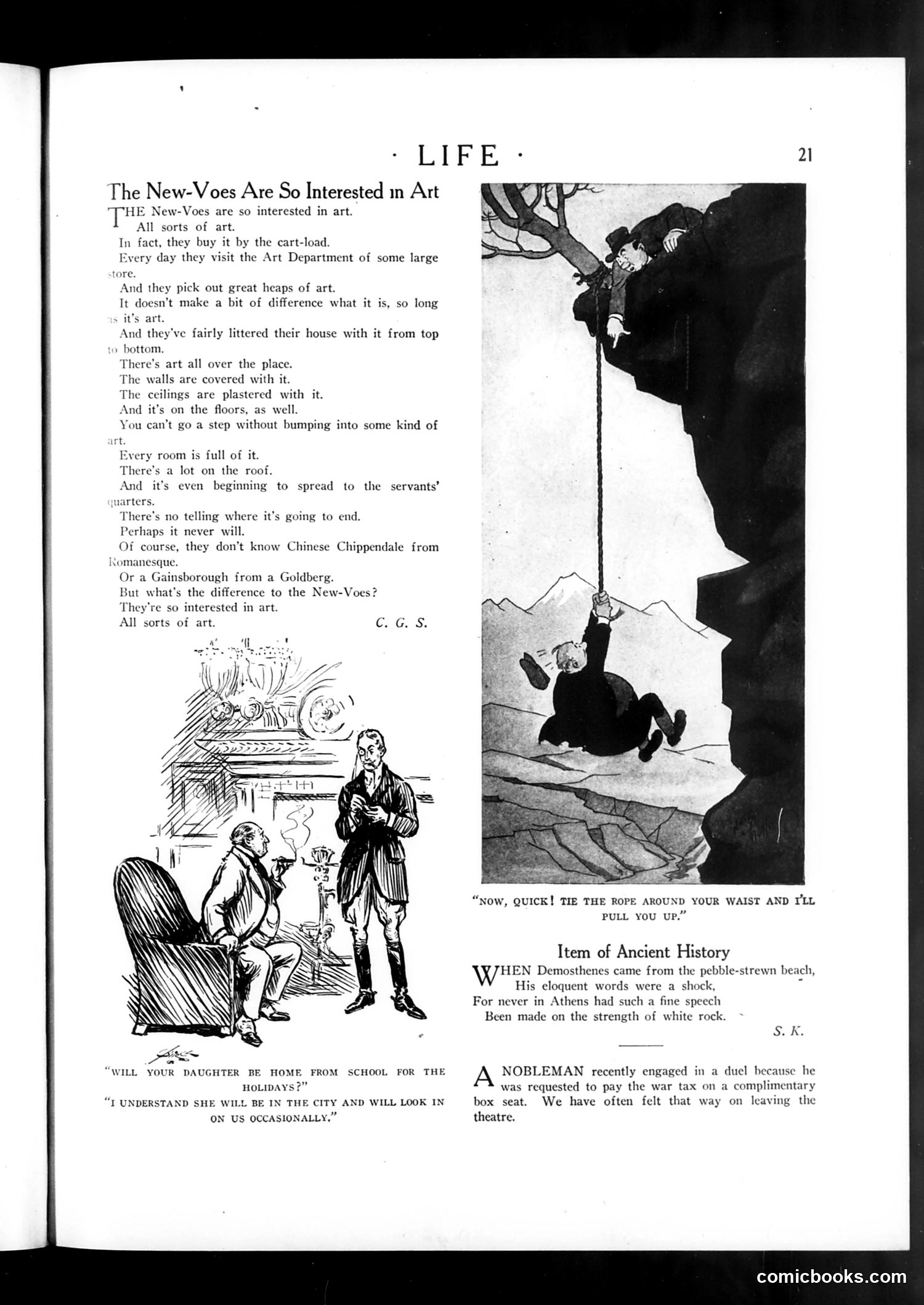
This page satirizes the newly wealthy ("New-Voes"—likely "nouveau riche") who indiscriminately purchase art as status symbols without genuine knowledge or taste. The poem mocks their obsessive accumulation: they buy art "by the cart-load," fill every surface of their homes with it, yet cannot distinguish between genuine masterpieces (Chinese Chippendale, Gainsborough) and inferior works (Romanesque, Goldberg). The satire suggests their art collecting reflects pretension rather than appreciation. The cartoon below depicts a parent indifferently dismissing their daughter's holiday visits home, expecting her to remain in the city—suggesting wealthy families treat children as inconveniences. The bottom items offer lighter social commentary: one jokes about resenting theatre taxes, another references Demosthenes (ancient Greek orator) practicing rhetoric on pebbles, implying effort builds mastery. Overall, the page criticizes Gilded Age wealth's superficial cultural aspirations.
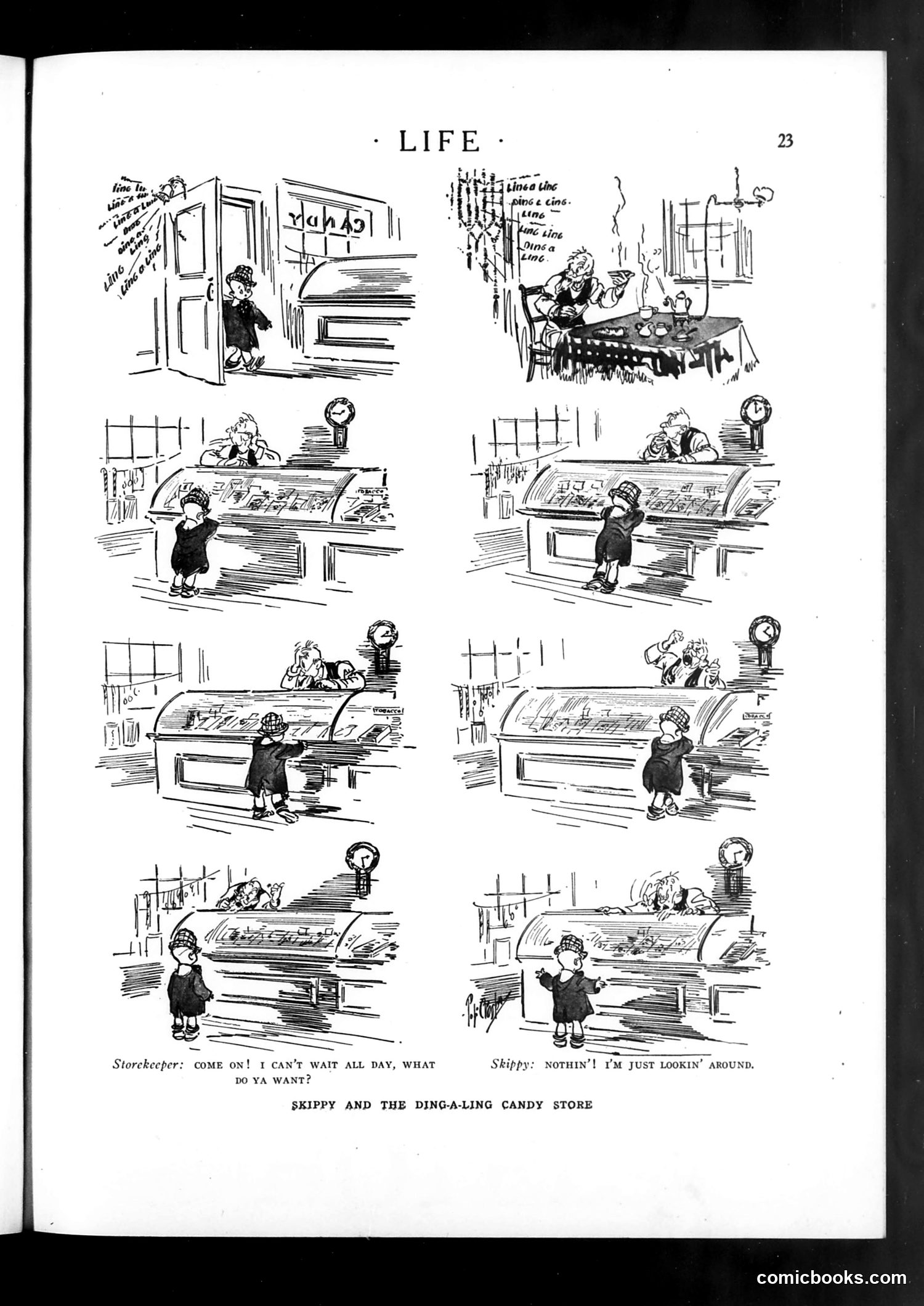
This is a humorous comic strip sequence featuring a character named Skippy visiting a candy store. The strip depicts a classic childhood scenario: a young boy repeatedly claiming he's "just looking around" while the impatient storekeeper urges him to make a purchase ("Come on! I can't wait all day, what do ya want?"). The humor derives from the relatable tension between a child's desire to browse and examine the candy display versus an adult shopkeeper's expectation of quick transactions. The strip satirizes nothing political; rather, it's gentle social comedy about generational differences in shopping behavior and patience. The title references "Ding-a-ling," likely a real candy product from the era, now obscure to modern readers.
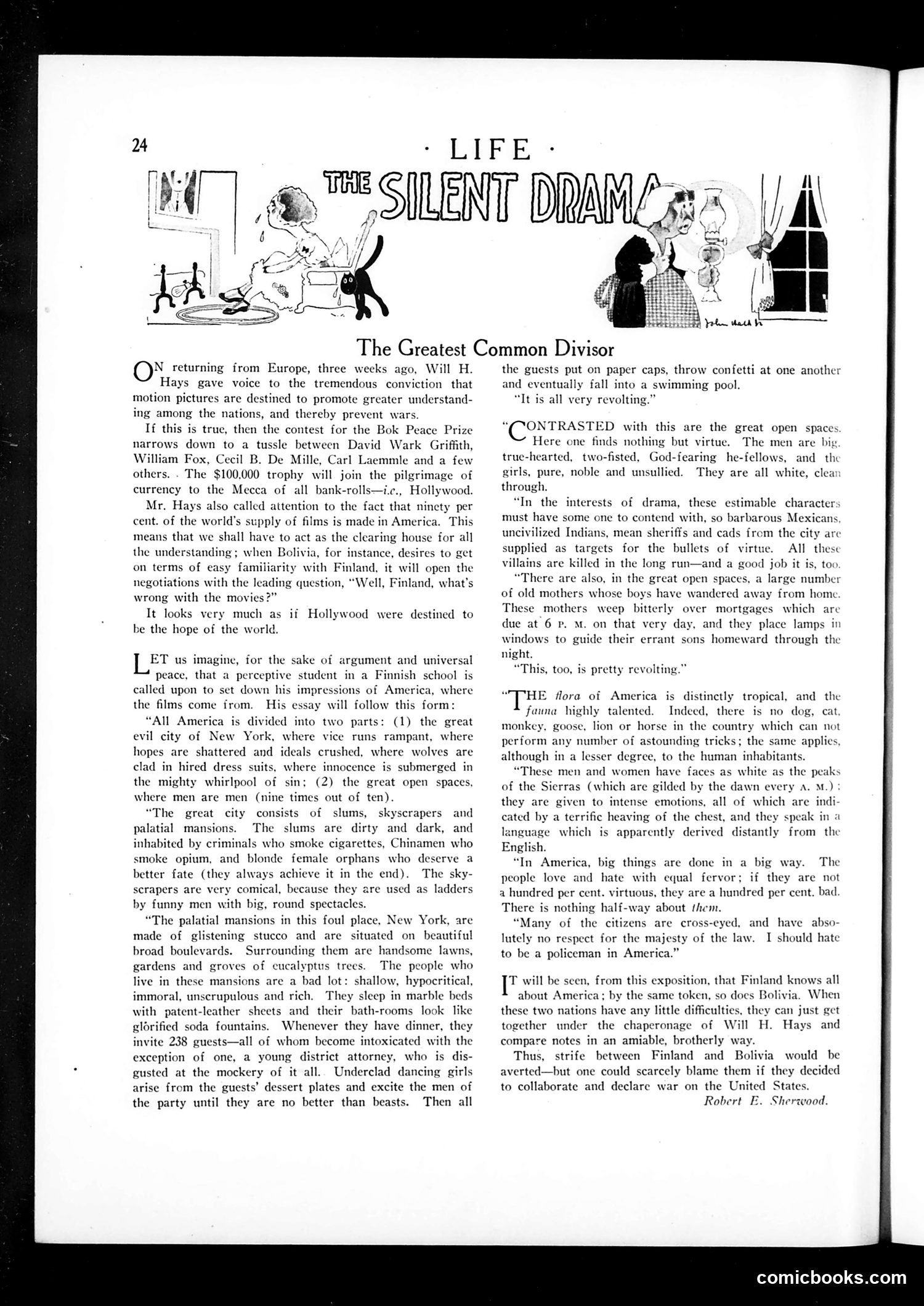
This article by Robert E. Sherwood satirizes Hollywood's influence on international understanding. Will H. Hays, head of the film industry's censorship board, claimed American movies promote world peace. Sherwood mocks this by imagining how a Finnish student would perceive America based solely on Hollywood films. The satire exposes how cinema creates false impressions: New York appears as a den of vice and criminality, while the countryside represents virtue. Sherwood ridicules standard film tropes—corrupt city elites, noble cowboys, innocent heroines rescued from peril, Mexican villains killed without consequence. The broader critique: if 90% of global film supply comes from Hollywood, other nations form their understanding of America through melodramatic, morally simplistic narratives rather than reality. The "common divisor" is cinema itself—supposedly unifying nations but actually spreading distorted stereotypes. The piece questions whether escapist entertainment genuinely promotes international understanding or merely projects American fantasies worldwide.
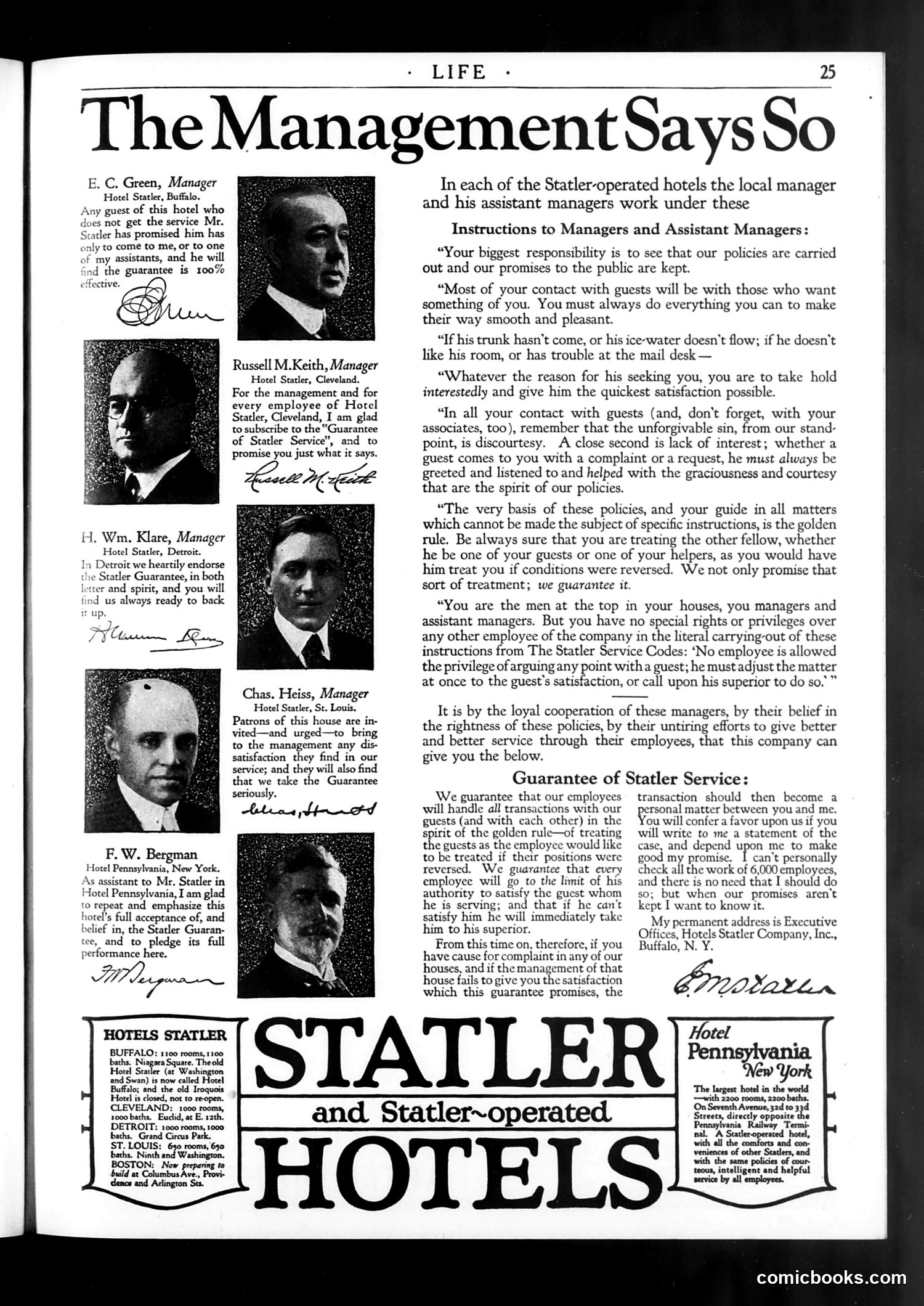
This is a **hotel industry advertisement**, not satire or political commentary. It features the Statler Hotels chain promoting their "Guarantee of Statler Service." The page showcases **testimonials from five hotel managers** (E.C. Green in Buffalo, Russell M. Keith in Cleveland, H. Wm. Klare in Detroit, Chas. Heiss in St. Louis, and F.W. Bergman at Hotel Pennsylvania in New York), each endorsing the company's service guarantee with their signatures. The core message is a business manifesto: managers are instructed to treat guests and employees with courtesy, promptness, and fairness—essentially articulating the "golden rule" as corporate policy. The repeated emphasis that "no employee is allowed the privilege of arguing any point with a guest" reflects early-20th-century hotel service standards. **For modern readers:** This represents corporate branding through managerial consensus, positioning Statler Hotels as customer-service pioneers. The paternalistic tone and emphasis on employee obedience reflect 1920s-era management philosophy.
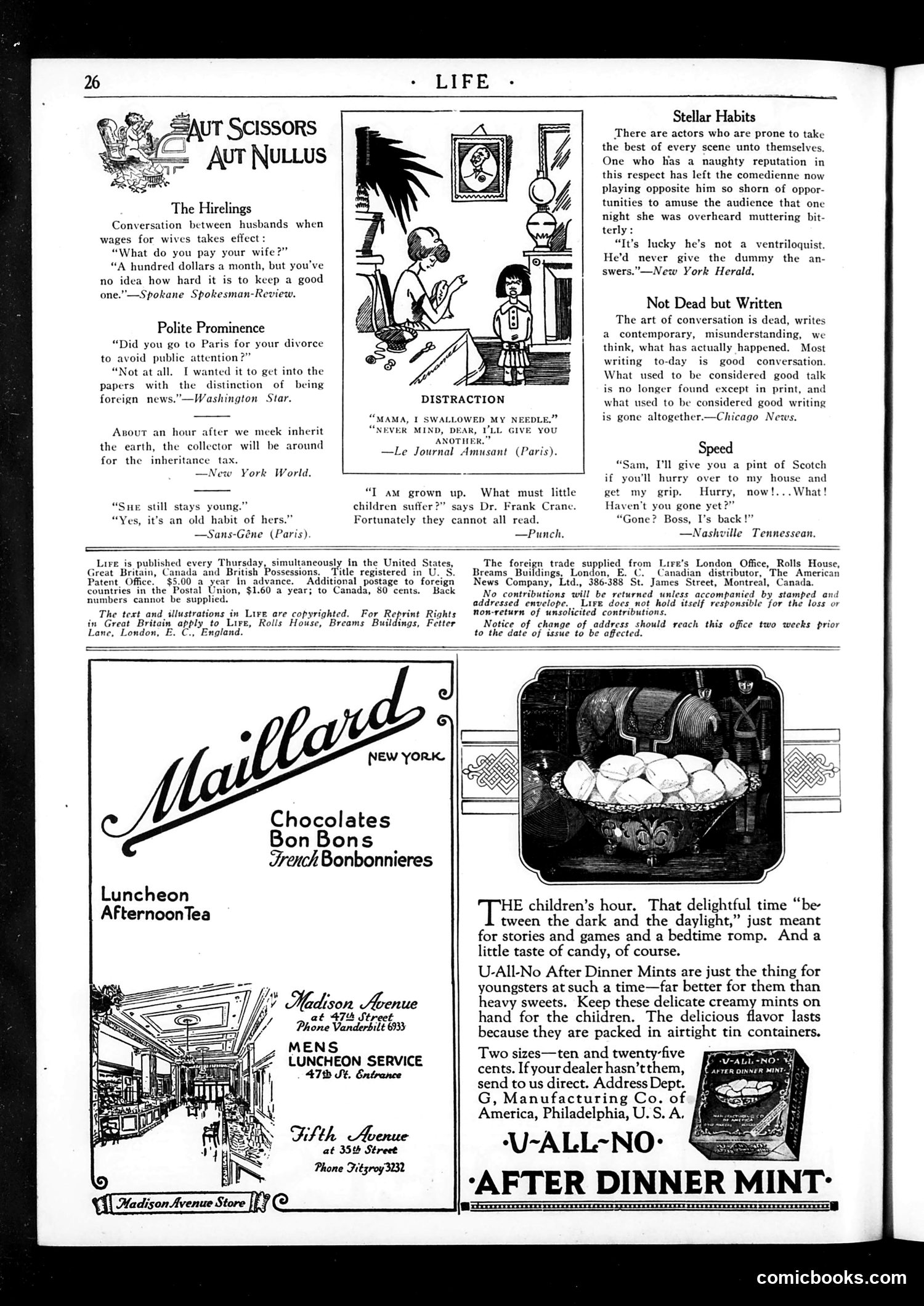
This page contains brief satirical observations rather than political cartoons. The "Aut Scissors Aut Nullus" section presents four short jokes about contemporary social issues: **"The Hirelings"** jokes about husbands discussing their wives' wages—likely referencing women's increasing workforce participation and the financial strain of supporting household staff. **"Polite Prominence"** satirizes how divorce, once scandalous, became fashionable among the wealthy, who now sought publicity rather than discretion. The inheritance joke mocks the inevitability of taxation. **"Stellar Habits"** criticizes selfish actors who dominate scenes, leaving supporting actresses with nothing to do. The remaining pieces—"Not Dead but Written" and "Speed"—are brief observations on conversation and hurried modern life. The page is primarily advertising (Mallard chocolates, U-All-No mints, Madison Avenue stores), with these satirical notes occupying minimal space. No specific political figures are caricatured; instead, Life targets general social trends of the era.

This is a **1923 advertisement**, not a political cartoon or satire. It promotes U.S. Royal Cord Tires manufactured by United States Rubber Company. The page features a large photograph of a tire displayed against stylized curved lines suggesting the Guggenheim Museum's spiral design (a common modernist aesthetic of the 1920s). The ad emphasizes three technical innovations: "Web Cord" (cross-thread-free construction for flexibility), "Flat Band Process" (uniform cord resistance), and "Sprayed Rubber" (pure rubber resistant to weather deterioration). The marketing pitch targets winter drivers expecting tire trouble, urging them to visit Royal Cord dealers. The tagline "United States Tires are Good Tires" positions the product as patriotic American manufacturing. This is straightforward commercial advertising reflecting 1920s consumer marketing: technical jargon presented as scientific breakthroughs to justify replacing serviceable tires with newer products.
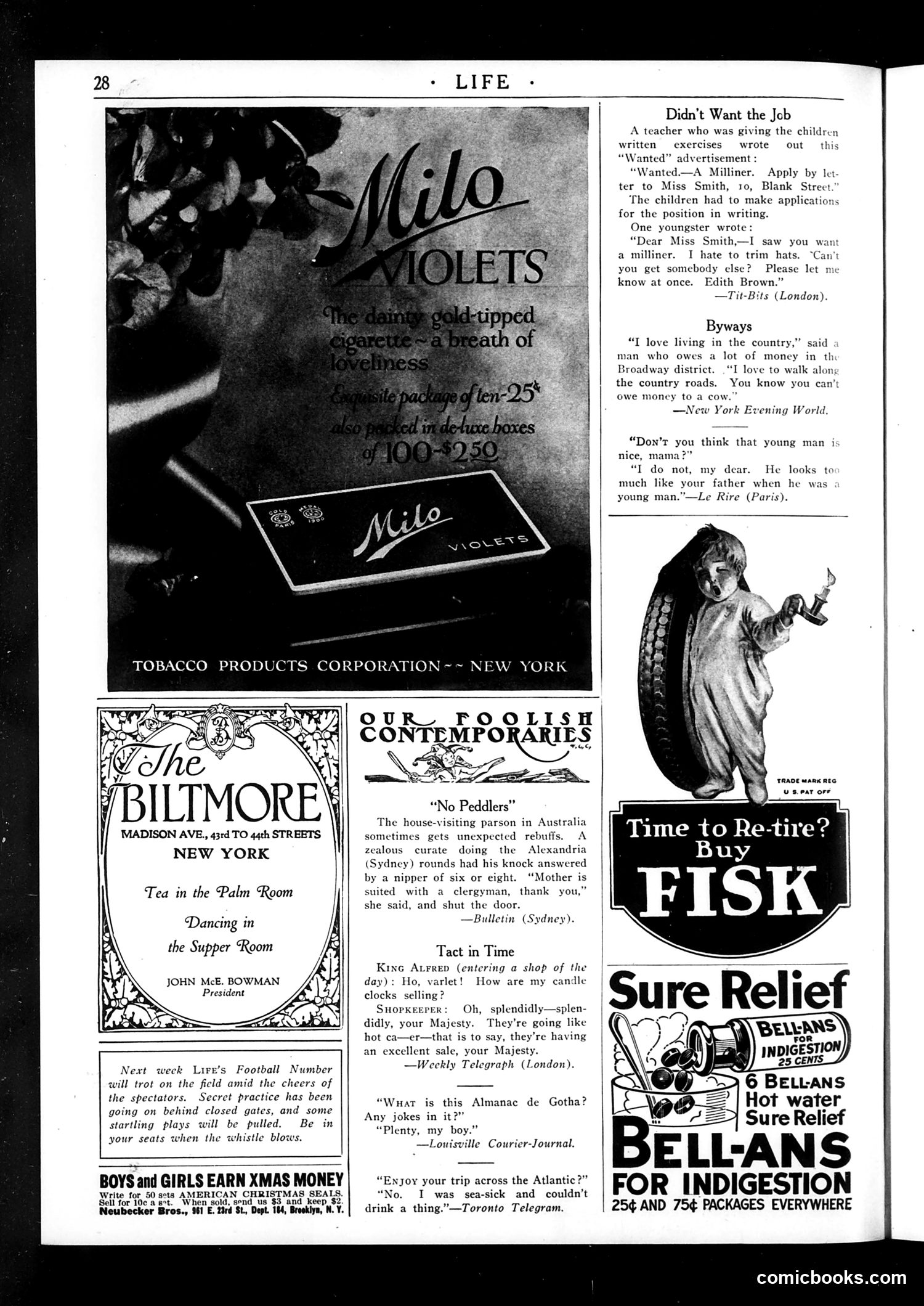
This page is primarily **advertisements and humor snippets** rather than political satire. The content includes: **Main Advertisement:** Milo Violets cigarettes, promoting "dainty, gold-tipped" smokes in small packages (10-25¢) or deluxe boxes (100-250 pieces). **Hotel Advertisement:** The Biltmore in New York, offering dining and dancing. **Humor Section ("Our Foolish Contemporaries"):** Satirical anecdotes reprinted from international newspapers mocking social awkwardness—including a child rejecting a milliner job application, a shopkeeper's nervous slip when describing candle-clock sales to King Alfred, and a clergyman rebuffed by a child in Australia. These are gentle, universal humor rather than political commentary. **Supporting Ads:** Christmas seal fundraising, Fisk tires, and Bell-Ans indigestion remedy. The page reflects early-to-mid 20th century American magazine format, mixing commerce with light social satire aimed at upper-middle-class readers.
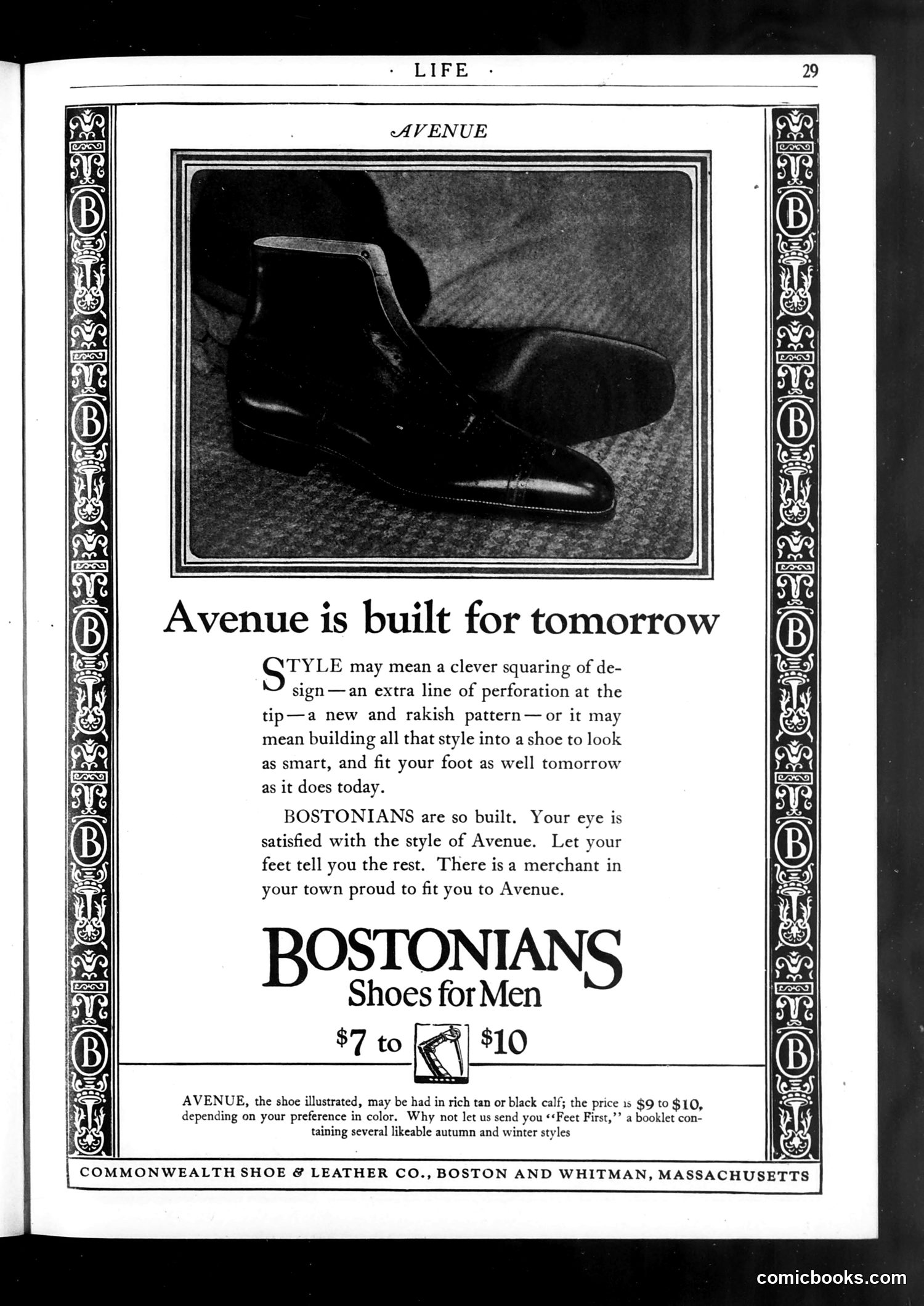
This is not a cartoon or satire—it's a **straightforward advertisement** for Bostonians brand men's shoes, specifically their "Avenue" model. The page features a photograph of a black leather dress shoe and marketing copy emphasizing durability and style. The ad's central conceit is a play on words: "Avenue is built for tomorrow" suggests the shoe combines contemporary fashion ("style") with lasting quality and comfort. The copy addresses Boston customers directly, appealing to regional pride ("Bostonians are so built"). The price range of $7-$10 and mention of tan or black calf leather indicate this was mid-range formal footwear. The reference to a "Feet First" booklet and local merchants suggests this was part of a broader advertising campaign. This represents typical early 20th-century magazine advertising—lifestyle marketing that links product quality to personal character and regional identity.
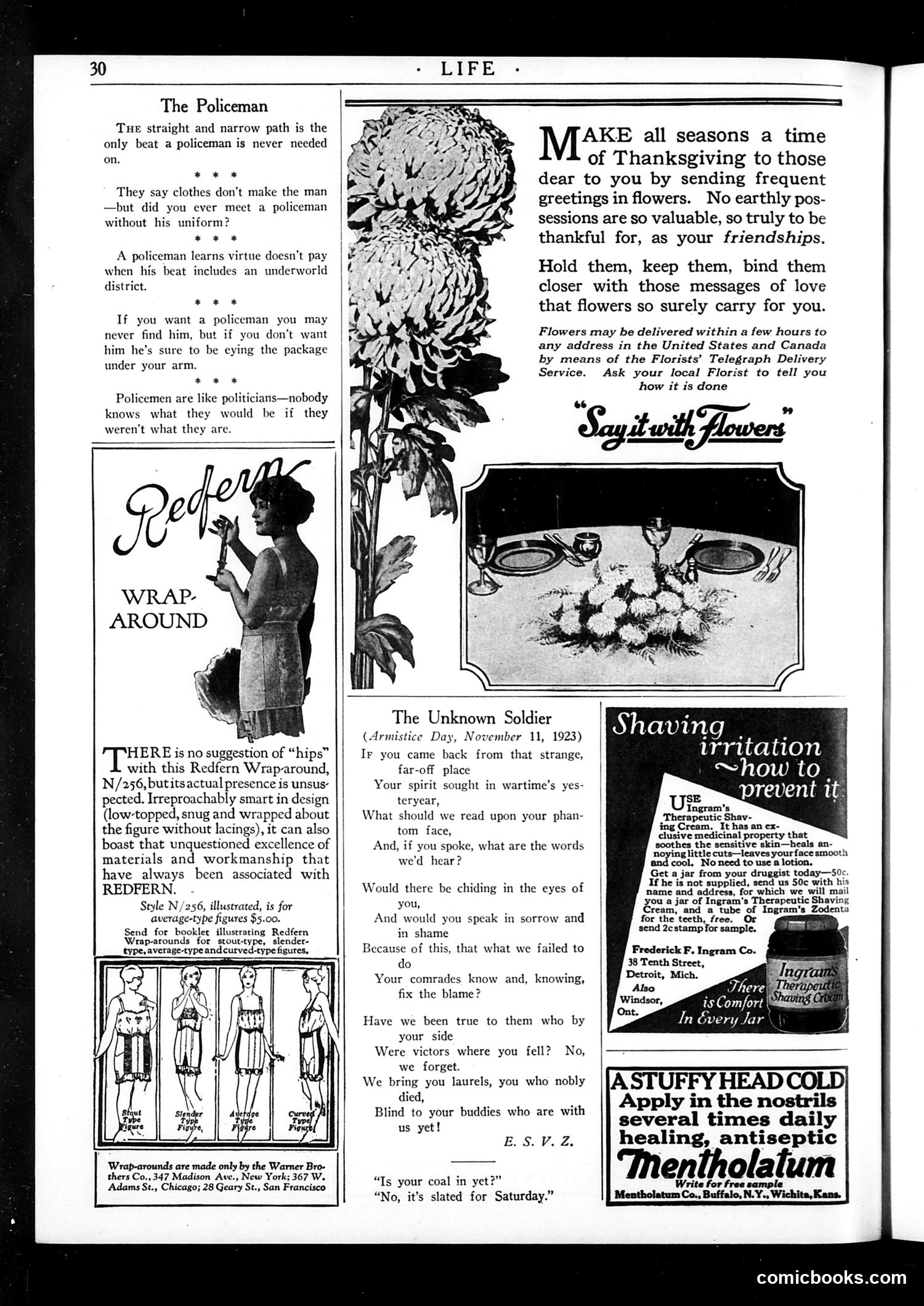
The left column contains four brief satirical observations about police officers, mocking their contradiction-laden nature: they need the "straight and narrow path" yet patrol it; they're defined by uniforms; virtue doesn't pay in underworld districts; and they're paradoxically both invisible when wanted and omnipresent when unwanted. The final quip compares cops to politicians—unknowable figures defined only by their roles. The page is primarily **advertising**, dominated by fashion (Redfern wrap-around dress), floral delivery services, and medicinal products (shaving cream, Mentholatum). Notably, "The Unknown Soldier" poem (dated Armistice Day, November 11, 1923) addresses post-WWI disillusionment: the living have failed their fallen comrades by forgetting them and abandoning surviving veterans. It's a pointed critique of society's inadequate memorialization and care for war survivors.
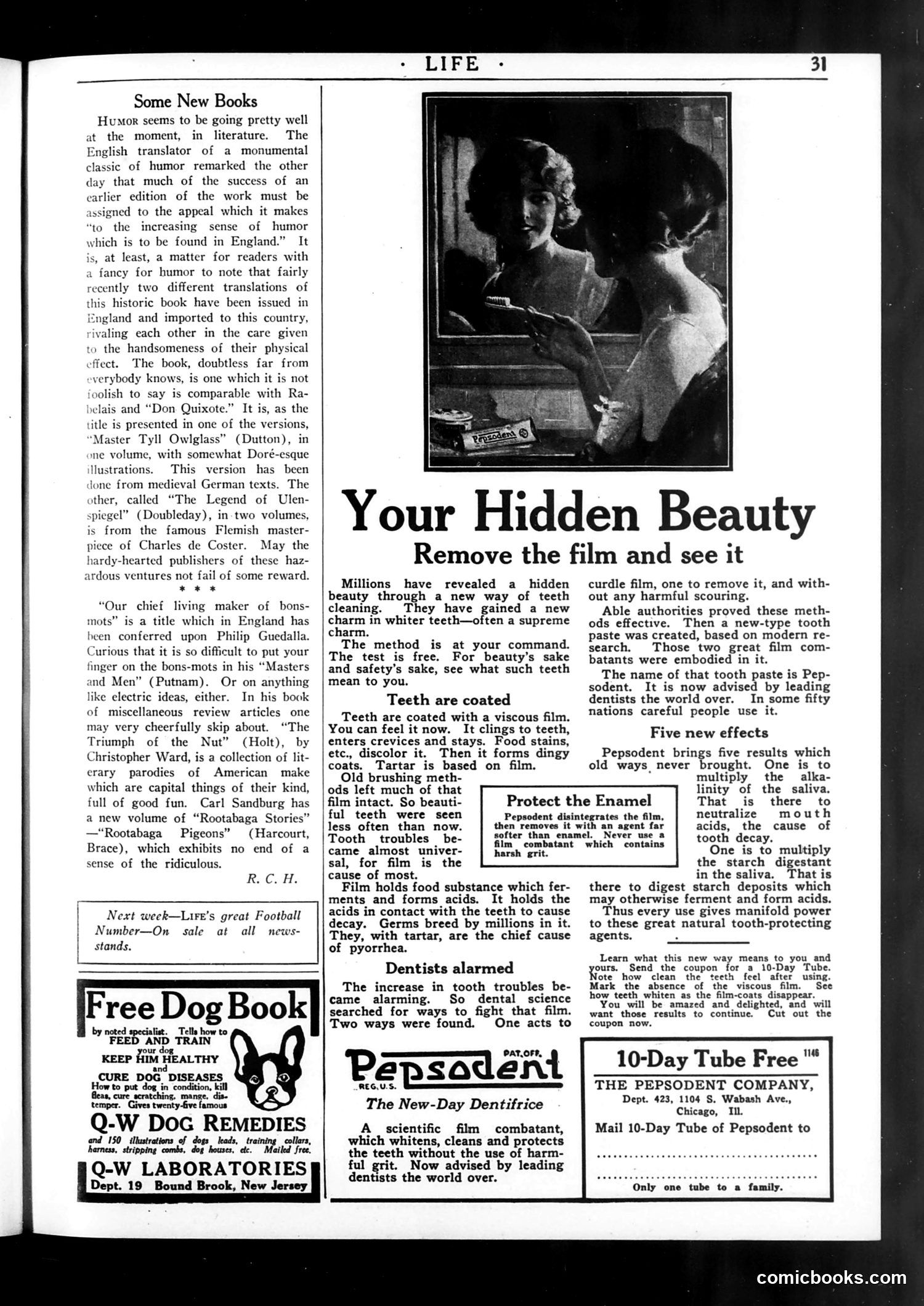
This page is primarily **advertising and book reviews**, not political satire. The main content comprises: **Book Reviews (left column):** Discussion of new humorous literature, including translations of classic comic works like "Master Tyll Owlglass" and "The Legend of Ulenspiegal," plus contemporary American works by Philip Guedalla and Carl Sandburg. **The Central Image & "Your Hidden Beauty" Advertisement (right side):** A large photograph of a woman's face accompanies a Pepsodent toothpaste ad. This reflects **1920s beauty culture standards**—the advertisement's message that whiter teeth enhance feminine attractiveness represents era-typical marketing linking dental hygiene to romantic/social appeal. The "film" on teeth was a genuine concern marketed heavily during this period. **Minor Ads:** Include dog remedies and other products typical of Life's commercial content. There is **no political cartoon or satire** on this page. It's a straightforward mix of literary criticism and period advertisements reflecting early twentieth-century consumer culture and aesthetic values.
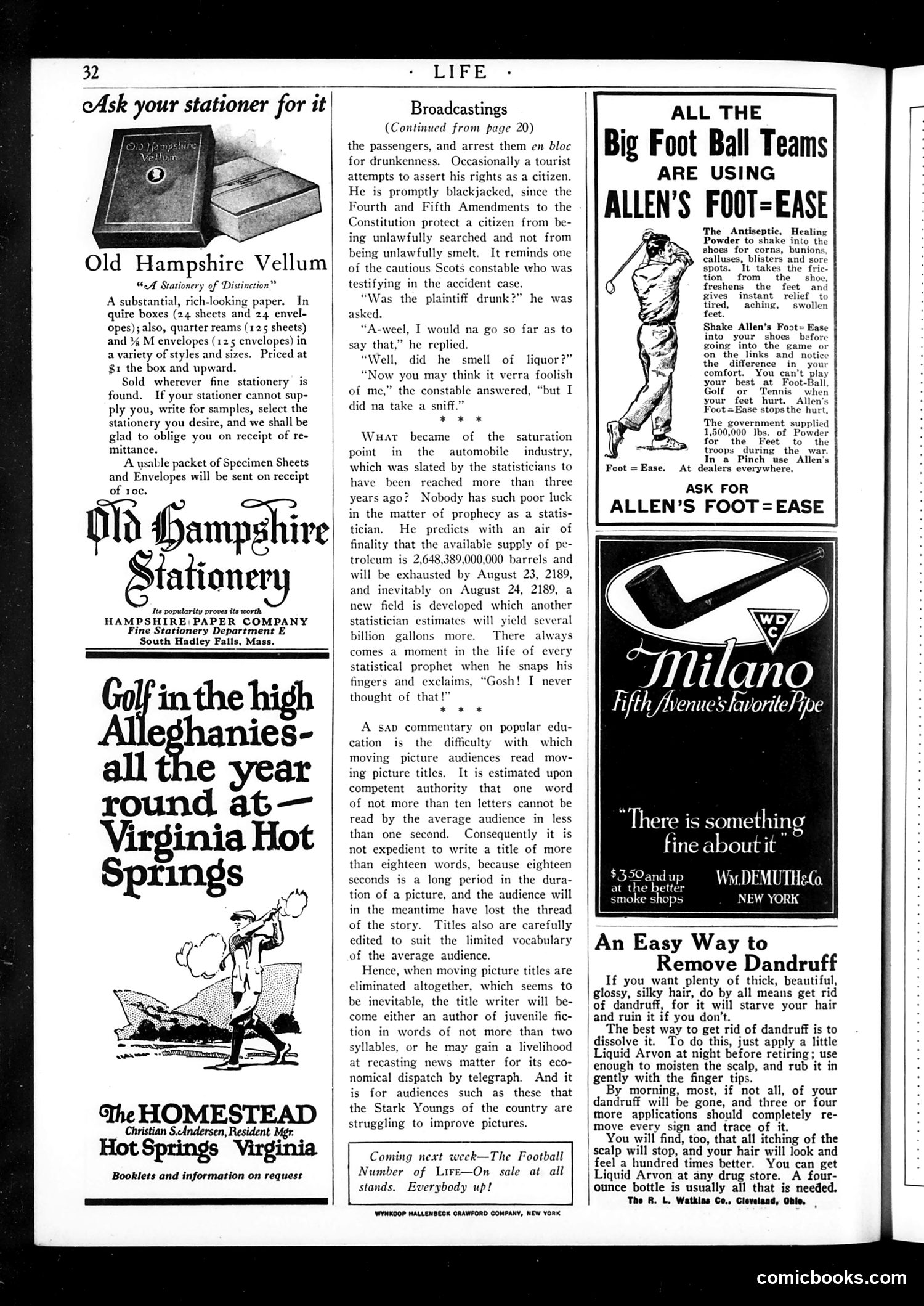
This page is primarily **advertisements** interspersed with brief editorial commentary. The main content includes: **Advertisements:** - Old Hampshire Vellum stationery - The Homestead resort in Hot Springs, Virginia - Allen's Foot-Ease powder (athletic/medical product) - Milano pipes and Liquid Arvon dandruff treatment **Editorial "Broadcastings" section** contains two satirical observations: 1. **On police conduct**: A humorous anecdote about a Scottish constable testifying about a drunk driver, using cautious language ("I did na take a sniff") to avoid making accusations—social commentary on evasive authority figures. 2. **On movie titles**: Criticism that cinema audiences read slowly (max one 10-letter word per second), forcing screenwriters to use only 18-word titles with simple vocabulary. The piece mocks this dumbing-down of entertainment. Both passages use gentle satire to critique contemporary social conditions—police incompetence and mass-audience limitations—typical of Life magazine's satirical approach during this era.
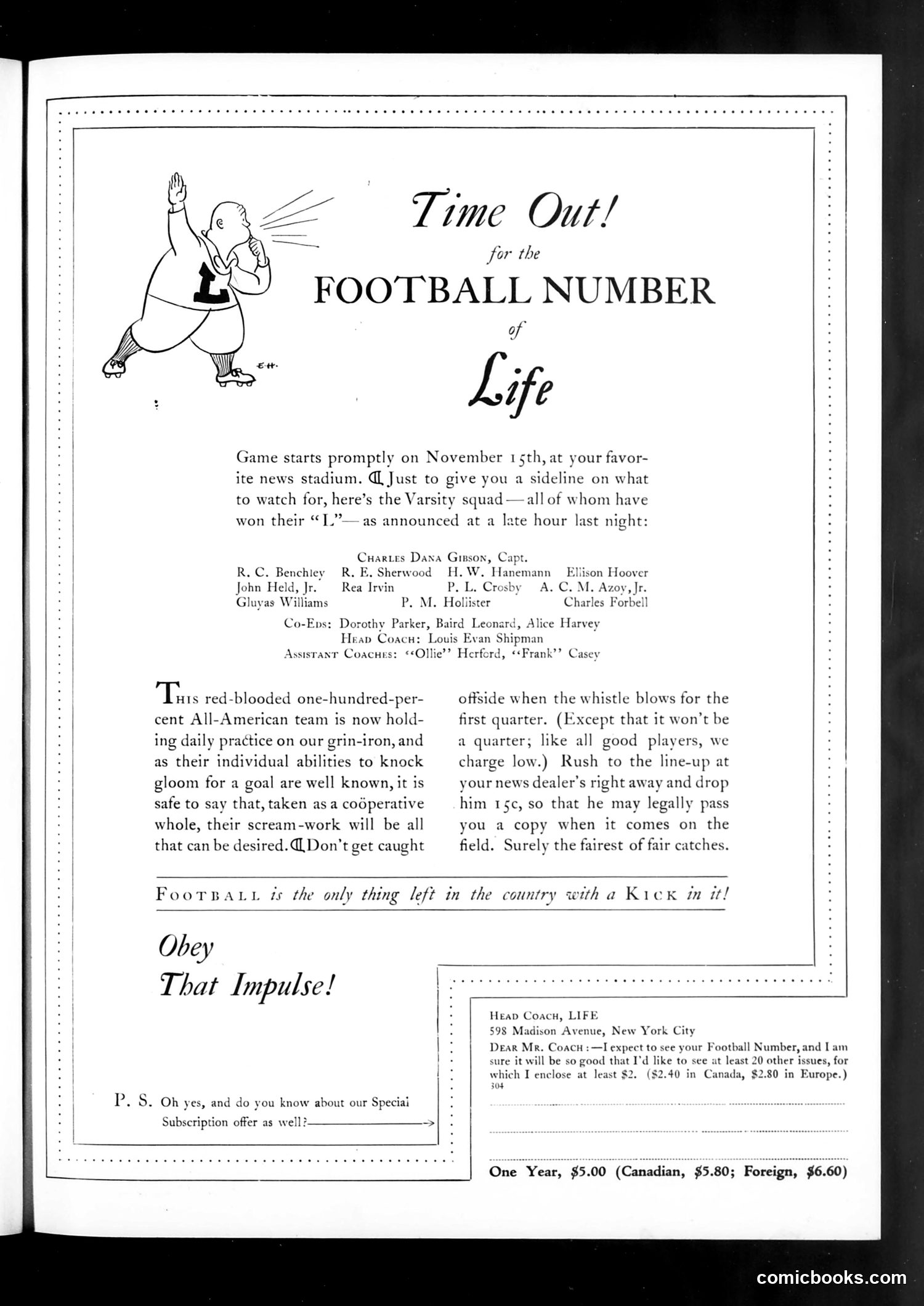
This is a promotional advertisement for *Life* magazine's upcoming "Football Number" issue, using sports metaphors to sell subscriptions. The "Varsity squad" lists actual *Life* contributors and editors—including cartoonist John Held Jr., writer Robert Benchley, and Dorothy Parker—presenting the magazine's staff as if they were football players who've "won their 'I'" (varsity letter). The satire works on multiple levels: it treats a magazine issue like a competitive sporting event ("game starts promptly"), uses football jargon metaphorically ("don't get caught offside," "charge low"), and frames purchasing the magazine as participating in this imaginary match. The closing tagline—"Football is the only thing left in the country with a Kick in it!"—suggests post-WWI disillusionment; only football, it jokes, still carries genuine excitement. The "Obey That Impulse!" section is a subscription order form encouraging impulse purchases at $5 annually.
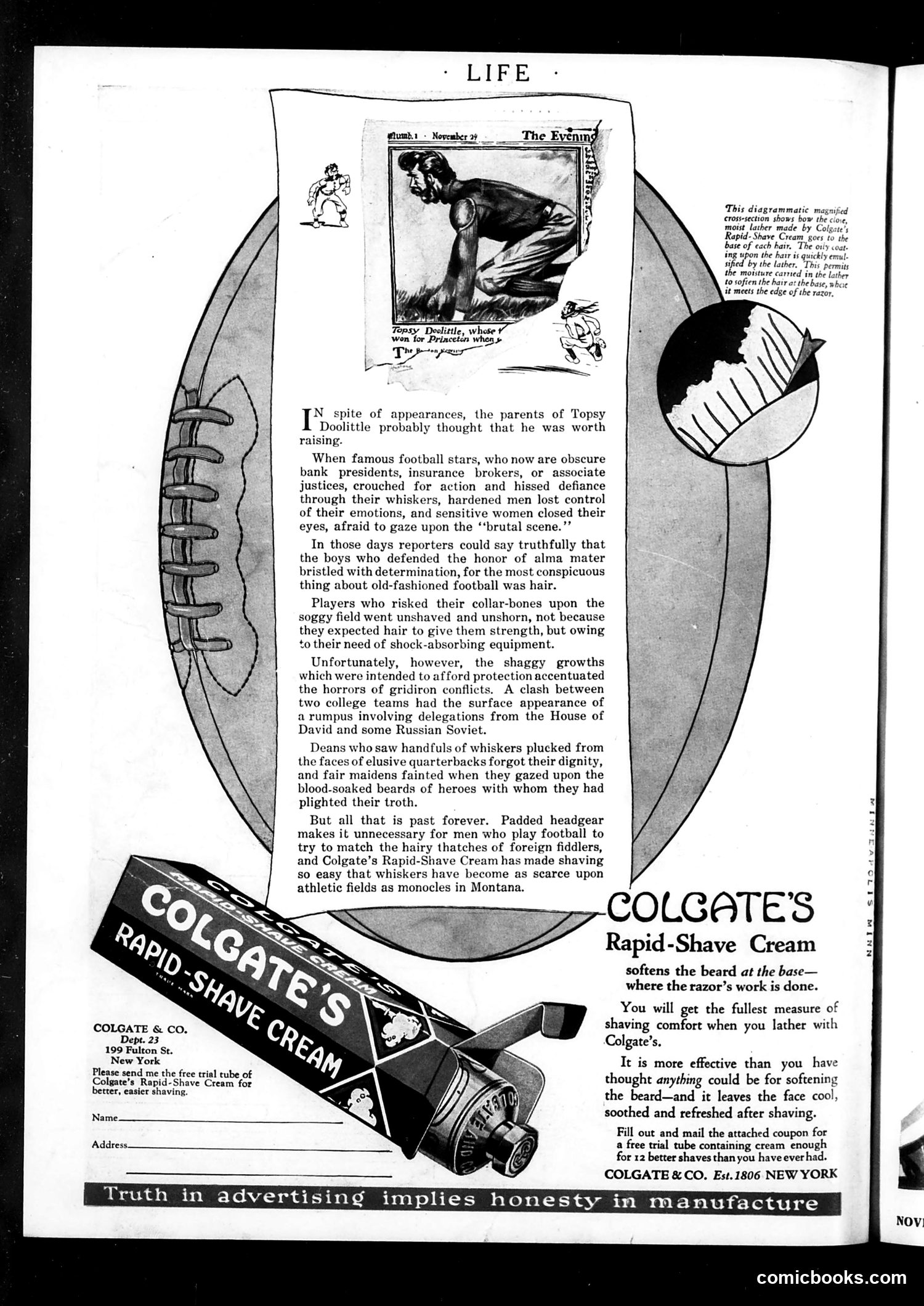
This page satirizes the evolution of college football through the character "Topsy Doolittle," a football player from Princeton. The joke contrasts old-fashioned football culture with modern times. **The Satire:** In the "old days," players grew long beards and whiskers supposedly for shock absorption, but actually because grooming was neglected. This gave football games the appearance of violent conflicts between "delegations from the House of David and some Russian Soviet"—absurdly depicting players as religious Jews or Bolsheviks based purely on their unkempt appearance. The text mocks how spectators were scandalized by this "brutality." **The Point:** Modern padding and equipment make beards unnecessary for protection, so Colgate's Rapid-Shave Cream has made whiskers "as scarce upon athletic fields as monocles in Montana"—a humorous exaggeration suggesting they've become completely obsolete. The cartoon uses football's evolution to advertise the shaving cream while gently mocking earlier generations' concerns about propriety and appearance.