
Life, 1923-11-08 · page 26 of 36
Life — November 8, 1923 — page 26: what you’re looking at
What you’re looking at
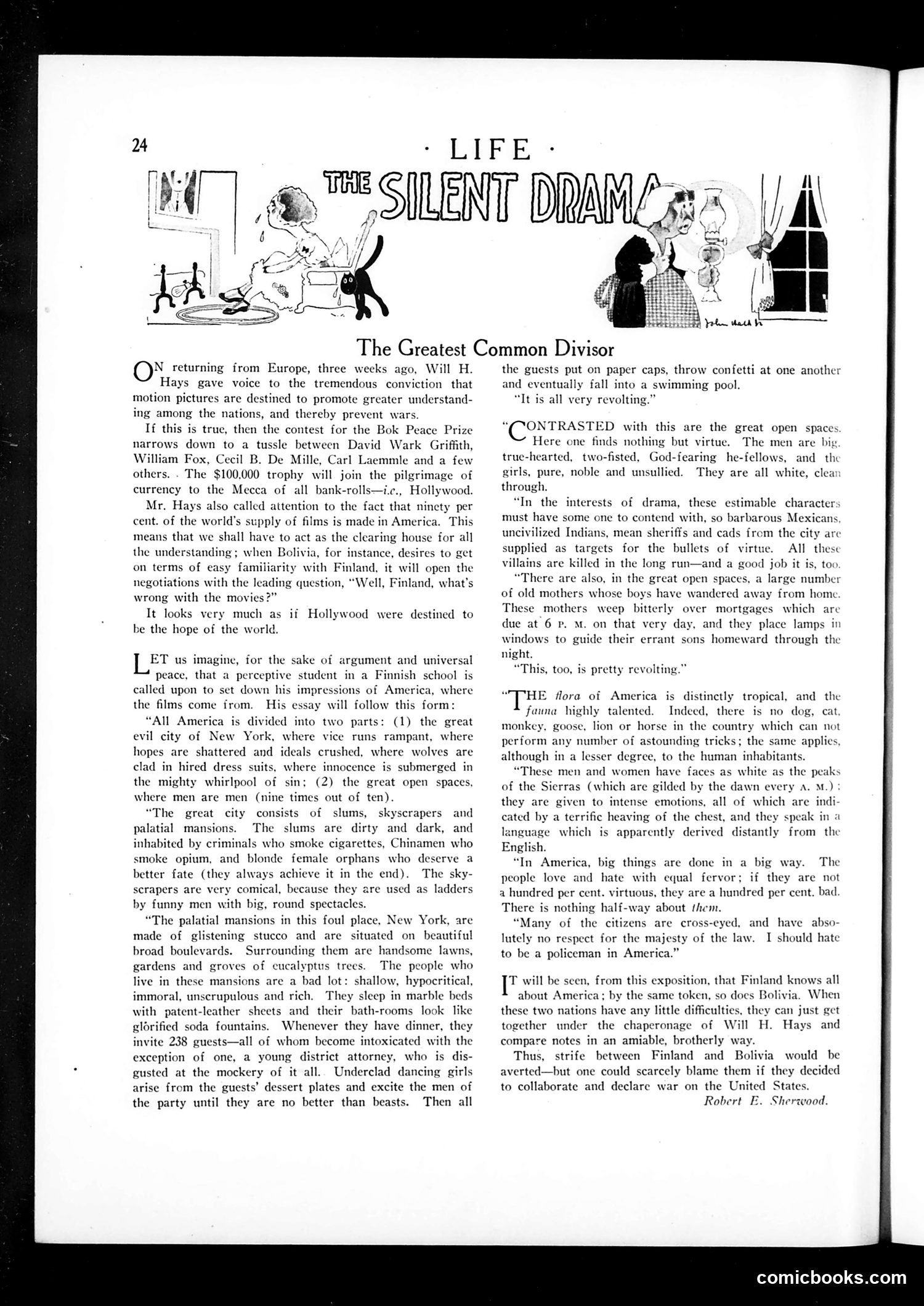
This article by Robert E. Sherwood satirizes Hollywood's influence on international understanding. Will H. Hays, head of the film industry's censorship board, claimed American movies promote world peace. Sherwood mocks this by imagining how a Finnish student would perceive America based solely on Hollywood films. The satire exposes how cinema creates false impressions: New York appears as a den of vice and criminality, while the countryside represents virtue. Sherwood ridicules standard film tropes—corrupt city elites, noble cowboys, innocent heroines rescued from peril, Mexican villains killed without consequence. The broader critique: if 90% of global film supply comes from Hollywood, other nations form their understanding of America through melodramatic, morally simplistic narratives rather than reality. The "common divisor" is cinema itself—supposedly unifying nations but actually spreading distorted stereotypes. The piece questions whether escapist entertainment genuinely promotes international understanding or merely projects American fantasies worldwide.
📄 Transcribed text from this page (OCR, searchable)
Machine-transcribed from the original scan — historical spelling and the odd misread are preserved.
LIFE LENT 0) The Greatest Common Divisor O”N returning from Europe, three weeks ago, Will H. Hays gave voice to the tremendous conviction that motion pictures are destined to promote greater understand- ing among the nations, and thereby prevent wars. If this is true, then the contest for the Bok Peace Prize narrows down to a tussle between David Wark Griffith, William Fox, Cecil B. De Mille, Carl Laemmle and a few others. . The $100,000 trophy will join the pilgrimage of currency to the Mecca of all bank-rolls—i.c., Hollywood. Mr. Hays also called attention to the fact that ninety per cent. of the world’s supply of films is made in America. This means that we shall have to act as the clearing house for all the understanding ; when Bolivia, for instance, desires to get on terms of y familiarity with Finland, it will open the negotiations with the leading question, “Well, Finland, what's wrong with the movies?” It looks very much as if Hollywood were destined to be the hope of the world. ET us imagine, for the sake of argument and universal peace, that a perceptive student in a Finnish school is called upon to set down his impressions of America, where the films come from. His essay will follow this form: “All America is divided into two parts: (1) the great evil city of New York, where vice runs rampant, where hopes are shattered and ideals crushed, where wolves are clad in hired dress suits, where innocence is submerged in the mighty whirlpool of sin; (2) the great open spaces, where men are men (nine times out of ten). “The great city consists of slums, skyscrapers and palatial mansior The slums are dirty and dark, and inhabited by criminals who smoke cigarettes, Chinamen who smoke opium, and blonde female orphans who deserve a better fate (they always achieve it in the end). The sky- scrapers are very comical, because they are used as ladders by funny men with big, round spectacles. The palatial mansions in this foul place, New York, are made of glistening stucco and are situated on beautiful broad boulevards. Surrounding them are handsome lawns, gardens and groves of eucalyptus trees. The people who live in these mansions are a bad lot: shallow, hypocritical, immoral, unscrupulous and rich. They sleep in marble beds with patent-leather sheets and their bath-rooms look like glorified soda fountains. Whenever they have dinner, they invite 238 guests—all of whom become intoxicated with the exception of one, a young district attorney, who is dis- gusted at the mockery of it all. Underclad dancing girls arise from the guests’ dessert plates and excite the men of the party until they are no better than beasts. Then all the guests put on paper caps, throw confetti at one another and eventually fall into a swimming pool. “It is all very revolting.” “CCONTRASTED with this are the great open spa Here one finds nothing but virtue. true-hearted, two-fisted, God girls, pure, noble and unsullied. through. “In the interests of drama, these estimable characters must have some one to contend The men are bi aring he-fellows, and the They are all white, clea ith, so barbarous Mexicans uncivilized Indians, mean sheriffs and cads from the city arc All these villains are killed in the long run—and a good job it is, too. “There are also, in the great open spaces, a large number of old mothers whose boys have wandered away from home These mothers weep bitterly over mortgages which are due at 6 p. M. on that very day, and they place lamps in windows to guide their errant sons homeward through the night. “This, too, is pretty revolting.” supplied as targets for the bullets of virtue. HE flora of America is distinctly tropical, and the fauna highly talented. Indeed, there is no dog, cat monkey, goose, lion or horse in the country which can not perform any number of astounding tricks; the same applies, although in a lesser degree, to the human inhabitants. “These men and women have faces as white as the peaks of the Sierras (which are gilded by the dawn e y ALM.) they are given to intense emotions, all of which are indi- cated by a terrific heaving of the ch and they speak in a language which is apparently derived distantly from. the English. “In America, big things are done in a big way. The people love and hate with equal fervor; if they are not a hundred per cent. virtuous, they are a hundred per cent. bad There is nothing half-way about them. zens are cross-eyed, and have abso- I should hate “Many of the ci lutely no respect for the majesty of the law. to be a policeman in America. T will be seen, from this exposition, that Finland knows all about America; by the same token, so docs Bolivia. When these two nations have any little difficulties, they can just get together under the chaperonage of Will H. Hays and compare notes in an amiable, brotherly w Thus, strife between Finland and Bolivia would be averted—but one could scarcely blame them if they decided to collaborate and declare war on the United States. Robert E. Sherwood. comicbooks.com